Article

AI-Powered Tools for Supply Chain Resilience: A Dynamic Capabilities Perspective from Jordanian Manufacturing Firms

by
Hazim Haddad
1,
Luay Jum’a
2,
Ziad Alkalha
3,* and
Hilda Madanat
4
1
College of Business, Westcliff University, Irvine, CA 92614, USA
2
Department of Logistics Sciences, Business School, German Jordanian University, Amman 11180, Jordan
3
School of Business, The University of Jordan, Amman 11942, Jordan
4
Global Engagement Department, Westcliff University, Irvine, CA 92614, USA
*
Author to whom correspondence should be addressed.
Logistics 2026, 10(1), 24; https://doi.org/10.3390/logistics10010024
Submission received: 1 December 2025 / Revised: 12 January 2026 / Accepted: 12 January 2026 / Published: 19 January 2026

Abstract

Background: In an increasingly volatile global business environment, supply chain resilience has become a strategic imperative, particularly for firms operating in developing economies. Guided by Dynamic Capabilities Theory (DCT), this study examines how AI-powered tools foster an innovation culture comprising communication, creativity, and learning, and how these dimensions enhance supply chain resilience measured through flexibility, efficiency, and velocity. Methods: A quantitative research design was employed using survey data collected from 270 supply chain and operations managers in Jordanian manufacturing firms. Twelve direct hypotheses were tested using Partial Least Squares Structural Equation Modeling. Results: The findings indicate that AI-powered tools significantly influence communication, creativity, and learning. Communication and creativity positively affect all three dimensions of supply chain resilience. Learning significantly improves efficiency but shows no significant effect on flexibility or velocity, indicating that learning is mainly utilized for process improvement rather than rapid adaptation. Conclusions: The study demonstrates that AI adoption alone is insufficient to build resilient supply chains unless supported by innovation-oriented cultural capabilities. The findings extend DCT by clarifying the differentiated role of learning in resilience building and provide actionable guidance for managers seeking to align AI investments with cultural development in resource-constrained manufacturing contexts and long-term competitive advantage.

1. Introduction

In the changing environment of international trade, supply chain management (SCM) has emerged as an essential factor influencing organizational competitiveness and operational efficiency [1]. Over the past decade, and particularly following large-scale disruptions such as COVID-19, geopolitical conflicts, and climate-related shocks, traditional efficiency-focused supply chain models have proven insufficient for ensuring continuity and long-term survival [2]. These disruptions have revealed that cost optimization alone cannot protect organizations from systemic risks, thereby elevating supply chain resilience from an operational concern to a strategic and research-critical issue [3].
The growing intricacy of supply chains—driven by globalization, fragmented sourcing, demand volatility, and regulatory uncertainty—has compelled organizations to search for advanced technological solutions capable of improving visibility, responsiveness, and adaptability [4]. Artificial intelligence (AI) has consequently gained substantial attention in SCM due to its ability to process large volumes of data, generate predictive insights, and support real-time decision-making [5]. From a research perspective, AI represents a paradigm shift in how supply chains sense disruptions, interpret signals, and respond dynamically, making it a critical phenomenon worthy of systematic investigation [6].
AI-powered tools are increasingly used to enhance forecasting accuracy, optimize inventory, and dynamically allocate resources across supply chain networks. These capabilities offer organizations the potential to move from reactive disruption management toward proactive resilience-building [7]. However, empirical evidence shows that many firms fail to realize these promised benefits, creating a gap between the theoretical potential of AI and its actual performance outcomes [8]. Despite substantial investments, AI adoption remains uneven and frequently underutilized due to infrastructural limitations, data quality challenges, skills shortages, and resistance to organizational change [9]. This inconsistency raises a fundamental research problem: technology alone does not guarantee resilience, suggesting the presence of underlying organizational mechanisms that shape AI effectiveness [10].
A growing body of literature indicates that organizational culture—particularly a culture of innovation—is central to how firms absorb, interpret, and apply advanced technologies [11]. A culture of innovation, encompassing communication, creativity, and learning, enables employees to collaborate, experiment, and adapt in uncertain environments [12]. Effective communication ensures that AI-generated insights are shared and acted upon across functional boundaries [13], creativity supports the development of novel responses to disruptions [14] and learning allows organizations to institutionalize lessons from past shocks and continuously improve capabilities [15]. From a research standpoint, these cultural dimensions represent critical but underexplored microfoundations that may explain why some firms successfully convert AI investments into resilience while others do not [10].
Supply chain resilience—defined as the ability to anticipate, absorb, recover from, and adapt to disruptions [16]—has therefore become a focal concept in contemporary SCM research. While existing studies acknowledge that AI and digital technologies can enhance resilience, much of the literature treats resilience as a direct technological outcome, overlooking the socio-organizational processes through which resilience is actually built [17,18]. This limitation is particularly evident in developing economies, where resource constraints, institutional weaknesses, and skill gaps magnify the risks of unsuccessful digital transformation [19]. As a result, understanding how innovation culture interacts with AI adoption is not only theoretically important but practically urgent.
Several theoretical perspectives could potentially explain this phenomenon. For instance, Information Processing Theory (IPT) emphasizes the role of information quality and processing capacity in managing uncertainty, while the Resource-Based View (RBV) and Knowledge-Based View (KBV) focus on valuable, rare, and knowledge-intensive resources as sources of competitive advantage [20,21]. Although these theories provide useful insights, they are limited in explaining how organizations continuously reconfigure technological and cultural resources in highly dynamic and disruption-prone environments.
Accordingly, this study adopts Dynamic Capabilities (DC) theory as its primary theoretical lens, as DC explicitly explains how firms sense environmental changes, seize opportunities through strategic investments such as AI, and transform organizational capabilities—particularly cultural and learning-based capabilities—to sustain resilience over time. DC theory is therefore especially suitable for examining the interaction between AI-powered tools, innovation culture, and supply chain resilience under conditions of high uncertainty and rapid change [10].
Moreover, although prior studies recognize innovation culture as an enabler of technology adoption, there remains insufficient empirical clarity regarding which specific cultural dimensions—communication, creativity, or learning—most strongly influence different aspects of supply chain resilience, such as flexibility, efficiency, and velocity. This lack of granularity limits the usefulness of existing research for managers, who require targeted guidance rather than broad cultural prescriptions [22]. Consequently, the rationale for this research lies in addressing a critical knowledge gap at the intersection of AI, organizational culture, and resilience outcomes.
This study responds to these gaps by empirically examining AI-powered tools as drivers of innovation culture and, in turn, supply chain resilience within Jordan’s manufacturing sector [23]. Jordan provides a theoretically relevant and practically significant context, as its manufacturing firms operate under heightened uncertainty, limited resources, and increasing pressure to adopt digital technologies to remain competitive [24]. By focusing on this context, the study extends existing theories beyond advanced economies and tests their applicability in resource-constrained environments.
Methodologically, this study employs a quantitative research design and Partial Least Squares Structural Equation Modeling (PLS-SEM), which is particularly appropriate given the study’s exploratory nature, complex model structure, and focus on prediction-oriented theory development within the DC framework [25]. PLS-SEM is well suited for simultaneously examining multiple direct relationships between latent constructs and for handling non-normal data and relatively moderate sample sizes [26]. Data were collected through a structured survey administered to supply chain and operations managers in Jordanian manufacturing firms, as these respondents possess direct knowledge of AI adoption, organizational culture, and resilience practices. A purposive sampling approach was adopted to ensure the relevance and reliability of responses, while PLS-SEM enabled robust assessment of both the measurement and structural models.
Using this approach, the study investigates the direct effects of AI-powered tools on innovation culture, as well as the direct effects of communication, creativity, and learning on supply chain resilience dimensions [27]. The findings are expected to contribute in three key ways: (1) theoretically, by clarifying the mechanisms through which AI influences resilience via cultural capabilities within the Dynamic Capabilities framework; (2) empirically, by identifying which dimensions of innovation culture matter most for different resilience outcomes; and (3) practically, by providing managers and policymakers with evidence-based guidance on aligning AI investments with cultural development efforts.
By addressing these issues, this research contributes to a deeper understanding of why AI adoption succeeds or fails in building resilient supply chains, particularly in developing economies. Rather than viewing resilience as a purely technological outcome, the study reframes it as a socio-technical capability that emerges from the interaction between AI-powered tools and innovation-oriented organizational cultures. Following this introduction, the paper presents a literature review that delineates the theoretical foundations of AI in supply chain management, innovation culture, and supply chain resilience, emphasizing interrelations among these concepts. The methodology section describes the quantitative research design, the steps taken to collect data, and the analytical methods used, such as structural equation modeling. The results section shows real-world evidence for the suggested relationships, along with a discussion that puts these findings in the context of another research. The paper concludes by addressing theoretical and managerial implications, recognizing its limitations, and proposing recommendations for future research initiatives.

2. Literature Review

To ensure a systematic and comprehensive review of the relevant literature, this study conducted a structured search using Scopus, Web of Science, and Google Scholar, as these databases are widely recognized for their extensive coverage of high-quality, peer-reviewed research in supply chain management, artificial intelligence, and organizational studies. The literature search focused on publications released between 2010 and 2024, a period that captures the rapid evolution of digital technologies and their increasing application in supply chain resilience research.
The search process employed combinations of the following keywords: “artificial intelligence,” “AI-powered tools,” “supply chain management,” “supply chain resilience,” “innovation culture,” “organizational culture,” and “dynamic capabilities.” Boolean operators (AND/OR) were used to refine and combine keywords to ensure both breadth and relevance. Additional relevant studies were identified through backward and forward citation tracking of highly cited articles. Only peer-reviewed journal articles published in English were included to ensure academic rigor and relevance to the research objectives.

2.1. AI, Innovation Culture, and Supply Chain Resilience

Artificial intelligence (AI) has emerged as a crucial facilitator of operational change in supply chain management (SCM). This is achieved by providing functionalities like predictive analytics, dynamic optimization, and real-time decision-making [5]. In the context of this technological transformation, a culture of innovation that includes communication, creativity, and learning becomes an essential factor for enhancing adaptability and performance [11]. An innovation culture serves as the essential foundation for organizational advancement and adaptability, fundamentally grounded in the harmonious blend of communication, creativity, and ongoing learning. Effective communication fosters an environment conducive to open dialogue and the sharing of knowledge, breaking down barriers that frequently obstruct innovation. It creates a psychologically safe environment in which team members are encouraged to express unconventional ideas and engage in constructive critique [28,29]. Creativity serves as a driving force behind innovative thinking, expanding boundaries and enabling individuals to envision new solutions to intricate challenges. Studies indicate that creativity flourishes in environments where organizations foster autonomy, encourage risk-taking, and promote collaboration across various disciplines [13,30,31].
Creativity alone is inadequate without a committed approach to learning. A culture of learning promotes innovation by encouraging continuous development, reflective consideration of past efforts, and the integration of new insights into practical applications [15,32]. This viewpoint underscores that organizations ought to perceive failures as opportunities for learning instead of attributing blame, thus promoting enduring adaptive capacity [33,34]. Additionally, communication, creativity, and learning are interrelated components that interact fluidly. For example, learning increases creativity by giving people more ways to think about things, and creativity improves communication by making people use different ways to explain complex ideas [12,35].
Technology has a big impact on the growth and care of these cultural aspects. Digital tools can help people work together better in different places, give them new ways to make prototypes, and make learning more personalized [14,36]. Moreover, leadership and institutional support are crucial in embedding these values into the organization’s daily operations. Leaders who exemplify transparent communication, foster creative thinking, and prioritize the development of educational resources act as vital drivers of enduring innovation [31]. Table 1 shows the most important parts of an innovation culture.
Supply chain resilience is evaluated through flexibility, efficiency, and velocity. It represents a strategic objective for organizations seeking to withstand and recover from disruptions in dynamic environments [4,16]. More people are realizing that supply chain resilience is an important strategic need. It has three main parts: flexibility, efficiency, and speed. Flexibility refers to a supply chain’s ability to respond to disruptions by reallocating resources, changing suppliers, or changing production processes in real time [19,42]. This flexibility is important in environments that are always changing and where things can go wrong at any time. It lets businesses keep doing what they do even when things go wrong. In this case, efficiency means that supply chains work with as little waste as possible and make the best use of resources. This means finding a balance between managing costs and providing good service. Studies show that well-functioning systems are better at handling disruptions and losing less money [16,43,44]. Along with these things, velocity also means how quickly supply chains can change and get back on track after a problem. A high-velocity supply chain can quickly pick up on signals and respond in a flexible way, which helps keep things running smoothly before problems get worse [45,46,47].
These components are profoundly interrelated. For instance, velocity depends on having flexible processes and good ways to share information [48,49]. Achieving this balance enables organizations to shift from a reactive risk management approach to a proactive strategy aimed at enhancing resilience. Ref. [50] asserted that resilient supply chains not only withstand disruptions but also emerge stronger, more responsive, and strategically aligned with market demands. Table 2 gives a short summary of what makes a supply chain resilient.
Prior studies have highlighted the distinct importance of AI adoption [7,10], innovation culture [12], and resilience [4,27]. However, there exists a deficiency in the literature concerning a thorough examination of their direct interrelations, especially within the context of developing economies such as Jordan.

2.2. Theoretical Foundation

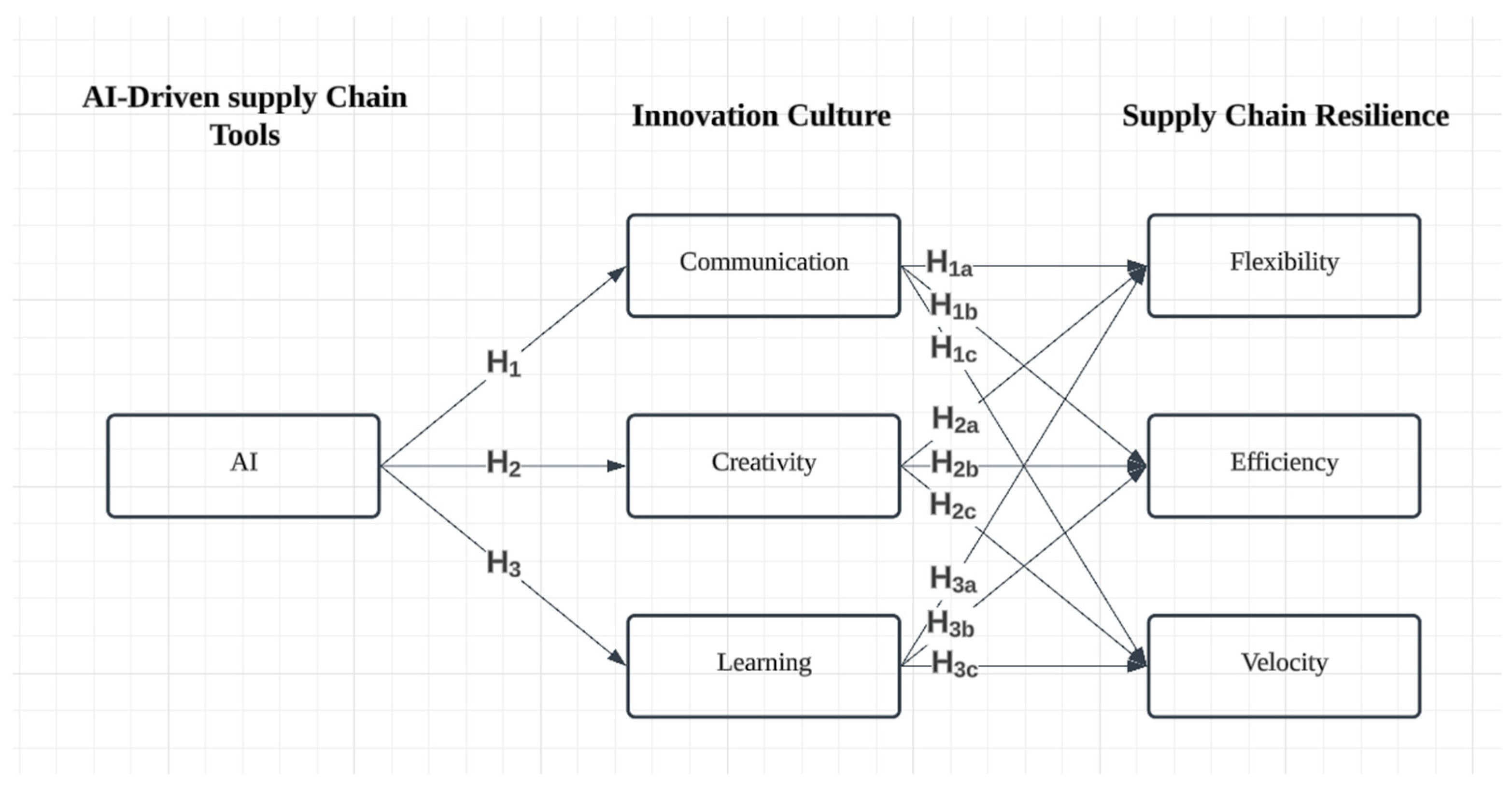
This study is primarily grounded in the Dynamic Capabilities Theory (DCT), which emphasizes an organization’s ability to assimilate, enhance, and restructure both internal and external competencies in reaction to rapidly changing environments [53]. In the context of AI adoption in supply chain management, dynamic capabilities manifest in the capacity to detect market fluctuations, capitalize on opportunities via technological integration, and adapt organizational processes to sustain a competitive advantage [23]. Communication, creativity, and learning, which are essential components of an innovative culture, can be regarded as fundamental elements of dynamic capabilities, enabling organizations to translate AI-generated insights into responsive actions [34]. The theory asserts that these capabilities enhance the components of supply chain resilience by enabling the swift and efficient reconfiguration of resources in reaction to disruptions [16]. As shown in Figure 1.

2.3. AI-Powered Tools and Innovation Culture

AI-powered tools are technologies that embed AI algorithms such as machine learning, predictive analytics, and optimization engines into SCM systems to enhance decision-making, forecasting, and operational execution [54]. Communication, as a dimension of innovation culture, involves the open and effective exchange of information to facilitate coordination and knowledge sharing [13]. Studies have shown that AI adoption can improve communication by generating actionable insights, increasing data transparency, and enabling real-time information exchange across the supply chain [55]. However, most of these studies focus on technologically advanced economies, creating a gap in understanding within resource-constrained manufacturing contexts [34]. Under DCT, AI tools act as enablers for sensing and disseminating critical market and operational information quickly. Therefore, it is hypothesized that AI-powered tools have a significant direct effect on communication.
H1. 
AI-powered tools have a significant direct effect on communication.
Creativity is the capacity to generate novel and useful ideas, processes, or solutions that improve organizational outcomes [14]. AI-powered tools can stimulate creativity by providing predictive insights, simulating alternative scenarios, and supporting employees in exploring innovative responses to challenges [56]. Prior research has demonstrated that advanced analytics systems support creative problem-solving by uncovering hidden data patterns [57]. Despite this, empirical work linking AI adoption to creativity in manufacturing supply chains of developing economies remains scarce [58]. From a KBV perspective, AI can be viewed as a knowledge enabler that fuels idea generation and novel approaches to SCM operations. Thus, the hypothesis is that AI-powered tools have a significant direct effect on creativity.
H2. 
AI-powered tools have a significant direct effect on creativity.
Learning is the continuous acquisition, assimilation, and application of knowledge that enhances organizational adaptability and performance [59]. AI adoption can enhance learning by automating feedback loops, storing institutional knowledge, and providing real-time analytics that facilitate decision-making [60]. High-tech sector evidence indicates that AI-supported platforms promote faster learning cycles and adaptive responses [61]. Nevertheless, there is limited empirical insight into how AI tools directly foster learning in manufacturing supply chains in developing economies [62]. Within DCT, learning is a key microfoundation enabling resource reconfiguration in dynamic environments. Therefore, the study hypothesizes that AI-powered tools have a significant direct effect on learning.
H3. 
AI-powered tools have a significant direct effect on learning.

2.4. Communication and Supply Chain Resilience

Flexibility refers to the supply chain’s ability to adapt quickly to changing market or operational conditions [63]. Effective communication supports flexibility by enabling faster decision-making and synchronized adjustments across functional areas [13]. While prior research supports this relationship, little is known about it in digitally emerging manufacturing environments [64]. DCT posits that communication acts as a capability that allows for quick sensing and reconfiguration of resources. Hence, it is hypothesized that communication has a significant direct effect on flexibility.
H1a. 
Communication has a significant direct effect on flexibility.
Efficiency is the optimal utilization of resources to achieve targeted outcomes [65]. Communication ensures that AI-derived insights reach the right decision-makers promptly, facilitating waste reduction and process optimization [13]. While evidence from advanced economies supports this link [66], its validation in developing manufacturing contexts is limited. From an RBV perspective, communication is a non-substitutable asset that enhances efficiency. Therefore, the hypothesis is that communication has a significant direct effect on efficiency.
H1b. 
Communication has a significant direct effect on efficiency.
Velocity refers to the speed of executing supply chain processes to meet market demands [67]. Communication accelerates velocity by ensuring information flows rapidly for prompt action [40]. AI-enhanced communication systems can further reduce latency in decision-making [52]. However, empirical testing in resource-limited settings remains sparse. DCT supports the notion that communication enables rapid operational adjustments. Hence, it is hypothesized that communication has a significant direct effect on velocity.
H1c. 
Communication has a significant direct effect on velocity.

2.5. Creativity and Supply Chain Resilience

Creativity promotes flexibility by generating innovative solutions that enable quick adaptation to market or operational shifts [56]. AI-enabled creativity allows firms to design alternative workflows in response to disruptions [57]. Despite its conceptual support, empirical validation in AI-integrated supply chains in developing economies is limited [58]. Innovation culture theory suggests that creativity is a driver of adaptive capacity. Therefore, creativity is hypothesized to have a significant direct effect on flexibility.
H2a. 
Creativity has a significant direct effect on flexibility.
Creativity can improve efficiency by enabling innovative process redesign, resource optimization, and waste reduction [68]. AI tools support creative efficiency improvements by identifying process bottlenecks and suggesting novel solutions [57]. However, empirical research connecting creativity to efficiency in developing manufacturing contexts is limited. KBV frames creativity as a transformation of knowledge into operational gains. Therefore, the hypothesis is that creativity has a significant direct effect on efficiency.
H2b. 
Creativity has a significant direct effect on efficiency.
Creativity enhances velocity by devising unique approaches to expedite production and delivery [69]. AI-assisted creativity can help remove process delays and accelerate decision-making [70]. The literature, however, lacks evidence of this relationship in AI-enabled manufacturing environments in developing countries [60]. From DCT, creativity facilitates rapid reconfiguration of workflows for speed advantages [10]. Thus, it is hypothesized that creativity has a significant direct effect on velocity.
H2c. 
Creativity has a significant direct effect on velocity.

2.6. Learning and Supply Chain Resilience

Learning builds flexibility by equipping employees with updated skills and adaptive problem-solving abilities [61]. AI-based learning systems accelerate capability building by delivering tailored insights [56]. Despite its theoretical appeal, the direct link between learning and flexibility in developing manufacturing sectors is underexplored [62]. Within DCT, learning enhances a firm’s capacity to reconfigure resources quickly. Therefore, it is hypothesized that learning has a significant direct effect on flexibility.
H3a. 
Learning has a significant direct effect on flexibility.
Learning contributes to efficiency by fostering process improvements and informed operational decisions [65]. AI enhances this by providing analytical feedback for continuous improvement [59]. Limited research examines this relationship in AI-enabled supply chains in resource-constrained environments [64]. RBV positions learning as a critical capability for sustained efficiency gains. Thus, the hypothesis is that learning has a significant direct effect on efficiency.
H3b. 
Learning has a significant direct effect on efficiency.
Learning accelerates velocity by improving the ability to implement new knowledge and techniques rapidly [59]. AI-enabled learning platforms can significantly reduce the time between knowledge acquisition and operational execution [64]. Yet, its direct influence on velocity in AI-integrated manufacturing remains empirically underexplored [60] DCT supports learning as a micro foundation for rapid operational change. Therefore, it is hypothesized that learning has a significant direct effect on velocity.
H3c. 
Learning has a significant direct effect on velocity.
Based on the previous discussions, the following conceptual model was formulated.

3. Methodology

This study adopts a quantitative, cross-sectional research design to investigate the direct relationships between AI-powered tools, innovation culture components (communication, creativity, learning), and supply chain resilience dimensions (flexibility, efficiency, velocity) within manufacturing companies in Jordan. Quantitative methods were selected because they allow for the statistical testing of hypothesized relationships and enable generalization of results to the broader population. The cross-sectional approach was appropriate for capturing data at a single point in time, offering a snapshot of the current state of AI adoption, innovation culture, and resilience in the manufacturing sector. The research design is grounded in the DCT which provides the theoretical basis for examining how AI-enabled capabilities influence resilience outcomes.
The target population for the study consists of supply chain managers, operations managers, and equivalent decision-makers in Jordanian manufacturing firms. This group was selected because these individuals are directly involved in AI adoption, supply chain decision-making, and the development of organizational culture, making them uniquely qualified to evaluate the study constructs. A judgmental (purposive) sampling technique was employed to ensure that respondents possessed deep, role-specific knowledge and direct experience with AI-enabled supply chain practices. Purposive sampling is particularly appropriate for theory-driven research examining complex and emergent phenomena, such as AI-enabled dynamic capabilities, where the inclusion of uninformed respondents through random sampling would undermine construct validity and theoretical inference [35,71]. In contexts involving advanced digital technologies, purposive sampling is widely endorsed because relevant expertise is unevenly distributed across organizations, and random sampling cannot guarantee respondent suitability [72,73].
The adequacy of the sample size was further justified using the rule-of-thumb proposed by [74], expressed as N > 50 + 8M, where N represents the sample size and M denotes the number of independent variables. In this study, the model includes one independent variable and three mediator variables (AI-powered tools, communication, creativity, and learning), resulting in a minimum required sample size of N > 50 + 8(4) = 82.
Regarding data collection, a total of 1080 survey questionnaires were distributed to manufacturing firms in Jordan, targeting supply chain managers or equivalent decision-makers, as the unit of analysis was at the company level. A total of 312 questionnaires were returned, yielding an initial response rate of approximately 28.9%. After screening the responses for completeness and consistency, 42 questionnaires were excluded due to missing data or incomplete responses. Consequently, 270 valid questionnaires were retained for final analysis, resulting in an effective response rate of approximately 25%.
This response rate exceeds the recommended minimum threshold of 20% for survey-based research in operations and supply chain management, thereby indicating an acceptable level of data quality and non-response bias risk [75]. The final sample of 270 valid responses substantially exceeds the minimum required sample size, ensuring sufficient statistical power and robustness for multivariate analysis and structural equation modeling.
Primary data were gathered using a structured, self-administered questionnaire distributed via email and professional networks. Both electronic and printed formats were made available to increase accessibility and encourage participation. The questionnaire, developed in English, underwent expert review by academics and practitioners to ensure clarity and face validity. It was organized into four main sections: demographic and organizational information, measures of AI-powered tool adoption, measures of innovation culture components, and measures of supply chain resilience dimensions. A pilot test was conducted with 20 participants from the target population, and based on their feedback, minor adjustments were made to wording for improved clarity and cultural relevance.
We used established scales that had been changed from previous research to fit the study’s context to measure all of the constructs. A five-point Likert scale was used to get answers, with choices ranging from 1 (“Strongly Disagree”) to 5 (“Strongly Agree”). The assessment of AI-powered tools utilized items modified from the studies of [52,54], focusing on the incorporation of AI in domains such as forecasting, inventory management, and logistics optimization. The assessment of communication incorporated elements from [13,41], emphasizing criteria such as transparency, promptness, and the precision of information dissemination. The evaluation of creativity incorporated elements from the studies of [14,28], concentrating on the dimensions of idea generation and problem-solving. The assessment of learning employed tools from [56,59], focusing on the themes of continuous improvement and the acquisition of knowledge. The evaluation of flexibility utilized items adapted from [76], while efficiency was assessed according to the framework developed by [65]. Moreover, velocity was assessed based on the standards established by [67] each reflecting essential elements such as adaptability, efficient resource allocation, and process acceleration.
We used SmartPLS 4 software to analyze the data. This software was chosen because it works well with complicated models, small sample sizes, and data that isn’t normally distributed. The analysis was performed utilizing a bifurcated methodology. We first checked the reliability of the measurement model using Cronbach’s alpha and composite reliability. Then we checked its convergent validity using average variance extracted and its discriminant validity using the Fornell-Larcker criterion and HTMT ratios. Subsequently, the structural model was evaluated by testing the hypothesized relationships, employing path coefficients, t-values, p-values, and R2 values. We also calculated effect sizes (f2) and predictive relevance (Q2). Bootstrapping with 5000 resamples was employed to ascertain standard errors and significance levels.
The research adhered to the ethical guidelines established by the Institutional Review Board (IRB) at Westcliff University. Prior to the collection of data, ethical approval was secured, and all participants were made aware of the study’s objectives, the voluntary aspect of their involvement, and the confidentiality of their responses. Prior to commencing the survey, informed consent was secured from each participant. Participants were assured that the information gathered would be used solely for academic purposes and presented collectively, guaranteeing that no personal identifiers would be disclosed. The data that was collected has been safely stored, and only the research team can access it. This keeps the ethical standards of confidentiality and data protection.

4. Results

4.1. Measurement Model Assessment

All constructs demonstrated robust internal consistency (See Table 3), as indicated by Cronbach’s alpha values surpassing 0.7. The composite reliability values varied between 0.83 and 0.91, while the Average Variance Extracted (AVE) surpassed the 0.50 threshold for all constructs, thereby affirming convergent validity. Moreover, the Fornell-Larcker criterion and HTMT ratio provided evidence for discriminant validity, as all HTMT values were found to be below 0.85.
The metrics for reliability and validity of the constructs employed in the study encompass Cronbach’s alpha, composite reliability (rho_a and rho_c), and Average Variance Extracted (AVE). All constructs surpassed the suggested threshold of 0.70 for Cronbach’s alpha, demonstrating robust internal consistency (e.g., AI = 0.916, Learning = 0.920). In a similar vein, the composite reliability values (rho_c) for all constructs exceeded the acceptable threshold of 0.70, with AI, Flexibility, and Learning attaining notably high scores of 0.936, 0.934, and 0.940, respectively. This further underscores the strength of the measurement model. Moreover, the AVE values for all constructs exceeded the 0.50 threshold, thereby affirming strong convergent validity. Among the constructs, Learning exhibited the highest AVE (0.758), indicating that the indicators effectively account for the variance of the construct. These results collectively affirm that the constructs used in this research demonstrate adequate reliability and convergent validity, making them suitable for further structural equation modeling analysis.

4.2. Common Method Bias Assessment

Given that the data were collected using a single, self-reported questionnaire, potential common method bias (CMB) was carefully assessed using a combination of procedural and statistical remedies. Procedurally, respondents were assured of anonymity and confidentiality to reduce evaluation apprehension and social desirability bias. The questionnaire employed previously validated measurement scales, clear item wording, and a structured layout to minimize ambiguity and consistency effects, following established methodological recommendations [41]. These ex-ante controls aimed to reduce respondents’ subjective bias when evaluating AI-powered tools, innovation culture dimensions (communication, creativity, and learning), and supply chain resilience outcomes.
Statistically, Harman’s single-factor test was first conducted to assess whether a single latent factor accounted for the majority of variance in the measurement items, as in Table 4.
The results indicated that the largest factor explained 32.4% of the total variance, which is well below the critical threshold of 50%, suggesting that CMB is unlikely to pose a serious threat. In addition, a full collinearity assessment was performed using variance inflation factors (VIFs), as in Table 5. All constructs—AI-powered tools, communication, creativity, learning, flexibility, efficiency, and velocity—exhibited VIF values ranging from 1.42 to 2.71, which are below the conservative cutoff value of 3.3, further confirming the absence of substantial common method bias [77].
To provide a more rigorous robustness check, a Latent Method Factor (LMF) analysis was conducted by introducing a common method construct linked to all indicators in the model. Table 6 presents a comparison of structural path coefficients before and after controlling for the latent method factor. The results show that the relationships between AI-powered tools and innovation culture dimensions, as well as between innovation culture dimensions and supply chain resilience outcomes, remained highly stable in terms of coefficient magnitude, direction, and statistical significance. Differences between original and LMF-adjusted estimates were minimal, and all previously significant paths remained significant, while non-significant paths remained non-significant.

4.3. Structural Model Analysis

The study structural model demonstrates a good overall fit with the data, as evidenced by multiple goodness-of-fit indices, as in Table 7. The non-significant chi-square statistic (p > 0.05) and acceptable incremental fit indices (NFI = 0.951 and TLI = 0.958) exceed recommended cut-off values, while absolute fit measures (RMSEA = 0.036 and SRMR 0.049) fall within good-fit thresholds [73].
The analysis showed that AI-powered tools had a statistically significant direct effect on each component of innovation culture, as in Table 8:
The structural model analysis of direct effects reveals several statistically significant relationships between AI-powered supply chain tools and various dimensions of innovation culture and supply chain resilience. The results indicate that AI has a strong and significant direct influence on communication (β = 0.505, t = 9.744, p < 0.001), creativity (β = 0.735, t = 23.502, p < 0.001), and learning (β = 0.553, t = 11.488, p < 0.001), confirming its foundational role in driving innovation culture. Furthermore, communication significantly predicts flexibility (β = 0.281), efficiency (β = 0.335), and velocity (β = 0.397), while creativity also has a significant effect on flexibility (β = 0.307), efficiency (β = 0.262), and velocity (β = 0.359), all with p-values less than 0.001. Interestingly, learning significantly influences efficiency (β = 0.247, t = 3.196, p = 0.001), but does not significantly impact flexibility (p = 0.725) or velocity (p = 0.611), highlighting that while learning contributes to performance optimization, it plays a lesser role in adaptability and speed.

5. Discussion

This study advances the growing body of literature on AI-enabled supply chain management by empirically examining how AI-powered tools influence supply chain resilience through innovation culture in a developing-economy manufacturing context. By grounding the analysis in Dynamic Capabilities Theory (DCT), the findings extend prior research that has largely emphasized either technological adoption or resilience outcomes in isolation.

5.1. AI-Powered Tools and Innovation Culture (H1–H3)

The results demonstrate that AI-powered tools have strong and significant positive effects on communication, creativity, and learning, thereby supporting H1–H3. These findings are consistent with earlier studies conducted in technologically advanced economies, which report that AI enhances information sharing, analytical capability, and organizational learning [27,52]. However, this study extends prior work by empirically validating these relationships within a resource-constrained manufacturing context, where digital maturity is lower and organizational readiness varies substantially.
While previous research has often treated AI as a productivity-enhancing tool [70], the present findings demonstrate that AI adoption also drives deeper socio-cognitive transformations, fostering communication flows, creative problem-solving, and learning routines. This supports recent arguments that AI contributes to the development of dynamic capabilities rather than merely automating operational tasks [10]. The novelty of this result lies in empirically confirming that AI strengthens the microfoundations of innovation culture in developing economies, a context that remains underexplored in the literature.

5.2. Communication and Supply Chain Resilience (H1a–H1c)

The findings show that communication has a significant and positive impact on flexibility, efficiency, and velocity, providing full support for H1a–H1c. These results are in line with prior studies emphasizing the role of information sharing and coordination in enabling resilient supply chain responses [78,79]. Similar to [76], this study confirms that effective communication reduces uncertainty and supports coordinated action during disruptions.
However, this study contributes new insights by demonstrating that AI-enhanced communication systems amplify resilience outcomes, particularly velocity, by reducing decision latency and accelerating execution. While earlier studies often examined communication as a standalone organizational capability [64], the current findings highlight the synergistic role of AI in strengthening communication as a dynamic capability, consistent with DCT’s sensing and transforming mechanisms [80].

5.3. Creativity and Supply Chain Resilience (H2a–H2c)

Creativity was found to significantly enhance flexibility, efficiency, and velocity, supporting H2a–H2c and aligning with innovation-focused resilience studies [64,81]. Prior research has suggested that creative problem-solving enables firms to design alternative workflows and reconfigure resources under uncertainty [28].
What differentiates this study is that it empirically establishes creativity as a central transmission mechanism through which AI adoption translates into resilience outcomes. While previous studies acknowledge creativity conceptually [14], few have quantitatively tested its role across multiple resilience dimensions. The results suggest that AI-enabled creativity not only supports adaptation (flexibility) but also improves operational efficiency and response speed, thereby broadening the understanding of creativity’s functional role in supply chains.

5.4. Learning and Supply Chain Resilience (H3a–H3c)

The results related to learning present a more nuanced picture. While learning significantly improves efficiency (supporting H3b), its effects on flexibility and velocity were not statistically significant (H3a and H3c not supported). This partially aligns with studies that link organizational learning to process improvement and cost efficiency [40,82].
However, the findings diverge from prior research conducted in advanced economies, which reports stronger associations between learning and adaptive capacity [41,83]. This divergence suggests that learning-based capabilities may require longer time horizons, complementary structures, or higher digital maturity to translate into rapid adaptation and speed, particularly in developing manufacturing environments. This contextual insight represents a key contribution of the study, highlighting that the resilience outcomes of learning are contingent on institutional and technological readiness.

5.5. Implications for Theory

This study enhances Dynamic Capabilities Theory (DCT) by illustrating how AI-driven tools operate as foundational enablers of dynamic capabilities through the development of an innovation-oriented organizational culture, specifically communication, creativity, and learning. Rather than treating AI as a standalone technological resource, the findings position AI as a capability-building mechanism that strengthens the microfoundations of sensing, seizing, and transforming, thereby advancing DCT’s explanatory power in digitally intensive supply chain contexts.
First, the study contributes to theory by empirically unpacking the cultural microfoundations through which AI-driven tools influence supply chain resilience. While prior DCT-based studies acknowledge the importance of organizational culture, they often conceptualize it at an aggregate level. This research advances DCT by demonstrating that communication and creativity function as distinct and powerful dynamic capabilities that consistently enhance flexibility, efficiency, and velocity, highlighting their central role in translating digital investments into resilient outcomes. This finding refines existing theoretical models by showing that not all cultural dimensions contribute equally to resilience.
Second, the differential effects observed across innovation culture dimensions introduce important nuances into DCT. The strong and consistent effects of communication and creativity support DCT’s emphasis on information integration and innovative problem-solving as key mechanisms for rapid adaptation. In contrast, the partial role of learning—significant only for efficiency—extends theory by suggesting that learning-based capabilities may be more exploitation-oriented, supporting incremental improvement rather than immediate adaptive reconfiguration. This challenges the implicit assumption in DCT that learning uniformly enhances all adaptive outcomes and suggests the need to distinguish between short-term adaptive capabilities and longer-term capability accumulation.
Third, the findings contribute to the DCT by demonstrating that AI-enabled communication and creativity outperform learning in driving responsiveness-related resilience outcomes The study suggests that dynamic capabilities emerge not only from knowledge accumulation but also from the speed and flexibility with which knowledge is shared and recombined. This insight encourages future theoretical work to more explicitly integrate DCT with information processing and knowledge orchestration mechanisms in digital supply chains.
Fourth, this study extends the boundary conditions of DCT by empirically validating its applicability in a developing-economy manufacturing context. Most DCT-based research has been conducted in advanced economies with high digital maturity. By providing evidence from Jordanian manufacturing firms operating under resource constraints and institutional limitations, the study demonstrates that dynamic capabilities can still emerge through targeted cultural mechanisms even when technological and infrastructural conditions are imperfect. This contributes to the contextualization of DCT and responds to calls for greater diversity in empirical settings.
Finally, the study advances the resilience concept by reframing supply chain resilience as a socio-technical outcome rather than a purely technological or structural one. By integrating AI-powered tools with innovation culture within a single theoretical framework, the findings highlight that resilience is best understood as an emergent capability arising from the interaction between digital technologies and organizational microfoundations. This perspective opens new theoretical avenues for examining how different combinations of technologies and cultural capabilities shape resilience trajectories over time.

5.6. Implications for Practice and Policy

The results of this study offer significant insights for managers, particularly in manufacturing firms situated in developing economies such as Jordan. The substantial and consistent influence of AI-driven tools on communication, creativity, and learning suggests that investments in AI should encompass more than just operational automation and analytics. They should also include programs that actively improve collaboration between people and departments. This could mean using AI-enhanced communication platforms, advanced knowledge management systems, and AI-powered brainstorming tools that encourage creativity and ongoing learning. Organizations can create a culture of innovation that is not only established but also constantly maintained by using these technologies in their daily operations.
Moreover, the significant influence of communication and creativity on the three dimensions of resilience—flexibility, efficiency, and velocity—highlights the necessity for managers to cultivate an environment that promotes open information exchange and appreciates innovative thinking. This may require structured meetings across different functions, AI-powered platforms for generating ideas, and collaborative sessions focused on problem-solving, all of which should be closely linked to operational performance metrics. Organizations should establish recognition and reward systems for individuals who offer innovative solutions during periods of disruption, thereby reinforcing the cultural framework that supports resilience.
Third, the fact that learning greatly increases efficiency but has no direct effect on flexibility or speed suggests that managers should rethink how they implement learning. It is just as important to focus learning on speed and agility as it is to improve processes and productivity. This can be done by adding scenario-based training, simulations of supply chain problems, and real-time feedback systems that let teams quickly use new information to make decisions that adapt. By adding AI-driven predictive analytics to these educational systems, teams can practice responding quickly to changing market conditions.
In the end, managers need to see the use of AI as a strategic change effort, not just a new technology. This means that AI capabilities need to be combined with the growth of the organization’s culture and the goals of resilience. Senior leaders must actively support efforts to create a culture of AI and innovation. This includes giving enough resources, putting in place good change management programs, and setting up ways to keep checking on both cultural and resilience outcomes.

5.7. Limitations of the Study and Future Research Directions

Despite its theoretical and empirical contributions, this study is subject to several limitations that should be considered when interpreting the findings and that also offer meaningful directions for future research. First, the cross-sectional research design restricts the ability to draw causal inferences among AI-powered tools, innovation culture dimensions, and supply chain resilience outcomes. More importantly, this design captures only contemporaneous capability effects and cannot fully reflect the cumulative, synergistic, and path-dependent nature of AI implementation and innovation culture development. In particular, the effects of learning on flexibility and velocity may materialize over longer time horizons, suggesting that the non-significant relationships observed in this study could reflect temporal delays rather than the absence of underlying effects. AI adoption typically involves an adaptation period, while fostering an innovation culture requires sustained managerial effort over time; therefore, the true long-term value of their integration for risk resilience may only become visible through longitudinal observation. Future research employing longitudinal designs (e.g., panel data, time-lagged models, or process-based approaches) would be better suited to capturing the dynamic evolution of learning processes, capability development, and resilience formation over time.
Second, the empirical focus on manufacturing firms in Jordan may limit the generalizability of the findings to other sectors or institutional contexts. Manufacturing supply chains in developing economies operate under distinctive regulatory, infrastructural, and resource constraints that may shape AI adoption and innovation culture differently than in service industries or advanced economies. Accordingly, future studies are encouraged to conduct cross-industry and cross-country comparisons to examine how institutional maturity, technological readiness, and market competitiveness condition the relationships identified in this study.
Third, although the study relied on self-reported survey data collected from single informants, which may raise concerns regarding common method bias, multiple procedural and statistical remedies were implemented to assess and mitigate this risk. Specifically, Harman’s single-factor test, variance inflation factor (VIF) analysis, and latent method factor diagnostics consistently indicated that common method bias is unlikely to have materially influenced the results. Nevertheless, perceptual measures may not fully capture objective operational behaviors or performance outcomes. Future research could enhance measurement robustness by triangulating survey data with objective indicators such as system usage logs, real-time operational performance metrics, or archival supply chain data.
In addition, although this study focuses on internal cultural mechanisms consistent with the microfoundational logic of Dynamic Capabilities Theory, it does not explicitly model contextual moderators such as firm size, technological maturity, industry competitiveness, or government policy support. This exclusion reflects a deliberate theoretical choice aimed at maintaining model parsimony and explanatory clarity, as the existing AI–supply chain resilience literature provides limited and fragmented empirical evidence to support robust moderation hypotheses, particularly in developing-economy contexts. Future research may extend the present model by systematically examining these variables as boundary conditions to better understand when and under what conditions AI-enabled innovation culture translates into enhanced supply chain resilience.
Finally, although innovation culture is inherently systemic, this study models communication, creativity, and learning as conceptually distinct but complementary dimensions in order to isolate their individual effects on supply chain resilience. As a result, potential interactive or synergistic relationships among these dimensions are not explicitly examined. In practice, learning may amplify the effectiveness of communication and creativity, while effective communication may facilitate the conversion of learning into actionable outcomes. Future research is therefore encouraged to adopt systems-oriented and configurational approaches—such as interaction effect modeling, polynomial regression, or fuzzy-set qualitative comparative analysis (fsQCA)—to explore how different combinations of innovation culture dimensions jointly contribute to supply chain resilience.

6. Conclusions

This study examined the role of AI-powered tools in shaping innovation culture—comprising communication, creativity, and learning—and its subsequent impact on supply chain resilience—measured through flexibility, efficiency, and velocity—in Jordanian manufacturing firms. The research was grounded in Dynamic Capabilities Theory (DCT) and tested twelve direct hypotheses, ten of which were supported. The findings demonstrate that AI-powered tools significantly enhance all three dimensions of innovation culture. Additionally, communication and creativity positively influenced all dimensions of resilience, while learning significantly improved efficiency without affecting flexibility or speed. This asymmetric effect suggests that learning in the studied context is predominantly exploited for process refinement and cost control rather than for rapid reconfiguration or accelerated response, indicating a distinction between efficiency-oriented learning and agility-oriented learning.
A plausible explanation for this pattern lies in contextual and organizational barriers prevalent in Jordanian manufacturing firms. Learning initiatives are often formalized, compliance-driven, and incremental in nature, focusing on standard operating procedures, quality assurance, and productivity improvements. While such learning enhances efficiency, it may not translate into flexibility or speed due to rigid organizational structures, hierarchical decision-making, limited empowerment of frontline employees, and the absence of real-time learning-to-action mechanisms. Consequently, learning remains embedded in routines rather than mobilized as a dynamic capability for rapid sensing and response.
From a managerial perspective, the findings underscore the necessity for firms in developing economies to invest not solely in AI technologies but also in enhancing communication channels and fostering creative capabilities, as these elements directly influence improved resilience performance. To unlock the adaptive potential of learning, managers must redesign learning models to be more action-oriented, decentralized, and time-sensitive. For example, they could embed lessons learned from past disruptions into rapid-response playbooks, scenario-based simulations, and cross-functional decision teams empowered to act swiftly. Linking AI-enabled analytics with experiential learning mechanisms—such as real-time dashboards, post-disruption reviews, and agile training modules—can help convert accumulated knowledge into operational agility and faster execution.
This study provides significant insights into Dynamic Capabilities Theory by demonstrating how AI-powered tools enhance an organization’s ability to sense, seize, and adapt to environmental changes through distinct cultural mechanisms. Importantly, the findings refine DCT by showing that learning does not automatically function as an adaptive capability unless supported by enabling structures and decision rights. While communication and creativity act as immediate microfoundations of flexibility and velocity, learning appears to contribute indirectly and over longer time horizons, thereby highlighting the need to differentiate between learning as a capability-building process and learning as an agility-enabling mechanism.


Author Contributions

Conceptualization, H.H.; Formal analysis, Z.A.; Resources, H.H.; Writing—original draft, L.J.; Writing—review & editing, H.M. All authors have read and agreed to the published version of the manuscript.

Funding

This research received no external funding.

Institutional Review Board Statement

The study was conducted in accordance with Westcliff University, and the protocol was approved by the Ethics Committee of WCDBA221224-1 on 22 December 2024.

Informed Consent Statement

Informed consent was obtained from all subjects involved in the study.

Data Availability Statement

The data presented in this study are available on request from the corresponding author due to privacy and ethical restrictions.

Acknowledgments

This study is part of the dissertation of the first author at Westcliffe University under the title of: ‘’Understanding The Nexus: Exploring Innovation Culture’s Mediating Role In The Relationship Between AI-Driven Supply Chain Tools and Supply Chain Resilience’’.

Conflicts of Interest

The authors declare no conflicts of interest.

References

  1. Imam, S. The importance of supply chain integration in the performance nexus: A case from developing country. South Asian J. Oper. Logist. 2023, 3, 1–21. [Google Scholar] [CrossRef]
  2. Zhao, G.; Vazquez-Noguerol, M.; Liu, S.; Prado-Prado, J.C. Agri-food supply chain resilience strategies for preparing, responding, recovering, and adapting in relation to unexpected crisis: A cross-country comparative analysis from the COVID-19 pandemic. J. Bus. Logist. 2024, 45, e12361. [Google Scholar] [CrossRef]
  3. Zighan, S.; Dwaikat, N.Y.; Alkalha, Z.; Abualqumboz, M. Knowledge management for supply chain resilience in pharmaceutical industry: Evidence from the Middle East region. Int. J. Logist. Manag. 2024, 35, 1142–1167. [Google Scholar] [CrossRef]
  4. Jum’a, L.; Zighan, S.; Alkalha, Z. Influence of supply chain digitalization on supply chain agility, resilience and performance: Environmental dynamism as a moderator. J. Manuf. Technol. Manag. 2025, 36, 798–819. [Google Scholar] [CrossRef]
  5. Shivkumar, K. The AI Paradigm: Transforming E-Commerce Dynamics in the digital era. Int. Res. J. Mod. Eng. Technol. Sci. 2024, 6, 3245–3253. [Google Scholar] [CrossRef]
  6. Alkalha, Z.; Al-Zain, Y.; Al-Rawi, F.; Obiedat, R. Artificial intelligence-driven resilience: Revolutionizing supply chain risk management in entrepreneurial projects. Int. J. Innov. Res. Sci. Stud. 2025, 8, 683–699. [Google Scholar] [CrossRef]
  7. Apriani, A.; Sani, I.; Kurniawati, L.; Prayoga, R.; Panggabean, H.L. The role of artificial intelligence (AI) and its benefits in digital marketing strategy. East Asian J. Multidiscip. Res. 2024, 3, 319–332. [Google Scholar]
  8. Enholm, I.M.; Papagiannidis, E.; Mikalef, P.; Krogstie, J. Artificial intelligence and business value: A literature review. Inf. Syst. Front. 2022, 24, 1709–1734. [Google Scholar] [CrossRef]
  9. Mallesham, G. The role of AI and ML in revolutionizing supply chain management. Int. J. Sci. Res. Manag. 2022, 10, 918–928. [Google Scholar] [CrossRef]
  10. Alkalha, Z.; Ali, A.H.Q.; Jum’a, L. Unleashing the potential of artificial intelligence to enhance reverse logistics operations. Int. J. Phys. Distrib. Logist. Manag. 2025, 1–34. [Google Scholar] [CrossRef]
  11. Muafi, M.; Siswanti, Y.; Diharto, A.K.; Salsabil, I. Innovation culture and process in mediating human capital supply chain on firm performance. J. Asian Financ. Econ. Bus. 2020, 7, 593–602. [Google Scholar] [CrossRef]
  12. Caro-Gonzalez, A. Establishing a culture of innovation and risk-taking. In Transformative Governance for the Future: Navigating Profound Transitions; Springer: Cham, Switzerland, 2023; pp. 47–56. [Google Scholar] [CrossRef]
  13. McNaughton, R.B. Innovation governance. In The PDMA Handbook of Innovation and New Product Development; Bstieler, L., Noble, C.H., Eds.; Wiley: Hoboken, NJ, US, 2023; p. 121. [Google Scholar]
  14. Free, M.; Kent, P.; Qu, X.; Yao, D. How Does Risk Tolerance Reflected in National Culture Affect Pay-Performance Sensitivity? J. Int. Account. Res. 2023, 22, 29–58. [Google Scholar] [CrossRef]
  15. Sawaean, F.; Ali, K. The impact of entrepreneurial leadership and learning orientation on organizational performance of SMEs: The mediating role of innovation capacity. Manag. Sci. Lett. 2020, 10, 369–380. [Google Scholar] [CrossRef]
  16. Belhadi, A.; Mani, V.; Kamble, S.S.; Khan, S.A.R.; Verma, S. Artificial intelligence-driven innovation for enhancing supply chain resilience and performance under the effect of supply chain dynamism: An empirical investigation. Ann. Oper. Res. 2024, 333, 627–652. [Google Scholar] [CrossRef]
  17. Alkalha, Z.; Al-Zu’bi, Z.B.M.; Zighan, S. Investigating the impact of absorptive capacity on operational performance: The mediating role of supply chain resilience. Int. J. Integr. Supply Manag. 2021, 14, 306–329. [Google Scholar] [CrossRef]
  18. Min, H.; Sheriff, K.M. Enhancing resilience in the global automotive supply chain: Lessons learned from the systematic literature review. Int. J. Logist. Syst. Manag. 2025, 51, 339–375. [Google Scholar] [CrossRef]
  19. Toorajipour, R.; Sohrabpour, V.; Nazarpour, A.; Oghazi, P.; Fischl, M. Artificial intelligence in supply chain management: A systematic literature review. J. Bus. Res. 2021, 122, 502–517. [Google Scholar] [CrossRef]
  20. Aqmala, D.; Panjaitan, R.; Ardyan, E.; Putra, F.I.F.S. The role of green blue ocean strategy in enhancing frugal innovation through IoT and AI: A resource-based view perspective. J. Entrep. Manag. Innov. 2025, 21, 56–81. [Google Scholar] [CrossRef]
  21. Lu, Q.; Jiang, Y.; Wang, Y. Improving supply chain resilience from the perspective of information processing theory. J. Enterp. Inf. Manag. 2024, 37, 721–744. [Google Scholar] [CrossRef]
  22. Dubey, R.; Bryde, D.J.; Dwivedi, Y.K.; Graham, G.; Foropon, C. Impact of artificial intelligence-driven big data analytics culture on agility and resilience in humanitarian supply chain: A practice-based view. Int. J. Prod. Econ. 2022, 250, 108618. [Google Scholar] [CrossRef]
  23. Cadden, T.; Dennehy, D.; Mantymaki, M.; Treacy, R. Understanding the influential and mediating role of cultural enablers of AI integration to supply chain. Int. J. Prod. Res. 2022, 60, 4592–4620. [Google Scholar] [CrossRef]
  24. Alkalha, Z.; Reid, I.; Dehe, B. The role of absorptive capacity within supply chain quality integration. Supply Chain Manag. Int. J. 2019, 24, 805–820. [Google Scholar] [CrossRef]
  25. Lowry, P.B.; Gaskin, J. Partial least squares (PLS) structural equation modeling (SEM) for building and testing behavioral causal theory: When to choose it and how to use it. IEEE Trans. Prof. Commun. 2014, 57, 123–146. [Google Scholar] [CrossRef]
  26. Goodhue, D.L.; Lewis, W.; Thompson, R. Does PLS have advantages for small sample size or non-normal data? MIS Q. 2012, 36, 981–1001. [Google Scholar] [CrossRef]
  27. Alkhatib, S.F.; Momani, R.A. Supply chain resilience and operational performance: The role of digital technologies in Jordanian manufacturing firms. Adm. Sci. 2023, 13, 40. [Google Scholar] [CrossRef]
  28. Fuad, D.R.S.M.; Musa, K.; Hashim, Z. Innovation culture in education: A systematic review of the literature. Manag. Educ. 2022, 36, 135–149. [Google Scholar] [CrossRef]
  29. Stockley-Patel, S.; Swords, J. Cultural and innovation intermediation in the cultural-creative industries. Creat. Ind. J. 2025, 18, 338–353. [Google Scholar] [CrossRef]
  30. Oh, I.; Kim, K.J.; Rowley, C. Female Empowerment and Radical Empathy for the Sustainability of Creative Industries: The Case of K-Pop. Sustainability 2023, 15, 3098. [Google Scholar] [CrossRef]
  31. Yan, W.; Li, K. Sustainable Cultural Innovation Practice: Heritage Education in Universities and Creative Inheritance of Intangible Cultural Heritage Craft. Sustainability 2023, 15, 1194. [Google Scholar] [CrossRef]
  32. Alerasoul, S.; Afeltra, G.; Hakala, H.; Minelli, E.; Strozzi, F. Organisational learning, learning organisation, and learning orientation: An integrative review and framework. Hum. Resour. Manag. Rev. 2022, 32, 100854. [Google Scholar] [CrossRef]
  33. Podsakoff, P.M.; MacKenzie, S.B.; Lee, J.Y.; Podsakoff, N.P. Common method biases in behavioral research: A critical review of the literature and recommended remedies. J. Appl. Psychol. 2003, 88, 879. [Google Scholar] [CrossRef] [PubMed]
  34. Pournader, M.; Ghaderi, H.; Hassanzadegan, A.; Fahimnia, B. Artificial intelligence applications in supply chain management. Int. J. Prod. Econ. 2021, 241, 108250. [Google Scholar] [CrossRef]
  35. Palinkas, L.A.; Horwitz, S.M.; Green, C.A.; Wisdom, J.P.; Duan, N.; Hoagwood, K. Purposeful sampling for qualitative data collection and analysis in mixed method implementation research. Adm. Policy Ment. Health Ment. Health Serv. Res. 2015, 42, 533–544. [Google Scholar] [CrossRef] [PubMed]
  36. Espig, A.; Mazzini, I.T.; Zimmermann, C.; de Carvalho, L.C. National culture and innovation: A multidimensional analysis. Innov. Manag. Rev. 2021, 19, 322–338. [Google Scholar]
  37. Bhuiyan, F.; Adu, D.A.; Ullah, H.; Islam, N. Employee organisational commitment and corporate environmental sustainability practices: Mediating role of organisation innovation culture. Bus. Strategy Environ. 2025, 34, 4485–4506. [Google Scholar] [CrossRef]
  38. Jegerson, D.; Jabeen, F.; Abdulla, H.H.; Putrevu, J.; Streimikiene, D. Does emotional intelligence impact service innovation capabilities? Exploring the role of diversity climate and innovation culture. J. Intellect. Cap. 2024, 25, 166–187. [Google Scholar] [CrossRef]
  39. Pi, T.; Yang, X. Board culture and bank innovation: Evidence from China. Int. Rev. Econ. Financ. 2023, 84, 732–755. [Google Scholar] [CrossRef]
  40. Wamba, S. Impact of artificial intelligence assimilation on firm performance: The mediating effects of organizational agility and customer agility. Int. J. Inf. Manag. 2022, 67, 102544. [Google Scholar] [CrossRef]
  41. Pisano, G.P. Innovation isn’t all fun and games—Creativity needs discipline. Harv. Bus. Rev. 2019, 1. Available online: https://vana.empowerment.ee/wp-content/uploads/2023/06/Innovation-Isnt-All-Fun-and-Games-%E2%80%94-Creativity-Needs-Discipline.pdf (accessed on 27 September 2025).
  42. Umar, M.; Wilson, M. Inherent and adaptive resilience of logistics operations in food supply chains. J. Bus. Logist. 2024, 45, e12362. [Google Scholar] [CrossRef]
  43. Hu, H.; Qi, Y.; Lee, H.L.; Shen, Z.-J.M.; Liu, C.; Zhu, W.; Kang, N. Supercharged by advanced analytics, JD.com attains agility, resilience, and shared value across its supply chain. Inf. J. Appl. Anal. 2024, 54, 54–70. [Google Scholar] [CrossRef]
  44. Srinivasan, R.; Swink, M. An investigation of visibility and flexibility as complements to supply chain analytics: An organizational information processing theory perspective. Prod. Oper. Manag. 2018, 27, 1849–1867. [Google Scholar] [CrossRef]
  45. Gupta, S.; Modgil, S.; Gunasekaran, A.; Bag, S. Dynamic capabilities and institutional theories for Industry 4.0 and digital supply chain. Supply Chain. Forum Int. J. 2020, 21, 139–157. [Google Scholar] [CrossRef]
  46. Qi, Y.; Wang, X.; Zhang, M.; Wang, Q. Developing supply chain resilience through integration: An empirical study on an e-commerce platform. J. Oper. Manag. 2023, 69, 477–496. [Google Scholar] [CrossRef]
  47. Zighan, S.; Abualqumboz, M.; Dwaikat, N.; Alkalha, Z. The role of entrepreneurial orientation in developing SMEs resilience capabilities throughout COVID-19. Int. J. Entrep. Innov. 2022, 23, 227–239. [Google Scholar] [CrossRef]
  48. Ismail, M.M.; Ahmed, Z.; Abdel-Gawad, A.F.; Mohamed, M. Toward Supply Chain 5.0: An Integrated Multi-Criteria Decision-Making Models for Sustainable and Resilient Enterprise. Decis. Mak. Appl. Manag. Eng. 2024, 7, 160–186. [Google Scholar] [CrossRef]
  49. Kazancoglu, I.; Ozbiltekin-Pala, M.; Mangla, S.K.; Kumar, A.; Kazancoglu, Y. Using emerging technologies to improve the sustainability and resilience of supply chains in a fuzzy environment in the context of COVID-19. Ann. Oper. Res. 2023, 322, 217–240. [Google Scholar] [CrossRef]
  50. Shi, Y.; Lin, W.; Chen, P.; Su, C. How can the ISO 9000 QMS improve the organizational innovation of supply chains? Int. J. Innov. Sci. 2019, 11, 278–298. [Google Scholar] [CrossRef]
  51. Jum’a, L.; Qamardin, S.; Ikram, M. Developing resilience strategies amid supply chain risks in the automotive industry: A stakeholder theory perspective. Bus. Strategy Environ. 2024, 33, 9197–9213. [Google Scholar] [CrossRef]
  52. Wamba, S.F.; Queiroz, M.M. A framework based on blockchain, artificial intelligence, and big data analytics to leverage supply chain resilience considering the COVID-19. IFAC-Pap. 2022, 55, 2396–2401. [Google Scholar] [CrossRef]
  53. Teece, D.J.; Pisano, G.; Shuen, A. Dynamic capabilities and strategic management. Strateg. Manag. J. 1997, 18, 509–533. [Google Scholar] [CrossRef]
  54. Arumugam, T.; Arun, R.; Natarajan, S.; Thoti, K.K.; Shanthi, P.; Kommuri, U.K. Unlocking the Power of Artificial Intelligence and Machine Learning in Transforming Marketing as We Know It. In Data-Driven Intelligent Business Sustainability; IGI Global Scientific Publishing: Palmdale, PA, USA, 2023; pp. 60–74. [Google Scholar] [CrossRef]
  55. Fan, H.; Han, B.; Gao, W. (Im)Balanced customer-oriented behaviors and AI chatbots’ Efficiency–Flexibility performance: The moderating role of customers’ rational choices. J. Retail. Consum. Serv. 2022, 66, 102937. [Google Scholar] [CrossRef]
  56. Wang, J.; Xue, Y.; Sun, X.; Yang, J. Green learning orientation, green knowledge acquisition and ambidextrous green innovation. J. Clean. Prod. 2020, 250, 119475. [Google Scholar] [CrossRef]
  57. Leoni, L.; Ardolino, M.; El Baz, J.; Gueli, G.; Bacchetti, A. The mediating role of knowledge management processes in the effective use of artificial intelligence in manufacturing firms. Int. J. Oper. Prod. Manag. 2022, 42, 411–437. [Google Scholar] [CrossRef]
  58. Agyabeng-Mensah, Y.; Baah, C.; Afum, E. Do the roles of green supply chain learning, green employee creativity, and green organizational citizenship behavior really matter in circular supply chain performance? J. Environ. Plan. Manag. 2024, 67, 609–631. [Google Scholar] [CrossRef]
  59. Sharma, K.; Giannakos, M.; Dillenbourg, P. Eye-tracking and artificial intelligence to enhance motivation and learning. Smart Learn. Environ. 2020, 7, 13. [Google Scholar] [CrossRef]
  60. Uda, S.K.; Basrowi, B. Environmental education using SARITHA-Apps to enhance environmentally friendly supply chain efficiency and foster environmental knowledge towards sustainability. Uncertain Supply Chain. Manag. 2024, 12, 359–372. [Google Scholar] [CrossRef]
  61. Ali, A.A.A.; Udin, Z.B.M.; Abualrejal, H.M.E. The Impact of Artificial Intelligence and Supply Chain Resilience on the Companies Supply Chains Performance: The Moderating Role of Supply Chain Dynamism. In International Conference on Information Systems and Intelligent Applications; Springer International Publishing: Cham, Switzerland, 2022; pp. 17–28. [Google Scholar] [CrossRef]
  62. Al-Omoush, K.S.; de Lucas, A.; del Val, M.T. The role of e-supply chain collaboration in collaborative innovation and value-co creation. J. Bus. Res. 2023, 158, 113647. [Google Scholar] [CrossRef]
  63. Dey, P.K.; Chowdhury, S.; Abadie, A.; Vann Yaroson, E.; Sarkar, S. Artificial intelligence-driven supply chain resilience in Vietnamese manufacturing small- and medium-sized enterprises. Int. J. Prod. Res. 2024, 62, 5417–5456. [Google Scholar] [CrossRef]
  64. Belhadi, A.; Kamble, S.; Fosso Wamba, S.; Queiroz, M.M. Building supply-chain resilience: An artificial intelligence-based technique and decision-making framework. Int. J. Prod. Res. 2021, 60, 4487–4507. [Google Scholar] [CrossRef]
  65. El Bhilat, E.M.; El Jaouhari, A.; Hamidi, L.S. Assessing the influence of artificial intelligence on agri-food supply chain performance: The mediating effect of distribution network efficiency. Technol. Forecast. Soc. Change 2024, 200, 123149. [Google Scholar] [CrossRef]
  66. Rege, A. The Impact of Artificial Intelligence on the SupplyChain in the Era of Data Analytics. Int. J. Comput. Trends Technol. 2023, 71, 28–39. [Google Scholar] [CrossRef]
  67. Cadden, T.; McIvor, R.; Cao, G.; Treacy, R.; Yang, Y.; Gupta, M.; Onofrei, G. Unlocking supply chain agility and supply chain performance through the development of intangible supply chain analytical capabilities. Int. J. Oper. Prod. Manag. 2022, 42, 1329–1355. [Google Scholar] [CrossRef]
  68. Dubey, R.; Gunasekaran, A.; Childe, S.J.; Bryde, D.J.; Giannakis, M.; Foropon, C.; Roubaud, D.; Hazen, B.T. Big data analytics and artificial intelligence pathway to operational performance under the effects of entrepreneurial orientation and environmental dynamism: A study of manufacturing organisations. Int. J. Prod. Econ. 2020, 226, 107599. [Google Scholar] [CrossRef]
  69. Tian, S.; Wu, L.; Pia Ciano, M.; Ardolino, M.; Pawar, K.S. Enhancing innovativeness and performance of the manu-facturing supply chain through datafication: The role of resilience. Comput. Ind. Eng. 2024, 188, 109841. [Google Scholar] [CrossRef]
  70. Mikalef, P.; Gupta, M. Artificial intelligence capability: Conceptualization, measurement calibration, and empirical study on its impact on organizational creativity and firm performance. Inf. Manag. 2021, 58, 103434. [Google Scholar] [CrossRef]
  71. Saunders, M.; Lewis, P.; Thornhill, A. Research Methods for Business Students; Pearson Education: London, UK, 2009. [Google Scholar]
  72. Etikan, I.; Musa, S.A.; Alkassim, R.S. Comparison of convenience sampling and purposive sampling. Am. J. Theor. Appl. Stat. 2016, 5, 1–4. [Google Scholar] [CrossRef]
  73. Hair, J.F., Jr.; Hult, G.T.M.; Ringle, C.M.; Sarstedt, M.; Danks, N.P.; Ray, S. Partial Least Squares Structural Equation Modeling (PLS-SEM) Using R: A Workbook; Springer Nature: New York, NY, USA, 2021; p. 197. [Google Scholar]
  74. Tabachnick, B.G.; Fidell, L.S.; Ullman, J.B. Using Multivariate Statistics; Pearson: Boston, MA, USA, 2007; p. 5. [Google Scholar]
  75. Malhotra, M.K.; Grover, V. An assessment of survey research in POM: From constructs to theory. J. Oper. Manag. 1998, 16, 407–425. [Google Scholar] [CrossRef]
  76. Remko, V.H. Research opportunities for a more resilient post-COVID-19 supply chain—Closing the gap between research findings and industry practice. Int. J. Oper. Prod. Manag. 2020, 40, 341–355. [Google Scholar] [CrossRef]
  77. Kock, N. Common method bias in PLS-SEM: A full collinearity assessment approach. Int. J. E-Collab. 2015, 11, 1–10. [Google Scholar] [CrossRef]
  78. Brandon-Jones, E.; Squire, B.; Autry, C.W.; Petersen, K.J. A contingent resource-based perspective of supply chain resilience and robustness. J. Supply Chain Manag. 2014, 50, 55–73. [Google Scholar] [CrossRef]
  79. Richey, R.G., Jr.; Chowdhury, S.; Davis-Sramek, B.; Giannakis, M.; Dwivedi, Y.K. Artificial intelligence in logistics and supply chain management: A primer and roadmap for research. J. Bus. Logist. 2023, 44, 532–549. [Google Scholar] [CrossRef]
  80. Teece, D.J. Business models and dynamic capabilities. Long Range Plan. 2018, 51, 40–49. [Google Scholar] [CrossRef]
  81. Qudus, L. Leveraging Artificial Intelligence to Enhance Process Control and Improve Efficiency in Manufacturing Industries. Int. J. Comput. Appl. Technol. Res. 2025, 14, 18–38. [Google Scholar] [CrossRef]
  82. Jiménez-Jiménez, D.; Sanz-Valle, R. Innovation, organizational learning, and performance. J. Bus. Res. 2011, 64, 408–417. [Google Scholar] [CrossRef]
  83. Pozzo, R.; Filippetti, A.; Paolucci, M.; Virgili, V. What does cultural innovation stand for? Dimensions, processes, outcomes of a new innovation category. Sci. Public Policy 2020, 47, 425–433. [Google Scholar] [CrossRef]
Figure 1. The study model. Source: developed by the authors.
Logistics 10 00024 g001
Table 1. Innovation Culture Components.
Author(s)Learning OrientationRisk ToleranceCreativityCommunication
[37] x
[38] x
[31] x
[29] x
[30] x
[14] x
[13] x
[39] x
[12]x x
[28]x xx
[32]x
[36] x x
[15]x
[40]x
[34] xx
[41] x
Source: developed by the authors. The x is a sign to indicate what factors other studies used.
Table 2. Supply Chain Resilience Components.
AuthorEfficiencyFlexibilityVelocity
[51]xxx
[42] x
[43]x
[2] x
[48]xxx
[52] xx
[49]x
[27] x
[19]x
[45]x
[50] x
[44] xx
Source: developed by the authors. The x is a sign to indicate what factors other studies used.
Table 3. Reliability and Validity test.
ConstructCronbach’s AlphaComposite Reliability (rho_a)Composite Reliability (rho_c)Average Variance Extracted (AVE)
AI0.9160.9230.9360.746
Communication0.8890.8900.9190.693
Creativity0.8440.8520.8960.685
Efficiency0.8890.8930.9190.694
Flexibility0.9120.9170.9340.740
Learning0.9200.9210.9400.758
Velocity0.8140.8210.8760.640
Source: developed by the authors.
Table 4. Harman’s Single-Factor Test.
ComponentInitial Eigenvalue% of VarianceCumulative %
16.48232.4032.40
23.21516.0748.47
32.18410.9259.39
41.6738.3667.75
51.2416.2173.96
60.9844.9278.88
70.7123.5682.44
Source: developed by the authors.
Table 5. Collinearity Test.
ModelPredictorToleranceVIF
1AI-powered tools0.4152.41
Communication0.4592.18
Creativity0.3692.71
Learning0.5101.96
Flexibility0.5431.84
Efficiency0.4792.09
Velocity0.7041.42
Source: developed by the authors.
Table 6. Latent Method Factor Analysis.
DV (Outcome)IV (Predictor)Original BOriginal βB with LMFβ with LMFSig. (p)Interpretation
CommunicationAI-powered tools0.5050.5070.4980.5010.000 ✅Strong, stable
CreativityAI-powered tools0.7350.7350.7280.7290.000 ✅Strong, stable
LearningAI-powered tools0.5530.5530.5460.5480.000 ✅Significant, stable
FlexibilityCommunication0.2810.2780.2760.2740.002Significant, stable
FlexibilityCreativity0.3070.3090.3010.3040.000 ✅Strong, stable
FlexibilityLearning0.0270.0300.0250.0280.731Null effect, stable
EfficiencyCommunication0.3350.3260.3290.3210.001 ✅Significant, stable
EfficiencyCreativity0.2620.2650.2580.2610.000 ✅Significant, stable
EfficiencyLearning0.2470.2550.2410.2490.002 ✅Significant, stable
VelocityCommunication0.3970.3920.3910.3870.000 ✅Strong, stable
VelocityCreativity0.3590.3610.3540.3570.000 ✅Strong, stable
VelocityLearning0.0360.0420.0330.0390.615Null effect, stable
Source: developed by the authors. ✅ indicates the confirmed hypotheses.
Table 7. Model fit indices.
Fit Index* Recommended ThresholdModel ValueInterpretation
χ2 (Chi-square)Non-significant (p > 0.05 ideal)2310.842 (p = 0.27)Acceptable (p = 0.27)
df-612Used for χ2/df
χ2/df<3 (good), <5 (acceptable)3.78Acceptable
NFI>0.90 (acceptable), >0.95 (good)0.951Acceptable
TLI>0.90 (acceptable), >0.95 (good)0.958Acceptable
RMSEA<0.06 (good), <0.08 (acceptable)0.036Good
SRMR<0.08 (acceptable), <0.05 (good)0.049Acceptable
* [33]. Source: developed by the authors.
Table 8. Hypotheses Test.
PathOriginal Sample (O)Sample Mean (M)Standard DeviationT Statistics (O/STDEV)p ValuesHypothesis
H1AI < Communication0.5050.5070.0529.7440.000Supported
H2AI < Creativity0.7350.7350.03123.5020.000Supported
H3AI < Learning0.5530.5530.04811.4880.000Supported
H1aCommunication < Flexibility0.2810.2780.0893.1520.002Supported
H1bCommunication < Efficiency0.3350.3260.0834.0180.000Supported
H1cCommunication < Velocity0.3970.3920.0715.5860.000Supported
H2aCreativity < Flexibility0.3070.3090.0595.1600.000Supported
H2bCreativity < Efficiency0.2620.2650.0604.3330.000Supported
H2cCreativity < Velocity0.3590.3610.0655.4870.000Supported
H3aLearning < Flexibility0.0270.0300.0770.3520.725Not Supported
H3bLearning < Efficiency 0.2470.2550.0773.1960.001Supported
H3cLearning < Velocity0.0360.0420.0720.5080.611Not Supported
Source: developed by the authors.
Disclaimer/Publisher’s Note: The statements, opinions and data contained in all publications are solely those of the individual author(s) and contributor(s) and not of MDPI and/or the editor(s). MDPI and/or the editor(s) disclaim responsibility for any injury to people or property resulting from any ideas, methods, instructions or products referred to in the content.