

Exploring the Interplay Between Green Practices, Resilience, and Viability in Supply Chains: A Systematic Literature Review



Abstract
1. Introduction
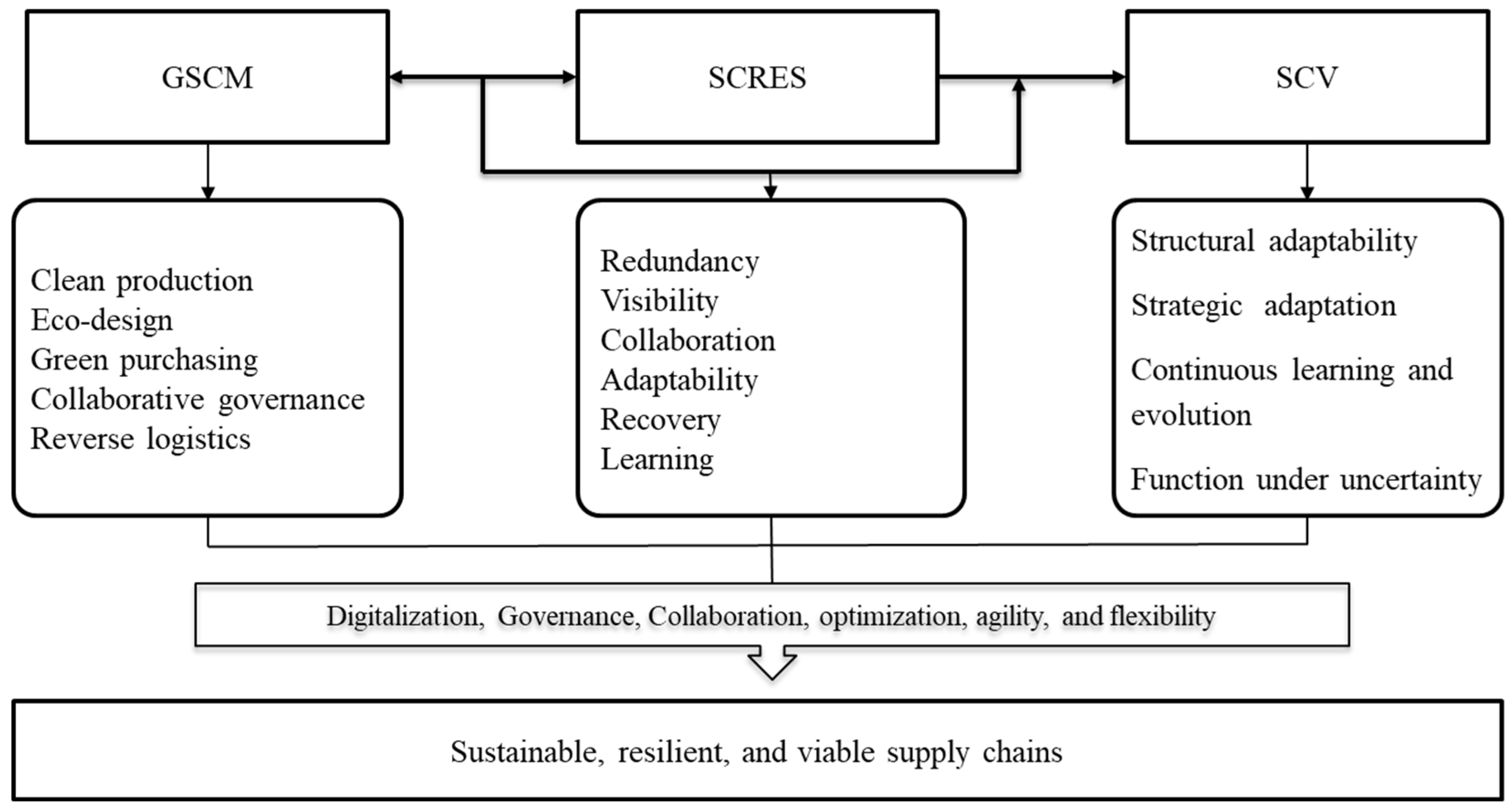
1.1. Conceptual Framework of the Study
1.2. Scope of the Review
1.3. Objective of the Systematic Literature Review
1.4. Research Gap and Rationale
1.5. Research Questions
- What are the most cited and widely adopted green supply chain (GSCM) practices identified in the literature?
- To what extent do these green supply chain practices have an impact on SCRES?
- Does the integration of GSCM and resilience contribute to supply chain viability?
- What trade-offs or synergies are identified among resilience, viability, and green supply chains?
- What optimization or modeling approaches are used to solve GSCM with resilience and viability problems?
2. Methodology
2.1. Review Approach
2.2. PICO Framework
2.3. Search Strategy and Data Sources
- Keywords used
- Scopus: (“green supply chain” OR “sustainable supply chain”) AND “resilience” AND (“viability” OR “sustainability”) AND (“optimization” OR “modeling”)
- Web of Science: (“green supply chain” OR “sustainable supply chain”) AND resilience AND (optimization OR modelling OR “mathematical model” OR “decision model”)
- ScienceDirect: “Green supply chain” AND “resilience” AND “viability” AND “optimization.”
- Filters applied:
- Publication date: 2010 to 2024
- Languages: English and French
- Document types: Peer-reviewed journal articles
2.3.1. Inclusion and Exclusion Criteria
- Inclusion Criteria:
- Articles that include at least one of the targeted keywords: GSCM, SCRES, SCV, or optimization;
- Various types of studies: empirical, conceptual, or optimization-based;
- Articles with structured methodology and clearly presented results;
- Articles published in English or French between 2010 and 2024.
- Exclusion Criteria:
- Studies that address green practices, resilience, viability, or optimization but are unrelated to supply chain contexts;
- Duplicate or inaccessible full texts;
- Papers that are not within the selected time period;
- Studies published in a language other than English or French.
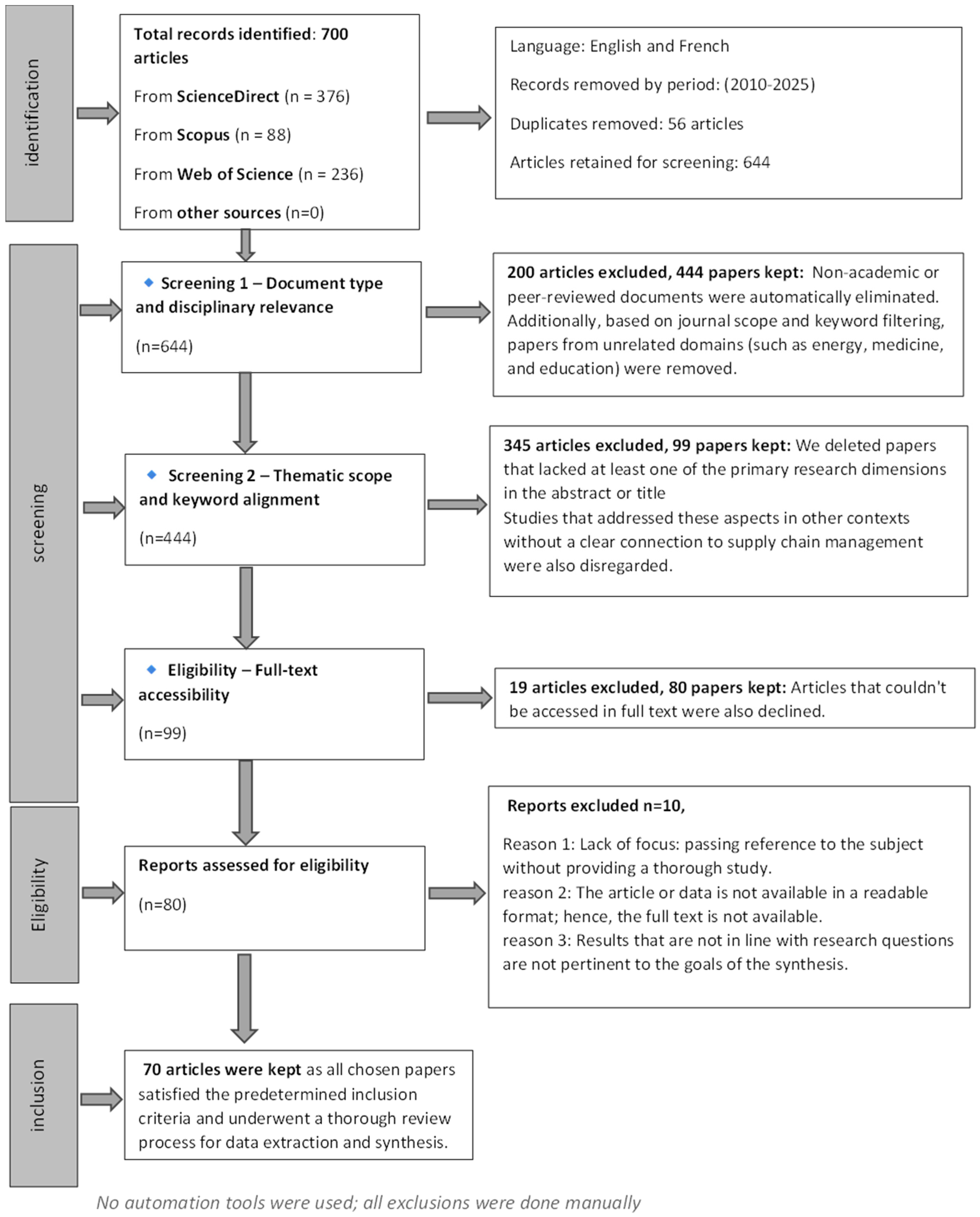
2.3.2. Article Screening and Selection Process
2.4. Prisma Chart Flow
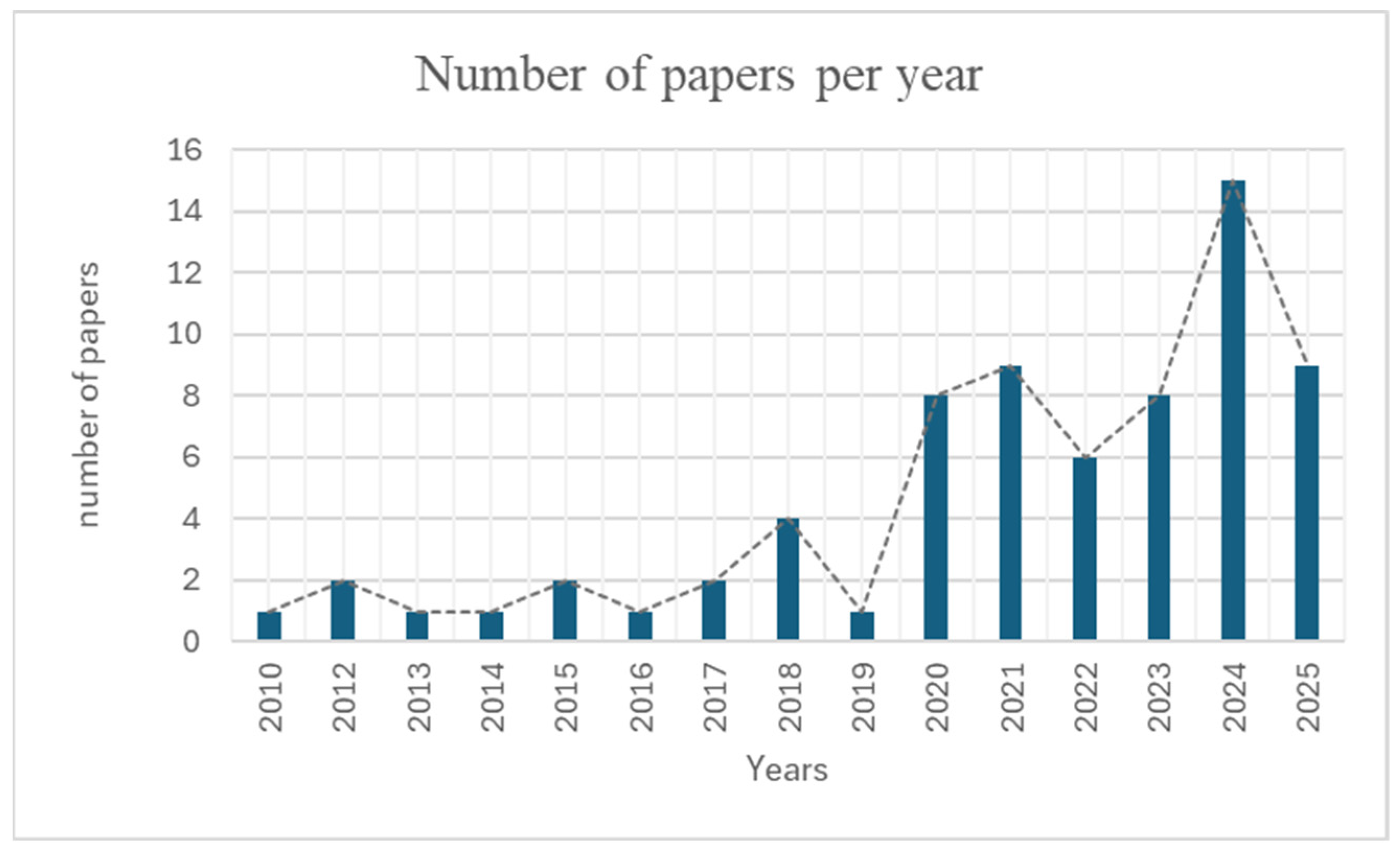
2.5. Descriptive Analysis of Selected Articles
2.6. Qualitative Analysis Approach
3. Green Supply Chain Management (GSCM) Practices
3.1. Introduction
3.2. Core Green Practices
3.2.1. Internal Environmental Management (IEM)
3.2.2. Green Purchasing (GP)
3.2.3. Eco-Design (ED)
3.2.4. Green Manufacturing (GM)
3.2.5. Green Logistics and Warehousing
3.2.6. Reverse Logistics (RL) and Investment Recovery (IR)
3.2.7. Collaboration, Digitalization, and Human Capital as Enablers of GSCM
3.3. Performance Outcomes
3.3.1. Impact of Green Supply Chain Management (GSCM) Practices on Performance
3.3.2. Critical Integration of GSCM Results
4. Supply Chain Resilience (SCRES)
4.1. Conceptualization and Positioning
4.2. Intra- and Inter-Organizational Antecedents of Resilience
4.3. Dynamic Capabilities and Organizational Enablers
4.4. Strategies for Resilience Across Disruption Phases
- -
- -
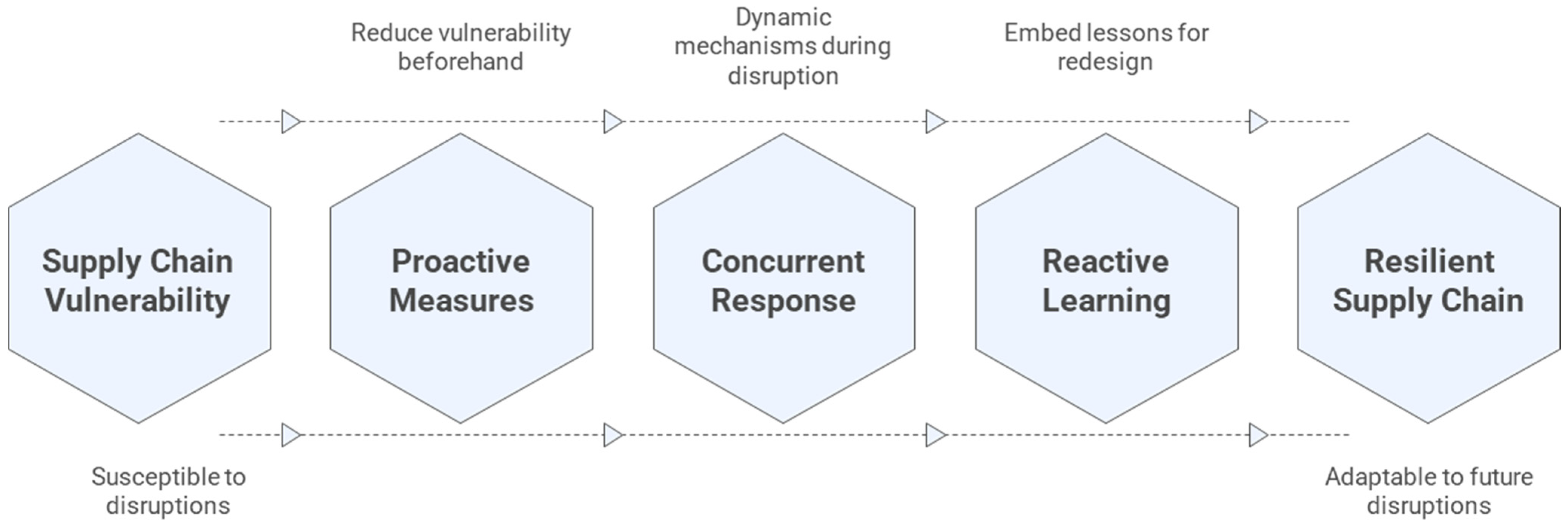
- During disruption (Concurrent): a dynamic readjustment mechanism is mandatory to maintain operation, including broad and real-time data sharing, resource reallocation, and the possibility of use of temporary facilities [9].
- -
- Post-disruption (Reactive and Learning): recovery mechanisms are coupled with organizational learning and reconfiguration, anchoring the lessons learned from the disruption and making them the first barriers to anticipate new potential disruptions [32].
4.5. Measurement and Instrumentation
4.6. Trade-Offs, Green Practices, and the Viability Nexus
5. Supply Chain Viability
5.1. Conceptualization and Consensus
5.2. Strategic Enablers and Mechanisms
5.3. Financial and Circular Economy Enablers of Supply Chain Viability
5.4. Trade-Offs, Boundary Conditions, and Sectoral Contexts
5.5. Measurement and Managerial Instrumentation
5.5.1. Consensus Framing Through ARS and KPIs
5.5.2. Organizational Diagnostics via Ruel’s Scale
5.5.3. Decision Dashboards Within a Viability Envelope
5.5.4. Evidence Summary
5.5.5. Critical Integration of SCV Results
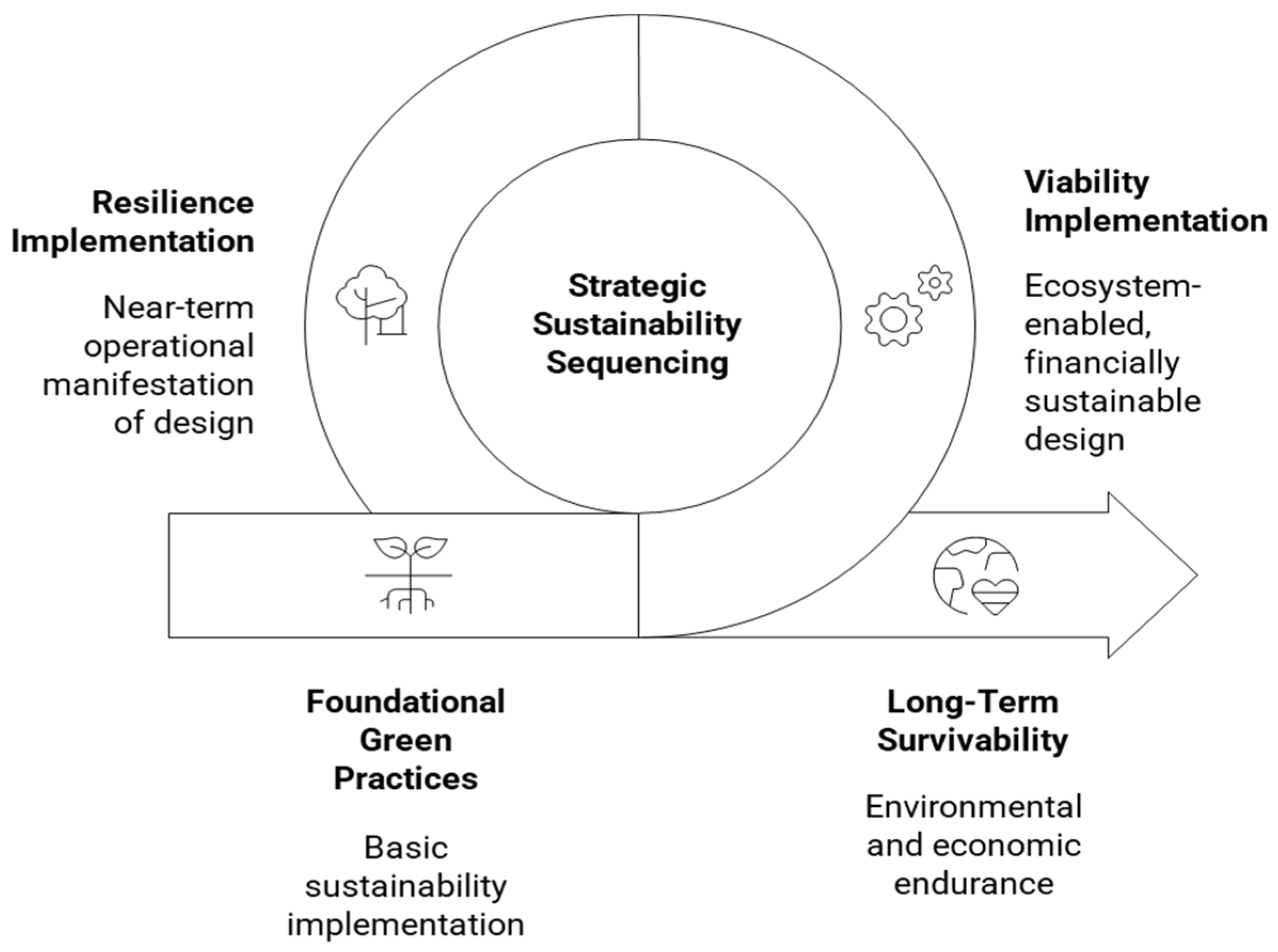
5.6. Positioning in the Literature Review
6. Modeling and Optimization Approaches in Green, Resilient, Viable Supply Chains
6.1. Overview of Modeling Paradigms
6.2. Key Findings from Optimization Studies
6.3. Implications and Research Outlook
- The operationalization of the ARS triad into measurable goals that could guarantee profitability, sustainability, and resilience;
- The enablement of trade-off and synergy analyses between green supply chain management and adaptive capabilities;
- The identification of high-impact levers, such as process flexibility, dual sourcing, and circular flows.
7. Research Gaps and Future Research Agenda
7.1. Answers to the Research Questions
- RQ1: Which green supply chain practices are the most commonly used?
- According to the review, the most widely used GSCM methods across industries include internal environmental management, green purchasing, eco-design, reverse logistics, and cooperation.
- RQ2: How much do these practices affect the resilience of the supply chain?
- Although their impacts are frequently context-dependent and linked to short-term cost trade-offs, the evidence demonstrates that green practices improve resilience by enhancing flexibility, visibility, and collaboration.
- RQ3: Does supply chain viability benefit from the integration of GSCM and resilience?
- Results show that resilience serves as a prerequisite for viability but is not sufficient. Resilience- and sustainability-focused practices both interact to produce long-term viability, which is bolstered by structural adaptation mechanisms.
- RQ4: What synergies and trade-offs are found?
- Cost versus redundancy and emissions versus network dispersion are common trade-offs throughout research, but circularity, digitalization, and cooperative governance show synergies.
- RQ5: Which modeling and optimization techniques are applied?
- Supply chain viability is frequently addressed implicitly or through proxy indicators in most of the quantitative research that uses resilience-oriented optimization models. There is still little explicit modeling of long-term structural adaptation.
7.2. Research Gaps
7.2.1. Discovering the Mechanisms Connecting Resilience, Viability, and Green Practices
7.2.2. Improving Viability Measurement and Operationalization
7.2.3. Capturing Adaptive Capabilities Temporal Dynamics
7.2.4. Underexplored Technological, Human, and Institutional Enablers
7.2.5. Taking Context-Specific Limitations and Vulnerabilities into Account
7.3. Future Research Agenda
7.3.1. Develop an Integrated Theoretical Framework and Standardized Measurement Systems
7.3.2. Combine Empirical Validation with Digital and Technological Enablers
7.3.3. Advance Integrative, Data-Driven, and Multi-Level Modeling Approaches
7.3.4. Embedding Human, Institutional, and Governance Mechanisms
8. Theoretical Contribution and Conclusions
Supplementary Materials
Author Contributions
Funding
Institutional Review Board Statement
Informed Consent Statement
Data Availability Statement
Conflicts of Interest
References
- Wieland, A. Dancing the Supply Chain: Toward Transformative Supply Chain Management. J. Supply Chain Manag. 2021, 57, 58–73. [Google Scholar] [CrossRef] [Scilit]
- Green, K.W., Jr.; Zelbst, P.J.; Meacham, J.; Bhadauria, V.S. Green supply chain management practices: Impact on performance. Supply Chain Manag. Int. J. 2012, 17, 290–305. [Google Scholar] [CrossRef] [Scilit]
- Rahman, H.U.; Zahid, M.; Ullah, M.; Al-Faryan, M.A.S. Green supply chain management and firm sustainable performance: The awareness of China Pakistan Economic Corridor. J. Clean. Prod. 2023, 414, 137502. [Google Scholar] [CrossRef] [Scilit]
- Hasani, A.; Mokhtari, H.; Fattahi, M. A multi-objective optimization approach for green and resilient supply chain network design: A real-life case study. J. Clean. Prod. 2021, 278, 123199. [Google Scholar] [CrossRef] [Scilit]
- Mirzaee, H.; Samarghandi, H.; Willoughby, K. Comparing resilience strategies for a multistage green supply chain to mitigate disruptions: A two-stage stochastic optimization model. J. Clean. Prod. 2024, 471, 143165. [Google Scholar] [CrossRef] [Scilit]
- Asif, M.S.; Lau, H.; Nakandala, D.; Fan, Y.; Hurriyet, H. Adoption of green supply chain management practices through collaboration approach in developing countries—From literature review to conceptual framework. J. Clean. Prod. 2020, 276, 124191. [Google Scholar] [CrossRef] [Scilit]
- Junejo, I.; Sohu, J.M.; Alwadi, B.M.; Ejaz, F.; Nasir, A.; Hossain, B. Green supply chain management and SMEs sustainable performance in developing country: Role of green knowledge sharing, green innovation and big data-driven supply chain. Discov. Sustain. 2025, 6, 342. [Google Scholar] [CrossRef] [Scilit]
- Sawik, T. A stochastic optimisation approach to maintain supply chain viability under the ripple effect. Int. J. Prod. Res. 2023, 61, 2452–2469. [Google Scholar] [CrossRef] [Scilit]
- Ali, A.; Mahfouz, A.; Arisha, A. Analysing supply chain resilience: Integrating the constructs in a concept mapping framework via a systematic literature review. SCM 2017, 22, 16–39. [Google Scholar] [CrossRef] [Scilit]
- Kochan, C.G.; Nowicki, D.R. Supply chain resilience: A systematic literature review and typological framework. Int. J. Phys. Distrib. Logist. Manag. 2018, 48, 842–865. [Google Scholar] [CrossRef] [Scilit]
- Conz, E.; Magnani, G. A dynamic perspective on the resilience of firms: A systematic literature review and a framework for future research. Eur. Manag. J. 2020, 38, 400–412. [Google Scholar] [CrossRef] [Scilit]
- Fahimnia, B.; Sarkis, J.; Talluri, S. Editorial: Design and Management of Sustainable and Resilient Supply Chains. IEEE Trans. Eng. Manag. 2019, 66, 2–7. [Google Scholar] [CrossRef] [Scilit]
- Negri, M.; Cagno, E.; Colicchia, C.; Sarkis, J. Integrating sustainability and resilience in the supply chain: A systematic literature review and a research agenda. Bus. Strat. Environ. 2021, 30, 2858–2886. [Google Scholar] [CrossRef] [Scilit]
- Kosasih, W.; Pujawan, I.N.; Karningsih, P.D.; Shee, H. Integrated lean-green practices and supply chain sustainability framework. Clean. Responsible Consum. 2023, 11, 100143. [Google Scholar] [CrossRef] [Scilit]
- Ruel, S.; El Baz, J.; Ivanov, D.; Das, A. Supply chain viability: Conceptualization, measurement, and nomological validation. Ann. Oper. Res. 2024, 335, 1107–1136. [Google Scholar] [CrossRef] [Scilit] [PubMed]
- Homayouni, Z.; Pishvaee, M.S.; Jahani, H.; Ivanov, D. A robust-heuristic optimization approach to a green supply chain design with consideration of assorted vehicle types and carbon policies under uncertainty. Ann. Oper. Res. 2023, 324, 395–435. [Google Scholar] [CrossRef] [Scilit]
- Sauer, P.C.; Seuring, S. How to conduct systematic literature reviews in management research: A guide in 6 steps and 14 decisions. Rev. Manag. Sci. 2023, 17, 1899–1933. [Google Scholar] [CrossRef] [Scilit]
- Ahmadini, A.A.H.; Modibbo, U.M.; Shaikh, A.A.; Ali, I. Multi-objective optimization modelling of sustainable green supply chain in inventory and production management. Alex. Eng. J. 2021, 60, 5129–5146. [Google Scholar] [CrossRef] [Scilit]
- Santos, J.A.M.; Martins, M.S.E.; Pinto, R.M.; Vieira, S.M. Towards Sustainable Inventory Management: A Many-Objective Approach to Stock Optimization in Multi-Storage Supply Chains. Algorithms 2024, 17, 271. [Google Scholar] [CrossRef] [Scilit]
- Hussaini, Z.; Nemati, A.; Paydar, M.M. A multi-period multi-season multi-objective mathematical model for guaranteeing the viability of supply chains under fluctuations: A healthcare closed-loop supply chain application. Ann. Oper. Res. 2025, 346, 1063–1108. [Google Scholar] [CrossRef] [Scilit]
- Ali, E.; Gossaye, W. The effects of supply chain viability on supply chain performance and marketing performance in case of large manufacturing firm in Ethiopia. Braz. J. Oper. Prod. Manag. 2023, 20, 1535. [Google Scholar] [CrossRef] [Scilit]
- Jayarathna, C.P.; Agdas, D.; Dawes, L. Viability of sustainable logistics practices enabling circular economy: A system dynamics approach. Bus. Strat. Environ. 2024, 33, 3422–3439. [Google Scholar] [CrossRef] [Scilit]
- Suksanchananun, W.; Kot, S.; Chaiyasoonthorn, W.; Chaveesuk, S. The model of White Supply Chain Management for sustainable performance in the food industry. Equilibrium 2024, 19, 1405–1448. [Google Scholar] [CrossRef] [Scilit]
- Wang, H. Green Supply Chain Optimization Based on BP Neural Network. Front. Neurorobot. 2022, 16, 865693. [Google Scholar] [CrossRef] [Scilit]
- Latpate, R.; Bhosale, M.; Kurade, S. Green Reverse Supply Chain Models with Fuzzy Stochastic Re-manufacturing Capacity. Int. J. Fuzzy Syst. 2024, 26, 403–417. [Google Scholar] [CrossRef] [Scilit]
- Alabdali, M.A.; Yaqub, M.Z.; Windsperger, J. Green digital leadership and algorithmic management for sustainable supply chains: A serial mediation model. Int. J. Inf. Manag. Data Insights 2025, 5, 100343. [Google Scholar] [CrossRef] [Scilit]
- Durach, C.F.; Wieland, A.; Machuca, J.A.D. Antecedents and dimensions of supply chain robustness: A systematic literature review. Int. J. Phys. Distrib. Logist. Manag. 2015, 45, 118–137. [Google Scholar] [CrossRef] [Scilit]
- Zhang, C.Y.; Ji, J.; Zhang, T. Can sustainable supply chain sustain supplier’s operational efficiency? Int. J. Prod. Econ. 2025, 285, 109640. [Google Scholar] [CrossRef] [Scilit]
- Zhao, N.; Hong, J.; Lau, K.H. Impact of supply chain digitalization on supply chain resilience and performance: A multi-mediation model. Int. J. Prod. Econ. 2023, 259, 108817. [Google Scholar] [CrossRef] [Scilit]
- Zhu, Q.; Sarkis, J.; Lai, K.-H. Examining the effects of green supply chain management practices and their mediations on performance improvements. Int. J. Prod. Res. 2012, 50, 1377–1394. [Google Scholar] [CrossRef] [Scilit]
- Ivanov, D.; Dolgui, A.; Blackhurst, J.V.; Choi, T.-M. Toward supply chain viability theory: From lessons learned through COVID-19 pandemic to viable ecosystems. Int. J. Prod. Res. 2023, 61, 2402–2415. [Google Scholar] [CrossRef] [Scilit]
- Liu, J.; Sarkar, S.; Kumar, S.; Jin, Z. An analysis of stock market impact from supply chain disruptions in Japan. Int. J. Prod. Perform. Manag. 2018, 67, 192–206. [Google Scholar] [CrossRef] [Scilit]
- Pettit, T.J.; Fiksel, J.; Croxton, K.L. ENSURING SUPPLY CHAIN RESILIENCE: DEVELOPMENT OF A CONCEPTUAL FRAMEWORK. J. Bus. Logist. 2010, 31, 1–21. [Google Scholar] [CrossRef] [Scilit]
- Wieland, A.; Durach, C.F. Two perspectives on supply chain resilience. J. Bus. Logist. 2021, 42, 315–322. [Google Scholar] [CrossRef] [Scilit]
- Li, F.; Zhang, H. The impact of green supply chain management on corporate performance under the full process model: A MASEM analysis based on heterogeneous moderation. J. Clean. Prod. 2024, 481, 144099. [Google Scholar] [CrossRef] [Scilit]
- Zhu, Q.; Feng, Y.; Choi, S.-B. The role of customer relational governance in environmental and economic performance improvement through green supply chain management. J. Clean. Prod. 2017, 155, 46–53. [Google Scholar] [CrossRef] [Scilit]
- Wen, X.; Cheah, J.-H.; Lim, X.-J.; Ramachandran, S. Why does “green” matter in supply chain management? Exploring institutional pressures, green practices, green innovation, and economic performance in the Chinese chemical sector. J. Clean. Prod. 2023, 427, 139182. [Google Scholar] [CrossRef] [Scilit]
- Zhao, X.; Li, S. Environmental uncertainty, supply chain, and stability of sustainable green innovation:Based on micro evidence from energy-intensive enterprises. J. Environ. Manag. 2024, 372, 123398. [Google Scholar] [CrossRef] [Scilit] [PubMed]
- Bahizire, G.M.; Sun, H.; Chen, T. Exploring the role of managerial green commitment in enhancing sustainability in Congo’s cobalt supply chain. J. Environ. Manag. 2024, 372, 122997. [Google Scholar] [CrossRef] [Scilit]
- Aslam, H.; Khan, A.Q.; Rashid, K.; Rehman, S.-U. Achieving supply chain resilience: The role of supply chain ambidexterity and supply chain agility. J. Manuf. Technol. Manag. 2020, 31, 1185–1204. [Google Scholar] [CrossRef] [Scilit]
- Çankaya, S.Y.; Sezen, B. Effects of green supply chain management practices on sustainability performance. J. Manuf. Technol. Manag. 2019, 30, 98–121. [Google Scholar] [CrossRef] [Scilit]
- Rasi, R.E.; Sohanian, M. A multi-objective optimization model for sustainable supply chain network with using genetic algorithm. J. Model. Manag. 2021, 16, 714–727. [Google Scholar] [CrossRef] [Scilit]
- Asha, L.N.; Aragon, L.G.; Dey, A.; Yodo, N. Location Optimization Strategies for Corn Production and Distribution towards Sustainable Green Supply Chain. Logistics 2024, 8, 78. [Google Scholar] [CrossRef] [Scilit]
- Abbasi, S.; Vlachos, I.; Samadzadeh, A.; Etemadifar, S.; Afshar, M.; Amra, M. Modelling a Logistics and Financial Supply Chain Network during the COVID-19 Era. Logistics 2024, 8, 32. [Google Scholar] [CrossRef] [Scilit]
- Moyo, E.H.; Carstens, S.; Walters, J. Simulation Model for a Sustainable Food Supply Chain in a Developing Country: A Case Study of the Banana Supply Chain in Malawi. Logistics 2024, 8, 85. [Google Scholar] [CrossRef] [Scilit]
- Shetty, S.K.; Bhat, K.S. Green supply chain management practices implementation and sustainability –A review. Mater. Today: Proc. 2022, 52, 735–740. [Google Scholar] [CrossRef] [Scilit]
- Yun, Y.; Chuluunsukh, A.; Gen, M. Sustainable Closed-Loop Supply Chain Design Problem: A Hybrid Genetic Algorithm Approach. Mathematics 2020, 8, 84. [Google Scholar] [CrossRef] [Scilit]
- Khot, S.B.; Thiagarajan, S. Unveiling the relationships between enablers in resiliently sustainable supply chains using an integrated TISM-Fuzzy MICMAC approach: Study of Indian automobile sector post-COVID-19. Multidiscip. Sci. J. 2024, 6, 2024256. [Google Scholar] [CrossRef] [Scilit]
- Jin, H.; Jiang, N.; Su, W.; Dalia, S. How does customer enterprise digitalization improve the green total factor productivity of state-owned suppliers: From the supply chain perspective. Omega 2025, 133, 103248. [Google Scholar] [CrossRef] [Scilit]
- Ahmed, W.; Ashraf, M.S.; Khan, S.A.; Kusi-Sarpong, S.; Arhin, F.K.; Kusi-Sarpong, H.; Najmi, A. Analyzing the impact of environmental collaboration among supply chain stakeholders on a firm’s sustainable performance. Oper. Manag. Res. 2020, 13, 4–21. [Google Scholar] [CrossRef] [Scilit]
- Imran, T.I.; Karmaker, C.L.; Karim, R.; Misbauddin, S.M.; Bari, A.B.M.M.; Raihan, A. Modeling the supply chain sustainability imperatives in the fashion retail industry: Implications for sustainable development. PLoS ONE 2024, 19, e0312671. [Google Scholar] [CrossRef] [Scilit]
- Stich, V.; Groten, M. Design and Simulation of a Logistics Distribution Network Applying the Viable System Model (VSM). Procedia Manuf. 2015, 3, 534–541. [Google Scholar] [CrossRef] [Scilit]
- Liu, F.; Song, J.; Tong, J.D. Building Supply Chain Resilience through Virtual Stockpile Pooling. Prod. Oper. Manag. 2016, 25, 1745–1762. [Google Scholar] [CrossRef] [Scilit]
- Simchi-Levi, D.; Wang, H.; Wei, Y. Increasing Supply Chain Robustness through Process Flexibility and Inventory. Prod. Oper. Manag. 2018, 27, 1476–1491. [Google Scholar] [CrossRef] [Scilit]
- Mohanty, R.; Prakash, A. Green supply chain management practices in India: An empirical study. Prod. Plan. Control 2014, 25, 1322–1337. [Google Scholar] [CrossRef] [Scilit]
- Katsela, K.; Pålsson, H. Viable business models for city logistics: Exploring the cost structure and the economy of scale in a Swedish initiative. Res. Transp. Econ. 2021, 90, 100857. [Google Scholar] [CrossRef] [Scilit]
- Kayani, S.A.; Warsi, S.S. Exploring the synergy between sustainability and resilience in supply chains under stochastic demand conditions and network disruptions. Results Eng. 2025, 26, 104954. [Google Scholar] [CrossRef] [Scilit]
- Berger-Douce, S. Capacité dynamique de résilience et RSE, l’alchimie gagnante face à la Covid-19 ? Rev. Int. P.M.E. 2021, 34, 100–120. [Google Scholar] [CrossRef] [Scilit]
- Feng, T.; Qamruzzaman, M.; Sharmin, S.S.; Karim, S. Bridging Environmental Sustainability and Organizational Performance: The Role of Green Supply Chain Management in the Manufacturing Industry. Sustainability 2024, 16, 5918. [Google Scholar] [CrossRef] [Scilit]
- Boutmir, Y.; Bannari, R.; Touil, A.; Fri, M.; Benmoussa, O. Dependent-Chance Goal Programming for Sustainable Supply Chain Design: A Reinforcement Learning-Enhanced Salp Swarm Approach. Sustainability 2025, 17, 6079. [Google Scholar] [CrossRef] [Scilit]
- Khan, M.T.; Idrees, M.D.; Rauf, M.; Sami, A.; Ansari, A.; Jamil, A. Green Supply Chain Management Practices’ Impact on Operational Performance with the Mediation of Technological Innovation. Sustainability 2022, 14, 3362. [Google Scholar] [CrossRef] [Scilit]
- Saeed, A.; Jun, Y.; Nubuor, S.A.; Priyankara, H.P.R.; Jayasuriya, M.P.F. Institutional Pressures, Green Supply Chain Management Practices on Environmental and Economic Performance: A Two Theory View. Sustainability 2018, 10, 1517. [Google Scholar] [CrossRef] [Scilit]
- Zarreh, M.; Khandan, M.; Goli, A.; Aazami, A.; Kummer, S. Integrating Perishables into Closed-Loop Supply Chains: A Comprehensive Review. Sustainability 2024, 16, 6705. [Google Scholar] [CrossRef] [Scilit]
- Ghazvinian, A.; Feng, B.; Feng, J.; Talebzadeh, H.; Dzikuć, M. Lean, Agile, Resilient, Green, and Sustainable (LARGS) Supplier Selection Using Multi-Criteria Structural Equation Modeling under Fuzzy Environments. Sustainability 2024, 16, 1594. [Google Scholar] [CrossRef] [Scilit]
- Guerra, J.D.; Palomino, G.; Yildiz, O.; Macassi, I.A.; Alvarez, J.C. Re-Designing Business Process Models for Enhancing Sustainability in Spinach Production Through Lean Tools with Digital Transformation. Sustainability 2025, 17, 5673. [Google Scholar] [CrossRef] [Scilit]
- Mahar, A.S.; Zhang, Y.; Sadiq, B.; Gul, R.F. Sustainability Transformation Through Green Supply Chain Management Practices and Green Innovations in Pakistan’s Manufacturing and Service Industries. Sustainability 2025, 17, 2204. [Google Scholar] [CrossRef] [Scilit]
- Suriyankietkaew, S.; Krittayaruangroj, K.; Iamsawan, N. Sustainable Leadership Practices and Competencies of SMEs for Sustainability and Resilience: A Community-Based Social Enterprise Study. Sustainability 2022, 14, 5762. [Google Scholar] [CrossRef] [Scilit]
- Agyabeng-Mensah, Y.; Ahenkorah, E.; Afum, E.; Dacosta, E.; Tian, Z. Green warehousing, logistics optimization, social values and ethics and economic performance: The role of supply chain sustainability. Int. J. Logist. Manag. 2020, 31, 549–574. [Google Scholar] [CrossRef] [Scilit]
- Liu, A.; Zhu, Q.; Xu, L.; Lu, Q.; Fan, Y. Sustainable supply chain management for perishable products in emerging markets: An integrated location-inventory-routing model. Transp. Res. Part E Logist. Transp. Rev. 2021, 150, 102319. [Google Scholar] [CrossRef] [Scilit]
- Nascimento, C.d.O.L.; Rigatto, I.B.; de Oliveira, L.K. Characterization and analysis of the economic viability of cycle logistics transport in Brazil. Transp. Res. Procedia 2020, 46, 189–196. [Google Scholar] [CrossRef] [Scilit]
- Katsela, K. Viable business models for city logistics: Exploring the cost structure and revenue streams of fourteen European cases. Transp. Res. Procedia 2025, 82, 3889–3899. [Google Scholar] [CrossRef] [Scilit]
- Alashhab, M.S. DEVELOPING A ROBUST GREEN SUPPLY CHAIN PLANNING OPTIMIZATION MODEL CONSIDERING POTENTIAL RISKS. Int. J. GEOMATE 2020, 19, 208–215. [Google Scholar] [CrossRef] [Scilit]
- Laosirihongthong, T.; Adebanjo, D.; Tan, K.C. Green supply chain management practices and performance. Ind. Manag. Data Syst. 2013, 113, 1088–1109. [Google Scholar] [CrossRef] [Scilit]



| Reference | GSCM Dimension | SCRES Dimension | Viability SCV Dimension |
|---|---|---|---|
| Ali, Mahfouz & Arisha (2017): Analyzing supply chain resilience: integrating the constructs in a concept mapping framework via a systematic literature review [9] | Not explored | Explicitly incorporated | Not explored |
| Kochan & Nowicki (2018): Supply chain resilience: a systematic literature review and typological framework [10] | Not explored | Explicitly incorporated | Not explored |
| Conz & Magnani (2020): A dynamic perspective on the resilience of firms: A systematic literature review [11] | Not explored | Explicitly addressed | Indirectly incorporated |
| Fahimnia, B., Sarkis, J., & Talluri, S. (2019): Design and Management of Sustainable and Resilient Supply Chains [12] | Partially integrated | Explicitly addressed | Not explored |
| Negri et al. (2021): Sustainability and resilience in supply chains: a literature review and research agenda [13] | Explicitly addressed | Explicitly addressed | Not explored |
| Asif et al. (2020): Adoption of green supply chain management practices: literature review to conceptual framework [6] | Explicitly addressed | Omitted | Not addressed |
| Kosasih et al. (2023)—Integrated lean-green practices and supply chain sustainability framework [14] | Explicitly addressed | Indirectly integrated | Not explored |
| Ruel et al. (2024)—Supply chain viability: conceptualization, measurement, and nomological validation [15] | Not explored | Indirectly integrated | Explicitly addressed |
| Ivanov (2022, 2023)—Viable supply chain viability ecosystem frameworks [16] | Not explored | Explicitly addressed | Explicitly addressed |
| PICO Elements | Description | Application in This Review |
|---|---|---|
| Population (P) | Target context | Supply chains currently lack sustainability and operate under unpredictable disruptions across sectors such as manufacturing, logistics, and distribution, as evidenced by measurable indicators (e.g., frequency of disruption, waste rate, and carbon emissions) |
| Intervention (I) | What are/the Main strategies | Green supply chain management (GSCM), green practices (GPs), supply chain resilience (SCRES), and viability approaches (SCVs) |
| Comparison (C) | Reference point/benchmark | Traditional supply chains vs. modern green, resilient, and viable supply chains |
| Outcomes (O) | Expected results | Quantifiable outcomes such as operational metrics (cost to serve, lead time, and service level), environmental indicators (carbon emission, waste reduction), resilience indicators (disruption cost, TTR, TTS), and viability indicators (adaptability rate, continuity, and circularity rate) |
| Journal | Number of Articles |
|---|---|
| Sustainability | 9 |
| Journal of Cleaner Production | 7 |
| Annals of Operations Research | 3 |
| International Journal of Production Research | 3 |
| Logistics | 3 |
| Journal of Environmental Management | 2 |
| Journal of Business Logistics | 2 |
| International Journal of Production Economics | 2 |
| Journal of Manufacturing Technology Management (JMTM) | 2 |
| Production and Operations Management | 2 |
| Transportation Research Procedia | 2 |
| Alexandria Engineering Journal | 1 |
| Algorithms | 1 |
| Brazilian Journal of Operations & Production Management (BJO&PM) | 1 |
| Business Strategy and the Environment (Bus Strat Env) | 1 |
| Cleaner and Responsible Consumption | 1 |
| Supply Chain Management: An International Journal (SCM) | 1 |
| Equilibrium Quarterly Journal of Economics and Economic Policy (eq) | 1 |
| European Management Journal | 1 |
| Transportation Research Part E: Logistics and Transportation Review | 1 |
| Industrial Management & Data Systems | 1 |
| International Journal of Fuzzy Systems | 1 |
| International Journal of Information Management Data Insights | 1 |
| International Journal of Physical Distribution & Logistics Management | 1 |
| International Journal of Physical Distribution & Logistics Management (IJPDLM) | 1 |
| International Journal of Productivity and Performance Management (IJPPM) | 1 |
| Journal of Modelling in Management (JM2) | 1 |
| Journal of Supply Chain Management | 1 |
| Materials Today: Proceedings | 1 |
| Supply Chain Management: An International Journal | 1 |
| Multidisciplinary Science Journal | 1 |
| The International Journal of Logistics Management (IJLM) | 1 |
| Operations Management Research | 1 |
| PLoS ONE | 1 |
| Procedia Manufacturing | 1 |
| Production Planning & Control | 1 |
| Research in Transportation Economics | 1 |
| Results in Engineering | 1 |
| Revue internationale P.M.E. | 1 |
| Mathematics | 1 |
| Discover Sustainability | 1 |
| Omega | 1 |
| Frontiers in Neurorobotics | 1 |
| International Journal of GEOMATE | 1 |
| Year | Number of Articles |
|---|---|
| 2010 | 1 |
| 2012 | 2 |
| 2013 | 1 |
| 2014 | 1 |
| 2015 | 2 |
| 2016 | 1 |
| 2017 | 2 |
| 2018 | 4 |
| 2019 | 1 |
| 2020 | 8 |
| 2021 | 9 |
| 2022 | 6 |
| 2023 | 8 |
| 2024 | 15 |
| 2024 | 9 |
| Journal | Paper Title |
|---|---|
| Alexandria Engineering Journal | Multi-objective optimization modelling of sustainable green supply chain in inventory and production management [18] |
| Algorithms | Towards Sustainable Inventory Management: A Many-Objective Approach to Stock Optimization in Multi-Storage Supply Chains [19] |
| Annals of Operations Research | A robust heuristic approach to a green supply chain design with consideration of assorted vehicle types and carbon policies under uncertainty [16] |
| Supply chain viability: conceptualization, measurement, and nomological validation [15] | |
| A multi-period multi-season multi-objective mathematical model for guaranteeing the viability of supply chains under fluctuations: a healthcare closed-loop supply chain application [20] | |
| Brazilian Journal of Operations & Production Management (BJO&PM) | The effects of supply chain viability on supply chain performance and marketing performance in case of large manufacturing firm in Ethiopia [21] |
| Business Strategy and the Environment (Bus Strat Env) | Viability of sustainable logistics practices enabling circular economy: A system dynamics approach [22] |
| Cleaner and Responsible Consumption | Integrated lean-green practices and supply chain sustainability framework [14] |
| Discover Sustainability | Green supply chain management and SMEs sustainable performance in developing countries: role of green knowledge sharing, green innovation and big data-driven supply chain [7] |
| Equilibrium Quarterly Journal of Economics and Economic Policy (eq) | The model of White Supply Chain Management for sustainable performance in the food industry [23] |
| European Management Journal | A dynamic perspective on the resilience of firms: A systematic literature review and a framework for future research [11] |
| Frontiers in Neurorobotics | Green Supply Chain Optimization Based on BP Neural Network [24] |
| Industrial Management & Data Systems | Green supply chain management practices and performance [2] |
| International Journal of Fuzzy Systems | Green Reverse Supply Chain Models with Fuzzy Stochastic Re-manufacturing Capacity [25] |
| International Journal of Information Management Data Insights | Green digital leadership and algorithmic management for sustainable supply chains: A serial mediation model [26] |
| International Journal of Physical Distribution & Logistics Management | Antecedents and dimensions of supply chain robustness: a systematic literature review [27] |
| International Journal of Physical Distribution & Logistics Management (IJPDLM) | Supply chain resilience: a systematic literature review and typological framework [10] |
| International Journal of Production Economics | Can sustainable supply chain sustain supplier’s operational efficiency? [28] |
| Impact of supply chain digitalization on supply chain resilience and performance: A multi-mediation model [29] | |
| A stochastic optimization approach to maintain supply chain viability under the ripple effect [8] | |
| Examining the effects of green supply chain management practices and their mediations on performance improvements [30] | |
| Toward supply chain viability theory: from lessons learned through COVID-19 pandemic to viable ecosystems [31] | |
| International Journal of Productivity and Performance Management (IJPPM) | An analysis of stock market impact from supply chain disruptions in Japan [32] |
| Journal of Business Logistics | ENSURING SUPPLY CHAIN RESILIENCE: DEVELOPMENT OF A CONCEPTUAL FRAMEWORK [33] |
| Two perspectives on supply chain resilience [34] | |
| Journal of Cleaner Production | A multi-objective optimization approach for green and resilient supply chain network design: A real-life case study [4] |
| Adoption of green supply chain management practices through a collaboration approach in developing countries—From literature review to conceptual framework [6] | |
| Comparing resilience strategies for a multistage green supply chain to mitigate disruptions: A two-stage stochastic optimization model [5] | |
| Green supply chain management and firm sustainable performance: The awareness of China Pakistan Economic Corridor [3] | |
| The impact of green supply chain management on corporate performance under the full process model: A MASEM analysis based on heterogeneous moderation [35] | |
| The role of customer relational governance in environmental and economic performance improvement through green supply chain management [36] | |
| Why does “green” matter in supply chain management? Exploring institutional pressures, green practices, green innovation, and economic performance in the Chinese chemical sector [37] | |
| Journal of Environmental Management | Environmental uncertainty, supply chain, and stability of sustainable green innovation: Based on micro evidence from energy-intensive enterprises [38] |
| Exploring the role of managerial green commitment in enhancing sustainability in Congo’s cobalt supply chain [39] | |
| Journal of Manufacturing Technology Management (JMTM) | Achieving supply chain resilience: the role of supply chain ambidexterity and supply chain agility [40] |
| Effects of green supply chain management practices on sustainability performance [41] | |
| Journal of Modelling in Management (JM2) | A multi-objective optimization model for a sustainable supply chain network with using genetic algorithm [42] |
| Journal of Supply Chain Management | Dancing the Supply Chain: Toward Transformative Supply Chain Management [1] |
| Logistics | Location Optimization Strategies for Corn Production and Distribution towards Sustainable Green Supply Chain [43] |
| Modelling a Logistics and Financial Supply Chain Network during the COVID-19 Era [44] | |
| Simulation Model for a Sustainable Food Supply Chain in a Developing Country: A Case Study of the Banana Supply Chain in Malawi [45] | |
| Materials Today: Proceedings | Green supply chain management practices implementation and sustainability—A review [46] |
| Mathematics | Sustainable Closed-Loop Supply Chain Design Problem: A Hybrid Genetic Algorithm Approach [47] |
| Multidisciplinary Science Journal | Unveiling the relationships between enablers in resiliently sustainable supply chains using an integrated TISM-Fuzzy MICMAC approach: Study of Indian automobile sector post-COVID-19 [48] |
| Omega | How does customer enterprise digitalization improve the green total factor productivity of state-owned suppliers: From the supply chain perspective [49] |
| Operations Management Research | Analyzing the impact of environmental collaboration among supply chain stakeholders on a firm’s sustainable performance [50] |
| PLoS ONE | Modeling the supply chain sustainability imperatives in the fashion retail industry: Implications for sustainable development [51] |
| Procedia Manufacturing | Design and Simulation of a Logistics Distribution Network Applying the Viable System Model (VSM) [52] |
| Production and Operations Management | Building Supply Chain Resilience through Virtual Stockpile Pooling [53] |
| Increasing Supply Chain Robustness through Process Flexibility and Inventory [54] | |
| Production Planning & Control | Green supply chain management practices in India: an empirical study [55] |
| Research in Transportation Economics | Viable business models for city logistics: Exploring the cost structure and the economy of scale in a Swedish initiative [56] |
| Results in Engineering | Exploring the synergy between sustainability and resilience in supply chains under stochastic demand conditions and network disruptions [57] |
| Revue internationale P.M.E. | Capacité dynamique de résilience et RSE, l’alchimie gagnante face à la COVID-19? [58] |
| Supply Chain Management: An International Journal | Green supply chain management practices: impact on performance [2] |
| Supply Chain Management: An International Journal (SCM) | Analyzing supply chain resilience: integrating the constructs in a concept mapping framework via a systematic literature review [9] |
| Sustainability | Bridging Environmental Sustainability and Organizational Performance: The Role of Green Supply Chain Management in the Manufacturing Industry [59] |
| Dependent-Chance Goal Programming for Sustainable Supply Chain Design: A Reinforcement Learning-Enhanced Slap Swarm Approach [60] | |
| Green Supply Chain Management Practices’ Impact on Operational Performance with the Mediation of Technological Innovation [61] | |
| Institutional Pressures, Green Supply Chain Management Practices on Environmental and Economic Performance: A Two Theory View [62] | |
| Integrating Perishables into Closed-Loop Supply Chains: A Comprehensive Review [63] | |
| Lean, Agile, Resilient, Green, and Sustainable (LARGS) Supplier Selection Using Multi-Criteria Structural Equation Modeling under Fuzzy Environments [64] | |
| Re-Designing Business Process Models for Enhancing Sustainability in Spinach Production Through Lean Tools with Digital Transformation [65] | |
| Sustainability Transformation Through Green Supply Chain Management Practices and Green Innovations in Pakistan’s Manufacturing and Service Industries [66] | |
| Sustainable Leadership Practices and Competencies of SMEs for Sustainability and Resilience: A Community-Based Social Enterprise Study [67] | |
| The International Journal of Logistics Management (IJLM) | Green warehousing, logistics optimization, social values and ethics, and economic performance: the role of supply chain sustainability [68] |
| Transportation Research Part E: Logistics and Transportation Review | Sustainable supply chain management for perishable products in emerging markets: An integrated location–inventory–routing model [69] |
| Transportation Research Procedia | Characterization and analysis of the economic viability of cycle logistics transport in Brazil [70] |
| Viable business models for city logistics: exploring the cost structure and revenue streams of fourteen European cases [71] | |
| International Journal of GEOMATE | DEVELOPING A ROBUST GREEN SUPPLY CHAIN PLANNING OPTIMIZATION MODEL CONSIDERING POTENTIAL RISKS [72] |
| Main Theme | Sub-Themes/Codes | Key Insight |
|---|---|---|
| GSCM Practices | IEM, Eco-Design, Reverse Logistics, Collaboration, Green Purchasing, and Production. | enhance operational and environmental performance, variable short-term costs [3,30,61]. |
| SCRES Capabilities | Redundancy, Flexibility, Agility, Visibility | Provide for adaptive continuity in the face of disruption [9,10,40]. |
| SCV Enablers | Digitalization, Ecosystem Governance, Circular Economy, Leadership | Maintain performance and flexibility over a long period [31,66]. |
| Modeling/Optimization | Multi-objective, Stochastic, Metaheuristic, AI-driven | Measure and operationalize the costs, emissions, and resilience trade-offs [4,8]. |
| GSCM Practices | Environmental Performance | Economic Performance | Operational Performance | Social Performance |
|---|---|---|---|---|
| Internal Environmental Management (IEM) | Great improvements in emission reduction and regulatory compliance [39] | Enhances efficiency and cost savings in the long term [41], but requires high initial implementation costs | Improves flexibility and quality [59] | Strengthens CSR and employee engagement, building trust and societal value [66] |
| Green Purchasing (GP) | Positive, although very dependent on institutional pressure [37] | Mixed: potential long-term cost reductions, but significant initial investment burden [3] | Improves supplier coordination [73], though supplier reliability remains variable | Mostly indirect social effects |
| Eco-Design (ED) | Reduces waste and ensures regulatory compliance [41] | High upfront costs, with long-term gains through innovation [3] | Stimulates product and process innovation [61,66], though it may slow time-to-market | Enhances corporate image [61] |
| Green Manufacturing (GM) | Reduces resource usage and pollution [46] | Improves financial performance when sustained [3], but initial efficiency losses may occur | Enhances productivity and quality [61] | — |
| Green Distribution and Packaging | Reduces logistics-related carbon impact and footprint [41] | Supports cost efficiency in transportation [61], but sustainable packaging often increases costs | Shorter lead times and reduced waste | — |
| Reverse Logistics (RL) | Promotes circularity and recycling [47] | Generates financial value recovery [61], though collection and transport costs can be high | Improves return management [55] | Reduces waste and creates recycling-related jobs [23] |
| Collaboration (Customers and Suppliers) | Customer collaboration yields environmental and financial benefits [36] | Supplier collaboration shows weaker environmental but stronger financial effects [3] | Improves flexibility and resilience [5], though coordination can be resource-intensive | Builds trust, partnerships, and societal value [67] |
| Green Information Systems/Digitalization | Enables traceability and emission monitoring [29,49] | Reduces hidden costs and enhances GTFP [49], but overinvestment in digitalization may increase costs | Improves resilience and visibility [29] | — |
| Green HRM and Knowledge Sharing | Promotes a pro-environmental culture [7,66] | Reinforces sustainability and innovation [66], though training programs are costly and slow to yield returns | Stimulates green innovation [7] | Enhances employee engagement and ethical standards [67] |
| GSCM Practice | Key Synthesized Pattern | Contingency |
|---|---|---|
| Internal Environmental Management (IEM) | The IEM is considered a foundational enabler for advanced GSCM adoption. | Its effectiveness relies on top management’s commitment and guidance. |
| Green Purchasing (GP) | Effectiveness depends on different contexts, and positive outcomes could be achievable but not guaranteed. | To succeed in adopting GP, this is merely tied to external institutional pressure and supplier readiness. |
| Eco-Design (ED) | Eco-design is the main driver for green products and process innovation. | Eco-designing can improve brand image and promote long-term environmental benefits, but this will consequently slow time-to-market. |
| Collaboration with Customers | The value is created mutually and by collaboration, leading to shared environmental and economic benefits. | The effectiveness requires collaborative decisions, while the company may interfere at certain points (for example, when cost constraints do not allow it). |
| Collaboration with Suppliers | Resilience-building patterns improve supply chain robustness and flexibility. | Supplier collaboration becomes more difficult in complex or dispersed supply chains. |
| Reverse Logistics (RL) | Reverse logistics is considered a cornerstone for circular economy integration. | While it aims to value and reduce waste, it is often challenged by high reverse network costs. |
| Green Digitalization | It improves traceability, monitoring, and efficiency. | If not well aligned with the core processes, it risks overinvestment and increased system complexity. |
| Indicator | Purpose |
|---|---|
| TTR (Time to Recover) | The total period of time needed after an interruption of a supply chain node to regain normal operations [33] |
| TTS (Time to Survive) | The longest duration for which the supply chain can continue to satisfy demand without replenishing after a disruption [54] |
| Service-level continuity | Capacity to sustain desired service levels both during and following interruptions [15] |
| Carbon intensity of recovery | Environmental cost of restoring operations [29] |
| Liquidity and financial buffers | Capacity to provide working capital and cash flow in times of crisis [32] |
| Aspect | Resilience | Viability |
|---|---|---|
| Time scope | Short-term to medium-term | Long-term/continuous |
| Purpose | Absorb, adapt, and recover | Evolve under prolonged uncertainty |
| Nature | Operational capability | Strategic capability |
| Outcome | Stability and recovery | Long-term survivability |
| Domain | Trade-Off | Implication for Viability |
|---|---|---|
| Dispersion vs. emissions [4] | The more we increase nodes, the more we ensure the continuity and reduce disruption risks. | A high number of nodes considerably raises the CO2 emissions, and this requires a balance between efficiency and sustainability. |
| Buffers vs. Performance [19,29] | Redundancy and safety stocks enhance preparedness and enable functioning under disrupted conditions. | High cost and energy burdens exceed benefits, pushing firms outside the viability zone. |
| Perishables (food/pharma) [45,69] | Balancing freshness, CO2 emissions, and delivery cost by implementing an efficient integrated location–inventory–routing (LIR) strategy. | Smallholders face infrastructure constraints (e.g., limited warehouses and lack of refrigerated transport), given that location–inventory–routing (LIR) is core to viable operations in perishable sectors. |
| Energy-intensive industries [38] | The green innovation adoption is restricted by regulatory uncertainty and high energy use. | The innovation pathways are increasingly destabilized with unclear policies and environmental uncertainty. |
| Emerging/developing markets [45,67] | SMEs rely on frugal digitalization and use community networks and decisive leadership. | Under resource constraints, viability is disproportionately shaped by these characteristics. |
| Key SCV Dimension | Core Insight from the Literature |
|---|---|
| Viability as a higher-order capability | Viability is no longer a stand-alone operational characteristic but rather a systemic competence that integrates sustainability, resilience, and agility [31]. |
| Structural and ecosystem reconfiguration | Ecosystem-level adaptation strategies, such as substitution, repurposing, and scalable network designs, are essential to long-term sustainability [15]. |
| Measurement and instrumentation of SCV | Multi-dimensional structures that capture structure, learning, redesign, and feedback mechanisms can be used to evaluate viability [15]. |
| Digitalization as a viability enabler | Digital technologies emphasize trade-offs in viability-oriented design by improving reaction and recovery but potentially decreasing efficiency when abused [29]. |
| Financial and relational foundations of viability | Operating under extended stress requires both financial consistency and relational stability, which are bolstered by income diversification, PPPs, and enduring buyer–supplier relationships [35,71]. |
| Problem Focus | Deterministic Models | Stochastic Models | Robust Optimization | Data-Driven/Adaptive Models |
|---|---|---|---|---|
| Supply Chain Network Design | Fixed-parameter facility placement and capacity planning | Two-stage network design and scenario-based disruption modeling | Network configuration at its worst, with limited disruptions | Adaptive network reconfiguration made possible by digital twins |
| Inventory and Sourcing Management | Static safety stock and EOQ-based models | Inventory models driven by supply and demand uncertainties | Strong sourcing and safety stock practices | AI and learning algorithms for real-time inventory management |
| Production and Planning | Production and scheduling models that are deterministic | Planning for capacity and stochastic demand | Sturdy production schedules in the face of parameter uncertainty | Predictive analytics-based adaptive production planning |
| Transportation and Logistics | Planning for distribution and fixed routing | Uncertainty in transit duration or demand while using stochastic routing | Sturdy routing and distribution of transport capacity | Dynamic routing with digital platforms and real-time data |
| Closed-Loop and Circular Supply Chains | Deterministic models for recycling and reverse logistics | Modeling stochastic return flow | Sturdy circular network architecture | Data-driven lifetime analytics and circular optimization |
| Study | Model Type/Technique | Decision Focus | Main Findings and Insights |
|---|---|---|---|
| Hasani et al. (2021) [4] | Multi-objective MINLP (SPEA2–ALNS hybrid) | Dual sourcing and facility location | Dual sourcing and facility dispersion greatly enhance resilience while only slightly increasing CO2 emissions. |
| Mirzaee et al. (2024) [5] | Two-stage stochastic MILP | backup suppliers, safety stock, temporary facilities | The optimum cost–resilience trade-offs need combining safety stock and backup providers to achieve an effective balance in a disruptive environment. |
| Homayouni et al. (2023) [16] | Robust heuristic optimization | Green transport, carbon emission policies | Robust design reduces cost penalties while being viable across multiple regulatory scenarios. |
| Ahmadini et al. (2021) [18] | Fuzzy multi-objective MILP and goal programming | production planning and inventory management | Fuzzy goal programming enables practical solutions while maintaining constant environmental performance in times of demand unpredictability. |
| Yun et al. (2020) [47] | Hybrid genetic algorithm (closed-loop network) | Recycling and reverse logistics | Resource recovery and circular flow improve long-term viability via closed loops. |
| Wang (2022) [24] | Neural-network-based optimization | Real-time inventory and transport | AI-driven optimization improves decision-making and dynamic recovery during disruption phases. |
Disclaimer/Publisher’s Note: The statements, opinions and data contained in all publications are solely those of the individual author(s) and contributor(s) and not of MDPI and/or the editor(s). MDPI and/or the editor(s) disclaim responsibility for any injury to people or property resulting from any ideas, methods, instructions or products referred to in the content. |
© 2026 by the authors. Licensee MDPI, Basel, Switzerland. This article is an open access article distributed under the terms and conditions of the Creative Commons Attribution (CC BY) license.
Share and Cite
Chajae, H.; El Oualidi, M.A.; Hebaz, A.; Mharzi, H. Exploring the Interplay Between Green Practices, Resilience, and Viability in Supply Chains: A Systematic Literature Review. Logistics 2026, 10, 23. https://doi.org/10.3390/logistics10010023
Chajae H, El Oualidi MA, Hebaz A, Mharzi H. Exploring the Interplay Between Green Practices, Resilience, and Viability in Supply Chains: A Systematic Literature Review. Logistics. 2026; 10(1):23. https://doi.org/10.3390/logistics10010023
Chicago/Turabian StyleChajae, Hamza, Moulay Ali El Oualidi, Ali Hebaz, and Hasna Mharzi. 2026. "Exploring the Interplay Between Green Practices, Resilience, and Viability in Supply Chains: A Systematic Literature Review" Logistics 10, no. 1: 23. https://doi.org/10.3390/logistics10010023
APA StyleChajae, H., El Oualidi, M. A., Hebaz, A., & Mharzi, H. (2026). Exploring the Interplay Between Green Practices, Resilience, and Viability in Supply Chains: A Systematic Literature Review. Logistics, 10(1), 23. https://doi.org/10.3390/logistics10010023