Article

Determining the Optimal Order Quantity for Perishable Products Affected by Stochastic Transportation Delays

by
Banthita Kanchanasathita
,
Atchara Wangpa
,
Apisit Pitakcheun
and
Chirakiat Saithong
*
Department of Industrial Engineering, Faculty of Engineering at Kamphaeng Saen, Kasetsart University, Nakhon Pathom 73140, Thailand
*
Author to whom correspondence should be addressed.
Logistics 2026, 10(1), 22; https://doi.org/10.3390/logistics10010022
Submission received: 8 December 2025 / Revised: 9 January 2026 / Accepted: 12 January 2026 / Published: 15 January 2026

Abstract

Background: Transportation delays pose significant challenges for perishable products by reducing freshness, shortening selling duration, and causing lost sales during the delay. Methods: Motivated by the growing importance of transportation delays on perishable products, this study develops a single-period analytical expected profit expression to determine the optimal order quantity that maximizes expected profit. The model incorporates deterioration-driven price reductions, lost sales opportunities occurring during the delay, and the shortened selling duration resulting from delayed delivery, without imposing a specific probability distribution on the transportation delay duration. Results: Numerical experiments illustrate how key parameters influence the optimal order quantity and the corresponding expected profit. Deterioration reduces expected profit by primarily reducing the selling price. In addition, a higher disruption probability reduces both the optimal order quantity and the expected profit, while longer selling durations result in larger order quantities and yield higher expected profits. A low initial selling price can result in negative expected profit, indicating cases where placing the order is inappropriate. Conclusions: The findings offer managerial implications for determining optimal order quantities that maximize profit under transportation delays for perishable products.

1. Introduction

Supply chains play a crucial role as the backbone of product transportation, facilitating the movement of products across members. In current logistics operations, where uncertainties abound, transportation delays are common and are caused by several factors. For instance, in the United States, severe snowstorms caused significant delays, disrupting major transportation hubs and delaying the delivery of numerous parcels [1]. West Coast ports, including Los Angeles and Long Beach, experienced severe port congestion in January 2024 due to a surge in demand, rerouted cargo intended to avoid disruption in the Suez Canal, and limited port capacity. This port congestion led to significant shipping delays, higher transportation costs, product shortages, and lost business opportunities [2]. These factors result in delays that push the delivery beyond the expected schedule.
For the perishable product category, such as meat, vegetables, fruits, and flowers, which are characterized as having limited shelf lives, degrading quality leading to degrading value over time, transportation delays have a significant impact on the perishable product. The delay degrades product quality, thereby reducing profitability [3,4]. In addition, due to the limited shelf life, the effective selling period becomes shorter as the lead time increases, which is caused by transportation delays [5]. Additionally, the increase in delay duration results in a lost sale penalty [6]. Therefore, the current research considers this product category and proposes some approaches to address transportation delay problems properly.
Upon accepting the transportation delay risks passively for the perishable product category, determining an optimal order quantity is crucial in a single-period setting. Over-ordering can lead to product spoilage and subsequent disposal costs; conversely, under-ordering can lead to excessive shortage costs. Since the nature of the product category has a limited shelf life, delaying delivery should reduce the selling duration [5]. Moreover, the quality of products upon arrival could deteriorate due to transportation delays [4]. For example, a reduction in freshness resulting from prolonged delivery, such as visible deterioration or the emergence of an odor, requires the firm to adjust its selling prices downward; as a result, the adjusted selling prices lead to a decline in expected profit [3]. Considering the trade-off between overstocking and understocking, as well as the deterioration in product quality due to delivery delays, together with a shortened selling duration and the lost sale opportunity during these delays, this research aims to determine the optimal order quantity that maximizes the expected profit under the circumstances.
For the contribution of this research, this research bridges a gap in the literature by considering the stochastic duration of the transportation delay together with the lost sale opportunity during the delay for the perishable product category. While a few studies addressed the stochastic disruption duration, Atan and Rousseau [7] and Czerniak et al. [8] accounted for it in a unit of a period length, which are not variable like ours. Importantly, both Atan and Rousseau [7] and Czerniak et al. [8] did not consider the transportation delays that result in deterioration in quality, reduced selling prices, and lost sales opportunities during the delay. By explicitly modeling the stochastic duration of transportation delays and their associated lost sales opportunities, the research provides a more realistic model for making a decision in uncertain logistics operations in a single-period setting. In practice, firms often face uncertain transportation delays that shorten the effective selling horizon or markdowns due to reduced product freshness. The proposed model enables managers to balance the risks of spoilage and stockouts in a single-period setting.

2. Literature Review

2.1. Perishable Product Supply Chains Under Uncertainties

Uncertainties significantly impact the management of perishable products, which are susceptible to spoilage due to aging. Haider et al. [9] identified the unreliability of supply as the strongest cause of challenges in perishable food supply chains, while Khalid et al. [10] evaluated risk management approaches for managing cold supply chains for food. The importance of this type of perishable product extends not only to economic perspectives but also to social and ecological perspectives. Focusing on the risks associated with the COVID-19 pandemic, Kumar et al. [11] investigated the risks to perishable food supply chains and identified appropriate mitigation strategies for those risks. Shafiee et al. [12] provided a decision-aided framework for evaluating risks in perishable supply chains under the COVID-19 pandemic. Due to the pandemic, many restrictions and controls were imposed that created challenges for supply chains to handle perishable products. The study revealed that the competition among perishable product supply chain networks, which was intensified during the COVID-19 outbreak, was one of the critical risks affecting the supply chain performance. Yavari et al. [13] developed a multi-period location-inventory-routing model for perishable products that considers transportation disruptions, which can occur due to events such as heavy traffic or quarantine during the COVID-19 pandemic. The dynamic pricing strategy was used as a demand management mechanism to enhance supply chain resilience under the disruption. Other than the risks associated with the COVID-19 pandemic, Hosseini-Motlagh et al. [14] examined the problem of platelet inventory management, in which the platelets had an extremely short shelf life. Using a real-world case study in Tehran, Iran, the study aimed to improve platelet inventory management and promote equity in distribution among hospitals. Jetto and Orsini [15] developed a robust and resilient replenishment policy that maximizes order fulfillment while avoiding overstocking. Staff and Mustafee [16] presented a literature review on the application of discrete-event simulation to perishable inventory management. The results revealed that existing studies have not sufficiently modeled uncertainties related to lead time, yield, or product lifetime, focusing on demand uncertainty instead. Herein, the uncertainty on both the supply and demand sides should be properly captured. Furthermore, these uncertainties could complicate replenishment decisions, resulting in inefficiencies in supply chains [5].

2.2. Inventory Control and Ordering Policies for Perishable Products

For the existing literature dealing with the perishable product category using inventory, Nahmias [17] was an early research that conducted a literature review on managing inventory systems where products are perishable and have limited lifetimes, decaying over time, focusing specifically on ordering policies. The lights on determining optimal ordering policy in case of positive lead time, as well as the case of stochastic lead time, were shed. Several researchers have explored ordering strategies by integrating perishability into cost optimization. Haijema [18] investigated the inefficiencies in inventory control policies for perishable products, highlighting the need for optimization. The study focused on three key problems: determining the optimal ordering policy, issuing policy, and disposal policy. Adopting a supply contract, Gong et al. [19] analyzed inventory management policies for perishable products under an (s, S) continuous-review system by incorporating a buyback contract, while Arikan et al. [20] used an advance supply contract for a seasonal product where the firm can gain benefits from a discounted purchasing price to minimize the total costs over multiple periods. Czerniak et al. [8] studied a (R, S) periodic review inventory system for pharmaceutical products by considering perishability and supply disruptions. Siriruk and Kotekangpoo [21] proposed a (Q, r) continuous review policy model by considering stochastic demand and outdating costs. Similarly, Motamedi et al. [22] developed a periodic review model for perishable products that integrates demand forecasts to optimize total expected cost. Herbon [23] introduced a concept in which a fraction of the inventory remains usable after expiration by incorporating inspection timing as a decision variable. The above-mentioned works aimed to optimize profit or cost under perishability; however, they did not directly address transportation uncertainty.

2.3. Transportation Delays and Quality Deterioration in Perishable Products

Several studies have investigated the impact of transportation delays on perishable products. Liu and Yue [24] analyzed how the customs-induced delays degrade quality and reduce price. Atan and Rousseau [7] examined disruptions in deterministic demand assumptions by optimizing base-stock levels for perishable products. Li et al. [3] incorporated freshness keeping and demand learning under transportation disruptions, proposing strategies to mitigate quality deterioration. Suryawanshi and Dutta [25] formulated a distribution planning model to minimize total costs under delay and stochastic demand. Chen et al. [26] and Moshtagh et al. [27] developed models capturing quality deterioration during long-distance transportation. However, few studies explicitly examine the stochastic duration of transportation delays and their impact in a single-period setting, while accounting for the lost sale opportunity during the delay, which this study aims to address.

2.4. Freshness- and Quality-Dependent Pricing Models

Some models incorporate heterogeneity in freshness or quality for decision-making. Banerjee et al. [28] addressed the problem of declining demand based on freshness for mixed-quality products. By modeling deterioration rate as a function of control temperature directly, Yang et al. [29] aimed to determine the optimal selling price and cycle length to maximize profit. Lin and Januardi [30] proposed a two-stage pricing model that accounts for quality deterioration, demonstrating that the proposed two-stage pricing scheme can yield lower food waste compared to the single-stage model. Gumasta et al. [31] analyzed the relationships between customer types and varying sensitivities to freshness level, intending to maximize the net profit. Moshtagh et al. [27] developed freshness-dependent pricing and production policies, indicating that price is related to freshness level.

2.5. Single-Period Perishability and Stochastic Supply Models

Fewer models capture single-period perishability and stochasticity in both demand and supply. Yao et al. [32] explored a two-stage inventory system for relief commodities before and after disasters. Chen et al. [26] investigated the issue of quality degradation in perishable products during long-distance transportation, which can result in financial losses for retailers. The variation in product quality, which could be categorized into high and low quality, could lead to market competition that reduces the profit of a retailer. It is worth noting that explicit modeling of stochastic delay durations and their associated lost sales in the delayed duration remains underdeveloped.
For other interesting research, Teimoury et al. [33] examined the issue of fruit and vegetable imports and exports, which had an impact on product prices in the domestic market. The study aimed to develop a model for determining the most effective import policy by employing a multi-objective modeling approach, and a systems dynamics approach was adopted. Implementing the Internet of Things (IoT) technologies in managing perishable inventories, Maheshwari et al. [34] aimed to address the concerns about high investment costs from adopting the technology versus the derived benefits, while Kayikci et al. [35] aimed at deriving an optimal dynamic pricing policy to reduce food waste in a multi-stage inventory system. Pathy and Rahimian [36] investigated procurement and inventory decisions for a single perishable product in a three-stage supply chain. The supply chain operated under a demand uncertainty assumption, and the study explicitly incorporated a risk-aversion attitude into the decision-making process. Hasiloglu-Ciftciler and Kaya [37] addressed the management of perishable food products for grocery retailers by developing a bi-objective dynamic programming model that maximizes profit while minimizing food waste. The product-age-dependent selling prices, simultaneous sales of new and old items, and inventory sharing between branches were considered. Chopra et al. [38] studied risk mitigation strategies for the supply disruption problem for short product life cycles, and future demand depended on current sales. The findings indicated that for short-life-cycle products, when demand was influenced by current sales, ordering from lower-cost but less reliable suppliers can also serve as an effective risk mitigation strategy. In the literature on the adoption of preservation technologies for perishable products, Yong-Chang et al. [39] examined the effects of preservation and advertising efforts within a perishable supply chain comprising a supplier, a retailer, and a third-party logistics provider. The paper analyzed how these two approaches were combined to manage products with a limited shelf life effectively. Pervin [40] added sustainability dimensions by balancing preservation technology investment with deterioration under a carbon cap-and-trade system. Aung and Chang [41] addressed temperature control for managing multiple types of perishable foods that require different temperature conditions for storage and distribution. The study aimed to define optimal temperature settings in a multi-commodity case to maintain food quality and reduce spoilage.
Despite extensive research on perishable products and supply uncertainties, the stochastic transportation delay duration, the lost sales opportunity cost during the delay, and the shortened selling duration in the presence of transportation disruption remain insufficiently explored. Furthermore, since deterioration is evident in perishable products, a quality-dependent selling price is also considered. A comparison of the existing literature on determining optimal inventory or ordering policies is presented in Table 1. Therefore, the research bridges a gap in the literature by determining the optimal order quantity for a perishable product, accounting for the lost-sales opportunity during transportation delays, the stochastic transportation disruption duration, which shortens the selling duration, and the quality-dependent selling price to maximize expected profit.

3. Problem Description and Mathematical Model Formulation

In the system under consideration, a single retailer places an order with a single supplier for a perishable product with a limited shelf life and price-dependent product quality. The product’s characteristics point toward a class of fresh agricultural products. Transportation from the supplier’s site to the retailer’s site is susceptible to disruptions that could delay delivery. In the absence of transportation disruptions, the retailer receives the product on time and of the right quality, enabling it to sell at the full selling price. However, in the presence of transportation disruption that prevents the perishable product from being delivered to the retailer’s site on time, the product’s quality degrades, leading to a downward adjustment in the selling price. In addition to the downward adjustment of the selling price, the delayed transportation duration also results in lost sale opportunities and a shortened remaining selling duration. The retailer aims to determine the optimal order quantity that maximizes profit. In order to facilitate the formulation of the mathematical expression for the expected profit, the following assumptions are made.
  • Demand per time unit is uncertain and follows an independent and identically distributed Normal distribution.
  • Emergency orders are not permitted.
  • Inventory disposal costs are calculated at the end of the sales period, due to leftover inventory.
  • The occurrence of transportation disruptions is modeled using a Bernoulli distribution. Conditioning on the occurrence of transportation disruption, the duration of transportation delay is uncertain and is modeled as a random variable with no specific probability distribution, allowing the retailer to use empirical transportation delay information rather than assuming a specific distribution.
  • Backorders are not allowed.
  • All cost parameters are constant and do not vary over time.
  • The selling price exponentially decreases if the transportation disruption occurs, which extends the delivery time.
  • The shelf life is fixed within the single-period model, and it cannot be extended through preservation technologies.
The notations used in this research are shown in Table 2.
For the mathematical model formulation, the model is developed on a single-period setting to capture the perishable product characteristics characterized by short selling durations and a single opportunity to place an order. Given these characteristics, ordering decisions are often made on a one-time basis, making the single-period modeling both realistic and appropriate. Furthermore, the model developed in this study represents a generic framework for perishable products. Different product categories, such as fruits, vegetables, ornamentals, and meats, may differ only in deterioration rates, shelf lives, and effective selling durations. These differences should be captured through different parameter values.
The development of an analytical mathematical model aims to determine the optimal ordering quantity that maximizes the expected profit. The analysis is divided into two cases: one with no transportation disruption and another with transportation disruption. The expected profit can be derived from (1).
E Profit = 1 p E Profit No   Disruption + p E Profit Disruption
Before deriving the mathematical expression for E Profit , there is a need to determine the probability density function of a demand during an interval. Regarding the demand process, the demand per time unit is assumed to follow an independently identically distributed Normal distribution. With the merits of the Normal distribution, the mean of demand and the variance of demand over an interval are constructed as the sum of the mean of per-unit-time demands and the sum of the variance of per-unit-time demand, respectively, over that interval [42]. For illustration, assuming that X i i . i . d . N μ , σ 2 for i , where X i is assumed to be a random variable representing the demand during i t h time unit, X = i = 1 a X i N a μ , a σ 2 , where X represents the demand during the a time unit. Furthermore, the demand is generally non-negative. However, a Normal distribution may theoretically yield negative values. When the mean demand is sufficiently large relative to its standard deviation, the probability of negative realizations is negligible, and the Normal distribution closely approximates a truncated Normal distribution.
Deriving the mathematical expression in the case where no disruption occurs, the retailer receives the products on time, enabling sales throughout the full selling period t max at the initial selling price P 0 . Thus, the expected profit can be determined from (2).
E Profit No   Disruption = 0 Q P 0 y t max f Y t max y t max d y t max + Q P 0 Q f Y t max y t max d y t max 0 Q Q C O + C T + C D Q y t max f Y t max y t max d y t max Q Q C O + C T + C S y t max Q f Y t max y t max d y t max
The above mathematical expression represents the expected profit given that transportation disruption does not occur. Given that the transportation disruption does not occur, the effective selling duration is t max with the corresponding demand of Y t max . The first term represents the selling revenue when the demand during the selling season does not exceed the order quantity. The second term represents the selling revenue when the demand during the selling season exceeds the order quantity. The third term represents the total ordering costs plus the disposal costs when the demand during the selling season is less than the order quantity. The last term represents the total ordering costs plus the shortage costs when the demand during the selling season exceeds the order quantity. After some mathematical operations, the E Profit No   Disruption can be rewritten as.
E Profit No   Disruption = P 0 + C D 0 Q y t max f Y t max y t max d y t max C S Q y t max f Y t max y t max d y t max + P 0 + C S Q P 0 + C D + C S Q F Y t max Q Q C O + C T
On the other hand, a transportation disruption delays the delivery of the product. The delayed duration not only causes the loss of a sale opportunity but also shortens the selling duration and deteriorates the product’s selling price. The expected profit for the case can be derived from (3).
E Profit Disruption = t E Profit Disruption , T d = t P T d = t
Then, the expression for E Profit Disruption , T d = t should be determined first, and it can be determined from.
E Profit Disruption , T d = t = 0 Q P 0 e α t y t max t f Y t max t y t max t d y t max t + Q Q P 0 e α t f Y t max t y t max t d y t max t 0 Q P 0 y t f Y t y t d y t Q P 0 Q f Y t y t d y t 0 Q Q C O + C T + C D Q y t max t f Y t max t y t max t d y t max t Q Q C O + C T + C S y t max t Q f Y t max t y t max t d y t max t
The above mathematical expression represents the expected profit given that transportation disruption occurs. The first two terms describe the selling revenue, which is subject to the deterioration rate α and the transportation delay duration T d = t , for the cases where the demand is less than the order quantity and the demand is greater than the order quantity, respectively. The unit selling price in the presence of transportation delay, duration of T d = t is P 0 e α t . It is observed that the retailer can sell the product at the initial selling price if t = 0 , regardless of the value of the deterioration rate α . Nonetheless, the selling price can be significantly reduced if there is a high value of the deterioration rate α given that T d = t . In other words, the deterioration rate determines the speed at which the selling price is reduced per unit of time. The deterioration rate could be estimated using price-delayed time historical data; however, we assumed that the selling price is exponentially decreased with the transportation delay duration for a given value of deterioration rate in the study. In practice, managers could determine the deterioration rate based on historical data that captures the relationship between the selling price and the delay duration. Regarding the duration of the selling period, since the whole duration of the selling period is t max , and the disruption length is t ; therefore, the remaining selling duration is t max t . Thus, the corresponding demand during this duration is Y t max t . The third and fourth terms represent the expected lost-sale opportunities during the transportation disruption duration, for the cases where demand during the disruption duration is less than the order quantity and greater than the order quantity, respectively. Since the disruption duration is t , the corresponding demand during the duration is Y t . The fifth and sixth terms represent the expected ordering costs plus the corresponding disposal or shortage costs for leftover or shortage inventory, respectively. Since the effective selling duration remains only t max t , the demand that account for the duration is Y t max t . Then, after some mathematical operations, the E Profit Disruption , T d = t can be rewritten as.
E Profit Disruption , T d = t = P 0 e α t 0 Q y t max t f Y t max t y t max t d y t max t P 0 Q 1 F Y t Q e α t 1 F Y t max t Q P 0 0 Q y t f Y t y t d y t C D + C S Q F Y t max t Q + C D 0 Q y t max t f Y t max t y t max t d y t max t Q C O + C T C S C S Q y t max t f Y t max t y t max t d y t max t
After that, replacing (4) into (3), the mathematical expression for E Profit Disruption can be derived as.
E Profit Disruption = t P 0 e α t 0 Q y t max t f Y t max t y t max t d y t max t P 0 Q 1 F Y t Q e α t 1 F Y t max t Q P 0 0 Q y t f Y t y t d y t C D + C S Q F Y t max t Q + C D 0 Q y t max t f Y t max t y t max t d y t max t Q C O + C T C S C S Q y t max t f Y t max t y t max t d y t max t P T d = t
Finally, the mathematical expression for E Profit can be derived from putting (2) and (5) into (1). We have.
E Profit = 1 p P 0 + C D 0 Q y t max f Y t max y t max d y t max C S Q y t max f Y t max y t max d y t max + P 0 + C S Q P 0 + C D + C S Q F Y t max Q Q C O + C T + p t P 0 e α t 0 Q y t max t f Y t max t y t max t d y t max t P 0 Q 1 F Y t Q e α t 1 F Y t max t Q P 0 0 Q y t f Y t y t d y t C D + C S Q F Y t max t Q + C D 0 Q y t max t f Y t max t y t max t d y t max t Q C O + C T C S C S Q y t max t f Y t max t y t max t d y t max t P T d = t
Because the mathematical expression above does not yield a closed-form solution for the optimal order quantity that maximizes the expected profit, numerical studies are required to determine the optimal value.

4. Numerical Examples

For the procedures determining the optimal order quantity, due to the fact that the expected profit function does not yield a closed-form expression for the optimal order quantity, numerical examples are employed for this purpose. The values of Q is examined over a sufficiently large discrete range with a step size of 1 unit. Then, the expected profit is computed by evaluating the value of the expected profit given a value of Q by using (6). After that, the optimal order quantity is obtained by comparing the expected profit across all values of Q , and the optimal order quantity is the value that yields the maximum expected profit.
In order to determine the optimal order quantity that maximizes the expected profit using numerical experiments, the base case parameters are assumed: P 0 = 220 $/unit, C O = 50 $/unit, C T = 20 $/unit, C D = 40 $/unit, C S = 40 $/unit, t max = 8 days, α = 0.01, μ = 80 units/day, σ = 15 units/day, and p = 0.5. Using illustrative discrete values of transportation delay duration with assigned probability, the P T d = t follows Table 3.
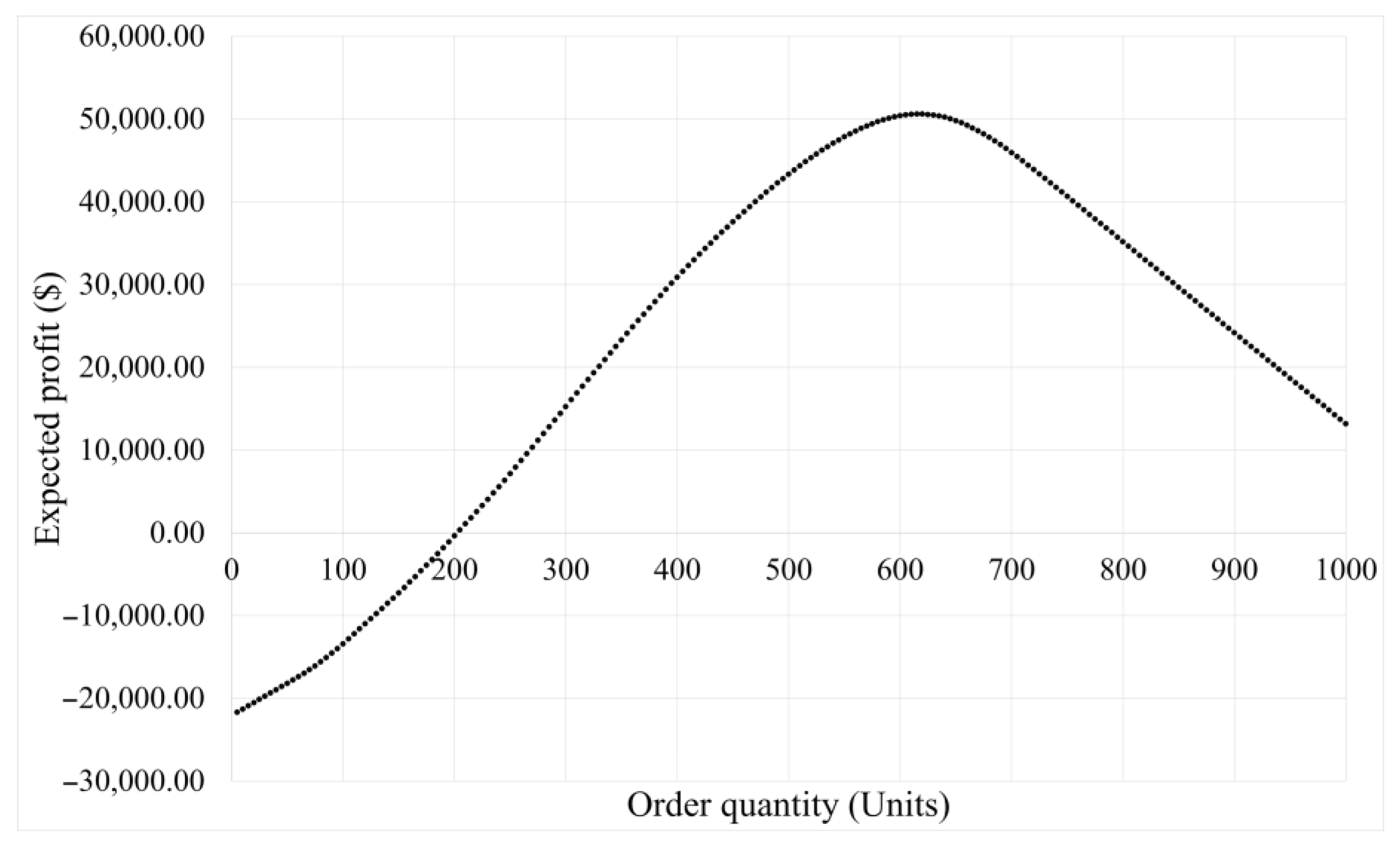
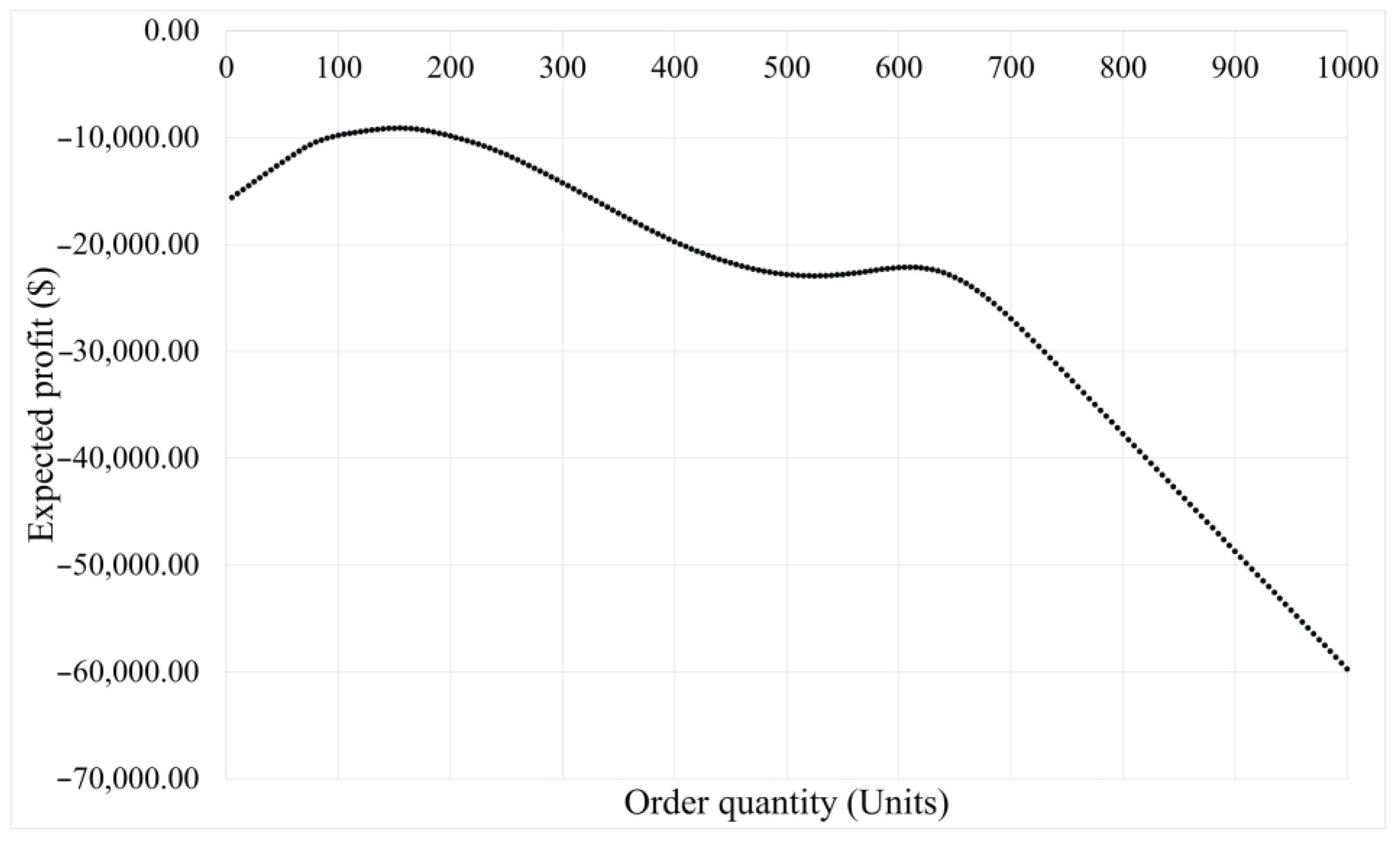
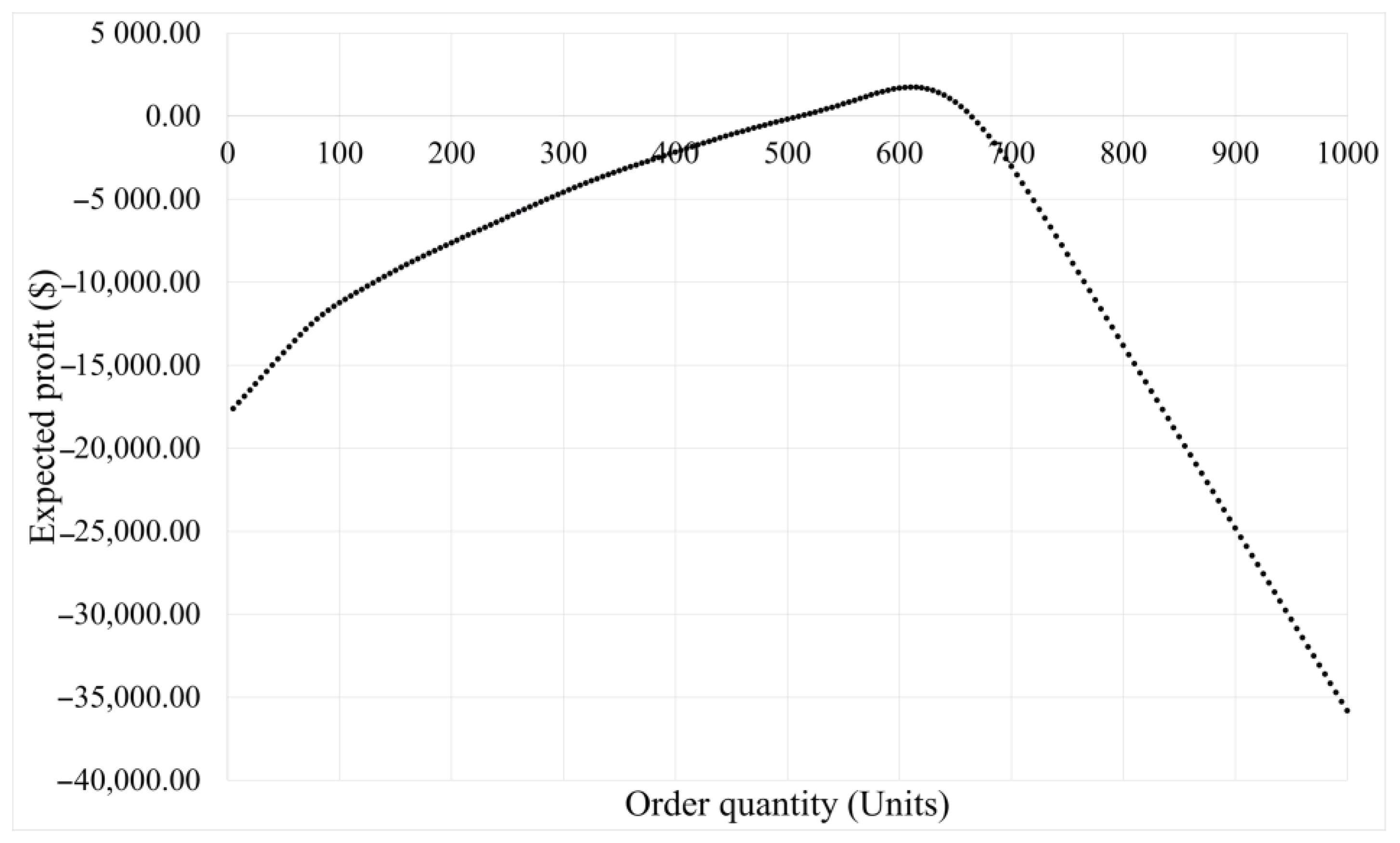
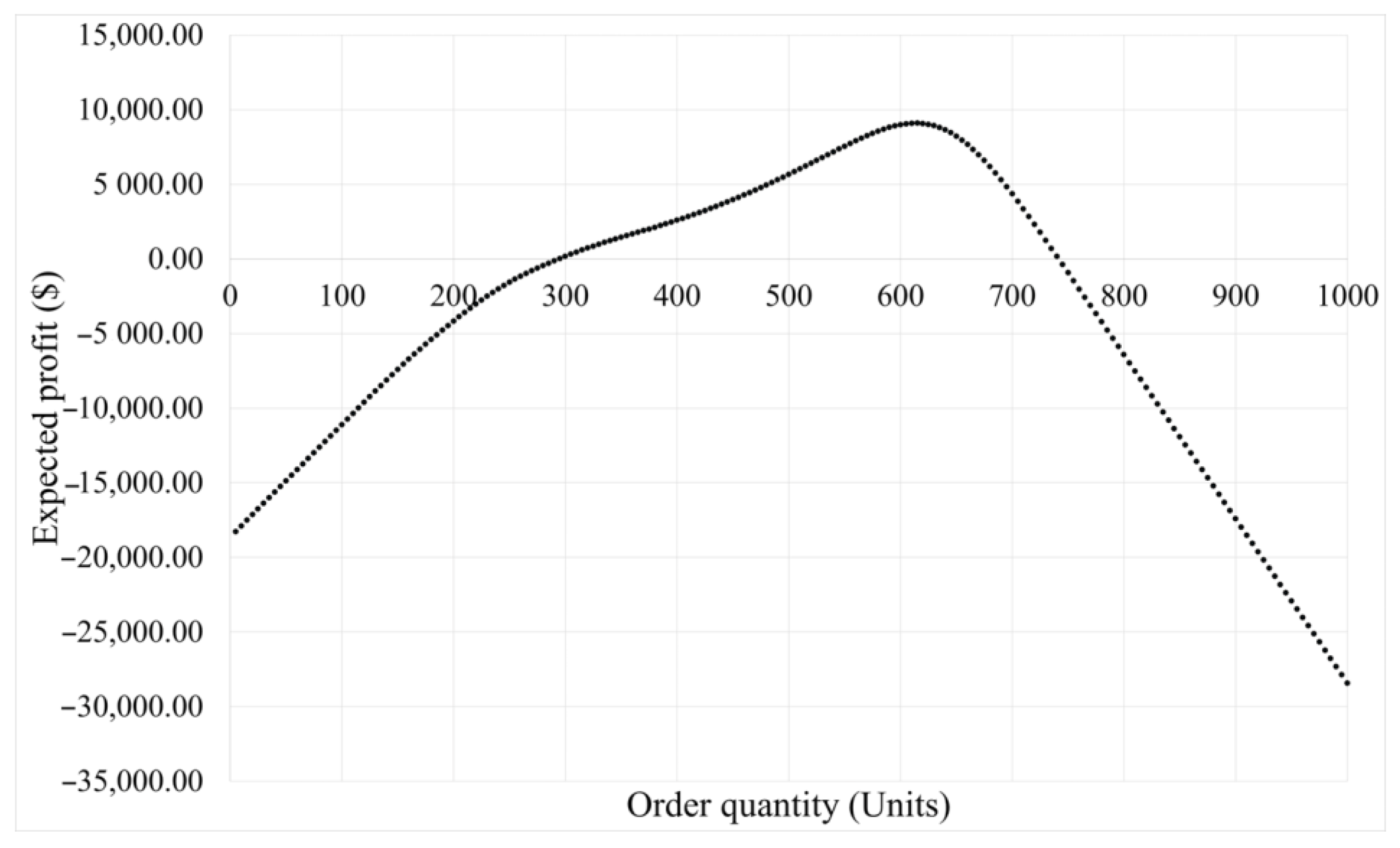
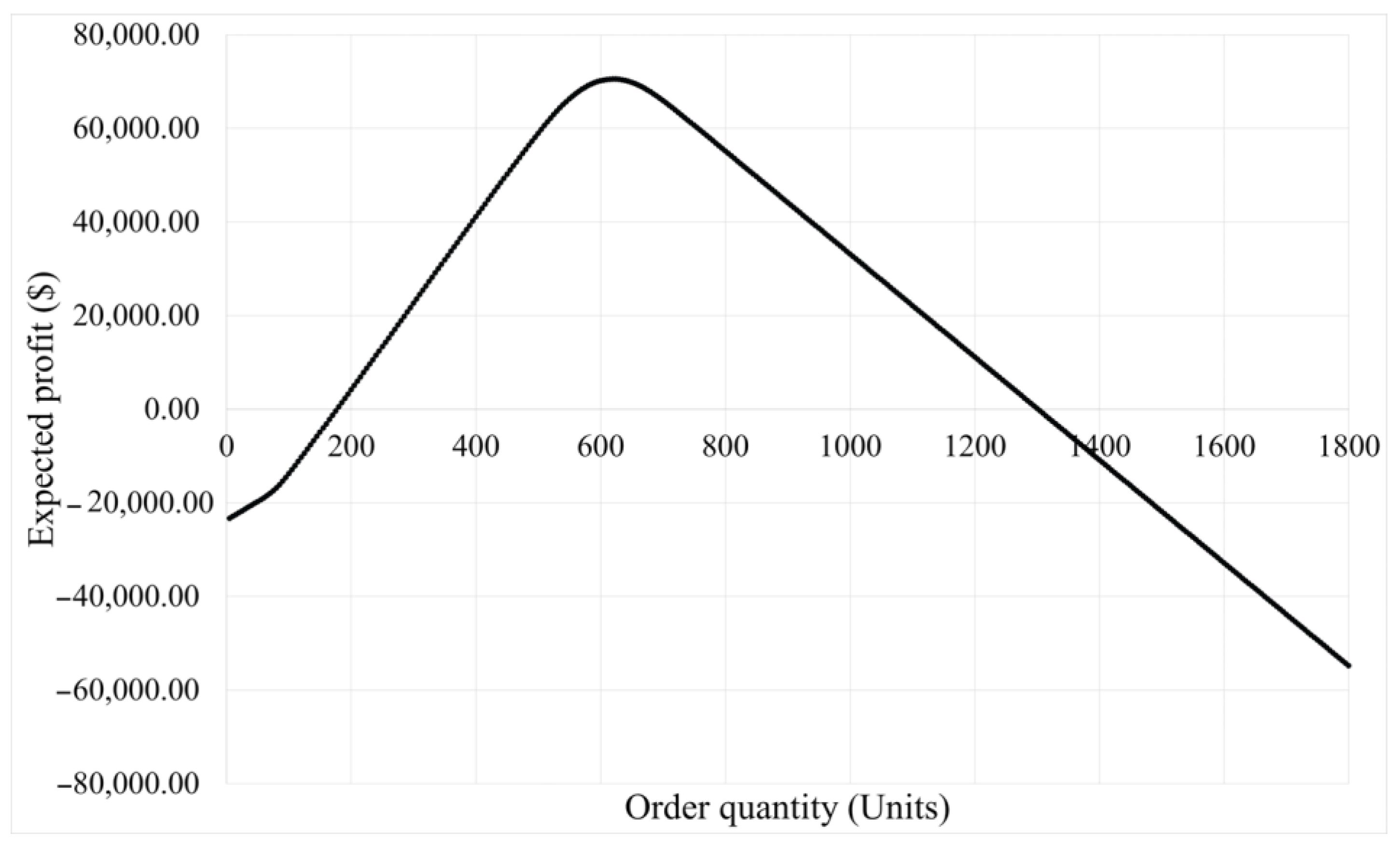
Based on the above parameter values and the associated probability mass function, the expected profit for different values of order quantities is depicted in Figure 1. The expected profit initially increases as higher order quantities allow the retailer to better satisfy demand, and then decreases beyond a certain point due to increased holding and disposal costs. For this base case, the optimal order quantity is 617 units, with a corresponding maximum profit of $50,591.55. To further examine the characteristics of the expected profit function, numerical examples are additionally conducted by varying the probability mass function of the transportation delay duration while keeping other parameters unchanged, and the results are illustrated in Appendix A. The results from these additional numerical examples confirm that the proposed model can accommodate diverse transportation delay profiles without relying on a specific parametric distribution, thereby reinforcing its applicability.
Next, a sensitivity analysis is conducted by varying parameter values to observe the resulting changes, specifically the optimal order quantity and the maximum expected profit, referring to the base-case parameter values. The parameters analyzed include the deterioration rate, disruption probability, selling duration, and initial selling price, respectively.
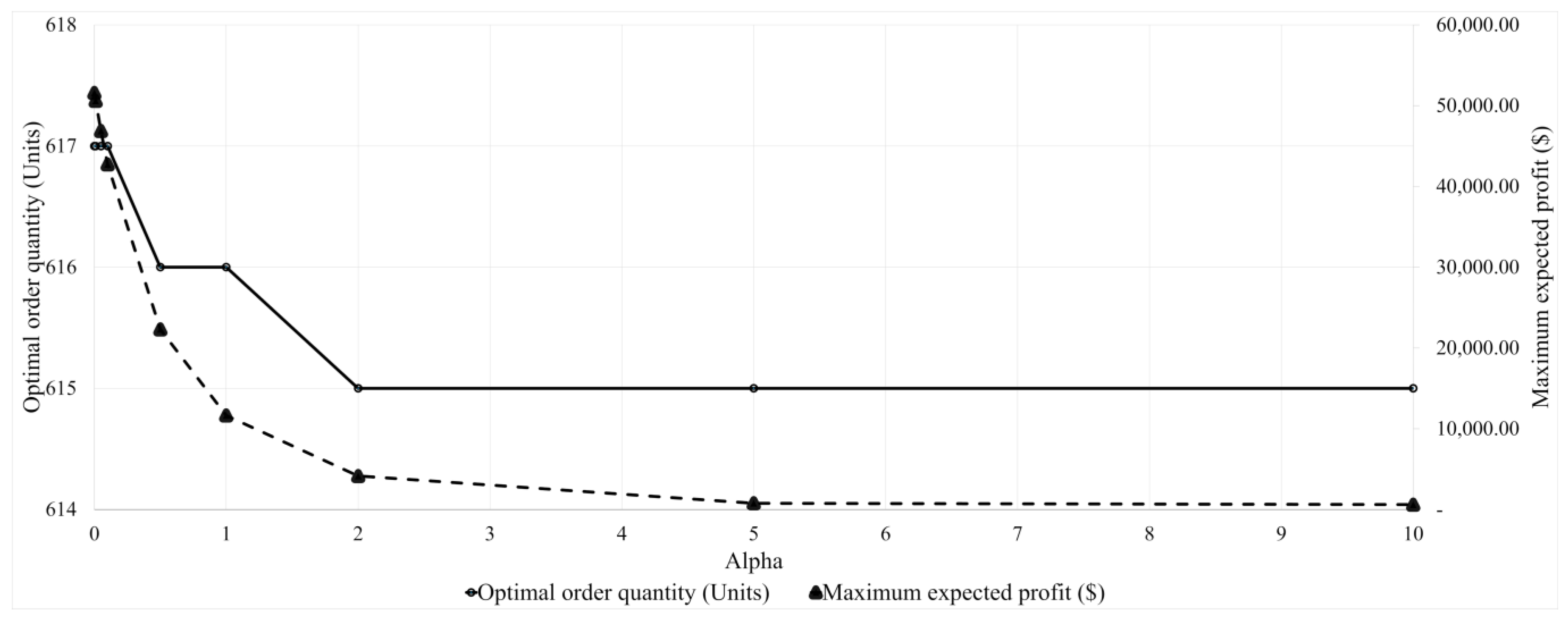
The optimal order quantity Q * and the corresponding expected profit for different values of the deterioration rate are illustrated in Figure 2. By varying the deterioration rate parameter α to observe its effects, two distinct cases can be identified: (i) the deterioration rate does not affect the selling price α = 0 , and (ii) the deterioration rate affects the selling price α > 0 . When the deterioration rate does not affect the selling price, the product does not degrade in quality, allowing it to be sold at the initial selling price even with a transportation delay. This results in the highest maximum expected profit. In contrast, when the deterioration rate affects the selling price, the product’s quality deteriorates over time, leading to a price reduction that corresponds to the deterioration rate. This price reduction results in lower revenue and, therefore, lower maximum expected profit. As the deterioration rate increases, indicating rapid product quality degradation, the maximum expected profit declines accordingly. This numerical result reveals that deterioration primarily affects the selling revenue. The reason the expected profit remains positive despite a significant deterioration rate is that it is applied only in the disruption scenario; in other words, it is not applied in the non-disruption scenario, where the product can still be sold at its initial price. As a result, the revenue obtained under the non-disruption scenario offsets the reduced profit in the disruption scenario, leading to a positive maximum expected profit for this set of numerical values. Furthermore, the optimal order quantity changes only slightly and eventually seems to stabilize, even as the deterioration rate increases. Overall, the deterioration rate slightly influences the optimal order quantity; however, it considerably affects profitability. From a strategic standpoint, these findings suggest that efforts to mitigate deterioration should be evaluated primarily based on their impact on profitability. Furthermore, investment in product preservation to slow price reduction does not significantly change order quantities; however, it could yield a significant improvement in expected profit in the presence of transportation disruption.
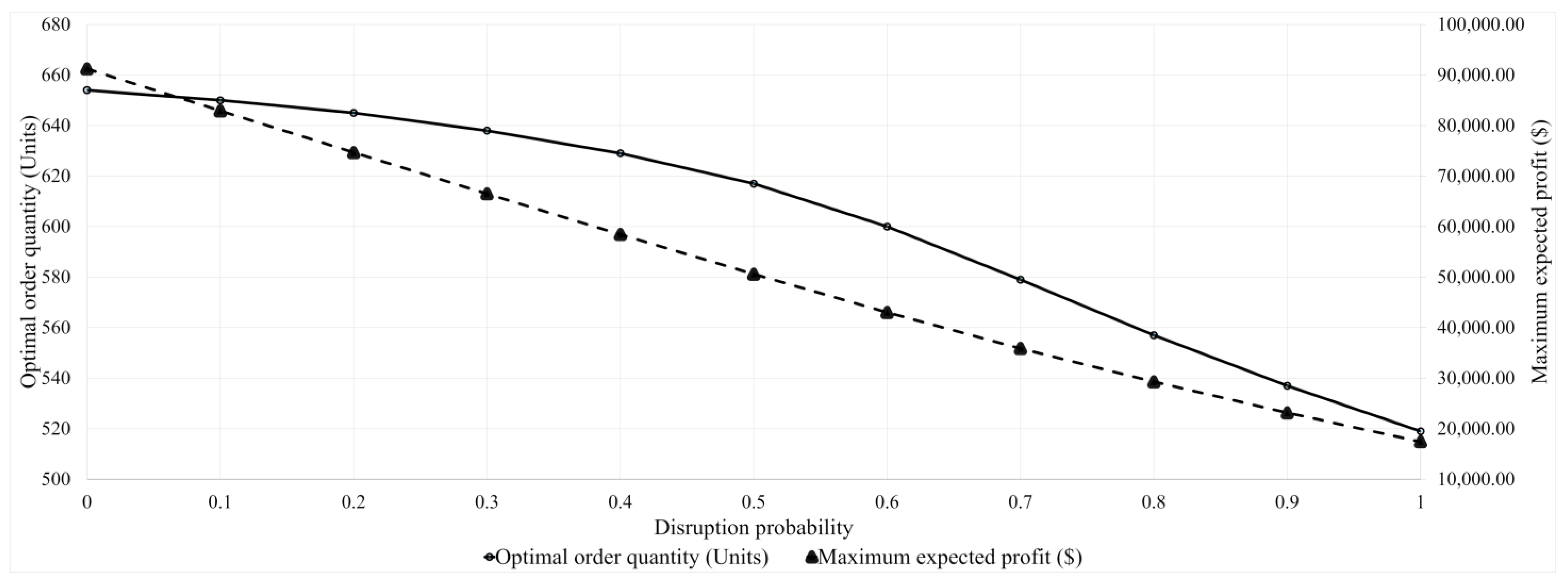
Based on variations in the transportation disruption probability parameter, it is observed that disruption probability affects both the optimal order quantity and the maximum expected profit. When a transportation disruption occurs, the resulting delay shortens the effective selling duration, thereby reducing revenue and increasing disposal costs. From Figure 3, as the probability of disruption increases, the optimal order quantity decreases. Ordering a large quantity when disruption is highly likely increases the risk of product deterioration, which leads to price reductions. Conversely, when the probability of disruption decreases, it becomes more appropriate to order a larger order quantity to take advantage of a longer effective selling duration and achieve a higher maximum expected profit. From a managerial perspective, the results emphasize the importance of transportation disruption likelihood in ordering decisions for perishable products. Managers should adjust order quantities based on the likelihood of transportation disruptions. Moreover, the results suggest that investments aimed at reducing disruption probability can increase both expected profit and order quantities.
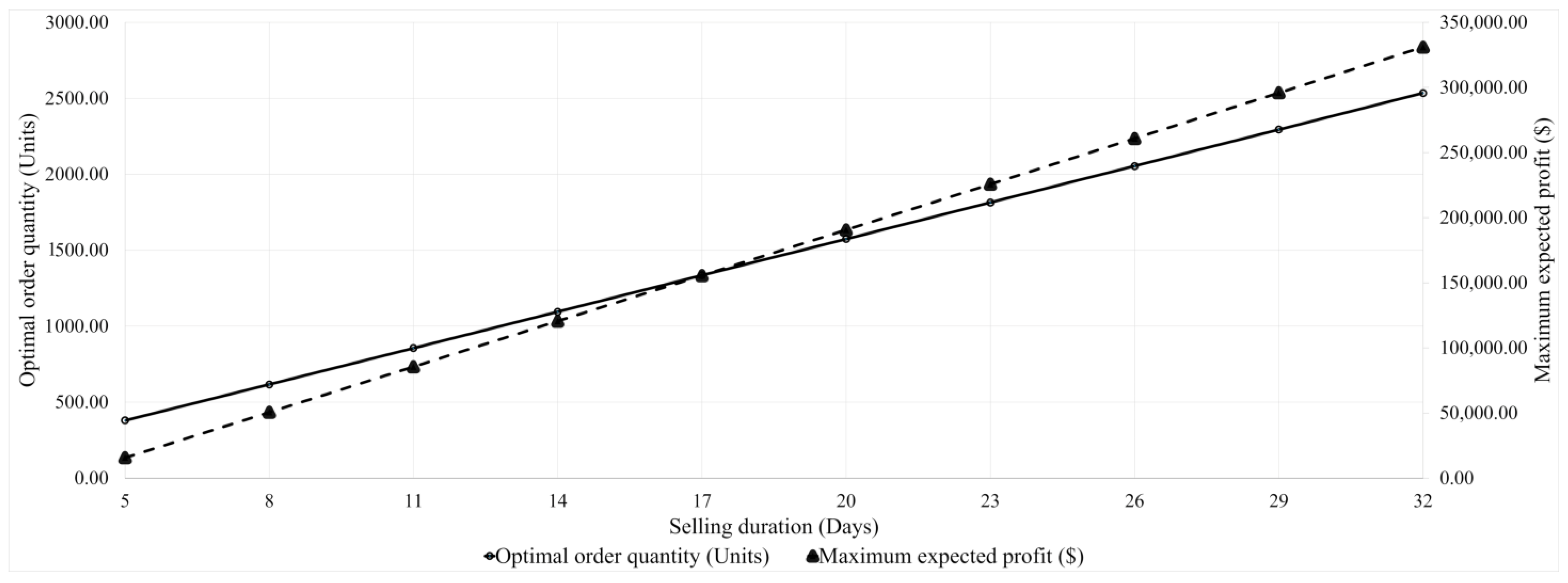
From Figure 4, varying the selling duration reveals that shorter selling durations yield smaller optimal order quantities. This is because a shorter selling duration reduces potential sales revenue, making it unjustifiable to place large order quantities. Conversely, when the selling duration is longer, the optimal order quantity increases to capture demand over a longer duration. A longer selling duration allows more time to sell the product, thereby justifying larger order quantities to enhance sales opportunities. As a result, the maximum expected profit increases correspondingly. The findings highlight the advantage of managing and extending the selling duration for perishable products.
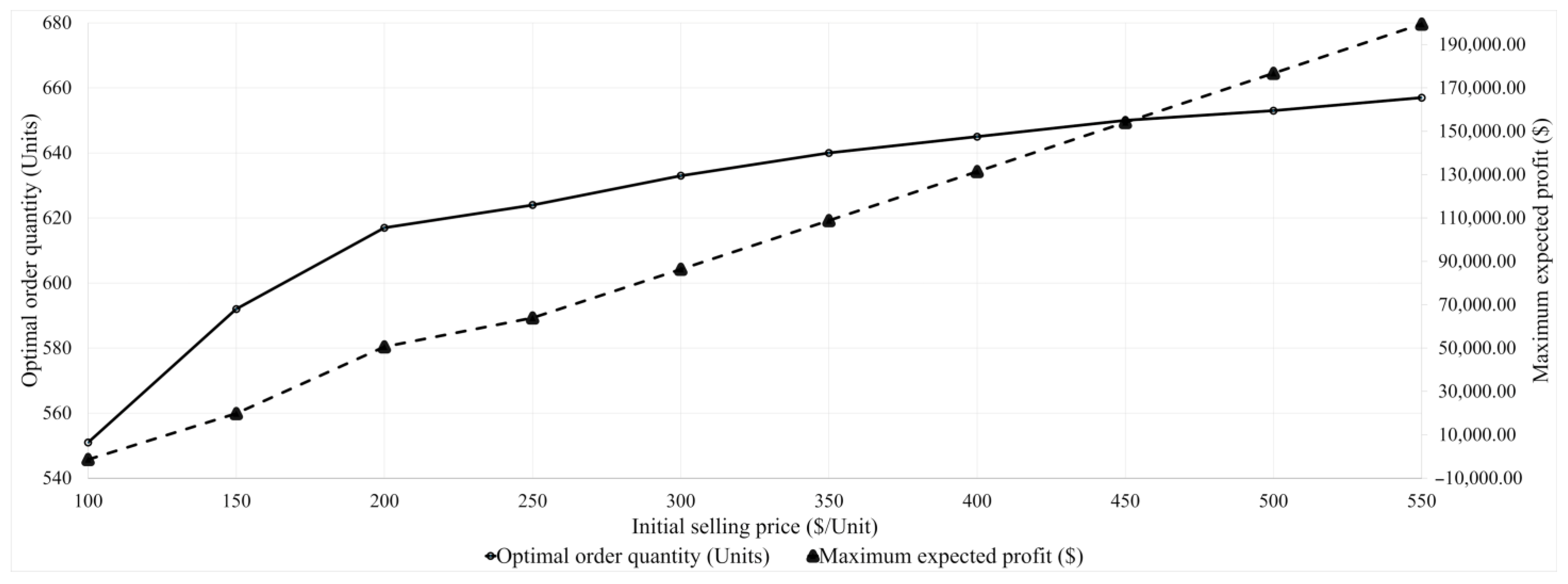
From Figure 5, it is observed that variations in the initial selling price significantly affect both the optimal order quantity and the corresponding maximum expected profit. Varying the initial selling price, it is found that when the initial selling price is low, the optimal order quantity decreases, and the maximum expected profit decreases as well. In case the initial selling price is very low, it results in a negative expected profit. This is because a lower initial selling price reduces revenue; therefore, ordering a large quantity is unjustified. In contrast, when the initial selling price is high, the optimal order quantity increases accordingly. This occurs because a higher initial selling price yields a higher revenue, thereby increasing the maximum expected profit, which makes ordering a larger order quantity justifiable. From a managerial perspective, the findings reveal the importance of pricing in affecting ordering decisions for perishable products. When market conditions force firms to sell at low selling prices, managers should order quantities cautiously, especially when transportation disruptions are likely. Furthermore, the results also highlight the potential value of pricing strategies that allow firms to maintain higher selling prices.

5. Managerial Implications

The findings of this research offer several practical implications for managers responsible for decisions involving perishable products exposed to uncertain transportation delays. The numerical examples show that the deterioration rate affecting the selling price is a significant determinant of profitability. When deterioration does not reduce the selling price, firms can achieve a higher expected profit with a transportation delay. However, as the deterioration reduces prices, profits decline as the deterioration rate increases. Importantly, the optimal order quantity is only slightly affected, as the deterioration rate influences revenue rather than the order quantity decision directly. This finding suggests that the deterioration rate can have a greater impact on the profit than on the order quantity. Therefore, the managers should evaluate whether the deterioration results in a price reduction in the actual market. If a deteriorated-driven price reduction is in effect, it highlights the importance of maintaining product quality amid transportation delays.
Furthermore, the likelihood of transportation disruption occurrence has a strong influence on both expected profit and optimal order quantity. As the probability of transportation delays increases, the optimal order quantity decreases because a shorter selling duration results in a lower potential selling revenue and a higher risk of disposal costs. Conversely, when the transportation disruptions are infrequent, firms can place larger orders to capture higher sales during the selling duration. Thus, managers should continuously assess the likelihood of transportation disruptions by evaluating potential transportation risks and, accordingly, adjust order quantities.
The length of the selling duration also plays a crucial role in determining the optimal ordering quantities. A shorter selling duration justifies a smaller order quantity due to the risk of disposal costs. A longer selling duration, on the other hand, justifies a larger order quantity. This is because the products have more time to be sold, leading to a higher expected profit. Thus, extending the selling duration leads to a higher expected profit.
Regarding the initial selling price, when it is low, ordering large quantities is unjustifiable and, in some cases, may result in a financial loss. Managers facing low selling prices should therefore carefully consider their ordering decisions and reduce order quantities or refrain from ordering, especially when transportation delays are likely. Conversely, when the initial selling price is high, firms can place larger order quantities. This finding highlights that managers should consider selling price and transportation delay risks when making ordering decisions for perishable products.
The numerical studies clarify how parameter values affect the maximum expected profit and the optimal ordering quantity. Managers can similarly apply the model using their own cost structures, demand means, and transportation delay profiles. Such experiments help firms determine the optimal order quantity and the adjustments needed as conditions change.

6. Conclusions

This research develops a single-period model that explicitly incorporates the stochastic duration of transportation delays, limited product shelf life, product deterioration leading to selling price reduction, and the lost sales opportunities for perishable products. By accounting for stochastic transportation delays, deterioration-driven selling prices, and shortened selling durations due to transportation delays, the proposed model provides a more realistic representation of the uncertainties firms face when managing perishable products amid transportation delays.
The analytical mathematical model developed in this research provides guidance for setting the optimal order quantity to maximize expected profit, without assuming any specific probability distribution for the transportation delay duration. This flexibility allows firms to analyze a wide range of delay scenarios by using their own empirical probability mass functions. The model also accounts for lost-sale opportunity costs due to the delayed delivery, enabling managers to incorporate this critical cost component into their decision-making. Furthermore, the analysis shows that the deterioration rate primarily influences profit through price reductions rather than changes in the optimal order quantity; therefore, managers should carefully assess whether the deterioration results in a selling price reduction. Likewise, the increase in the likelihood of transportation disruption reduces both the optimal order quantity and profit due to the greater risk of shortened selling duration and lost sales during the delay. In contrast, rare transportation disruptions allow firms to place larger orders to capture higher sales potential. Similarly, a longer selling duration supports larger order quantities and higher expected profits. The numerical analysis further indicates that a lower initial selling price results in both a lower order quantity and lower profit.
Overall, the findings confirm that transportation delays significantly influence the optimal order quantity and the corresponding maximum expected profit. By applying the proposed model and adjusting the order quantity in response to changing deterioration rates, disruption likelihood, selling durations, and financial parameters, firms can derive the maximum expected profit to manage transportation delays in the perishable product category. It is interesting to note that, in some situations, e.g., when the initial selling price is low, the firm is susceptible to losing profits; therefore, alternative approaches should be applied to address the delay problem, which is identified as an avenue for further research. In addition, many categories of perishable products operate over multiple periods, during which demand may vary and depend on previous periods. Another possible direction for future research is to extend the proposed model to a multi-period or rolling-horizon setting in which demand is non-stationary and correlated across periods. In such an extension, ordering decisions could be updated at each period based on the conditions in earlier periods.

Author Contributions

Conceptualization, B.K., A.W., A.P. and C.S.; methodology, B.K., A.W., A.P. and C.S.; software, B.K., A.W., A.P. and C.S.; validation, B.K., A.W., A.P. and C.S.; formal analysis, B.K., A.W., A.P. and C.S.; investigation, B.K., A.W., A.P. and C.S.; resources, C.S.; data curation, B.K., A.W., A.P. and C.S.; writing—original draft preparation, B.K., A.W., A.P. and C.S.; writing—review and editing, C.S.; visualization, B.K., A.W., A.P. and C.S.; supervision, C.S.; project administration, C.S.; funding acquisition, C.S. All authors have read and agreed to the published version of the manuscript.

Funding

The APC was funded by the Department of Industrial Engineering, Faculty of Engineering at Kamphaeng Saen, Kasetsart University, Thailand.

Institutional Review Board Statement

Not applicable.

Informed Consent Statement

Not applicable.

Data Availability Statement

The raw data supporting the conclusions of this article will be made available by the authors on request.

Acknowledgments

During the preparation of this manuscript, the authors used ChatGPT 5.2 and Grammarly Pro for the purposes of enhancing clarity, restructuring sentences for better flow, helping in outlining, translating, and providing alternative wording and expressions. The authors have reviewed and edited the output and take full responsibility for the content of this publication. Furthermore, the authors would like to thank the anonymous reviewers for their insightful comments and valuable suggestions, which significantly improved the quality and clarity of the manuscript.

Conflicts of Interest

The authors declare no conflicts of interest.

Appendix A

This Appendix A aims to characterize the expected profit function under various probability mass functions for the transportation delay duration.
Table A1. Set A1 of the probability mass function of T d .
T d = t 4567
P T d = t 0.100.200.300.40
Figure A1. Characteristics of the expected profit function for Set A1 of the probability mass function of T d .
Logistics 10 00022 g0a1
Table A2. Set A2 of the probability mass function of T d .
T d = t 2467
P T d = t 0.250.250.250.25
Figure A2. Characteristics of the expected profit function for Set A2 of the probability mass function of T d .
Logistics 10 00022 g0a2
Table A3. Set A3 of the probability mass function of T d .
T d = t 3456
P T d = t 0.200.350.350.10
Figure A3. Characteristics of the expected profit function for Set A3 of the probability mass function of T d .
Logistics 10 00022 g0a3
Table A4. Set A4 of the probability mass function of T d .
T d = t 1234
P T d = t 0.900.050.0250.025
Figure A4. Characteristics of the expected profit function for Set A4 of the probability mass function of T d .
Logistics 10 00022 g0a4

References

  1. Deliso, M. Winter Storm Could Cause Delivery Delays Ahead of Christmas. ABC News. Available online: https://abcnews.go.com/US/winter-storm-cause-delivery-delays-ahead-christmas/story?id=95752466 (accessed on 30 October 2025).
  2. De Muynck, B. Congested Ports Choking the Supply Chain. FreightWaves. Available online: https://www.freightwaves.com/news/congested-ports-choking-the-supply-chain (accessed on 30 October 2025).
  3. Li, S.; He, Y.; Salling, M. Strategic Rationing and Freshness Keeping of Perishable Products under Transportation Disruptions and Demand Learning. Complex Intell. Syst. 2022, 8, 4513–4527. [Google Scholar] [CrossRef]
  4. Hishamuddin, H.; Sarker, R.A.; Essam, D. A Recovery Model for a Two-Echelon Serial Supply Chain with Consideration of Transportation Disruption. Comput. Ind. Eng. 2013, 64, 552–561. [Google Scholar] [CrossRef]
  5. Kirci, M.; Isaksson, O.; Seifert, R. Managing Perishability in the Fruit and Vegetable Supply Chains. Sustainability 2022, 14, 5378. [Google Scholar] [CrossRef]
  6. Paul, S.K.; Asian, S.; Goh, M.; Torabi, S.A. Managing Sudden Transportation Disruptions in Supply Chains under Delivery Delay and Quantity Loss. Ann. Oper. Res. 2019, 273, 783–814. [Google Scholar] [CrossRef]
  7. Atan, Z.; Rousseau, M. Inventory Optimization for Perishables Subject to Supply Disruptions. Optim. Lett. 2016, 10, 89–108. [Google Scholar] [CrossRef][Green Version]
  8. Czerniak, L.L.; Daskin, M.S.; Lavieri, M.S.; Sweet, B.V.; Leja, J.; Tupps, M.A.; Renius, K. Closed-Form (R,S) Inventory Policies for Perishable Inventory Systems with Supply Chain Disruptions. INFOR Inf. Syst. Oper. Res. 2023, 61, 327–367. [Google Scholar] [CrossRef]
  9. Haider, M.; Jha, A.K.; Raut, R.; Kumar, M.; Ghoshal, S. Redesigning Short and Perishable Food Supply Chains Getting Insight from the Causal Analysis of Challenges to Sustainable Development. Br. Food J. 2025, 127, 1620–1647. [Google Scholar] [CrossRef]
  10. Khalid, R.U.; Jajja, M.S.S.; Ahsan, M.B. Supply Chain Sustainability and Risk Management in Food Cold Chains-a Literature Review. Mod. Supply Chain. Res. Appl. 2024, 6, 193–221. [Google Scholar] [CrossRef]
  11. Kumar, A.; Mangla, S.K.; Kumar, P.; Song, M. Mitigate Risks in Perishable Food Supply Chains: Learning from COVID-19. Technol. Forecast. Soc. Change 2021, 166, 120643. [Google Scholar] [CrossRef]
  12. Shafiee, M.; Zare-Mehrjerdi, Y.; Govindan, K.; Dastgoshade, S. A Causality Analysis of Risks to Perishable Product Supply Chain Networks during the COVID-19 Outbreak Era: An Extended DEMATEL Method under Pythagorean Fuzzy Environment. Transp. Res. Part E Logist. Transp. Rev. 2022, 163, 102759. [Google Scholar] [CrossRef] [PubMed]
  13. Yavari, M.; Enjavi, H.; Geraeli, M. Demand Management to Cope with Routes Disruptions in Location-Inventory-Routing Problem for Perishable Products. Res. Transp. Bus. Manag. 2020, 37, 100552. [Google Scholar] [CrossRef]
  14. Hosseini-Motlagh, S.-M.; Samani, M.R.G.; Kordhaghi, H. A Possibilistic Programming Approach in an Integrated Fuzzy Periodic Review Model and Clustering Strategy for Optimizing Platelet Supply Chain. Expert Syst. Appl. 2026, 298, 129539. [Google Scholar] [CrossRef]
  15. Jetto, B.; Orsini, V. Resilient and Robust Management Policy for Multi-Stage Supply Chains with Perishable Goods and Inaccurate Forecast Information: A Distributed Model Predictive Control Approach. Optim. Control. Appl. Methods 2024, 45, 2383–2414. [Google Scholar] [CrossRef]
  16. Staff, M.E.; Mustafee, N. Discrete-Event Simulation for Effective Perishable Inventory Management: A Review. Simulation 2025, 101, 981–1000. [Google Scholar] [CrossRef]
  17. Nahmias, S. Perishable Inventory Theory: A Review. Oper. Res. 1982, 30, 680–708. [Google Scholar] [CrossRef]
  18. Haijema, R. Optimal Ordering, Issuance and Disposal Policies for Inventory Management of Perishable Products. Int. J. Prod. Econ. 2014, 157, 158–169. [Google Scholar] [CrossRef]
  19. Gong, M.; Lian, Z.; Xiao, H. Inventory Control Policy for Perishable Products under a Buyback Contract and Brownian Demands. Int. J. Prod. Econ. 2022, 251, 108522. [Google Scholar] [CrossRef]
  20. Arikan, M.; Demir, S.; Erkoc, M. Inventory Management with Advance Supply Contracts across Multiple Replenishment Periods. Asia-Pac. J. Oper. Res. 2023, 40, 2250031. [Google Scholar] [CrossRef]
  21. Siriruk, P.; Kotekangpoo, A. Order Quantity Optimization Model for Perishable Products under Continuous Review (Q, R) Inventory Policy with Stochastic Demand and Positive Lead Time. Omega 2026, 138, 103392. [Google Scholar] [CrossRef]
  22. Motamedi, M.; Li, N.; Down, D.G. Optimal Ordering Policy for Perishable Products by Incorporating Demand Forecasts. Eur. J. Oper. Res. 2026, 329, 124–137. [Google Scholar] [CrossRef]
  23. Herbon, A. Optimal Replenishment and Inspection Timing for Expiring Inventory with Survival Reset and Curvature Shift. Comput. Ind. Eng. 2025, 210, 111540. [Google Scholar] [CrossRef]
  24. Liu, L.; Yue, C. Investigating the Impacts of Time Delays on Trade. Food Policy 2013, 39, 108–114. [Google Scholar] [CrossRef]
  25. Suryawanshi, P.; Dutta, P. Distribution Planning Problem of a Supply Chain of Perishable Products under Disruptions and Demand Stochasticity. Int. J. Product. Perform. Manag. 2023, 72, 246–278. [Google Scholar] [CrossRef]
  26. Chen, J.; Tian, Z.; Hang, W. Optimal Ordering and Pricing Policies in Managing Perishable Products with Quality Deterioration. Int. J. Prod. Res. 2021, 59, 4472–4494. [Google Scholar] [CrossRef]
  27. Moshtagh, M.S.; Zhou, Y.; Verma, M. Dynamic Inventory and Pricing Control of a Perishable Product with Multiple Shelf Life Phases. Transp. Res. Part E Logist. Transp. Rev. 2025, 195, 103960. [Google Scholar] [CrossRef]
  28. Banerjee, S.; Parmal, V.; Agrawal, S. Optimal Ordering and Discounting Policy for a Segmented Market with Price and Freshness Dependent Demand for Mixed Quality Product. Int. J. Appl. Manag. Sci. 2024, 16, 113–137. [Google Scholar] [CrossRef]
  29. Yang, M.-F.; Tsai, P.-F.; Tu, M.-R.; Yuan, Y.-F. An EOQ Model for Temperature-Sensitive Deteriorating Items in Cold Chain Operations. Mathematics 2024, 12, 775. [Google Scholar] [CrossRef]
  30. Lin, S.; Januardi. Two-Stage Pricing of Perishable Food Supply Chain with Quality-Keeping and Waste Reduction Efforts. Manag. Decis. Econ. 2023, 44, 1749–1766. [Google Scholar] [CrossRef]
  31. Gumasta, K.; Chan, F.T.S.; Tiwari, M.K. An Incorporated Inventory Transport System with Two Types of Customers for Multiple Perishable Goods. Int. J. Prod. Econ. 2012, 139, 678–686. [Google Scholar] [CrossRef]
  32. Yao, X.; Huang, R.; Song, M.; Mishra, N. Pre-Positioning Inventory and Service Outsourcing of Relief Material Supply Chain. Int. J. Prod. Res. 2018, 56, 6859–6871. [Google Scholar] [CrossRef]
  33. Teimoury, E.; Nedaei, H.; Ansari, S.; Sabbaghi, M. A Multi-Objective Analysis for Import Quota Policy Making in a Perishable Fruit and Vegetable Supply Chain: A System Dynamics Approach. Comput. Electron. Agric. 2013, 93, 37–45. [Google Scholar] [CrossRef]
  34. Maheshwari, P.; Kamble, S.; Pundir, A.; Belhadi, A.; Ndubisi, N.O.; Tiwari, S. Internet of Things for Perishable Inventory Management Systems: An Application and Managerial Insights for Micro, Small and Medium Enterprises. Ann. Oper. Res. 2025, 350, 395–423. [Google Scholar] [CrossRef]
  35. Kayikci, Y.; Demir, S.; Mangla, S.K.; Subramanian, N.; Koc, B. Data-Driven Optimal Dynamic Pricing Strategy for Reducing Perishable Food Waste at Retailers. J. Clean. Prod. 2022, 344, 131068. [Google Scholar] [CrossRef]
  36. Pathy, S.R.; Rahimian, H. Value of Risk Aversion in Perishable Products Supply Chain Management. Comput. Optim. Appl. 2024, 89, 517–552. [Google Scholar] [CrossRef]
  37. Hasiloglu-Ciftciler, M.; Kaya, O. Dynamic Inventory Sharing, Ordering, and Pricing Strategies for Perishable Foods to Maximize Profit and Minimize Waste. Comput. Ind. Eng. 2025, 205, 111158. [Google Scholar] [CrossRef]
  38. Chopra, S.; Glinskiy, V.; Lücker, F. Using Anticipatory Orders to Manage Disruption Risk over a Short Product Life Cycle. Eur. J. Oper. Res. 2024, 319, 153–167. [Google Scholar] [CrossRef]
  39. Yong-Chang, J.; Jia-Xur, C.; He-Jie, Z. Research on Inventory Control and Pricing Decisions in the Supply Chain of Fresh Agricultural Products under the Advertisement Delay Effect. IEEE Access 2024, 12, 197468–197487. [Google Scholar] [CrossRef]
  40. Pervin, M. A Sustainable Deteriorating Inventory Model with Backorder and Controllable Carbon Emission by Using Green Technology. Environ. Dev. Sustain. 2025, 27, 25005–25041. [Google Scholar] [CrossRef]
  41. Aung, M.M.; Chang, Y.S. Temperature Management for the Quality Assurance of a Perishable Food Supply Chain. Food Control 2014, 40, 198–207. [Google Scholar] [CrossRef]
  42. Ross, S.M. Introduction to Probability Models, 10th ed.; Academic Press: San Diego, CA, USA, 2010. [Google Scholar]
Figure 1. The expected profit for different values of order quantity.
Logistics 10 00022 g001
Figure 2. The optimal order quantity and the corresponding maximum expected profit for different values of alpha.
Logistics 10 00022 g002
Figure 3. The optimal order quantity and the corresponding maximum expected profit for different values of the disruption probability.
Logistics 10 00022 g003
Figure 4. The optimal order quantity and the corresponding maximum expected profit for different values of the selling duration.
Logistics 10 00022 g004
Figure 5. The optimal order quantity and the corresponding maximum expected profit for different values of the initial selling price.
Logistics 10 00022 g005
Table 1. Comparison of the existing literature with the study.
Research on Determining Optimal
Ordering/Inventory Policies
Disruption DurationDemand ProcessConsidering the Effect of Quality on PriceConsidering the Lost Sale Opportunity Costs During the Disruption
DeterministicStochasticDeterministicStochastic
Li et al. [3] 1 1 1
Paul et al. [5]1 1
Hishamuddin et al. [6]1 1 1
Atan and Rousseau [7] 1 1
Czerniak et al. [8] 11
Yavari et al. [13] 1 1
Hosseini-Motlagh et al. [14] 1
Jetto and Orsini [15] 1
Haijema [18] 11
Gong et al. [19] 1
Arikan et al. [20] 1
Siriruk and Kotekangpoo [21] 1
Motamedi et al. [22] 1
Herbon [23] 1
Suryawanshi and Dutta [25] 11
Chen et al. [26] 11
Moshtagh et al. [27] 1 1
Banerjee et al. [28] 11
Yang et al. [29] 1
Lin and Januardi [30] 1 1
Gumasta et al. [31] 11
Yao et al. [32] 1
Kayikci et al. [35] 11
Pathy and Rahimian [36] 1 1
Hasiloglu-Ciftciler and Kaya [37] 1
Chopra et al. [38]1 1
Yong-Chang et al. [39] 1 1
Pervin [40] 1
This study 1 111
Table 2. Notations.
Table 2. Notations.
CategorySymbolDescription
Parameters P 0 Initial selling price per unit
C O Ordering cost per unit
C T Transportation cost per unit
C D Disposal cost per unit
C S Shortage cost per unit
t max Selling duration
α Product deterioration rate
μ Average demand per unit time
σ Standard deviation of demand per unit time
p Probability of a transportation disruption
Random variables and distributions T d Transportation disruption duration
t max T d Remaining selling duration when a transportation disruption occurs
Y t max Demand during the selling duration when no transportation disruption occurs
Y t max t Demand during the remaining selling duration when a transportation disruption occurs
Y t Demand during the transportation disruption duration when the product has not yet arrived
P T d = t Probability mass function of T d
f Y t max y t max Probability density function of Y t max
F Y t max y t max Cumulative distribution function of Y t max
f Y t max t y t max t Probability density function of Y t max t
F Y t max t y t max t Cumulative distribution function of Y t max t
f Y t y t Probability density function of Y t
F Y t y t Cumulative distribution function of Y t
Decision variable Q Order quantity
Q * Optimal order quantity
Table 3. P T d = t for the base case.
T d = t 1234
P T d = t 0.400.200.200.20
Disclaimer/Publisher’s Note: The statements, opinions and data contained in all publications are solely those of the individual author(s) and contributor(s) and not of MDPI and/or the editor(s). MDPI and/or the editor(s) disclaim responsibility for any injury to people or property resulting from any ideas, methods, instructions or products referred to in the content.