

Biofortification of Chicken Eggs with Vitamin K—Nutritional and Quality Improvements

 ,
, 
Abstract
1. Introduction
2. Materials and Methods
2.1. Trial Design and Animal Management
2.2. Egg and Eggshell Quality Analysis
2.3. Proximate Analysis of Experimental Diets and Eggs
2.4. Estimation of the Vitamin K3 Content of Experimental Diets and Eggs
2.5. Measurement of the Vitamin K1 and MK in Whole Eggs
2.6. Antioxidant Activity of Egg Samples
2.7. Statistical Analysis
3. Results
3.1. Effect of Dietary Vitamin K3 Treatment on Hen Performance Parameters
3.2. Menadione Content of Diets and Eggs
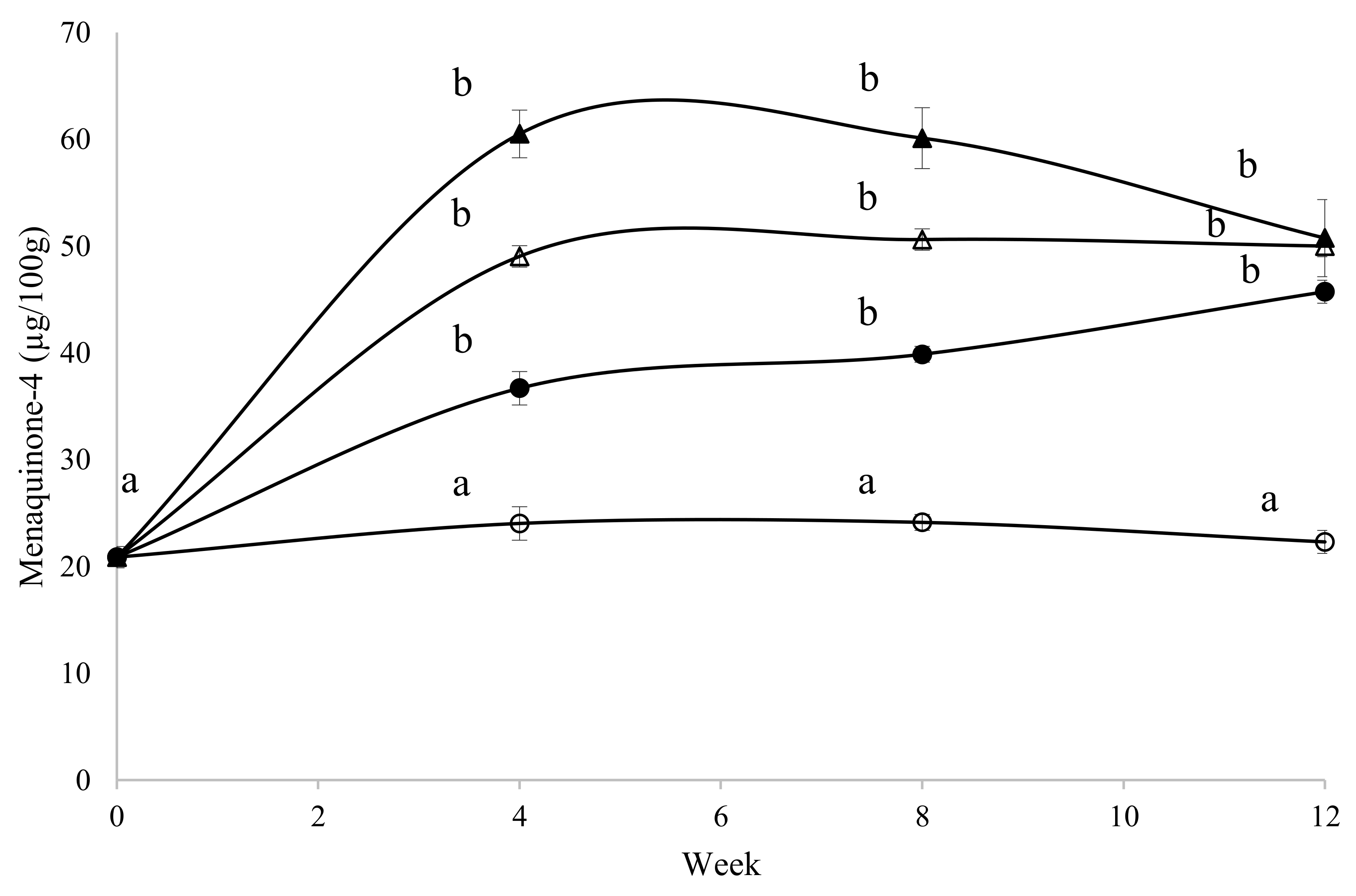
3.3. Effect of Dietary Vitamin K3 Treatment on Egg Vitamin K Content
3.4. Effect of Dietary Vitamin K3 Treatment on Egg and Eggshell Quality Parameters
3.5. Effect of Dietary Vitamin K3 Treatment on Antioxidant Activity of Egg Samples
4. Discussion
5. Conclusions
Author Contributions
Funding
Acknowledgments
Conflicts of Interest
References
- Institute of Medicine. Dietary Reference Intakes for Vitamin A, Vitamin K, Arsenic, Boron, Chromium, Copper, Iodine, Iron, Manganese, Molybdenum, Nickel, Silicon, Vanadium, and Zinc; National Academies Press: Washington, DC, USA, 2001. [Google Scholar]
- Vermeer, C. Vitamin K: The effect on health beyond coagulation—An overview. Food Nutr. Res. 2012, 56, 5329. [Google Scholar] [CrossRef] [Scilit] [PubMed]
- Willems, B.A.; Vermeer, C.; Reutelingsperger, C.P.; Schurgers, L.J. The realm of vitamin K dependent proteins: Shifting from coagulation toward calcification. Mol. Nutr. Food Res. 2014, 58, 1620–1635. [Google Scholar] [CrossRef] [Scilit] [PubMed]
- Hayes, A.; Hennessy, A.; Walton, J.; Mcnulty, B.A.; Lucey, A.J.; Kiely, M.; Flynn, A.; Cashman, K.D. Phylloquinone intakes and food sources and vitamin K status in a nationally representative sample of irish adults. J. Nutr. 2016, 146, 2274–2280. [Google Scholar] [CrossRef] [Scilit] [PubMed]
- Thane, C.W.; Bolton-Smith, C.; Coward, W.A. Comparative dietary intake and sources of phylloquinone (vitamin K1) among british adults in 1986–7 and 2000–1. Br. J. Nutr. 2006, 96, 1105–1115. [Google Scholar] [CrossRef] [Scilit] [PubMed]
- Fulgoni, V.L., III; Keast, D.R.; Bailey, R.L.; Dwyer, J. Foods, fortificants, and supplements: Where do americans get their nutrients? J. Nutr. 2011, 141, 1847–1854. [Google Scholar] [CrossRef] [Scilit]
- McCann, J.C.; Ames, B.N. Vitamin K, an example of triage theory: Is micronutrient inadequacy linked to diseases of aging? Am. J. Clin. Nutr. 2009, 90, 889–907. [Google Scholar] [CrossRef] [Scilit] [PubMed]
- Beulens, J.W.; Booth, S.L.; Van Den Heuvel, E.G.; Stoecklin, E.; Baka, A.; Vermeer, C. The role of menaquinones (vitamin K2) in human health. Br. J. Nutr. 2013, 110, 1357–1368. [Google Scholar] [CrossRef] [Scilit]
- Harshman, S.G.; Finnan, E.G.; Barger, K.J.; Bailey, R.L.; Haytowitz, D.B.; Gilhooly, C.H.; Booth, S.L. Vegetables and mixed dishes are top contributors to phylloquinone intake in us adults: Data from the 2011–2012 NHANES. J. Nutr. 2017, 147, 1308–1313. [Google Scholar] [CrossRef] [Scilit] [PubMed]
- Irish Universities Nutrition Alliance. National Adult Nutrition Survey: Summary Report. 2011. Available online: http://www.iuna.net/wp-content/uploads/2010/12/national-adult-nutrition-survey-summary-report-march-2011.pdf (accessed on 1 June 2011).
- U.S Department of Health and Human Services; U.S Department of Agriculture. 2015–2020 Dietary Guidelines for Americans, 8th ed. 2015. Available online: http://health.gov/dietaryguidelines/2015/guidelines/ (accessed on 3 February 2017).
- Cashman, K.D. Vitamin D: Dietary requirements and food fortification as a means of helping achieve adequate vitamin D status. J. Steroid Biochem. Mol. Biol. 2015, 148, 19–26. [Google Scholar] [CrossRef] [Scilit]
- IFA. Agricultural Market Dashboards 2019—Poultry and Eggs. Available online: https://www.ifa.ie/agricultural-market-dashboards-poultry-and-eggs/ (accessed on 31 July 2019).
- Hayes, A.; Duffy, S.; O’Grady, M.; Jakobsen, J.; Galvin, K.; Teahan-Dillon, J.; Kerry, J.; Kelly, A.; O’Doherty, J.; Higgins, S.; et al. Vitamin D-enhanced eggs are protective of wintertime serum 25-hydroxyvitamin D in a randomized controlled trial of adults. Am. J. Clin. Nutr. 2016, 104, 629–637. [Google Scholar] [CrossRef] [Scilit]
- Duffy, S.K.; Rajauria, G.; Clarke, L.C.; Kelly, A.K.; Cashman, K.D.; O’Doherty, J.V. The potential of cholecalciferol and 25-hydroxyvitamin D3 enriched diets in laying hens, to improve egg vitamin D content and antioxidant availability. Innov. Food Sci. Emerg. Technol. 2017, 44, 109–116. [Google Scholar] [CrossRef] [Scilit]
- Jiang, Y.H.; Mcgeachin, R.B.; Bailey, C.A. α-tocopherol, β-carotene, and retinol enrichment of chicken eggs. Poult. Sci. 1994, 73, 1137–1143. [Google Scholar] [CrossRef] [Scilit] [PubMed]
- Surai, P.F.; Ionov, I.A.; Kuklenko, T.V.; Kostjuk, I.A.; Macpherson, A.M.; Speake, B.K.; Noble, R.C.; Sparks, N.H.C. Effect of supplementing the hen’s diet with vitamin A on the accumulation of vitamins A and E, ascorbic acid and carotenoids in the egg yolk and in the embryonic liver. Br. Poult. Sci. 1998, 39, 257–263. [Google Scholar] [CrossRef] [Scilit]
- Suzuki, Y.; Okamoto, M. Production of hen’s eggs rich in vitamin K. Nutr. Res. 1997, 17, 1607–1615. [Google Scholar] [CrossRef] [Scilit]
- Park, S.W.; Namkung, H.; Ahn, H.J.; Paik, I.K. Enrichment of vitamins D3, K and iron in eggs of laying hens. Asian Austral. J. Anim. Sci. 2005, 18, 226–229. [Google Scholar] [CrossRef] [Scilit]
- Kjeldahl, J. A new method for the determination of nitrogen in organic matter. Z. Anal. Chem. 1883, 22, 366–382. [Google Scholar] [CrossRef] [Scilit]
- Graff, I.E.; Krossøy, C.; Gjerdevik, K.; Julshamn, K. Influence of dietary menadione nicotinamide bisulphite (vitamin K3) and phylloquinone (vitamin K1) on atlantic salmon (Salmo salar L.) tissue levels, determined by high-performance liquid chromatography with fluorescence detection. Aquac. Nutr. 2010, 16, 637–647. [Google Scholar] [CrossRef] [Scilit]
- Brand-Williams, W.; Cuvelier, M.E.; Berset, C. Use of a free radical method to evaluate antioxidant activity. LWT Food Sci. Technol. 1995, 28, 25–30. [Google Scholar] [CrossRef] [Scilit]
- Singleton, V.L.; Rossi, J.A. Colorimetry of total phenolics with phosphomolybdic-phosphotungstic acid reagents. Am. J. Enol. Vitic. 1965, 16, 144–158. [Google Scholar]
- Benzie, I.F.; Strain, J.J. Ferric reducing/antioxidant power assay: Direct measure of total antioxidant activity of biological fluids and modified version for simultaneous measurement of total antioxidant power and ascorbic acid concentration. Methods Enzymol. 1999, 299, 15–27. [Google Scholar]
- Roe, M.; Pinchen, H.; Church, S.; Finglas, P. Nutrient Analysis of Eggs: Analytical Report (Revised Version); Department of Health: London, UK, 2013. [Google Scholar]
- U.S Department of Agriculture: Agricultural Research Service. FoodData Central. 2019. Available online: http://fdc.nal.usda.gov (accessed on 4 May 2020).
- Elder, S.J.; Haytowitz, D.B.; Howe, J.; Peterson, J.W.; Booth, S.L. Vitamin K contents of meat, dairy, and fast food in the U.S. diet. J. Agric. Food Chem. 2006, 54, 463–467. [Google Scholar] [CrossRef] [Scilit]
- DSM Animal Nutrition & Health 2017. DSM Vitamin Supplementation Guidelines 2016 for Animal Nutrition. Available online: https://www.feedstuffs.com/sites/feedstuffs.com/files/Vitamin%20Supplement%20Guidelines.pdf (accessed on 28 May 2020).
- Schurgers, L.J.; Teunissen, K.J.; Hamulyak, K.; Knapen, M.H.; Vik, H.; Vermeer, C. Vitamin K-containing dietary supplements: Comparison of synthetic vitamin K1 and natto-derived menaquinone-7. Blood 2007, 109, 3279–3283. [Google Scholar] [CrossRef] [Scilit]
- Dooren, M.M.G.-V.; Ronden, J.E.; Soute, B.A.; Vermeer, C. Bioavailability of phylloquinone and menaquinones after oral and colorectal administration in vitamin K-deficient rats. Biochem. Pharmacol. 1995, 50, 797–801. [Google Scholar] [CrossRef] [Scilit]
- Sano, Y.; Tadano, K.; Kikuchi, K.; Kaneko, K.; Yuzuriha, T. Pharmacokinetic characterization of menaquinone-4 in dogs by sensitive HPLC determination. J. Nutr. Sci. Vitaminol. 1993, 39, 555–566. [Google Scholar] [CrossRef] [Scilit]
- Shino, M.; Yamashiro, T.; Yamada, K.; Mori, Y.; Sato, T.; Kawabe, K.; Okada, K. Determination of menaquinone-4 in plasma after administration of menaquinone-4 dosage forms in healthy human subjects. Yakugaku Zasshi 1982, 102, 651–658. [Google Scholar] [CrossRef] [Scilit]
- Schurgers, L.J.; Vermeer, C. Differential lipoprotein transport pathways of K-vitamins in healthy subjects. Biochim. Biophys. Acta 2002, 1570, 27–32. [Google Scholar] [CrossRef] [Scilit]
- Nakamura, E.; Aoki, M.; Watanabe, F.; Kamimura, A. Low-dose menaquinone-4 improves γ-carboxylation of osteocalcin in young males: A non-placebo-controlled dose-response study. Nutr. J. 2014, 13, 85. [Google Scholar] [CrossRef] [Scilit]
- Sato, T.; Schurgers, L.J.; Uenishi, K. Comparison of menaquinone-4 and menaquinone-7 bioavailability in healthy women. Nutr. J. 2012, 11, 93. [Google Scholar] [CrossRef] [Scilit] [PubMed]
- Uematsu, T.; Nagashima, S.; Niwa, M.; Kohno, K.; Sassa, T.; Ishii, M.; Tomono, Y.; Yamato, C.; Kanamaru, M. Effect of dietary fat content on oral bioavailability of menatetrenone in humans. J. Pharm. Sci. 1996, 85, 1012–1016. [Google Scholar] [CrossRef] [Scilit]
- European Food Safety Authority’s Panel on Additives and Products or Substances Used in Animal Feed. Scientific opinion on the safety and efficacy of vitamin K3 (Menadione Sodium Bisulphite and Menadione Nicotinamide Bisulphite) as a feed additive for all animal species. EFSA J. 2014, 12, 3532. [Google Scholar]
- Maxie, G.; Van Dreumel, T.; McMaster, D.; Baird, J. Menadione (Vitamin K(3)) toxicity in six horses. Can. Vet. J. 1992, 33, 756–757. [Google Scholar]
- Grisdale-Helland, B.; Helland, S.J.; Åsgård, T. Problems associated with the present use of menadione sodium bisulfite and vitamin A in diets for Atlantic salmon. Aquaculture 1991, 92, 351–358. [Google Scholar] [CrossRef] [Scilit]
- Marchetti, M.; Tassinari, M.; Bauce, G. Tolerance of high dietary levels of menadione bisulfite-nicotinamide by rainbow trout, Oncorhynchus mykiss. Aquaculture 1995, 134, 137–142. [Google Scholar] [CrossRef] [Scilit]
- Marchetti, M.; Tassinari, M.; Marchetti, S. Menadione nicotinamide bisulphite as a source of vitamin K and niacin activities for the growing pig. Anim. Sci. 2000, 71, 111–117. [Google Scholar] [CrossRef] [Scilit]
- Egg Nutrition Centre. Does Egg Yolk Color Impact Nutrition Quality? 2018. Available online: https://www.eggnutritioncenter.org/articles/egg-yolk-color-impact-nutrition-quality/ (accessed on 24 September 2019).
- Beardsworth, P.; Hernandez, J. Yolk colour–an important egg quality attribute. Int. Poult. Prod. 2004, 12, 17–18. [Google Scholar]
- United Nations. Sustainable Development Goals. 2015. Available online: https://www.un.org/sustainabledevelopment/sustainable-development-goals/. (accessed on 15 July 2019).
- Willett, W.; Rockstrom, J.; Loken, B.; Springmann, M.; Lang, T.; Vermeulen, S.; Garnett, T.; Tilman, D.; Declerck, F.; Wood, A.; et al. Food in the anthropocene: The EAT-Lancet commission on healthy diets from sustainable food systems. Lancet 2019, 393, 447–492. [Google Scholar] [CrossRef] [Scilit]

| Ingredient | (g or IU */kg Feed) |
|---|---|
| Wheat | 655 |
| Hypro soya | 218 |
| Limestone flour/grit | 85 |
| Soya oil | 22 |
| Dicalcium phosphate | 9.5 |
| Sodium chloride | 3.0 |
| Sodium bicarbonate | 2.0 |
| Methionine | 1.5 |
| Lysine | 0.5 |
| Vitamins/minerals: | |
| Retinyl acetate * | 8000 |
| Cholecalciferol * | 3000 |
| Calcium carbonate | 1.906 |
| Manganese | 0.145 |
| Iron | 0.100 |
| Zinc | 0.097 |
| α-Tocopherol | 0.060 |
| Nicotinic acid | 0.040 |
| Copper | 0.040 |
| Cobalamin | 0.020 |
| Calcium-d-pantothenate | 0.006 |
| Selenium | 0.004 |
| Riboflavin | 0.004 |
| Menadione 1 | 0.003 |
| Iodine | 0.002 |
| Thiamine | 0.001 |
| Pyroxidine | 0.001 |
| Folic Acid | 0.0003 |
| Color | 0.925 |
| Antioxidant | 0.125 |
| Xylanase | 0.035 |
| Phytase | 0.025 |
| Treatment 1 | Treatment 2 | Treatment 3 | Treatment 4 | |
|---|---|---|---|---|
| Dry matter (g/kg) | 892.9 | 889.9 | 873.4 | 868.3 |
| Ash (g/kg) | 69.8 | 107.2 | 94.5 | 73.7 |
| Crude protein (N × 6.25) (g/kg) | 199.6 | 193.3 | 197.5 | 196.3 |
| Fat (g/kg) | 27.8 | 20.8 | 16.7 | 16.9 |
| T1 (n = 32) | T2 (n = 32) | T3 (n = 32) | T4 (n = 28) | Pooled SEM | p-Value * | |
|---|---|---|---|---|---|---|
| Hen start weight (g) | 1890 | 1897 | 1931 | 1904 | 23.0 | 0.614 |
| Hen end weight (g) | 1987 | 2066 | 2004 | 2011 | 30.2 | 0.297 |
| Total egg weight (g) | 20,168 | 20,311 | 19,982 | 19,306 | 338.6 | 0.185 |
| Total number of eggs/pen | 314.6 | 315.8 | 313 | 299.1 | 4.90 | 0.081 |
| Average egg weight (g) | 64.1 | 64.3 | 63.9 | 64.6 | 0.621 | 0.849 |
| Feed intake (g/hen/day) | 128.8 | 130.8 | 126.8 | 133.3 | 4.98 | 0.815 |
| FCR (intake–egg weight) | 2.14 | 2.17 | 2.13 | 2.32 | 0.084 | 0.362 |
| Total eggs/hen | 78.7 | 78.9 | 78.2 | 74.8 | 1.224 | 0.081 |
| Egg production (%) | 93.6 | 94.0 | 93.1 | 89.0 | 1.457 | 0.081 |
| T1 1 | T2 | T3 | T4 | Pooled SEM | p-Value | |
|---|---|---|---|---|---|---|
| Phylloquinone (µg/100 g) | 0.87 a | 0.76 ab | 0.51 bc | 0.38 c | 0.22 | 0.00 * |
| Menaquinone-4 (µg/100 g) | 22.30 a | 45.73 b | 50.00 b | 50.74 b | 8.99 | 0.00 * |
| Menaquinone-7 (µg/100 g) | 1.22 | 0.97 | 0.71 | 0.86 | 0.68 # | 0.45 Ψ |
| Total vitamin K2 (µg/100 g) 2 | 23.52 a | 46.70 b | 50.71 b | 51.60 b | 9.30 | 0.00 * |
| Total vitamin K (µg/100 g) 3 | 24.39 a | 47.46 b | 51.22 b | 51.99 b | 9.35 | 0.00 * |
| T1 | T2 | T3 | T4 | Pooled SEM | p-Value ¶ | |
|---|---|---|---|---|---|---|
| Egg: | ||||||
| Weight (g) | 63.5 | 67.4 | 63.9 | 65.1 | 5.32 | 0.289 |
| Haugh unit | 98.9 | 97.8 | 95.6 | 95.8 | 5.77 | 0.435 |
| Albumen height (mm) | 7.84 | 7.74 | 7.27 | 7.20 | 1.16 | 0.409 |
| Yolk height (mm) | 17.7 | 17.7 | 17.1 | 17.2 | 1.03 | 0.543 |
| Percentage yolk (%) | 29.9 | 28.6 | 30.3 | 30.3 | 2.47 | 0.600 |
| Yolk/albumen ratio | 0.52 | 0.51 | 0.53 | 0.53 | 0.055 | 0.842 |
| Yolk color: | ||||||
| L* | 51.6 | 54.3 | 52.9 | 53.2 | 2.96 | 0.166 |
| A* | −3.4 | 0.9 | 0.8 | −0.9 | 0.21 | 0.274 |
| b* | 27.3 a | 39.6 b | 36.6 bc | 34.7 c | 3.44 | 0.000 |
| Eggshell: | ||||||
| Weight (g) | 6.2 a | 7.9 b | 7.5 bc | 6.8 ac | 0.76 | 0.000 |
| Thickness (mm) | 0.28 a | 0.36 b | 0.36 b | 0.32 a | 0.03 | 0.000 |
| Calcium content (%) | 32.9 ab | 32.5 a | 35.7 b | 34.3 ab | 2.48 | 0.035 |
| Magnesium content (%) | 0.39 | 0.41 | 0.40 | 0.39 | 0.06 | 0.886 |
| T1 | T2 | T3 | T4 | Pooled SEM | p-Value * | |
|---|---|---|---|---|---|---|
| Dry matter (g/kg) | 254.9 | 268.3 | 249.7 | 251.2 | 0.490 | 0.163 |
| Ash (g/kg) | 26.4 | 29.5 | 27.1 | 27.4 | 0.017 | 0.235 |
| Crude protein (N × 6.25) (g/kg) | 405.5 | 387.5 | 350.0 | 377.2 | 12.325 | 0.525 |
| Fat (g/kg) | 231.7 | 235.7 | 214.2 | 223.9 | 11.369 | 0.920 |
Publisher’s Note: MDPI stays neutral with regard to jurisdictional claims in published maps and institutional affiliations. |
© 2020 by the authors. Licensee MDPI, Basel, Switzerland. This article is an open access article distributed under the terms and conditions of the Creative Commons Attribution (CC BY) license (http://creativecommons.org/licenses/by/4.0/).
Share and Cite
O’Sullivan, S.M.; E. Ball, M.E.; McDonald, E.; Hull, G.L.J.; Danaher, M.; Cashman, K.D. Biofortification of Chicken Eggs with Vitamin K—Nutritional and Quality Improvements. Foods 2020, 9, 1619. https://doi.org/10.3390/foods9111619
O’Sullivan SM, E. Ball ME, McDonald E, Hull GLJ, Danaher M, Cashman KD. Biofortification of Chicken Eggs with Vitamin K—Nutritional and Quality Improvements. Foods. 2020; 9(11):1619. https://doi.org/10.3390/foods9111619
Chicago/Turabian StyleO’Sullivan, Siobhan M., M. Elizabeth E. Ball, Emma McDonald, George L. J. Hull, Martin Danaher, and Kevin D. Cashman. 2020. "Biofortification of Chicken Eggs with Vitamin K—Nutritional and Quality Improvements" Foods 9, no. 11: 1619. https://doi.org/10.3390/foods9111619
APA StyleO’Sullivan, S. M., E. Ball, M. E., McDonald, E., Hull, G. L. J., Danaher, M., & Cashman, K. D. (2020). Biofortification of Chicken Eggs with Vitamin K—Nutritional and Quality Improvements. Foods, 9(11), 1619. https://doi.org/10.3390/foods9111619

