

Prevalence and Loads of Fecal Pollution Indicators and the Antibiotic Resistance Phenotypes of Escherichia coli in Raw Minced Beef in Lebanon


Abstract
1. Introduction
2. Materials and Methods
2.1. Sampling of Minced Beef
2.2. Enumeration of Fecal Coliforms and E. coli
2.3. Assessing Antimicrobial Resistance (AMR) of E. coli Using the Disk Diffusion Assay
3. Results and Discussion
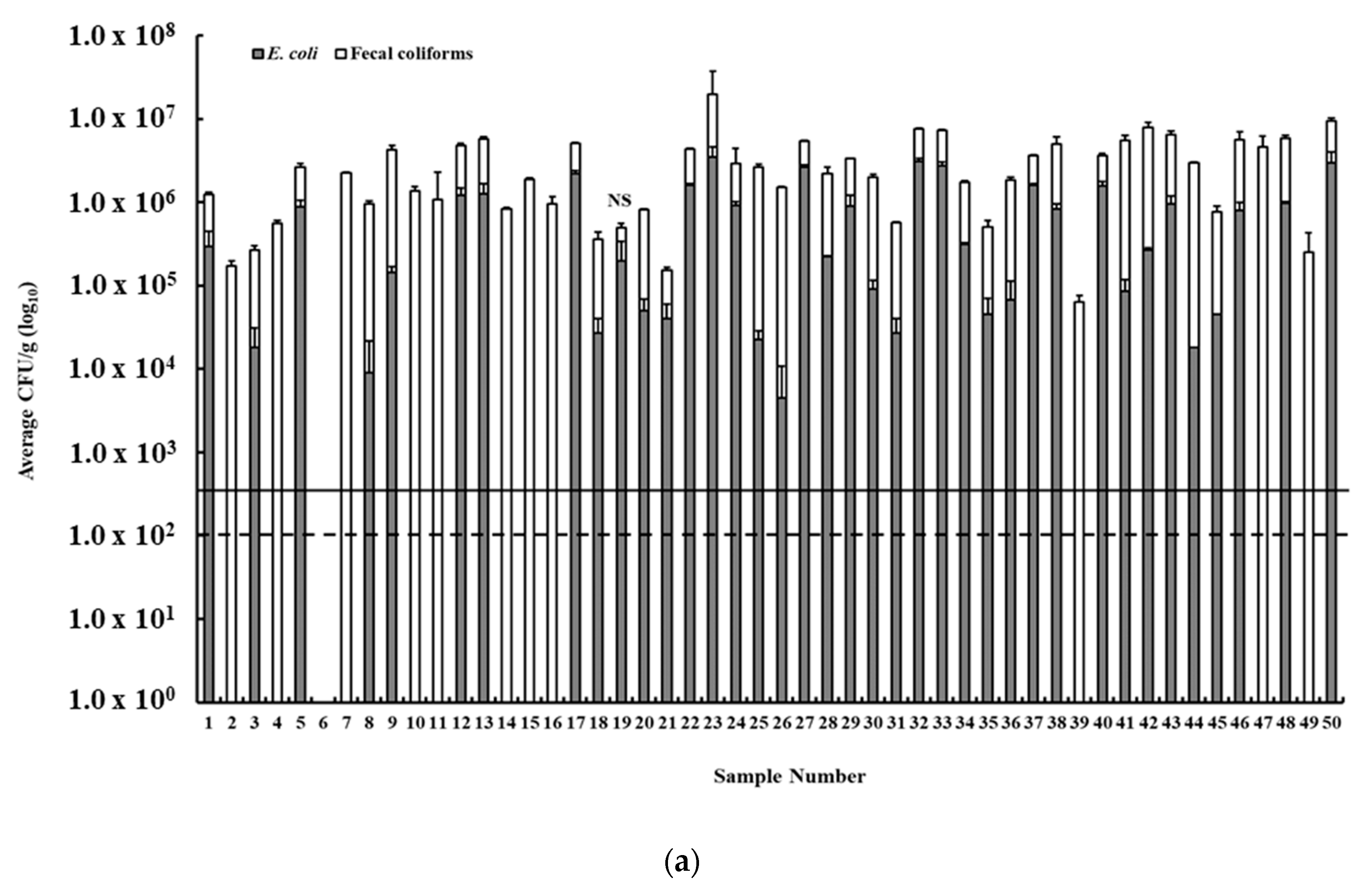
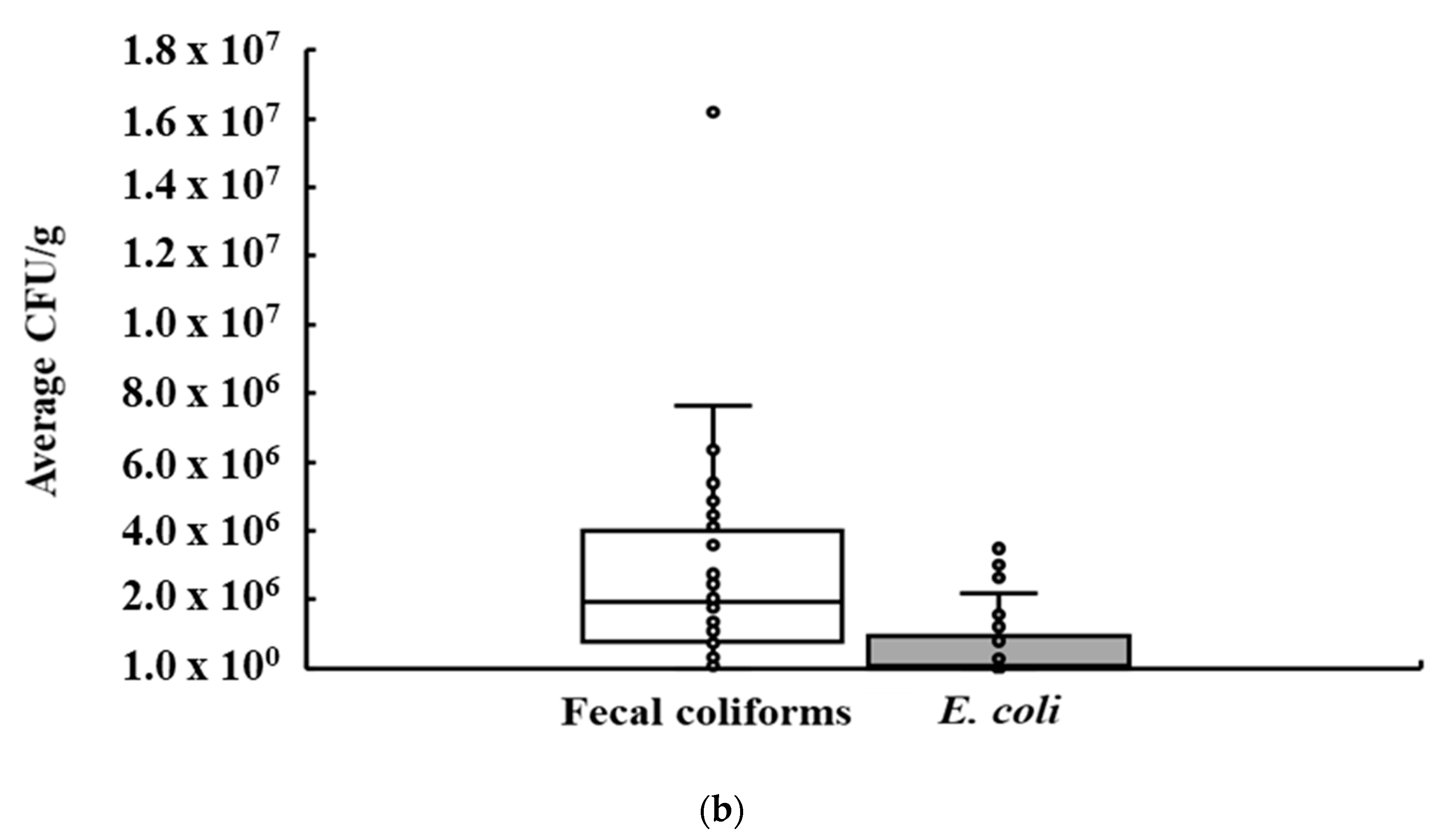
3.1. Prevalence and Loads of Fecal Coliforms and E. coli
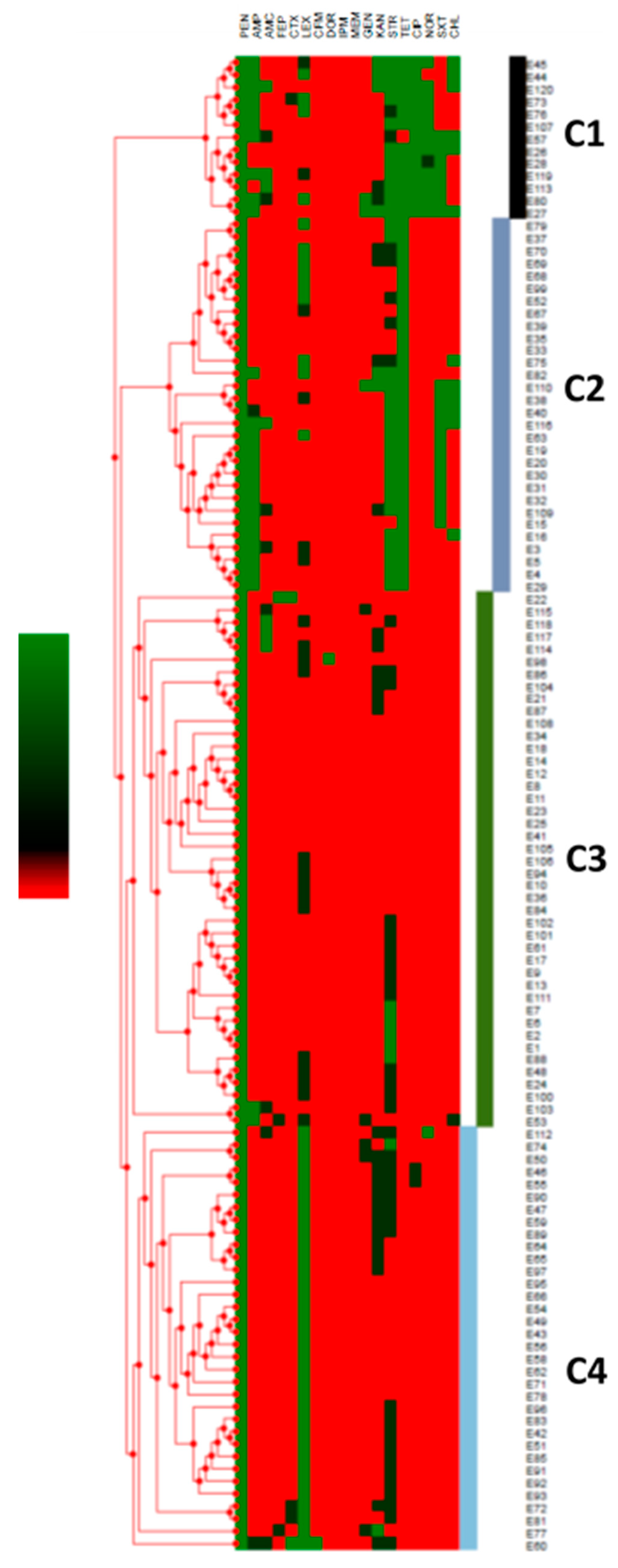
3.2. AMR Profiles of E. coli Isolated from Minced Beef Meat
4. Conclusions
Author Contributions
Funding
Acknowledgments
Conflicts of Interest
References
- Williams, P.G. Nutritional Composition of Red Meat. 2007. Available online: https://ro.uow.edu.au/hbspapers/48 (accessed on 18 September 2018).
- Ritchie, H.; Roser, M. Meat and Seafood Production & Consumption. Our World in Data. 2017. Available online: https://ourworldindata.org/grapher/meat-production-tonnes (accessed on 20 October 2018).
- Nasreddine, L.; Hwalla, N.; Sibai, A.; Hamzé, M.; Parent-Massin, D. Food consumption patterns in an adult urban population in Beirut, Lebanon. Public Health Nutr. 2006, 9, 194–203. [Google Scholar] [CrossRef]
- USDA FAS. Global Agricultural Information Network (GAIN): Lebanese Market Overview. 2016. Available online: https://gain.fas.usda.gov/Recent%20GAIN%20Publications/Lebanese%20Market%20Overview_Cairo_Lebanon_6-26-2016.pdf (accessed on 10 December 2018).
- WHO. Food Safety. 2017. Available online: http://www.who.int/news-room/fact-sheets/detail/food-safety (accessed on 29 October 2018).
- UNHCR. UNHCR Lebanon-Operational Fact Sheet-January 2020. Available online: https://www.unhcr.org/lb/wp-content/uploads/sites/16/2020/02/UNHCR-Lebanon-Operational-Fact-sheet-January-2020.pdf (accessed on 11 September 2020).
- Todd, E. Foodborne diseases: Overview of biological hazards and foodborne diseases. Encycl. Food Saf. 2014, 1, 221–242. [Google Scholar] [CrossRef]
- Jay, J.M.; Loessner, M.J.; Golden, D.A. Foodborne gastroenteritis. In Modern Food Microbiology, 7th ed.; Springer: Boston, MA, USA, 2005; pp. 619–655. [Google Scholar]
- FSIS. FSIS Microbiological Hazard Identification Guide for Meat and Poultry Components of Products Produced by very Small Plants. 1999. Available online: https://www.fsis.usda.gov/wps/wcm/connect/0b96c2cf-ffdc-4dc5-92f0-bdfd181b8368/higuide.pdf?MOD=AJPERES (accessed on 18 September 2020).
- NSAI. IS 340:2007 Hygiene in the Catering Sector; National Standards Authority of Ireland: Dublin, Ireland, 2007; Available online: https://www.nsai.ie/images/uploads/standards/I-S-340-2007-A1-2015.pdf (accessed on 18 September 2020).
- Economou, V.; Gousia, P. Agriculture and food animals as a source of antimicrobial-resistant bacteria. Infect. Drug Resist. 2015, 8, 49–61. [Google Scholar] [CrossRef] [PubMed]
- Johnson, J.R.; Sannes, M.R.; Croy, C.; Johnston, B.; Clabots, C.; Kuskowski, M.A.; Bender, J.; Smith, K.E.; Winokur, P.L.; Belongia, E.A. Antimicrobial drug–resistant Escherichia coli from humans and poultry products, Minnesota and Wisconsin, 2002–2004. Emerg. Infect. Dis. 2007, 13, 838. [Google Scholar] [CrossRef] [PubMed]
- Moawad, A.A.; Hotzel, H.; Awad, O.; Tomaso, H.; Neubauer, H.; Hafez, H.M.; El-Adawy, H. Occurrence of Salmonella enterica and Escherichia coli in raw chicken and beef meat in northern Egypt and dissemination of their antibiotic resistance markers. Gut. Pathog. 2017, 9, 57. [Google Scholar] [CrossRef] [PubMed]
- Nekouei, O.; Checkley, S.; Waldner, C.; Smith, B.A.; Invik, J.; Carson, C.; Avery, B.; Sanchez, J.; Gow, S. Exposure to antimicrobial-resistant Escherichia coli through the consumption of ground beef in Western Canada. Int. J. Food Microbiol. 2018, 272, 41–48. [Google Scholar] [CrossRef]
- Rasheed, M.U.; Thajuddin, N.; Ahamed, P.; Teklemariam, Z.; Jamil, K. Antimicrobial drug resistance in strains of Escherichia coli isolated from food sources. Rev. Inst. Med. Trop. Sao Paulo 2014, 56, 341–346. [Google Scholar] [CrossRef]
- Kassem, I.I.; Helmy, Y.A.; Kashoma, I.P.; Rajashekara, G. The Emergence of Antibiotic Resistance in Poultry Farms. In Achieving Sustainable Production of Poultry Meat Volume 1: Safety, Quality and Sustainability; Ricke, S., Ed.; Burleigh Dodds Science Publishing Limited: Cambridge, UK, 2016; ISBN 978 1 78676 064 7. [Google Scholar]
- Kassem, I.I.; Hijazi, M.A.; Saab, R. On a collision course: The availability and use of colistin-containing drugs in human therapeutics and food-animal farming in Lebanon. J. Glob. Antimicrob. Resist. 2019, 16, 162–164. [Google Scholar] [CrossRef]
- WHO. Antimicrobial Resistance. 2020. Available online: https://www.who.int/news-room/fact-sheets/detail/antimicrobial-resistance (accessed on 21 September 2020).
- WHO. Antimicrobial Resistance in the Food Chain. 2017. Available online: https://www.who.int/foodsafety/areas_work/antimicrobial-resistance/amrfoodchain/en/ (accessed on 21 September 2020).
- Osman, M.; Al Mir, H.; Rafei, R.; Dabboussi, F.; Madec, J.-Y.; Haenni, M.; Hamze, M. Epidemiology of antimicrobial resistance in Lebanese extra-hospital settings: An overview. J. Glob. Antimicrob. Resist. 2019, 17, 123–129. [Google Scholar] [CrossRef]
- LIBNOR. Lebanese Specification Standard No. 503: Minced Meat; Lebanese Standards Institution: Beirut, Lebanon, 2004; p. 12. [Google Scholar]
- El-Jardali, F.; Hammoud, R.; Kamleh, R.; Jurdi, M. K2P Briefing Note: Protecting Consumers in Lebanon: The Need for Effective Food Safety System; American University of Beirut: Beirut, Lebanon, 2014; Available online: https://eventscal.lau.edu.lb/conferences/nfrd2014/abstracts/food/food-abstract13.pdf (accessed on 18 September 2020).
- Erkmen, O.; Bozoglu, T.F. Indicators of Foodborne Pathogens; Chapter 12 in Food Microbiology, 2 Volume Set: Principles into Practice; John Wiley & Sons: Hoboken, NJ, USA, 2016. [Google Scholar]
- EFSA. Report from the Task Force on Zoonoses Data Collection including guidance for harmonized monitoring and reporting of antimicrobial resistance in commensal Escherichia coli and Enterococcus spp. from food animals. EFSA J. 2008, 6, 1–44. [Google Scholar] [CrossRef]
- Balouiri, M.; Sadiki, M.; Ibnsouda, S.K. Methods for in vitro evaluating antimicrobial activity: A review. J. Pharm. Anal. 2016, 6, 71–79. [Google Scholar] [CrossRef]
- Sourenian, T.; Mann, D.; Li, S.; Deng, X.; Jaafar, H.; Kassem, I.I. Dissemination of multidrug-resistant Escherichia coli harboring the mobile colistin resistance gene mcr-1.1 on transmissible plasmids in the Mediterranean Sea. J. Glob. Antimicrob. Resist. 2020, 22, 84–86. [Google Scholar] [CrossRef]
- Nguyen, M.C.P.; Woerther, P.L.; Bouvet, M.; Andremont, A.; Leclercq, R.; Canu, A. Escherichia coli as reservoir for macrolide resistance genes. Emerg. Infect. Dis. 2009, 15, 1648–1650. [Google Scholar] [CrossRef] [PubMed]
- CLSI. Performance Standards for Antimicrobial Susceptibility Testing; Clinical and Laboratory Standards Institute: Wayne, PA, USA, 2016. [Google Scholar]
- European Committee on Antimicrobial Susceptibility Testing (EUCAST). Breakpoint Tables for Interpretation of MICs and Zone Diameters; EUCAST, Version 8.1. 2018. Available online: http://www.eucast.org (accessed on 20 September 2020).
- Multiple Experiment Viewer (MEV). Available online: http://mev.tm4.org/#/welcome (accessed on 14 October 2020).
- Berrazeg, M.; Drissi, M.; Medjahed, L.; Rolain, J.M. Hierarchical clustering as a rapid tool for surveillance of emerging antibiotic-resistance phenotypes in Klebsiella pneumoniae strains. J. Med. Microbiol. 2013, 62, 864–874. [Google Scholar] [CrossRef] [PubMed]
- Government of New Zealand. Microbiological Reference Criteria for Food. 1995. Available online: https://www.mpi.govt.nz/dmsdocument/21185/direct (accessed on 21 September 2020).
- AMS USDA. Microbiological Testing of Ams Purchased Meat, Poultry and Egg Commodities. 2020. Available online: https://www.ams.usda.gov/resources/microbiological-testing (accessed on 21 September 2020).
- Goepfert, J. The aerobic plate count, coliform and Escherichia coli content of raw ground beef at the retail level. J. Milk Food Technol. 1976, 39, 175–178. [Google Scholar] [CrossRef]
- EC. Commission Regulation (EC) No 2073/2005 of 15 November 2005 on microbiological criteria for foodstuffs. OJEU 2005, 50, 1–26. [Google Scholar]
- National Research Council. Application of microbiological criteria to foods and food ingredients. In An Evaluation of the Role of Microbiological Criteria for Foods and Food Ingredients; National Academies Press: Washington, DC, USA, 1985. [Google Scholar]
- National Research Council. Current status of microbiological criteria and legislative bases. In An Evaluation of the Role of Microbiological Criteria for Foods and Food Ingredients; National Academies Press: Washington, DC, USA, 1985. [Google Scholar]
- Ekici, G.; Dümen, E. Escherichia coli and food safety. In The Universe of Escherichia coli; Starčič Erjavec, M., Ed.; IntechOpen: London, UK, 2019. [Google Scholar] [CrossRef]
- Souli, M.; Galani, I.; Giamarellou, H. Emergence of extensively drug-resistant and pandrug-resistant Gram-negative bacilli in Europe. Eurosurveillance 2008, 13, 19045. [Google Scholar] [CrossRef]
- González-Gutiérrez, M.; García-Fernández, C.; Alonso-Calleja, C.; Capita, R. Microbial load and antibiotic resistance in raw beef preparations from northwest Spain. Food Sci. Nutr. 2020, 8, 777–7785. [Google Scholar] [CrossRef]
- Adzitey, F. Incidence and antimicrobial susceptibility of Escherichia coli isolated from beef (meat muscle, liver and kidney) samples in Wa Abattoir, Ghana. Cogent Food Agric. 2020, 6, 1718269. [Google Scholar] [CrossRef]
- Sabala, R.F.; Usui, M.; Tamura, Y.; Abd-Elghany, S.M.; Sallam, K.I.; Elgazzar, M.M. Prevalence of colistin-resistant Escherichia coli harbouring mcr-1 in raw beef and ready-to-eat beef products in Egypt. Food Control 2021, 119, 107436. [Google Scholar] [CrossRef]
- Hmede, Z.; Kassem, I.I. The colistin resistance gene, mcr-1, is prevalent in commensal E. coli isolated from Lebanese pre-harvest poultry. Antimicrob. Agents Chemother. 2018, 62. [Google Scholar] [CrossRef] [PubMed]
- Hassan, J.; El-Gemayel, L.; Bashour, I.; Kassem, I.I. On the edge of a precipice: The global emergence and dissemination of plasmid-borne mcr genes that confer resistance to colistin, a last-resort antibiotic. In Antibiotics and Antimicrobial Resistance Genes in the Environment; Elsevier: Amsterdam, The Netherlands, 2020; pp. 155–182. [Google Scholar]
- Hmede, Z.; Alhaj Sulaiman, A.; Jaafar, H.; Kassem, I.I. Emergence of plasmid-borne colistin resistance gene mcr-1 in multidrug-resistant Escherichia coli isolated from irrigation water in Lebanon. Int. J. Antimicrob. Agents 2019, 54, 102–104. [Google Scholar] [CrossRef] [PubMed]
- Kassem, I.I.; Kehinde, O.; Kumar, A.; Rajashekara, G. Antimicrobial-resistant Campylobacter in organically and conventionally raised layer chickens. Foodborne Pathog. Dis. 2017, 14, 29–34. [Google Scholar] [CrossRef] [PubMed]
- Nisar, M.; Kassem, I.I.; Rajashekara, G.; Goyal, S.M.; Lauer, D.; Voss, S.; Nagaraja, K.V. Genotypic relatedness and antimicrobial resistance of Salmonella Heidelberg isolated from chickens and turkeys in the midwestern United States. J. Vet. Diagn. Invest. 2017, 29, 370–375. [Google Scholar] [CrossRef]
- Sahin, O.; Kassem, I.I.; Shen, Z.; Lin, J.; Rajashekara, G.; Zhang, Q. Campylobacter in poultry: Ecology and potential interventions. Avian Dis. 2015, 59, 185–200. [Google Scholar] [CrossRef]
- Cogliani, C.; Goossens, H.; Greko, C. Restricting antimicrobial use in food animals: Lessons from Europe. Microbe 2011, 6, 274–279. [Google Scholar] [CrossRef]
- Kimera, Z.I.; Mshana, S.E.; Rweyemamu, M.M.; Mboera, L.E.; Matee, M.I. Antimicrobial use and resistance in food-producing animals and the environment: An African perspective. Antimicrob. Resist. Infect. Control 2020, 9, 1–12. [Google Scholar] [CrossRef]
- Hassan, J.; Kassem, I.I. Audacious hitchhikers: The role of travel and the international food trade in the global dissemination of mobile colistin-resistance (mcr) genes. Antibiotics 2020, 9, 370. [Google Scholar] [CrossRef]

| Resistance Profiles | PEN | AMP | FEP | CTX | LEX | DOR | GEN | KAN | STR | TET | CIP | NOR | SXT | CHL | Number of Isolates (%) | Number of Antibiotic Classes |
|---|---|---|---|---|---|---|---|---|---|---|---|---|---|---|---|---|
| P1 | R | R | R | R | R | R | R | R | R | R | 1 (0.8) | 6 | ||||
| P2 | R | R | R | R | R | R | R | R | R | 1 (0.8) | 6 | |||||
| P3 | R | R | R | R | R | R | R | R | 1 (0.8) | 6 | ||||||
| P4 | R | R | R | R | R | R | R | R | 2 (1.7) | 5 | ||||||
| P5 | R | R | R | R | R | R | R | 1 (0.8) | 5 | |||||||
| P6 | R | R | R | R | R | R | R | 2 (1.7) | 5 | |||||||
| P7 | R | R | R | R | R | R | R | 1 (0.8) | 5 | |||||||
| P8 | R | R | R | R | R | R | 1 (0.8) | 5 | ||||||||
| P9 | R | R | R | R | R | R | 1 (0.8) | 4 | ||||||||
| P10 | R | R | R | R | R | R | 1 (0.8) | 4 | ||||||||
| P11 | R | R | R | R | R | R | 1 (0.8) | 5 | ||||||||
| P12 | R | R | R | R | R | R | 1 (0.8) | 5 | ||||||||
| P13 | R | R | R | R | R | 1 (0.8) | 4 | |||||||||
| P14 | R | R | R | R | R | 1 (0.8) | 3 | |||||||||
| P15 | R | R | R | R | R | 7 (5.8) | 4 | |||||||||
| P16 | R | R | R | R | R | 2 (1.7) | 5 | |||||||||
| P17 | R | R | R | R | R | 1 (0.8) | 5 | |||||||||
| P18 | R | R | R | R | 4 (3.3) | 3 | ||||||||||
| P19 | R | R | R | R | 1 (0.8) | 3 | ||||||||||
| P20 | R | R | R | R | 1 (0.8) | 4 | ||||||||||
| P21 | R | R | R | R | 1 (0.8) | 4 | ||||||||||
| P22 | R | R | R | 1 (0.8) | 3 | |||||||||||
| P23 | R | R | R | 1 (0.8) | 3 | |||||||||||
| P24 | R | R | R | 1 (0.8) | 3 | |||||||||||
| P25 | R | R | R | 5 (4.2) | 3 | |||||||||||
| P26 | R | R | R | 1 (0.8) | 3 | |||||||||||
| P27 | R | R | R | 1 (0.8) | 2 | |||||||||||
| P28 | R | R | R | 1 (0.8) | 2 | |||||||||||
| P29 | R | R | 2 (1.7) | 1 | ||||||||||||
| P30 | R | R | 29 (24.2) | 2 | ||||||||||||
| P31 | R | R | 5 (4.2) | 2 | ||||||||||||
| P32 | R | R | 4 (3.3) | 2 | ||||||||||||
| P33 | R | R | 1 (0.8) | 2 | ||||||||||||
| P34 | R | 35 (29.2) | 1 | |||||||||||||
| Total | 120 | |||||||||||||||
Publisher’s Note: MDPI stays neutral with regard to jurisdictional claims in published maps and institutional affiliations. |
© 2020 by the authors. Licensee MDPI, Basel, Switzerland. This article is an open access article distributed under the terms and conditions of the Creative Commons Attribution (CC BY) license (http://creativecommons.org/licenses/by/4.0/).
Share and Cite
Kassem, I.I.; Nasser, N.A.; Salibi, J. Prevalence and Loads of Fecal Pollution Indicators and the Antibiotic Resistance Phenotypes of Escherichia coli in Raw Minced Beef in Lebanon. Foods 2020, 9, 1543. https://doi.org/10.3390/foods9111543
Kassem II, Nasser NA, Salibi J. Prevalence and Loads of Fecal Pollution Indicators and the Antibiotic Resistance Phenotypes of Escherichia coli in Raw Minced Beef in Lebanon. Foods. 2020; 9(11):1543. https://doi.org/10.3390/foods9111543
Chicago/Turabian StyleKassem, Issmat I., Nivin A Nasser, and Joanna Salibi. 2020. "Prevalence and Loads of Fecal Pollution Indicators and the Antibiotic Resistance Phenotypes of Escherichia coli in Raw Minced Beef in Lebanon" Foods 9, no. 11: 1543. https://doi.org/10.3390/foods9111543
APA StyleKassem, I. I., Nasser, N. A., & Salibi, J. (2020). Prevalence and Loads of Fecal Pollution Indicators and the Antibiotic Resistance Phenotypes of Escherichia coli in Raw Minced Beef in Lebanon. Foods, 9(11), 1543. https://doi.org/10.3390/foods9111543

