Abstract
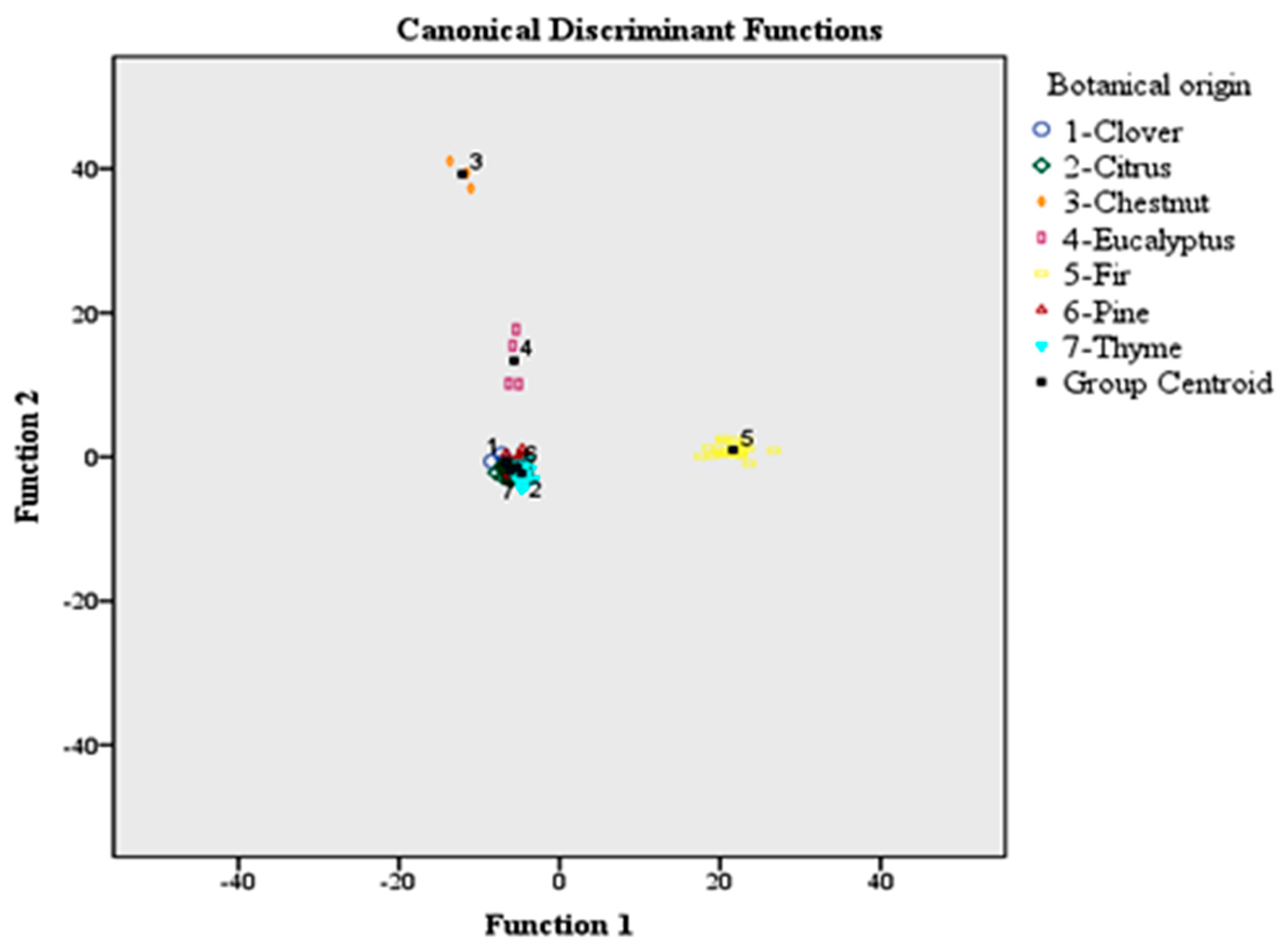
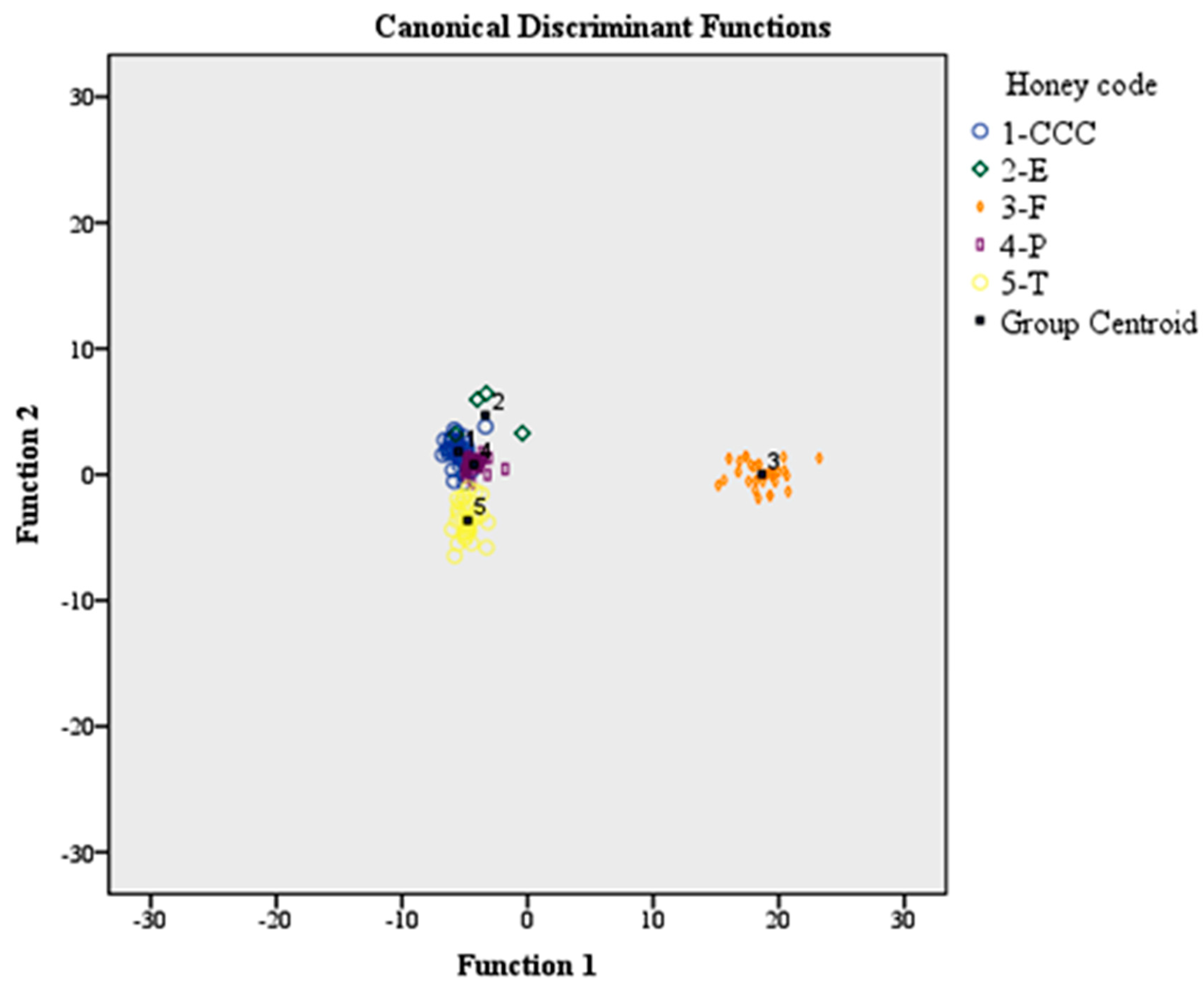
Background: The present study comprises the second part of a new theory related to honey authentication based on the implementation of the honey code and the use of chemometrics. Methods: One hundred and fifty-one honey samples of seven different botanical origins (chestnut, citrus, clover, eucalyptus, fir, pine, and thyme) and from five different countries (Egypt, Greece, Morocco, Portugal, and Spain) were subjected to analysis of mass spectrometry (GC-MS) in combination with headspace solid-phase microextraction (HS-SPME). Results: Results showed that 94 volatile compounds were identified and then semi-quantified. The most dominant classes of compounds were acids, alcohols, aldehydes, esters, ethers, phenolic volatiles, terpenoids, norisoprenoids, and hydrocarbons. The application of classification and dimension reduction statistical techniques to semi-quantified data of volatiles showed that honey samples could be distinguished effectively according to both botanical origin and the honey code (p < 0.05), with the use of hexanoic acid ethyl ester, heptanoic acid ethyl ester, octanoic acid ethyl ester, nonanoic acid ethyl ester, decanoic acid ethyl ester, dodecanoic acid ethyl ester, tetradecanoic acid ethyl ester, hexadecanoic acid ethyl ester, octanal, nonanal, decanal, lilac aldehyde C (isomer III), lilac aldehyde D (isomer IV), benzeneacetaldehyde, alpha-isophorone, 4-ketoisophorone, 2-hydroxyisophorone, geranyl acetone, 6-methyl-5-hepten-2-one, 1-(2-furanyl)-ethanone, octanol, decanol, nonanoic acid, pentanoic acid, 5-methyl-2-phenyl-hexenal, benzeneacetonitrile, nonane, and 5-methyl-4-nonene. Conclusions: New amendments in honey authentication and data handling procedures based on hierarchical classification strategies (HCSs) are exhaustively documented in the present study, supporting and flourishing the state of the art.