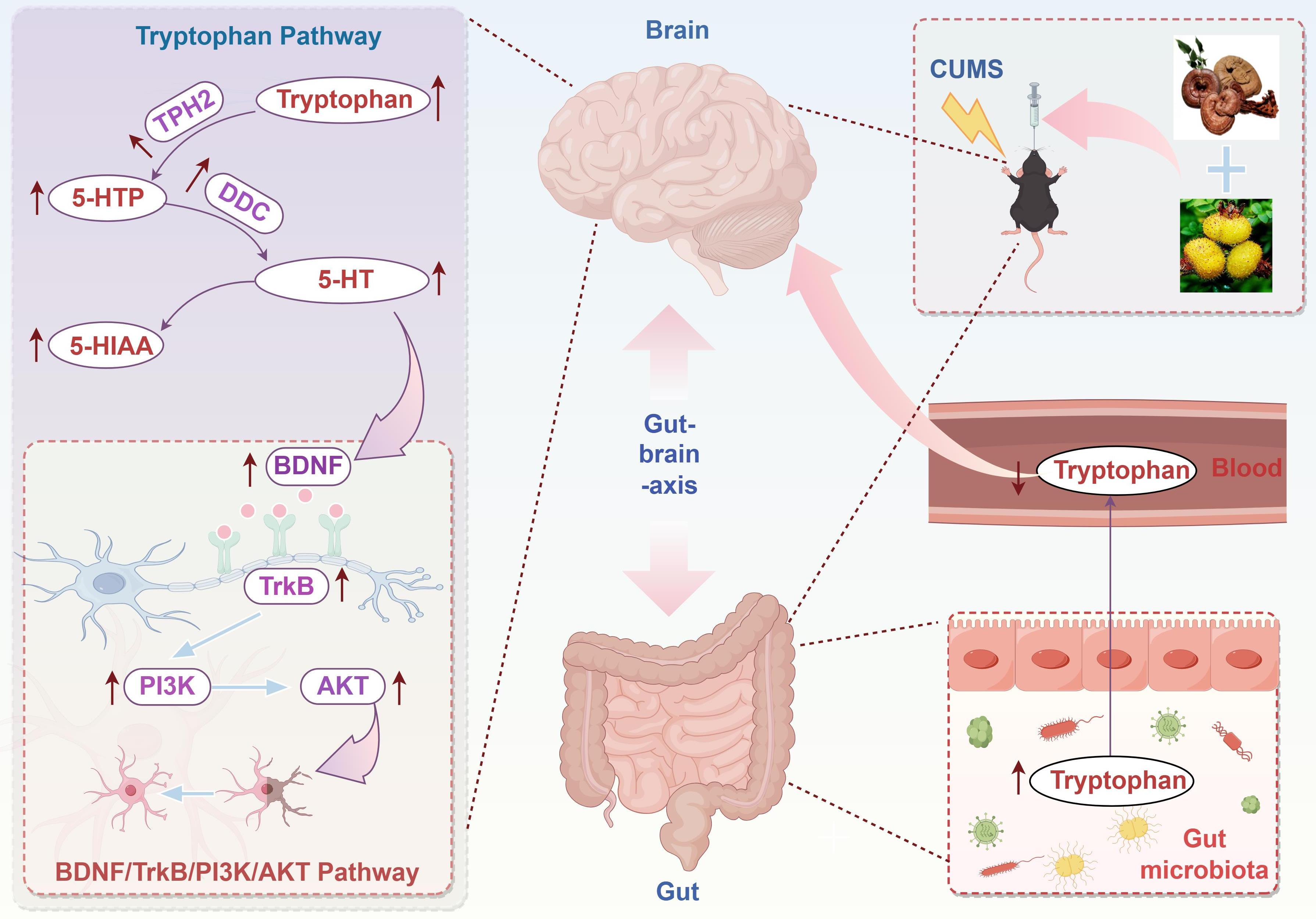
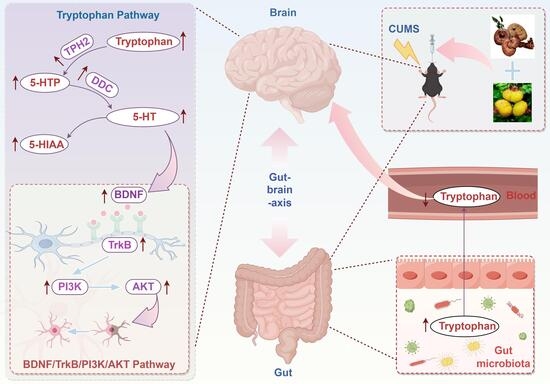
The Ganoderma lucidum and Rosa roxburghii Tratt Formulation Prevents Depressive-like Behaviors in Mice by Modulating Tryptophan Metabolism via the Gut–Brain Axis and Upregulating the BDNF/TrkB/PI3K/AKT Pathway

 ,
,  ,
,
Abstract
1. Introduction
2. Materials and Methods
2.1. Materials
2.2. Preparation of G. lucidum and R. roxburghii Extracts
2.3. UHPLC-ESI-Q-Exactive Plus Orbitrap-MS Analysis
2.4. Animal Experiments
2.4.1. Establishment of Animal Model and Drug Administration
2.4.2. Sucrose Preference Test (SPT)
2.4.3. Open Field Test (OFT)
2.4.4. Forced Swimming Test (FST)
2.4.5. Tail Suspension Test (TST)
2.4.6. Elevated Plus Maze Test (EPMT)
2.4.7. FLX Group
2.5. Histopathological Staining and Biochemical Detection
2.6. Airflow-Assisted Desorption Electrospray Ionization Mass Spectrometry Imaging
2.7. 16S rRNA Analysis of the Gut Microbiota
2.8. No-Targeted Metabolomics of Serum, Brain Tissue, and Feces
2.8.1. Sample Pretreatment
2.8.2. Sample Detection and Analysis
2.9. Network Pharmacology
2.10. Western Blot Assay
2.11. Data Processing and Analysis
3. Results
3.1. Preliminary Identification of the Chemical Components of GLRRTF
3.2. Effects of GLRRTF on CUMS-Induced Depressive-like Behaviors in Mice
3.3. Effects of GLRRTF Intervention on Histopathology of CUMS-Induced Depressive Mice
3.4. Effects of GLRRTF on Neurotransmitters in CUMS-Induced Depressive Mice
3.5. AFADESI-MSI Analysis
3.6. Effects of GLRRTF on Gut Microbiota Dysbiosis in Depressive Mice
3.7. Effects of GLRRTF on Fecal Metabolites in Depressed Mice
3.8. Serum Metabolomics Analysis
3.9. Analysis of Brain Tissue Metabolomics
3.10. Network Pharmacology
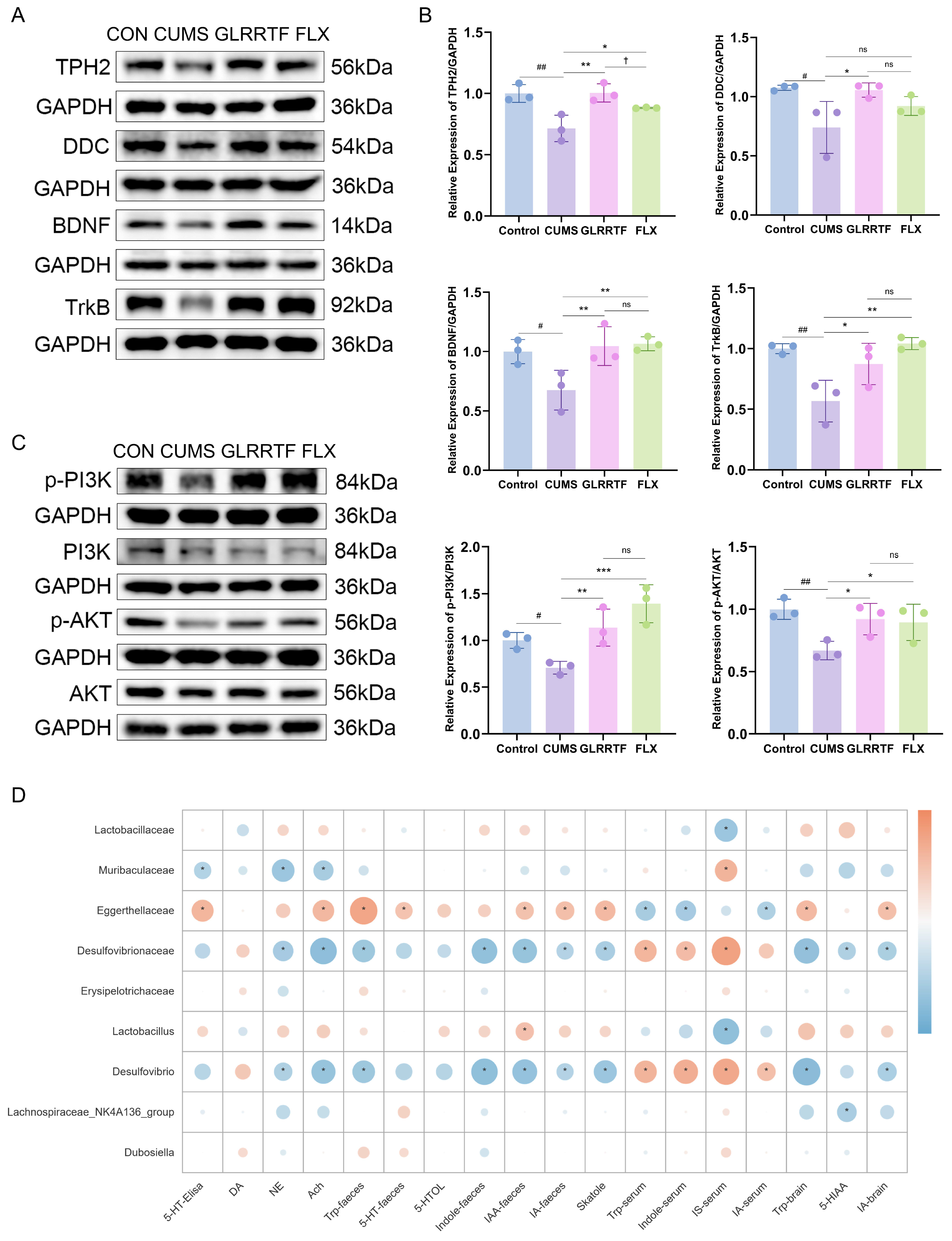
3.11. Western Blot
3.12. Comprehensive Analysis of Gut Microbiota and Metabolites
4. Discussion
5. Conclusions
Supplementary Materials
Author Contributions
Funding
Institutional Review Board Statement
Informed Consent Statement
Data Availability Statement
Acknowledgments
Conflicts of Interest
Abbreviations
| 5-HIAA | 5-hydroxyindole-3-acetic acid |
| 5-HT (serotonin) | 5-hydroxytryptamine |
| 5-HTOL | hydroxytryptophol |
| 5-HTP | 5-hydroxytryptophan |
| Ach | acetylcholine |
| AFADESI-MSI | airflow-assisted desorption electrospray ionization mass spectrometry imaging |
| AKT | protein kinase B |
| BDNF | brain-derived neurotrophic factor |
| CUMS | chronic unpredictable mild stress |
| DA | dopamine |
| DDC | DOPA decarboxylase |
| ELISA | enzyme-linked immunosorbent assay |
| EPMT | elevated plus maze test |
| FLX | fluoxetine |
| FST | forced swimming test |
| GABA | gamma-aminobutyric acid |
| GAPDH | glyceraldehyde-3-phosphate dehydrogenase |
| GBA | gut–brain axis |
| GLRRTF | Ganoderma lucidum and Rosa roxburghii Tratt formulation |
| H&E | hematoxylin and eosin |
| HPA | hypothalamic–pituitary–adrenal |
| IA | 3-indoleacrylic acid |
| IAA | indole-3-acetic acid |
| IS | 3-indoxyl sulphate |
| NE | norepinephrine |
| OFT | open field test |
| PCA | principal component analysis |
| PI3K | phosphatidylinositol 3-kinase |
| SPT | sucrose preference test |
| TPH2 | tryptophan hydroxylase 2 |
| TrkB | tropomyosin receptor kinase B |
| TST | tail suspension test |
| VIP | variable importance in projection |
References
- Lazur, J.; Hnatyk, K.; Kała, K.; Sułkowska-Ziaja, K.; Muszyńska, B. Discovering the Potential Mechanisms of Medicinal Mushrooms Antidepressant Activity: A Review. Antioxidants 2023, 12, 623. [Google Scholar] [CrossRef]
- Gutiérrez-Rodelo, C.; Martínez-Tolibia, S.E.; Morales-Figueroa, G.E.; Velázquez-Moyado, J.A.; Olivares-Reyes, J.A.; Navarrete-Castro, A. Modulating cyclic nucleotides pathways by bioactive compounds in combatting anxiety and depression disorders. Mol. Biol. Rep. 2023, 50, 7797–7814. [Google Scholar] [CrossRef]
- Gonda, X.; Tarazi, F.I.; Dome, P. The emergence of antidepressant drugs targeting GABAA receptors: A concise review. Biochem. Pharmacol. 2024, 228, 116481. [Google Scholar] [CrossRef]
- Dobrek, L.; Głowacka, K. Depression and Its Phytopharmacotherapy—A Narrative Review. Int. J. Mol. Sci. 2023, 24, 4772. [Google Scholar] [CrossRef] [PubMed]
- Song, Z.; Cheng, L.; Liu, Y.; Zhan, S.; Wu, Z.; Zhang, X. Plant-derived bioactive components regulate gut microbiota to prevent depression and depressive-related neurodegenerative diseases: Focus on neurotransmitters. Trends Food Sci. Technol. 2022, 129, 581–590. [Google Scholar] [CrossRef]
- Yoon, S.; Iqbal, H.; Kim, S.M.; Jin, M. Phytochemicals that act on synaptic plasticity as potential prophylaxis against stress-induced depressive disorder. Biomol. Ther. 2023, 31, 148. [Google Scholar] [CrossRef] [PubMed]
- Trigo, M. The role of the gut-brain axis in depression and anxiety disorders. Eur. Psychiatry 2021, 64, S695. [Google Scholar] [CrossRef]
- Gong, P.; Wang, J.; Long, H.; Yang, W.; Chen, X.; Li, N.; Chen, F.; Zhang, J.; Guo, Y. Edible and Medicinal Fungi as Candidate Natural Antidepressants: Mechanisms and Nutritional Implications. Mol. Nutr. Food Res. 2025, 69, e70080. [Google Scholar] [CrossRef]
- Naoi, M.; Wu, Y.; Maruyama, W.; Shamoto-Nagai, M. Phytochemicals modulate biosynthesis and function of serotonin, dopamine, and norepinephrine for treatment of monoamine neurotransmission-related psychiatric diseases. Int. J. Mol. Sci. 2025, 26, 2916. [Google Scholar] [CrossRef]
- Agus, A.; Planchais, J.; Sokol, H. Gut microbiota regulation of tryptophan metabolism in health and disease. Cell Host Microbe 2018, 23, 716–724. [Google Scholar] [CrossRef]
- Pardossi, S.; Fagiolini, A.; Cuomo, A. Variations in BDNF and Their Role in the Neurotrophic Antidepressant Mechanisms of Ketamine and Esketamine: A Review. Int. J. Mol. Sci. 2024, 25, 13098. [Google Scholar] [CrossRef]
- Molska, M.; Mruczyk, K.; Cisek-Woźniak, A.; Prokopowicz, W.; Szydełko, P.; Jakuszewska, Z.; Marzec, K.; Trocholepsza, M. The Influence of Intestinal Microbiota on BDNF Levels. Nutrients 2024, 16, 2891. [Google Scholar] [CrossRef] [PubMed]
- Tu, F.; Pang, Q.; Huang, T.; Zhao, Y.; Liu, M.; Chen, X. Apigenin ameliorates post-stroke cognitive deficits in rats through histone acetylation-mediated neurochemical alterations. Med. Sci. Monit. Int. Med. J. Exp. Clin. Res. 2017, 23, 4004. [Google Scholar] [CrossRef] [PubMed]
- Fan, X.; Deng, H.; Qiu, J.; Ji, H.; Shen, X. Antibiotics-induced depression in mice via the microbiota-gut-brain axis. J. Affect. Disord. 2022, 318, 152–158. [Google Scholar] [CrossRef]
- Correia, A.S.; Cardoso, A.; Vale, N. BDNF unveiled: Exploring its role in major depression disorder serotonergic imbalance and associated stress conditions. Pharmaceutics 2023, 15, 2081. [Google Scholar] [CrossRef]
- Fan, Y.; Luan, X.; Wang, X.; Li, H.; Zhao, H.; Li, S.; Li, X.; Qiu, Z. Exploring the association between BDNF related signaling pathways and depression: A literature review. Brain Res. Bull. 2025, 220, 111143. [Google Scholar] [CrossRef]
- Swallah, M.S.; Bondzie-Quaye, P.; Wang, H.; Shao, C.-S.; Hua, P.; Bashir, M.A.; Holman, J.B.; Sossah, F.L.; Huang, Q. Potentialities of Ganoderma lucidum extracts as functional ingredients in food formulation. Food Res. Int. 2023, 172, 113161. [Google Scholar] [CrossRef] [PubMed]
- Wachtel-Galor, S.; Yuen, J.; Buswell, J.A.; Benzie, I.F. Ganoderma lucidum (Lingzhi or Reishi): A medicinal mushroom. In Herbal Medicine: Biomolecular and Clinical Aspects; CRC Press: Boca Raton, FL, USA, 2012. [Google Scholar]
- Socala, K.; Nieoczym, D.; Grzywnowicz, K.; Stefaniuk, D.; Wlaz, P. Evaluation of anticonvulsant, antidepressant-, and anxiolytic-like effects of an aqueous extract from cultured mycelia of the Lingzhi or Reishi medicinal mushroom Ganoderma lucidum (Higher Basidiomycetes) in mice. Int. J. Med. Mushrooms 2015, 17, 209–218. [Google Scholar] [CrossRef]
- Zhao, Y.; Qin, Y.; Hu, X.; Chen, X.; Jiang, Y.-P.; Jin, X.-J.; Li, G.; Li, Z.-H.; Yang, J.-H.; Cui, S.-Y.; et al. Sporoderm-removed Ganoderma lucidum spores ameliorated early depression-like behavior in a rat model of sporadic Alzheimer’s disease. Front. Pharmacol. 2024, 15, 1406127. [Google Scholar] [CrossRef]
- Li, H.; Xiao, Y.; Han, L.; Jia, Y.; Luo, S.; Zhang, D.; Zhang, L.; Wu, P.; Xiao, C.; Kan, W. Ganoderma lucidum polysaccharides ameliorated depression-like behaviors in the chronic social defeat stress depression model via modulation of Dectin-1 and the innate immune system. Brain Res. Bull. 2021, 171, 16–24. [Google Scholar] [CrossRef]
- Mi, X.; Zeng, G.-R.; Liu, J.-Q.; Luo, Z.-S.; Zhang, L.; Dai, X.-M.; Fang, W.-T.; Zhang, J.; Chen, X.-C. Ganoderma lucidum triterpenoids improve maternal separation-induced anxiety- and depression-like behaviors in mice by mitigating inflammation in the periphery and brain. Nutrients 2022, 14, 2268. [Google Scholar] [CrossRef]
- Wang, L.; Wei, T.; Zheng, L.; Jiang, F.; Ma, W.; Lu, M.; Wu, X.; An, H. Recent Advances on Main Active Ingredients, Pharmacological Activities of Rosa roxbughii and Its Development and Utilization. Foods 2023, 12, 1051. [Google Scholar] [CrossRef] [PubMed]
- Jain, A.; Sarsaiya, S.; Gong, Q.; Wu, Q.; Shi, J. Chemical diversity, traditional uses, and bioactivities of Rosa roxburghii Tratt: A comprehensive review. Pharmacol. Ther. 2024, 259, 108657. [Google Scholar] [CrossRef]
- Lai, C.-C.; Zhang, S.; Chen, Z.-Y.; Meng, D.; Liang, H.; Huang, B.-R.; Wang, P.-J.; Huang, X.-C.; Zhang, M.; Gao, X.-L. Decoding the Protective Mechanisms of Rosa roxburghii Fermented Juice against CUMS-Induced Depression-like Behaviors: Insights from Gut Microbiota and Neuroinflammation. J. Agric. Food Chem. 2025, 74, 1460–1477. [Google Scholar] [CrossRef]
- Chen, F.; Wang, L.; Jin, F.; Li, L.; Wang, T.; Gao, M.; Li, L.; Wang, Y.; Lou, Z.; Yang, J.; et al. Neuroprotection of Kaji-Ichigoside F1 via the BDNF/Akt/mTOR Signaling Pathways against NMDA-Induced Neurotoxicity. Int. J. Mol. Sci. 2022, 23, 16150. [Google Scholar] [CrossRef]
- Chen, F.; Li, L.; Huang, M.; Wang, Y.; Wang, L.; Jin, F.; Yang, L.; Gao, M.; Li, L.; Wang, Y. Natural product Kaji-ichigoside F1 exhibits rapid antidepression via activating the AMPA–BDNF–mTOR pathway and inhibiting the NMDAR–CaMKIIα pathway. Phytomedicine 2024, 126, 155452. [Google Scholar] [CrossRef]
- Yin, C.; Zhang, Y.; Zhang, L.; Tian, Y.; Zhong, X.; Fang, X.; Yang, Y.; Tao, A. Exploring Rosa roxburghii Tratt polysaccharides: From extraction to application potential in functional products-An in-depth review. Int. J. Biol. Macromol. 2024, 280, 135543. [Google Scholar] [CrossRef]
- Shoji, H.; Miyakawa, T. Increased depression-related behavior during the postpartum period in inbred BALB/c and C57BL/6 strains. Mol. Brain 2019, 12, 70. [Google Scholar] [CrossRef] [PubMed]
- Sharma, S.; Chawla, S.; Kumar, P.; Ahmad, R.; Verma, P.K. The chronic unpredictable mild stress (CUMS) Paradigm: Bridging the gap in depression research from bench to bedside. Brain Res. 2024, 1843, 149123. [Google Scholar] [CrossRef]
- Liaqat, H.; Parveen, A.; Kim, S.Y. Neuroprotective natural products’ regulatory effects on depression via gut–brain axis targeting tryptophan. Nutrients 2022, 14, 3270. [Google Scholar] [CrossRef] [PubMed]
- Xu, S.Y.; Bian, R.L.; Chen, X. Pharmacological Experimental Methodology, 3rd ed.; People’s Medical Publishing House: Beijing, China, 2002; pp. 202–203. [Google Scholar]
- Li, Q.; Zhao, B.; Li, W.; He, Y.; Tang, X.; Zhang, T.; Zhong, Z.; Pan, Q.; Zhang, Y. Effects of repeated drug administration on behaviors in normal mice and fluoxetine efficacy in chronic unpredictable mild stress mice. Biochem. Biophys. Res. Commun. 2022, 615, 36–42. [Google Scholar] [CrossRef]
- Antoniuk, S.; Bijata, M.; Ponimaskin, E.; Wlodarczyk, J. Chronic unpredictable mild stress for modeling depression in rodents: Meta-analysis of model reliability. Neurosci. Biobehav. Rev. 2019, 99, 101–116. [Google Scholar] [CrossRef]
- Schalla, M.A.; Kühne, S.G.; Friedrich, T.; Hanel, V.; Kobelt, P.; Goebel-Stengel, M.; Rose, M.; Stengel, A. Sucrose preference and novelty-induced hypophagia tests in rats using an automated food intake monitoring system. J. Vis. Exp. 2020, 159, e60953. [Google Scholar] [CrossRef]
- Kraeuter, A.-K.; Guest, P.C.; Sarnyai, Z. The open field test for measuring locomotor activity and anxiety-like behavior. In Pre-Clinical Models: Techniques and Protocols; Springer: New York, NY, USA, 2018; pp. 99–103. [Google Scholar]
- De Kloet, E.; Molendijk, M. Coping with the forced swim stressor: Towards understanding an adaptive mechanism. Neural Plast. 2016, 2016, 6503162. [Google Scholar] [CrossRef] [PubMed]
- Can, A.; Dao, D.T.; Terrillion, C.E.; Piantadosi, S.C.; Bhat, S.; Gould, T.D. The tail suspension test. J. Vis. Exp. 2012, 59, 3769. [Google Scholar] [CrossRef]
- Leo, L.M.; Pamplona, F.A. Elevated plus maze test to assess anxiety-like behavior in the mouse. Bio-Protocol 2014, 4, e1211. [Google Scholar] [CrossRef]
- Cardiff, R.D.; Miller, C.H.; Munn, R.J. Manual hematoxylin and eosin staining of mouse tissue sections. Cold Spring Harb. Protoc. 2014, 2014, 655–658. [Google Scholar] [CrossRef]
- Kiernan, J. Histological and Histochemical Methods; Scion Publishing Ltd.: Banbury, UK, 2015. [Google Scholar]
- Tokarz, D.A. Red Deads, Ghosts, and the Afterlife: A Guide to Neuronal Cell Death. Toxicol. Pathol. 2025, 53, 651–656. [Google Scholar] [CrossRef]
- Elmore, S.A.; Dixon, D.; Hailey, J.R.; Harada, T.; Herbert, R.A.; Maronpot, R.R.; Nolte, T.; Rehg, J.E.; Rittinghausen, S.; Rosol, T.J. Recommendations from the INHAND apoptosis/necrosis working group. Toxicol. Pathol. 2016, 44, 173–188. [Google Scholar] [CrossRef]
- Li, C.; Zhang, M.; Zhao, Y.; Yang, D.; Zhao, M.; Shang, L.; Sun, X.; Zhang, S.; Wang, P.; Gao, X. Exploring the Impact of Pharmaceutical Excipient PEG400 on the Pharmacokinetics of Mycophenolic Acid Through In Vitro and In Vivo Experiments. Int. J. Mol. Sci. 2025, 26, 72. [Google Scholar] [CrossRef]
- Klindworth, A.; Pruesse, E.; Schweer, T.; Peplies, J.; Quast, C.; Horn, M.; Glöckner, F.O. Evaluation of general 16S ribosomal RNA gene PCR primers for classical and next-generation sequencing-based diversity studies. Nucleic Acids Res. 2013, 41, e1. [Google Scholar] [CrossRef]
- Pichler, M.; Coskun, Ö.K.; Ortega-Arbulú, A.-S.; Conci, N.; Wörheide, G.; Vargas, S.; Orsi, W.D. A 16S rRNA gene sequencing and analysis protocol for the Illumina MiniSeq platform. MicrobiologyOpen 2018, 7, e00611. [Google Scholar] [CrossRef] [PubMed]
- Chen, Z.; Zhang, S.; Sun, X.; Meng, D.; Lai, C.; Zhang, M.; Wang, P.; Huang, X.; Gao, X. Rosa roxburghii fermented juice mitigates LPS-induced acute lung injury by modulation of intestinal flora and metabolites. Front. Microbiol. 2024, 15, 1447735. [Google Scholar] [CrossRef]
- Sule, R.; Rivera, G.; Gomes, A.V. Western blotting (immunoblotting): History, theory, uses, protocol and problems. Biotechniques 2023, 75, 99–114. [Google Scholar] [CrossRef]
- Peng, L.; Zhang, X.; Tian, J.; Wen, J.; Qiu, R.; Zheng, Y.; Chen, C.; Ma, H. Desulfovibrio vulgaris trigger depression-like behavior in mice through dual disruption of colonic homeostasis and fatty acid metabolism. Physiol. Behav. 2026, 307, 115232. [Google Scholar] [CrossRef] [PubMed]
- Ge, C.; Wang, S.; Wu, X.; Lei, L. Quercetin attenuates brain apoptosis in mice with chronic unpredictable mild stress-induced depression. Behav. Brain Res. 2024, 465, 114934. [Google Scholar] [CrossRef]
- Su, P.; Liu, L.; Gong, Y.; Peng, S.; Yan, X.; Bai, M.; Xu, E.; Li, Y. Kaempferol improves depression-like behaviors through shifting microglia polarization and suppressing NLRP3 via tilting the balance of PPARγ and STAT1 signaling. Int. Immunopharmacol. 2024, 143, 113538. [Google Scholar] [CrossRef] [PubMed]
- Zhang, L.; Lu, R.-R.; Xu, R.-H.; Wang, H.-H.; Feng, W.-S.; Zheng, X.-K. Naringenin and apigenin ameliorates corticosterone-induced depressive behaviors. Heliyon 2023, 9, e15618. [Google Scholar] [CrossRef]
- Yanfang, S.; Ping, Q.; Li, C.; Lijing, Z.; Wenpeng, P.; Xianfang, M. Catechin Protects against Lipopolysaccharide-induced Depressive-like Behaviour in Mice by Regulating Neuronal and Inflammatory Genes. Curr. Gene Ther. 2024, 24, 292–306. [Google Scholar]
- Martínez-Damas, M.G.; Genis-Mendoza, A.D.; Cruz, V.P.-D.L.; Canela-Tellez, G.D.; Jiménez-Estrada, I.; Sanchez, J.H.N.; Ramos-Chávez, L.A.; García, S.; Ramírez-Ramírez, M.; Coral-Vázquez, R.M. Epicatechin treatment generates resilience to chronic mild stress-induced depression in a murine model through a modulatory effect on KAT. Physiol. Behav. 2021, 238, 113466. [Google Scholar] [CrossRef]
- Girish, C.; Raj, V.; Arya, J.; Balakrishnan, S. Evidence for the involvement of the monoaminergic system, but not the opioid system in the antidepressant-like activity of ellagic acid in mice. Eur. J. Pharmacol. 2012, 682, 118–125. [Google Scholar] [CrossRef]
- Liu, Y.-M.; Shen, J.-D.; Xu, L.-P.; Li, H.-B.; Li, Y.-C.; Yi, L.-T. Ferulic acid inhibits neuro-inflammation in mice exposed to chronic unpredictable mild stress. Int. Immunopharmacol. 2017, 45, 128–134. [Google Scholar] [CrossRef] [PubMed]
- Song, Y.; Xiao, F.; Aa, J.; Wang, G. Desorption Electrospray Ionization Mass Spectrometry Imaging Techniques Depict a Reprogramming of Energy and Purine Metabolism in the Core Brain Regions of Chronic Social Defeat Stress Mice. Metabolites 2024, 14, 284. [Google Scholar] [CrossRef] [PubMed]
- Liu, G.-X.; Li, Z.-L.; Lin, S.-Y.; Wang, Q.; Luo, Z.-Y.; Wu, K.; Zhou, Y.-L.; Ning, Y.-P. Mapping metabolite change in the mouse brain after esketamine injection by ambient mass spectrometry imaging and metabolomics. Front. Psychiatry 2023, 14, 1109344. [Google Scholar] [CrossRef] [PubMed]
- Spring, S.; Lerch, J.P.; Wetzel, M.K.; Evans, A.C.; Henkelman, R.M. Cerebral asymmetries in 12-week-old C57Bl/6J mice measured by magnetic resonance imaging. Neuroimage 2010, 50, 409–415. [Google Scholar] [CrossRef]
- Mundorf, A.; Ocklenburg, S. Hemispheric asymmetries in mental disorders: Evidence from rodent studies. J. Neural Transm. 2023, 130, 1153–1165. [Google Scholar] [CrossRef]
- Ocklenburg, S.; Peterburs, J.; Mundorf, A. Hemispheric asymmetries in the amygdala: A comparative primer. Prog. Neurobiol. 2022, 214, 102283. [Google Scholar] [CrossRef]
- Shipton, O.A.; El-Gaby, M.; Apergis-Schoute, J.; Deisseroth, K.; Bannerman, D.M.; Paulsen, O.; Kohl, M.M. Left–right dissociation of hippocampal memory processes in mice. Proc. Natl. Acad. Sci. USA 2014, 111, 15238–15243. [Google Scholar] [CrossRef]
- Luscher, B.; Fuchs, T. GABAergic control of depression-related brain states. In Advances in Pharmacology; Elsevier: Amsterdam, The Netherlands, 2015; pp. 97–144. [Google Scholar]
- Mamelak, M. Depression and the glutamate/GABA-glutamine cycle. Curr. Neuropharmacol. 2025, 23, 75–84. [Google Scholar] [CrossRef]
- Dulawa, S.C.; Janowsky, D.S. Cholinergic regulation of mood: From basic and clinical studies to emerging therapeutics. Mol. Psychiatry 2019, 24, 694–709. [Google Scholar] [CrossRef]
- Maffei, M.E. 5-Hydroxytryptophan (5-HTP): Natural occurrence, analysis, biosynthesis, biotechnology, physiology and toxicology. Int. J. Mol. Sci. 2020, 22, 181. [Google Scholar] [CrossRef]
- Han, H.; Yao, J.; Wu, J.; Mao, S.; Pan, H.; Qv, L.; Zhu, G.; Ren, J.; Yu, Y.; Xuan, F. Implications of neurogenesis in depression through BDNF: Rodent models, regulatory pathways, gut microbiota, and potential therapy. Mol. Psychiatry 2025, 30, 4409–4421. [Google Scholar] [CrossRef]
- Liu, L.; Wang, H.; Zhang, H.; Chen, X.; Zhang, Y.; Wu, J.; Zhao, L.; Wang, D.; Pu, J.; Ji, P. Toward a deeper understanding of gut microbiome in depression: The promise of clinical applicability. Adv. Sci. 2022, 9, 2203707. [Google Scholar] [CrossRef]
- Dacaya, P.; Sarapis, K.; Moschonis, G. The role and mechanisms of probiotic supplementation on depressive symptoms: A narrative review. Curr. Nutr. Rep. 2025, 14, 53. [Google Scholar] [CrossRef] [PubMed]
- Lv, J.-L.; Bai, Y.; Lv, Y.-E.; Chen, C.-C.; Qin, X.-M.; Du, G.-H.; Zhou, Y.-Z. Integrated colon Microbiome and metabolomics to elucidate the antidepressant mechanisms of the Radix Bupleuri-Radix paeoniae Alba herb pair. Metab. Brain Dis. 2024, 40, 45. [Google Scholar] [CrossRef]
- Rao, Z.; Li, J.; Shi, B.; Zeng, Y.; Liu, Y.; Sun, Z.; Wu, L.; Sun, W.; Tang, Z. Dietary tryptophan levels impact growth performance and intestinal microbial ecology in weaned piglets via tryptophan metabolites and intestinal antimicrobial peptides. Animals 2021, 11, 817. [Google Scholar] [CrossRef] [PubMed]
- Xie, J.; Wu, W.-T.; Chen, J.-J.; Zhong, Q.; Wu, D.; Niu, L.; Wang, S.; Zeng, Y.; Wang, Y. Tryptophan metabolism as bridge between gut microbiota and brain in chronic social defeat stress-induced depression mice. Front. Cell. Infect. Microbiol. 2023, 13, 1121445. [Google Scholar] [CrossRef]
- Liu, B.; Yu, D.; Sun, J.; Wu, X.; Xin, Z.; Deng, B.; Fan, L.; Fu, J.; Ge, L.; Ren, W. Characterizing the influence of gut microbiota on host tryptophan metabolism with germ-free pigs. Anim. Nutr. 2022, 11, 190–200. [Google Scholar] [CrossRef] [PubMed]
- Guo, X.; Lin, F.; Yang, F.; Chen, J.; Cai, W.; Zou, T. Gut microbiome characteristics of comorbid generalized anxiety disorder and functional gastrointestinal disease: Correlation with alexithymia and personality traits. Front. Psychiatry 2022, 13, 946808. [Google Scholar] [CrossRef]
- Borisova, M.A.; Snytnikova, O.A.; Litvinova, E.A.; Achasova, K.M.; Babochkina, T.I.; Pindyurin, A.V.; Tsentalovich, Y.P.; Kozhevnikova, E.N. Fucose Ameliorates Tryptophan Metabolism and Behavioral Abnormalities in a Mouse Model of Chronic Colitis. Nutrients 2020, 12, 445. [Google Scholar] [CrossRef]
- Platten, M.; Nollen, E.A.; Röhrig, U.F.; Fallarino, F.; Opitz, C.A. Tryptophan metabolism as a common therapeutic target in cancer, neurodegeneration and beyond. Nat. Rev. Drug Discov. 2019, 18, 379–401. [Google Scholar]
- Han, X.-M.; Qin, Y.-J.; Zhu, Y.; Zhang, X.-L.; Wang, N.-X.; Rang, Y.; Zhai, X.-J.; Lu, Y.-N. Development of an underivatized LC-MS/MS method for quantitation of 14 neurotransmitters in rat hippocampus, plasma and urine: Application to CUMS induced depression rats. J. Pharm. Biomed. Anal. 2019, 174, 683–695. [Google Scholar] [CrossRef] [PubMed]
- Wang, D.; Wu, J.; Zhu, P.; Xie, H.; Lu, L.; Bai, W.; Pan, W.; Shi, R.; Ye, J.; Xia, B. Tryptophan-rich diet ameliorates chronic unpredictable mild stress induced depression-and anxiety-like behavior in mice: The potential involvement of gut-brain axis. Food Res. Int. 2022, 157, 111289. [Google Scholar] [CrossRef]
- Rust, C.; Malan-Muller, S.; van den Heuvel, L.L.; Tonge, D.; Seedat, S.; Pretorius, E.; Hemmings, S.M.J. Platelets bridging the gap between gut dysbiosis and neuroinflammation in stress-linked disorders: A narrative review. J. Neuroimmunol. 2023, 382, 578155. [Google Scholar] [CrossRef]
- Philippe, C.; de Edelenyi, F.S.; Naudon, L.; Druesne-Pecollo, N.; Hercberg, S.; Kesse-Guyot, E.; Latino-Martel, P.; Galan, P.; Rabot, S. Relation between Mood and the Host-Microbiome Co-Metabolite 3-Indoxylsulfate: Results from the Observational Prospective NutriNet-Santé Study. Microorganisms 2021, 9, 716. [Google Scholar]
- Roager, H.M.; Licht, T.R. Microbial tryptophan catabolites in health and disease. Nat. Commun. 2018, 9, 3294. [Google Scholar] [CrossRef] [PubMed]
- Musumeci, G.; Castrogiovanni, P.; Castorina, S.; Imbesi, R.; Szychlinska, M.A.; Scuderi, S.; Loreto, C.; Giunta, S. Changes in serotonin (5-HT) and brain-derived neurotrophic factor (BDFN) expression in frontal cortex and hippocampus of aged rat treated with high tryptophan diet. Brain Res. Bull. 2015, 119, 12–18. [Google Scholar] [CrossRef] [PubMed]
- Bai, Y.-Y.; Ruan, C.-S.; Yang, C.-R.; Li, J.-Y.; Kang, Z.-L.; Zhou, L.; Liu, D.; Zeng, Y.-Q.; Wang, T.-H.; Tian, C.-F.; et al. ProBDNF Signaling Regulates Depression-Like Behaviors in Rodents under Chronic Stress. Neuropsychopharmacology 2016, 41, 2882–2892. [Google Scholar]
- Liaqat, H.; Parveen, A.; Kim, S.-Y. Antidepressive effect of natural products and their derivatives targeting BDNF-TrkB in gut–brain axis. Int. J. Mol. Sci. 2022, 23, 14968. [Google Scholar]
- Siopi, E.; Chevalier, G.; Katsimpardi, L.; Saha, S.; Bigot, M.; Moigneu, C.; Eberl, G.; Lledo, P.-M. Changes in gut microbiota by chronic stress impair the efficacy of fluoxetine. Cell Rep. 2020, 30, 3682–3690.e6. [Google Scholar]
- Shi, H.-J.; Wu, D.-L.; Chen, R.; Li, N.; Zhu, L.-J. Requirement of hippocampal DG nNOS-CAPON dissociation for the anxiolytic and antidepressant effects of fluoxetine. Theranostics 2022, 12, 3656. [Google Scholar] [CrossRef] [PubMed]
- Dong, H.; Tang, X.; Ye, J.; Xiao, W. 16S rRNA gene sequencing reveals the effect of fluoxetine on gut microbiota in chronic unpredictable stress-induced depressive-like rats. Ann. Gen. Psychiatry 2023, 22, 27. [Google Scholar] [CrossRef]
- Zhao, L.; Xiong, Z.; Lu, X.; Zheng, S.; Wang, F.; Ge, L.; Su, G.; Yang, J.; Wu, C. Metabonomic evaluation of chronic unpredictable mild stress-induced changes in rats by intervention of fluoxetine by HILIC-UHPLC/MS. PLoS ONE 2015, 10, e0129146. [Google Scholar] [CrossRef]
- Eid, R.S.; Gobinath, A.R.; Galea, L.A. Sex differences in depression: Insights from clinical and preclinical studies. Prog. Neurobiol. 2019, 176, 86–102. [Google Scholar] [CrossRef] [PubMed]
- Ghaffar, T.; Valeriani, F.; Spica, V.R. The sex related differences in health and Disease: A systematic review of sex-specific gut microbiota and Possible implications for microbial pathogenesis. Microb. Pathog. 2025, 209, 108094. [Google Scholar] [CrossRef] [PubMed]
- Pais, M.L.; Martins, J.; Castelo-Branco, M.; Goncalves, J. Sex differences in tryptophan metabolism: A systematic review focused on neuropsychiatric disorders. Int. J. Mol. Sci. 2023, 24, 6010. [Google Scholar] [CrossRef]
- Eltokhi, A.; Kurpiers, B.; Pitzer, C. Baseline Depression-Like Behaviors in Wild-Type Adolescent Mice Are Strain and Age but Not Sex Dependent. Front. Behav. Neurosci. 2021, 15, 759574. [Google Scholar] [CrossRef]
- Dalla, C.; Pitychoutis, P.M.; Kokras, N.; Papadopoulou-Daifoti, Z. Sex differences in animal models of depression and antidepressant response. Basic Clin. Pharmacol. Toxicol. 2010, 106, 226–233. [Google Scholar] [CrossRef]


Disclaimer/Publisher’s Note: The statements, opinions and data contained in all publications are solely those of the individual author(s) and contributor(s) and not of MDPI and/or the editor(s). MDPI and/or the editor(s) disclaim responsibility for any injury to people or property resulting from any ideas, methods, instructions or products referred to in the content. |
© 2026 by the authors. Licensee MDPI, Basel, Switzerland. This article is an open access article distributed under the terms and conditions of the Creative Commons Attribution (CC BY) license.
Share and Cite
Feng, F.; Zhang, S.; Lai, C.; Chen, Z.; Zhang, J.; He, J.; Zhang, M.; Wang, P.; Gao, X. The Ganoderma lucidum and Rosa roxburghii Tratt Formulation Prevents Depressive-like Behaviors in Mice by Modulating Tryptophan Metabolism via the Gut–Brain Axis and Upregulating the BDNF/TrkB/PI3K/AKT Pathway. Foods 2026, 15, 1535. https://doi.org/10.3390/foods15091535
Feng F, Zhang S, Lai C, Chen Z, Zhang J, He J, Zhang M, Wang P, Gao X. The Ganoderma lucidum and Rosa roxburghii Tratt Formulation Prevents Depressive-like Behaviors in Mice by Modulating Tryptophan Metabolism via the Gut–Brain Axis and Upregulating the BDNF/TrkB/PI3K/AKT Pathway. Foods. 2026; 15(9):1535. https://doi.org/10.3390/foods15091535
Chicago/Turabian StyleFeng, Fangling, Shuo Zhang, Chencen Lai, Zhiyu Chen, Jian Zhang, Jiuming He, Min Zhang, Pengjiao Wang, and Xiuli Gao. 2026. "The Ganoderma lucidum and Rosa roxburghii Tratt Formulation Prevents Depressive-like Behaviors in Mice by Modulating Tryptophan Metabolism via the Gut–Brain Axis and Upregulating the BDNF/TrkB/PI3K/AKT Pathway" Foods 15, no. 9: 1535. https://doi.org/10.3390/foods15091535
APA StyleFeng, F., Zhang, S., Lai, C., Chen, Z., Zhang, J., He, J., Zhang, M., Wang, P., & Gao, X. (2026). The Ganoderma lucidum and Rosa roxburghii Tratt Formulation Prevents Depressive-like Behaviors in Mice by Modulating Tryptophan Metabolism via the Gut–Brain Axis and Upregulating the BDNF/TrkB/PI3K/AKT Pathway. Foods, 15(9), 1535. https://doi.org/10.3390/foods15091535