Article

Valorization of Pterospartum tridentatum (Carqueja) Stems: Influence of Extraction Methods on Phenolic Composition, Antioxidant Capacity, and Functional Bioactivity


by
Tiago Barros Afonso
1,*,
Teresa Bonifácio-Lopes
1,
Eduardo M. Costa
1,
Tiago Macedo
2,
Joana Moreira
2,
Juliana A. S. A. Oliveira
2 and
Manuela Pintado
1
1
CBQF-Centro de Biotecnologia e Química Fina–Laboratório Associado, Escola Superior de Biotecnologia, Universidade Católica Portuguesa, Rua Diogo Botelho 1327, 4169-005 Porto, Portugal
2
Centre for Nanotechnology and Advanced Materials, CeNTI, Rua Fernando Mesquita 2785, 4760-034 Vila Nova de Famalicão, Portugal
*
Author to whom correspondence should be addressed.
Foods 2026, 15(9), 1461; https://doi.org/10.3390/foods15091461
Submission received: 10 March 2026 / Revised: 17 April 2026 / Accepted: 20 April 2026 / Published: 22 April 2026

Abstract

Pterospartum tridentatum (L.) Willk. (carqueja) is widely used in traditional medicine and culinary practices in the Iberian Peninsula; however, most studies have focused on its flowers, while its stems remain largely unexplored, despite representing a significant proportion of the plant biomass. This study aimed to evaluate the potential of P. tridentatum stems as a source of bioactive compounds using different extraction methodologies. Aqueous, hydroethanolic, ultrasound-assisted extraction (UAE) and pressurized liquid extraction (PLE) were applied, and the resulting extracts were characterized in terms of their extraction yield, protein and carbohydrate content, phenolic composition, antioxidant capacity, antimicrobial activity, and cytotoxicity in HaCaT and Caco-2 cell lines. Phenolic profiling by LC-ESI-QqTOF-HRMS tentatively identified 37 compounds, mainly corresponding to flavonoid and isoflavonoid glycosides, with genistein derivatives representing the dominant constituents across all extracts. Although extraction yields differed among methods, phenolic profiles were broadly similar. UAE and PLE extracts showed slightly higher antioxidant activity, while antimicrobial activity was limited, with only moderate inhibition observed against Staphylococcus epidermidis and Malassezia furfur. Additionally, cytotoxicity assays indicated low toxicity. Overall, the results demonstrate that P. tridentatum stems represent a promising yet underutilized biomass source of phenolic compounds with antioxidant potential and low cytotoxicity under the tested in vitro conditions.

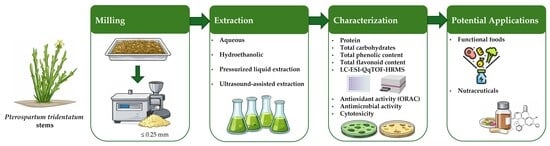
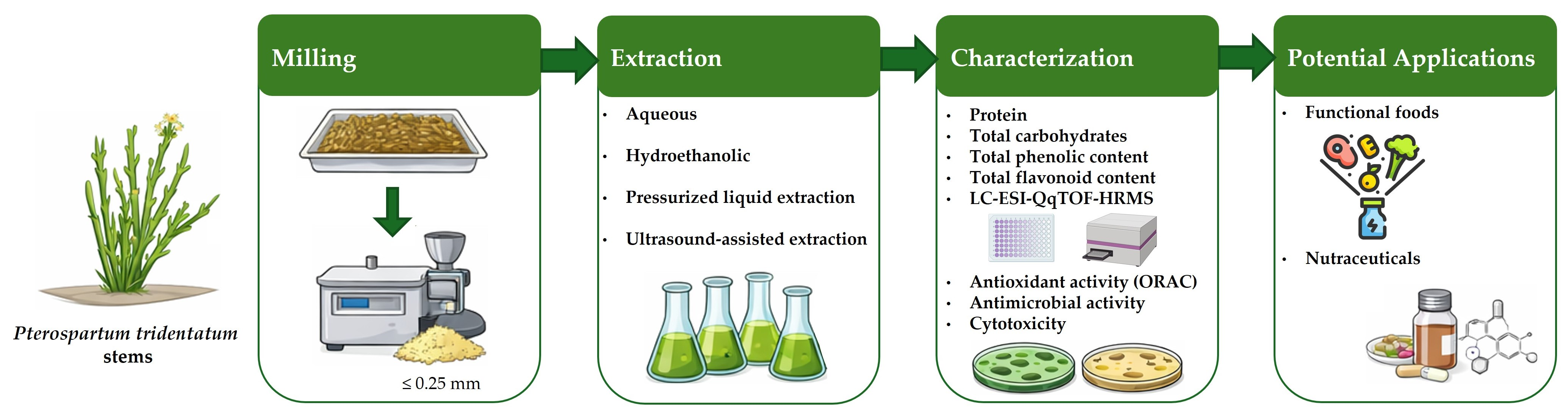
Graphical Abstract

1. Introduction

Pterospartum tridentatum (L.) Willk. [=Chamaespartium tridentatum (L.) P. Gibbs.,] (syn. Genista tridentata), commonly known in Portugal as “carqueja”, is an endemic shrub of the Fabaceae family and is broadly distributed in the Iberian Peninsula and North Africa [1,2,3]. It typically reaches heights of up to 100 cm and is characterized by yellow flowers, alternate branches, and coriaceous winged stems [2,3]. P. tridentatum has long been used in traditional medicine, where its fresh or dried flowers are prepared as infusions, decoctions, and tonic beverages valued for their anti-inflammatory, diuretic, and depurative properties [4,5,6,7]. It is commonly used to relieve symptoms associated with colds, digestive, intestinal, and urologic problems [2,5,8,9,10]. In addition to its medicinal use, P. tridentatum is also used in gastronomy, for example, to flavor rice and game meat [2,11]. Previous research has reported significant antioxidant potential, as well as antimicrobial and cytotoxic activities, associated with extracts obtained from P. tridentatum flowers and leaves, highlighting their potential as a source of bioactive compounds for food and health-related applications [12,13,14,15]. Phytochemical studies have revealed that this species is particularly rich in phenolic compounds, especially flavonoids and isoflavones, such as genistein derivatives, which are believed to contribute to its biological activities [12,16,17].
Despite these promising findings, most previous studies have focused primarily on the flowers or aerial parts of the plant, which are the raw materials traditionally used for herbal infusions and medicinal preparations, reporting high amounts of bioactive compounds [10,11,12,14]. Additionally, toxicological studies have generally demonstrated low cytotoxicity for flower extracts, supporting the traditional consumption of carqueja preparations [3,11,14,18]. However, other plant organs, in particular stems, remain largely unexplored in terms of their chemical composition and biological potential. The investigation of stems is particularly relevant from the perspective of biomass valorization and sustainable resource use. During the harvesting and processing of P. tridentatum, stems are often generated as residual plant material (by-product) and have received little attention despite potentially containing valuable secondary metabolites. Exploring these underutilized plant fractions may therefore contribute to maximizing the use of available biomass while simultaneously reducing waste generation [19]. Moreover, the identification of bioactive compounds in stems could open new opportunities for the development of functional ingredients derived from this plant.
In addition to exploring new plant matrices, advances in extraction technologies have played a key role in improving the recovery of bioactive compounds from natural sources [19,20]. Conventional extraction methods, such as aqueous or hydroethanolic extraction, are widely used for the extraction of phenolic compounds. However, extraction strategies such as ultrasound-assisted extraction (UAE) and pressurized liquid extraction (PLE) have gained increasing attention as green extraction technologies. These approaches can improve extraction efficiency while reducing solvent consumption, extraction time, and energy requirements [19,20]. Despite the growing interest in these methods for the recovery of plant phenolics, their application to P. tridentatum, and in particular when considering stem biomass, remains poorly explored.
Therefore, the present study aimed to evaluate the potential of P. tridentatum stems as a source of bioactive compounds through the application of different extraction methodologies, including conventional aqueous and hydroethanolic extraction as well as assisted techniques such as UAE and PLE. The resulting extracts were characterized in terms of extraction yield, protein and carbohydrate content, phenolic composition, antioxidant capacity, antimicrobial activity, and cytotoxicity in human cell lines. By integrating phytochemical profiling with biological evaluation, this work contributes to expanding the current knowledge of P. tridentatum while supporting the valorization of its stem biomass as a promising source of bioactive compounds for functional and nutraceutical applications.

2. Materials and Methods

2.1. Materials

Stems of P. tridentatum (carqueja) were obtained as a by-product from the food sector, kindly supplied by Ervital (Castro Daire, Portugal). Upon receipt, the material was stored protected from direct light, at room temperature (below 30 °C) and at a relative humidity between 55–65%. Prior to the extraction protocols, the P. tridentatum stem was milled to ≤0.25 mm, using a Fritsch Pulverisette 19 cutting mill (Idar-Oberstein, Germany).

2.2. Extraction Methodologies

Extraction conditions are summarized in Table 1. Four extraction approaches were applied: conventional aqueous and hydroethanolic extraction, and assisted extraction using ultrasound (UAE) and pressurized liquid extraction (PLE). It should be noted that the extraction methodologies differ in several operational parameters, including solvent composition, solid-to-liquid ratio, temperature, and extraction time. Therefore, the comparison reflects the performance of each extraction system under the selected conditions rather than a fully controlled optimization of individual variables. Each extraction procedure was performed in duplicate under the specified conditions. All subsequent analytical determinations were performed in triplicate. Statistical analysis was performed as described in Section 2.11.

2.2.1. Aqueous and Hydroethanolic Extraction

For the conventional solvent extractions, P. tridentatum stem was extracted using deionized water or ethanol–water (70:30 v/v). The aqueous extraction was carried out at a solid-to-solution ratio of 10% (m/v) for 15 min at 50 °C with agitation in a thermomixer (Vorwerk, Wuppertal, Germany). The hydroethanolic extraction was performed with a solid-to-solution ratio of 3% (m/v), with three consecutive extraction steps applied at room temperature under agitation (450 rpm). The first extraction lasted 30 min, followed by two cycles of 15 min each. After each cycle, the samples were centrifuged (Multifuge X1, Thermo Fisher Scientific, Waltham, MA, USA) and the supernatants were collected. All extracts were filtered, and the ethanol was evaporated under reduced pressure (Buchi R-210, Buchi Labortechnik AG, Flawil, Switzerland). The aqueous phase was then lyophilized to obtain a dried extract.

2.2.2. Ultrasound-Assisted Extraction

Ultrasound-assisted extraction (UAE) was performed using deionized water at a solid-to-liquid ratio of 10% (m/v). The mixture was subjected to ultrasound treatment (20 kHz, programmed to work at an amplitude of 35 µm to a target energy density of 6.6 kJ/L) using an ultrasonic processor (UIP1000hdT, Hielscher, Teltow, Germany), under magnetic stirring. During ultrasound exposure, the mixture’s temperature was monitored and limited to 50 °C. Subsequently, the mixture was stirred for an additional 30 min at room temperature and then centrifuged at 9000 rpm for 10 min. The resulting supernatants were filtered through a 5 µm–13 µm paper filter and lyophilized to obtain a dried extract.

2.2.3. Pressurized Liquid Extraction

Pressurized-liquid extraction (PLE) was performed using ethanol–water (50:50 v/v) as the extraction solvent at a solid-to-liquid ratio of 3% (m/v). Extraction was carried out using a 1500 mL Parr batch reactor model 5100 (Parr Instrument Company, Moline, IL, USA). The extraction vessel was purged with N2, followed by pressurization to 5 bar, and, subsequently, the mixture was stirred (300 rpm) for a total extraction time of 30 min at room temperature. The resulting extracts were centrifuged at 9000 rpm for 10 min, and the supernatants were filtered through a paper filter, the ethanol evaporated under pressure, and the aqueous phase lyophilized to obtain a dried extract.

2.2.4. Extraction Yield

The extraction yield was calculated based on the initial amount of P. tridentatum stem (g) used in the extraction and the amount of dried extract (DE) obtained, as shown in the following formula:
Yield (%) = weight of DE (g)/initial weight of P. tridentatum stem (g) × 100

2.3. Total Protein Quantification

The protein content of the extracts was quantified using the micro-Kjeldahl method, according to Afonso et al. [21]. Approximately 200 mg of each extract was analyzed, and the nitrogen content was converted to protein using a conversion factor of 4.64 [22]. A blank determination was also performed. Analyses were performed in triplicate.

2.4. Total Carbohydrate Quantification

For the total carbohydrate content, the phenol-sulfuric acid colorimetric method was performed following the method described by [23], adapted to a 96-well microtiter plate. Briefly, each extract was reconstituted in distilled water at a final concentration of 10 mg/mL. Then, 50 µL of each sample (or its respective dilution if necessary) was mixed rapidly in a well of a 96-well microtiter plate with 150 µL of concentrated sulfuric acid (95–97%) (Honeywell, Charlotte, NC, USA). Afterwards, 30 µL of a phenol working solution (5%) was added to the mixture and heated for 5 min at 90 °C. After cooling to room temperature for an additional 5 min, the absorbance was measured at 490 nm using a Synergy H1 microplate reader (Biotek, Winooski, VT, USA) using distilled water as a blank. The results were expressed as mg glucose equivalents per g of dry extract (mg GE/g DE). Each sample was evaluated in triplicate.

2.5. Total Phenolic Content (TPC)

TPC was determined using the Folin–Ciocalteu method, as described by Vilas-Boas et al. [24]. Extracts were prepared in distilled water at a final concentration of 10 mg/mL. All analyses were performed in triplicate and the results expressed as mg gallic acid equivalents per g of dry extract (mg GAE/g DE). All analyses were performed in triplicate.

2.6. Total Flavonoid Content (TFC)

TFC was determined via the aluminum chloride colorimetric method described by Herald et al. [25]. Extracts were prepared in distilled water at a final concentration of 10 mg/mL. Catechin was used as a standard for the calibration curve, and the results were expressed as mg catechin equivalents per g of dry extract (mg CAE/g DE.) All analyses were performed in triplicate.

2.7. Antioxidant Activity

The antioxidant activity of P. tridentatum stem extracts was evaluated using the oxygen radical absorbance capacity (ORAC) assay as described in the literature with minor modifications [26]. The ORAC assay was selected as the initial functional screening due to its physiological relevance, as it measures the scavenging capacity against peroxyl radicals, which are predominant in biological systems, and considers both reaction kinetics and stoichiometry, providing a comprehensive evaluation of antioxidant activity. Lyophilized extracts were dissolved in distilled water (10 mg/mL) prior to analysis. The assay was performed in black 96-well microplates at 37 °C using fluorescein as the fluorescent probe and 2,2′-azobis(2-amidinopropane) dihydrochloride (AAPH) as the peroxyl radical generator. Fluorescence was recorded using a microplate reader (Synergy H1; excitation 485 nm, emission 528 nm). Trolox was used as the calibration standard, and the results were expressed as µmol Trolox equivalents per gram of dry extract (µmol TE/g DE). All analyses were performed in triplicate.

2.8. Phenolic Profiling by LC-ESI-QqTOF-HRMS

Phenolic compounds present in the carqueja extracts were analyzed using LC-ESI-QqTOF-HRMS (Bruker Daltonics, Billerica, MA, USA) following Vilas-Boas et al. [24], with some modifications. Extracts (at 10 mg/mL) were precipitated with cold methanol (−80 °C), diluted (1:20), and filtered (0.22 µm, Clarify, Phenomenex, Torrance, CA, USA). The separation was achieved in a Bruker Elute series liquid chromatograph, coupled with a UHR-QqTOF mass spectrometer with 50,000 full-sensitivity resolution (FSR) (Impact II, Bruker Daltonics, Bremen, Germany), using a BRHSC18022100 intensity Solo 2 C18 column (100 × 2.1 mm, 2.2 μm, Bruker). High-resolution mass spectrometry was used to identify the compounds. The elemental composition for the compound was confirmed according to accurate mass and isotope distribution analysis (mSigma, Bruker Daltonics). The precise mass measurement was within 5 mDa of the assigned elemental composition, and mSigma values under 20 provided confirmation. Compounds were tentatively identified by assessing the accurate mass [M-H].

2.9. Antimicrobial Activity

2.9.1. Antibacterial Activity

The antibacterial activity of the extracts was evaluated by determining the minimum inhibitory concentration (MIC) and minimum bactericidal concentration (MBC), following the method of Afonso et al. [21]. The assay was performed against four Gram-negative bacteria (Escherichia coli ATCC 8739, Pseudomonas aeruginosa ATCC 27853, Salmonella enterica ATCC 13076, and Yersinia enterocolitica DSM 11503) and 3 Gram-positive bacteria (Listeria monocytogenes ATCC 15313, Staphylococcus epidermidis DSM 20044, and S. aureus ATCC 6538). Extracts were dissolved in Mueller–Hinton (MH) broth (40 mg/mL), filtered (0.22 µm), and serially diluted in microplates (20 mg/mL to 1.25 mg/mL). Bacterial suspensions (106 CFU/mL) were added to each well, and plates were incubated for 24 h at 37 °C, except for Y. enterocolitica, which was incubated at 30 °C. Two negative controls (extract dissolved in MH broth (20 mg/mL) and MH broth only) and a positive control for each bacterium (100 μL of MH broth with 5 × 10⁵ CFU) were made. MIC values were defined as the lowest extract concentration that inhibited visible bacterial growth, while MBC values were determined by subculturing onto MH agar plates. All assays were performed in duplicate.

2.9.2. Antifungal Activity

The antifungal activity of the extracts was assessed by determining the MICs and minimum fungicidal concentrations (MFCs) against four environmental filamentous fungi, namely Aspergillus niger, Penicillium expansum, Fusarium verticillioides, and Cladosporium sp., as well as the yeast Malassezia furfur (from the internal microbial collection of the Escola Superior de Biotecnologia da Universidade Católica Portuguesa). For the MICs’, the procedures were based on those previously described by Melo et al. [26]. The fungal concentration for the broth microdilution method was adjusted to 105 spores/mL. Five serially diluted concentrations in Sabouraud Dextrose Broth (SDB) of each extract (20 mg/mL to 1.25 mg/mL) were prepared, and all were added in duplicate to a 96-well microtiter plate. A positive (100 μL of SDB with 5 × 10⁴ CFU) and a negative control (SDB only) were used. Then, the plates were incubated at 25 °C for 48 h. Afterwards, 10 μL from each well was plated onto SDA. Cultivation was conducted at 25 °C for 3 days. Regarding M. furfur, the determination of the MIC values followed the CLSI document M27, fourth edition [27]. MIC values were defined as the lowest extract concentration that inhibited visible fungal growth, while MFC values were determined by subculturing onto SDA plates. All assays were performed in duplicate.

2.10. Cell-Based Assay

2.10.1. Cell Lines

Human keratinocytes (HaCaT, CLS 300493, Eppelheim, Germany) and Human Caucasian colon carcinoma epithelial cells (Caco-2, ECACC 86010202) were used in this study. HaCaT cells were cultured as monolayers at 37 °C in a humidified atmosphere containing 5% CO2 and 95% air. Cells were maintained in Dulbecco’s Modified Eagle Medium (DMEM, ThermoFisher Scientific, Waltham, MA, USA) containing 4.5 g/L glucose; L-glutamine without pyruvate (ThermoScientific, Waltham, MA, USA), supplemented with 10% fetal bovine serum (Lonza, Switzerland); and 1% (v/v) Penicillin–Streptomycin–Fungizone (ThermoScientific, Waltham, MA, USA). Caco-2 cells were cultured in DMEM, supplemented with 10% (v/v) fetal bovine serum, 1% (v/v) Penicillin–Streptomycin–Fungizone, and 1% non-essential amino acids. All cell lines were incubated at 37 °C in a humidified atmosphere of 5% CO2 and 95% air.

2.10.2. Cytotoxicity Evaluation

Cytotoxicity assays were performed according to the ISO 10993-5:2009 standard, as previously described by Costa et al. [28]. Cells were grown to 80–90% confluence, detached, and seeded in a 96-well microplate at a density of 1 × 10⁵ cells/mL. After 24 h, the culture medium was replaced with fresh medium containing test samples at concentrations varying from 1000 to 62.5 µg/mL. Plain medium and medium containing 30% (v/v) DMSO were used as negative (dead) and positive (growth) controls, respectively. Following 24 h of exposure, 10 μL of PrestoBlue (ThermoFisher Scientific, USA) was added to each well, and the plates were incubated at 37 °C in the dark for 1 h. Afterwards, fluorescence (Ex: 560 nm; Em: 590 nm) was measured using a Synergy H1 microplate reader. Assays were conducted in quadruplicate, and the results were expressed as percentage inhibition of cell metabolism relative to control.

2.11. Statistical Analysis

The statistical analysis was performed using GraphPad Prism version 10.4.1 (GraphPad Software, La Jolla, CA, USA). The mean values and standard deviation (SD) within samples were calculated for all cases. Results were analyzed using one-way ANOVA followed by Tukey’s post hoc test, with differences considered statistically significant at p-values < 0.05. Additionally, multivariate analysis was performed using principal component analysis (PCA) and hierarchical clustering to evaluate the relationships between extraction methods and the measured chemical composition and bioactivity variables.

3. Results and Discussion

3.1. Yield and Chemical Composition

The results for the extraction yield, protein content, and total carbohydrate content are presented in Table 2. The highest yield was obtained with the hydroethanolic methodology (26.95%), followed by UAE, PLE, and finally aqueous extraction. This may be attributed to the ability of ethanol/water mixtures to solubilize compounds across a wider polarity range. In contrast, the lowest yield of the aqueous extract likely reflects its selectivity toward highly polar compounds. In the case of the aqueous extraction, the additional use of the ultrasound technology resulted in a higher yield when compared to the aqueous conventional extraction. Regarding the hydroethanolic extraction, the additional use of pressure did not offset the percentage of ethanol (70% to 50%) as an extraction solvent. It should be emphasized that the extraction systems evaluated in this study were not compared under fully standardized conditions. Therefore, the results reflect the performance of each method within the specific parameters applied, rather than a direct comparison of extraction technologies in isolation. These findings are consistent with previous studies on P. tridentatum, where higher extraction yields have been reported for alcoholic and hydroalcoholic systems compared to aqueous extraction. Ethanol-based extractions have been shown to achieve yields close to 28% to 30%, whereas aqueous extraction typically results in significantly lower values [2,8,14,17]. Extraction yields reported in the literature vary depending on the plant part, with lower efficiencies commonly observed for stems, compared with flowers [2,17]. For example, aqueous extracts of aerial parts showed reduced yields for stems, while higher values were reported for flowers during the flowering period [2].
Total protein content was relatively low in all extracts, indicating that proteins are minor constituents of carqueja stem extracts. The highest protein content was observed in the UAE (2.94 g/100 g DE), which may be explained by the ultrasound-assisted methodology, enhancing cell wall disruption and enabling the release of intracellular proteins [29]. In contrast, the lower protein content observed for the hydroethanolic and PLE extracts may be due to a reduction in protein solubility or partial precipitation of proteins in ethanol/water systems [30].
All extracts exhibited high total carbohydrate contents, confirming that carbohydrates represent a major fraction of the dry extracts. As expected, the aqueous extract showed the highest content (774.80 mg GE/g DE), consistent with the high polarity of sugars and polysaccharides. Hydroethanolic extraction resulted in the lowest values (448.18 mg GE/g DE), while the PLE and UAE methodologies resulted in intermediate carbohydrate contents.
TPC ranged from 140.80 to 166.78 mg GAE/g DE, with no significant differences observed among the extracts (Table 3). Regarding total flavonoid content, it varied between 54.25 and 67.93 mg CAE/g DE with the PLE and UAE methodologies showing higher flavonoid content, indicating that the extraction methodology may influence the relative extraction of flavonoid subclasses. Although no significant differences were observed for the TPC, the hydroethanolic extract showed a slightly higher content, which is aligned with previous studies where hydroethanolic extracts of carqueja demonstrated higher recovery of phenolics compared to infusions (42.84 vs. 34.80 mg/g dried extract) [11]. However, in another study, aqueous extracts of carqueja stems were reported to contain a high phenolic content, reaching values between 320.0 and 402.9 mg GAE/g dry matter, depending on the harvest period of the plant [2]. A methanolic extraction methodology of carqueja stems and leaves yielded a TPC of 113.60 mg GAE/g DE [10]. These differences presented in the literature values can be largely attributed to the plant part analyzed. Most previous studies evaluated flowers or whole aerial parts, whereas the present work focused specifically on stems. Plant organs are known to strongly influence phenolic accumulation, with flowers often presenting higher phenolic concentrations than vegetative structures [2]. Therefore, the lower TPC observed in the present study may reflect intrinsic compositional differences between stems and reproductive tissues rather than extraction inefficiency. The different methods employed in this study yielded similar amounts of TPC, which supports this view. However, when the extraction yield was taken into account, differences between methodologies became more evident. The hydroethanolic extraction resulted in the highest recovery efficiency (44.95 mg GAE/g plant material), indicating a greater overall extraction of phenolic compounds at the plant level, despite the relatively similar TPC values among extracts. Additionally, studies comparing wild and in vitro plant material have demonstrated significant variation in phenolic content depending on growth conditions, reinforcing that environmental factors and plant developmental stage further contribute to variability across studies [17].
Overall, the comparison between extraction methodologies in the present study suggests that while assisted techniques such as PLE and UAE may improve mass transfer, solvent polarity remains the primary determinant of phenolic recovery. Furthermore, when compared with the literature data, the plant part appears to have a stronger influence on TPC than the extraction technology itself.
Regarding the antioxidant capacity of the extracts, evaluated by the ORAC assay, the values ranged from 2665.82 to 3320.90 µmol TE/g DE, with PLE and UAE showing the highest values compared to the conventional extractions under the tested conditions. Notably, the antioxidant activity did not strictly follow TPC, as the hydroethanolic extract, despite having the highest TPC, did not exhibit the highest antioxidant value. Instead, the extracts with higher TFC (PLE and UAE) showed higher radical scavenging capacity, suggesting that flavonoids may contribute more significantly to antioxidant performance than total phenolics alone. These findings indicate that antioxidant capacity is not solely dependent on the total amount of phenolic compounds, but also on their chemical composition and the specific mechanisms involved in the assay. In particular, the ORAC assay is based on a hydrogen atom transfer mechanism, which may favor compounds such as flavonoids with high radical scavenging efficiency. In addition, potential synergistic interactions between different phenolic compounds may further enhance the overall antioxidant activity, which cannot be fully captured by TPC alone. Furthermore, flavonoids are known to exhibit strong antioxidant capacity due to their structural features, including hydroxyl groups and their ability to stabilize radical species through hydrogen atom transfer mechanisms, which are consistent with the ORAC assay. Overall, while all extracts demonstrated relevant antioxidant activity, PLE and UAE showed higher activity under the tested conditions, highlighting the importance of the extraction strategy on the antioxidant potential of the extracts.
The antioxidant activity of P. tridentatum extracts has been evaluated through different in vitro assays, with DPPH and TBARS among the most frequently used [6]. However, direct comparison between studies remains challenging due to the lack of methodological standardization, as differences in assay protocols, extraction solvents, and plant origin can significantly influence the reported antioxidant values [2,15,17,31].

3.2. Phenolic Profiling by LC-ESI-QqTOF-HRMS

The phenolic profiles of the different P. tridentatum stem extracts were obtained by LC-ESI-QqTOF-HRMS and are presented in Table 4. Identified peaks were grouped according to the mass (m/z) of the corresponding deprotonated molecules. Several phenolic compounds were detected, all of which were tentatively identified based on accurate mass measurements, fragmentation patterns, and comparison with the literature data. In cases where a specific tentative identification could not be assigned, compounds were classified according to their probable phenolic family or class.
Among the detected compounds, flavonoid derivatives represented the main class across all extracts, particularly flavonoid and isoflavonoid glycosides. A total of 37 peaks were tentatively identified, and their abundance varied greatly, with some compounds representing less than 1% of the total relative abundance of the extracts. The predominance of flavonoid derivatives is consistent with previous phytochemical studies describing P. tridentatum as a species rich in flavonoids, in which isoflavone derivatives constitute an important fraction of the phenolic composition [3,8,12,13,14,17,18,31,32]. Within this group, several genistein derivatives were detected as the main compounds in all four extracts. In particular, genistein-8-C-glucoside (m/z = 431) represented the most abundant compound, accounting for approximately 21.43–29.29% of the total phenolic abundance. Another abundant isoflavonoid was genistein-O-dihexoside (m/z = 593), accounting for approximately 10.16–17.99% of the total phenolic abundance. The other two main phenolic compounds tentatively identified in all four extracts were dihydroquercetin 6-C-hexoside (m/z = 465) and myricetin-C-hexoside (m/z = 479), accounting for approximately 9.71–14.19% and 9.24–13.90% of the total phenolic abundance, respectively. These compounds were also reported as major phenolic compounds in previous studies using aqueous, hydroethanolic, and hydromethanolic extractions, and are considered important contributors to the antioxidant properties associated with this plant [8,12,18]. In addition to these compounds, other flavonol derivatives were also detected, particularly quercetin-O-hexoside (isoquercitrin, m/z = 463), although with a relative abundance below 2%. The occurrence of other glycosylated flavonoids (m/z = 447, 461, 513, and 515) is also consistent with previous studies indicating that flavonoids in P. tridentatum are predominantly present as O- and C-glycosylated derivatives [8].
Most compounds were identified in all extracts; however, some exceptions were observed. The compound with m/z = 207, tentatively identified as a hydroxycinnamic acid derivative, was only detected in the PLE extract, while genistein (m/z = 269) was only identified in the hydroethanolic and PLE extracts. Additionally, quercetin (m/z = 301) was only identified in the ultrasound-assisted extract. Nonetheless, these compounds were residual, with relative abundances below 1%.
Previous phytochemical studies have mainly focused on flowers or aerial parts of P. tridentatum. In contrast, the present work provides, to the best of our knowledge, the first detailed phenolic profiling of P. tridentatum stem extracts. This distinction is particularly relevant since phenolic composition can vary significantly between plant organs due to differences in metabolic function and physiological roles. Despite these differences, stems still contain the main phenolic compounds previously reported for aerial parts of the plant, although with slight variations.
The relative abundance of phenolic compounds varied only slightly among the extraction methodologies. The PLE extract exhibited the highest total phenolic signal intensity (1.14 × 10⁹ a.u.), followed by the hydroethanolic (9.73 × 10⁸ a.u.), UAE (8.73 × 10⁸ a.u.), and aqueous (8.63 × 10⁸ a.u.) extracts. Nevertheless, the qualitative phenolic profiles of the extracts were broadly similar, with differences mainly observed in the relative abundance of individual compounds rather than in the presence or absence of major phenolic families.
Overall, the LC-ESI-QqTOF-HRMS analysis revealed that P. tridentatum stems contain a diverse phenolic profile dominated by isoflavonoid and flavonoid glycosides, particularly genistein derivatives. The predominance of these compounds supports the relatively high total phenolic and flavonoid contents measured in the extracts through the spectrophotometric methods described previously. Moreover, these classes of compounds are widely recognized for their antioxidant properties. In particular, genistein glycosides, as well as myricetin and dihydroquercetin derivatives, are known to exhibit strong radical scavenging activity and may contribute to the higher antioxidant capacity observed, especially for the PLE and UAE extracts.

3.3. Antimicrobial Activity

The antimicrobial activity of P. tridentatum stem extracts is presented in Table 5. Overall, the extracts exhibited limited antibacterial activity under the tested conditions. No inhibitory effects were observed against the majority of Gram-negative and Gram-positive bacteria evaluated. Only the PLE extract showed weak activity against S. epidermidis (MIC = 20 mg/mL), without bactericidal effect (MBC > 20 mg/mL), suggesting a predominantly bacteriostatic action at the highest concentration tested. Regarding antifungal activity, none of the extracts inhibited the growth of the filamentous fungi tested. However, some inhibitory effects were observed against M. furfur, with MIC values ranging from 10 to 20 mg/mL, although fungicidal concentrations were not achieved (MFC > 20 mg/mL).
These findings differ from those of previous studies reporting stronger antimicrobial activity for P. tridentatum. For instance, Aires et al. [13] showed dose-dependent antibacterial effects of methanolic extracts of the whole plant of P. tridentatum against methicillin-sensitive and methicillin-resistant S. aureus (MICs < 100 mg/mL), attributing this activity to their flavonoid-rich composition. Similarly, Garcia-Oliveira et al. [8] reported antibacterial and antifungal activity for hydroethanolic extracts of carqueja flowers, with minimum fungicidal concentrations as low as 0.5 to 1 mg/mL. In addition, Caleja et al. [18] also reported notable antimicrobial activity in carqueja flower infusions (MICs < 2 mg/mL) against several filamentous fungi and bacteria, reinforcing the bioactive potential of aerial parts rich in phenolic compounds. The differences between the present results and those reported in the literature may be attributed to several factors. Previous studies mainly focused on flowers or aerial parts of carqueja, whereas the present work evaluated exclusively stem extracts, which contain lower concentrations of bioactive compounds. Furthermore, solvent composition, extraction methodology, and the carbohydrate (sugar) content of the extracts may also have influenced the observed antimicrobial activity. Overall, although P. tridentatum has been reported to exhibit antimicrobial activity in other plant parts and extraction systems, our results indicate that stem extracts display weak antibacterial activity, with only limited antifungal effects observed against M. furfur. These findings reinforce the importance of plant part selection and extraction strategy in determining antimicrobial efficacy.

3.4. Cytotoxicity

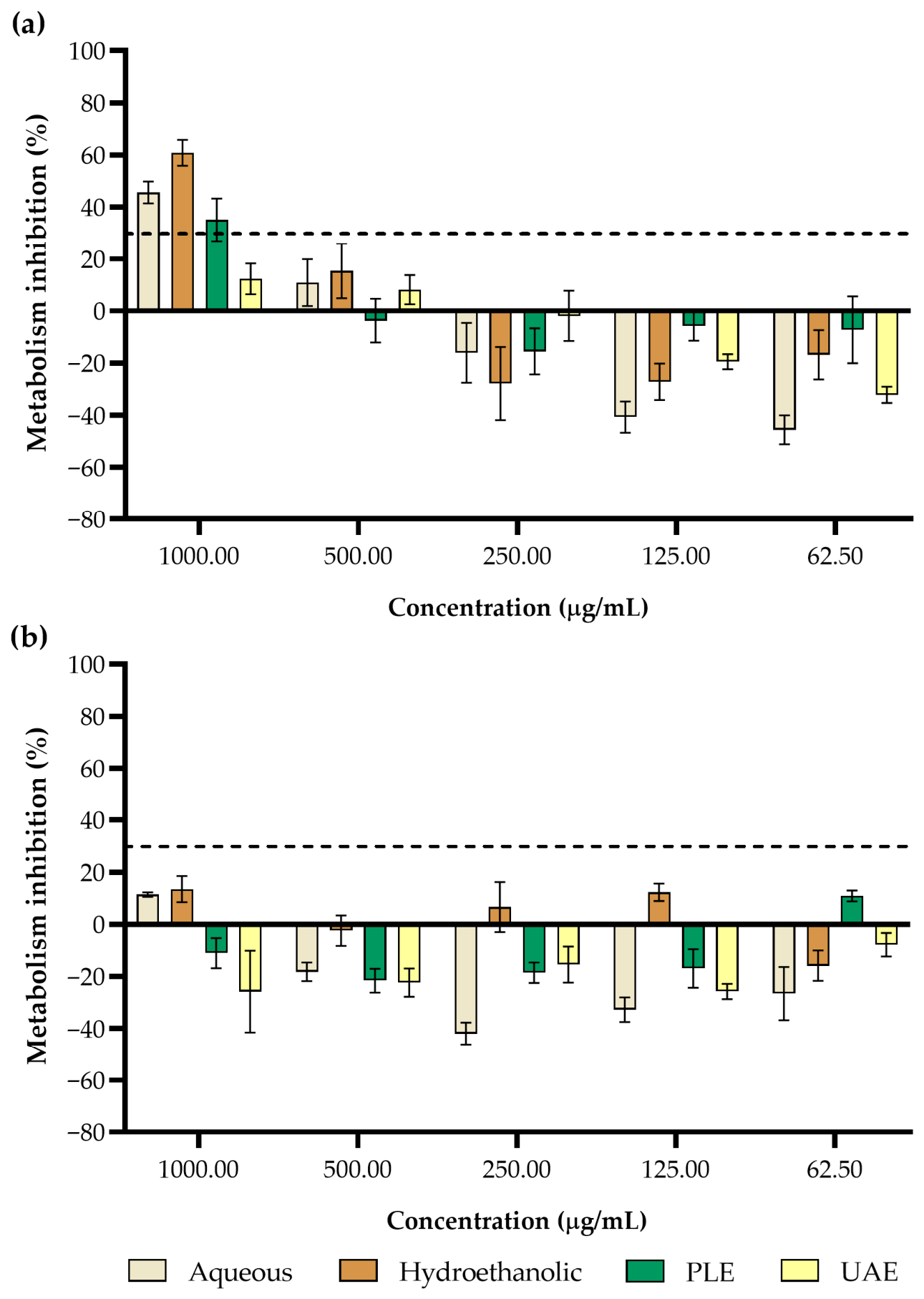
The cytotoxicity of the P. tridentatum stem extracts was evaluated in HaCaT and Caco-2 cell lines at concentrations ranging from 1000 to 62.50 mg/mL (Figure 1). Concentrations causing metabolic inhibition below 30% were considered safe according to the ISO 10993-5 standard. In the present study, most extracts did not exceed this threshold across the tested concentration range, indicating generally low cytotoxicity.
For Caco-2 cells (Figure 1b), none of the extracts induced metabolic inhibition at the tested concentrations, suggesting that the extracts did not significantly affect intestinal epithelial cell viability. Similar observations have been reported for P. tridentatum infusions, which showed no toxicity toward Caco-2 cells at a concentration of 2 mg/mL, while maintaining some biological activity associated with their phenolic composition [14].
Additionally, another work evaluating P. tridentatum flower extracts (infusion and hydroethanolic) demonstrated dose-dependent effects on Caco-2 cells, with extracts showing cytotoxicity at concentrations above 100 μg/mL and 200 μg/mL for the infusion and hydroethanolic extract, respectively [17]. However, these authors also highlighted protective effects against oxidative stress, suggesting that the extracts may interact with cellular metabolic pathways without necessarily inducing strong cytotoxicity.
In HaCaT cells (Figure 1a), however, the aqueous, hydroethanolic, and PLE extracts showed metabolic inhibition above the 30% cytotoxicity threshold at the highest tested concentration (1000 μg/mL). At concentrations below this level, all extracts remained within the non-cytotoxic range. These results indicate a concentration-dependent response, which may be related to the presence of bioactive phenolic compounds such as flavonoids and isoflavones that can influence cellular metabolism at elevated doses. No previous reports were found regarding the cytotoxicity of P. tridentatum extracts in this cell line. However, previous cytotoxic assessments of carqueja extracts have similarly reported low toxicity at commonly used concentrations. For example, a study evaluating flower extracts reported no cytotoxicity towards the human hepatocarcinoma cell line (HepG2) within the tested range of 125 and 375 μg/mL while also demonstrating no significant impairment of mitochondrial respiratory function or cellular viability, suggesting that the extracts can generally be regarded as safe for traditional use [3]. Additionally, analyses of plant infusions containing P. tridentatum reported bioactive properties such as antioxidant and antimicrobial activity without hepatotoxic effects in non-tumor cells [8,18]. In contrast to these studies, which primarily focused on flowers or aerial parts, the present work evaluates the cytotoxicity of P. tridentatum stem extracts, providing new information regarding the biological safety of this less-studied plant organ.
Overall, the results indicate that P. tridentatum stem extracts exhibit low cytotoxicity under the tested in vitro conditions toward both HaCaT and Caco-2 cell lines. Based on the ISO 10993-5 criterion (30% inhibition threshold), concentrations up to 500 µg/mL can be considered non-cytotoxic for all extracts. At 1000 µg/mL, cytotoxic effects were observed in HaCaT cells for the aqueous, hydroethanolic, and PLE extracts, while no cytotoxicity was detected for the UAE extract or in Caco-2 cells. These findings are in line with previous reports indicating that carqueja extracts can be safely used in traditional medicine, culinary applications, and for the preservation of foods against oxidative stress [3,8,14,18]. Therefore, the present results further support the potential use of P. tridentatum stem extracts as sources of bioactive compounds with low cytotoxicity, highlighting their potential for application in functional foods and nutraceutical formulations.

3.5. Principal Component Analysis

Principal component analysis (PCA) was performed to explore the relationships between extraction methods and the measured chemical and bioactivity variables, including extraction yield, protein and carbohydrate contents, TPC, TFC, antioxidant activity, and cytotoxicity parameters.
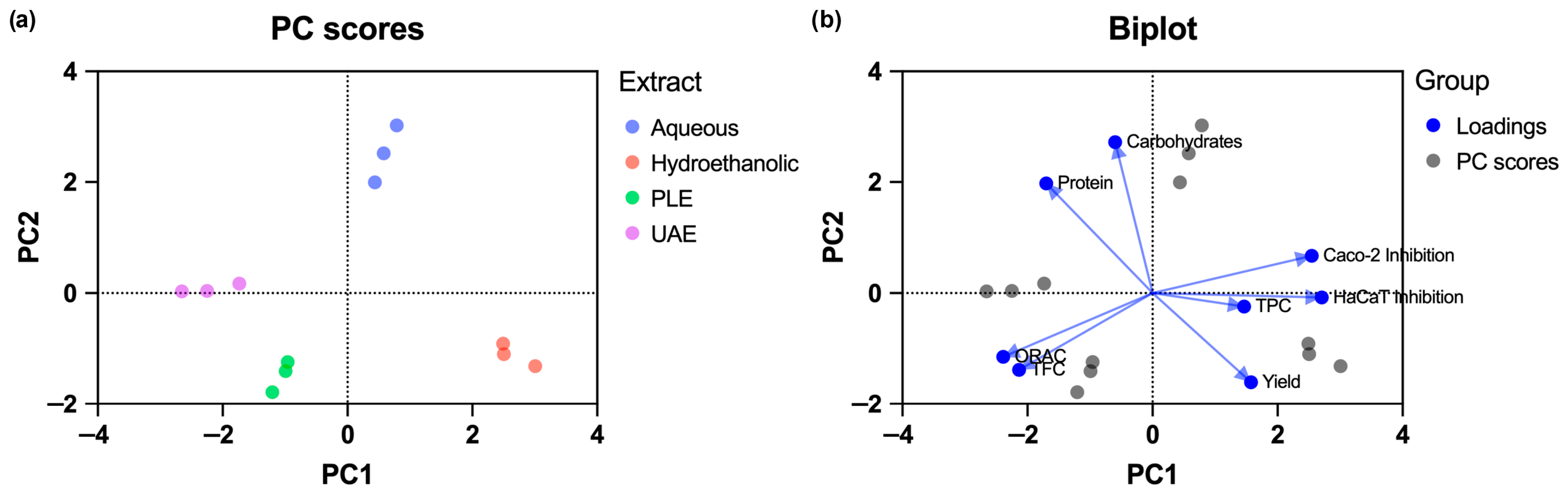
The first two principal components explained 80.76% of the total variance (PC1: 46.75%; PC2: 34.01%), indicating that the model adequately represents the dataset.
The PCA score plot (Figure 2a) showed a clear separation of samples according to extraction method. Hydroethanolic extracts were located on the positive side of PC1 and were associated with higher TPC, extraction yield, and cytotoxicity parameters (Figure 2b). In contrast, aqueous extracts were separated along PC2 and were mainly associated with higher carbohydrate and protein contents, reflecting the extraction of polar, non-phenolic constituents.
Extracts obtained using assisted techniques (PLE and UAE) clustered in a different region of the plot and were associated with antioxidant activity and flavonoid content (Figure 2b). This distribution suggests that, under the tested conditions, these extraction systems are associated with the recovery of compounds with higher antioxidant capacity, even when differences in TPC are relatively limited.
These results indicate that the bioactivity of P. tridentatum stem extracts is not solely dependent on total phenolic content but may also be influenced by the qualitative composition of the extracts and potential synergistic interactions between bioactive compounds. This observation is consistent with the fact that extracts with comparable TPC values exhibited different antioxidant responses under the tested conditions.
Overall, the multivariate analysis suggests that the extraction systems are associated with differences in antioxidant activity and phenolic composition, reinforcing the importance of selecting extraction strategies when targeting specific extract properties.

4. Conclusions

This study provides the first comprehensive evaluation of Pterospartum tridentatum stem extracts obtained using different extraction methodologies, contributing to the valorization of this underexplored plant biomass. Overall, the results demonstrated that P. tridentatum stems represent a relevant source of phenolic compounds, particularly flavonoid and isoflavonoid derivatives such as genistein glycosides, which were identified as the dominant constituents across all extracts.
Although the extraction methodologies differed considerably in terms of extraction yield, the qualitative phenolic profiles obtained by LC-ESI-QqTOF-HRMS were broadly similar among the four extracts. Hydroethanolic extraction resulted in the highest extraction yield and phenolic recovery, whereas PLE showed higher flavonoid content. However, the differences in total phenolic content among extraction techniques were relatively limited, indicating that more advanced extraction technologies do not necessarily lead to a substantially higher recovery of phenolic compounds in this plant matrix. Multivariate analysis demonstrated that extraction methodology influences antioxidant activity in addition to total phenolic content. Assisted extraction techniques were associated with higher antioxidant activity, whereas hydroethanolic extraction was more strongly linked to phenolic content and extraction yield. These findings suggest that antioxidant activity is not solely dependent on the total amount of phenolic compounds but may also be influenced by their qualitative composition and potential synergistic interactions. Within the broader bioactivity evaluation, antimicrobial effects were limited, whereas cytotoxicity assays indicated low cytotoxicity under the tested in vitro conditions toward both HaCaT and Caco-2 cell lines.
From a comparative perspective, hydroethanolic extraction was the most effective for maximizing extraction yield and TPC, whereas PLE and UAE were more suitable for enhancing flavonoid content and antioxidant activity under the tested conditions. In terms of cytotoxicity, all extracts exhibited low cytotoxicity, with no major differences between extraction systems. Despite these promising results, some limitations should be acknowledged. The antioxidant capacity was evaluated using a single assay (ORAC), and the application of complementary methods based on different mechanisms (e.g., electron transfer assays such as DPPH or ABTS) would provide a more comprehensive characterization. The present study should be considered exploratory in nature, providing an initial comparative evaluation of extraction systems and associated bioactivities. Future studies should therefore include additional antioxidant assays, as well as bioavailability and metabolism assessments, to better understand the biological relevance of these extracts. Furthermore, additional work focusing on the optimization of extraction conditions and the incorporation of these extracts into food or nutraceutical systems would help to support their practical application.
Overall, these findings highlight P. tridentatum stems as a valuable yet underutilized source of bioactive compounds with relevant antioxidant potential and low cytotoxicity under the tested in vitro conditions. From a practical perspective, the results suggest that conventional hydroethanolic extraction may be sufficient when the objective is to maximize phenolic recovery, whereas assisted extraction techniques such as PLE and UAE are more suitable when targeting enhanced antioxidant activity. This supports the valorization of carqueja stems for the development of functional foods and nutraceutical applications.

Author Contributions

Conceptualization, T.B.A., J.A.S.A.O. and M.P.; methodology, T.B.A., T.B.-L. and E.M.C.; validation, T.B.A.; formal analysis, T.B.A. and E.M.C.; investigation, T.B.A., T.B.-L., E.M.C., T.M. and J.M.; resources, M.P.; data curation, T.B.A. and E.M.C.; writing—original draft preparation, T.B.A. and J.A.S.A.O.; writing—review and editing, T.B.A., T.B.-L., E.M.C. and M.P.; visualization, T.B.A. and M.P.; supervision, J.A.S.A.O. and M.P.; funding acquisition, M.P. All authors have read and agreed to the published version of the manuscript.

Funding

This research was funded by Integrated Project be@t—Textile Bioeconomy, to strengthen the National Bioeconomy, financed by the Environmental Fund through Component 12—Promotion of Sustainable Bioeconomy (Investment TC-C12-i01—Sustainable Bioeconomy No. 02/C12-i01.01/2022), of European funds allocated to Portugal by the Recovery and Resilience Plan (RRP), within the scope of the European Union (EU) Recovery and Resilience Mechanism, framed in the Next Generation EU, for the period 2021–2026. Additionally, this work was also supported by National Funds from FCT—Fundação para a Ciência e a Tecnologia, through project UID/50016/2025.

Institutional Review Board Statement

Not applicable.

Informed Consent Statement

Not applicable.

Data Availability Statement

The original contributions presented in this study are included in the article. Further inquiries can be directed to the corresponding author.

Acknowledgments

During the preparation of this manuscript, the authors used ChatGPT (OpenAI, GPT-5.3) to assist with language editing and drafting of certain text sections. The authors critically reviewed and edited all generated content and take full responsibility for the final version of the manuscript.

Conflicts of Interest

The authors declare no conflicts of interest.

Abbreviations

The following abbreviations are used in this manuscript:
AAPH2,2′-Azobis(2-amidinopropane) dihydrochloride
ANOVAAnalysis of variance
ATCCAmerican Type Culture Collection
CAECatechin equivalents
CFUColony-forming units
CLSIClinical and Laboratory Standards Institute
DEDry extract
DMEMDulbecco’s Modified Eagle Medium
DMSODimethyl sulfoxide
EtOHEthanol
GEGlucose equivalents
GAEGallic acid equivalents
LC-ESI-QqTOF-HRMSLiquid chromatography–electrospray ionization–quadrupole time-of-flight high-resolution mass spectrometry
MBCMinimum bactericidal concentration
MeOHMethanol
MFCMinimum fungicidal concentration
MHMueller–Hinton
MICMinimum inhibitory concentration
m/zMass-to-charge ratio
ORACOxygen radical absorbance capacity
PLEPressurized liquid extraction
RTRetention time
SDASabouraud dextrose agar
TFCTotal flavonoid content
TPCTotal phenolic content
TETrolox equivalents
UAEUltrasound-assisted extraction

References

  1. Clara Grosso, A.; Costa, M.M.; Ganço, L.; Pereira, A.L.; Teixeira, G.; Lavado, J.M.G.; Figueiredo, A.C.; Barroso, J.G.; Pedro, L.G. Essential Oil Composition of Pterospartum tridentatum Grown in Portugal. Food Chem. 2007, 102, 1083–1088. [Google Scholar] [CrossRef]
  2. Coelho, M.T.; Gonçalves, J.C.; Alves, V.; Moldão-Martins, M. Antioxidant Activity and Phenolic Content of Extracts from Different Pterospartum tridentatum Populations Growing in Portugal. Procedia Food Sci. 2011, 1, 1454–1458. [Google Scholar] [CrossRef]
  3. Ferreira, F.M.; Dinis, L.T.; Azedo, P.; Galhano, C.I.C.; Simões, A.; Cardoso, S.M.; Domingues, M.R.M.; Pereira, O.R.; Palmeira, C.M.; Peixoto, F.P. Antioxidant Capacity and Toxicological Evaluation of Pterospartum tridentatum Flower Extracts. CYTA-J. Food 2012, 10, 92–102. [Google Scholar] [CrossRef]
  4. Gião, M.S.; González-Sanjosé, M.L.; Rivero-Pérez, M.D.; Pereira, C.I.; Pintado, M.E.; Malcata, F.X. Infusions of Portuguese Medicinal Plants: Dependence of Final Antioxidant Capacity and Phenol Content on Extraction Features. J. Sci. Food Agric. 2007, 87, 2638–2647. [Google Scholar] [CrossRef]
  5. Gonçalves, S.; Gomes, D.; Costa, P.; Romano, A. The Phenolic Content and Antioxidant Activity of Infusions from Mediterranean Medicinal Plants. Ind. Crops Prod. 2013, 43, 465–471. [Google Scholar] [CrossRef]
  6. Laranjeira, I.M.; Dias, A.C.P.; Pinto-Ribeiro, F.L. Genista Tridentata Phytochemical Characterization and Biological Activities: A Systematic Review. Biology 2023, 12, 1387. [Google Scholar] [CrossRef]
  7. Bremner, P.; Rivera, D.; Calzado, M.A.; Obón, C.; Inocencio, C.; Beckwith, C.; Fiebich, B.L.; Muñoz, E.; Heinrich, M. Assessing Medicinal Plants from South-Eastern Spain for Potential Anti-Inflammatory Effects Targeting Nuclear Factor-Kappa B and Other pro-Inflammatory Mediators. J. Ethnopharmacol. 2009, 124, 295–305. [Google Scholar] [CrossRef]
  8. Garcia-Oliveira, P.; Carreira-Casais, A.; Pereira, E.; Dias, M.I.; Pereira, C.; Calhelha, R.C.; Stojković, D.; Sokovic, M.; Simal-Gandara, J.; Prieto, M.A.; et al. From Tradition to Health: Chemical and Bioactive Characterization of Five Traditional Plants. Molecules 2022, 27, 6495. [Google Scholar] [CrossRef]
  9. Balanč, B.; Kalušević, A.; Drvenica, I.; Coelho, M.T.; Djordjević, V.; Alves, V.D.; Sousa, I.; Moldão-Martins, M.; Rakić, V.; Nedović, V.; et al. Calcium-Alginate-Inulin Microbeads as Carriers for Aqueous Carqueja Extract. J. Food Sci. 2016, 81, E65–E75. [Google Scholar] [CrossRef]
  10. Luís, Â.; Domingues, F.; Duarte, A.P. Bioactive Compounds, RP-HPLC Analysis of Phenolics, and Antioxidant Activity of Some Portuguese Shrub Species Extracts. Nat. Prod. Commun. 2011, 6, 1934578X1100601219. [Google Scholar] [CrossRef]
  11. Gonçalves, A.C.; Bento, C.; Nunes, A.R.; Simões, M.; Alves, G.; Silva, L.R. Multitarget Protection of Pterospartum tridentatum Phenolic-Rich Extracts against a Wide Range of Free Radical Species, Antidiabetic Activity and Effects on Human Colon Carcinoma (Caco-2) Cells. J. Food Sci. 2020, 85, 4377–4388. [Google Scholar] [CrossRef]
  12. Roriz, C.L.; Barros, L.; Carvalho, A.M.; Santos-Buelga, C.; Ferreira, I.C.F.R. Pterospartum tridentatum, Gomphrena Globosa and Cymbopogon Citratus: A Phytochemical Study Focused on Antioxidant Compounds. Food Res. Int. 2014, 62, 684–693. [Google Scholar] [CrossRef]
  13. Aires, A.; Marrinhas, E.; Carvalho, R.; Dias, C.; Saavedra, M.J. Phytochemical Composition and Antibacterial Activity of Hydroalcoholic Extracts of Pterospartum tridentatum and Mentha Pulegium against Staphylococcus Aureus Isolates. Biomed. Res. Int. 2016, 2016, 5201879. [Google Scholar] [CrossRef] [PubMed]
  14. Serralheiro, M.L.M.; Falé, P.L.; Ferreira, C.; Rodrigues, A.M.; Cleto, P.; Madeira, P.J.A.; Florêncio, M.H.; Frazão, F.N.; Serralheiro, M.L.M. Antioxidant and Anti-Acetylcholinesterase Activity of Commercially Available Medicinal Infusions after in Vitro Gastrointestinal Digestion. J. Med. Plants Res. 2013, 7, 1370–1378. [Google Scholar] [CrossRef]
  15. Pinela, J.; Barros, L.; Carvalho, A.M.; Ferreira, I.C.F.R. Influence of the Drying Method in the Antioxidant Potential and Chemical Composition of Four Shrubby Flowering Plants from the Tribe Genisteae (Fabaceae). Food Chem. Toxicol. 2011, 49, 2983–2989. [Google Scholar] [CrossRef]
  16. Vitor, R.F.; Mota-Filipe, H.; Teixeira, G.; Borges, C.; Rodrigues, A.I.; Teixeira, A.; Paulo, A. Flavonoids of an Extract of Pterospartum tridentatum Showing Endothelial Protection against Oxidative Injury. J. Ethnopharmacol. 2004, 93, 363–370. [Google Scholar] [CrossRef]
  17. Gonçalves, J.C.; Coelho, M.T.; Da Graça Diogo, M.; Alves, V.D.; Rosário Bronze, M.; Coimbra, M.A.; Martins, M.; Moldão-Martins, M. In Vitro Shoot Cultures of Pterospartum tridentatum as an Alternative to Wild Plants as a Source of Bioactive Compounds. Nat. Prod. Commun. 2018, 13, 1934578X1801300415. [Google Scholar] [CrossRef]
  18. Caleja, C.; Finimundy, T.C.; Pereira, C.; Barros, L.; Calhelha, R.C.; Sokovic, M.; Ivanov, M.; Carvalho, A.M.; Rosa, E.; Ferreira, I.C.F.R. Challenges of Traditional Herbal Teas: Plant Infusions and Their Mixtures with Bioactive Properties. Food Funct. 2019, 10, 5939–5951. [Google Scholar] [CrossRef] [PubMed]
  19. Oro, C.E.D.; Wancura, J.H.C.; Santos, M.S.N.d.; Venquiaruto, L.D.; Dallago, R.M.; Tres, M.V. High-Pressure Extraction Techniques for Efficient Recovery of Flavonoids and Coumarins from Flower Seeds. Processes 2025, 13, 300. [Google Scholar] [CrossRef]
  20. Wen, C.; Zhang, J.; Zhang, H.; Dzah, C.S.; Zandile, M.; Duan, Y.; Ma, H.; Luo, X. Advances in Ultrasound Assisted Extraction of Bioactive Compounds from Cash Crops—A Review. Ultrason. Sonochem. 2018, 48, 538–549. [Google Scholar]
  21. Afonso, T.B.; Marçal, S.; Vale, P.; Sousa, A.S.; Nunes, J.; Pintado, M. Exploring the Bioactive Potential of Mushroom Aqueous Extracts: Antimicrobial, Antioxidant, and Prebiotic Properties. Appl. Sci. 2025, 15, 1551. [Google Scholar] [CrossRef]
  22. Magomya, A.M.; Kubmarawa, D.; Ndahi, J.A.; Yebpella, G.G. Determination Of Plant Proteins Via The Kjeldahl Method and Amino Acid Analysis: A Comparative Study. Int. J. Sci. Technol. Res. 2014, 3, 68–72. [Google Scholar]
  23. Dubois, M.; Gilles, K.A.; Hamilton, J.K.; Rebers, P.A.; Smith, F. Colorimetric Method for Determination of Sugars and Related Substances. Anal. Chem. 1956, 28, 350–356. [Google Scholar] [CrossRef]
  24. Vilas-Boas, A.A.; Campos, D.A.; Nunes, C.; Ribeiro, S.; Nunes, J.; Oliveira, A.; Pintado, M. Polyphenol Extraction by Different Techniques for Valorisation of Non-Compliant Portuguese Sweet Cherries towards a Novel Antioxidant Extract. Sustainability 2020, 12, 5556. [Google Scholar] [CrossRef]
  25. Herald, T.J.; Gadgil, P.; Tilley, M. High-Throughput Micro Plate Assays for Screening Flavonoid Content and DPPH-Scavenging Activity in Sorghum Bran and Flour. J. Sci. Food Agric. 2012, 92, 2326–2331. [Google Scholar] [CrossRef]
  26. Melo, A.; Afonso, T.B.; Pedrosa, M.C.; Carvalho, M.; Rodrigues, C.; Dias, M.I.; Ribeiro, T.; Machado, M.; Tavaria, F.; Carocho, M.; et al. Phenolic Profile and Antioxidant and Biological Activities of Plant Extracts Rich in Hydrolyzable Tannins. ACS Agric. Sci. Technol. 2024, 4, 988–1001. [Google Scholar] [CrossRef]
  27. Clinical and Laboratory Standards Institute (CLSI). Reference Method for Broth Dilution Antifungal Susceptibility Testing of Yeasts, 4th ed.; Clinical and Laboratory Standards Institute: Wayne, PA, USA, 2017. [Google Scholar]
  28. Costa, E.M.; Oliveira, A.S.; Silva, S.; Ribeiro, A.B.; Pereira, C.F.; Ferreira, C.; Casanova, F.; Pereira, J.O.; Freixo, R.; Pintado, M.E.; et al. Spent Yeast Waste Streams as a Sustainable Source of Bioactive Peptides for Skin Applications. Int. J. Mol. Sci. 2023, 24, 2253. [Google Scholar] [CrossRef] [PubMed]
  29. Xue, F.; Li, C. Effects of Ultrasound Assisted Cell Wall Disruption on Physicochemical Properties of Camellia Bee Pollen Protein Isolates. Ultrason. Sonochem. 2023, 92, 106249. [Google Scholar] [CrossRef]
  30. Grossmann, L.; McClements, D.J. Current Insights into Protein Solubility: A Review of Its Importance for Alternative Proteins. Food Hydrocoll. 2023, 137, 108416. [Google Scholar] [CrossRef]
  31. Paulo, A.; Martins, S.; Branco, P.; Dias, T.; Borges, C.; Rodrigues, A.I.; Do Céu Costa, M.; Teixeira, A.; Mota-Filipe, H. The Opposing Effects of the Flavonoids Isoquercitrin and Sissotrin, Isolated from Pterospartum tridentatum, on Oral Glucose Tolerance in Rats. Phytother. Res. 2008, 22, 539–543. [Google Scholar] [CrossRef]
  32. Garcia, C.; Dias, M.I.; Henriques, M.H.F.; Barros, L.; Ramos, F. Pterospartum tridentatum Liqueur Using Spirits Aged with Almond Shells: Chemical Characterization and Phenolic Profile. Molecules 2023, 28, 4455. [Google Scholar] [CrossRef] [PubMed]
Figure 1. Cytotoxicity of P. tridentatum stem extracts at different concentrations, assessed in two cell lines: (a) HaCaT and (b) Caco-2. Dashed lines represent the 30% cytotoxicity limit as defined in the ISO 10993-5: 2009.
Foods 15 01461 g001
Figure 2. Principal component analysis (PCA) of P. tridentatum stem extracts based on chemical composition and bioactivity parameters. (a) Score plot showing the clustering of samples according to extraction method (aqueous, hydroethanolic, PLE, and UAE). (b) Biplot displaying the contribution of variables, including extraction yield, protein, carbohydrates, total phenolic content (TPC), total flavonoid content (TFC), antioxidant activity (ORAC), and cytotoxicity parameters (HaCaT and Caco-2 inhibition).
Foods 15 01461 g002
Table 1. Extraction conditions for P. tridentatum stem extracts.
ExtractionSolventsSolid/Liquid Ratio (% m/v)Temperature (°C)Time (min)Agitation/Energy InputPressure
AqueousH2O10%50 °C15Thermomixer (agitation)Atmospheric
HydroethanolicEtOH:H2O (70:30 v/v)3%RT30 + 15 + 15 450 rpm Atmospheric
UAEH2O10%RTUltrasound + 30 stirring20 kHz, 35 µm, 6.6 kJ/LAtmospheric
PLEEtOH:H2O (50:50 v/v)3%RT30300 rpm5 bar
Table 2. Extraction yield, protein, and total carbohydrate content of P. tridentatum stem extracts. Results are presented as mean ± SD. Different letters in each column stand for statistical differences (p-value < 0.05).
ExtractYield (%)Protein (g/100 g DE)Carbohydrates (mg GE/g DE)
Aqueous8.37 ± 0.17 a2.58 ± 0.06 a774.80 ± 43.04 a
Hydroethanolic26.95 ± 0.54 b1.32 ± 0.03 b448.18 ± 17.26 b
PLE16.10 ± 0.14 c1.43 ± 0.11 b513.88 ± 13.72 c
UAE14.72 ± 0.09 c2.94 ± 0.04 c595.03 ± 23.28 d
Table 3. Results for total phenolic content, recovery efficiency, total flavonoid content, and antioxidant activity (ORAC) of P. tridentatum stem extracts. Recovery efficiency was calculated by combining extraction yield and TPC values and expressed as mg GAE per g of plant material. Results are presented as mean ± SD. Different letters in each column stand for statistical differences (p-value < 0.05).
ExtractTPC (mg GAE/g DE)Recovery Efficiency (mg GAE/g Plant Material)TFC (mg CAE/g DE)ORAC (µmol TE/g DE)
Aqueous150.14 ± 12.04 a12.57 ± 1.01 a54.25 ± 2.76 a2665.82 ± 127.18 a
Hydroethanolic166.78 ± 27.78 a44.95 ± 7.28 b56.80 ± 1.98 a2672.77 ± 100.26 a
PLE140.80 ± 10.26 a22.67 ± 1.65 c67.93 ± 2.78 b3320.90 ± 45.62 b
UAE147.29 ± 20.69 a21.68 ± 3.05 c64.70 ± 0.92 b3147.13 ± 15.75 b
Table 4. Phenolic compounds tentatively identified in the different P. tridentatum extracts by LC-ESI-QqTOF-HRMS.
PeakRT (min)m/z Calc. [M-H]MS2 [M-H]Proposed FormulaTentative IdentificationExtracts; Peak Area–a.u. (Relative Abundance-%)
AqueousHydroethanolicPLEUAE
112.7465125, 167 *, 197, 317, 345, 375C21H22O12Dihydroquercetin 6-C-hexoside1.22 × 108 (14.19)9.45 × 10⁷
(9.71)
1.15 × 10⁸ (10.06)1.12 × 10⁸ (12.87)
214.357989, 101, 113, 119, 161, 179, 209C24H36O16Phenolic glycosiden.d.n.d.n.d.8.58 × 106 (0.98)
315.4417176, 194, 209C18H26O11Phenolic glycoside2.74 × 107 (3.18)2.01 × 10⁷
(2.06)
2.96 × 10⁷ (2.60)2.76 × 10⁷ (3.16)
417.3623415C28H32O16Flavonol glycosiden.d.1.37 × 107
(1.40)
1.48 × 10⁷ (1.30)n.d.
517.6653445C29H34O17Flavonoid glycosiden.d.n.d.8.14 × 106 (0.72)n.d.
618.6593310, 473C27H30O15Genistein-O-dihexoside1.55 × 108 (17.99)1.64 × 10⁸
(16.84)
1.73 × 10⁸ (15.21)8.87 × 10⁷ (10.16)
720.0479167, 359C22H24O12Myricetin-C-hexoside1.14 × 108 (13.17)8.99 × 10⁷
(9.24)
1.17 × 10⁸ (10.27)1.21 × 10⁸ (13.90)
820.720796, 105, 121, 149, 177C11H12O4Hydroxycinnamic acid derivativen.d.n.d.8.14 × 106 (0.71)n.d.
921.1639431C28H32O17Flavonoid glycoside2.83 × 107 (3.28)9.11 × 10⁷
(9.36)
8.75 × 10⁷ (7.68)n.d.
1022.8447299, 327C21H20O11Flavonoid C-glycoside7.54 × 106 (0.87)7.91 × 10⁶
(0.81)
8.58 × 10⁶ (0.75)1.27 × 10⁷ (1.46)
1124.3479167, 359C22H24O12Myricetin-C-hexoside7.20 × 106 (0.83)n.d.8.00 × 106 (0.70)8.20 × 10⁶ (0.94)
1224.441589, 99, 101, 113, 119, 131, 161, 191C19H28O10Phenolic glycoside7.31 × 106 (0.85)n.d.n.d.n.d.
1325.243389, 101, 113, 119C19H14O12Ellagic acid pentoside4.10 × 107 (4.75)2.77 × 10⁷
(2.85)
4.48 × 10⁷ (3.93)4.72 × 10⁷ (5.42)
1428.0431283, 311C21H20O10Genistein-8-C-glucoside2.04 × 108 (23.59)2.21 × 10⁸
(22.73)
2.44 × 10⁸ (21.43)2.56 × 10⁸ (29.29)
1528.5461298, 326, 341C22H22O115,5′-Dihydroxy-3′-methoxy-isoflavone-7-O-β-glucoside2.85 × 107 (3.30)4.14 × 10⁷
(4.29)
4.49 × 10⁷ (3.95)3.56 × 10⁷ (4.08)
1629.1431268, 311C21H20O10Genistein-8-C-glucosiden.d.7.02 × 106
(0.72)
8.42 × 10⁶ (0.74)n.d.
1729.4415252C21H20O9Phenolic glycoside1.05 × 107 (1.22)n.d.6.83 × 106 (0.60)1.01 × 10⁷ (1.16)
1830.3461298, 326, 341C22H22O115,5′-Dihydroxy-3′-methoxy-isoflavone 7-O-β-glucosiden.d.n.d.4.51 × 106 (0.40)n.d.
1930.7463300C21H20O12Quercetin-O-hexoside (isoquercitrin)6.72 × 10⁶ (0.78)1.75 × 10⁷
(1.80)
2.16 × 10⁷ (1.90)1.00 × 10⁷ (1.15)
2130.9431268C21H20O10Genistein 7-O-glucoside (genistin)n.d.1.55 × 107
(1.60)
1.44 × 10⁷ (1.26)n.d.
2231.1463300, 343C21H20O12Quercetin-O-hexoside (isoquercitrin)n.d.n.d.1.47 × 107 (1.29)n.d.
2332.5431268C21H20O10Genistein 7-O-glucoside (genistin)7.94 × 10⁷ (9.20)4.80 × 10⁷
(4.93)
5.71 × 10⁷ (5.02)5.53 × 10⁷ (6.34)
2433.2431268, 311C21H20O10Genistein-8-C-glucosiden.d.4.57 × 106
(0.47)
5.20 × 10⁶ (0.46)n.d.
2533.3287107, 125, 151, 177C15H12O6Flavanonen.d.3.83 × 106
(0.39)
n.d.7.19 × 106 (0.82)
2633.9513393, 423C26H26O11Flavonoid C-glycoside1.12 × 107 (1.30)1.73 × 10⁷
(1.77)
2.43 × 10⁷ (2.13)1.61 × 10⁷ (1.84)
2734.6269107, 135, 159, 183, 201C15H10O5Genisteinn.d.4.31 × 106
(0.44)
4.93 × 10⁶ (0.43)n.d.
2834.8283184, 196, 240, 268C16H12O54‘-O-Methylgenistein
(biochanin A)
5.05 × 10⁶ (0.59)1.16 × 10⁷
(1.19)
1.33 × 10⁷ (1.17)1.53 × 10⁷ (1.75)
2935.3445282, 297, 325C22H22O10Swertisinn.d.4.19 × 106
(0.43)
5.67 × 10⁶ (0.50)3.57 × 10⁶ (0.41)
3035.6515282, 353, 445C26H28O11Prenylated isoflavone glucosiden.d.4.81 × 106
(0.49)
5.96 × 10⁶ (0.52)n.d.
3236.025391, 133, 209, 224C15H10O4Daidzein7.93 × 106 (0.92)1.24 × 10⁷
(1.28)
1.30 × 10⁷ (1.14)2.22 × 10⁷ (2.54)
3336.5285133, 149, 175, 199, 217, 241, 268C15H10O6Kaempferoln.d.1.09 × 107
(1.12)
1.30 × 10⁷ (1.14)4.69 × 10⁶ (0.54)
3436.8285135, 149, 185, 229, 257C15H10O6Scutellareinn.d.1.45 × 107
(1.49)
1.07 × 10⁷ (0.94)5.71 × 10⁶ (0.65)
3536.9369293, 351C20H18O7Prenylated flavonoidn.d.6.27 × 106
(0.64)
n.d.n.d.
3637.7301121, 151, 183, 245C15H10O7Quercetinn.d.n.d.n.d.4.69 × 106 (0.54)
3737.9369293, 351C20H18O7Prenylated flavonoidn.d.1.87 × 107
(1.92)
1.19 × 10⁷ (1.05)n.d.
Total Phenolic Area (a.u.)8.63 × 1089.73 × 1081.14 × 1098.73 × 108
* Bold represents the main fragment; [M-H] is the deprotonated molecular ion; n.d.—not detected.
Table 5. Antimicrobial activity of the different carqueja stem extracts.
Microorganisms
Bacteria
MIC and MBC (mg/mL)
AqueousHydroethanolicPLEUAE
MICMBCMICMBCMICMBCMICMBC
E. colin.d. *n.d.n.d.n.d.n.d.n.d.n.d.n.d.
P. aeruginosan.d.n.d.n.d.n.d.n.d.n.d.n.d.n.d.
S. enterican.d.n.d.n.d.n.d.n.d.n.d.n.d.n.d.
Y. enterocolitican.d.n.d.n.d.n.d.n.d.n.d.n.d.n.d.
S. aureusn.d.n.d.n.d.n.d.n.d.n.d.n.d.n.d.
S. epidermidisn.d.n.d.n.d.n.d.20>20n.d.n.d.
L. monocytogenesn.d.n.d.n.d.n.d.n.d.n.d.n.d.n.d.
FungiMICMFCMICMFCMICMFCMICMFC
A. nigern.d.n.d.n.d.n.d.n.d.n.d.n.d.n.d.
Cladosporium sp.n.d.n.d.n.d.n.d.n.d.n.d.n.d.n.d.
F. verticillioidesn.d.n.d.n.d.n.d.n.d.n.d.n.d.n.d.
P. expansumn.d.n.d.n.d.n.d.n.d.n.d.n.d.n.d.
M. furfur20>2010>2010>2020>20
* n.d.—no inhibition detected at the highest tested concentration of 20 mg/mL.
Disclaimer/Publisher’s Note: The statements, opinions and data contained in all publications are solely those of the individual author(s) and contributor(s) and not of MDPI and/or the editor(s). MDPI and/or the editor(s) disclaim responsibility for any injury to people or property resulting from any ideas, methods, instructions or products referred to in the content.