Effects of Different Maceration Times on the Chemical and Sensory Characteristics of Cabernet Sauvignon Grapes Wine




Abstract
1. Introduction
2. Materials and Methods
2.1. Experimental Materials
2.2. Experimental Instruments and Reagents
2.2.1. Experimental Instruments
2.2.2. Experimental Reagents
2.3. Experimental Method
2.3.1. Determination of Basic Physicochemical
2.3.2. Determination of Total Phenols in Wine
2.3.3. Determination of Total Anthocyanins in Wine
2.3.4. Determination of Total Tannins in Wine
2.3.5. Determination of Total Flavonoids in Wine
2.3.6. Determination of Total Flavan-3-ols in Wine
2.3.7. Measurement of Wine Color
2.3.8. Determination of Wine Aroma
2.4. Statistical Analysis
3. Result and Discussion
3.1. The Impact of Fragmentation on Wine
3.1.1. Basic Physical and Chemical Indicators
3.1.2. Phenolic Content at Different Degrees of Crushing
3.1.3. Color Changes Under Different Degrees of Fragmentation
3.1.4. Qualitative and Quantitative Analysis of Aromatic at Different Degrees of Fragmentation
3.2. The Effect of Soaking Time on Wine
3.2.1. Basic Physicochemical Indicators
3.2.2. Changes in Phenolic Content at Different Soaking Times
3.2.3. Color Changes Under Different Soaking Time
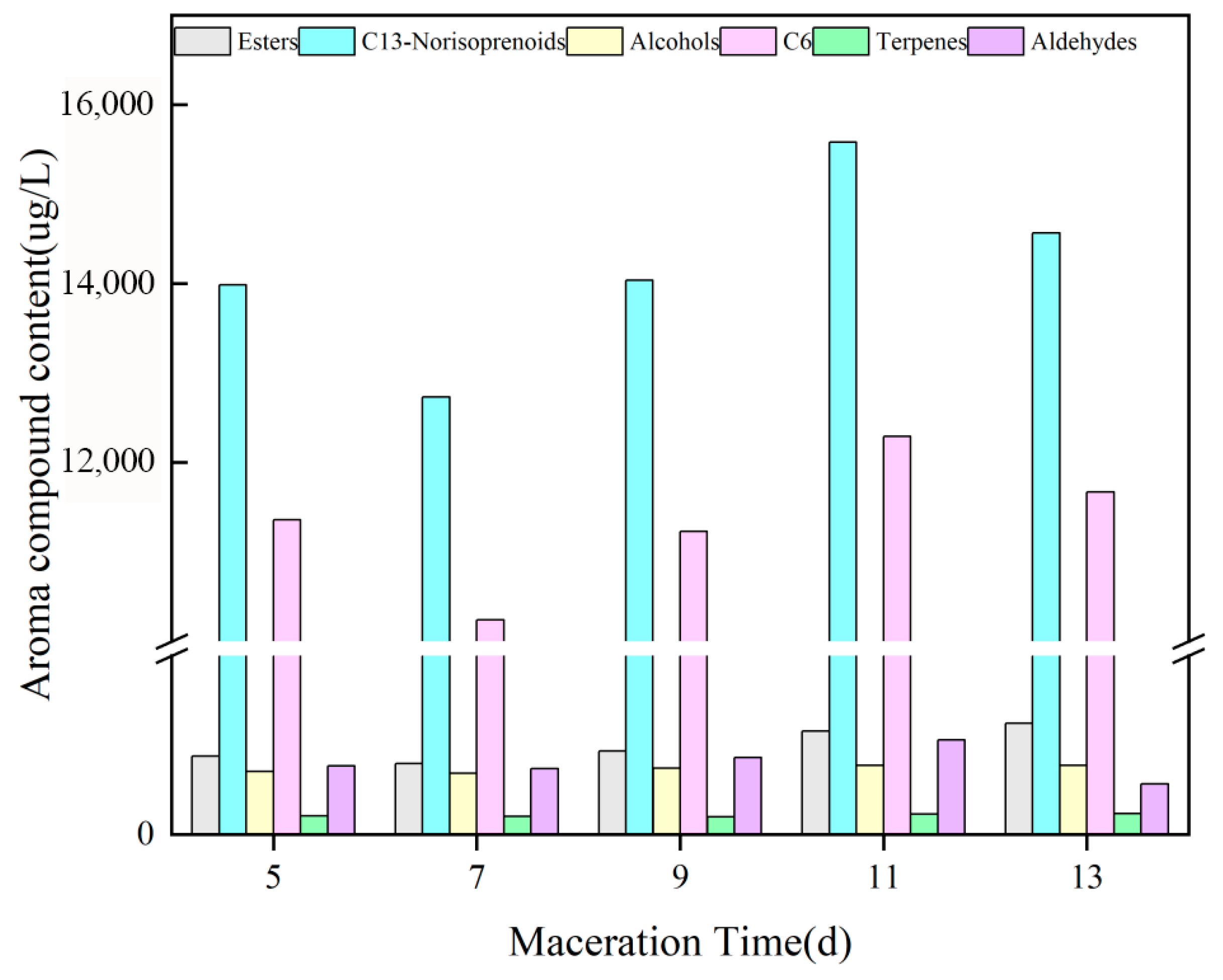
3.2.4. Qualitative and Quantitative Analysis of Aromatic with Different Soaking Times
4. Conclusions
Author Contributions
Funding
Institutional Review Board Statement
Informed Consent Statement
Data Availability Statement
Conflicts of Interest
References
- Ding, Y.; Shi, H.M. Effects of phenols on the quality of wine. Liq. Mach. Sci. Technol. 2011, 04, 55–59. [Google Scholar]
- Casassa, L.F.; Beaver, C.W.; Mireles, M.S.; Harbertson, J.F. Effect of extended maceration and ethanol concentration on the extraction and evolution of phenolics, colour components and sensory attributes of Merlot wines. Aust. J. Grape Wine Res. 2013, 19, 25–39. [Google Scholar] [CrossRef]
- González-Barreiro, C.; Rial-Otero, R.; Cancho-Grande, B.; Simal-Gándara, J. Wine aroma compounds in grapes: A critical review. Crit. Rev. Food Sci. Nutr. 2015, 55, 202–218. [Google Scholar] [CrossRef] [PubMed]
- International Organisation of Vine and Wine. International Code of Oenological Practices (CPO 2024): Section: Crushing (Resolution OIV-OENO 16/70). 2024. Available online: https://www.oiv.int/sites/default/files/publication/2024-03/CPO%202024%20EN%20.pdf (accessed on 20 December 2025).
- Wang, X.Q.; Zhang, Q.H.; Zhan, J.C.; Yan, G.L.; Huang, W.D. Effects of grape varieties and geographical on contents of phenolic compounds in grape wine. Food Sci. 2009, 30, 113–118. [Google Scholar]
- Zhang, J.; Wang, X.Y.; Tian, C. Analysis of phenolic compounds in red grape varieties. Sci. Agric. Sin. 2015, 48, 1355–1385. [Google Scholar]
- Casassa, L.F.; Huff, R.; Steele, N.B. Chemical consequences of extended maceration and post-fermentation additions of grape pomace in Pinot noir and zinfandel wines from the central coast of california (USA). J. Agric. Food Chem. 2023, 362, 130–148. [Google Scholar] [CrossRef]
- Carew, A.L.; Sparrow, A.M.; Curtin, C.D.; Dambergs, R.G. Microwave maceration of Pinot Noir grape must: Sanitation and extraction effects and wine phenolics outcomes. Food Bioprocess Technol. 2014, 7, 954–963. [Google Scholar] [CrossRef]
- Zhang, P.; Fuentes, S.; Wang, Y.; Deng, R.; Krstic, M.; Herderich, M.; Howell, K. Assessment of maceration and grape tannin interactions during fermentation on phenolic profiles of Vitis vinifera cv. Cabernet Sauvignon wines. Food Chem. 2020, 331, 127349. [Google Scholar] [CrossRef]
- Parker, M.; Capone, D.L.; Francis, I.L.; Herderich, M.J. Aroma precursors in grapes and wine: Flavor release during wine production and consumption. J. Agric. Food Chem. 2017, 65, 2281–2286. [Google Scholar] [CrossRef]
- Kostecka-Gugała, A.; Stanula, J.; Żuchowski, J.; Kaszycki, P. Optimizing wine production from hybrid cultivars: Impact of grape maceration time on the content of bioactive compounds. Molecules 2026, 31, 179. [Google Scholar] [CrossRef]
- Pascual, O.; González-Royo, E.; Gil, M.; Gómez-Alonso, S.; García-Romero, E.; Canals, J.M.; Zamora, F. Influence of grape maturity and maceration time on the chemical and sensory characteristics of red wines from a warm climate. Food 2022, 11, 291. [Google Scholar]
- Zhai, W.L. The Study on Maturity Degree of Meili Grape at Yangling Region and the Application of Saignee Process in Meili Wine. Master’s Thesis, Northwest A&F University, Yangling, China, 2018. [Google Scholar]
- GB/T 15038-2006; Analytical Methods of Wine and Fruit Wine. China Standards Press: Beijing, China, 2006.
- Yue, T.X. Study on Wine Grapes and Wine Quality from Different Ecological Regions. PhD Thesis, Northwest A&F University, Yangling, China, 2015. [Google Scholar]
- Liang, P. The Difference of Pinot Noir Grapes and Wine Quality in Different Ecological Regions. Master’s Thesis, Northwest A&F University, Yangling, China, 2018. [Google Scholar]
- Boulton, R. The relationships between total acidity, titratable acidity and pH in grape tissue. Vitis 1980, 19, 113–120. [Google Scholar]
- Du, J.H.; Xia, X.M. Roles of phenolic compounds in red wine. Sino-Overseas Grapevine Wine 2001, 2, 48–50. [Google Scholar]
- Bora, F.D.; Pop, T.I. Research on the quality of the three white wine varieties in transylvania. Harvest of 2013-14. Bull. Univ. Agric. Sci. Vet. Med. Cluj-Napoca Hortic. 2015, 72, 327–334. [Google Scholar] [CrossRef] [PubMed][Green Version]
- Liu, Y.J.; Sun, J.F.; Wang, J. Progress of research in phenolic compounds in wine. China Brew. 2009, 28, 5–9. [Google Scholar]
- Gutiérrez-Escobar, R.; Aliaño-González, M.J.; Cantos-Villar, E. Wine polyphenol content and its influence on wine quality and properties: A review. Molecules 2021, 26, 718. [Google Scholar] [CrossRef]
- Landete, J.M. Beneficial and harmful effects of wine consumption on health: Phenolic compounds, biogenic amines and ochratoxin A. In Nutrition and Diet Research Progress: Appetite and Weight Loss, 1st ed.; Tsisana, S., Ed.; Nova Science Publishers: New York, NY, USA, 2011; pp. 173–206. [Google Scholar]
- Avizcuri, J.-M.; Sáenz-Navajas, M.-P.; Echávarri, J.-F.; Ferreira, V.; Fernández-Zurbano, P. Evaluation of the impact of initial red wine composition on changes in color and anthocyanin content during bottle storage. Food Chem. 2016, 213, 123–134. [Google Scholar] [CrossRef]
- Alcalde-Eon, C.; García-Estévez, I.; Puente, V.; Rivas-Gonzalo, J.C.; Escribano-Bailón, M.T. Color stabilization of red wines: A chemical and colloidal approach. J. Agric. Food Chem. 2014, 62, 6984–6994. [Google Scholar] [CrossRef]
- Liu, W.Q. Study on the Quality of Marselan Grape and Wine Among Different Sub-Regions in the Eastern Foot of Helan Mountain. Master’s Thesis, Northwest A&F University, Yangling, China, 2024. [Google Scholar]
- Sparrow, A.M.; Smart, R.E.; Dambergs, R.G.; Close, D.C. Skin particle size affects the phenolic attributes of Pinot noir wine: Proof of concept. Am. J. Enol. Vitic. 2016, 67, 29–37. [Google Scholar] [CrossRef]
- Sparrow, A.M.; Holt, H.E.; Pearson, W.; Dambers, R.G.; Close, D.C. Accentuated cut edges (ACE): Effects of skin fragmentation on the composition and sensory attributes of Pinot noir wines. Am. J. Enol. Vitic. 2016, 67, 169–178. [Google Scholar] [CrossRef]
- Li, H.; Wang, H.; Yuan, C.L.; Wang, S.S. Oenology; Science Press: Beijing, China, 2007; ISBN 978-7-030-19862-4. [Google Scholar]
- Wang, Z.X. Effects of the Row Direction on Wine Grape Fruits and Wine Quality in Shangri-La Dry Hot Valley. Master’s Thesis, Northwest A&F University, Yangling, China, 2019. [Google Scholar]
- Yang, S.Y. Discussion on organic acids in wine and their determination methods. China Food Saf. Mag. 2021, 29, 187–188. [Google Scholar]
- Min, Z.; Ouyang, Y.N.; Zhang, Y. Research advances in flavonoids in grapes and wines. North. Hortic. 2018, 05, 160–170. [Google Scholar]
- Zhang, G.D.; Hu, B.R. Influence of different fermentation technology on total polyphenols and antioxidant capacity of red wine. Food Sci. Technol. 2015, 40, 56–60. [Google Scholar]
- Zhang, X.K.; Zhao, X.; Liu, P.T. Anthocyanins in red wines: Origin, coloration reactions. Food Sci. 2023, 44, 342–352. [Google Scholar] [CrossRef]
- He, Y.; Wang, X.; Li, P.; Lv, Y.; Nan, H.; Wen, L.; Wang, Z. Research progress of wine aroma components: A critical review. Food Chem. 2023, 402, 134491. [Google Scholar] [CrossRef]
- Li, H. Wine Tasting; China Youth Press: Beijing, China, 1992. [Google Scholar]
- Wei, R.T. Microbial Diversity in Grape-Wine Natural System and Its Effect on Wine Flavor Compounds. PhD Thesis, Northwest A&F University, Yangling, China, 2023. [Google Scholar]
- Wang, Y.M.; Shi, H.M.; Chen, Y.C.; Wang, J.G.; Xu, J.W.; Yan, J.Q. Influence of different maceration times on sensory properties of Italian Riesling Wine. Sci. Technol. Food Ind. 2016, 37, 68–73. [Google Scholar] [CrossRef]
- Panprivech, S.; Lerno, L.A.; Brenneman, C.A.; Block, D.E.; Oberholster, A. Investigating the effect of cold soak duration on phenolic extraction during Cabernet Sauvignon fermentation. Molecules 2015, 20, 7974–7989. [Google Scholar] [CrossRef]
- Zhang, L.; Chen, Y.; Lian, W.J.; Li, K.; Han, C.; Liu, W.; Japar, A.; Lei, J. Quality evolution of Turpan dry red wine during aging under controlled micro-oxygenation. Food Chem. 2025, 426, 136568. [Google Scholar]
- Fan, X.; Li, J.M. Study on Phenolic characteristics of Different Vitis. Sino-Overseas Grapevine Wine 2000, 04, 13–15. [Google Scholar]
- Prezioso, I.; Fioschi, G.; Rustioni, L.; Mascellani, M.; Natrella, G.; Venerito, P.; Paradiso, V.M. Influence of prolonged maceration on phenolic compounds, volatile profile and sensory properties of wines from Minutolo and Verdeca, two Apulian white grape varieties. LWT 2024, 192, 115698. [Google Scholar] [CrossRef]
- Pérez-Magariño, S.; González-San José, M.L. Formation and evolution of anthocyanin-derived pigments in red wines. Eur. Food Res. Technol. 2020, 246, 149–162. [Google Scholar]
- He, F.; Liang, N.N.; Mu, L.; Pan, Q.H. Advances in anthocyanin degradation and stabilization mechanisms in red wine: A review. Crit. Rev. Food Sci. Nutr. 2020, 60, 3245–3262. [Google Scholar]
- González-Neves, G.; Favre, G.; Gil, G.; Ferrer, M.; Charamelo, D. Effect of cold pre-fermentative maceration on the color and composition of young red wines cv. Tannat. J. Food Sci. Technol. 2015, 52, 3449–3457. [Google Scholar] [CrossRef] [PubMed]
- Yang, Y.; Ye, Z.; Araujo, L.D.; Rutan, T.; Deed, R.C.; Kilmartin, P.A. Inter-regional characterisation of New Zealand pinot noir wines: Correlation between wine colour, monomeric and polymeric phenolics, tannin composition, antioxidant capacity, and sensory attributes. Food Chem. 2025, 467, 142311. [Google Scholar] [CrossRef] [PubMed]
- Cheng, Y.; Savits, J.R.; Watrelot, A.A. Effect of the application time of accentuated cut edges (ACE) on marquette wine phenolic compounds. Molecules 2022, 27, 542. [Google Scholar] [CrossRef]
- Beaver, J.W.; Miller, K.V.; Medina-Plaza, C.; Dokoozlian, N.; Ponangi, R.; Blair, T.; Block, D.; Oberholster, A. Heat-dependent desorption of proanthocyanidins from grape-derived cell wall material under variable ethanol concentrations in model wine systems. Molecules 2019, 24, 3561. [Google Scholar] [CrossRef]
- Chen, T.G. Effects of Grape Skins and Seeds on Physicochemical Properties and Sensory Quality of Red Wine. Master’s thesis, Shaanxi Normal University, Xi’an, China, 2019. [Google Scholar]
- Ding, Y.; Harrison, R.; Wang, C.P. Effects of different maceration times on the composition of condensed tannins and sensory quality of wines. Sci. Technol. Food Ind. 2021, 42, 64–69. [Google Scholar]
- Li, H.; Wang, H.; Zhang, L. Effects of different soaking times on total flavonoids and β-glucosidase activity in grape pomace. Food Sci. 2018, 39, 116–121. [Google Scholar]
- Garde-Cerdán, T.; Ancín-Azpilicueta, C. Review of quality factors on wine ageing in oak barrels. Trend Food Sci. Technol. 2006, 17, 438–447. [Google Scholar] [CrossRef]
- Kang, W.H.; Xu, Y.; Cui, Y.Z. Comparative analysis of contents of C6 aldehydes and alcohols responsible for the aroma of different varieties of wine grapes. Food Sci. 2010, 31, 252–256. [Google Scholar]
- Kalua, C.M.; Boss, P.K. Evolution of volatile compounds during the development of Cabernet Sauvignon grapes (Vitis vinifera L.). J. Agric. Food Chem. 2009, 57, 3818–3830. [Google Scholar] [CrossRef]
- Wang, X.; Capone, D.L.; Kang, W.; Roland, A.; Jeffery, D.W. Impact of accentuated cut edges (ACE) technique on volatile and sensory profiles of Shiraz wines. Food Chem. 2022, 372, 131222. [Google Scholar] [CrossRef]
- Ferreira, V.; López, R.; Cacho, J.F. Quantitative determination of the odorants of young red wines from different grape varieties. J. Sci. Food Agric. 2000, 80, 1659–1667. [Google Scholar] [CrossRef]
- Hernández-Orte, P.; Cacho, J.F.; Ferreira, V. Relationship between varietal amino acid profile of grapes and wine aromatic composition. J. Agric. Food Chem. 2002, 50, 2891–2899. [Google Scholar] [CrossRef] [PubMed]
- Rapp, A.; Mandery, H. Wine aroma. Experientia 1986, 42, 873–884. [Google Scholar] [CrossRef]
- Swiegers, J.H.; Pretorius, I.S. Yeast modulation of wine flavor. Adv. Appl. Microbiol. 2005, 57, 131–175. [Google Scholar] [CrossRef]
- Tao, Y.S.; Peng, C.T. Correlation analysis of aroma characters and volatiles in chardonnaydry white wines from Five districts in China. Trans. Chin. Soc. Agric. Mach. 2012, 43, 130–139. [Google Scholar] [CrossRef]



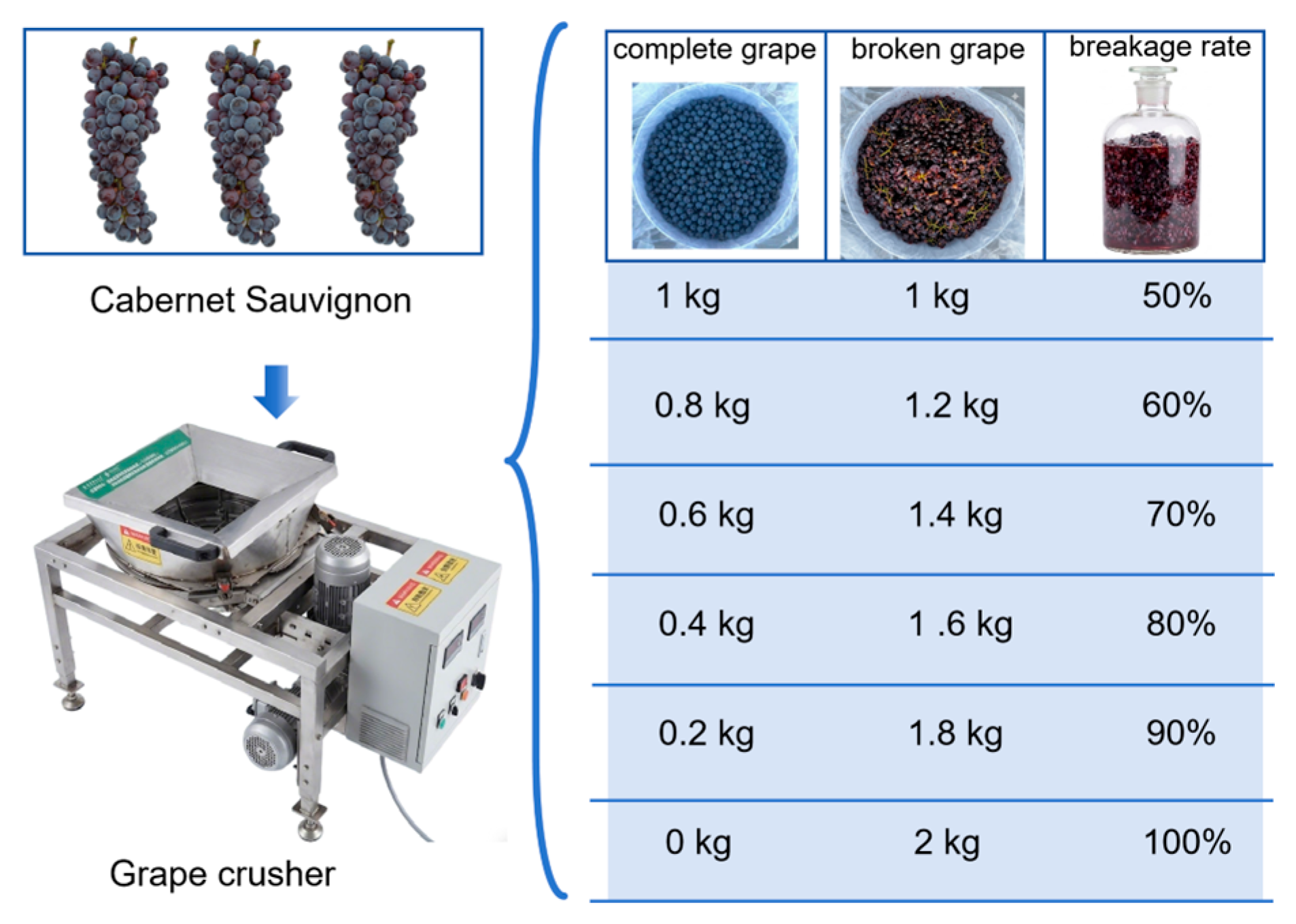
| Effect of Different Crushing Degrees on Wine | Number | T1 | T2 | T3 | T4 | T5 | T6 |
| Crushing Degree/% | 50 | 60 | 70 | 80 | 90 | 100 | |
| Maceration Time/days | 5 | 5 | 5 | 5 | 5 | 5 | |
| Effect of Different Maceration Times on Wine | Number | T6 | T7 | T8 | T9 | T10 | |
| Crushing Degree/% | 100 | 100 | 100 | 100 | 100 | ||
| Maceration Time/days | 5 | 7 | 9 | 11 | 13 |
| Crushing Degree | Alcoholic Degree/%vol | Residual Sugar Content/(g·L−1) | Titratable Acidity Content/(g·L−1) | Volatile Acidity/(g·L−1) (Calculated as Acetic Acid) | pH | Dry Extract Content/(g·L−1) |
|---|---|---|---|---|---|---|
| 50 | 11.20 ± 0.05 bc | 0.53 ± 0.06 ab | 4.74 ± 0.05 b | 0.57 ± 0.05 ab | 3.88 ± 0.02 b | 31.33 ± 0.06 ab |
| 60 | 10.88 ± 0.05 e | 0.70 ± 0.20 a | 4.58 ± 0.03 c | 0.60 ± 0.04 ab | 3.91 ± 0.01 a | 31.07 ± 0.50 b |
| 70 | 11.25 ± 0.05 bc | 0.50 ± 0.17 ab | 4.72 ± 0.01 b | 0.61 ± 0.03 a | 3.91 ± 0.01 a | 31.67 ± 0.42 ab |
| 80 | 11.15 ± 0.05 cd | 0.60 ± 0.10 ab | 4.53 ± 0.04 cd | 0.57 ± 0.02 ab | 3.92 ± 0.01 a | 31.97 ± 0.25 a |
| 90 | 11.10 ± 0.05 d | 0.43 ± 0.06 b | 4.51 ± 0.01 d | 0.61 ± 0.08 ab | 3.92 ± 0.01 a | 31.70 ± 0.36 ab |
| 100 | 11.51 ± 0.03 a | 0.53 ± 0.12 ab | 4.91 ± 0.01 a | 0.53 ± 0.03 b | 3.82 ± 0.02 c | 31.60 ± 0.35 ab |
| Crushing Degree/% | L* | a* | b* | C*ab | h*ab/(°) | ΔE*ab |
|---|---|---|---|---|---|---|
| 50 | 87.49 ± 0.45 ab | 11.86 ± 0.14 d | 5.70 ± 0.21 c | 13.16 ± 0.18 e | 0.45 ± 0.02 c | 2.10 ± 0.33 c |
| 60 | 87.42 ± 1.12 ab | 12.34 ± 0.06 c | 7.00 ± 0.37 ab | 14.19 ± 0.15 c | 0.52 ± 0.03 a | 3.21 ± 0.16 b |
| 70 | 88.20 ± 0.48 a | 12.32 ± 0.08 c | 5.95 ± 0.14 c | 13.69 ± 0.12 d | 0.45 ± 0.01 c | 2.95 ± 0.30 b |
| 80 | 86.33 ± 1.47 b | 13.59 ± 0.07 a | 7.29 ± 0.45 a | 15.43 ± 0.23 a | 0.49 ± 0.03 ab | 3.82 ± 0.40 a |
| 90 | 87.44 ± 0.47 ab | 13.03 ± 0.10 b | 6.55 ± 0.16 b | 14.58 ± 0.14 b | 0.47 ± 0.01 bc | 3.12 ± 0.09 b |
| 100 | 86.70 ± 1.43 ab | 13.56 ± 0.46 a | 5.59 ± 0.42 c | 14.67 ± 0.25 b | 0.39 ± 0.04 d | 3.02 ± 0.27 b |
| Maceration Time/d | Alcoholic Degree/%vol | Residual Sugar Content/(g·L−1) | Titratable Acidity Content/(g·L−1) | Volatile Acidity/(g·L−1) (Calculated as Acetic Acid) | pH | Dry Extract Content/(g·L−1) |
|---|---|---|---|---|---|---|
| 5 | 11.51 ± 0.03 b | 0.53 ± 0.12 a | 4.91 ± 0.01 a | 0.53 ± 0.03 a | 3.82 ± 0.02 b | 31.60 ± 0.35 b |
| 7 | 11.78 ± 0.02 c | 0.47 ± 0.06 a | 4.58 ± 0.04 b | 0.43 ± 0.04 b | 3.85 ± 0.01 a | 32.43 ± 0.32 a |
| 9 | 11.89 ± 0.06 c | 0.57 ± 0.06 a | 4.53 ± 0.04 bc | 0.38 ± 0.00 b | 3.83 ± 0.01 ab | 32.23 ± 0.40 ab |
| 11 | 12.14 ± 0.08 a | 0.63 ± 0.25 a | 4.50 ± 0.03 cd | 0.41 ± 0.05 b | 3.84 ± 0.01 a | 31.93 ± 0.40 ab |
| 13 | 12.03 ± 0.09 b | 0.50 ± 0.00 a | 4.47 ± 0.01 d | 0.44 ± 0.08 b | 3.84 ± 0.01 ab | 31.90 ± 0.14 ab |
| Maceration Time/d | L* | a* | b* | C*ab | h*ab/(°) | ΔE*ab |
|---|---|---|---|---|---|---|
| 5 | 86.70 ± 1.43 b | 13.56 ± 0.46 b | 5.59 ± 0.42 a | 14.67 ± 0.25 b | 0.39 ± 0.04 a | 3.02 ± 0.27 c |
| 7 | 86.53 ± 0.38 b | 14.77 ± 0.11 a | 4.67 ± 0.11 b | 15.49 ± 0.14 a | 0.31 ± 0.01 c | 3.71 ± 0.04 a |
| 9 | 88.02 ± 0.24 a | 13.16 ± 0.08 c | 3.94 ± 0.07 d | 13.74 ± 0.08 c | 0.29 ± 0.01 c | 3.08 ± 0.15 c |
| 11 | 88.33 ± 0.20 a | 12.66 ± 0.08 d | 4.41 ± 0.04 bc | 13.40 ± 0.08 d | 0.34 ± 0.01 b | 2.94 ± 0.14 c |
| 13 | 89.09 ± 0.23 a | 11.92 ± 0.04 e | 4.25 ± 0.08 c | 12.66 ± 0.06 e | 0.34 ± 0.01 b | 3.38 ± 0.22 b |
Disclaimer/Publisher’s Note: The statements, opinions and data contained in all publications are solely those of the individual author(s) and contributor(s) and not of MDPI and/or the editor(s). MDPI and/or the editor(s) disclaim responsibility for any injury to people or property resulting from any ideas, methods, instructions or products referred to in the content. |
© 2026 by the authors. Licensee MDPI, Basel, Switzerland. This article is an open access article distributed under the terms and conditions of the Creative Commons Attribution (CC BY) license.
Share and Cite
Chu, X.; Zhang, A.; Su, Y.; Sun, X. Effects of Different Maceration Times on the Chemical and Sensory Characteristics of Cabernet Sauvignon Grapes Wine. Foods 2026, 15, 1416. https://doi.org/10.3390/foods15081416
Chu X, Zhang A, Su Y, Sun X. Effects of Different Maceration Times on the Chemical and Sensory Characteristics of Cabernet Sauvignon Grapes Wine. Foods. 2026; 15(8):1416. https://doi.org/10.3390/foods15081416
Chicago/Turabian StyleChu, Xiang, Ai Zhang, Yuan Su, and Xiangyu Sun. 2026. "Effects of Different Maceration Times on the Chemical and Sensory Characteristics of Cabernet Sauvignon Grapes Wine" Foods 15, no. 8: 1416. https://doi.org/10.3390/foods15081416
APA StyleChu, X., Zhang, A., Su, Y., & Sun, X. (2026). Effects of Different Maceration Times on the Chemical and Sensory Characteristics of Cabernet Sauvignon Grapes Wine. Foods, 15(8), 1416. https://doi.org/10.3390/foods15081416