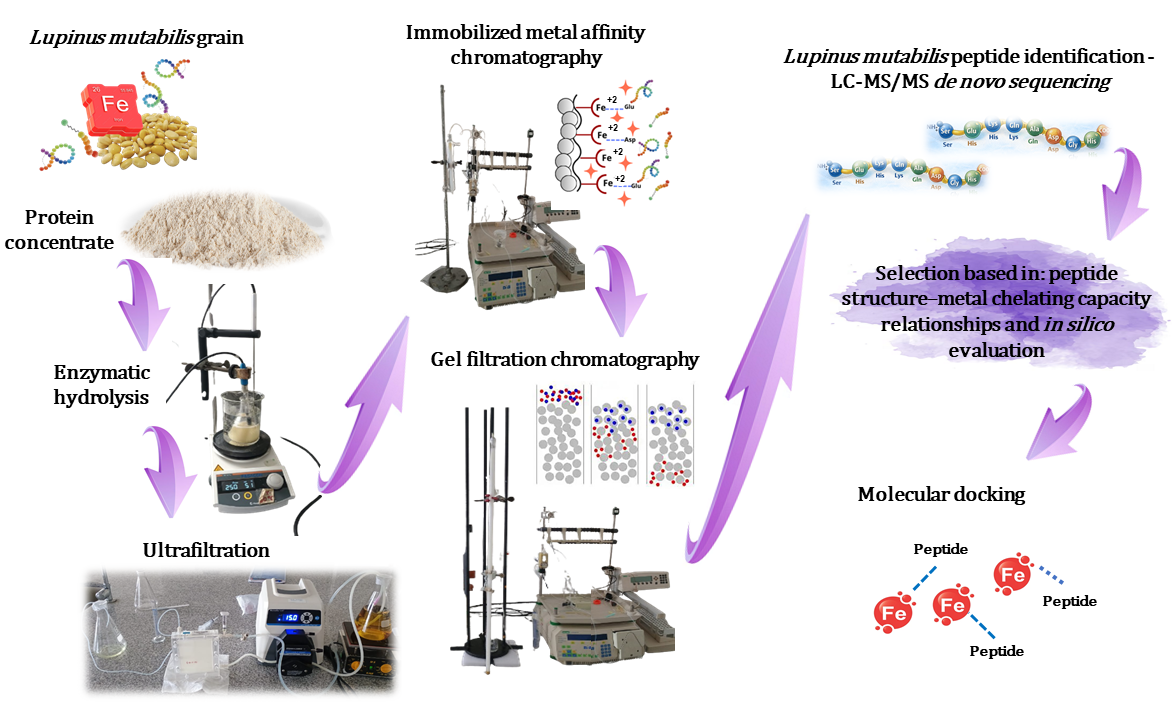
Discovery of Iron-Chelating Peptides from Lupinus mutabilis via Integrated Purification and In Silico Validation
 , ,
, ,  , and
, and
Abstract
1. Introduction
2. Materials and Methods
2.1. Materials and Reagents
2.2. Preparation of Lupinus mutabilis Peptides
2.2.1. Protein Extraction
2.2.2. Preparation and Concentration of the Protein Hydrolysate
2.3. Immobilized Metal Affinity Chromatography
2.4. Gel Filtration Chromatography
2.5. Identification of Lupinus mutabilis Peptides by LC-MS/MS
2.6. Molecular Docking of Lupinus mutabilis Peptides with Fe2+-Chelating Capacity
2.6.1. Receptor and Ligand Preparation
2.6.2. Docking Protocol and Scoring Analysis
2.7. Soluble Protein
2.8. Degree of Hydrolysis
2.9. Determination of Iron-Chelating Capacity
2.10. Statistical Analysis
3. Results and Discussion
3.1. Production, Characterization and Iron-Chelating Capacity of Lupinus mutabilis Protein Hydrolysate and Its Fractions
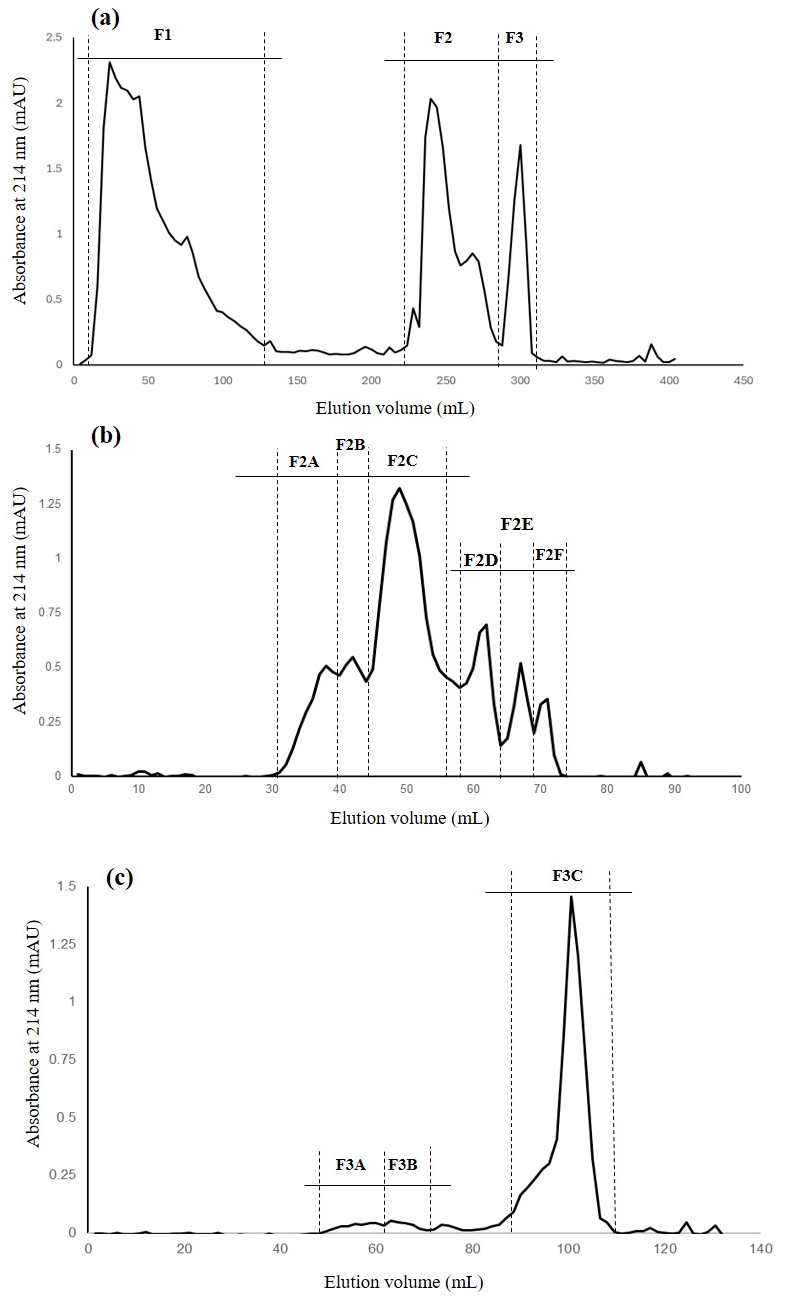
3.2. Separation of Fe2+-Binding Peptides Using Chromatographic Techniques
3.3. Peptide Identification by LC-MS/MS De Novo Sequencing
3.4. Molecular Docking Analysis of Identified Peptides from Lupinus mutabilis
4. Conclusions
Supplementary Materials
Author Contributions
Funding
Institutional Review Board Statement
Informed Consent Statement
Data Availability Statement
Conflicts of Interest
References
- Lee, S.; Son, Y.; Hwang, J.; Kim, M.S.; Shin, J.I.; Yon, D.K.; Kassebaum, N.J. Global, regional and national burden of dietary iron deficiency from 1990 to 2021: A Global Burden of Disease study. Nat. Med. 2025, 31, 1809–1829. [Google Scholar] [CrossRef]
- Man, Y.; Xu, T.; Adhikari, B.; Zhou, C.; Wang, Y.; Wang, B. Iron supplementation and iron-fortified foods: A review. Crit. Rev. Food Sci. Nutr. 2022, 62, 4504–4525. [Google Scholar] [CrossRef]
- Zheng, B.D.; Xiao, M.T. Harnessing food-derived bioactive peptides for iron chelation: An alternative solution to iron deficiency anemia. Food Funct. 2025, 16, 4226–4241. [Google Scholar] [CrossRef]
- Piskin, E.; Cianciosi, D.; Gulec, S.; Tomas, M.; Capanoglu, E. Iron absorption: Factors, limitations, and improvement methods. ACS Omega 2022, 7, 20441–20456. [Google Scholar] [CrossRef]
- Shubham, K.; Anukiruthika, T.; Dutta, S.; Kashyap, A.V.; Moses, J.A.; Anandharamakrishnan, C. Iron deficiency anemia: A comprehensive review on iron absorption, bioavailability and emerging food fortification approaches. Trends Food Sci. Technol. 2020, 99, 58–75. [Google Scholar] [CrossRef]
- Mattar, G.; Haddarah, A.; Haddad, J.; Pujola, M.; Sepulcre, F. New approaches, bioavailability and the use of chelates as a promising method for food fortification. Food Chem. 2022, 373, 131394. [Google Scholar] [CrossRef] [PubMed]
- Jin, W.; Wang, L.; Ma, Q.; Zhang, Y.; Yang, L.; Wang, X.; Liu, D. Characterization and bioaccessibility of Fe2+-oat bran peptide chelate. Food Chem. 2025, 495, 146323. [Google Scholar] [CrossRef] [PubMed]
- Wu, W.; Yang, Y.; Sun, N.; Bao, Z.; Lin, S. Food protein-derived iron-chelating peptides: The binding mode and promotive effects of iron bioavailability. Food Res. Int. 2020, 131, 108976. [Google Scholar] [CrossRef] [PubMed]
- Fan, C.; Ge, X.; Hao, J.; Wu, T.; Liu, R.; Sui, W.; Geng, J.; Zhang, M. Identification of high iron-chelating peptides with unusual antioxidant effect from sea cucumbers and the possible binding mode. Food Chem. 2023, 399, 133912. [Google Scholar] [CrossRef]
- Guo, H.; Zhou, Y.; Luo, C.; Li, Z.; Peng, J.; Xu, W.; Wang, D.; Yang, J. The binding mechanism of a novel ferrous ion chelating peptide from chicken blood hemoglobin and the bioavailability of the chelate. Food Chem. X 2025, 32, 103349. [Google Scholar] [CrossRef]
- Torres-Fuentes, C.; Alaiz, M.; Vioque, J. Iron-chelating activity of chickpea protein hydrolysate peptides. Food Chem. 2012, 134, 1585–1588. [Google Scholar] [CrossRef] [PubMed]
- Athira, S.; Mann, B.; Sharma, R.; Pothuraju, R.; Bajaj, R.K. Preparation and characterization of iron-chelating peptides from whey protein: An alternative approach for chemical iron fortification. Food Res. Int. 2021, 141, 110133. [Google Scholar] [CrossRef] [PubMed]
- Tian, Q.; Fan, Y.; Hao, L.; Wang, J.; Xia, C.; Wang, J.; Hou, H. A comprehensive review of calcium and ferrous ions chelating peptides: Preparation, structure and transport pathways. Crit. Rev. Food Sci. Nutr. 2023, 63, 4418–4430. [Google Scholar] [CrossRef]
- Li, Y.; Jiang, H.; Huang, G. Protein hydrolysates as promoters of non-haem iron absorption. Nutrients 2017, 9, 609. [Google Scholar] [CrossRef]
- Sun, N.; Cui, P.; Jin, Z.; Wu, H.; Wang, Y.; Lin, S. Contributions of molecular size, charge distribution, and specific amino acids to the iron-binding capacity of sea cucumber (Apostichopus japonicus) ovum hydrolysates. Food Chem. 2017, 230, 627–636. [Google Scholar] [CrossRef]
- Liu, W.-Y.; Ren, J.; Qin, X.-Y.; Zhang, X.-X.; Wu, H.-S.; Han, L.-J. Structural identification and combination mechanism of iron (II)–chelating Atlantic salmon (Salmo salar L.) skin active peptides. J. Food Sci. Technol. 2024, 61, 340–352. [Google Scholar] [CrossRef]
- Li, J.; Lin, S.; Chen, S.; Li, Z.; Hu, X. Collagen-derived Fe2+-chelating peptide: Key amino acids for Fe2+ chelating and mechanisms for enhancing cellular Fe2+ bioavailability. Food Chem. 2025, 493, 145847. [Google Scholar] [CrossRef]
- Carvajal-Larenas, F.E.; Linnemann, A.R.; Nout, M.J.R.; Koziol, M.; van Boekel, M.A.J.S. Lupinus mutabilis: Composition, uses, toxicology, and debittering. Crit. Rev. Food Sci. Nutr. 2016, 56, 1454–1487. [Google Scholar] [CrossRef]
- Chirinos, R.; Cerna, E.; Pedreschi, R.; Calsin, M.; Aguilar-Galvez, A.; Campos, D. Multifunctional in vitro bioactive properties: Antioxidant, antidiabetic, and antihypertensive of protein hydrolyzates from tarwi (Lupinus mutabilis Sweet) obtained by enzymatic biotransformation. Cereal Chem. 2021, 98, 423–433. [Google Scholar] [CrossRef]
- Guo, L.; Harnedy, P.A.; O’Keeffe, M.B.; Zhang, L.; Li, B.; Hou, H.; FitzGerald, R.J. Fractionation and identification of Alaska pollock skin collagen-derived mineral chelating peptides. Food Chem. 2015, 173, 536–542. [Google Scholar] [CrossRef] [PubMed]
- Chirinos, R.; Ochoa, K.; Aguilar-Galvez, A.; Carpentier, S.; Pedreschi, R.; Campos, D. Obtaining of peptides with in vitro antioxidant and angiotensin I converting enzyme inhibitory activities from cañihua protein (Chenopodium pallidicaule Aellen). J. Cereal Sci. 2018, 83, 139–146. [Google Scholar] [CrossRef]
- Ma, B. Novor: Real-time peptide de novo sequencing software. J. Am. Soc. Mass Spectrom. 2015, 26, 1885–1894. [Google Scholar] [CrossRef]
- Hanwell, M.D.; Curtis, D.E.; Lonie, D.C.; Vandermeersch, T.; Zurek, E.; Hutchison, G.R. Avogadro: An advanced semantic chemical editor, visualization, and analysis platform. J. Cheminform. 2012, 4, 17. [Google Scholar] [CrossRef] [PubMed]
- Eberhardt, J.; Santos-Martins, D.; Tillack, A.F.; Forli, S. AutoDock Vina 1.2.0: New docking methods, expanded force field, and Python bindings. J. Chem. Inf. Model. 2021, 61, 3891–3898. [Google Scholar] [CrossRef] [PubMed]
- Bitencourt-Ferreira, G.; Pintro, V.O.; de Azevedo, W.F. Docking with AutoDock4. In Docking Screens for Drug Discovery; de Azevedo, W.F., Jr., Ed.; Springer: New York, NY, USA, 2019; pp. 125–148. [Google Scholar] [CrossRef]
- Rutherfurd, S.M. Methodology for determining degree of hydrolysis of proteins in hydrolysates: A review. J. AOAC Int. 2010, 93, 1515–1522. [Google Scholar] [CrossRef] [PubMed]
- Arise, A.K.; Alashi, A.M.; Nwachukwu, I.D.; Ijabadeniyi, O.A.; Aluko, R.E.; Amonsou, E.O. Antioxidant activities of bambara groundnut (Vigna subterranea) protein hydrolysates and their membrane ultrafiltration fractions. Food Funct. 2016, 7, 2431–2437. [Google Scholar] [CrossRef]
- Islam, M.S.; Wang, H.; Admassu, H.; Noman, A.; Ma, C.; An, W.F. Degree of hydrolysis, functional and antioxidant properties of protein hydrolysates from grass turtle (Chinemys reevesii) as influenced by enzymatic hydrolysis conditions. Food Sci. Nutr. 2021, 9, 4031–4047. [Google Scholar] [CrossRef]
- Tacias-Pascacio, V.G.; Morellon-Sterling, R.; Siar, E.-H.; Tavano, O.; Berenguer-Murcia, Á.; Fernandez-Lafuente, R. Use of Alcalase in the production of bioactive peptides: A review. Int. J. Biol. Macromol. 2020, 165, 2143–2196. [Google Scholar] [CrossRef]
- Vo, T.D.L.; Pham, K.T.; Le, V.M.V.; Lam, H.H.; Huynh, O.N.; Vo, B.C. Evaluation of iron-binding capacity, amino acid composition, functional properties of Acetes japonicus proteolysate and identification of iron-binding peptides. Process Biochem. 2020, 91, 374–386. [Google Scholar] [CrossRef]
- Wu, W.; Jia, J.; Wen, C.; Yu, C.; Zhao, Q.; Hu, J. Optimization of ultrasound assisted extraction of abalone viscera protein and its effect on the iron-chelating activity. Ultrason. Sonochemistry 2021, 77, 105670. [Google Scholar] [CrossRef]
- Wu, W.; Li, B.; Hou, H.; Zhang, H.; Zhao, X. Identification of iron-chelating peptides from Pacific cod skin gelatin and the possible binding mode. J. Funct. Foods 2017, 35, 418–427. [Google Scholar] [CrossRef]
- Caetano-Silva, M.E.; Netto, F.M.; Bertoldo-Pacheco, M.T.; Alegría, A.; Cilla, A. Peptide-metal complexes: Obtention and role in increasing bioavailability and decreasing the pro-oxidant effect of minerals. Crit. Rev. Food Sci. Nutr. 2021, 61, 1470–1489. [Google Scholar] [CrossRef]
- Miao, J.; Liao, W.; Pan, Z.; Wang, Q.; Duan, S.; Xiao, S.; Yang, Z.; Cao, Y. Isolation and identification of iron-chelating peptides from casein hydrolysates. Food Funct. 2019, 10, 2372–2381. [Google Scholar] [CrossRef] [PubMed]
- Lv, Y.; Bao, X.; Liu, H.; Ren, J.; Guo, S. Purification and characterization of calcium-binding soybean protein hydrolysates by Ca2+/Fe3+ immobilized metal affinity chromatography (IMAC). Food Chem. 2013, 141, 1645–1650. [Google Scholar] [CrossRef] [PubMed]
- Caetano-Silva, M.E.; Bertoldo-Pacheco, M.T.; Paes-Leme, A.F.; Netto, F.M. Iron-binding peptides from whey protein hydrolysates: Evaluation, isolation and sequencing by LC-MS/MS. Food Res. Int. 2015, 71, 132–139. [Google Scholar] [CrossRef]
- Wu, H.; Liu, Z.; Zhao, Y.; Zeng, M. Enzymatic preparation and characterization of iron-chelating peptides from anchovy (Engraulis japonicus) muscle protein. Food Res. Int. 2012, 48, 435–441. [Google Scholar] [CrossRef]
- Hu, S.; Lin, S.; Wang, D.; Zhang, S.; Sun, N. Antarctic krill-derived peptides with consecutive Glu residues enhanced iron binding, solubility, and absorption. Food Funct. 2021, 12, 8615–8625. [Google Scholar] [CrossRef]
- Lin, S.; Hu, X.; Li, L.; Yang, X.; Chen, S.; Wu, Y.; Yang, S. Preparation, purification and identification of iron-chelating peptides derived from tilapia (Oreochromis niloticus) skin collagen and characterization of the peptide–iron complexes. LWT 2021, 149, 111796. [Google Scholar] [CrossRef]
- Stephenson, F.H. Protein. In Calculations for Molecular Biology and Biotechnology, 3rd ed.; Academic Press: Cambridge, MA, USA, 2016; pp. 375–429. [Google Scholar] [CrossRef]
- Ding, X.; Li, H.; Xu, M.; Li, X.; Li, M. Iron binding modes of small molecular weight peptides from mung bean. Food Res. Int. 2024, 175, 113735. [Google Scholar] [CrossRef]
- Echavarría, J.A.C.; Hajj, S.E.; Irankunda, R.; Selmeczi, K.; Paris, C.; Udenigwe, C.C.; Canabady-Rochelle, L. Screening, separation and identification of metal-chelating peptides for nutritional, cosmetics and pharmaceutical applications. Food Funct. 2024, 15, 3300–3326. [Google Scholar] [CrossRef]
- Sóvágó, I.; Kállay, C.; Várnagy, K. Peptides as complexing agents: Factors influencing the structure and thermodynamic stability of peptide complexes. Coord. Chem. Rev. 2012, 256, 2225–2233. [Google Scholar] [CrossRef]
- Olsen, T.H.; Yesiltas, B.; Marin, F.I.; Pertseva, M.; García-Moreno, P.J.; Gregersen, S.; Marcatili, P. AnOxPePred: Using deep learning for the prediction of antioxidative properties of peptides. Sci. Rep. 2020, 10, 21471. [Google Scholar] [CrossRef] [PubMed]
- Zhang, Z.; Shu, G.; Lei, H.; Meng, F.; Chen, L.; Gao, H.; Li, G. Antihypertensive and antioxidant peptide identification and storage stability assessment of novel probiotic fermented sheep milk: A comparative study with bovine milk. Food Chem. X 2025, 32, 103364. [Google Scholar] [CrossRef]
- Gaigher, B.; da Silva, E.d.N.; Lacerda Sanches, V.; Milani, R.F.; Galland, F.; Cadore, S.; Grancieri, M.; Bertoldo-Pacheco, M.T. Formulations with microencapsulated Fe–peptides improve in vitro bioaccessibility and bioavailability. Curr. Res. Food Sci. 2022, 5, 687–697. [Google Scholar] [CrossRef] [PubMed]
- Kaur, N.; Kaur, S.; Kumar, C.; Tandon, G.; Jaiswal, S.; Agarwal, A. In silico identification of bioactive peptides from Amaranthus globulin protein for enhancement of iron absorption: A food science perspective. Food Biotechnol. 2025, 39, 436–455. [Google Scholar] [CrossRef]


| Fraction | Iron Chelation Capacity (mg Fe2+·g−1 Protein) * | Rate of Iron Chelation (%) * |
|---|---|---|
| LMPH | 22.75 ± 0.61 c | 54.67 ± 1.15 bc |
| UF > 10 kDa | 26.19 ± 0.36 b | 58.33 ± 0.58 b |
| UF < 10 kDa –> 2 kDa | 18.21 ± 0.61 d | 44.33 ± 1.53 c |
| UF < 2 kDa | 35.16 ± 0.99 a | 69.40 ± 2.41 a |
| Fraction IMAC | Iron Chelation Capacity (mg Fe2+·g−1 Protein) * | Rate of Iron Chelation (%) * |
|---|---|---|
| F1 | 13.07 ± 0.60 c | N.D |
| F2 | 51.06 ± 0.19 a | 94.75 ± 0.50 a |
| F3 | 33.33 ± 9.91 b | 71.25 ± 2.36 c |
| Fraction | Iron Chelation Capacity (mg Fe2+·g−1 Protein) * | Rate of Iron Chelation (%) * |
|---|---|---|
| F2A | N.D | N.D |
| F2B | 0.77 ± 0.06 d | 1.00 ± 0.01 d |
| F2C | 11.96 ± 0.12 b | 5.25 ± 0.50 b |
| F2D | 45.20 ± 0.40 a | 87.25 ± 0.50 a |
| F2E | 1.86 ± 0.16 d | 7.00 ± 0.00 d |
| F2F | 8.36 ± 1.42 c | 14.50 ± 4.04 c |
| N° | m/z | z | Score | Peptide Mass | Error (ppm) | Length | De Novo Peptide | Chelating Capacity & | Toxicity § |
|---|---|---|---|---|---|---|---|---|---|
| Peptides from subfraction F2-E | |||||||||
| 1 | 453.21 | 2 | 96.2 | 904.41 | 2.6 | 7 | FDGWQPR | 0.2518 | Non-Toxin |
| 2 | 420.20 | 2 | 95.9 | 838.38 | 2.4 | 6 | DWYDLK | 0.2143 | Non-Toxin |
| 3 | 446.69 | 2 | 95.9 | 891.37 | 2 | 6 | EDYRFY | 0.249 | Non-Toxin |
| 4 | 386.69 | 2 | 95.4 | 771.36 | 2.1 | 6 | EGWQPR | 0.2411 | Non-Toxin |
| 5 | 415.20 | 2 | 94.8 | 828.38 | 4.3 | 7 | ADGWQPR | 0.2400 | Non-Toxin |
| 6 | 429.21 | 2 | 94.7 | 856.41 | 5.5 | 7 | VDGWQPR | 0.2299 | Non-Toxin |
| 7 | 439.72 | 2 | 93.9 | 877.42 | 2 | 7 | SNEPLYR ** | 0.2530 | Non-Toxin |
| 8 | 422.21 | 2 | 93.6 | 842.40 | 7.5 | 7 | AEGWQPR | 0.2362 | Non-Toxin |
| 9 | 386.69 | 2 | 93.4 | 771.36 | 2.1 | 6 | ADWQPR | 0.2452 | Non-Toxin |
| 10 | 369.71 | 2 | 92.5 | 737.41 | −0.2 | 6 | QQPLPR * | 0.2730 | Non-Toxin |
| 11 | 375.16 | 2 | 91.6 | 748.31 | 1.7 | 5 | DWDKW | 0.2160 | Non-Toxin |
| 12 | 461.21 | 2 | 91.2 | 920.41 | 2.1 | 7 | YDGWQPR | 0.2427 | Non-Toxin |
| 13 | 354.68 | 2 | 91 | 707.36 | −0.5 | 5 | EYLRQ | 0.2337 | Non-Toxin |
| 14 | 421.19 | 2 | 89.6 | 840.38 | 1 | 6 | YDFLHF | 0.2687 | Non-Toxin |
| 15 | 415.20 | 2 | 89.4 | 828.38 | 4.3 | 6 | ENWQPR | 0.2440 | Non-Toxin |
| 16 | 393.53 | 3 | 88.3 | 1177.59 | 1.9 | 9 | RYDRDGQLR ** | 0.2758 | Non-Toxin |
| 17 | 460.22 | 2 | 87.7 | 918.43 | 8.4 | 7 | FEGWQPR | 0.2481 | Non-Toxin |
| Peptides from subfraction F3-C | |||||||||
| 1 | 364.70 | 2 | 96.7 | 727.39 | 1.9 | 6 | VNPDKRQ * | 0.2244 | Non-Toxin |
| 2 | 421.24 | 2 | 95.8 | 840.48 | 1.2 | 7 | LVNPDKR * | 0.2498 | Non-Toxin |
| 3 | 401.21 | 1 | 94.5 | 400.20 | 1.7 | 3 | EPR | 0.2749 | Non-Toxin |
| 4 | 439.72 | 2 | 94 | 877.42 | 2 | 7 | SNEPLYR ** | 0.2536 | Non-Toxin |
| 5 | 462.27 | 2 | 91 | 922.53 | 0.5 | 8 | SPPTLRPR * | 0.2567 | Non-Toxin |
| 6 | 361.19 | 2 | 90.4 | 720.36 | 3.1 | 5 | RFDQR * | 0.2320 | Non-Toxin |
| 7 | 353.68 | 2 | 90.2 | 705.35 | 1.8 | 5 | RDYPR | 0.2145 | Non-Toxin |
| 8 | 415.20 | 2 | 88.9 | 828.38 | 4.3 | 7 | DAGWQPR | 0.2466 | Non-Toxin |
| 9 | 379.23 | 3 | 88.1 | 1134.68 | −0.5 | 10 | VLSPPTLRPR * | 0.2432 | Non-Toxin |
| 10 | 393.53 | 3 | 85.7 | 1177.59 | 1.9 | 9 | RYDRDGQLR ** | 0.2758 | Non-Toxin |
| 11 | 379.21 | 2 | 85.4 | 756.42 | 0.3 | 6 | REPSLR | 0.2690 | Non-Toxin |
| 12 | 478.28 | 2 | 85. 3 | 954.54 | 7.8 | 7 | RDKRQPR | 0.2159 | Non-Toxin |
| N° | Peptide | Binding Energy (kcal/mol) | Residue Closest/Distance | Spatial Proximity of the Peptide to Fe2+ |
|---|---|---|---|---|
| 1 | FDGWQPR | −0.63 | Phe 1 5.6 Å |  |
| 2 | EDYRFY | −0.63 | Glu 1 2.9 Å |  |
| 3 | SNEPLYR | −0.55 | Tyr 6 3.8 Å |  |
| 4 | QQPLPR | −0.48 | Leu 4 4.4 Å Pro 5 3.8 Å |  |
| 5 | YDFLHF | −0.69 | Phe 6 4.5 Å |  |
| 6 | EPR | −0.46 | Arg 3 5.9 Å |  |
| 7 | SPPTLRPR | −0.55 | Leu 5 4.8 Å |  |
| 8 | RYDRDGQLR | −0.42 | Arg 4 7.0 Å |  |
| 9 | REPSLR | −0.51 | Leu 5 8.1 Å |  |
Disclaimer/Publisher’s Note: The statements, opinions and data contained in all publications are solely those of the individual author(s) and contributor(s) and not of MDPI and/or the editor(s). MDPI and/or the editor(s) disclaim responsibility for any injury to people or property resulting from any ideas, methods, instructions or products referred to in the content. |
© 2026 by the authors. Licensee MDPI, Basel, Switzerland. This article is an open access article distributed under the terms and conditions of the Creative Commons Attribution (CC BY) license.
Share and Cite
Vila-Santillán, Z.; Campos, D.; Aguilar-Galvez, A.; Carpentier, S.; Oliveira, T.V.d.; Pedreschi, R.; Chirinos, R. Discovery of Iron-Chelating Peptides from Lupinus mutabilis via Integrated Purification and In Silico Validation. Foods 2026, 15, 1318. https://doi.org/10.3390/foods15081318
Vila-Santillán Z, Campos D, Aguilar-Galvez A, Carpentier S, Oliveira TVd, Pedreschi R, Chirinos R. Discovery of Iron-Chelating Peptides from Lupinus mutabilis via Integrated Purification and In Silico Validation. Foods. 2026; 15(8):1318. https://doi.org/10.3390/foods15081318
Chicago/Turabian StyleVila-Santillán, Zayra, David Campos, Ana Aguilar-Galvez, Sebastien Carpentier, Thomás Valente de Oliveira, Romina Pedreschi, and Rosana Chirinos. 2026. "Discovery of Iron-Chelating Peptides from Lupinus mutabilis via Integrated Purification and In Silico Validation" Foods 15, no. 8: 1318. https://doi.org/10.3390/foods15081318
APA StyleVila-Santillán, Z., Campos, D., Aguilar-Galvez, A., Carpentier, S., Oliveira, T. V. d., Pedreschi, R., & Chirinos, R. (2026). Discovery of Iron-Chelating Peptides from Lupinus mutabilis via Integrated Purification and In Silico Validation. Foods, 15(8), 1318. https://doi.org/10.3390/foods15081318