Multi-Country Study of Stable Isotopes and Mineral Elements in European Pork

 , , , , ,
  , , ,
, , ,  , , , and
Abstract
1. Introduction
- To improve understanding of the relationships between some of the above-mentioned husbandry practices, isotope ratios, and mineral profile of pork;
- To evaluate the suitability of SIRA and multi-element analysis for identifying pork based on geographical origin and animal management, thus promoting the authenticity and traceability of European pork products;
- To provide a basis for the development of a European reference database of isotopic and elemental data on pork, enabling the authentication, traceability, and protection of European pork products, including the eligibility for PDO and PGI designations.
2. Materials and Methods
2.1. Sample Origin
Sampling
2.2. Stable Isotope Ratio Analysis (δ13C, δ15N, δ34S, δ18O, and δ2H)
2.3. Multi-Element Analysis
2.3.1. Chemicals and Reagents
2.3.2. Samples Preparation and Instrumentation
2.4. Statistical Analysis
3. Results and Discussion
3.1. Stable Isotope Composition
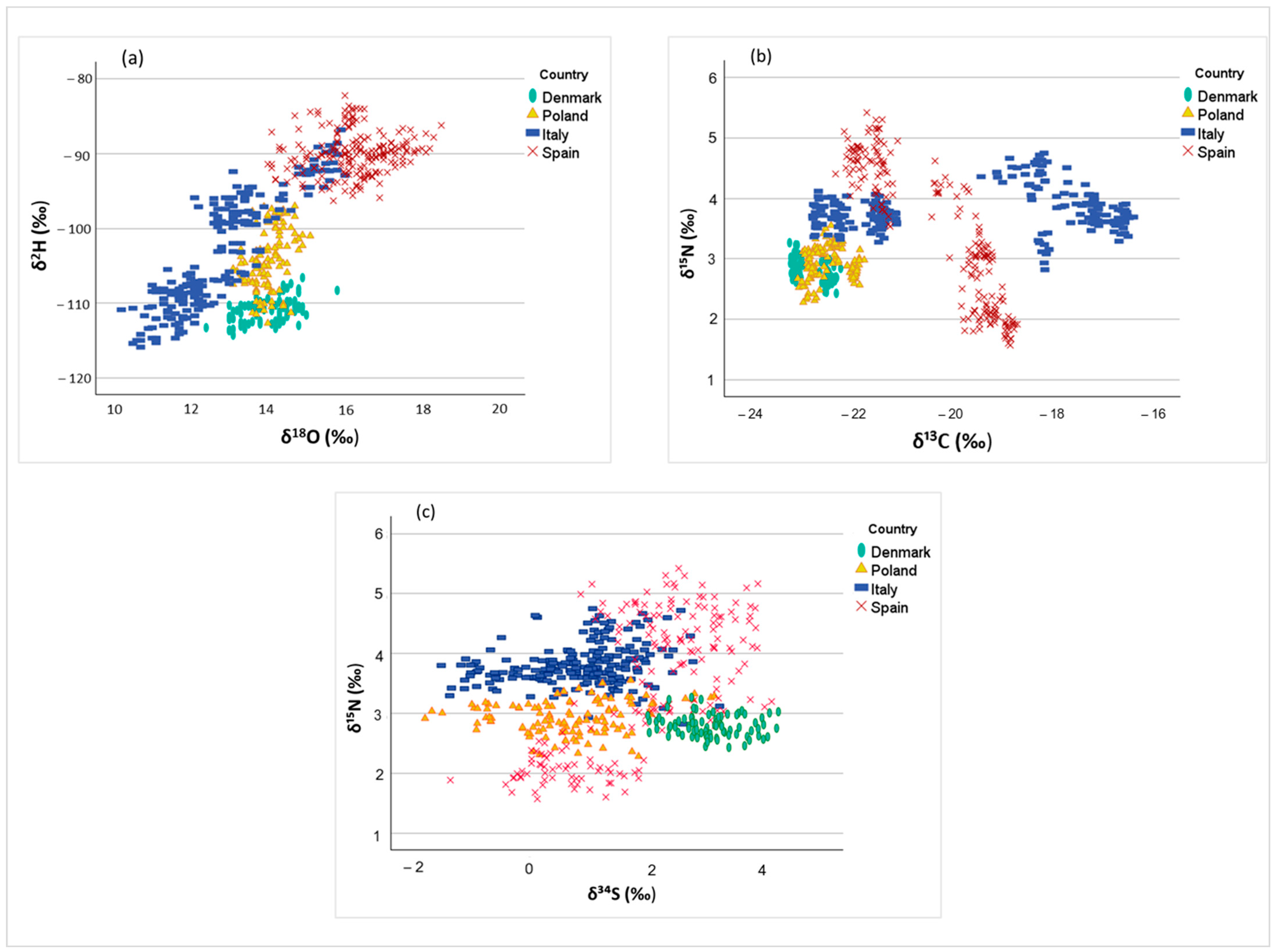
3.1.1. Influence of the Country of Provenance
3.1.2. Effect of Farm’s Husbandry Conditions
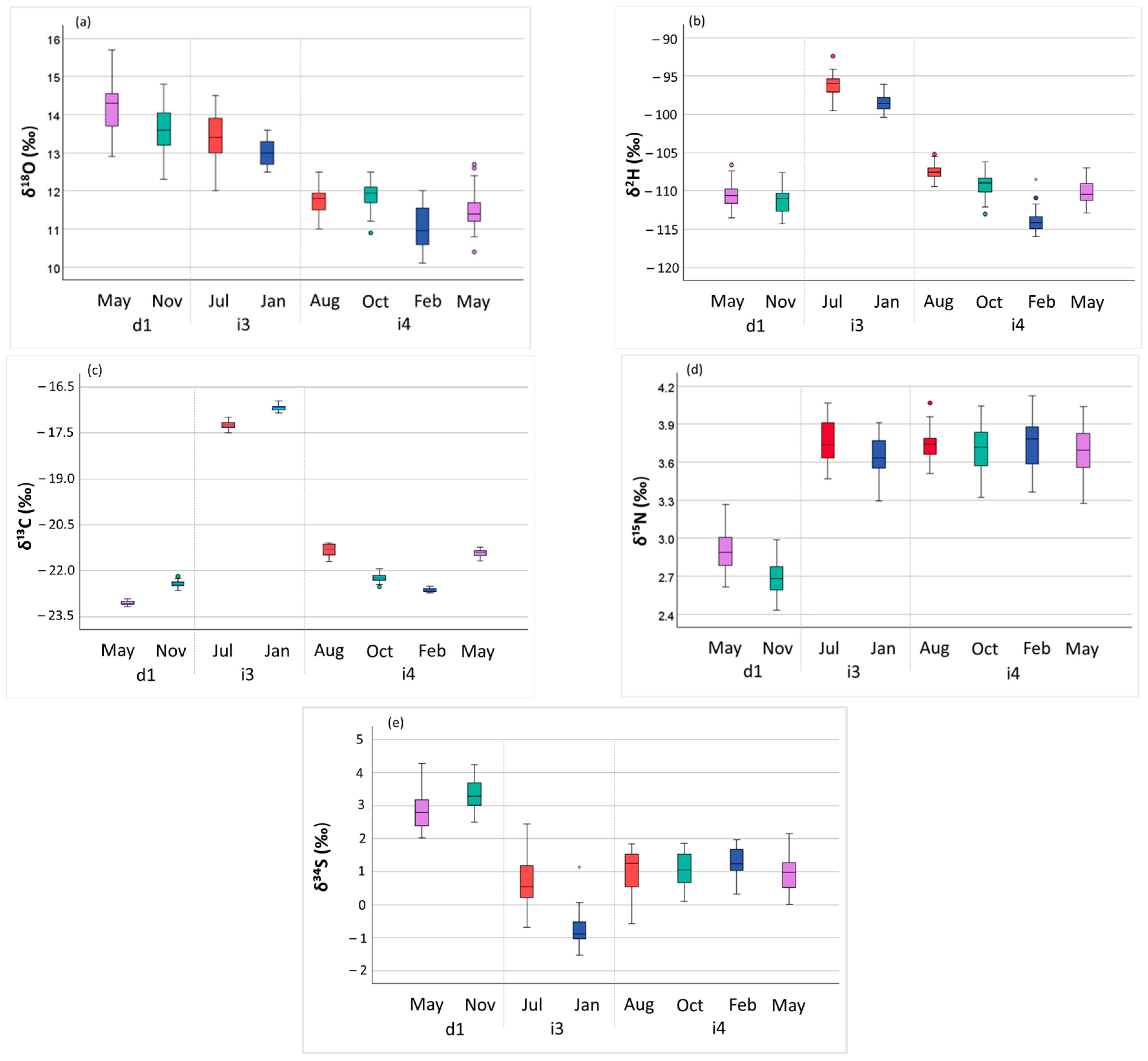
3.1.3. Influence of Slaughter Season
3.2. Mineral Elements Profile
- Macronutrients (K, P, Na, Mg, and Ca), present at high concentrations, and essential for growth, skeletal development, neuromuscular function, and osmotic and acid–base balance [61];
- Micronutrients (Zn, Fe, Cu, Se, Mn, Cr, Mo, Ni, and Co), essential minor elements required in small amounts for critical biological functions;
- Non-essential elements (Rb, Sr, Cs, Ba, Pb, Ag, Li, As, Cd, V, Tl, Ga, and U), including micro- and trace elements without a recognized biological role in animals, primarily reflecting environmental or soil-derived sources.
3.2.1. Influence of the Country of Provenance
3.2.2. Effect of Farm’s Husbandry Conditions
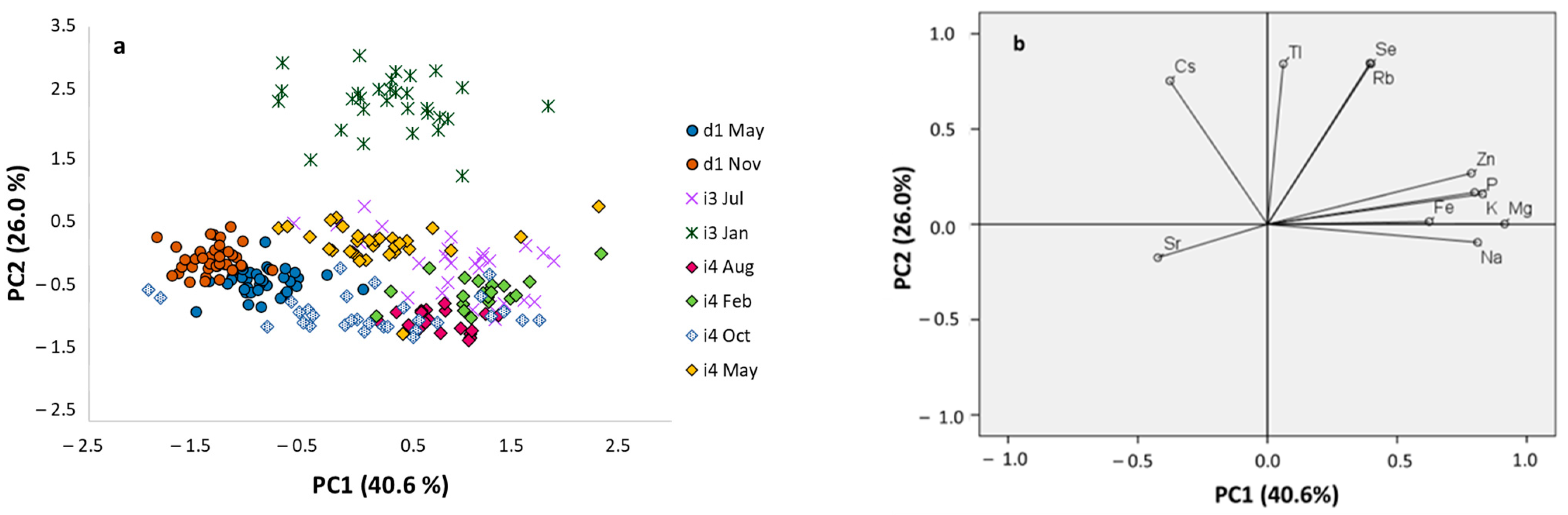
3.2.3. Effect of Slaughter Season
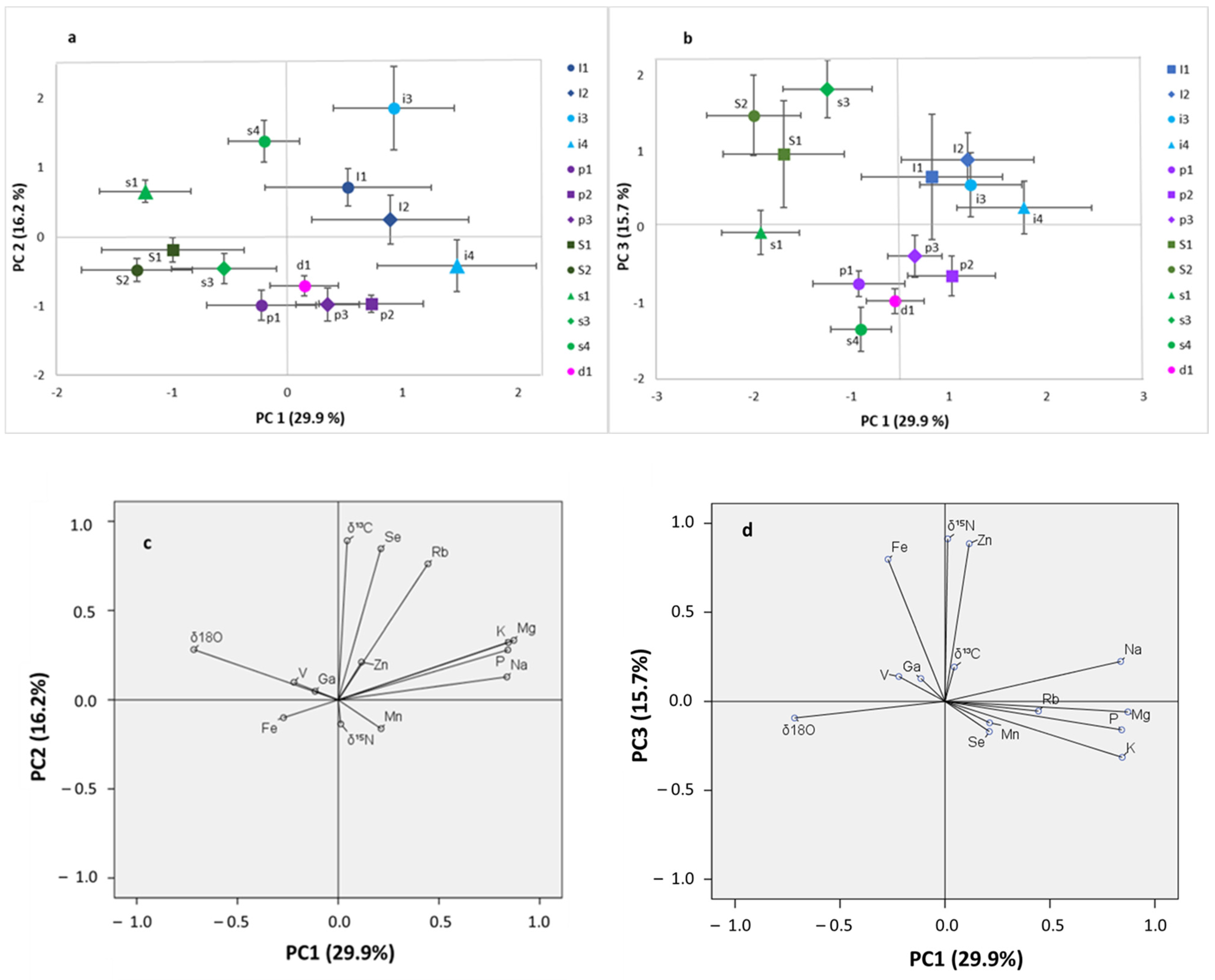
3.3. Multivariate Analysis of Stable Isotope Ratio and Mineral Elements Data
4. Conclusions
Supplementary Materials
Author Contributions
Funding
Institutional Review Board Statement
Informed Consent Statement
Data Availability Statement
Acknowledgments
Conflicts of Interest
Abbreviations
| PDO | Protected Designation of Origin |
| PGI | Protected Geographical Indication |
| SIRA | Stable Isotope Ratio Analysis |
| IRMS | Isotope Ratio Mass Spectroscopy |
| Q-ICP-MS | Single-Quadrupole Inductively Coupled Plasma Mass Spectrometer |
| PCA | Principal Component Analysis |
| ANOVA | Analysis of Variance |
| DU | Duroc |
| LA | Landrace |
| Y | Yorkshire |
| LW | Large White |
| PLW | Pulawska |
| P | Pietrain |
| MR | Mora Romagnola |
| CS | Cinta Senese |
| IB | Iberian |
| LTL | Longissimus thoracis et lumborum |
| DM | Dry matter |
| DFDM | Defatted Dry Matter |
| δ | Delta Notation |
| VPDB | Vienna Pee Dee Belemnite |
| VCDT | Vienna Canyon Diablo Troilite |
| VSMOW | Vienna Standard Mean Ocean Water |
| LOD | Limit of Detection |
| LOQ | Limit of Quantification |
| RSD | Relative Standard Deviation |
| R | Recovery |
References
- Pereira, P.M.C.C.; Vicente, A.F.R.B. Meat nutritional composition and nutritive role in the human diet. Meat Sci. 2014, 93, 586–592. [Google Scholar] [CrossRef]
- World Population Review. Meat Consumption by Country. 2026. Available online: https://worldpopulationreview.com/country-rankings/meat-consumption-by-country (accessed on 25 January 2026).
- European Commission. Pork—Agriculture and Rural Development. European Commission. 2025. Available online: https://agriculture.ec.europa.eu/farming/animal-products/pork_en (accessed on 17 February 2026).
- FAO. FAOSTAT: Pigmeat Production and Trade Statistics. Food and Agriculture Organization of the United Nations. 2024. Available online: https://www.fao.org/markets-and-trade/commodities-overview/basic-foods/meat/en (accessed on 9 February 2026).
- Erasmus, S.W.; Sohaib, M.; Revilla, I.; Vivar-Quintana, A.M.; Giancoli, S.J. Markers for meat provenance and authenticity with an account of its defining factors and quality characteristics—A review. J. Sci. Food Agric. 2024, 104, 7027–7084. [Google Scholar] [CrossRef] [PubMed]
- Rodríguez-Estévez, V.; García, A.; Peña, F.; Gómez, A.G. Foraging of Iberian fattening pigs grazing natural pasture in the dehesa. Livest. Sci. 2009, 120, 135–143. [Google Scholar] [CrossRef]
- Hernández-Jiménez, M.; Revilla, I.; Arce, L.; Cardador, M.J.; Ríos-Reina, R.; González-Martín, M.I.; Vivar-Quintana, A.M. Authentication of the Montanera period on carcasses of Iberian pigs by using analytical techniques and chemometric analyses. Animals 2021, 11, 2671. [Google Scholar] [CrossRef] [PubMed]
- García-Gudiño, J.; Blanco-Penedo, I.; Font-i-Furnols, M.; Angón, E.; Perea, J.M. Analysis of the sustainability of fattening systems for Iberian traditional pig production through a technical and environmental approach. Animals 2021, 11, 411. [Google Scholar] [CrossRef]
- Čandek-Potokar, M.; Batorek Lukač, N.; Tomažin, U.; Škrlep, M.; Nieto, R. Analytical review of productive performance of local pig breeds. Animal 2022, 16, 100490. [Google Scholar] [CrossRef]
- Ludwiczak, A.; Kasprowicz-Potocka, M.; Zaworska-Zakrzewska, A.; Składanowska-Baryza, J.; Rodríguez-Estévez, V.; Sanz-Fernández, S.; Díaz-Gaona, C.; Ferrari, P.; Pedersen, L.J.; Couto, M.Y.R.; et al. Husbandry practices associated with extensification in European pig production and their effects on pork quality. Meat Sci. 2023, 206, 109339. [Google Scholar] [CrossRef]
- Osorio, M.T.; Moloney, A.P.; Schmidt, O.; Monahan, F.J. Multielement isotope analysis of bovine muscle for determination of international geographical origin of meat. J. Agric. Food Chem. 2011, 59, 3285–3294. [Google Scholar] [CrossRef] [PubMed]
- Monahan, F.J.; Schmidt, O.; Moloney, A.P. Meat provenance: Authentication of geographical origin and dietary background of meat. Meat Sci. 2018, 144, 2–14. [Google Scholar] [CrossRef]
- Camin, F.; Bontempo, L.; Perini, M.; Piasentier, E. Stable isotope ratio analysis for assessing the authenticity of food of animal origin. Compr. Rev. Food Sci. Food Saf. 2016, 15, 868–877. [Google Scholar] [CrossRef] [PubMed]
- Pianezze, S.; Camin, F.; Perini, M.; Corazzin, M.; Piasentier, E. Tracing lamb meat with stable isotope ratio analysis: A review. Small Rumin. Res. 2021, 203, 106482. [Google Scholar] [CrossRef]
- Bontempo, L.; Camin, F.; Perini, M.; Piasentier, E. Isotopic and elemental composition of meat as a tool for authentication. Food Chem. 2011, 125, 901–909. [Google Scholar] [CrossRef]
- Bahar, B.; Monahan, F.J.; Moloney, A.P.; O’Kiely, P.; Scrimgeour, C.M.; Schmidt, O. Alteration of the carbon and nitrogen stable isotope composition of beef by substitution of grass silage with maize silage. Rapid Commun. Mass Spectrom. 2005, 19, 1937–1942. [Google Scholar] [CrossRef] [PubMed]
- Zhao, Y.; Tu, T.; Tang, X.; Zhao, S.; Qie, M.; Chen, A.; Yang, S. Authentication of organic pork and identification of geographical origins of pork in four regions of China by combined analysis of stable isotopes and multi-elements. Meat Sci. 2020, 165, 108129. [Google Scholar] [CrossRef]
- Piasentier, E.; Valusso, R.; Camin, F.; Versini, G. Stable isotope ratio analysis for authentication of lamb meat. Meat Sci. 2003, 64, 239–247. [Google Scholar] [CrossRef] [PubMed]
- Franke, B.M.; Gremaud, G.; Hadorn, R.; Kreuzer, M. Geographic origin of meat—Elements of an analytical approach to its authentication. Eur. Food Res. Technol. 2005, 221, 493–503. [Google Scholar] [CrossRef]
- National Research Council. Nutrient Requirements of Swine: Eleventh Revised Edition; The National Academies Press: Washington, DC, USA, 2012. [Google Scholar]
- Kelly, S.; Heaton, K.; Hoogewerff, J. Tracing the geographical origin of food: The application of multi-element and multi-isotope analysis. Trends Food Sci. Technol. 2005, 16, 555–567. [Google Scholar] [CrossRef]
- Kim, J.S.; Hwang, I.M.; Lee, G.H.; Park, Y.M.; Choi, J.Y.; Jamila, N.; Khan, N.; Kim, K.S. Geographical origin authentication of pork using multi-element and multivariate data analyses. Meat Sci. 2017, 123, 13–20. [Google Scholar] [CrossRef]
- Dehelean, A.; Feher, I.; Romulus, P.; Magdas, D.A.; Covaciu, F.-D.; Kasza, A.M.; Curean, V.; Cristea, G. Influence of geographical origin on isotopic and elemental compositions of pork meat. Foods 2023, 12, 4271. [Google Scholar] [CrossRef] [PubMed]
- Cristea, G.; Voica, C.; Feher, I.; Puscas, R.; Magdas, D.A. Isotopic and elemental characterization of Romanian pork meat in corroboration with advanced chemometric methods: A first exploratory study. Meat Sci. 2022, 189, 108825. [Google Scholar] [CrossRef]
- Kim, K.S.; Kim, J.S.; Hwang, I.M.; Jeong, I.S.; Khan, N.; Lee, S.I.; Jeon, D.B.; Song, Y.H.; Kim, K.S. Application of stable isotope ratio analysis for origin authentication of pork. Korean J. Food Sci. Anim. Res. 2013, 33, 39–44. [Google Scholar] [CrossRef]
- Park, Y.M.; Lee, C.M.; Hong, J.H.; Jamila, N.; Khan, N.; Jung, J.H.; Jung, Y.C.; Kim, K.S. Origin discrimination of defatted pork via trace elements profiling, stable isotope ratios analysis, and multivariate statistical techniques. Meat Sci. 2018, 143, 93–103. [Google Scholar] [CrossRef]
- Shin, W.J.; Choi, S.H.; Ryu, J.S.; Song, B.Y.; Song, J.H.; Park, S.; Min, J.S. Discrimination of the geographic origin of pork using multi-isotopes and statistical analysis. Rapid Commun. Mass Spectrom. 2018, 32, 1843–1850. [Google Scholar] [CrossRef] [PubMed]
- Song, O.Y.; Islam, M.A.; Son, J.H.; Jeong, J.Y.; Kim, H.E.; Yeon, L.S.; Khan, N.; Jamila, N.; Kim, K.S. Elemental composition of pork meat from conventional and animal welfare farms by inductively coupled plasma-optical emission spectrometry (ICP-OES) and ICP-mass spectrometry (ICP-MS) and their authentication via multivariate chemometric analysis. Meat Sci. 2021, 172, 108344. [Google Scholar] [CrossRef] [PubMed]
- González-Martín, I.; González-Pérez, C.; Hernández-Méndez, J.; Marquéz-Marcia, E.; Sanz Poveda, F. Use of isotope analysis to characterize meat from Iberian-breed swine. Meat Sci. 1999, 52, 437–441. [Google Scholar] [CrossRef]
- González-Martín, I.; Pérez-Pavón, A.; González-Pérez, C.; Hernández-Méndez, J.; Álvarez-García, F. Differentiation of dietary regimen of Iberian swine by means of isotopic analysis of carbon and sulphur in hepatic tissue. Meat Sci. 2001, 58, 25–30. [Google Scholar] [CrossRef]
- Litrenta, F.; Cavallo, C.; Perini, M.; Pianezze, S.; D’Alessandro, E.; Lo Turco, V.; Di Bella, G.; Liotta, L. Preliminary study on the influence of the geographical origin and farming system on ‘Nero dei Nebrodi’ pig using chemical and isotopic fingerprinting. J. Food Compos. Anal. 2025, 137, 106918. [Google Scholar] [CrossRef]
- Varrà, M.O.; Husáková, L.; Zanardi, E.; Alborali, G.L.; Patočka, J.; Ianieri, A.; Ghidini, S. Elemental profiles of swine tissues as descriptors for the traceability of value-added Italian heavy pig production chains. Meat Sci. 2023, 204, 109285. [Google Scholar] [CrossRef]
- PIC (Pig Improvement Company). Available online: https://www.pic.com (accessed on 16 March 2026).
- Topigs Norsvin Italia. Available online: https://www.topigsnorsvin.it (accessed on 16 March 2026).
- Ministerio de Agricultura, Alimentación y Medio Ambiente. Real Decreto 4/2014, de 10 de Enero, por el Que se Aprueba la Norma de Calidad Para la Carne, el Jamón, la Paleta y la Caña de Lomo Ibérico. BOE 2014, 10, 1569–1585. Available online: http://www.boe.es/boe/dias/2014/01/11/pdfs/BOE-A-2014-318.pdf (accessed on 17 February 2026).
- AOAC International. AOAC Official Method 950.46. Moisture in Meat. J. AOAC 1950, 36, 279. [Google Scholar]
- AOAC International. AOAC Official Method 960.39. Fat (Crude) in Meat. J. AOAC 1960, 43, 390. [Google Scholar]
- Perini, M.; Camin, F.; del Pulgar, J.S.; Piasentier, E. Effect of origin, breeding and processing conditions on the isotope ratios of bioelements in dry-cured ham. Food Chem. 2013, 136, 1543–1550. [Google Scholar] [CrossRef]
- ISO/IEC 17025:2017; General Requirements for the Competence of Testing and Calibration Laboratories. ISO: Geneva, Switzerland, 2017.
- Fragni, R.; Trifirò, A.; Nucci, A.; Seno, A.; Allodi, A.; Di Rocco, M. Italian tomato-based products authentication by multi-element approach: A mineral elements database to distinguish the domestic provenance. Food Control 2018, 93, 211. [Google Scholar] [CrossRef]
- Zhao, L.; Zhang, H.; Huang, F.; Liu, H.; Wang, T.; Zhang, C. Authenticating Tibetan pork in China by tracing the species and geographical features based on stable isotopic and multi-elemental fingerprints. Food Control 2023, 145, 109411. [Google Scholar] [CrossRef]
- Bontempo, L.; Perini, M.; Pianezze, S.; Horacek, M.; Roßmann, A.; Kelly, S.D.; Thomas, F.; Heinrich, K.; Schlicht, C.; Schellenberg, A.; et al. Characterization of beef coming from different European countries through stable isotope (H, C, N, and S) ratio analysis. Molecules 2023, 28, 2856. [Google Scholar] [CrossRef]
- Perini, M.; Camin, F.; Bontempo, L.; Rossmann, A.; Piasentier, E. Multielement (H, C, N, O, S) stable isotope characteristics of lamb meat from different Italian regions. Rapid Commun. Mass Spectrom. 2009, 23, 2573–2585. [Google Scholar] [CrossRef]
- Heaton, K.; Kelly, S.D.; Hoogewerff, J.; Woolfe, M. Verifying the geographical origin of beef: The application of multi-element isotope and trace element analysis. Food Chem. 2008, 107, 506–515. [Google Scholar] [CrossRef]
- Craig, H. Isotopic Variations in Meteoric Waters. Science 1961, 133, 1702–1703. [Google Scholar] [CrossRef]
- Harrison, S.M.; Schmidt, O.; Moloney, A.P.; Kelly, S.D.; Rossmann, A.; Schellenberg, A.; Camin, F.; Perini, M.; Hoogewerff, J.; Monahan, F.J. Tissue turnover in ovine muscles and lipids as recorded by multiple (H, C, O, S) stable isotope ratios. Food Chem. 2011, 124, 291–297. [Google Scholar] [CrossRef]
- DeNiro, M.J.; Epstein, S. Influence of diet on the distribution of carbon isotopes in animals. Geochim. Cosmochim. Acta 1978, 42, 495–506. [Google Scholar] [CrossRef]
- Zhao, Y.; Yang, S.; Wang, D. Stable carbon and nitrogen isotopes as a potential tool to differentiate pork from organic and conventional systems. J. Sci. Food Agric. 2016, 96, 3950–3955. [Google Scholar] [CrossRef]
- DeNiro, M.J. Influence of diet on the distribution of nitrogen isotopes in animals. Geochim. Cosmochim. Acta 1981, 45, 341–351. [Google Scholar] [CrossRef]
- Sparks, J.M.; Crowley, B.E.; Rutherford, M.G.; Jaggernauth, D. Coastal proximity, orientation, and precipitation amount drive spatial variability in δ34S values on the Caribbean island of Trinidad. Appl. Geochem. 2019, 108, 104372. [Google Scholar] [CrossRef]
- Chen, G.; Zhou, H.; Ji, D.; Gu, B. Stable isotope enrichment in muscle, liver, and whole fish tissues of brown-marbled groupers (Epinephelus fuscoguttatus). Ecol. Process. 2012, 1, 7. [Google Scholar] [CrossRef]
- Giustini, F.; Brilli, M.; Patera, A. Mapping oxygen stable isotopes of precipitation in Italy. J. Hydrol. Reg. Stud. 2016, 8, 162–181. [Google Scholar] [CrossRef]
- Dawson, T.E.; Ehleringer, J.R. Isotopic enrichment of water in the woody tissues of plants: Implications for plant water source, water uptake, and other studies which use the stable isotopic composition of cellulose. Geochim. Cosmochim. Acta 1993, 57, 3487–3492. [Google Scholar] [CrossRef]
- Ingraham, N.L. Isotopic variations in precipitation. In Isotope Tracers in Catchment Hydrology; Elsevier: Amsterdam, The Netherlands, 1998; pp. 87–118. [Google Scholar] [CrossRef]
- Camin, F.; Bontempo, L.; Heinrich, K.; Horacek, M.; Kelly, S.D.; Schlicht, C.; Thomas, F.; Monahan, F.J.; Hoogeweff, J.; Rossmann, A. Multi-element (H, C, N, S) stable isotope characteristics of lamb meat from different European regions. Anal. Bioanal. Chem. 2007, 389, 309–320. [Google Scholar] [CrossRef]
- Abeni, F.; Petrera, F.; Capelletti, M.; Dal Prà, A.; Bontempo, L.; Tonon, A.; Camin, F. Hydrogen and oxygen stable isotope fractionation in body fluid compartments of dairy cattle according to season, farm, breed, and reproductive stage. PLoS ONE 2015, 10, e0127391. [Google Scholar] [CrossRef] [PubMed]
- Hatvani, I.G.; Erdélyi, D.; Vrečca, P.; Kern, Z. Analysis of the spatial distribution of stable oxygen and hydrogen isotopes in precipitation across the Iberian Peninsula. Water 2020, 12, 481. [Google Scholar] [CrossRef]
- Rodríguez-Hernández, P.; Saavedra, D.; Martín-Gómez, A.; Cardador, M.J.; Arce, L.; Rodríguez-Estévez, V. In vivo authentication of Iberian pig feeding regime using faecal volatilome information. Livest. Sci. 2022, 260, 104913. [Google Scholar] [CrossRef]
- Rodríguez-Hernández, P.; Cardador, M.J.; Ríos-Reina, R.; Simões, J.; Arce, L.; Rodríguez-Estévez, V. Feed supplementation detection during the last productive stage of the acorn-Fed Iberian pig through a faecal volatilome analysis. Animals 2023, 13, 226. [Google Scholar] [CrossRef] [PubMed]
- Boner, M.; Förstel, H. Stable isotope variation as a tool to trace the authenticity of beef. Anal. Bioanal. Chem. 2004, 378, 301–310. [Google Scholar] [CrossRef]
- Ahmad, R.S.; Imran, A.; Hussain, M.B. Nutritional composition of meat. In Meat Science and Nutrition; IntechOpen: London, UK, 2018; Volume 4. [Google Scholar]
- Underwood, E.J.; Suttle, N.F. The Mineral Nutrition of Livestock, 4th ed.; CABI: Wallingford, UK, 1999. [Google Scholar]
- Kabata-Pendias, A. Trace Elements in Soils and Plants, 4th ed.; CRC Press: Boca Raton, FL, USA, 2011. [Google Scholar]
- European Commission. Commission Regulation (EU) 2023/915 of 25 April 2023 on maximum levels for certain contaminants in food and repealing. Regulation (EC) No 1881/2006. Off. J. Eur. Union 2023, 119, 103–157. [Google Scholar]
- Momot, M.; Nogalski, Z.; Pogorzelska-Przybyłek, P.; Sobczuk-Szul, M. Influence of genotype and slaughter age on the content of selected minerals and fatty acids in the longissimus thoracis muscle of crossbred bulls. Animals 2020, 10, 2004. [Google Scholar] [CrossRef]
- Fragni, R.; Trifirò, A.; Virgili, R.; Zinfollino, R.; Di Rocco, M. Assessment of pork authenticity by means of multi-element analysis. In Proceedings of the Food Integrity Conference, Parma, Italy, 10–11 May 2017. [Google Scholar]
- Ventanas, S.; Ventanas, J.; Ruiz, J.; Estévez, M. Iberian pigs for the development of high-quality cured products. Recent Res. Dev. Agric. Food Chem. 2005, 6, 1–27. [Google Scholar]
- Schivazappa, C.; Simoncini, N.; Pinna, A.; Faccioli, A.; Zambonelli, P.; Virgili, R. Zinc-protoporphyrin formation in nitrite-free Parma ham and its relationship with intrinsic parameters and red color profile of processed hams. Meat Sci. 2024, 213, 109477. [Google Scholar] [CrossRef] [PubMed]
- Middleton, M.; Olivares, M.; Espinoza, A.; Arredondo, M.; Pizarro, F.; Valenzuela, C. Exploratory study: Excessive iron supplementation reduces zinc content in pork. Animals 2021, 11, 776. [Google Scholar] [CrossRef] [PubMed]
- Bilandžić, N.; Poljak, V.; Škrbić, B.; Ljubić, B. Comparative study of iron, magnesium and zinc and daily intakes in certain meats and meat products. Slov. Vet. Res. 2013, 50, 13–20. [Google Scholar]
- González-Montaña, J.-R.; Escalera-Valente, F.; Alonso, A.J.; Lomillos, J.M.; Robles, R.; Alonso, M.E. Relationship between vitamin B12 and cobalt metabolism in domestic ruminant: An update. Animals 2020, 10, 1855. [Google Scholar] [CrossRef] [PubMed]
- Essén-Gustavsson, B.; Fjelkner-Modig, S. Skeletal muscle characteristics in different breeds of pigs in relation to sensory properties of meat. Meat Sci. 1985, 13, 33–47. [Google Scholar] [CrossRef]
- Ryu, Y.-C.; Choi, Y.-M.; Lee, S.-H.; Shin, H.-G.; Choe, J.-H.; Kim, J.-M.; Hong, K.-C.; Kim, B.-C. Comparing the histochemical characteristics and meat quality traits of different pig breeds. Meat Sci. 2008, 80, 363–369. [Google Scholar] [CrossRef]
- Pugliese, C.; Bozzi, R.; Gallo, M.; Geraci, C.; Fontanesi, L.; Batorek-Lukac, N. Cinta Senese Pig. In European Local Pig Breeds—Diversity and Performance: A Study of Project TREASURE; Candek-Potokar, M., Nieto Linam, R.M., Eds.; IntechOpen: London, UK, 2019; p. 73. [Google Scholar]
- Lehel, J.; Pleva, D.; Nagy, A.L.; Süth, M.; Kocsner, T. Potential metal contamination in foods of animal origin—Food safety aspects. Appl. Sci. 2025, 15, 8468. [Google Scholar] [CrossRef]
- Mordenti, A.; Piva, A.; Piva, G. The European perspective on organic chromium in animal nutrition. J. Trace Elem. Med. Biol. 1997, 11, 183–187. [Google Scholar]
- Estévez, M.; Morcuende, D.; Cava, R. Oxidative and colour changes in meat from three lines of free-range reared Iberian pigs slaughtered at 90 kg live weight and from industrial pigs during refrigerated storage. Meat Sci. 2003, 65, 1139–1146. [Google Scholar] [CrossRef]
- Guo, J.; Shan, T.; Wu, T.; Zhu, L.N.; Ren, Y.; An, S.; Wang, Y. Comparisons of different muscle metabolic enzymes and muscle fiber types in Jinhua and Landrace pigs. J. Anim. Sci. 2011, 89, 185–191. [Google Scholar] [CrossRef]
- Rodríguez-Estévez, V.; Sánchez-Rodríguez, M.; García, A.; Gómez-Castro, A.G. Feed conversion rate and estimated energy balance of free grazing Iberian pigs. Livest. Sci. 2010, 132, 152–156. [Google Scholar] [CrossRef]
- Ngu, T.T.; Stillman, M.J. Arsenic binding to human metallothionein. J. Am. Chem. Soc. 2006, 128, 12473–12483. [Google Scholar] [CrossRef] [PubMed]
- Lebret, B.; Lenoir, H.; Daré, S.; Fonseca, A.; Fève, K.; Riquet, J.; Mercat, M.J. Finishing season and feeding resources influence the quality of products from extensive-system Gascon pigs. Part 1: Carcass traits and quality of fresh loin. Animal 2021, 15, 100240. [Google Scholar] [CrossRef] [PubMed]
- Prates, J.A.M. Heat stress effects on animal health and performance in monogastric livestock: Physiological responses, molecular mechanisms, and management interventions. Vet. Sci. 2025, 12, 429. [Google Scholar] [CrossRef] [PubMed]
- Zheng, Y.; Xie, T.; Li, S.; Wang, W.; Wang, Y.; Cao, Z.; Yang, H. Effects of selenium as a dietary source on performance, inflammation, cell damage, and reproduction of livestock induced by heat stress: A review. Front. Immunol. 2022, 12, 820853. [Google Scholar] [CrossRef] [PubMed]
- Pearce, S.C.; Mani, V.; Boddicker, R.L.; Johnson, J.S.; Weber, T.E.; Ross, J.W.; Rhoads, R.P.; Patience, J.F.; Baumgard, L.H.; Gabler, N.K. The effects of heat stress and plane of nutrition on metabolism in growing pigs. J. Anim. Sci. 2013, 91, 2108–2118. [Google Scholar] [CrossRef] [PubMed]



| Pig’s Provenance | Farm | Farming System | Photosynthetic Type of Diet | Breed 2 | Slaughter | ||
|---|---|---|---|---|---|---|---|
| ID 1 | GPS Coordinates | Age (Months) | Period | ||||
| Denmark | d1 | 56.28° N, 9.36° E | Intensive | C3 | DU × (LA × Y) | 6 | May and November 2023 |
| Poland | p1 | 52.60° N, 16.50° E | Intensive | C3 | LW | 5.5 | January 2024 |
| LW × PLW | 5.7 | ||||||
| PLW | 6 | ||||||
| PIC® | 5 | February 2023 | |||||
| p2 | 52.95° N, 17.27° E | Intensive | C3 | (LW × LA) × (DU × P) | 5 | May 2023 | |
| p3 | 52.89° N, 16.65° E | Intensive | C3 | PLW | 7 | October 2023 | |
| Italy | I1 | 44.22° N, 11.77° E | Semi-extensive | C3 and C4 | LW × DU | 10 | June 2023 |
| MR | 14 | July 2023 | |||||
| I2 | 42.76° N, 11.11° E | Semi-extensive | C3 and C4 | CS | 13–14 | July 2023 | |
| LW × CS | June 2023 | ||||||
| DU × CS | |||||||
| i3 | 44.64° N, 10.92° E | Intensive | C3 and C4 | DU × LW | 10 | July 2023 and January 2024 | |
| i4 | 44.38° N, 7.55° E | Intensive with outdoor access | C3 (organic) | Topigs® | 10 | August and October 2023, February and May 2024 | |
| Spain | S1 | 37.80° N, −5.02° W | Extensive Montanera | C3 (Grass, acorns) | IB | 14 | January 2024 |
| IB × DU | February 2024 | ||||||
| s1 | Intensive | C3 and C4 | IB × DU | 12 | May 2024 | ||
| S2 | 37.89° N, −4.78° W | Extensive Cebo de Campo | C3 (Grass, acorns, and feed) | IB | 23 | March 2023 | |
| IB × DU | |||||||
| s3 | 38.49° N, −5.14° W | Intensive Outdoor | C3 | IB | 50 | January 2024 | |
| s4 | 37.67° N, −1.69° W | Intensive | C3 and C4 | LW × LA | 7 | February 2024 | |
| Parameters | Settings |
|---|---|
| RF power (W) | 1500 |
| Argon plasma gas flow (L/min) | 15 |
| Argon auxiliary gas flow rate (L/min) | 0.8 |
| Nebulizer gas flow rate (mL/min) | 0.4 |
| Spray chamber temperature (°C) | 2.7 |
| Helium flow rate in collision cell (mL/min) | 5.0 |
| Mass resolution | 300 |
| Dwell time for Se and As (s) | 0.5 |
| Dwell time for all elements, except Se and As (s) | 0.1 |
| Acquisition points for each mass | 3 |
| Replicates for peak integration | 3 |
| Element | Measurement Mode 1 | Internal Standard | LOD (mg/L) | LOQ (mg/L) | Repeatability (RSD) | R (%) | |
|---|---|---|---|---|---|---|---|
| Standard 2 | Real Sample | ||||||
| 7Li | STD | 9Be | 0.001 | 0.003 | 1.3 | 5.5 | 106 |
| 23Na | KED | 45Sc | 0.876 | 2.65 | 3.5 | 0.8 | 78 |
| 24Mg | KED | 45Sc | 0.306 | 0.928 | 5.0 | 0.5 | 75 |
| 31P | KED | 45Sc | 2.41 | 7.29 | 1.0 | 1.6 | 113 |
| 39K | KED | 45Sc | 1.57 | 4.77 | 2.7 | 1.1 | 115 |
| 44Ca | KED | 45Sc | 5.22 | 15.8 | 0.2 | 1.3 | 90 |
| 51V | KED | 103Rh | 0.002 | 0.005 | 3.2 | 11.6 | 109 |
| 52Cr | KED | 103Rh | 0.003 | 0.009 | 1.1 | 2.1 | 112 |
| 55Mn | KED | 103Rh | 0.014 | 0.042 | 1.4 | 2.2 | 98 |
| 57Fe | KED | 103Rh | 0.290 | 0.879 | 6.0 | 2.3 | 107 |
| 59Co | KED | 103Rh | 0.001 | 0.003 | 1.7 | 5.9 | 117 |
| 60Ni | KED | 103Rh | 0.015 | 0.046 | 1.0 | 2.4 | 110 |
| 63Cu | KED | 103Rh | 0.009 | 0.027 | 1.8 | 1.4 | 97 |
| 66Zn | KED | 103Rh | 0.176 | 0.534 | 1.2 | 0.9 | 111 |
| 71Ga | KED | 103Rh | 0.001 | 0.002 | 1.1 | 10.4 | 95 |
| 75As | KED | 103Rh | 0.001 | 0.005 | 1.7 | 9.0 | 86 |
| 78Se | KED | 103Rh | 0.009 | 0.027 | 4.5 | 3.0 | 102 |
| 85Rb | KED | 103Rh | 0.003 | 0.010 | 1.8 | 1.3 | 112 |
| 88Sr | KED | 103Rh | 0.010 | 0.031 | 1.7 | 1.5 | 116 |
| 95Mo | KED | 103Rh | 0.007 | 0.020 | 1.1 | 1.2 | 83 |
| 107Ag | KED | 103Rh | 0.001 | 0.003 | 0.6 | 1.1 | 101 |
| 111Cd | KED | 103Rh | 0.0004 | 0.001 | 1.7 | 5.9 | 95 |
| 133Cs | KED | 103Rh | 0.0002 | 0.001 | 1.3 | 0.4 | 99 |
| 138Ba | KED | 103Rh | 0.008 | 0.025 | 1.1 | 4.2 | 96 |
| 203Tl | STD | 209Bi | 0.0004 | 0.001 | 1.5 | 8.9 | 115 |
| 208Pb | STD | 209Bi | 0.006 | 0.019 | 5.8 | 10.2 | 111 |
| 238U | STD | 209Bi | 0.0002 | 0.001 | 6.4 | 7.8 | 115 |
| Denmark | Poland | Italy | Spain | |
|---|---|---|---|---|
| n. | 80 | 118 | 210 | 204 |
| Stable Isotope Ratios | ||||
| δ18O (‰) | 13.9 ± 0.6 | 14.0 ± 0.3 | 13.3 ± 1.5 | 16.0 ± 0.9 |
| δ2H (‰) | −111 ± 2 | −103 ± 4 | −101 ± 8 | −89 ± 3 |
| δ13C (‰) | −22.7 ± 0.3 | −22.4 ± 0.4 | −18.8 ± 2.1 | −20.5 ± 1.2 |
| δ15N (‰) | 2.8 ± 0.2 | 2.9 ± 0.1 | 3.9 ± 0.4 | 3.7 ± 1.1 |
| δ34S (‰) | 3.1 ± 0.6 | 0.5 ± 0.8 | 1.0 ± 0.7 | 2.2 ± 0.9 |
| Mineral Elements | ||||
| Macronutrients | ||||
| K (mg/kg) | 3928 ± 140 | 3954 ± 642 | 3974 ± 356 | 3737 ± 469 |
| P (mg/kg) | 2004 ± 61 | 2086 ± 343 | 2093 ± 252 | 2002 ± 224 |
| Na (mg/kg) | 394 ± 27 | 380 ± 70 | 443 ± 60 | 373 ± 42 |
| Mg (mg/kg) | 237 ± 7.5 | 252 ± 42 | 267 ± 24 | 244 ± 24 |
| Ca (mg/kg) | 42.8 ± 6.39 | 42.9 ± 9.4 | 35.6 ± 4.97 | 38.2 ± 6.76 |
| Micronutrients | ||||
| Zn (mg/kg) | 9.60 ± 0.72 | 11.5 ± 2.29 | 14.2 ± 2.6 | 15.9 ± 5.1 |
| Fe (mg/kg) | 3.46 ± 0.39 | 4.20 ± 0.97 | 3.90 ± 0.73 | 5.72 ± 2.15 |
| Cu (μg/kg) | 414 ± 147 | 369 ± 75.8 | 356 ± 46.1 | 393 ± 85.4 |
| Se (μg/kg) | 110 ± 9.71 | 108 ± 22.9 | 144 ± 47.4 | 147 ± 42.3 |
| Mn (μg/kg) | 59 ± 6.85 | 66 ± 15 | 52.3 ± 11.4 | 62.8 ± 15.4 |
| Cr (μg/kg) | 21.6 ± 19.1 | 43.3 ± 58 | 11.6 ± 11.7 | 19.4 ± 33.6 |
| Mo (μg/kg) | 6.04 ± 3.59 | 7.17 ± 3.72 | 5.86 ± 3.01 | 7.04 ± 4.28 |
| Ni (μg/kg) | 3.75 ± 2.15 | 7.83 ± 6.49 | 4.16 ± 3.1 | 4.97 ± 2.89 |
| Co (μg/kg) | 0.35 ± 0.14 | 0.56 ± 0.26 | 0.62 ± 0.48 | 0.66 ± 0.3 |
| Non-Essential Elements | ||||
| Rb (mg/kg) | 4.52 ± 0.32 | 2.89 ± 0.67 | 5.29 ± 1.33 | 4.42 ± 0.95 |
| Sr (μg/kg) | 42.0 ± 11.8 | 23.5 ± 12.8 | 26.4 ± 13.7 | 33.6 ± 19.6 |
| Ba (μg/kg) | 29.7 ± 5.66 | 14.0 ± 4.74 | 22.4 ± 7.98 | 26.9 ± 15.6 |
| Cs (μg/kg) | 9.93 ± 18.6 | 34.1 ± 51.1 | 14 ± 9.28 | 22.6 ± 25.2 |
| Pb (μg/kg) | 1.11 ± 2.26 | 4.96 ± 6.73 | 1.89 ± 1.57 | 3.4 ± 4.73 |
| Ag (μg/kg) | 1.31 ± 0.93 | 1.12 ± 1.87 | 0.92 ± 0.9 | 0.55 ± 0.58 |
| Li (μg/kg) | 1.00 ± 0.42 | 1.67 ± 0.96 | 1.38 ± 1.47 | 1.71 ± 1.41 |
| As (μg/kg) | 0.64 ± 0.23 | 0.50 ± 0.2 | 0.51 ± 0.32 | 1.80 ± 1.42 |
| Cd (μg/kg) | 0.22 ± 0.05 | 0.39 ± 0.3 | 0.95 ± 1.2 | 1.00± 0.93 |
| V (μg/kg) | 0.36 ± 0.18 | 0.70 ± 0.58 | 0.4 ± 0.24 | 0.99 ± 0.79 |
| Tl (ng/kg) | 204 ± 42.1 | 737 ± 390 | 195 ± 168 | 288 ± 636 |
| Ga (ng/kg) | 41.6 ± 24.7 | 166 ± 438 | 113 ± 57.5 | 202 ± 246 |
| U (ng/kg) | 23 ± 17.8 | 39.4 ± 23.8 | 63.0 ± 72 | 76.6 ± 30.9 |
| FARM | |||||
|---|---|---|---|---|---|
| p1 | p2 | p3 | Pooled SEM | Sign. p | |
| n. | 59 | 29 | 30 | ||
| Stable Isotope Ratios | |||||
| δ18O (‰) | 13.7 b | 14.1 a | 14.2 a | 0.06 | *** |
| δ2H (‰) | −107 c | −98 a | −104 b | 0.37 | *** |
| δ13C (‰) | −22.5 b | −21.9 a | −22.7 b | 0.03 | *** |
| δ15N (‰) | 2.9 b | 2.8 b | 3.1 a | 0.04 | *** |
| δ34S (‰) | 1.2 a | 0.8 b | −0.4 c | 0.12 | *** |
| Mineral Elements | |||||
| Macronutrients | |||||
| K (mg/kg) | 3680 b | 4161 a | 4249 a | 9.98 | ** |
| P (mg/kg) | 1928 b | 2219 a | 2241 a | 7.25 | ** |
| Na (mg/kg) | 339 b | 428 a | 408 a | 3.10 | ** |
| Mg (mg/kg) | 234 b | 270 a | 268 a | 2.52 | ** |
| Ca (mg/kg) | 40.7 b | 44.7 a | 44.8 a | 1.04 | ** |
| Micronutrients | |||||
| Zn (mg/kg) | 10.6 b | 10.9 b | 13.6 a | 0.30 | ** |
| Fe (mg/kg) | 3.91 b | 4.32 a | 4.61 a | 0.14 | ** |
| Cu (μg/kg) | 348 b | 362 a,b | 412 a | 3.05 | ** |
| Se (μg/kg) | 115 | 100 | 102 | 1.65 | n.s. |
| Mn (μg/kg) | 60.3 b | 71.1 a | 71.5 a | 1.29 | ** |
| Cr (μg/kg) | 11.5 c | 82.8 a | 62.6 b | 1.05 | ** |
| Mo (μg/kg) | 6.82 b | 8.47 a | 6.56 b | 0.43 | ** |
| Ni (μg/kg) | 3.79 c | 15.6 a | 8.13 b | 0.44 | ** |
| Co (μg/kg) | 0.51 b | 0.67 a | 0.55 a,b | 0.12 | ** |
| Non-Essential Elements | |||||
| Rb (mg/kg) | 2.62 b | 2.85 a,b | 3.42 a | 0.01 | ** |
| Sr (μg/kg) | 24.5 | 23.5 | 21.8 | 0.77 | n.s. |
| Ba (μg/kg) | 24.1 b | 78.2 a | 8.78 c | 0.93 | ** |
| Cs (μg/kg) | 14.0 b | 11.0 b | 16.7 a | 0.59 | ** |
| Pb (μg/kg) | 3.53 b | 2.61 b | 9.80 a | 0.35 | ** |
| Ag (μg/kg) | 0.96 b | 1.62 a | 0.97 b | 0.17 | ** |
| Li (μg/kg) | 2.10 a | 0.97 c | 1.56 b | 0.20 | ** |
| As (μg/kg) | 0.38 c | 0.50 b | 0.71 a | 0.11 | ** |
| Cd (μg/kg) | 0.41 b | 0.19 c | 0.57 a | 0.10 | ** |
| V (μg/kg) | 0.35 b | 0.91 a | 1.10 a | 0.13 | ** |
| Tl (ng/kg) | 1049 a | 275 c | 631 b | 140 | ** |
| Ga (ng/kg) | 148 b | 158 b | 206 a | 64.8 | ** |
| U (ng/kg) | 31.5 b | 40.2 a,b | 52.8 a | 27.7 | ** |
| FARM | ||||||
|---|---|---|---|---|---|---|
| I1 | I2 | i3 | i4 | Pooled | Sign. p | |
| n. | 20 | 30 | 59 | 100 | SEM | |
| Stable Isotope Ratios | ||||||
| δ18O (‰) | 13.1 b | 15.3 a | 13.2 b | 11.6 c | 0.06 | *** |
| δ2H (‰) | −105 c | −92 a | −97 b | −110 d | 0.25 | *** |
| δ13C (‰) | −18.0 b | −18.5 b | −17.0 a | −21.9 c | 0.05 | *** |
| δ15N (‰) | 3.6 b | 4.4 a | 3.7 b | 3.7 b | 0.02 | *** |
| δ34S (‰) | 1.6 a | 1.4 a | 0.0 b | 1.0 a | 0.08 | *** |
| Mineral Elements | ||||||
| Macronutrients | ||||||
| K (mg/kg) | 3826 b | 4080 a | 4064 a | 3939 a,b | 37.1 | ** |
| P (mg/kg) | 1904 b | 2127 a | 2127 a | 2118 a | 26.5 | ** |
| Na (mg/kg) | 451 | 450 | 449 | 438 | 6.01 | n.s. |
| Mg (mg/kg) | 264 b | 279 a | 273 a | 263 b | 2.44 | ** |
| Ca (mg/kg) | 39.3 a | 37.3 a,b | 35.2 b | 34.5 b | 0.50 | ** |
| Micronutrients | ||||||
| Zn (mg/kg) | 14.7 a,b | 14.8 a,b | 15.1 a | 13.6 b | 0.28 | ** |
| Fe (mg/kg) | 4.47 a,b | 4.66 a | 3.88 b | 3.56 c | 0.06 | ** |
| Cu (μg/kg) | 375 | 373 | 354 | 347 | 4.95 | n.s. |
| Se (μg/kg) | 131 b | 104 c | 199 a | 124 b | 4.58 | ** |
| Mn (μg/kg) | 48.0 b | 63.8 a | 49.1 b | 51.6 b | 1.13 | ** |
| Cr (μg/kg) | 13.7 | 16.2 | 10.5 | 10.8 | 1.24 | n.s. |
| Mo (μg/kg) | 5.37 a,b | 6.34 a | 4.79 b | 6.36 a | 0.33 | ** |
| Ni (μg/kg) | 4.83 | 5.22 | 3.93 | 3.70 | 0.33 | n.s. |
| Co (μg/kg) | 0.42 b | 1.54 a | 0.44 b | 0.49 b | 0.03 | ** |
| Non-Essential Elements | ||||||
| Rb (mg/kg) | 5.11 b | 4.09 c | 6.72 a | 4.76 b,c | 0.13 | ** |
| Sr (μg/kg) | 27.8 a,b | 38.2 a | 23.0 b | 24.9 b | 1.40 | ** |
| Ba (μg/kg) | 16.7 | 15.2 | 12.8 | 13.8 | 1.01 | n.s. |
| Cs (μg/kg) | 20.7 a,b | 21.0 b | 27.8 a | 19.4 b | 0.80 | ** |
| Pb (μg/kg) | 2.71 a | 2.13 a | 2.18 a | 1.52 b | 0.17 | ** |
| Ag (μg/kg) | 0.57 | 1.11 | 0.73 | 0.91 | 0.10 | n.s. |
| Li (μg/kg) | 1.13 b | 3.96 a | 0.88 b | 1.01 b | 0.11 | ** |
| As (μg/kg) | 0.87 a | 1.08 a | 0.37 b | 0.37 b | 0.02 | ** |
| Cd (μg/kg) | 1.23 a | 1.05 b | 0.48 c | 1.08 b | 0.13 | ** |
| V (μg/kg) | 0.61 a | 0.51 a | 0.53 a | 0.33 b | 0.03 | ** |
| Tl (ng/kg) | 126 b,c | 245 b | 354 a | 100 c | 2.01 | ** |
| Ga (ng/kg) | 145 | 122 | 112 | 106 | 6.18 | n.s. |
| U (ng/kg) | 128 a | 74.3 a,b | 78.6 a,b | 40.2 b | 7.37 | ** |
| FARM | |||||||
|---|---|---|---|---|---|---|---|
| S1 | S2 | s1 | s3 | s4 | Pooled | Sign. p | |
| n. | 32 | 34 | 34 | 34 | 66 | SEM | |
| Stable Isotope Ratios | |||||||
| δ18O (‰) | 15.9 c | 15.8 c | 17.2 a | 14.8 d | 16.6 b | 0.09 | *** |
| δ2H (‰) | −90 b,c | −85 a | −90 b | −91 b,c | −91 c | 0.32 | *** |
| δ13C (‰) | −20.7 b | −21.4 b,c | −19.4 a | −21.9 c | −19.2 a | 0.06 | *** |
| δ15N (‰) | 4.0 b | 4.7 a | 3.1 c | 4.7 a | 2.1 d | 0.05 | *** |
| δ34S (‰) | 2.8 a | 2.7 a | 2.6 a | 2.3 a | 0.7 b | 0.12 | *** |
| Mineral Elements | |||||||
| Macronutrients | |||||||
| K (mg/kg) | 3444 d | 3054 e | 3661 c | 3877 b | 4181 a | 40.4 | ** |
| P (mg/kg) | 1886 c | 1694 d | 1999 b | 2166 a | 2128 a | 25.5 | ** |
| Na (mg/kg) | 384 a,b | 361 b | 405 a | 401 a | 343 c | 5.10 | ** |
| Mg (mg/kg) | 232 b | 209 c | 246 a,b | 257 a | 258 a | 2.67 | ** |
| Ca (mg/kg) | 39.6 a | 40.5 a | 39.1 a | 40.7 a | 34.7 b | 1.01 | ** |
| Micronutrients | |||||||
| Zn (mg/kg) | 16.8 b | 18.0 b | 15.7 b | 23.6 a | 10.5 c | 0.53 | ** |
| Fe (mg/kg) | 6.89 b | 7.27 b | 4.66 c | 8.37 a | 3.58 d | 0.24 | ** |
| Cu (μg/kg) | 436 a | 469 a | 381 b | 453 a,b | 312 c | 9.59 | ** |
| Se (μg/kg) | 105 d | 118 c | 128 b | 129 b | 201 a | 1.98 | ** |
| Mn (μg/kg) | 62.2 a,b | 65.4 a | 53.5 b | 67.3 a | 64.3 a | 2.48 | ** |
| Cr (μg/kg) | 22.2 a,b | 38.6 a | 16.5 b | 18.5 b | 10.7 c | 5.22 | ** |
| Mo (μg/kg) | 6.05 | 6.96 | 7.49 | 8.13 | 6.79 | 0.68 | n.s. |
| Ni (μg/kg) | 4.35 | 5.33 | 5.60 | 5.95 | 4.31 | 0.45 | n.s. |
| Co (μg/kg) | 0.67 a,b | 0.71 a | 0.74 a | 0.88 a | 0.47 b | 0.04 | ** |
| Non-Essential Elements | |||||||
| Rb (mg/kg) | 3.96 b | 3.02 c | 4.84 a,b | 3.98 b | 5.35 a | 0.08 | ** |
| Sr (μg/kg) | 31.9 | 33.8 | 31.9 | 33.3 | 35.4 | 3.15 | n.s. |
| Ba (μg/kg) | 16.8 c | 29.5 a | 18.1 b,c | 29.1 a | 21.2 b | 3.93 | ** |
| Cs (μg/kg) | 45.3 a | 16.3 b | 42.4 a | 17.8 b | 19.7 b | 1.95 | ** |
| Pb (μg/kg) | 5.17 a | 4.13 a,b | 1.95 b | 5.17 a | 2.00 b | 0.74 | ** |
| Ag (μg/kg) | 0.47 b | 0.89 a | 0.61 a,b | 0.34 b | 0.49 b | 0.09 | ** |
| Li (μg/kg) | 2.75 a | 1.36 b | 1.18 c | 0.92 c | 2.02 a,b | 0.20 | ** |
| As (μg/kg) | 0.89 d | 2.53 b | 0.59 e | 3.95 a | 1.43 c | 0.21 | ** |
| Cd (μg/kg) | 0.81 b,c | 1.53 a | 1.00 a,b | 1.61 a | 0.53 c | 0.14 | ** |
| V (μg/kg) | 1.07 a | 1.06 a | 1.02 a | 1.09 a | 0.85 b | 0.13 | ** |
| Tl (ng/kg) | 260 b | 73.4 d | 284 b | 141 c | 482 a | 9.23 | ** |
| Ga (ng/kg) | 229 a,b | 163 b,c | 142 c | 285 a | 196 b | 39.6 | ** |
| U (ng/kg) | 77.0 a,b | 80.4 a,b | 97.9 a | 81.2 a,b | 61.5 b | 4.52 | ** |
Disclaimer/Publisher’s Note: The statements, opinions and data contained in all publications are solely those of the individual author(s) and contributor(s) and not of MDPI and/or the editor(s). MDPI and/or the editor(s) disclaim responsibility for any injury to people or property resulting from any ideas, methods, instructions or products referred to in the content. |
© 2026 by the authors. Licensee MDPI, Basel, Switzerland. This article is an open access article distributed under the terms and conditions of the Creative Commons Attribution (CC BY) license.
Share and Cite
Pinna, A.; Fragni, R.; Virgili, R.; Loffi, C.; Revilla, I.; Vivar-Quintana, A.M.; Sell-Kubiak, E.; Ludwiczak, A.; Zaworska-Zakrzewska, A.; Hviid, M.S.; et al. Multi-Country Study of Stable Isotopes and Mineral Elements in European Pork. Foods 2026, 15, 1317. https://doi.org/10.3390/foods15081317
Pinna A, Fragni R, Virgili R, Loffi C, Revilla I, Vivar-Quintana AM, Sell-Kubiak E, Ludwiczak A, Zaworska-Zakrzewska A, Hviid MS, et al. Multi-Country Study of Stable Isotopes and Mineral Elements in European Pork. Foods. 2026; 15(8):1317. https://doi.org/10.3390/foods15081317
Chicago/Turabian StylePinna, Anna, Rosaria Fragni, Roberta Virgili, Cecilia Loffi, Isabel Revilla, Ana M. Vivar-Quintana, Ewa Sell-Kubiak, Agnieszka Ludwiczak, Anita Zaworska-Zakrzewska, Marchen Sonja Hviid, and et al. 2026. "Multi-Country Study of Stable Isotopes and Mineral Elements in European Pork" Foods 15, no. 8: 1317. https://doi.org/10.3390/foods15081317
APA StylePinna, A., Fragni, R., Virgili, R., Loffi, C., Revilla, I., Vivar-Quintana, A. M., Sell-Kubiak, E., Ludwiczak, A., Zaworska-Zakrzewska, A., Hviid, M. S., Reyes-Palomo, C., Sanz-Fernández, S., Bertolini, A., Garavaldi, A., & Ferrari, P. (2026). Multi-Country Study of Stable Isotopes and Mineral Elements in European Pork. Foods, 15(8), 1317. https://doi.org/10.3390/foods15081317