Enhancing Glucuronic Acid and Bacterial Cellulose Yield in Kombucha via Valorization of Male Jelly Fig (Ficus pumila L. var. awkeotsang)

 , ,
, ,  and
and 
Abstract
1. Introduction
2. Materials and Methods
2.1. Microorganisms and Maintenance
2.2. Preparation and Fermentation of FK
2.3. HPLC Profiling of Kombucha Metabolites
2.4. Antioxidant Capacity
2.5. Polyphenolics Analysis
2.6. Bacterial Cellulose Production, Water Content and Swelling Ratio
2.7. Morphological and Physicochemical Characterization
2.7.1. FTIR Analysis
2.7.2. SEM Analysis
2.7.3. TGA Analysis
2.8. Statistical Analysis
3. Results
3.1. Physicochemical Analysis of FK
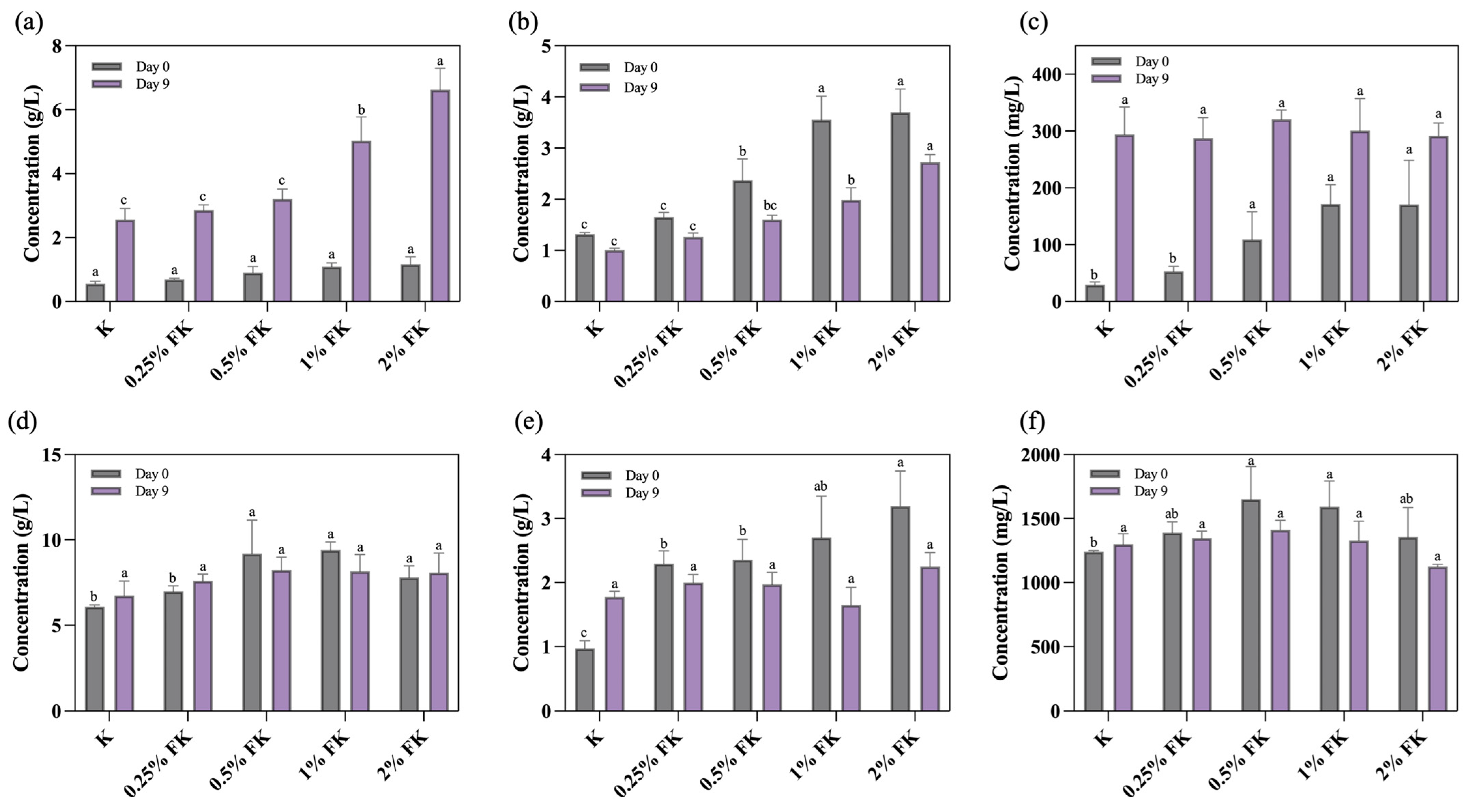
3.1.1. Modulation of Organic Acids and Caffeine
3.1.2. Optical Appearance and Color Difference
3.1.3. Antioxidant Capacity and TPC
3.2. Material Characteristics of FK-Derived BC
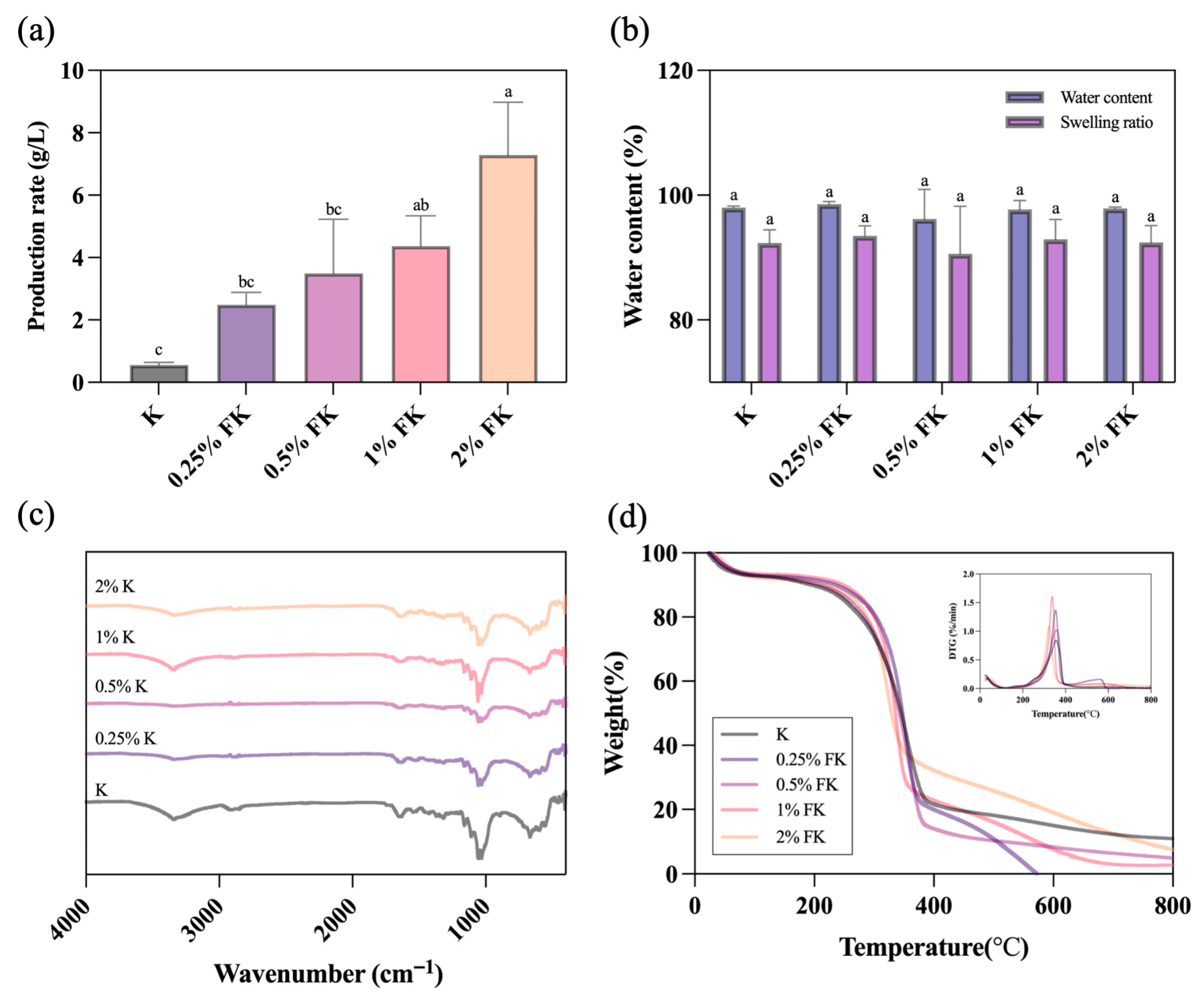
3.2.1. BC Yield, Water Content, and Swelling Ratio
3.2.2. FTIR
3.2.3. TGA
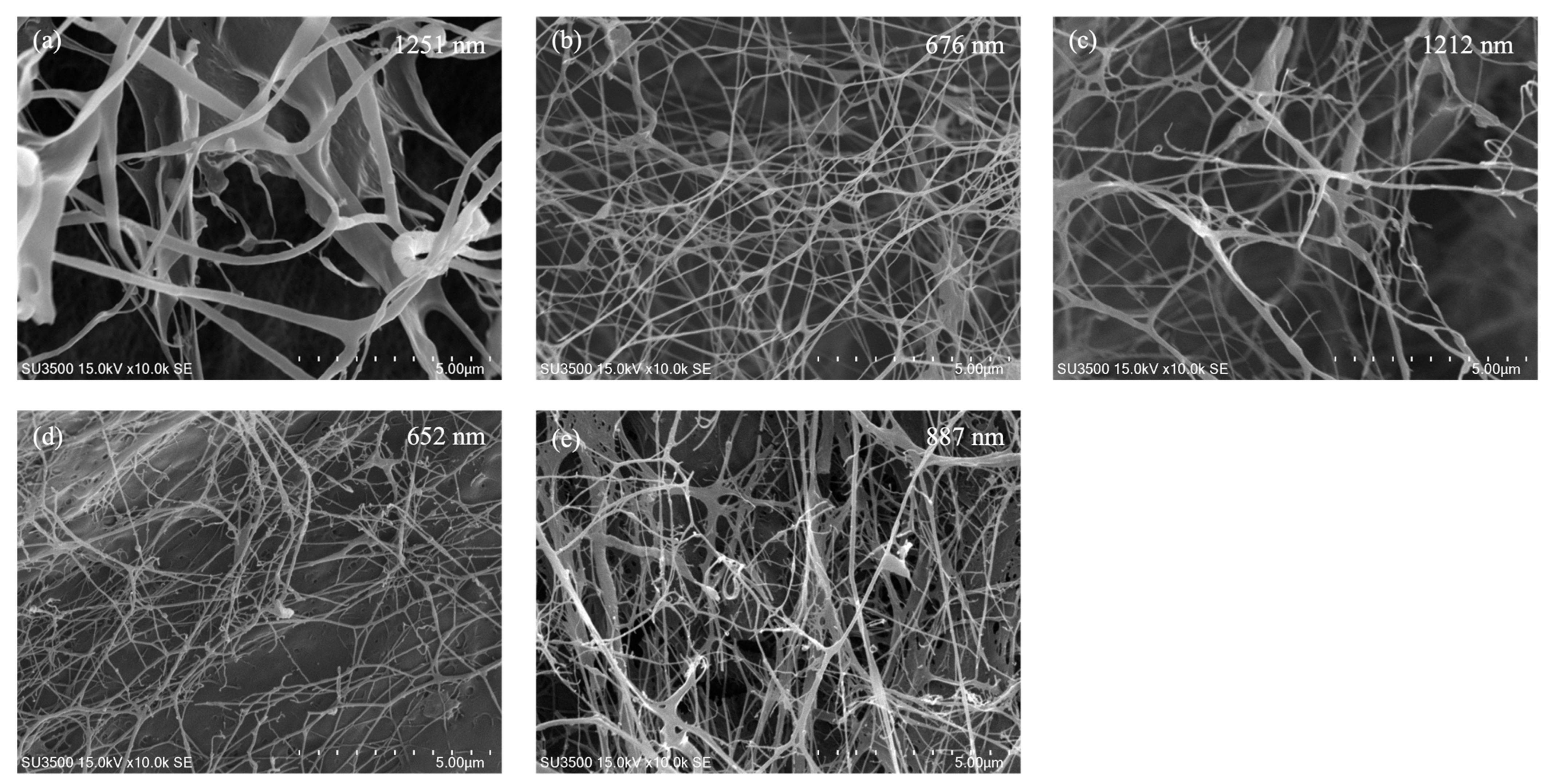
3.2.4. Morphological Analysis
4. Discussion
5. Conclusions
Author Contributions
Funding
Institutional Review Board Statement
Informed Consent Statement
Data Availability Statement
Conflicts of Interest
References
- de Melo, L.M.; Soares, M.G.; Bevilaqua, G.C.; Schmidt, V.C.R.; de Lima, M. Historical overview and current perspectives on kombucha and SCOBY: A literature review and bibliometrics. Food Biosci. 2024, 59, 104081. [Google Scholar] [CrossRef]
- Chou, Y.-C.; Lin, H.-W.; Wang, C.-Y.; Hsieh, C.-C.; Santoso, S.P.; Lin, S.-P.; Cheng, K.-C. Enhancing antioxidant benefits of kombucha through optimized glucuronic acid by selected symbiotic fermentation culture. Antioxidants 2024, 13, 1323. [Google Scholar] [CrossRef]
- Nyiew, K.-Y.; Kwong, P.J.; Yow, Y.-Y. An overview of antimicrobial properties of kombucha. Compr. Rev. Food Sci. Food Saf. 2022, 21, 1024–1053. [Google Scholar] [CrossRef] [PubMed]
- Su, J.; Tan, Q.; Wu, S.; Abbas, B.; Yang, M. Application of kombucha fermentation broth for antibacterial, antioxidant, and anti-inflammatory processes. Int. J. Mol. Sci. 2023, 24, 13984. [Google Scholar] [CrossRef] [PubMed]
- Dechakhamphu, A.; Wongchum, N.; Chumroenphat, T.; Tanomtong, A.; Pinlaor, S.; Siriamornpun, S. In Vitro and In Vivo evaluation for antioxidant and anti-diabetic properties of Cyperus rotundus L. kombucha. Foods 2023, 12, 4059. [Google Scholar] [CrossRef] [PubMed]
- Hartati, F.K.; Kurnia, D.; Nafisah, W.; Haryanto, I.B. Potential anticancer agents of Curcuma aeruginosa-based kombucha: In Vitro and in silico study. Food Chem. Adv. 2024, 4, 100606. [Google Scholar] [CrossRef]
- Vargas, B.K.; Fabricio, M.F.; Záchia Ayub, M.A. Health effects and probiotic and prebiotic potential of Kombucha: A bibliometric and systematic review. Food Biosci. 2021, 44, 101332. [Google Scholar] [CrossRef]
- Kim, H.; Hur, S.; Lim, J.; Jin, K.; Yang, T.-h.; Keehm, I.-s.; Kim, S.W.; Kim, T.; Kim, D. Enhancement of the phenolic compounds and antioxidant activities of Kombucha prepared using specific bacterial and yeast. Food Biosci. 2023, 56, 103431. [Google Scholar] [CrossRef]
- Tran, T.; Verdier, F.; Martin, A.; Alexandre, H.; Grandvalet, C.; Tourdot-Maréchal, R. Oxygen management during kombucha production: Roles of the matrix, microbial activity, and process parameters. Food Microbiol. 2022, 105, 104024. [Google Scholar] [CrossRef]
- Aung, T.; Kim, M.J. A comprehensive review on kombucha biofilms: A promising candidate for sustainable food product development. Trends Food Sci. Technol. 2024, 144, 104325. [Google Scholar] [CrossRef]
- Wang, S.; Li, C.; Xu, Q.; Wang, Y.; Wang, S.; Zou, Y.; Yang, Z.; Yuan, L. Addition of lactic acid bacteria modulates microbial community and promotes the flavor profiles of Kombucha. Food Biosci. 2024, 60, 104340. [Google Scholar] [CrossRef]
- Kohli, K.; Prajapati, R.; Shah, R.; Das, M.; Sharma, B.K. Food waste: Environmental impact and possible solutions. Sustain. Food Technol. 2024, 2, 70–80. [Google Scholar] [CrossRef]
- Batool, F.; Kurniawan, T.A.; Mohyuddin, A.; Othman, M.H.D.; Aziz, F.; Al-Hazmi, H.E.; Goh, H.H.; Anouzla, A. Environmental impacts of food waste management technologies: A critical review of life cycle assessment (LCA) studies. Trends Food Sci. Technol. 2024, 143, 104287. [Google Scholar] [CrossRef]
- Vilas-Franquesa, A.; Montemurro, M.; Casertano, M.; Fogliano, V. The food by-products bioprocess wheel: A guidance tool for the food industry. Trends Food Sci. Technol. 2024, 152, 104652. [Google Scholar] [CrossRef]
- Wagh, M.S.; S, S.; Nath, P.C.; Chakraborty, A.; Amrit, R.; Mishra, B.; Mishra, A.K.; Mohanta, Y.K. Valorisation of agro-industrial wastes: Circular bioeconomy and biorefinery process—A sustainable symphony. Process Saf. Environ. Prot. 2024, 183, 708–725. [Google Scholar] [CrossRef]
- Konjevod, M.; Alonso, R.M.; Taha, A.Y.; Lanceros-Méndez, S.; Sáiz, J. Zero-waste valorization of agricultural products: The model case of mixed fermentation in kombucha. Environ. Chall. 2025, 20, 101225. [Google Scholar] [CrossRef]
- Lo, B.-W.; Wang, H.-Y. Genetic data revealed co-diversification and host switching in the Wiebesia pumilae species complex, pollinators of Ficus pumila. Taiwania 2021, 66, 345–352. [Google Scholar] [CrossRef]
- Wang, F.-W.; Geri, M.; Chen, Y.-J.; Huang, J.-R.; McKinley, G.H.; Chen, Y.-L. Rheo-chemistry of gelation in aiyu (fig) jelly. Food Hydrocoll. 2022, 123, 107001. [Google Scholar] [CrossRef]
- Ziemlewska, A.; Nizioł-Łukaszewska, Z.; Zagórska-Dziok, M.; Bujak, T.; Wójciak, M.; Sowa, I. Evaluation of cosmetic and dermatological properties of kombucha-fermented berry leaf extracts considered to be by-products. Molecules 2022, 27, 2345. [Google Scholar] [CrossRef]
- Lazzaroli, C.; Sordini, B.; Daidone, L.; Veneziani, G.; Esposto, S.; Urbani, S.; Selvaggini, R.; Servili, M.; Taticchi, A. Recovery and valorization of food industry by-products through the application of Olea europaea L. leaves in kombucha tea manufacturing. Food Biosci. 2023, 53, 102551. [Google Scholar] [CrossRef]
- Liang, W.; Wang, X.; Zhang, L.; Jiao, S.; Song, H.; Sun, J.; Wang, D. Changes and biotransformation mechanism of main functional compounds during kombucha fermentation by the pure cultured tea fungus. Food Chem. 2024, 458, 140242. [Google Scholar] [CrossRef]
- Shi, S.; Wei, Y.; Lin, X.; Liang, H.; Zhang, S.; Chen, Y.; Dong, L.; Ji, C. Microbial metabolic transformation and antioxidant activity evaluation of polyphenols in kombucha. Food Biosci. 2023, 51, 102287. [Google Scholar] [CrossRef]
- Morales, D.; Gutiérrez-Pensado, R.; Bravo, F.I.; Muguerza, B. Novel kombucha beverages with antioxidant activity based on fruits as alternative substrates. LWT 2023, 189, 115482. [Google Scholar] [CrossRef]
- Tran, T.; Billet, K.; Torres-Cobos, B.; Vichi, S.; Verdier, F.; Martin, A.; Alexandre, H.; Grandvalet, C.; Tourdot-Maréchal, R. Use of a Minimal Microbial Consortium to Determine the Origin of Kombucha Flavor. Front. Microbiol. 2022, 13, 836617. [Google Scholar] [CrossRef] [PubMed]
- Czarnowska-Kujawska, M.; Klepacka, J.; Starowicz, M.; Lesińska, P. Functional properties and sensory quality of kombucha analogs based on herbal infusions. Antioxidants 2024, 13, 1191. [Google Scholar] [CrossRef]
- Ramírez Tapias, Y.A.; Di Monte, M.V.; Peltzer, M.A.; Salvay, A.G. Bacterial cellulose films production by Kombucha symbiotic community cultured on different herbal infusions. Food Chem. 2022, 372, 131346. [Google Scholar] [CrossRef]
- Miranda, B.; Lawton, N.M.; Tachibana, S.R.; Swartz, N.A.; Hall, W.P. Titration and HPLC characterization of kombucha fermentation: A laboratory experiment in food analysis. J. Chem. Educ. 2016, 93, 1770–1775. [Google Scholar] [CrossRef]
- Jayabalan, R.; Subathradevi, P.; Marimuthu, S.; Sathishkumar, M.; Swaminathan, K. Changes in free-radical scavenging ability of kombucha tea during fermentation. Food Chem. 2008, 109, 227–234. [Google Scholar] [CrossRef]
- Ford, L.; Theodoridou, K.; Sheldrake, G.N.; Walsh, P.J. A critical review of analytical methods used for the chemical characterisation and quantification of phlorotannin compounds in brown seaweeds. Phytochem. Anal. 2019, 30, 587–599. [Google Scholar] [CrossRef] [PubMed]
- Grube, M.; Shvirksts, K.; Denina, I.; Ruklisa, M.; Semjonovs, P. Fourier-transform infrared spectroscopic analyses of cellulose from different bacterial cultivations using microspectroscopy and a high-throughput screening device. Vib. Spectrosc. 2016, 84, 53–57. [Google Scholar] [CrossRef]
- Atykyan, N.; Revin, V.; Shutova, V. Raman and FT-IR Spectroscopy investigation the cellulose structural differences from bacteria Gluconacetobacter sucrofermentans during the different regimes of cultivation on a molasses media. AMB Express 2020, 10, 84. [Google Scholar] [CrossRef] [PubMed]
- O’Neill, H.; Pingali, S.V.; Petridis, L.; He, J.; Mamontov, E.; Hong, L.; Urban, V.; Evans, B.; Langan, P.; Smith, J.C.; et al. Dynamics of water bound to crystalline cellulose. Sci. Rep. 2017, 7, 11840. [Google Scholar] [CrossRef]
- Tran, T.; Grandvalet, C.; Verdier, F.; Martin, A.; Alexandre, H.; Tourdot-Maréchal, R. Microbial Dynamics between yeasts and acetic acid bacteria in kombucha: Impacts on the chemical composition of the beverage. Foods 2020, 9, 963. [Google Scholar] [CrossRef]
- Jayabalan, R.; Marimuthu, S.; Swaminathan, K. Changes in content of organic acids and tea polyphenols during kombucha tea fermentation. Food Chem. 2007, 102, 392–398. [Google Scholar] [CrossRef]
- Ebrahimi, S.; Dabbagh, H.A. Oxidative and non-oxidative degradation pathways of L-ascorbic acid. Int. J. Food Sci. Technol. 2019, 54, 2770–2779. [Google Scholar] [CrossRef]
- De’Nobili, M.D.; Pérez, C.D.; Navarro, D.A.; Stortz, C.A.; Rojas, A.M. Hydrolytic Stability of l-(+)-Ascorbic Acid in Low Methoxyl Pectin Films with Potential Antioxidant Activity at Food Interfaces. Food Bioprocess Technol. 2013, 6, 186–197. [Google Scholar] [CrossRef]
- Villarreal-Soto, S.A.; Beaufort, S.; Bouajila, J.; Souchard, J.P.; Taillandier, P. Understanding Kombucha Tea Fermentation: A Review. J. Food Sci. 2018, 83, 580–588. [Google Scholar] [CrossRef] [PubMed]
- Wang, S.; Li, C.-W.; Wang, Y.; Wang, S.; Zou, Y.-P.; Sun, Z.; Yuan, L. Changes on physiochemical properties and volatile compounds of Chinese kombucha during fermentation. Food Biosci. 2023, 55, 103029. [Google Scholar] [CrossRef]
- Mock, M.B.; Summers, R.M. Microbial metabolism of caffeine and potential applications in bioremediation. J. Appl. Microbiol. 2024, 135, lxae080. [Google Scholar] [CrossRef]
- Pathare, P.B.; Opara, U.L.; Al-Said, F.A.-J. Colour Measurement and Analysis in Fresh and Processed Foods: A Review. Food Bioprocess Technol. 2013, 6, 36–60. [Google Scholar] [CrossRef]
- Kuehni, R.G. Color-tolerance data and the tentative CIE 1976 L*a*b* formula. J. Opt. Soc. Am. 1976, 66, 497–500. [Google Scholar] [CrossRef]
- Abudureheman, B.; Yu, X.; Fang, D.; Zhang, H. Enzymatic Oxidation of Tea Catechins and Its Mechanism. Molecules 2022, 27, 942. [Google Scholar] [CrossRef]
- Zhao, T.; Huang, X.; Zhao, J.; Yang, C.S.; Zhang, S.; Huang, J.; Wang, K.; Liu, Z.; Zhu, M. Theaflavins: An underexploited functional compound in black tea. Trends Food Sci. Technol. 2024, 154, 104755. [Google Scholar] [CrossRef]
- Cortés-Ferré, H.E.; Arredondo-Ochoa, T.; Gaytán-Martínez, M. Polysaccharides-polyphenolic interactions: Formation, functionality and applications. Trends Food Sci. Technol. 2025, 163, 105117. [Google Scholar] [CrossRef]
- Shahidi, F.; Athiyappan, K.D. Polyphenol-polysaccharide interactions: Molecular mechanisms and potential applications in food systems—A comprehensive review. Food Prod. Process. Nutr. 2025, 7, 42. [Google Scholar] [CrossRef]
- Spence, C. On the psychological impact of food colour. Flavour 2015, 4, 21. [Google Scholar] [CrossRef]
- Xu, Z.; Yang, Z.; Ji, J.; Mou, Y.; Chen, F.; Xiao, Z.; Liao, X.; Hu, X.; Ma, L. Polyphenol mediated non-enzymatic browning and its inhibition in apple juice. Food Chem. 2023, 404, 134504. [Google Scholar] [CrossRef] [PubMed]
- Jiang, X.; Lei, X.; Li, C.; Wang, L.; Wang, X.; Jiang, H. Increased Oxygen Treatment in the Fermentation Process Improves the Taste and Liquor Color Qualities of Black Tea. Foods 2025, 14, 2736. [Google Scholar] [CrossRef]
- Reyes-Flores, S.; Pereira, T.S.S.; Ramírez-Rodrigues, M.M. Optimization of Hempseed-Added Kombucha for Increasing the Antioxidant Capacity, Protein Concentration, and Total Phenolic Content. Beverages 2023, 9, 50. [Google Scholar] [CrossRef]
- Essiedu, J.A.; Areerate, P.; Withayagiat, U. Evaluation of physiochemical composition, phenolic compounds, and antioxidant activity of Kombucha produced from Thunbergia laurifolia as a potential functional food. Int. J. Food Sci. Technol. 2024, 59, 6999–7010. [Google Scholar] [CrossRef]
- Mfopa, A.N.; Kemzeu, R.; Fokom, R.; Yamthe, L.R.T.; Dize, D.; Boyom, F.F. Phenolic compounds, antioxidant and antileishmanial activities of kombucha as affected by fermentation time. Heliyon 2024, 10, e40463. [Google Scholar] [CrossRef]
- Raposo, F.; Borja, R.; Gutiérrez-González, J.A. A comprehensive and critical review of the unstandardized Folin-Ciocalteu assay to determine the total content of polyphenols: The conundrum of the experimental factors and method validation. Talanta 2024, 272, 125771. [Google Scholar] [CrossRef]
- Platzer, M.; Kiese, S.; Herfellner, T.; Schweiggert-Weisz, U.; Eisner, P. How Does the Phenol Structure Influence the Results of the Folin-Ciocalteu Assay? Antioxidants 2021, 10, 811. [Google Scholar] [CrossRef]
- Gulcin, İ.; Alwasel, S.H. DPPH Radical Scavenging Assay. Processes 2023, 11, 2248. [Google Scholar] [CrossRef]
- Nguyen, H.T.; Saha, N.; Ngwabebhoh, F.A.; Zandraa, O.; Saha, T.; Saha, P. Kombucha-derived bacterial cellulose from diverse wastes: A prudent leather alternative. Cellulose 2021, 28, 9335–9353. [Google Scholar] [CrossRef]
- Ul-Islam, M.; Khan, T.; Park, J.K. Water holding and release properties of bacterial cellulose obtained by in situ and ex situ modification. Carbohydr. Polym. 2012, 88, 596–603. [Google Scholar] [CrossRef]
- Nasresfahani, M.; Babaeipour, V.; Imani, M. Improving the water absorption properties of bacterial cellulose by in-situ and ex-situ modifications for use in CMC-graft-sodium acrylate superabsorbent. Colloid Polym. Sci. 2025, 303, 759–777. [Google Scholar] [CrossRef]
- Sumini, M.; Andrade, G.J.S.; Tischer, C.A.; Kobayashi, R.K.T.; Nakazato, G. Production of bacterial cellulose by Komagataeibacter xylinus: Biochemistry, synthesis and applications. Cellulose 2025, 32, 81–94. [Google Scholar] [CrossRef]
- Amorim, J.; Liao, K.; Mandal, A.; Costa, A.F.d.S.; Roumeli, E.; Sarubbo, L.A. Impact of Carbon Source on Bacterial Cellulose Network Architecture and Prolonged Lidocaine Release. Polymers 2024, 16, 3021. [Google Scholar] [CrossRef] [PubMed]
- Takayama, G.; Kondo, T. Quantitative evaluation of fiber network structure–property relationships in bacterial cellulose hydrogels. Carbohydr. Polym. 2023, 321, 121311. [Google Scholar] [CrossRef] [PubMed]
- Iyer, H.; Mandal, A.; Holden, M.; Roumeli, E. Modifying bacterial cellulose dispersions with deep eutectic solvent and pectin to tune the properties of open-celled foams Electronic supplementary information (ESI) available. RSC Appl. Polym. 2024, 3, 407–419. [Google Scholar] [CrossRef]
- Illa, M.P.; Sharma, C.S.; Khandelwal, M. Tuning the physiochemical properties of bacterial cellulose: Effect of drying conditions. J. Mater. Sci. 2019, 54, 12024–12035. [Google Scholar] [CrossRef]



| Day 0 | Day 9 | |||||||
|---|---|---|---|---|---|---|---|---|
| L* | a* | b* | ΔE* | L* | a* | b* | ΔE* | |
| K | 26.10 | 10.00 | 11.12 | - | 34.79 | 13.14 | 24.82 | - |
| 0.25% FK | 23.25 | 12.22 | 12.08 | 3.74 | 28.28 | 10.59 | 14.71 | 12.29 |
| 0.5% FK | 22.98 | 13.14 | 10.89 | 4.43 | 28.28 | 10.62 | 12.54 | 14.13 |
| 1% FK | 24.55 | 14.51 | 10.50 | 4.81 | 27.77 | 11.09 | 10.46 | 16.11 |
| 2% FK | 25.94 | 14.37 | 9.42 | 4.69 | 27.96 | 12.35 | 8.39 | 17.81 |
| DPPH (mM TEAC) | TPC (mg GAE/mL) | |
|---|---|---|
| K | 8.52 ± 2.20 a | 0.69 ± 0.46 a |
| 0.25% FK | 10.32 ± 3.84 a | 1.10 ± 0.56 a |
| 0.5% FK | 9.25 ± 1.00 a | 1.21 ± 0.47 a |
| 1% FK | 10.79 ± 1.71 a | 1.96 ± 0.87 a |
| 2% FK | 10.79 ± 1.86 a | 1.63 ± 0.32 a |
Disclaimer/Publisher’s Note: The statements, opinions and data contained in all publications are solely those of the individual author(s) and contributor(s) and not of MDPI and/or the editor(s). MDPI and/or the editor(s) disclaim responsibility for any injury to people or property resulting from any ideas, methods, instructions or products referred to in the content. |
© 2026 by the authors. Licensee MDPI, Basel, Switzerland. This article is an open access article distributed under the terms and conditions of the Creative Commons Attribution (CC BY) license.
Share and Cite
Chou, Y.-C.; Ku, W.-L.; Cheng, K.-C.; Hsieh, C.-C.; Santoso, S.P.; Lin, Y.-K.; Hung, W.-L.; Lin, S.-P. Enhancing Glucuronic Acid and Bacterial Cellulose Yield in Kombucha via Valorization of Male Jelly Fig (Ficus pumila L. var. awkeotsang). Foods 2026, 15, 1290. https://doi.org/10.3390/foods15081290
Chou Y-C, Ku W-L, Cheng K-C, Hsieh C-C, Santoso SP, Lin Y-K, Hung W-L, Lin S-P. Enhancing Glucuronic Acid and Bacterial Cellulose Yield in Kombucha via Valorization of Male Jelly Fig (Ficus pumila L. var. awkeotsang). Foods. 2026; 15(8):1290. https://doi.org/10.3390/foods15081290
Chicago/Turabian StyleChou, Yu-Chieh, Wei-Lun Ku, Kuan-Chen Cheng, Chen-Che Hsieh, Shella Permatasari Santoso, Yung-Kai Lin, Wei-Lun Hung, and Shin-Ping Lin. 2026. "Enhancing Glucuronic Acid and Bacterial Cellulose Yield in Kombucha via Valorization of Male Jelly Fig (Ficus pumila L. var. awkeotsang)" Foods 15, no. 8: 1290. https://doi.org/10.3390/foods15081290
APA StyleChou, Y.-C., Ku, W.-L., Cheng, K.-C., Hsieh, C.-C., Santoso, S. P., Lin, Y.-K., Hung, W.-L., & Lin, S.-P. (2026). Enhancing Glucuronic Acid and Bacterial Cellulose Yield in Kombucha via Valorization of Male Jelly Fig (Ficus pumila L. var. awkeotsang). Foods, 15(8), 1290. https://doi.org/10.3390/foods15081290