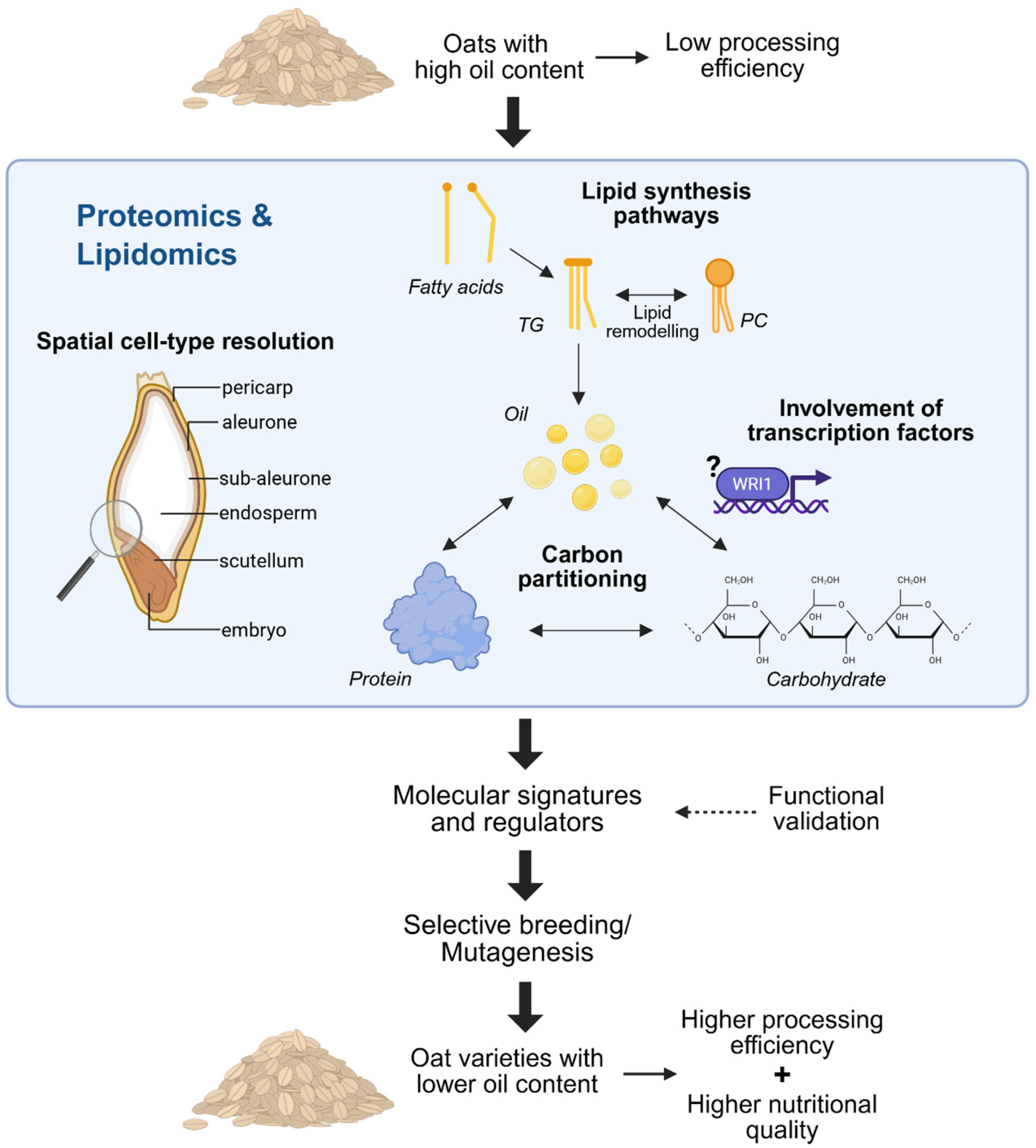
Oil as a Hindrance to Oat (Avena sativa L.) Nutrient Fractionation: Leveraging Mass Spectrometry-Based Omics to Unravel Lipid Regulation for Functional Crop Improvement


Abstract
1. Introduction
2. Oil as a Processing Barrier to Oat Nutrient Fractionation
2.1. Oat Nutrient Profile
2.2. Extraction of Oat Nutrients at Industrial Scale
3. Regulation of Oat Oil Synthesis
3.1. Molecular Overview of Seed Oil Synthesis

| Target | Organism | Method | Outcome | Ref. |
|---|---|---|---|---|
| ACCase | Arabidopsis thaliana Camelina sativa | Overexpression (OE) of Pisum sativum α-carboxyltransferase (ACCase subunit) | Increased oil content by 14%. | [47] |
| Cotton | OE of four individual ACCase subunits | Increased oil content by ~17 to 20%. | [48] | |
| MCMT | Arabidopsis thaliana | Transgenic line expressing antisense MCMT | Impaired growth and cell division. | [49] |
| OE of MCMT | Increased total fatty acids by 15 to 20%. | |||
| KAS | Arabidopsis thaliana | T-DNA insertion KASI mutant | Reduced total fatty acids by ~34%. | [50] |
| HAD | Rice | Chemical-induced ZEBRA LEAF16 (encodes for HAD) mutant. | Reduced total fatty acids by ~10%. | [51] |
| FAD | Cotton seeds | Transgenic lines expressing non-functional rapeseed FAD2 | Reduced seed oil content by ~10%. | [52] |
| TE | Arabidopsis thaliana | T-DNA insertion TE mutant | Reduced total fatty acids by ~10 to 30%. Reduced TG content by ~50%. | [53] |
| Soybean | OE of TE | Increased seed oil content by ~20%. | [54] | |
| LACS | Arabidopsis thaliana | T-DNA insertion LACS1, LACS8 and LACS9 mutant | Reduced total fatty acids by ~12%. | [55] |
| Rapeseed | Transgenic lines with LACS2 OE or RNAi expression | OE: Increased lipid content by ~3%. KD: Reduced by ~2%. | [56] | |
| Sunflower seeds | Transgenic lines expressing Arabidopsis LACS4 and LACS9 double mutant | Reduced TG content by ~27%. | [57] | |
| GPAT | Arabidopsis thaliana | Transformation with plastidial safflower GPAT | Increased seed oil content by 10 to 21%. | [58] |
| Arabidopsis thaliana | Seed-specific miRNA GPAT9 knockdown (KD) | Reduced total fatty acids by ~10 to 30%. | [59] | |
| Peanut | GPAT9 OE and KD | OE and KD significantly increased and reduced oil content, respectively. | [60] | |
| Arabidopsis thaliana | OE of rapeseed GPAT9 | Increased seed oil content by ~10%. | [61] | |
| LPAAT | Rapeseed | OE, KD via RNAi and KO via CRISPR-Cas9 of rapeseed LPAAT2 or LPAAT5 | OE: Increased seed oil content by ~13 to 16%. KD and KO: Reduced seed oil content, increased sugar and protein by ~15%. | [62] |
| Arabidopsis thaliana | Transgenic lines overexpressing peanut LPAAT2 | Increased total fatty acids by ~25%. | [63] | |
| Rapeseed | OE of Trapaeolum majus LPAAT | Increased TG accumulation by up to ~30%. | [64] | |
| Arabidopsis thaliana | OE of rapeseed LPAAT | Increased total fatty acids by ~13%. | [65] | |
| PAH | Arabidopsis thaliana | Transgenic lines expressing the PAH RNAi silencing vector | Reduced seed oil content by ~20%. | [66] |
| PDCT | Camelina sativa | Transgenic lines overexpressing the PDCT gene | Increased seed oil yield by 32 to 76%. FA incorporation into TG and DG, but reduced for PC. | [67] |
| PDAT | Rapeseed | Transgenic lines overexpressing the PDAT gene | Reduced seed TG content by ~10 to 20%. | [68] |
| Brassica napus | Transgenic lines overexpressing the Sapium sebiferum PDAT1 gene | Increased oil content by ~10%. | [69] | |
| DGAT | Arabidopsis thaliana | T-DNA KO of DGAT OE of DGAT cDNA in wild-type lines | KO: Reduced seed oil content by ~5%. KD: Increased seed oil content by ~5–10%. | [70] |
| Arabidopsis thaliana | PDAT RNAi expression in DGAT1 mutant lines | ~20% fatty acid content reduced in DGAT1 mutant lines. ~80% fatty acid content reduced in DGAT1 mutant with PDAT RNAi. | [71] | |
| Soybean | Transgenic lines overexpressing DGAT2 | Increased seed oil content by ~10%. | [72] | |
| Soybean | Transgenic lines overexpressing peanut DGAT3 | Increased total fatty acids by ~10%. | [73] | |
| Camelina sativa | Transgenic lines with DGAT1 silencing and/or PDAT OE | DGAT1 KD reduced the incorporation of radioactive 14C into TG. DGAT1 KD + PDAT OE increased the incorporation of radioactive 14C into TG and PC, but reduced that into DG. | [74] | |
| Camelina sativa | Transgenic lines with DGAT1 OE | Increased total fatty acids by ~24%. | [75] | |
| Oleosin | Rice | Transgenic lines with embryo-specific soybean OLEOSIN OE | Increased seed oil content by ~40%. Increased number of oil bodies with a smaller diameter. | [76] |
| Cottonseeds | Transgenic lines with OLEOSIN OE | Increased total fatty acid content by ~10 to 20%. | [77] | |
| Arabidopsis thaliana | Transgenic Arabidopsis oleosin-deficient lines with sorghum OLEOSIN OE | Increased seed oil content by ~30% compared to wild-type and Arabidopsis oleosin-deficient lines. | [78] | |
| Soybean | Transgenic lines with OLEOSIN OE | Increased seed oil content by ~10%. Increased number of oil bodies with a smaller diameter. | [79] | |
| Rice | Transgenic lines with OLEOSIN RNAi expression | Reduced TG levels in purified oil bodies by 50%. | [80] |
3.2. Genomic and Transcriptomic Identification of Targets for Oat Oil Accumulation
4. Investigation of Oat Oil Regulation Using Mass Spectrometry-Based Omics Approaches
4.1. General Principles of MS
4.2. Proteomic and Lipidomic Interrogation of Oat Oil Synthesis
5. Potential Omics-Driven Insights to Bridge Knowledge Gaps in Oat Lipid Synthesis
5.1. Investigation of Oat Oil Synthesis at Cell-Type Resolution
5.2. Carbon Partitioning Between Macronutrients and Involvement of Transcription Factors
6. Conclusions
Author Contributions
Funding
Institutional Review Board Statement
Informed Consent Statement
Data Availability Statement
Acknowledgments
Conflicts of Interest
References
- Holopainen-Mantila, U.; Vanhatalo, S.; Lehtinen, P.; Sozer, N. Oats as a source of nutritious alternative protein. J. Cereal Sci. 2024, 116, 103862. [Google Scholar] [CrossRef]
- Soycan, G.; Schär, M.Y.; Kristek, A.; Boberska, J.; Alsharif, S.N.S.; Corona, G.; Shewry, P.R.; Spencer, J.P.E. Composition and content of phenolic acids and avenanthramides in commercial oat products: Are oats an important polyphenol source for consumers? Food Chem. X 2019, 3, 100047. [Google Scholar] [CrossRef]
- Schmidt, M. Cereal beta-glucans: An underutilized health endorsing food ingredient. Crit. Rev. Food Sci. Nutr. 2022, 62, 3281–3300. [Google Scholar] [CrossRef]
- Heusala, H.; Sinkko, T.; Sözer, N.; Hytönen, E.; Mogensen, L.; Knudsen, M.T. Carbon footprint and land use of oat and faba bean protein concentrates using a life cycle assessment approach. J. Clean. Prod. 2020, 242, 118376. [Google Scholar] [CrossRef]
- Sibakov, J.; Myllymäki, O.; Holopainen, U.; Kaukovirta-Norja, A.; Hietaniemi, V.; Pihlava, J.M.; Poutanen, K.; Lehtinen, P. Lipid removal enhances separation of oat grain cell wall material from starch and protein. J. Cereal Sci. 2011, 54, 104–109. [Google Scholar] [CrossRef]
- Yang, Y.; Saand, M.A.; Huang, L.; Abdelaal, W.B.; Zhang, J.; Wu, Y.; Li, J.; Sirohi, M.H.; Wang, F. Applications of Multi-Omics Technologies for Crop Improvement. Front. Plant Sci. 2021, 12, 563953. [Google Scholar] [CrossRef] [PubMed]
- Agarwal, P.; Parida, S.K.; Mahto, A.; Das, S.; Mathew, I.E.; Malik, N.; Tyagi, A.K. Expanding frontiers in plant transcriptomics in aid of functional genomics and molecular breeding. Biotechnol. J. 2014, 9, 1480–1492. [Google Scholar] [CrossRef]
- Gemperline, E.; Keller, C.; Li, L. Mass Spectrometry in Plant-omics. Anal. Chem. 2016, 88, 3422–3434. [Google Scholar] [CrossRef]
- Khakimov, B.; Bak, S.; Engelsen, S.B. High-throughput cereal metabolomics: Current analytical technologies, challenges and perspectives. J. Cereal Sci. 2014, 59, 393–418. [Google Scholar] [CrossRef]
- Banaś, K.; Harasym, J. Current Knowledge of Content and Composition of Oat Oil—Future Perspectives of Oat as Oil Source. Food Bioprocess Technol. 2020, 14, 232–247. [Google Scholar] [CrossRef]
- Zhou, M.; Robards, K.; Glennie-Holmes, M.; Helliwell, S. Oat lipids. J. Am. Oil Chem. Soc. 1999, 76, 159–169. [Google Scholar] [CrossRef]
- Meckfessel, M.H.; Brandt, S. The structure, function, and importance of ceramides in skin and their use as therapeutic agents in skin-care products. J. Am. Acad. Dermatol. 2014, 71, 177–184. [Google Scholar] [CrossRef] [PubMed]
- Tong, L.-T.; Zhong, K.; Liu, L.; Guo, L.; Cao, L.; Zhou, S. Oat oil lowers the plasma and liver cholesterol concentrations by promoting the excretion of faecal lipids in hypercholesterolemic rats. Food Chem. 2014, 142, 129–134. [Google Scholar] [CrossRef] [PubMed]
- Escobedo-Flores, Y.; Chavez-Flores, D.; Salmeron, I.; Molina-Guerrero, C.; Perez-Vega, S. Optimization of supercritical fluid extraction of polyphenols from oats (Avena sativa L.) and their antioxidant activities. J. Cereal Sci. 2018, 80, 198–204. [Google Scholar] [CrossRef]
- Hitayezu, R.; Baakdah, M.M.; Kinnin, J.; Henderson, K.; Tsopmo, A. Antioxidant activity, avenanthramide and phenolic acid contents of oat milling fractions. J. Cereal Sci. 2015, 63, 35–40. [Google Scholar] [CrossRef]
- Aktaş, H.; Napiórkowska, A.; Szpicer, A.; Custodio-Mendoza, J.A.; Paraskevopoulou, A.; Pavlidou, E.; Kurek, M.A. Microencapsulation of green tea polyphenols: Utilizing oat oil and starch-based double emulsions for improved delivery. Int. J. Biol. Macromol. 2024, 274, 133295. [Google Scholar] [CrossRef]
- Kouřimská, L.; Sabolová, M.; Horčička, P.; Rys, S.; Božik, M. Lipid content, fatty acid profile, and nutritional value of new oat cultivars. J. Cereal Sci. 2018, 84, 44–48. [Google Scholar] [CrossRef]
- Sánchez-Velázquez, O.A.; Cuevas-Rodríguez, E.O.; Mondor, M.; Ribéreau, S.; Arcand, Y.; Mackie, A.; Hernández-Álvarez, A.J. Impact of in vitro gastrointestinal digestion on peptide profile and bioactivity of cooked and non-cooked oat protein concentrates. Curr. Res. Food Sci. 2021, 4, 93–104. [Google Scholar] [CrossRef]
- Darewicz, M.; Pliszka, M.; Borawska-Dziadkiewicz, J.; Minkiewicz, P.; Iwaniak, A. Multi-Bioactivity of Protein Digests and Peptides from Oat (Avena sativa L.) Kernels in the Prevention of the Cardiometabolic Syndrome. Molecules 2022, 27, 7907. [Google Scholar] [CrossRef]
- Mel, R.; Malalgoda, M. Oat protein as a novel protein ingredient: Structure, functionality, and factors impacting utilization. Cereal Chem. 2022, 99, 21–36. [Google Scholar] [CrossRef]
- Kamal, N.; Tsardakas Renhuldt, N.; Bentzer, J.; Gundlach, H.; Haberer, G.; Juhász, A.; Lux, T.; Bose, U.; Tye-Din, J.A.; Lang, D.; et al. The mosaic oat genome gives insights into a uniquely healthy cereal crop. Nature 2022, 606, 113–119. [Google Scholar] [CrossRef]
- De Paula, R.; Abdel-Aal, E.-S.M.; Messia, M.C.; Rabalski, I.; Marconi, E. Effect of processing on the beta-glucan physicochemical properties in barley and semolina pasta. J. Cereal Sci. 2017, 75, 124–131. [Google Scholar] [CrossRef]
- Herrera, M.P.; Gao, J.; Vasanthan, T.; Temelli, F.; Henderson, K.; Navabi, A. β-Glucan content, viscosity, and solubility of Canadian grown oat as influenced by cultivar and growing location. Can. J. Plant Sci. 2016, 96, 183–196. [Google Scholar] [CrossRef]
- Casterline, J.L.; Oles, C.J.; Ku, Y. In Vitro Fermentation of Various Food Fiber Fractions. J. Agric. Food Chem. 1997, 45, 2463–2467. [Google Scholar] [CrossRef]
- Carlson, J.L.; Erickson, J.M.; Hess, J.M.; Gould, T.J.; Slavin, J.L. Prebiotic Dietary Fiber and Gut Health: Comparing the in Vitro Fermentations of Beta-Glucan, Inulin and Xylooligosaccharide. Nutrients 2017, 9, 1361. [Google Scholar] [CrossRef]
- Bai, J.; Zhao, J.; Al-Ansi, W.; Wang, J.; Xue, L.; Liu, J.; Wang, Y.; Fan, M.; Qian, H.; Li, Y.; et al. Oat β-glucan alleviates DSS-induced colitis via regulating gut microbiota metabolism in mice. Food Funct. 2021, 12, 8976–8993. [Google Scholar] [CrossRef]
- Drzikova, B.; Dongowski, G.; Gebhardt, E. Dietary fibre-rich oat-based products affect serum lipids, microbiota, formation of short-chain fatty acids and steroids in rats. Br. J. Nutr. 2005, 94, 1012–1025. [Google Scholar] [CrossRef]
- Othman, R.A.; Moghadasian, M.H.; Jones, P.J.H. Cholesterol-lowering effects of oat β-glucan. Nutr. Rev. 2011, 69, 299–309. [Google Scholar] [CrossRef]
- Lia, A.; Hallmans, G.; Sandberg, A.S.; Sundberg, B.; Aman, P.; Andersson, H. Oat beta-glucan increases bile acid excretion and a fiber-rich barley fraction increases cholesterol excretion in ileostomy subjects. Am. J. Clin. Nutr. 1995, 62, 1245–1251. [Google Scholar] [CrossRef]
- Pino, J.L.; Mujica, V.; Arredondo, M. Effect of dietary supplementation with oat β-glucan for 3 months in subjects with type 2 diabetes: A randomized, double-blind, controlled clinical trial. J. Funct. Foods 2021, 77, 104311. [Google Scholar] [CrossRef]
- Reyna, N.Y.; Cano, C.; Bermúdez, V.J.; Medina, M.T.; Souki, A.J.; Ambard, M.; Nuñez, M.; Ferrer, M.A.; Inglett, G.E. Sweeteners and beta-glucans improve metabolic and anthropometrics variables in well controlled type 2 diabetic patients. Am. J. Ther. 2003, 10, 438–443. [Google Scholar] [CrossRef] [PubMed]
- Zhu, Y.; Dong, L.; Huang, L.; Shi, Z.; Dong, J.; Yao, Y.; Shen, R. Effects of oat β-glucan, oat resistant starch, and the whole oat flour on insulin resistance, inflammation, and gut microbiota in high-fat-diet-induced type 2 diabetic rats. J. Funct. Foods 2020, 69, 103939. [Google Scholar] [CrossRef]
- Jenkins, A.; Jenkins, D.; Zdravkovic, U.; WÜRsch, P.; Vuksan, V. Depression of the glycemic index by high levels of β-glucan fiber in two functional foods tested in type 2 diabetes. Eur. J. Clin. Nutr. 2002, 56, 622–628. [Google Scholar] [CrossRef] [PubMed]
- Cheng, Y.; Zhang, J.; Luo, K.; Zhang, G. Oat bran β-glucan improves glucose homeostasis in mice fed on a high-fat diet. RSC Adv. 2017, 7, 54717–54725. [Google Scholar] [CrossRef]
- Alminger, M.; Eklund-Jonsson, C. Whole-grain cereal products based on a high-fibre barley or oat genotype lower post-prandial glucose and insulin responses in healthy humans. Eur. J. Nutr. 2008, 47, 294–300. [Google Scholar] [CrossRef]
- Biorklund, M.; Rees, A.v.; Mensink, R.P.; Onning, G. Changes in serum lipids and postprandial glucose and insulin concentrations after consumption of beverages with β-glucans from oats or barley: A randomised dose-controlled trial. Eur. J. Clin. Nutr. 2005, 59, 1272–1281. [Google Scholar] [CrossRef]
- Wu, Y.V.; Doehlert, D.C. Enrichment of β -glucan in Oat Bran by Fine Grinding and Air Classification. Food Sci. Technol. 2002, 35, 30–33. [Google Scholar] [CrossRef]
- Vasanthan, T.; Temelli, F. Grain fractionation technologies for cereal beta-glucan concentration. Food Res. Int. 2008, 41, 876–881. [Google Scholar] [CrossRef]
- Stevenson, D.G.; Eller, F.J.; Radosavljević, M.; Jane, J.-l.; Inglett, G.E. Characterisation of oat bran products with and without supercritical carbon dioxide extraction: Oat bran characteristics with lipid extraction. Int. J. Food Sci. Technol. 2007, 42, 1489–1496. [Google Scholar] [CrossRef]
- McNamee, C.E.; Sato, Y.; Wiege, B.; Furikado, I.; Marefati, A.; Nylander, T.; Kappl, M.; Rayner, M. Rice Starch Particle Interactions at Air/Aqueous Interfaces—Effect of Particle Hydrophobicity and Solution Ionic Strength. Front. Chem. 2018, 6, 139. [Google Scholar] [CrossRef]
- Harasym, J.; Suchecka, D.; Gromadzka-Ostrowska, J. Effect of size reduction by freeze-milling on processing properties of beta-glucan oat bran. J. Cereal Sci. 2015, 61, 119–125. [Google Scholar] [CrossRef]
- Sasaki, Y.; Nagano, Y. Plant acetyl-CoA carboxylase: Structure, biosynthesis, regulation, and gene manipulation for plant breeding. Biosci. Biotechnol. Biochem. 2004, 68, 1175–1184. [Google Scholar] [CrossRef]
- Xu, Y.; Singer, S.D.; Chen, G. Protein interactomes for plant lipid biosynthesis and their biotechnological applications. Plant Biotechnol. J. 2023, 21, 1734–1744. [Google Scholar] [CrossRef] [PubMed]
- Leonova, S.; Grimberg, Å.; Marttila, S.; Stymne, S.; Carlsson, A.S. Mobilization of lipid reserves during germination of oat (Avena sativa L.), a cereal rich in endosperm oil. J. Exp. Bot. 2010, 61, 3089–3099. [Google Scholar] [CrossRef] [PubMed]
- Grimberg, Å.; Wilkinson, M.; Snell, P.; De Vos, R.P.; González-Thuillier, I.; Tawfike, A.; Ward, J.L.; Carlsson, A.S.; Shewry, P.; Hofvander, P. Transitions in wheat endosperm metabolism upon transcriptional induction of oil accumulation by oat endosperm WRINKLED1. BMC Plant Biol. 2020, 20, 235. [Google Scholar] [CrossRef] [PubMed]
- Zhou, Z.; Kaur, R.; Donoso, T.; Ohm, J.-B.; Gupta, R.; Lefsrud, M.; Singh, J. Metabolic engineering-induced transcriptome reprogramming of lipid biosynthesis enhances oil composition in oat. Plant Biotechnol. J. 2024, 22, 3459–3472. [Google Scholar] [CrossRef]
- Wang, M.; Garneau, M.G.; Poudel, A.N.; Lamm, D.; Koo, A.J.; Bates, P.D.; Thelen, J.J. Overexpression of pea α-carboxyltransferase in Arabidopsis and camelina increases fatty acid synthesis leading to improved seed oil content. Plant J. 2022, 110, 1035–1046. [Google Scholar] [CrossRef]
- Cui, Y.; Liu, Z.; Zhao, Y.; Wang, Y.; Huang, Y.; Li, L.; Wu, H.; Xu, S.; Hua, J. Overexpression of Heteromeric GhACCase Subunits Enhanced Oil Accumulation in Upland Cotton. Plant Mol. Biol. Report. 2017, 35, 287–297. [Google Scholar] [CrossRef]
- Jung, S.H.; Kim, R.J.; Kim, K.J.; Lee, D.H.; Suh, M.C. Plastidial and Mitochondrial Malonyl CoA-ACP Malonyltransferase is Essential for Cell Division and Its Overexpression Increases Storage Oil Content. Plant Cell Physiol. 2019, 60, 1239–1249. [Google Scholar] [CrossRef]
- Wu, G.-Z.; Xue, H.-W. Arabidopsis β-Ketoacyl-[Acyl Carrier Protein] Synthase I Is Crucial for Fatty Acid Synthesis and Plays a Role in Chloroplast Division and Embryo Development. Plant Cell 2010, 22, 3726–3744. [Google Scholar] [CrossRef]
- Liu, Z.; Wang, Z.; Gu, H.; You, J.; Hu, M.; Zhang, Y.; Zhu, Z.; Wang, Y.; Liu, S.; Chen, L.; et al. Identification and Phenotypic Characterization of ZEBRA LEAF16 Encoding a β-Hydroxyacyl-ACP Dehydratase in Rice. Front. Plant Sci. 2018, 9, 782. [Google Scholar] [CrossRef]
- Chapman, K.D.; Neogi, P.B.; Hake, K.D.; Stawska, A.A.; Speed, T.R.; Cotter, M.Q.; Garrett, D.C.; Kerby, T.; Richardson, C.D.; Ayre, B.G. Reduced Oil Accumulation in Cottonseeds Transformed with a Brassica Nonfunctional Allele of a Delta-12 Fatty Acid Desaturase (FAD2). Crop Sci. 2008, 48, 1470–1481. [Google Scholar] [CrossRef]
- Moreno-Pérez, A.J.; Venegas-Calerón, M.; Vaistij, F.E.; Salas, J.J.; Larson, T.R.; Garcés, R.; Graham, I.A.; Martínez-Force, E. Reduced expression of FatA thioesterases in Arabidopsis affects the oil content and fatty acid composition of the seeds. Planta 2012, 235, 629–639. [Google Scholar] [CrossRef] [PubMed]
- Liao, W.; Guo, R.; Qian, K.; Shi, W.; Whelan, J.; Shou, H. The acyl–acyl carrier protein thioesterases GmFATA1 and GmFATA2 are essential for fatty acid accumulation and growth in soybean. Plant J. 2024, 118, 823–838. [Google Scholar] [CrossRef] [PubMed]
- Zhao, L.; Katavic, V.; Li, F.; Haughn, G.W.; Kunst, L. Insertional mutant analysis reveals that long-chain acyl-CoA synthetase 1 (LACS1), but not LACS8, functionally overlaps with LACS9 in Arabidopsis seed oil biosynthesis. Plant J. 2010, 64, 1048–1058. [Google Scholar] [CrossRef]
- Ding, L.-N.; Gu, S.-L.; Zhu, F.-G.; Ma, Z.-Y.; Li, J.; Li, M.; Wang, Z.; Tan, X.-L. Long-chain acyl-CoA synthetase 2 is involved in seed oil production in Brassica napus. BMC Plant Biol. 2020, 20, 21. [Google Scholar] [CrossRef] [PubMed]
- Jessen, D.; Roth, C.; Wiermer, M.; Fulda, M. Two Activities of Long-Chain Acyl-Coenzyme A Synthetase Are Involved in Lipid Trafficking between the Endoplasmic Reticulum and the Plastid in Arabidopsis1. Plant Physiol. 2014, 167, 351–366. [Google Scholar] [CrossRef]
- Jain, R.K.; Coffey, M.; Lai, K.; Kumar, A.; MacKenzie, S.L. Enhancement of seed oil content by expression of glycerol-3-phosphate acyltransferase genes. Biochem. Soc. Trans. 2000, 28, 958–961. [Google Scholar] [CrossRef]
- Shockey, J.; Regmi, A.; Cotton, K.; Adhikari, N.; Browse, J.; Bates, P.D. Identification of Arabidopsis GPAT9 (At5g60620) as an Essential Gene Involved in Triacylglycerol Biosynthesis. Plant Physiol. 2016, 170, 163–179. [Google Scholar] [CrossRef]
- Lv, Y.; Zhang, X.; Luo, L.; Yang, H.; Li, P.; Zhang, K.; Liu, F.; Wan, Y. Characterization of glycerol-3-phosphate acyltransferase 9 (AhGPAT9) genes, their allelic polymorphism and association with oil content in peanut (Arachis hypogaea L.). Sci. Rep. 2020, 10, 14648. [Google Scholar] [CrossRef]
- Gong, W.; Chen, W.; Gao, Q.; Qian, L.; Yuan, X.; Tang, S.; Hong, Y. Glycerol-3-Phosphate Acyltransferase GPAT9 Enhanced Seed Oil Accumulation and Eukaryotic Galactolipid Synthesis in Brassica napus. Int. J. Mol. Sci. 2023, 24, 16111. [Google Scholar] [CrossRef] [PubMed]
- Zhang, K.; He, J.; Yin, Y.; Chen, K.; Deng, X.; Yu, P.; Li, H.; Zhao, W.; Yan, S.; Li, M. Lysophosphatidic acid acyltransferase 2 and 5 commonly, but differently, promote seed oil accumulation in Brassica napus. Biotechnol. Biofuels 2022, 15, 83. [Google Scholar] [CrossRef] [PubMed]
- Chen, S.; Lei, Y.; Xu, X.; Huang, J.; Jiang, H.; Wang, J.; Cheng, Z.; Zhang, J.; Song, Y.; Liao, B.; et al. The Peanut (Arachis hypogaea L.) Gene AhLPAT2 Increases the Lipid Content of Transgenic Arabidopsis Seeds. PLoS ONE 2015, 10, e0136170. [Google Scholar] [CrossRef] [PubMed]
- Woodfield, H.K.; Fenyk, S.; Wallington, E.; Bates, R.E.; Brown, A.; Guschina, I.A.; Marillia, E.-F.; Taylor, D.C.; Fell, D.; Harwood, J.L.; et al. Increase in lysophosphatidate acyltransferase activity in oilseed rape (Brassica napus) increases seed triacylglycerol content despite its low intrinsic flux control coefficient. New Phytol. 2019, 224, 700–711. [Google Scholar] [CrossRef]
- Maisonneuve, S.; Bessoule, J.-J.; Lessire, R.; Delseny, M.; Roscoe, T.J. Expression of Rapeseed Microsomal Lysophosphatidic Acid Acyltransferase Isozymes Enhances Seed Oil Content in Arabidopsis. Plant Physiol. 2010, 152, 670–684. [Google Scholar] [CrossRef]
- Wang, L.; Kazachkov, M.; Shen, W.; Bai, M.; Wu, H.; Zou, J. Deciphering the roles of Arabidopsis LPCAT and PAH in phosphatidylcholine homeostasis and pathway coordination for chloroplast lipid synthesis. Plant J. 2014, 80, 965–976. [Google Scholar] [CrossRef]
- Abdullah, H.M.; Pang, N.; Chilcoat, B.; Shachar-Hill, Y.; Schnell, D.J.; Dhankher, O.P. Overexpression of the Phosphatidylcholine: Diacylglycerol Cholinephosphotransferase (PDCT) gene increases carbon flux toward triacylglycerol (TAG) synthesis in Camelina sativa seeds. Plant Physiol. Biochem. 2024, 208, 108470. [Google Scholar] [CrossRef]
- Fenyk, S.; Woodfield, H.K.; Romsdahl, T.B.; Wallington, E.J.; Bates, R.E.; Fell, D.A.; Chapman, K.D.; Fawcett, T.; Harwood, J.L. Overexpression of phospholipid: Diacylglycerol acyltransferase in Brassica napus results in changes in lipid metabolism and oil accumulation. Biochem. J. 2022, 479, 805–823. [Google Scholar] [CrossRef]
- Zhou, B.; Fei, W.; Yang, S.; Yang, F.; Qu, G.; Tang, W.; Ou, J.; Peng, D. Alteration of the fatty acid composition of Brassica napus L. via overexpression of phospholipid: Diacylglycerol acyltransferase 1 from Sapium sebiferum (L.) Roxb. Plant Sci. 2020, 298, 110562. [Google Scholar] [CrossRef]
- Colette, J.; Kumar, A.; Yangdou, W.; Zou, J.; Dennis, L.B.; Giblin, E.M.; Patrick, S.C.; Taylor, D.C. Seed-Specific Over-Expression of an Arabidopsis cDNA Encoding a Diacylglycerol Acyltransferase Enhances Seed Oil Content and Seed Weight. Plant Physiol. 2001, 126, 861–874. [Google Scholar] [CrossRef]
- Zhang, M.; Fan, J.; Taylor, D.C.; Ohlrogge, J.B. DGAT1 and PDAT1 Acyltransferases Have Overlapping Functions in Arabidopsis Triacylglycerol Biosynthesis and Are Essential for Normal Pollen and Seed Development. Plant Cell 2009, 21, 3885–3901. [Google Scholar] [CrossRef]
- Jing, G.; Tang, D.; Yao, Y.; Su, Y.; Shen, Y.; Bai, Y.; Jing, W.; Zhang, Q.; Lin, F.; Guo, D.; et al. Seed specifically over-expressing DGAT2A enhances oil and linoleic acid contents in soybean seeds. Biochem. Biophys. Res. Commun. 2021, 568, 143–150. [Google Scholar] [CrossRef] [PubMed]
- Xu, Y.; Yan, F.; Liang, Z.; Wang, Y.; Li, J.; Zhao, L.; Yang, X.; Wang, Q.; Liu, J. Overexpression of the Peanut AhDGAT3 Gene Increases the Oil Content in Soybean. Agronomy 2023, 13, 2333. [Google Scholar] [CrossRef]
- Marmon, S.; Sturtevant, D.; Herrfurth, C.; Chapman, K.; Stymne, S.; Feussner, I. Two Acyltransferases Contribute Differently to Linolenic Acid Levels in Seed Oil. Plant Physiol. 2017, 173, 2081–2095. [Google Scholar] [CrossRef]
- Kim, H.; Park, J.H.; Kim, D.J.; Kim, A.Y.; Suh, M.C. Functional analysis of diacylglycerol acyltransferase1 genes from Camelina sativa and effects of CsDGAT1B overexpression on seed mass and storage oil content in C. sativa. Plant Biotechnol. Rep. 2016, 10, 141–153. [Google Scholar] [CrossRef]
- Liu, W.X.; Liu, H.L.; Qu, L.Q. Embryo-specific expression of soybean oleosin altered oil body morphogenesis and increased lipid content in transgenic rice seeds. Theor. Appl. Genet. 2013, 126, 2289–2297. [Google Scholar] [CrossRef]
- Yuan, Y.; Cao, X.; Zhang, H.; Liu, C.; Zhang, Y.; Song, X.L.; Gai, S. Genome-wide identification and analysis of Oleosin gene family in four cotton species and its involvement in oil accumulation and germination. BMC Plant Biol. 2021, 21, 569. [Google Scholar] [CrossRef]
- Ojha, R.; Kaur, S.; Sinha, K.; Chawla, K.; Kaur, S.; Jadhav, H.; Kaur, M.; Bhunia, R.K. Characterization of oleosin genes from forage sorghum in Arabidopsis and yeast reveals their role in storage lipid stability. Planta 2021, 254, 97. [Google Scholar] [CrossRef]
- Zhang, D.; Zhang, H.; Hu, Z.; Chu, S.; Yu, K.; Lv, L.; Yang, Y.; Zhang, X.; Chen, X.; Kan, G.; et al. Artificial selection on GmOLEO1 contributes to the increase in seed oil during soybean domestication. PLoS Genet. 2019, 15, e1008267. [Google Scholar] [CrossRef]
- Wu, Y.-Y.; Chou, Y.-R.; Wang, C.-S.; Tseng, T.-H.; Chen, L.-J.; Tzen, J.T.C. Different effects on triacylglycerol packaging to oil bodies in transgenic rice seeds by specifically eliminating one of their two oleosin isoforms. Plant Physiol. Biochem. 2010, 48, 81–89. [Google Scholar] [CrossRef]
- Kianian, S.F.; Egli, M.A.; Phillips, R.L.; Rines, H.W.; Somers, D.A.; Gengenbach, B.G.; Webster, F.H.; Livingston, S.M.; Groh, S.; O'Donoughue, L.S. Association of a major groat oil content QTL and an acetyl-CoA carboxylase gene in oat. Theor. Appl. Genet. 1999, 98, 884–894. [Google Scholar] [CrossRef]
- Hizbai, B.T.; Gardner, K.M.; Wight, C.P.; Dhanda, R.K.; Molnar, S.J.; Johnson, D.; Frégeau-Reid, J.; Yan, W.; Rossnagel, B.G.; Holland, J.B.; et al. Quantitative Trait Loci Affecting Oil Content, Oil Composition, and Other Agronomically Important Traits in Oat. Plant Genome 2012, 5, 164–175. [Google Scholar] [CrossRef]
- Tanhuanpää, P.; Manninen, O.; Beattie, A.; Eckstein, P.; Scoles, G.; Rossnagel, B.; Kiviharju, E. updated doubled haploid oat linkage map and QTL mapping of agronomic and grain quality traits from Canadian field trials. Genome 2012, 55, 289–301. [Google Scholar] [CrossRef] [PubMed]
- Zhu, S.; Rossnagel, B.G.; Kaeppler, H.F. Genetic analysis of quantitative trait loci for groat protein and oil content in oat. Crop Sci. 2004, 44, 254–260. [Google Scholar] [CrossRef]
- Ardayfio, N.K.; Kinney, C.; Li, D.; Naraghi, S.M.; McMullen, M.S.; Fiedler, J.D. Genome-wide association studies reveal genetic control of nutritional quality, milling traits, and agronomic characteristics in oat (Avena sativa L.). Plant Genome 2025, 18, e70060. [Google Scholar] [CrossRef]
- Hayden, D.M.; Rolletschek, H.; Borisjuk, L.; Corwin, J.; Kliebenstein, D.J.; Grimberg, A.; Stymne, S.; Dehesh, K. Cofactome analyses reveal enhanced flux of carbon into oil for potential biofuel production. Plant J. 2011, 67, 1018–1028. [Google Scholar] [CrossRef]
- Hu, H.; Gutierrez-Gonzalez, J.J.; Liu, X.; Yeats, T.H.; Garvin, D.F.; Hoekenga, O.A.; Sorrells, M.E.; Gore, M.A.; Jannink, J.L. Heritable temporal gene expression patterns correlate with metabolomic seed content in developing hexaploid oat seed. Plant Biotechnol. J. 2020, 18, 1211–1222. [Google Scholar] [CrossRef]
- Heneen, W.K.; Banas, A.; Leonova, S.; Carlsson, A.S.; Marttila, S.; Debski, H.; Stymne, S. The distribution of oil in the oat grain. Plant Signal. Behav. 2009, 4, 55–56. [Google Scholar] [CrossRef]
- Neuberger, T.; Sreenivasulu, N.; Rokitta, M.; Rolletschek, H.; Göbel, C.; Rutten, T.; Radchuk, V.; Feussner, I.; Wobus, U.; Jakob, P.; et al. Quantitative imaging of oil storage in developing crop seeds. Plant Biotechnol. J. 2008, 6, 31–45. [Google Scholar] [CrossRef]
- Saoussem, H.; Sadok, B.; Habib, K.; Mayer, P.M. Fatty acid accumulation in the different fractions of the developing corn kernel. Food Chem. 2009, 117, 432–437. [Google Scholar] [CrossRef]
- Yang, Z.; Liu, X.; Li, N.; Du, C.; Wang, K.; Zhao, C.; Wang, Z.; Hu, Y.; Zhang, M. WRINKLED1 homologs highly and functionally express in oil-rich endosperms of oat and castor. Plant Sci. 2019, 287, 110193. [Google Scholar] [CrossRef]
- Glish, G.L.; Vachet, R.W. The basics of mass spectrometry in the twenty-first century. Nat. Rev. Drug Discov. 2003, 2, 140–150. [Google Scholar] [CrossRef] [PubMed]
- El-Aneed, A.; Cohen, A.; Banoub, J. Mass Spectrometry, Review of the Basics: Electrospray, MALDI, and Commonly Used Mass Analyzers. Appl. Spectrosc. Rev. 2009, 44, 210–230. [Google Scholar] [CrossRef]
- Perry, R.H.; Cooks, R.G.; Noll, R.J. Orbitrap mass spectrometry: Instrumentation, ion motion and applications. Mass Spectrom. Rev. 2008, 27, 661–699. [Google Scholar] [CrossRef] [PubMed]
- Paglia, G.; Williams, J.P.; Menikarachchi, L.; Thompson, J.W.; Tyldesley-Worster, R.; Halldórsson, S.d.; Rolfsson, O.; Moseley, A.; Grant, D.; Langridge, J.; et al. Ion Mobility Derived Collision Cross Sections to Support Metabolomics Applications. Anal. Chem. 2014, 86, 3985–3993. [Google Scholar] [CrossRef]
- Dodds, J.N.; Baker, E.S. Ion Mobility Spectrometry: Fundamental Concepts, Instrumentation, Applications, and the Road Ahead. J. Am. Soc. Mass Spectrom. 2019, 30, 2185–2195. [Google Scholar] [CrossRef]
- Aebersold, R.; Mann, M. Mass spectrometry-based proteomics. Nature 2003, 422, 198–207. [Google Scholar] [CrossRef]
- Doerr, A. DIA mass spectrometry. Nat. Methods 2015, 12, 35. [Google Scholar] [CrossRef]
- Zhang, H.; Lu, K.H.; Ebbini, M.; Huang, P.; Lu, H.; Li, L. Mass spectrometry imaging for spatially resolved multi-omics molecular mapping. NPJ Imaging 2024, 2, 20. [Google Scholar] [CrossRef]
- Ellis, S.R.; Paine, M.R.L.; Eijkel, G.B.; Pauling, J.K.; Husen, P.; Jervelund, M.W.; Hermansson, M.; Ejsing, C.S.; Heeren, R.M.A. Automated, parallel mass spectrometry imaging and structural identification of lipids. Nat. Methods 2018, 15, 515–518. [Google Scholar] [CrossRef]
- Li, M.J.; Meyer, L.C.; Meier, N.; Witte, J.; Maldacker, M.; Seredynska, A.; Schueler, J.; Schilling, O.; Föll, M.C. Spatial Proteomics by Parallel Accumulation-Serial Fragmentation Supported MALDI MS/MS Imaging: A First Glance Into Multiplexed and Spatial Peptide Identification. Rapid Commun. Mass Spectrom. 2025, 39, e10006. [Google Scholar] [CrossRef]
- Bose, U.; Broadbent, J.A.; Byrne, K.; Hasan, S.; Howitt, C.A.; Colgrave, M.L. Optimisation of protein extraction for in-depth profiling of the cereal grain proteome. J. Proteom. 2019, 197, 23–33. [Google Scholar] [CrossRef]
- Colgrave, M.L.; Goswami, H.; Byrne, K.; Blundell, M.; Howitt, C.A.; Tanner, G.J. Proteomic Profiling of 16 Cereal Grains and the Application of Targeted Proteomics To Detect Wheat Contamination. J. Proteome Res. 2015, 14, 2659–2668. [Google Scholar] [CrossRef]
- Lau, W.C.D.; Donnellan, L.; Harris, J.C.; Seidel, J.; Hayes, J.E.; Croser, J.; Hoffmann, P. Coupling proteomics and lipidomics for insights into regulation of oat (Avena sativa) grain lipid synthesis. Food Chem. 2025, 478, 143644. [Google Scholar] [CrossRef] [PubMed]
- Grimberg, A. Preferred carbon precursors for lipid labelling in the heterotrophic endosperm of developing oat (Avena sativa L.) grains. Plant Physiol. Biochem. 2014, 83, 346–355. [Google Scholar] [CrossRef] [PubMed]
- Li, N.; Huang, Y.; Zhao, Y.; Yang, Z.; Jia, Q.; Feng, B.; Taylor, D.C.; Du, C.; Zhang, M. Lipidomics studies reveal dynamic changes in polar lipids of developing endosperm of oat and wheat varieties with differing oil contents. Food Chem. 2024, 444, 138597. [Google Scholar] [CrossRef] [PubMed]
- Lau, W.C.D.; Donnellan, L.; Briggs, M.; Rupasinghe, T.; Harris, J.C.; Hayes, J.E.; Hoffmann, P. Sodium doping and trapped ion mobility spectrometry improve lipid detection for novel MALDI-MSI analysis of oats. Food Chem. 2024, 433, 137275. [Google Scholar] [CrossRef]
- Lau, D.; Donnellan, L.; Harris, J.C.; Hayes, J.E.; Croser, J.; Hoffmann, P. Proteomic and lipidomic analyses reveal novel molecular insights into oat (Avena sativa L.) lipid regulation and crosstalk with starch synthesis during grain development. Int. J. Biol. Macromol. 2025, 306, 141305. [Google Scholar] [CrossRef]
- Olsen, O.-A. The Modular Control of Cereal Endosperm Development. Trends Plant Sci. 2020, 25, 279–290. [Google Scholar] [CrossRef]
- Olsen, O.-A. ENDOSPERM DEVELOPMENT: Cellularization and Cell Fate Specification. Annu. Rev. Plant Biol. 2001, 52, 233–267. [Google Scholar] [CrossRef]
- Evers, T.; Millar, S. Cereal Grain Structure and Development: Some Implications for Quality. J. Cereal Sci. 2002, 36, 261–284. [Google Scholar] [CrossRef]
- Zhang, S.; Ghatak, A.; Mohammadi Bazargani, M.; Kramml, H.; Zang, F.; Gao, S.; Ramšak, Ž.; Gruden, K.; Varshney, R.K.; Jiang, D.; et al. Cell-type proteomic and metabolomic resolution of early and late grain filling stages of wheat endosperm. Plant Biotechnol. J. 2024, 22, 555–571. [Google Scholar] [CrossRef]
- Zhang, S.; Ghatak, A.; Bazargani, M.M.; Bajaj, P.; Varshney, R.K.; Chaturvedi, P.; Jiang, D.; Weckwerth, W. Spatial distribution of proteins and metabolites in developing wheat grain and their differential regulatory response during the grain filling process. Plant J. 2021, 107, 669–687. [Google Scholar] [CrossRef] [PubMed]
- Ekman, Å.; Hayden, D.M.; Dehesh, K.; Bülow, L.; Stymne, S. Carbon partitioning between oil and carbohydrates in developing oat (Avena sativa L.) seeds. J. Exp. Bot. 2008, 59, 4247–4257. [Google Scholar] [CrossRef] [PubMed]
- Fan, J.; Zhou, C.; Yu, L.; Li, P.; Shanklin, J.; Xu, C. Diversion of carbon flux from sugars to lipids improves the growth of an arabidopsis starchless mutant. Plants 2019, 8, 229. [Google Scholar] [CrossRef] [PubMed]
- Yu, L.; Fan, J.; Yan, C.; Xu, C. Starch Deficiency Enhances Lipid Biosynthesis and Turnover in Leaves. Plant Physiol. 2018, 178, 118–129. [Google Scholar] [CrossRef]
- Xu, X.; Vanhercke, T.; Shrestha, P.; Luo, J.; Akbar, S.; Konik-Rose, C.; Venugoban, L.; Hussain, D.; Tian, L.; Singh, S.; et al. Upregulated Lipid Biosynthesis at the Expense of Starch Production in Potato (Solanum tuberosum) Vegetative Tissues via Simultaneous Downregulation of ADP-Glucose Pyrophosphorylase and Sugar Dependent1 Expressions. Front. Plant Sci. 2019, 10, 1444. [Google Scholar] [CrossRef]
- Peterson, D.M.; Wood, D.F. Composition and Structure of High-Oil Oat. J. Cereal Sci. 1997, 26, 121–128. [Google Scholar] [CrossRef]
- Schwender, J.; Hebbelmann, I.; Heinzel, N.; Hildebrandt, T.; Rogers, A.; Naik, D.; Klapperstück, M.; Braun, H.-P.; Schreiber, F.; Denolf, P.; et al. Quantitative Multilevel Analysis of Central Metabolism in Developing Oilseeds of Oilseed Rape during in Vitro Culture. Plant Physiol. 2015, 168, 828–848. [Google Scholar] [CrossRef]
- Ruuska, S.A.; Girke, T.; Benning, C.; Ohlrogge, J.B. Contrapuntal Networks of Gene Expression during Arabidopsis Seed Filling. Plant Cell 2002, 14, 1191–1206. [Google Scholar] [CrossRef]
- Maeo, K.; Tokuda, T.; Ayame, A.; Mitsui, N.; Kawai, T.; Tsukagoshi, H.; Ishiguro, S.; Nakamura, K. AP2-type transcription factor, WRINKLED1, of Arabidopsis thaliana binds to the AW-box sequence conserved among proximal upstream regions of genes involved in fatty acid synthesis. Plant J. 2009, 60, 476–487. [Google Scholar] [CrossRef] [PubMed]
- Kuczynski, C.; McCorkle, S.; Keereetaweep, J.; Shanklin, J.; Schwender, J. An expanded role for the transcription factor WRINKLED1 in the biosynthesis of triacylglycerols during seed development. Front. Plant Sci. 2022, 13, 955589. [Google Scholar] [CrossRef] [PubMed]
- Deng, S.; Mai, Y.; Shui, L.; Niu, J. WRINKLED1 transcription factor orchestrates the regulation of carbon partitioning for C18:1 (oleic acid) accumulation in Siberian apricot kernel. Sci. Rep. 2019, 9, 2693. [Google Scholar] [CrossRef] [PubMed]
- Baud, S.; Wuillème, S.; To, A.; Rochat, C.; Lepiniec, L. Role of WRINKLED1 in the transcriptional regulation of glycolytic and fatty acid biosynthetic genes in Arabidopsis. Plant J. 2009, 60, 933–947. [Google Scholar] [CrossRef]
- Liu, K.; Tang, Y.; Tang, Y.; Li, M.; Wu, G.; Chen, Y.; Jiang, H.; Juven-Gershon, T. Ectopic expression of WRINKLED1 in rice improves lipid biosynthesis but retards plant growth and development. PLoS ONE 2022, 17, e0267684. [Google Scholar] [CrossRef]
- Shen, B.; Allen, W.B.; Zheng, P.; Li, C.; Glassman, K.; Ranch, J.; Nubel, D.; Tarczynski, M.C. Expression of ZmLEC1 and ZmWRI1 Increases Seed Oil Production in Maize. Plant Physiol. 2010, 153, 980–987. [Google Scholar] [CrossRef]
- Yang, J.; Tian, R.; Gao, Z.; Yang, H. Characterization of AtWRI1 in fatty acids and starch synthesis in rice. Biosci. Biotechnol. Biochem. 2019, 83, 1807–1814. [Google Scholar] [CrossRef]
- Grimberg, Å.; Carlsson, A.S.; Marttila, S.; Bhalerao, R.; Hofvander, P. Transcriptional transitions in Nicotiana benthamiana leaves upon induction of oil synthesis by WRINKLED1 homologs from diverse species and tissues. BMC Plant Biol. 2015, 15, 192. [Google Scholar] [CrossRef]
- Kong, Q.; Ma, W. WRINKLED1 transcription factor: How much do we know about its regulatory mechanism? Plant Sci. 2018, 272, 153–156. [Google Scholar] [CrossRef]
- Brajkovic, S.; Rugen, N.; Agius, C.; Berner, N.; Eckert, S.; Sakhteman, A.; Schwechheimer, C.; Kuster, B. Getting Ready for Large-Scale Proteomics in Crop Plants. Nutrients 2023, 15, 783. [Google Scholar] [CrossRef]
- Wilcox, J.R.; Shibles, R.M. Interrelationships among Seed Quality Attributes in Soybean. Crop Sci. 2001, 41, 11–14. [Google Scholar] [CrossRef]
- Allen, D.K.; Young, J.D. Carbon and Nitrogen Provisions Alter the Metabolic Flux in Developing Soybean Embryos. Plant Physiol. 2013, 161, 1458–1475. [Google Scholar] [CrossRef]
- Pipolo, A.E.; Sinclair, T.R.; Camara, G.M.S. Protein and oil concentration of soybean seed cultured in vitro using nutrient solutions of differing glutamine concentration. Ann. Appl. Biol. 2004, 144, 223–227. [Google Scholar] [CrossRef]
- Chung, J.; Babka, H.L.; Graef, G.L.; Staswick, P.E.; Lee, D.J.; Cregan, P.B.; Shoemaker, R.C.; Specht, J.E. The Seed Protein, Oil, and Yield QTL on Soybean Linkage Group I. Crop Sci. 2003, 43, 1053–1067. [Google Scholar] [CrossRef]
- Jolivet, P.; Deruyffelaere, C.; Boulard, C.; Quinsac, A.; Savoire, R.; Nesi, N.; Chardot, T. Deciphering the structural organization of the oil bodies in the Brassica napus seed as a mean to improve the oil extraction yield. Ind. Crops Prod. 2013, 44, 549–557. [Google Scholar] [CrossRef]
- Jasinski, S.; Chardon, F.; Nesi, N.; Lécureuil, A.; Guerche, P. Improving seed oil and protein content in Brassicaceae: Some new genetic insights from Arabidopsis thaliana. Oléagineux Corps Gras Lipides 2018, 25, D603. [Google Scholar] [CrossRef]
- Li, W.P.; Shi, H.B.; Zhu, K.; Zheng, Q.; Xu, Z. The Quality of Sunflower Seed Oil Changes in Response to Nitrogen Fertilizer. Agron. J. 2017, 109, 2499–2507. [Google Scholar] [CrossRef]


Disclaimer/Publisher’s Note: The statements, opinions and data contained in all publications are solely those of the individual author(s) and contributor(s) and not of MDPI and/or the editor(s). MDPI and/or the editor(s) disclaim responsibility for any injury to people or property resulting from any ideas, methods, instructions or products referred to in the content. |
© 2026 by the authors. Licensee MDPI, Basel, Switzerland. This article is an open access article distributed under the terms and conditions of the Creative Commons Attribution (CC BY) license.
Share and Cite
Lau, D.; Donnellan, L.; Harris, J.C.; Hoffmann, P. Oil as a Hindrance to Oat (Avena sativa L.) Nutrient Fractionation: Leveraging Mass Spectrometry-Based Omics to Unravel Lipid Regulation for Functional Crop Improvement. Foods 2026, 15, 1224. https://doi.org/10.3390/foods15071224
Lau D, Donnellan L, Harris JC, Hoffmann P. Oil as a Hindrance to Oat (Avena sativa L.) Nutrient Fractionation: Leveraging Mass Spectrometry-Based Omics to Unravel Lipid Regulation for Functional Crop Improvement. Foods. 2026; 15(7):1224. https://doi.org/10.3390/foods15071224
Chicago/Turabian StyleLau, Darren, Leigh Donnellan, John C. Harris, and Peter Hoffmann. 2026. "Oil as a Hindrance to Oat (Avena sativa L.) Nutrient Fractionation: Leveraging Mass Spectrometry-Based Omics to Unravel Lipid Regulation for Functional Crop Improvement" Foods 15, no. 7: 1224. https://doi.org/10.3390/foods15071224
APA StyleLau, D., Donnellan, L., Harris, J. C., & Hoffmann, P. (2026). Oil as a Hindrance to Oat (Avena sativa L.) Nutrient Fractionation: Leveraging Mass Spectrometry-Based Omics to Unravel Lipid Regulation for Functional Crop Improvement. Foods, 15(7), 1224. https://doi.org/10.3390/foods15071224