Recent Trends and Developments to Valorize Sheep and Goat Cheese Whey for Small and Medium-Size Enterprises


Abstract
1. Introduction
2. Production and Properties of Sheep and Goat Cheese Wheys
3. Valorization of Sheep and Goat Cheese Whey for Small and Medium-Size Enterprises
3.1. Integration of Membrane Processes
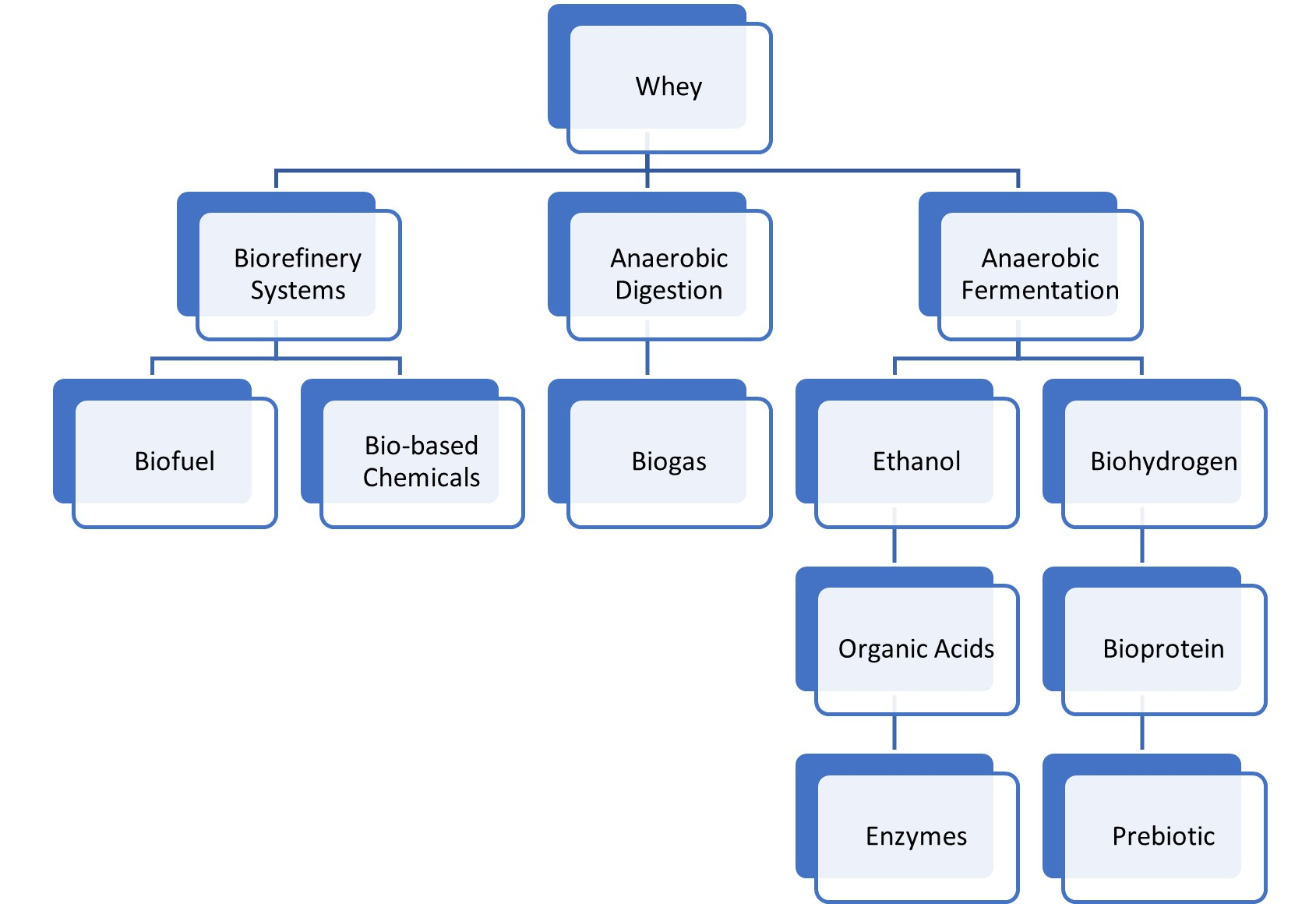
3.2. Biotechnological Processes
3.2.1. Anaerobic Digestion
3.2.2. Fermentation
Ethanol
Bioprotein/Single-Cell Protein
Organic Acids
Prebiotics
Others
3.3. Production of Whey-Based Beverages
3.4. Biorefinery Systems

| Process Description | Substrate | Product | Process Condition/Efficiency | References |
|---|---|---|---|---|
| Two-stage biorefinery with anaerobic digestion | Whey and vinasse | Protein-rich fungal biomass and methane | Max. biomass yield: 12.0 g L−1 of wastewaters, cultivation at pH 6.5 and vinasse to whey ratio of 25:75 (v/v) for 96 h with nitrogen source supplementation. | [116] |
| Anaerobic fermentation of CW and electrodialysis (ED) | Cheese whey | Polyhydroxyalkanoates (PHAs) | PHAs yield: ca. 0.60 g PHAs g carboxylic acids−1 by fed-batch fermentation and 7 sequential batch ED processes. | [114] |
| Microbial fermentation by Kluyveromyces marxianus and Saccharomyces fragilis | Cheese whey | Ethanol and beta-galactosidase | Max. ethanol: 3.90% by Saccharomyces fragilis in 150 g L−1 CW at 40 °C, max. beta-galactosidase activity: 1.10 U mg−1 by Kluyveromyces marxianus in 150 g L−1 CW at 30 °C. | [74] |
| Two-stage bioprocess with microbial fermentation by Saccharomyces cerevisiae and Gluconobacter oxydans | Cheese whey powder (CWP) | Ethanol and galactonic acid | Max. ethanol: 110 g (1 kg CWP)−1, max. galactonic acid: 305 g (1 kg CWP)−1 for 24–36 h at 30 °C. | [75] |
| Ultrafiltration, reverse osmosis and fermentation | Tunisian cheese whey | Ethanol | Max. ethanol yield: 1.65 metric tonnes year−1, including a reverse osmosis procedure and fermentation at 28 °C for 20 h. | [117] |
| Centrifugation, filtration and fermentation by wild-type non-conventional yeast strains | Mizithra second cheese whey | Single-cell oil and polysaccharides | Total dry weight (TDW) of Cryptococcus curvatus: 22.0 g L−1, with 3.7 g L−1 cellular lipids produced (17% of TDW), 0.32 g L−1 h−1 biomass productivity, and 0.054 g L−1 h−1 lipid productivity in a 69 h long batch fermentation. TDW of Papiliotrema laurentii: 22.0 g L−1 and secreted significant quantities of exopolysaccharides. | [118] |
| Three-stage bioprocess, with dark fermentation, selection of PHA storing microorganisms, and PHA accumulation | Sheep cheese whey | Biohydrogen and PHA | Max. biohygrogen production: 5.3 L, and max. PHA production: 7.6 g per liter of sheep cheese whey at 39 °C and pH 6.0. | [18] |
4. Global Whey Revolution: Examples of SME Innovations Worldwide
5. Conclusions
Author Contributions
Funding
Institutional Review Board Statement
Informed Consent Statement
Data Availability Statement
Conflicts of Interest
References
- Valta, K.; Damala, P.; Angeli, E.; Antonopoulou, G.; Malamis, D.; Haralambous, K.J. Current Treatment Technologies of Cheese Whey and Wastewater by Greek Cheese Manufacturing Units and Potential Valorisation Opportunities. Waste Biomass Valor. 2017, 8, 1649–1663. [Google Scholar] [CrossRef]
- Karim, A.; Aider, M. Production of prebiotic lactulose through isomerisation of lactose as a part of integrated approach through whey and whey permeate complete valorisation: A review. Int. Dairy J. 2022, 126, 105249. [Google Scholar] [CrossRef]
- Awasthi, M.K.; Paul, A.; Kumar, V.; Sar, T.; Kumar, D.; Sarsaiya, S.; Liu, H.; Zhang, Z.; Binod, P.; Sindhu, R.; et al. Recent trends and developments on integrated biochemical conversion process for valorization of dairy waste to value added bioproducts: A review. Bioresour. Technol. 2022, 344, 126193. [Google Scholar] [CrossRef]
- Barba, F.J. An Integrated Approach for the Valorization of Cheese Whey. Foods 2021, 10, 564. [Google Scholar] [CrossRef]
- Eurostat. EU Dairies Increased Production in 2020—Products Eurostat News. 2020. Available online: https://ec.europa.eu/eurostat/web/products-eurostat-news/-/ddn-20211118-1 (accessed on 27 September 2025).
- Pulina, G.; Milán, M.J.; Lavín, M.P.; Theodoridis, A.; Morin, E.; Capote, J.; Thomas, D.L.; Francesconi, A.H.D.; Caja, G. Invited review: Current production trends, farm structures, and economics of the dairy sheep and goat sectors. J. Dairy Sci. 2018, 101, 6715–6729. [Google Scholar] [CrossRef]
- Verma, D.K.; Patel, A.R.; Tripathy, S.; Gupta, A.K.; Singh, S.; Shah, N.; Utama, G.L.; Chavez-Gonzalez, M.L.; Zongo, K.; Banwo, K.; et al. Processing and formulation technology of nutritional and functional food products by utilizing cheese and/or paneer whey: A critical review. J. King Saud Univ.-Sci. 2024, 36, 103508. [Google Scholar] [CrossRef]
- Chourasia, R.; Phukon, L.C.; Abedin, M.M.; Padhi, S.; Singh, S.P.; Rai, A.K. Whey valorization by microbial and enzymatic bioprocesses for the production of nutraceuticals and value-added products. Bioresour. Technol. Rep. 2022, 19, 101144. [Google Scholar] [CrossRef]
- Addai, F.P.; Lin, F.; Wang, T.; Kosiba, A.A.; Sheng, P.; Yu, F.; Gu, J.; Zhou, Y.; Shi, H. Technical integrative approaches to cheese whey valorization towards sustainable environment. Food Funct. 2020, 11, 8407–8423. [Google Scholar] [CrossRef] [PubMed]
- Asunis, F.; De Gioannis, G.; Dessì, P.; Isipato, M.; Lens, P.N.L.; Muntoni, A.; Polettini, A.; Pomi, R.; Rossi, A.; Spiga, D. The dairy biorefinery: Integrating treatment processes for cheese whey valorization. J. Environ. Manag. 2020, 276, 111240. [Google Scholar] [CrossRef] [PubMed]
- Kaur, N.; Sharma, P.; Jaimni, S.; Kehinde, B.A.; Kaur, S. Recent developments in purification techniques and industrial applications for whey valorization: A review. Chem. Eng. Commun. 2020, 207, 123–138. [Google Scholar] [CrossRef]
- Pires, A.F.; Marnotes, N.G.; Rubio, O.D.; Garcia, A.C.; Pereira, C.D. Dairy By-Products: A Review on the Valorization of Whey and Second Cheese Whey. Foods 2021, 10, 1067. [Google Scholar] [CrossRef]
- Macedo, A.; Monteiro, J.; Duarte, E. A Contribution for the Valorisation of Sheep and Goat Cheese Whey through Nanofiltration. Membranes 2018, 8, 114. [Google Scholar] [CrossRef]
- Marnotes, N.G.; Pires, A.F.; Díaz, O.; Cobos, A.; Pereira, C.D. Sheep’s and Goat’s Frozen Yoghurts Produced with Ultrafiltrated Whey Concentrates. Appl. Sci. 2021, 11, 6568. [Google Scholar] [CrossRef]
- Hernández-Ledesma, B.; Ramos, M.; Gómez-Ruiz, J.Á. Bioactive components of ovine and caprine cheese whey. Small Rumin. Res. 2011, 101, 196–204. [Google Scholar] [CrossRef]
- de Albuquerque, C.D.; Cerny, M.; Silva, F.L.; Belahcen, L.; Doutart, E.; Peter, M.; Tormo, H.; Valentin, R. Sweet and deproteinized sheep whey: A nutrient-rich coproduct with seasonal variability. Small Rumin. Res. 2025, 253, 107635. [Google Scholar] [CrossRef]
- Ramos-Suárez, J.L.; Vargas-Avendaño, C.L.; Mata-González, J.; Camacho-Pérez, A. Evaluation of poultry manure and goat cheese whey anaerobic co-digestion. Span. J. Agric. Res. 2019, 17, e0302. [Google Scholar] [CrossRef]
- Asunis, F.; Carucci, A.; De Gioannis, G.; Farru, G.; Muntoni, A.; Polettini, A.; Pomi, R.; Rossi, A.; Spiga, D. Combined biohydrogen and polyhydroxyalkanoates production from sheep cheese whey by a mixed microbial culture. J. Environ. Manag. 2022, 322, 116149. [Google Scholar] [CrossRef]
- Food and Agriculture Organization of the United Nations. Gateway to Dairy Production and Products. 2019. Available online: http://www.fao.org/dairy-production-products/production/dairy-animals/en/ (accessed on 27 September 2025).
- Thum, C.; Cookson, A.; McNabb, W.C.; Roy, N.C.; Otter, D. Composition and enrichment of caprine milk oligosaccharides from New Zealand Saanen goat cheese whey. J. Food Compos. Anal. 2015, 42, 30–37. [Google Scholar] [CrossRef]
- Griffin, S.; Falzon, O.; Camilleri, K.; Valdramidis, V.P. Bacterial and fungal contaminants in caprine and ovine cheese: A meta-analysis assessment. Food Res. Int. 2020, 137, 109445. [Google Scholar] [CrossRef] [PubMed]
- FAOSTAT. Data. Food and Agriculture Organization of the United Nations. 2020. Available online: https://www.fao.org/faostat/en/#data (accessed on 27 September 2025).
- Ghinea, C.; Leahu, A. Life cycle assessment of sheep cheese production in a small dairy factory from Romanian rural area. Environ. Sci. Pollut. Res. 2023, 30, 6986–7004. [Google Scholar] [CrossRef]
- Popescu, A.; Marcuta, A.; Marcuta, L.; Tindeche, C. Trendes in goats’ livestock and goat milk, meat and cheese production in the world in the period 1990–2019—A statistical approach. Sci. Pap. Ser. Manag. Econom. Eng. Agric. Rural. Dev. 2021, 21, 647–653. [Google Scholar]
- Bittante, G.; Amalfitano, N.; Bergamaschi, M.; Patel, N.; Haddi, M.L.; Benabid, H.; Pazzola, M.; Vacca, G.M.; Tagliapietra, F.; Schiavon, S. Composition and aptitude for cheese-making of milk from cows, buffaloes, goats, sheep, dromedary camels, and donkeys. J. Dairy Sci. 2021, 105, 2132–2215. [Google Scholar] [CrossRef] [PubMed]
- Leite Júnior, B.R.C.; Tribst, A.A.L. Use of nisin and bioprotective lactic cultures to extend the shelf life of sheep and goat cheese whey. Food Biosci. 2022, 50, 102096. [Google Scholar] [CrossRef]
- de Albuquerque, J.N.; Paulinetti, A.P.; Lovato, G.; Albanez, R.; Ratusznei, S.M.; Rodrigues, J.A.D. Anaerobic Sequencing Batch Reactors Co-digesting Whey and Glycerin as a Possible Solution for Small and Mid-size Dairy Industries: Environmental Compliance and Methane Production. Appl. Biochem. Biotechnol. 2020, 192, 979–998. [Google Scholar] [CrossRef] [PubMed]
- Kovácová, M.; Výrostková, J.; Eva, E.; Zigo, F.; Semjon, B.; Regecová, I. Assessment of Quality and Safety of Farm Level Produced Cheeses from Sheep and Goat Milk. Appl. Sci. 2021, 11, 3196. [Google Scholar] [CrossRef]
- Caja, G.; Castro-Costa, A.; Salama, A.A.; Oliver, J.; Baratta, M.; Ferrer, C.; Knight, C.H. Sensing solutions for improving the performance, health and wellbeing of small ruminants. J. Dairy Res. 2020, 87, 34–46. [Google Scholar] [CrossRef] [PubMed]
- FAOSTAT. Food and Agriculture Data. Food and Agriculture Organization of the United Nations. 2023. Available online: https://www.fao.org/faostat/en/#data/QCL (accessed on 1 February 2026).
- Kurnick, J.V.; Michellimi, M.G.G.; Yada, R.Y.; Leite Junior, B.R.C.; Tribst, A.A.L. Development of value-added beverages using sheep and goat cheese whey and secondary whey. Int. Dairy J. 2024, 152, 105886. [Google Scholar] [CrossRef]
- Lastra-Mejias, M.; Villa-Martineza, A.; Izquierdo, M.; Aroca-Santosa, R.; Cancillab, J.C.; Torrecillaa, J.S. Combination of LEDs and cognitive modeling to quantify sheep cheese whey in watercourses. Talanta 2020, 203, 290–296. [Google Scholar] [CrossRef]
- Tribst, A.A.L.; Falcade, L.T.P.; Carvalho, N.S.; Leite Júnior, B.R.C.; de Oliveira, M.M. Manufacture of a fermented dairy product using whey from sheep’s milk cheese: An alternative to using the main by-product of sheep’s milk cheese production in small farms. Int. Dairy J. 2020, 111, 104803. [Google Scholar] [CrossRef]
- Scarlat, G.; Stefan, A.I.; Ciric, A.; Coman, S.; Vasiliu, R.E.; Pogurschı, E.N. Milk’s hidden treasure: Exploring whey production in cows, sheep, buffalo, and goats. Sci. Pap. Ser. D Anim. Sci. 2025, 68, 481–488. [Google Scholar]
- Pires, A.; Tan, G.; Gomes, D.; Pereira-Dias, S.; Díaz, O.; Cobos, A.; Pereira, C. Application of ultrafiltration to produce sheep’s and goat’s whey-based synbiotic kefir products. Membranes 2023, 13, 473. [Google Scholar] [CrossRef]
- Guliyev, R.; Akgün, M.; Börekçi, B.S.; Sadak, Ö.; Esen, Y. Modelling and process optimization of cheese whey wastewater treatment using magnetic nanoparticles. Biomass Convers. Biorefin. 2023, 13, 17223–17234. [Google Scholar] [CrossRef]
- dos Santos, F.R.; Filho, C.M.M.; de Cerqueira, R.F.L.; Yada, R.Y.; Augusto, P.E.D.; Leite Junior, B.R.C.; Tribst, A.A.L. Strategies to extend the shelf life of sheep and goat cheese whey under refrigeration: Nisin, bioprotective culture, and acidification. Food Biosci. 2024, 57, 103495. [Google Scholar] [CrossRef]
- Borba, K.K.S.; Gadelha, T.S.; Sant’Ana, A.M.S.; Pacheco, M.T.B.; Pinto, L.S.; Madruga, M.S.; Medeiros, A.N.; Bessa, R.J.B.; Alves, S.P.A.; Magnani, M.; et al. Fatty acids, essential amino acids, minerals and proteins profile in whey from goat cheese: Impacts of raising system. Small Rumin. Res. 2022, 217, 106842. [Google Scholar] [CrossRef]
- Macedo, A.; Bilau, J.; Cambóias, E.; Duarte, E. Integration of Membrane Processes for By-Product Valorization to Improve the Eco-Efficiency of Small/Medium Size Cheese Dairy Plants. Foods 2021, 10, 1740. [Google Scholar] [CrossRef]
- Cechmánková, J.; Skála, J.; Sedlarík, V.; Durpeková, S.; Drbohlav, J.; Salaková, A.; Vácha, R. The Synergic Effect of Whey-Based Hydrogel Amendment on SoilWater Holding Capacity and Availability of Nutrients for More Efficient Valorization of Dairy By-Products. Sustainability 2021, 13, 10701. [Google Scholar] [CrossRef]
- Abdelraouf, E.A.; Nassar, I.N.; Gomma, I.; Aboukila, E.F. Valorization of Cheese Whey as A Fertilizer: Effects on Maize Germination and Growth in Clay Loam and Calcareous Soil. Egypt. J. Soil Sci. 2023, 63, 489–502. [Google Scholar] [CrossRef]
- Conte, R.; Valentino, A.; Romano, S.; Yazdanpanah, S.; Di Salle, A.; Kandsi, F.; Peluso, G. Valorization of buffalo mozzarella cheese whey as human functional food and soil fertilizer. Int. J. Recycl. Org. Waste Agric. 2025, 14, 142514. [Google Scholar] [CrossRef]
- dos Santos Emiliano, J.V.; Fusieger, A.; Camargo, A.C.; da Cruz Rodrigues, F.F.; Nero, L.A.; Perrone, Í.T.; de Carvalho, A.F. Microbiological aspects in whey powder production: What is the relevance of enterotoxigenic Staphylococcus aureus? J. Dairy Res. 2025, 92, 98–106. [Google Scholar] [CrossRef]
- dos Santos, F.R.; Leite Junior, B.R.C.; Tribst, A.A.L. Impact of ultrasound and protease addition on the fermentation profile and final characteristics of fermented goat and sheep cheese whey. J. Food Sci. Technol. 2023, 60, 2444–2453. [Google Scholar] [CrossRef] [PubMed]
- Zotta, T.; Solieri, L.; Iacumin, L.; Picozzi, C.; Gullo, M. Valorization of cheese whey using microbial fermentations. Appl. Microbiol. Biotechnol. 2020, 104, 2749–2764. [Google Scholar] [CrossRef]
- Tribst, A.A.L.; Leite Júnior, B.R.C. Heat treatment design for the valorization of sheep cheese whey in artisanal production. Res. Soc. Dev. 2022, 11, e20911931776. [Google Scholar] [CrossRef]
- Rocha, J.M.; Guerra, A. On the valorization of lactose and its derivatives from cheese whey as a dairy industry by-product: An overview. Eur. Food Res. Technol. 2020, 246, 2161–2174. [Google Scholar] [CrossRef]
- Lavelli, V.; Beccalli, M.P. Cheese whey recycling in the perspective of the circular economy: Modeling processes and the supply chain to design the involvement of the small and medium enterprises. Trends Food Sci. Technol. 2022, 126, 86–98. [Google Scholar] [CrossRef]
- Varavallo, G.; Caragnano, G.; Bertone, F.; Vernetti-Prot, L.; Terzo, O. Traceability platform based on green blockchain: An application case study in dairy supply chain. Sustainability 2022, 14, 3321. [Google Scholar] [CrossRef]
- Mangla, S.K.; Kazancoglu, Y.; Ekinci, E.; Liu, M.; Ozbiltekin, M.; Sezer, M.D. Using system dynamics to analyze the societal impacts of blockchain technology in milk supply chains. Transp. Res. Part E Logist. Transp. Rev. 2021, 149, 102289. [Google Scholar] [CrossRef]
- Tan, A.; Ngan, P.T. A proposed framework model for dairy supply chain traceability. Sustain. Futures 2020, 2, 100034. [Google Scholar] [CrossRef]
- Rambim, D.; Awuor, F.M. Blockchain based milk delivery platform for stallholder dairy farmers in Kenya: Enforcing transparency and fair payment. In IST-Africa Conference; Article 144071; IEEE: New York, NY, USA, 2020; Available online: www.IST-Africa.org/Conference2020 (accessed on 4 February 2026).
- Banaszewska, A.; Cruijssen, F.; Claassen, G.D.H.; van der Vorst, J.G.A.J. Effect and key factors of byproducts valorization: The case of dairy industry. J. Dairy Sci. 2013, 97, 1893–1908. [Google Scholar] [CrossRef] [PubMed]
- Dinkçi, N.; Akdeniz, V.; Akalın, A.S. Probiotic Whey-Based Beverages from Cow, Sheep and Goat Milk: Antioxidant Activity, Culture Viability, Amino Acid Contents. Foods 2023, 12, 610. [Google Scholar] [CrossRef] [PubMed]
- Fancello, F.; Zara, G.; Hatami, F.; Scano, E.A.; Mannazzu, I. Unlocking the potential of second cheese whey: A comprehensive review on valorisation strategies. Rev. Environ. Sci. Biotechnol. 2024, 23, 411–441. [Google Scholar] [CrossRef]
- Stratigakis, N.C.; Nazos, T.T.; Chatzopoulou, M.; Mparka, N.; Spantidaki, M.; Lagouvardou-Spantidaki, A.; Ghanotakis, D.F. Cultivation of a naturally resilient Chlorella sp.: A bioenergetic strategy for valorization of cheese whey for high nutritional biomass production. Algal Res. 2024, 82, 103616. [Google Scholar] [CrossRef]
- Macedo, A.; Azedo, D.; Duarte, E.; Pereira, C. Valorization of Goat Cheese Whey through an Integrated Process of Ultrafiltration and Nanofiltration. Membranes 2021, 11, 477. [Google Scholar] [CrossRef]
- Weerasingha, V.; Kelly, A.L.; Sheehan, J.J.; Alehosseini, A. Sustainable utilisation of salty whey generated during cheese manufacture: A review. Int. J. Dairy Technol. 2025, 78, e70033. [Google Scholar] [CrossRef]
- Li, J.; Wang, K.; Liu, F.; Ji, M.; Ge, Z.; Xie, M. Charge-enhanced sulfonated block copolymer composite membrane for whey recovery. Sep. Purif. Technol. 2025, 363, 132081. [Google Scholar] [CrossRef]
- Romo, M.; Bou, R.; Castellari, M.; Felipe, X. Caprine and bovine cheese whey valorization: High-pressure processing for α-lactalbumin fractionation from whey concentrates. Int. Dairy J. 2026, 175, 106553. [Google Scholar] [CrossRef]
- Prazeres, A.R.; Carvalho, F.; Rivas, J. Cheese whey management: A review. J. Environ. Manag. 2012, 110, 48–68. [Google Scholar] [CrossRef] [PubMed]
- Rao, R.; Basak, N. Fermentative molecular biohydrogen production from cheese whey: Present prospects and future strategy. Appl. Biochem. Biotechnol. 2021, 193, 2297–2330. [Google Scholar] [CrossRef] [PubMed]
- Yadav, J.S.S.; Yan, S.; Pilli, S.; Kumar, L.; Tyagi, R.D.; Surampalli, R.Y. Cheese whey: A potential resource to transform into bioprotein, functional/nutritional proteins and bioactive peptides. Biotechnol. Adv. 2015, 33, 756–774. [Google Scholar] [CrossRef] [PubMed]
- Ramos-Suárez, J.L.; Álvarez-Méndez, S.J.; Ritter, A.; González, J.M.; Pérez, A.C. A comprehensive evaluation of cheese whey to produce biogas in the Canary Islands. Biomass Bioenergy 2024, 180, 107008. [Google Scholar] [CrossRef]
- Tesfaw, A. The current trends of bioethanol production from cheese whey using yeasts: Biological and economical perspectives. Front. Energy Res. 2023, 11, 1183035. [Google Scholar] [CrossRef]
- Uribe-Velázquez, T.; Díaz-Vázquez, D.; Barajas-Álvarez, P.; González-López, M.E.; Gradilla-Hernández, M.S.; Garcia-Amezquita, L.E.; Carrillo-Nieves, D.; García-Cayuela, T. From waste to value: Mitigating the environmental impact of whey in Jalisco, Mexico. J. Clean. Prod. 2025, 501, 145334. [Google Scholar] [CrossRef]
- Trivino, A.; Godbout, S.; Pelletier, F.; Heitz, M.; De Halleux, D. Environmental Study of Valorization of Cheese Dairy Residues. CSABE/SCGAB. CSBE16-066. 2016. Available online: https://library.csbe-scgab.ca/docs/meetings/2016/CSBE16066.pdf (accessed on 4 February 2026).
- Mainardis, M.; Flaibani, S.; Trigatti, M.; Goi, D. Techno-economic feasibility of anaerobic digestion of cheese whey in small Italian dairies and effect of ultrasound pre-treatment on methane yield. J. Environ. Manag. 2019, 246, 557–563. [Google Scholar] [CrossRef] [PubMed]
- Escalante, H.; Castro, L.; Amaya, M.P.; Jaimes, L.; Jaimes-Estévez, J. Anaerobic digestion of cheese whey: Energetic and nutritional potential for the dairy sector in developing countries. Waste Manag. 2018, 71, 711–718. [Google Scholar] [CrossRef] [PubMed]
- Comino, E.; Riggio, V.A.; Rosso, M. Biogas production by anaerobic co-digestion of cattle slurry and cheese whey. Bioresour. Technol. 2012, 114, 46–53. [Google Scholar] [CrossRef]
- Hublin, A.; Zelić, B. Modelling of the whey and cow manure co-digestion process. Waste Manag. Res. 2013, 31, 353–360. [Google Scholar] [CrossRef]
- Rincón-Pérez, J.; Celis, L.B.; Morales, M.; Alatriste-Mondragón, F.; Tapia-Rodríguez, A.; Razo-Flores, E. Improvement of methane production at alkaline and neutral pH from anaerobic co-digestion of microalgal biomass and cheese whey. Biochem. Eng. J. 2021, 169, 107972. [Google Scholar] [CrossRef]
- Azkarahman, A.R.; Cysneiros, D.; Chatzifragkou, A.; Karatzas, K.A.G. Anaerobic digestion of whey permeate: Impact of feedstock ratio and organic loading rate in batch and semi-continuous systems. Heliyon 2025, 11, e42395. [Google Scholar] [CrossRef]
- Alves, É.D.P.; Morioka, L.R.I.; Suguimoto, H.H. Comparison of bioethanol and beta-galactosidase production by Kluyveromyces and Saccharomyces strains grown in cheese whey. Int. J. Dairy Technol. 2019, 72, 409–415. [Google Scholar] [CrossRef]
- Zhou, X.; Hua, X.; Huang, L.; Xu, Y. Bio-utilization of cheese manufacturing wastes (cheese whey powder) for bioethanol and specific product (galactonic acid) production via a two-step bioprocess. Bioresour. Technol. 2019, 272, 70–76. [Google Scholar] [CrossRef] [PubMed]
- Karim, A.; Aider, M. Bioconversion of electro-activated lactose, whey and whey permeate to produce single cell protein, ethanol, aroma volatiles, organic acids and fat by Kluyveromyces marxianus. Int. Dairy J. 2022, 129, 105334. [Google Scholar] [CrossRef]
- Farkas, C.; Rezessy-Szabó, J.M.; Gupta, V.K.; Bujna, E.; Pham, T.M.; Pásztor-Huszár, K.; Friedrich, L.; Bhat, R.; Thakur, V.K.; Nguyen, Q.D. Batch and fed-batch ethanol fermentation of cheese-whey powder with mixed cultures of different yeasts. Energies 2019, 12, 4495. [Google Scholar] [CrossRef]
- Tesfaw, A.; Oner, E.T.; Assefa, F. Evaluating crude whey for bioethanol production using non-Saccharomyces yeast, Kluyveromyces marxianus. Appl. Sci. 2021, 3, 42. [Google Scholar] [CrossRef]
- Koukoumaki, D.I.; Papanikolaou, S.; Ioannou, Z.; Mourtzinos, I.; Sarris, D. Single-cell protein and ethanol production of a newly isolated Kluyveromyces marxianus strain through cheese whey valorization. Foods 2024, 13, 1892. [Google Scholar] [CrossRef]
- Nazos, T.T.; Stratigakis, N.C.; Spantidaki, M.; Lagouvardou Spantidaki, A.; Ghanotakis, D.F. Characterization of cheese whey effluents and investigation of their potential to be used as a nutrient substrate for Chlorella biomass production. Waste Biomass Valor. 2023, 14, 3643–3655. [Google Scholar] [CrossRef]
- Bansfield, D.; Spilling, K.; Mikola, A.; Piiparinen, J. Fungal cultivation in a dairy side stream: Valorisation potential of whey into added-value biomass and by-products. Waste Biomass Valoriz. 2026, 17, 1543–1558. [Google Scholar] [CrossRef]
- Patel, A.K.; Vaisnav, N.; Mathur, A.; Gupta, R.; Tuli, D.K. Whey waste as potential feedstock for biohydrogen production. Renew. Energy 2016, 98, 221–225. [Google Scholar] [CrossRef]
- Pandey, A.; Srivastava, S.; Rai, P.; Duke, M. Cheese whey to biohydrogen and useful organic acids: A non-pathogenic microbial treatment by L. acidophilus. Sci. Rep. 2019, 9, 8320. [Google Scholar] [CrossRef]
- Nagarajan, D.; Nandini, A.; Dong, C.D.; Lee, D.J.; Chang, J.S. Lactic acid production from renewable feedstocks using poly(vinyl alcohol)-Immobilized Lactobacillus plantarum 23. Ind. Eng. Chem. Res. 2020, 59, 17156–17164. [Google Scholar] [CrossRef]
- Louast’e, B.; Eloutassi, N. Succinic acid production from whey and lactose by Actinobacillus succinogenes 130Z in batch fermentation. Biotechnol. Rep. 2020, 27, e00481. [Google Scholar] [CrossRef]
- de Giorgi, S.; Raddadi, N.; Fabbri, A.; Toschi, T.G.; Fava, F. Potential use of ricotta cheese whey for the production of lactobionic acid by Pseudomonas taetrolens strains. New Biotechnol. 2018, 42, 71–76. [Google Scholar] [CrossRef] [PubMed]
- Bosso, A.; Bosso Tomal, A.A.; Rodrigues Miranda, L.C.; Bonifácio da Silva, J.; Hiroshi Suguimoto, H.; Hernan Castro-Gomez, R.J. β-galactosidase production by Saccharomyces fragilis IZ 275 in cheese whey. Braz. J. Agric. Sci. 2020, 15, e7236. [Google Scholar] [CrossRef]
- Ricciardi, A.; Zotta, T.; Ianniello, R.G.; Boscaino, F.; Matera, A.; Parente, E. Effect of respiratory growth on the metabolite pro-896 duction and stress robustness of Lactobacillus casei N87 cultivated in cheese whey permeate medium. Front. Microbiol. 2019, 10, 851. [Google Scholar] [CrossRef]
- Fischer, C.; Kleinschmidt, T. Valorisation of sweet whey by fermentation with mixed yoghurt starter cultures with focus on galactooligosaccharide synthesis. Int. Dairy J. 2021, 119, 105068. [Google Scholar] [CrossRef]
- Ribeiro, J.E.S.; Martini, M.; Altomonte, I.; Salari, F.; Nardoni, S.; Sorce, C.; da Silva, F.L.D.; Andreucci, A. Production of Chlorella protothecoides biomass, chlorophyll and carotenoids using the dairy industry by-product scotta as a substrate. Biocatal. Agric. Biotechnol. 2017, 11, 207–213. [Google Scholar] [CrossRef]
- Carvalho, P.; Costa, C.E.; Baptista, S.L.; Domingues, L. Yeast cell factories for sustainable whey-to-ethanol valorisation towards a circular economy. Biofuel Res. J. 2021, 8, 1529–1549. [Google Scholar] [CrossRef]
- Kaur, R.; Panwar, D.; Panesar, P.S. Biotechnological approach for valorization of whey for value-added products. In Food Industry Wastes: Assessment and Recuperation of Commodities; Elsevier: Amsterdam, The Netherlands, 2020; pp. 275–302. [Google Scholar] [CrossRef]
- Das, M.; Raychaudhuri, A.; Ghosh, S.K. Supply chain of bioethanol production from whey: A review. Procedia Environ. Sci. 2016, 35, 833–846. [Google Scholar] [CrossRef]
- Guimarães, P.M.; Teixeira, J.A.; Domingues, L. Fermentation of lactose to bio-ethanol by yeasts as part of integrated solutions for the valorisation of cheese whey. Biotechnol. Adv. 2010, 28, 375–384. [Google Scholar] [CrossRef] [PubMed]
- Soumati, B.; Atmani, M.; Benabderrahmane, A.; Benjelloun, M. Whey valorization–innovative strategies for sustainable development and value-added product creation. J. Ecol. Eng. 2023, 24, 86–104. [Google Scholar] [CrossRef]
- Utama, G.L.; Kurnani, T.B.A.; Sunardi, S.; Cahyandito, M.F.; Balia, R.L. Joint cost allocation of cheese-making wastes bioconversions into ethanol and organic liquid fertilizer. Bulg. J. Agric. Sci. 2017, 23, 1016–1020. [Google Scholar]
- Yadav, J.S.S.; Bezawada, J.; Ajila, C.M.; Yan, S.; Tyagi, R.D.; Surampalli, R.Y. Mixed culture of Kluyveromyces marxianus and Candida krusei for single-cell protein production and organic load removal from whey. Bioresour. Technol. 2014, 164, 119–127. [Google Scholar] [CrossRef]
- Kaur, R.; Panesar, P.S.; Singh, R.S. Utilization of whey for the production of β-galactosidase using yeast and fungal culture. World Acad. Sci. Eng. Technol. 2015, 9, 690–694. [Google Scholar]
- Sebastián-Nicolás, J.L.; González-Olivares, L.G.; Vázquez-Rodríguez, G.A.; Lucho-Constatino, C.A.; Castañeda-Ovando, A.; Cruz-Guerrero, A.E. Valorization of whey using a biorefinery. Biofuels Bioproduc. Biorefin. 2020, 14, 1010–1027. [Google Scholar] [CrossRef]
- Barukčić, I.; Lisak Jakopović, K.; Božanić, R. Valorisation of whey and buttermilk for production of functional beverages–an overview of current possibilities. Food Technol. Biotechnol. 2019, 57, 448–460. [Google Scholar] [CrossRef] [PubMed]
- Arora, S.K.; Mali, Y. Water-rich Whey: An Invaluable Resource for Beverage Development Toward Sustainable Dairy. Water Res. J. 2024, 14, 69–82. [Google Scholar] [CrossRef]
- Kumar, K.; Singh, J.; Chandra, S.J.C.S.R.L. Formulation of whey based pineapple herbal beverages and its storage conditions. Chem. Sci. Rev. Lett. 2017, 6, 198–203. [Google Scholar]
- Alane, D.; Raut, N.; Kamble, D.B.; Bhotmange, M. Studies on preparation and storage stability of whey based mango herbalbeverage. Int. J. Chem. Stud. 2017, 5, 237–241. [Google Scholar]
- Pescuma, M.; de Valdez, G.F.; Mozzi, F. Whey-derived valuable products obtained by microbial fermentation. Appl. Microbiol. Biotechnol. 2015, 99, 6183–6196. [Google Scholar] [CrossRef]
- de Souza Pereira, Á.M.; de Farias, D.R.B.; de Queiroz, B.B.; Nobre, M.S.D.C.; Cavalcanti, M.T.; Salles, H.O.; Santos, K.M.O.D.; de Medeiros, A.C.D.; Florentino, E.R.; Buriti, F.C.A. Influence of a co-culture of Streptococcus thermophilus and Lactobacillus casei on the proteolysis and ace-inhibitory activity of a beverage based on reconstituted goat whey powder. Probiotics Antimicrob. Proteins 2019, 11, 273–282. [Google Scholar] [CrossRef] [PubMed]
- Jitpakdee, J.; Kantachote, D.; Kanzaki, H.; Nitoda, T. Potential of lactic acid bacteria to produce functional fermented whey beverage with putative health promoting attributes. LWT 2022, 160, 113269. [Google Scholar] [CrossRef]
- Chatterjee, G.; De Neve, J.; Dutta, A.; Das, S. Formulation and statistical evaluation of a ready-to-drink whey based orange beverage and its storage stability. Rev. Mex. Ing. Química 2015, 14, 253–264. [Google Scholar]
- Abdo, E.M.; Allam, M.G.; Gomaa, M.A.; Shaltout, O.E.; Mansour, H.M. Valorization of whey proteins and beetroot peels to develop a functional beverage high in proteins and antioxidants. Front. Nutr. 2022, 9, 984891. [Google Scholar] [CrossRef]
- AbdulAlim, T.S.; Zayan, A.F.; Campelo, P.H.; Bakry, A.M. Development of new functional fermented product: Mulberry-whey beverage. J. Nutr. Food. Res. Technol. 2019, 1, 64–69. [Google Scholar] [CrossRef]
- Elkot, W.F.; Elmahdy, A.; Talaat, H.; Alghamdia, O.A.; Alhag, S.K.; Al-Shahari, E.A.; AL-Farga, A.; Ismail, H.A. Development and characterization of a novel flavored functional fermented whey-based sports beverage fortified with Spirulina platensis. Int. J. Biol. Macromol. 2024, 258, 128999. [Google Scholar] [CrossRef] [PubMed]
- Alves, C.S.J.; Floriano, S.A.M.; Voltarelli, V.P.; de Rensis, C.M.V.B.; Pimentel, T.C.; Costa, G.N.; Vianna, P.C.B. Effect of carbonation and probiotic addition on the physicochemical, microbiological and sensory characteristics of whey dairy beverage. J. Dairy Res. 2020, 87, 255–258. [Google Scholar] [CrossRef] [PubMed]
- del Río, P.G.; Gomes-Dias, J.S.; Rocha, C.M.; Romaní, A.; Garrote, G.; Domingues, L. Recent trends on seaweed fractionation for liquid biofuels production. Bioresour. Technol. 2020, 299, 122613. [Google Scholar] [CrossRef] [PubMed]
- Cunha, J.T.; Gomes, D.G.; Romaní, A.; Inokuma, K.; Hasunuma, T.; Kondo, A.; Domingues, L. Cell surface engineering of Saccharomyces cerevisiae for simultaneous valorization of corn cob and cheese whey via ethanol production. Energy Convers. Manag. 2021, 243, 114359. [Google Scholar] [CrossRef]
- Domingos, J.M.; Puccio, S.; Martinez, G.A.; Amaral, N.; Reis, M.A.; Bandini, S.; Fava, F.; Bertin, L. Cheese whey integrated valorisation: Production, concentration and exploitation of carboxylic acids for the production of polyhydroxyalkanoates by a fed-batch culture. Chem. Eng. J. 2018, 336, 47–53. [Google Scholar] [CrossRef]
- Buchanan, D.; Martindale, W.; Romeih, E.; Hebishy, E. Recent advances in whey processing and valorisation: Technological and environmental perspectives. Int. J. Dairy Technol. 2023, 76, 291–312. [Google Scholar] [CrossRef]
- Hashemi, S.S.; Karimi, K.; Taherzadeh, M.J. Valorization of vinasse and whey to protein and biogas through an environmental fungi-based biorefinery. J. Environ. Manag. 2022, 303, 114138. [Google Scholar] [CrossRef]
- Mabrouki, J.; Abbassi, M.A.; Khiari, B.; Jellali, S.; Zorpas, A.A.; Jeguirim, M. The dairy biorefinery: Integrating treatment process for Tunisian cheese whey valorization. Chemosphere 2020, 293, 133567. [Google Scholar] [CrossRef]
- Vasilakis, G.; Karayannis, D.; Massouras, T.; Politis, I.; Papanikolaou, S. Biotechnological conversions of Mizithra second cheese whey by wild-type non-conventional yeast strains: Production of yeast cell biomass, single-cell oil and polysaccharides. Appl. Sci. 2022, 12, 11471. [Google Scholar] [CrossRef]
- Valorization of Whey in Lebanon’s Dairy Sector. 2025. Available online: https://www.test-toolkit.eu/wp-content/uploads/2024/10/SwitchMed-Business-case-Valorization-of-whey-in-Lebanons-dairy-sector.pdf (accessed on 21 March 2026).
- Production of Innovative Dairy Drinks Based on Co-Products of Cheese Manufacturing. 2025. Available online: https://www.fairchain-h2020.eu/case-studies/france/ (accessed on 21 March 2026).
- First Bioplastic Made from Surplus Whey Cheese İndustry. 2025. Available online: https://www.ainia.com/en/ainia-news/first-bioplastic-made-from-surplus-whey-cheese-industry/ (accessed on 21 March 2026).
- Tanzi, G.; Tonsi, M.; Grilli, C.; Malpei, F. Dairy by-products valorization with biomethane and biohydrogen production through lactose fermentation in anmbr. Chem. Eng. Trans. 2017, 57, 1819–1824. [Google Scholar] [CrossRef]
- Whey- from Waste to a Food Supplement. 2025. Available online: https://www.arlafoodsingredients.com/dairy/innovations/refreshing-fermented-protein-drink/ (accessed on 30 March 2026).

| Bovine CW | Ovine CW | Goat CW | Ovine SCW | |
|---|---|---|---|---|
| Total solids | 6.0–7.0 | 7.6–10.5 | 7.1–10.8 | 7.1–8.3 |
| Lactose | 4.2–5.0 | 4.3–6.1 | 5.0–6.7 | 4.5–5.7 |
| Proteins | 0.7–0.9 | 1.6–1.8 | 0.6–1.2 | 0.8–1.2 |
| Fat | 0.1–0.8 | 1.2–2.5 | 0.8 | 0.2–0.4 |
| Minerals | 0.5–0.6 | 1.0–1.8 | 0.6 | 1.7–1.9 |
| Value-Added Products | Growth Medium | Microorganisms | Process Condition/Efficiency | References |
|---|---|---|---|---|
| Bioalcohols | ||||
| Ethanol | Mashes containing 10% cheese whey powder | Eight yeast strains of Lachancea thermotolerans, Kluyveromyces marxianus, and Kluyveromyces waltii | K. marxianus achieved 3.5% (v/v) ethanol concentration at 96–120 h of fermentation. Also, mixed cultures and fed-batch fermentation technology increased efficiency. | [77] |
| Ethanol | Crude whey | Kluyveromyces marxianus | 36 h at 30 °C, ethanol production: 10–12 g L−1 from crude whey, 17 g L−1 from 75% whey and 25% molasses. | [78] |
| Ethanol | Deproteinized cheese whey | Kluyveromyces marxianus | 72 h at 20–35 °C, 35–100 g L−1 lactose concentration, and 180 rpm. Max. ethanol production: 35.5 g L−1 at 35 °C and 100 g L−1 lactose concentration. | [79] |
| Ethanol, 2-phenylethanol, isoamyl alcohol | Electro-activated whey/whey permeate | Kluyveromyces marxianus | 96 h at 30 °C and 150 rpm, max. ethanol production: 28.13 g L−1. | [76] |
| Bioprotein | ||||
| SCP | Deproteinized cheese whey | Kluyveromyces marxianus | 144 h at 20–35 °C, 35–100 g L−1 lactose concentration, and 180 rpm. max. biomass: 14.24 g L−1, SCP: 6.14 g L−1 at 20 °C and 70 g L−1 lactose concentration. | [79] |
| Chlorella biomass | Primary (PCW) and second (SCW) cheese whey from goat and sheep milk cheeses | Chlorella sp. | Chlorella cell growth was achieved in cheese whey with trace mineral addition, the measurements were carried out as chlorophyll-a content, max. value: 28.38 μg Ca (mL culture)−1 for undiluted PCW. | [80] |
| Chlorella biomass | Second cheese whey from goat and sheep milk cheeses | Chlorella sp. | Higher Chlorella biomass production (>800 mg mL−1) was achieved with trace mineral addition and continuous air supply. | [56] |
| Biomass | Electro-activated whey/whey permeate | Kluyveromyces marxianus | 96 h at 30 °C and 150 rpm, max. biomass: 4.23 g L−1. | [76] |
| Biomass | Crude whey | Kluyveromyces marxianus | 36 h at 30 °C and 3.8 pH, biomass: 6.20 g L−1. | [78] |
| Biomass | Cheese whey | Batch cultures Geotrichum candidum, Penicillium corylophilum, Pleurotus ostreatus Penicillium restrictum | 3–6 days at 23 °C and 150–200 rpm, highest biomass yield: 16.9 dry weight L−1 by P. corylophilum. | [81] |
| Biogas | ||||
| Biohyrojen | Cheese whey | Clostridium sp. | 24 h at 37 °C and 120 rpm max. biohydrogen yield: 6.35 ± 0.2 mol-H2/mol-lactose. | [82] |
| Biohyrojen | Cheese whey | Lactobacillus spp. | 72 h at 37 °C and pH 6.5 with 18 h inoculum age, max. biogas: 85 mL 100 mL−1 of culture media. | [83] |
| Organic Acid | ||||
| Citric acid | Deproteinized cheese whey | Kluyveromyces marxianus | 144 h at 20–35 °C, 35–100 g L−1 lactose concentration, and 180 rpm. max. citric acid: 8.3 g L−1 at 35 °C and 100 g L−1 lactose concentration. | [79] |
| Lactic acid | Renewable feedstocks: sugar cane bagasse, cheese whey, microalgal and macroalgal biomass | Lactobacillus plantarum | 14 h at 30 °C with 200 rpm, 33.8 g L−1 lactic acid titer and 11.3 g (L h)−1 productivity. | [84] |
| Lactic, acetic, citric, propionic acids | Electro-activated whey/whey permeate | Kluyveromyces marxianus | Up to 96 h at 30 °C and 150 rpm, max. lactic acid: 1480.12 mg L−1, max. acetic acid: 1173.84 mg L−1, max. citric acid: 1908.43 mg L−1, max. propionic acid: 358.23 mg L−1. | [76] |
| Succinic acid | Whey and lactose | Actinobacillus succinogenes | 72 h at 38 °C, 6.8 pH and 200 rpm, max. yield of 62.1% and max. productivity of 0.81 g L−1 h−1 were obtained with 35 g L−1 of whey. | [85] |
| Lactic, pyruvic, formic, acetic, butyric and propionic acid | Cheese whey | Lactobacillus spp. | 24–64 h at 37 °C and 6.5 pH, max. lactic acid: 0.56 moles, max. acetic acid:0.12 moles, max. pyruvic acid: 0.031 moles, max. propionic acid: 0.165 moles, max. butyric acid: 0.01 moles, max. formic acid: 0.125 moles from the 0.114 moles of hexose. | [83] |
| Lactobionic acid | Ricotta cheese whey | Pseudomonas taetrolens | 48 h at 30 °C and 150 rpm, max. lactobionic acid titer: 34.25 g L−1, max. yield 85% (mol lactobionic acid/mol of consumed lactose%). | [86] |
| Enzymes | ||||
| β-galactosidase | Cheese whey | Saccharomyces fragilis | 72 h at 35 °C, 6.0 pH and 180 rpm with 20% inoculum concentration provided max. production of β-galactosidase. | [87] |
| Aroma compounds | ||||
| Diacetyl, Acetoin | Whey permeate | Lactobacillus casei | 16 h at 37 °C, the production of acetoin (max: 12 mM) and diacetyl (max: 2.3 mM) was higher under respirative growth. | [88] |
| Prebiotics | ||||
| Galacto-oligosaccharide | Sweet whey | YO-MIX 101 culture (Lactobacillus acidophilus, Streptococcus thermophilus and Bifidobacterium lactis) and YO-MIX 532 culture (Lactobacillus delbrueckii subsp. bulgaricus and S. thermophilus) | 24 h at 50 °C and 100 g L−1 initial lactose using YO-MIX 532 culture max. yield: 34.2% including disaccharide GOS, 25.4% excluding disaccharide GOS. | [89] |
| Others | ||||
| Carotenoids and chlorophyll | Ricotta cheese whey (bovine and ovine cheese whey) | Chlorella protothecoides | 7 days at 25 °C, max. chlorophyll (42.17 mg L−1) and max. carotenoids (11.98 mg L−1) were found in the medium containing ovine ricotta cheese whey after 4 days of cultivation. | [90] |
| Type of Beverage | Beverage Formulation | Reference |
|---|---|---|
| Fermented probiotic dairy beverage from goat whey powder | Reconstituted goat whey powder fermentation by co-culture of probiotic culture of Lactobacillus casei BGP93 co-cultured with Streptococcus thermophilus TA-40 | [105] |
| Functional fermented whey-based beverage | Whey fermentation by lactic acid bacteria Pediococcus pentosaceus ENM104, Lactiplantibacillus plantarum SPS109 and their co-culture (1:1) | [106] |
| Whey-based pineapple mint beverage | Incorporation of Mentha arvensis extract into whey at different ratios (0 to 3%) | [102] |
| Whey-based mango herbal beverage | Incorporation of ginger extract (at different ratios between 0.5 and 5 ml (v/v)) and mango pulp into whey | [103] |
| Whey-based orange beverage | Incorporation of orange juice, sugar, stabilizer, citric acid and flavor into concentrated whey | [107] |
| Health based functional whey drink | Incorporation of carrot, beetroot and ginger juice, and mint extract into whey | [98] |
| Functional beverage | Mixing whey protein isolate (5%) with different concentrations of beetroot peel water extract (1, 2.5, and 5%) and flavored with strawberries puree (5%). | [108] |
| Functional fermented mulberry-whey beverage | Sweet whey fermentation by Lactobacilllus bulgaricus, Streptococcus thermophilus and probiotic cultures of Lactobacilllus rhamnosus GG and Bifidobacterium animalis ssp. lactis, and mixing with black mulberry juice at different ratios (0–100%) | [109] |
| Probiotic fermented whey-based beverages from cow, sheep and goat whey | Reconstituted cow, sheep and goat whey powder (separately) fermentation by Streptococcus thermophilus and probiotic cultures of Lactobacillus acidophilus and Bifidobacterium animalis ssp. lactis, and mixing with kiwi powder (1%) | [54] |
| Spirulina-fermented whey-based beverages | Fermentation of whey with Streptococcus thermophilus, and probiotic bacteria Lactobacillus acidophilus, and Bifidobacterium spp., fortified with Spirulina algae powder, and flavored with lemon and peppermint (Mentha piperita) juice | [110] |
| Passion fruit-flavored whey dairy beverages | Fermentation of whey and milk (70% milk/30% whey) with Lactobacillus casei and/or carbonation process flavored with passion fruit pulp | [111] |
Disclaimer/Publisher’s Note: The statements, opinions and data contained in all publications are solely those of the individual author(s) and contributor(s) and not of MDPI and/or the editor(s). MDPI and/or the editor(s) disclaim responsibility for any injury to people or property resulting from any ideas, methods, instructions or products referred to in the content. |
© 2026 by the authors. Licensee MDPI, Basel, Switzerland. This article is an open access article distributed under the terms and conditions of the Creative Commons Attribution (CC BY) license.
Share and Cite
Dinkçi, N.; Akdeniz, V.; Akalın, A.S. Recent Trends and Developments to Valorize Sheep and Goat Cheese Whey for Small and Medium-Size Enterprises. Foods 2026, 15, 1217. https://doi.org/10.3390/foods15071217
Dinkçi N, Akdeniz V, Akalın AS. Recent Trends and Developments to Valorize Sheep and Goat Cheese Whey for Small and Medium-Size Enterprises. Foods. 2026; 15(7):1217. https://doi.org/10.3390/foods15071217
Chicago/Turabian StyleDinkçi, Nayil, Vildan Akdeniz, and Ayşe Sibel Akalın. 2026. "Recent Trends and Developments to Valorize Sheep and Goat Cheese Whey for Small and Medium-Size Enterprises" Foods 15, no. 7: 1217. https://doi.org/10.3390/foods15071217
APA StyleDinkçi, N., Akdeniz, V., & Akalın, A. S. (2026). Recent Trends and Developments to Valorize Sheep and Goat Cheese Whey for Small and Medium-Size Enterprises. Foods, 15(7), 1217. https://doi.org/10.3390/foods15071217