Edible Marine Red Alga Gracilaria coronopifolia as a Potential Functional Ingredient: Chemical Profiling and Metabolic Effects in Diet-Induced Obese Rats

 ,
,
Abstract
1. Introduction
2. Materials and Methods
2.1. Materials
2.2. Preparation of G. coronopifolia Red Algae Extract
2.3. Identification of Compounds in G. coronopifolia Red Algae Extract
2.4. Preparation of Semaglutide Injection Solution and G. coronopifolia Red Algae Extract Solution
2.5. High-Fat-Diet Animal Model
2.6. High-Fat Diet (HFD) Composition
2.7. Dietary Supplementation of Test Animals
2.8. Food Intake Measurement
2.9. Lee Index and Body Mass Index
2.10. Adiposity Index and Visceral Fat Weight
2.11. Histological Analysis of Adipose Tissue (Hematoxylin and Eosin Staining)
2.12. Lipid Profile
2.12.1. Triglycerides
2.12.2. HDL
2.12.3. Total Cholesterol
2.13. Serum Adipokine Levels
2.14. Quantitative Real-Time PCR Analysis of Appetite- and Lipid Metabolism–Related Genes
2.15. Statistical Analysis
3. Results
3.1. Chemical Characterization of G. coronopifolia Extract
3.2. Effects of G. coronopifolia Extract on Obesity-Related Physiological Parameters
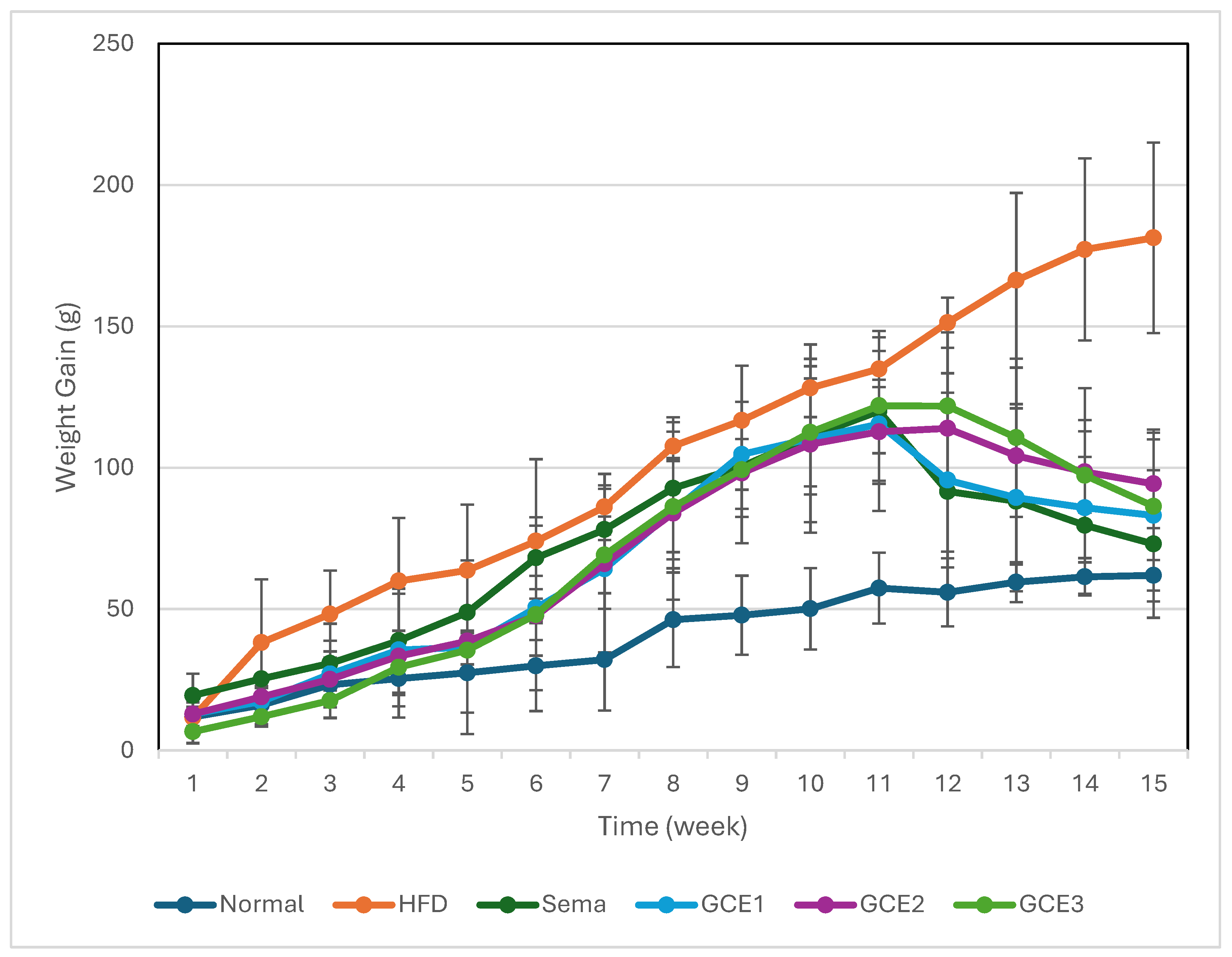
3.2.1. Weight Gain
3.2.2. Lee Index and Body Mass Index (BMI)
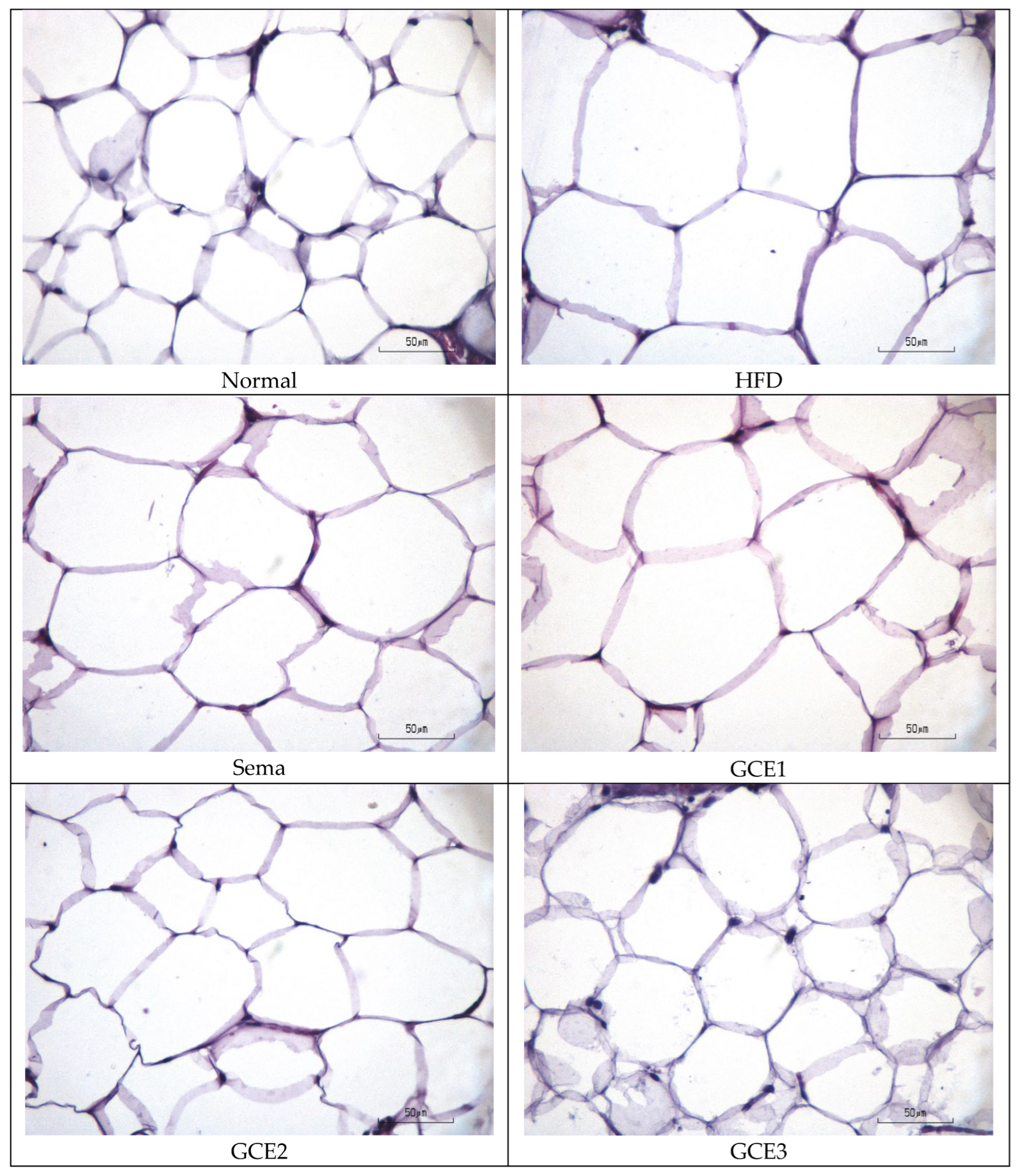
3.2.3. The Effects of G. coronopifolia Extract on Food Intake, Adiposity-Related Parameters, and Adipocyte Morphology in High-Fat Diet (HFD)-Induced Obese Rats
3.3. Effects of G. coronopifolia Extract on Metabolic Biomarkers and Gene Expression
3.3.1. Effects of G. coronopifolia Extract on Serum Adipokines and Lipid Profile in High-Fat Diet (HFD)-Induced Obese Rats
3.3.2. Gene Expression Analysis Related to Appetite Regulation and Lipid Metabolism
4. Discussion
4.1. Chemical Characterization and Biological Relevance
4.2. Physiological and Morphological Outcomes
4.3. Metabolic Biomarkers and Molecular Mechanisms
4.4. Positioning Novelty
5. Conclusions
Study Limitations
Supplementary Materials
Author Contributions
Funding
Institutional Review Board Statement
Informed Consent Statement
Data Availability Statement
Acknowledgments
Conflicts of Interest
References
- Ahmed, S.K.; Mohammed, R.A. Obesity: Prevalence, causes, consequences, management, preventive strategies and future research directions. Metab. Open 2025, 27, 100375. [Google Scholar] [CrossRef]
- Monda, A.; de Stefano, M.I.; Villano, I.; Allocca, S.; Casillo, M.; Messina, A.; Monda, V.; Moscatelli, F.; Dipace, A.; Limone, P.; et al. Ultra-Processed Food Intake and Increased Risk of Obesity: A Narrative Review. Foods 2024, 13, 2627. [Google Scholar] [CrossRef] [PubMed]
- Müller, T.D.; Blüher, M.; Tschöp, M.H.; DiMarchi, R.D. Anti-obesity drug discovery: Advances and challenges. Nat. Rev. Drug Discov. 2022, 21, 201–223. [Google Scholar] [CrossRef] [PubMed]
- Al-Noshokaty, T.M.; Abdelhamid, R.; Abdelmaksoud, N.M.; Khaled, A.; Hossam, M.; Ahmed, R.; Saber, T.; Khaled, S.; Elshaer, S.S.; Abulsoud, A.I. Unlocking the multifaceted roles of GLP-1: Physiological functions and therapeutic potential. Toxicol. Rep. 2025, 14, 101895. [Google Scholar] [CrossRef] [PubMed]
- Yaribeygi, H.; Jamialahmadi, T.; Moallem, S.A.; Sahebkar, A. Boosting GLP-1 by Natural Products. In Natural Products and Diabetes; Sahebkar, A., Ed.; Springer: Cham, Switzerland, 2021; pp. 513–522. [Google Scholar] [CrossRef]
- Monroy-García, I.N.; Torres-Romero, S.; Castro-Ochoa, L.D.; Mendoza-Acosta, A.; Viveros-Valdez, E.; Ayala-Zavala, F. Bioactive Compounds from Marine Macroalgae: A Natural Defense Against Oxidative Stress-Related Diseases. Stresses 2025, 5, 22. [Google Scholar] [CrossRef]
- Magwaza, S.N.; Islam, S. Roles of Marine Macroalgae or Seaweeds and Their Bioactive Compounds in Combating Overweight, Obesity and Diabetes: A Comprehensive Review. Mar. Drugs 2023, 21, 258. [Google Scholar] [CrossRef]
- Liu, L.; Chen, Y.; Chen, B.; Xu, M.; Liu, S.; Su, Y.; Qiao, K.; Liu, Z. Advances in Research on Marine-Derived Lipid-Lowering Active Substances and Their Molecular Mechanisms. Nutrients 2023, 15, 5118. [Google Scholar] [CrossRef]
- Pradhan, B.; Nayak, R.; Patra, S.; Jit, B.P.; Ragusa, A.; Jena, M. Bioactive Metabolites from Marine Algae as Potent Pharmacophores against Oxidative Stress-Associated Human Diseases: A Comprehensive Review. Molecules 2020, 26, 37. [Google Scholar] [CrossRef]
- Elbandy, M. Anti-Inflammatory Effects of Marine Bioactive Compounds and Their Potential as Functional Food Ingredients in the Prevention and Treatment of Neuroinflammatory Disorders. Molecules 2022, 28, 2. [Google Scholar] [CrossRef]
- Cadar, E.; Popescu, A.; Dragan, A.-M.; Pesterau, A.-M.; Pascale, C.; Anuta, V.; Prasacu, I.; Velescu, B.S.; Tomescu, C.L.; Bogdan-Andreescu, C.F.; et al. Bioactive Compounds of Marine Algae and Their Potential Health and Nutraceutical Applications: A Review. Mar. Drugs 2025, 23, 152. [Google Scholar] [CrossRef]
- Ullah, R.; Akhter, M.; Khan, A.B.S.; Yasmin, F.; Hasan, M.; Bosu, A.; Haque, M.A.; Islam, S.; Islam, A.; Mahmud, Y. Nutritional composition and phenolic contents of Gracilariopsis longissima, Padina tetrastromatica and Ulva intestinalis from the Bay of Bengal, Bangladesh coast. Heliyon 2024, 10, e31128. [Google Scholar] [CrossRef]
- Zhou, L.; Li, K.; Duan, X.; Hill, D.; Barrow, C.; Dunshea, F.; Martin, G.; Suleria, H. Bioactive compounds in microalgae and their potential health benefits. Food Biosci. 2022, 49, 101932. [Google Scholar] [CrossRef]
- Carpena, M.; Garcia-Perez, P.; Garcia-Oliveira, P.; Chamorro, F.; Otero, P.; Lourenço-Lopes, C.; Cao, H.; Simal-Gandara, J.; Prieto, M.A. Biological properties and potential of compounds extracted from red seaweeds. Phytochem. Rev. 2023, 22, 1509–1540. [Google Scholar] [CrossRef] [PubMed]
- Wang, Z.; Scherbinek, M.; Skurk, T. Algae and Algal Protein in Human Nutrition: A Narrative Review of Health Outcomes from Clinical Studies. Nutrients 2026, 18, 277. [Google Scholar] [CrossRef] [PubMed]
- Francis, I.O. Marine-Derived Compounds as Dual Modulators of Lipid Metabolism and Tumor Suppression in Obese Cancer Models. Newport Int. J. Sci. Exp. Sci. 2025, 6, 157–164. [Google Scholar] [CrossRef]
- Sobuj, M.K.A.; Islam, A.; Islam, S.; Islam, M.; Mahmud, Y.; Rafiquzzaman, S.M. Effect of solvents on bioactive compounds and antioxidant activity of Padina tetrastromatica and Gracilaria tenuistipitata seaweeds collected from Bangladesh. Sci. Rep. 2021, 11, 19082. [Google Scholar] [CrossRef]
- Dias, M.d.M.e.; dos Reis, S.A.; da Conceição, L.L.; Sediyama, C.M.N.d.O.; Pereira, S.S.; de Oliveira, L.L.; Peluzio, M.D.C.G.; Martinez, J.A.; Milagro, F.I. Diet-induced obesity in animal models: Points to consider and influence on metabolic markers. Diabetol. Metab. Syndr. 2021, 13, 32. [Google Scholar] [CrossRef]
- El Majnaoui, S.; Lekrati, M.; El Broudi, S.; Benkhalti, F.; Zehhar, N.; ElKaoua, M.; Belmouden, A.; Houari, A.; El Kadmiri, N. Effect of drying methods on phenolic compounds, antioxidant activity and surface colour of the potentially valuable Moroccan seaweeds Gracilaria gracilis and Ulva lactuca: Modelling the optimal treatment. J. Appl. Phycol. 2025, 6, 223–235. [Google Scholar] [CrossRef]
- Rachman, S.D.; Mukhtari, Z.; Soedjanaatmadja, R.U.M.S. Alga Merah (Gracilaria coronopifolia) sebagai Sumber Fitohormon Sitokinin yang Potensial. Chim. Nat. Acta 2017, 5, 124–131. [Google Scholar] [CrossRef]
- Windarsih, A.; Suratno Warmiko, H.D.; Indrianingsih, A.W.; Rohman, A.; Ulumuddin, Y.I. Untargeted metabolomics and proteomics approach using liquid chromatography-Orbitrap high resolution mass spectrometry to detect pork adulteration in Pangasius hypopthalmus meat. Food Chem. 2022, 386, 132856. [Google Scholar] [CrossRef]
- Dmour, I. Content Analysis of US FDA Warning Letters Issued to Compounding Pharmacies Regarding Violations of Current Good Manufacturing Practices Between 2017 and 2022. J. Pharm. Innov. 2023, 18, 965–979. [Google Scholar] [CrossRef] [PubMed]
- Tucović, D.; Popov Aleksandrov, A.; Popović, D.; Malešević, A.; Subota, V.; Brdarić, E.; Bajić, S.S.; Živković, M.; Kataranovski, M.; Mirkov, I.; et al. Differential Proneness to Obesity in Two Rat Strains with Diverse Immune Responses. Biology 2025, 14, 557. [Google Scholar] [CrossRef] [PubMed]
- Kasanen, I.H.E.; Inhilä, K.J.; Nevalainen, T.O.; Scheinin, M.; Savontaus, E. Effects of Dietary Restriction on Regulation of Energy Metabolism in Male Wistar Rats (Rattus norvegicus). J. Am. Assoc. Lab. Anim. Sci. 2025, 64, 744–749. [Google Scholar] [CrossRef]
- Yustisia, I.; Tandiari, D.; Cangara, M.H.; Hamid, F.; Daud, N.A.S. A high-fat, high-fructose diet induced hepatic steatosis, renal lesions, dyslipidemia, and hyperuricemia in non-obese rats. Heliyon 2022, 8, e10896. [Google Scholar] [CrossRef]
- Finan, B.; Douros, J.D.; Goldwater, R.; Hansen, A.M.K.; Hjerpsted, J.B.; Hjøllund, K.R.; Kankam, M.K.; Knerr, P.J.; Konkar, A.; Mowery, S.A.; et al. A once-daily GLP-1/GIP/glucagon receptor tri-agonist (NN1706) lowers body weight in rodents, monkeys and humans. Mol. Metab. 2025, 96, 102129. [Google Scholar] [CrossRef]
- Guo, M.; Li, C.; Lei, Y.; Xu, S.; Zhao, D.; Lu, X.-Y. Role of the adipose PPARγ-adiponectin axis in susceptibility to stress and depression/anxiety-related behaviors. Mol. Psychiatry 2017, 22, 1056–1068. [Google Scholar] [CrossRef]
- Damgaard, M.V.; Treebak, J.T. Protocol for qPCR analysis that corrects for cDNA amplification efficiency. STAR Protoc. 2022, 3, 101515. [Google Scholar] [CrossRef]
- Prakash, S.; Rai, U.; Kosuru, R.; Tiwari, V.; Singh, S. Amelioration of diet-induced metabolic syndrome and fatty liver with sitagliptin via regulation of adipose tissue inflammation and hepatic Adiponectin/AMPK levels in mice. Biochimie 2020, 168, 198–209. [Google Scholar] [CrossRef]
- Saftić Martinović, L.; Barbarić, A.; Gobin, I. Qualitative and Quantitative Mass Spectrometry Approaches for the Analysis of Phenolic Compounds in Complex Natural Matrices. Appl. Sci. 2025, 15, 12529. [Google Scholar] [CrossRef]
- Nguyen, V.; Taine, E.G.; Meng, D.; Cui, T.; Tan, W. Chlorogenic Acid: A Systematic Review on the Biological Functions, Mechanistic Actions, and Therapeutic Potentials. Nutrients 2024, 16, 924. [Google Scholar] [CrossRef] [PubMed]
- Dwitiyanti, D.; Harahap, Y.; Elya, B.; Bahtiar, A. Binahong (Anredera cordifolia (Tenore) Steen.) Leaf Extract Modulates Fatty Acids and Amino Acids to Lower Blood Glucose in High-Fat Diet-Induced Diabetes Mellitus Rats. Adv. Pharmacol. Pharm. Sci. 2021, 2021, 8869571. [Google Scholar] [CrossRef]
- Wardani, E.; Harahap, Y.; Mun’im, A.; Bahtiar, A. Evaluation of the Combination of Kemuning Leaves Extracts and Simvastatin on Blood fatty acids and amino acidsof Hyperlipidemic Model Rats. Res. J. Pharm. Technol. 2021, 14, 2076–2080. [Google Scholar] [CrossRef]
- Thibault, L. Animal Models of Dietary-Induced Obesity. In Animal Models for the Study of Human Disease; Elsevier: Amsterdam, The Netherlands, 2013; pp. 277–303. [Google Scholar] [CrossRef]
- Ma, Y.; Gao, M.; Liu, D. Chlorogenic Acid Improves High Fat Diet-Induced Hepatic Steatosis and Insulin Resistance in Mice. Pharm. Res. 2015, 32, 1200–1209. [Google Scholar] [CrossRef] [PubMed]
- Jung, C.H.; Cho, I.; Ahn, J.; Jeon, T.; Ha, T. Quercetin Reduces High-Fat Diet-Induced Fat Accumulation in the Liver by Regulating Lipid Metabolism Genes. Phytother. Res. 2013, 27, 139–143. [Google Scholar] [CrossRef] [PubMed]
- Zhao, J.; Cao, Q.; Xing, M.; Xiao, H.; Cheng, Z.; Song, S.; Ji, A. Advances in the Study of Marine Products with Lipid-Lowering Properties. Mar. Drugs 2020, 18, 390. [Google Scholar] [CrossRef] [PubMed]
- Micallef, M.A.; Garg, M.L. The Lipid-Lowering Effects of Phytosterols and (n-3) Polyunsaturated Fatty Acids Are Synergistic and Complementary in Hyperlipidemic Men and Women. J. Nutr. 2008, 138, 1086–1090. [Google Scholar] [CrossRef]
- Farhat, G. Polyphenols in obesity and weight management: Are they worth further research? An umbrella review. Nutr. Bull. 2024, 49, 126–131. [Google Scholar] [CrossRef]
- Yang, C.S.; Zhang, J.; Zhang, L.; Huang, J.; Wang, Y. Mechanisms of body weight reduction and metabolic syndrome alleviation by tea. Mol. Nutr. Food Res. 2016, 60, 160–174. [Google Scholar] [CrossRef]
- Chumphoochai, K.; Manohong, P.; Niamnont, N.; Tamtin, M.; Sobhon, P.; Meemon, K. Anti-Obesity Effects of Marine Macroalgae Extract Caulerpa lentillifera in a Caenorhabditis elegans Model. Mar. Drugs 2023, 21, 577. [Google Scholar] [CrossRef]
- Tucci, S.A. Phytochemicals in the Control of Human Appetite and Body Weight. Pharmaceuticals 2010, 3, 748–763. [Google Scholar] [CrossRef]
- Aloo, S.-O.; Ofosu, F.K.; Kim, N.-H.; Kilonzi, S.M.; Oh, D.-H. Insights on Dietary Polyphenols as Agents against Metabolic Disorders: Obesity as a Target Disease. Antioxidants 2023, 12, 416. [Google Scholar] [CrossRef] [PubMed]
- Magwaza, S.N.; Islam, M.S. Mechanisms behind the anti-diabetic and anti-obesity effects of seaweeds or macroalgae and their bioactive compounds. World J. Diabetes 2025, 16, 112847. [Google Scholar] [CrossRef] [PubMed]
- Clemente-Suárez, V.J.; Redondo-Flórez, L.; Beltrán-Velasco, A.I.; Martín-Rodríguez, A.; Martínez-Guardado, I.; Navarro-Jiménez, E.; Laborde-Cárdenas, C.C.; Tornero-Aguilera, J.F. The Role of Adipokines in Health and Disease. Biomedicines 2023, 11, 1290. [Google Scholar] [CrossRef]
- Janiszewska, J.; Ostrowska, J.; Szostak-Węgierek, D. The Influence of Nutrition on Adiponectin—A Narrative Review. Nutrients 2021, 13, 1394. [Google Scholar] [CrossRef]
- Fatollahi, A.; Salehi, E.; Daneshmand, M.A. Insight into triglyceride-reducing potential of quercetin in blood plasma environment. Process Biochem. 2023, 126, 200–215. [Google Scholar] [CrossRef]
- Millington, G.W. The role of proopiomelanocortin (POMC) neurones in feeding behaviour. Nutr. Metab. 2007, 4, 18. [Google Scholar] [CrossRef]
- Lodhi, I.J.; Yin, L.; Jensen-Urstad, A.P.; Funai, K.; Coleman, T.; Baird, J.H.; El Ramahi, M.K.; Razani, B.; Song, H.; Fu-Hsu, F.; et al. Inhibiting Adipose Tissue Lipogenesis Reprograms Thermogenesis and PPARγ Activation to Decrease Diet-Induced Obesity. Cell Metab. 2012, 16, 189–201. [Google Scholar] [CrossRef] [PubMed]



| RT (min) | m/z | Formula | Tentative Identification | Class | Relative Peak Area (%) | MSI Level |
|---|---|---|---|---|---|---|
| 14.022 | 367.336 | C27H44O | 22-dehydrocholesterol | Sterol | 2.0387 | Level 2 |
| 1.065 | 182.081 | C9H8O3 | p-coumaric acid | Phenolic acid | 0.0749 | Level 2 |
| 13.108 | 255.232 | C16H30O2 | Palmitoleic acid | Monounsaturated fatty acid (MUFA) | 0.0652 | Level 2 |
| 16.203 | 584.488 | C35H61N5O2 | N-[(2S)-1-{4-[{4[(3,3-dimethylbutyl)amino] phenyl}(3methylbutyl)amino]piperidin-1-yl}-4-methyl-1-oxopentan-2-yl]azepane-1-carboxamide | Amide | 0.0505 | Level 2 |
| 0.941 | 311.259 | C19H36O3 | 10-oxo-nonadecanoic acid | Oxo-fatty acid (fatty acid derivative) | 0.0487 | Level 2 |
| 2.715 | 353.088 | C16H18O9 | Chlorogenic acid | Phenolic acid | 0.0321 | Level 2 |
| 1.206 | 169.014 | C7H6O5 | Gallic acid | Phenolic acid | 0.0308 | Level 2 |
| 13.713 | 335.294 | C22H38O2 | Dihomo-γ-linolenic acid ethyl ester | PUFA (ω-6) | 0.0269 | Level 2 |
| 4.694 | 303.05 | C15H10O7 | Quercetin | Flavonoid | 0.0203 | Level 2 |
| 10.859 | 317.212 | C20H30O3 | (+/−)18-HEPE | PUFA derivative (ω-3 oxylipin) | 0.0127 | Level 2 |
| Group | Final Body Weight (g) | Lee Index | BMI |
|---|---|---|---|
| Normal | 197.1 ± 13.7 | 321.9 ± 11.6 | 0.60 ± 0.0 |
| HFD | 294.8 ± 43.3 a | 377.5 ± 21.9 a | 0.95 ± 0.2 a |
| Sema | 221.7 ± 36.1 | 345.6 ± 27.6 | 0.73 ± 0.1 b |
| GCE1 | 213.1 ± 27.8 b | 336.9 ± 20.3 | 0.68 ± 0.1 b |
| GCE2 | 220.7 ± 32.8 | 342.1 ± 16.7 | 0.71 ± 0.1 b |
| GCE3 | 215.2 ± 11.9 b | 326.1 ± 8.6 b | 0.64 ± 0.1 b |
| Parameters | Normal | HFD | Sema | GCE1 | GCE2 | GCE3 | |
|---|---|---|---|---|---|---|---|
| Food intake | HFD induction period (g/day) | 14.4 ± 1.1 | 15.5 ± 1.8 | 11.9 ± 0.6 | 14.2 ± 1.7 | 14.2 ± 0.8 | 13.6 ± 1.0 |
| After treatment (g/day) | 17.0 ± 1.2 | 17.2 ± 2.2 | 9.2 ± 2.3 ab | 13.1 ± 1.3 ab | 11.5 ± 0.9 ab | 9.4 ± 1.0 ab | |
| Adiposity parameters | Total Visceral Fat (g) | 4.02 ± 0.8 | 22.7 ± 2.3 a | 5.45 ± 0.7 b | 12.42 ± 1.2 b | 9.27 ± 1.06 b | 7.63 ± 1.2 b |
| Adiposity index (%) | 1.88 ± 0.3 | 6.39 ± 0.4 a | 2.37 ± 0.48 b | 5.51 ± 0.8 | 4.63 ± 0.4 b | 3.31 ± 0.22 b | |
| Adipocyte morphology | Circumference of the cell circle (µm) | 179.99 ± 21.7 | 301.56 ± 25.1 a | 219.71 ± 40.4 b | 273.32 ± 22.5 a | 261.56 ± 38.7 a | 236.10 ± 31.8 b |
| Diameter (µm) | 57.29 ± 6.9 | 95.99 ± 7.9 a | 69.94 ± 12.9 b | 87.00 ± 7.2 a | 83.26 ± 12.3 a | 75.15 ± 10.1 b | |
| Normal | HFD | Sema | GCE1 | GCE2 | GCE3 | ||
|---|---|---|---|---|---|---|---|
| Serum adipokines | Adiponectin | 831.47 ± 16.55 | 176.01 ± 12.86 a | 736.86 ± 23.05 b | 478.19 ± 57.02 ab | 541.02 ± 37.23 ab | 779.55 ± 15.66 b |
| Leptin | 3.79 ± 0.71 | 9.25 ± 0.52 a | 4.52 ± 0.17 b | 8.05 ± 0.47 a | 6.06 ± 0.67 ab | 4.94 ± 0.75 ab | |
| Amylin | 458.56 ± 32.49 | 1006.93 ± 28.09 a | 510.04 ± 14.57 b | 796.76 ± 37.8 ab | 651.56 ± 49.08 ab | 532.44 ± 30.00 ab | |
| Lipid profiles | Total cholesterol (mg/dL) | 81.52 ± 4.94 | 125.17 ± 1.77 a | 84.89 ± 7.36 b | 85.28 ± 3.64 b | 83.22 ± 3.44 b | 83.39 ± 3.68 b |
| Triglycerides (mg/dL) | 92.23 ± 5.54 | 185.46 ± 11.58 a | 115.13 ± 6.48 b | 143.26 ± 21.75 ab | 129.11 ± 33.43 b | 101.54 ± 24.29 b | |
| HDL (mg/dL) | 130.04 ± 20.90 | 59.71 ± 4.63 a | 79.17 ± 3.63 b | 87.08 ± 3.53 b | 86.43 ± 4.41 b | 75.64 ± 4.73 b |
| (A) Hypothalamus | (B) Adipose Tissue | ||||||
|---|---|---|---|---|---|---|---|
| Npy | Pomc | Mc4r | Fas | Cpt-1 | Adipor1 | Pparγ | |
| Normal | 1 | 1 | 1 | 1 | 1 | 1 | 1 |
| HFD | 17.8 ± 1.9 a | 0.72 ± 0.04 a | 0.57 ± 0.05 a | 2.53 ± 0.1 a | n.d | 1.63 ± 0.4 a | 3.95 ± 0.4 a |
| Sema | 9.3 ± 0.9 ab | 1.77 ± 0.15 ab | 1.19 ± 0.23 b | 3.53 ± 0.2 ab | 2.26 ± 0.05 a | 1.65 ± 0.6 b | 0.82 ± 0.1 b |
| GCE3 | 1.22 ± 0.2 b | 1.98 ± 0.29 ab | 1.36 ± 0.12 b | 1.6 ± 0.4 ab | 2.48 ± 0.4 a | 0.95 ± 0.5 b | 2.42 ± 0.7 ab |
Disclaimer/Publisher’s Note: The statements, opinions and data contained in all publications are solely those of the individual author(s) and contributor(s) and not of MDPI and/or the editor(s). MDPI and/or the editor(s) disclaim responsibility for any injury to people or property resulting from any ideas, methods, instructions or products referred to in the content. |
© 2026 by the authors. Licensee MDPI, Basel, Switzerland. This article is an open access article distributed under the terms and conditions of the Creative Commons Attribution (CC BY) license.
Share and Cite
Bahtiar, A.; Musyantika, L.; Wahyuni, T.; Utami, R.A.; Siriamornpun, S. Edible Marine Red Alga Gracilaria coronopifolia as a Potential Functional Ingredient: Chemical Profiling and Metabolic Effects in Diet-Induced Obese Rats. Foods 2026, 15, 1167. https://doi.org/10.3390/foods15071167
Bahtiar A, Musyantika L, Wahyuni T, Utami RA, Siriamornpun S. Edible Marine Red Alga Gracilaria coronopifolia as a Potential Functional Ingredient: Chemical Profiling and Metabolic Effects in Diet-Induced Obese Rats. Foods. 2026; 15(7):1167. https://doi.org/10.3390/foods15071167
Chicago/Turabian StyleBahtiar, Anton, Larissa Musyantika, Tri Wahyuni, Ratna Annisa Utami, and Sirithon Siriamornpun. 2026. "Edible Marine Red Alga Gracilaria coronopifolia as a Potential Functional Ingredient: Chemical Profiling and Metabolic Effects in Diet-Induced Obese Rats" Foods 15, no. 7: 1167. https://doi.org/10.3390/foods15071167
APA StyleBahtiar, A., Musyantika, L., Wahyuni, T., Utami, R. A., & Siriamornpun, S. (2026). Edible Marine Red Alga Gracilaria coronopifolia as a Potential Functional Ingredient: Chemical Profiling and Metabolic Effects in Diet-Induced Obese Rats. Foods, 15(7), 1167. https://doi.org/10.3390/foods15071167