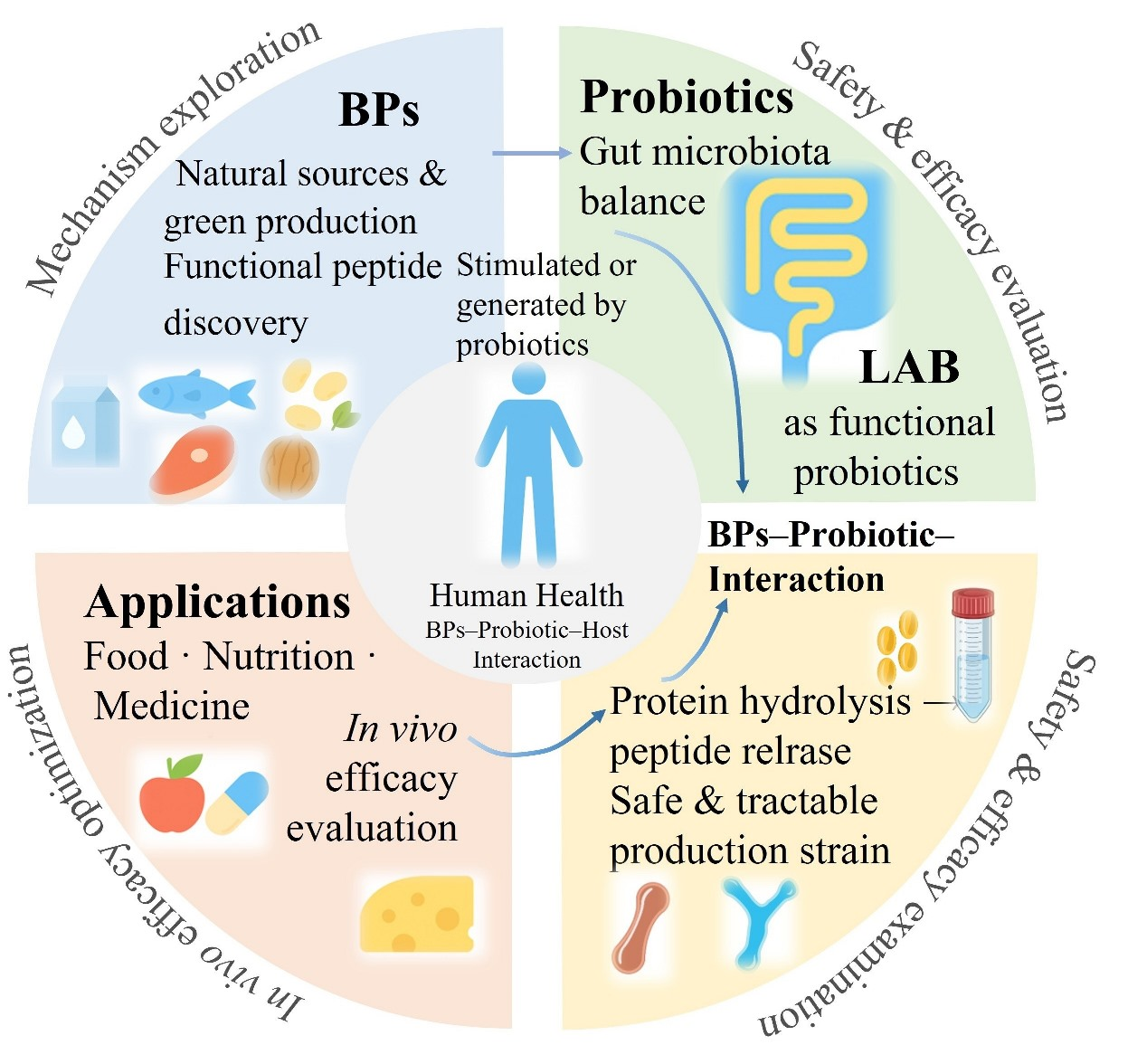
Bioactive Peptides–Probiotics Interactions: Implications for Microbial Function and Human Health

Abstract
1. Introduction
2. Sources and Production of BPs
2.1. Natural Sources of BPs and Their Biological Relevance
2.2. Technological Approaches to Protein Hydrolysate and Peptide Production
3. LAB-Peptides Functional Interactions
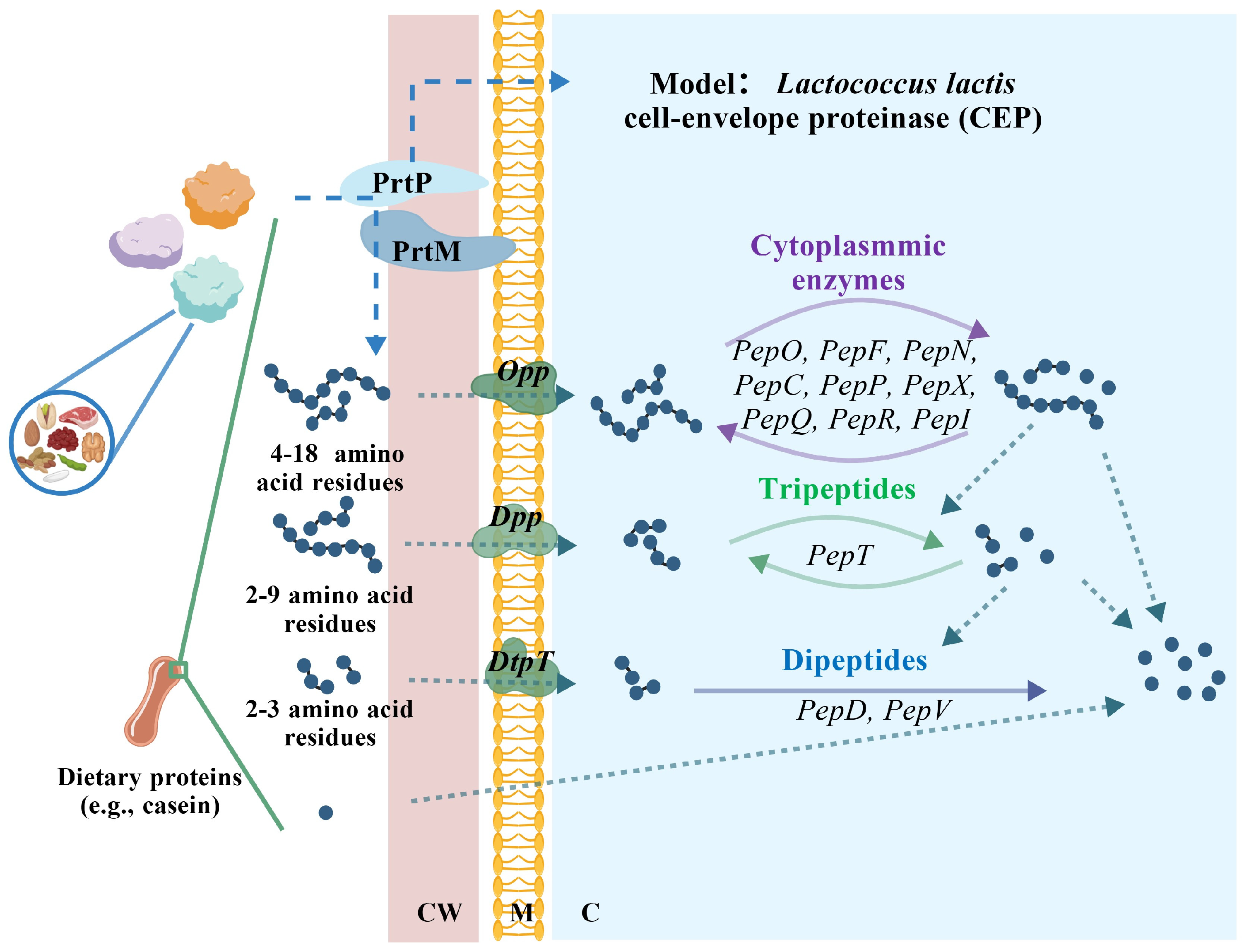
3.1. LAB Metabolism in Relation to Peptide Transport and Utilization
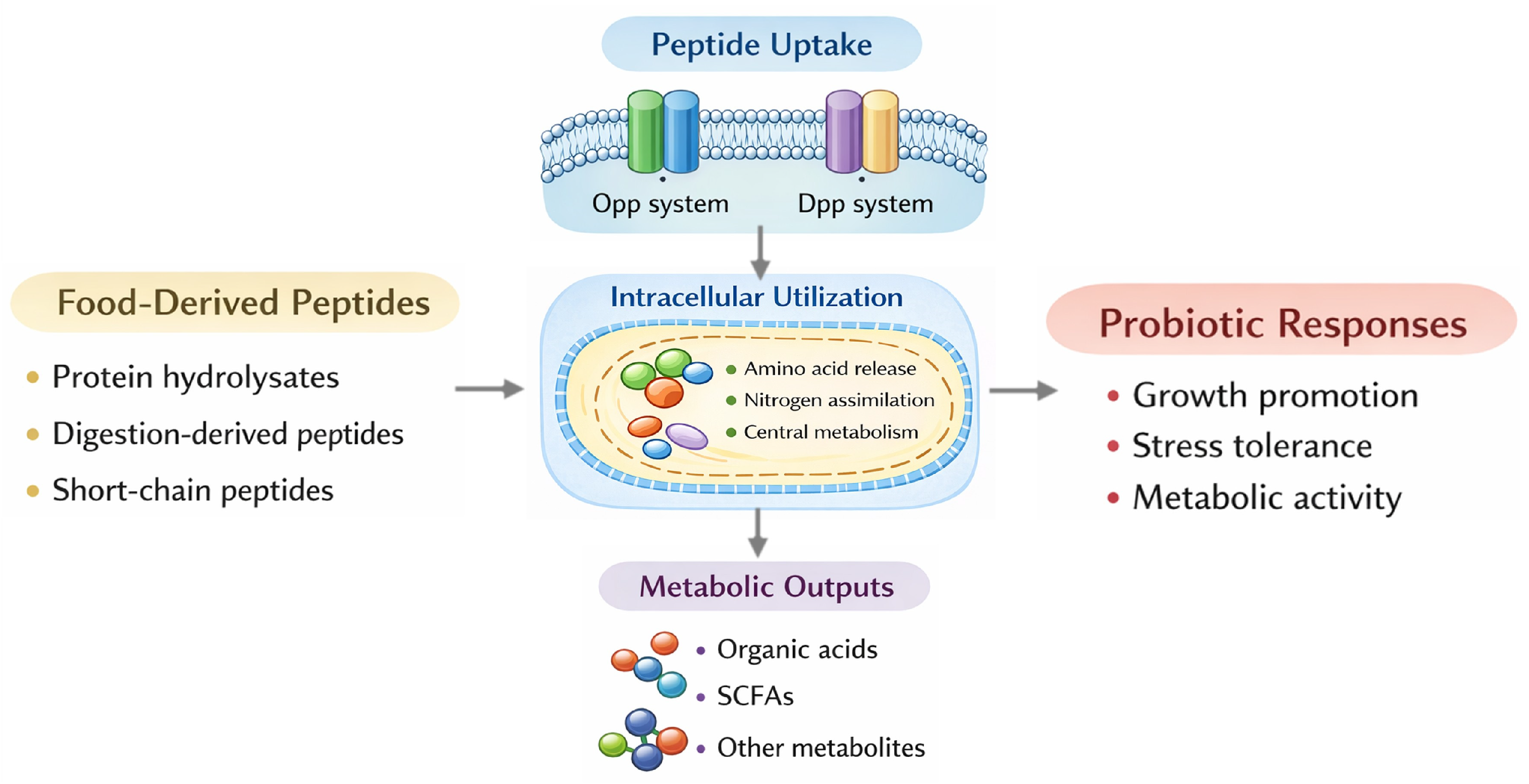
3.2. Peptide-Derived Modulation of Probiotic Activity
3.3. Structural Determinants and Peptide Composition Preferences of BP Functions
4. Recent Advances in the Effects of BPs on Probiotic Growth
5. LAB-BPs Interactions and Their Implications for Human Health
5.1. Effects of BPs on Probiotic Growth and Microbial Interactions
5.2. Modulation of Gut Microbiota and Functional Delivery of BPs and Probiotics
6. Current Challenges and Research Limitations
7. Conclusions and Future Perspectives
Author Contributions
Funding
Institutional Review Board Statement
Informed Consent Statement
Data Availability Statement
Conflicts of Interest
Abbreviations
| BPs | Bioactive peptides |
| LAB | Lactic acid bacteria |
| E. coli | Escherichia coli |
| MW | Molecular weight |
| SCFAs | Short-chain fatty acids |
| Opp | Oligopeptide permease |
| Dpp | Di-/tripeptide permease |
| RP-HPLC | Reversed-phase high-performance liquid chromatography |
| SEC-HPLC | Size exclusion chromatography-high-performance liquid chromatography |
References
- Fernando, I.P.S.; Wu, J. Food-Derived Bioactive Peptides: The Gateway to Reach the Full Potential of Food Proteins for Human Health. Trends Food Sci. Technol. 2025, 157, 104896. [Google Scholar] [CrossRef]
- Korhonen, H.; Pihlanto, A. Bioactive Peptides: Production and Functionality. Int. Dairy J. 2006, 16, 945–960. [Google Scholar] [CrossRef]
- Rui, X.; Boye, J.I.; Simpson, B.K.; Prasher, S.O. Angiotensin I-Converting Enzyme Inhibitory Properties of Phaseolus vulgaris Bean Hydrolysates: Effects of Different Thermal and Enzymatic Digestion Treatments. Food Res. Int. 2012, 49, 739–746. [Google Scholar] [CrossRef]
- Pavlicevic, M.; Maestri, E.; Marmiroli, M. Marine Bioactive Peptides—An Overview of Generation, Structure and Application with a Focus on Food Sources. Mar. Drugs 2020, 18, 424. [Google Scholar] [CrossRef] [PubMed]
- Wen, C.; Zhang, J.; Zhang, H.; Duan, Y.; Ma, H. Study on the Structure–Activity Relationship of Watermelon Seed Antioxidant Peptides by Using Molecular Simulations. Food Chem. 2021, 364, 130432. [Google Scholar] [CrossRef]
- Zhang, F.; Qu, J.; Thakur, K.; Zhang, J.-G.; Mocan, A.; Wei, Z.-J. Purification and Identification of an Antioxidative Peptide from Peony (Paeonia suffruticosa Andr.) Seed Dreg. Food Chem. 2019, 285, 266–274. [Google Scholar] [CrossRef] [PubMed]
- Forghani, B.; Zarei, M.; Ebrahimpour, A.; Philip, R.; Bakar, J.; Abdul Hamid, A.; Saari, N. Purification and Characterization of Angiotensin Converting Enzyme-Inhibitory Peptides Derived from Stichopus horrens: Stability Study against the ACE and Inhibition Kinetics. J. Funct. Foods 2016, 20, 276–290. [Google Scholar] [CrossRef]
- Zhao, J.; Guo, L.; Zeng, H.; Yang, X.; Yuan, J.; Shi, H.; Xiong, Y.; Chen, M.; Han, L.; Qiu, D. Purification and Characterization of a Novel Antimicrobial Peptide from Brevibacillus laterosporus Strain A60. Peptides 2012, 33, 206–211. [Google Scholar] [CrossRef]
- Zhang, Y.; Zhang, C.; Wang, J.; Wen, Y.; Li, H.; Liu, X. The Investigation of Soybean Protein Isolates and Soybean Peptides Assisting Lactobacillus plantarum K25 to Inhibit Escherichia coli. Curr. Res. Food Sci. 2024, 8, 100662. [Google Scholar] [CrossRef]
- Hill, C.; Guarner, F.; Reid, G.; Gibson, G.R.; Merenstein, D.J.; Pot, B.; Morelli, L.; Canani, R.B.; Flint, H.J.; Salminen, S.; et al. The International Scientific Association for Probiotics and Prebiotics Consensus Statement on the Scope and Appropriate Use of the Term Probiotic. Nat. Rev. Gastroenterol. Hepatol. 2014, 11, 506–514. [Google Scholar] [CrossRef]
- Gibson, G.R.; Hutkins, R.; Sanders, M.E.; Prescott, S.L.; Reimer, R.A.; Salminen, S.J.; Scott, K.; Stanton, C.; Swanson, K.S.; Cani, P.D.; et al. Expert Consensus Document: The International Scientific Association for Probiotics and Prebiotics (ISAPP) Consensus Statement on the Definition and Scope of Prebiotics. Nat. Rev. Gastroenterol. Hepatol. 2017, 14, 491–502. [Google Scholar] [CrossRef]
- Pandey, K.R.; Naik, S.R.; Vakil, B.V. Probiotics, Prebiotics and Synbiotics—A Review. J. Food Sci. Technol. 2015, 52, 7577–7587. [Google Scholar] [CrossRef] [PubMed]
- Shi, Z.; Fan, X.; Tu, M.; Wu, Z.; Pan, D. Comparison of Changes in Fermented Milk Quality Due to Differences in the Proteolytic System between Lactobacillus helveticus R0052 and Lactococcus lactis Subsp. lactis JCM5805. Food Biosci. 2023, 51, 102271. [Google Scholar] [CrossRef]
- Murali, S.K. Next Generation Probiotics: Engineering Live Biotherapeutics. Biotechnol. Adv. 2024, 72, 108336. [Google Scholar] [CrossRef]
- De Vos, W.M.; Tilg, H.; Van Hul, M.; Cani, P.D. Gut Microbiome and Health: Mechanistic Insights. Gut 2022, 71, 1020–1032. [Google Scholar] [CrossRef]
- Macpherson, A.J. Boundaries and Integration between Microbiota, the Nervous System, and Immunity. Immunity 2023, 56, 1712–1726. [Google Scholar] [CrossRef]
- Kunath, B.J.; De Rudder, C.; Laczny, C.C.; Letellier, E.; Wilmes, P. The Oral–Gut Microbiome Axis in Health and Disease. Nat. Rev. Microbiol. 2024, 22, 791–805. [Google Scholar] [CrossRef]
- Cani, P.D.; Van Hul, M. Gut Microbiota in Overweight and Obesity: Crosstalk with Adipose Tissue. Nat. Rev. Gastroenterol. Hepatol. 2024, 21, 164–183. [Google Scholar] [CrossRef]
- Hummel, S.; Veltman, K.; Cichon, C.; Sonnenborn, U.; Schmidt, M.A. Differential Targeting of the E-Cadherin/β-Catenin Complex by Gram-Positive Probiotic Lactobacilli Improves Epithelial Barrier Function. Appl. Environ. Microbiol. 2012, 78, 1140–1147. [Google Scholar] [CrossRef] [PubMed]
- Mennigen, R.; Nolte, K.; Rijcken, E.; Utech, M.; Loeffler, B.; Senninger, N.; Bruewer, M. Probiotic Mixture VSL#3 Protects the Epithelial Barrier by Maintaining Tight Junction Protein Expression and Preventing Apoptosis in a Murine Model of Colitis. Am. J. Physiol.-Gastrointest. Liver Physiol. 2009, 296, G1140–G1149. [Google Scholar] [CrossRef] [PubMed]
- Zyrek, A.A.; Cichon, C.; Helms, S.; Enders, C.; Sonnenborn, U.; Schmidt, M.A. Molecular Mechanisms Underlying the Probiotic Effects of Escherichia coli Nissle 1917 Involve ZO-2 and PKCz Redistribution Resulting in Tight Junction and Epithelial Barrier Repair. Cell. Microbiol. 2006, 9, 804–816. [Google Scholar] [CrossRef] [PubMed]
- Ali, S.; Hamayun, M.; Siraj, M.; Khan, S.A.; Kim, H.-Y.; Lee, B. Recent Advances in Prebiotics: Classification, Mechanisms, and Health Applications. Future Foods 2025, 12, 100680. [Google Scholar] [CrossRef]
- Gibson, G.R.; Probert, H.M.; Loo, J.V.; Rastall, R.A.; Roberfroid, M.B. Dietary Modulation of the Human Colonic Microbiota: Updating the Concept of Prebiotics. Nutr. Res. Rev. 2004, 17, 259–275. [Google Scholar] [CrossRef] [PubMed]
- Great Iruoghene, E.; Alice Njolke, M.; Ali, B.M.A.; Patrick Othuke, A.; Emad, Y.; Endurance Fegor, I. A Critical Review on the Impacts of β-Glucans on Gut Microbiota and Human Health. Microbe 2025, 7, 100394. [Google Scholar] [CrossRef]
- Van De Wouw, M.; Schellekens, H.; Dinan, T.G.; Cryan, J.F. Microbiota-Gut-Brain Axis: Modulator of Host Metabolism and Appetite. J. Nutr. 2017, 147, 727–745. [Google Scholar] [CrossRef]
- Venkataraman, A.; Sieber, J.R.; Schmidt, A.W.; Waldron, C.; Theis, K.R.; Schmidt, T.M. Variable Responses of Human Microbiomes to Dietary Supplementation with Resistant Starch. Microbiome 2016, 4, 33. [Google Scholar] [CrossRef]
- Dai, Z.; Wu, G.; Zhu, W. Amino Acid Metabolism in Intestinal Bacteria: Links between Gut Ecology and Host Health. Front. Biosci. 2011, 16, 1768. [Google Scholar] [CrossRef]
- Aloo, S.O.; Oh, D.-H. The Functional Interplay between Gut Microbiota, Protein Hydrolysates/Bioactive Peptides, and Obesity: A Critical Review on the Study Advances. Antioxidants 2022, 11, 333. [Google Scholar] [CrossRef]
- Mafe, A.N.; Edo, G.I.; Majeed, O.S.; Gaaz, T.S.; Akpoghelie, P.O.; Isoje, E.F.; Igbuku, U.A.; Owheruo, J.O.; Opiti, R.A.; Garba, Y.; et al. A Review on Probiotics and Dietary Bioactives: Insights on Metabolic Well-Being, Gut Microbiota, and Inflammatory Responses. Food Chem. Adv. 2025, 6, 100919. [Google Scholar] [CrossRef]
- Sun, C.; Zhu, J.; Sun, X.; Zhang, Z.; Sun, Y.; Jin, Y.; Wu, T. Targeting the Human Gut Microbiome: A Comparative Review of Probiotics, Prebiotics, Synbiotics, and Postbiotics. J. Adv. Res. 2025, in press. [Google Scholar] [CrossRef]
- Liu, G.; Chu, M.; Xu, P.; Nie, S.; Xu, X.; Ren, J. Effects of Ilisha elongata Proteins on Proliferation and Adhesion of Lactobacillus plantarum. Food Chem. X 2022, 13, 100206. [Google Scholar] [CrossRef]
- Yu, Y.-J.; Amorim, M.; Marques, C.; Calhau, C.; Pintado, M. Effects of Whey Peptide Extract on the Growth of Probiotics and Gut Microbiota. J. Funct. Foods 2016, 21, 507–516. [Google Scholar] [CrossRef]
- Lazzi, C.; Meli, F.; Lambertini, F.; Bottesini, C.; Nikolaev, I.; Gatti, M.; Sforza, S.; Koroleva, O.; Popov, V.; Neviani, E.; et al. Growth Promotion of Bifidobacterium and Lactobacillus Species by Proteinaceous Hydrolysates Derived from Poultry Processing Leftovers. Int. J. Food Sci. Technol. 2013, 48, 341–349. [Google Scholar] [CrossRef]
- Li, W.; Zhang, Y.; Li, H.; Zhang, C.; Zhang, J.; Uddin, J.; Liu, X. Effect of Soybean Oligopeptide on the Growth and Metabolism of Lactobacillus acidophilus JCM 1132. RSC Adv. 2020, 10, 16737–16748. [Google Scholar] [CrossRef]
- Meli, F.; Lazzi, C.; Neviani, E.; Gatti, M. Effect of Protein Hydrolysates on Growth Kinetics and Aminopeptidase Activities of Lactobacillus. Curr. Microbiol. 2014, 68, 82–87. [Google Scholar] [CrossRef]
- Zhang, H.; Huang, X.; Zhang, Y. Silver Carp (Hypophthalmichthys molitrix) by-Product Hydrolysates: A New Nitrogen Source for Bifidobacterium animalis Ssp. lactis BB-12. Food Chem. 2023, 404, 134630. [Google Scholar] [CrossRef] [PubMed]
- Yi, Y.; Chen, M.; Coldea, T.E. Soy Protein Hydrolysates Induce Menaquinone-7 Biosynthesis by Enhancing the Biofilm Formation of Bacillus subtilis Natto. Food Microbiol. 2024, 124, 104599. [Google Scholar] [CrossRef] [PubMed]
- Huang, L.; Wu, Y.; Fan, Y.; Su, Y.; Liu, Z.; Bai, J.; Zhao, X.; Li, Y.; Xie, X.; Zhang, J.; et al. The Growth-Promoting Effects of Protein Hydrolysates and Their Derived Peptides on Probiotics: Structure-Activity Relationships, Mechanisms and Future Perspectives. Crit. Rev. Food Sci. Nutr. 2025, 65, 4401–4420. [Google Scholar] [CrossRef] [PubMed]
- Wang, Y.; Wang, J.; Wen, Y.; Zhang, Y.; Wang, R.; Liu, Y.; Li, H.; Li, Y.; Zhang, C. Effect of Soybean Proteins and Peptides on the Growth and Adhesive Ability of Limosilactobacillus reuteri DSM17938. Arch. Microbiol. 2024, 206, 322. [Google Scholar] [CrossRef]
- Pessione, E.; Cirrincione, S. Bioactive Molecules Released in Food by Lactic Acid Bacteria: Encrypted Peptides and Biogenic Amines. Front. Microbiol. 2016, 7, 876. [Google Scholar] [CrossRef]
- Robitaille, G.; Lapointe, C.; Leclerc, D.; Britten, M. Effect of Pepsin-Treated Bovine and Goat Caseinomacropeptide on Escherichia coli and Lactobacillus rhamnosus in Acidic Conditions. J. Dairy Sci. 2012, 95, 1–8. [Google Scholar] [CrossRef] [PubMed]
- Zhang, C.; Zhang, Y.; Liu, G.; Li, W.; Xia, S.; Li, H.; Liu, X. Effects of Soybean Protein Isolates and Peptides on the Growth and Metabolism of Lactobacillus rhamnosus. J. Funct. Foods 2021, 77, 104335. [Google Scholar] [CrossRef]
- Xu, Y.; Nie, S.; Wang, M. Walnut-Derived Peptide PPKNW Alleviate Polystyrene Microparticles-Induced Growth Inhibition of Lactobacillus rhamnosus GG. Food Biosci. 2023, 53, 102528. [Google Scholar] [CrossRef]
- Kayamori, F.; Hirata, M.; Kariya, T.; Arimoto, Y.; Osawa, R.; Ishikawa, M.; Endoh, T.; Nakanishi, N.; Usui, K. Development of a Microwave-Assisted Method for Enhancing the Cellular Uptake of Arginine-Rich Peptides. Processes 2026, 14, 497. [Google Scholar]
- Savijoki, K.; Ingmer, H.; Varmanen, P. Proteolytic Systems of Lactic Acid Bacteria. Appl. Microbiol. Biotechnol. 2006, 71, 394–406. [Google Scholar] [CrossRef] [PubMed]
- Pritchard, G.G.; Coolbear, T. The Physiology and Biochemistry of the Proteolytic System in Lactic Acid Bacteria. FEMS Microbiol. Rev. 1993, 12, 179–206. [Google Scholar] [CrossRef]
- Zhang, X.; Song, X.; Hu, X.; Chen, F.; Ma, C. Health Benefits of Proanthocyanidins Linking with Gastrointestinal Modulation: An Updated Review. Food Chem. 2022, 143, 134596. [Google Scholar] [CrossRef]
- Cabanos, C.; Matsuoka, Y.; Maruyama, N. Soybean Proteins/Peptides: A Review on Their Importance, Biosynthesis, Vacuolar Sorting, and Accumulation in Seeds. Peptides 2021, 143, 170598. [Google Scholar] [CrossRef]
- Dong, Y.; Chen, X.; Abdelnaby, T.; Guyonnet, V.; Cai, X.; Wang, S. Regulatory Potential of Food-Derived Bioactive Peptides on Gut Microbiota: A New Perspective against Immune-Mediated Inflammatory Diseases. J. Agric. Food Chem. 2025, 73, 17403–17416. [Google Scholar] [CrossRef]
- Yang, K.; Mei, J.; Xie, J. Preparation, Identification, and Applications of Protein Hydrolysates from Blue Foods by-Products. Trends Food Sci. Technol. 2024, 148, 104524. [Google Scholar] [CrossRef]
- Kitts, D.; Weiler, K. Bioactive Proteins and Peptides from Food Sources. Applications of Bioprocesses Used in Isolation and Recovery. Curr. Pharm. Des. 2003, 9, 1309–1323. [Google Scholar] [CrossRef] [PubMed]
- Rizzello, C.G.; Tagliazucchi, D.; Babini, E.; Sefora Rutella, G.; Taneyo Saa, D.L.; Gianotti, A. Bioactive Peptides from Vegetable Food Matrices: Research Trends and Novel Biotechnologies for Synthesis and Recovery. J. Funct. Foods 2016, 27, 549–569. [Google Scholar] [CrossRef]
- Feng, Y.; Song, Y.; Zhou, J.; Duan, Y.; Kong, T.; Ma, H.; Zhang, H. Recent Progress of Lycium barbarum Polysaccharides on Intestinal Microbiota, Microbial Metabolites and Health: A Review. Crit. Rev. Food Sci. Nutr. 2024, 64, 2917–2940. [Google Scholar] [CrossRef] [PubMed]
- Wang, Y.-Y.; Wang, C.-Y.; Wang, S.-T.; Li, Y.-Q.; Mo, H.-Z.; He, J.-X. Physicochemical Properties and Antioxidant Activities of Tree Peony (Paeonia suffruticosa Andr.) Seed Protein Hydrolysates Obtained with Different Proteases. Food Chem. 2021, 345, 128765. [Google Scholar] [CrossRef]
- Liu, Y.; Wang, L.; Hu, X.; Luo, S.; Liu, C.; Ye, J. Bioactivity and Structural Characterization of Black Sesame Protein Hydrolysate: Impact of Enzymatic Hydrolysis Strategies. Food Biosci. 2026, 76, 108215. [Google Scholar] [CrossRef]
- Gan, J.; Ji, Y.; Sheng, Q.; Wang, C.; Shen, X. Characterization of the Physicochemical Property, Antioxidant Activity and Hypoglycemic Potential of Quinoa Protein Hydrolysates. Food Biosci. 2025, 68, 106685. [Google Scholar] [CrossRef]
- Ashraf, J.; Liu, L.; Awais, M.; Xiao, T.; Wang, L.; Zhou, X.; Tong, L.-T.; Zhou, S. Effect of Thermosonication Pre-Treatment on Mung Bean (Vigna radiata) and White Kidney Bean (Phaseolus vulgaris) Proteins: Enzymatic Hydrolysis, Cholesterol Lowering Activity and Structural Characterization. Ultrason. Sonochem. 2020, 66, 105121. [Google Scholar] [CrossRef]
- Wang, X.; Zhang, X. Separation, Antitumor Activities, and Encapsulation of Polypeptide from Chlorella pyrenoidosa. Biotechnol. Prog. 2013, 29, 681–687. [Google Scholar] [CrossRef] [PubMed]
- Saalia, F.K.; Yada, R.Y. The Effect of Thermal and Ultrasonic Treatment on Amino Acid Composition, Radical Scavenging and Reducing Potential of Hydrolysates Obtained from Simulated Gastrointestinal Digestion of Cowpea Proteins. Plant Foods Hum. Nutr. 2013, 68, 31–38. [Google Scholar] [CrossRef]
- Li, P.; Jia, J.; Fang, M.; Zhang, L.; Guo, M.; Xie, J.; Xia, Y.; Zhou, L.; Wei, D. In Vitro and In Vivo ACE Inhibitory of Pistachio Hydrolysates and In Silico Mechanism of Identified Peptide Binding with ACE. Process Biochem. 2014, 49, 898–904. [Google Scholar] [CrossRef]
- Li, W.; Li, H.; Zhang, Y.; He, L.; Zhang, C.; Liu, X. Different Effects of Soybean Protein and Its Derived Peptides on the Growth and Metabolism of Bifidobacterium animalis Subsp. animalis JCM 1190. Food Funct. 2021, 12, 5731–5744. [Google Scholar] [CrossRef]
- Liu, C.; Fang, L.; Min, W.; Liu, J.; Li, H. Exploration of the Molecular Interactions between Angiotensin-I-Converting Enzyme (ACE) and the Inhibitory Peptides Derived from Hazelnut (Corylus heterophylla Fisch.). Food Chem. 2018, 245, 471–480. [Google Scholar] [CrossRef]
- Zhu, D.; Yuan, Z.; Wu, D.; Wu, C.; El-Seedi, H.R.; Du, M. The Dual-Function of Bioactive Peptides Derived from Oyster (Crassostrea gigas) Proteins Hydrolysates. Food Sci. Hum. Wellness 2023, 12, 1609–1617. [Google Scholar] [CrossRef]
- Lei, B.; Majumder, K.; Shen, S.; Wu, J. Effect of Sonication on Thermolysin Hydrolysis of Ovotransferrin. Food Chem. 2011, 124, 808–815. [Google Scholar] [CrossRef]
- Oda, H.; Wakabayashi, H.; Yamauchi, K.; Sato, T.; Xiao, J.-Z.; Abe, F.; Iwatsuki, K. Isolation of a Bifidogenic Peptide from the Pepsin Hydrolysate of Bovine Lactoferrin. Appl. Environ. Microbiol. 2013, 79, 1843–1849. [Google Scholar] [CrossRef] [PubMed]
- Zeng, Y.; Cheng, H.; Zhong, R.; Zhong, W.; Zheng, R.; Miao, J. Novel Immunomodulatory Peptides from Hydrolysates of the Rana Spinosa (Quasipaa spinosa) Meat and Their Immunomodulatory Activity Mechanism. Food Chem. 2025, 465, 142024. [Google Scholar] [CrossRef] [PubMed]
- Sun, L.; Wang, X.; Li, R.; Dong, W.; Gong, T.; Song, W.; Li, M.; Zhang, S.; Huang, S.; Gao, J. Preparation, Characterization, Antioxidant Activity Evaluation, and Potential Application of Peruvian Squid Liver Protein Hydrolysates. Food Chem. X 2025, 30, 102998. [Google Scholar] [CrossRef] [PubMed]
- Li, Z.; Zhao, S.; Xin, X.; Zhang, B.; Thomas, A.; Charles, A.; Lee, K.S.; Jin, B.R.; Gui, Z. Purification and Characterization of a Novel Immunomodulatory Hexapeptide from Alcalase Hydrolysate of Ultramicro-Pretreated Silkworm (Bombyx mori) Pupa Protein. J. Asia-Pac. Entomol. 2019, 22, 633–637. [Google Scholar] [CrossRef]
- Chen, J.; Bai, W.; Cai, D.; Yu, Z.; Xu, B. Characterization and Identification of Novel Anti-Inflammatory Peptides from Baijiao Sea Bass (Lateolabrax maculatus). LWT 2021, 147, 111521. [Google Scholar] [CrossRef]
- Jiang, Y.; Li, S.; Yuan, R.; Tuo, Y.; Mu, G.; Jiang, S. Preparation of Casein Hydrolysate by Two-Step Enzymatic Hydrolysis and Its Immunomodulatory Activities In Vitro and In Vivo. Food Biosci. 2024, 59, 104007. [Google Scholar] [CrossRef]
- Basiricò, L.; Catalani, E.; Morera, P.; Cattaneo, S.; Stuknytė, M.; Bernabucci, U.; De Noni, I.; Nardone, A. Release of Angiotensin Converting Enzyme-Inhibitor Peptides during In Vitro Gastrointestinal Digestion of Parmigiano Reggiano PDO Cheese and Their Absorption through an in Vitro Model of Intestinal Epithelium. J. Dairy Sci. 2015, 98, 7595–7601. [Google Scholar] [CrossRef] [PubMed]
- Adjonu, R.; Doran, G.; Torley, P.; Agboola, S. Screening of Whey Protein Isolate Hydrolysates for Their Dual Functionality: Influence of Heat Pre-Treatment and Enzyme Specificity. Food Chem. 2013, 136, 1435–1443. [Google Scholar] [CrossRef]
- Kleekayai, T.; O’Neill, A.; Clarke, S.; Holmes, N.; O’Sullivan, B.; FitzGerald, R.J. Contribution of Hydrolysis and Drying Conditions to Whey Protein Hydrolysate Characteristics and In Vitro Antioxidative Properties. Antioxidants 2022, 11, 399. [Google Scholar] [CrossRef]
- Jin, Y.; Yu, Y.; Qi, Y.; Wang, F.; Yan, J.; Zou, H. Peptide Profiling and the Bioactivity Character of Yogurt in the Simulated Gastrointestinal Digestion. J. Proteom. 2016, 141, 24–46. [Google Scholar] [CrossRef]
- Noptana, R.; McClements, D.J.; McLandsborough, L.A.; Onsaard, W.; Onsaard, E. Application of Sesame Peptides in Soymilk: Impact of Food Matrix Effects on Antibacterial Activity of Natural Plant-Based Preservatives. Food Control 2026, 181, 111732. [Google Scholar] [CrossRef]
- Ranok, A.; Musika, S.; Katemala, S.; Thawornkuno, C.; Kosinan, A.; Luasiri, P.; Sangsawad, P.; Khongla, C. Dough Grain Rice Bran Hydrolysate Characterization and Stability of Biofunctional Peptides; Antioxidants and ACE/DPP-IV Inhibitory Activities during In-Vitro Gastrointestinal Digestion. Food Biosci. 2025, 71, 107370. [Google Scholar] [CrossRef]
- Ji, X.; Chen, J.; Zhang, J.; Peng, Z. Keratinase Efficiently Hydrolyses Corn Gluten Meal to Produce Antioxidant Peptides. Food Biosci. 2025, 73, 107785. [Google Scholar] [CrossRef]
- Dan, Y.; Lai, Y.; Wu, Y.; He, Q.; Zhao, Y. Novel Wheat Peptide GYP Ameliorates Helicobacter pylori Infection with AMPK Activation. J. Agric. Food Res. 2026, 26, 102697. [Google Scholar] [CrossRef]
- Cai, J.; Liu, Y.-Y.; Li, M.-C.; Guo, X.-X.; Liao, A.-M.; Hou, Y.-C.; Liu, Q.-P.; Fan, Y.-C.; Pan, L.; Huang, J.-H. Wheat Germ Peptides Enhance Hypoxia Tolerance by Modulating Gut Microbiota and Reprogramming Brain Energy Metabolism in Mice. Food Biosci. 2025, 74, 108055. [Google Scholar] [CrossRef]
- Alnuaimi, A.; Fisayo Ajayi, F.; Hamdi, M.; Mudgil, P.; Kamal, H.; Yuen Gan, C.; Maqsood, S. A Comparative Analysis of Anti-Lipidemic Potential of Soybean (Glycine max) Protein Hydrolysates Obtained from Different Ripening Stages: Identification, and Molecular Interaction Mechanisms of Novel Bioactive Peptides. Food Chem. 2022, 402, 134192. [Google Scholar] [CrossRef]
- Li, J.; Hu, H.; Chen, X.; Zhu, H.; Zhang, W.; Tai, Z.; Yu, X.; He, Q. A Novel ACE Inhibitory Peptide from Douchi hydrolysate: Stability, Inhibition Mechanism, and Antihypertensive Potential in Spontaneously Hypertensive Rats. Food Chem. 2024, 460, 140734. [Google Scholar] [CrossRef]
- Kruså, M.; Torre, M.; Marina, M.L. A Reversed-Phase High-Performance Liquid Chromatographic Method for the Determination of Soya Bean Proteins in Bovine Milks. Anal. Chem. 2000, 72, 1814–1818. [Google Scholar] [CrossRef]
- Zhang, Y.; Zhang, C.; Zhu, S.; Wang, J.; Li, H.; Liu, X. Identification and Characterization of Soybean Peptides and Their Fractions Used by Lacticaseibacillus rhamnosus Lra05. Food Chem. 2023, 401, 134195. [Google Scholar] [CrossRef]
- Wang, J.; Zhang, C.; Wen, Y.; Zhang, Y.; Zhu, S.; Liu, X. Investigating the Antibacterial Mode of Limosilactobacillus reuteri LR08 Regulated by Soybean Proteins and Peptides. Food Chem. 2024, 446, 138780. [Google Scholar] [CrossRef] [PubMed]
- Etoh, S.; Asamura, K.; Obu, A. Purification and Identification of a Growth-Stimulating Peptide for Bifidobacterium bifidum from Natural Rubber Serum Powder. Biosci. Biotechnol. Biochem. 2000, 64, 2083–2088. [Google Scholar] [CrossRef] [PubMed]
- Taniguchi, M.; Kameda, M.; Namae, T.; Ochiai, A.; Saitoh, E.; Tanaka, T. Identification and Characterization of Multifunctional Cationic Peptides Derived from Peptic Hydrolysates of Rice Bran Protein. J. Funct. Foods 2017, 34, 287–296. [Google Scholar] [CrossRef]
- Bottari, B.; Quartieri, A.; Prandi, B.; Raimondi, S.; Leonardi, A.; Rossi, M. Characterization of the Peptide Fraction from Digested Parmigiano Reggiano Cheese and Its Effect on Growth of Lactobacilli and Bifidobacteria. Int. J. Food Microbiol. 2017, 255, 32–41. [Google Scholar] [CrossRef]
- Zhao, W.; Zhang, D.; Yu, Z.; Ding, L.; Liu, J. Novel Membrane Peptidase Inhibitory Peptides with Activity against Angiotensin Converting Enzyme and Dipeptidyl Peptidase IV Identified from Hen Eggs. J. Funct. Foods 2020, 64, 103649. [Google Scholar] [CrossRef]
- Zhao, W.; Tan, L.; Zhang, Q.; Chen, F.; Yu, Z. In Silico Identification and Mechanistic Evaluation of Novel Tyrosinase Inhibitory Peptides Derived from Coconut Proteins. Food Biosci. 2024, 61, 104595. [Google Scholar] [CrossRef]
- Sumny, E.H.; Cunico, L.; Giorgio De Oliveira Cécere, B.; Shafer Da Silva, A.; Kempka, A.P. Comparative Analysis of Non-Fermented and Saccharomyces Boulardii-Fermented Whey: Peptidomic Profiling, In Silico Bioactive Peptide Analysis, and in Vivo Evaluation of Serum Proteins and Immune Response. Int. Dairy J. 2025, 166, 106222. [Google Scholar] [CrossRef]
- Zheng, X.; Zou, B.; Zhang, J. Recent Advances of Ultrasound-Assisted Technology on Aquatic Protein Processing: Extraction, Modification, and Freezing/Thawing-Induced Oxidation. Trends Food Sci. Technol. 2024, 144, 104309. [Google Scholar] [CrossRef]
- Ruan, S.; Li, Y.; Wang, Y.; Huang, S.; Luo, J.; Ma, H. Analysis in Protein Profile, Antioxidant Activity and Structure-Activity Relationship Based on Ultrasound-Assisted Liquid-State Fermentation of Soybean Meal with Bacillus subtilis. Ultrason. Sonochem. 2020, 64, 104846. [Google Scholar] [CrossRef] [PubMed]
- Pacheco, A.F.C. Bibliometric Analysis of Pumpkin Seed Proteins: A Review of the Multifunctional Properties of Their Hydrolysates and Future Perspectives. Food Biosci. 2024, 59, 104269. [Google Scholar] [CrossRef]
- Singh, B.P.; Vij, S. Growth and Bioactive Peptides Production Potential of Lactobacillus Plantarum Strain C2 in Soy Milk: A LC-MS/MS Based Revelation for Peptides Biofunctionality. LWT 2017, 86, 293–301. [Google Scholar] [CrossRef]
- Freitas, C.S.; Vericimo, M.A.; Da Silva, M.L.; Da Costa, G.C.V.; Pereira, P.R.; Paschoalin, V.M.F.; Del Aguila, E.M. Encrypted Antimicrobial and Antitumoral Peptides Recovered from a Protein-Rich Soybean (Glycine max) by-Product. J. Funct. Foods 2019, 54, 187–198. [Google Scholar] [CrossRef]
- Raveschot, C.; Cudennec, B.; Coutte, F.; Flahaut, C.; Fremont, M.; Drider, D.; Dhulster, P. Production of Bioactive Peptides by Lactobacillus Species: From Gene to Application. Front. Microbiol. 2018, 9, 2354. [Google Scholar] [CrossRef]
- Sun, J.; Chen, Y.; Yang, Y.; Chen, H.; Zhang, J.; Wang, S.; Bai, D.; Sun, Z.; Song, J.; Dai, L. Research Progress on Bioactive Peptides from Animal Sources: A Comprehensive Review. Food Chem. 2025, 490, 145006. [Google Scholar] [CrossRef]
- Yu, T.; Yuan, B.; Huang, J.; Wang, R.; Huang, G.; Huang, D.; Xiao, J. Characterisation of the Physicochemical, Functional and Antioxidant Properties of House Cricket (Acheta domesticus) Protein Hydrolysate Processed with Six Proteases. LWT 2025, 227, 118007. [Google Scholar] [CrossRef]
- Ding, J.; Dong, L.; Jiang, P.; Tang, Y.; Lin, S. Regulation of Action Sites for Reducing the Allergenicity of Pea Protein Based on Enzymatic Hydrolysis with Alcalase. Food Chem. 2023, 398, 133930. [Google Scholar] [CrossRef]
- Nawaz, M.A.; Buckow, R.; Jegasothy, H.; Stockmann, R. Enzymatic Hydrolysis Improves the Stability of UHT Treated Faba Bean Protein Emulsions. Food Bioprod. Process. 2022, 132, 200–210. [Google Scholar] [CrossRef]
- Yang, K.; Xu, T.-R.; Fu, Y.-H.; Cai, M.; Xia, Q.-L.; Guan, R.-F.; Zou, X.-G.; Sun, P.-L. Effects of Ultrasonic Pre-Treatment on Physicochemical Properties of Proteins Extracted from Cold-Pressed Sesame Cake. Food Res. Int. 2021, 139, 109907. [Google Scholar] [CrossRef]
- Kaemper, C.; Mossburger, J.; Geyer, M.; Hartl, L.; Geisslitz, S.; Scherf, K.A. Comparative Shotgun Proteomics Analysis of Wheat Gluten Proteins Digested by Various Peptidases. Curr. Res. Food Sci. 2025, 11, 101095. [Google Scholar] [CrossRef]
- Rios-Morales, S.N.; Tacias-Pascacio, V.G.; Aguilar-Uscanga, M.G.; Torrestiana-Sánchez, B. Sequential Enzymatic Hydrolysis of Egg Yolk Proteins: Kinetics, Functionality, and Bioactivity of Hydrolysates. Int. J. Biol. Macromol. 2025, 318, 145163. [Google Scholar] [CrossRef]
- Hanh, V.T.; Kobayashi, Y.; Maebuchi, M.; Nakamori, T.; Tanaka, M.; Matsui, T. Quantitative Mass Spectrometric Analysis of Dipeptides in Protein Hydrolysate by a TNBS Derivatization-Aided Standard Addition Method. Food Chem. 2016, 190, 345–350. [Google Scholar] [CrossRef]
- Zhang, A.; Ou, M.; Wu, P.; Zheng, K.; Zhang, H.; Yu, Y.; Guo, Y.; Zhang, T.; Pan, D.; Wu, Z. Coupled Effect of Nutritional Food Molecules and Lactobacillus reuteri Surface Protein Interaction on the Bacterial Gastrointestinal Tolerance. Foods 2024, 13, 3685. [Google Scholar] [CrossRef]
- Zhang, Y.; Zhu, S.; Zhang, C.; Soliman, M.M.; Li, H.; Liu, X. Transcriptome Analysis Revealing the Mechanism of Soybean Protein Isolates and Soybean Peptides on Lacticaseibacillus rhamnosus Lra05. Food Biosci. 2022, 47, 101681. [Google Scholar] [CrossRef]
- Zhang, C. Identification of Soybean Peptides and Their Effect on the Growth and Metabolism of Limosilactobacillus reuteri LR08. Food Chem. 2022, 369, 130923. [Google Scholar] [CrossRef] [PubMed]
- Wang, M.; Amakye, W.K.; Guo, L.; Gong, C.; Zhao, Y.; Yao, M.; Ren, J. Walnut-Derived Peptide PW5 Ameliorates Cognitive Impairments and Alters Gut Microbiota in APP/PS1 Transgenic Mice. Mol. Nutr. Food Res 2019, 63, e1900326. [Google Scholar] [CrossRef]
- Kang, S.; Xu, Y.; Zhang, Y.; Gao, P.; Guan, Y.; Ku, S.; Xu, J.; Zhu, X.; Li, H. Modulation of Gut Microbiota by Chickpea-Derived Proteins and Peptides with Antioxidant Capabilities. LWT 2023, 187, 115341. [Google Scholar] [CrossRef]
- Gao, P.-P.; Shen, X.-X.; Chen, Y.-C.; Zheng, Q.-W.; Ye, Z.-W.; Guo, L.-Q.; Zou, Y.; Lin, J.-F. MR-10 Peptide from Cordyceps Militaris Enhances Thermotolerance in Lacticaseibacillus paracasei R21 by Preserving Membrane Integrity and Promoting Biofilm Formation. Microbiol. Res. 2025, 300, 128266. [Google Scholar] [CrossRef] [PubMed]
- Jiang, S.; Li, H.; Zhang, L.; Mu, W.; Zhang, Y.; Chen, T.; Wu, J.; Tang, H.; Zheng, S.; Liu, Y.; et al. Generic Diagramming Platform (GDP): A Comprehensive Database of High-Quality Biomedical Graphics. Nucleic Acids Res. 2025, 53, D1670–D1676. [Google Scholar] [CrossRef]
- Vermeirssen, V.; Camp, J.V.; Verstraete, W. Bioavailability of Angiotensin I Converting Enzyme Inhibitory Peptides. Br. J. Nutr. 2004, 92, 357–366. [Google Scholar] [CrossRef]
- Marulo, S.; De Caro, S.; Nitride, C.; Di Renzo, T.; Di Stasio, L.; Ferranti, P.; Reale, A.; Mamone, G. Bioactive Peptides Released by Lactic Acid Bacteria Fermented Pistachio Beverages. Food Biosci. 2024, 59, 103988. [Google Scholar] [CrossRef]
- Rutherfurd-Markwick, K.J. Food Proteins as a Source of Bioactive Peptides with Diverse Functions. Br. J. Nutr. 2012, 108, S149–S157. [Google Scholar] [CrossRef] [PubMed]
- Zhang, C.; Zhang, Y.; Li, H.; Liu, X. The Potential of Proteins, Hydrolysates and Peptides as Growth Factors for Lactobacillus and Bifidobacterium: Current Research and Future Perspectives. Food Funct. 2020, 11, 1946–1957. [Google Scholar] [CrossRef] [PubMed]
- Ding, T.; Li, Y. The Beneficial Effect of Whey Protein Hydrolysate on Lactobacillus acidophilus JC1. J. Chin. Inst. Food Sci. Technol. 2021, 21, 54–61. [Google Scholar]
- Zhao, R.-J.; Huo, C.-Y.; Qian, Y.; Ren, D.-F.; Lu, J. Ultra-High-Pressure Processing Improves Proteolysis and Release of Bioactive Peptides with Activation Activities on Alcohol Metabolic Enzymes In Vitro from Mushroom Foot Protein. Food Chem. 2017, 231, 25–32. [Google Scholar] [CrossRef]
- Yang, F.; Chen, X.; Huang, M.; Yang, Q.; Cai, X.; Chen, X.; Du, M.; Huang, J.; Wang, S. Molecular Characteristics and Structure–Activity Relationships of Food-Derived Bioactive Peptides. J. Integr. Agric. 2021, 20, 2313–2332. [Google Scholar] [CrossRef]
- Cowman, R.A.; Baron, S.S. Influence of Hydrophobicity on Oligopeptide Utilization by Oral Streptococci. J. Dent. Res. 1990, 69, 1847–1851. [Google Scholar] [CrossRef]
- Juillard, V.; Bars, D.L.; Kunji, E.R.; Konings, W.N.; Gripon, J.C.; Richard, J. Oligopeptides Are the Main Source of Nitrogen for Lactococcus lactis during Growth in Milk. Appl. Environ. Microbiol. 1995, 61, 3024–3030. [Google Scholar] [CrossRef]
- Lyu, S.; Cai, Z.; Yang, Q. Soybean Meal Peptide Gly-Thr-Tyr-Trp Could Protect Mice from Acute Alcoholic Liver Damage: A Study of Protein-Protein Interaction and Proteomic Analysis. Food Chem. 2024, 451, 139337. [Google Scholar] [PubMed]
- Hu, M.; Du, Y.; Li, W.; Zong, X.; Du, W.; Sun, H.; Liu, H.; Zhao, K.; Li, J.; Farooq, M.Z.; et al. Interplay of Food-Derived Bioactive Peptides with Gut Microbiota: Implications for Health and Disease Management. Mol. Nutr. Food Res 2024, 68, 2400251. [Google Scholar] [CrossRef]
- Li, H.; Fan, H.; Wang, Z.; Zhu, Q.; Wu, J. Effect of Simulated Gastrointestinal Digestion on Antioxidant, and Anti-Inflammatory Activities of Bioactive Peptides Generated in Sausages Fermented with Staphylococcus simulans QB7. Food Sci. Hum. Wellness 2024, 13, 1662–1671. [Google Scholar] [CrossRef]
- Ding, T.; Li, Y. Beneficial Effect and Mechanism of Walnut Oligopeptide on Lactobacillus rlantarum Z7. Food Sci. Nutr. 2021, 9, 672–681. [Google Scholar] [CrossRef]
- Liu, Y.; Wang, R.; Wen, Y.; Chen, S.; Zhang, X.; Liu, X.; Zhang, C. Digested Soybean Proteins and Peptides Differentially Boost HT-29 Enterocyte Adhesion to Lactobacillus Strains: A Transcriptomic Mechanism Study. Food Biosci. 2026, 77, 108375. [Google Scholar] [CrossRef]
- Song, N.; Jiang, X.; Gu, J.; Zhang, B.; Zhao, H. Plant-Based Oat Peptides as Cryoprotectants Mitigate Freezing Damage to Lactobacillus bulgaricus CICC 22163. Food Res. Int. 2025, 203, 115855. [Google Scholar] [CrossRef]
- Waqar, M.; Awlqadr, F.H.; Ullah, Q.; Muneer, A.; Mushtaq, N.; Rafiq, I.; Haider, W.; Sajjad, N.; Panpipat, W.; Chaijan, M.; et al. Harnessing Meat Byproducts for Health: Bioactive Peptides to Modulate Gut Microbiota and Promote Sustainability. Food Chem. X 2026, 34, 103538. [Google Scholar] [CrossRef] [PubMed]
- Xu, Z.; Wang, E.; Wang, Y.; Zhou, Y.; Zeng, F.; Luo, Y.; Tan, Y.; Jiang, Y.; Zhao, C.; Hong, H. Effects of Fish Collagen Peptides and Probiotics on Skin Health and Their Potential Synergistic Interactions: A Comprehensive Review. J. Funct. Foods 2025, 132, 106979. [Google Scholar] [CrossRef]
- Roy, T.; Singh, A.; Kumar Das, K.; Sari, T.P.; Wagh, M.D. Rice Protein-Derived Bioactive Peptides: Production, Purification, Health Promoting Benefits and Food Applications. J. Food Compos. Anal. 2025, 148, 108142. [Google Scholar] [CrossRef]
- Huang, L.; Zhao, X.; Wu, Q.; Guo, W.; Yang, N.; Fan, Y.; Zhang, Y.; Li, Y.; Xie, X.; Chen, M. Soybean Protein Hydrolysate Enhances Growth and Freeze-Drying Survival of Bifidobacterium breve and Bifidobacterium longum Strains. Foods 2025, 14, 4071. [Google Scholar] [CrossRef]
- Li, L.; Zhao, Y.; Li, J.; Ban, L.; Yang, L.; Wang, S.; Zhu, L.; Song, H.; Liu, H. The Adhesion of the Gut Microbiota to Insoluble Dietary Fiber from Soy Hulls Promoted the Proliferation of Probiotics In Vitro. LWT 2022, 153, 112560. [Google Scholar] [CrossRef]
- Shireen, A.; Wright, A.J. The Meat of the Matter: Plant-Based Meat Analogue versus Traditional Meat Product Nutritional Quality. Food Sci. Hum. Wellness 2024, 13, 3110–3125. [Google Scholar] [CrossRef]
- Vieira, A.; Mateus, C.; Fonseca, I.M.; Domingues, F.; Oleastro, M.; Ferreira, S. The Dual Action of Probiotic Lactobacilli in Suppressing Virulence and Survival of Arcobacter butzleri. Microb. Pathog. 2025, 204, 107589. [Google Scholar] [CrossRef]
- Candela, M.; Perna, F.; Carnevali, P.; Vitali, B.; Ciati, R.; Gionchetti, P.; Rizzello, F.; Campieri, M.; Brigidi, P. Interaction of Probiotic Lactobacillus and Bifidobacterium Strains with Human Intestinal Epithelial Cells: Adhesion Properties, Competition against Enteropathogens and Modulation of IL-8 Production. Int. J. Food Microbiol. 2008, 125, 286–292. [Google Scholar] [CrossRef]
- Lebeer, S.; Vanderleyden, J.; De Keersmaecker, S.C.J. Genes and Molecules of Lactobacilli Supporting Probiotic Action. Microbiol. Mol. Biol. Rev. 2008, 72, 728–764. [Google Scholar] [CrossRef]
- Wang, M.; Liu, P.; Kong, L. Promotive Effects of Sesamin on Proliferation and Adhesion of Intestinal Probiotics and Its Mechanism of Action. Food Chem. Toxicol. 2021, 149, 112049. [Google Scholar] [CrossRef] [PubMed]
- Parkar, S.G.; Redgate, E.L. In Vitro Studies of Modulation of Pathogenic and Probiotic Bacterial Proliferation and Adhesion to Intestinal Cells by Blackcurrant Juices. J. Funct. Foods 2014, 8, 35–44. [Google Scholar] [CrossRef]
- Ávila, M.; Hidalgo, M.; Sánchez-Moreno, C.; Pelaez, C.; Requena, T.; Pascual-Teresa, S.D. Bioconversion of Anthocyanin Glycosides by Bifidobacteria and Lactobacillus. Food Res. Int. 2009, 42, 1453–1461. [Google Scholar] [CrossRef]
- Xu, H.; Zhao, F.; Hou, Q.; Huang, W.; Liu, Y.; Zhang, H.; Sun, Z. Metagenomic Analysis Revealed Beneficial Effects of Probiotics in Improving the Composition and Function of the Gut Microbiota in Dogs with Diarrhoea. Food Funct. 2019, 10, 2618–2629. [Google Scholar] [CrossRef]
- Silva, M.P.; Martelli-Tosi, M.; Massarioli, A.P.; Melo, P.S.; Alencar, S.M.; Favaro-Trindade, C.S. Co-Encapsulation of Guaraná Extracts and Probiotics Increases Probiotic Survivability and Simultaneously Delivers Bioactive Compounds in Simulated Gastrointestinal Fluids. LWT 2022, 161, 113351. [Google Scholar] [CrossRef]
- Navaneethan, U.; Giannella, R.A. Mechanisms of Infectious Diarrhea. Nat. Rev. Gastroenterol. Hepatol. 2008, 5, 637–647. [Google Scholar] [CrossRef]
- Mantegazza, C.; Molinari, P.; D’Auria, E.; Sonnino, M.; Morelli, L.; Zuccotti, G.V. Probiotics and Antibiotic-Associated Diarrhea in Children: A Review and New Evidence on Lactobacillus rhamnosus GG during and after Antibiotic Treatment. Pharmacol. Res. 2018, 128, 63–72. [Google Scholar] [CrossRef] [PubMed]
- Ruiz-Barba, J.L.; Caballero-Guerrero, B.; Maldonado-BarragAn, A.; JimEnez-DIaz, R. Coculture with Specific Bacteria Enhances Survival of Lactobacillus plantarum NC8, an Autoinducer-Regulated Bacteriocin Producer, in Olive Fermentations. Food Microbiol. 2010, 27, 413–417. [Google Scholar] [CrossRef]
- Liu, Z.; Shi, J.; Wang, L.; Dong, J.; Yu, J.; Chen, M. Association of Moderate Beer Consumption with the Gut Microbiota. Food Sci. Hum. Wellness 2024, 13, 3126–3138. [Google Scholar] [CrossRef]
- Amigo, L.; Hernández-Ledesma, B. Current Evidence on the Bioavailability of Food Bioactive Peptides. Molecules 2020, 25, 4479. [Google Scholar] [CrossRef] [PubMed]
- Zhu, S.; Shan, K.; Xu, Y.; Zhang, C.; Xiao, H.; Song, W.; Dong, M.; Zhang, C. The Protective Mechanism of Soy Peptides in Enhancing Stress Resistance of Lacticaseibacillus rhamnosus GG during Thermal Convective Drying. Food Hydrocoll. 2025, 159, 110661. [Google Scholar] [CrossRef]
- Zhang, Y.; Hong, J.; Zhang, Y.; Gao, Y.; Liang, L. The Effects of Synbiotics Surpass Prebiotics in Improving Inflammatory Biomarkers in Children and Adults: A Systematic Review, Meta-Analysis, and Meta-Evidence of Data from 5207 Participants in 90 Randomized Controlled Trials. Pharmacol. Res. 2025, 218, 107832. [Google Scholar] [CrossRef]
- Yang, Y.-C.; Chang, S.-C.; Hung, C.-S.; Shen, M.-H.; Lai, C.-L.; Huang, C.-J. Gut-Microbiota-Derived Metabolites and Probiotic Strategies in Colorectal Cancer: Implications for Disease Modulation and Precision Therapy. Nutrients 2025, 17, 2501. [Google Scholar] [CrossRef]
- Yoo, J.; Groer, M.; Dutra, S.; Sarkar, A.; McSkimming, D. Gut Microbiota and Immune System Interactions. Microorganisms 2020, 8, 1587. [Google Scholar] [CrossRef] [PubMed]
- Pang, A.; Pu, S.; Pan, Y.; Huang, N.; Li, D. Short-Chain Fatty Acids from Gut Microbiota Restore Th17/Treg Balance in Rheumatoid Arthritis: Mechanisms and Therapeutic Potential. J. Transl. Autoimmun. 2025, 11, 100316. [Google Scholar] [CrossRef] [PubMed]
- Parada Venegas, D.; De La Fuente, M.K.; Landskron, G.; González, M.J.; Quera, R.; Dijkstra, G.; Harmsen, H.J.M.; Faber, K.N.; Hermoso, M.A. Short Chain Fatty Acids (SCFAs)-Mediated Gut Epithelial and Immune Regulation and Its Relevance for Inflammatory Bowel Diseases. Front. Immunol. 2019, 10, 277, Erratum in Front Immunol. 2019, 10, 1486. https://doi.org/10.3389/fimmu.2019.01486. [Google Scholar]
- Almansour, N.; Al-Rashed, F.; Choudhry, K.; Alqaderi, H.; Sindhu, S.; Al-Mulla, F.; Ahmad, R. Gut Microbiota: A Promising New Target in Immune Tolerance. Front. Immunol. 2025, 16, 1607388. [Google Scholar] [CrossRef]
- Pannella, G.; Lombardi, S.J.; Coppola, F.; Vergalito, F.; Iorizzo, M.; Succi, M.; Tremonte, P.; Iannini, C.; Sorrentino, E.; Coppola, R. Effect of Biofilm Formation by Lactobacillus plantarum on the Malolactic Fermentation in Model Wine. Foods 2020, 9, 797. [Google Scholar] [CrossRef] [PubMed]
- Muttenthaler, M.; King, G.F.; Adams, D.J.; Alewood, P.F. Trends in Peptide Drug Discovery. Nat. Rev. Drug Discov. 2021, 20, 309–325. [Google Scholar] [CrossRef]
- Fosgerau, K.; Hoffmann, T. Peptide Therapeutics: Current Status and Future Directions. Drug Discov. Today 2015, 20, 122–128. [Google Scholar] [CrossRef]
- Craik, D.J.; Fairlie, D.P.; Liras, S.; Price, D. The Future of Peptide-based Drugs. Chem. Biol. Drug Des. 2013, 81, 136–147. [Google Scholar] [CrossRef] [PubMed]
- Hayes, M.; Stanton, C.; Fitzgerald, G.F.; Ross, R.P. Putting Microbes to Work: Dairy Fermentation, Cell Factories and Bioactive Peptides. Part II: Bioactive Peptide Functions. Biotechnol. J. 2007, 2, 435–449. [Google Scholar] [CrossRef]
- Charbonnel, P.; Lamarque, M.; Piard, J.-C.; Gilbert, C.; Juillard, V.; Atlan, D. Diversity of Oligopeptide Transport Specificity in Lactococcus lactis Species. J. Biol. Chem. 2003, 278, 14832–14840. [Google Scholar] [CrossRef]
- Marco, M.L.; Sanders, M.E.; Gänzle, M.; Arrieta, M.C.; Cotter, P.D.; De Vuyst, L.; Hill, C.; Holzapfel, W.; Lebeer, S.; Merenstein, D.; et al. The International Scientific Association for Probiotics and Prebiotics (ISAPP) Consensus Statement on Fermented Foods. Nat. Rev. Gastroenterol. Hepatol. 2021, 18, 196–208. [Google Scholar] [CrossRef] [PubMed]
- Visconti, A.; Le Roy, C.I.; Rosa, F.; Rossi, N.; Martin, T.C.; Mohney, R.P.; Li, W.; De Rinaldis, E.; Bell, J.T.; Venter, J.C.; et al. Interplay between the Human Gut Microbiome and Host Metabolism. Nat. Commun. 2019, 10, 4505. [Google Scholar] [CrossRef]
- Verma, I.; Banerjee, B.; Singh, A.; Kannan, P.; Saleena, L.M. Exploring Omics Approaches in Probiotics: Contemporary Developments and Prospective Pathways. J. Microbiol. Methods 2025, 232–234, 107135. [Google Scholar] [CrossRef] [PubMed]



| Peptide Source | Preparation/Production | Peptide Fraction/Features | Characterization Level | Target Probiotic Strain(s) | Evidence Types | Main Observed Effects | Mechanistic Clue | References |
|---|---|---|---|---|---|---|---|---|
| Soybean | Simulated GI digestion (pepsin + pancreatin) | Short-chain and hydrophilic peptides enriched | Level III—Complex hydrolysate | Lacticaseibacillus rhamnosus Lra05 | In vitro | Growth promotion and metabolic activation | Preferential utilization of short-chain peptides (mechanism not fully elucidated) | [83,106] |
| Soybean | Enzymatic hydrolysis/simulated digestion of soybean protein | RP-HPLC fractionated peptides; specific short peptides identified (e.g., LISPL, IQLP, IAANPA, FASPA, IATSPA, IIP) | Level I—Purified peptides (defined sequences) | Limosilactobacillus reuteri LR08 | In vitro | Enhanced probiotic growth and organic acid secretion; synergistic growth promotion with FOS | Nitrogen-source peptides enhance probiotic metabolism and act synergistically with carbon-source prebiotics | [107] |
| Soybean | Digested soybean proteins (dpro) and digested soybean peptides (dpep) | Not specified | Level III—Complex hydrolysate | Limosilactobacillus reuteri LR08 | In vitro (co-culture and inhibition zone assays) | Promoted growth and metabolism of L. reuteri under competition with E. coli; enhanced competitiveness | Increased organic acid secretion and improved nitrogen utilization capacity | [84] |
| Walnut protein | Alkaline protease hydrolysis of defatted walnut dregs | PPNKW (PW5, 100 μg/mL) | Level I—Purified peptide (defined sequence) | Lacticaseibacillus rhamnosus LGG | In vitro | Reversed growth inhibition caused by PS500 microplastics | Formation of PW5-PS500 complex via hydrogen bonding and van der Waals interactions, reducing MP inhibitory effects | [43,108] |
| Parmigiano Reggiano cheese | Simulated gastrointestinal digestion (oral, gastric, duodenal) | Digestion-derived peptides (2–24 amino acids); 71 new peptides identified | Level II—Defined peptide fraction | Bifidobacterium (27 strains); Lactobacillus (30 strains) | In vitro (pure cultures and human colonic microbiota batch cultures) | Promoted growth of bifidobacteria and most lactobacilli; higher growth on PR digests than on control peptone | Strain- and species-specific peptide utilization preferences; differential peptide consumption patterns between bifidobacteria and lactobacilli | [87] |
| Poultry by-products (bone and meat) | Enzymatic hydrolysis (e.g., 78T) | Hydrolysates rich in free amino acids; no specific peptide sequences reported | Level III—Complex hydrolysate | Lactobacillus spp. (ten strains) | In vitro (growth kinetics in supplemented media) | Supported maximum growth rate and biomass yield to MRS; in some cases, superior to tryptone or peptone | High free amino acid content supplies auxotrophic requirements | [35] |
| Poultry processing leftovers (meat and feathers) | Enzymatic hydrolysis (FPAP, FFP) | Characterized by total/soluble nitrogen, molecular weight distribution, and free amino acids; no specific sequences reported | Level III—Complex hydrolysate | Lactobacillus spp.; Bifidobacterium spp. | In vitro (growth media supplementation; microscopy) | Promoted growth and maintained viability | Nutritional supplementation supporting biomass formation | [33] |
| Caseinomacropeptide (κ-casein-derived) | Pepsin treatment (simulated gastric digestion) | κ-casein fragment f (106–124); low-pH-active peptide; | Level I—Purified peptide (defined fragment) | Lactobacillus rhamnosus | In vitro | Increased acid resistance (pH 3.5); no growth promotion | Protective effect under acidic conditions; | [41] |
| Chickpea | Enzymatic digestion of chickpea protein | Albumin-derived peptide fraction; high antioxidant activity | Level II—Defined peptide fraction | Bifidobacterium spp.; LAB (e.g., Pediococcus, Weissella); Veillonella | In vitro (fecal batch fermentation) | Promoted bifidobacteria growth; enhanced SCFA production; reduced ammonia and indole formation | Antioxidant activity associated with modulation of colonic fermentation | [109] |
| Cordyceps militaris mycelium | Extraction of albumin and glutenin followed by enzymatic hydrolysis | Glutenin-derived peptides, 5–10 kDa; identified peptide MR-10 (MAVNLVPFPR) | Level I—Purified peptide (MR-10 identified) | Lacticaseibacillus paracasei R21 | In vitro (heat stress model, microscopy, multi-omics) | Enhanced thermoprotection and survival (65 °C); increased viable cell counts; improved membrane integrity | MR-10 is involved in peptide transport via ABC transporters; promoted biofilm formation, and fatty acid synthesis | [110] |
Disclaimer/Publisher’s Note: The statements, opinions and data contained in all publications are solely those of the individual author(s) and contributor(s) and not of MDPI and/or the editor(s). MDPI and/or the editor(s) disclaim responsibility for any injury to people or property resulting from any ideas, methods, instructions or products referred to in the content. |
© 2026 by the authors. Licensee MDPI, Basel, Switzerland. This article is an open access article distributed under the terms and conditions of the Creative Commons Attribution (CC BY) license.
Share and Cite
Fan, Y.; Wu, Q.; Huang, L.; Zhang, Y.; Lin, X.; Gu, Q.; Chen, M. Bioactive Peptides–Probiotics Interactions: Implications for Microbial Function and Human Health. Foods 2026, 15, 979. https://doi.org/10.3390/foods15060979
Fan Y, Wu Q, Huang L, Zhang Y, Lin X, Gu Q, Chen M. Bioactive Peptides–Probiotics Interactions: Implications for Microbial Function and Human Health. Foods. 2026; 15(6):979. https://doi.org/10.3390/foods15060979
Chicago/Turabian StyleFan, Yue, Qingping Wu, Lanyan Huang, Ying Zhang, Xiuhua Lin, Qihui Gu, and Moutong Chen. 2026. "Bioactive Peptides–Probiotics Interactions: Implications for Microbial Function and Human Health" Foods 15, no. 6: 979. https://doi.org/10.3390/foods15060979
APA StyleFan, Y., Wu, Q., Huang, L., Zhang, Y., Lin, X., Gu, Q., & Chen, M. (2026). Bioactive Peptides–Probiotics Interactions: Implications for Microbial Function and Human Health. Foods, 15(6), 979. https://doi.org/10.3390/foods15060979