

Geographical Traceability of Zanthoxylum schinifolium Sieb. et Zucc. Using Stable Isotope and Multi-Element Fingerprinting Combined with Chemometrics

 ,
,
Abstract
1. Introduction
2. Materials and Methods
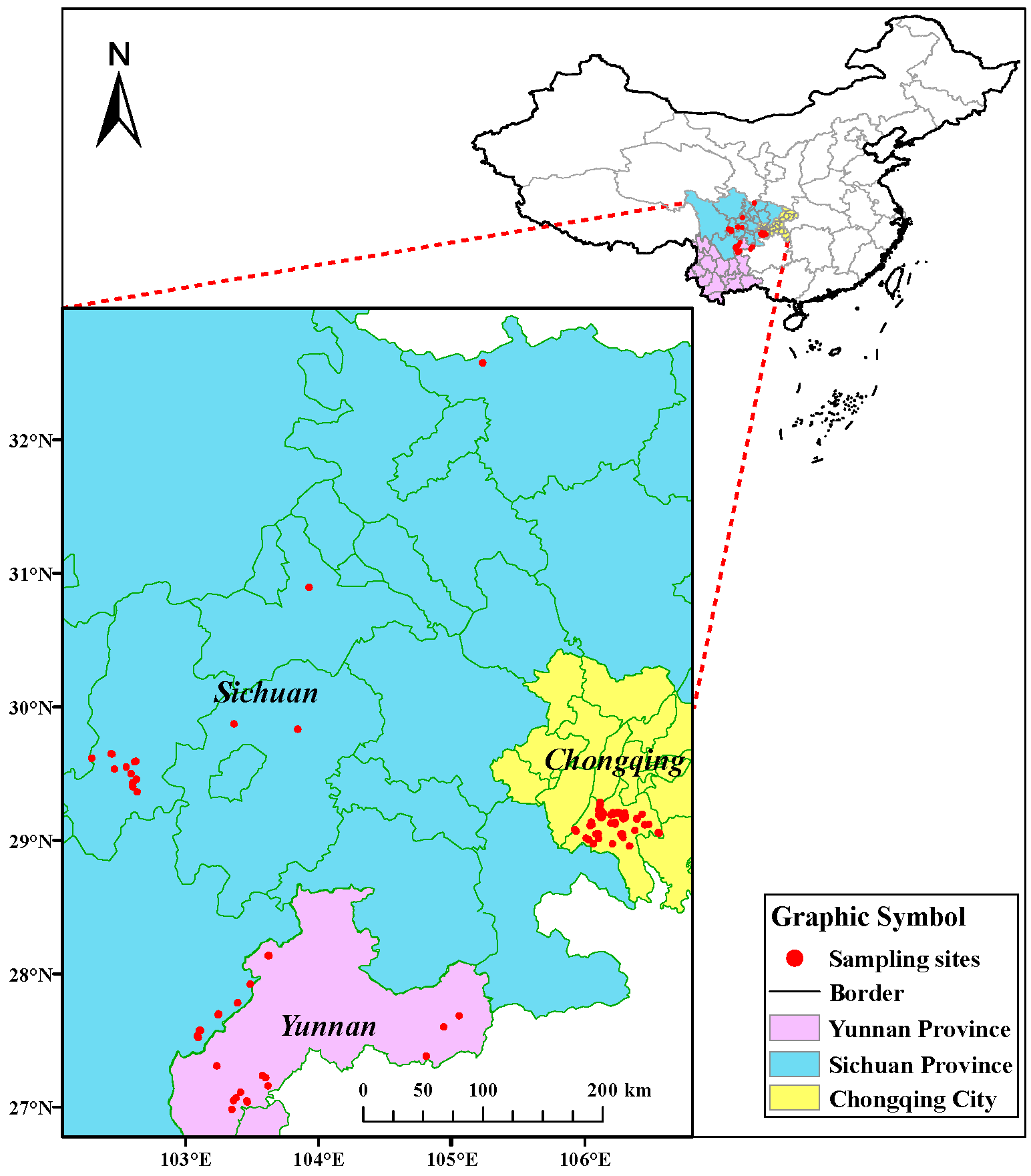
2.1. Zanthoxylum schinifolium Sieb. et Zucc. Collection and Pre-Treatment
2.2. Stable Isotope Ratio Analysis
2.3. Elemental Composition Analysis
2.4. Data Analysis
3. Results and Discussion
3.1. Analysis of Stable Isotope Ratios
3.2. Analysis of Elemental Composition
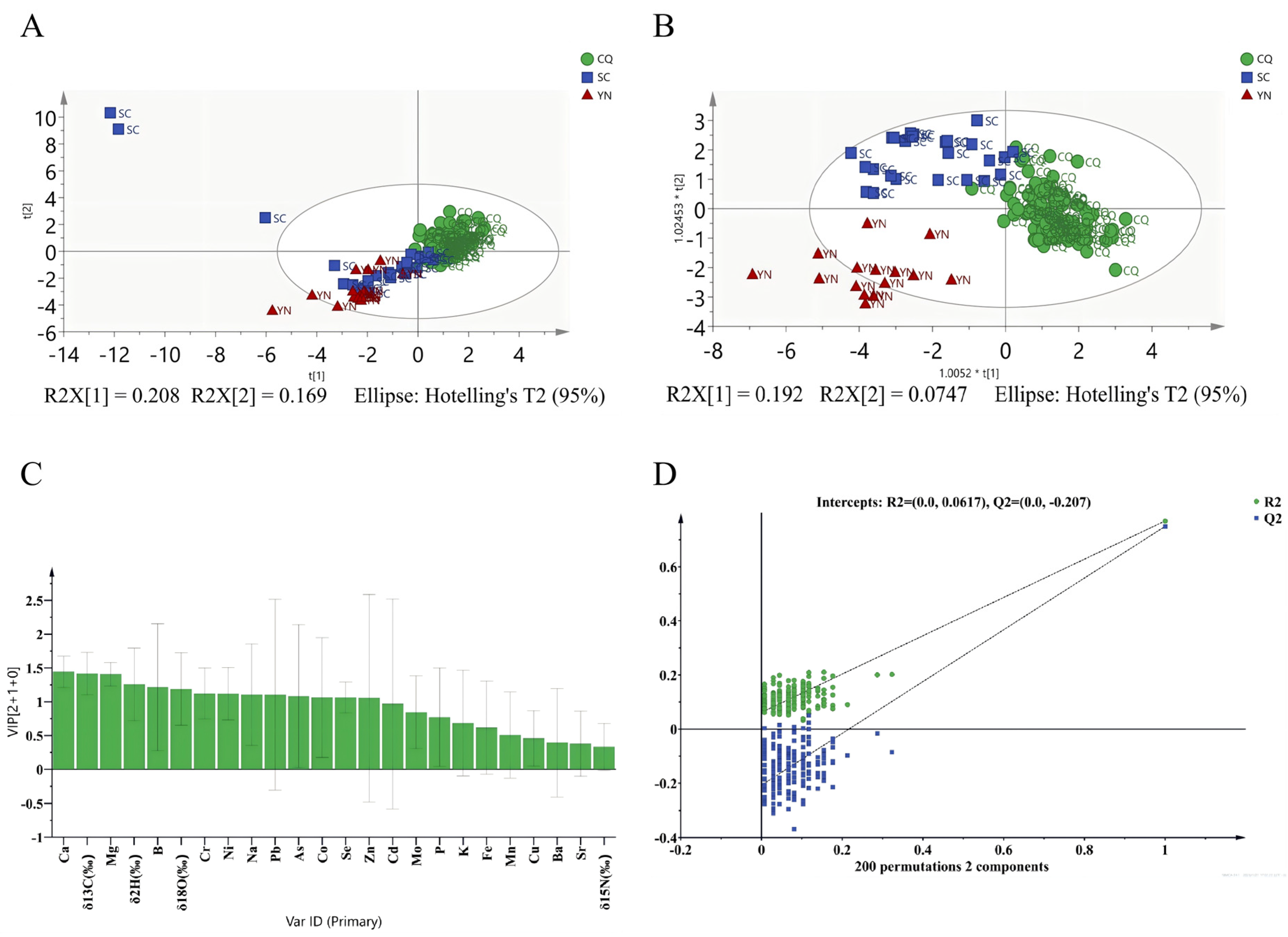
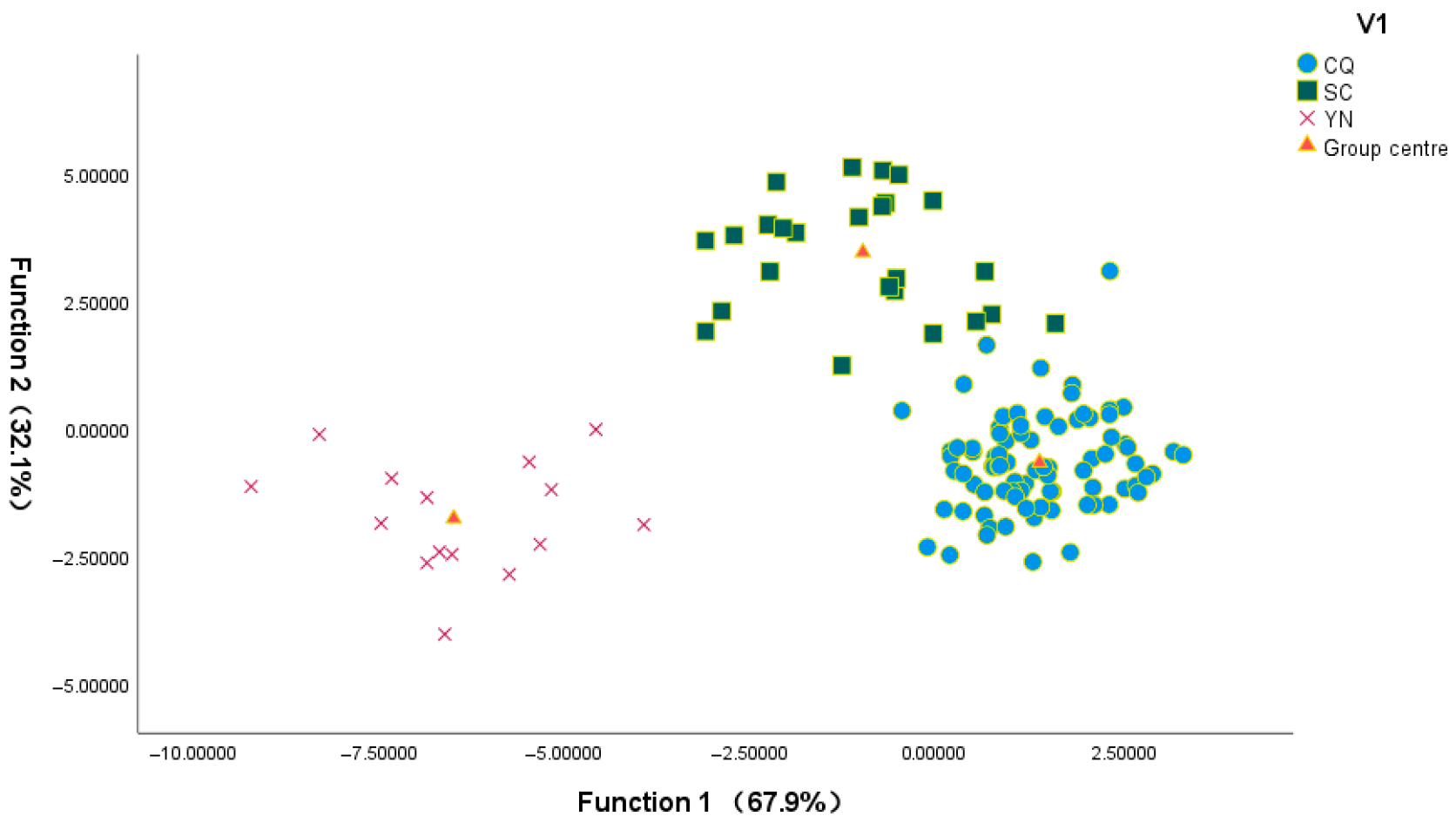
3.3. Multivariate Statistical Analysis

4. Conclusions
Supplementary Materials
Author Contributions
Funding
Institutional Review Board Statement
Informed Consent Statement
Data Availability Statement
Conflicts of Interest
References
- Bao, Y.; Yang, L.; Fu, Q.; Fu, Y.; Tian, Q.; Wang, C.; Huang, Q. The current situation of Zanthoxylum bungeanum industry and the research and application prospect. A review. Fitoterapia 2023, 164, 105380. [Google Scholar] [CrossRef]
- Guo, T.; Deng, Y.X.; Xie, H.; Yao, C.Y.; Cai, C.C.; Pan, S.L.; Wang, Y.L. Antinociceptive and anti-inflammatory activities of ethyl acetate fraction from Zanthoxylum armatum in mice. Fitoterapia 2011, 82, 347–351. [Google Scholar] [CrossRef]
- Liang, W.; Yang, H.; Lei, H.; Xiang, Z.; Duan, Y.; Xin, H.; Han, T.; Su, J. Phytochemistry and health functions of Zanthoxylum bungeanum Maxim and Zanthoxylum schinifolium Sieb. et Zucc as pharma-foods: A systematic review. Trends Food Sci. Technol. 2024, 143, 104225. [Google Scholar] [CrossRef]
- Katerinopoulou, K.; Kontogeorgos, A.; Salmas, C.E.; Patakas, A.; Ladavos, A. Geographical Origin Authentication of Agri-Food Products: A Review. Foods 2020, 9, 489. [Google Scholar] [CrossRef]
- Zhang, Q.; Liu, Y.; Zuo, C.; Zou, Y. Research Progress on Global Food Traceability Based on Bibliometric Analysis. Food Sci. 2024, 45, 275–284. [Google Scholar]
- Anastasiadis, F.; Manikas, I.; Apostolidou, I.; Wahbeh, S. The role of traceability in end-to-end circular agri-food supply chains. Ind. Mark. Manag. 2022, 104, 196–211. [Google Scholar]
- Rossi, S.; Gemma, S.; Borghini, F.; Perini, M.; Butini, S.; Carullo, G.; Campiani, G. Agri-food traceability today: Advancing innovation towards efficiency, sustainability, ethical sourcing, and safety in food supply chains. Trends Food Sci. Technol. 2025, 163, 105154. [Google Scholar] [CrossRef]
- Li, C.; Kang, X.; Nie, J.; Li, A.; Farag, M.A.; Liu, C.; Rogers, K.M.; Xiao, J.; Yuan, Y. Recent advances in Chinese food authentication and origin verification using isotope ratio mass spectrometry. Food Chem. 2023, 398, 133896. [Google Scholar] [CrossRef]
- Li, A.; Yang, J.; Ju, Y.; Niu, S.; Liu, S.; Kelly, S.D.; Vlachou, C.; Wang, M. Multiple stable isotopes characterization as a tool for determination of the geographical origin of honey in Northern China. J. Food Compos. Anal. 2026, 149, 108800. [Google Scholar] [CrossRef]
- Zeng, T.; Fu, T.; Huang, Y.; Zhang, W.; Gong, J.; Ji, B.; Yang, X.; Tang, M. Preliminary study on the geographical origin of Chinese ‘Cuiguan’ pears using integrated stable isotope and multi-element analyses. Heliyon 2024, 10, e37450. [Google Scholar] [CrossRef]
- Li, M.; Wang, Y. Geographical origin traceability of chrysanthemum (Chrysanthemum morifolium) by fusion of NIR and ICP-MS enhanced by explainable XGBoost-SHAP model. LWT 2026, 239, 118922. [Google Scholar] [CrossRef]
- Nie, W.; Alimujiang, S.; Zhang, Y.; Zhang, S.; Li, W. A Multi-omics approach combining GC-MS, LC-MS, and FT-NIR with chemometrics and machine learning for metabolites systematic profiling and geographical origin tracing of Artemisia argyi Folium. J. Chromatogr. A 2025, 1757, 466138. [Google Scholar] [CrossRef]
- Liu, J.; Chen, N.; Yang, J.; Yang, B.; Ouyang, Z.; Wu, C.; Yuan, Y.; Wang, W.; Chen, M. An integrated approach combining HPLC, GC/MS, NIRS, and chemometrics for the geographical discrimination and commercial categorization of saffron. Food Chem. 2018, 253, 284–292. [Google Scholar] [CrossRef]
- Xian, Z.; Li, S.; Mann, D.A.; Deng, X. Geographical origin authentication of whole garlic using 16S ribosomal RNA profiling of garlic microbiota and machine learning. Food Microbiol. 2026, 137, 105039. [Google Scholar] [CrossRef]
- Wang, Y.; Lin, J.; Cheng, S.; Qin, T.; Ni, X.; Hu, Q.; Zheng, X.; Xie, G.; Peng, Q. Flavoromics, sensory evaluation, metagenomics and untargeted metabolomics analysis of fermented tofu sheets from different regions of China. J. Food Compos. Anal. 2025, 148, 108209. [Google Scholar] [CrossRef]
- Li, A.; Zhao, J.; Xi, J.; Yang, X.; Jin, X.; Chen, Q.; Pan, L. Geographical authentication of peach in China based on stable isotope combined with multielement analysis of peach juice. Food Control 2021, 127, 108126. [Google Scholar] [CrossRef]
- Zhou, X.; Wu, H.; Pan, J.; Chen, H.; Rogers, K.M. Geographical traceability of south-east Asian durian: A chemometric study using stable isotopes and elemental compositions. J. Food Compos. Anal. 2021, 101, 103940. [Google Scholar] [CrossRef]
- Xiong, F.; Lyu, C.; Kang, C.; Wan, X.; Sun, J.; Wang, T.; Wang, S.; Li, H.; Yang, J.; Guo, L. Authenticating the geographical origin of the Chinese yam (Tiegun) with stable isotopes and multiple elements. Food Chem. X 2023, 18, 100678. [Google Scholar] [CrossRef]
- Liu, X.; Liu, Z.; Qian, Q.; Song, W.; Yuan, Y. Isotope chemometrics determines farming methods and geographical origin of vegetables from Yangtze River Delta Region, China. Food Chem. 2020, 342, 128379. [Google Scholar] [CrossRef]
- Chung, I.M.; Kim, J.K.; Lee, J.H.; An, M.J.; Lee, K.J.; Park, S.K.; Kim, J.U.; Kim, M.J.; Kim, S.H. C/N/O/S stable isotopic and chemometric analyses for determining the geographical origin of Panax ginseng cultivated in Korea. J. Ginseng Res. 2017, 42, 485–495. [Google Scholar] [CrossRef]
- Nie, J.; Shao, S.; Xia, W.; Liu, Z.; Yu, C.; Li, R.; Wang, W.; Li, J.; Yuan, Y.; Rogers, K.M. Stable isotopes verify geographical origin of yak meat from Qinghai-Tibet plateau. Meat Sci. 2020, 165, 108113. [Google Scholar] [CrossRef]
- Zhao, L.; Zhang, H.; Huang, F.; Liu, H.; Wang, T.; Zhang, C. Authenticating Tibetan pork in China by tracing the species and geographical features based on stable isotopic and multi-elemental fingerprints. Food Control 2023, 145, 109411. [Google Scholar] [CrossRef]
- Zhou, P.; Li, Z.; Ouyang, L.; Gong, X.; Meng, P.; Dai, M.; Wang, Z.; Wang, Y. A multi-element stable isotope approach coupled with chemometrics for the determination of Tieguanyin tea geographical origin and harvest season. Anal. Methods 2019, 11, 346–352. [Google Scholar] [CrossRef]
- Wang, X.-L.; Zhang, B.-W.; Wu, Y.-N.; Hao, Y.-B.; Chen, X.-J.; Jiang, H.-Y.; Liu, H.-Y. Effects of geographical origin, variety, harvest season, and their interactions on stable isotopes and multi-elements in tea. Food Control 2026, 180, 111673. [Google Scholar] [CrossRef]
- Akamatsu, F.; Shimizu, H.; Hayashi, S.; Kamada, A.; Igi, Y.; Koyama, K.; Yamada, O.; Goto-Yamamoto, N. Chemometric approaches for determining the geographical origin of Japanese Chardonnay wines using oxygen stable isotope and multi-element analyses. Food Chem. 2022, 371, 131113. [Google Scholar] [CrossRef]
- Su, Y.; Zhang, J.; Wang, L.; Dias Araujo, L.; Tan, D.; Yuan, C.; Zhang, A. Assessing geographical origin of Diqing wines based on their elemental and isotopic profiles. J. Food Compos. Anal. 2024, 125, 105671. [Google Scholar] [CrossRef]
- Del Rio-Lavín, A.; Weber, J.; Molkentin, J.; Jiménez, E.; Artetxe-Arrate, I.; Pardo, M.Á. Stable isotope and trace element analysis for tracing the geographical origin of the Mediterranean mussel (Mytilus galloprovincialis) in food authentication. Food Control 2022, 139, 109069. [Google Scholar] [CrossRef]
- Zhang, D.; Lin, Z.; Xuan, L.; Lu, M.; Shi, B.; Shi, J.; He, F.; Battino, M.; Zhao, L.; Zou, X. Rapid determination of geographical authenticity and pungency intensity of the red Sichuan pepper (Zanthoxylum bungeanum) using differential pulse voltammetry and machine learning algorithms. Food Chem. 2024, 439, 137978. [Google Scholar] [CrossRef]
- Ke, J.; Rao, L.; Zhou, L.; Chen, X.; Zhang, Z. Non-destructive determination of volatile oil and moisture content and discrimination of geographical origins of Zanthoxylum bungeanum Maxim. by hyperspectral imaging. Infrared Phys. Technol. 2020, 105, 103185. [Google Scholar] [CrossRef]
- Wadood, S.A.; Nie, J.; Li, C.; Rogers, K.M.; Zhang, Y.; Yuan, Y. Geographical origin classification of peanuts and processed fractions using stable isotopes. Food Chem. X 2022, 16, 100456. [Google Scholar] [CrossRef]
- Shapiro, S.S.; Wilk, M.B. An analysis of variance test for normality (complete samples). Biometrika 1975, 67, 215–216. [Google Scholar]
- Kruskal, W.H.; Wallis, W.A. Use of ranks in one-criterion variance analysis. J. Am. Stat. Assoc. 1952, 47, 583–621. [Google Scholar] [CrossRef]
- Kaiser, H.F.; Rice, J. Little Jiffy, Mark IV. Educ. Psychol. Meas. 1974, 34, 111–117. [Google Scholar]
- Tharwat, A.; Gaber, T.; Ibrahim, A.; Hassanien, A.E. Linear discriminant analysis: A detailed tutorial. AI Commun. 2017, 30, 169–190. [Google Scholar] [CrossRef]
- Abdi, H.; Williams, L.J. Principal component analysis. Wiley Interdiscip. Rev. Comput. Stat. 2010, 2, 433–459. [Google Scholar] [CrossRef]
- Boccard, J.; Rutledge, D.N. A consensus orthogonal partial least squares discriminant analysis (OPLS-DA) strategy for multiblock Omics data fusion. Anal. Chim. Acta 2013, 769, 30–39. [Google Scholar] [CrossRef]
- Diefendorf, A.F.; Mueller, K.E.; Wing, S.L.; Koch, P.L.; Freeman, K.H. Global patterns in leaf C-13 discrimination and implications for studies of past and future climate. Proc. Natl. Acad. Sci. USA 2010, 107, 5738–5743. [Google Scholar] [CrossRef]
- Bat, K.B.; Vidrih, R.; Nečmer, M.; Vodopivec, B.M.; Mulič, I.; Kump, P.; Ogrinc, N. Characterization of Slovenian Apples with Respect to Their Botanical and Geographical Origin and Agricultural Production Practice. Food Technol. Biotechnol. 2012, 50, 107–116. [Google Scholar]
- Wang, Z.; Erasmus, S.W.; Dekker, P.; Guo, B.; Ruth, S.M.V. Linking growing conditions to stable isotope ratios and elemental compositions of Costa Rican bananas (Musa spp.). Food Res. Int. 2019, 129, 108882. [Google Scholar] [CrossRef]
- Cui, L.; Chen, H.; Yuan, Y.; Zhu, F.; Nie, J.; Han, S.; Fu, Y.N.; Hou, H.B.; Hu, Q.; Chen, Z.P. Tracing the geographical origin of tobacco at two spatial scales by stable isotope and element analyses with chemometrics. Food Chem. X 2023, 18, 100716. [Google Scholar] [CrossRef]
- Wang, C.; He, W.Z.; Zhao, D.Y.; Liu, Z.; Fan, Y.Y.; Tian, W.N.; Wu, W.L.; Rogers, K.M. Modeling of stable isotope and multi-element compositions of jujube (Ziziphus jujuba Mill.) for origin traceability of protected geographical indication (PGI) products in Xinjiang, China. J. Food Compos. Anal. 2020, 92, 103577. [Google Scholar] [CrossRef]
- Barbour, M.M. Stable oxygen isotope composition of plant tissue: A review. Funct. Plant Biol. 2007, 34, 83. [Google Scholar] [CrossRef]
- Galimov, E.M. Fractionation of Isotopes in Biological Systems. In The Biological Fractionation of Isotopes; Academic Press: Cambridge, MA, USA, 1985; pp. 174–197. [Google Scholar]
- Teng, Y.; Wu, J.; Lu, S.; Wang, Y.; Jiao, X.; Song, L. Soil and soil environmental quality monitoring in China: A review. Environ. Int. 2014, 69, 177–199. [Google Scholar] [CrossRef]
- Rohloff, J.; Uleberg, E.; Nes, A.; Krogstad, T.; Nestby, R.; Martinussen, I. Nutritional composition of bilberries (Vaccinium myrtillus L.) from forest fields in Norway—Effects of geographic origin, climate, fertilization and soil properties. J. Appl. Bot. Food Qual. 2015, 88, 274–287. [Google Scholar] [CrossRef]
- Belmonte-Sánchez, J.R.; Romero-González, R.; Arrebola, F.J.; Martínez Vidal, J.L.; Garrido Frenich, A. An Innovative Metabolomic Approach for Golden Rum Classification Combining Ultrahigh-Performance Liquid Chromatography-Orbitrap Mass Spectrometry and Chemometric Strategies. J. Agric. Food Chem. 2019, 67, 1302–1311. [Google Scholar] [CrossRef]
- Zhao, R.; Su, M.; Zhao, Y.; Chen, G.; Yang, S. Chemical Analysis Combined with Multivariate Statistical Methods to Determine the Geographical Origin of Milk from Four Regions in China. Foods 2021, 10, 1119. [Google Scholar] [CrossRef]



| Origin | Number | Longitude/° E | Latitude/° N | Average Altitude/m | Mean Annual Temperature (°C) |
|---|---|---|---|---|---|
| CQ | 85 | 105.92 to 106.56 | 28.78 to 29.28 | 250.72 | 20.5 |
| SC | 25 | 102.30 to 106.56 | 27.47 to 32.58 | 1306.40 | 18.85 |
| YN | 15 | 103.23 to 105.06 | 26.98 to 28.24 | 1653.33 | 13.33 |
| Isotopic Ratio [‰] or Elements (mg/kg) | Min | Max | Median | Mean | SE | Std. Dev | Coef. Var |
|---|---|---|---|---|---|---|---|
| δ13C (‰) | −30 | −24.5 | −28.5 | −28.3 | 0.1 | 1.0 | 0.04 |
| δ2H (‰) | −109 | −24.1 | −76.3 | −76.4 | 1.0 | 11.3 | 0.15 |
| δ15N (‰) | −0.918 | 8.41 | 2.57 | 2.75 | 0.13 | 1.40 | 0.51 |
| δ18O (‰) | 21.4 | 30.3 | 25.3 | 25.3 | 0.1 | 1.4 | 0.06 |
| K | 13,608 | 28,273 | 20,045 | 20,042 | 230 | 2567 | 0.13 |
| Ca | 4165 | 17,049 | 6237 | 6886 | 185 | 2074 | 0.30 |
| P | 2110 | 5468 | 3421 | 3465 | 50 | 560 | 0.16 |
| Mg | 1149 | 3787 | 1761 | 1897 | 42 | 470 | 0.25 |
| Na | 95 | 870 | 136 | 196 | 16 | 174 | 0.89 |
| Mn | 15.7 | 214 | 59.3 | 65.7 | 3.1 | 34.3 | 0.52 |
| Fe | 36.8 | 120 | 55.9 | 60.9 | 1.5 | 16.6 | 0.27 |
| Sr | 6.17 | 72.2 | 23.1 | 26.2 | 1.0 | 10.7 | 0.41 |
| Ba | 4.52 | 84.7 | 20.6 | 24.0 | 1.2 | 13.1 | 0.54 |
| Zn | 9.62 | 311 | 15.3 | 21.8 | 3.3 | 36.4 | 1.67 |
| Cu | 4.85 | 18.5 | 7.07 | 8.72 | 0.29 | 3.20 | 0.37 |
| Ni | 0.93 | 19.9 | 5.97 | 6.35 | 0.30 | 3.38 | 0.53 |
| B | 0.06 | 20.3 | 5.385 | 6.30 | 0.34 | 3.79 | 0.60 |
| Cr | 0.007 | 1.62 | 0.303 | 0.428 | 0.031 | 0.348 | 0.81 |
| Pb | 0.144 | 19.5 | 0.368 | 0.757 | 0.214 | 2.389 | 3.16 |
| Cd | 0.043 | 2.81 | 0.246 | 0.279 | 0.030 | 0.335 | 1.20 |
| Mo | 0.0257 | 1.25 | 0.154 | 0.201 | 0.014 | 0.160 | 0.80 |
| As | 0.0288 | 1.35 | 0.0605 | 0.0974 | 0.0175 | 0.1962 | 2.01 |
| Se | 0.0059 | 0.0822 | 0.031 | 0.0327 | 0.001 | 0.016 | 0.50 |
| Co | 0.0313 | 0.351 | 0.0776 | 0.103 | 0.006 | 0.070 | 0.68 |
| Isotopic Ratio [‰] or Elements (mg/kg) | CQ (n = 85) | SC (n = 25) | YN (n = 15) | p |
|---|---|---|---|---|
| δ13C (‰) | −28.8 ± 0.5 b | −27.3 ± 0.8 a | −26.7 ± 0.8 a | *** |
| δ2H (‰) | −72.3 ± 8.6 a | −80.1 ± 10.2 b | −93.6 ± 8 c | *** |
| δ15N (‰) | 2.97 ± 1.46 | 2.25 ± 0.98 | 2.32 ± 1.38 | ns |
| δ18O (‰) | 25.1 ± 1.1 b | 26.4 ± 1.2 a | 24.2 ± 2 b | *** |
| K | 20,357 ± 2517 | 19,081 ± 2346 | 19,861 ± 2941 | ns |
| Ca | 5823 ± 899 b | 9174 ± 1786 a | 9094 ± 2517 a | *** |
| P | 3399 ± 493 b | 3341 ± 418 b | 4050 ± 775 a | * |
| Mg | 1694 ± 246 c | 2090 ± 481 b | 2719 ± 400 a | *** |
| Na | 141 ± 38 b | 257 ± 234 b | 409 ± 304 a | ** |
| Mn | 70.2 ± 36.1 a | 51.7 ± 23.4 | 63.7 ± 34.9 | ns |
| Fe | 61.5 ± 17.1 | 61.9 ± 18.6 a | 56.1 ± 7.8 | ns |
| Sr | 26.9 ± 10.9 a | 23.9 ± 8.3 | 25.8 ± 13 | ns |
| Ba | 25.2 ± 14.1 a | 23.3 ± 11.2 | 18.4 ± 7.3 | ns |
| Zn | 17.7 ± 7.2 b | 39.6 ± 79 a | 15.1 ± 2.4 ab | ** |
| Cu | 9.15 ± 3.48 a | 7.69 ± 2.34 | 7.94 ± 2.21 | ns |
| Ni | 7.43 ± 3.33 a | 3.48 ± 1.62 b | 5.01 ± 2.58 b | *** |
| B | 6.36 ± 3.52 b | 8.91 ± 2.77 a | 1.3 ± 1.35 c | *** |
| Cr | 0.544 ± 0.353 a | 0.194 ± 0.135 b | 0.126 ± 0.103 b | *** |
| Pb | 0.396 ± 0.201 | 2.208 ± 5.158 a | 0.381 ± 0.115 | ns |
| Cd | 0.239 ± 0.094 | 0.446 ± 0.711 a | 0.23 ± 0.104 | ns |
| Mo | 0.155 ± 0.108 b | 0.263 ± 0.101 a | 0.353 ± 0.309 a | *** |
| As | 0.0624 ± 0.0215 | 0.23 ± 0.416 a | 0.0742 ± 0.034 | ns |
| Se | 0.0378 ± 0.0143 a | 0.0249 ± 0.0188 b | 0.0167 ± 0.0036 b | *** |
| Co | 0.0859 ± 0.0514 b | 0.101 ± 0.047 b | 0.201 ± 0.106 a | *** |
| Geographical Origin | Predicted Group (Original/Cross-Validated) | Correctly Classified% (Original/Cross-Validated) | ||
|---|---|---|---|---|
| CQ | SC | YN | ||
| (A). Stable isotopes | ||||
| CQ (85) | 82/82 | 3/3 | 0/0 | 96.5/96.5 |
| SC (25) | 6/7 | 17/16 | 2/2 | 68.0/64.0 |
| YN (15) | 0/2 | 5/6 | 10/7 | 66.7/46.7 |
| 87.2/84.0 | ||||
| (B). Element profiles | ||||
| CQ (85) | 83/80 | 2/5 | 0/0 | 97.6/94.1 |
| SC (25) | 4/7 | 21/18 | 0/0 | 84.0/72.0 |
| YN (15) | 0/2 | 0/0 | 15/13 | 100.0/86.7 |
| 95.2/88.8 | ||||
| (C). Stable isotopes and elements combined | ||||
| CQ (85) | 84/82 | 1/3 | 0/0 | 98/96.5 |
| SC (25) | 1/5 | 24/20 | 0/0 | 96/80 |
| YN (15) | 0/0 | 0/1 | 15/14 | 100/93.3 |
| Total | 98.4/92.8 | |||
Disclaimer/Publisher’s Note: The statements, opinions and data contained in all publications are solely those of the individual author(s) and contributor(s) and not of MDPI and/or the editor(s). MDPI and/or the editor(s) disclaim responsibility for any injury to people or property resulting from any ideas, methods, instructions or products referred to in the content. |
© 2026 by the authors. Licensee MDPI, Basel, Switzerland. This article is an open access article distributed under the terms and conditions of the Creative Commons Attribution (CC BY) license.
Share and Cite
Zhang, W.; Zeng, T.; Fu, T.; Huang, Y.; Ji, B.; Meng, X.; Fan, Y.; Tang, M. Geographical Traceability of Zanthoxylum schinifolium Sieb. et Zucc. Using Stable Isotope and Multi-Element Fingerprinting Combined with Chemometrics. Foods 2026, 15, 1088. https://doi.org/10.3390/foods15061088
Zhang W, Zeng T, Fu T, Huang Y, Ji B, Meng X, Fan Y, Tang M. Geographical Traceability of Zanthoxylum schinifolium Sieb. et Zucc. Using Stable Isotope and Multi-Element Fingerprinting Combined with Chemometrics. Foods. 2026; 15(6):1088. https://doi.org/10.3390/foods15061088
Chicago/Turabian StyleZhang, Wei, Tingting Zeng, Tingting Fu, Yongchuan Huang, Bingjing Ji, Xia Meng, Yongyang Fan, and Mingfeng Tang. 2026. "Geographical Traceability of Zanthoxylum schinifolium Sieb. et Zucc. Using Stable Isotope and Multi-Element Fingerprinting Combined with Chemometrics" Foods 15, no. 6: 1088. https://doi.org/10.3390/foods15061088
APA StyleZhang, W., Zeng, T., Fu, T., Huang, Y., Ji, B., Meng, X., Fan, Y., & Tang, M. (2026). Geographical Traceability of Zanthoxylum schinifolium Sieb. et Zucc. Using Stable Isotope and Multi-Element Fingerprinting Combined with Chemometrics. Foods, 15(6), 1088. https://doi.org/10.3390/foods15061088