Encapsulation of Bee Pollen Phenolics with β-Cyclodextrin: Effects on Antioxidant Activity, Antimicrobial Properties, and Digestive Stability

 , ,
, ,  , and
, and
Abstract
1. Introduction
2. Materials & Methods
2.1. Materials
2.2. Preparation of Powdered Pollen Phenolic Extracts (PE)
2.3. Preparation of Inclusion Complexes
2.4. Characterization of Inclusion Complex
2.4.1. Zeta Potential and Particle Size Distribution
2.4.2. Encapsulation Efficiency
2.4.3. Determination of Antimicrobial Activity
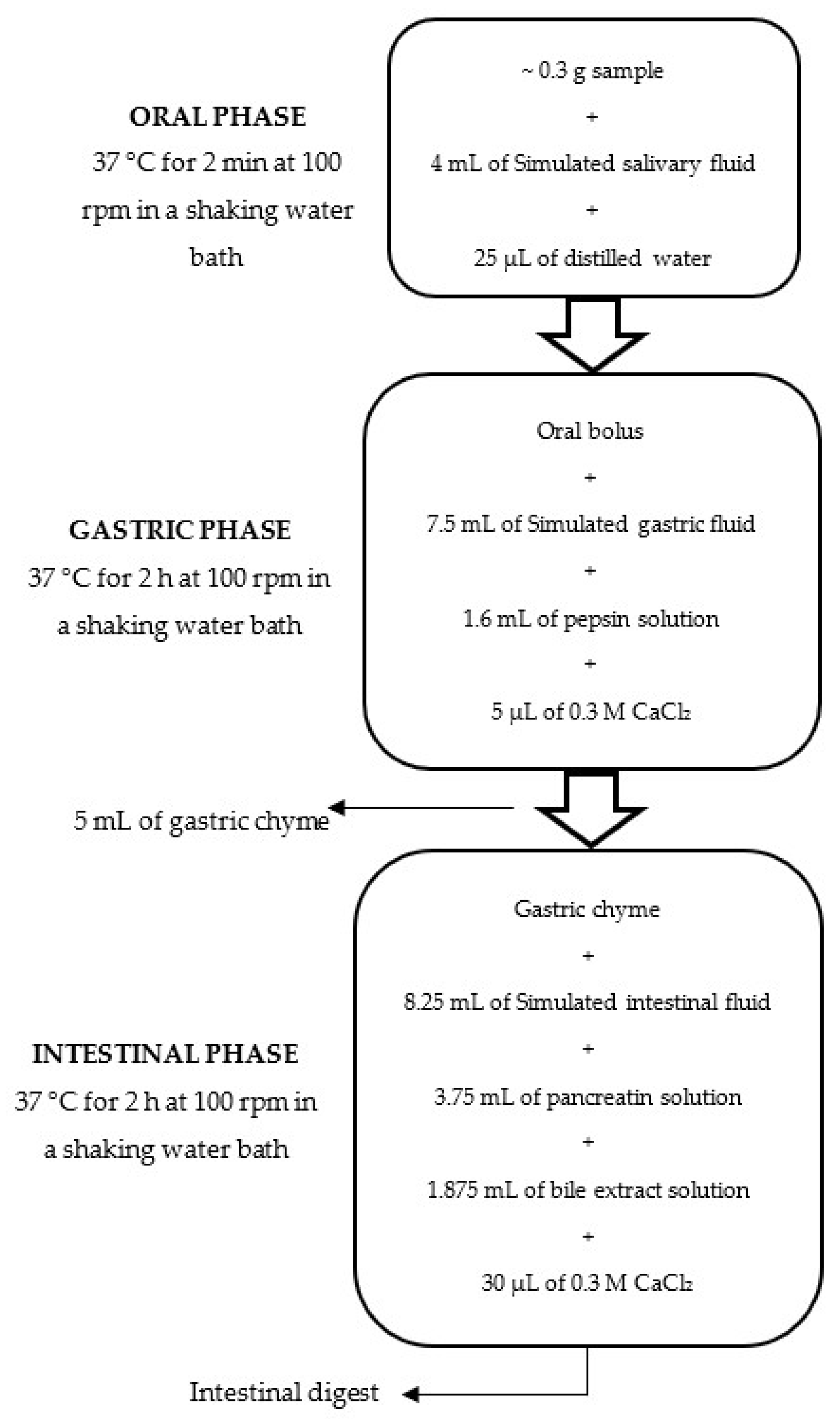
2.5. In Vitro Gastrointestinal Digestion
2.6. Determination and Identification of Phenolic Compounds
2.7. Bioactive Properties
2.7.1. Total Phenolic Content (TPC)
2.7.2. Total Flavonoid Content (TFC)
2.7.3. Antioxidant Activities
2.8. Statistical Analyses
3. Results and Discussion
3.1. Bioactive Potential of PE and Inclusion Complex
3.2. Characterization of Complexes with and Without Pollen Extract
3.2.1. Zeta Potential and Particle Size Distribution
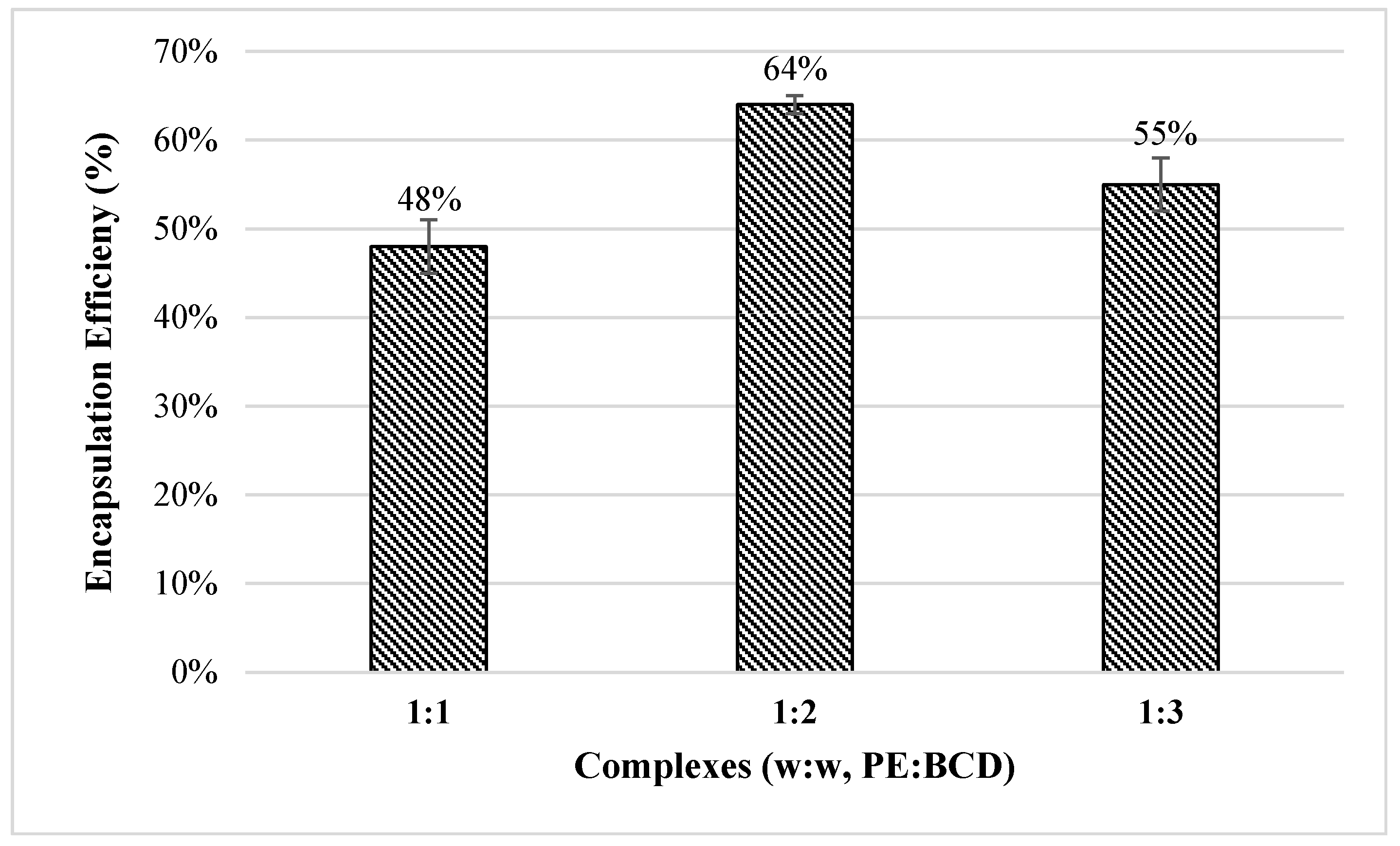
3.2.2. Encapsulation Efficiency
3.2.3. Antimicrobial Activity
3.3. In Vitro Gastrointestinal Digestion
3.3.1. Phenolic Content and Antioxidant Activity
3.3.2. Determination and Identification of Phenolic Compounds
4. Conclusions
Author Contributions
Funding
Institutional Review Board Statement
Informed Consent Statement
Data Availability Statement
Conflicts of Interest
References
- Giampieri, F.; Alvarez-Suarez, J.M.; Machì, M.; Cianciosi, D.; Navarro-Hortal, M.D.; Battino, M. Edible Insects: A Novel Nutritious, Functional, and Safe Food Alternative. Food Front. 2022, 3, 358–365. [Google Scholar] [CrossRef]
- Martinello, M.; Mutinelli, F.; Zooprofilattico, I.; Delle Venezie, S. Antioxidant Activity in Bee Products: A Review. Antioxidants 2021, 10, 71. [Google Scholar] [CrossRef]
- Denisow, B.; Denisow-Pietrzyk, M. Biological and Therapeutic Properties of Bee Pollen: A Review. J. Sci. Food Agric. 2016, 96, 4303–4309. [Google Scholar] [CrossRef]
- Durazzo, A.; Lucarini, M.; Plutino, M.; Lucini, L.; Aromolo, R.; Martinelli, E.; Souto, E.B.; Santini, A.; Pignatti, G. Bee Products: A Representation of Biodiversity, Sustainability, and Health. Life 2021, 11, 970. [Google Scholar] [CrossRef]
- Zhao, L.; Zhou, Y.; Yue, W.; Shen, Q.; Ke, J.; Ma, Y.; Zhang, L.; Bian, H. Natural Phenolics as Multitarget Antimicrobials for Food Preservation: Mechanisms of Action. Food Chem. X 2025, 31, 103056. [Google Scholar] [CrossRef] [PubMed]
- Ansari, Z.G.; Kumar, S.; Singh, V.P.; Raypa, P. Phenolics and Flavonoids: Antioxidant and Antimicrobial Roles in Plant Health. In Plant Secondary Metabolites; CRC Press: Boca Raton, FL, USA, 2025; pp. 109–129. [Google Scholar] [CrossRef]
- Allerberger, F.; Wagner, M. Inhibitory Activity of Phenolic Acids against Listeria Monocytogenes: Decipher-ing the Mechanisms of Action Using Three Different Models. Food Microbiol. 2019, 80, 18–24. [Google Scholar] [CrossRef]
- Valdivia-Olivares, R.Y.; Martinez-González, E.A.; Montenegro, G.; Bridi, R.; Alvarez-Figueroa, M.J.; González-Aramundiz, J.V. Innovative Multiple Nanoemulsion (W/O/W) Based on Chilean Honeybee Pollen Improves Their Permeability, Antioxidant and Antibacterial Activity. Food Res. Int. 2023, 168, 112767. [Google Scholar] [CrossRef] [PubMed]
- Fernández-Moreno, P.; del Carmen Villegas-Aguilar, M.; Huertas-Camarasa, F.; Fernández-Ochoa, Á. Chapter 2: Metabolization Pathways and Bioavailability of Polyphenols. Bioact. Polyphen. Health Pathol. Treat. 2025, 43–80. [Google Scholar] [CrossRef]
- Pinarli, B.; Simge Karliga, E.; Ozkan, G.; Capanoglu, E. Interaction of Phenolics with Food Matrix: In Vitro and in Vivo Approaches. Med. J. Nutrition Metab. 2020, 13, 63–74. [Google Scholar] [CrossRef]
- González-Montiel, L.; Figueira, A.C.; Medina-Pérez, G.; Fernández-Luqueño, F.; Aguirre-Álvarez, G.; Pérez-Soto, E.; Pérez-Ríos, S.; Campos-Montiel, R.G. Bioactive Compounds, Antioxidant and Antimicrobial Activity of Propolis Extracts during In Vitro Digestion. Appl. Sci. 2022, 12, 7892. [Google Scholar] [CrossRef]
- Jia, Z.; Dumont, M.J.; Orsat, V. Encapsulation of Phenolic Compounds Present in Plants Using Protein Matrices. Food Biosci. 2016, 15, 87–104. [Google Scholar] [CrossRef]
- Kfoury, M.; Landy, D.; Fourmentin, S. Characterization of Cyclodextrin/Volatile Inclusion Complexes: A Review. Molecules 2018, 23, 1204. [Google Scholar] [CrossRef] [PubMed]
- Pinho, E.; Soares, G.; Henriques, M. Evaluation of Antibacterial Activity of Caffeic Acid Encapsulated by β-Cyclodextrins. J. Microencapsul. 2015, 32, 804–810. [Google Scholar] [CrossRef]
- Pinho, E.; Soares, G.; Henriques, M. Cyclodextrin Modulation of Gallic Acid in Vitro Antibacterial Activity. J. Incl. Phenom. Macrocycl. Chem. 2014, 81, 205–214. [Google Scholar] [CrossRef]
- Ahmed, J.; Mulla, M.Z.; Al-Attar, H.; AlZuwayed, S.; Ejaz, M.; Al-Jassar, S.; Jacob, H.; Thomas, L.; Al-Ruwaih, N.; Joseph, A. Thermal, Structural, Antimicrobial, and Physicochemical Characterisation of Thyme Essential Oil Encapsulated in β- and γ-Cyclodextrin. J. Microencapsul. 2022, 39, 364–379. [Google Scholar] [CrossRef]
- Baysal, G.; Olcay, H.S.; Keresteci, B.; Özpinar, H. The Antioxidant and Antibacterial Properties of Chitosan Encapsulated with the Bee Pollen and the Apple Cider Vinegar. J. Biomater. Sci. Polym. Ed. 2022, 33, 995–1011. [Google Scholar] [CrossRef]
- Dundar, A.N.; Cinar, A.; Altuntas, S.; Ulubayram, N.; Taner, G.; Dagdelen, A.F.; Demircan, H.; Oral, R.A. The Role of Microencapsulation in Maintaining Biological Activity of Royal Jelly: Comparison with Biological Activity and Bioaccessibility of Microencapsulated, Fresh and Lyophilized Forms during Storage. J. Sci. Food Agric. 2022, 102, 5502–5511. [Google Scholar] [CrossRef]
- Yesiltas, B.; Capanoglu, E.; Firatligil-Durmus, E.; Sunay, A.E.; Samanci, T.; Boyacioglu, D. Investigating the In-Vitro Bioaccessibility of Propolis and Pollen Using a Simulated Gastrointestinal Digestion System. J. Apic. Res. 2014, 53, 101–108. [Google Scholar] [CrossRef]
- dos Santos Ferreira, C.I.; Gonzales, A.P.; Mazzobre, M.F.; Ulrih, N.P.; del Pilar Buera, M. Solubility, Sorption Isotherms and Thermodynamic Parameters of β-Cyclodextrin Complexes with Poplar Propolis Components: Practical Implicances. LWT 2022, 167, 113811. [Google Scholar] [CrossRef]
- Catchpole, O.; Mitchell, K.; Bloor, S.; Davis, P.; Suddes, A. Anti-Gastrointestinal Cancer Activity of Cyclodex-trin-Encapsulated Propolis. J. Funct. Foods 2018, 41, 1–8. [Google Scholar] [CrossRef]
- Alizadeh Behbahani, B.; Noshad, M.; Falah, F. Cumin Essential Oil: Phytochemical Analysis, Antimicrobial Activity and Investigation of Its Mechanism of Action through Scanning Electron Microscopy. Microb. Pathog. 2019, 136, 103716. [Google Scholar] [CrossRef]
- Calvo, L.G.; Villarino, R.A.; Rama, J.L.R.; Abril, A.G.; de Miguel, T. A Modification of the Resazurin Cell Via-bility Assay, Suitable for the Quantification of Lactic Acid Producing Bacteria. LWT 2025, 215, 117259. [Google Scholar] [CrossRef]
- Minekus, M.; Alminger, M.; Alvito, P.; Ballance, S.; Bohn, T.; Bourlieu, C.; Carriere, F.; Boutrou, R.; Corredig, M.; Dupont, D.; et al. A Standardised Static in Vitro Digestion Method Suitable for Food—An International Consensus. Food Funct. 2014, 5, 1113–1124. [Google Scholar] [CrossRef] [PubMed]
- Capanoglu, E.; Beekwilder, J.; Boyacioglu, D.; Hall, R.; De Vos, R. Changes in Antioxidant and Metabolite Profiles during Production of Tomato Paste. J. Agric. Food Chem. 2008, 56, 964–973. [Google Scholar] [CrossRef]
- Singleton, V.L.; Rossi, J.A. Colorimetry of Total Phenolics with Phosphomolybdic-Phosphotungstic Acid Reagents. Am. J. Enol. Vitic. 1965, 16, 144–158. [Google Scholar] [CrossRef]
- Ozkan, G.; Sanli, I.; Mottola, S.; De Marco, I.; Capanoglu, E. Supercritical Antisolvent Processing of Propolis Extract: Solubility and Release Behaviour of Bioactive Compounds in Different Food Simulants. Food Chem. 2025, 489, 144742. [Google Scholar] [CrossRef]
- Dewanto, V.; Wu, X.; Adom, K.K.; Liu, R.H. Thermal Processing Enhances the Nutritional Value of Tomatoes by Increasing Total Antioxidant Activity. J. Agric. Food Chem. 2002, 50, 3010–3014. [Google Scholar] [CrossRef]
- Apak, R.; Güçlü, K.; Özyürek, M.; Karademir, S.E. Novel Total Antioxidant Capacity Index for Dietary Poly-phenols and Vitamins C and E, Using Their Cupric Ion Reducing Capability in the Presence of Neocupro-ine: CUPRAC Method. J. Agric. Food Chem. 2004, 52, 7970–7981. [Google Scholar] [CrossRef]
- Yılmaz Tuncel, N.; Polat Kaya, H.; Sakarya, F.B.; Andaç, A.E.; Korkmaz, F.; Ozkan, G.; Tuncel, N.B.; Ca-panoglu, E. The Effect of Germination on Antinutritional Components, In Vitro Starch and Protein Digestibil-ity, Content, and Bioaccessibility of Phenolics and Antioxidants of Some Pulses. Food Sci. Nutr. 2025, 13, e70103. [Google Scholar] [CrossRef]
- Hara, K.; Someya, T.; Sano, K.; Sagane, Y.; Watanabe, T.; Wijesekara, R.G.S. Antioxidant Activities of Tradi-tional Plants in Sri Lanka by DPPH Free Radical-Scavenging Assay. Data Brief 2018, 17, 870–875. [Google Scholar] [CrossRef]
- Kahraman, H.A.; Tutun, H.; Kaya, M.M.; Usluer, M.S.; Tutun, S.; Yaman, C.; Sevin, S.; Keyvan, E. Ethanolic Extract of Turkish Bee Pollen and Propolis: Phenolic Composition, Antiradical, Antiproliferative and Antibacterial Activities. Biotechnol. Biotechnol. Equip. 2022, 36, 44–55. [Google Scholar] [CrossRef]
- Mutlu, C.; Erbas, M. Turkish Bee Pollen: Composition, Regional Discrimination and Polyphenol Bioaccessibility. Food Biosci. 2023, 53, 102805. [Google Scholar] [CrossRef]
- Yamauchi, M.; Kitamura, Y.; Nagano, H.; Kawatsu, J.; Gotoh, H. DPPH Measurements and Structure—Activity Relationship Studies on the Antioxidant Capacity of Phenols. Antioxidants 2024, 13, 309. [Google Scholar] [CrossRef] [PubMed]
- Qiao, J.; Feng, Z.; Zhang, Y.; Xiao, X.; Dong, J.; Haubruge, E.; Zhang, H. Phenolamide and Flavonoid Glycoside Profiles of 20 Types of Monofloral Bee Pollen. Food Chem. 2023, 405, 134800. [Google Scholar] [CrossRef] [PubMed]
- Branković, J.; Matejić, V.; Simijonović, D.; Petrović, Z.D.; Vukić, M.D.; Kacaniova, M.; Rakić, S.; Petrović, V.P. Molecular Encapsulation of the Protocatechuic and Vanillic Acid Derivatives with β-Cyclodextrin: Structural Determination, Antibacterial Assessment, and Molecular Docking Analysis. J. Mol. Struct. 2024, 1312, 138615. [Google Scholar] [CrossRef]
- Mohdaly, A.A.A.; Mahmoud, A.A.; Roby, M.H.H.; Smetanska, I.; Ramadan, M.F. Phenolic Extract from Propo-lis and Bee Pollen: Composition, Antioxidant and Antibacterial Activities. J. Food Biochem. 2015, 39, 538–547. [Google Scholar] [CrossRef]
- Barbieri, D.; Gabriele, M.; Summa, M.; Colosimo, R.; Leonardi, D.; Domenici, V.; Pucci, L. Antioxidant, Nutraceutical Properties, and Fluorescence Spectral Profiles of Bee Pollen Samples from Different Botanical Origins. Antioxidants 2020, 9, 1001. [Google Scholar] [CrossRef]
- Kalaycıoğlu, Z.; Kaygusuz, H.; Döker, S.; Kolaylı, S.; Erim, F.B. Characterization of Turkish Honeybee Pollens by Principal Component Analysis Based on Their Individual Organic Acids, Sugars, Minerals, and Antioxi-dant Activities. LWT 2017, 84, 402–408. [Google Scholar] [CrossRef]
- Nisbet, C.; Tabatabaei, P. Investigation of Phenolic Compounds and Antioxidant Capacity of Bee Pollen Collected from Different Geographical Regions in Turkey. Kocatepe Vet. J. 2021, 14, 359–365. [Google Scholar] [CrossRef]
- Ozkan, K.; Sagcan, N.; Ozulku, G.; Sagdic, O.; Toker, O.S.; Muz, M.N. Bioactive and Bioaccessibility Character-istics of Honeybee Pollens Collected from Different Regions of Turkey. J. Food Meas. Charact. 2017, 12, 581–587. [Google Scholar] [CrossRef]
- Hanafy, N.A.N.; Eltonouby, E.A.B.; Salim, E.I.; Mahfouz, M.E.; Leporatti, S.; Hafez, E.H. Simultaneous Admin-istration of Bevacizumab with Bee-Pollen Extract-Loaded Hybrid Protein Hydrogel NPs Is a Promising Targeted Strategy against Cancer Cells. Int. J. Mol. Sci. 2023, 24, 3548. [Google Scholar] [CrossRef] [PubMed]
- Chelli, S.; Majdoub, M.; Jouini, M.; Aelyach, S.; Maurel, F.; Chane-Ching, K.I.; Lacaze, P.C. Host-Guest Com-plexes of Phenol Derivatives with β-Cyclodextrin: An Experimental and Theoretical Investigation. J. Phys. Org. Chem. 2007, 20, 30–43. [Google Scholar] [CrossRef]
- Maqsoudlou, A.; Sadeghi Mahoonak, A.; Mohebodini, H.; Koushki, V. Stability and Structural Properties of Bee Pollen Protein Hydrolysate Microencapsulated Using Maltodextrin and Whey Protein Concentrate. Heliyon 2020, 6, e03731. [Google Scholar] [CrossRef]
- Sitti, R.H.S.; Sugita, P.; Ambarsari, L.; Rahayu, D.U.C. Antibacterial Mangosteen (Garcinia mangostana Linn.) Peel Extract Encapsulated in Chitosan. J. Phys. Conf. Ser. 2018, 1116, 042037. [Google Scholar] [CrossRef]
- Kaur, S.; Panesar, P.S.; Chopra, H.K.; Dilbaghi, N. Encapsulation of Citrus Polyphenols in Multi-Phase Nano-Emulsion: Preservative Potential, Bio-Accessibility and Cytotoxicity Studies. Food Biosci. 2024, 59, 103911. [Google Scholar] [CrossRef]
- Luca, A.; Cilek, B.; Hasirci, V.; Sahin, S.; Sumnu, G. Effect of Degritting of Phenolic Extract from Sour Cherry Pomace on Encapsulation Efficiency—Production of Nano-Suspension. Food Bioprocess Technol. 2012, 6, 2494–2502. [Google Scholar] [CrossRef]
- Alshehri, K.M.; Abdella, E.M. Development of Ternary Nanoformulation Comprising Bee Pollen-Thymol Oil Extracts and Chitosan Nanoparticles for Anti-Inflammatory and Anticancer Applications. Int. J. Biol. Macromol. 2023, 242, 124584. [Google Scholar] [CrossRef]
- Khoshnamvand, M.; Huo, C.; Liu, J. Silver Nanoparticles Synthesized Using Allium Ampeloprasum L. Leaf Extract: Characterization and Performance in Catalytic Reduction of 4-Nitrophenol and Antioxidant Activity. J. Mol. Struct. 2019, 1175, 90–96. [Google Scholar] [CrossRef]
- Varan, G.; Varan, C.; Erdoğar, N.; Hıncal, A.A.; Bilensoy, E. Amphiphilic Cyclodextrin Nanoparticles. Int. J. Pharm. 2017, 531, 457–469. [Google Scholar] [CrossRef]
- Cremin, K.; Jones, B.A.; Teahan, J.; Meloni, G.N.; Perry, D.; Zerfass, C.; Asally, M.; Soyer, O.S.; Unwin, P.R. Scanning Ion Conductance Microscopy Reveals Differences in the Ionic Environments of Gram-Positive and Negative Bacteria. Anal. Chem. 2020, 92, 16024–16032. [Google Scholar] [CrossRef]
- Kumar, M.; Curtis, A.; Hoskins, C. Application of Nanoparticle Technologies in the Combat against Anti-Microbial Resistance. Pharmaceutics 2018, 10, 11. [Google Scholar] [CrossRef]
- Eyüboğlu, S.; Patır, İ.; Şahin, S.; Ata, G.D. Optimization of the Inclusion Efficiency of Phenolic Pinus Brutia Extracts. Wood Sci. Technol. 2025, 59, 102. [Google Scholar] [CrossRef]
- Kalogeropoulos, N.; Konteles, S.; Mourtzinos, I.; Troullidou, E.; Chiou, A.; Karathanos, V.T. Encapsulation of Complex Extracts in β-Cyclodextrin: An Application to Propolis Ethanolic Extract. J. Microencapsul. 2009, 26, 603–613. [Google Scholar] [CrossRef] [PubMed]
- Bakour, M.; Laaroussi, H.; Ousaaid, D.; Oumokhtar, B.; Lyoussi, B. Antioxidant and Antibacterial Effects of Pollen Extracts on Human Multidrug-Resistant Pathogenic Bacteria. J. Food Qual. 2021, 2021, 5560182. [Google Scholar] [CrossRef]
- Velásquez, P.; Rodríguez, K.; Retamal, M.; Giordano, A.; Valenzuela, L.M.; Montenegro, G. Relation between Composition, Antioxidant and Antibacterial Activities and Botanical Origin of Multifloral Bee Pollen. J. Appl. Bot. Food Qual. 2017, 90, 306–314. [Google Scholar] [CrossRef]
- Pascoal, A.; Rodrigues, S.; Teixeira, A.; Feás, X.; Estevinho, L.M. Biological Activities of Commercial Bee Pol-lens: Antimicrobial, Antimutagenic, Antioxidant and Anti-Inflammatory. Food Chem. Toxicol. 2014, 63, 233–239. [Google Scholar] [CrossRef]
- Gercek, Y.C.; Celik, S.; Bayram, A.S. Screening of Plant Pollen Sources, Polyphenolic Compounds, Fatty Acids and Antioxidant/Antimicrobial Activity from Bee Pollen. Molecules 2021, 27, 117. [Google Scholar] [CrossRef]
- Przybyłek, I.; Karpiński, T.M. Antibacterial Properties of Propolis. Molecules 2019, 24, 2047. [Google Scholar] [CrossRef]
- Sforcin, J.M. Biological Properties and Therapeutic Applications of Propolis. Phytother. Res. 2016, 30, 894–905. [Google Scholar] [CrossRef]
- Gutiérrez-Larraínzar, M.; Rúa, J.; Caro, I.; de Castro, C.; de Arriaga, D.; García-Armesto, M.R.; del Valle, P. Evaluation of Antimicrobial and Antioxidant Activities of Natural Phenolic Compounds against Foodborne Pathogens and Spoilage Bacteria. Food Control 2012, 26, 555–563. [Google Scholar] [CrossRef]
- Kaškonienė, V.; Adaškevičiūtė, V.; Kaškonas, P.; Mickienė, R.; Maruška, A. Antimicrobial and Antioxidant Activities of Natural and Fermented Bee Pollen. Food Biosci. 2020, 34, 100532. [Google Scholar] [CrossRef]
- Soares de Arruda, V.A.; Vieria dos Santos, A.; Figueiredo Sampaio, D.; da Silva Araújo, E.; de Castro Peixoto, A.L.; Estevinho, L.M.; de Almeida-Muradian, L.B. Brazilian Bee Pollen: Phenolic Content, Antioxidant Prop-erties and Antimicrobial Activity. J. Apic. Res. 2021, 60, 775–783. [Google Scholar] [CrossRef]
- Auezova, L.; Najjar, A.; Kfoury, M.; Fourmentin, S.; Greige-Gerges, H. Antibacterial Activity of Free or En-capsulated Selected Phenylpropanoids against Escherichia coli and Staphylococcus epidermidis. J. Appl. Microbiol. 2020, 128, 710–720. [Google Scholar] [CrossRef]
- Nardello-Rataj, V.; Leclercq, L. Encapsulation of Biocides by Cyclodextrins: Toward Synergistic Effects against Pathogens. Beilstein J. Org. Chem. 2014, 10, 2603–2622. [Google Scholar] [CrossRef]
- Eghbal, N.; Liao, W.; Dumas, E.; Azabou, S.; Dantigny, P.; Gharsallaoui, A. Microencapsulation of Natural Food Antimicrobials: Methods and Applications. Appl. Sci. 2022, 12, 3837. [Google Scholar] [CrossRef]
- Bridi, R.; Echeverría, J.; Larena, A.; Nuñez Pizarro, P.; Atala, E.; De Camargo, A.C.; Oh, W.Y.; Shahidi, F.; Gar-cia, O.; Ah-Hen, K.S.; et al. Honeybee Pollen From Southern Chile: Phenolic Profile, Antioxidant Capacity, Bioaccessibility, and Inhibition of DNA Damage. Front. Pharmacol. 2022, 13, 775219. [Google Scholar] [CrossRef]
- Aylanc, V.; Tomás, A.; Russo-Almeida, P.; Falcão, S.I.; Vilas-Boas, M. Assessment of Bioactive Compounds under Simulated Gastrointestinal Digestion of Bee Pollen and Bee Bread: Bioaccessibility and Antioxidant Activity. Antioxidants 2021, 10, 651. [Google Scholar] [CrossRef]
- Grgić, J.; Šelo, G.; Planinić, M.; Tišma, M.; Bucić-Kojić, A. Role of the Encapsulation in Bioavailability of Phenolic Compounds. Antioxidants 2020, 9, 923. [Google Scholar] [CrossRef]
- Hızır-Kadı, İ.; Gültekin-Özgüven, M.; Altin, G.; Demircan, E.; Özçelik, B. Liposomal Nanodelivery Systems Generated from Proliposomes for Pollen Extract with Improved Solubility and in Vitro Bioaccessibility. Heliyon 2020, 6, e05030. [Google Scholar] [CrossRef]
- Dulger Altiner, D.; Sandikci Altunatmaz, S.; Sabuncu, M.; Aksu, F.; Sahan, Y. In-Vitro Bioaccessibility of Anti-oxidant Properties of Bee Pollen in Turkey. Food Sci. Technol. 2021, 41, 133–141. [Google Scholar] [CrossRef]
- Hanafy, N.A.N.; Salim, E.I.; Mahfouz, M.E.; Eltonouby, E.A.; Hamed, I.H. Fabrication and Characterization of Bee Pollen Extract Nanoparticles: Their Potential in Combination Therapy against Human A549 Lung Cancer Cells. Food Hydrocoll. Health 2023, 3, 100110. [Google Scholar] [CrossRef]
- Bohn, T. Dietary Factors Affecting Polyphenol Bioavailability. Nutr. Rev. 2014, 72, 429–452. [Google Scholar] [CrossRef] [PubMed]
- Tang, Y.; Liu, W.; Zhang, J.; Juan, B.; Zhu, Y.; Zhu, L.; Zhao, Y.; Daglia, M.; Xiao, X.; He, Y. Advances in Intes-tinal-Targeted Release of Phenolic Compounds. Nutrients 2025, 17, 2598. [Google Scholar] [CrossRef]
- Lenard, N.; Henagan, T.M.; Lan, T.; Nguyen, A.; Bhattacharya, D. Antimicrobial Activity of Quercetin: An Approach to Its Mechanistic Principle. Molecules 2022, 27, 2494. [Google Scholar] [CrossRef]
- Mokhtar, M.; Ginestra, G.; Youcefi, F.; Filocamo, A.; Bisignano, C.; Riazi, A. Antimicrobial Activity of Selected Polyphenols and Capsaicinoids Identified in Pepper (Capsicum annuum L.) and Their Possible Mode of In-teraction. Curr. Microbiol. 2017, 74, 1253–1260. [Google Scholar] [CrossRef] [PubMed]
- Dai, K.; Wu, J.; Liu, X.; Wang, S.; Liu, Y.; Li, H.; Wang, H. Inclusion Complex of Quercetin with Sulfobutyleth-er β-Cyclodextrin: Preparation, Characterization, Antioxidant and Antibacterial Activities and the Inclusion Mechanism. RSC Adv. 2024, 14, 9472–9481. [Google Scholar] [CrossRef] [PubMed]



| BCD Complex | PE-BCD Complexes (w:w, PE:BCD) | |||
|---|---|---|---|---|
| 1:1 | 1:2 | 1:3 | ||
| Particle Size (nm) | 173.1 ± 1.5 d | 373.5 ± 3.4 c | 410.1 ± 5.0 b | 640.0 ± 2.1 a |
| Zeta Potential (mV) | 3.66 ± 0.4 a | −24.0 ± 1.3 c | −22.0 ± 2.8 b | −23.5 ± 4.7 c |
| Microorganisms | PE | BCD Complex | PE-BCD Complex | |||
|---|---|---|---|---|---|---|
| MIC | MBC | MIC | MBC | MIC | MBC | |
| Bacillus cereus ATCC 11778 | 6.25 | 12.5 | >50 | >50 | 50 | 50 |
| Escherichia coli ATCC 25922 | 12.5 | 50 | >50 | >50 | 25 | 50 |
| Staphylococcus aureus ATCC 25923 | 12.5 | 50 | >50 | >50 | 25 | 50 |
| Salmonella Typhimurium ATCC 0402 | 25 | 50 | >50 | >50 | 50 | 50 |
| Initial | Gastric Phase | Intestinal Phase | Bioaccessibility (%) | |
|---|---|---|---|---|
| TPC (mg GAE/100 g) | 1832 ± 30 a | 1122 ± 25 c | 1420 ± 23 b | 81 |
| TFC (mg QE/100 g) | 2146 ± 56 a | 719 ± 60 b | 716 ± 28 b | 33 |
| DPPH (mg TE/100 g) | 3600 ± 257 a | 1817 ± 246 b | 1719 ± 88 b | 48 |
| CUPRAC (mg TE/100 g) | 3500 ± 121 a | 2560 ± 82 b | 2650 ± 120 b | 76 |
| Phenolic Compound | Initial | Gastric Phase | Intestinal Phase |
|---|---|---|---|
| t-Cinnamic acid | 43.3 ± 0.7 a | – | – |
| Chlorogenic acid | 12 ± 0.8 a | 2.2 ± 0.2 c | 6.2 ± 0.9 b |
| p-Coumaric acid | 13.3 ± 1.6 a | – | – |
| Caffeic Acid Phenethyl Ester (CAPE) | 355 ± 2.5 a | – | – |
| Quercetin-3-O-glucoside | 235.5 ± 4.9 a | 93.0 ± 0.5 a | 65.5 ± 0.4 b |
| Quercetin | 100.8 ± 6.4 a | 72.5 ± 7.8 a | 50.7 ± 1 b |
Disclaimer/Publisher’s Note: The statements, opinions and data contained in all publications are solely those of the individual author(s) and contributor(s) and not of MDPI and/or the editor(s). MDPI and/or the editor(s) disclaim responsibility for any injury to people or property resulting from any ideas, methods, instructions or products referred to in the content. |
© 2026 by the authors. Licensee MDPI, Basel, Switzerland. This article is an open access article distributed under the terms and conditions of the Creative Commons Attribution (CC BY) license.
Share and Cite
Akdas, A.; Günal-Köroğlu, D.; Devecioglu, D.; Capanoglu, E.; Karbancioglu-Guler, F.; Ozkan, G. Encapsulation of Bee Pollen Phenolics with β-Cyclodextrin: Effects on Antioxidant Activity, Antimicrobial Properties, and Digestive Stability. Foods 2026, 15, 1047. https://doi.org/10.3390/foods15061047
Akdas A, Günal-Köroğlu D, Devecioglu D, Capanoglu E, Karbancioglu-Guler F, Ozkan G. Encapsulation of Bee Pollen Phenolics with β-Cyclodextrin: Effects on Antioxidant Activity, Antimicrobial Properties, and Digestive Stability. Foods. 2026; 15(6):1047. https://doi.org/10.3390/foods15061047
Chicago/Turabian StyleAkdas, Aslı, Deniz Günal-Köroğlu, Dilara Devecioglu, Esra Capanoglu, Funda Karbancioglu-Guler, and Gulay Ozkan. 2026. "Encapsulation of Bee Pollen Phenolics with β-Cyclodextrin: Effects on Antioxidant Activity, Antimicrobial Properties, and Digestive Stability" Foods 15, no. 6: 1047. https://doi.org/10.3390/foods15061047
APA StyleAkdas, A., Günal-Köroğlu, D., Devecioglu, D., Capanoglu, E., Karbancioglu-Guler, F., & Ozkan, G. (2026). Encapsulation of Bee Pollen Phenolics with β-Cyclodextrin: Effects on Antioxidant Activity, Antimicrobial Properties, and Digestive Stability. Foods, 15(6), 1047. https://doi.org/10.3390/foods15061047