Antihypertensive Peptides and Hydrolysates Derived from Plant Proteins and Their Bioavailability


Abstract
1. Introduction
2. Hypertension: Classification, Prevalence, and Management
2.1. Classification
2.2. Global Prevalence and Disease Burden
2.3. Causes of Hypertension
2.4. Management of Hypertension
3. Antihypertensive Bioactive Peptides and Hydrolysates
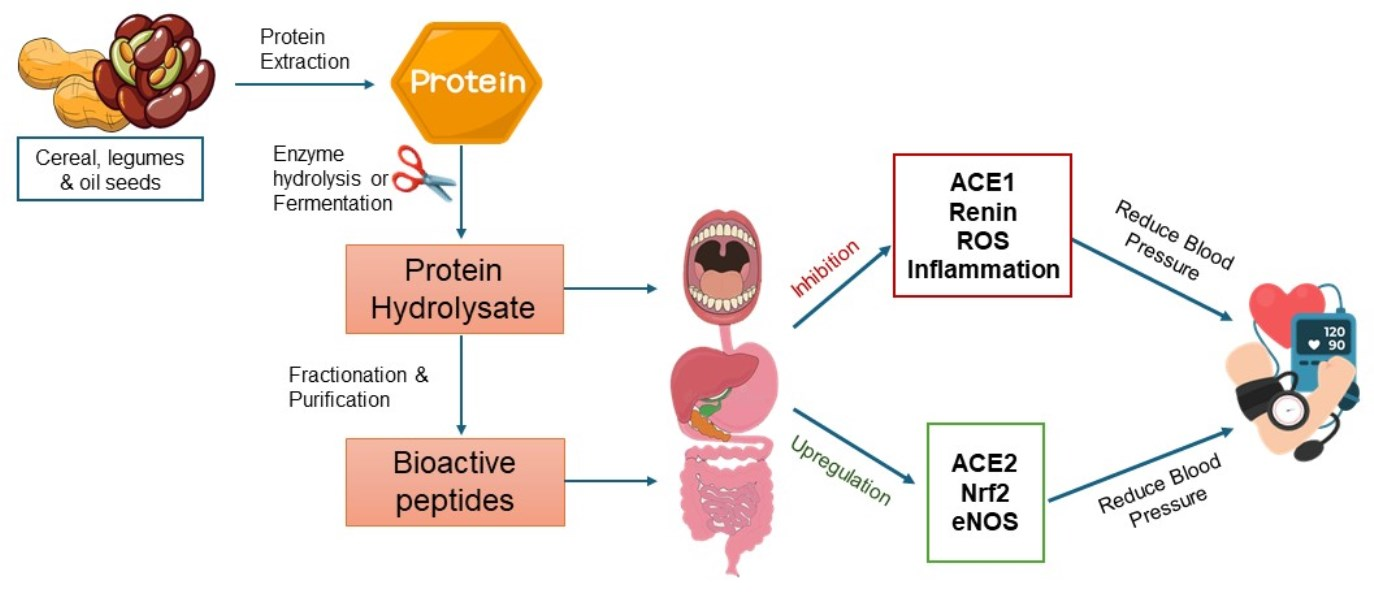
3.1. Production of Antihypertensive Peptides and Hydrolysates
3.1.1. Protein Source
3.1.2. Protein Extraction
3.1.3. Protein Hydrolysis
3.1.4. Separation and Purification
3.2. ACE-Inhibitory Activity of Plant Protein-Based Peptides and Hydrolysates
3.2.1. Categories of ACE-Inhibitory Peptides
- Inhibitor Type: These peptides maintain their inhibitory activity without structural modification after interaction with ACE. IY (IC50 = 2.1 μM) [80].
- Prodrug Type: These peptides are initially inactive but become more potent after being cleaved by proteases in the serum, gastrointestinal tract, or ACE itself. For example, LKPNM (IC50 = 2.4 μM) is hydrolyzed by ACE to produce LKP (IC50 = 0.32 μM), which has 8 times higher ACE-inhibitory activity [81].
- Substrate Type: These peptides act as ACE substrates and are cleaved into fragments with reduced or no inhibitory activity. FKGRYYP (IC50 = 0.55 μM) is hydrolyzed by ACE to FKG, RY, and YP (IC50 = 34 μM) [82].
3.2.2. Molecular Mechanisms of ACE Inhibition of Plant-Derived ACE-Inhibitory Peptides
3.3. Plant-Derived Renin-Inhibitory Peptides
3.3.1. Mechanisms of Renin Inhibition
3.3.2. Structural Determinants of Renin Inhibition
3.3.3. Renin-Inhibitory Activity of Plant Protein-Derived Peptides and Hydrolysate
3.4. Alternative Antihypertensive Mechanisms for Plant-Derived Peptides

| Peptide Sequence | Protein Source | Production Method | Type of Animal | Route of Administration | Dose (mg/kg BW) | BP Drop (ΔmmHg) | Reference |
|---|---|---|---|---|---|---|---|
| YADLVE | Mung bean | Bromelain hydrolysis | SHRs | Oral Gavage | 20 | 27 (SBP) | [130] |
| FDWLR | Walnut | Alcalase, pepsin, and pancreatin hydrolysis | Male SHRs | Oral Gavage | 10 | 43.53 (SBP), 35.16 (DBP) | [38] |
| Crude hydrolysate | Moth bean | Alcalase hydrolysis | Dexamethasone-induced hypertensive rats. | Intraperitoneal | 5 | 30 ± 2.37 (SBP) | [138] |
| LGF, GLFF | Moringa | Alcalase hydrolysis | SHRs | Oral Gavage | 30 | 19.4, 18.2 (SBP) 12, 13.8 (DBP) | [90] |
| LDSPSEGRAPG | Wine lees | Flavourzyme hydrolysis | Male SHRs | Oral Gavage | 10 | 19.0 ± 4.8 (SBP), 33.6 ± 3.6 (DBP) | [147] |
| MGR, HDCF | Garlic | Pepsin and pancreatin hydrolysis | SHRs | Oral | 50 | 46.67, 49.33 (SBP), 32.33, 37.67 (DBP) | [148] |
| <1 kDa fraction (NL, QL, FL, HAL, AAVL, AKTVF, TPLTR) | Wheat bran | Alcalase hydrolysis | Male SHRs | Oral Gavage | 100 | 35 (SBP) | [133] |
| Water-soluble peptide extract | Olive oil | Water extraction and FPLC fractionation | SHRs | Oral Gavage | 0.425 | 20 (SBP) | [149] |
| Soy protein | Soybeans | Fermentation with Lactobacillus rhamnosus | Male SHRs | Oral Gavage | 100 | 25 ± 4 mmHg (SBP), 40 ± 5 mmHg (DBP) | [150] |
| Crude hydrolysate | Lotus seeds | Protamex hydrolysis | SHRs | Oral Gavage | 15 | 27.4 (SBP) | [91] |
| Crude hydrolysate | Kabuli chickpea | α-amylase, pepsin, and pancreatin hydrolysis | Male SHRs | Intragastrical | 1200 | 61.41 (SBP) | [151] |
| Crude hydrolysate | Chickpea | Alcalase hydrolysis | Male SHRs | Intragastrical | 50 | 47.35 (SBP) | [152] |
4. Bioavailability of Antihypertensive Peptides
4.1. Effects of Gastrointestinal Digestion on Antihypertensive Peptides and Protein Hydrolysates
4.2. Peptide Absorption Mechanisms
4.3. Peptide Fate in Circulation
5. Challenges in Plant Protein-Derived Antihypertensive Peptides and Hydrolysates
5.1. Safety and Regulations
5.2. Bitterness of Bioactive Peptides and Hydrolysates
5.3. Enhancement of Peptide Stability and Bioavailability
6. Conclusions and Future Perspectives
Author Contributions
Funding
Data Availability Statement
Acknowledgments
Conflicts of Interest
References
- World Health Organization. Hypertension. Available online: https://www.who.int/news-room/fact-sheets/detail/hypertension (accessed on 20 February 2026).
- Fryar, C.D.; Kit, B.; Carroll, M.D.; Afful, J. Hypertension Prevalence, Awareness, Treatment, and Control among Adults Age 18 and Older: United States, August 2021–August 2023. 2024. Available online: https://www.cdc.gov/nchs/products/databriefs/db511.htm (accessed on 8 September 2025).
- Centers for Disease Control and Prevention Multiple Cause of Death Data on CDC WONDER. Available online: https://wonder.cdc.gov/mcd.html (accessed on 20 February 2026).
- Kazi, D.S.; Elkind, M.S.V.; Deutsch, A.; Dowd, W.N.; Heidenreich, P.; Khavjou, O.; Mark, D.; Mussolino, M.E.; Ovbiagele, B.; Patel, S.S.; et al. Forecasting the Economic Burden of Cardiovascular Disease and Stroke in the United States Through 2050: A Presidential Advisory from the American Heart Association. Circulation 2024, 150, e89–e101. [Google Scholar] [CrossRef] [PubMed]
- Fountain, J.H.; Kaur, J.; Lappin, S.L. Renin Angiotensin System. In Physiology; StatPearls Publishing: Treasure Island, FL, USA, 2023. [Google Scholar]
- Khalil, H.; Zeltser, R. Antihypertensive Medications. In StatPearls [Internet]; StatPearls Publishing: Treasure Island, FL, USA, 2023. [Google Scholar]
- Hong, F.; Ming, L.; Yi, S.; Zhanxia, L.; Yongquan, W.; Chi, L. The Antihypertensive Effect of Peptides: A Novel Alternative to Drugs? Peptides 2008, 29, 1062–1071. [Google Scholar] [CrossRef] [PubMed]
- Olalere, O.A.; Yap, P.-G.; Gan, C.-Y. Comprehensive Review on Some Food-Derived Bioactive Peptides with Anti-Hypertension Therapeutic Potential for Angiotensin-Converting Enzyme (ACE) Inhibition. J. Proteins Proteom. 2023, 14, 129–161. [Google Scholar] [CrossRef]
- Aluko, R.E. Food Protein-Derived Renin-Inhibitory Peptides: In Vitro and in Vivo Properties. J. Food Biochem. 2019, 43, e12648. [Google Scholar] [CrossRef]
- Duffuler, P.; Bhullar, K.S.; de Campos Zani, S.C.; Wu, J. Bioactive Peptides: From Basic Research to Clinical Trials and Commercialization. J. Agric. Food Chem. 2022, 70, 3585–3595. [Google Scholar] [CrossRef]
- Chalamaiah, M.; Keskin Ulug, S.; Hong, H.; Wu, J. Regulatory Requirements of Bioactive Peptides (Protein Hydrolysates) from Food Proteins. J. Funct. Foods 2019, 58, 123–129. [Google Scholar] [CrossRef]
- Oparil, S.; Acelajado, M.C.; Bakris, G.L.; Berlowitz, D.R.; Cífková, R.; Dominiczak, A.F.; Grassi, G.; Jordan, J.; Poulter, N.R.; Rodgers, A.; et al. Hypertension. Nat. Rev. Dis. Primers 2018, 4, 18014. [Google Scholar] [CrossRef]
- Bolívar, J.J. Essential Hypertension: An Approach to Its Etiology and Neurogenic Pathophysiology. Int. J. Hypertens. 2013, 2013, 547809. [Google Scholar] [CrossRef]
- Whelton, P.K.; Carey, R.M.; Aronow, W.S.; Casey, D.E.; Collins, K.J.; Dennison Himmelfarb, C.; DePalma, S.M.; Gidding, S.; Jamerson, K.A.; Jones, D.W.; et al. 2017 ACC/AHA/AAPA/ABC/ACPM/AGS/APhA/ASH/ASPC/NMA/PCNA Guideline for the Prevention, Detection, Evaluation, and Management of High Blood Pressure in Adults: A Report of the American College of Cardiology/American Heart Association Task Force on Clinical Practice Guidelines. Hypertension 2018, 71, e13–e115. [Google Scholar] [CrossRef]
- Mishra, S.R.; Satheesh, G.; Khanal, V.; Nguyen, T.N.; Picone, D.; Chapman, N.; Lindley, R.I. Closing the Gap in Global Disparities in Hypertension Control. Hypertension 2025, 82, 407–410. [Google Scholar] [CrossRef]
- Zhou, B.; Perel, P.; Mensah, G.A.; Ezzati, M. Global Epidemiology, Health Burden and Effective Interventions for Elevated Blood Pressure and Hypertension. Nat. Rev. Cardiol. 2021, 18, 785–802. [Google Scholar] [CrossRef]
- Reynolds, K.; Gu, D.; Muntner, P.; Kusek, J.W.; Chen, J.; Wu, X.; Duan, X.; Chen, C.-S.; Klag, M.J.; Whelton, P.K. A Population-Based, Prospective Study of Blood Pressure and Risk for End-Stage Renal Disease in China. J. Am. Soc. Nephrol. 2007, 18, 1928–1935. [Google Scholar] [CrossRef] [PubMed]
- Mills, K.T.; Stefanescu, A.; He, J. The Global Epidemiology of Hypertension. Nat. Rev. Nephrol. 2020, 16, 223–237. [Google Scholar] [CrossRef] [PubMed]
- Ji, H.; Kim, A.; Ebinger, J.E.; Niiranen, T.J.; Claggett, B.L.; Bairey Merz, C.N.; Cheng, S. Sex Differences in Blood Pressure Trajectories Over the Life Course. JAMA Cardiol. 2020, 5, 19–26. [Google Scholar] [CrossRef] [PubMed]
- Ostchega, Y.; Fryar, C.D.; Nwankwo, T.; Nguyen, D.T. Hypertension Prevalence among Adults Aged 18 and over: United States, 2017–2018. 2020. Available online: https://stacks.cdc.gov/view/cdc/87559 (accessed on 8 September 2025).
- Carnethon, M.R.; Pu, J.; Howard, G.; Albert, M.A.; Anderson, C.A.M.; Bertoni, A.G.; Mujahid, M.S.; Palaniappan, L.; Taylor, H.A.; Willis, M.; et al. Cardiovascular Health in African Americans: A Scientific Statement From the American Heart Association. Circulation 2017, 136, e393–e423. [Google Scholar] [CrossRef]
- Gay, H.C.; Rao, S.G.; Vaccarino, V.; Ali, M.K. Effects of Different Dietary Interventions on Blood Pressure. Hypertension 2016, 67, 733–739. [Google Scholar] [CrossRef]
- Marketou, M.E.; Maragkoudakis, S.; Anastasiou, I.; Nakou, H.; Plataki, M.; Vardas, P.E.; Parthenakis, F.I. Salt-Induced Effects on Microvascular Function: A Critical Factor in Hypertension Mediated Organ Damage. J. Clin. Hypertens. 2019, 21, 749–757. [Google Scholar] [CrossRef]
- Haddy, F.J.; Vanhoutte, P.M.; Feletou, M. Role of Potassium in Regulating Blood Flow and Blood Pressure. Am. J. Physiol.-Regul. Integr. Comp. Physiol. 2006, 290, R546–R552. [Google Scholar] [CrossRef]
- Whelton, S.P.; Chin, A.; Xin, X.; He, J. Effect of Aerobic Exercise on Blood Pressure. Ann. Intern. Med. 2002, 136, 493–503. [Google Scholar] [CrossRef]
- Hall, M.E.; do Carmo, J.M.; da Silva, A.A.; Juncos, L.A.; Wang, Z.; Hall, J.E. Obesity, Hypertension, and Chronic Kidney Disease. Int. J. Nephrol. Renov. Dis. 2014, 7, 75–88. [Google Scholar] [CrossRef]
- The Trials of Hypertension Prevention Collaborative Research Group Effects of Weight Loss and Sodium Reduction Intervention on Blood Pressure and Hypertension Incidence in Overweight People with High-Normal Blood Pressure: The Trials of Hypertension Prevention, Phase II. Arch. Intern. Med. 1997, 157, 657–667. [CrossRef]
- Sacks, F.M.; Svetkey, L.P.; Vollmer, W.M.; Appel, L.J.; Bray, G.A.; Harsha, D.; Obarzanek, E.; Conlin, P.R.; Miller, E.R.; Simons-Morton, D.G.; et al. Effects on Blood Pressure of Reduced Dietary Sodium and the Dietary Approaches to Stop Hypertension (DASH) Diet. N. Engl. J. Med. 2001, 344, 3–10. [Google Scholar] [CrossRef] [PubMed]
- Whelton, P.K.; He, J.; Cutler, J.A.; Brancati, F.L.; Appel, L.J.; Follmann, D.; Klag, M.J. Effects of Oral Potassium on Blood Pressure: Meta-Analysis of Randomized Controlled Clinical Trials. JAMA 1997, 277, 1624–1632. [Google Scholar] [CrossRef] [PubMed]
- Roerecke, M.; Kaczorowski, J.; Tobe, S.W.; Gmel, G.; Hasan, O.S.M.; Rehm, J. The Effect of a Reduction in Alcohol Consumption on Blood Pressure: A Systematic Review and Meta-Analysis. Lancet Public Health 2017, 2, e108–e120. [Google Scholar] [CrossRef]
- The Sixth Report of the Joint National Committee on Prevention, Detection, Evaluation, and Treatment of High Blood Pressure. Arch. Intern. Med. 1997, 157, 2413–2446. [CrossRef]
- O’Brien, E.; Barton, J.; Nussberger, J.; Mulcahy, D.; Jensen, C.; Dicker, P.; Stanton, A. Aliskiren Reduces Blood Pressure and Suppresses Plasma Renin Activity in Combination with a Thiazide Diuretic, an Angiotensin-Converting Enzyme Inhibitor, or an Angiotensin Receptor Blocker. Hypertension 2007, 49, 276–284. [Google Scholar] [CrossRef]
- Bjerre, H.L.; Christensen, J.B.; Buus, N.H.; Simonsen, U.; Su, J. The Role of Aliskiren in the Management of Hypertension and Major Cardiovascular Outcomes: A Systematic Review and Meta-Analysis. J. Hum. Hypertens. 2019, 33, 795–806. [Google Scholar] [CrossRef]
- Laurent, S. Antihypertensive Drugs. Pharmacol. Res. 2017, 124, 116–125. [Google Scholar] [CrossRef]
- Mancia, G.; Grassi, G.; Rosei, E.A.; Dominiczak, A.; Kjeldsen, S. (Eds.) Manual of Hypertension of the European Society of Hypertension, 3rd ed.; CRC Press: Boca Raton, FL, USA, 2019; ISBN 978-0-429-19918-9. [Google Scholar]
- Sirtori, C.R.; Arnoldi, A.; Cicero, A.F.G. Nutraceuticals for Blood Pressure Control. Ann. Med. 2015, 47, 447–456. [Google Scholar] [CrossRef]
- Wagenaar, G.T.M.; Moll, G.N. Clinical Significance of Intervention in the Renin-Angiotensin-Aldosterone-Apelinergic System. Eur. J. Pharmacol. 2025, 1003, 177866. [Google Scholar] [CrossRef]
- Xie, J.; Chen, S.; Huan, P.; Wang, S.; Zhuang, Y. A Novel Angiotensin I-Converting Enzyme Inhibitory Peptide from Walnut (Juglans Sigillata) Protein Hydrolysates and Its Evaluation in Ang II-Induced HUVECs and Hypertensive Rats. Int. J. Biol. Macromol. 2024, 266, 131152. [Google Scholar] [CrossRef] [PubMed]
- Ferreira, S.H.; Bartelt, D.C.; Greene, L.J. Isolation of Bradykinin-Potentiating Peptides from Bothrops Jararaca Venom. Biochemistry 1970, 9, 2583–2593. [Google Scholar] [CrossRef] [PubMed]
- Xue, L.; Yin, R.; Howell, K.; Zhang, P. Activity and Bioavailability of Food Protein-Derived Angiotensin-I-Converting Enzyme–Inhibitory Peptides. Compr. Rev. Food Sci. Food Saf. 2021, 20, 1150–1187. [Google Scholar] [CrossRef] [PubMed]
- Bhandari, D.; Rafiq, S.; Gat, Y.; Gat, P.; Waghmare, R.; Kumar, V. A Review on Bioactive Peptides: Physiological Functions, Bioavailability and Safety. Int. J. Pept. Res. Ther. 2020, 26, 139–150. [Google Scholar] [CrossRef]
- Li-Chan, E.C. Bioactive Peptides and Protein Hydrolysates: Research Trends and Challenges for Application as Nutraceuticals and Functional Food Ingredients. Curr. Opin. Food Sci. 2015, 1, 28–37. [Google Scholar] [CrossRef]
- Liao, W.; Sun, G.; Xu, D.; Wang, Y.; Lu, Y.; Sun, J.; Xia, H.; Wang, S. The Blood-Pressure-Lowering Effect of Food-Protein-Derived Peptides: A Meta-Analysis of Recent Clinical Trials. Foods 2021, 10, 2316. [Google Scholar] [CrossRef]
- Nasri, M. Protein Hydrolysates and Biopeptides: Production, Biological Activities, and Applications in Foods and Health Benefits. A Review. In Advances in Food and Nutrition Research; Toldrá, F., Ed.; Academic Press: Cambridge, MA, USA, 2017; Volume 81, pp. 109–159. ISBN 1043-4526. [Google Scholar]
- Pei, J.; Gao, X.; Pan, D.; Hua, Y.; He, J.; Liu, Z.; Dang, Y. Advances in the Stability Challenges of Bioactive Peptides and Improvement Strategies. Curr. Res. Food Sci. 2022, 5, 2162–2170. [Google Scholar] [CrossRef]
- Daskaya-Dikmen, C.; Yucetepe, A.; Karbancioglu-Guler, F.; Daskaya, H.; Ozcelik, B. Angiotensin-I-Converting Enzyme (ACE)-Inhibitory Peptides from Plants. Nutrients 2017, 9, 316. [Google Scholar] [CrossRef]
- Möller, N.P.; Scholz-Ahrens, K.E.; Roos, N.; Schrezenmeir, J. Bioactive Peptides and Proteins from Foods: Indication for Health Effects. Eur. J. Nutr. 2008, 47, 171–182. [Google Scholar] [CrossRef]
- Sosalagere, C.; Adesegun Kehinde, B.; Sharma, P. Isolation and Functionalities of Bioactive Peptides from Fruits and Vegetables: A Reviews. Food Chem. 2022, 366, 130494. [Google Scholar] [CrossRef]
- Fan, H.; Liu, H.; Zhang, Y.; Zhang, S.; Liu, T.; Wang, D. Review on Plant-Derived Bioactive Peptides: Biological Activities, Mechanism of Action and Utilizations in Food Development. J. Future Foods 2022, 2, 143–159. [Google Scholar] [CrossRef]
- Daroit, D.J.; Brandelli, A. In Vivo Bioactivities of Food Protein-Derived Peptides—A Current Review. Curr. Opin. Food Sci. 2021, 39, 120–129. [Google Scholar] [CrossRef]
- Garbacz, K.; Wawrzykowski, J.; Czelej, M.; Czernecki, T.; Waśko, A. Recent Trends in the Application of Oilseed-Derived Protein Hydrolysates as Functional Foods. Foods 2023, 12, 3861. [Google Scholar] [CrossRef] [PubMed]
- El-Adawy, T.A.; Taha, K.M. Characteristics and Composition of Different Seed Oils and Flours. Food Chem. 2001, 74, 47–54. [Google Scholar] [CrossRef]
- Yu, J.; Ahmedna, M.; Goktepe, I. Peanut Protein Concentrate: Production and Functional Properties as Affected by Processing. Food Chem. 2007, 103, 121–129. [Google Scholar] [CrossRef]
- Perović, M.N.; Antov, M.G. The Influence of Enzymatic Pretreatment of Chickpea on Properties of Protein Nanoparticles Prepared by Heat Treatment. LWT 2022, 163, 113545. [Google Scholar] [CrossRef]
- Jain, I.; Kaur, R.; Kumar, A.; Paul, M.; Singh, N. Emerging Protein Sources and Novel Extraction Techniques: A Systematic Review on Sustainable Approaches. Int. J. Food Sci. Technol. 2024, 59, 6797–6820. [Google Scholar] [CrossRef]
- Ningrum, S.; Liang Hsu, J. Study of Angiotensin-I Converting Enzyme Inhibitory Peptides Derived from Ficus pumila var. awkeotsang Seeds Hydrolysate. J. Teknol. Pertan. 2024, 25, 1–8. [Google Scholar] [CrossRef]
- Poddar, S.; Yu, J. Angiotensin-Converting Enzyme and Renin-Inhibitory Activities of Protein Hydrolysates Produced by Alcalase Hydrolysis of Peanut Protein. Int. J. Mol. Sci. 2024, 25, 7463. [Google Scholar] [CrossRef]
- Liu, K.; Gao, Z.; Li, Q.; Zhang, H. Identification and Mechanistic Study of Four Novel ACE Inhibitory Peptides from Maize Germ Protein Hydrolysates. LWT 2023, 186, 115254. [Google Scholar] [CrossRef]
- Zarei, M.; Ghanbari, R.; Zainal, N.; Ovissipour, R.; Saari, N. Inhibition Kinetics, Molecular Docking, and Stability Studies of the Effect of Papain-Generated Peptides from Palm Kernel Cake Proteins on Angiotensin-Converting Enzyme (ACE). Food Chem. Mol. Sci. 2022, 5, 100147. [Google Scholar] [CrossRef] [PubMed]
- Cruz-Casas, D.E.; Aguilar, C.N.; Ascacio-Valdés, J.A.; Rodríguez-Herrera, R.; Chávez-González, M.L.; Flores-Gallegos, A.C. Enzymatic Hydrolysis and Microbial Fermentation: The Most Favorable Biotechnological Methods for the Release of Bioactive Peptides. Food Chem. Mol. Sci. 2021, 3, 100047. [Google Scholar] [CrossRef] [PubMed]
- Zumwalt, R.W.; Absheer, J.S.; Kaiser, F.E.; Gehrke, C.W. Acid Hydrolysis of Proteins for Chromatographic Analysis of Amino Acids. J. AOAC Int. 1987, 70, 147–151. [Google Scholar] [CrossRef]
- Tiengo, A.; Faria, M.; Netto, F.M. Characterization and ACE-Inhibitory Activity of Amaranth Proteins. J. Food Sci. 2009, 74, H121–H126. [Google Scholar] [CrossRef]
- Garcia-Mora, P.; Peñas, E.; Frias, J.; Martínez-Villaluenga, C. Savinase, the Most Suitable Enzyme for Releasing Peptides from Lentil (Lens culinaris Var. Castellana) Protein Concentrates with Multifunctional Properties. J. Agric. Food Chem. 2014, 62, 4166–4174. [Google Scholar] [CrossRef]
- Goyal, N.; Hajare, S.N.; Gautam, S. Release of an Encrypted, Highly Potent ACE-Inhibitory Peptide by Enzymatic Hydrolysis of Moth Bean (Vigna aconitifolia) Protein. Front. Nutr. 2023, 10, 1167259. [Google Scholar] [CrossRef]
- García, M.C.; Endermann, J.; González-García, E.; Marina, M.L. HPLC-Q-TOF-MS Identification of Antioxidant and Antihypertensive Peptides Recovered from Cherry (Prunus cerasus L.) Subproducts. J. Agric. Food Chem. 2015, 63, 1514–1520. [Google Scholar] [CrossRef]
- Tavano, O.L.; Berenguer-Murcia, A.; Secundo, F.; Fernandez-Lafuente, R. Biotechnological Applications of Proteases in Food Technology. Comp. Rev. Food Sci. Food Safe 2018, 17, 412–436. [Google Scholar] [CrossRef]
- Zhang, Y.; Ma, H.; Wang, B.; Qu, W.; Wali, A.; Zhou, C. Relationships between the Structure of Wheat Gluten and ACE Inhibitory Activity of Hydrolysate: Stepwise Multiple Linear Regression Analysis. J. Sci. Food Agric. 2016, 96, 3313–3320. [Google Scholar] [CrossRef]
- Kanu, P.J.; Kanu, J.B.; Sandy, E.H.; Kande, J.B.A.; Mornya, P.M.P.; Huiming, Z. Optimization of Enzymatic Hydrolysis of Defatted Sesame Flour by Different Proteases and Their Effect on the Functional Properties of the Resulting Protein Hydrolysate. Am. J. Food Technol. 2009, 4, 226–240. [Google Scholar] [CrossRef]
- Sukrasno, S.; Rizaldy, D.; Kurniati, N.F.; Raihanah, C.; Al Iman, A. Two Optimized Cysteine Protease-Aided Protein Hydrolysates of Soybean Tempeh Inhibit Angiotensin-Converting Enzyme Activity In Vitro. Prev. Nutr. Food Sci. 2025, 30, 379–390. [Google Scholar] [CrossRef] [PubMed]
- Qu, Y.; Harte, F.M.; Elias, R.J.; Coupland, J.N. Effect of Ethanol on the Solubilization of Hydrophobic Molecules by Sodium Caseinate. Food Hydrocoll. 2018, 77, 454–459. [Google Scholar] [CrossRef]
- Guo, C.; Steinberg, L.K.; Henderson, J.P.; Gross, M.L. Organic Solvents for Enhanced Proteolysis of Stable Proteins for Hydrogen–Deuterium Exchange Mass Spectrometry. Anal. Chem. 2020, 92, 11553–11557. [Google Scholar] [CrossRef] [PubMed]
- Shi, Q.; Wei, M.; Chen, H.; Gao, J.; Tong, P. Desalination of Duck Egg White by Biocoagulation to Obtain Peptide-ferrous Chelate as Iron Delivery System: Preparation, Characterization, and Fe2+ Release Evaluation in Vitro. J. Food Sci. 2021, 86, 4678–4690. [Google Scholar] [CrossRef]
- Ratnaningsih, E.; Reynard, R.; Khoiruddin, K.; Wenten, I.G.; Boopathy, R. Recent Advancements of UF-Based Separation for Selective Enrichment of Proteins and Bioactive Peptides—A Review. Appl. Sci. 2021, 11, 1078. [Google Scholar] [CrossRef]
- Kekessie, I.; Wegner, K.; Martinez, I.; Kopach, M.E.; White, T.D.; Tom, J.K.; Kenworthy, M.N.; Gallou, F.; Lopez, J.; Koenig, S.G.; et al. Process Mass Intensity (PMI): A Holistic Analysis of Current Peptide Manufacturing Processes Informs Sustainability in Peptide Synthesis. J. Org. Chem. 2024, 89, 4261–4282. [Google Scholar] [CrossRef]
- Chakrabarti, S.; Guha, S.; Majumder, K. Food-Derived Bioactive Peptides in Human Health: Challenges and Opportunities. Nutrients 2018, 10, 1738. [Google Scholar] [CrossRef]
- He, R.; Malomo, S.A.; Alashi, A.; Girgih, A.T.; Ju, X.; Aluko, R.E. Purification and Hypotensive Activity of Rapeseed Protein-Derived Renin and Angiotensin Converting Enzyme Inhibitory Peptides. J. Funct. Foods 2013, 5, 781–789. [Google Scholar] [CrossRef]
- Ajibola, C.F.; Fashakin, J.B.; Fagbemi, T.N.; Aluko, R.E. Renin and Angiotensin Converting Enzyme Inhibition with Antioxidant Properties of African Yam Bean Protein Hydrolysate and Reverse-Phase HPLC-Separated Peptide Fractions. Food Res. Int. 2013, 52, 437–444. [Google Scholar] [CrossRef]
- Alashi, A.M.; Blanchard, C.L.; Mailer, R.J.; Agboola, S.O.; Mawson, A.J.; He, R.; Malomo, S.A.; Girgih, A.T.; Aluko, R.E. Blood Pressure Lowering Effects of Australian Canola Protein Hydrolysates in Spontaneously Hypertensive Rats. Food Res. Int. 2014, 55, 281–287. [Google Scholar] [CrossRef]
- Girgih, A.T.; Udenigwe, C.C.; Li, H.; Adebiyi, A.P.; Aluko, R.E. Kinetics of Enzyme Inhibition and Antihypertensive Effects of Hemp Seed (Cannabis sativa L.) Protein Hydrolysates. J. Americ. Oil Chem. Soc. 2011, 88, 1767–1774. [Google Scholar] [CrossRef]
- Iroyukifujita, H.; Eiichiyokoyama, K.; Yoshikawa, M. Classification and Antihypertensive Activity of Angiotensin I-Converting Enzyme Inhibitory Peptides Derived from Food Proteins. J. Food Sci. 2000, 65, 564–569. [Google Scholar] [CrossRef]
- Fujita, H.; Yoshikawa, M. LKPNM: A Prodrug-Type ACE-Inhibitory Peptide Derived from Fish Protein. Immunopharmacology 1999, 44, 123–127. [Google Scholar] [CrossRef] [PubMed]
- Li, G.; Le, G.; Shi, Y.; Shrestha, S. Angiotensin I–Converting Enzyme Inhibitory Peptides Derived from Food Proteins and Their Physiological and Pharmacological Effects. Nutr. Res. 2004, 24, 469–486. [Google Scholar] [CrossRef]
- Bello Mada, S.; Paul Ugwu, C.; Musa Abarshi, M.; Saliu, M.A. Renin-Inhibitory Bioactive Peptides with Antihypertensive Property: A Review. Fudma J. Sci. 2020, 4, 478–489. [Google Scholar] [CrossRef]
- Kaur, A.; Kehinde, B.A.; Sharma, P.; Sharma, D.; Kaur, S. Recently Isolated Food-Derived Antihypertensive Hydrolysates and Peptides: A Review. Food Chem. 2021, 346, 128719. [Google Scholar] [CrossRef]
- Lee, S.Y.; Hur, S.J. Antihypertensive Peptides from Animal Products, Marine Organisms, and Plants. Food Chem. 2017, 228, 506–517. [Google Scholar] [CrossRef]
- Wei, Y.; Liu, Y.; Li, Y.; Wang, X.; Zheng, Y.; Xu, J.; Sang, S.; Liu, Y. A Novel Antihypertensive Pentapeptide Identified in Quinoa Bran Globulin Hydrolysates: Purification, In Silico Characterization, Molecular Docking with ACE and Stability against Different Food-Processing Conditions. Nutrients 2022, 14, 2420. [Google Scholar] [CrossRef]
- Zhang, Y.; Cong, J.; Bao, G.; Gu, S.; Wang, X. In Vitro Gastrointestinal Digestion Study and Identification of Novel Angiotensin I-Converting Enzyme Inhibitory Peptide from Broccoli (Brassica oleracea). LWT 2022, 164, 113613. [Google Scholar] [CrossRef]
- Zhu, Q.; Xue, J.; Wang, P.; Wang, X.; Zhang, J.; Fang, X.; He, Z.; Wu, F. Identification of a Novel ACE Inhibitory Hexapeptide from Camellia Seed Cake and Evaluation of Its Stability. Foods 2023, 12, 501. [Google Scholar] [CrossRef]
- Liu, W.; Wei, G.; He, R.; Tian, Y.; Huang, A.; Wang, X. Health-Promoting Activities of Moringa Oleifera Lam. Seeds Protein Hydrolysates and Its Ultra-Filtered Peptide Fractions. Food Chem. Adv. 2023, 2, 100324. [Google Scholar] [CrossRef]
- Ma, K.; Wang, Y.; Wang, M.; Wang, Z.; Wang, X.; Ju, X.; He, R. Antihypertensive Activity of the ACE–Renin Inhibitory Peptide Derived from Moringa oleifera Protein. Food Funct. 2021, 12, 8994–9006. [Google Scholar] [CrossRef]
- Tian, Y.; Zhu, L.; Zhang, H. The Antihypertensive Activity of Lotus Seed Protein Hydrolysates and the Identification of Antihypertensive Peptides. Food Biosci. 2025, 73, 107702. [Google Scholar] [CrossRef]
- Hung, W.-T.; Liao, H.-Y.; Sutopo, C.C.Y.; Widyastuti, E.; Lin, T.C.-C.; Hsu, J.-L. Perilla Frutescens Seeds as a Source of Antihypertensive Peptides: Discovery of Novel Tetrapeptides with ACE Inhibitory Activity. Plant Foods Hum. Nutr. 2025, 80, 178. [Google Scholar] [CrossRef] [PubMed]
- Zhang, L.; Pan, D.; Shao, L.; Zheng, Y.; Hao, W.; Kan, Y.; Cao, J.; Yu, H.; Liu, J. Oil Palm Kernel Globulin Antihypertensive Peptides: Isolation and Characterization, ACE Inhibition Mechanisms, Zinc-Chelating Activity, Security and Stability. Front. Pharmacol. 2023, 14, 1225256. [Google Scholar] [CrossRef] [PubMed]
- Shao, B.; Huang, X.; Xu, M.; Cheng, D.; Li, X.; Li, M. Peptides Isolated from Black Soybean Synergistically Inhibit the Activity of Angiotensin Converting Enzyme (ACE). J. Funct. Foods 2023, 106, 105604. [Google Scholar] [CrossRef]
- Li, X.; Peng, C.; Xiao, S.; Wang, Q.; Zhou, A. Two Novel Angiotensin-Converting Enzyme (ACE) Inhibitory and ACE2 Upregulating Peptides from the Hydrolysate of Pumpkin (Cucurbita moschata) Seed Meal. J. Agric. Food Chem. 2024, 72, 10909–10922. [Google Scholar] [CrossRef]
- Wu, F.; Luo, X.; Zhang, Y.; Wang, P.; Chang, Y.; He, Z.; Liu, X. Purification, Identification, and Inhibitory Mechanisms of a Novel ACE Inhibitory Peptide from Torreya Grandis. Nutrients 2023, 15, 2374. [Google Scholar] [CrossRef]
- Xiong, W.; Guo, L.; Zhang, Y.; Li, S.; Wu, Z.; Cai, S. Identification of Novel Angiotensin I-Converting Enzyme Inhibitory Peptides from Walnut (Juglans Sigillata Dode) Protein Hydrolysates and Their Vascular Endothelial Protective Properties: In Silico and in Vitro Studies. Curr. Res. Food Sci. 2025, 11, 101135. [Google Scholar] [CrossRef]
- Chen, Y.; Zhang, Y.; Qi, Q.; Liang, F.; Wang, N.; Chen, Q.; Li, X.; Sun, S.; Wang, X.; Bai, K.; et al. Preparation and Activity Evaluation of Angiotensin-I Converting Enzyme Inhibitory Peptides from Protein Hydrolysate of Mulberry Leaf. Front. Nutr. 2023, 9, 1064526. [Google Scholar] [CrossRef]
- Wongngam, W.; Hamzeh, A.; Tian, F.; Roytrakul, S.; Yongsawatdigul, J. Purification and Molecular Docking of Angiotensin Converting Enzyme-Inhibitory Peptides Derived from Corn Gluten Meal Hydrolysate and from in Silico Gastrointestinal Digestion. Process Biochem. 2023, 129, 113–120. [Google Scholar] [CrossRef]
- Zheng, Y.; Wang, X.; Guo, M.; Yan, X.; Zhuang, Y.; Sun, Y.; Li, J. Two Novel Antihypertensive Peptides Identified in Millet Bran Glutelin-2 Hydrolysates: Purification, In Silico Characterization, Molecular Docking with ACE and Stability in Various Food Processing Conditions. Foods 2022, 11, 1355. [Google Scholar] [CrossRef] [PubMed]
- Suleman, D.P.; Sutopo, C.C.Y.; Hsu, J.-L. Characterization of Novel Angiotensin-I Converting Enzyme Inhibitory Peptides Derived from Taiwan Red Quinoa (Chenopodium formosanum Koidz.) Seed Proteins Using Two Sequential Bioassay-Guided Fractionations. Med. Chem. Res. 2024, 33, 107–116. [Google Scholar] [CrossRef]
- Li, Y.; Li, J.; Cheng, C.; Zheng, Y.; Li, H.; Zhu, Z.; Yan, Y.; Hao, W.; Qin, N. Study on the In Silico Screening and Characterization, Inhibition Mechanisms, Zinc-Chelate Activity, and Stability of ACE-Inhibitory Peptides Identified in Naked Oat Bran Albumin Hydrolysates. Foods 2023, 12, 2268. [Google Scholar] [CrossRef]
- Dai, H.; He, M.; Hu, G.; Li, Z.; Al-Romaima, A.; Wu, Z.; Liu, X.; Qiu, M. Discovery of ACE Inhibitory Peptides Derived from Green Coffee Using In Silico and In Vitro Methods. Foods 2023, 12, 3480. [Google Scholar] [CrossRef]
- Prangthip, P.; Panbangred, W.; Reamtong, O. Potential Antihypertensive Activity of Novel Peptides from Green Basil Leaves. BMC Complement. Med. Ther. 2023, 23, 282. [Google Scholar] [CrossRef]
- Ciau-Solís, N.; Rodríguez-Canto, W.; Fernández-Martínez, L.; Sandoval-Peraza, M.; Chel-Guerrero, L.; Betancur-Ancona, D. Inhibitory Activity of Angiotensin-I Converting Enzyme (ACE-I) from Partially Purified Phaseolus Lunatus Peptide Fractions. Process Biochem. 2024, 139, 44–50. [Google Scholar] [CrossRef]
- Fadimu, G.J.; Gan, C.-Y.; Olalere, O.A.; Farahnaky, A.; Gill, H.; Truong, T. Novel Antihypertensive Peptides from Lupin Protein Hydrolysate: An in-Silico Identification and Molecular Docking Studies. Food Chem. 2023, 407, 135082. [Google Scholar] [CrossRef]
- Sarnthima, R.; Khammuang, S.; Sanachai, K. ACE-Inhibitory Activity of Seed Storage Proteins and Hydrolysates from Job’s Tears (Coix lacryma-jobi L.). Int. Food Res. J. 2023, 30, 439–446. [Google Scholar] [CrossRef]
- Llontop-Bernabé, K.S.; Intiquilla, A.; Ramirez-Veliz, C.; Santos, M.; Jiménez-Aliaga, K.; Zavaleta, A.I.; Paterson, S.; Hernández-Ledesma, B. Production of Multifunctional Hydrolysates from the Lupinus Mutabilis Protein Using a Micrococcus Sp. PC7 Protease. BioTech 2025, 14, 32. [Google Scholar] [CrossRef]
- Wang, L.; Li, A.; Zhong, Z.; Tang, Y.; Li, D.; Xiao, J. Isolation, Purification and Bioactivity of ACE Inhibitory Peptides from Peach Kernel Protein Enzymatic Hydrolysate. Food Sci. Technol. 2022, 42, e107921. [Google Scholar] [CrossRef]
- Chaipoot, S.; Punfa, W.; Ounjaijean, S.; Phongphisutthinant, R.; Kulprachakarn, K.; Parklak, W.; Phaworn, L.; Rotphet, P.; Boonyapranai, K. Antioxidant, Anti-Diabetic, Anti-Obesity, and Antihypertensive Properties of Protein Hydrolysate and Peptide Fractions from Black Sesame Cake. Molecules 2022, 28, 211. [Google Scholar] [CrossRef] [PubMed]
- Zeng, W.; Yu, X.; Chen, M.; Zhang, H.; Xu, J.; Zeng, X.; Liang, Y. ACE-Inhibitory Peptides from Morchella Esculenta: Screening, Kinetics, and Molecular Dynamics Simulation. Food Chem. 2025, 490, 145011. [Google Scholar] [CrossRef]
- Shi, A.; Liu, H.; Liu, L.; Hu, H.; Wang, Q.; Adhikari, B. Isolation, Purification and Molecular Mechanism of a Peanut Protein-Derived ACE-Inhibitory Peptide. PLoS ONE 2014, 9, e111188. [Google Scholar] [CrossRef] [PubMed]
- Wu, J.; Ding, X. Hypotensive and Physiological Effect of Angiotensin Converting Enzyme Inhibitory Peptides Derived from Soy Protein on Spontaneously Hypertensive Rats. J. Agric. Food Chem. 2001, 49, 501–506. [Google Scholar] [CrossRef]
- Fan, H.; Liao, W.; Wu, J. Molecular Interactions, Bioavailability, and Cellular Mechanisms of Angiotensin-Converting Enzyme Inhibitory Peptides. J. Food Biochem. 2019, 43, e12572. [Google Scholar] [CrossRef] [PubMed]
- Zhang, L.; Huang, Q.; Gong, W.-Y.; Wang, W.-J.; Yang, C.-T.; Zhang, W.-T.; Sheng, J.; Xie, J.; Tian, Y. Structure-Activity Relationship Analysis of the ACE Inhibitory Activity of Three Walnut Protein Hydrolysates and Elucidation of the ACE Inhibitory Mechanism of Its Derived Peptides. LWT 2025, 228, 118131. [Google Scholar] [CrossRef]
- Kobayashi, Y.; Yamauchi, T.; Katsuda, T.; Yamaji, H.; Katoh, S. Angiotensin-I Converting Enzyme (ACE) Inhibitory Mechanism of Tripeptides Containing Aromatic Residues. J. Biosci. Bioeng. 2008, 106, 310–312. [Google Scholar] [CrossRef]
- Li, J.; Liu, Z.; Zhao, Y.; Zhu, X.; Yu, R.; Dong, S.; Wu, H. Novel Natural Angiotensin Converting Enzyme (ACE)-Inhibitory Peptides Derived from Sea Cucumber-Modified Hydrolysates by Adding Exogenous Proline and a Study of Their Structure–Activity Relationship. Mar. Drugs 2018, 16, 271. [Google Scholar] [CrossRef]
- Ma, M.; Feng, Y.; Miao, Y.; Shen, Q.; Tang, S.; Dong, J.; Zhang, J.Z.H.; Zhang, L. Revealing the Sequence Characteristics and Molecular Mechanisms of ACE Inhibitory Peptides by Comprehensive Characterization of 160,000 Tetrapeptides. Foods 2023, 12, 1573. [Google Scholar] [CrossRef]
- Oshima, G.; Nagasawa, K. Stereospecificity of Peptidyl Dipeptide Hydrolase (Angiotensin I-Converting Enzyme). J. Biochem. 1979, 86, 1719–1724. [Google Scholar] [CrossRef] [PubMed]
- London, R.E.; Matwiyoff, N.A.; Stewart, J.M.; Cann, J.R. 13C Nuclear Magnetic Resonance Study of the Cis-Trans Isomerism in X-Pro-Pro Tripeptides. Biochemistry 1978, 17, 2277–2283. [Google Scholar] [CrossRef] [PubMed]
- Valjakka, J.; Siltari, A.; Kukkurainen, S.; Vapaatalo, H.; Viitanen, R. Does the Cis/Trans Configuration of Peptide Bonds in Bioactive Tripeptides Play a Role in ACE-1 Enzyme Inhibition? Biol. Targets Ther. 2014, 8, 59–65. [Google Scholar] [CrossRef] [PubMed][Green Version]
- Ariza-Ortega, T.D.J.; Zenón-Briones, E.Y.; Castrejón-Flores, J.L.; Yáñez-Fernández, J.; Gómez-Gómez, Y.D.L.M.; Oliver-Salvador, M.D.C. Angiotensin-I-Converting Enzyme Inhibitory, Antimicrobial, and Antioxidant Effect of Bioactive Peptides Obtained from Different Varieties of Common Beans (Phaseolus vulgaris L.) with in Vivo Antihypertensive Activity in Spontaneously Hypertensive Rats. Eur. Food Res. Technol. 2014, 239, 785–794. [Google Scholar] [CrossRef]
- Onuh, J.O.; Girgih, A.T.; Malomo, S.A.; Aluko, R.E.; Aliani, M. Kinetics of in Vitro Renin and Angiotensin Converting Enzyme Inhibition by Chicken Skin Protein Hydrolysates and Their Blood Pressure Lowering Effects in Spontaneously Hypertensive Rats. J. Funct. Foods 2015, 14, 133–143. [Google Scholar] [CrossRef]
- Madeddu, P.; Emanueli, C.; El-Dahr, S. Mechanisms of Disease: The Tissue Kallikrein–Kinin System in Hypertension and Vascular Remodeling. Nat. Rev. Nephrol. 2007, 3, 208–221. [Google Scholar] [CrossRef]
- Li, H.; Prairie, N.; Udenigwe, C.C.; Adebiyi, A.P.; Tappia, P.S.; Aukema, H.M.; Jones, P.J.H.; Aluko, R.E. Blood Pressure Lowering Effect of a Pea Protein Hydrolysate in Hypertensive Rats and Humans. J. Agric. Food Chem. 2011, 59, 9854–9860. [Google Scholar] [CrossRef]
- Udenigwe, C.C.; Li, H.; Aluko, R.E. Quantitative Structure–Activity Relationship Modeling of Renin-Inhibiting Dipeptides. Amino Acids 2012, 42, 1379–1386. [Google Scholar] [CrossRef]
- Udenigwe, C.C.; Lin, Y.-S.; Hou, W.-C.; Aluko, R.E. Kinetics of the Inhibition of Renin and Angiotensin I-Converting Enzyme by Flaxseed Protein Hydrolysate Fractions. J. Funct. Foods 2009, 1, 199–207. [Google Scholar] [CrossRef]
- Gong, K.; Deng, L.; Shi, A.; Liu, H.; Liu, L.; Hu, H.; Adhikari, B.; Wang, Q. High-pressure Microfluidisation Pretreatment Disaggregate Peanut Protein Isolates to Prepare Antihypertensive Peptide Fractions. Int. J. Food Sci. Tech. 2017, 52, 1760–1769. [Google Scholar] [CrossRef]
- Li, Y.; Gu, M.; Shi, F.; Zhou, L.; Huang, J. Identification of Novel Renin Inhibitory Peptides from Tartary Buckwheat Albumin Hydrolysates by Molecular Docking. Process Biochem. 2024, 138, 120–129. [Google Scholar] [CrossRef]
- Sonklin, C.; Alashi, M.A.; Laohakunjit, N.; Kerdchoechuen, O.; Aluko, R.E. Identification of Antihypertensive Peptides from Mung Bean Protein Hydrolysate and Their Effects in Spontaneously Hypertensive Rats. J. Funct. Foods 2020, 64, 103635. [Google Scholar] [CrossRef]
- Malomo, S.; Onuh, J.; Girgih, A.; Aluko, R. Structural and Antihypertensive Properties of Enzymatic Hemp Seed Protein Hydrolysates. Nutrients 2015, 7, 7616–7632. [Google Scholar] [CrossRef] [PubMed]
- Nardo, A.E.; Añón, M.C.; Quiroga, A.V. Identification of Renin Inhibitors Peptides from Amaranth Proteins by Docking Protocols. J. Funct. Foods 2020, 64, 103683. [Google Scholar] [CrossRef]
- Zou, Z.; Wang, M.; Wang, Z.; Aluko, R.E.; He, R. Antihypertensive and Antioxidant Activities of Enzymatic Wheat Bran Protein Hydrolysates. J. Food Biochem. 2020, 44, e13090. [Google Scholar] [CrossRef]
- Olagunju, A.I.; Omoba, O.S.; Enujiugha, V.N.; Alashi, A.M.; Aluko, R.E. Antioxidant Properties, ACE/Renin Inhibitory Activities of Pigeon Pea Hydrolysates and Effects on Systolic Blood Pressure of Spontaneously Hypertensive Rats. Food Sci. Nutr. 2018, 6, 1879–1889. [Google Scholar] [CrossRef]
- Ciau-Solís, N.A.; Acevedo-Fernández, J.J.; Betancur-Ancona, D. In Vitro Renin–Angiotensin System Inhibition and in Vivo Antihypertensive Activity of Peptide Fractions from Lima Bean (Phaseolus lunatus L.). J. Sci. Food Agric. 2018, 98, 781–786. [Google Scholar] [CrossRef]
- Kwak, J.H.; Kim, M.; Lee, E.; Lee, S.-H.; Ahn, C.-W.; Lee, J.H. Effects of Black Soy Peptide Supplementation on Blood Pressure and Oxidative Stress: A Randomized Controlled Trial. Hypertens. Res. 2013, 36, 1060–1066. [Google Scholar] [CrossRef]
- Tsai, B.C.-K.; Kuo, W.-W.; Day, C.H.; Hsieh, D.J.-Y.; Kuo, C.-H.; Daddam, J.; Chen, R.-J.; Padma, V.V.; Wang, G.; Huang, C.-Y. The Soybean Bioactive Peptide VHVV Alleviates Hypertension-Induced Renal Damage in Hypertensive Rats via the SIRT1-PGC1α/Nrf2 Pathway. J. Funct. Foods 2020, 75, 104255. [Google Scholar] [CrossRef]
- Bhadkaria, A.; Narvekar, D.T.; Nagar, D.P.; Sah, S.P.; Srivastava, N.; Bhagyawant, S.S. Purification, Molecular Docking and in Vivo Analyses of Novel Angiotensin-Converting Enzyme Inhibitory Peptides from Protein Hydrolysate of Moth Bean (Vigna aconitifolia (Jacq.) Màrechal) Seeds. Int. J. Biol. Macromol. 2023, 230, 123138. [Google Scholar] [CrossRef]
- Mäkinen, S.; Streng, T.; Larsen, L.B.; Laine, A.; Pihlanto, A. Angiotensin I-Converting Enzyme Inhibitory and Antihypertensive Properties of Potato and Rapeseed Protein-Derived Peptides. J. Funct. Foods 2016, 25, 160–173. [Google Scholar] [CrossRef]
- Miyoshi, S.; Ishikawa, H.; Kaneko, T.; Fukui, F.; Tanaka, H.; Maruyama, S. Structures and Activity of Angiotensin-Converting Enzyme Inhibitors in an α-Zein Hydrolysate. Agric. Biol. Chem. 1991, 55, 1313–1318. [Google Scholar] [CrossRef] [PubMed]
- Motoi, H.; Kodama, T. Isolation and Characterization of Angiotensin I-converting Enzyme Inhibitory Peptides from Wheat Gliadin Hydrolysate. Nahrung 2003, 47, 354–358. [Google Scholar] [CrossRef] [PubMed]
- Chen, J.; Liu, S.; Ye, R.; Cai, G.; Ji, B.; Wu, Y. Angiotensin-I Converting Enzyme (ACE) Inhibitory Tripeptides from Rice Protein Hydrolysate: Purification and Characterization. J. Funct. Foods 2013, 5, 1684–1692. [Google Scholar] [CrossRef]
- Li, G.-H.; Qu, M.-R.; Wan, J.-Z.; You, J.-M. Antihypertensive Effect of Rice Protein Hydrolysate with in Vitro Angiotensin I-Converting Enzyme Inhibitory Activity in Spontaneously Hypertensive Rats. Asia Pac. J. Clin. Nutr. 2007, 16, 275–280. [Google Scholar]
- Wang, X.; Chen, H.; Fu, X.; Li, S.; Wei, J. A Novel Antioxidant and ACE Inhibitory Peptide from Rice Bran Protein: Biochemical Characterization and Molecular Docking Study. LWT 2017, 75, 93–99. [Google Scholar] [CrossRef]
- He, J.; Gu, D.; Wu, X.; Chen, J.; Duan, X.; Chen, J.; Whelton, P.K. Effect of Soybean Protein on Blood Pressure: A Randomized, Controlled Trial. Ann. Intern. Med. 2005, 143, 1–9. [Google Scholar] [CrossRef]
- Ogawa, Y.; Shobako, N.; Fukuhara, I.; Satoh, H.; Kobayashi, E.; Kusakari, T.; Suwa, M.; Matsumoto, M.; Ishikado, A. Rice Bran Supplement Containing a Functional Substance, the Novel Peptide Leu-Arg-Ala, Has Anti-Hypertensive Effects: A Double-Blind, Randomized, Placebo-Controlled Study. Nutrients 2019, 11, 726. [Google Scholar] [CrossRef]
- Bravo, F.I.; Mas-Capdevila, A.; López-Fernández-Sobrino, R.; Torres-Fuentes, C.; Mulero, M.; Alcaide-Hidalgo, J.M.; Muguerza, B. Identification of Novel Antihypertensive Peptides from Wine Lees Hydrolysate. Food Chem. 2022, 366, 130690. [Google Scholar] [CrossRef]
- Xiang, L.; Zheng, Z.; Guo, X.; Bai, R.; Zhao, R.; Chen, H.; Qiu, Z.; Qiao, X. Two Novel Angiotensin I-Converting Enzyme Inhibitory Peptides from Garlic Protein: In Silico Screening, Stability, Antihypertensive Effects in Vivo and Underlying Mechanisms. Food Chem. 2024, 435, 137537. [Google Scholar] [CrossRef]
- Alcaide-Hidalgo, J.M.; Margalef, M.; Bravo, F.I.; Muguerza, B.; López-Huertas, E. Virgin Olive Oil (Unfiltered) Extract Contains Peptides and Possesses ACE Inhibitory and Antihypertensive Activity. Clin. Nutr. 2020, 39, 1242–1249. [Google Scholar] [CrossRef]
- Daliri, E.B.-M.; Ofosu, F.K.; Chelliah, R.; Lee, B.H.; An, H.; Elahi, F.; Barathikannan, K.; Kim, J.-H.; Oh, D.-H. Influence of Fermented Soy Protein Consumption on Hypertension and Gut Microbial Modulation in Spontaneous Hypertensive Rats. Biosci. Microbiota Food Health 2020, 39, 199–208. [Google Scholar] [CrossRef] [PubMed]
- Chávez-Ontiveros, J.; Reyes-Moreno, C.; Ramírez-Torres, G.I.; Figueroa-Salcido, O.G.; Arámburo-Gálvez, J.G.; Montoya-Rodríguez, A.; Ontiveros, N.; Cuevas-Rodríguez, E.O. Extrusion Improves the Antihypertensive Potential of a Kabuli Chickpea (Cicer arietinum L.) Protein Hydrolysate. Foods 2022, 11, 2562. [Google Scholar] [CrossRef] [PubMed]
- Figueroa-Salcido, O.G.; Arámburo-Gálvez, J.G.; Mora-Melgem, J.A.; Camacho-Cervantes, D.L.; Gracia-Valenzuela, M.H.; Cuevas-Rodríguez, E.O.; Ontiveros, N. Alcalase-Based Chickpea (Cicer arietinum L.) Protein Hydrolysates Efficiently Reduce Systolic Blood Pressure in Spontaneously Hypertensive Rats. Foods 2024, 13, 1216. [Google Scholar] [CrossRef] [PubMed]
- Vermeirssen, V.; Augustijns, P.; Morel, N.; Van Camp, J.; Opsomer, A.; Verstraete, W. In Vitro Intestinal Transport and Antihypertensive Activity of ACE Inhibitory Pea and Whey Digests. Int. J. Food Sci. Nutr. 2005, 56, 415–430. [Google Scholar] [CrossRef]
- Norris, R.; J., R. Antihypertensive Peptides from Food Proteins. In Bioactive Food Peptides in Health and Disease; Hernndez-Ledesma, B., Ed.; InTech: Seo-gu, Republic of Korea, 2013; ISBN 978-953-51-0964-8. [Google Scholar]
- Yang, Y.; Marczak, E.D.; Yokoo, M.; Usui, H.; Yoshikawa, M. Isolation and Antihypertensive Effect of Angiotensin I-Converting Enzyme (ACE) Inhibitory Peptides from Spinach Rubisco. J. Agric. Food Chem. 2003, 51, 4897–4902. [Google Scholar] [CrossRef]
- Wang, B.; Xie, N.; Li, B. Influence of Peptide Characteristics on Their Stability, Intestinal Transport, and in Vitro Bioavailability: A Review. J. Food Biochem. 2019, 43, e12571. [Google Scholar] [CrossRef]
- Bhutta, Z.A.; Sadiq, K. Protein Digestion and Bioavailability. In Encyclopedia of Human Nutrition, 4th ed.; Caballero, B., Allen, L., Prentice, A., Eds.; Elsevier: Amsterdam, The Netherlands, 2013; pp. 116–122. [Google Scholar]
- Ozorio, L.; Mellinger-Silva, C.; Cabral, L.M.C.; Jardin, J.; Boudry, G.; Dupont, D. The Influence of Peptidases in Intestinal Brush Border Membranes on the Absorption of Oligopeptides from Whey Protein Hydrolysate: An Ex Vivo Study Using an Ussing Chamber. Foods 2020, 9, 1415. [Google Scholar] [CrossRef]
- Webb, K.E. Intestinal Absorption of Protein Hydrolysis Products: A Review. J. Anim. Sci. 1990, 68, 3011. [Google Scholar] [CrossRef]
- Abumrad, N.A.; Nassi, F.; Marcus, A. Digestion and Absorption of Dietary Fat, Carbohydrate, and Protein. In Fordtran’s Gastrointestinal and Liver Disease; US Elsevier Health: New York, NY, USA, 2016. [Google Scholar]
- Kiela, P.R.; Ghishan, F.K. Physiology of Intestinal Absorption and Secretion. Best Pract. Res. Clin. Gastroenterol. 2016, 30, 145–159. [Google Scholar] [CrossRef]
- Mirzapour, M.; Rezaei, K.; Sentandreu, M.A. Identification of Potent ACE Inhibitory Peptides from Wild Almond Proteins. J. Food Sci. 2017, 82, 2421–2431. [Google Scholar] [CrossRef] [PubMed]
- García-Mora, P.; Martín-Martínez, M.; Angeles Bonache, M.; González-Múniz, R.; Peñas, E.; Frias, J.; Martinez-Villaluenga, C. Identification, Functional Gastrointestinal Stability and Molecular Docking Studies of Lentil Peptides with Dual Antioxidant and Angiotensin I Converting Enzyme Inhibitory Activities. Food Chem. 2017, 221, 464–472. [Google Scholar] [CrossRef]
- Gu, Y.; Wu, J. LC–MS/MS Coupled with QSAR Modeling in Characterising of Angiotensin I-Converting Enzyme Inhibitory Peptides from Soybean Proteins. Food Chem. 2013, 141, 2682–2690. [Google Scholar] [CrossRef] [PubMed]
- Amigo, L.; Hernández-Ledesma, B. Current Evidence on the Bioavailability of Food Bioactive Peptides. Molecules 2020, 25, 4479. [Google Scholar] [CrossRef]
- Brodin, B.; Nielsen, C.U.; Steffansen, B.; Frøkjær, S. Transport of Peptidomimetic Drugs by the Intestinal Di/Tri-peptide Transporter, PepT1. Pharmacol. Toxicol. 2002, 90, 285–296. [Google Scholar] [CrossRef] [PubMed]
- Nielsen, C.U.; Andersen, R.; Brodin, B.; Frokjaer, S.; Taub, M.E.; Steffansen, B. Dipeptide Model Prodrugs for the Intestinal Oligopeptide Transporter. Affinity for and Transport via hPepT1 in the Human Intestinal Caco-2 Cell Line. J. Control. Release 2001, 76, 129–138. [Google Scholar] [CrossRef]
- Guettou, F.; Quistgaard, E.M.; Raba, M.; Moberg, P.; Löw, C.; Nordlund, P. Selectivity Mechanism of a Bacterial Homolog of the Human Drug-Peptide Transporters PepT1 and PepT2. Nat. Struct. Mol. Biol. 2014, 21, 728–731. [Google Scholar] [CrossRef]
- Moore, V.A.; Irwin, W.J.; Timmins, P.; Lambert, P.A.; Chong, S.; Dando, S.A.; Morrison, R.A. A Rapid Screening System to Determine Drug Affinities for the Intestinal Dipeptide Transporter 2: Affinities of ACE Inhibitors. Int. J. Pharm. 2000, 210, 29–44. [Google Scholar] [CrossRef]
- Lundquist, P.; Artursson, P. Oral Absorption of Peptides and Nanoparticles across the Human Intestine: Opportunities, Limitations and Studies in Human Tissues. Adv. Drug Deliv. Rev. 2016, 106, 256–276. [Google Scholar] [CrossRef]
- Walter, E.; Kissel, T.; Raddatz, P. Transport of Peptidomimetic Renin Inhibitors Across Monolayers of a Human Intestinal Cell Line (Caco-2): Evidence for Self-Enhancement of Paracellular Transport Route. Pharm. Res. 1995, 12, 1801–1805. [Google Scholar] [CrossRef]
- Quirós, A.; Dávalos, A.; Lasunción, M.A.; Ramos, M.; Recio, I. Bioavailability of the Antihypertensive Peptide LHLPLP: Transepithelial Flux of HLPLP. Int. Dairy J. 2008, 18, 279–286. [Google Scholar] [CrossRef]
- Salamat-Miller, N.; Johnston, T.P. Current Strategies Used to Enhance the Paracellular Transport of Therapeutic Polypeptides across the Intestinal Epithelium. Int. J. Pharm. 2005, 294, 201–216. [Google Scholar] [CrossRef] [PubMed]
- Chua, H.-L.; Jois, S.; Sim, M.-K.; Go, M.-L. Transport of Angiotensin Peptides across the Caco-2 Monolayer. Peptides 2004, 25, 1327–1338. [Google Scholar] [CrossRef] [PubMed]
- Sim, M.K.; Radhakrishnan, R. Novel Central Action of Des-Asp-Angiotensin I. Eur. J. Pharmacol. 1994, 257, R1–R3. [Google Scholar] [CrossRef]
- Wang, B.; Li, B. Charge and Hydrophobicity of Casein Peptides Influence Transepithelial Transport and Bioavailability. Food Chem. 2018, 245, 646–652. [Google Scholar] [CrossRef]
- Van der Velden, V.H.; Hulsmann, A.R. Peptidases: Structure, Function and Modulation of Peptide-mediated Effects in the Human Lung. Clin Exp. Allergy 1999, 29, 445–456. [Google Scholar] [CrossRef]
- Matsui, T.; Li, C.-H.; Tanaka, T.; Maki, T.; Osajima, Y.; Matsumoto, K. Depressor Effect of Wheat Germ Hydrolysate and Its Novel Angiotensin I-Converting Enzyme Inhibitory Peptide, Ile-Val-Tyr, and the Metabolism in Rat and Human Plasma. Biol. Pharm. Bull. 2000, 23, 427–431. [Google Scholar] [CrossRef]
- Penchala, S.C.; Miller, M.R.; Pal, A.; Dong, J.; Madadi, N.R.; Xie, J.; Joo, H.; Tsai, J.; Batoon, P.; Samoshin, V.; et al. A Biomimetic Approach for Enhancing the in Vivo Half-Life of Peptides. Nat. Chem. Biol. 2015, 11, 793–798. [Google Scholar] [CrossRef]
- Sato, K. Metabolic Fate and Bioavailability of Food-Derived Peptides: Are Normal Peptides Passed through the Intestinal Layer to Exert Biological Effects via Proposed Mechanisms? J. Agric. Food Chem. 2022, 70, 1461–1466. [Google Scholar] [CrossRef]
- Nakashima, E.M.N.; Kudo, A.; Iwaihara, Y.; Tanaka, M.; Matsumoto, K.; Matsui, T. Application of 13C Stable Isotope Labeling Liquid Chromatography–Multiple Reaction Monitoring–Tandem Mass Spectrometry Method for Determining Intact Absorption of Bioactive Dipeptides in Rats. Anal. Biochem. 2011, 414, 109–116. [Google Scholar] [CrossRef]
- Foltz, M.; Meynen, E.E.; Bianco, V.; Van Platerink, C.; Koning, T.M.M.G.; Kloek, J. Angiotensin Converting Enzyme Inhibitory Peptides from a Lactotripeptide-Enriched Milk Beverage Are Absorbed Intact into the Circulation1. J. Nutr. 2007, 137, 953–958. [Google Scholar] [CrossRef] [PubMed]
- Asai, T.; Takahashi, A.; Ito, K.; Uetake, T.; Matsumura, Y.; Ikeda, K.; Inagaki, N.; Nakata, M.; Imanishi, Y.; Sato, K. Amount of Collagen in the Meat Contained in Japanese Daily Dishes and the Collagen Peptide Content in Human Blood after Ingestion of Cooked Fish Meat. J. Agric. Food Chem. 2019, 67, 2831–2838. [Google Scholar] [CrossRef] [PubMed]
- Ejima, A.; Nakamura, M.; Suzuki, Y.A.; Sato, K. Identification of Food-Derived Peptides in Human Blood after Ingestion of Corn and Wheat Gluten Hydrolysates. J. Food Bioact. 2018, 2, 104–111. [Google Scholar] [CrossRef]
- Shigemura, Y.; Nakaba, M.; Shiratsuchi, E.; Suyama, M.; Yamada, M.; Kiyono, T.; Fukamizu, K.; Park, E.Y.; Nakamura, Y.; Sato, K. Identification of Food-Derived Elastin Peptide, Prolyl-Glycine (Pro-Gly), in Human Blood after Ingestion of Elastin Hydrolysate. J. Agric. Food Chem. 2012, 60, 5128–5133. [Google Scholar] [CrossRef]
- Ejima, A.; Yamada, K.; Sato, K. Presence of Aspartic Dipeptides with β Peptide Bond and/or D-Aspartyl Residue in Rat Blood after Ingestion of Porcine Liver Protein Hydrolysate. Bioact. Compd. Health Dis. 2019, 2, 155. [Google Scholar] [CrossRef]
- Matsui, T.; Imamura, M.; Oka, H.; Osajima, K.; Kimoto, K.; Kawasaki, T.; Matsumoto, K. Tissue Distribution of Antihypertensive Dipeptide, Val-Tyr, after Its Single Oral Administration to Spontaneously Hypertensive Rats. J. Pept. Sci. 2004, 10, 535–545. [Google Scholar] [CrossRef]
- Duchin, K.L.; Singhvi, S.M.; Willard, D.A.; Migdalof, B.H.; McKinstry, D.N. Captopril Kinetics. Clin. Pharmacol. Ther. 1982, 31, 452–458. [Google Scholar] [CrossRef]
- Kawaguchi, T.; Nanbu, P.N.; Kurokawa, M. Distribution of Prolylhydroxyproline and Its Metabolites after Oral Administration in Rats. Biol. Pharm. Bull. 2012, 35, 422–427. [Google Scholar] [CrossRef]
- Shigemura, Y.; Iwasaki, Y.; Tateno, M.; Suzuki, A.; Kurokawa, M.; Sato, Y.; Sato, K. A Pilot Study for the Detection of Cyclic Prolyl-Hydroxyproline (Pro-Hyp) in Human Blood after Ingestion of Collagen Hydrolysate. Nutrients 2018, 10, 1356. [Google Scholar] [CrossRef]
- Liao, W.; Fan, H.; Liu, P.; Wu, J. Identification of Angiotensin Converting Enzyme 2 (ACE2) up-Regulating Peptides from Pea Protein Hydrolysate. J. Funct. Foods 2019, 60, 103395. [Google Scholar] [CrossRef]
- Shirako, S.; Kojima, Y.; Tomari, N.; Nakamura, Y.; Matsumura, Y.; Ikeda, K.; Inagaki, N.; Sato, K. Pyroglutamyl Leucine, a Peptide in Fermented Foods, Attenuates Dysbiosis by Increasing Host Antimicrobial Peptide. npj Sci. Food 2019, 3, 18. [Google Scholar] [CrossRef] [PubMed]
- Młynarska, E.; Wasiak, J.; Gajewska, A.; Bilińska, A.; Steć, G.; Jasińska, J.; Rysz, J.; Franczyk, B. Gut Microbiota and Gut–Brain Axis in Hypertension: Implications for Kidney and Cardiovascular Health—A Narrative Review. Nutrients 2024, 16, 4079. [Google Scholar] [CrossRef] [PubMed]
- Capilupi, M.J.; Kerath, S.M.; Becker, L.B. Vagus Nerve Stimulation and the Cardiovascular System. Cold Spring Harb. Perspect. Med. 2020, 10, a034173. [Google Scholar] [CrossRef]
- Mori, Y.; Asakura, S.; Yamamoto, A.; Odagiri, S.; Yamada, D.; Sekiguchi, M.; Wada, K.; Sato, M.; Kurabayashi, A.; Suzuki, H.; et al. Characterization of Soy-deprestatin, a Novel Orally Active Decapeptide That Exerts Antidepressant-like Effects via Gut–Brain Communication. FASEB J. 2018, 32, 568–575. [Google Scholar] [CrossRef]
- Liu, L.; Li, S.; Zheng, J.; Bu, T.; He, G.; Wu, J. Safety Considerations on Food Protein-Derived Bioactive Peptides. Trends Food Sci. Technol. 2020, 96, 199–207. [Google Scholar] [CrossRef]
- Burnett, C.L.; Boyer, I.J.; Bergfeld, W.F.; Belsito, D.V.; Hill, R.A.; Klaassen, C.D.; Liebler, D.C.; Marks, J.G.; Shank, R.C.; Slaga, T.J.; et al. Safety Assessment of Plant-Derived Proteins and Peptides as Used in Cosmetics. Int. J. Toxicol. 2022, 41, 5S–20S. [Google Scholar] [CrossRef]
- Food and Drug Administration. Authorized Health Claims That Meet the Significant Scientific Agreement (SSA) Standard. 2024. Available online: https://www.fda.gov/food/nutrition-food-labeling-and-critical-foods/authorized-health-claims-meet-significant-scientific-agreement-ssa-standard (accessed on 27 November 2025).
- Agriculture and Agri-Food Canada Canada’s Regulatory System for Foods with Health Benefits—An Overview for Industry. Available online: https://agriculture.canada.ca/en/sector/food-processing-industry/regulatory-requirements/health-benefits (accessed on 21 February 2026).
- Regulation (EC) No 1924/2006 of the European Parliament and of the Council of 20 December 2006 on Nutrition and Health Claims Made on Foods. Available online: https://www.legislation.gov.uk/eur/2006/1924/contents (accessed on 28 November 2025).
- EFSA Panel on Nutrition, Novel Foods and Food Allergens (NDA); Turck, D.; Bohn, T.; Castenmiller, J.; de Henauw, S.; Hirsch-Ernst, K.I.; Maciuk, A.; Mangelsdorf, I.; McArdle, H.J.; Naska, A.; et al. Guidance on the Scientific Requirements for an Application for Authorisation of a Novel Food in the Context of Regulation (EU) 2015/2283. EFSA J. 2024, 22, e8961. [Google Scholar] [CrossRef]
- Zhang, H.; Liu, B. Effect of Limited Hydrolysis with Endopeptidase on Bitterness Properties of Wheat Gluten Hydrolysates. LWT 2024, 198, 115988. [Google Scholar] [CrossRef]
- Sun, X.; Zheng, J.; Liu, B.; Huang, Z.; Chen, F. Characteristics of the Enzyme-Induced Release of Bitter Peptides from Wheat Gluten Hydrolysates. Front. Nutr. 2022, 9, 1022257. [Google Scholar] [CrossRef]
- Cho, M.J.; Unklesbay, N.; Hsieh, F.; Clarke, A.D. Hydrophobicity of Bitter Peptides from Soy Protein Hydrolysates. J. Agric. Food Chem. 2004, 52, 5895–5901. [Google Scholar] [CrossRef]
- Seo, W.H.; Lee, H.G.; Baek, H.H. Evaluation of Bitterness in Enzymatic Hydrolysates of Soy Protein Isolate by Taste Dilution Analysis. J. Food Sci. 2008, 73, S41–S46. [Google Scholar] [CrossRef]
- Sawicki, T.; Jabłońska, M.; Danielewicz, A.; Przybyłowicz, K.E. Phenolic Compounds Profile and Antioxidant Capacity of Plant-Based Protein Supplements. Molecules 2024, 29, 2101. [Google Scholar] [CrossRef]
- Kim, W.; Yiu, C.C.; Wang, Y.; Zhou, W.; Selomulya, C. Toward Diverse Plant Proteins for Food Innovation. Adv. Sci. 2024, 11, 2408150. [Google Scholar] [CrossRef]
- Lei, F.; Chen, Y.; Chen, L.; Zhang, L.; Zheng, J. An Arginine Aminopeptidase from Marine Bacillus Axarquiensis SWJSX8 and Its Application in Improving Pumpkin Seed Protein Hydrolysis. Int. J. Food Sci. Technol. 2021, 56, 4680–4689. [Google Scholar] [CrossRef]
- Liu, B.; Li, N.; Chen, F.; Zhang, J.; Sun, X.; Xu, L.; Fang, F. Review on the Release Mechanism and Debittering Technology of Bitter Peptides from Protein Hydrolysates. Comp. Rev. Food Sci. Food Safe 2022, 21, 5153–5170. [Google Scholar] [CrossRef]
- Gradl, K.; Sterneder, S.; Kahlenberg, K.; Brandl, B.; Skurk, T.; Somoza, V. Randomized Controlled Trial: Effects of a Bitter-Tasting Pea Protein Hydrolysate Intervention With Low Degree of Hydrolyzation on Energy Intake in Moderately Overweight Male Subjects. Mol. Nutr. Food Res. 2025, 69, e70195. [Google Scholar] [CrossRef]
- Rezvankhah, A.; Yarmand, M.S.; Ghanbarzadeh, B.; Mirzaee, H. Characterization of Bioactive Peptides Produced from Green Lentil (Lens culinaris) Seed Protein Concentrate Using Alcalase and Flavourzyme in Single and Sequential Hydrolysis. Food Process. Preserv. 2021, 45, e15932. [Google Scholar] [CrossRef]
- Humiski, L.M.; Aluko, R.E. Physicochemical and Bitterness Properties of Enzymatic Pea Protein Hydrolysates. J. Food Sci. 2007, 72, S605–S611. [Google Scholar] [CrossRef] [PubMed]
- Sun, X.; Okagu, O.D.; Udenigwe, C.C. Encapsulation Technology for Protection and Delivery of Bioactive Peptides. In Biologically Active Peptides; Toldrá, F., Wu, J., Eds.; Elsevier: London, UK, 2021; pp. 331–356. [Google Scholar]
- Cian, R.E.; Campos-Soldini, A.; Chel-Guerrero, L.; Drago, S.R.; Betancur-Ancona, D. Bioactive Phaseolus Lunatus Peptides Release from Maltodextrin/Gum Arabic Microcapsules Obtained by Spray Drying after Simulated Gastrointestinal Digestion. Int. J. Food Sci. Technol. 2019, 54, 2002–2009. [Google Scholar] [CrossRef]
- Wang, Z.; Ju, X.; He, R.; Yuan, J.; Wang, L. The Effect of Rapeseed Protein Structural Modification on Microstructural Properties of Peptide Microcapsules. Food Bioprocess Technol. 2015, 8, 1305–1318. [Google Scholar] [CrossRef]
- Du, T.; Xu, J.; Zhu, S.; Yao, X.; Guo, J.; Lv, W. Effects of Spray Drying, Freeze Drying, and Vacuum Drying on Physicochemical and Nutritional Properties of Protein Peptide Powder from Salted Duck Egg White. Front. Nutr. 2022, 9, 1026903. [Google Scholar] [CrossRef] [PubMed]
- Giroldi, M.; Grambusch, I.M.; Neutzling Lehn, D.; Volken De Souza, C.F. Encapsulation of Dairy Protein Hydrolysates: Recent Trends and Future Prospects. Dry. Technol. 2021, 39, 1513–1528. [Google Scholar] [CrossRef]
- GanjiVtan, B.; Hosseini Ghaboos, S.H.; Sadeghi Mahoonak, A.; Shahi, T.; Farzin, N. Spray-Dried Wheat Gluten Protein Hydrolysate Microcapsules: Physicochemical Properties, Retention of Antioxidant Capability, and Release Behavior Under Simulated Gastrointestinal Digestion Conditions. Food Sci. Nutr. 2025, 13, e4662. [Google Scholar] [CrossRef] [PubMed]
- Sarabandi, K.; Gharehbeglou, P.; Jafari, S.M. Spray-Drying Encapsulation of Protein Hydrolysates and Bioactive Peptides: Opportunities and Challenges. Dry. Technol. 2020, 38, 577–595. [Google Scholar] [CrossRef]
- Baldelli, A.; Cidem, A.; Guo, Y.; Ong, H.X.; Singh, A.; Traini, D.; Pratap-Singh, A. Spray Freeze Drying for Protein Encapsulation: Impact of the Formulation to Morphology and Stability. Dry. Technol. 2023, 41, 137–150. [Google Scholar] [CrossRef]
- Chhabra, N.; Arora, M.; Garg, D.; Samota, M.K. Spray Freeze Drying—A Synergistic Drying Technology and Its Applications in the Food Industry to Preserve Bioactive Compounds. Food Control 2024, 155, 110099. [Google Scholar] [CrossRef]
- Auwal, S.M.; Zarei, M.; Abdul-Hamid, A.; Saari, N. Response Surface Optimisation for the Production of Antioxidant Hydrolysates from Stone Fish Protein Using Bromelain. Evid. Based Complement. Altern. Med. 2017, 2017, 4765463. [Google Scholar] [CrossRef]
- Pérez-Pérez, V.; Jiménez-Martínez, C.; González-Escobar, J.L.; Corzo-Ríos, L.J. Exploring the Impact of Encapsulation on the Stability and Bioactivity of Peptides Extracted from Botanical Sources: Trends and Opportunities. Front. Chem. 2024, 12, 1423500. [Google Scholar] [CrossRef]
- Khubber, S.; Gharibzahedi, S.M.T.; Gupta, S. Gum Arabic-Protein Coacervation: Recent Advances for Improved Functionality and Food Applications. Adv. Colloid Interface Sci. 2025, 342, 103522. [Google Scholar] [CrossRef]
- Mankan, E.; Karakas, C.Y.; Saroglu, O.; Mzoughi, M.; Sagdic, O.; Karadag, A. Food-Grade Liposome-Loaded Delivery Systems: Current Trends and Future Perspectives. Foods 2025, 14, 2978. [Google Scholar] [CrossRef]
- Bhopatkar, D.; Anal, A.K.; Stevens, W.F. Ionotropic Alginate Beads for Controlled Intestinal Protein Delivery: Effect of Chitosan and Barium Counter-Ions on Entrapment and Release. J. Microencapsul. 2005, 22, 91–100. [Google Scholar] [CrossRef]
- Jafarirad, S.; Nateghi, L.; Moslemi, M.; Afshari, K.P.; Khosravi-Darani, K. Encapsulation of Bioactive Peptides Derived from Sargassum Angustifolium Algae Using Calcium Alginate and Chia Gum. Food Chem. X 2025, 29, 102787. [Google Scholar] [CrossRef]
- Cruz-Casas, D.E.; Ramos-González, R.; Prado-Barragán, L.A.; Aguilar, C.N.; Rodríguez-Herrera, R.; Iliná, A.; Esparza-González, S.C.; Flores-Gallegos, A.C. Antihypertensive Amaranth Protein Hydrolysates Encapsulation in Alginate/Pectin Beads: Influence on Bioactive Properties upon In Vitro Digestion. Polysaccharides 2024, 5, 450–462. [Google Scholar] [CrossRef]
- Abraham, R.E.; Su, P.; Puri, M.; Raston, C.L.; Zhang, W. Release of Encapsulated Bioactives Influenced by Alginate Viscosity under In-Vitro Gastrointestinal Model. Int. J. Biol. Macromol. 2021, 170, 540–548. [Google Scholar] [CrossRef]
- Ten Have, G.A.M.; Van Der Pijl, P.C.; Kies, A.K.; Deutz, N.E.P. Enhanced Lacto-Tri-Peptide Bio-Availability by Co-Ingestion of Macronutrients. PLoS ONE 2015, 10, e0130638. [Google Scholar] [CrossRef]
- Grootaert, C.; Jacobs, G.; Matthijs, B.; Pitart, J.; Baggerman, G.; Possemiers, S.; Van Der Saag, H.; Smagghe, G.; Van Camp, J.; Voorspoels, S. Quantification of Egg Ovalbumin Hydrolysate-Derived Anti-Hypertensive Peptides in an in Vitro Model Combining Luminal Digestion with Intestinal Caco-2 Cell Transport. Food Res. Int. 2017, 99, 531–541. [Google Scholar] [CrossRef]
- Aatif, M. Current Understanding of Polyphenols to Enhance Bioavailability for Better Therapies. Biomedicines 2023, 11, 2078. [Google Scholar] [CrossRef]
| Category | SBP (mmHg) | DBP (mmHg) |
|---|---|---|
| Normal | <120 | and < 80 |
| Elevated/Prehypertension | 120–129 | and <80 |
| Stage 1 Hypertension | 130–139 | and/or 80–89 |
| Stage 2 Hypertension | 140–159 | and/or 90–99 |
| Stage 3 Hypertensive crisis | ≥160/180 | and/or ≥100 |
| Drug Class | Drug Names | Mechanism of Action | Side Effects |
|---|---|---|---|
| ACE Inhibitors | Lisinopril, Enalapril, Ramipril, Perindopril, Captopril | Inhibit ACE → ↓ angiotensin II + ↑ bradykinin levels → vasodilation | Dry cough, Angioedema, hyperkalemia, acute kidney injury, Anemia, hypotension |
| Angiotensin Receptor Blockers (ARBs) | Losartan, Valsartan, Irbesartan, Candesartan, Olmesartan | Block AT1 receptors → prevent angiotensin II effects → vasodilation | Hyperkalemia, acute kidney injury, cough |
| Calcium Channel Blockers | DHPs: Amlodipine, Nifedipine Non-DHPs: Verapamil, Diltiazem | Block L-type Ca2+ channels → smooth muscle relaxation + ↓ cardiac contractility | DHPs: Peripheral edema, flushing, headache, tachycardia Non-DHPs: Bradycardia, constipation (verapamil) All: Gingival hypertrophy |
| Diuretics-Loop | Furosemide, Bumetanide, Torsemide | Inhibit Na+/K+/2Cl− cotransporter (NKCC) in the loop of Henle | Hyponatremia, hypokalemia, hypocalcemia, hypomagnesemia, hyperuricemia, hyperglycemia, hyperlipidemia, ototoxicity |
| Diuretics-Thiazides | Hydrochlorothiazide, Chlorthalidone, Indapamide | Inhibit Na+/Cl− cotransporter in the distal tubule | Hyponatremia, hypokalemia, hypercalcemia, hypomagnesemia, hyperuricemia, hyperglycemia, hyperlipidemia |
| Diuretics-K+ Sparing | Spironolactone, Eplerenone, Amiloride | Spironolactone/Eplerenone: Aldosterone receptor antagonists Amiloride: ENaC channel blocker | Spironolactone: Gynecomastia, sexual dysfunction, menstrual irregularities All: Hyperkalemia |
| β-Blockers | Non-selective: Timolol, Propranolol β1-selective: Metoprolol, Atenolol Vasodilating: Carvedilol, Nebivolol | Block β-adrenergic receptors → ↓ heart rate, ↓ cardiac output, ↓ renin release | Bronchospasm, masking hypoglycemia, glucose intolerance, vivid dreams, depression, sexual dysfunction, cold extremities, fatigue |
| Renin Inhibitors | Aliskiren | Direct renin inhibition → ↓ angiotensinogen to angiotensin I conversion | Headache, diarrhea, dizziness, fatigue |
| Peptide Sequence | Protein Source | Production Method | IC50 for ACE Inhibition * | Reference |
|---|---|---|---|---|
| FDWLR | Walnut | Alcalase, pepsin, and pancreatin hydrolysis | 8.02 µg/mL | [38] |
| PW, VTLL, LPGP, SPGTAF | Maize germ | Flavourzyme hydrolysis | 446 ± 21 µg/mL, 996 ± 4 µg/mL, 788 ± 4 µg/mL, 1339 ± 35 µg/mL | [58] |
| YGIKVGYAIP | Palm kernel cake | Papain hydrolysis | 1.08 μg/mL | [59] |
| SAPPP | Quinoa bran | Papain hydrolysis | 510 µg/mL | [86] |
| KSVLLKF | Broccoli | Pepsin and pancreatin hydrolysis | 0.129 μg/mL | [87] |
| VVVPQN | Camellia seeds | Neutral protease, alkaline protease, papain, and trypsin hydrolysis | 130 μg/mL | [88] |
| IWHHTFYNELR LGF GLFF | Moringa | Alcalase hydrolysis | 1057 µg/mL 97.3 ± 43.6 µg/mL 149.6 ± 19.3 µg/mL | [89,90] |
| WSF, FGFL | Lotus seeds | Protamex hydrolysis | 34.86 µg/mL, 36 µg/mL | [91] |
| TLVY LLVY | Beefsteak plant seeds | Thermolysin hydrolysis | 15.33 μg/mL, 22.29 μg/mL, | [92] |
| EVPQAYIP | Oil palm kernels | Papain hydrolysis | 94.12 μg/mL | [93] |
| KDFPPR, VVPPGHPF, DTFPYPR | Black soybean | Alcalase hydrolysis | 7910 μg/mL, 12130 μg/mL, 10690 μg/mL | [94] |
| SNHANQLDFHP, PVQVLASAYR | Pumpkin seeds | Neutrase 5.0 BG hydrolysis | 220.1 μg/mL, 100.1 μg/mL | [95] |
| VNDYLNW | Chinese nutmeg yew | Alkaline protease hydrolysis | 190.1 μg/mL | [96] |
| HWS, VLSGF | Peony seeds | Neutral protease hydrolysis | 640 ± 16 μg/mL, 328 ± 40 μg/mL | [97] |
| ERFNVE, TELVLK, MELVLK, FDDKLD | Mulberry leaf | Flavourzyme hydrolysis | 2650 µg/mL, 980 µg/mL 1900 µg/mL, 700 µg/mL | [98] |
| DLLGCS | Corn gluten meal | Alcalase hydrolysis | 23.0 µg/mL | [99] |
| PLLK, PPMWPFV | Millet bran | Papain, Alcalase, and trypsin hydrolysis | 298 µg/mL, 364 µg/mL | [100] |
| LGAVPPRY, IARDSAAVF, VYLAELHF | Taiwan red quinoa | Thermolysin hydrolysis | 25.6 µg/mL, 53.5 µg/mL, 115 µg/mL | [101] |
| QYVPF, GYHGH | Oat bran | Cellulase, papain, and flavourzyme hydrolysis | 136.9 µg/mL, 154.4 µg/mL | [102] |
| IIPNEVY, ITPPVMLPP | Green coffee | Alcalase and thermolysin hydrolysis | 48.73 μg/mL, 38.92 μg/mL | [103] |
| DLSSAP | Basil leaves | Pepsin and trypsin hydrolysis | 2.80 μg/mL | [104] |
| Crude hydrolysates | Peanut | Alcalase hydrolysis | 5450–7400 µg/mL | [57] |
| Hydrolysate (Fraction <5 kDa) | Peanut | Alcalase hydrolysis | 850 µg/mL | [57] |
| Hydrolysate (Fraction <3 kDa) | Lima bean | Pepsin and pancreatin hydrolysis | 2.69 μg/mL | [105] |
| Crude hydrolysate | Lupin | Alcalase hydrolysis | 3210 ± 60 µg/mL | [106] |
| Crude hydrolysate | Job’s tears | Pronase hydrolysis | 52 µg/mL | [107] |
| Crude hydrolysate | Tarwi | PC7 and Alcalase hydrolysis | 13.5 ± 1.1 μg/mL | [108] |
| Hydrolysate (Fraction <1 kDa) | Peach Kernel | Alcalase hydrolysis | 780 μg/mL | [109] |
| Hydrolysate (Fraction <3 kDa) | Black sesame | Flavourzyme hydrolysis | 150 ± 30 µg/mL | [110] |
| Peptide/Hydrolysate | Protein Source | Production Method(s) | Renin IC50 or Inhibition (%) | Reference |
|---|---|---|---|---|
| GHS | Rapeseed | Enzymatic hydrolysis (pepsin + pancreatin) | IC50: 320 ± 10 µg/mL | [76] |
| LFFR, LGLLPYFR | Tartary buckwheat | Enzymatic hydrolysis (pepsin + trypsin) | IC50: 2909 μg/mL, IC50: 9967 μg/mL | [129] |
| YADLVE | Mung bean | Enzymatic hydrolysis (bromelain) | 97 ± 3.06% | [130] |
| FNLPILR | Amaranth | Enzymatic hydrolysis (Alcalase) | IC50: 350 µg/mL | [132] |
| LGF, GLFF | Moringa | Enzymatic hydrolysis (Alcalase) | IC50: 630 ± 295 µg/mL, IC50: 1351 ± 39 µg/mL | [90] |
| Crude hydrolysates | Peanut | Alcalase hydrolysis | 32.6–54.9% | [57] |
| Hydrolysate (Fraction <5 kDa) | Peanut | Alcalase hydrolysis | 1780 µg/mL | [57] |
| Crude Hydrolysate | Hemp | Enzymatic hydrolysis (pepsin + pancreatin) | 35% | [79] |
| Crude hydrolysate | African yam bean | Enzymatic hydrolysis (Alcalase) | 55.49% | [77] |
| Crude hydrolysate | Peanut | Enzymatic hydrolysis (neutrase + protamex) + high-pressure microfluidization | 77.24 ± 3.81% | [128] |
| Crude hydrolysate | Hemp | Enzymatic hydrolysis (Alcalase) | >50% | [131] |
| Crude hydrolysate | Hemp | Enzymatic hydrolysis (pepsin) | IC50: 79 µg/mL | [131] |
| Hydrolysate <1 kDa fraction (NL, QL, FL, HAL, AAVL, AKTVF, TPLTR) | Wheat bran | Enzymatic hydrolysis (Alcalase) | 75.19 ± 1.75% | [133] |
| Crude hydrolysate | Pigeon Pea | Enzymatic hydrolysis (thermoase) | IC50: 570 µg/mL | [134] |
| Crude hydrolysate | Pigeon pea | Enzymatic hydrolysis (pepsin + pancreatin) | 14.28% | [134] |
| Hydrolysate (Fraction <3 kDa) | Lima bean | Enzymatic hydrolysis (pepsin + pancreatin) | 31.73% | [135] |
Disclaimer/Publisher’s Note: The statements, opinions and data contained in all publications are solely those of the individual author(s) and contributor(s) and not of MDPI and/or the editor(s). MDPI and/or the editor(s) disclaim responsibility for any injury to people or property resulting from any ideas, methods, instructions or products referred to in the content. |
© 2026 by the authors. Licensee MDPI, Basel, Switzerland. This article is an open access article distributed under the terms and conditions of the Creative Commons Attribution (CC BY) license.
Share and Cite
Adebayo, S.D.; Poddar, S.; Yu, J. Antihypertensive Peptides and Hydrolysates Derived from Plant Proteins and Their Bioavailability. Foods 2026, 15, 900. https://doi.org/10.3390/foods15050900
Adebayo SD, Poddar S, Yu J. Antihypertensive Peptides and Hydrolysates Derived from Plant Proteins and Their Bioavailability. Foods. 2026; 15(5):900. https://doi.org/10.3390/foods15050900
Chicago/Turabian StyleAdebayo, Seyi David, Sukanya Poddar, and Jianmei Yu. 2026. "Antihypertensive Peptides and Hydrolysates Derived from Plant Proteins and Their Bioavailability" Foods 15, no. 5: 900. https://doi.org/10.3390/foods15050900
APA StyleAdebayo, S. D., Poddar, S., & Yu, J. (2026). Antihypertensive Peptides and Hydrolysates Derived from Plant Proteins and Their Bioavailability. Foods, 15(5), 900. https://doi.org/10.3390/foods15050900