From Fingerprint Spectra to Intelligent Perception: Research Advances in Spectral Techniques for Ginseng Species Identification
 , ,
, ,
Abstract
1. Introduction
Literature Search Strategy
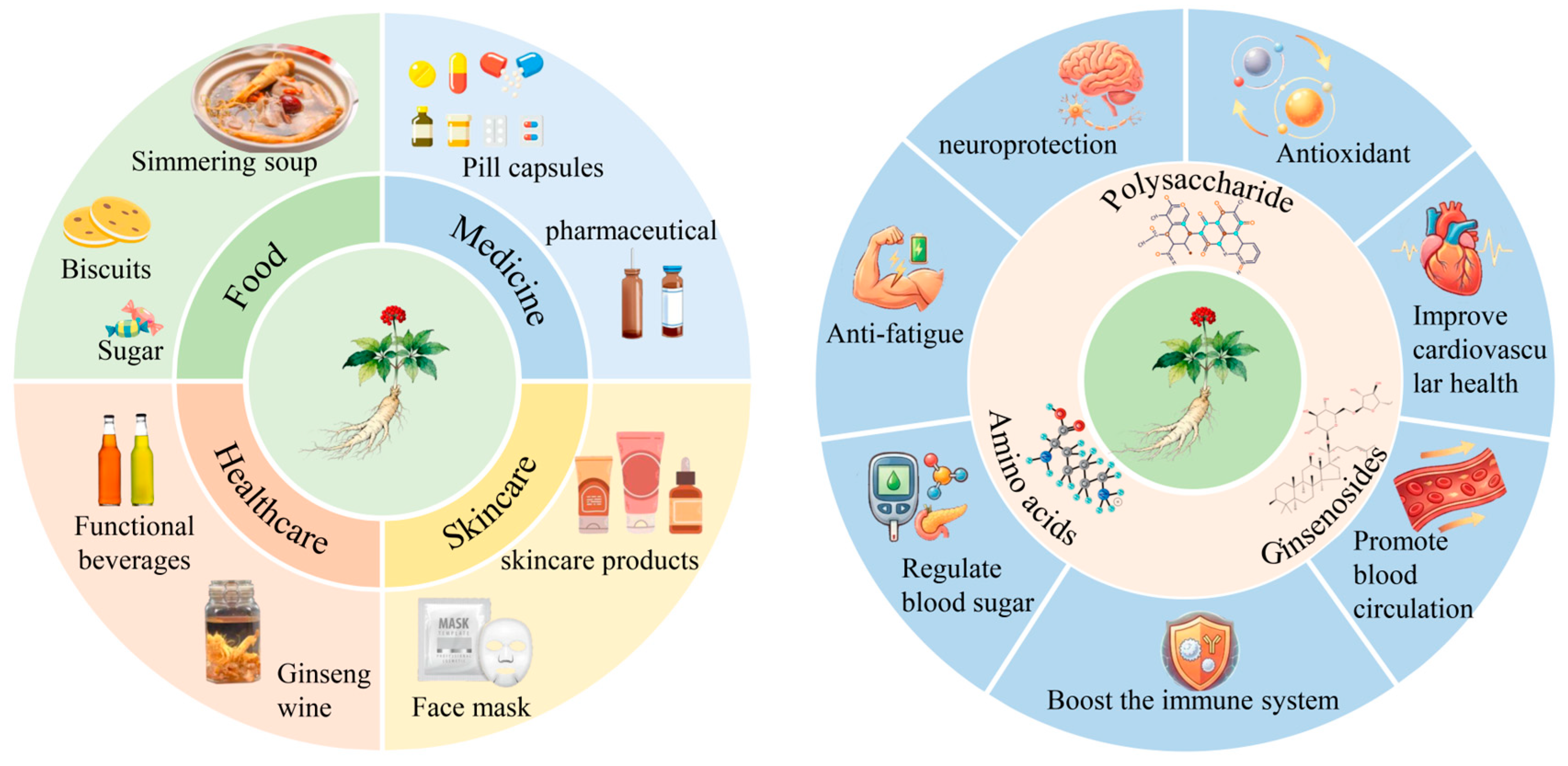
2. Active Constituents in Ginseng Plants
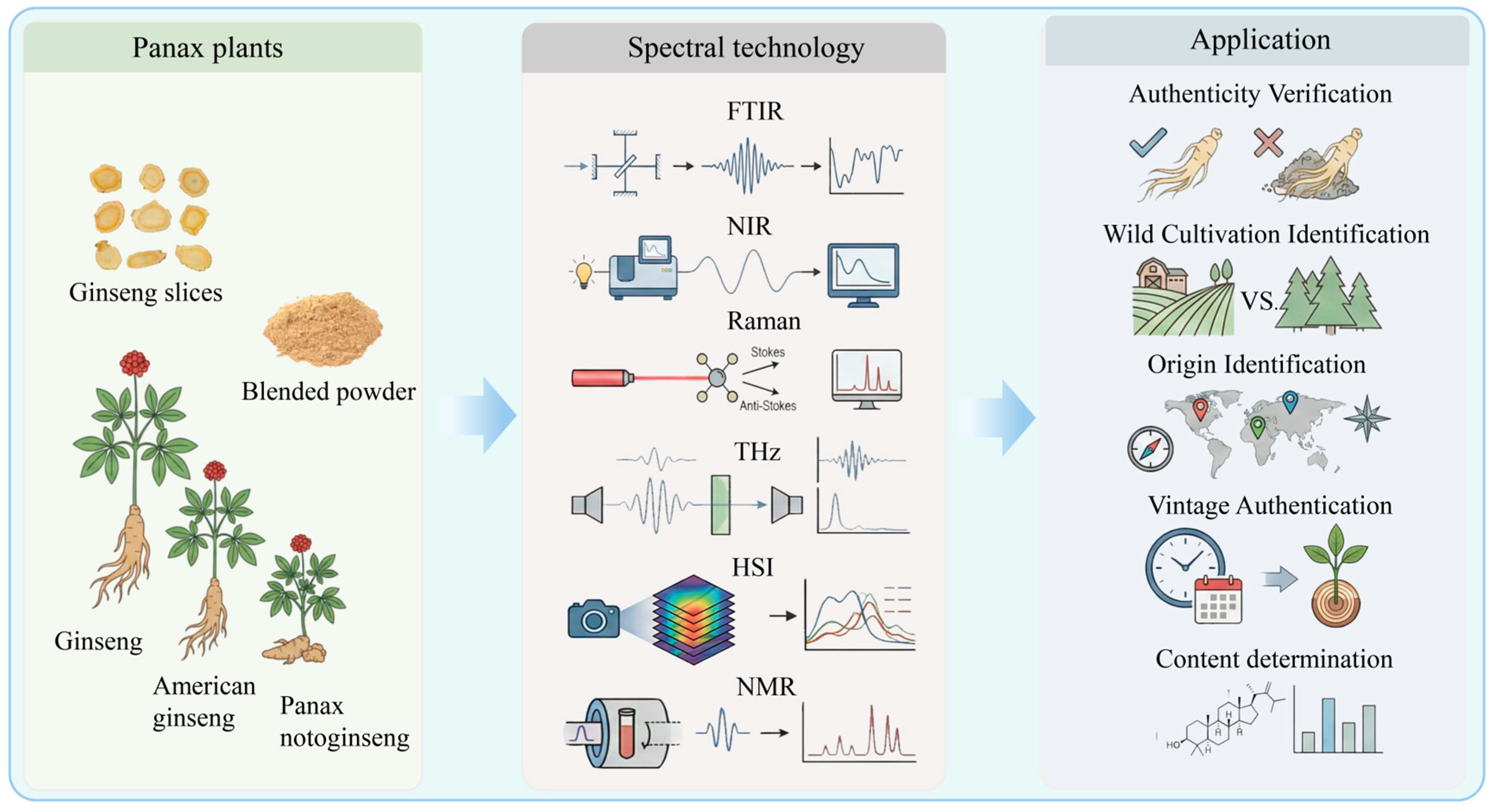
3. Measurement Principles and Current Applications of Core Spectral Technologies
3.1. Infrared Spectroscopy: Functional-Group-Driven Fingerprinting and Quantitative Modeling
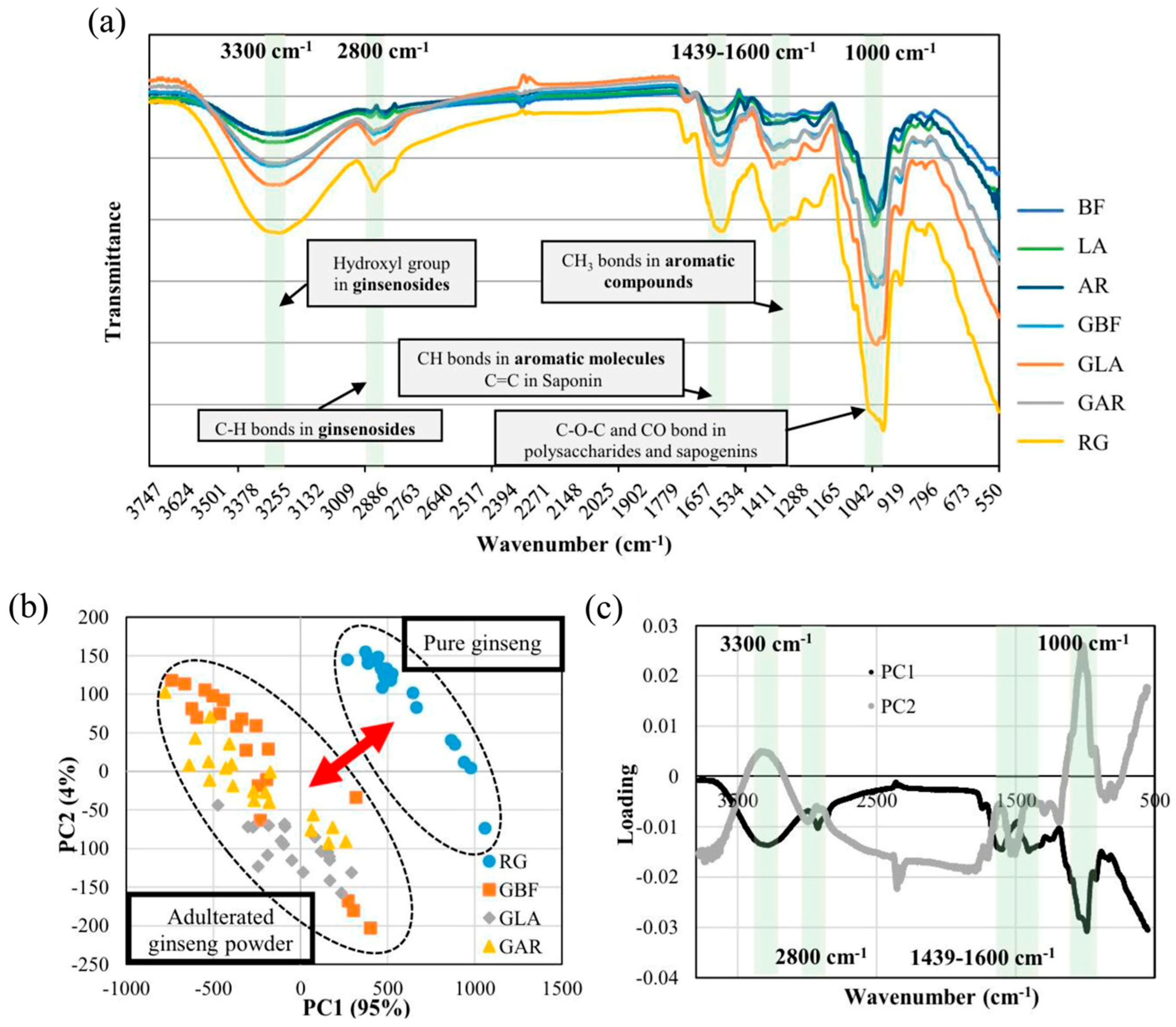
3.1.1. FTIR
3.1.2. NIR
3.2. Raman Spectroscopy: Precise Analysis of Microstructures and Isomers
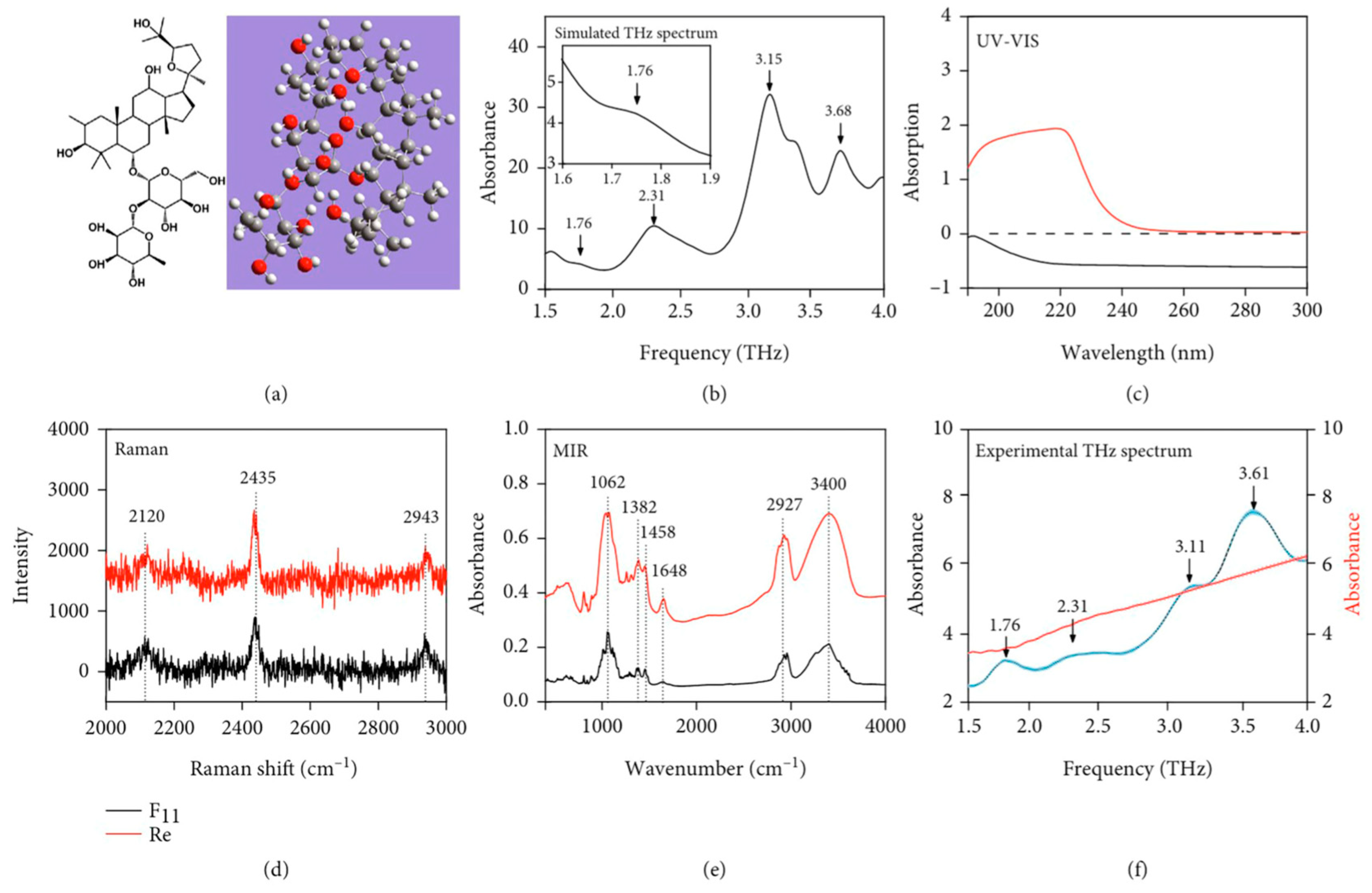
3.3. Terahertz Spectroscopy: Fingerprint Identification of Molecular Isomers and Fine Structures
3.4. Hyperspectral Imaging: Spatio-Temporal Distribution Perception Through Integrated Mapping and Spectral Analysis
3.5. Nuclear Magnetic Resonance: Chemical Structure Confirmation and Comprehensive Spectral Analysis
3.6. Other Spectra: Supplementary Perception of Multi-Source Information
4. Comparative Analysis and Ecological Niche of Spectral Technologies
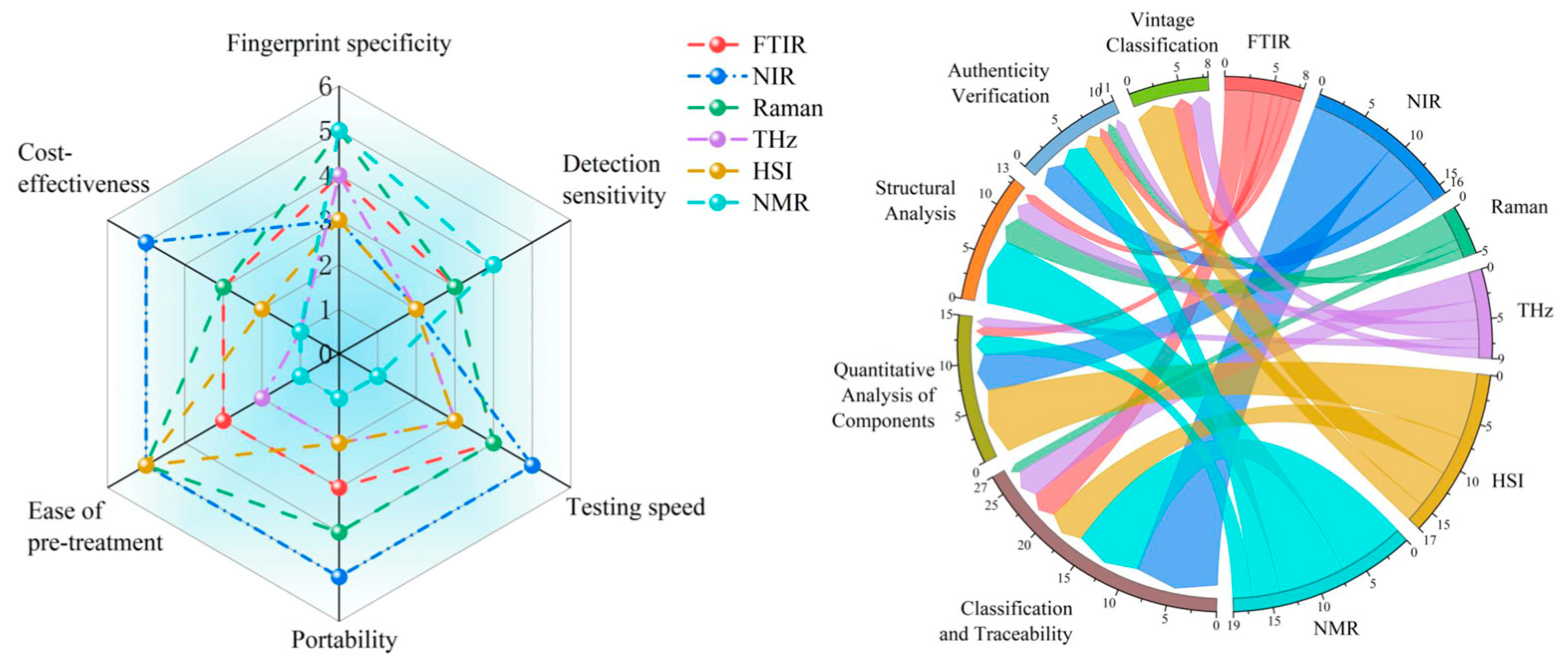
4.1. Comparative Analysis of Application Scenarios
4.2. Performance Metrics and Ecological Niche Distribution
5. Challenges and Prospects
5.1. Current Technical Bottlenecks and Limitations
- (1)
- Functional Polarization and Blind Spots in Single-Modality Perception
- (2)
- The Data Silos Effect and the Crisis of Model Robustness
- (3)
- The lack of explanation regarding the mechanism of black-box algorithms
5.2. Future Outlook
- (1)
- From solitary endeavors to multimodal holistic perception
- (2)
- From Black-Box Fitting to Explainable Cognitive Intelligence
- (3)
- From Offline Detection to Edge-Cloud Collaboration in Ubiquitous Perception
- (4)
- Standardized Spectral Data Ecosystem
6. Conclusions
Author Contributions
Funding
Institutional Review Board Statement
Informed Consent Statement
Data Availability Statement
Conflicts of Interest
Abbreviations
| IR | Infrared |
| NIR | Near-Infrared Spectroscopy |
| THz | Terahertz |
| HSI | Hyperspectral Imaging |
| NMR | Nuclear Magnetic Resonance |
| Vis-NIR | Visible–Near-Infrared Spectroscopy |
| CARS | Competitive Adaptive Reweighted Sampling |
| PLS | Partial Least Squares |
| PLS-DA | Partial Least Squares Discrimination Analysis |
| PLSR | Partial Least Squares Regression |
| ANN | Artificial Neural Network |
| LSTM | Long Short-Term Memory |
| ResNet | Residual Network |
| RF | Random Forest |
| MPA-LSSVM | Marine Predator Algorithm Optimized Least Squares Support Vector Machine |
| SVM | Support Vector Machine |
| SAM | Segment Anything Model |
| AOA-SVR | Arithmetic Optimization Algorithm- Support Vector Regression |
| bs-HSQC | Band-selective Heteronuclear Single Quantum Coherence |
| NUS | Non-Uniform Sampling |
| PCA | Principal Components Analysis |
| OPLS-DA | Orthogonal PLS-DA |
| LF/HF-NMR | Low-Field Nuclear Magnetic Resonance |
| RMSEP | Root Mean Square Error of Prediction |
References
- Zhao, L.; Xu, Y. Introduction of Panax ginseng (Origin, Distribution, Germplasm, Cultivation and Economics Importance). In The Ginseng Genome; Springer: Berlin/Heidelberg, Germany, 2021; pp. 1–13. [Google Scholar]
- Shim, H.; Waminal, N.E.; Kim, H.H.; Yang, T.-J. Dynamic evolution of Panax species. Genes Genom. 2021, 43, 209–215. [Google Scholar] [CrossRef] [PubMed]
- Kim, D.-H. Chemical diversity of Panax ginseng, Panax quinquifolium, and Panax notoginseng. J. Ginseng Res. 2012, 36, 1–15. [Google Scholar] [CrossRef]
- Yue, J.; Zuo, Z.; Huang, H.; Wang, Y. Application of identification and evaluation techniques for ethnobotanical medicinal plant of genus Panax: A review. Crit. Rev. Anal. Chem. 2021, 51, 373–398. [Google Scholar] [CrossRef] [PubMed]
- Chen, C.F.; Chiou, W.F.; Zhang, J.T. Comparison of the pharmacological effects of Panax ginseng and Panax quinquefolium. Acta Pharmacol. Sin. 2008, 29, 1103–1108. [Google Scholar] [CrossRef]
- Zhang, K.; Guo, Y.; Zhang, Z.; Amist, N. Allelopathic medicinal plants: 2. Ginseng (Panax) species. Allelopath. J. 2023, 60, 13–26. [Google Scholar] [CrossRef]
- Potenza, M.A.; Montagnani, M.; Santacroce, L.; Charitos, I.A.; Bottalico, L. Ancient herbal therapy: A brief history of Panax ginseng. J. Ginseng Res. 2023, 47, 359–365. [Google Scholar] [CrossRef] [PubMed]
- Mancuso, C.; Santangelo, R. Panax ginseng and Panax quinquefolius: From pharmacology to toxicology. Food Chem. Toxicol. 2017, 107, 362–372. [Google Scholar] [CrossRef]
- Yang, L.; Hou, A.; Zhang, J.; Wang, S.; Man, W.; Yu, H.; Zheng, S.; Wang, X.; Liu, S.; Jiang, H. Panacis quinquefolii radix: A review of the botany, phytochemistry, quality control, pharmacology, toxicology and industrial applications research progress. Front. Pharmacol. 2020, 11, 602092. [Google Scholar] [CrossRef]
- Xu, Y.; Zhu, M.; Feng, Y.; Xu, H. Panax notoginseng-microbiota interactions: From plant cultivation to medicinal application. Phytomedicine 2023, 119, 154978. [Google Scholar] [CrossRef]
- Hu, Y.; He, Z.; Zhang, W.; Niu, Z.; Wang, Y.; Zhang, J.; Shen, T.; Cheng, H.; Hu, W. The potential of Panax notoginseng against COVID-19 infection. J. Ginseng Res. 2023, 47, 622. [Google Scholar] [CrossRef]
- Farh, M.E.-A.; Kim, Y.-J.; Abbai, R.; Singh, P.; Jung, K.-H.; Kim, Y.-J.; Yang, D.-C. Pathogenesis strategies and regulation of ginsenosides by two species of Ilyonectria in Panax ginseng: Power of speciation. J. Ginseng Res. 2020, 44, 332–340. [Google Scholar] [CrossRef] [PubMed]
- Hou, M.; Wang, R.; Zhao, S.; Wang, Z. Ginsenosides in Panax genus and their biosynthesis. Acta Pharm. Sin. B 2021, 11, 1813–1834. [Google Scholar] [CrossRef]
- Shahrajabian, M.H.; Sun, W.; Cheng, Q. A review of ginseng species in different regions as a multipurpose herb in traditional Chinese medicine, modern herbology and pharmacological science. J. Med. Plants Res. 2019, 13, 213–226. [Google Scholar]
- Zhang, S.; Ding, C.; Liu, X.; Zhao, Y.; Ding, Q.; Sun, S.; Zhang, J.; Yang, J.; Liu, W.; Li, W. Research progress on extraction, isolation, structural analysis and biological activity of polysaccharides from Panax Genus. Molecules 2023, 28, 3733. [Google Scholar] [CrossRef] [PubMed]
- Ichim, M.C.; de Boer, H.J. A review of authenticity and authentication of commercial ginseng herbal medicines and food supplements. Front. Pharmacol. 2021, 11, 612071. [Google Scholar] [CrossRef] [PubMed]
- Orhan, N.; Gafner, S.; Blumenthal, M. Ginseng Adulteration Across Global Markets and Evaluation of Commercial Product Authenticity. Nat. Prod. Commun. 2025, 20, 1934578X251405982. [Google Scholar] [CrossRef]
- Sibik, J.; Löbmann, K.; Rades, T.; Zeitler, J.A. Predicting crystallization of amorphous drugs with terahertz spectroscopy. Mol. Pharm. 2015, 12, 3062–3068. [Google Scholar] [CrossRef]
- Brinckmann, J.; Huang, L. American ginseng a genuine traditional Chinese medicine. J. Hist. Med. Med. Humanit. 2018, 30, 907–928. [Google Scholar]
- Proctor, J.T.; Shelp, B.J. Effect of boron nutrition on American ginseng in field and in nutrient cultures. J. Ginseng Res. 2014, 38, 73–77. [Google Scholar] [CrossRef]
- Zhao, Z.; Liang, Z.; Ping, G. Macroscopic identification of Chinese medicinal materials: Traditional experiences and modern understanding. J. Ethnopharmacol. 2011, 134, 556–564. [Google Scholar] [CrossRef]
- Lin, L.; Liu, S.; Zhao, Y. Research progress of HPLC detection and analysis of ginseng rare saponins. J. Food Compos. Anal. 2025, 137, 106960. [Google Scholar] [CrossRef]
- Sun, Y.; Li, W.; Zhang, J.; Yin, Y.; Bao, J.; Ning, X.; Hao, W. Research Progress on Identification Techniques for Ginseng Species. J. Ginseng Res. 2024, 36, 69–73. (In Chinese) [Google Scholar] [CrossRef]
- He, S.; Zuo, Z.; Yang, S.; Wang, Y. Nondestructive analytical techniques as a tool for detecting herbal medicines: A review. Appl. Spectrosc. Rev. 2025, 61, 38–77. [Google Scholar] [CrossRef]
- Wang, K.; Sun, D.-W.; Pu, H. Emerging non-destructive terahertz spectroscopic imaging technique: Principle and applications in the agri-food industry. Trends Food Sci. Technol. 2017, 67, 93–105. [Google Scholar] [CrossRef]
- Feng, Y.; Zhu, X.; Wang, Y. Application of spectroscopic technology with machine learning in Chinese herbs from seeds to medicinal materials: The case of genus Paris. J. Pharm. Anal. 2025, 15, 101103. [Google Scholar] [CrossRef]
- Kharbach, M.; Alaoui Mansouri, M.; Taabouz, M.; Yu, H. Current application of advancing spectroscopy techniques in food analysis: Data handling with chemometric approaches. Foods 2023, 12, 2753. [Google Scholar] [CrossRef]
- Yang, Y.; Ju, Z.; Yang, Y.; Zhang, Y.; Yang, L.; Wang, Z. Phytochemical analysis of Panax species: A review. J. Ginseng Res. 2021, 45, 1–21. [Google Scholar] [CrossRef]
- Liu, H.; Lu, X.; Hu, Y.; Fan, X. Chemical constituents of Panax ginseng and Panax notoginseng explain why they differ in therapeutic efficacy. Pharmacol. Res. 2020, 161, 105263. [Google Scholar] [CrossRef]
- Qi, L.-W.; Wang, C.-Z.; Yuan, C.-S. Ginsenosides from American ginseng: Chemical and pharmacological diversity. Phytochemistry 2011, 72, 689–699. [Google Scholar] [CrossRef]
- Zhang, H.; Li, J.; Diao, M.; Li, J.; Xie, N. Production and pharmaceutical research of minor saponins in Panax notoginseng (Sanqi): Current status and future prospects. Phytochemistry 2024, 223, 114099. [Google Scholar] [CrossRef]
- Chen, Y.; Liu, M.; Wen, J.; Yang, Z.; Li, G.; Cao, Y.; Sun, L.; Ren, X. Panax japonicus CA Meyer: A comprehensive review on botany, phytochemistry, pharmacology, pharmacokinetics and authentication. Chin. Med. 2023, 18, 148. [Google Scholar] [CrossRef]
- Xia, P.; Mao, Y.; Liang, Z. Two important Ginseng plants in Southeast Asia: A systematic review of their traditional uses, botany, phytochemistry, and pharmacology. Acta Physiol. Plant. 2022, 44, 105. [Google Scholar] [CrossRef]
- Penner, M.H. Basic principles of spectroscopy. In Food Analysis; Springer: Berlin/Heidelberg, Germany, 2017; pp. 79–88. [Google Scholar]
- Liu, Z.-Q. Chemical insights into ginseng as a resource for natural antioxidants. Chem. Rev. 2012, 112, 3329–3355. [Google Scholar] [CrossRef] [PubMed]
- Edwards, H.; Munshi, T.; Page, K. Analytical discrimination between sources of ginseng using Raman spectroscopy. Anal. Bioanal. Chem. 2007, 389, 2203–2215. [Google Scholar] [CrossRef]
- Hong, T.; Yin, J.-Y.; Nie, S.-P.; Xie, M.-Y. Applications of infrared spectroscopy in polysaccharide structural analysis: Progress, challenge and perspective. Food Chem. X 2021, 12, 100168. [Google Scholar] [CrossRef]
- Sandasi, M.; Vermaak, I.; Chen, W.; Viljoen, A. The application of vibrational spectroscopy techniques in the qualitative assessment of material traded as ginseng. Molecules 2016, 21, 472. [Google Scholar] [CrossRef] [PubMed]
- Bunaciu, A.A.; Hoang, V.D.; Aboul-Enein, H.Y. Vibrational micro-spectroscopy of human tissues analysis. Crit. Rev. Anal. Chem. 2017, 47, 194–203. [Google Scholar] [CrossRef] [PubMed]
- Lilo, T.; Morais, C.L.; Shenton, C.; Ray, A.; Gurusinghe, N. Revising Fourier-transform infrared (FT-IR) and Raman spectroscopy towards brain cancer detection. Photodiagnosis Photodyn. Ther. 2022, 38, 102785. [Google Scholar] [CrossRef]
- Hu, X.; Zuo, Z.; Wang, Y. A review of the application of vibrational spectroscopy combined with chemometrics in genus Panax. Appl. Spectrosc. Rev. 2024, 59, 519–550. [Google Scholar] [CrossRef]
- Su, W.-H.; He, H.-J.; Sun, D.-W. Non-destructive and rapid evaluation of staple foods quality by using spectroscopic techniques: A review. Crit. Rev. Food Sci. Nutr. 2017, 57, 1039–1051. [Google Scholar] [CrossRef]
- Lu, G.-H.; Zhou, Q.; Sun, S.-Q.; Leung, K.S.-Y.; Zhang, H.; Zhao, Z.-Z. Differentiation of Asian ginseng, American ginseng and Notoginseng by Fourier transform infrared spectroscopy combined with two-dimensional correlation infrared spectroscopy. J. Mol. Struct. 2008, 883, 91–98. [Google Scholar] [CrossRef]
- Bu, H.-B.; Wang, F.; Lin, H.-Y.; Guo, Z.-Y.; Yuan, S.-X.; Pan, L.-L.; Xu, X.-J.; Li, X.-R.; Wang, G.-L.; Lin, R.-C. Nondestructive recognization of mountain cultivated ginseng and garden cultivated ginseng by FTIR microspectroscopy. Spectrosc. Spectr. Anal. 2013, 33, 3028–3031. [Google Scholar]
- Kwon, Y.-K.; Ahn, M.S.; Park, J.S.; Liu, J.R.; In, D.S.; Min, B.W.; Kim, S.W. Discrimination of cultivation ages and cultivars of ginseng leaves using Fourier transform infrared spectroscopy combined with multivariate analysis. J. Ginseng Res. 2014, 38, 52–58. [Google Scholar] [CrossRef] [PubMed]
- Li, J.-R.; Chen, J.-B.; Zhou, Q.; Sun, S.-Q.; Lü, G.-H. Analysis of different parts and tissues of Panax notoginseng by Fourier transform infrared spectroscopy. Guang Pu Xue Yu Guang Pu Fen Xi = Guang Pu 2014, 34, 634–637. [Google Scholar] [PubMed]
- Lee, B.-J.; Kim, H.-Y.; Lim, S.R.; Huang, L.; Choi, H.-K. Discrimination and prediction of cultivation age and parts of Panax ginseng by Fourier-transform infrared spectroscopy combined with multivariate statistical analysis. PLoS ONE 2017, 12, e0186664. [Google Scholar] [CrossRef]
- Li, P.; Zhang, Y.; Ding, Y.; Wu, Q.; Liu, Z.; Zhao, P.; Zhao, G.; Ye, S. Discrimination of raw and sulfur-fumigated ginseng based on Fourier transform infrared spectroscopy coupled with chemometrics. Microchem. J. 2022, 181, 107767. [Google Scholar] [CrossRef]
- Choi, J.-Y.; Kim, M.; Park, S.; Cho, J.-S.; Lim, J.H.; Moon, K.-D. Rapid discrimination of Panax ginseng powder adulterated with various root plants by FT-IR spectroscopy coupled with multivariate analysis. Food Sci. Biotechnol. 2024, 33, 805–815. [Google Scholar] [CrossRef]
- Lee, J.-D.; Ho, T.-T.; Ahn, M.-S.; Kim, S.-W.; Murthy, H.N.; Park, S.-Y. Partial least squares discriminant analysis (PLS-DA) of fourier transform infrared spectroscopy (FT-IR) metabolic fingerprinting data of ginseng enables to differentiate ginseng cultivars, cultivation age of cultivated/ex vitro and in vitro cultured samples. Plant Biotechnol. Rep. 2025, 19, 157–166. [Google Scholar]
- Nie, P.; Wu, D.; Sun, D.-W.; Cao, F.; Bao, Y.; He, Y. Potential of visible and near infrared spectroscopy and pattern recognition for rapid quantification of notoginseng powder with adulterants. Sensors 2013, 13, 13820–13834. [Google Scholar] [CrossRef] [PubMed]
- Chen, H.; Tan, C.; Lin, Z.; Li, H. Quantifying several adulterants of notoginseng powder by near-infrared spectroscopy and multivariate calibration. Spectrochim. Acta Part A Mol. Biomol. Spectrosc. 2019, 211, 280–286. [Google Scholar] [CrossRef]
- Guan, H.; Zhang, Z.-T.; Bai, L.; Chen, L.; Yuan, D.; Liu, W.; Chen, P.; Shi, Z.; Hu, C.; Xue, M.; et al. Multi-spectra combined with Bayesian optimized machine learning algorithms for rapid and non-destructive detection of adulterated functional food Panax notoginseng powder. J. Food Compos. Anal. 2024, 133, 106412. [Google Scholar] [CrossRef]
- Ji, C.; Ba, H.; Dai, J.; Xie, Y.; Zang, T.; Sun, Y.; Shi, R.; Zhao, L.; Yang, M.; He, X.; et al. Developing a quantitative adulteration discrimination model for forest-grown Panax notoginseng using near-infrared spectroscopy with a dual-branch network. Food Res. Int. 2025, 205, 115879. [Google Scholar] [CrossRef]
- Li, Y.; Zhang, J.-Y.; Wang, Y.-Z. FT-MIR and NIR spectral data fusion: A synergetic strategy for the geographical traceability of Panax notoginseng. Anal. Bioanal. Chem. 2018, 410, 91–103. [Google Scholar] [CrossRef]
- Dong, J.-E.; Wang, Y.; Zuo, Z.-T.; Wang, Y.-Z. Deep learning for geographical discrimination of Panax notoginseng with directly near-infrared spectra image. Chemom. Intell. Lab. Syst. 2020, 197, 103913. [Google Scholar] [CrossRef]
- Zhou, Y.; Zuo, Z.; Xu, F.; Wang, Y. Origin identification of Panax notoginseng by multi-sensor information fusion strategy of infrared spectra combined with random forest. Spectrochim. Acta Part A Mol. Biomol. Spectrosc. 2020, 226, 117619. [Google Scholar] [CrossRef] [PubMed]
- Liu, C.; Xu, F.; Zuo, Z.; Wang, Y. Network pharmacology and fingerprint for the integrated analysis of mechanism, identification and prediction in Panax notoginseng. Phytochem. Anal. 2023, 34, 772–787. [Google Scholar] [CrossRef] [PubMed]
- Liu, C.; Zuo, Z.; Xu, F.; Wang, Y. Study of the suitable climate factors and geographical origins traceability of Panax notoginseng based on correlation analysis and spectral images combined with machine learning. Front. Plant Sci. 2023, 13, 1009727. [Google Scholar] [CrossRef]
- Li, C.; Zuo, Z.; Wang, Y. Combination of Near-Infrared Spectroscopy and Multisource Data Fusion for the Geographical Origin Authentication of Panax notoginseng. Anal. Lett. 2025, 58, 1695–1707. [Google Scholar] [CrossRef]
- Chen, H.; Tan, C.; Lin, Z. Geographical origin identification of ginseng using near-infrared spectroscopy coupled with subspace-based ensemble classifiers. Spectrochim. Acta Part A Mol. Biomol. Spectrosc. 2024, 304, 123315. [Google Scholar] [CrossRef]
- Ping, J.; Hao, N.; Guo, X.; Miao, P.; Guan, Z.; Chen, H.; Liu, C.; Bai, G.; Li, W. Rapid and accurate identification of Panax ginseng origins based on data fusion of near-infrared and laser-induced breakdown spectroscopy. Food Res. Int. 2025, 204, 115925. [Google Scholar] [CrossRef]
- Yang, Y.; Wang, S.; Zhu, Q.; Qin, Y.; Zhai, D.; Lian, F.; Li, P. Non-destructive geographical traceability of American ginseng using near-infrared spectroscopy combined with a novel deep learning model. J. Food Compos. Anal. 2024, 136, 106736. [Google Scholar] [CrossRef]
- Li, C.; Zuo, Z.; Wang, Y. Optimization of Fourier transform near-infrared spectroscopy model in determining saponin compounds of Panax notoginseng roots. Vib. Spectrosc. 2024, 130, 103615. [Google Scholar] [CrossRef]
- Li, P.; Wang, S.; Yu, L.; Liu, A.; Zhai, D.; Yang, Z.; Qin, Y.; Yang, Y. Non-destructive origin and ginsenoside analysis of American ginseng via NIR and deep learning. Spectrochim. Acta Part A Mol. Biomol. Spectrosc. 2025, 334, 125913. [Google Scholar] [CrossRef]
- Zuo, Z.-T.; Wang, Y.-Z.; Yao, Z.-Y. Habitat suitability evaluation of high-quality Panax notoginseng based on FT-NIR and HPLC. Ind. Crop. Prod. 2025, 233, 121401. [Google Scholar] [CrossRef]
- Das, R.S.; Agrawal, Y. Raman spectroscopy: Recent advancements, techniques and applications. Vib. Spectrosc. 2011, 57, 163–176. [Google Scholar] [CrossRef]
- Petersen, M.; Yu, Z.; Lu, X. Application of Raman spectroscopic methods in food safety: A review. Biosensors 2021, 11, 187. [Google Scholar] [CrossRef]
- Qu, X.-B.; Zhao, Y.; Song, Y.; Zhang, W.; Zhao, B.; Li, Y.-X. Raman spectroscopy study on the structure of ginsenoside Rg3. Guang Pu Xue Yu Guang Pu Fen Xi = Guang Pu 2008, 28, 569–571. [Google Scholar] [PubMed]
- Wan, Q.-E.; Liu, H.-P.; Zhang, H.-M.; Liu, S.-H. Identification of ginseng and its counterfeit by laser Raman spectroscopy. Spectrosc. Spectr. Anal. 2012, 32, 989–992. [Google Scholar]
- Lin, X.; Zhen, X.; Lin, J.; Huang, Y.; Yang, J.; Dai, P.; Ren, Y.; Ding, K. Data fusion of laser-induced breakdown spectroscopy (LIBS) and Raman spectroscopy: Improving the accuracy of ginseng classification. Anal. Lett. 2025, 58, 1139–1150. [Google Scholar] [CrossRef]
- Pawar, A.Y.; Sonawane, D.D.; Erande, K.B.; Derle, D.V. Terahertz technology and its applications. Drug Invent. Today 2013, 5, 157–163. [Google Scholar] [CrossRef]
- Neu, J.; Schmuttenmaer, C.A. Tutorial: An introduction to terahertz time domain spectroscopy (THz-TDS). J. Appl. Phys. 2018, 124, 231101. [Google Scholar] [CrossRef]
- Kou, T.; Ye, J.; Wang, J.; Peng, Y.; Wang, Z.; Shi, C.; Wu, X.; Hu, X.; Chen, H.; Zhang, L.; et al. Terahertz Spectroscopy for Accurate Identification of Panax quinquefolium basing on nonconjugated 24 (R)-pseudoginsenoside F11. Plant Phenomics 2021, 2021, 6793457. [Google Scholar] [CrossRef] [PubMed]
- Zhang, H.; Huang, L.; Xu, C.; Li, Z.; Yin, X.; Chen, T.; Wang, Y. Rapid determination of Panax notoginseng origin by terahertz spectroscopy combined with the machine learning method. Spectrosc. Lett. 2022, 55, 566–578. [Google Scholar] [CrossRef]
- Liu, L.; Gao, Y.; Wu, X.; Chang, T.; Li, Y.; Lv, J.; Jiang, D.; Zhao, B.; Wang, Z. A rapid origin identification method for Panax quinquefolius by terahertz spectroscopy combined with random forest. Optik 2022, 268, 169718. [Google Scholar] [CrossRef]
- Bin, L.; Zhao-yang, H.; Hui-zhou, C.; A-kun, Y.; Ai-guo, O.Y. Identification of different parts of Panax notoginseng based on terahertz spectroscopy. J. Anal. Sci. Technol. 2022, 13, 18. [Google Scholar] [CrossRef]
- Li, B.; Yin, H.; Yang, A.-K.; Ouyang, A.-G.J. Detection of adulteration of Panax notoginseng powder by terahertz technology. J. Spectrosc. 2022, 2022, 7247941. [Google Scholar] [CrossRef]
- Zhang, G.-M.; Hu, S.-Y.; Chen, G.; Huang, Q.; Gu, H.-Y.; Zheng, C.-W.; Peng, Y.; Xu, H.-X. Age identification of the root of Huanren mountain cultivated ginseng and differentiation with cultivated ginseng using terahertz spectroscopy. J. Food Compos. Anal. 2024, 125, 105790. [Google Scholar] [CrossRef]
- Gu, H.; Wang, S.; Hu, S.; Wu, X.; Li, Q.; Zhang, R.; Zhang, J.; Zhang, W.; Peng, Y. Identification of Panax notoginseng origin using terahertz precision spectroscopy and neural network algorithm. Talanta 2024, 274, 125968. [Google Scholar] [CrossRef]
- Wang, J.; Wang, S.; Sun, L.; Chen, G.; Ye, X.; Zhang, G.; Li, Q.; Zheng, C.; Xu, H.; Zhu, Y.; et al. Age identification of mountain-cultivated ginseng based on terahertz precision spectroscopy and convolutional neural network. Microchem. J. 2026, 221, 116954. [Google Scholar] [CrossRef]
- ElMasry, G.; Sun, D.-W. Principles of hyperspectral imaging technology. In Hyperspectral Imaging for Food Quality Analysis and Control; Elsevier: Amsterdam, The Netherlands, 2010; pp. 3–43. [Google Scholar]
- Kamruzzaman, M.; Sun, D.-W. Introduction to hyperspectral imaging technology. In Computer Vision Technology for Food Quality Evaluation; Elsevier: Amsterdam, The Netherlands, 2016; pp. 111–139. [Google Scholar]
- Lixin, L.; Mengzhu, L.; Zhigang, Z.; Junle, Q. Recent advances of hyperspectral imaging application in biomedicine. Chin. J. Lasers 2018, 45, 0207017. [Google Scholar] [CrossRef]
- Yao, K.; Sun, J.; Tang, N.; Xu, M.; Cao, Y.; Fu, L.; Zhou, X.; Wu, X. Nondestructive detection for Panax notoginseng powder grades based on hyperspectral imaging technology combined with CARS-PCA and MPA-LSSVM. J. Food Process. Eng. 2021, 44, e13718. [Google Scholar] [CrossRef]
- Zhao, S.; Song, W.; Hou, Z.; Wang, Z. Classification of ginseng according to plant species, geographical origin, and age using laser-induced breakdown spectroscopy and hyperspectral imaging. J. Anal. At. Spectrom. 2021, 36, 1704–1711. [Google Scholar] [CrossRef]
- Zhao, L.; Liu, S.; Chen, X.; Wu, Z.; Yang, R.; Shi, T.; Zhang, Y.; Zhou, K.; Li, J. Hyperspectral identification of ginseng growth years and spectral importance analysis based on random forest. Appl. Sci. 2022, 12, 5852. [Google Scholar] [CrossRef]
- Cheng, R.; Bai, X.; Guo, J.; Huang, L.; Zhao, D.; Liu, Z.; Zhang, W. Hyperspectral discrimination of ginseng variety and age from Changbai Mountain area. Spectrochim. Acta Part A Mol. Biomol. Spectrosc. 2024, 307, 123613. [Google Scholar] [CrossRef]
- Chen, X.; Du, H.; Liu, Y.; Shi, T.; Li, J.; Liu, J.; Zhao, L.; Liu, S. Fully connected-convolutional (FC-CNN) neural network based on hyperspectral images for rapid identification of P. ginseng growth years. Sci. Rep. 2024, 14, 7209. [Google Scholar] [CrossRef] [PubMed]
- Ping, J.; Ying, Z.; Hao, N.; Miao, P.; Ye, C.; Liu, C.; Li, W. Rapid and non-destructive identification of Panax ginseng origins using hyperspectral imaging, visible light imaging, and X-ray imaging combined with multi-source data fusion strategies. Food Res. Int. 2024, 192, 114758. [Google Scholar] [CrossRef]
- Shu, Z.; Li, X.; Liu, Y. Ginseng Seed Variety Identification Based on Hyperspectral Imaging Technology and Transfer Learning. J. Chemom. 2025, 39, e70080. [Google Scholar] [CrossRef]
- Zhang, F.; Shi, L.; Li, L.; Zhou, Y.; Tian, L.; Cui, X.; Gao, Y. Nondestructive detection for adulteration of panax notoginseng powder based on hyperspectral imaging combined with arithmetic optimization algorithm-support vector regression. J. Food Process. Eng. 2022, 45, e14096. [Google Scholar] [CrossRef]
- Shi, L.; Li, L.; Zhang, F.; Lin, Y. Nondestructive detection of Panax notoginseng saponins by using hyperspectral imaging. Int. J. Food Sci. Technol. 2022, 57, 4537–4546. [Google Scholar] [CrossRef]
- Wang, Y.; Zhou, C.; Wang, S.; Yuan, Y.; Bai, R.; Nan, T.; Yang, J. Ginsenoside Rg2 content prediction in Panax ginseng based on the fusion of hyperspectral wavelengths combined with chemometric analysis. J. Food Compos. Anal. 2023, 123, 105619. [Google Scholar] [CrossRef]
- Wang, Y.; Wang, S.; Yuan, Y.; Li, X.; Bai, R.; Wan, X.; Nan, T.; Yang, J.; Huang, L. Fast prediction of diverse rare ginsenoside contents in Panax ginseng through hyperspectral imaging assisted with the temporal convolutional network-attention mechanism (TCNA) deep learning. Food Control. 2024, 162, 110455. [Google Scholar] [CrossRef]
- Wang, Y.; Wang, S.; Bai, R.; Li, X.; Yuan, Y.; Nan, T.; Kang, C.; Yang, J.; Huang, L. Prediction performance and reliability evaluation of three ginsenosides in Panax ginseng using hyperspectral imaging combined with a novel ensemble chemometric model. Food Chem. 2024, 430, 136917. [Google Scholar] [CrossRef] [PubMed]
- Miao, P.; Hao, N.; Zhao, Q.; Ping, J.; Liu, C. Non-destructive determination of ginsenosides in ginseng by combined hyperspectral and X-ray techniques based on ensemble learning. Food Chem. 2024, 437, 137828. [Google Scholar] [CrossRef]
- Sun, J.; Yao, K.; Cheng, J.; Xu, M.; Zhou, X. Nondestructive detection of saponin content in Panax notoginseng powder based on hyperspectral imaging. J. Pharm. Biomed. Anal. 2024, 242, 116015. [Google Scholar] [CrossRef]
- Yang, Y.; Zhou, J.; Liu, A.; Yang, Z.; Qin, Y.; Tian, F.; Li, P.; Zhai, D. Non-destructive origin tracing and ginsenoside quantification in American ginseng using hyperspectral imaging and mixed multi-task 1DCNN. J. Food Compos. Anal. 2025, 147, 108063. [Google Scholar] [CrossRef]
- Shen, X.; Dong, Y.; Yu, H.; Hao, N.; Ping, J.; Wang, W.; Song, M.; Wang, Y.; Liu, C.; Yu, H.; et al. Simultaneous prediction of Panax ginseng origin and ginsenoside Re content using hyperspectral imaging and a multi-task one-dimensional convolutional neural network. Measurement 2025, 258, 119151. [Google Scholar] [CrossRef]
- Bharti, S.K.; Roy, R. Quantitative 1H NMR spectroscopy. TrAC Trends Anal. Chem. 2012, 35, 5–26. [Google Scholar] [CrossRef]
- Lee, A.-R.; Gautam, M.; Kim, J.; Shin, W.-J.; Choi, M.-S.; Bong, Y.-S.; Hwang, G.-S.; Lee, K.-S. A multianalytical approach for determining the geographical origin of ginseng using strontium isotopes, multielements, and 1H NMR analysis. J. Agric. Food Chem. 2011, 59, 8560–8567. [Google Scholar] [CrossRef]
- Yuk, J.; McIntyre, K.L.; Fischer, C.; Hicks, J.; Colson, K.L.; Lui, E.; Brown, D.; Arnason, J.T. Distinguishing Ontario ginseng landraces and ginseng species using NMR-based metabolomics. Anal. Bioanal. Chem. 2013, 405, 4499–4509. [Google Scholar] [CrossRef]
- Chan, P.H.; Zheng, K.Y.; Tsim, K.W.; Lam, H. Metabonomic analysis of water extracts from Chinese and American ginsengs by 1H nuclear magnetic resonance: Identification of chemical profile for quality control. Chin. Med. 2012, 7, 25. [Google Scholar] [CrossRef] [PubMed]
- Zhang, S.; Fang, K.; Ding, Z.; Wu, J.; Lin, J.; Xu, D.; Zhong, J.; Xia, F.; Feng, J.; Shen, G. Untargeted metabolomics analysis revealed the difference of component and geographical indication markers of Panax notoginseng in different production areas. Foods 2023, 12, 2377. [Google Scholar] [CrossRef]
- Chen, H.; Ding, Z.; Dai, T.; Lin, J.; Xu, D.; Xia, F.; Feng, J.; Shen, G. Quantitative comparison and rapid discrimination of Panax notoginseng powder and Caulis clematidis armandii using NMR combined with pattern recognition. J. Sci. Food Agric. 2023, 103, 3766–3775. [Google Scholar] [CrossRef]
- Guo, C.; Dong, J.; Deng, L.; Cheng, K.; Xu, Y.; Zhu, H.; Deng, A.; Zhou, X.; Qin, H.; Wang, Y. Application of Band-Selective HSQC NMR in Species Discrimination and Adulteration Identification of Panax Linn. Molecules 2023, 28, 4332. [Google Scholar] [CrossRef]
- Zhao, H.; Xu, J.; Ghebrezadik, H.; Hylands, P.J. Metabolomic quality control of commercial Asian ginseng, and cultivated and wild American ginseng using 1H NMR and multi-step PCA. J. Pharm. Biomed. Anal. 2015, 114, 113–120. [Google Scholar] [CrossRef]
- Wang, Y.-S.; Jin, Y.-P.; Gao, W.; Xiao, S.-Y.; Zhang, Y.-W.; Zheng, P.-H.; Wang, J.; Liu, J.-X.; Sun, C.-H.; Wang, Y.-P. Complete 1H-NMR and 13C-NMR spectral assignment of five malonyl ginsenosides from the fresh flower buds of Panax ginseng. J. Ginseng Res. 2016, 40, 245–250. [Google Scholar] [CrossRef]
- Yoon, D.; Shin, W.C.; Lee, Y.-S.; Kim, S.; Baek, N.-I.; Lee, D.Y. A comparative study on processed Panax ginseng products using HR-MAS NMR-based metabolomics. Molecules 2020, 25, 1390. [Google Scholar] [CrossRef]
- Kim, T.-K.; Lee, C.; Nam, T.-H.; Seo, Y.-K.; Kim, K.-S.; Kang, K.; Yun, S.-H.; Yoon, S.-H.; Jeong, J. Isolation and Identification of Non-Conjugated Linoleic Acid from Processed Panax ginseng Using LC-MS/MS and 1H-NMR. Separations 2021, 8, 208. [Google Scholar] [CrossRef]
- Van Hung, H.; Tan, L.Q.; Hoang, N.H.; Tai, B.H.; Van Kiem, P. Chemical constituents of the roots of Vietnamese Panax pseudoginseng. Vietnam. J. Chem. 2022, 60, 770–776. [Google Scholar] [CrossRef]
- Chen, Z.; Zhang, S.; Zhao, Z.; Xia, F.; Lin, J.; Feng, J.; Xu, D.; Shen, G. Metabolomics fingerprinting uncovered regional and cultivation-specific metabolic signatures in panax notoginseng: Insights into geographical and agricultural influences. J. Food Compos. Anal. 2025, 143, 107617. [Google Scholar] [CrossRef]
- Zhong, G.; Zhao, Y.; Zhang, J.; Shen, T.; Xiao, Y.; Wang, Y.; Zhang, J. UV spectra fingerprint and multivariate analysis approach for identification of the species of Panax. Asian J. Chem. 2014, 26, 16447. [Google Scholar] [CrossRef]
- Bian, X.-H.; Zhang, R.-L.; Jing, W.; Peng, L.; Lin, L.-G.; Tan, X.-Y. Rapid quantification of adulterated Panax notoginseng powder by ultraviolet-visible diffuse reflectance spectroscopy combined with chemometrics. Chin. J. Anal. Chem. 2022, 50, 100055. [Google Scholar] [CrossRef]
- Liu, Z.-X.; Tang, S.-H.; Wang, Y.; Tan, J.; Jiang, Z.-T. Rapid, simultaneous and non-destructive determination of multiple adulterants in Panax notoginseng powder by front-face total synchronous fluorescence spectroscopy. Fitoterapia 2023, 166, 105469. [Google Scholar] [CrossRef] [PubMed]



| Variety | Core Saponin Types | Signature/Distinctive Chemical Fingerprint | Other Associated Photosensitizing Components | Pharmacological Action | Reference |
|---|---|---|---|---|---|
| P. ginseng | With PPD and PPT types at their core, the range is extensive. | Characteristic marker: Ginsenoside Rf Core constituents: Rb1, Rb2, Rc, Rg1 | Pectin polysaccharides (RG-I/RG-II types), polyacetylene compounds | Cardiovascular protection, neuroprotection, antitumor | [29] |
| P. quinquefolius | PPD type predominates, with low PPT content | Characteristic marker: Panax ginsenoside F11 Core constituents: Rb1, Rd, Re | Sucrose, relatively high starch content, polyacetylene compounds | Anti-stress, blood sugar regulation, immune modulation | [30] |
| P. notoginseng | PPT and PPD types predominate | Characteristic marker: Panax notoginsenoside R1 Core constituents: Rg1, Rb1, Rd | Panax notoginsenosides (non-protein amino acids), flavonoids | Cerebrovascular protection, anti-inflammatory analgesia, hemostasis | [31] |
| P. japonicus | Includes OA type, PPD type, and PPT type, with a high proportion of OA type. | Characteristic markers: Bamboo-joint saponin IVa and stipuleanoside R1/R2 | Rich in flavonoids, phenolic acids, and high-content polysaccharides | Anti-inflammatory and analgesic, hepatoprotective, and immune-enhancing | [32] |
| P. vietnamensis | Predominantly OT type, with minor amounts of PPT and PPD types | Characteristic marker: Majonoside R1/R2 | High volatile oil content Novel dammarane-type saponins | Anti-cancer, liver protection, kidney protection, and neuro-regulation | [33] |
| Task Type | Testing Method | Method/Model | Performance Metrics and Key Findings | Reference |
|---|---|---|---|---|
| Adulteration Quantification | Vis-NIR | CARS-PLSR | Precise prediction of Panax notoginseng content through feature band screening, validating the efficacy of full-spectrum feature extraction. | [51] |
| NIR | CARS + PLS | Establish standardized quantitative procedures to enable rapid detection of adulterants. | [52] | |
| NIR + VIS | ANN + LSTM | By introducing LSTM, the detection rate for adulterated Panax notoginseng powder reached 100%, demonstrating the advantages of deep learning in processing time-series spectral data. | [53] | |
| NIR | Dual-branch network | Customized dual-branch network model, training set R2 = 0.991, significantly enhancing the depth and breadth of feature extraction. | [54] | |
| Origin Tracing | FT-MIR + NIR | Data fusion | Through advanced data fusion, the identification rate of Panax notoginseng origins has been elevated to 98–100%, confirming the necessity of complementary multi-source information. | [55] |
| NIR image | ResNet | Converting spectral data into images for input into ResNet, initiating a novel pathway for spectral imaging analysis. | [56] | |
| FT-MIR + NIR | RF | Multispectral fusion enables rapid, non-destructive origin tracing. | [57] | |
| NIR + ATRFTIR | Data fusion | Data layer fusion effectively prevents overfitting and enhances classification robustness. | [58] | |
| NIR + 2D-COS | ResNet | Combining two-dimensional correlation spectroscopy with deep learning to achieve micro-geographical traceability at the county/township level for Panax notoginseng. | [59] | |
| NIR | PLS-DA | Integrating regional data with spectral characteristics to achieve 100% origin classification at low cost. | [60] | |
| NIR | RSE-LDA | Random Subspace Ensemble Linear Discriminant Analysis Enhances the model’s robustness against interference from anomalous samples Enables classification of ginseng origins | [61] | |
| NIR + LIBS | Ensemble learning | By integrating atomic emission spectroscopy with molecular vibrational spectroscopy, classification accuracy reaches 99.0%. The complementary nature of multimodal approaches significantly enhances perception precision. | [62] | |
| NIR | AGOTNet | Proposing a variant of graph convolutional networks, with ginseng origin-tracing accuracy reaching 98.95%, identifying Re and Rb1 as key differential biomarkers. | [63] | |
| Quantitative Classification | FT-NIR | Correlation coefficient method + PLSR | By screening based on characteristic spectral bands, rapid and non-destructive quantification of total saponins in Panax notoginseng is achieved, significantly enhancing detection efficiency. | [64] |
| NIR | MMTDL | MMTDL simultaneously achieves American ginseng traceability and saponin prediction, validating the feasibility of multiple analyses from a single spectrum. | [65] | |
| FT-NIR + HPLC | PLSR + ML | Achieving simultaneous detection of origin identification (100%) and saponin quantification (RPD > 2.3). | [66] |
| Task Type | Testing Method | Modeling/Algorithms | Performance Metrics and Key Findings | Reference |
|---|---|---|---|---|
| Classification and Traceability | HSI Reflected Image | MPA-LSSVM | The quality classification accuracy rate reached 95–96.67%, validating its effectiveness in quality grading. | [85] |
| HSI + LIBS | multivariate analysis | Combining HSI and LIBS to enhance the robustness of models in authenticating ginseng authenticity and origin identification within complex backgrounds. | [86] | |
| HSI Reflectance Spectra | RF | For samples aged six years or less, the annual identification rate reached 92.9%, confirming HSI’s capability to capture surface texture and chemical characteristics that evolve over time. | [87] | |
| HSI | SVM, SAM | Combining spectral and spatial information modeling significantly outperforms single-feature models, enabling precise classification based on growth duration. | [88] | |
| HSI | FC-CNN | FC-CNN extracts deep features, achieving 100% accuracy in growth year identification, demonstrating the advantages of deep learning in processing high-dimensional data. | [89] | |
| HSI + Visible Light + X-ray | Ensemble learning | A multi-source heterogeneous data fusion model was constructed, achieving an AUC of 0.997 for origin prediction, demonstrating the immense potential of multimodal fusion technology. | [90] | |
| HSI | Transfer learning | Introducing transfer learning strategies to address model adaptability across batches, thereby extending application scenarios to breeding selection. | [91] | |
| Quantitative analysis | HSI | AOA-SVR | Combined with AOA prediction of adulteration ratios in Panax notoginseng powder, enabling non-destructive visual inspection of blended powders. | [92] |
| HSI | BOSS-EO-SVR | BOSS algorithm optimizes wavelength bands, predicting total saponins in Panax notoginseng with Rp2 = 0.95. | [93] | |
| HSI | Chemometrics | Integrating effective wavelength screening enables rapid prediction of trace saponins such as Rg2, overcoming the limitations of HSI detection for low-content components. | [94] | |
| HSI | TCNA | Six rare saponins predicted to have RPD > 3.0, enabling high-precision simultaneous detection of multiple target components. | [95] | |
| HSI | CNN-GRU-GPR | Enhancing the ability to predict stability and quantify uncertainty in saponin content. | [96] | |
| HSI + X-ray imaging | Ensemble learning | Integrating internal density with surface chemical information to achieve a comprehensive assessment of quality. | [97] | |
| HSI | IRIV-GNDO-ELM | Introducing intelligent optimization algorithms to enhance the Extreme Learning Machine, demonstrating the potential of novel algorithms to improve the performance of traditional models. | [98] | |
| Multi-task collaboration | HSI | MMT1DCNN | Simultaneously achieving traceability of American ginseng origins and quantitative analysis of its content, realizing end-to-end intelligent sensing. | [99] |
| HSI | 1DCNN + Attention | The introduction of a channel attention mechanism enables the visualization of weights to reveal intrinsic correlations between spectral bands, geographical origin, and saponins, thereby enhancing the model’s interpretability. | [100] |
| Task Type | MR Type/Combined Technology | Method/Model | Key Findings and Contributions | Reference |
|---|---|---|---|---|
| Classification and Traceability | 1H NMR + isotope | Metabolomics | Distinguishing origins through analysis of carbohydrate and metal element variations, verifying the complementary effects of combining NMR with other techniques. | [102] |
| 1H NMR | Metabolomics | Achieving high-throughput differentiation of closely related species and their origins, laying the foundation for constructing large-scale metabolic fingerprint databases. | [103] | |
| 1H NMR | multivariate statistics | Simultaneously distinguishing three reference species from different origins, demonstrating multi-objective classification capability. | [104] | |
| Non-targeted NMR | Metabolomics | Identifying 52 components and screening for regional markers to achieve metabolic phenotyping traceability across four major production areas. | [105] | |
| Quantitative analysis | LF/HF-NMR | Pattern Recognition | Based on differences in relaxation time, it achieves 100% accuracy when the adulteration ratio is ≥30%, providing a novel rapid screening method for authenticity verification. | [106] |
| bs-HSQC + NUS | multivariate statistics | By incorporating non-uniform sampling techniques, testing time is significantly reduced, enabling precise quantification of minute adulterations. | [107] | |
| Component Analysis | 1H NMR | Multi-step PCA | Revealing significant differences in metabolite lineages provides data support for establishing quality control standards. | [108] |
| 1D/2D NMR | Structural affiliation | For the first time, complete signal assignment has been achieved for core saponins such as Re and Rb1, establishing a reliable spectral reference library. | [109] | |
| 1H NMR | PCA | Distinguish between processed products such as white ginseng and red ginseng, enabling non-destructive evaluation of chemical transformations during processing. | [110] | |
| NMR + LC-MS/MS | Structural Analysis | Confirm the chemical nature of the unknown peak in black ginseng, thereby rectifying previous misinterpretations of saponin derivatives. | [111] | |
| 2D NMR | Structural assessment | Discovery and characterization of novel saponin structures in Vietnamese ginseng, enriching the chemical fingerprint database of the genus Panax. | [112] | |
| 1H NMR | OPLS-DA | It has been confirmed that the understorey cultivation model can significantly enhance saponin content, providing metabolomic evidence for high-quality ecological cultivation. | [113] |
| Spectral Technology | Core Principle | Advantages | Disadvantages | Application Scenarios |
|---|---|---|---|---|
| FTIR | Characteristic absorption peak analysis of chemical bond types and molecular structures. | Fingerprints offer high specificity, rapid processing, and straightforward pre-treatment. | Water-sensitive, shallow penetration. | Tracing origins, structural analysis, and verifying vintage authenticity. |
| NIR | C–H, O–H, N–H bond second-harmonic and sum-frequency absorption. | High penetration, portable, suitable for online analysis. | Peak overlap is severe, and model transferability is limited. | Tracing origins, authenticity verification, non-destructive quantification. |
| Raman | Scattered light analysis of molecular vibrations. | Resistant to water interference, high fingerprint specificity, high resolution. | Fluorescence interference is severe, and the signal is weak. | Structural analysis, traceability, and authenticity verification. |
| THz | Intermolecular forces, crystal structure and low-frequency vibrational modes. | Non-ionizing and non-destructive, sensitive to crystal structure. | The equipment is costly, and water absorption is intense. | Part identification, traceability, authenticity verification, quantitative analysis of constituents. |
| HIS | Simultaneous acquisition of spatial imagery and spectral characteristics. | Integration of diagrams and text, rich in information. | Large data volumes, complex modeling. | Quantitative analysis of ingredients, verification of vintage authenticity, traceability. |
| NMR | Structure of Nuclear Magnetic Resonance Signal Analysis. | Structural analysis is precise, quantitative results are accurate, and the database is extensive. | Pre-processing is cumbersome, detection speed is slow, and the instrumentation is costly. | Tracing origins, complex component identification, authenticity verification. |
Disclaimer/Publisher’s Note: The statements, opinions and data contained in all publications are solely those of the individual author(s) and contributor(s) and not of MDPI and/or the editor(s). MDPI and/or the editor(s) disclaim responsibility for any injury to people or property resulting from any ideas, methods, instructions or products referred to in the content. |
© 2026 by the authors. Licensee MDPI, Basel, Switzerland. This article is an open access article distributed under the terms and conditions of the Creative Commons Attribution (CC BY) license.
Share and Cite
Jiang, Y.; Jin, X.; Li, G.; Ge, H.; Yin, Y.; Zheng, H.; Li, X.; Li, P. From Fingerprint Spectra to Intelligent Perception: Research Advances in Spectral Techniques for Ginseng Species Identification. Foods 2026, 15, 684. https://doi.org/10.3390/foods15040684
Jiang Y, Jin X, Li G, Ge H, Yin Y, Zheng H, Li X, Li P. From Fingerprint Spectra to Intelligent Perception: Research Advances in Spectral Techniques for Ginseng Species Identification. Foods. 2026; 15(4):684. https://doi.org/10.3390/foods15040684
Chicago/Turabian StyleJiang, Yuying, Xi Jin, Guangming Li, Hongyi Ge, Yida Yin, Huifang Zheng, Xing Li, and Peng Li. 2026. "From Fingerprint Spectra to Intelligent Perception: Research Advances in Spectral Techniques for Ginseng Species Identification" Foods 15, no. 4: 684. https://doi.org/10.3390/foods15040684
APA StyleJiang, Y., Jin, X., Li, G., Ge, H., Yin, Y., Zheng, H., Li, X., & Li, P. (2026). From Fingerprint Spectra to Intelligent Perception: Research Advances in Spectral Techniques for Ginseng Species Identification. Foods, 15(4), 684. https://doi.org/10.3390/foods15040684