Article

Simple, Sensitive and Simultaneous Determination of Free D3 and K2 Vitamins in Fortified Chicken Meat Products by LC-MS/MS with Electrospray Ionisation


Laboratory for Food Chemistry, Department of Analytical Chemistry, National Institute of Chemistry, Hajdrihova 19, 1000 Ljubljana, Slovenia
Foods 2026, 15(3), 570; https://doi.org/10.3390/foods15030570
Submission received: 16 December 2025 / Revised: 29 January 2026 / Accepted: 3 February 2026 / Published: 5 February 2026

Abstract

A rapid and simplified LC–MS method was developed for quantifying vitamins D3 (cholecalciferol) and K2 (menaquinone-4 and menaquinone-7) in high-fat chicken meat products. Sample preparation involves a two-step solvent extraction followed by centrifugation. Efficient separation was achieved on a Gemini C18 column, and electrospray in positive mode was used for detection. Method validation confirmed good performance and reproducibility. The method was successfully applied to both fortified and unfortified chicken pâté samples. Owing to its simplicity, robustness, and sensitivity, this approach provides a practical and reliable means for quantifying fat-soluble vitamins in complex animal-derived matrices and can serve as a foundation for broader applications in high-fat food products.

1. Introduction

Vitamins from groups D and K are essential fat-soluble micronutrients involved in calcium metabolism and have complementary metabolic roles [1,2,3]. The crucial role of vitamins, especially vitamin D3, has been recognised for a long time [4]. Meat is an important dietary source of these vitamins. Due to their nutritional importance, many contemporary food products are also fortified with these vitamins [5,6,7]. Analytical procedures for determining these vitamins, especially vitamin D3, have long been established, beginning with thin-layer chromatography [8] or gas chromatography [9]. However, the vast majority of analyses to date have been based on high-performance liquid chromatography (HPLC). Earlier HPLC procedures used UV detection and usually required more involved sample preparation, such as liquid–liquid extraction, solid-phase extraction, and sample concentration, due to the low inherent concentrations of these vitamins in studied foods [10,11,12,13,14]. Modern analytical procedures for assaying these vitamins are still based on liquid-phase separations, but mass spectrometric (MS) detection is usually employed [15,16,17,18,19]. While the selectivity and sensitivity of MS detection allow for better instrumental performance, sample preparation is in many instances still laborious, mainly due to the need to remove potentially interfering fatty matrix in meat samples [20,21,22]. When hydroxylated metabolites of vitamin D (e.g., 25-hydroxycholecalciferol) are also involved in the analysis of biological tissues (such as meat), sample saponification is also required, involving even more elaborate sample preparation procedures [23,24], since hydroxylated forms of vitamin D3 have a much higher binding affinity to specific proteins [25]. In the case of milk and dairy samples, analyte derivatisation has also been employed [21,26]. In this context, relatively simple sample preparation procedures are only known when such vitamins are analysed from biological fluids like blood plasma, where sample preparation is generally limited to protein precipitation and solvent reconstitution [27,28,29,30], although in some cases derivatisation has also been used [29,31].
Vitamin K2, on the other hand, is involved in the so-called “vitamin K cycle”, in which a circular redox reaction occurs, and the vast majority of K2 is present in its oxidised (i.e., quinone) form [32]. Due to its high lipophilicity, it associates with various lipoproteins through non-covalent interactions [33]. Therefore, a simple extraction step (with subsequent solvent evaporation and redissolution, if needed) is sufficient for vitamin K [34], or a series of solvent evaporation and re-extraction steps [35]. In a highly lipophilic matrix, QuEChERS cleanup has also been used [36]. Beyond the domain of biochemical or comprehensive food studies, the need for a quick, robust and credible assessment of these vitamins is relevant to many food production facilities, particularly those producing meat and meat-derived products. Food products currently on the market are often fortified with these vitamins due to their recognised health effects [5,37,38,39].
In this study, an analytical procedure for the simple and rapid determination of fortified vitamin D3 (cholecalciferol), naturally occurring vitamin K2 (as menaquinone-4 or MK4), and fortified K2 (as menaquinone-7 or MK7) is presented. The aims of this analytical study were: (a) to simplify sample preparation, preferably to a single step; (b) to develop a reasonably short chromatographic separation suitable for sample solutions with a high-fat matrix; and (c) to deploy appropriate MS detection capable of handling relatively low analyte concentrations and a complex sample matrix.
The objective was to obtain a reliable, robust analytical tool for use in a production environment where input and output process controls must be performed rapidly, from raw input materials to the finished product, chicken pâté. Additionally, such an analytical procedure is required as a tool for monitoring product stability and homogeneity. This is particularly important when vitamins are fortified in the end product.

2. Materials and Methods

2.1. Samples

Samples of chicken pâté products were provided by a local food company participating in the project. Some of these pâté samples were fortified with vitamins D3 and K2 (in the MK-7 form).

2.2. Chemicals and Solutions

Demineralised water with a conductivity of 18 MΩ was obtained from a Milli-Q apparatus (Millipore, Billerica, MA, USA). All solvents, namely methanol and 2-propanol, were purchased from Merck (Darmstadt, Germany). The solvents used for sample extraction and solution preparation were of analytical (p.a.) grade, while those used for chromatography were LC–MS grade. Ammonium acetate (LC–MS grade) was purchased from Sigma-Aldrich (St. Louis, MA, USA). Cholecalciferol (vitamin D3) and menaquinone-4 (vitamin K2, MK-4) analytical standards were purchased from Sigma-Aldrich, and menaquinone-7 (vitamin K2, MK-7) was purchased as a USP reference standard. The working standard solution consisted of vitamins D3, K2–MK4, and K2–MK7, each at 15 ng/mL, prepared in 2-propanol/methanol (1:1, v/v).

2.3. Sample Preparation Procedure

Meat pâté samples were homogenised by hand mixing. Approximately 1 g of sample was weighed into a 50 mL volumetric flask, and 25 mL of methanol were added. The resulting mixture was sonicated in an ultrasonic bath for 10 min at 50 °C. The flask contents were then cooled to room temperature. 2-Propanol was added up to the flask mark, and the flask was mixed by inversion. The flask was then sonicated again for about 10 min at 50 °C. After cooling to room temperature, an aliquot (about 1.5 mL) from the flask was centrifuged for about 10 min at 13,000× g in an Eppendorf tube. The supernatant was then transferred into an HPLC vial for analysis. Throughout sample preparation, exposure to light was avoided by using either brown glassware or protecting the samples with aluminium foil, and by working under subdued light.

2.4. LC–MS/MS Method

The analytical work was performed using an LC–MS system comprising a TSQ Quantum mass spectrometer coupled to an Accela 600 HPLC system, both from Thermo Scientific (San Jose, CA, USA), and the data acquisition software Xcalibur v. 2.1. The selected column was a Gemini C18 (octadecyl silica) with dimensions of 50 mm × 2 mm i.d., 3 μm particle size (Phenomenex, Torrance, CA, USA), with the temperature set at 30 °C. Sample vials were thermostatted at 15 °C. The autosampler flush solvent was pure methanol. The flow rate during analysis was constant at 0.3 mL/min, and the injection volume was 5 μL. The column elution gradient consisted of three solvents: A—water with 5 mM ammonium acetate; B—methanol with 5 mM ammonium acetate; C—2-propanol. The gradient conditions are shown in Table 1. The total analysis run time was 15 min.
Mass spectrometric detection was performed using a heated electrospray (ESI) ion source in positive ion mode, set at +6 kV and a vaporiser temperature of 385 °C. The sheath gas, ion sweep gas, and auxiliary gas pressures were set at 10 psi, 0.3 psi, and 5 psi, respectively. The transfer capillary was set at 280 °C and the skimmer voltage at 5 V. The total MS acquisition time was 8 min. Analyte-specific parameters are shown in Table 2.

2.5. Method Validation

The developed LC–MS method was evaluated for several validation parameters to ensure successful quantification of analytes, including precision, accuracy, sensitivity, linearity, and stability. Injection precision was determined by four injections of the working standard solution. Extraction efficiency was assessed by three consecutive extractions of selected samples, and analyte recovery was compared with the combined recovery from all extraction steps. Accuracy was determined in four replicates by spiking homogeneous samples with standards at 50% concentration relative to the working standard solution, followed by the described sample preparation procedure. Repeatability and intermediate precision were also tested on a homogeneous sample. Four replicates were assayed for repeatability, while three replicates were assayed on each of three consecutive days for intermediate precision. Limits of detection (LOD) and quantitation (LOQ) were based on signal-to-noise ratios of 3 and 10, respectively, obtained from standard solutions. Linearity was checked in two replicates over the range of 10 to 200% concentration relative to the working standard solution, at a minimum of six points. Correlation coefficients were calculated with intercept values set to zero. Stability tests were conducted using a spiked sample solution kept at 15 °C in the dark for approximately 24 h (autosampler).

3. Results and Discussion

3.1. Sample Preparation Strategy

From the outset of method development, the aim was to use the simplest possible sample preparation approach, thereby avoiding unnecessary and laborious steps. Procedures such as solvent evaporation, sample reconstitution, re-extraction, and solid-phase extraction were intentionally omitted. A sample weight to solvent volume ratio of 1:50 was found to be optimal, providing good extraction efficiency (recovery) while maintaining adequate detection sensitivity in the working sample solutions. The stepwise addition of solvents during extraction (first methanol, then 2-propanol) was also found to be effective, as methanol provided sufficient extraction strength for the analytes (at this sample weight to solvent volume ratio) while preventing complete dissolution of fatty substances in the sample solution. Interestingly, the simultaneous use of methanol and 2-propanol during extraction proved less effective, resulting in prolonged extraction times and higher levels of chemical background noise in the chromatograms. This may be attributed to the concurrent dissolution of fatty substances, which partially hinders the dissolution of analytes. Mild heating during extraction further improved extraction efficiency, with 50 °C providing the optimum balance between extraction efficiency, short extraction times, and low chemical noise. The addition of 2-propanol in the second extraction step was primarily a preventive measure to stabilise the sample solutions for further analysis, preventing the precipitation of solutes of interest after a certain period (i.e., improving solution stability after about 24 h or more). A feasible explanation for this is the relatively low solubilising power of methanol alone as a solvent for lipophilic compounds. While this may not be an issue for chicken meat, which typically has a fat content below 15%, in the case of chicken pâté, with a fat content around 30%, some matrix-related issues, such as fat precipitation, have arisen without the addition of 2-propanol. Centrifugation of the sample solution was necessary for debris removal and also proved to be more practical and economical than filtration.

3.2. Analyte Selection and Chromatographic Conditions

During the method development phase, several HPLC stationary phases were evaluated for selectivity, focusing primarily on columns with low to mid-range carbon loads, while avoiding high carbon load columns due to potential issues with elution and excessive retention of highly lipophilic compounds (e.g., lipids). Columns with lower carbon loads were inadequate for efficient analyte separation, whereas columns with higher carbon loads presented problems with matrix elution consistency and resulted in longer run times. The Gemini C18 stationary phase, with a carbon load of approximately 14%, was ultimately selected based on its good selectivity and the consistent results obtained after many repeated injections, indicating complete and consistent elution of potentially interfering matrix compounds. The final elution phase before column re-equilibration, consisting mainly of 2-propanol (85% C), is crucial for fatty matrix removal from the column and for achieving consistent results. Although the fatty sample matrix is an important consideration in this case, and HILIC separation mode could theoretically be a more appropriate approach for such a set of analytes, the choice of reversed-phase HPLC separation was made on a practical basis, due to potentially better compatibility of sample extraction solvents with a reversed-phase separation, rather than with a HILIC one, as alcohols are used for extraction.
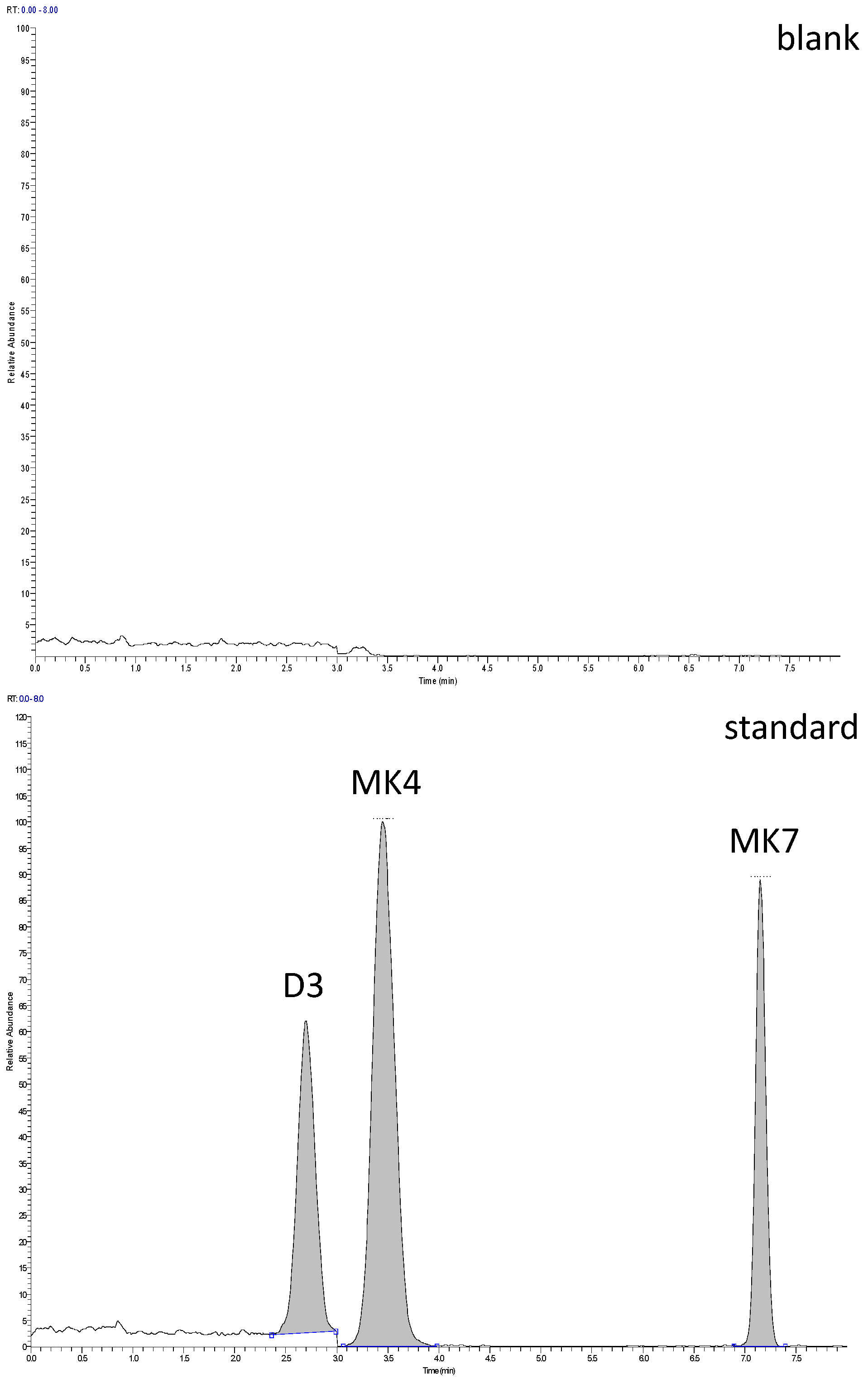
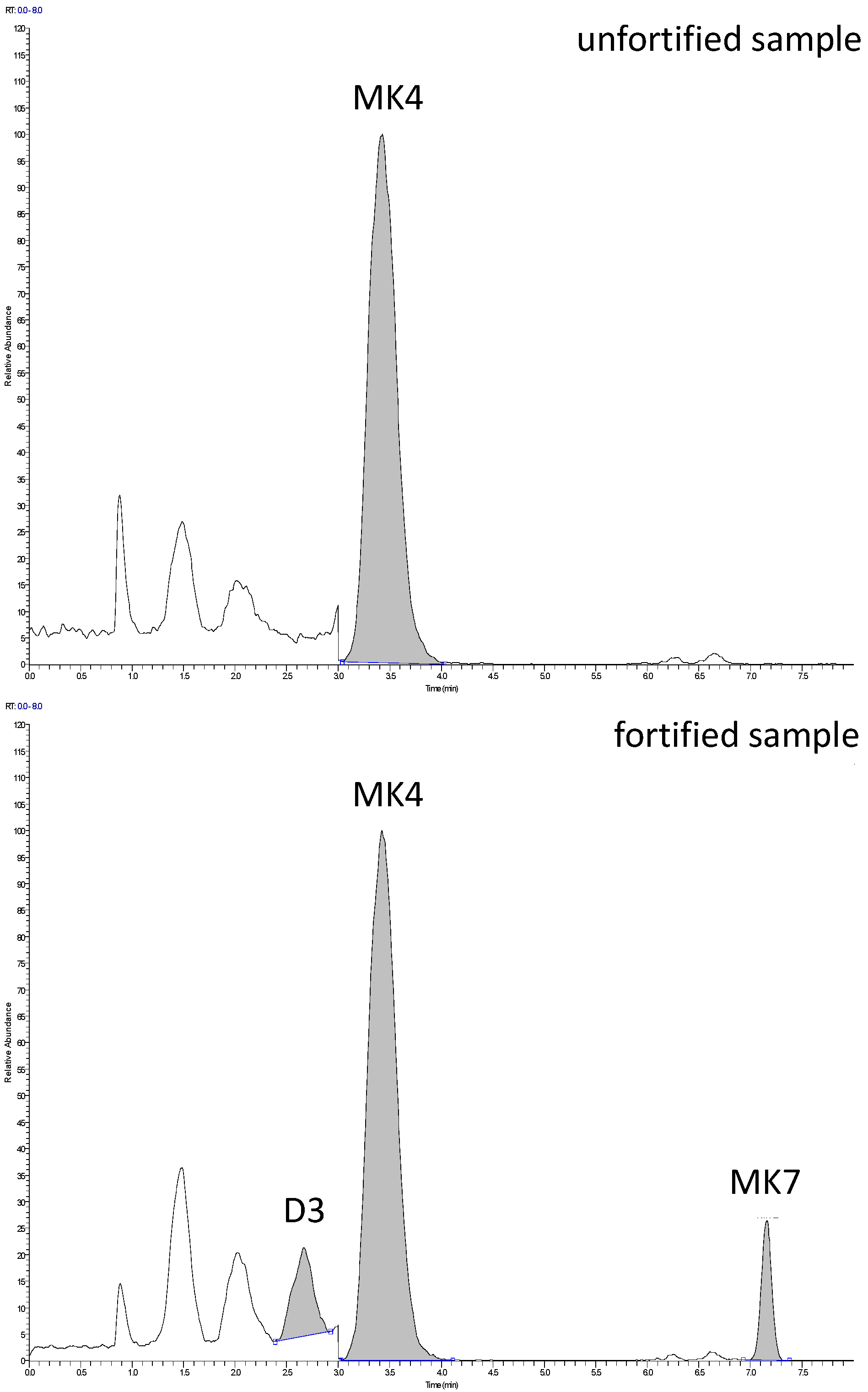
For practical reasons, only the native form of vitamin D3 (cholecalciferol) was analysed, excluding its metabolites (with 25OH–D3 having the highest concentration among them). In addition to absolute concentrations, previous studies indicate significant differences in the ratio between vitamin D3 and 25OH–D3 among different types of meat [20,34], while this ratio is quite predictable within a specific type of meat. Studies on chicken meat samples [20,40,41,42] indicate that the majority of vitamin D3 is present as cholecalciferol, accounting for approximately 50–60% of total vitamin D3 in unfortified meat. Additionally, the vast majority of vitamin D3 in the studied samples is present in its native and free form due to fortification. It must also be mentioned that, in general, the absolute content of unfortified vitamin D3 can be highly variable. Values as high as 4.5 µg/100 g of free vitamin D3 in chicken meat have also been reported [40]. Examples of chromatograms are shown in Figure 1.

3.3. MS Detection

Vitamins D3 and K2 both lack ionisable groups. Early LC–MS methods used thermospray (TS) ionisation [19], particle beam (PB) ionisation [15,16], and later atmospheric-pressure chemical ionisation (APCI) [17,18,20,22,27]. Only more recently, and with fewer reports to date, has electrospray (ESI) ionisation also become a valid option in this context [21,28,29]. With technical developments and improvements, ESI provides a viable option for ionisation of non-polar compounds as well, provided they are detected as adducts with suitable ions [43,44], while also offering lower levels of chemical noise. With ESI, in some cases, extreme measures have been taken to obtain well-defined adducts, for example, by using methylamine in the mobile phase [21]. In other cases, a range of adducts has been observed, from protonated species to ammoniated and sodiated adducts, most likely originating from matrix interferences [45].
In this study, to keep the analytical procedure simple and minimise sources of error, only ammonium acetate was used as a mobile-phase modifier for ionisation. The most prevalent ion species observed were protonated target analytes, with no appreciable detection of ammoniated adducts (as theoretically expected), even during method development. A plausible explanation for the almost exclusive presence of protonated species is the use of a relatively high vaporisation temperature (385 °C) and electrospray voltage (6 kV) in the ion source, which probably favours the stability of protonated rather than ammoniated species. At lower vaporisation temperatures, ammoniated species were also present at low levels, but the background signal (chemical noise) was significantly higher. At higher vaporisation temperatures, the analyte (parent ion) signals began to decrease, indicating that the selected vaporisation temperature is optimal, at least for this specific case. Interestingly, with the use of formic acid as a mobile-phase modifier (instead of ammonium acetate), the detector responses for analytes were slightly lower. This may be attributed to several factors: on one hand, the higher conductivity of such a mobile phase, and on the other, analyte-modifier and/or matrix-modifier interactions, which would require a more detailed mechanistic study beyond the scope of this work. Regardless of the ESI conditions, the presence of analyte adducts with sodium and potassium was also expected due to the complexity of the matrix. Contrary to predictions, no such adducts were observed. This implies separation efficiency not only in terms of analyte selectivity, but also in terms of matrix interference removal.
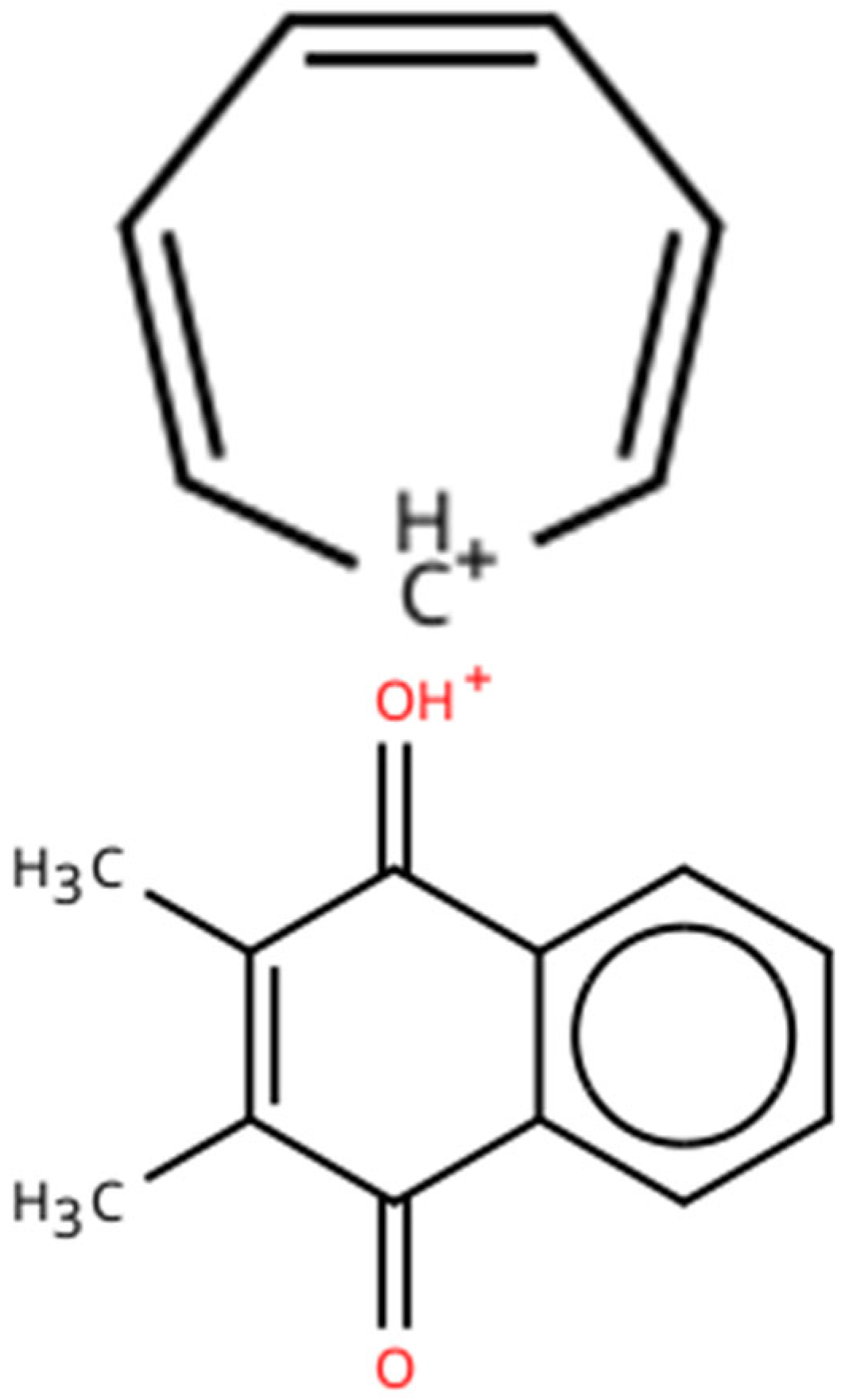
In contrast to most related studies, the fragmentation conditions in this study were set relatively high in terms of collision energy, resulting primarily in smaller fragment (product) ions. This approach was chosen deliberately during method development, as the large difference in m/z values between precursor and product ions appeared to lower signal background noise, thereby improving sensitivity. The main product ion observed for D3 was at m/z 91, while for both K2–MK4 and K2–MK7 the product ion was at m/z 187. Product ion spectra for all three analytes under experimental conditions are shown in Figures S1–S3. The product ion at m/z 91 most likely corresponds to the tropylium cation, which can be formed by molecular rearrangement, also from non-aromatic moieties [46,47,48,49,50]. While tropylium ions as a fragment species were originally found in electron ionisation spectra, their occurrence has also been confirmed in collision-induced dissociation spectra from parent ions originating from positive electrospray ionisation [51,52]. The product ion at m/z 187 is most likely the protonated species of methyl menadione [53,54]. The proposed ionic species are shown in Figure 2. To simplify the procedure and reduce operating costs, no isotope-labelled standards were used, as the validation data showed good figures of merit (Section 3.4). For MS detection, only single ion transitions were monitored (single reaction monitoring, SRM), recording only quantifier product ions and not the so-called qualifier ions. This decision was made to maximise MS detection sensitivity, partly because the instrument used (TSQ Quantum Ultra) tends to drastically reduce sensitivity when multiple transitions are recorded simultaneously. Nevertheless, the method offers very good sensitivity at the same or a higher level compared to similar methods (Table A1).

3.4. Method Validation, Performance and Applicability

The validation data indicate good figures of merit for the proposed methodology, with no issues regarding any performance parameters, even though quantification was based solely on external standards. The use of isotope-labelled internal standards was beyond the scope of the method, as good validation data were already obtained as described, without unnecessarily increasing the method’s operating costs. The method has been tested on chicken meat-derived pâté products, which have very complex matrices containing additional animal fat, vegetable oils, and other components. Therefore, it is assumed, although not tested (due to project constraints), that this methodology could also serve as a good starting point for other animal-derived raw materials and products high in fatty matrix and with similar vitamin levels. The validation results are shown in Table 3.

3.5. Sample Analyses

Examples of analytical results from different pâté samples are shown in Table 4. Although all results fall within the expected or specified ranges, they demonstrate variability in measured vitamin levels, despite the thorough industrial processes used in manufacturing. This variability can be attributed both to batch-to-batch variation in raw materials and to inhomogeneity issues arising during vitamin fortification in the mixing phase of production. The quantities of vitamins required for fortification are quite small, and although they are pre-solubilised in edible oil, their distribution within a production batch must be carefully monitored through analysis. In addition to monitoring vitamin stability, homogeneity monitoring was also a key task in the development of the method.

3.6. Potential Limitations and Future Prospects

The method relies on a simple, yet robust, sample extraction procedure, which inevitably co-extracts a large portion of the fatty matrix. Therefore, as a trade-off, much of the analytical run time is devoted to matrix elution and column conditioning, prolonging the analysis as the main drawback. Although the developed method was primarily intended as a quality control tool within the production environment, its relative simplicity means it could be adapted—particularly in terms of sample preparation (i.e., solvents and extraction conditions)—for other types of animal-derived raw materials and final products, such as dairy or other types of meat.

4. Conclusions

The presented LC–MS method offers a simple and efficient approach for the analysis of vitamins D3 and K2 in chicken meat products with matrices containing high fat content (around 30%). Although the method has not yet been applied to plain meat samples (as this was beyond the scope of the project), it is reasonable to assume that it can also be used to analyse native MK4 content in meat. Furthermore, in cases of high vitamin D3 levels (i.e., above 0.6 µg/100 g), it can also be used for such analyses. Its main advantages are simplicity, sensitivity, and robustness.

Supplementary Materials

The following supporting information can be downloaded at: https://www.mdpi.com/article/10.3390/foods15030570/s1, Figure S1: Fragmentation spectra of cholecalciferol (vitamin D3), Figure S2: menaquinone-4, Figure S3: menaquinone-7.

Funding

This work was supported by the research programme “Food for Future” (Ministry of Education, Science and Sport, EU—European Regional Development Fund; 2016–2020) and the research core funding No. P1-0005 (Slovenian Research and Innovation Agency, former Slovenian Research Agency).

Institutional Review Board Statement

Not applicable.

Informed Consent Statement

Not applicable.

Data Availability Statement

The original contributions presented in the study are included in the article/Supplementary Materials. Further inquiries can be directed to the corresponding author.

Conflicts of Interest

The author declares no conflicts of interest.

Appendix A

In Table A1, a comparison between LC–MS methods referenced for analysis of vitamins D and K has been carried out regarding sample type(s), sample preparation procedure, analytical run time(s), and limits of detection (LOD) and quantification (LOQ).
Table A1. Comparison among different published LC–MS methods. * refers to the analyte amount injected on column (recalculated from published data, as needed); n.a.—not available; Apx.—approximately; SPE—solid phase extraction; SLE—supportive liquid extraction; LLE—liquid–liquid extraction.
AnalytesSample Type(s)Sample Preparation
Procedure
LC(–MS)
Run Time (min)
LOD
(pg) *
LOQ
(pg) *
Reference
Vit. A, D3, Edietetic infant formula, infant cerealsSaponification, SPE, solvent reconstitution3080 for D3200 for D3[17]
Vit. K1, K2-MK4,
K2-MK7
Human plasmaSolvent extraction, SPE, solvent reconstitution75n.a.1.2 for K1
1.5 for MK4
2.4 for MK7
[18]
Vit. D3, 25OH-D3Fish, meat, eggsSaponification, extraction, SPE, solvent reconstitution, preparative chromatography20508 for D3Apx. 2000 for D3[20]
Vit. D3, 25OH-D3Meat, eggs, dairy prod.Saponification, extraction, SPE, derivatisation18n.a.n.a.[21]
Vit. D2, 25OH-D2, D3, 25OH-D3Various meatsSaponification, extraction, SPE, solvent reconstitution35Apx. 280 for D3Apx. 470 for D3[22]
Vit. D2, 25OH-D2, D3, 25OH-D3Human and cow milkSolvent extraction, SPE, solvent reconstitution, derivatisation17n.a.1.9 for D3
7.7 for 25OH-D3
[26]
Vit. 25OH-D2,
25OH-D3
Human serum/plasmaSolvent extraction/precipitation, solvent reconstitution10Apx. 45 for 25OH-D2
Apx. 90 for 25OH-D3
Apx. 225 for 25OH-D2
Apx. 450 for 25OH-D3
[27]
Vit. 25OH-D2, 25OH-D3 and othersHuman serumSolvent extraction/precipitation, SLE, solvent reconstitution8n.a.Apx. 2.2 for 25OH-D2
Apx. 4.4 for 25OH-D3
[28]
Vit. 25OH-D2, 25OH-D3 and othersHuman serumSolvent extraction/precipitation, solvent reconstitution, derivatization, solvent reconstitution5.50.04 for 25OH-D2
0.2 for 25OH-D3
0.2 for 25OH-D2
1 for 25OH-D3
[29]
Vit. D2, 25OH-D2, D3, 25OH-D3 and othersHuman plasmaSolvent extraction/precipitation, solvent reconstitution, LLE, solvent reconstitution81.3 for D2
1 for D3
5.3 for 25OH-D3
4.5 for D2
3.2 for D3
17.6 for 25OH-D3
[30]
Vit. D3, 25OH-D3 and othersHuman serumSolvent extraction/precipitation, solvent reconstitution, LLE, derivatization, solvent reconstitution14.5n.a.8 for D3[31]
Vit. K1, K2-MK4, K2-MK7Various foodsSolvent extraction, centrifugation, solvent reconstitution255.1 for MK4
10.0 for MK7
17.6 for MK4
33.3 for MK7
[34]
Vit. K1, K2-MK4, K2-MK7, K2-MK9Human and rat serumSolvent extraction/precipitation, miniaturised LLE, solvent reconstitution8.50.8 for MK4
0.5 for MK7
1.3 for MK4
0.8 for MK7
[35]
Vit. D2, D3, K1, K2-MK4Nanoemulsions, fortified yogurtQuEChERS63.8 for D2
0.9 for D3 0.5 for MK4
11.6 for D2
2.6 for D3 1.5 for MK4
[36]
Vit. D3, K2-MK4,
K2-MK7
Chicken pâtéSolvent extraction, centrifugation150.25 for D3
0.6 for MK4
0.4 for MK7
0.6 for D3
2 for MK4
1.6 for MK7
Present work

References

  1. Hubicka, U.; Padiasek, A.; Żuromska Witek, B.; Szlósarczyk, M. Determination of Vitamins K1, K2 MK 4, MK 7, MK 9 and D3 in Pharmaceutical Products and Dietary Supplements by TLC Densitometry. Processes 2020, 8, 870. [Google Scholar] [CrossRef]
  2. van Ballegooijen, A.J.; Pilz, S.; Tomaschitz, A.; Grübler, M.R.; Verheyen, N. The Synergistic Interplay between Vitamins D and K for Bone and Cardiovascular Health: A Narrative Review. Int. J. Endocrinol. 2017, 2017, 7454376. [Google Scholar] [CrossRef]
  3. Yan, Q.; Zhang, T.; O’Connor, C.; Barlow, J.W.; Walsh, J.; Scalabrino, G.; Xu, F.; Sheridan, H. The biological responses of vitamin K2: A comprehensive review. Food Sci. Nutr. 2023, 11, 1634–1656, Erratum in Food Sci. Nutr. 2023, 13, e70005. https://doi.org/10.1002/fsn3.70005. [Google Scholar] [CrossRef]
  4. Jones, G. 100 YEARS OF VITAMIN D: Historical aspects of vitamin D. Endocr. Connect. 2022, 11, e210594. [Google Scholar] [CrossRef]
  5. Aaseth, J.O.; Finnes, T.E.; Askim, M.; Alexander, J. The Importance of Vitamin K and the Combination of Vitamins K and D for Calcium Metabolism and Bone Health: A Review. Nutrients 2024, 16, 2420. [Google Scholar] [CrossRef]
  6. Duffy, S.; Kelly, A.; Rajauria, G.; O’Doherty, J. Biofortification of meat with vitamin D. CAB Rev. Perspect. Agric. Vet. Sci. Nutr. Nat. Resour. 2019, 13, 1–10. [Google Scholar] [CrossRef]
  7. Dunlop, E.; Kiely, M.E.; James, A.P.; Singh, T.; Pham, N.M.; Black, L.J. Vitamin D Food Fortification and Biofortification Increases Serum 25-Hydroxyvitamin D Concentrations in Adults and Children: An Updated and Extended Systematic Review and Meta-Analysis of Randomized Controlled Trials. J. Nutr. 2021, 151, 2622–2635. [Google Scholar] [CrossRef] [PubMed]
  8. Hanewald, K.H.; Mulder, F.J.; Keuning, K.J. Thin-Layer Chromatographic Assay of Vitamin D in High-Potency Preparations: Analysis of Fat-Soluble Vitamins IX. J. Pharm. Sci. 1968, 57, 1308–1312. [Google Scholar] [CrossRef]
  9. Kobayashi, T.; Adachi, A. Gas-liquid chromatographic determination of vitamin D in multivitamin preparation. J. Nutr. Sci. Vitaminol. 1976, 22, 41–51. [Google Scholar] [CrossRef][Green Version]
  10. Boulch, N.L.; Cancela, L.; Miravet, L. Cholecalciferol sulfate identification in human milk by HPLC. Steroids 1982, 39, 391–398. [Google Scholar] [CrossRef] [PubMed]
  11. Hollis, B.W.; Frank, N.E. Quantitation of vitamin D2, vitamin D3, 25-hydroxyvitamin D2, and 25-hydroxyvitamin D3 in human milk. Methods Enzymol. 1986, 123, 167–176. [Google Scholar] [CrossRef]
  12. Jang, M.B. A simple HPLC analysis of vitamin D in fortified milk. Can. Inst. Food Technol. J. 1983, 16, xv. [Google Scholar] [CrossRef]
  13. Lukaszkiewicz, J.; Bibik, K.; Lorenc, R.S. Simplified HPLC method for quantitation of vitamin D in blood serum. J. Pharmacol. Methods 1989, 21, 247–254. [Google Scholar] [CrossRef] [PubMed]
  14. Usui, Y.; Tanimura, H.; Nishimura, N.; Kobayashi, N.; Okanoue, T.; Ozawa, K. Vitamin K concentrations in the plasma and liver of surgical patients. Am. J. Clin. Nutr. 1990, 51, 846–852. [Google Scholar] [CrossRef]
  15. Andreoli, R.; Careri, M.; Manini, P.; Mori, G.; Musci, M. HPLC analysis of fat-soluble vitamins on standard and narrow bore columns with UV, electrochemical and particle beam MS detection. Chromatographia 1997, 44, 605–612. [Google Scholar] [CrossRef]
  16. Careri, M.; Lugari, M.T.; Mangia, A.; Manini, P.; Spagnoli, S. Identification of vitamins A, D and E by particle beam liquid chromatography-mass spectrometry. Fresenius J. Anal. Chem. 1995, 351, 768–776. [Google Scholar] [CrossRef]
  17. Heudi, O.; Trisconi, M.J.; Blake, C.J. Simultaneous quantification of vitamins A, D3 and E in fortified infant formulae by liquid chromatography-mass spectrometry. J. Chromatogr. A 2004, 1022, 115–123. [Google Scholar] [CrossRef]
  18. Suhara, Y.; Kamao, M.; Tsugawa, N.; Okano, T. Method for the determination of vitamin K homologues in human plasma using high-performance liquid chromatography-tandem mass spectrometry. Anal. Chem. 2005, 77, 757–763. [Google Scholar] [CrossRef] [PubMed]
  19. Watson, D.; Setchell, K.D.; Ross, R. Analysis of vitamin D and its metabolites using thermospray liquid chromatography/mass spectrometry. Biomed. Chromatogr. 1991, 5, 153–160. [Google Scholar] [CrossRef]
  20. Bilodeau, L.; Dufresne, G.; Deeks, J.; Clément, G.; Bertrand, J.; Turcotte, S.; Robichaud, A.; Beraldin, F.; Fouquet, A. Determination of vitamin D3 and 25-hydroxyvitamin D3 in foodstuffs by HPLC UV-DAD and LC–MS/MS. J. Food Compos. Anal. 2011, 24, 441–448. [Google Scholar] [CrossRef]
  21. Ložnjak Švarc, P.; Barnkob, L.L.; Jakobsen, J. Quantification of vitamin D3 and 25-hydroxyvitamin D3 in food—The impact of eluent additives and labelled internal standards on matrix effects in LC-MS/MS analysis. Food Chem. 2021, 357, 129588. [Google Scholar] [CrossRef]
  22. Strobel, N.; Buddhadasa, S.; Adorno, P.; Stockhamm, K.; Greenfieldm, H. Vitamin D and 25-hydroxyvitamin D determination in meats by LC-IT-MS. Food Chem. 2013, 138, 1042–1047. [Google Scholar] [CrossRef] [PubMed]
  23. Fanali, C.; D’Orazio, G.; Fanali, S.; Gentili, A. Advanced analytical techniques for fat soluble vitamin analysis. Trends Anal. Chem. 2017, 87, 82–97. [Google Scholar] [CrossRef]
  24. Alexandridou, A.; Volmer, D.A. Sample preparation techniques for extraction of vitamin D metabolites from non conventional biological sample matrices prior to LC–MS/MS analysis. Anal. Bioanal. Chem. 2022, 414, 4613–4632. [Google Scholar] [CrossRef]
  25. Bikle, D.D. Vitamin D metabolism, mechanism of action, and clinical applications. Chem. Biol. 2014, 21, 319–329. [Google Scholar] [CrossRef] [PubMed]
  26. Jones, K.S.; Meadows, S.R.; Billing, G.; Koulman, A.; Prentice, A. The validation of an LC–MS/MS method for the quantification of vitamin D metabolites in human milk and their biological variability in Gambian women. J. Steroid Biochem. Mol. Biol. 2025, 245, 106633. [Google Scholar] [CrossRef]
  27. Gören, A.C.; Bilsel, G.; Bilsel, M. Rapid and simultaneous determination of 25-OH-vitamin D2 and D3 in human serum by LC/MS/MS: Validation and uncertainty assessment. J. Chem. Metrl 2007, 1, 1–9. [Google Scholar]
  28. Jenkinson, C.; Taylor, A.E.; Hassan-Smith, Z.K.; Adams, J.S.; Stewart, P.M.; Hewison, M.; Keevil, B.G. High throughput LC–MS/MS method for the simultaneous analysis of multiple vitamin D analytes in serum. J. Chromatogr. B Anal. Technol. Biomed. Life Sci. 2016, 1014, 56–63. [Google Scholar] [CrossRef]
  29. Rola, R.; Kowalski, K.; Bieńkowski, T.; Studzińska, S. Improved sample preparation method for fast LC–MS/MS analysis of vitamin D metabolites in serum. J. Pharm. Biomed. Anal. 2020, 190, 113529. [Google Scholar] [CrossRef]
  30. Socas-Rodríguez, B.; Pilařová, V.; Sandahl, M.; Holm, C.; Turner, C. Simultaneous Determination of Vitamin D and Its Hydroxylated and Esterified Metabolites by Ultrahigh-Performance Supercritical Fluid Chromatography-Tandem Mass Spectrometry. Anal. Chem. 2022, 94, 3065–3073. [Google Scholar] [CrossRef]
  31. Schorr, P.; Stokes, C.S.; Volmer, D.A. Improved quantitative LC–MS/MS analysis of vitamin D metabolites in serum after one-pot double derivatization. J. Pharm. Biomed. Anal. 2023, 234, 115522. [Google Scholar] [CrossRef] [PubMed]
  32. Mladěnka, P.; Macáková, K.; Kujovská Krčmová, L.; Javorská, L.; Mrštná, K.; Carazo, A.; Protti, M.; Remião, F.; Nováková, L. Vitamin K—Sources, physiological role, kinetics, deficiency, detection, therapeutic use, and toxicity. Nutr. Rev. 2022, 80, 677–698. [Google Scholar] [CrossRef]
  33. Shearer, M.J.; Newman, P. Metabolism and cell biology of vitamin K. Thromb. Haemost. 2008, 100, 530–547. [Google Scholar] [CrossRef] [PubMed]
  34. Tanaka, R.; Tanaka, R. Development of vitamin K analysis method using column switching high-performance liquid chromatography method and analysis results of various food items for vitamin K content. Food Anal. Methods 2024, 17, 1218–1228. [Google Scholar] [CrossRef]
  35. Mrštná, K.; Matoušová, K.; Krčmová, L.K.; Carazo, A.; Pourová, J.; Mladěnka, P.; Matysová, L.; Švec, F. Analysis of vitamin K1 and major K2 variants in rat/human serum and lipoprotein fractions by a rapid, simple, and sensitive UHPLC-MS/MS method. J. Chromatogr. A 2024, 1714, 464548. [Google Scholar] [CrossRef]
  36. Kim, T.E.; Yoo, G.; Hyeock Lee, M.; Kim, B.K.; Won Jang, H. Novel QuEChERS-ultra-performance liquid chromatography-atmospheric-pressure chemical ionization tandem mass spectrometry method for the simultaneous determination of vitamin D and vitamin K in vitamin-fortified nanoemulsions. Food Chem. 2022, 389, 133009. [Google Scholar] [CrossRef]
  37. Iwamoto, J.; Takeda, T.; Ichimura, S. Effect of combined administration of vitamin D3 and vitamin K2 on bone mineral density of the lumbar spine in postmenopausal women with osteoporosis. J. Orthop. Sci. 2000, 5, 546–551. [Google Scholar] [CrossRef]
  38. McCourt, A.F.; O’Sullivan, A.M. Using food fortification to improve vitamin D bioaccessibility and intakes. Proc. Nutr. Soc. 2022, 81, 99–107. [Google Scholar] [CrossRef]
  39. Phillips, K.M.; Pehrsson, P.R.; Patterson, K.Y. Survey of vitamin D and 25-hydroxyvitamin D in traditional native Alaskan meats, fish, and oils. J. Food Compos. Anal. 2018, 74, 114–128. [Google Scholar] [CrossRef]
  40. Jakobsen, J.; Christensen, T. Natural Vitamin D in Food: To What Degree Does 25-Hydroxyvitamin D Contribute to the Vitamin D Activity in Food? J. Bone Miner. Res. Plus 2021, 5, e10453. [Google Scholar] [CrossRef]
  41. Mattila, P.H.; Piironen, V.I.; Koivistoinen, P.E.; Uusi-Rauva, E.J. Contents of cholecalciferol, ergocalciferol, and their 25-hydroxylated metabolites in milk products and raw meat and liver as determined by HPLC. J. Agric. Food Chem. 1995, 43, 2394–2399. [Google Scholar] [CrossRef]
  42. Mattila, P.H.; Valkonen, E.; Valaja, J. Effect of different vitamin D supplementations in poultry feed on vitamin D content of eggs and chicken meat. J. Agric. Food Chem. 2011, 59, 8298–8303. [Google Scholar] [CrossRef]
  43. Lien, G.W.; Chen, C.Y.; Wang, G.S. Comparison of electrospray ionization, atmospheric pressure chemical ionization and atmospheric pressure photoionization for determining estrogenic chemicals in water by liquid chromatography tandem mass spectrometry with chemical derivatizations. J. Chromatogr. A 2009, 1216, 956–966. [Google Scholar] [CrossRef]
  44. Wang, R.; Zhang, L.; Zhang, Z.; Tian, Y. Comparison of ESI- and APCI-LC-MS/MS methods: A case study of levonorgestrel in human plasma. J. Pharm. Anal. 2016, 6, 356–362. [Google Scholar] [CrossRef]
  45. Hagenhoff, S.; Hayen, H. LC/MS analysis of vitamin D metabolites by dielectric barrier discharge ionization and a comparison with electrospray ionization and atmospheric pressure chemical ionization. Anal. Bioanal. Chem. 2018, 410, 4905–4911. [Google Scholar] [CrossRef]
  46. Brady, L.E.; Williams, D.H.; Traynor, S.C.; Crowley, K.J. Contrasting reactions for conversion of some dihydroaromatic cations to aromatic cations through hydrogen elimination. Org. Mass. Spectrom. 1975, 10, 116–121. [Google Scholar] [CrossRef]
  47. Ausloos, P. Structure and isomerization of C7H7+ ions formed in the charge-transfer-induced fragmentation of ethylbenzene, toluene, and norbornadiene. J. Am. Chem. Soc. 1982, 104, 5259–5265. [Google Scholar] [CrossRef]
  48. Russell, D.H.; Freiser, B.S.; McBay, E.H.; Canada, D.C. The structure of decomposing [C7H7O]+ ions: Benzyl versus tropylium ion structures. Org. Mass. Spectrom. 1983, 18, 474–485. [Google Scholar] [CrossRef]
  49. Schwell, M.; Dulieu, F.; Gée, C.; Jochims, H.W.; Chotin, J.L.; Baumgärtel, H.; Leach, S. Photoionization mass spectrometry of six isomers of C7H8 in the 7–22 eV photon energy range. Chem. Phys. 2000, 260, 261–279. [Google Scholar] [CrossRef]
  50. Kharnaior, K.S.; Devi, M.; Duncan Lyngdoh, R.H. Generation of C7H7+ cations with isomerization reactions. Comput. Theor. Chem. 2016, 1091, 150–164. [Google Scholar] [CrossRef]
  51. Fleissner, S.; Pittenauer, E.; Kirchner, K. Electrospray Ionization Tandem Mass Spectrometric Study of Selected Phosphine-Based Ligands for Catalytically Active Organometallics. J. Am. Soc. Mass. Spectrom. 2023, 34, 1647–1652. [Google Scholar] [CrossRef] [PubMed]
  52. Dias, H.J.; Santos, W.H.; Filho, L.C.S.; Crevelin, E.J.; McIndoe, J.S.; Vessecchi, R.; Crotti, A.E.M. Electrospray ionization tandem mass spectrometry of 4-aryl-3,4-dihydrocoumarins. J. Mass. Spectrom. 2024, 59, e5062. [Google Scholar] [CrossRef] [PubMed]
  53. Carlone, G.M.; Anet, F.A. Detection of menaquinone-6 and a novel methyl-substituted menaquinone-6 in Campylobacter jejuni and Campylobacter fetus subsp. fetus. J. Gen. Microbiol. 1983, 129, 3385–3393. [Google Scholar] [CrossRef] [PubMed]
  54. Szterk, A.; Bus, K.; Zmysłowski, A.; Ofiara, K. Analysis of Menaquinone-7 Content and Impurities in Oil and Non-Oil Dietary Supplements. Molecules 2018, 23, 1056. [Google Scholar] [CrossRef]
Figure 1. Chromatograms of blank, standard solution, unfortified pâté sample and pâté fortified with D3 and K2–MK7 (top to bottom).
Foods 15 00570 g001aFoods 15 00570 g001b
Figure 2. Proposed structures of observed product ions. Top: tropylium cation (m/z 91). Bottom: protonated methyl menadione (m/z 187).
Foods 15 00570 g002
Table 1. Mobile-phase gradient program.
Time (min)% A% B% C
0.05950
4.05950
4.551085
10.051085
10.15950
15.05950
Table 2. Analyte-specific MS parameters.
Time (min)Parent m/zProduct m/zCollision Energy (V)Tube Lens (V)Collision Gas Pressure (mTorr)Analyte
0–2.67385.191.150911.7D3
2.67–4.5445.2187.022821.7MK4
4.5–8.0649.5187.0321151.7MK7
Table 3. Method validation parameters.
AnalyteInjection Precision (% RSD, n = 4)Accuracy
(%, n = 4)
Extraction
Efficiency (%) *
Repeatability
(% RSD, n = 4)
Intermediate
Precision (% RSD, n = 9)
LOD ** (ng/g)LOQ ** (ng/g)Regression
Coefficient
(r)
Stability 24 h (%)
D3
K2–MK4
K2–MK7
1.3886.6 ± 5.1-5.876.482.46.10.998198.0
3.81104.9 ± 4.893.85.175.715.919.80.999194.3
2.0488.7 ± 3.694.62.947.554.215.70.998393.9
* D3 has not been assessed for extraction efficiency, since the second consecutive extraction of samples gave no detectable peaks in unspiked samples. ** determination of LOD and LOQ was based on extrapolation of signal-to-noise responses, expressed as ng in g of sample; LOD—limit of detection; LOQ—limit of quantitation.
Table 4. Sample analyses. The samples have been analysed in duplicates. The values are expressed in µg per 100 g of sample.
AnalyteD3K2–MK4K2–MK7
Pâté Type(µg/100 g)(µg/100 g)(µg/100 g)
Unfortifiedn.d48.3 ±1.6n.d
Unfortified2.1 ± 0.163.8 ± 3.72.6 ± 0.3
Unfortified0.9 ± 0.153.1 ± 2.91.8 ± 0.2
Unfortified3.4 ± 0.261.9 ± 2.42.4 ± 0.1
Fortified13.8 ± 0.658.9 ± 3.618.2 ± 0.4
Fortified8.1 ± 0.442.7 ± 2.313.6 ± 0.7
Fortified22.1 ± 0.774.6 ± 1.728.0 ± 0.7
Fortified8.2 ± 0.390.4 ± 2.412.2 ± 0.8
n.d.—not detected.
Disclaimer/Publisher’s Note: The statements, opinions and data contained in all publications are solely those of the individual author(s) and contributor(s) and not of MDPI and/or the editor(s). MDPI and/or the editor(s) disclaim responsibility for any injury to people or property resulting from any ideas, methods, instructions or products referred to in the content.