Molecularly Imprinted Deoxynivalenol Surface Plasmon Resonance Sensor Based on Sulfur-Doped Boron Graphitic Carbon Nitride

Abstract
1. Introduction
2. Materials and Methods
2.1. Chemicals and Apparatus
- Zeroing: the moment the injection started was determined as the starting point on the time axis (t = 0) and the signal axis (y = 0).
- Reference subtraction: to eliminate bulk effects and non-specific bindings that occurred during the experiment, data from an empty channel without a solution were removed from the master data.
- Cropping: parts irrelevant to the analysis, such as during stabilization, were removed from the dataset.
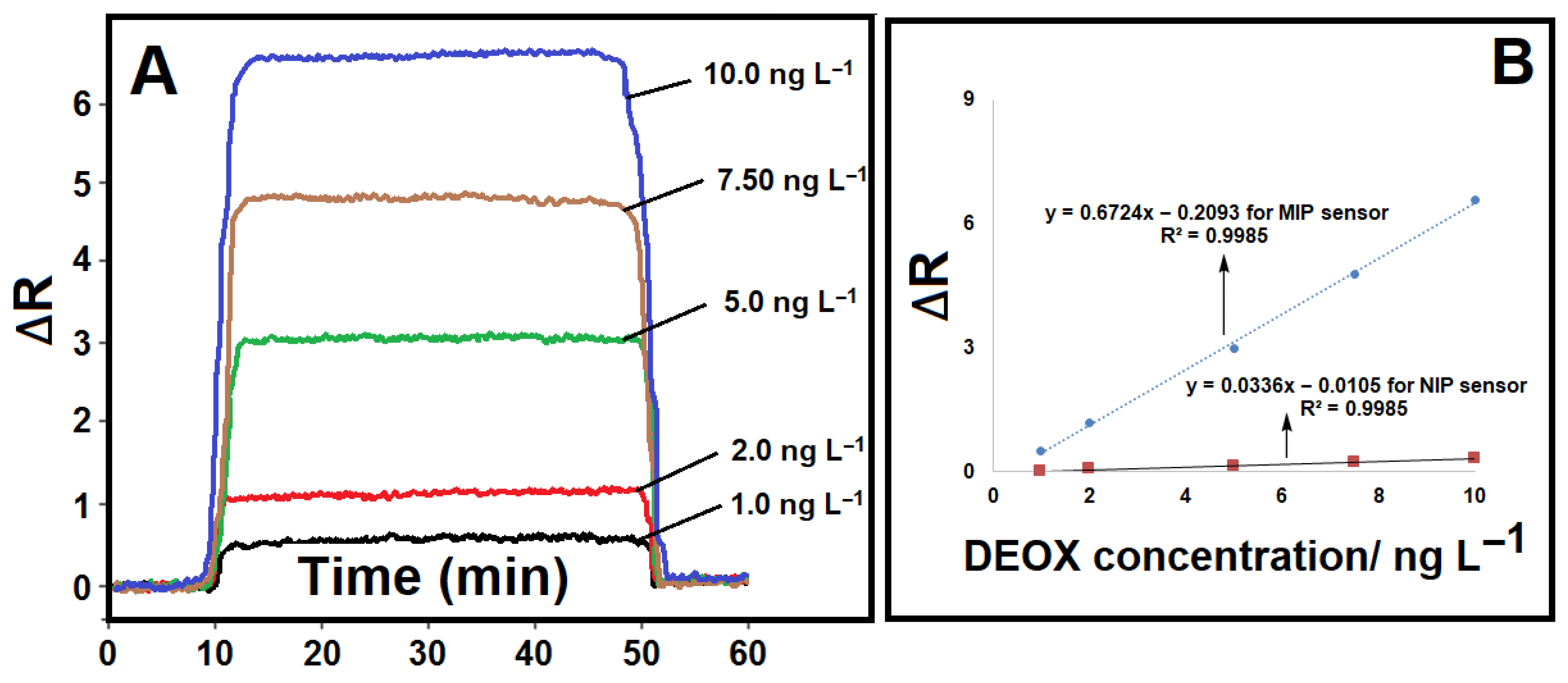
- Association: the analyte interacted with the sensor surface, and an increase in response unit (RU) was observed.
- Dissociation: the analyte flow was interrupted, and the separation of bound molecules was observed.
- Maximum response (Rmax): the response value at the point where the sensor surface reached saturation was determined.
2.2. Preparation of g-C3N4, B-g-C3N4, and S-B-g-C3N4 Nanocomposites
2.3. Modification of SPR Chip with 0.2S-B-g-C3N4 and Preparation of DEOX-Imprinted SPR Sensor with 0.2S-B-g-C3N4
2.4. DEOX Removal from MIP/0.2S-B-g-C3N4/SPR Sensor and Analysis Process
2.5. Sample Preparation
3. Results and Discussion
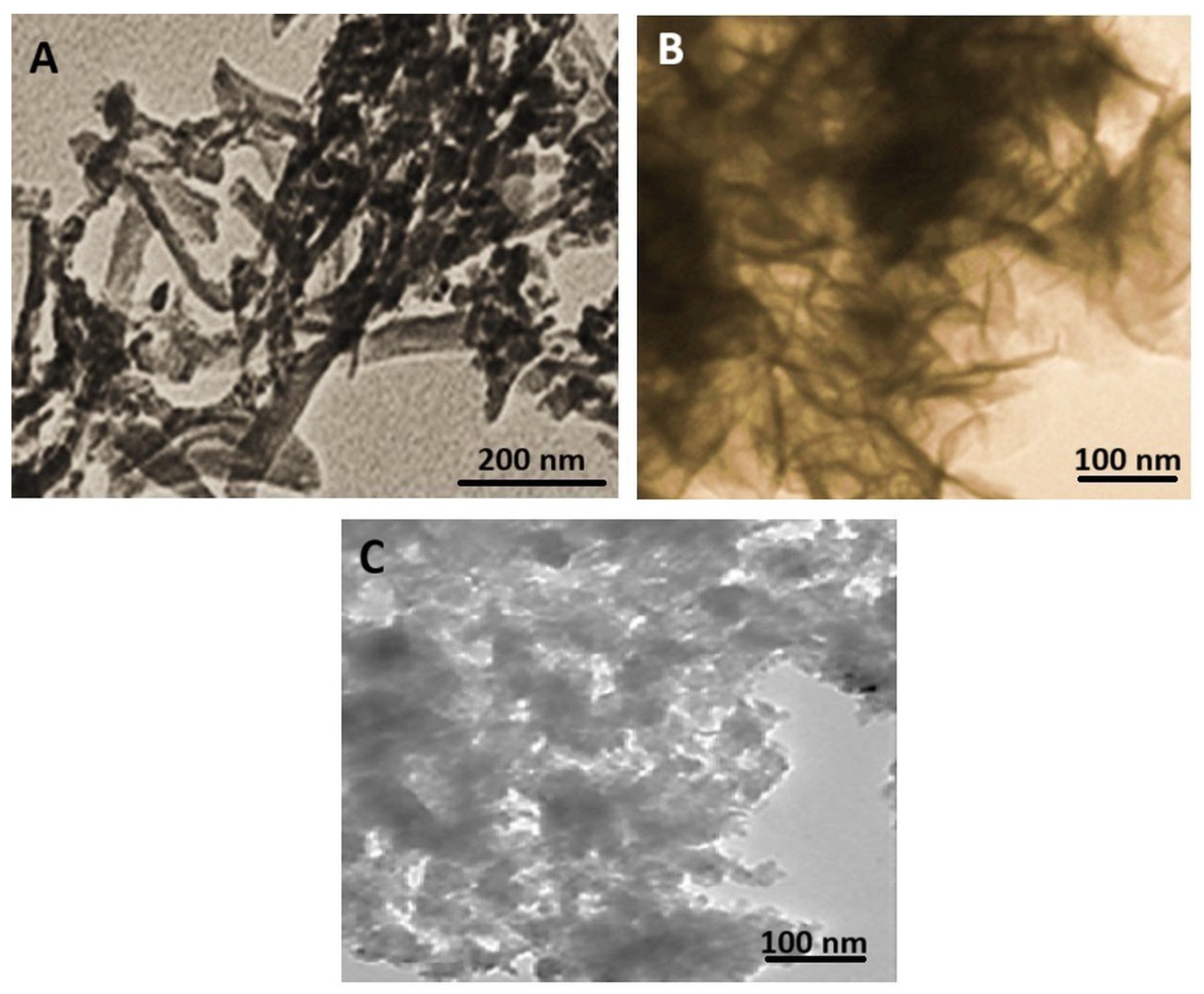
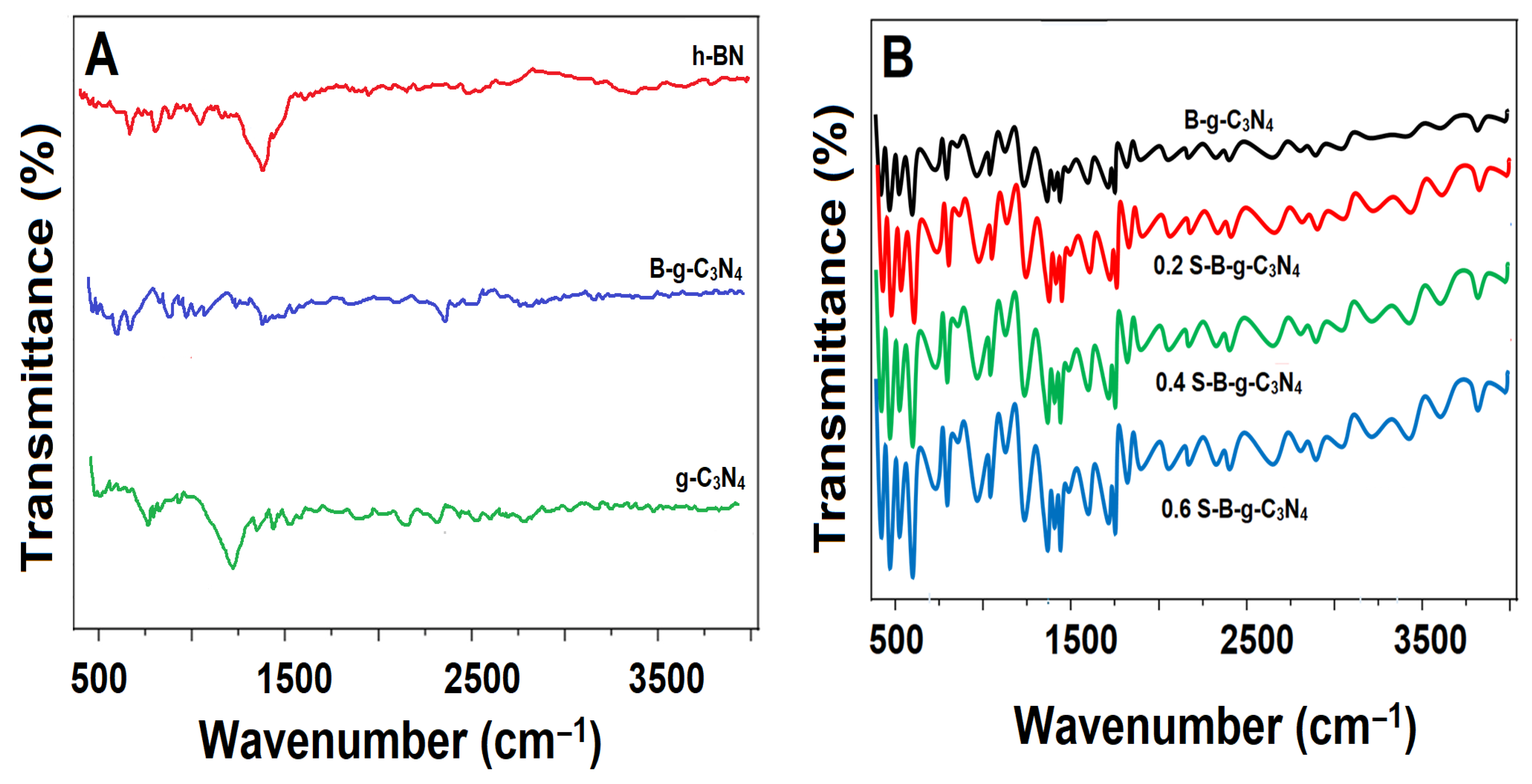
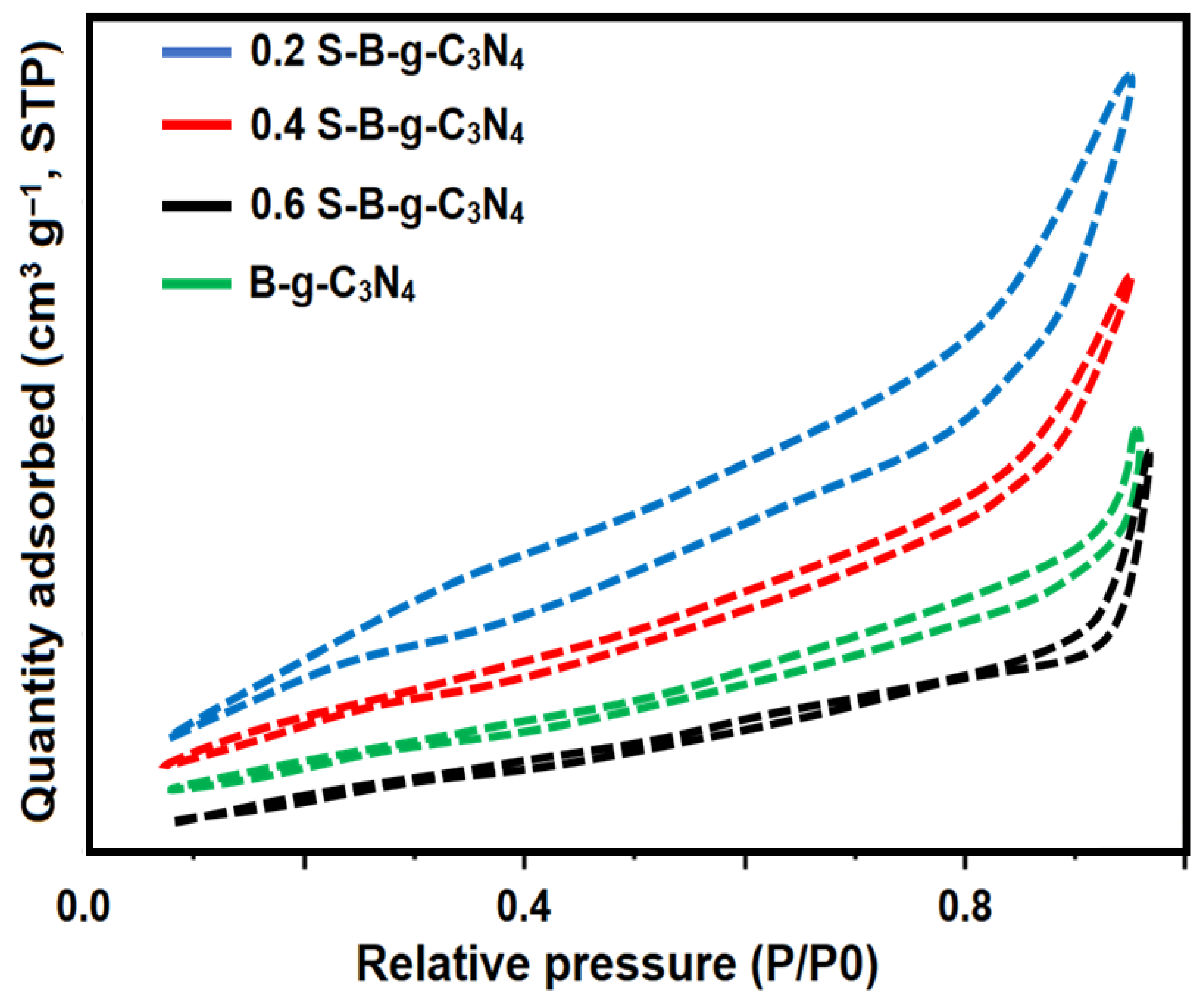
3.1. Characterization of S-B-g-C3N4 Nanocomposite
3.2. FTIR and Atomic Force Microscopy (AFM) Studies of DEOX-Imprinted Film on 0.2S-B-g-C3N4/SPR Chip
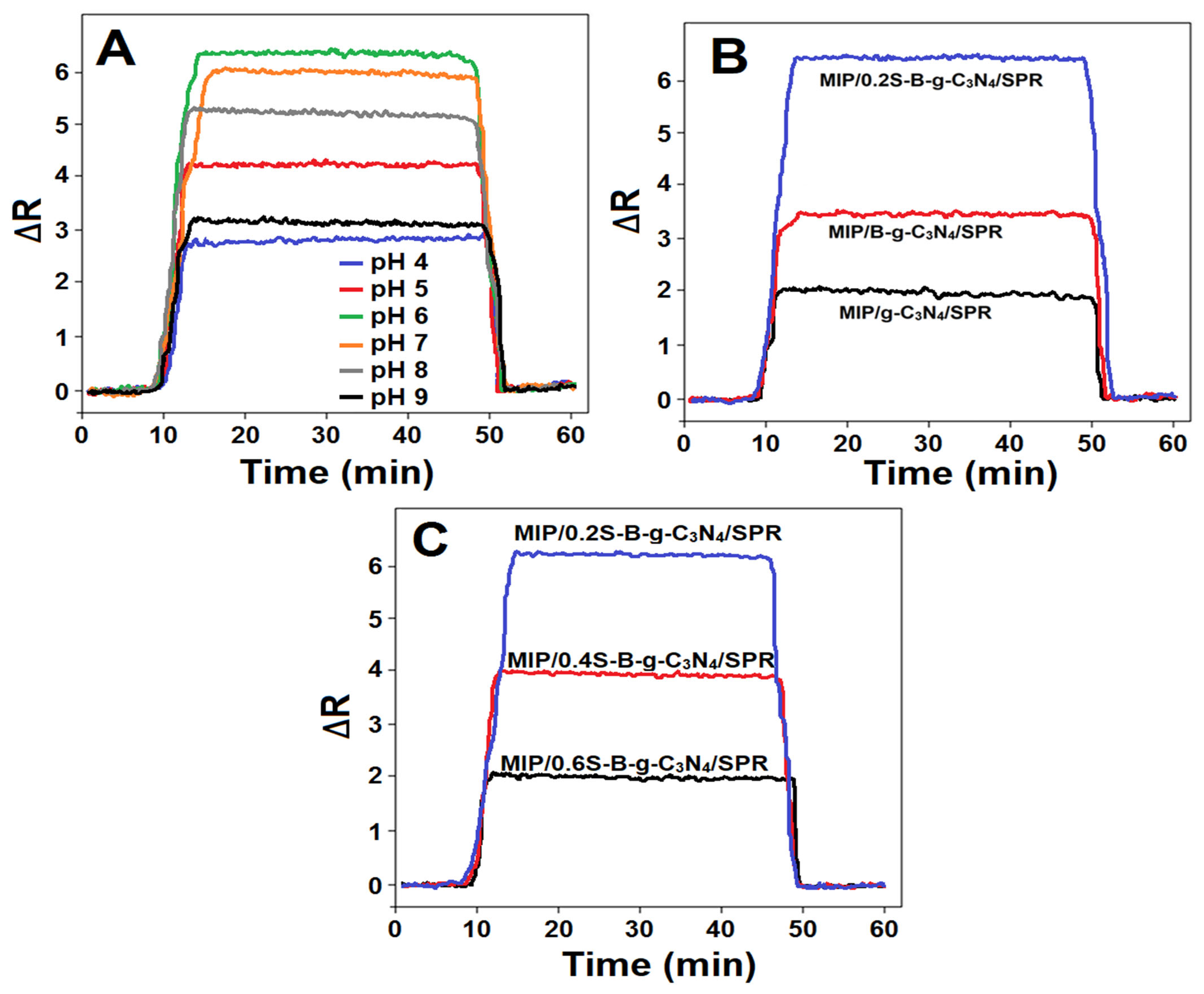
3.3. pH Effect and Nanocomposite Effect on SPR
3.4. Sensitivity of MIP/0.2S-B-g-C3N4/SPR Chip
3.5. Recovery
3.6. Selectivity, Repeatability, Reusability, and Reproducibility of MIP/0.2S-B-g-C3N4/SPR Chip
3.7. Precision and Accuracy of MIP/0.2S-B-g-C3N4/SPR Sensor
3.8. Ruggedness and Robustness of MIP/0.2S-B-g-C3N4/SPR Sensor
4. Conclusions
Supplementary Materials
Author Contributions
Funding
Institutional Review Board Statement
Informed Consent Statement
Data Availability Statement
Conflicts of Interest
References
- Bennett, J.W.; Klich, M. Mycotoxins. Clin. Microbiol. Rev. 2003, 16, 497–516. [Google Scholar] [CrossRef]
- Camenzuli, L.; Van Dam, R.; de Rijk, T.; Andriessen, R.; Van Schelt, J.; Van der Fels-Klerx, H.J.I. Tolerance and Excretion of the Mycotoxins Aflatoxin B1, Zearalenone, Deoxynivalenol, and Ochratoxin A by Alphitobius diaperinus and Hermetia illucens from Contaminated Substrates. Toxins 2018, 10, 91. [Google Scholar] [CrossRef]
- Pestka, J.J. Deoxynivalenol: Toxicity, mechanisms and animal health risks. Anim. Feed Sci. Technol. 2007, 137, 283–298. [Google Scholar] [CrossRef]
- Tian, Y.; Tan, Y.; Liu, N.; Yan, Z.; Liao, Y.; Chen, J.; De Saeger, S.; Yang, H.; Zhang, Q.; Wu, A. Detoxification of Deoxynivalenol via Glycosylation Represents Novel Insights on Antagonistic Activities of Trichoderma when Confronted with Fusarium graminearum. Toxins 2016, 8, 335. [Google Scholar] [CrossRef]
- Sumarah, M.W. The Deoxynivalenol Challenge. J. Agric. Food. Chem. 2022, 70, 9619–9624. [Google Scholar] [CrossRef]
- Rodrigues, I.; Naehrer, K. A Three-Year Survey on the Worldwide Occurrence of Mycotoxins in Feedstuffs and Feed. Toxins 2012, 4, 663–675. [Google Scholar] [CrossRef]
- Thapa, A.; Horgan, K.A.; White, B.; Walls, D. Deoxynivalenol and Zearalenone—Synergistic or Antagonistic Agri-Food Chain Co-Contaminants? Toxins 2021, 13, 561. [Google Scholar] [CrossRef]
- Lancova, K.; Hajslova, J.; Poustka, J.; Krplova, A.; Zachariasova, M.; Dostalek, P.; Sachambula, L. Transfer of Fusarium mycotoxins and ‘masked’ deoxynivalenol (deoxynivalenol-3-glucoside) from field barley through malt to beer. Food Addit. Contam. Part A 2008, 25, 732–744. [Google Scholar] [CrossRef]
- Mishra, S.; Srivastava, S.; Dewangan, J.; Divakar, A.; Kumar Rath, S. Global occurrence of deoxynivalenol in food commodities and exposure risk assessment in humans in the last decade: A survey. Crit. Rev. Food Sci. Nutr. 2022, 60, 1346–1374. [Google Scholar] [CrossRef]
- Rocha, O.; Ansari, K.; Doohan, F.M. Effects of trichothecene mycotoxins on eukaryotic cells: A review. Food Addit. Contam. 2005, 22, 369–378. [Google Scholar] [CrossRef]
- Le Hégarat, L.; Takakura, N.; Simar, S.; Nesslany, F.; Fessard, V. The in vivo genotoxicity studies on nivalenol and deoxynivalenol. EFSA Support. Publ. 2014, 11, 697E. [Google Scholar] [CrossRef]
- Payros, D.; Alassane-Kpembi, I.; Pierron, A.; Loiseau, N.; Pinton, P.; Oswald, I.P. Toxicology of deoxynivalenol and its acetylated and modified forms. Arch. Toxicol. 2016, 90, 2931–2957. [Google Scholar] [CrossRef]
- Fiby, I.; Sopel, M.M.; Michlmayr, H.; Adam, G.; Berthiller, F. Development and Validation of an LC-MS/MS Based Method for the Determination of Deoxynivalenol and Its Modified Forms in Maize. Toxins 2021, 13, 600. [Google Scholar] [CrossRef]
- Zou, Z.; He, Z.; Li, H.; Han, P.; Tang, J.; Xi, C.; Li, Y.; Zhang, L.; Li, X. Development and application of a method for the analysis of two trichothecenes: Deoxynivalenol and T-2 toxin in meat in China by HPLC–MS/MS. Meat Sci. 2012, 90, 613–617. [Google Scholar] [CrossRef]
- Gagiu, V.; Mateescu, E.; Dobre, A.A.; Smeu, I.; Cucu, M.E.; Oprea, O.A.; Alexandru, D.; Iorga, E.; Belc, N. Deoxynivalenol Occurrence in Triticale Crops in Romania During the 2012–2014 Period with Extreme Weather Events. Toxins 2021, 13, 456. [Google Scholar] [CrossRef]
- Warth, B.; Parich, A.; Bueschl, C.; Schoefbeck, D.; Neumann, N.K.N.; Kluger, B.; Schuster, K.; Krska, R.; Adam, G.; Lemmens, M.; et al. GC–MS based targeted metabolic profiling identifies changes in the wheat metabolome following deoxynivalenol treatment. Metabolomics 2015, 11, 722–738. [Google Scholar] [CrossRef]
- Yang, H.; Du, L.; Geng, L.; Liu, X.; Xu, Z.; Liu, R.; Liu, W.; Zuo, H.; Chen, Z.; Wang, X.; et al. A novel yeast-based biosensor for the quick determination of Deoxynivalenol. Anal. Chim. Acta 2024, 1315, 342760. [Google Scholar] [CrossRef]
- Sun, B.; Xu, J.; Liu, S.; Li, Q.X. Characterization of Small Molecule-Protein Interactions Using SPR Method. Methods Mol. Biol. 2023, 2690, 149–159. [Google Scholar]
- Rosso, C.; Filippini, G.; Criado, A.; Melchionna, M.; Fornasiero, P.; Prato, M. Metal-Free Photocatalysis: Two-Dimensional Nanomaterial Connection Toward Advanced Organic Synthesis. ACS Nano 2021, 15, 3621–3630. [Google Scholar] [CrossRef]
- Wang, F.; Ng, W.K.H.; Yu, J.C.; Zhu, H.; Li, C.; Zhang, L.; Liu, Z.; Li, Q. Red phosphorus: An elemental photocatalyst for hydrogen formation from water. Appl. Catal. B Environ. 2012, 111–112, 409–414. [Google Scholar] [CrossRef]
- Kumar, S.; Karthikeyan, S.; Lee, A.F. g-C3N4-Based Nanomaterials for Visible Light-Driven Photocatalysis. Catalysts 2018, 8, 74. [Google Scholar] [CrossRef]
- Mishra, A.; Mehta, A.; Basu, S.; Shetti, N.P.; Reddy, K.R.; Aminabhavi, T.M. Graphitic carbon nitride (g–C3N4)–based metal-free photocatalysts for water splitting: A review. Carbon 2019, 149, 693–721. [Google Scholar] [CrossRef]
- Zhang, C.; Li, Y.; Shuai, D.; Shen, Y.; Xiong, W.; Wang, L. Graphitic carbon nitride (g-C3N4)-based photocatalysts for water disinfection and microbial control: A review. Chemosphere 2019, 214, 462–479. [Google Scholar] [CrossRef] [PubMed]
- Li, C.; Xu, Y.; Tu, W.; Chen, G.; Xu, R. Metal-free photocatalysts for various applications in energy conversion and environmental purification. Green Chem. 2017, 19, 882–899. [Google Scholar] [CrossRef]
- Pios, S.; Huang, X.; Sobolewski, A.L.; Domcke, W. Triangular boron carbon nitrides: An unexplored family of chromophores with unique properties for photocatalysis and optoelectronics. Phys. Chem. Chem. Phys. 2021, 23, 12968–12975. [Google Scholar] [CrossRef] [PubMed]
- Kaur, M.; Singh, K.; Chauhan, I.; Sharma, R.K.; Vij, A.; Kumar, A. Defects-induced transition in low-temperature electrical properties of boron carbon nitride thin films. J. Mater. Sci. Mater. Electron. 2022, 33, 4341–4349. [Google Scholar] [CrossRef]
- Kaur, M.; Ahmad Mir, R.; Chauhan, I.; Singh, K.; Krishnan, U.; Kumar, M.; Devi, P.; Pandey, O.P.; Kumar, A. Defect states induced luminescence and electrochemical studies of boron carbon nitride nanosheets. Appl. Surf. Sci. 2021, 559, 149982. [Google Scholar] [CrossRef]
- Haiyan, J.; Yang, L.; Daohan, W.; Xiaodong, X.; Bing, L. Recent Advances in Heteroatom Doped Graphitic Carbon Nitride (g-C3N4) and g-C3N4/Metal Oxide Composite Photocatalysts. Curr. Org. Chem. 2020, 24, 673–693. [Google Scholar]
- Chen, J.; Hong, Z.; Chen, Y.; Lin, B.; Gao, B. One-step synthesis of sulfur-doped and nitrogen-deficient g-C3N4 photocatalyst for enhanced hydrogen evolution under visible light. Mater. Lett. 2015, 145, 129–132. [Google Scholar] [CrossRef]
- Putri, L.K.; Ng, B.-J.; Ong, W.-J.; Lee, H.W.; Chang, W.S.; Chai, S.-P. Engineering nanoscale p–n junction via the synergetic dual-doping of p-type boron-doped graphene hybridized with n-type oxygen-doped carbon nitride for enhanced photocatalytic hydrogen evolution. J. Mater. Chem. A 2018, 6, 3181–3194. [Google Scholar] [CrossRef]
- Guo, Y.; Chen, T.; Liu, Q.; Zhang, Z.; Fang, X. Insight into the Enhanced Photocatalytic Activity of Potassium and Iodine Codoped Graphitic Carbon Nitride Photocatalysts. J. Phys. Chem. C 2016, 120, 25328–25337. [Google Scholar] [CrossRef]
- Ayerdurai, V.; Lach, P.; Lis-Cieplak, A.; Cieplak, M.; Kutner, W.; Sharma, P.S. An advantageous application of molecularly imprinted polymers in food processing and quality control. Crit. Rev. Food Sci. Nutr. 2024, 64, 3407–3440. [Google Scholar] [CrossRef] [PubMed]
- Elfadil, D.; Lamaoui, A.; Della Pelle, F.; Amine, A.; Compagnone, D. Molecularly Imprinted Polymers Combined with Electrochemical Sensors for Food Contaminants Analysis. Molecules 2021, 26, 4607. [Google Scholar] [CrossRef] [PubMed]
- Weiss, R.; Freudenschuss, M.; Krska, R.; Mizaikoff, B. Improving methods of analysis for mycotoxins: Molecularly imprinted polymers for deoxynivalenol and zearalenone. Food Addit. Contam. 2003, 20, 386–395. [Google Scholar] [CrossRef]
- Choi, S.-W.; Chang, H.-J.; Lee, N.; Chun, H.S. A Surface Plasmon Resonance Sensor for the Detection of Deoxynivalenol Using a Molecularly Imprinted Polymer. Sensors 2011, 11, 8654–8664. [Google Scholar] [CrossRef]
- Radi, A.-E.; Eissa, A.; Wahdan, T. Impedimetric sensor for deoxynivalenol based on electropolymerised molecularly imprinted polymer on the surface of screen-printed gold electrode. Int. J. Environ. Anal. Chem. 2021, 101, 2586–2597. [Google Scholar] [CrossRef]
- Yola, M.L.; Eren, T.; Atar, N. A Molecular Imprinted Voltammetric Sensor Based on Carbon Nitride Nanotubes: Application to Determination of Melamine. J. Electrochem. Soc. 2016, 163, B588. [Google Scholar] [CrossRef]
- Kadirsoy, S.; Atar, N.; Yola, M.L. Molecularly imprinted QCM sensor based on delaminated MXene for chlorpyrifos detection and QCM sensor validation. New J. Chem. 2020, 44, 6524–6532. [Google Scholar] [CrossRef]
- Mohamed, H.H.; Alqahtani, S.; Alsunaidi, Z.H.A. Sulphur doped boron carbon nitride as novel metal free nanomaterials for photocatalytic degradation of organic pollutants and H2 production. J. Alloys Compd. 2025, 1018, 179236. [Google Scholar] [CrossRef]
- Mohamed, H.H.; Aziz, M.; Youssef, T.E.; Alomair, N.A. Microwave synthesized g-C3N4 nanofibers with modified properties for enhanced solar light photocatalytic performance. Inorg. Chem. Commun. 2024, 168, 112975. [Google Scholar] [CrossRef]
- Mohamed, H.H. Microwave-assisted and ultrasonic phyto-synthesis of TiO2/g-C3N4 for solar driven-water remediation from toxic metals and organic pollutants. Mater. Sci. Eng. B 2024, 310, 117679. [Google Scholar] [CrossRef]
- Chen, Y.; Xu, X.; Li, C.; Bendavid, A.; Westerhausen, M.T.; Bradac, C.; Toth, M.; Aharonovich, I.; Tran, T.T. Bottom-Up Synthesis of Hexagonal Boron Nitride Nanoparticles with Intensity-Stabilized Quantum Emitters. Small 2021, 17, e2008062. [Google Scholar] [CrossRef]
- Kim, K.K.; Hsu, A.; Jia, X.; Kim, S.M.; Shi, Y.; Hofmann, M.; Nezich, D.; Rodriguez-Nieva, J.F.; Dresselhaus, M.; Palacios, T.; et al. Synthesis of Monolayer Hexagonal Boron Nitride on Cu Foil Using Chemical Vapor Deposition. Nano Lett. 2012, 12, 161–166. [Google Scholar] [CrossRef] [PubMed]
- Chen, L.; Chen, P.; Dai, X.; Zhang, W.; Xing, P.; He, Y. Facile and rapid preparation of hexagonal boron nitride via microwave heating method and its application in photocatalytic H2 evolution. Mater. Lett. 2020, 266, 127477. [Google Scholar] [CrossRef]
- Babu, P.; Mohanty, S.; Naik, B.; Parida, K. Synergistic Effects of Boron and Sulfur Co-doping into Graphitic Carbon Nitride Framework for Enhanced Photocatalytic Activity in Visible Light Driven Hydrogen Generation. ACS Appl. Energy Mater. 2018, 1, 5936–5947. [Google Scholar] [CrossRef]
- Chien, L.C.; Chiang, C.W.; Lao, C.C.; Lin, Y.-I.; Lin, H.-W.; Keng, P.Y. Boron Carbon Oxynitride as a Novel Metal-Free Photocatalyst. Nanoscale Res. Lett. 2021, 16, 176. [Google Scholar] [CrossRef]
- Sivaprakash, K.; Induja, M.; Gomathipriya, P.; Karthikeyan, S.; Umabharathi, S.T. Single-step synthesis of efficient nanometric boron carbon nitride semiconductor for photocatalysis. Mater. Res. Bull. 2021, 134, 111106. [Google Scholar] [CrossRef]
- Çapar, N.; Yola, B.B.; Polat, İ.; Bekerecioğlu, S.; Atar, N.; Yola, M.L. A zearalenone detection based on molecularly imprinted surface plasmon resonance sensor including sulfur-doped g-C3N4/Bi2S3 nanocomposite. Microchem. J. 2023, 193, 109141. [Google Scholar] [CrossRef]
- Quispe-Garrido, L.V.; Ruiz-Montoya, J.G.; Baena-Moncada, A.M.; La Rosa-Toro, A. Recent developments in materials containing N and S groups for gold recovering. J. Environ. Chem. Eng. 2024, 12, 112585. [Google Scholar] [CrossRef]
- Akıcı, Ş.Y.; Bankoğlu Yola, B.; Karslıoğlu, B.; Polat, İ.; Atar, N.; Yola, M.L. Fenpicoxamid-Imprinted Surface Plasmon Resonance (SPR) Sensor Based on Sulfur-Doped Graphitic Carbon Nitride and Its Application to Rice Samples. Micromachines 2024, 15, 6. [Google Scholar] [CrossRef]
- Zhu, X.; Zhang, B.; Wang, J.; He, Y.; Chen, Z.; Chang, W.; Xie, X.; Zhu, H. Cu2O nanoparticles with morphology-dependent peroxidase mimic activity: A novel colorimetric biosensor for deoxynivalenol detection. Microchim. Acta 2024, 191, 588. [Google Scholar] [CrossRef]
- Feng, X.; Xu, Q.; Liu, Y.; Wang, S.; Cao, Y.; Zhao, C.; Peng, S. Smartphone-enabled colorimetric immunoassay for deoxynivalenol based on Mn2+-mediated aggregation of AuNPs. Anal. Biochem. 2024, 692, 115572. [Google Scholar] [CrossRef]
- Zhang, J.; Gao, L.; Zhou, B.; Zhu, L.; Zhang, Y.; Huang, B. Simultaneous detection of deoxynivalenol and zearalenone by dual-label time-resolved fluorescence immunoassay. J. Sci. Food Agric. 2011, 91, 193–197. [Google Scholar] [CrossRef]
- You, F.; Wen, Z.; Yuan, R.; Qian, J.; Long, L.; Wang, K. Sensitive and stable detection of deoxynivalenol based on electrochemiluminescence aptasensor enhanced by 0D/2D homojunction effect in food analysis. Food Chem. 2023, 403, 134397. [Google Scholar] [CrossRef]
- Yuan, J.; Sun, C.; Guo, X.; Yang, T.; Wang, H.; Fu, S.; Li, C.; Yang, H. A rapid Raman detection of deoxynivalenol in agricultural products. Food Chem. 2017, 221, 797–802. [Google Scholar] [CrossRef]
- Lee, S.Y.; Woo, S.Y.; Malachová, A.; Michlmayr, H.; Kim, S.-H.; Kang, G.J.; Chun, H.S. Simple validated method for simultaneous determination of deoxynivalenol, nivalenol, and their 3-β-D-glucosides in baby formula and Korean rice wine via HPLC-UV with immunoaffinity cleanup. Food Addit. Contam. Part A 2019, 36, 964–975. [Google Scholar] [CrossRef]
- Wang, K.; Yan, X.; Wu, J.; Qi, J.; Ning, M.; Li, M.; Sun, R.; Wang, Z.; Yuan, Y.; Yue, T. A fluorescent aptasensor for deoxynivalenol detection based on Nb.BbvCI-assisted targeted-responsive three-way junctions integrated DNA walking machine. Food Chem. 2025, 467, 142365. [Google Scholar] [CrossRef]


| Material/Method | Linear Range (ng L−1) | LOD (ng L−1) | Real Sample | Ref. |
|---|---|---|---|---|
| Cu2O nanoparticles | 2.0 × 10³–1.0 × 10⁵ | 10.0 | Wheat and corn | [51] |
| Colorimetric immunoassay | 1.77 × 10²–6.07 × 10³ | 98.0 | Corn flour | [52] |
| Dual-label time-resolved fluoroimmunoassay (TRFIA) | 19.40–1.0 × 10⁵ | 19.4 | Cereal samples | [53] |
| Electrochemiluminescence aptasensor | 1.0 × 10³–2.0 × 10⁷ | 300.0 | Milk | [54] |
| Surface enhanced Raman spectroscopy (SERS) | 2.96 × 10²–2.96 × 10⁷ | 2.96 × 10⁷ | Oats | [55] |
| HPLC-UV | 2.0 × 10⁴–1.0 × 10⁶ | 4.4 × 10³ | Baby formula and Korean rice wine | [56] |
| MIP/0.2S-B-g-C3N4/SPR | 1.0–10.0 | 0.30 | Drinking water and orange juice | This study |
| MIP/0.2S-B-g-C3N4/SPR | Fluorescence | ||||
|---|---|---|---|---|---|
| Sample | Added DEOX (ng L−1) | Found DEOX (ng L−1) | * Recovery (%) | Found DEOX (ng L−1) | * Recovery (%) |
| Drinking water | - | 1.03 ± 0.01 | - | 1.02 ± 0.02 | - |
| 2.00 | 3.06 ± 0.02 | 100.99 ± 0.01 | 3.04 ± 0.03 | 100.66 ± 0.01 | |
| 5.00 | 5.99 ± 0.03 | 99.34 ± 0.02 | 6.03 ± 0.01 | 100.17 ± 0.01 | |
| 7.00 | 8.04 ± 0.02 | 100.13 ± 0.02 | 8.02 ± 0.02 | 100.00 ± 0.02 | |
| Orange juice | - | 2.02 ± 0.02 | - | 2.03 ± 0.04 | - |
| 2.00 | 4.01 ± 0.04 | 99.75 ± 0.03 | 4.02 ± 0.03 | 99.75 ± 0.02 | |
| 5.00 | 7.03 ± 0.04 | 100.14 ± 0.02 | 7.02 ± 0.05 | 99.86 ± 0.01 | |
| 7.00 | 9.03 ± 0.03 | 100.11 ± 0.01 | 9.02 ± 0.02 | 99.89 ± 0.03 | |
Disclaimer/Publisher’s Note: The statements, opinions and data contained in all publications are solely those of the individual author(s) and contributor(s) and not of MDPI and/or the editor(s). MDPI and/or the editor(s) disclaim responsibility for any injury to people or property resulting from any ideas, methods, instructions or products referred to in the content. |
© 2026 by the authors. Licensee MDPI, Basel, Switzerland. This article is an open access article distributed under the terms and conditions of the Creative Commons Attribution (CC BY) license.
Share and Cite
Mavioğlu Kaya, M.; Deveci, H.A.; Bankoğlu Yola, B.; Polat, İ.; Bekerecioğlu, S.; Atar, N.; Yola, M.L. Molecularly Imprinted Deoxynivalenol Surface Plasmon Resonance Sensor Based on Sulfur-Doped Boron Graphitic Carbon Nitride. Foods 2026, 15, 481. https://doi.org/10.3390/foods15030481
Mavioğlu Kaya M, Deveci HA, Bankoğlu Yola B, Polat İ, Bekerecioğlu S, Atar N, Yola ML. Molecularly Imprinted Deoxynivalenol Surface Plasmon Resonance Sensor Based on Sulfur-Doped Boron Graphitic Carbon Nitride. Foods. 2026; 15(3):481. https://doi.org/10.3390/foods15030481
Chicago/Turabian StyleMavioğlu Kaya, Müge, Haci Ahmet Deveci, Bahar Bankoğlu Yola, İlknur Polat, Sena Bekerecioğlu, Necip Atar, and Mehmet Lütfi Yola. 2026. "Molecularly Imprinted Deoxynivalenol Surface Plasmon Resonance Sensor Based on Sulfur-Doped Boron Graphitic Carbon Nitride" Foods 15, no. 3: 481. https://doi.org/10.3390/foods15030481
APA StyleMavioğlu Kaya, M., Deveci, H. A., Bankoğlu Yola, B., Polat, İ., Bekerecioğlu, S., Atar, N., & Yola, M. L. (2026). Molecularly Imprinted Deoxynivalenol Surface Plasmon Resonance Sensor Based on Sulfur-Doped Boron Graphitic Carbon Nitride. Foods, 15(3), 481. https://doi.org/10.3390/foods15030481