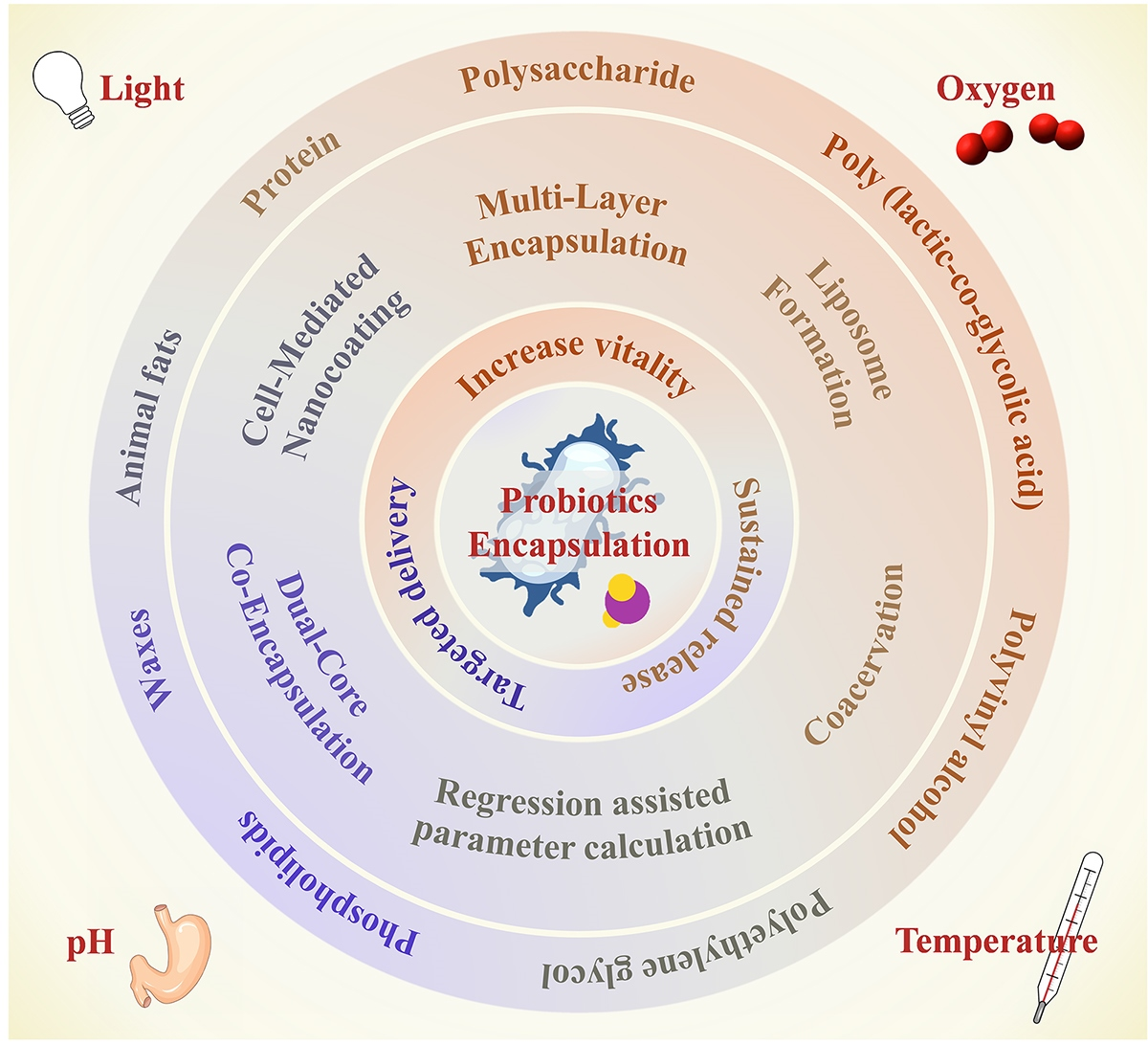

Recent Progress in Probiotic Encapsulation: Techniques, Characterization and Food Industry Prospects

Abstract
1. Introduction
1.1. Probiotics and Their Functional Applications
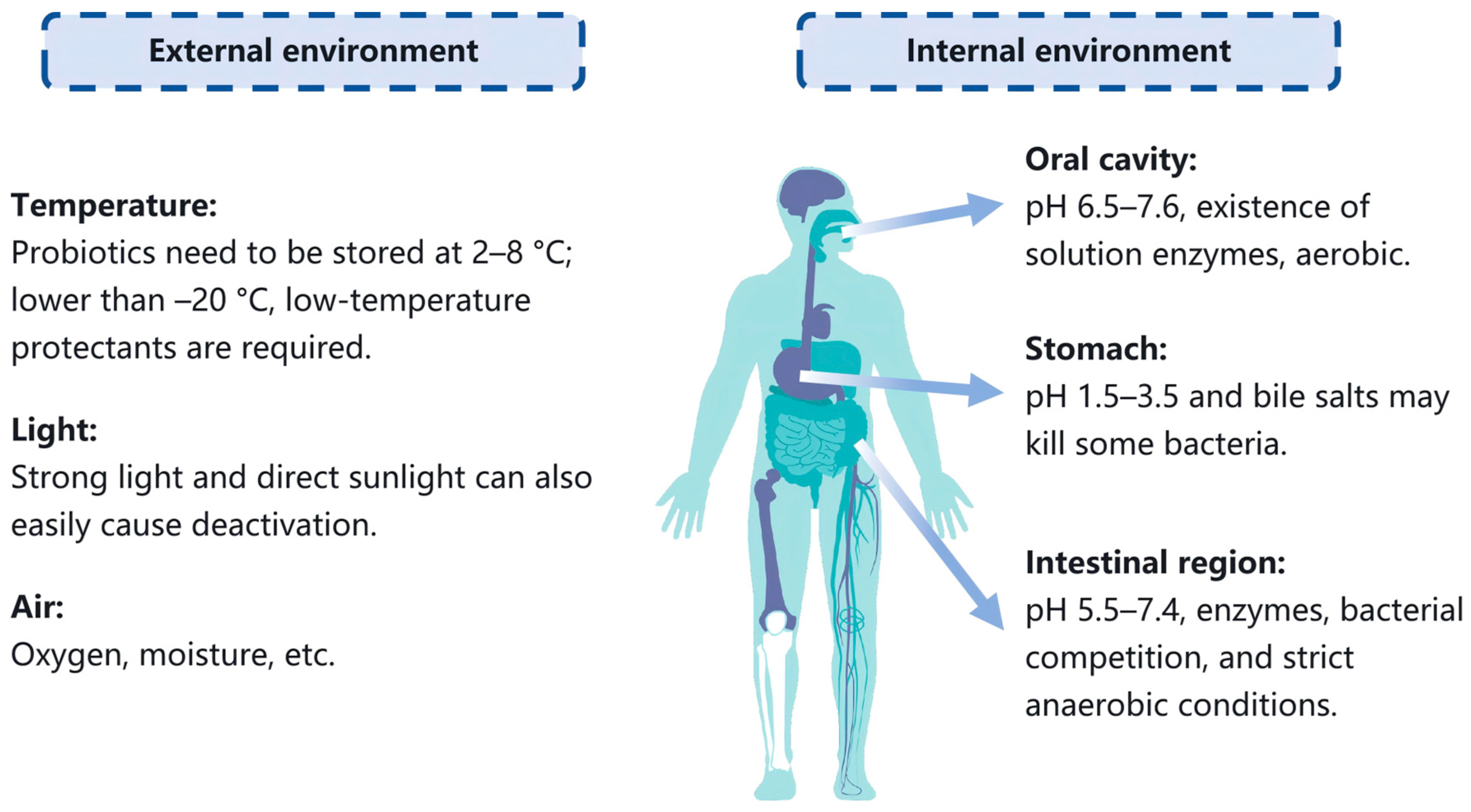
1.2. Encapsulation as a Solution for Probiotic Protection
1.3. Scope and Significance of This Review
2. Encapsulation Strategies for Probiotic Delivery
2.1. Physical Methods
2.1.1. Spray Drying
2.1.2. Freeze Drying
2.2. Chemical Methods
2.2.1. Coacervation
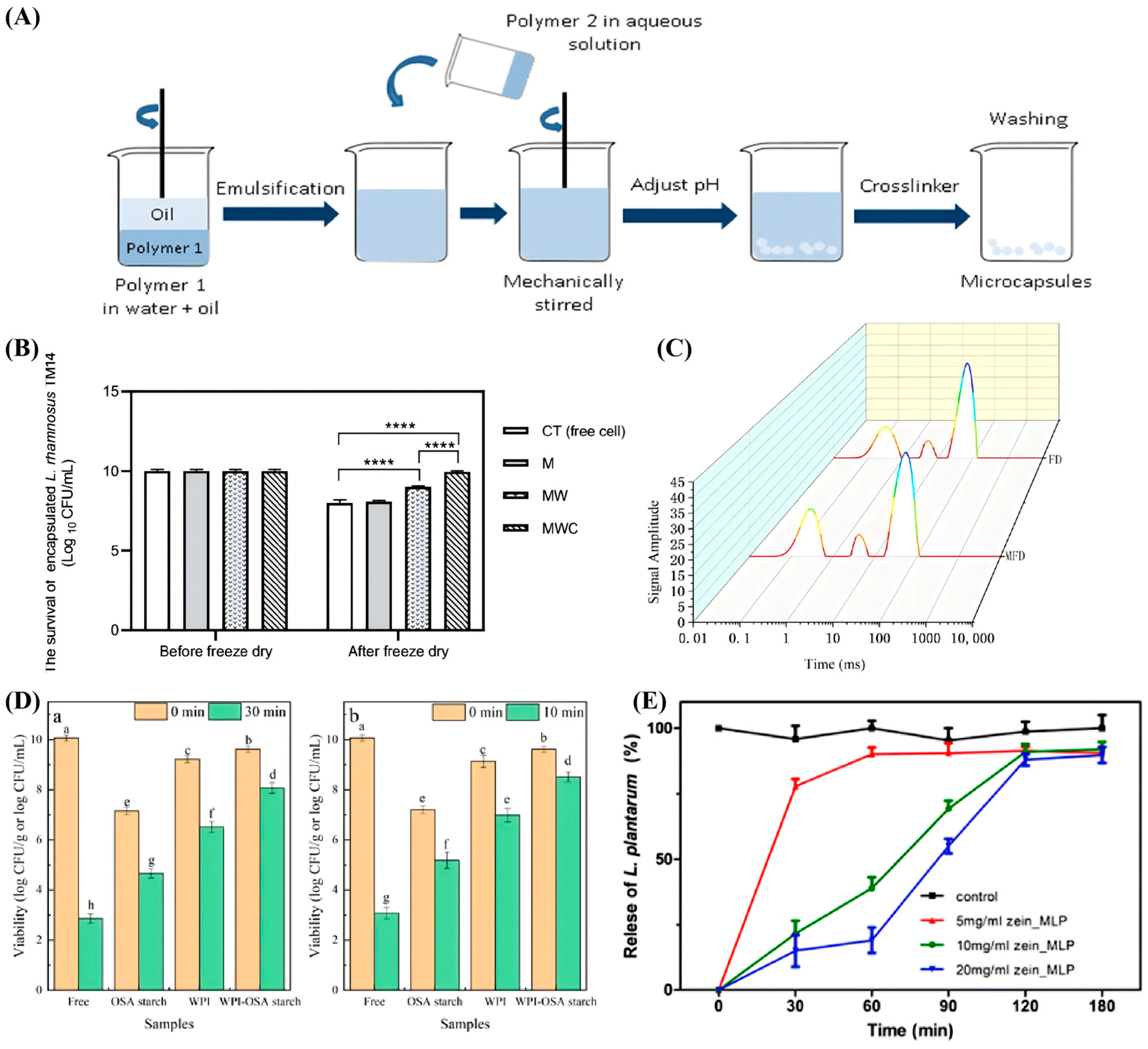
2.2.2. Endogenous Emulsion
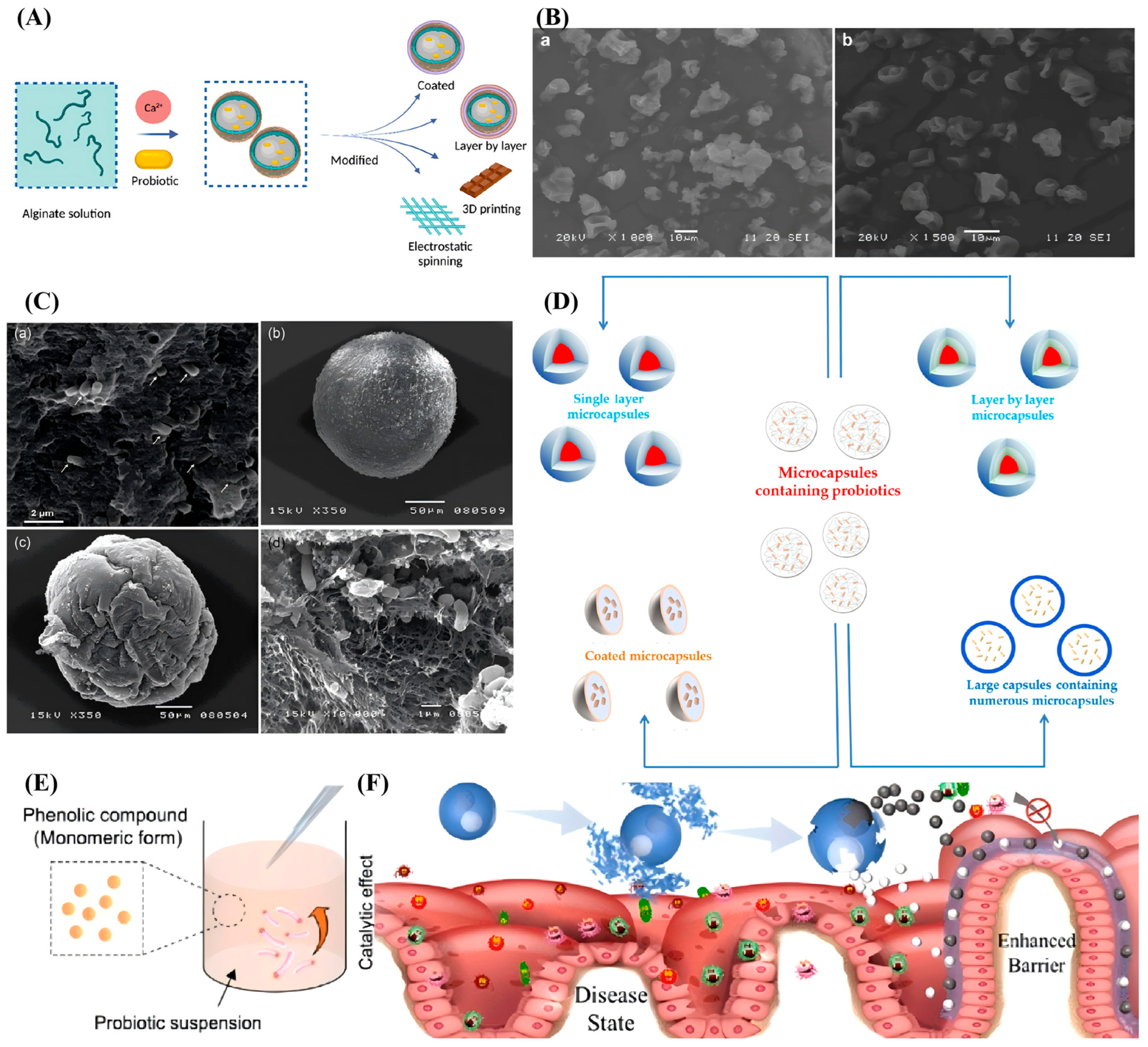
2.3. Multi-Layer Embedding
2.4. Cell-Mediated Nanocoatings
2.5. Collaborative Inclusion of Two Bacteria

3. Encapsulation Materials for Probiotics
3.1. Natural Polymers
3.1.1. Polysaccharides
- 1.
- Alginate
- 2.
- Pectin
- 3.
- Chitosan
- 4.
- Modified starch
- 5.
- Cellulose
- 6.
- Gum Arabic
3.1.2. Proteins
- 1.
- Gelatin
- 2.
- Whey protein
- 3.
- Zein

3.1.3. Lipids
- 1.
- Animal fats
- 2.
- Waxes
- 3.
- Phospholipids
3.1.4. Pickering Emulsions
3.2. Synthetic Polymers
3.2.1. Poly(Lactic-co-Glycolic) Acid
3.2.2. Polyvinyl Alcohol
3.2.3. Polyethylene Glycol
4. Evaluation of Encapsulation Performance
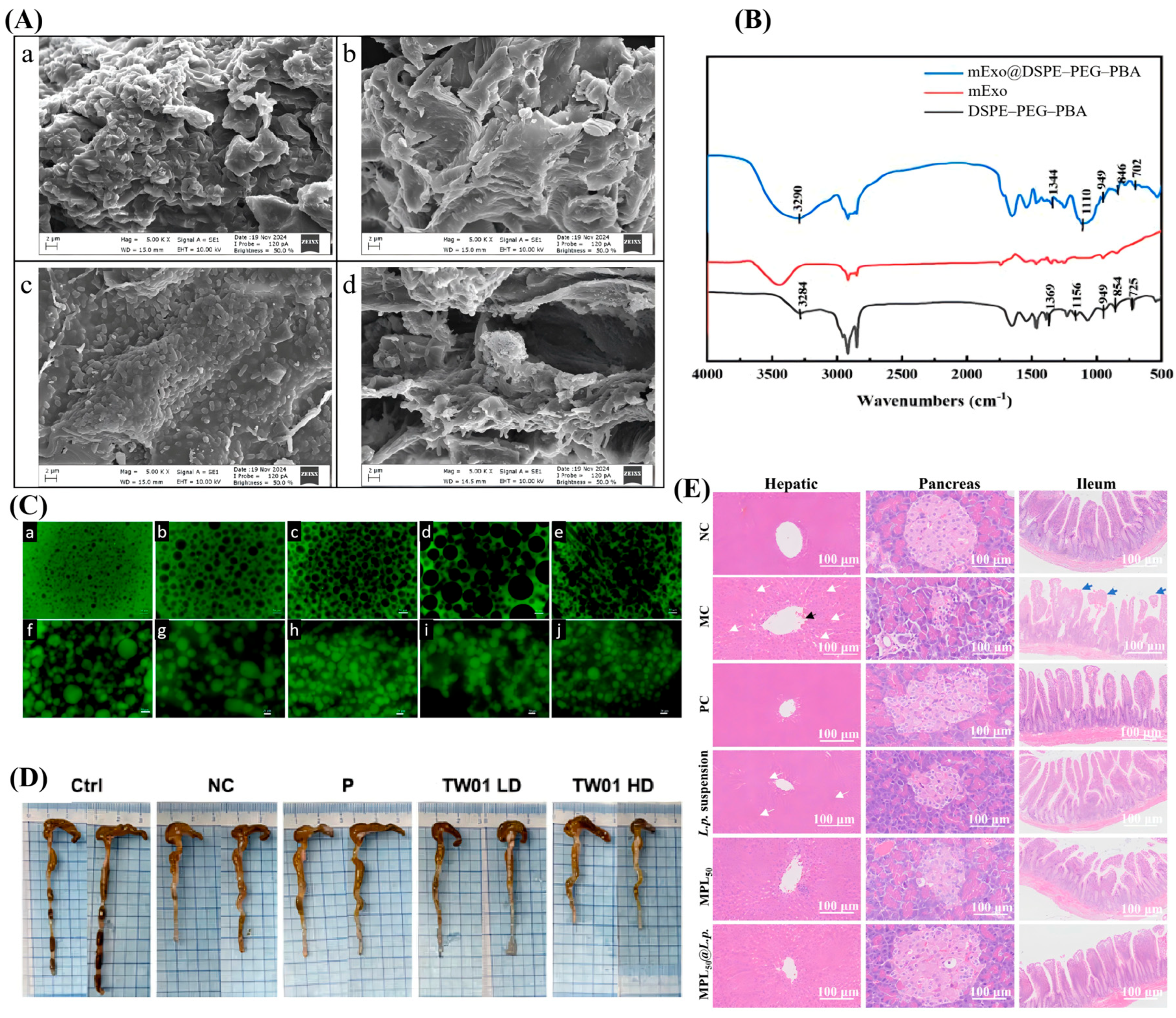
4.1. Physical and Structural Characterization
4.2. Physicochemical Stability Mechanisms
4.2.1. Thermodynamic State and Ice Crystal Morphology
4.2.2. Oxidative Stability and Evaluation Strategies
4.3. Biological Testing
4.4. In Vivo Studies

5. Challenges of Probiotic Encapsulation
5.1. Cost of Encapsulation Techniques
5.2. Scale-Up Issues for Commercial Production
- 1.
- Process consistency
- 2.
- Equipment Limitations
5.3. Variability Among Probiotic Strains
6. Prospects and Suggestions for Encapsulation of Probiotics
6.1. Personalized Probiotics
6.2. Regulatory and Standardization Challenges
- 1.
- Security assessment
- 2.
- Labels and efficacy claims
- 3.
- Production quality control
7. Conclusions
Author Contributions
Funding
Institutional Review Board Statement
Informed Consent Statement
Data Availability Statement
Acknowledgments
Conflicts of Interest
References
- Jain, D.; Chaudhary, H.S. Clinical significance of probiotics in human. Int. J. Nutr. Pharmacol. Neurol. Dis. 2014, 4, 11–22. [Google Scholar] [CrossRef]
- da Cruz Nascimento, S.S.; de Oliveira, T.R.; dos Santos Lima, M.; de Oliveira Tavares, R.M.; da Silva Chaves, K.S.F.; de Assis, C.F.; Passos, T.S.; de Sousa Júnior, F.C. Oat-grape beverages enriched with anthocyanins from jambolan (Syzygium cumini): A novel plant-based probiotic functional food. Food Chem. 2025, 487, 144673. [Google Scholar]
- Beikzadeh, S.; Sadeghi, A.; Khezerlou, A.; Assadpour, E.; Jafari, S.M. Enrichment of bread with encapsulated probiotics as a functional product containing bioactive compounds: Principles, outcomes, and challenges. Future Foods 2025, 12, 100732. [Google Scholar] [CrossRef]
- Wang, Y.; Tian, L.; Fabi, J.P.; de Vos, P. The potential of prebiotics, probiotics, and synbiotics for ameliorating intestinal barrier dysfunction and modulating inflammatory responses as dietary supplements in diabetes mellitus management. Food Biosci. 2025, 72, 107539. [Google Scholar] [CrossRef]
- Kim, C.H. Complex regulatory effects of gut microbial short-chain fatty acids on immune tolerance and autoimmunity. Cell. Mol. Immunol. 2023, 20, 341–350. [Google Scholar] [CrossRef]
- Ji, J.; Jin, W.; Liu, S.J.; Jiao, Z.; Li, X. Probiotics, prebiotics, and postbiotics in health and disease. MedComm 2023, 4, e420. [Google Scholar] [CrossRef]
- Mai, R.; Liu, J.; Yang, J.; Li, X.; Zhao, W.; Bai, W. Formation mechanism of lipid-derived volatile flavor compounds metabolized by inoculated probiotics and their improving effect on the flavor of low-salt dry-cured mackerel. Food Chem. 2024, 437, 137636. [Google Scholar] [CrossRef]
- Kuo, C.-C.; Clark, S.; Qin, H.; Shi, X. Development of a shelf-stable, gel-based delivery system for probiotics by encapsulation, 3D printing, and freeze-drying. LWT 2022, 157, 113075. [Google Scholar] [CrossRef]
- Zhao, R.; Yu, T.; Li, J.; Niu, R.; Liu, D.; Wang, W. Single-cell encapsulation systems for probiotic delivery: Armor probiotics. Adv. Colloid Interface Sci. 2024, 332, 103270. [Google Scholar] [CrossRef]
- Wang, W.; Zhang, L.; Zhang, Y.; Liu, X.; Song, A.; Ren, J.; Qu, X. A Self-Adaptive Pyroptosis Inducer: Optimizing the Catalytic Microenvironment of Nanozymes by Membrane-Adhered Microbe Enables Potent Cancer Immunotherapy. Adv. Mater. 2024, 36, 2310063. [Google Scholar] [CrossRef]
- Yang, J.; Ge, S.; Tan, S.; Liu, H.; Yang, M.; Liu, W.; Zhang, K.; Zhang, Z.; Liu, J.; Shi, J.; et al. Modified montmorillonite armed probiotics with enhanced on-site mucus-depleted intestinal colonization and H2S scavenging for colitis treatment. J. Control. Release 2024, 374, 140–153. [Google Scholar] [CrossRef] [PubMed]
- Chen, B.; Wang, X.; Li, P.; Feng, X.; Mao, Z.; Wei, J.; Lin, X.; Li, X.; Wang, L. Exploring the protective effects of freeze-dried Lactobacillus rhamnosus under optimized cryoprotectants formulation. LWT 2023, 173, 114295. [Google Scholar] [CrossRef]
- Lai, J.; Azad, A.K.; Sulaiman, W.M.A.W.; Kumarasamy, V.; Subramaniyan, V.; Alshehade, S.A. Alginate-Based Encapsulation Fabrication Technique for Drug Delivery: An Updated Review of Particle Type, Formulation Technique, Pharmaceutical Ingredient, and Targeted Delivery System. Pharmaceutics 2024, 16, 370. [Google Scholar] [CrossRef] [PubMed]
- Jenny, A.-Q.; Karla, N.; Victor, R.-S.; Beatriz Adriana, A.-E. Nano-encapsulation of probiotics: Need and critical considerations to design new non-dairy probiotic products. J. Funct. Foods 2024, 116, 106192. [Google Scholar] [CrossRef]
- Laein, S.S.; Samborska, K.; Karaca, A.C.; Mostashari, P.; Akbarbaglu, Z.; Sarabandi, K.; Jafari, S.M. Strategies for further stabilization of lipid-based delivery systems with a focus on solidification by spray-drying. Trends Food Sci. Technol. 2024, 146, 104412. [Google Scholar] [CrossRef]
- Michalska-Ciechanowska, A.; Brzezowska, J.; Nowicka, P.; Tkacz, K.; Turkiewicz, I.P.; Hendrysiak, A.; Oszmianski, J.; Andlauer, W. Advantages of Spray Drying over Freeze Drying: A Comparative Analysis of Lonicera caerulea L. Juice Powders-Matrix Diversity and Bioactive Response. Molecules 2024, 29, 3586. [Google Scholar] [CrossRef]
- Meng, Y.; Qiu, C.; Li, X.; McClements, D.J.; Sang, S.; Jiao, A.; Jin, Z. Polysaccharide-based nano-delivery systems for encapsulation, delivery, and pH-responsive release of bioactive ingredients. Crit. Rev. Food Sci. Nutr. 2024, 64, 187–201. [Google Scholar] [CrossRef]
- Liu, Y.; Ma, X.; Cazzaniga, M.; Gahan, C.G.M.; den Besten, H.M.W.; Abee, T. Nano in Micro: Novel Concepts in Foodborne Pathogen Transmission and Pathogenesis. Annu. Rev. Food Sci. Technol. 2024, 16, 245–268. [Google Scholar] [CrossRef]
- Lee, Y.; Shin, S.; Kim, M.J. Production of CaCO3-single-coated probiotics and evaluation of their spectroscopic properties, morphological characteristics, viability, and intestinal delivery efficiency. Food Chem. 2024, 457, 140076. [Google Scholar] [CrossRef]
- Wintzheimer, S.; Luthardt, L.; Cao, K.L.A.; Imaz, I.; Maspoch, D.; Ogi, T.; Bueck, A.; Debecker, D.P.; Faustini, M.; Mandel, K. Multifunctional, Hybrid Materials Design via Spray-Drying: Much more than Just Drying. Adv. Mater. 2023, 35, 2306648. [Google Scholar] [CrossRef]
- D’Amico, V.; Siepmann, F.; Siepmann, J.; Neut, C.; Denora, N.; Lopedota, A.A. Microencapsulation of the probiotic Bifidobacterium longum by spray-drying: Formulation and process optimisation. J. Drug Deliv. Sci. Technol. 2025, 115, 107670. [Google Scholar] [CrossRef]
- Narmin, N.-S.; Saber, A.; Amin Mousavi, K. The application of the coacervation technique for microencapsulation bioactive ingredients: A critical review. J. Agric. Food Res. 2024, 18, 101431. [Google Scholar] [CrossRef]
- Ge, S.; Han, J.; Sun, Q.; Zhou, Q.; Ye, Z.; Li, P.; Gu, Q. Research progress on improving the freeze-drying resistance of probiotics: A review. Trends Food Sci. Technol. 2024, 147, 104425. [Google Scholar] [CrossRef]
- Ma, M.; Liu, Y.; Chen, Y.; Zhang, S.; Yuan, Y. Co-encapsulation: An effective strategy to enhance the synergistic effects of probiotics and polyphenols. Trends Food Sci. Technol. 2025, 158, 104927. [Google Scholar] [CrossRef]
- Monshipouri, M.; Rudolph, A.S. Liposome-Encapsulated Alginate-Controlled Hydrogel Particle Formation and Release. J. Microencapsul. 1995, 12, 117–127. [Google Scholar] [CrossRef]
- Dai, C.Y.; Wang, B.C.; Zhao, H.W.; Li, B.; Wang, H. Preparation and characterization of liposomes-in-alginate (LIA) for protein delivery system. Colloids Surf. B-Biointerfaces 2006, 47, 205–210. [Google Scholar] [CrossRef]
- Wang, L.; Zhong, X.; Li, S.; Liu, X.; Wang, K.; Cai, R.; Yue, T.; Yuan, Y.; Wang, Z. Probiotics encapsulated by gelatin and hyaluronic acid via layer-by-layer assembly technology for enhanced viability. Food Hydrocoll. 2024, 153, 109967. [Google Scholar] [CrossRef]
- Agriopoulou, S.; Smaoui, S.; Chaari, M.; Varzakas, T.; Can Karaca, A.; Jafari, S.M. Encapsulation of probiotics within double/multiple layer beads/carriers: A concise review. Molecules 2024, 29, 2431. [Google Scholar] [CrossRef]
- Centurion, F.; Merhebi, S.; Baharfar, M.; Abbasi, R.; Zhang, C.; Mousavi, M.; Xie, W.; Yang, J.; Cao, Z.; Allioux, F.M. Cell-mediated biointerfacial phenolic assembly for probiotic nano encapsulation. Adv. Funct. Mater. 2022, 32, 2200775. [Google Scholar] [CrossRef]
- Ji, C.; Li, D.; Liang, Y.; Luo, Y. Co-encapsulation of probiotics with functional components: Design strategies, synergistic mechanisms, biomedical applications, and challenges for industrialization. J. Mater. Chem. B 2025, 13, 13122–13153. [Google Scholar] [CrossRef]
- Mohammed, N.K.; Tan, C.P.; Manap, Y.A.; Muhialdin, B.J.; Hussin, A.S.M. Spray Drying for the Encapsulation of Oils—A Review. Molecules 2020, 25, 3873. [Google Scholar] [CrossRef] [PubMed]
- Yin, M.; Chen, L.; Chen, M.; Yuan, Y.; Liu, F.; Zhong, F. Encapsulation of Lactobacillus rhamnosus GG in double emulsions: Role of prebiotics in improving probiotics survival during spray drying and storage. Food Hydrocoll. 2024, 151, 109792. [Google Scholar] [CrossRef]
- Barbosa, J.C.; Almeida, D.; Machado, D.; Sousa, S.; Freitas, A.C.; Andrade, J.C.; Gomes, A.M. Spray-drying encapsulation of the live biotherapeutic candidate Akkermansia muciniphila DSM 22959 to survive aerobic storage. Pharmaceuticals 2022, 15, 628. [Google Scholar] [CrossRef] [PubMed]
- Fu, N.; Hao, F.; Zhang, S.; Mao, H.; Lu, W.; Chen, X.D.; Wu, W.D. The survival and stability of Lactobacillus rhamnosus GG as affected by particle formation during spray drying and spray-freeze drying. J. Food Eng. 2024, 383, 112252. [Google Scholar] [CrossRef]
- Wang, A.; Zhong, Q. Drying of probiotics to enhance the viability during preparation, storage, food application, and digestion: A review. Compr. Rev. Food Sci. Food Saf. 2024, 23, e13287. [Google Scholar] [CrossRef]
- Ermis, E. A review of drying methods for improving the quality of probiotic powders and characterization. Dry. Technol. 2022, 40, 2199–2216. [Google Scholar] [CrossRef]
- Ma, L.; Su, C.; Li, X.; Wang, H.; Luo, M.; Chen, Z.; Zhang, B.; Zhu, J.; Yuan, Y. Preparation and characterization of bilayered microencapsulation for co-delivery Lactobacillus casei and polyphenols via Zein-chitosan complex coacervation. Food Hydrocoll. 2024, 148, 109410. [Google Scholar] [CrossRef]
- Zhao, M.; Huang, X.; Zhang, H.; Zhang, Y.; Ganzle, M.; Yang, N.; Nishinari, K.; Fang, Y. Probiotic encapsulation in water-in-water emulsion via heteroprotein complex coacervation of type-A gelatin/sodium caseinate. Food Hydrocoll. 2020, 105, 105790. [Google Scholar] [CrossRef]
- Bansal, D.; Gulbake, A.; Tiwari, J.; Jain, S.K. Development of liposomes entrapped in alginate beads for the treatment of colorectal cancer. Int. J. Biol. Macromol. 2016, 82, 687–695. [Google Scholar] [CrossRef] [PubMed]
- Peng, Q.; Hu, H.; Cui, X.; Wu, J.; Han, W.; Dan, T. Encapsulation of Lacticaseibacillus paracasei ProSci-92 in sodium alginate/soy protein isolate by endogenous emulsification: Enhanced viability and storage of probiotics. LWT 2025, 237, 118794. [Google Scholar] [CrossRef]
- Jiang, H.; Qi, L.; Li, Y.; Zhao, B.; Guan, X.; Ma, P.; Liu, W.; Yang, C.; Jiang, J.; Binks, B.P. Localizing anaerobic microbial cultivation and recovery through intelligent Pickering emulsion phase inversion. CCS Chem. 2025, 7, 2137–2148. [Google Scholar] [CrossRef]
- Bufalini, C.; Campardelli, R. Versatile Emulsion-Based Encapsulation System Production Processes: A Review. Processes 2025, 13, 1409. [Google Scholar] [CrossRef]
- Han, M.; Yang, S.; Song, J.; Gao, Z. Layer-by-layer coated probiotics with chitosan and liposomes demonstrate improved stability and antioxidant properties in vitro. Int. J. Biol. Macromol. 2024, 258, 128826. [Google Scholar] [CrossRef]
- Anselmo, A.C.; McHugh, K.J.; Webster, J.; Langer, R.; Jaklenec, A. Layer-by-layer encapsulation of probiotics for delivery to the microbiome. Adv. Mater. 2016, 28, 9486. [Google Scholar] [CrossRef]
- Fan, Q.; Zeng, X.; Wu, Z.; Guo, Y.; Du, Q.; Tu, M.; Pan, D. Nanocoating of lactic acid bacteria: Properties, protection mechanisms, and future trends. Crit. Rev. Food Sci. Nutr. 2024, 64, 10148–10163. [Google Scholar] [CrossRef]
- Chen, C.; Zhu, Z. Recent advances in the nanoshells approach for encapsulation of single probiotics. Drug Des. Dev. Ther. 2023, 17, 2763–2774. [Google Scholar] [CrossRef]
- Li, C.; Wang, Z.-X.; Xiao, H.; Wu, F.-G. Intestinal Delivery of Probiotics: Materials, Strategies, and Applications. Adv. Mater. 2024, 36, 2310174. [Google Scholar] [CrossRef]
- Guo, Y.; Wu, F.-G. Probiotics armored with metal-phenolic network-based nanocoatings for gut microbiome modulation. Matter 2023, 6, 23–25. [Google Scholar] [CrossRef]
- Lim, J.-H.; Na, G.; Kang, J.-W. A green nanocoating approach to Lactobacillus plantarum using tea residue-derived phenolic compounds and cellulose nanocrystals. Food Hydrocoll. 2025, 167, 111469. [Google Scholar] [CrossRef]
- Youn, W.; Kim, J.Y.; Park, J.; Kim, N.; Choi, H.; Cho, H.; Choi, I.S. Single-cell nanoencapsulation: From passive to active shells. Adv. Mater. 2020, 32, 1907001. [Google Scholar] [CrossRef] [PubMed]
- Bazzaz, S.; Abbasi, A.; Ghotbabad, A.G.; Pourjafar, H.; Hosseini, H. Novel Encapsulation Approaches in the Functional Food Industry: With a Focus on Probiotic Cells and Bioactive Compounds. Probiotics Antimicrob. Proteins 2024, 17, 1132–1170. [Google Scholar] [CrossRef] [PubMed]
- Qiu, B.; Jing, H.; Han, S.; Zhang, S.; Ba, F.; Xu, L.; Xie, S.; Gao, W.; Huang, Y.; Xiao, H.; et al. Enhanced gut microbiota delivery of a model probiotic (Faecalibacterium prausnitzii): Layer-by-layer encapsulation using riboflavin-conjugated sodium alginate and glycol chitosan. Food Hydrocoll. 2024, 154, 110055. [Google Scholar] [CrossRef]
- Zhao, C.; Zhu, Y.; Kong, B.; Huang, Y.; Yan, D.; Tan, H.; Shang, L. Dual-Core Prebiotic Microcapsule Encapsulating Probiotics for Metabolic Syndrome. ACS Appl. Mater. Interfaces 2020, 12, 42586–42594. [Google Scholar] [CrossRef]
- Sun, Q.; Yin, S.; He, Y.; Cao, Y.; Jiang, C. Biomaterials and encapsulation techniques for probiotics: Current status and future prospects in biomedical applications. Nanomaterials 2023, 13, 2185. [Google Scholar] [CrossRef]
- Wang, L.; Sun, Y.; Li, S.; Wang, K.; Liu, Y.; Cai, R.; Yue, T.; Yuan, Y.; Wang, J.; Wang, Z. Encapsulation of Enterococcus faecium in hyaluronic acid/gelatin/sodium alginate/protamine improves cell viability and stability. Int. J. Biol. Macromol. 2025, 309, 142948. [Google Scholar] [CrossRef]
- Huq, T.; Fraschini, C.; Khan, A.; Riedl, B.; Bouchard, J.; Lacroix, M. Alginate based nanocomposite for microencapsulation of probiotic: Effect of cellulose nanocrystal (CNC) and lecithin. Carbohydr. Polym. 2017, 168, 61–69. [Google Scholar] [CrossRef] [PubMed]
- Li, Q.; Lin, H.; Li, J.; Liu, L. Improving probiotic (Lactobacillus casei) viability by encapsulation in alginate-based microgels: Impact of polymeric and colloidal fillers. Food Hydrocoll. 2023, 134, 108028. [Google Scholar] [CrossRef]
- Thinkohkaew, K.; Jonjaroen, V.; Niamsiri, N.; Panya, A.; Suppavorasatit, I.; Potiyaraj, P. Microencapsulation of probiotics in chitosan-coated alginate/gellan gum: Optimization for viability and stability enhancement. Food Hydrocoll. 2024, 151, 109788. [Google Scholar] [CrossRef]
- Santos, M.B.; da Costa, N.R.; Garcia-Rojas, E.E. Interpolymeric complexes formed between whey proteins and biopolymers: Delivery systems of bioactive ingredients. Compr. Rev. Food Sci. Food Saf. 2018, 17, 792–805. [Google Scholar] [CrossRef] [PubMed]
- Poopan, B.; Kasorn, A.; Puttarat, N.; Kasemwong, K.; Pachekrepapol, U.; Taweechotipatr, M. Freeze drying microencapsulation using whey protein, maltodextrin and corn powder improved survivability of probiotics during storage. Food Sci. Biotechnol. 2025, 34, 959–970. [Google Scholar] [CrossRef]
- Rao, Y.; Deng, J.; Zhang, C.; Song, Y.; Liu, L. Probiotics encapsulated by calcium pectin/chitosan-calcium pectin/sodium alginate-pectin-whey through biofilm-based microencapsulation strategy and their preventive effects on ulcerative colitis. Food Hydrocoll. 2025, 158, 110501. [Google Scholar] [CrossRef]
- Wang, Y.; Lin, A.; Yan, Z.; Shen, B.; Zhu, L.; Jiang, L. Enhanced tolerance to environmental stress of Clostridium butyricum spore encapsulated in citrus peel pectin polysaccharide for colitis therapy. Food Biosci. 2024, 60, 104436. [Google Scholar] [CrossRef]
- Sun, R.; Lv, Z.; Wang, Y.; Gu, Y.; Sun, Y.; Zeng, X.; Gao, Z.; Zhao, X.; Yuan, Y.; Yue, T. Preparation and characterization of pectin-alginate-based microbeads reinforced by nano montmorillonite filler for probiotics encapsulation: Improving viability and colonic colonization. Int. J. Biol. Macromol. 2024, 264, 130543. [Google Scholar] [CrossRef]
- Melanie, H.H.; Lorena, I.B.; Diego, B.G. Mixed kappa/iota-carrageenan-LM pectin gels: Relating the rheological and mechanical properties with the capacity for probiotic encapsulation. Int. J. Biol. Macromol. 2024, 273, 133009. [Google Scholar] [CrossRef]
- Rajapakse, J.; Khatiwada, S.; Akon, A.C.; Yu, K.L.; Shen, S.; Zekry, A. Unveiling the complex relationship between gut microbiota and liver cancer: Opportunities for novel therapeutic interventions. Gut Microbes 2023, 15, 2240031. [Google Scholar] [CrossRef]
- Mehrana, A.; Mehdi, D.; Mohammad Reza, S.; Masoumeh, B. Encapsulation of Lactiplantibacillus plantarum probiotics through cross-linked chitosan and casein for improving their viability, antioxidant and detoxification. Int. J. Biol. Macromol. 2024, 280, 135820. [Google Scholar] [CrossRef] [PubMed]
- Li, H.; Chen, H.; Shi, Z.; Yi, Z.; Hu, W.; Zhou, S.; Yang, X.; Kan, J.; Awad, S.; Hegyi, F.; et al. Structure and physicochemical properties of rice starch modified with dodecenyl succinic anhydride and its use for microencapsulating Pediococcus acidilactici probiotic. Food Chem. 2025, 463, 141276. [Google Scholar] [CrossRef] [PubMed]
- Noman, M.; Afzaal, M.; Saeed, F.; Ahmad, A.; Imran, A.; Akram, N.; Asghar, A.; Shah, Y.A.; Ateeq, H.; Khan, M.R.; et al. Effect of starch-based nanoparticles on the viability and stability of probiotics under adverse conditions. Int. J. Food Prop. 2023, 26, 1841–1854. [Google Scholar] [CrossRef]
- Wang, F.; Yang, R.; Wang, J.; Wang, A.; Li, M.; Wang, R.; Strappe, P.; Zhou, Z. Starch propionylation acts as novel encapsulant for probiotic bacteria: A structural and functional analysis. Int. J. Biol. Macromol. 2022, 213, 11–18. [Google Scholar] [CrossRef]
- Zhu, Q.; Tang, J.; Yao, S.; Feng, J.; Mi, B.; Zhu, W.; Chen, Q.; Liu, D.; Xu, E. Controllable structure of porous starch facilitates bioactive encapsulation by mild gelatinization. Food Hydrocoll. 2023, 145, 109135. [Google Scholar] [CrossRef]
- Zhou, C.; Xie, Y.; Li, Y.; Li, B.; Zhang, Y.; Liu, S. Water-in-water emulsion stabilized by cellulose nanocrystals and their high enrichment effect on probiotic bacteria. J. Colloid Interface Sci. 2023, 633, 254–264. [Google Scholar] [CrossRef]
- Batta-Mpouma, J.; Kandhola, G.; Kaur, J.; Foley, K.; Walters, K.B.; Kotagiri, N.; Kim, J.-W. Cellulose nanocrystal-based hydrogel microspheres prepared via electrohydrodynamic processes for controlled release of bioactive compounds. Carbohydr. Polym. 2025, 356, 123355. [Google Scholar] [CrossRef]
- Li, M.-F.; Cui, H.-L.; Lou, W.-Y. Millettia speciosa Champ cellulose-based hydrogel as a novel delivery system for Lactobacillus paracasei: Its relationship to structure, encapsulation and controlled release. Carbohydr. Polym. 2023, 316, 121034. [Google Scholar] [CrossRef]
- Zhong, Y.; Huang, W.; Zheng, Y.; Chen, T.; Liu, C. Alginate-coated pomelo pith cellulose matrix for probiotic encapsulation and controlled release. Int. J. Biol. Macromol. 2024, 262, 130143. [Google Scholar] [CrossRef]
- Jayani, T.; Sanjeev, B.; Marimuthu, S.; Uthandi, S. Bacterial Cellulose Nano Fiber (BCNF) as carrier support for the immobilization of probiotic, Lactobacillus acidophilus 016. Carbohydr. Polym. 2020, 250, 116965. [Google Scholar] [CrossRef]
- Zhao, M.; Wang, Y.; Huang, X.; Gaenzle, M.; Wu, Z.; Nishinari, K.; Yang, N.; Fang, Y. Ambient storage of microencapsulated Lactobacillus plantarum ST-III by complex coacervation of type-A gelatin and gum arabic. Food Funct. 2018, 9, 1000–1008. [Google Scholar] [CrossRef] [PubMed]
- Chen, Y.; Wang, W.; Zhang, W.; Lan, D.; Wang, Y. Co-encapsulation of probiotics with acylglycerols in gelatin-gum arabic complex coacervates: Stability evaluation under adverse conditions. Int. J. Biol. Macromol. 2023, 251, 126899. [Google Scholar] [CrossRef] [PubMed]
- Ma, J.; Li, T.; Wang, Q.; Xu, C.; Yu, W.; Yu, H.; Wang, W.; Feng, Z.; Chen, L.; Hou, J.; et al. Enhanced viability of probiotics encapsulated within synthetic/natural biopolymers by the addition of gum arabic via electrohydrodynamic processing. Food Chem. 2023, 413, 135680. [Google Scholar] [CrossRef] [PubMed]
- Haro-Gonzalez, J.N.; de Alba, B.N.S.; Morales-Hernandez, N.; Espinosa-Andrews, H. Type A gelatin-amidated low methoxyl pectin complex coacervates for probiotics protection: Formation, characterization, and viability. Food Chem. 2024, 453, 139644. [Google Scholar] [CrossRef]
- Chen, J.; Liu, Z.; Ma, S.; Chen, X.; Li, L.; Liu, W.; Ren, G.; Duan, X.; Cao, W.; Xu, Y.; et al. Effects of Transglutaminase Concentration and Drying Method on Encapsulation of Lactobacillus plantarum in Gelatin-Based Hydrogel. Molecules 2023, 28, 8070. [Google Scholar] [CrossRef]
- Ni, F.; Luo, X.; Zhao, Z.; Yuan, J.; Song, Y.; Liu, C.; Huang, M.; Dong, L.; Xie, H.; Cai, L.; et al. Enhancing viability of Lactobacillus plantarum encapsulated by alginate-gelatin hydrogel beads during gastrointestinal digestion, storage and in the mimic beverage systems. Int. J. Biol. Macromol. 2023, 224, 94–104. [Google Scholar] [CrossRef]
- Zhang, Y.; Wang, Y.; Zhang, X.; Wang, P.; Shi, F.; Zhang, Z.; Wang, R.; Wu, D.; She, J. Gastrointestinal Self-Adaptive and Nutrient Self-Sufficient Akkermansia muciniphila-Gelatin Porous Microgels for Synergistic Therapy of Ulcerative Colitis. ACS Nano 2024, 18, 26807–26827. [Google Scholar] [CrossRef]
- Li, W.; Zhao, Y.; Li, S.; Yun, L.; Wu, T.; Zhang, M. Improving the physical stability of Lactobacillus plantarum LP90 during storage by mixing carboxymethylated dextran-whey protein conjugates and small-molecule sugars. Food Res. Int. 2025, 203, 115834. [Google Scholar] [CrossRef]
- Li, S.; Su, W.; Zhang, Y.; Gan, W.; Liu, X.; Fan, L. Enhanced viability of Lactiplantibacillus plantarun by encapsulation with whey protein isolate fibrils and polysaccharides through layer-by-layer coating. Food Hydrocoll. 2025, 163, 111105. [Google Scholar] [CrossRef]
- Krunic, T.Z.; Rakin, M.B. Enriching alginate matrix used for probiotic encapsulation with whey protein concentrate or its trypsin-derived hydrolysate: Impact on antioxidant capacity and stability of fermented whey-based beverages. Food Chem. 2022, 370, 130931. [Google Scholar] [CrossRef]
- Yin, M.; Chen, M.; Yuan, Y.; Liu, F.; Zhong, F. Encapsulation of Lactobacillus rhamnosus GG in whey protein isolate-shortening oil and gum Arabic by complex coacervation: Enhanced the viability of probiotics during spray drying and storage. Food Hydrocoll. 2024, 146, 109252. [Google Scholar] [CrossRef]
- Etchepare, M.d.A.; Nunes, G.L.; Nicoloso, B.R.; Barin, J.S.; Flores, E.M.M.; Mello, R.d.O.; Menezes, C.R.d. Improvement of the viability of encapsulated probiotics using whey proteins. LWT 2020, 117, 108601. [Google Scholar] [CrossRef]
- Ngamekaue, N.; Dumrongchai, T.; Rodklongtan, A.; Chitprasert, P. Improving probiotic survival through encapsulation in coconut oil in whey protein isolate emulsions during spray drying and gastrointestinal digestion. LWT 2024, 198, 116061. [Google Scholar] [CrossRef]
- Liu, Q.; Lin, C.; Yang, X.; Wang, S.; Yang, Y.; Liu, Y.; Xiong, M.; Xie, Y.; Bao, Q.; Yuan, Y. Improved viability of probiotics via microencapsulation in whey-protein-isolate-octenyl-succinic-anhydride-starch-complex coacervates. Molecules 2023, 28, 5732. [Google Scholar] [CrossRef]
- Luo, M.; Ma, L.; Guo, Y.; Zhu, C.; Chen, J.; Zhang, B.; Zhu, J.; Jellicoe, M.; He, S.; Zou, Y. Preparation and characterization of microcapsules and tablets for probiotic encapsulation via whey protein isolate-nanochitin complex coacervation. Int. J. Biol. Macromol. 2025, 285, 138225. [Google Scholar] [CrossRef]
- Xu, C.; Guo, J.; Chang, B.; Wang, Q.; Zhang, Y.; Chen, X.; Zhu, W.; Ma, J.; Qian, S.; Jiang, Z.; et al. Study on encapsulation of Lactobacillus plantarum 23-1 in W/O/W emulsion stabilized by pectin and zein particle complex. Int. J. Biol. Macromol. 2024, 279, 135346. [Google Scholar] [CrossRef]
- Jia, M.; Luo, J.; Wang, L.; Yang, X.; Bao, Y. The construction of a double-layer colon-targeted delivery system based on zein-shellac complex and gelatin-isomaltooligosaccharide Maillard product: In vitro and in vivo evaluation. Food Res. Int. 2025, 200, 115477. [Google Scholar] [CrossRef]
- Cheng, C.; Sun, M.; Wang, L.; Wang, H.; Li, L.; Yang, Q.; Zhao, Y.; Chen, W.; Wang, P. Zein and soy polysaccharide encapsulation enhances probiotic viability and modulates gut microbiota. LWT 2024, 210, 116827. [Google Scholar] [CrossRef]
- Liu, B.; Hu, J.; Yao, H.; Zhang, L.; Liu, H. Improved viability of probiotics encapsulated by layer-by-layer assembly using zein nanoparticles and pectin. Food Hydrocoll. 2023, 143, 108899. [Google Scholar] [CrossRef]
- Zhu, S.; Shan, K.; Xu, Y.; Zhang, C.; Xiao, H.; Song, W.; Dong, M.; Zhang, C. The protective mechanism of soy peptides in enhancing stress resistance of Lacticaseibacillus rhamnosus GG during thermal convective drying. Food Hydrocoll. 2025, 159, 110661. [Google Scholar] [CrossRef]
- Zeng, J.; Lyu, Y.; Huang, X.; Leung, H.K.; Zhao, S.; Zhang, J.; Wang, Y.; Wang, D.Y. Optimizing Lactiplantibacillus plantarum viability in the gastrointestinal tract and its impact on gut microbiota–brain axis through zein microencapsulation. J. Food Sci. 2024, 89, 9783–9798. [Google Scholar] [CrossRef] [PubMed]
- Fan, Q.; Liu, L.; Wang, L.; Yang, R.; Liu, X.; Dong, Y.; Zeng, X.; Liu, X.; Du, Q.; Wu, Z. Nanocoating of quinoa protein and hyaluronic acid enhances viability and stability of Limosilactobacillus fermentum RC4 microcapsules. Int. J. Biol. Macromol. 2025, 307, 141863. [Google Scholar] [CrossRef] [PubMed]
- Gao, J.; Li, X.; Zhang, G.; Sadiq, F.A.; Simal-Gandara, J.; Xiao, J.; Sang, Y. Probiotics in the dairy industry—Advances and opportunities. Compr. Rev. Food Sci. Food Saf. 2021, 20, 3937–3982. [Google Scholar] [CrossRef] [PubMed]
- Silva, K.K.d.P.E.; Queiros, M.d.S.; Ribeiro, A.P.B.; Gigante, M.L. Modified milk fat as encapsulating material for the probiotic microorganism Lactobacillus acidophilus LA3. Int. Dairy J. 2022, 125, 105237. [Google Scholar] [CrossRef]
- Shi, Z.; Wu, J.; Wang, X.; Nie, T.; Zeng, Q.; Yuan, C.; Jin, R. Development of Pickering water-in-oil emulsions using a dual stabilization of candelilla wax and acylated EGCG derivatives to enhance the survival of probiotics (Lactobacillus plantarum) powder. Food Funct. 2024, 15, 11141–11157. [Google Scholar] [CrossRef]
- Premjit, Y.; Mitra, J. Optimization of Electrospray-Assisted Microencapsulation of Probiotics (Leuconostoc lactis) in Soy Protein Isolate-Oil Particles Using Box-Behnken Experimental Design. Food Bioprocess Technol. 2021, 14, 1730–1732. [Google Scholar] [CrossRef]
- Zhang, W.; Chen, Y.; Wang, W.; Lan, D.; Wang, Y. Soy lecithin increases the stability and lipolysis of encapsulated algal oil and probiotics complex coacervates. J. Sci. Food Agric. 2023, 103, 4164–4173. [Google Scholar] [CrossRef]
- Zhang, J.; Xie, Y.; Liu, C.; Cao, H.; Li, Y.; Li, B.; Zhang, Y.; Liu, S. Water-in-water Pickering emulsion: A fascinating microculture apparatus for embedding and cultivation of Lactobacillus helveticus. Food Hydrocoll. 2024, 147, 109398. [Google Scholar] [CrossRef]
- Xie, Y.; Liu, C.; Zhang, J.; Li, Y.; Li, B.; Liu, S. Crosslinking alginate at water-in-water Pickering emulsions interface to control the interface structure and enhance the stress resistance of the encapsulated probiotics. J. Colloid Interface Sci. 2024, 655, 653–663. [Google Scholar] [CrossRef]
- Du, L.; Ru, Y.; Weng, H.; Zhang, Y.; Xiao, A.; Chen, J.; Xiao, Q. Agar-lauric acid complex-stabilized Pickering emulsions: Fabrication, stabilization, and probiotics encapsulation. Food Hydrocoll. 2025, 159, 110685. [Google Scholar] [CrossRef]
- Rashidinejad, A.; Bahrami, A.; Rehman, A.; Rezaei, A.; Babazadeh, A.; Singh, H.; Jafari, S.M. Co-encapsulation of probiotics with prebiotics and their application in functional/synbiotic dairy products. Crit. Rev. Food Sci. Nutr. 2022, 62, 2470–2494. [Google Scholar] [CrossRef]
- Ajalloueian, F.; Thamdrup, L.H.E.; Mazzoni, C.; Petersen, R.S.; Keller, S.S.; Boisen, A. High-yield fabrication of monodisperse multilayer nanofibrous microparticles for advanced oral drug delivery applications. Heliyon 2024, 10, e30844. [Google Scholar] [CrossRef]
- Ajalloueian, F.; Guerra, P.R.; Bahl, M.I.; Torp, A.M.; Te Hwu, E.; Licht, T.R.; Boisen, A. Multi-layer PLGA-pullulan-PLGA electrospun nanofibers for probiotic delivery. Food Hydrocoll. 2022, 123, 107112. [Google Scholar] [CrossRef]
- Celem, E.; Tarakci, Z. Investigation of the use of fruit pomace and glycerol in the encapsulation of Lactobacillus acidophilus (THT 030101) in pullulan-based electrospun nanofibers. Carbohydr. Polym. 2025, 356, 123341. [Google Scholar] [CrossRef]
- Wang, Y.; Yue, Y.; Yang, S.; Duan, S.; Yang, Y.; Wang, Z.; Li, X.; Li, B.; Wang, Y. Preparation of polyvinyl alcohol/Pullulan nanofibers and Eudragit® S100/polyvinyl alcohol/Pullulan core-shell nanofibers for enhanced probiotic storage and oral viability. Food Hydrocoll. 2025, 164, 111172. [Google Scholar] [CrossRef]
- Ma, J.; Tan, Z.; Wu, M.; Tian, Z.; Xu, C.; Zhang, J.; Ma, Y.; Feng, Z.; Yu, W.; Li, B.; et al. Co-encapsulation of probiotic Lactiplantibacillus plantarum and polyphenol within novel polyvinyl alcohol/fucoidan electrospun nanofibers with improved viability and antioxidation. Int. J. Biol. Macromol. 2024, 282, 136907. [Google Scholar] [CrossRef]
- Wei, L.; Zhou, D.; Kang, X. Electrospinning as a novel strategy for the encapsulation of living probiotics in polyvinyl alcohol/silk fibroin. Innov. Food Sci. Emerg. Technol. 2021, 71, 102726. [Google Scholar] [CrossRef]
- Canga, E.M.; Dudak, F.C. Improved digestive stability of probiotics encapsulated within poly(vinyl alcohol)/cellulose acetate hybrid fibers. Carbohydr. Polym. 2021, 264, 117990. [Google Scholar] [CrossRef] [PubMed]
- Bayat, F.; Danafar, H.; Aminzare, M.; Mohseni, M. Investigating the stability of vitamin D3 and Bifidobacterium lactis nanoparticles coated with polycaprolactone-polyethylene glycol-polycaprolactone triblock copolymer in Iranian white cheese and determining its physicochemical and sensory properties. J. Agric. Food Res. 2024, 15, 101039. [Google Scholar] [CrossRef]
- Vijayaram, S.; Sinha, R.; Faggio, C.; Ringø, E.; Chou, C.-C. Biopolymer encapsulation for improved probiotic delivery: Advancements and challenges. AIMS Microbiol. 2024, 10, 986. [Google Scholar] [CrossRef]
- Desai, K.G.H.; Jin Park, H. Recent developments in microencapsulation of food ingredients. Dry. Technol. 2005, 23, 1361–1394. [Google Scholar] [CrossRef]
- Tülek, E.; Karkar, B.; Şahin, S.; Yılmaz-Ersan, L.; Sucu, E. Effect of encapsulation on the viability of Lacticaseibacillus rhamnosus and Lacticaseibacillus paracasei during in vitro gastrointestinal digestion and storage conditions. Food Sci. Nutr. 2025, 13, e70614. [Google Scholar] [CrossRef] [PubMed]
- Hao, L.; Liu, Y.; Szeto, I.M.-Y.; Hao, H.; Zhang, T.; Liu, T.; Yi, H. Milk exosome-based delivery system for probiotic encapsulation that enhances the gastrointestinal resistance and adhesion of probiotics. Nutrients 2025, 17, 923. [Google Scholar] [CrossRef] [PubMed]
- Wu, Y.; Yan, Z.; Zhang, S.; Li, S.; Gong, Y.; Gao, Z. Electrospun Gelatin/Dextran Nanofibers from W/W Emulsions: Improving Probiotic Stability Under Thermal and Gastrointestinal Stress. Foods 2025, 14, 1725. [Google Scholar] [CrossRef]
- Van Engeland, C.; Haut, B.; Debaste, F. A Closer Look at the Potential Mechanisms of Action of Protective Agents Used in the Drying of Microorganisms: A Review. Microorganisms 2025, 13, 435. [Google Scholar] [CrossRef]
- Liu, X.; Mao, B.; Tang, X.; Zhang, Q.; Zhao, J.; Chen, W.; Cui, S. Bacterial viability retention in probiotic foods: A review. Crit. Rev. Food Sci. Nutr. 2025, 65, 7964–7986. [Google Scholar] [CrossRef]
- Sun, C.; Zhang, Z.; Sun, Y.; Sun, X.; Jin, Y.; Zhu, J.; Yu, J.; Wu, T. Enteric Delivery of Probiotics: Challenges, Techniques, and Activity Assays. Foods 2025, 14, 2318. [Google Scholar] [CrossRef]
- Chen, X.; Liang, R.; Zhong, F.; Ma, J.; John, N.-A.; Goff, H.D.; Yokoyama, W.H. Effect of high concentrated sucrose on the stability of OSA-starch-based beta-carotene microcapsules. Food Hydrocoll. 2021, 113, 105472. [Google Scholar] [CrossRef]
- Li, W.; Zhao, Y.; Zhao, Y.; Li, S.; Yun, L.; Zhi, Z.; Liu, R.; Wu, T.; Sui, W.; Zhang, M. Improving the viability of Lactobacillus plantarum LP90 by carboxymethylated dextran-whey protein conjugates: The relationship with glass transition temperature. Food Hydrocoll. 2023, 134, 108102. [Google Scholar] [CrossRef]
- Nag, A.; Waterland, M.; Janssen, P.; Anderson, R.; Singh, H. Importance of intact secondary protein structures of cell envelopes and glass transition temperature of the stabilization matrix on the storage stability of probiotics. Food Res. Int. 2019, 123, 198–207. [Google Scholar] [CrossRef]
- Barbosa, J.; Teixeira, P. Development of probiotic fruit juice powders by spray-drying: A review. Food Rev. Int. 2017, 33, 335–358. [Google Scholar] [CrossRef]
- Zihan, S.; Lu, L.; Tao, W.; Bolin, Z.; Hongfei, Z. Starch nanoparticles as a new ice crystal nucleator in Lactobacillus bulgaricus CICC 6097 cryoprotection. Int. J. Biol. Macromol. 2023, 251, 126395. [Google Scholar] [CrossRef] [PubMed]
- Khan, M.T.; Dwibedi, C.; Sundh, D.; Pradhan, M.; Kraft, J.D.; Caesar, R.; Tremaroli, V.; Lorentzon, M.; Bäckhed, F. Synergy and oxygen adaptation for development of next-generation probiotics. Nature 2023, 620, 381–385. [Google Scholar] [CrossRef] [PubMed]
- Sies, H.; Belousov, V.V.; Chandel, N.S.; Davies, M.J.; Jones, D.P.; Mann, G.E.; Murphy, M.P.; Yamamoto, M.; Winterbourn, C. Defining roles of specific reactive oxygen species (ROS) in cell biology and physiology. Nat. Rev. Mol. Cell Biol. 2022, 23, 499–515. [Google Scholar] [CrossRef]
- Moeini, A.; Pedram, P.; Fattahi, E.; Cerruti, P.; Santagata, G. Edible polymers and secondary bioactive compounds for food packaging applications: Antimicrobial, mechanical, and gas barrier properties. Polymers 2022, 14, 2395. [Google Scholar] [CrossRef]
- Đinh, H.-N.; Ureña, M.; Oliete, B.; Denimal, E.; Dupont, S.; Beney, L.; Karbowiak, T. Sodium Alginate as a promising encapsulating material for extremely-oxygen sensitive probiotics. Food Hydrocoll. 2025, 160, 110857. [Google Scholar]
- Chen, P.; Tian, J.; Ren, Y.; Cheng, H.; Pan, H.; Chen, S.; Ye, X.; Chen, J. Enhance the resistance of probiotics by microencapsulation and biofilm construction based on rhamnogalacturonan I rich pectin. Int. J. Biol. Macromol. 2024, 258, 128777. [Google Scholar] [CrossRef]
- Ahmadi, M.; Khajeh, F.; Sohrabi, S.; Shahbahrami, R.; Mirmoghtadaie, L.; Shahraz, F.; Bahmanyar, F.; Hashempour-Baltork, F.; Hosseini, S.M. Spray-dried probiotic microcapsules with calcium cross-linked oxidized starch and inulin. Carbohydr. Polym. Technol. Appl. 2025, 10, 100760. [Google Scholar]
- dos Santos, D.X.; Casazza, A.A.; Aliakbarian, B.; Bedani, R.; Saad, S.M.I.; Perego, P. Improved probiotic survival to in vitro gastrointestinal stress in a mousse containing Lactobacillus acidophilus La-5 microencapsulated with inulin by spray drying. LWT 2019, 99, 404–410. [Google Scholar] [CrossRef]
- Zhou, R.; Xu, Y.; Dong, D.; Hu, J.; Zhang, L.; Liu, H. The effects of microcapsules with different protein matrixes on the viability of probiotics during spray drying, gastrointestinal digestion, thermal treatment, and storage. Efood 2023, 4, e98. [Google Scholar] [CrossRef]
- Izadi, M.; Niakousari, M.; Eskandari, M.H.; Shekarforoush, S.S.; Majdinasab, M. Microencapsulation of Lacticaseibacillus rhamnosus GG ATCC 53103 by freeze-drying: Evaluation of storage stability and survival in simulated infant gastrointestinal digestion. J. Food Meas. Charact. 2024, 18, 5211–5221. [Google Scholar] [CrossRef]
- Mahmud, S.; Khan, S.; Khan, M.R.; Islam, J.; Sarker, U.K.; Hasan, G.A.; Ahmed, M. Viability and stability of microencapsulated probiotic bacteria by freeze-drying under in vitro gastrointestinal conditions. J. Food Process. Preserv. 2022, 46, e17123. [Google Scholar] [CrossRef]
- Chen, Y.; Zhang, W.; Wang, W. Stability of probiotic microcapsules produced through complex coacervation based on whey protein-gum arabic coupled with double emulsification: Role of krill oil in middle oil phase. Int. J. Biol. Macromol. 2025, 298, 139982. [Google Scholar] [CrossRef] [PubMed]
- Xu, N.; Feng, Y.; Wan, H.; Li, Z.; Sun, K.; Ye, S. Construction and characterization of probiotic intestinal-targeted delivery system based on complex coacervation and double-emulsion structure. Food Hydrocoll. 2025, 160, 110814. [Google Scholar] [CrossRef]
- Fangmeier, M.; Leonhardt, F.; Dallé, D.; Lehn, D.N.; Maciel, M.J.; Volken de Souza, C.F. Encapsulation of Lactobacillus spp. using vibratory extrusion technology and dairy by-products as encapsulating agents: Promising microparticles for the probiotics industry. Int. J. Dairy Technol. 2025, 78, e70023. [Google Scholar] [CrossRef]
- Han, S.Y.; Nguyen, D.T.; Kim, B.J.; Kim, N.; Kang, E.K.; Park, J.H.; Choi, I.S. Cytoprotection of probiotic Lactobacillus acidophilus with artificial nanoshells of nature-derived eggshell membrane hydrolysates and coffee melanoidins in single-cell nanoencapsulation. Polymers 2023, 15, 1104. [Google Scholar] [CrossRef]
- Pandey, P.; Mishra, H.N. Co-microencapsulation of γ-aminobutyric acid (GABA) and probiotic bacteria in thermostable and biocompatible exopolysaccharides matrix. LWT 2021, 136, 110293. [Google Scholar] [CrossRef]
- Srivastava, N.; Choudhury, A.R. Enhanced encapsulation efficiency and controlled release of co-encapsulated Bacillus coagulans spores and vitamin B9 in gellan/κ-carrageenan/chitosan tri-composite hydrogel. Int. J. Biol. Macromol. 2023, 227, 231–240. [Google Scholar] [CrossRef]
- Byeon, J.H.; Kang, Y.-R.; Chang, Y.H. Physicochemical and in vitro digestion properties of gelatin/low-methoxyl pectin synbiotic microgels co-encapsulating Lacticaseibacillus casei and pectic oligosaccharides via double-crosslinking with transglutaminase and calcium ions. Food Hydrocoll. 2023, 142, 108757. [Google Scholar] [CrossRef]
- Luo, S.-M.; Chen, M.-J. Lactobacillus acidophilus TW01 Mitigates PM2. 5-Induced Lung Injury and Improves Gut Health in Mice. Nutrients 2025, 17, 831. [Google Scholar]
- Tosta, T.A.A.; de Faria, P.R.; Neves, L.A.; do Nascimento, M.Z. Computational normalization of H&E-stained histological images: Progress, challenges and future potential. Artif. Intell. Med. 2019, 95, 118–132. [Google Scholar]
- Liu, R.; Ding, Y.; Xu, Y.; Wu, Q.; Chen, Y.; Yan, G.; Yin, D.; Yang, Y. Engineering a Dual-Function Starch–Cellulose Composite for Colon-Targeted Probiotic Delivery and Synergistic Gut Microbiota Regulation in Type 2 Diabetes Therapeutics. Pharmaceutics 2025, 17, 663. [Google Scholar] [CrossRef] [PubMed]
- Zhou, L.; Huang, Y.; Wang, D.; Yuan, T.; Song, G.; Gong, J.; Xiao, G.; Kim, S.-A.; Li, L. Microencapsulation of Lactobacillus sakei and Lactobacillus rhamnosus in whey protein isolate and sodium hyaluronate for potential food-grade probiotic delivery system. Food Biosci. 2024, 61, 104784. [Google Scholar] [CrossRef]
- Zhang, H.; Wu, X.; Quan, L.; Ao, Q. Characteristics of Marine Biomaterials and Their Applications in Biomedicine. Mar. Drugs 2022, 20, 372. [Google Scholar] [CrossRef]
- Huang, S.; Vignolles, M.L.; Chen, X.D.; Loir, Y.l.; Jan, G.; Schuck, P.; Jeantet, R. Spray drying of probiotics and other food-grade bacteria: A review. Trends Food Sci. Technol. 2017, 63, 1–17. [Google Scholar] [CrossRef]
- Sahar, N.; Leily, V.-d.; Reza, Y.; Mehdi, F.; Amir, M.M. Effects of using different O2 scavengers on the qualitative attributes of bifidus yogurt during refrigerated storage. Food Res. Int. 2021, 140, 109953. [Google Scholar] [CrossRef]
- Mondal, P.P.; Galodha, A.; Verma, V.K.; Singh, V.; Show, P.L.; Awasthi, M.K.; Lall, B.; Anees, S.; Pollmann, K.; Jain, R. Review on machine learning-based bioprocess optimization, monitoring, and control systems. Bioresour. Technol. 2023, 370, 128523. [Google Scholar] [CrossRef]
- Jafari, S.M.; Arpagaus, C.; Cerqueira, M.A.; Samborska, K. Nano spray drying of food ingredients; materials, processing and applications. Trends Food Sci. Technol. 2021, 109, 632–646. [Google Scholar] [CrossRef]
- Sungatullina, A.; Petrova, T.; Kharina, M.; Mikshina, P.; Nikitina, E. Effect of Flaxseed Mucilage on the Probiotic, Antioxidant, and Structural-Mechanical Properties of the Different Lactobacillus Cells. Fermentation 2023, 9, 486. [Google Scholar] [CrossRef]
- Chen, Y.; Maninder, M.; Xu, B. A narrative review on microencapsulation of obligate anaerobe probiotics Bifidobacterium, Akkermansia muciniphila, and Faecalibacterium prausnitzii. Food Rev. Int. 2022, 38, 373–402. [Google Scholar] [CrossRef]
- Yuan, Y.; Yin, M.; Zhai, Q.; Chen, M. The encapsulation strategy to improve the survival of probiotics for food application: From rough multicellular to single-cell surface engineering and microbial mediation. Crit. Rev. Food Sci. Nutr. 2024, 64, 2794–2810. [Google Scholar] [CrossRef]
- Arpita, D.; Rama, N.B.; Ayushi, K.; Kiran, A. The Potential of Meta-Proteomics and Artificial Intelligence to Establish the Next Generation of Probiotics for Personalized Healthcare. J. Agric. Food Chem. 2023, 71, 17528–17542. [Google Scholar] [CrossRef]
- Niv, Z.; Gili, Z.-S.; Jotham, S.; Uria, M.; Mally, D.-B.; Stavros, B.; Eran, K.; Maya, Z.; Dana, R.-L.; Rotem Ben-Zeev, B.; et al. Personalized Gut Mucosal Colonization Resistance to Empiric Probiotics Is Associated with Unique Host and Microbiome Features. Cell 2018, 174, 1388–1405. [Google Scholar] [CrossRef]
- Kok, C.R.; Rose, D.; Hutkins, R. Predicting Personalized Responses to Dietary Fiber Interventions: Opportunities for Modulation of the Gut Microbiome to Improve Health. Annu. Rev. Food Sci. Technol. 2023, 14, 157–182. [Google Scholar] [CrossRef]
- Tirumala, M.G.; Anchi, P.; Raja, S.; Rachamalla, M.; Godugu, C. Novel Methods and Approaches for Safety Evaluation of Nanoparticle Formulations: A Focus Towards In Vitro Models and Adverse Outcome Pathways. Front. Pharmacol. 2021, 12, 612659. [Google Scholar] [CrossRef]
- Páez, A.; Rovers, M.; Hutchison, K.; Rogers, W.; Vasey, B.; McCulloch, P. Beyond the RCT: When are Randomized Trials Unnecessary for New Therapeutic Devices, and What Should We Do Instead? Ann. Surg. 2022, 275, 324–331. [Google Scholar] [CrossRef]


| Method | Formation Mechanism | Advantages | Disadvantages | Ref. |
|---|---|---|---|---|
| Spray Drying | The probiotic suspension is dispersed and then forms dry powder particles in the hot air flow. | 1. Energy-efficient. 2. Low cost. 3. Suitable for large-scale production. | 1. High temperatures damage probiotics. 2. Porous particle structure. 3. Broad size distribution. | [20,21] |
| Freeze Drying | Moisture removal via ice sublimation under vacuum after low-temperature freezing. | 1. Maximizes viability retention. 2. Ideal for heat-sensitive strains. | 1. Long production cycle. 2. High energy consumption. 3. Risk of ice crystal damage. | [22,23] |
| Coacervation | Electrostatic deposition of oppositely charged biopolymers on cell surfaces. | 1. High encapsulation efficiency. 2. Mild conditions. | 1. Complex parameter control. 2. Often requires additional cross-linking steps. | [24] |
| Endogenous Emulsion | Construction of multiple functional polymer shells via layer-by-layer assembly. | 1. Outer layer provides acid/stress resistance. 2. Inner layer offers nutrients/buffering. | 1. Tedious multi-step process. 2. Interlayer instability. 3. Difficult industrial scalability. | [25,26] |
| Multi-Layer Encapsulation | Sequential coating with multiple materials (e.g., alginate and chitosan). | 1. Enhanced protection against harsh environments. | 1. Complex fabrication. 2. Higher cost. | [27,28] |
| Cell-Mediated Nanocoatings | In situ self-assembly or coordination driven by cell surface templates or secretions. | 1. No mass transfer limitation for nutrients. 2. Negligible impact on product’s sensory texture. | 1. Potential toxicity of specific reaction conditions to sensitive strains. | [29] |
| Dual-Core Co-Encapsulation | Co-encapsulation of probiotics and prebiotics/bioactives as independent or mixed cores within a single matrix. | Facilitates synergistic (synbiotic) effects. | 1. Complex internal structure. 2. Difficult synchronization of release kinetics. 3. Limited loading capacity. | [30] |
| Method | Probiotics | Coating Material | Encapsulation Efficiency (%) | Survival Rate (%) | Ref. | |
|---|---|---|---|---|---|---|
| in SGF | in SIF | |||||
| Spray drying | L. acidophilus LA-5 | Modified starch | 88.55 | 85.99 | - | [133] |
| L. acidophilus La-5 | Inulin | ~66 | - | - | [134] | |
| L. acidophilus | Gum arabic, β-cyclodextrin | 93.51 | 84.05 | 96.04 | [135] | |
| B. bifidum | 82.02 | 90.10 | 87.94 | |||
| Freeze drying | L. rhamnosus GG | Whey proteins, galactooligosaccharides, fructooligosaccharides | 95.08 | 58.88 | 46.77 | [136] |
| Limosilactobacillus fermentum | Whey protein, gum arabic | 94.69 | - | - | [137] | |
| Coacervation | L. Plantarum WCFS1 | Whey protein isolate, gum arabic | - | 93.33 | 90.50 | [138] |
| L. plantarum | Gelatin, sodium carboxymethyl cellulose | 87.27 | 55.41 | - | [139] | |
| Endogenous emulsion | Lacticaseibacillus paracasei ProSci-92 | SA, soy protein | 92.17 | 84.17 | 80.20 | [40] |
| Multi-layer encapsulation | L. rhamnosus 6133 | Hyaluronan, gelatin | 92 | - | - | [27] |
| L. paracasei ML33, L. paracasei ML82 | SA, maize starch | 98.71 | >94 | >94 | [140] | |
| Cell-mediated nanocoatings | L. rhamnosus | Polydopamine | 99 | 62 | 73 | [29] |
| L. acidophilus | Eggshell membrane hydrolysates, coffee melanoidins | 93.8 | 79 | - | [141] | |
| Dual-core co-encapsulation | L. plantarum NCDC 414 | Inulin, dextran, maltodextrin | 99.21 | - | - | [142] |
| Bacillus coagulans | Gellan/κ-carrageenan/chitosan tri-composite hydrogel | 89.56 | - | - | [143] | |
Disclaimer/Publisher’s Note: The statements, opinions and data contained in all publications are solely those of the individual author(s) and contributor(s) and not of MDPI and/or the editor(s). MDPI and/or the editor(s) disclaim responsibility for any injury to people or property resulting from any ideas, methods, instructions or products referred to in the content. |
© 2026 by the authors. Licensee MDPI, Basel, Switzerland. This article is an open access article distributed under the terms and conditions of the Creative Commons Attribution (CC BY) license.
Share and Cite
Jin, Z.; Wang, Y. Recent Progress in Probiotic Encapsulation: Techniques, Characterization and Food Industry Prospects. Foods 2026, 15, 431. https://doi.org/10.3390/foods15030431
Jin Z, Wang Y. Recent Progress in Probiotic Encapsulation: Techniques, Characterization and Food Industry Prospects. Foods. 2026; 15(3):431. https://doi.org/10.3390/foods15030431
Chicago/Turabian StyleJin, Zixin, and Yi Wang. 2026. "Recent Progress in Probiotic Encapsulation: Techniques, Characterization and Food Industry Prospects" Foods 15, no. 3: 431. https://doi.org/10.3390/foods15030431
APA StyleJin, Z., & Wang, Y. (2026). Recent Progress in Probiotic Encapsulation: Techniques, Characterization and Food Industry Prospects. Foods, 15(3), 431. https://doi.org/10.3390/foods15030431