Evaluating the Quality of Selected Commercial Probiotic Products, Both Dietary Supplements and Foods for Special Medical Purposes

 , ,
, ,  , , and
Abstract
1. Introduction
2. Materials and Methods
2.1. Product Characteristics
2.2. Determination of Microorganism Count
2.2.1. Pour Plate Method
2.2.2. Flow Cytometry
2.3. Strain Identification
2.3.1. MALDI-TOF MS
2.3.2. Nucleic Acid Isolation and qPCR
2.4. Microbiological Purity
2.5. Biostatistics and Visualisation
3. Results
3.1. Determination of Microorganism Count
3.1.1. Pour Plate Method
3.1.2. Flow Cytometry
3.2. Strain Identification
3.3. Microbiological Purity
3.4. Bacterial Cell Viability Assessment
4. Discussion
5. Limitations
6. Conclusions
Author Contributions
Funding
Institutional Review Board Statement
Informed Consent Statement
Data Availability Statement
Acknowledgments
Conflicts of Interest
Abbreviations
| AD | Atopic Dermatitis |
| AFU | Active Fluorescence Units |
| AMCC | Aerobic Microbial Contamination Count |
| ATCC | American Type Culture Collection |
| BSM | Bifidobacteria Selective Medium |
| cFDA | Fluorescent Dyes, 5-(And-6)-Carboxyfluorescein Diacetate |
| CFU | Colony-Forming Unit |
| Cq | Cycle Quantification |
| DSM | German Collection Of Microorganisms |
| DSs | Dietary Supplements |
| Exp. Date | Expiration Date |
| F | Refrigerator Temperature (2–8 °C) |
| FSMPs | Foods For Special Medical Purposes |
| IBS | Irritable Bowel Syndrome |
| ISO | International Standard Organization |
| MALDI-TOF MS | Matrix-Assisted Laser Desorption/Ionisation Time-Of-Flight Mass Spectrometry |
| MRS Medium | Deman Rogosa And Sharpe Medium |
| N-AFU | Nonactive Fluorescence Units |
| Nd | Not Done |
| Nt | Not Tested |
| PCR | Polymerase Chain Reaction |
| Ph. Eur. | European Pharmacopoeia |
| PI | Propidium Iodide |
| qPCR | Real-Time Quantitative Polymerase Chain Reaction |
| R | Room Temperature (15–25 °C) |
| SV | Score Value |
| USP | United States Pharmacopeia |
| VBNC | Viable But Non-Culturable |
| YMCC | Yeast And Mould Contamination Count |
References
- Food and Agriculture Organization of the United Nations; World Health Organization (FAO/WHO). Health and Nutritional Properties of Probiotics in Food Including Powder Milk with Live Lactic Acid Bacteria; 2001; Available online: https://www.fao.org/3/y6398e/y6398e.pdf (accessed on 12 October 2025).
- Hill, C.; Guarner, F.; Reid, G.; Gibson, G.R.; Merenstein, D.J.; Pot, B.; Morelli, L.; Canani, R.B.; Flint, H.J.; Salminen, S.; et al. Expert consensus document. The International Scientific Association for Probiotics and Prebiotics consensus statement on the scope and appropriate use of the term probiotic. Nat. Rev. Gastroenterol. Hepatol. 2014, 11, 506–514. [Google Scholar] [CrossRef] [PubMed]
- Binda, S.; Hill, C.; Johansen, E.; Obis, D.; Pot, B.; Sanders, M.E.; Tremblay, A.; Ouwehand, A.C. Criteria to Qualify Microorganisms as “Probiotic” in Foods and Dietary Supplements. Front. Microbiol. 2020, 11, 1662. [Google Scholar] [CrossRef]
- Zawistowska-Rojek, A.; Tyski, S. How to Improve Health with Biological Agents—Narrative Review. Nutrients 2022, 14, 1700. [Google Scholar] [CrossRef]
- Bron, P.A.; Kleerebezem, M.; Brummer, R.J.; Cani, P.D.; Mercenier, A.; MacDonald, T.T.; Garcia-Ródenas, C.L.; Wells, J.M. Can probiotics modulate human disease by impacting intestinal barrier function? Br. J. Nutr. 2017, 117, 93–107. [Google Scholar] [CrossRef]
- Sarita, B.; Samadhan, D.; Hassan, M.Z.; Kovaleva, E.G. A comprehensive review of probiotics and human health-current prospective and applications. Front. Microbiol. 2025, 15, 1487641. [Google Scholar] [CrossRef]
- Bermúdez-Humarán, L.G.; Chassaing, B.; Langella, P. Exploring the interaction and impact of probiotic and commensal bacteria on vitamins, minerals and short chain fatty acids metabolism. Microb. Cell Fact. 2024, 23, 172. [Google Scholar] [CrossRef]
- Wang, J.; Chen, J.; Gao, M.; Ouyang, Z.; Li, Y.; Liu, D.; Zhu, M.; Sun, H. Research Progress on the Mechanism of Action and Screening Methods of Probiotics for Lowering Blood Lipid Levels. Foods 2025, 14, 1583. [Google Scholar] [CrossRef]
- Maftei, N.M.; Raileanu, C.R.; Balta, A.A.; Ambrose, L.; Boev, M.; Marin, D.B.; Lisa, E.L. The Potential Impact of Probiotics on Human Health: An Update on Their Health-Promoting Properties. Microorganisms 2024, 12, 234. [Google Scholar] [CrossRef] [PubMed]
- Zawistowska-Rojek, A.; Tyski, S. Drugs Versus Microbiota: How Pharmacotherapy Affects Gut and Probiotic Bacteria. Pharmaceuticals 2025, 18, 1372. [Google Scholar] [CrossRef]
- Dinan, T.G.; Stanton, C.; Cryan, J.F. Psychobiotics: A novel class of psychotropic. Biol. Psychiatry 2013, 74, 720–726. [Google Scholar] [CrossRef] [PubMed]
- Kolaček, S.; Hojsak, I.; Berni Canani, R.; Guarino, A.; Indrio, F.; Orel, R.; Pot, B.; Shamir, R.; Szajewska, H.; Vandenplas, Y.; et al. ESPGHAN Working Group for Probiotics and Prebiotics. Commercial Probiotic Products: A Call for Improved Quality Control. A Position Paper by the ESPGHAN Working Group for Probiotics and Prebiotics. J. Pediatr. Gastroenterol. Nutr. 2017, 65, 117–124. [Google Scholar] [CrossRef]
- Wang, G.; Chen, Y.; Xia, Y.; Song, X.; Ai, L. Characteristics of Probiotic Preparations and Their Applications. Foods 2022, 11, 2472. [Google Scholar] [CrossRef]
- Mazzantini, D.; Calvigioni, M.; Celandroni, F.; Lupetti, A.; Ghelardi, E. Spotlight on the Compositional Quality of Probiotic Formulations Marketed Worldwide. Front. Microbiol. 2021, 12, 693973. [Google Scholar] [CrossRef]
- Zawistowska-Rojek, A.; Zareba, T.; Mrówka, A.; Tyski, S. Assessment of the Microbiological Status of Probiotic Products. Pol. J. Microbiol. 2016, 65, 97–104. [Google Scholar] [CrossRef]
- Ghelardi, E.; Mazzantini, D.; Celandroni, F.; Calvigioni, M.; Panattoni, A.; Lupetti, A.; Bois De Fer, B.; Perez, M., 3rd. Analysis of the microbial content of probiotic products commercialized worldwide and survivability in conditions mimicking the human gut environment. Front. Microbiol. 2023, 14, 1127321. [Google Scholar] [CrossRef] [PubMed]
- Jackson, S.A.; Schoeni, J.L.; Vegge, C.; Pane, M.; Stahl, B.; Bradley, M.; Goldman, V.S.; Burguière, P.; Atwater, J.B.; Sanders, M.E. Improving End-User Trust in the Quality of Commercial Probiotic Products. Front. Microbiol. 2019, 10, 739. [Google Scholar] [CrossRef] [PubMed]
- Li, W.; Liu, L.; Tian, H.; Luo, X.; Liu, S. Encapsulation of Lactobacillus plantarum in cellulose based microgel with controlled release behavior and increased long-term storage stability. Carbohydr. Polym. 2019, 223, 115065. [Google Scholar] [CrossRef] [PubMed]
- D’Amico, V.; Lopalco, A.; Iacobazzi, R.M.; Vacca, M.; Siragusa, S.; De Angelis, M.; Lopedota, A.A.; Denora, N. Multistimuli responsive microcapsules produced by the prilling/vibration technique for targeted colonic delivery of probiotics. Int. J. Pharm. 2024, 658, 124223. [Google Scholar] [CrossRef]
- Gazalian, D.; Aliahmadi, A.; Rafati, H. Microencapsulation of Lactobacillus plantarum using cellulose-based polymers by spray-drying: A probiotic-delivery system for enhanced acid-resistance and storage stability. Int. J. Biol. Macromol. 2025, 311, 143634. [Google Scholar] [CrossRef]
- Zawistowska-Rojek, A.; Zaręba, T.; Tyski, S. Microbiological Testing of Probiotic Preparations. Int. J. Environ. Res. Public Health 2022, 19, 5701. [Google Scholar] [CrossRef]
- Shehata, H.R.; Hassane, B.; Newmaster, S.G. Real-time polymerase chain reaction methods for strain specific identification and enumeration of strain Lacticaseibacillus paracasei 8700:2. Front. Microbiol. 2023, 13, 1076631. [Google Scholar] [CrossRef]
- Tracey, H.; Coates, N.; Hulme, E.; John, D.; Michael, D.R.; Plummer, S.F. Insights into the enumeration of mixtures of probiotic bacteria by flow cytometry. BMC Microbiol. 2023, 23, 48. [Google Scholar] [CrossRef] [PubMed]
- ISO 19344:2015; Milk and Milk Products—Starter Cultures, Probiotics and Fermented Products—Quantification of Lactic Acid Bacteria by Flow Cytometry. International Standards Organization (ISO): Geneva, Switzerland, 2015.
- Bellassi, P.; Fontana, A.; Morelli, L. Application of flow cytometry for rapid bacterial enumeration and cells physiological state detection to predict acidification capacity of natural whey starters. Heliyon 2023, 9, e19146. [Google Scholar] [CrossRef]
- Kralik, P.; Duskova, M.; Klanica, M.; Dziedzinska, R. Novel and simple qPCR system for the detection and quantification of the probiotic bacteria in food supplements. Food Meas. 2025, 19, 3288–3300. [Google Scholar] [CrossRef]
- Mohar Lorbeg, P.; Golob, M.; Kramer, M.; Treven, P.; Bogovič Matijašić, B. Evaluation of Dietary Supplements Containing Viable Bacteria by Cultivation/MALDI-TOF Mass Spectrometry and PCR Identification. Front. Microbiol. 2021, 12, 700138. [Google Scholar] [CrossRef] [PubMed]
- Merenstein, D.; Pot, B.; Leyer, G.; Ouwehand, A.C.; Preidis, G.A.; Elkins, C.A.; Hill, C.; Lewis, Z.T.; Shane, A.L.; Zmora, N.; et al. Emerging issues in probiotic safety: 2023 perspectives. Gut Microbes 2023, 15, 2185034. [Google Scholar] [CrossRef]
- Kim, E.; Yang, S.-M.; Lim, B.; Park, S.H.; Rackerby, B.; Kim, H.-Y. Design of PCR Assays to Specifically Detect and Identify 37 Lactobacillus Species in a Single 96 Well Plate. BMC Microbiol. 2020, 20, 96. [Google Scholar] [CrossRef]
- You, I.; Kim, E.B. Genome-Based Species-Specific Primers for Rapid Identification of Six Species of Lactobacillus acidophilus Group Using Multiplex PCR. PLoS ONE 2020, 15, e0230550. [Google Scholar] [CrossRef]
- Matsuki, T.; Watanabe, K.; Tanaka, R.; Fukuda, M.; Oyaizu, H. Distribution of Bifidobacterial Species in Human Intestinal Microflora Examined with 16S rRNA-Gene-Targeted Species-Specific Primers. Appl. Environ. Microbiol. 1999, 65, 4506–4512. [Google Scholar] [CrossRef]
- Bolzon, V.; Pesando, M.; Bulfoni, M.; Nencioni, A.; Nencioni, E. An Integrated Analytical Approach for the Characterization of Probiotic Strains in Food Supplements. Nutrients 2022, 14, 5085. [Google Scholar] [CrossRef]
- Microbiological examination of live biotherapeutic products: Tests for enumeration of microbial contaminants. In European Pharmacopoeia (Ph. Eur.), 11th ed.; European Directorate for the Quality of Medicines and HealthCare (EDQM) Council of Europe: Strasbourg, France, 2023; Chapter 2.6.36.
- Microbiological examination of live biotherapeutic products: Tests for specified micro-organisms. In European Pharmacopoeia (Ph. Eur.), 11th ed.; European Directorate for the Quality of Medicines and HealthCare (EDQM) Council of Europe: Strasbourg, France, 2023; Chapter 2.6.38.
- United States Pharmacopeia (USP). General Tests and Assays: Probiotic Tests <64>. In USP42-NF37, First Supplement; United States Pharmacopeial Convention: Rockville, MD, USA, 2019. [Google Scholar]
- United States Pharmacopeia (USP). General Chapter: Microbial Enumeration Tests—Nutritional and Dietary Supplements <2021>. In USP42-NF37; United States Pharmacopeial Convention: Rockville, MD, USA, 2019. [Google Scholar]
- United States Pharmacopeia (USP). General Chapter: Microbiological Procedures for absence of specified microorganisms—Nutritional and dietary supplements <2022>. In USP42-NF37; United States Pharmacopeial Convention: Rockville, MD, USA, 2019. [Google Scholar]
- Rossi, F.; Amadoro, C.; Gasperi, M.; Colavita, G. Lactobacilli Infection Case Reports in the Last Three Years and Safety Implications. Nutrients 2022, 14, 1178. [Google Scholar] [CrossRef]
- Esaiassen, E.; Hjerde, E.; Cavanagh, J.P.; Simonsen, G.S.; Klingenberg, C. Norwegian Study Group on Invasive Bifidobacterial Infections. Bifidobacterium Bacteremia: Clinical Characteristics and a Genomic Approach to Assess Pathogenicity. J. Clin. Microbiol. 2017, 55, 2234–2248. [Google Scholar] [CrossRef] [PubMed]
- Ohishi, A.; Takahashi, S.; Ito, Y.; Ohishi, Y.; Tsukamoto, K.; Nanba, Y.; Ito, N.; Kakiuchi, S.; Saitoh, A.; Morotomi, M.; et al. Bifidobacterium septicemia associated with postoperative probiotic therapy in a neonate with omphalocele. J. Pediatr. 2010, 156, 679–681. [Google Scholar] [CrossRef]
- Sakurai, Y.; Watanabe, T.; Miura, Y.; Uchida, T.; Suda, N.; Yoshida, M.; Nawa, T. Clinical and Bacteriologic Characteristics of Six Cases of Bifidobacterium breve Bacteremia Due to Probiotic Administration in the Neonatal Intensive Care Unit. Pediatr. Infect. Dis. J. 2022, 41, 62–65. [Google Scholar] [CrossRef]
- Korona-Glowniak, I.; Siwiec, R.; Luszczewska-Sierokowska, I.; Maciejewski, R.; Wrabel, R.; Malm, A. Microbiological evaluation of 10 commercial probiotic products available in Poland. Curr. Issue Pharm. Med. Sci. 2019, 32, 121124. [Google Scholar] [CrossRef]
- Taha, M.W.; Fenwick, D.J.C.; Marrs, E.C.L.; Chaudhry, A.S. Assessing Bacterial Viability and Label Accuracy in Human and Poultry Probiotics Sold in the United Kingdom. Microorganisms 2025, 13, 1933. [Google Scholar] [CrossRef] [PubMed]
- Niseteo, T.; Balun, M.; Zovko, M.; Novak, J. Evaluation of the counts and survival of the probiotic strains contained in the formulation in vitro. Microbiota Host 2025, 3, e240010. [Google Scholar] [CrossRef]
- Wendel, U. Assessing Viability and Stress Tolerance of Probiotics-A Review. Front. Microbiol. 2022, 12, 818468. [Google Scholar] [CrossRef]
- Sielatycka, K.; Juzwa, W.; Śliwa-Dominiak, J.; Kaczmarczyk, M.; Łoniewski, I.; Marlicz, W. Multiparametrer flow cytometric enumeration of probiotic-containing commercial powders. Innov. Food Sci. Emerg. Technol. 2021, 68, 102598. [Google Scholar] [CrossRef]
- Wilkinson, M.G. Flow Cytometry in Food Microbiology: Challenges, Opportunities and Progress to Date. Téc. Lab. 2016, 417, 722–728. [Google Scholar]
- Boyte, M.E.; Benkowski, A.; Pane, M.; Shehata, H.R. Probiotic and postbiotic analytical methods: A perspective of available enumeration techniques. Front. Microbiol. 2023, 14, 1304621. [Google Scholar] [CrossRef]
- Foglia, C.; Allesina, S.; Amoruso, A.; De Prisco, A.; Pane, M. New insights in enumeration methodologies of probiotic cells in finished products. J. Microbiol. Methods 2020, 175, 105993. [Google Scholar] [CrossRef]
- Kiepś, J.; Juzwa, W.; Dembczyński, R. Imaging Flow Cytometry Demonstrates Physiological and Morphological Diversity within Treated Probiotic Bacteria Groups. Int. J. Mol. Sci. 2023, 24, 6841. [Google Scholar] [CrossRef]
- Pazos-Rojas, L.A.; Cuellar-Sánchez, A.; Romero-Cerón, A.L.; Rivera-Urbalejo, A.; Van Dillewijn, P.; Luna-Vital, D.A.; Muñoz-Rojas, J.; Morales-García, Y.E.; Bustillos-Cristales, M.d.R. The Viable but Non-Culturable (VBNC) State, a Poorly Explored Aspect of Beneficial Bacteria. Microorganisms 2024, 12, 39. [Google Scholar] [CrossRef] [PubMed]
- Bucka-Kolendo, J.; Sokołowska, B.; Winiarczyk, S. Influence of High Hydrostatic Pressure on the Identification of Lactobacillus by MALDI-TOF MS—Preliminary Study. Microorganisms 2020, 8, 813. [Google Scholar] [CrossRef]
- Herbel, S.R.; Vahjen, W.; Wieler, L.H.; Guenther, S. Timely approaches to identify probiotic species of the genus Lactobacillus. Gut Pathog. 2013, 5, 27. [Google Scholar] [CrossRef] [PubMed]
- Stevens, M.J.; Wiersma, A.; de Vos, W.M.; Kuipers, O.P.; Smid, E.J.; Molenaar, D.; Kleerebezem, M. Improvement of Lactobacillus plantarum aerobic growth as directed by comprehensive transcriptome analysis. Appl. Environ. Microbiol. 2008, 74, 4776–4778. [Google Scholar] [CrossRef]
- Heo, S.; Jung, E.J.; Park, M.-K.; Sung, M.-H.; Jeong, D.-W. Evolution and Competitive Struggles of Lactiplantibacillus plantarum under Different Oxygen Contents. Int. J. Mol. Sci. 2024, 25, 8861. [Google Scholar] [CrossRef]
- Ruiz, L.; Gueimonde, M.; Ruas-Madiedo, P.; Ribbera, A.; de Los Reyes-Gavilán, C.G.; Ventura, M.; Margolles, A.; Sánchez, B. Molecular clues to understand the aerotolerance phenotype of Bifidobacterium animalis subsp. lactis. Appl. Environ. Microbiol. 2012, 78, 644–650. [Google Scholar] [CrossRef]
- Tyski, S.; Burza, M.; Laudy, A.E. Microbiological Contamination of Medicinal Products—Is It a Significant Problem? Pharmaceuticals 2025, 18, 946. [Google Scholar] [CrossRef] [PubMed]



| Probiotic Product (Manufacturer) | Dosage Forms | Indication | Temperature of Storage: R/F |
|---|---|---|---|
| Latopic (IBSS BIOMED, Krakow, Poland) | Capsules | food allergy, AD | R |
| Biotilac IBSin (COLFARM, Mielec, Poland) | Capsules | IBS | R |
| Compli Flora (Pamex Pharmaceuticals, Selters, Germany) | Capsules | diarrhoea, food allergies, during/after antibiotic therapy | R |
| Crohnax IBS (Farmina, Krakow, Poland) | Capsules | restoration of gut microbiota, bloating symptoms, abdominal pain, obstipation | F |
| Neurax Biotic Spectrum (Bened Biomedical Co., Istrana, Italy) | Sachets | autism spectrum disorders (alleviating aggression, anxiety, rule-breaking, hyperactivity) | R |
| Neuro LPC (Kosma Pharma Group, Warsaw, Poland) | Capsules | restoration of gut microbiota, stress, low mood | R |
| Probio Slimit (Aflofarm Farmacja Polska, Pabianice, Poland) | Capsules | restoration of gut microbiota, fat burning, weight control | R |
| Psychobiotyk CBD (UNIPRO, Kłaj, Poland) | Capsules | restoration of gut microbiota, support for mental/physical health | R |
| Psychobiotyk IBS (UNIPRO, Kłaj, Poland) | Capsules | fatigue, depression, IBS | R |
| SanBiotics IBS (UNIPRO, Kłaj, Poland) | Capsules | IBS | R |
| SanBiotics Stress (UNIPRO, Kłaj, Poland) | Capsules | nervous tension, malaise, improved digestion, restoration of gut microbiota | R |
| Sanprobi IBS (Sanprobi, Szczecin, Poland) | Capsules | abdominal pain, constipation, bloating, restoration of gut microbiota | R |
| Sanprobi Stress (Sanprobi, Szczecin, Poland) | Capsules | restoration of gut microbiota, stress | R |
| Tribio Dr (DIATHER Petrusewicz, Gdańsk, Poland) | Capsules | restoration of gut microbiota, during/after antibiotic therapy, AD, allergies | R |
| Tributron (Aurovitas Pharma Polska, Warsaw, Poland) | Capsules | restoration of gut microbiota, during/after antibiotic therapy, IBS | R |
| Species | Target Gene/Region | Primer Name | Sequence (5′-3′) | References |
|---|---|---|---|---|
| L. rhamnosus | 16S–23S | Rhamnosus-F | GCC GAT CGT TGA CGT TAG TTG G | [29] |
| Rhamnosus-R | CAG CGG TTA TGC GAT GCG AAT | |||
| L. paracasei | Cation transport ATPase | Paracasei-F | CAA TGC CGT GGT TGT TGG AA | [29] |
| Paracasei-R | GCC AAT CAC CGC ATT AAT CG | |||
| L. acidophilus | 16S–23S | Acidophilus-F | CCT TTC TAA GGA AGC GAA GGA T | [29] |
| Acidophilus-R | ACG CTT GGT ATT CCA AAT CGC | |||
| L. plantarum | LPXTG motif cell wall anchor domain protein | Plantarum-F | GCT GGC AAT GCC ATC GTG CT | [29] |
| Plantarum-R | TCT CAA CGG TTG CTG TAT CG | |||
| L. helveticus | ACPS-malonyltransferase | Helveticus-F | GTA TGA TCG TTC GCC ACC AC | [30] |
| Helveticus-R | ATT GTC GCC ATG AGT ACA GG | |||
| L. reuteri | 16S–23S | Reuteri-F | GAT TGA CGA TGG ATC ACC AGT | [29] |
| Reuteri-R | CAT CCC AGA GTG ATA GCC AA | |||
| B. bifidium | 16S–23S | Bifidium-F | CCA CAT GAT CGC ATG TGA TTG | [31] |
| Bifidium-R | CCG AAG GCT TGC TCC CAA A | |||
| B. breve | 16S–23S | Breve-F | CCG GAT CGT CCA TCA CAC | [32] |
| Breve-R | ACA AAG TGC CTT GCT CCC T | |||
| B. longum | 16S–23S | Longum-F | TTC CAG TTG ATC GCA TGG TC | [31] |
| Longum-R | GGG AAG CCG TAT CTC TAC GA | |||
| B. lactis | 16S–23S | Lactis-F | ACC TCA CCA ATC CGC TGT TC | [32] |
| Lactis-R | GAT CCG CAT GGT GGA ACT CT | |||
| B. infantis | 16S–23S | Infantis-F | TTC CAG TTG ATC GCA TGG TC | [31] |
| Infantis-R | GGA AAC CCC ATC TCT GGG AT |
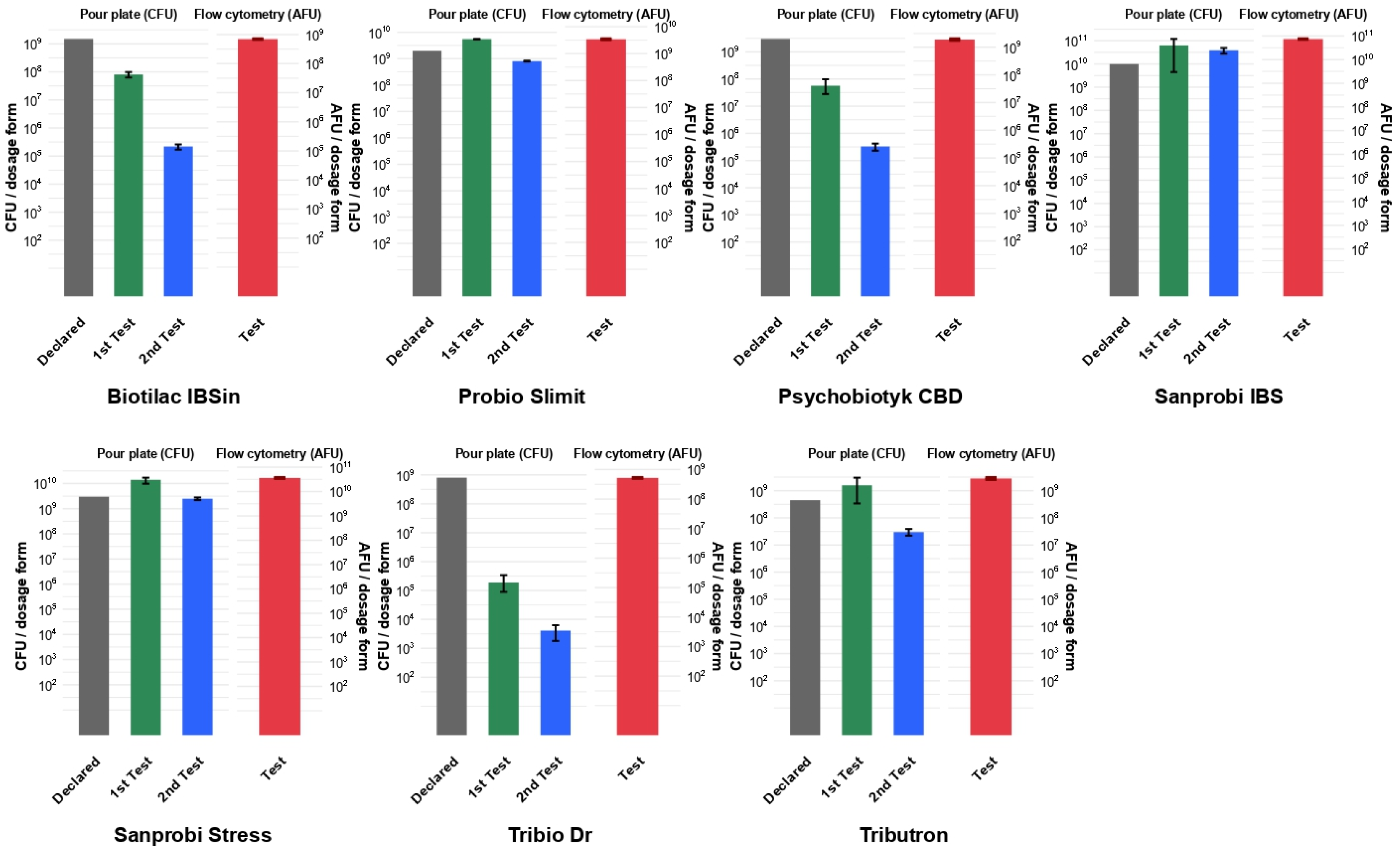
| Probiotic Product | Microorganism | Declared CFU/Dosage Form | 1st Test | 2nd Test | ||
|---|---|---|---|---|---|---|
| Exp. Date (Month) | Obtained CFU/Dosage Form (Confidence Interval) | Exp. Date (Month) | Obtained CFU/Dosage Form (Confidence Interval) | |||
| Latopic | Lactobacillaceae | 1.5 × 10⁹ | 9 | 9.3 × 101 (8.1 × 101–1.1 × 10²) | nt | nt |
| Biotilac IBSin | Lactobacillaceae | 1 × 10¹⁰ | 19 | 8.1 × 10⁷ (6.3 × 10⁷–9.9 × 10⁷) | 5 | 2.2 × 10⁵ (1.7 × 10⁵–2.6 × 10⁵) |
| Compli Flora | Lactobacillaceae | 2 × 10⁹ | 2 | 4.6 × 10⁵ (4.1 × 10⁵–5.1 × 10⁵) | nt | nt |
| Bifidobacterium spp. | 2 × 10⁹ | 3.6 × 10⁷ (3.2 × 10⁷–3.9 × 10⁷) | nt | nt | ||
| Saccharomyces spp. | 2 × 10⁹ | 4.7 × 10⁷ (4.6 × 10⁷–4.7 × 10⁷) | nt | nt | ||
| Crohnax IBS | Bifidobacterium spp. | Total 5 × 10⁹ | 18 | 7.2 × 10⁹ (5.4 × 10⁹–9.1 × 10⁹) | nt | nt |
| Lactobacillaceae | 5.4 × 10⁹ (5.0 × 10⁹–5.7 × 10⁹) | nt | nt | |||
| Neurax Biotic Spectrum | Lactobacillaceae | 3 × 10¹⁰ | 9 | 6.7 × 10⁹ (5.4 × 10⁹–8.0 × 10⁹) | nt | nt |
| Neuro LPC | Lactobacillaceae | 2.5 × 10¹⁰ | 23 | 4.1 × 10¹⁰ (3.8 × 10¹⁰–4.3 × 10¹⁰) | nt | nt |
| Probio Slimit | Bifidobacterium spp. | 2 × 10⁹ | 16 | 5.5 × 10⁹ (5.3 × 10⁹–5.6 × 10⁹) | 2 | 8.1 × 10⁸ (7.8 × 10⁸–8.4 × 10⁸) |
| Psychobiotyk CBD | Bifidobacterium spp. | 2 × 10⁹ | 16 | 7.9 × 10⁷ (6.1 × 10⁷–9.8 × 10⁷) | 3 | 3.7 × 10⁵ (3.1 × 10⁵–4.2 × 10⁵) |
| Lactobacillaceae | 4 × 10⁹ | 3.4 × 10⁷ (2.8 × 10⁷–4.0 × 10⁷) | 3.0 × 10⁵ (2.3 × 10⁵–3.6 × 10⁵) | |||
| Psychobiotyk IBS | Bacillus spp. | 1 × 10⁸ | 11 | 5.6 × 10⁶ (4.9 × 10⁶–6.3 × 10⁶) | nt | nt |
| Bifidobacterium spp. | 3 × 10⁹ | 8.2 × 10⁷ (6.1 × 10⁷–1.0 × 10⁸) | nt | nt | ||
| Lactobacillaceae | 3 × 10⁹ | 5.1 × 10⁷ (5.0 × 10⁷–5.3 × 10⁷) | nt | nt | ||
| Saccharomyces spp. | 1 × 10⁹ | 7.3 × 10⁸ (5.8 × 10⁸–8.9 × 10⁸) | nt | nt | ||
| SanBiotics IBS | Lactobacillaceae | 1 × 10¹⁰ | 10 | 9.4 × 10⁷ (8.6 × 10⁷–1.0 × 10⁸) | nt | nt |
| SanBiotics Stress | Bifidobacterium spp. | 1.6 × 10⁹ | 8 | 2.5 × 101 (1.6 × 101–3.5 × 101) | nt | nt |
| Lactobacillaceae | 1.4 × 10⁹ | 4.3 × 10³ (3.9 × 10³–4.7 × 10³) | nt | nt | ||
| Sanprobi IBS | Lactobacillaceae | 1 × 10¹⁰ | 22 | 6.3 × 10¹⁰ (4.5 × 10⁹–1.2 × 10¹¹) | 8 | 3.9 × 10¹⁰ (2.8 × 10¹⁰–4.9 × 10¹⁰) |
| Sanprobi Stress | Lactobacillaceae | Total 3 × 10⁹ | 20 | 1.4 × 10¹⁰ (1.2 × 10¹⁰–1.7 × 10¹⁰) | 6 | 2.5 × 10⁹ (2.2 × 10⁹–2.8 × 10⁹) |
| Bifidobacterium spp. | 1.0 × 10⁹ (9.0 × 10⁸–1.2 × 10⁹) | 4.3 × 10⁸ (3.9 × 10⁸–4.7 × 10⁸) | ||||
| Tribio Dr | Lactobacillaceae | 9 × 10⁸ | 23 | 8.2 × 10³ (6.9 × 10³–9. × 103) | 11 | 6.0 × 10³ (5.7 × 10³–6.3 × 10³) |
| Bifidobacterium spp. | 7 × 10⁸ | 3.8 × 10⁵ (3.4 × 10⁵–4.3 × 10⁵) | 2.4 × 10³ (1.8 × 10³–3.0 × 10³) | |||
| Tributron | Bifidobacterium spp. | 7.2 × 10⁸ | 18 | 2.6 × 10⁹ (2.3 × 10⁹–3.0 × 10⁹) | 4 | 2.7 × 10³ (2.1 × 10³–3.3 × 10³) |
| Lactobacillaceae | 2.8 × 10⁸ | 1.3 × 10⁸ (1.1 × 10⁸–1.4 × 10⁸) | 3.0 × 10⁷ (2.2 × 10⁷–3.9 × 10⁷) | |||
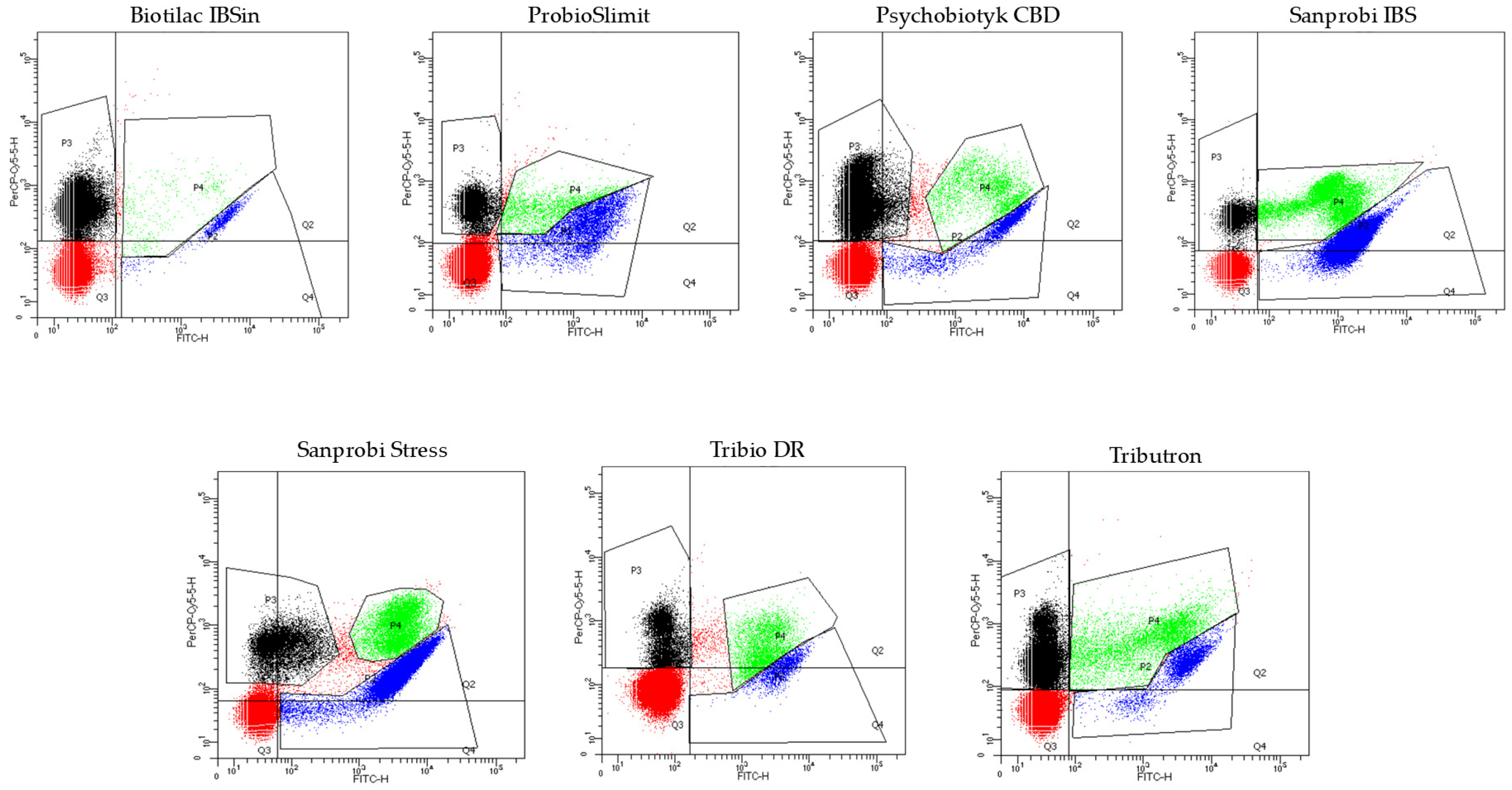
| Probiotic Product | Microorganism | AFU/Dosage Form (Confidence Interval) | N-AFU/Dosage Form (Confidence Interval) |
|---|---|---|---|
| Biotilac IBSin | Lactobacillaceae | 7.0 × 10⁸ (6.9 × 10⁸–7.1 × 10⁸) | 3.6 × 10¹⁰ (3.3 × 10¹⁰–3.9 × 10¹⁰) |
| Probio Slimit | Bifidobacterium spp. | 3.4 × 10⁹ (3.3 × 10⁹–3.5 × 10⁹) | 7.0 × 10⁹ (6.9 × 10⁹–7.1 × 10⁹) |
| Psychobiotyk CBD | Bifidobacterium spp. Lactobacillaceae | 1.9 × 10⁹ (1.8 × 10⁹–2.0 × 10⁹) | 2.1 × 10¹⁰ (2.0 × 10¹⁰–2.2 × 10¹⁰) |
| Sanprobi IBS | Lactobacillaceae | 7.4 × 10¹⁰ (7.3 × 10¹⁰–7.5 × 10¹⁰) | 6.2 × 10⁹ (6.1 × 10¹⁰–6.3 × 10¹⁰) |
| Sanprobi Stress | Lactobacillaceae Bifidobacterium spp. | 3.6 × 10¹⁰ (3.5 × 10¹⁰–3.7 × 10¹⁰) | 5.8 × 10¹⁰ (5.7 × 10¹⁰–5.9 × 10¹⁰) |
| Tribio Dr | Lactobacillaceae Bifidobacterium spp. | 5.2 × 10⁸ (5.1 × 10⁸–5.3 × 10⁸) | 1.8 × 10⁹ (1.6 × 10⁹–2.0 × 10⁹) |
| Tributron | Bifidobacterium spp. Lactobacillaceae | 2.8 × 10⁹ (2.6 × 10⁹–3.0 × 10⁹) | 2.5 × 10¹⁰ (2.3 × 10¹⁰–2.7 × 10¹⁰) |
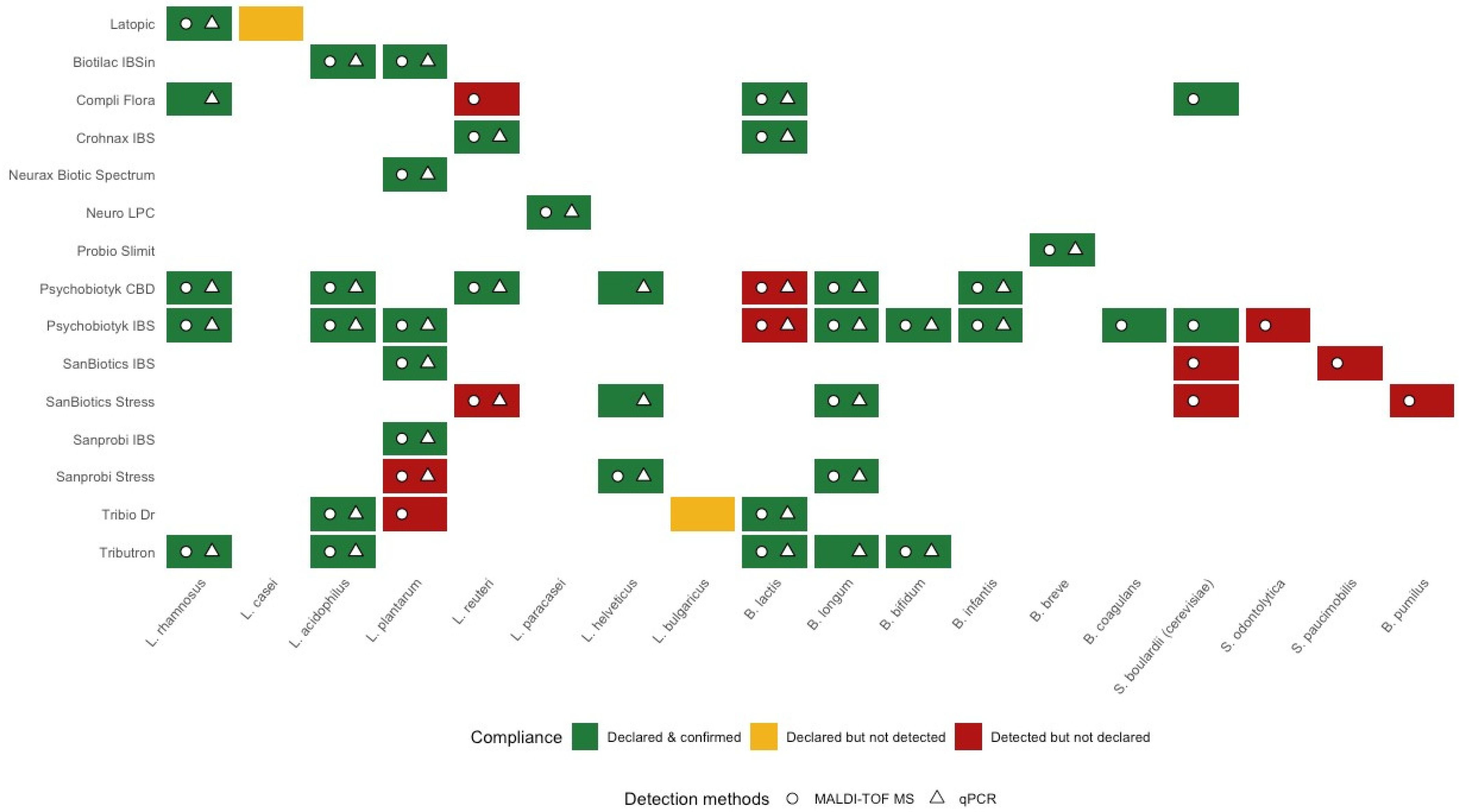
| Probiotic Product | Declared Strain | MALDI-TOF MS | qPCR | |||
|---|---|---|---|---|---|---|
| Identification | SV | Identification | Test Sample Cq | Positive Control Cq | ||
| Latopic | L. rhamnosus ŁOCK 0908 | L. rhamnosus | 2.25 | L. rhamnosus | 15 | 16 |
| L. rhamnosus ŁOCK 0900 | ||||||
| L. casei ŁOCK0919 | nd | - | nt | - | - | |
| Biotilac IBSin | L. acidophilus LA02 | L. acidophilus | 2.45 | L. acidophilus | 24 | 19 |
| L. plantarum LP01 | L. plantarum | 2.47 | L. plantarum | 19 | 17 | |
| Compli Flora | L. rhamnosus GG | nd | - | L. rhamnosus | 19 | 16 |
| B. lactis BS01 | B. animalis ssp. lactis | 2.63 | B. lactis | 23 | 18 | |
| S. boulardii | S. cerevisiae | 2.13 | nt | - | - | |
| Crohnax IBS | B. lactis 5764 | B. animalis ssp. lactis | 2.59 | B. lactis | 17 | 18 |
| L. reuteri 5454 | L. reuteri | 2.18 | L. reuteri | 15 | 12 | |
| Neurax Biotic Spectrum | L. plantarum PS128 | L. plantarum | 2.32 | L. plantarum | 17 | 17 |
| Neuro LPC | L. paracasei (Lpc-37) | L. paracasei ssp. paracasei | 2.37 | L. paracasei | 14 | 16 |
| Probio Slimit | B. breve B-3 | B. breve | 2.34 | B. breve | 18 | 25 |
| Psychobiotyk CBD | B. infantis BI02 | B. longum ssp. infantis | 2.41 | B. infantis | 16 | 25 |
| B. longum BL-G301 | B. longum | 2.35 | B. longum | 34 | 33 | |
| L. acidophilus LA02 | L. acidophilus | 2.47 | L. acidophilus | 21 | 19 | |
| L. reuteri LRE02 | L. reuteri | 2.31 | L. reuteri | 16 | 12 | |
| L. rhamnosus GG | L. rhamnosus | 2.37 | L. rhamnosus | 18 | 16 | |
| L. helveticus CNCMI-3360 | nd | - | L. helveticus | 19 | 16 | |
| Psychobiotyk IBS | B. coagulans | B. coagulans | 2.15 | nt | - | - |
| B. bifidum | B. bifidum | 2.37 | B. bifidum | 20 | 25 | |
| B. infantis | B. longum ssp. infantis | 2.07 | B. infantis | 17 | 25 | |
| B. longum | B. longum | 2.14 | B. longum | 35 | 33 | |
| L. acidophilus | L. acidophilus | 2.30 | L. acidophilus | 21 | 19 | |
| L. plantarum | L. plantarum | 2.38 | L. plantarum | 21 | 17 | |
| L. rhamnosus | L. rhamnosus | 2.32 | L. rhamnosus | 19 | 16 | |
| S. boulardii | S. cerevisiae | 2.05 | nt | - | - | |
| SanBiotics IBS | L. plantarum LP09 DSM 25710 | L. plantarum | 2.41 | L. plantarum | 21 | 17 |
| SanBiotics Stress | B. longum CNCM I-5097 | B. longum | 2.31 | B. longum | 38 | 32 |
| L. helveticus LMG P-31392 | nd | - | L. helveticus | 19 | 16 | |
| Sanprobi IBS | L. plantarum 299v | L. plantarum | 2.48 | L. plantarum | 17 | 17 |
| Sanprobi Stress | L. helveticus Rosell-2 | L. helveticus | 1.99 | L. helveticus | 17 | 16 |
| B. longum Rosell-175 | B. longum | 2.25 | B. longum | 36 | 33 | |
| Tribio Dr | L. acidophilus | L. acidophilus | 2.58 | L. acidophilus | 21 | 19 |
| L. delbrueckii ssp. bulgaricus | nd | - | nt | - | - | |
| B. lactis | B. animalis ssp. lactis | 2.44 | B. lactis | 24 | 18 | |
| Tributron | B. lactis Flora Active 32269 | B. animalis ssp. lactis | 2.45 | B. lactis | 19 | 18 |
| B. bifidum Flora Active 32403 | B. bifidum | 2.36 | B. bifidum | 19 | 24 | |
| B. longum Flora Active 32946 | nd | - | B. longum | 33 | 33 | |
| L. rhamnosus Flora Active 19070-2 | L. rhamnosus | 2.36 | L. rhamnosus | 17 | 16 | |
| L. acidophilus Flora Active 32418 | L. acidophilus | 2.32 | L. acidophilus | 20 | 19 | |
| Probiotic Product | AMCC [CFU/g] | YMCC [CFU/g] | E. coli (1 g) | S. aureus (1 g) | Salmonella spp. (1 g) | Listeria spp. (1 g) | Gram-Negative Bile-Tolerant Bacteria (1 g) | Other Contaminants |
|---|---|---|---|---|---|---|---|---|
| Latopic | <1 × 101 | <1 × 101 | nd | nd | nd | nd | nd | nd |
| Biotilac IBSin | 2.4 × 10² | <1 × 101 | nd | nd | nd | nd | nd | nd |
| Compli Flora | <1 × 101 | nt | nd | nd | nd | nd | nd | L. reuteri |
| Crohnax IBS | 1.7 × 10³ | <1 × 101 | nd | nd | nd | nd | nd | nd |
| Neurax Biotic Spectrum | <1 × 101 | <1 × 101 | nd | nd | nd | nd | nd | nd |
| Neuro LPC | <1 × 101 | <1 × 101 | nd | nd | nd | nd | nd | nd |
| Probio Slimit | 3.5 × 101 | <1 × 101 | nd | nd | nd | nd | nd | nd |
| Psychobiotyk CBD | 1.0 × 101 | <1 × 101 | nd | nd | nd | nd | nd | B. animalis ssp. lactis |
| Psychobiotyk IBS | nt | nt | nd | nd | nd | nd | nd | Schaalia odontolytica B. animalis ssp. lactis |
| SanBiotics IBS | 1.3 × 10³ | 7.1 × 10⁴ | nd | nd | nd | nd | nd | S. cerevisiae, Sphingomonas paucimobilis |
| SanBiotics Stress | <1 × 101 | 1.0 × 10⁴ | nd | nd | nd | nd | nd | S. cerevisiae Bacillus pumilus L. reuteri |
| Sanprobi IBS | <1 × 101 | <1 × 101 | nd | nd | nd | nd | nd | nd |
| Sanprobi Stress | 2.4 × 10⁴ | 6.5 × 101 | nd | nd | nd | nd | nd | L. plantarum |
| Tribio Dr | 1.5 × 101 | <1 × 101 | nd | nd | nd | nd | nd | L. plantarum |
| Tributron | <1 × 101 | <1 × 101 | nd | nd | nd | nd | nd | nd |
| Methods | Advantages | Limitations |
|---|---|---|
| Pour plate method |
|
|
| Flow cytometry |
|
|
| qPCR |
|
|
| MALDI-TOF MS |
|
|
Disclaimer/Publisher’s Note: The statements, opinions and data contained in all publications are solely those of the individual author(s) and contributor(s) and not of MDPI and/or the editor(s). MDPI and/or the editor(s) disclaim responsibility for any injury to people or property resulting from any ideas, methods, instructions or products referred to in the content. |
© 2026 by the authors. Licensee MDPI, Basel, Switzerland. This article is an open access article distributed under the terms and conditions of the Creative Commons Attribution (CC BY) license.
Share and Cite
Zawistowska-Rojek, A.; Rybak, J.; Smoleń, P.; Kociszewska, A.; Rudnicki-Velasquez, P.; Węgrzyńska, K.; Zaręba, T.; Tyski, S.; Baraniak, A. Evaluating the Quality of Selected Commercial Probiotic Products, Both Dietary Supplements and Foods for Special Medical Purposes. Foods 2026, 15, 373. https://doi.org/10.3390/foods15020373
Zawistowska-Rojek A, Rybak J, Smoleń P, Kociszewska A, Rudnicki-Velasquez P, Węgrzyńska K, Zaręba T, Tyski S, Baraniak A. Evaluating the Quality of Selected Commercial Probiotic Products, Both Dietary Supplements and Foods for Special Medical Purposes. Foods. 2026; 15(2):373. https://doi.org/10.3390/foods15020373
Chicago/Turabian StyleZawistowska-Rojek, Anna, Justyna Rybak, Paulina Smoleń, Agnieszka Kociszewska, Paweł Rudnicki-Velasquez, Karolina Węgrzyńska, Tomasz Zaręba, Stefan Tyski, and Anna Baraniak. 2026. "Evaluating the Quality of Selected Commercial Probiotic Products, Both Dietary Supplements and Foods for Special Medical Purposes" Foods 15, no. 2: 373. https://doi.org/10.3390/foods15020373
APA StyleZawistowska-Rojek, A., Rybak, J., Smoleń, P., Kociszewska, A., Rudnicki-Velasquez, P., Węgrzyńska, K., Zaręba, T., Tyski, S., & Baraniak, A. (2026). Evaluating the Quality of Selected Commercial Probiotic Products, Both Dietary Supplements and Foods for Special Medical Purposes. Foods, 15(2), 373. https://doi.org/10.3390/foods15020373