Dual-Mode Detection of Perfluorooctanoic Acid Using Up-Conversion Fluorescent Silicon Quantum Dots–Molecularly Imprinted Polymers and Smartphone Sensing

Abstract
1. Introduction
2. Experiment
2.1. Materials and Instruments
2.2. Preparation of SiQDs and SiQDs@SiO2
2.3. Preparation of SiQDs@SiO2
2.4. Fabrication of MIPs and NIPs
2.5. Up-Conversion Fluorescence Detection of PFOA
2.6. Smartphone-Enabled Detection of PFOA
3. Results and Discussion
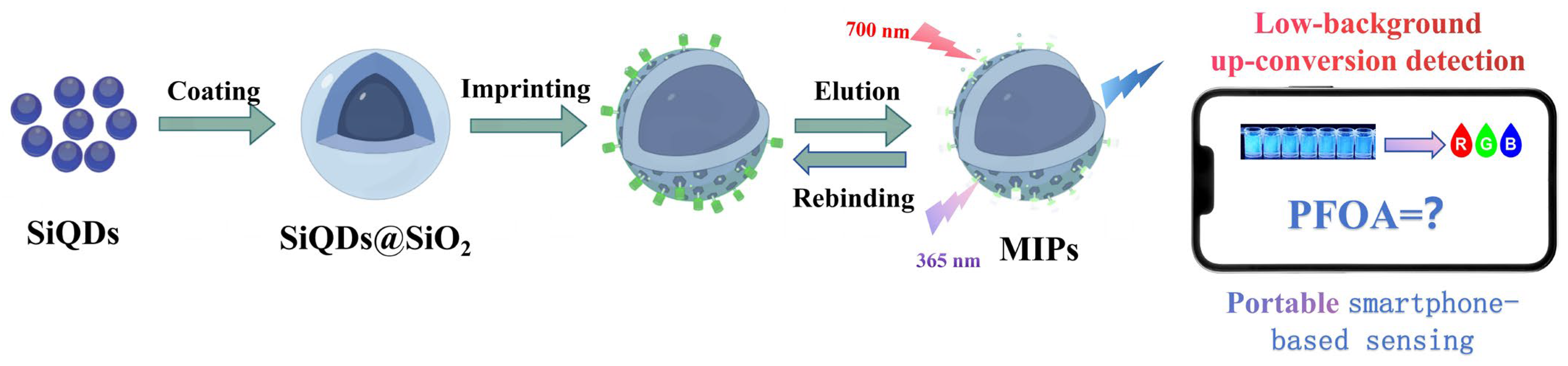
3.1. Preparation and Characterization of MIPs
3.2. Optical Properties of MIPs
3.3. Fluorescence Quenching Mechanism Between MIPs and PFOA
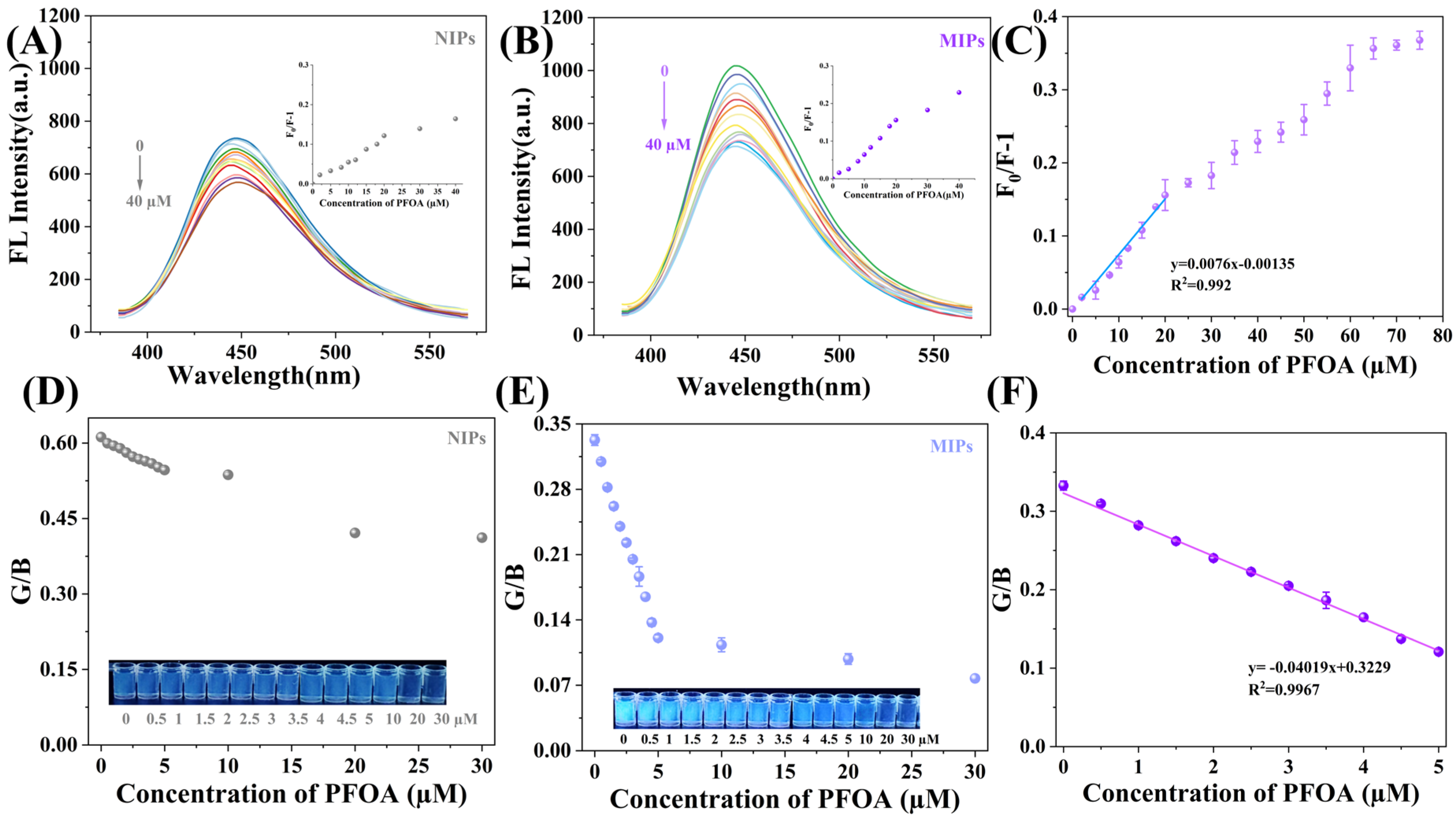
3.4. Low-Background Up-Conversion Fluorescence Method and Portable Smartphone-Sensing Platform Method for the Detection of PFOA
3.5. Application in Real Sample Analysis
4. Conclusions
Supplementary Materials
Author Contributions
Funding
Institutional Review Board Statement
Informed Consent Statement
Data Availability Statement
Conflicts of Interest
References
- de Souza, B.B.; Perera, D.C.; Teymourian, T.; Meegoda, J.N. Mechanism of sonolytic PFAS degradation into inorganic products: A combined reactive molecular dynamics and density functional theory approaches. J. Colloid Interface Sci. 2025, 699, 138215. [Google Scholar] [CrossRef]
- Perera, D.C.; Meegoda, J.N. PFAS: The journey from wonder chemicals to environmental nightmares and the search for solutions. Appl. Sci. 2024, 14, 8611. [Google Scholar] [CrossRef]
- Tian, Y.; Yao, Y.; Chang, S.; Zhao, Z.; Zhao, Y.; Yuan, X.; Wu, F.; Sun, H. Occurrence and phase distribution of neutral and ionizable per-and polyfluoroalkyl substances (PFASs) in the atmosphere and plant leaves around landfills: A case study in Tianjin, China. Environ. Sci. Technol. 2018, 52, 1301–1310. [Google Scholar] [CrossRef]
- Dimitrakopoulou, M.E.; Karvounis, M.; Marinos, G.; Theodorakopoulou, Z.; Aloizou, E.; Petsangourakis, G.; Papakonstantinou, M.; Stoitsis, G. Comprehensive analysis of PFAS presence from environment to plate. npj Sci. Food 2024, 8, 80. [Google Scholar] [CrossRef]
- Ryu, H.; Li, B.; De Guise, S.; McCutcheon, J.; Lei, Y. Recent progress in the detection of emerging contaminants PFASs. J. Hazard. Mater. 2021, 408, 124437. [Google Scholar] [CrossRef]
- Messmer, M.F.; Siegel, L.; Locwin, B. Global manufacturer concealed hazards of PFAS releases for decades. Curr. Opin. Green Sustain. Chem. 2024, 47, 100901. [Google Scholar] [CrossRef]
- Shahi, S.; Winquist, A.; Troeschel, A.N.; Teras, L.R.; Campbell, P.T.; Flanders, W.D.; Goodman, M. A Case-Cohort Study of the Association between Per-and Polyfluoroalkyl Substances (PFAS) and Breast Cancer among Participants in the American Cancer Society’s Cancer Prevention Study-II. Environ. Res. 2025, 264, 120386. [Google Scholar] [CrossRef] [PubMed]
- Tokranov, A.K.; Ransom, K.M.; Bexfield, L.M.; Lindsey, B.D.; Watson, E.; Dupuy, D.I.; Zeighami, E.A.; Campagnolo, E.R.; LeBlanc, D.R. Predictions of groundwater PFAS occurrence at drinking water supply depths in the United States. Science 2024, 386, 748–755. [Google Scholar] [CrossRef]
- Breshears, L.E.; Mata-Robles, S.; Tang, Y.; Baker, J.C.; Reynolds, K.A.; Yoon, J.-Y. Rapid, sensitive detection of PFOA with smartphone-based flow rate analysis utilizing competitive molecular interactions during capillary action. J. Hazard. Mater. 2023, 446, 130699. [Google Scholar] [CrossRef] [PubMed]
- Domingo, J.L.; Nadal, M. Human exposure to per- and polyfluoroalkyl substances (PFAS) through drinking water: A review of the recent scientific literature. Environ. Res. 2019, 177, 108648. [Google Scholar] [CrossRef]
- Pérez, F.; Nadal, M.; Navarro-Ortega, A.; Fàbrega, F.; Domingo, J.L.; Barceló, D.; Farré, M. Accumulation of perfluoroalkyl substances in human tissues. Environ. Int. 2013, 59, 354–362. [Google Scholar] [CrossRef]
- Fu, J.; Gao, Y.; Cui, L.; Wang, Y.; Zhang, A.; Sun, J.; Liu, W.; Li, G.; Sun, Z.; Jiang, G. Occurrence, temporal trends, and half-lives of perfluoroalkyl acids (PFAAs) in occupational workers in China. Sci. Rep. 2016, 6, 38039. [Google Scholar] [CrossRef] [PubMed]
- Fang, C.; Megharaj, M.; Naidu, R. Chemical oxidization of some AFFFs leads to the formation of 6:2FTS and 8:2FTS. Environ. Toxicol. Chem. 2015, 34, 2625–2628. [Google Scholar] [CrossRef] [PubMed]
- Robel, A.E.; Marshall, K.; Dickinson, M.; Lunderberg, D.; Butt, C.; Peaslee, G.; Stapleton, H.M. Closing the mass balance on fluorine on papers and textiles. Environ. Sci. Technol. 2017, 51, 9022–9032. [Google Scholar] [CrossRef]
- Poothong, S.; Boontanon, S.K.; Boontanon, N. Determination of perfluorooctane sulfonate and perfluorooctanoic acid in food packaging using liquid chromatography coupled with tandem mass spectrometry. J. Hazard. Mater. 2012, 205–206, 139–143. [Google Scholar] [CrossRef]
- Zacs, D.; Bartkevics, V. Trace determination of perfluorooctane sulfonate and perfluorooctanoic acid in environmental samples (surface water, wastewater, biota, sediments, and sewage sludge) using liquid chromatography-Orbitrap mass spectrometry. J. Chromatogr. A 2016, 1473, 109–121. [Google Scholar] [CrossRef]
- Yao, P.; Ou, J.; Zhao, D.; Zhou, S.; Wang, Q.; Feng, Y.; Meng, X. An AIE-activated fluorescent sensor for one-step concurrent detection and bioimaging of perfluorooctanoic acid and perfluorooctane sulfonate in vitro and in vivo. J. Hazard. Mater. 2025, 494, 138765. [Google Scholar] [CrossRef]
- Chen, Q.; Liu, J.; Liu, S.; Zhang, J.; He, L.; Liu, R.; Jiang, H.; Han, X.; Zhang, K. Visual and rapid detection of nerve agent mimics in gas and solution phase by a simple fluorescent probe. Anal. Chem. 2023, 95, 4390–4394. [Google Scholar] [CrossRef]
- Zhang, J.; Hou, J.; Zhang, K.; Zhang, R.; Geng, J.; Wang, S.; Zhang, Z. Integration of quantum dots with Zn2GeO4 nanoellipsoids to expand the dynamic detection range of uranyl ions in fluorescent test strips. J. Hazard. Mater. 2022, 436, 129182. [Google Scholar] [CrossRef]
- Geng, X.; Li, Z.; Hu, Y.; Liu, H.; Sun, Y.; Meng, H.; Wang, Y.; Qu, L.; Lin, Y. One-pot green synthesis of ultrabright N-doped fluorescent silicon nanoparticles for cellular imaging by using ethylenediaminetetraacetic acid disodium salt as an effective reductant. ACS Appl. Mater. Interfaces 2018, 10, 27979–27986. [Google Scholar] [CrossRef] [PubMed]
- Qin, Y.T.; Peng, H.; He, X.W.; Li, W.Y.; Zhang, Y.K. Highly effective drug delivery and cell imaging using fluorescent double-imprinted nanoparticles by targeting recognition of the epitope of membrane protein. Anal. Chem. 2019, 91, 12696–12703. [Google Scholar] [CrossRef] [PubMed]
- Ma, Y.J.; Li, S.; Qin, Y.T.; He, X.W.; Li, W.Y.; Zhang, Y.K. Multimode sensing platform based on turn-on fluorescent silicon nanoparticles for monitoring of intracellular pH and GSH. Anal. Chem. 2023, 95, 6664–6671. [Google Scholar] [CrossRef] [PubMed]
- Cao, L.; Wang, X.; Meziani, M.J.; Lu, F.S.; Wang, H.F.; Luo, P.G.; Lin, Y.; Harruff, B.A.; Veca, L.M.; Murray, D.; et al. Carbon dots for multiphoton bioimaging. J. Am. Chem. Soc. 2007, 129, 11318–11319. [Google Scholar] [CrossRef]
- Ye, H.L.; Cai, S.N.J.; Li, S.; He, X.W.; Li, W.Y.; Li, Y.H.; Zhang, Y.K. One-pot microwave synthesis of water-dispersible, high fluorescence silicon nanoparticles and their imaging applications in vitro and in vivo. Anal. Chem. 2016, 88, 11631–11638. [Google Scholar] [CrossRef]
- Brown, S. Photodynamic Therapy: Two photons are better than one. Nat. Photonics 2008, 2, 394–395. [Google Scholar] [CrossRef]
- Wang, D.; Zhu, L.; Pu, Y.; Wang, J.X.; Chen, J.F.; Dai, L.M. Transferrin-coated magnetic upconversion nanoparticles for efficient photodynamic therapy with near-infrared irradiation and luminescence bioimaging. Nanoscale 2017, 9, 11214–11221. [Google Scholar] [CrossRef] [PubMed]
- Çelik, H.; Caf, B.B.; Çebi, G. Smartphone-assisted biosensors in point-of-care diagnostics: Integration, applications, and future challenges. Chem. Pap. 2025, 79, 7323–7342. [Google Scholar] [CrossRef]
- Rajendran, V.K.; Bakthavathsalam, P.; Bergquist, P.L.; Anwar, S. Smartphone technology facilitates point-of-care nucleic acid diagnosis: A beginner’s guide. Crit. Rev. Clin. Lab. Sci. 2021, 58, 77–100. [Google Scholar] [CrossRef]
- Kou, M.; Qin, F.; Wang, Y.; Zhang, X.; Li, L.; Hu, Z.; Zhao, H.; Zhang, Z. Effects of excitation power density on the Stern–Volmer constant measurement. Opt. Lett. 2023, 48, 5133–5136. [Google Scholar] [CrossRef]
- Chun, H.J.; Ocola, E.J.; Laane, J. Vapor-phase infrared and Raman spectra and ab-initio calculations of the axial and equatorial forms of cyclohexane-d1 and d11. J. Mol. Spectrosc. 2016, 329, 43–45. [Google Scholar] [CrossRef]
- Calabrò, E.; Currò, M.; Caccamo, M.T.; Lentile, R.; Magazù, S. Competition between N–H bending vibration and α-helix polarization under 50 Hz magnetic field in SH-SY5Y neuronal-like cells. Spectrosc. Lett. 2020, 53, 458–465. [Google Scholar] [CrossRef]
- Hatmanto, A.D.; Kita, K. Physical analysis of remained oxidation byproducts as the origins of lattice distortion at the surface of 4H-SiC by Fourier-transform infrared spectroscopy. Jpn. J. Appl. Phys. 2020, 59, SMMA02. [Google Scholar] [CrossRef]
- Lobanok, M.V.; Mukhammad, A.I.; Gaiduk, P.I. Structural and Optical Properties of SiC/Si Heterostructures Obtained Using Rapid Vacuum-Thermal Carbidization of Silicon. J. Appl. Spectrosc. 2022, 89, 256–260. [Google Scholar] [CrossRef]
- Mohai, M.; László, K.; Bertóti, I. Reduction and covalent modification of graphene-oxide by nitrogen in glow discharge plasma. Surf. Interface Anal. 2018, 50, 1207–1212. [Google Scholar] [CrossRef]
- Yadav, I.; Dutta, S.; Pandey, A.; Yadav, N.; Goyal, A.; Chatterjee, R. Evolution of TiOx-SiOx nano-composite during annealing of ultrathin titanium oxide films on Si substrate. Ceram. Int. 2020, 46, 19935–19941. [Google Scholar] [CrossRef]
- Liu, S.; Xin, Z.J.; Lei, Y.J.; Yang, Y.; Yan, X.Y.; Lu, Y.B.; Li, C.B.; Wang, H.Y. Thin copper-based film for efficient electrochemical hydrogen production from neutral aqueous solutions. ACS Sustain. Chem. Eng. 2017, 5, 7496–7501. [Google Scholar] [CrossRef]
- Ootani, Y.; Xu, J.; Takahashi, N.; Kanda, N.; Nakamura, T.; Morita, N.; Nakayama, Y.; Kubo, M.; Koganezawa, S.; Sugimura, J. Self-formed double tribolayers play collaborative roles in achieving superlow friction in an aqueous environment. J. Phys. Chem. C 2020, 124, 8295–8303. [Google Scholar] [CrossRef]
- Zaman, A.C.; Kaya, F.; Kaya, C. A study on optimum surfactant to multiwalled carbon nanotube ratio in alcoholic stable suspensions via UV–Vis absorption spectroscopy and zeta potential analysis. Ceram. Int. 2020, 46, 29120–29129. [Google Scholar] [CrossRef]
- de Carvalho Bertozo, L.; Fernandes, A.J.F.C.; Yoguim, M.I.; Pereira, E.; Gonçalves, D.; Sineli, P.E.; da Silva, R.A.; Itri, R. Entropy-driven binding of octyl gallate in albumin: Failure in the application of temperature effect to distinguish dynamic and static fluorescence quenching. J. Mol. Recognit. 2020, 33, e2840. [Google Scholar] [CrossRef]
- Arabi, M.S.; Karami, C.; Taher, M.A.; Ghaemi, F.; Shamsipur, M. Fluorescence detection of laccases activity by the photoinduced electron transfer (PET) process. JBIC J. Biol. Inorg. Chem. 2020, 25, 151–159. [Google Scholar] [CrossRef]
- Luo, L.; Jia, B.Z.; Wei, X.Q.; Wang, J.; Liu, Y.; Wang, H.; Wang, S. Development of an inner filter effect-based fluorescence immunoassay for the detection of acrylamide using 9-xanthydrol derivatization. Sens. Actuators B Chem. 2021, 332, 129561. [Google Scholar] [CrossRef]
- Halter, O.; Plenio, H. Fluorescence resonance energy transfer (FRET) for the verification of dual gold catalysis. Chem. Commun. 2017, 53, 12461–12464. [Google Scholar] [CrossRef]
- Kumar, A.T.N.; Rice, W.L.; López, J.C.; Kulkarni, R.A.; Pudavar, H.E.; Cai, Z.; Achilefu, S. Substrate-based near-infrared imaging sensors enable fluorescence lifetime contrast via built-in dynamic fluorescence quenching elements. ACS Sens. 2016, 1, 427–436. [Google Scholar] [CrossRef] [PubMed]
- Mann, M.M.; Berger, B.W. A genetically-encoded biosensor for direct detection of perfluorooctanoic acid. Sci. Rep. 2023, 13, 15186. [Google Scholar] [CrossRef]
- Faiz, F.; Cran, M.J.; Zhang, J.; Muthukumaran, S.; Sidiroglou, F. Graphene Oxide Doped Alginate Coated Optical Fiber Sensor for the Detection of Perfluorooctanoic Acid in Water. IEEE Sens. J. 2023, 23, 12861–12867. [Google Scholar] [CrossRef]
- Faiz, F.; Baxter, G.; Collins, S.; Sidiroglou, F.; Cran, M. Polyvinylidene fluoride coated optical fibre for detecting perfluorinated chemicals. Sens. Actuators B Chem. 2020, 312, 128006. [Google Scholar] [CrossRef]
- Ranaweera, R.; Ghafari, C.; Luo, L. Bubble-Nucleation-Based Method for the Selective and Sensitive Electrochemical Detection of Surfactants. Anal. Chem. 2019, 91, 7744–7748. [Google Scholar] [CrossRef]
- Hou, C.; Chen, F.; Cheng, D.; Zou, S.; Wang, J.; Shen, M.; Wang, Y. MOFs-derived Cu/Carbon membrane as bi-functional catalyst: Improving catalytic activity in detection and degradation of PFOA via regulation of reactive Cu species. Chem. Eng. J. 2024, 481, 148467. [Google Scholar] [CrossRef]
- Fang, C.; Chen, Z.; Megharaj, M.; Naidu, R. Potentiometric detection of AFFFs based on MIP. Environ. Technol. Innov. 2016, 5, 52–59. [Google Scholar] [CrossRef]
- Sahu, S.P.; Kole, S.; Arges, C.G.; Ranjan, M. Rapid and Direct Perfluorooctanoic Acid Sensing with Selective Ionomer Coatings on Screen-Printed Electrodes under Environmentally Relevant Concentrations. ACS Omega 2022, 7, 5001–5007. [Google Scholar] [CrossRef]
- Grung, M.; Hjermann, D.Ø.; Rundberget, T.; Bæk, K.; Thomsen, C.; Knutsen, K.H.; Smastuen Haug, L. Low levels of per-and polyfluoroalkyl substances (PFAS) detected in drinking water in Norway, but elevated concentrations found near known sources. Sci. Total Environ. 2024, 947, 174550. [Google Scholar] [CrossRef] [PubMed]



| Materials | Linear Ranges | LOD | References |
|---|---|---|---|
| cp. GFP/hLFABP | 0–50 µM | 797 nM | [44] |
| Alg/GO-FPI-OFS | 0–4.83 nM | 0.97 nM | [45] |
| PVDF-OFS | 0–144.9 µM | 12.1 µM | [46] |
| bubble-nucleation-based electrochemical | 241.5 nM–241.5 µM | 72.5 nM | [47] |
| CNF-Cu/C-SPEF | 1–100 μM | 133 nM | [48] |
| AFFFs-MB-MIP | 10 µM–10 mM | 100 nM | [49] |
| PFAEI | 0–460 nM | 15 nM | [50] |
| ES-tetraphenyl derivatives | 1.5–10.5 μM | 4.75 nM | [17] |
| SiQDs–MIPs | 2–20 μM 0–5 μM | 37.5 nM 73.9 nM | This work |
| Analytes | Up-Conversion Fluorescence Method | HPLC-MS/MS Method | Smartphone-Based Method | HPLC-MS/MS Method | ||||||
|---|---|---|---|---|---|---|---|---|---|---|
| Spiked (µM) | Found (µM) | Recovery (%) | RSD (%) | Found (µM) | Spiked (µM) | Found (µM) | Recovery (%) | RSD (%) | Found (µM) | |
| Tap water | 0 | N.F. | - | - | 0.016 | 0  | N.F. | - | - | 0.016 |
| 5 | 5.72 ± 0.028 | 114.4 | 1.2 | 5.12 | 1.5  | 1.55 ± 0.045 | 103.3 | 1.4 | 1.36 | |
| 10 | 9.24 ± 0.088 | 92.4 | 1.4 | 8.02 | 2.5  | 2.58 ± 0.088 | 103.2 | 1.5 | 2.60 | |
| 15 | 12.92 ± 0.017 | 86.1 | 3.4 | 11.94 | 3.5  | 3.49 ± 0.062 | 99.7 | 1.4 | 3.26 | |
| Sea water | 0 | N.F. | - | - | - | 0  | N.F. | - | - | - |
| 5 | 5.48 ± 0.090 | 109.6 | 2.7 | - | 1.5  | 1.53 ± 0.094 | 102.0 | 1.8 | - | |
| 10 | 10.67 ± 0.039 | 106.7 | 1.8 | - | 2.5  | 2.74 ± 0.097 | 109.6 | 2.9 | - | |
| 15 | 16.29 ± 0.066 | 108.6 | 2.8 | - | 3.5  | 3.21 ± 0.014 | 91.7 | 1.5 | - | |
| Milk | 0 | N.F. | - | - | - | 0  | N.F. | - | - | - |
| 5 | 4.34 ± 0.087 | 86.8 | 7.6 | - | 1.5  | 1.76 ± 0.077 | 117.3 | 5.9 | - | |
| 10 | 11.25 ± 0.020 | 112.5 | 1.2 | - | 2.5  | 2.67 ± 0.082 | 106.8 | 1.8 | - | |
| 15 | 16.64 ± 0.044 | 110.9 | 2.9 | - | 3.5  | 3.46 ± 0.011 | 99.9 | 2.1 | - | |
| Orange juice | 0 | N.F. | - | - | 0.006 | 0  | N.F. | - | - | 0.006 |
| 5 | 4.91 ± 0.032 | 98.2 | 0.6 | 4.98 | 1.5  | 1.31 ± 0.028 | 87.3 | 1.2 | 1.54 | |
| 10 | 9.83 ± 0.075 | 98.3 | 1.8 | 9.82 | 2.5  | 2.67 ± 0.069 | 106.8 | 0.8 | 2.64 | |
| 15 | 12.94 ± 0.096 | 86.3 | 3.2 | 12.3 | 3.5  | 3.74 ± 0.054 | 106.9 | 0.6 | 3.62 | |
Disclaimer/Publisher’s Note: The statements, opinions and data contained in all publications are solely those of the individual author(s) and contributor(s) and not of MDPI and/or the editor(s). MDPI and/or the editor(s) disclaim responsibility for any injury to people or property resulting from any ideas, methods, instructions or products referred to in the content. |
© 2026 by the authors. Licensee MDPI, Basel, Switzerland. This article is an open access article distributed under the terms and conditions of the Creative Commons Attribution (CC BY) license.
Share and Cite
Ye, H.; Wang, X.; Xu, X.; Xu, H.; Yuan, R.; Cheng, P. Dual-Mode Detection of Perfluorooctanoic Acid Using Up-Conversion Fluorescent Silicon Quantum Dots–Molecularly Imprinted Polymers and Smartphone Sensing. Foods 2026, 15, 331. https://doi.org/10.3390/foods15020331
Ye H, Wang X, Xu X, Xu H, Yuan R, Cheng P. Dual-Mode Detection of Perfluorooctanoic Acid Using Up-Conversion Fluorescent Silicon Quantum Dots–Molecularly Imprinted Polymers and Smartphone Sensing. Foods. 2026; 15(2):331. https://doi.org/10.3390/foods15020331
Chicago/Turabian StyleYe, Hongli, Xinran Wang, Xiangqian Xu, Hongyang Xu, Rui Yuan, and Ping Cheng. 2026. "Dual-Mode Detection of Perfluorooctanoic Acid Using Up-Conversion Fluorescent Silicon Quantum Dots–Molecularly Imprinted Polymers and Smartphone Sensing" Foods 15, no. 2: 331. https://doi.org/10.3390/foods15020331
APA StyleYe, H., Wang, X., Xu, X., Xu, H., Yuan, R., & Cheng, P. (2026). Dual-Mode Detection of Perfluorooctanoic Acid Using Up-Conversion Fluorescent Silicon Quantum Dots–Molecularly Imprinted Polymers and Smartphone Sensing. Foods, 15(2), 331. https://doi.org/10.3390/foods15020331