Natural Essential Oils as Promising Antimicrobial Agents to Improve Food Safety: Mechanistic Insights Against Multidrug-Resistant Campylobacter jejuni and Campylobacter coli Isolated from Tunisia
 , , ,
, , ,
Abstract
1. Introduction
2. Materials and Methods
2.1. Essential Oils
2.2. Selected Bacteria and Growth Conditions
2.3. Preliminary Assessment of the Antimicrobial Activity of Essential Oils
2.4. Quantitative Evaluation of the Antibacterial Efficacy of Essential Oils
2.5. Investigation of the Mechanism of Action of Thymus Capitatus Essential Oil
2.5.1. Time–Kill Kinetics Assay
2.5.2. Bacteriolytic Activity Assay
2.5.3. Determination of Cytoplasmic Material Leakage
2.5.4. Evaluation of Salt Tolerance Impairment
2.6. Statistical Analysis
3. Results and Discussion
3.1. Antibacterial Activity of Essential Oils (Disk Diffusion Assay)
3.2. Minimum Inhibitory and Bactericidal Concentrations (MIC and MBC)
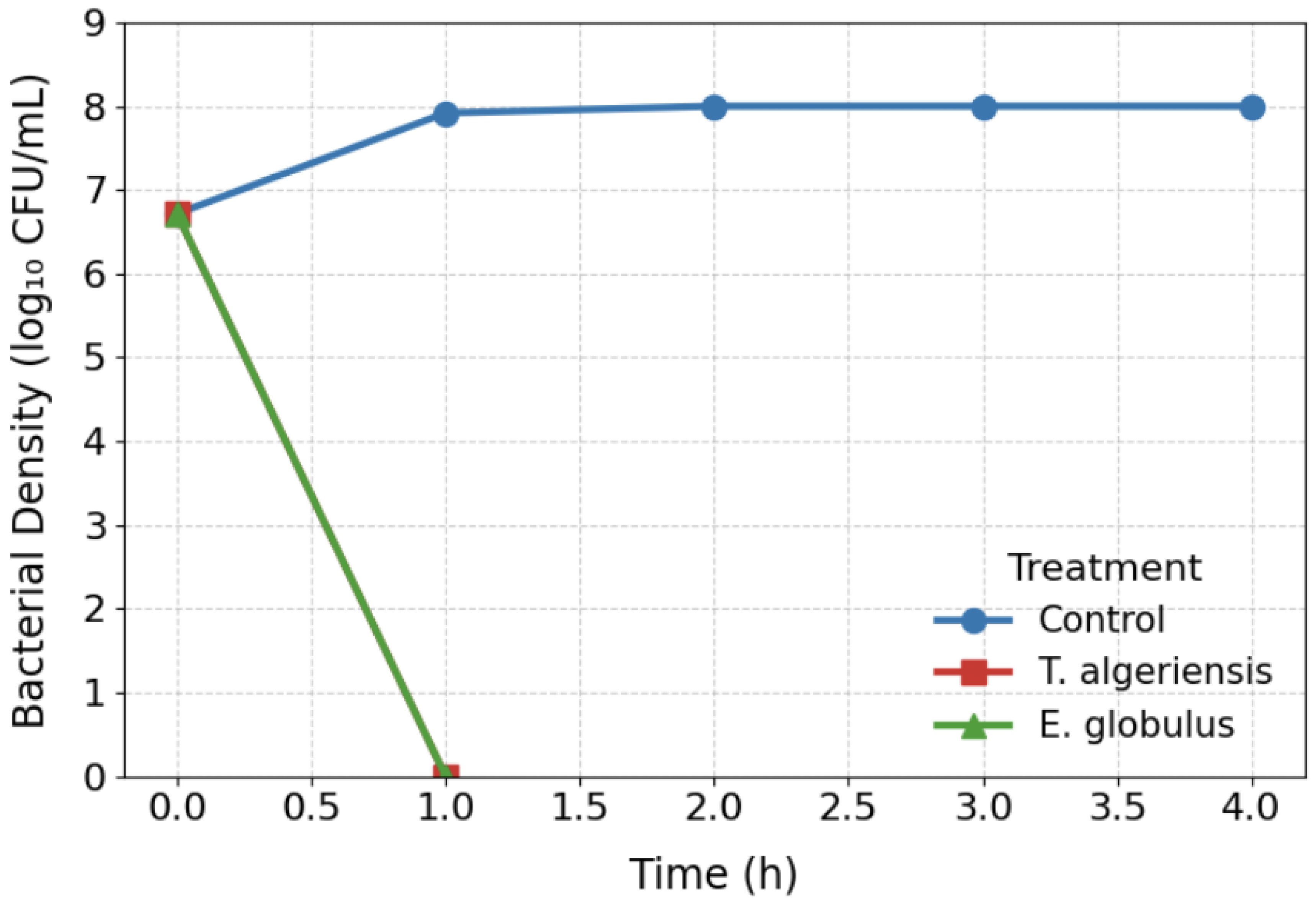
3.3. Time–Kill Kinetics
3.4. Cell Lysis Assay
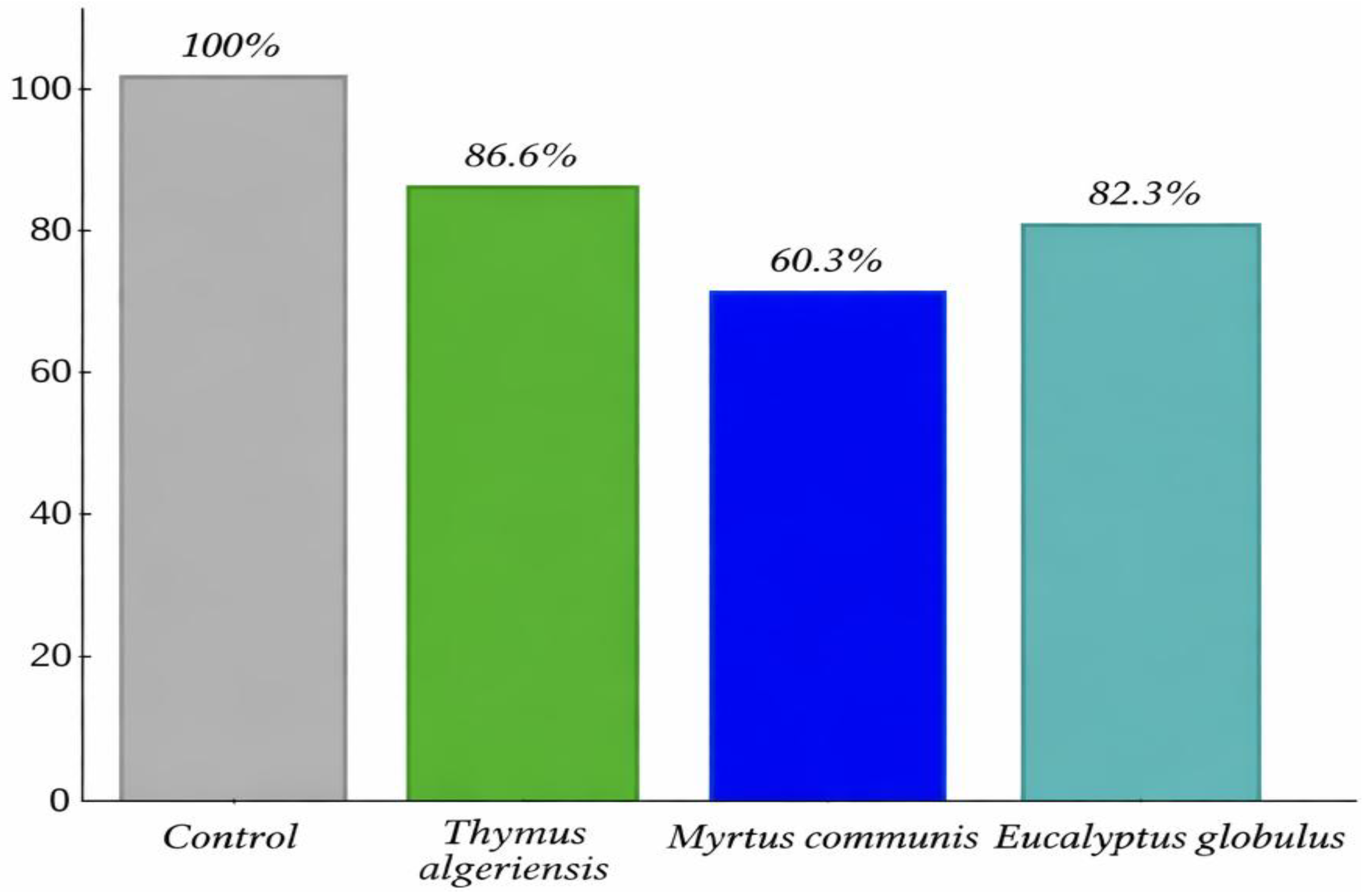
3.5. Effect on Salt Tolerance
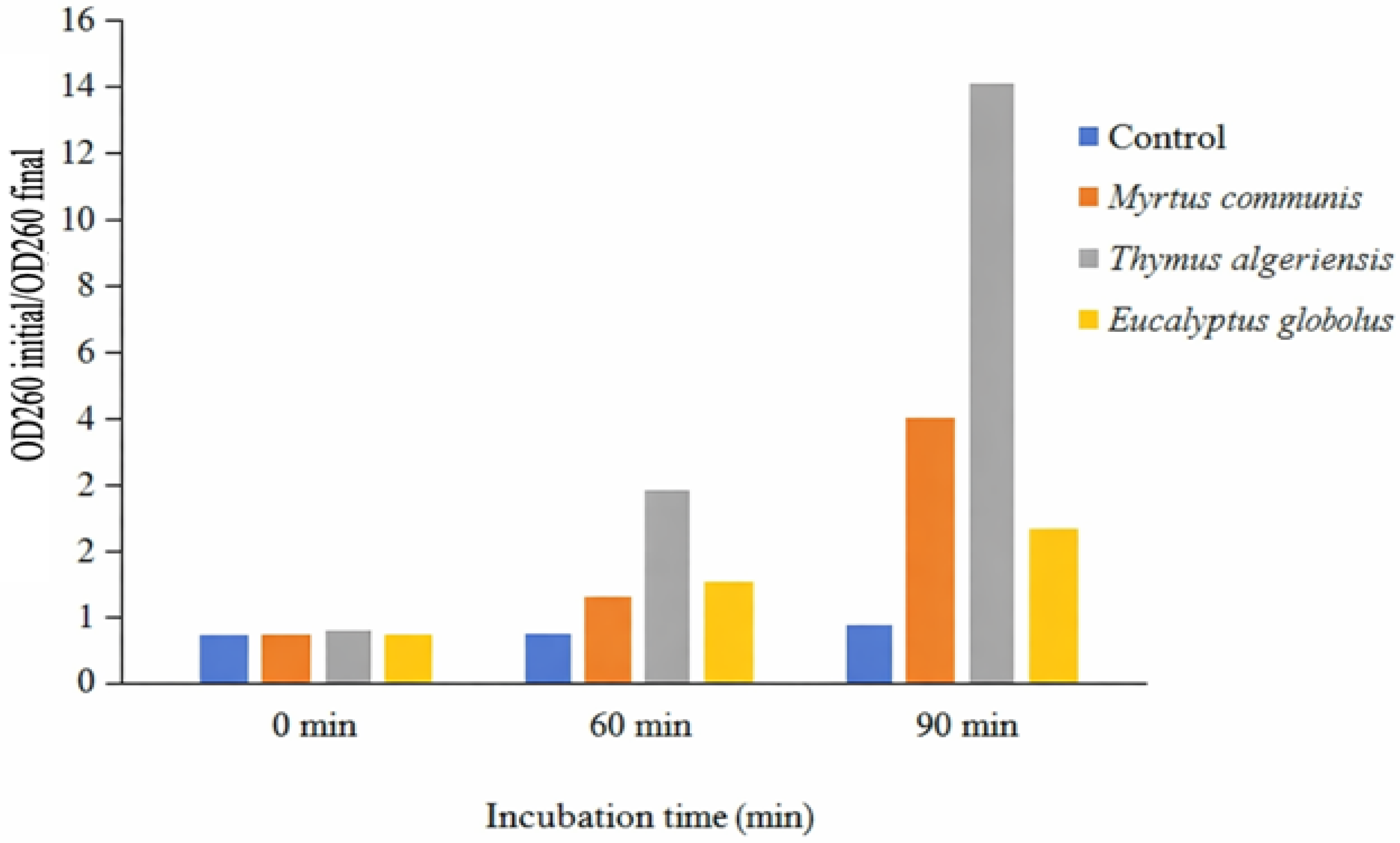
3.6. Membrane Integrity
4. Conclusions
Author Contributions
Funding
Institutional Review Board Statement
Informed Consent Statement
Data Availability Statement
Conflicts of Interest
Abbreviations
| MIC | Minimum Inhibitory Concentration |
| MBC | Minimum Bactericidal Concentration |
| EOs | Essential Oils |
References
- Kovačević, Z.; Čabarkapa, I.; Šarić, L.; Pajić, M.; Tomanić, D.; Kokić, B.; Božić, D.D. Natural solutions to antimicrobial resistance: The role of essential oils in poultry meat preservation with focus on Gram-negative bacteria. Foods 2024, 13, 3905. [Google Scholar] [CrossRef] [Scilit]
- Pires, H.M.; Bastos, L.M.; da Silva, E.F.; Fonseca, B.B.; Sommerfeld, S.; de Oliveira Junior, R.J.; Ribeiro, L.N.M. Antimicrobial activity of essential-oil-based nanostructured lipid carriers against Campylobacter Spp. isolated from chicken carcasses. Pharmaceutics 2024, 16, 922. [Google Scholar] [CrossRef] [Scilit]
- Aljazzar, A.; Abd El-Hamid, M.I.; El-Malt, R.M.S.; El-Gharreb, W.R.; Abdel-Raheem, S.M.; Ibrahim, A.M.; Abdelaziz, A.M.; Ibrahim, D. Prevalence and antimicrobial susceptibility of Campylobacter species with particular focus on the growth promoting, immunostimulant and anti-Campylobacter jejuni activities of eugenol and trans-cinnamaldehyde mixture in broiler Chickens. Animals 2022, 12, 905. [Google Scholar] [CrossRef] [Scilit] [PubMed]
- Sharafutdinov, I.; Linz, B.; Tegtmeyer, N.; Backert, S. Therapeutic and protective approaches to combat Campylobacter jejuni infections. Front. Pharmacol. 2025, 16, 1572616. [Google Scholar] [CrossRef] [Scilit] [PubMed]
- Micciche, A.; Rothrock, M.J., Jr.; Yang, Y.; Ricke, S.C. Essential oils as intervention strategies to reduce Campylobacter levels in food production systems. Front. Microbiol. 2019, 10, 1058. [Google Scholar] [CrossRef] [Scilit] [PubMed]
- Arsi, K.; Donoghue, A.M.; Venkitanarayanan, K.; Kollanoor-Johny, A.; Fanatico, A.C.; Blore, P.J.; Donoghue, D.J. The Efficacy of the natural plant extracts, thymol and carvacrol against Campylobacter colonization in broiler Chickens. J. Food Safety 2024, 34, 321–325. [Google Scholar] [CrossRef] [Scilit]
- Soulaimani, B. Comprehensive review of the combined antimicrobial activity of essential oil mixtures and synergism with conventional antimicrobials. Nat. Prod. Commun. 2025, 20, 1934578X251328241. [Google Scholar] [CrossRef] [Scilit]
- Kaakoush, N.O.; Castaño-Rodríguez, N.; Mitchell, H.M.; Man, S.M. Global epidemiology of Campylobacter infection. Clin. Microbiol. Rev. 2015, 28, 687–720. [Google Scholar] [CrossRef] [Scilit]
- Van Boeckel, T.P.; Brower, C.; Gilbert, M.; Grenfell, B.T.; Levin, S.A.; Robinson, T.P.; Teillant, A.; Laxminarayan, R. Global trends in antimicrobial use in food animals. Proc. Natl. Acad. Sci. USA 2015, 112, 5649–5654. [Google Scholar] [CrossRef] [Scilit]
- Burt, S. Essential oils: Their antibacterial properties and potential applications in foods: A review. Int. J. Food Microbiol. 2004, 94, 223–253. [Google Scholar] [CrossRef] [Scilit]
- Marchese, A.; Barbieri, R.; Coppo, E.; Orhan, I.E.; Daglia, M.; Nabavi, S.F.; Izadi, M.; Nabavi, S.M. Antimicrobial activity of essential oils: A review. Trends Food Sci. Technol. 2017, 61, 36–48. [Google Scholar]
- Lambert, R.J.W.; Skandamis, P.N.; Coote, P.J.; Nychas, G.J.E. Study of the MIC and mode of action of oregano essential oil, thymol and carvacrol. J. Appl. Microbiol. 2001, 91, 453–462. [Google Scholar] [CrossRef] [Scilit] [PubMed]
- Cristani, M.; D’Arrigo, M.; Mandalari, G.; Castelli, F.; Sarpietro, M.G.; Micieli, D.; Venuti, V.; Bisignano, G.; Saija, A.; Trombetta, D. Interaction of four monoterpenes contained in essential oils with model membranes: Implications for their antibacterial activity. J. Agric. Food Chem. 2007, 55, 6300–6308. [Google Scholar] [CrossRef] [Scilit] [PubMed]
- Ramić, D.; Bucar, F.; Kunej, U.; Dogša, I.; Klančnik, A.; Smole Možina, S. Antibiofilm potential of Lavandula preparations against Campylobacter jejuni. Appl. Environ. Microbiol. 2021, 87, e0109921. [Google Scholar] [CrossRef] [Scilit]
- Gahamanyi, N.; Song, D.G.; Cha, K.H.; Yoon, K.Y.; Mboera, L.E.G.; Matee, M.I.; Mutangana, D.; Amachawadi, R.G.; Komba, E.V.G.; Pan, C.H. Susceptibility of Campylobacter strains to selected natural products and frontline antibiotics. Antibiotics 2020, 9, 790. [Google Scholar] [CrossRef] [Scilit]
- Kurekci, C.; Padmanabha, J.; Bishop-Hurley, S.L.; Hassan, E.; Al Jassim, R.A.; McSweeney, C.S. Antimicrobial activity of essential oils and five terpenoid compounds against Campylobacter jejuni in pure and mixed culture experiments. Int. J. Food Microbiol. 2013, 166, 450–457. [Google Scholar] [CrossRef] [Scilit]
- Angelini, P. Plant-derived antimicrobials and their crucial role in combating antimicrobial resistance. Antibiotics 2024, 13, 746. [Google Scholar] [CrossRef] [Scilit]
- Dai, L.; Sahin, O.; Grover, M.; Zhang, Q. New and alternative strategies for the prevention, control, and treatment of antibiotic-resistant Campylobacter. Transl. Res. 2020, 223, 76–88. [Google Scholar] [CrossRef] [Scilit]
- Jubair, N.; Rajagopal, M.; Chinnappan, S.; Abdullah, N.B.; Fatima, A. Review on the antibacterial mechanism of plant-derived compounds against multidrug-resistant bacteria (MDR). Evid.-Based Complement. Altern. Med. 2021, 2021, 3663315. [Google Scholar] [CrossRef] [Scilit]
- Gharbi, M.; Kamoun, S.; Hkimi, C.; Ghedira, K.; Béjaoui, A.; Maaroufi, A. Relationships between virulence genes and antibiotic resistance phenotypes/genotypes in Campylobacter spp. isolated from layer hens and eggs in the North of Tunisia: Statistical and computational insights. Foods 2022, 11, 3554. [Google Scholar] [CrossRef] [Scilit]
- Gharbi, M.; Béjaoui, A.; Hamrouni, S.; Arfaoui, A.; Maaroufi, A. Persistence of Campylobacter spp. in poultry flocks after disinfection, virulence, and antimicrobial resistance traits of recovered isolates. Foods 2023, 12, 890. [Google Scholar] [CrossRef] [Scilit] [PubMed]
- Aouadhi, C.; Jouini, A.; Maaroufi, K.; Maaroufi, A. Antibacterial effect of eight essential oils against bacteria implicated in bovine mastitis and characterization of primary action mode of Thymus capitatus essential oil. Foods 2024, 13, 237. [Google Scholar] [CrossRef] [Scilit] [PubMed]
- Viljoen, A.; van Vuuren, S.; Ernst, E.; Klepser, M.; Demirci, B.; Başer, H.; van Wyk, B.E. Osmitopsis asteriscoides (Asteraceae)-the antimicrobial activity and essential oil composition of a Cape-Dutch remedy. J. Ethnopharmacol. 2003, 88, 137–143. [Google Scholar] [CrossRef] [Scilit] [PubMed]
- Guinoiseau, E.; Luciani, A.; de Rocca Serra, D.; Quilichini, Y.; Berti, L.; Lorenzi, V. Primary mode of action of Cistus ladaniferus L. essential oil active fractions on Staphyloccocus aureus strain. Adv. Microbiol. 2015, 5, 881–890. [Google Scholar] [CrossRef]
- Carson, C.F.; Mee, B.J.; Riley, T.V. Mechanism of action of Melaleuca alternifolia (Tea Tree) oil on Staphylococcus aureus determined by time-kill, lysis, leakage, and salt tolerance assays. J. Antimicrob. Chemother. 2002, 50, 195–201. [Google Scholar]
- Shapiro, S.S.; Wilk, M.B. An analysis of variance test for normality (complete samples). Biometrika 1965, 52, 591–611. [Google Scholar] [CrossRef] [Scilit]
- Levene, H. Robust tests for equality of variances. In Contributions to Probability and Statistics: Essays in Honor of Harold Hotelling; Stanford University Press: Stanford, CA, USA, 1960; pp. 278–292. [Google Scholar]
- Tukey, J.W. Comparing individual means in the analysis of variance. Biometrics 1949, 5, 99–114. [Google Scholar] [CrossRef] [Scilit]
- Falleh, H. Demystifying the power of essential oils: A review of their antibacterial properties and potential as natural food preservatives. EXCLI J. 2025, 24, 828–850. [Google Scholar]
- Kalemba, D.; Kunicka, A. Antibacterial and antifungal properties of essential oils. Curr. Med. Chem. 2003, 10, 813–829. [Google Scholar] [CrossRef] [Scilit]
- da Silva, A.T.; Cândido, A.E.C.M.; Júnior, E.D.C.M.; do É., G.N.; Moura, M.P.S.; Souza, R.F.S.; Guimarães, M.L.; Peixoto, R.M.; de Oliveira, H.P.; da Costa, M.M. Bactericidal and synergistic effects of Lippia origanoides essential oil and its main constituents against multidrug-resistant strains of Acinetobacter baumannii. ACS Omega 2024, 9, 43927–43939. [Google Scholar] [CrossRef] [Scilit]
- Yasir, M.; Nawaz, A.; Ghazanfar, S.; Okla, M.K.; Chaudhary, A.; Al, W.H.; Ajmal, M.N.; AbdElgawad, H.; Ahmad, Z.; Abbas, F.; et al. Anti-bacterial activity of essential oils against multidrug-resistant foodborne pathogens isolated from raw milk. Braz. J. Biol. 2022, 84, e259449. [Google Scholar] [CrossRef] [Scilit]
- Ozogul, Y.; Kuley, E.; Ucar, Y.; Ozogul, F. Antimicrobial impacts of essential oils on food borne-pathogens. Recent Pat. Food Nutr. Agric. 2015, 7, 53–61. [Google Scholar] [CrossRef] [Scilit]
- da Silva, E.F.; Bastos, L.M.; Fonseca, B.B.; Ribas, R.M.; Sommerfeld, S.; Pires, H.M.; Dos Santos, F.A.L.; Ribeiro, L.N.M. Lipid nanoparticles based on natural matrices with activity against multidrug resistant bacterial species. Front. Cell. Infect Microbiol. 2024, 13, 1328519. [Google Scholar] [CrossRef] [Scilit]
- Álvarez-Martínez, F.J.; Barrajón-Catalán, E.; Herranz-López, M.; Micol, V. Antibacterial plant compounds, extracts and essential oils: An updated review on their effects and putative mechanisms of action. Phytomedicine 2021, 90, 153626. [Google Scholar] [CrossRef] [Scilit] [PubMed]
- Friedman, M.; Henika, P.R.; Mandrell, R.E. Bactericidal activities of plant essential oils and some of their isolated constituents against Campylobacter jejuni, Escherichia coli, Listeria monocytogenes, and Salmonella enterica. J. Food Prot. 2002, 65, 1545–1560. [Google Scholar] [CrossRef] [Scilit] [PubMed]
- Dedieu, L.; Brunel, J.M.; Lorenzi, V.; Muselli, A.; Berti, L.; Bolla, J.M. Antibacterial mode of action of the Daucus carota essential oil active compounds against Campylobacter jejuni and efflux-mediated drug resistance in Gram-negative bacteria. Molecules 2020, 25, 5448. [Google Scholar] [CrossRef] [Scilit] [PubMed]
- Mutlu-Ingok, A.; Karbancioglu-Guler, F. Cardamom, cumin, and dill weed essential oils: Chemical compositions, antimicrobial activities, and mechanisms of action against Campylobacter spp. Molecules 2017, 22, 1191. [Google Scholar] [CrossRef] [Scilit]
- Bakkali, F.; Averbeck, S.; Averbeck, D.; Idaomar, M. Biological effects of essential oils: A review. Food Chem. Toxicol. 2008, 46, 446–475. [Google Scholar] [CrossRef] [Scilit]



| Strains | Species | Phenotype of Resistance | Resistance Genes Detected |
|---|---|---|---|
| I208E17P48 | C. jejuni | Amp, Amc, Cip, Chl, Nal, Ery, Tet, Chl, Lin | tet(O), cmeB, blaOXA-61, 23S rRNA, gyrA, fexB, optrA, aac(6′)-Ib-cr, blaVIM, blaOXA-48, NDM |
| I201E17P48 | C. jejuni | Amp, Amc, Cip, Chl, Nal, Ery, Tet, Chl, Lin | tet(O), cmeB, blaOXA-61, 23S rRNA, gyrA, blaVIM, aac(6′)-Ib-cr, blaOXA-48 |
| I245E17P48 | C. jejuni | Amp, Amc, Cip, Chl, Nal, Ery, Tet, Chl, Lin | tet(O), cmeB, blaOXA-61, 23SrRNA, gyrA, blaVIM, aac(6′)-Ib-cr, blaOXA-48 |
| I255E17P48 | C. jejuni | Amp, Amc, Cip, Chl, Nal, Ery, Tet, Chl, Lin | tet(O), cmeB, blaOXA-61, 23SrRNA, gyrA, blaVIM, aac(6′)-Ib-cr, blaNDM |
| I260E17P48 | C. jejuni | Amp, Amc, Cip, Chl, Nal, Ery, Tet, Chl, Lin | tet(O), cmeB, blaOXA-61, 23SrRNA, gyrA, blaVIM, aac(6′)-Ib-cr, blaNDM |
| I1E17P1 | C. coli | Amp, Cip, Chl, Ery, Tet, Chl, Gen | tet(O), cmeB, blaOXA-61, 23SrRNA, gyrA, blaVIM, aac(6′)-Ib, blaNDM |
| I267E30D10 | C. coli | Amc, Cip, Chl, Nal, Ery, Tet, Chl, Lin | tet(O), cmeB, blaOXA-61, 23S rRNA, gyrA, blaVIM, aac(6′)-Ib-cr, blaOXA-48, blaNDM |
| I234E30A12 | C. coli | Amp, Amc, Cip, Chl, Nal, Ery, Tet, Chl, Lin | tet(O), cmeB, blaOXA-61, 23S rRNA, gyrA, blaVIM, aac(6′)-Ib, blaNDM |
| I179E17P19 | C. coli | Amp, Amc, Cip, Chl, Ery, Tet, Chl, Lin | tet(O), cmeB, blaOXA-61, 23S rRNA, gyrA, blaVIM, aac(6′)-Ib, blaNDM |
| I292E21P2 | C. coli | Amp, Amc, Cip, Chl, Nal, Ery, Tet, Chl, Lin | tet(O), cmeB, blaOXA-61, 23S rRNA, gyrA, blaVIM, aac(6′)-Ib-cr, blaNDM |
| EOs | C. jejuni | C. coli |
|---|---|---|
| C. citratus | 6.0 ± 0.0 d | 28.6 ± 0.3 b |
| M. pulegium | 6.0 ± 0.0 d | 31.0 ± 0.2 b |
| A. absinthium | 18.3 ± 0.6 c | 37.6 ± 0.6 a |
| M. communis | 25.0 ± 0.5 b | 29.6 ± 0.3 b |
| T. algeriensis | 29.3 ± 0.3 b | 29.3 ± 0.5 b |
| T. capitatus | 20.3 ± 0.7 c | 31.3 ± 0.4 b |
| E. globulus | 34.6 ± 0.4 a | 23.3 ± 0.6 c |
| ERY | 6.0 ± 0.0 d | 6.0 ± 0.0 d |
| Tested Campylobacter Species | Essential oils | |||||
|---|---|---|---|---|---|---|
| E. globulus | T. capitatus | T. algeriensis | M. communis | A. absinthium | M. pulegium | |
| MIC (% v/v) | ||||||
| C. jejuni | 3.13 ± 0.0 b | 25.0 ± 0.0 a | 6.25 ± 0.0 b | 6.25 ± 0.0 b | 25.0 ± 0.0 a | – |
| C. coli | 12.5 ± 0.0 a | 50.0 ± 0.0 a | 25.0 ± 0.0 a | 25.0 ± 0.0 a | – | 12.5 ± 0.0 a |
| MBC (% v/v) | ||||||
| C. jejuni | 1.56 ± 0.0 b | 12.5 ± 0.0 a | 3.13 ± 0.0 b | 3.13 ± 0.0 b | 12.5 ± 0.0 a | – |
| C. coli | 6.25 ± 0.0 a | 25.0 ± 0.0 a | 12.5 ± 0.0 a | 12.5 ± 0.0 a | – | 6.25 ± 0.0 a |
| NaCl (%) | Control | Essential oils | ||
|---|---|---|---|---|
| M. communis | T. algeriensis | E. globulus | ||
| 0.0 | 100.0 ± 0.0 a | 66.4 ± 1.3 b | 67.4 ± 0.8 b | 1.0 ± 0.2 c |
| 2.5 | 91.2 ± 0.6 a | 58.4 ± 0.9 b | 66.4 ± 1.1 b | 0.8 ± 0.1 c |
Disclaimer/Publisher’s Note: The statements, opinions and data contained in all publications are solely those of the individual author(s) and contributor(s) and not of MDPI and/or the editor(s). MDPI and/or the editor(s) disclaim responsibility for any injury to people or property resulting from any ideas, methods, instructions or products referred to in the content. |
© 2026 by the authors. Licensee MDPI, Basel, Switzerland. This article is an open access article distributed under the terms and conditions of the Creative Commons Attribution (CC BY) license.
Share and Cite
Gharbi, M.; Aouadhi, C.; Hamdi, C.; Hamrouni, S.; Maaroufi, A. Natural Essential Oils as Promising Antimicrobial Agents to Improve Food Safety: Mechanistic Insights Against Multidrug-Resistant Campylobacter jejuni and Campylobacter coli Isolated from Tunisia. Foods 2026, 15, 308. https://doi.org/10.3390/foods15020308
Gharbi M, Aouadhi C, Hamdi C, Hamrouni S, Maaroufi A. Natural Essential Oils as Promising Antimicrobial Agents to Improve Food Safety: Mechanistic Insights Against Multidrug-Resistant Campylobacter jejuni and Campylobacter coli Isolated from Tunisia. Foods. 2026; 15(2):308. https://doi.org/10.3390/foods15020308
Chicago/Turabian StyleGharbi, Manel, Chedia Aouadhi, Chadlia Hamdi, Safa Hamrouni, and Abderrazak Maaroufi. 2026. "Natural Essential Oils as Promising Antimicrobial Agents to Improve Food Safety: Mechanistic Insights Against Multidrug-Resistant Campylobacter jejuni and Campylobacter coli Isolated from Tunisia" Foods 15, no. 2: 308. https://doi.org/10.3390/foods15020308
APA StyleGharbi, M., Aouadhi, C., Hamdi, C., Hamrouni, S., & Maaroufi, A. (2026). Natural Essential Oils as Promising Antimicrobial Agents to Improve Food Safety: Mechanistic Insights Against Multidrug-Resistant Campylobacter jejuni and Campylobacter coli Isolated from Tunisia. Foods, 15(2), 308. https://doi.org/10.3390/foods15020308