Physicochemical Properties and Consumer Acceptance of Yak Mozzarella Cheese Produced by Culture Acidification and Direct Acidification
 ,
, 
Abstract
1. Introduction
2. Materials and Methods
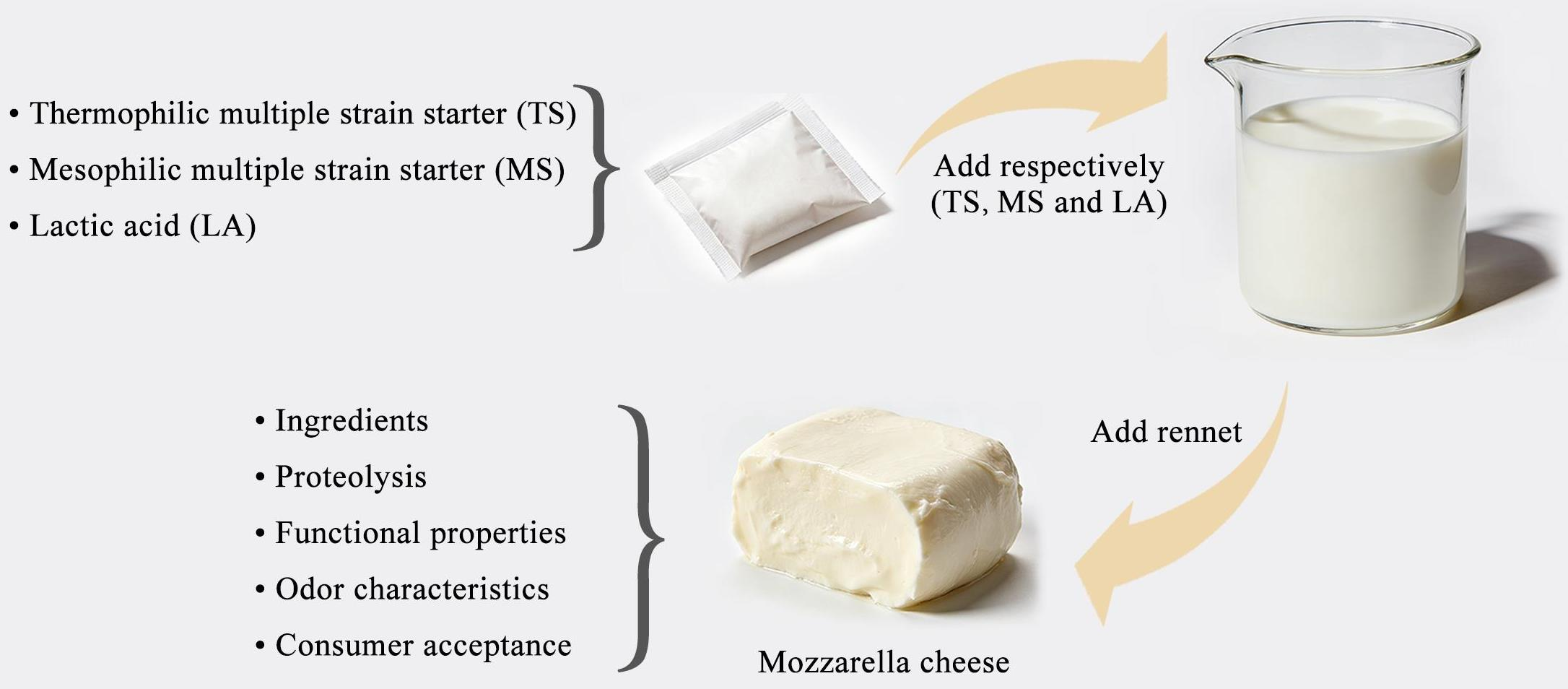
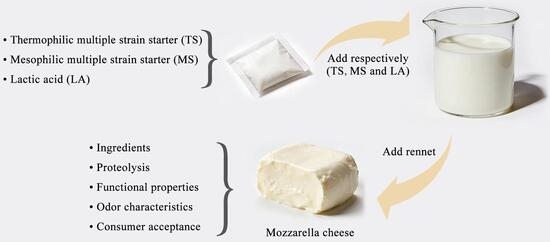
2.1. Yak Mozzarella Cheese Preparation
2.2. Physicochemical Characteristics and Proteolysis Determination
2.3. Cheese Functional Properties and Texture Profile Analysis (TPA)
2.3.1. Stretchability
2.3.2. Meltability
2.3.3. TPA
2.4. Volatile Organic Compounds (VOC) Analysis and Consumer Acceptance Test
2.5. Statistical Analysis
3. Results
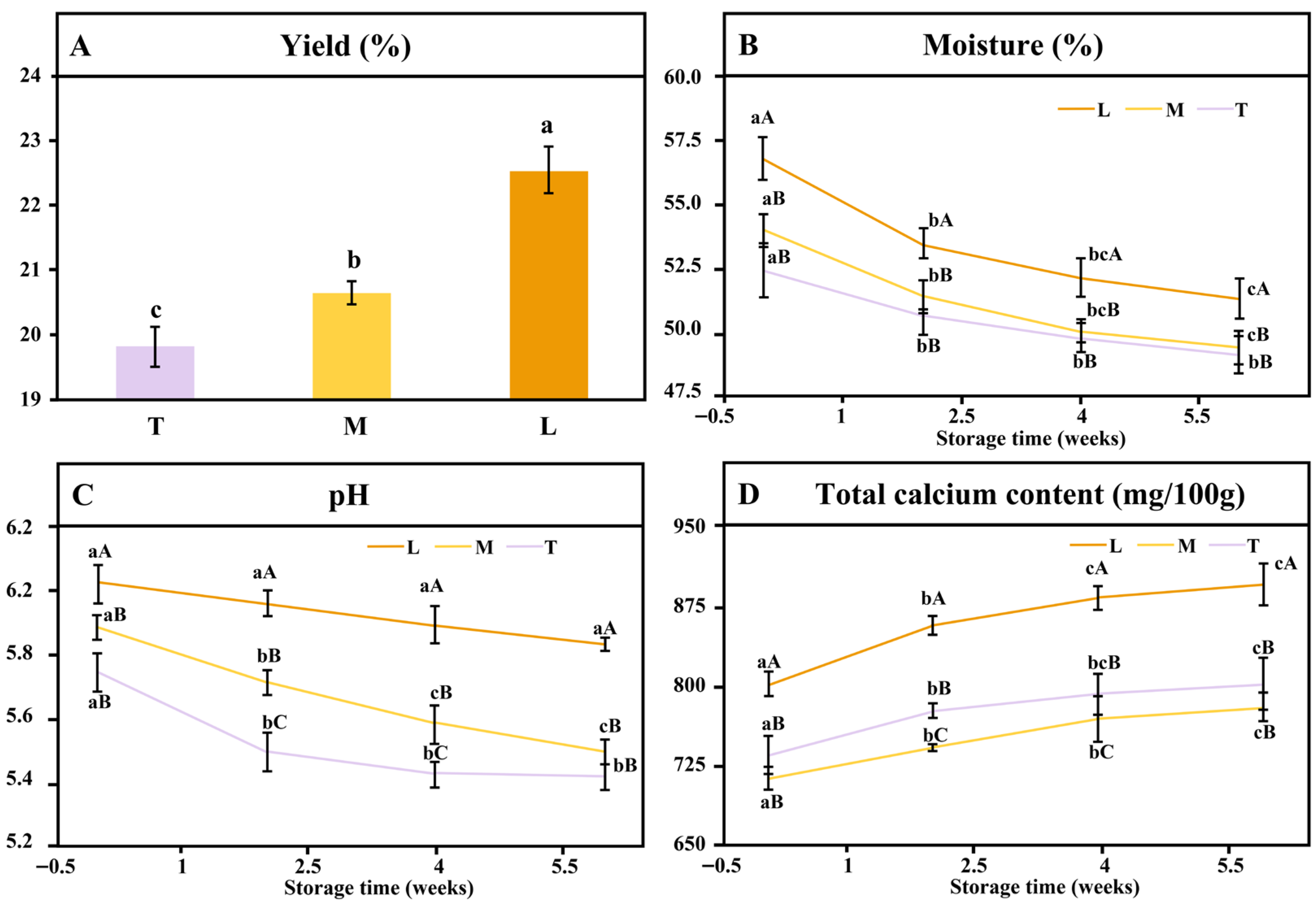
3.1. Composition of Yak Mozzarella Cheese
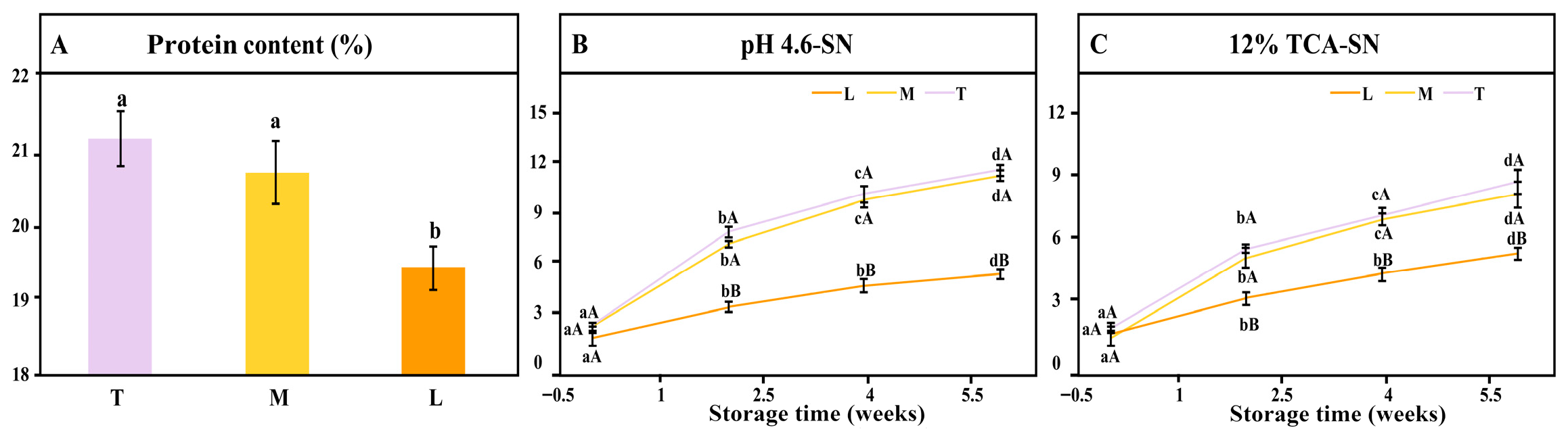
3.2. Proteolysis of Yak Mozzarella Cheese During Ripening
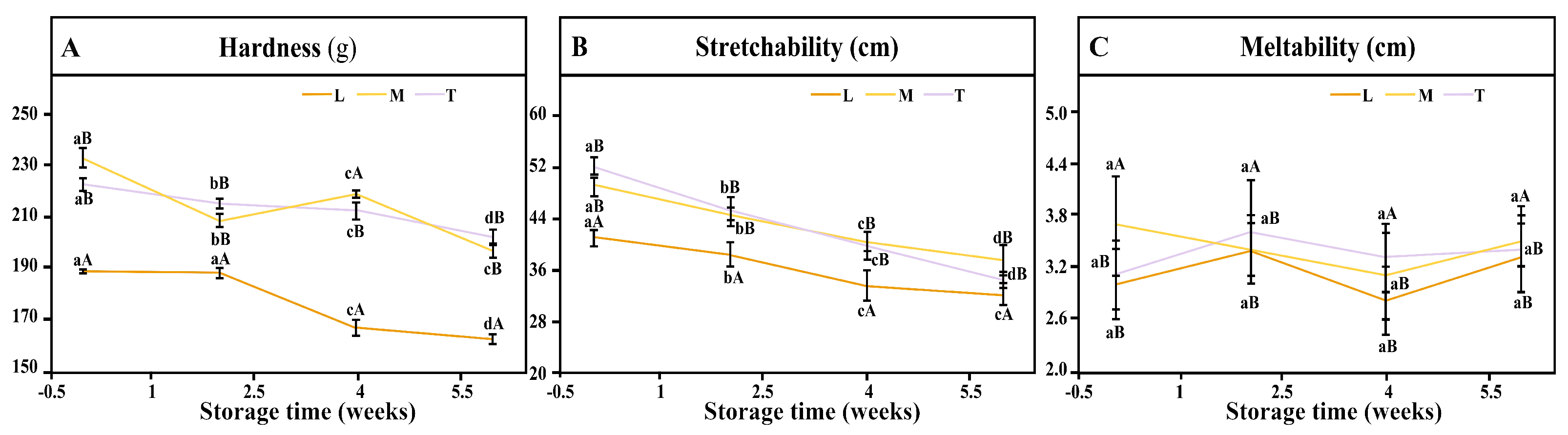
3.3. Cheese Functional Properties and Texture Profiles
3.3.1. Hardness
3.3.2. Stretchability and Meltability
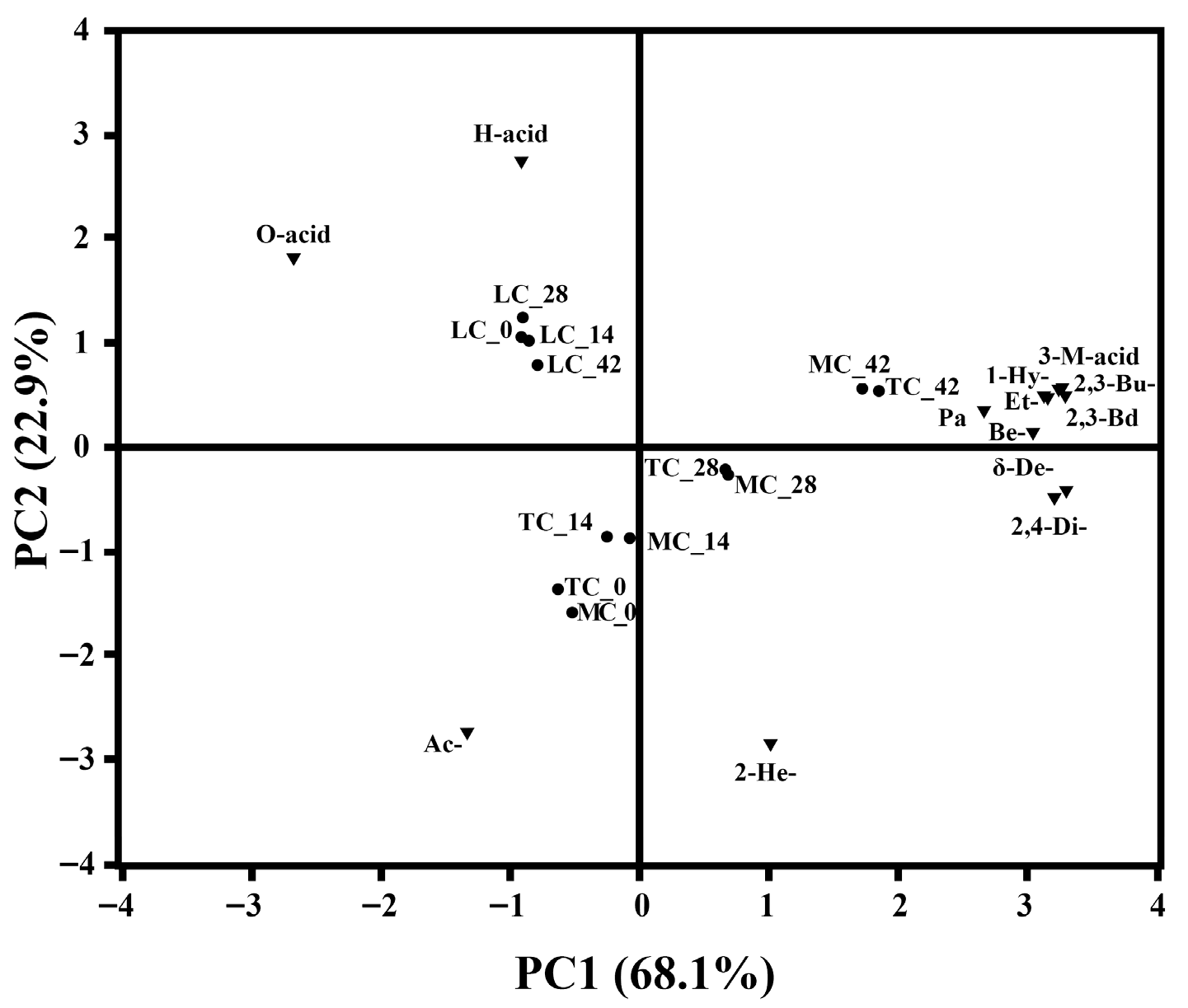
3.4. VOC Profile of Yak Mozzarella Cheeses
3.5. Consumer Acceptance
4. Conclusions
Author Contributions
Funding
Institutional Review Board Statement
Informed Consent Statement
Data Availability Statement
Conflicts of Interest
Abbreviations
| TS | Thermophilic multiple strain starter |
| MS | Mesophilic multiple strain starter |
| LA | Lactic acid |
References
- Dan, T.; Jin, R.; Ren, W.; Li, T.; Chen, H.; Sun, T. Characteristics of milk fermented by Streptococcus thermophilus MGA45-4 and the profiles of associated volatile compounds during fermentation and storage. Molecules 2018, 23, 878. [Google Scholar] [CrossRef]
- Zhang, Y.; Ren, F.; Wang, P.; Liang, Q.; Peng, Y.; Song, L.; Wen, P. The influence of yak casein micelle size on rennet-induced coagulation properties. J. Sci. Food Agric. 2021, 101, 327–333. [Google Scholar] [CrossRef]
- Wang, D.; Zhou, Y.; Zheng, X.; Guo, J.; Duan, H.; Zhou, S.; Yan, W. Yak milk: Nutritional value, functional activity, and current applications. Foods 2023, 12, 2090. [Google Scholar] [CrossRef]
- Mi, L.; Liang, Q.; Zhang, W.; Zhen, S.; Song, X.; Wen, P.; Zhang, Y. Sterilization of yak milk by direct steam injection (DSI) and effects on milk quality. LWT 2023, 189, 115450. [Google Scholar] [CrossRef]
- Lin, X.; Zhang, Q.; Wu, Q.; Huo, W.; Zhang, X. Exploring the acceptance of mozzarella cheese in school lunches among school-aged children: A pilot study. Front. Nutr. 2025, 12, 1495180. [Google Scholar] [CrossRef]
- Zhang, M.; Zhang, Z.; Qiao, H.; Weng, P.; Wang, Y.; Song, X.; Zhang, Y.; Zhang, W. Quality characteristics during ripening of mozzarella cheese made from yak milk harvested in different seasons. Food Ferment. Ind. 2023, 49, 85–92. [Google Scholar]
- Kumar, S.; Kanawjia, S.K.; Kumar, S.; Khatkar, S. Effect of rate of addition of starter culture on textural characteristics of buffalo milk feta type cheese during ripening. J. Food Sci. Technol. 2014, 51, 800–804. [Google Scholar] [CrossRef] [PubMed]
- Ah, J.; Tagalpallewar, G.P. Functional properties of mozzarella cheese for its end use application. J. Food Sci. Technol. 2017, 54, 3766–3778. [Google Scholar] [CrossRef] [PubMed]
- Faccia, M.; Trani, A.; Di Luccia, A. Relationships between milk quality and acidification in the production of table mozzarella without starters. J. Dairy Sci. 2009, 92, 4211–4217. [Google Scholar] [CrossRef] [PubMed]
- Soni, R.; Jain, N.K.; Shah, V.; Soni, J.; Suthar, D.; Gohel, P. Development of probiotic yogurt: Effect of strain combination on nutritional, rheological, organoleptic and probiotic properties. J. Food Sci. Technol. 2020, 57, 2038–2050. [Google Scholar] [CrossRef]
- Rehman, R.; Wang, Y.; Wang, J.; Geng, W. Physicochemical analysis of mozzarella cheese produced and developed by the novel EPS-producing strain Lactobacillus Kefiranofaciens ZW3. Int. J. Dairy Technol. 2018, 71, 90–98. [Google Scholar] [CrossRef]
- Natrella, G.; Faccia, M.; Lorenzo, J.M.; Palo, P.D.; Gambacorta, G. Short communication: Sensory characteristics and volatile organic compound profile of high-moisture mozzarella made by traditional and direct acidification technology. J. Dairy Sci. 2020, 103, 2089–2097. [Google Scholar] [CrossRef]
- Wang, J.; Zhao, W.; Guo, S.; Sun, Y.; Yao, K.; Liu, Z.; Sun, Z.; Kwok, L.Y.; Peng, C. Different growth behaviors and metabolomic profiles in yogurts induced by multistrain probiotics of Lactobacillus casei Zhang and Bifidobacterium Lactis V9 under different fermentation temperatures. J. Dairy Sci. 2021, 104, 10528–10539. [Google Scholar] [CrossRef] [PubMed]
- Li, L.; Liu, J.; Wang, D.; Kwok, L.Y.; Li, B.; Guo, S.; Chen, Y. Enhancing storage stability, antihypertensive properties, flavor and functionality of fermented milk through co-fermentation with Lactobacillus helveticus h11 adjunct culture. Food Chem. 2025, 470, 142574. [Google Scholar] [CrossRef] [PubMed]
- Yamamoto, E.; Watanabe, R.; Ichimura, T.; Ishida, T.; Kimura, K. Effect of lactose hydrolysis on the milk-fermenting properties of Lactobacillus delbrueckii ssp. Bulgaricus 2038 and Streptococcus thermophilus 1131. J. Dairy Sci. 2021, 104, 1454–1464. [Google Scholar] [CrossRef] [PubMed]
- Afzal, M.I.; Ariceaga, C.C.G.; Boulahya, K.A.; Jacquot, M.; Delaunay, S.; Cailliez-Grimal, C. Biosynthesis and role of 3-methylbutanal in cheese by lactic acid bacteria: Major metabolic pathways, enzymes involved, and strategies for control. Crit. Rev. Food Sci. Nutr. 2017, 57, 399–406. [Google Scholar] [CrossRef]
- Chen, J.; Shen, J.; Ingvar Hellgren, L.; Ruhdal Jensen, P.; Solem, C. Adaptation of Lactococcus lactis to high growth temperature leads to a dramatic increase in acidification rate. Sci. Rep. 2015, 5, 14199. [Google Scholar] [CrossRef]
- Akarca, G.; Atik, A.; Atik, İ.; Denizkara, A.J. A comparison study on functional and textural properties of mozzarella cheeses made from bovine and buffalo milks using different starter cultures. Int. Dairy J. 2023, 141, 105622. [Google Scholar] [CrossRef]
- GB 5009.3-2016; National Food Safety Standard—Determination of Moisture Content in Foods. National Standard of the People’s Republic of China: Beijing, China, 2016.
- GB 5009.5-2016; National Food Safety Standard—Determination of Protein in Foods. National Standard of the People’s Republic of China: Beijing, China, 2016.
- GB 5009.92-2016; National Food Safety Standard—Determination of Calcium in Foods. National Standard of the People’s Republic of China: Beijing, China, 2016.
- To, C.M.; Kerkaert, B.; Bossier, S.; Van Gaver, D. Effects of reducing milk pH to 6.2 by CO2 injection or by addition of lactic acid on the biochemical and functional properties of commercial low-moisture part-skim mozzarella. Int. Dairy J. 2022, 129, 105341. [Google Scholar] [CrossRef]
- Ye, A.; Hewitt, S.; Taylor, S. Characteristics of rennet-casein-based model processed cheese containing maize starch: Rheological properties, meltabilities and microstructures. Food Hydrocoll. 2009, 23, 1220–1227. [Google Scholar] [CrossRef]
- Natrella, G.; Gambacorta, G.; Faccia, M. An attempt at producing a “lactose-free” directly acidified mozzarella (high moisture type) by curd washing and pressing: A chemical and sensory study. Int. Dairy J. 2023, 136, 105499. [Google Scholar] [CrossRef]
- Zhang, J.; Yang, M.; Cai, D.; Hao, Y.; Zhao, X.; Zhu, Y.; Zhu, H.; Yang, Z. Composition, coagulation characteristics, and cheese making capacity of yak milk. J. Dairy Sci. 2020, 103, 1276–1288. [Google Scholar] [CrossRef]
- Johnson, M.E.; Lucey, J.A. Calcium: A key factor in controlling cheese functionality. Aust. J. Dairy Technol. 2006, 61, 147–153. [Google Scholar]
- Choi, J.; Horne, D.S.; Johnson, M.E.; Lucey, J.A. Effects of the concentration of insoluble calcium phosphate associated with casein micelles on the functionality of directly acidified cheese. J. Dairy Sci. 2008, 91, 513–522. [Google Scholar] [CrossRef] [PubMed]
- Makhal, S.; Kanawjia, S.K.; Giri, A. A dual-acidification process for the manufacture of direct-acidified cottage cheese. Int. J. Dairy Technol. 2013, 66, 552–561. [Google Scholar] [CrossRef]
- Ayesha, S.; Anjum, F.; Huma, N.; Haq, N. Quality evaluation of mozzarella cheese from different milk sources. J. Nutr. 2008, 7, 753–756. [Google Scholar]
- Silva, L.F.; Sunakozawa, T.N.; Amaral, D.M.F.; Casella, T.; Nogueira, M.C.L.; De Dea Lindner, J.; Bottari, B.; Gatti, M.; Penna, A.L.B. Safety and technological application of autochthonous Streptococcus thermophilus cultures in the buffalo Mozzarella cheese. Food Microbiol. 2020, 87, 103383. [Google Scholar] [CrossRef]
- Iyer, R.; Tomar, S.K.; Kapila, S.; Mani, J.; Singh, R. Probiotic properties of folate producing Streptococcus thermophilus strains. Food Res. Int. 2010, 43, 103–110. [Google Scholar] [CrossRef]
- Liu, K.; Zeng, X.; Qiao, L.; Li, X.; Yang, Y.; Dai, C.; Hou, A.; Xu, D. The sensitivity and significance analysis of parameters in the model of pH regulation on lactic acid production by Lactobacillus bulgaricus. BMC Bioinf. 2014, 15, S5. [Google Scholar] [CrossRef] [PubMed]
- Thybo, C.D.; Lillevang, S.K.; Skibsted, L.H.; Ahrné, L. Calcium balance during direct acidification of milk for mozzarella cheese production. LWT 2020, 131, 109677. [Google Scholar] [CrossRef]
- Rajani, B.; Jana, A.H.; Bihola, A.; Adil, S. Changes in physico-chemical and functional properties of pizza cheeses made using ‘dual acidification’ method during refrigerated storage. Discov. Food 2024, 4, 157. [Google Scholar] [CrossRef]
- Lucey, J.A.; Mishra, R.; Hassan, A.; Johnson, M.E. Rheological and calcium equilibrium changes during the ripening of cheddar cheese. Int. Dairy J. 2005, 15, 645–653. [Google Scholar] [CrossRef]
- Banville, V.; Morin, P.; Pouliot, Y.; Britten, M. Physical properties of pizza mozzarella cheese manufactured under different cheese-making conditions. J. Dairy Sci. 2013, 96, 4804–4815. [Google Scholar] [CrossRef]
- Kethireddipalli, P.; Hill, A.R. Rennet coagulation and cheesemaking properties of thermally processed milk: Overview and recent developments. J. Agric. Food Chem. 2015, 63, 9389–9403. [Google Scholar] [CrossRef] [PubMed]
- To, C.M.; Vermeir, L.; Kerkaert, B.; Van Gaver, D.; Van der Meeren, P.; Guinee, T.P. Seasonal variations in the functional performance of industrial low-moisture part-skim mozzarella over a 1.5-year period. J. Dairy Sci. 2020, 103, 11163–11177. [Google Scholar] [CrossRef] [PubMed]
- Kieliszek, M.; Pobiega, K.; Piwowarek, K.; Kot, A.M. Characteristics of the proteolytic enzymes produced by lactic acid bacteria. Molecules 2021, 26, 1858. [Google Scholar] [CrossRef]
- Fox, P.F.; Cogan, T.M. Factors that affect the quality of cheese. In Cheese: Chemistry, Physics and Microbiology; Academic Press: Cambridge, MA, USA, 2004; Volume 1, pp. 583–608. [Google Scholar]
- Ozcan, T.; Kurdal, E. The effects of using a starter culture, lipase, and protease enzymes on ripening of Mihalic cheese. Int. J. Dairy Technol. 2012, 65, 585–593. [Google Scholar] [CrossRef]
- Feeney, E.P.; Guinee, T.P.; Fox, P.F. Effect of ph and calcium concentration on proteolysis in mozzarella cheese. J. Dairy Sci. 2002, 85, 1646–1654. [Google Scholar] [CrossRef]
- Guinee, T.P.; Feeney, E.P.; Auty, M.A.E.; Fox, P.F. Effect of pH and calcium concentration on some textural and functional properties of mozzarella cheese. J. Dairy Sci. 2002, 85, 1655–1669. [Google Scholar] [CrossRef]
- Bähler, B.; Kunz, A.; Hinrichs, J. Hot Brining of Pasta Filata Cheese: Effect of sodium and calcium chloride on composition, yield, and hardness. Dairy Sci. Technol. 2016, 96, 703–714. [Google Scholar] [CrossRef]
- Diezhandino Hernández, I.; Fernández, D.; Combarros Fuertes, P.; Renes Bañuelos, E.; Fresno Baro, J.M.; Tornadijo Rodríguez, M.E. Characteristics and proteolysis of a Spanish blue cheese made with raw or pasteurised milk. Int. J. Dairy Technol. 2022, 75, 630–642. [Google Scholar] [CrossRef]
- Dave, R.I.; McMahon, D.J.; Oberg, C.J.; Broadbent, J.R. Influence of coagulant level on proteolysis and functionality of mozzarella cheeses made using direct acidification. J. Dairy Sci. 2003, 86, 114–126. [Google Scholar] [CrossRef]
- Dong, J.Y.; Chen, L.J.; Maubois, J.L.; Ma, Y. Influence of medium-concentration factor microfiltration treatment on the characteristics of low-moisture mozzarella cheese. Dairy Sci. Technol. 2009, 89, 139–154. [Google Scholar] [CrossRef]
- Oommen, B.S.; McMahon, D.J.; Oberg, C.J.; Broadbent, J.R.; Strickland, M. Proteolytic specificity of Lactobacillus delbrueckii subsp. bulgaricus influences functional properties of mozzarella cheese. J. Dairy Sci. 2002, 85, 2750–2758. [Google Scholar] [CrossRef] [PubMed]
- O’Mahony, J.A.; McSweeney, P.L.H.; Lucey, J.A. A Model system for studying the effects of colloidal calcium phosphate concentration on the rheological properties of cheddar cheese. J. Dairy Sci. 2006, 89, 892–904. [Google Scholar] [CrossRef]
- Jia, R.; Zhang, F.; Song, Y.; Lou, Y.; Zhao, A.; Liu, Y.; Peng, H.; Hui, Y.; Ren, R.; Wang, B. Physicochemical and textural characteristics and volatile compounds of semihard goat cheese as affected by starter cultures. J. Dairy Sci. 2021, 104, 270–280. [Google Scholar] [CrossRef]
- Joshi, N.S.; Muthukumarappan, K.; Dave, R.I. Effect of calcium on physicochemical properties of fat-free mozzarella cheese. J. Food Sci. 2003, 68, 2289–2294. [Google Scholar] [CrossRef]
- Li, Z.; Wang, Y.; Fu, B.; Xu, J.; Cheng, S.; Du, M. Pre-acidification modulates stretchability of casein gels via multi-scale structural remodeling mechanisms of hydrogen bonding-calcium phosphate network coupling. Food Hydrocoll. 2025, 172, 112146. [Google Scholar] [CrossRef]
- Afaneh, I. The effect of adjusting pH on stretchability and meltability to white brined Nabulsi cheese. Am. J. Appl. Sci. 2009, 6, 543–550. [Google Scholar]
- Chevanan, N.; Muthukumarappan, K. Effect of calcium and phosphorus, residual lactose, and salt-to-moisture ratio on the melting characteristics and hardness of cheddar cheese during ripening. J. Food Sci. 2007, 72, 168–176. [Google Scholar] [CrossRef]
- Natrella, G.; Difonzo, G.; Calasso, M.; Costantino, G.; Caponio, F.; Faccia, M. Evolution of VOC and sensory characteristics of stracciatella cheese as affected by different preservatives. Foods 2020, 9, 1446. [Google Scholar] [CrossRef]
- Cincotta, F.; Condurso, C.; Tripodi, G.; Merlino, M.; Prestia, O.; Stanton, C.; Verzera, A. Comparison of lactose free and traditional mozzarella cheese during shelf-life by aroma compounds and sensory analysis. LWT 2021, 140, 110845. [Google Scholar] [CrossRef]
- Bertuzzi, A.S.; McSweeney, P.L.H.; Rea, M.C.; Kilcawley, K.N. Detection of volatile compounds of cheese and their contribution to the flavor profile of surface-ripened cheese. Comp. Rev. Food Sci. Food Safe 2018, 17, 371–390. [Google Scholar] [CrossRef]
- Curioni, P.M.G.; Bosset, J.O. Key odorants in various cheese types as determined by gas chromatography-olfactometry. Int. Dairy J. 2002, 12, 959–984. [Google Scholar] [CrossRef]
- Mazguene, S. Lactic acid bacteria metabolism: Mini-review. Curr. Nutr. Food. Sci. 2023, 19, 94–104. [Google Scholar] [CrossRef]
- Ullah, M.; Naeem, M.; Andoh, V.; Khan, M.N.; Han, J.; Rizwan, M.; Hussain, N.; Saeed, M.; Chen, Y.; Chen, H. Lactic acid bacteria as biofactories: Mechanistic insights, engineering strategies, and future horizons for heterologous enzyme expression. J. Agric. Food Chem. 2025, 73, 16028–16048. [Google Scholar] [CrossRef] [PubMed]
- Carbonell, M.; Nuñez, M.; Fernández-García, E. Evolution of the volatile components of ewe raw milk La Serena cheese during ripening. Correlation with flavour characteristics. Le Lait 2002, 82, 683–698. [Google Scholar] [CrossRef]
- Cais-Sokolińska, D.; Kaczyński, Ł.K.; Bierzuńska, P.; Skotarczak, E.; Dobek, A. Consumer acceptance in context: Texture, melting, and sensory properties of fried ripened curd cheese. Int. J. Dairy Tech. 2021, 74, 225–234. [Google Scholar] [CrossRef]
- Del Toro-Gipson, R.S.; Rizzo, P.V.; Hanson, D.J.; Drake, M.A. Consumer perception of smoked cheddar cheese. J. Dairy Sci. 2021, 104, 1560–1575. [Google Scholar] [CrossRef]



| Compounds | T Cheese | M Cheese | L Cheese | |||||||||
|---|---|---|---|---|---|---|---|---|---|---|---|---|
| Ripening Time (d) | Ripening Time (d) | Ripening Time (d) | ||||||||||
| 0 | 14 | 28 | 42 | 0 | 14 | 28 | 42 | 0 | 14 | 28 | 42 | |
| Ketones | ||||||||||||
| Acetoin | 1357.95 a | 949.73 b | 485.49 c | 181.61 d | 1409.24 a | 886.78 b | 492.13 c | 165.34 d | 443.27 a | 361.57 b | 388.48 b | 292.28 c |
| 2,3-Butanediol | - | 4.88 c | 18.65 b | 42.73 a | - | 6.08 c | 15.33 b | 35.61 a | - | - | - | 0.71 a |
| 2-Heptanone | 3.66 a | 3.01 b | 2.88 b | 1.63 c | 4.04 a | 3.39 b | 3.01 c | 2.45 d | 0.83 a | 0.24 a | - | - |
| Aldehydes | ||||||||||||
| Benzaldehyde | 0.14 d | 0.86 c | 2.40 b | 4.61 a | 0.32 c | 0.69 b | 1.22 a | 1.98 a | - | - | - | - |
| Alcohols | ||||||||||||
| 1-Hydroxy-2-propanone | - | - | 2.02 a | 2.65 a | - | - | 1.35 a | 1.97 a | - | - | - | - |
| Ethanol | 3.62 d | 18.09 c | 86.12 b | 235.49 a | 11.25 d | 41.63 c | 102.45 b | 258.33 a | 5.87 bc | 4.92 c | 6.13 b | 7.79 a |
| Phenethyl alcohol | - | - | 1.38 b | 3.25 a | 1.04 d | 2.96 c | 5.08 b | 8.14 a | - | 0.89 ab | 0.57 b | 1.05 a |
| (R, R)-2,3-Butanediol | - | 1.99 c | 5.31 b | 13.58 a | - | 3.54 c | 8.67 b | 22.15 a | - | - | - | 0.65 a |
| Acids | ||||||||||||
| Hexanoic acid | 4.21 c | 4.58 b | 4.86 ab | 5.02 a | 3.81 c | 4.42 b | 4.99 ab | 5.36 a | 7.06 c | 6.31 b | 6.98 bc | 5.16 a |
| Octanoic acid | 2.68 a | 1.89 b | 1.02 c | 0.22 d | 3.02 a | 2.12 b | 1.23 c | 0.34 d | 8.83 a | 8.37 a | 8.58 a | 8.21 a |
| 3-Methylbutanoic acid | - | 8.46 c | 19.68 b | 38.14 a | - | 7.66 c | 15.20 b | 31.43 a | 2.34 a | 2.85 a | 2.18 a | 2.57 a |
| Others | ||||||||||||
| δ-Decalactone | 0.20 d | 0.47 c | 0.83 b | 1.21 a | 0.36 d | 0.52 c | 0.96 b | 1.34 a | - | - | - | - |
| 2, 4-Di-tert-butylphenol | 0.19 d | 0.56 c | 0.97 b | 1.62 a | 0.34 c | 0.65 b | 0.88 ab | 1.01 a | - | - | - | - |
| Item | T Cheese | M Cheese | L Cheese | |||
|---|---|---|---|---|---|---|
| Ripening Time (d) | Ripening Time (d) | Ripening Time (d) | ||||
| 0 | 42 | 0 | 42 | 0 | 42 | |
| Liking 1 | ||||||
| Appearance | 5.7 c | 6.1 abc | 5.5 c | 6.2 ab | 6.7 a | 6.5 a |
| Aroma | 5.6 b | 6.4 a | 5.7 b | 6.8 a | 5.2 b | 5.4 b |
| Color | 6.2 b | 6.7 a | 6.3 ab | 6.6 ab | 6.1 b | 6.4 ab |
| Flavor | 5.2 ab | 5.7 a | 5.3 a | 5.9 a | 4.8 b | 5.2 ab |
| Texture | 4.9 b | 6.4 a | 5.2 b | 6.4 a | 6.2 a | 6.2 a |
| Creaminess | 5.3 b | 6.6 a | 5.7 ab | 6.4 a | 5.9 a | 6.1 a |
| Overall | 6.2 ab | 6.6 a | 6.1 b | 6.8 a | 5.6 c | 5.9 bc |
| JAR questions 2 | ||||||
| Flavor (%) | ||||||
| Not enough flavor | 30.19 (16) | 26.42 (14) | 32.07 (17) | 22.64 (12) | 71.69 (38) | 67.92 (36) |
| JAR | 52.83 (28) | 60.38 (32) | 49.06 (26) | 54.72 (29) | 26.42 (14) | 30.19 (16) |
| Too much flavor | 16.98 (9) | 13.20 (7) | 18.87 (10) | 22.64 (12) | 1.89 (1) | 1.89 (1) |
| Color (%) | ||||||
| Too light | 18.87 (10) | 24.53 (13) | 16.98 (9) | 24.53 (13) | 43.40 (23) | 37.74 (20) |
| JAR | 49.06 (26) | 54.72 (29) | 52.83 (28) | 56.60 (30) | 43.40 (23) | 50.94 (27) |
| Too dark | 32.07 (17) | 20.75 (11) | 30.19 (16) | 18.87 (10) | 13.20 (7) | 11.32 (6) |
| Texture (%) | ||||||
| Too soft | 13.21 (7) | 33.96 (18) | 11.32 (6) | 37.74 (20) | 41.51 (22) | 45.28 (24) |
| JAR | 41.51 (22) | 52.83 (28) | 43.40 (23) | 50.94 (27) | 50.94 (27) | 49.06 (26) |
| Too firm | 45.28 (24) | 13.21 (7) | 45.28 (24) | 11.32 (6) | 7.55 (4) | 5.66 (3) |
| Creaminess (%) | ||||||
| Not creamy enough | 39.62 (21) | 28.30 (15) | 43.40 (23) | 26.42 (14) | 41.51 (22) | 37.74 (20) |
| JAR | 37.74 (20) | 43.40 (23) | 35.85 (19) | 47.16 (25) | 43.40 (23) | 45.28 (24) |
| Too creamy | 22.64 (12) | 28.30 (15) | 20.75 (11) | 26.42 (14) | 15.09 (8) | 16.98 (9) |
| Purchase intent 3 | 3.1 b | 3.7 a | 3.2 b | 4.1 a | 2.3 c | 2.6 c |
Disclaimer/Publisher’s Note: The statements, opinions and data contained in all publications are solely those of the individual author(s) and contributor(s) and not of MDPI and/or the editor(s). MDPI and/or the editor(s) disclaim responsibility for any injury to people or property resulting from any ideas, methods, instructions or products referred to in the content. |
© 2026 by the authors. Licensee MDPI, Basel, Switzerland. This article is an open access article distributed under the terms and conditions of the Creative Commons Attribution (CC BY) license.
Share and Cite
Yan, P.; Mi, L.; Song, L.; Lu, Y.; Liang, Q.; Zhang, L.; Zhang, Y.; Zhu, Y. Physicochemical Properties and Consumer Acceptance of Yak Mozzarella Cheese Produced by Culture Acidification and Direct Acidification. Foods 2026, 15, 252. https://doi.org/10.3390/foods15020252
Yan P, Mi L, Song L, Lu Y, Liang Q, Zhang L, Zhang Y, Zhu Y. Physicochemical Properties and Consumer Acceptance of Yak Mozzarella Cheese Produced by Culture Acidification and Direct Acidification. Foods. 2026; 15(2):252. https://doi.org/10.3390/foods15020252
Chicago/Turabian StyleYan, Puwei, Lan Mi, Li Song, Yingrui Lu, Qi Liang, Liya Zhang, Yan Zhang, and Yinhua Zhu. 2026. "Physicochemical Properties and Consumer Acceptance of Yak Mozzarella Cheese Produced by Culture Acidification and Direct Acidification" Foods 15, no. 2: 252. https://doi.org/10.3390/foods15020252
APA StyleYan, P., Mi, L., Song, L., Lu, Y., Liang, Q., Zhang, L., Zhang, Y., & Zhu, Y. (2026). Physicochemical Properties and Consumer Acceptance of Yak Mozzarella Cheese Produced by Culture Acidification and Direct Acidification. Foods, 15(2), 252. https://doi.org/10.3390/foods15020252