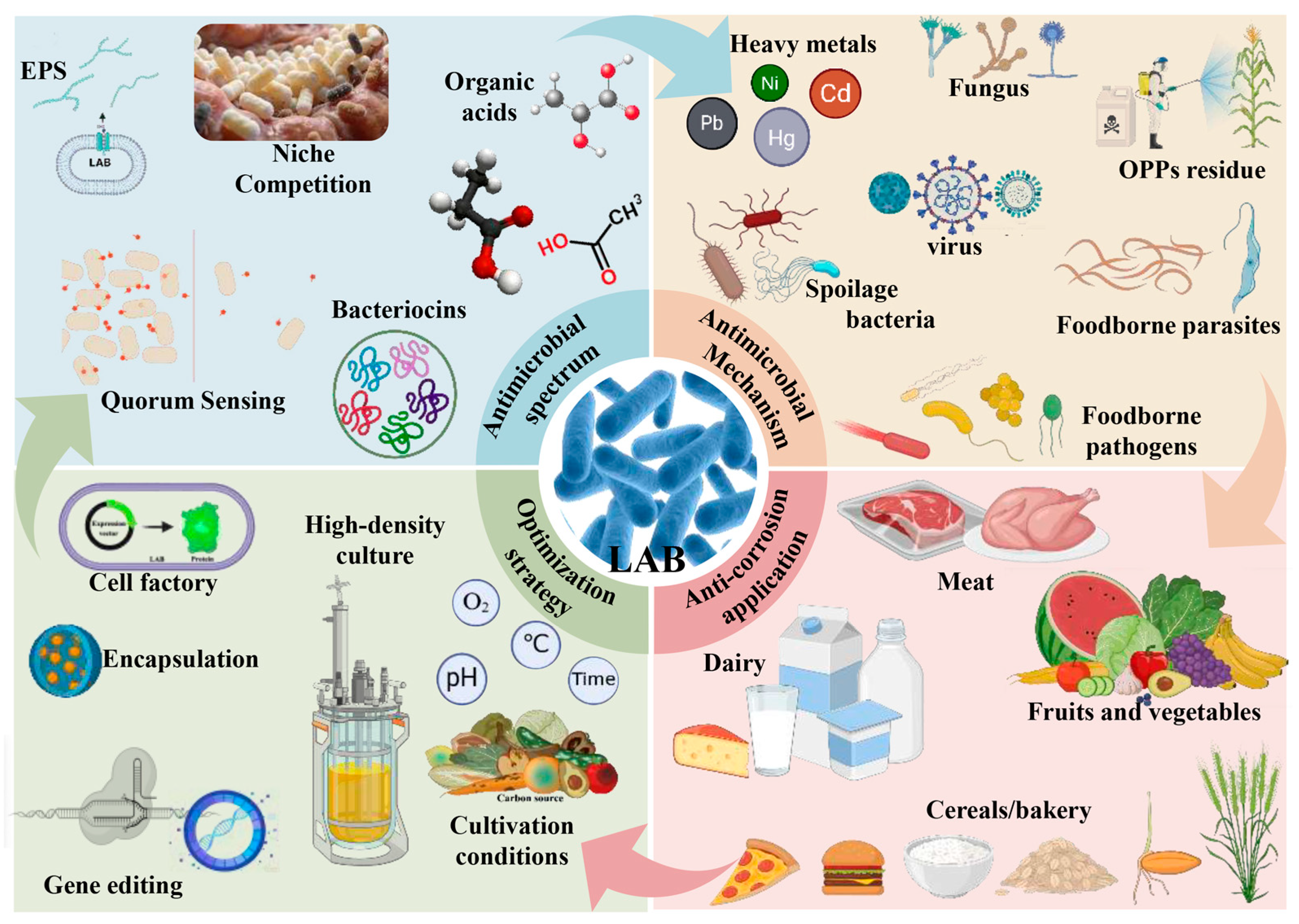
Lactic Acid Bacteria as the Green and Safe Food Preservatives: Their Mechanisms, Applications and Prospects
 ,
,  , ,
, ,
Abstract
1. Introduction
2. LAB as the Starter and Preservatives in Fermentation Food
2.1. Meat
2.2. Dairy

| Food Category | Specific Food | LAB Strains | Specific Effects | References |
|---|---|---|---|---|
| Meat | Surimi | Lactiplantibacillus plantarum H30-2 | Promoted production of flavor compounds | [19] |
| Sausages | Latilactobacillus sakei L.48 | Enhanced formation of flavor substances | [20] | |
| Chilled pork | Lactiplantibacillus pentosus 31-1 | Reduced volatile basic nitrogen, inhibited Listeria/Pseudomonas, extended shelf life | [21] | |
| Raw goat meat | Lactiplantibacillus paracasei subsp. N2, Lactiplantibacillus casei subsp. TM1b | Produced biosurfactants, inhibited P. aeruginosa, extended shelf life to 15 days | [22] | |
| Fresh beef | Lactococcus lactis BZ | Produced bacteriocins (dose-dependent antibacterial), reduced psychrophilic bacteria by 3.5 Log (12d storage) | [23] | |
| Cheese | Lactobacillus acidophilus ItalTR260 | Improved milk texture/flavor, promoted protein absorption; EPS enhanced rheology; nonstarter LAB improved cheese aroma/texture; synthesized diacetyl for flavor | [17,24,25,26,27] | |
| Yogurt | Lactobacillus gasseri BNR17 and Lactiplantibacillus plantarum HY7714 | [28] | ||
| Cream | Leuconostoc mesenteroides | High acid production, antioxidant/antibacterial, inhibited Shigella/Salmonella/Staphylococcus aureus | [29] | |
| Fruits and Vegetables | Sichuan pickles | Lactiplantibacillus plantarum, Levilactobacillus brevis, Leuconostoc mesenteroides | Produced lactic acid (sour taste), promoted flavor substances (aldehydes, esters, etc.) | [30] |
| Cucumber pickles | Levilactobacillus brevis T7 | Improved acceptability, antimicrobial (potential probiotic) | [31] | |
| Fresh lotus roots | Lactiplantibacillus plantarum | Inhibited phenolic oxidation, transformed 84.17% catechin (30 h) | [32] | |
| Grapes | Lactiplantibacillus plantarum | Reduced fungal infection, decreased surface mycotoxin | [33] | |
| Fresh strawberries | Lactiplantibacillus plantarum | Extended shelf life, inhibited yeast/mold growth | [34] | |
| Cereals and Bakery | Cereal products | LAB (non-specific) | Improved amino acid bioavailability, reduced anti-nutrients, enhanced mineral absorption | [15,35] |
| Bread | Lactiplantibacillus plantarum 5L1 | Improved volume/elasticity/flavor, reduced gluten intolerance/glycemic index; inhibited mycotoxin-producing fungi, extended shelf life | [36,37,38] | |
| Bread (sponge dough) | Lactococcus lactis subsp. diacetylactis, Lactobacillus delbrueckii subsp. bulgaricus, and Lacticaseibacillus rhamnosus | Extended shelf life by 5 days vs. control | [39] |
2.3. Fruits and Vegetables
2.4. Cereals and Bakery
3. Inhibitory Effects of LAB on Foodborne Pathogens and Spoilage Microbes
3.1. Inhibition of Bacteria
- (1)
- Foodborne pathogens
- (2)
- Spoilage bacteria
- (3)
- Bacteria biofilm
3.2. Inhibition of Fungal
- (1)
- Yeasts
- (2)
- Molds
3.3. Inhibition of the Virus
3.4. Inhibition of Foodborne Parasites
3.5. Biodegradation of Toxic Chemicals and Their Derivatives
4. Antimicrobial Metabolites and the Inhibitory Mechanism of LAB
4.1. Acid-Producing
| Inhibitory Substance | Types | Inhibitory Mechanism | Inhibitory Effect | References | |
|---|---|---|---|---|---|
| Organic acid | lactic acid | Intracellular acidosis and anion accumulation, disrupt the cell membrane | Ligilactobacillus agilis ZY25 and Ligilactobacillus salivarius ZY35, verified by in vitro antibacterial experiments | [110,111] | |
| citric acid | Interfere with the activity of key metabolic enzymes, disrupt energy metabolism | ||||
| amber acid | |||||
| malic acid | |||||
| acetic acid | Intracellular acidosis and anion accumulation | ||||
| propionic acid | Latilactobacillus curvatus CCFM1268, verified by in vitro antibacterial experiments | [112,113] | |||
| butyric acid | |||||
| formic acid | Inhibit the activity of DNA polymerase; Block the DNA replication | Lactococcus lactis, Lactococcus lactis cremoris, Enterococci durans, Enterococci faecalis, verified by in vitro antibacterial experiments | [114,115] | ||
| pyruvicacid | Interfere with the activity of key metabolic enzymes, disrupt energy metabolism | Enterococcus faecium, verified by in vitro antibacterial experiments | [116,117] | ||
| benzoic acid | Acidify the cytoplasm, inhibit mitochondrial respiration | Lactobacillus acidophilus La-5, verified by in vitro antibacterial experiments | [118,119] | ||
| sorbic acid | disrupt the cell membrane | ||||
| chlorogenic acid | Disrupting the cell membrane, chelating with metal ions, inhibiting enzyme activity, and inducing oxidative stress | Lacticaseibacillus casei H1, verified by in vitro antibacterial experiments | [120,121] | ||
| Bacteriocin | Class I | nisinF; nisin Q; nisin Z | Damage to cell membrane integrity, specific target Lipid II | Lactococcus lactis subsp. lactis, Latilactobacillus sakei, verified by in vitro pathogenic bacteria inhibition and meat preservation verification | [119,122,123,124] |
| lactocin S | Disrupt the cell membrane | ||||
| lacticin 3147 | Inhibits the biosynthesis of peptidoglycan; Disrupts the cell membrane. | ||||
| Class II | pediocin PA-1 | Disrupt the cell membrane, specific target Lipid II | Pediococcus acidilactici, verified through in vitro experiments | [125] | |
| pediocin-like bacteriocins | Pentosaceus pediococcus, verified through in vitro experiments | [126] | |||
| enterocins L50A, L50B | Enterococcus durans EDD2, verified through in vitro experiments | [114] | |||
| enterocin P | |||||
| leuconocin S | Weissella paramesenteroides, verified through in vitro experiments | [116,127] | |||
| enterocin AS-48 | Internalized via vesicle-mediated endocytosis and induces autophagic cell death; specific target variant surface glycoprotein (VSG) | Enterococcus faecalis, verified by in vitro parasite inhibition experiments | [54] | ||
| plantaricin W3-2 | Disrupt the integrity of the cell membrane | Lactiplantibacillus plantarum W3-2, Lactiplantibacillus plantarum ZJ316, validated for the inhibition of foodborne pathogens in vitro | [128] | ||
| plantaricin ZJ316 | [122] | ||||
| Class III | helveticin J | Inhibits DNA replication, RNA synthesis, or protein synthesis | Lactobacillus delbrueckii subsp. indicus TY-11, validated for functional inhibition in vitro | [119,129] | |
| enterolysin A | Possesses enzymatic activity, causes cell lysis | ||||
| EPS | EPS of L. plantarum LRCC5310 | High adhesiveness, interfering with the attachment of viruses to cells in vitro | Verified by in vitro antiviral experiments and intestinal cell | [130] | |
| EPS of L. plantarum YW32 | Inhibits bacterial adhesion ability and interferes with biofilm activity | [63] | |||
| Others | CO2 | Reduces the pH value of cells and the activity of enzymes; Generates an anoxic environment | [109] | ||
| H2O2 | Damages the molecular structure of proteins | Lactobacillus bulgaricus, Lacticaseibacillus casei, L. lactis, verified through experiments | [108,131] | ||
4.2. Bacteriocin-Producing
4.3. Competition of Niche, Nutrition and Ions
4.4. Extracellular Polymeric Substances (EPS) Production
4.5. Quorum-Sensing (QS) Interference
5. The Influences of LAB Inhibitory Activities
5.1. Optimization of Growth Media
5.2. Culture Conditions
5.3. Ionic Components in Cultural Condition
5.4. Regulatory Signaling Molecules
5.5. Key Regulatory Factors
6. Conclusions and Prospect
6.1. Screening of Novel Probiotics and Exploration of Novel Functions of LAB
6.2. AI-Driven Optimization of Culture Media and Culture Conditions
6.3. Strain Modification with Induced Mutation and Gene Editing
6.4. Nano-Encapsulation and Active Packaging Technology
6.5. Development of LAB as Expression Vectors and Cell Factories
Supplementary Materials
Author Contributions
Funding
Institutional Review Board Statement
Informed Consent Statement
Data Availability Statement
Conflicts of Interest
References
- Özogul, F.; Hamed, I. The importance of lactic acid bacteria for the prevention of bacterial growth and their biogenic amines formation: A review. Crit. Rev. Food Sci. 2018, 58, 1660–1670. [Google Scholar] [CrossRef] [PubMed]
- Marcelli, V.; Osimani, A.; Aquilanti, L. Research progress in the use of lactic acid bacteria as natural biopreservatives against spp. in meat and meat products: A review. Food Res. Int. 2024, 196, 115129. [Google Scholar] [CrossRef]
- Chiozzi, V.; Agriopoulou, S.; Varzakas, T. Advances, Applications, and Comparison of Thermal (Pasteurization, Sterilization, and Aseptic Packaging) against Non-Thermal (Ultrasounds, UV Radiation, Ozonation, High Hydrostatic Pressure) Technologies in Food Processing. Appl. Sci. 2022, 12, 2202. [Google Scholar] [CrossRef]
- Anand, S.P.; Sati, N. Artificial Preservatives and Their Harmful Effects: Looking toward Nature for Safer Alternatives. Int. J. Pharm. Sci. Res. 2013, 4, 2496–2501. [Google Scholar]
- Bak, K.H.; Bauer, S.; Eisenreich, C.; Paulsen, P. Residual Nitrite, Nitrate, and Volatile N-Nitrosamines in Organic and Conventional Ham and Salami Products. Foods 2025, 14, 112. [Google Scholar] [CrossRef]
- Azuma, S.L.; Quartey, N.K.A.; Ofosu, I.W. Sodium benzoate in non-alcoholic carbonated (soft) drinks: Exposure and health risks. Sci. Afr. 2020, 10, e00611. [Google Scholar] [CrossRef]
- Santos, C.; Raymundo, A.; Moreira, J.B.; Prista, C. Exploring the Potential of Lactic Acid Bacteria Fermentation as a Clean Label Alternative for Use in Yogurt Production. Appl. Sci. 2025, 15, 2686. [Google Scholar] [CrossRef]
- Sivamaruthi, B.S.; Kesika, P.; Rafeek, S.B.S.; Sivakumar, K.; Ramasamy, S.P.; Chaiaysut, C.; Fukngoen, P.; Alagarsamy, K. Lactic acid bacteria in the meat industry: Flavor, function, and food safety. Front. Microbiol. 2025, 16, 1703213. [Google Scholar] [CrossRef] [PubMed]
- da Costa, R.J.; Voloski, F.L.S.; Mondadori, R.G.; Duval, E.H.; Fiorentini, A.M. Preservation of Meat Products with Bacteriocins Produced by Lactic Acid Bacteria Isolated from Meat. J. Food Qual. 2019, 2019, 4726510. [Google Scholar] [CrossRef]
- Khani, N.; Ashkezary, M.R.; Hosseinzadeh, N.; Aghapour, B.; Hosseini, A.; Soleimani, R.A.; Houshmandi, S.; Shokouhian, S.M.j.; Homayouni-Rad, A. The role of functional foods based on probiotics in improving fertility: A review. J. Funct. Foods 2025, 129, 106871. [Google Scholar] [CrossRef]
- Anjana; Tiwari, S.K. Bacteriocin-Producing Probiotic Lactic Acid Bacteria in Controlling Dysbiosis of the Gut Microbiota. Front. Cell. Infect. Microbiol. 2022, 12, 851140. [Google Scholar] [CrossRef]
- Hakim, B.N.A.; Xuan, N.J.; Oslan, S.N.H. A Comprehensive Review of Bioactive Compounds from Lactic Acid Bacteria: Potential Functions as Functional Food in Dietetics and the Food Industry. Foods 2023, 12, 2850. [Google Scholar] [CrossRef] [PubMed]
- Ibrahim, S.A.; Ayivi, R.D.; Zimmerman, T.; Siddiqui, S.A.; Altemimi, A.B.; Fidan, H.; Esatbeyoglu, T.; Bakhshayesh, R.V. Lactic Acid Bacteria as Antimicrobial Agents: Food Safety and Microbial Food Spoilage Prevention. Foods 2021, 10, 3131. [Google Scholar] [CrossRef]
- Harper, A.R.; Dobson, R.C.J.; Morris, V.K.; Moggre, G.J. Fermentation of plant-based dairy alternatives by lactic acid bacteria. Microb. Biotechnol. 2022, 15, 1404–1421. [Google Scholar] [CrossRef] [PubMed]
- Ashaolu, T.J.; Reale, A. A Holistic Review on Euro-Asian Lactic Acid Bacteria Fermented Cereals and Vegetables. Microorganisms 2020, 8, 1176. [Google Scholar] [CrossRef]
- Rachwal, K.; Gustaw, K. Lactic Acid Bacteria in Sustainable Food Production. Sustainability 2024, 16, 3362. [Google Scholar] [CrossRef]
- Fernández, M.; Hudson, J.A.; Korpela, R.; de los Reyes-Gavilán, C.G. Impact on Human Health of Microorganisms Present in Fermented Dairy Products: An Overview. Biomed. Res. Int. 2015, 2015, 12714. [Google Scholar] [CrossRef]
- Sharma, H.; Ozogul, F.; Bartkiene, E.; Rocha, J.M. Impact of lactic acid bacteria and their metabolites on the techno-functional properties and health benefits of fermented dairy products. Crit. Rev. Food Sci. 2023, 63, 4819–4841. [Google Scholar] [CrossRef]
- Li, C.S.; Li, L.H.; Cui, Q.Y.; Huang, H.; Chen, S.J.; Zhao, Y.Q.; Wang, Y.Q. Formation and improvement mechanism of physical property and volatile flavor of fermented tilapia surimi by newly isolated lactic acid bacteria based on two dimensional correlation networks. Food Chem. 2024, 440, 138260. [Google Scholar] [CrossRef]
- Zheng, S.S.; Wang, C.Y.; Hu, Y.Y.; Yang, L.; Xu, B.C. Enhancement of fermented sausage quality driven by mixed starter cultures: Elucidating the perspective of flavor profile and microbial communities. Food Res. Int. 2024, 178, 113951. [Google Scholar] [CrossRef]
- Zhang, J.L.; Liu, G.R.; Li, P.L.; Qu, Y. Pentocin 31-1, a novel meat-borne bacteriocin and its application as biopreservative in chill-stored tray-packaged pork meat. Food Control 2010, 21, 198–202. [Google Scholar] [CrossRef]
- Mouafo, H.T.; Mbawala, A.; Tanaji, K.; Somashekar, D.; Ndjouenkeu, R. Improvement of the shelf life of raw ground goat meat by using biosurfactants produced by lactobacilli strains as biopreservatives. LWT-Food Sci. Technol. 2020, 133, 110071. [Google Scholar] [CrossRef]
- Yildirim, Z.; Yerlikaya, S.; Öncül, N.; Sakin, T. Inhibitory Effect of Lactococcin BZ Against Listeria innocua and Indigenous Microbiota of Fresh Beef. Food Technol. Biotechnol. 2016, 54, 317–323. [Google Scholar] [CrossRef] [PubMed]
- Nambiar, R.B.; Sellamuthu, P.S.; Perumal, A.B.; Sadiku, E.R.; Phiri, G.; Jayaramudu, J. Characterization of an exopolysaccharide produced by Lactobacillus plantarum HM47 isolated from human breast milk. Process Biochem. 2018, 73, 15–22. [Google Scholar] [CrossRef]
- Margalho, L.P.; Feliciano, M.D.; Silva, C.E.; Abreu, J.S.; Piran, M.V.F.; Sant’Ana, A.S. Brazilian artisanal cheeses are rich and diverse sources of nonstarter lactic acid bacteria regarding technological, biopreservative, and safety properties-Insights through multivariate analysis. J. Dairy Sci. 2020, 103, 7908–7926. [Google Scholar] [CrossRef] [PubMed]
- Rincon-Delgadillo, M.I.; Lopez-Hernandez, A.; Wijaya, I.; Rankin, S.A. Diacetyl levels and volatile profiles of commercial starter distillates and selected dairy foods. J. Dairy Sci. 2012, 95, 1128–1139. [Google Scholar] [CrossRef]
- Pinilla, C.M.B.; Brandelli, A.; Isaia, H.A.; Guzman, F.; da Gama, M.A.S.; Spadoti, L.M.; Alves, A. Probiotic Potential and Application of Indigenous Non-Starter Lactic Acid Bacteria in Ripened Short-Aged Cheese. Curr. Microbiol. 2024, 81, 202. [Google Scholar] [CrossRef]
- Dong, Y.S.; Li, M.; Yue, X.Q. Current Research on Probiotics and Fermented Products. Foods 2024, 13, 1406. [Google Scholar] [CrossRef]
- Yang, Y.; Ye, G.B.; Qi, X.T.; Zhou, B.S.; Yu, L.S.; Song, G.; Du, R.P. Exploration of Exopolysaccharide from Leuconostoc mesenteroides HDE-8: Unveiling Structure, Bioactivity, and Food Industry Applications. Polymers 2024, 16, 954. [Google Scholar] [CrossRef]
- Xiong, H.; Lei, D.; Xiong, J.; Liu, J.Y.; Yao, J. Exploring the mechanism of Weissella cibaria cooperating with Lactiplantibacillus plantarum to improve volatile flavor of Sichuan pickle using dialysis membranes. Food Biosci. 2024, 60, 104520. [Google Scholar] [CrossRef]
- Guney, D.; Basdogan, M.G.B.; Sengun, I. Probiotic characterisation of lactic acid bacteria isolated from pickles and their potential application as presumptive probiotic starter culture in cucumber pickles. J. Food Meas. Charact. 2025, 19, 2077–2097. [Google Scholar] [CrossRef]
- Wang, Y.; Yang, Y.; Yang, X.Y.; Huang, L.; Wang, P.C.; Zhao, L.L. Effects of Lactiplantibacillus plantarum and Fermentation Time on the Quality, Bacterial Community, and Functional Prediction of Silage from Lotus corniculatus L. in Karst Regions. Agriculture 2025, 15, 16. [Google Scholar] [CrossRef]
- Lappa, I.K.; Mparampouti, S.; Lanza, B.; Panagou, E.Z. Control of Aspergillus carbonarius in grape berries by Lactobacillus plantarum: A phenotypic and gene transcription study. Int. J. Food Microbiol. 2018, 275, 56–65. [Google Scholar] [CrossRef] [PubMed]
- Chen, C.; Cao, Z.; Li, J.; Tao, C.; Feng, Y.N.; Han, Y.L. A novel endophytic strain of Lactobacillus plantarum CM-3 with antagonistic activity against Botrytis cinerea on strawberry fruit. Biol. Control 2020, 148, 104306. [Google Scholar] [CrossRef]
- Reale, A.; Konietzny, U.; Coppola, R.; Sorrentino, E.; Greiner, R. The importance of lactic acid bacteria for phytate degradation during cereal dough fermentation. J. Agric. Food Chem. 2007, 55, 2993–2997. [Google Scholar] [CrossRef]
- Hu, Y.W.; Zhang, J.L.; Wang, S.J.; Liu, Y.B.; Li, L.; Gao, M.X. Lactic acid bacteria synergistic fermentation affects the flavor and texture of bread. J. Food Sci. 2022, 87, 1823–1836. [Google Scholar] [CrossRef]
- El Houssni, I.; Khedid, K.; Zahidi, A.; Hassikou, R. The inhibitory effects of lactic acid bacteria isolated from sourdough on the mycotoxigenic fungi growth and mycotoxins from wheat bread. Biocatal. Agric. Biotechnol. 2023, 50, 102702. [Google Scholar] [CrossRef]
- Dopazo, V.; Illueca, F.; Luz, C.; Musto, L.; Moreno, A.; Calpe, J.; Meca, G. Evaluation of shelf life and technological properties of bread elaborated with lactic acid bacteria fermented whey as a bio-preservation ingredient. LWT-Food Sci. Technol. 2023, 174, 114427. [Google Scholar] [CrossRef]
- Dong, Y.N.; Chidar, E.; Karboune, S. Investigation of in situ and ex situ mode of lactic acid bacteria incorporation and the effect on dough extensibility, bread texture and flavor quality during shelf-life. Food Chem. X 2024, 24, 101857. [Google Scholar] [CrossRef]
- Liao, Y.T.; Cheng, Y.J.; Zheng, J.; Li, Z.X.; Wang, F.Q.; Li, L. Lactic Acid Bacteria Fermentation Advances in Fruit-Vegetables: Enhancing Quality and Bioactivity. Food Bioprocess Technol. 2025, 18, 10004–10024. [Google Scholar] [CrossRef]
- Rastogi, S.; Singh, A. Gut microbiome and human health: Exploring how the probiotic genus Lactobacillus modulate immune responses. Front. Pharmacol. 2022, 13, 1042189. [Google Scholar] [CrossRef]
- Chen, O.; Hong, Y.; Ma, J.H.; Deng, L.L.; Yi, L.H.; Zeng, K.F. Screening lactic acid bacteria from pickle and cured meat as biocontrol agents of Penicillium digitatum on citrus fruit. Biol. Control 2021, 158, 104606. [Google Scholar] [CrossRef]
- Dopazo, V.; Luz, C.; Quiles, J.M.; Calpe, J.; Romano, R.; Mañes, J.; Meca, G. Potential application of lactic acid bacteria in the biopreservation of red grape from mycotoxigenic fungi. J. Sci. Food Agric. 2022, 102, 898–907. [Google Scholar] [CrossRef] [PubMed]
- Almohammadi, A.R.; Abdel-Sha, S.; Tartour, E.; Enan, G. Inhibitory action of three lactic acid bacteria cultures on some food-borne pathogens during pickling of green olive fruits. Heliyon 2022, 8, e11693. [Google Scholar] [CrossRef]
- Choi, A.R.; Patra, J.K.; Kim, W.J.; Kang, S.S. Antagonistic Activities and Probiotic Potential of Lactic Acid Bacteria Derived from a Plant-Based Fermented Food. Front. Microbiol. 2018, 9, 1963. [Google Scholar] [CrossRef]
- Zhang, Y.M.; Zhu, L.X.; Dong, P.C.; Liang, R.R.; Mao, Y.W.; Qiu, S.B.; Luo, X. Bio-protective potential of lactic acid bacteria: Effect of Lactobacillus sakei and Lactobacillus curvatus on changes of the microbial community in vacuum-packaged chilled beef. Asian-Australas. J. Anim. Sci. 2018, 31, 585–594. [Google Scholar] [CrossRef] [PubMed]
- Xu, M.M.; Kaur, M.; Pillidge, C.J.; Torley, P.J. Evaluation of the potential of protective cultures to extend the microbial shelf-life of chilled lamb meat. Meat Sci. 2021, 181, 108613. [Google Scholar] [CrossRef]
- Morales, P.; Aguirre, J.; Troncoso, M.; Figueroa, G. Comparison of In Vitro and in situ antagonism assays as tools for the selection of bio-preservative lactic acid bacteria (LAB) in poultry meat. LWT-Food Sci. Technol. 2020, 118, 108846. [Google Scholar] [CrossRef]
- Watanabe, T.; Hayashi, K.; Takahashi, I.; Ohwaki, M.; Kan, T.; Kawahara, T. Physical properties of lactic acid bacteria influence the level of protection against influenza infection in mice. PLoS ONE 2021, 16, e0251784. [Google Scholar] [CrossRef]
- Lange-Starke, A.; Petereit, A.; Truyen, U.; Braun, P.G.; Fehlhaber, K.; Albert, T. Antiviral Potential of Selected Starter Cultures, Bacteriocins and D,L-Lactic Acid. Food Environ. Virol. 2014, 6, 42–47. [Google Scholar] [CrossRef]
- Mokoena, M.P.; Omatola, C.A.; Olaniran, A.O. Applications of Lactic Acid Bacteria and Their Bacteriocins against Food Spoilage Microorganisms and Foodborne Pathogens. Molecules 2021, 26, 7055. [Google Scholar] [CrossRef] [PubMed]
- Kim, K.; Lee, G.; Thanh, H.D.; Kim, J.H.; Konkit, M.; Yoon, S.; Park, M.; Yang, S.; Park, E.; Kim, W. Exopolysaccharide from Lactobacillus plantarum LRCC5310 offers protection against rotavirus-induced diarrhea and regulates inflammatory response. J. Dairy Sci. 2018, 101, 5702–5712. [Google Scholar] [CrossRef] [PubMed]
- Martín-Escolano, R.; Cebrián, R.; Martín-Escolano, J.; Rosales, M.J.; Maqueda, M.; Sánchez-Moreno, M.; Marín, C. Insights into Chagas treatment based on the potential of bacteriocin AS-48. Int. J. Parasitol-Drug 2019, 10, 1–8. [Google Scholar] [CrossRef]
- Martinez-Garcia, M.; Bart, J.M.; Campos-Salinas, J.; Valdivia, E.; Martínez-Bueno, M.; González-Rey, E.; Navarro, M.; Maqueda, M.; Cebrián, R.; Pérez-Victoria, J.M. Autophagic-related cell death of Trypanosoma brucei induced by bacteriocin AS-48. Int. J. Parasitol-Drug 2018, 8, 203–212. [Google Scholar] [CrossRef] [PubMed]
- Abengózar, M.A.; Cebrián, R.; Saugar, J.M.; Gárate, T.; Valdivia, E.; Martínez-Bueno, M.; Maqueda, M.; Rivas, L. Enterocin AS-48 as Evidence for the Use of Bacteriocins as New Leishmanicidal Agents. Antimicrob. Agents Chemother. 2017, 61, 10. [Google Scholar] [CrossRef] [PubMed]
- El Shanawany, E.E.; Abdel-Razik, R.; Nofal, A.E.; Zalat, R.S.; Abouelmagd, F. Protective and therapeutic effects of Lactobacillus brevis PQ214320 and Bacillus subtilis PQ198038 Against experimental Trichinella Infection. PLoS Neglected Trop. Dis. 2025, 19, e0013331. [Google Scholar] [CrossRef]
- Escrivá, L.; Calpe, J.; Lafuente, C.; Moreno, A.; Musto, L.; Meca, G.; Luz, C. Aflatoxin B1 and ochratoxin A reduction by Lactobacillus spp. during bread making. J. Sci. Food Agric. 2023, 103, 7095–7103. [Google Scholar] [CrossRef]
- Murtaza, B.; Jin, B.W.; Wang, L.L.; Li, X.Y.; Saleemi, M.K.; Majeed, S.; Khatoon, A.; Li, G.; Xu, Y.P. Mitigation of zearalenone In Vitro using probiotic strains. LWT-Food Sci. Technol. 2023, 186, 115265. [Google Scholar] [CrossRef]
- Albedwawi, A.S.; Al Sakkaf, R.; Yusuf, A.; Osaili, T.M.; Al-Nabulsi, A.; Liu, S.Q.; Palmisano, G.; Ayyash, M.M. Acrylamide Elimination by Lactic Acid Bacteria: Screening, Optimization, In Vitro Digestion and Mechanism. Microorganisms 2022, 10, 557. [Google Scholar] [CrossRef]
- Lin, D.R.; Cao, H.F.; Zhong, Y.X.; Huang, Y.C.; Zou, J.P.; He, Q.; Ji, R.; Qin, T.; Chen, Y.; Wang, D.; et al. Screening and identification of Lactic acid bacteria from Ya’an pickle water to effectively remove Pb2+. Amb Express 2019, 9, 10. [Google Scholar] [CrossRef]
- Li, W.; Chen, Y.Y.; Wang, T. Cadmium biosorption by lactic acid bacteria Weissella viridescens ZY-6. Food Control 2021, 123, 107747. [Google Scholar] [CrossRef]
- Mostafidi, M.; Sanjabi, M.R.; Mojgani, N.; Eskandari, S.; Bidgoli, S.A. Heavy Metal Bioremediation Potential of Autochthonous Lactic Acid Bacteria for Use in Edible Leafy Vegetables. J. Food Qual. 2023, 21, 7191–7206. [Google Scholar] [CrossRef]
- Yuan, S.F.; Li, C.J.; Yu, H.; Xie, Y.F.; Guo, Y.H.; Yao, W.R. Screening of lactic acid bacteria for degrading organophosphorus pesticides and their potential protective effects against pesticide toxicity. LWT-Food Sci. Technol. 2021, 147, 111672. [Google Scholar] [CrossRef]
- Bintsis, T. Foodborne pathogens. Aims Microbiol. 2017, 3, 529–563. [Google Scholar] [CrossRef]
- Issazadeh, K.; Abadi, M.A.A.; Darsanaki, R.K.; Alikhani, F.; Dadras, H.; Tajehmiri, A. Isolation, Identification and Analysis of Probiotic Properties of Lactobacillus spp. from Traditional Yoghurts in North of Iran. J. Pure Appl. Microbiol. 2013, 7, 2965–2971. [Google Scholar]
- Margalho, L.P.; Kamimura, B.A.; Brexó, R.P.; Alvarenga, V.O.; Cebeci, A.S.; Janssen, P.W.M.; Dijkstra, A.; Starrenburg, M.J.C.; Sheombarsing, R.S.; Cruz, A.G.; et al. High throughput screening of technological and biopreservation traits of a large set of wild lactic acid bacteria from Brazilian artisanal cheeses. Food Microbiol. 2021, 100, 103872. [Google Scholar] [CrossRef] [PubMed]
- Fonseca, H.C.; Melo, D.D.; Ramos, C.L.; Dias, D.R.; Schwan, R.F. Probiotic Properties of Lactobacilli and Their Ability to Inhibit the Adhesion of Enteropathogenic Bacteria to Caco-2 and HT-29 Cells. Probiotics Antimicrob. Proteinsb. Proteins 2021, 13, 102–112. [Google Scholar] [CrossRef] [PubMed]
- Taha, M.D.M.; Jaini, M.F.M.; Saidi, N.B.; Rahim, R.A.; Shah, U.K.M.; Hashim, A.M. Biological control of Erwinia mallotivora, the causal agent of papaya dieback disease by indigenous seed-borne endophytic lactic acid bacteria consortium. PLoS ONE 2019, 14, e0224431. [Google Scholar] [CrossRef]
- Zhang, Y.X.; Wei, J.P.; Yuan, Y.H.; Yue, T.L. Diversity and characterization of spoilage-associated psychrotrophs in food in cold chain. Int. J. Food Microbiol. 2019, 290, 86–95. [Google Scholar] [CrossRef]
- Wang, J.; Xie, J.; Mei, J. Research Progress Regarding Psychrotrophic Pseudomonas in Aquatic Products: Psychrophilic Characteristics, Spoilage Mechanisms, Detection Methods, and Control Strategies. Foods 2025, 14, 363. [Google Scholar] [CrossRef] [PubMed]
- Gajendran, V.P.; Rajamani, S. Recent Advancements in Harnessing Lactic Acid Bacterial Metabolites for Fruits and Vegetables Preservation. Probiotics Antimicrob. Proteins 2025, 17, 2673–2689. [Google Scholar] [CrossRef] [PubMed]
- Zhu, T.; Yang, C.; Bao, X.; Chen, F.; Guo, X. Strategies for controlling biofilm formation in food industry. Grain Oil Sci. Technol. 2022, 5, 179–186. [Google Scholar] [CrossRef]
- Pang, X.Y.; Song, X.Y.; Chen, M.J.; Tian, S.H.; Lu, Z.X.; Sun, J.; Li, X.F.; Lu, Y.J.; Yuk, H.G. Combating biofilms of foodborne pathogens with bacteriocins by lactic acid bacteria in the food industry. Compr. Rev. Food Sci. Food Saf. 2022, 21, 1657–1676. [Google Scholar] [CrossRef]
- Wang, J.; Zhao, X.; Yang, Y.W.; Zhao, A.M.; Yang, Z.N. Characterization and bioactivities of an exopolysaccharide produced by Lactobacillus plantarum YW32. Int. J. Biol. Macromol. 2015, 74, 119–126. [Google Scholar] [CrossRef]
- Rana, S.; Bhawal, S.; Kumari, A.; Kapila, S.; Kapila, R. pH-dependent inhibition of AHL-mediated quorum sensing by cell-free supernatant of lactic acid bacteria in Pseudomonas aeruginosa PAO1. Microb. Pathog. 2020, 142, 104105. [Google Scholar] [CrossRef] [PubMed]
- Awuchi, C.G.; Ondari, E.N.; Ogbonna, C.U.; Upadhyay, A.K.; Baran, K.; Okpala, C.O.R.; Korzeniowska, M.; Guiné, R.P.F. Mycotoxins Affecting Animals, Foods, Humans, and Plants: Types, Occurrence, Toxicities, Action Mechanisms, Prevention, and Detoxification Strategies-A Revisit. Foods 2021, 10, 1279. [Google Scholar] [CrossRef]
- Narendranath, N.V.; Thomas, K.C.; Ingledew, W.M. Acetic acid and lactic acid inhibition of growth of Saccharomyces cerevisiae by different mechanisms. J. Am. Soc. Brew. Chem. 2001, 59, 187–194. [Google Scholar]
- Bayrock, D.P.; Ingledew, W.M. Inhibition of yeast by lactic acid bacteria in continuous culture: Nutrient depletion and/or acid toxicity? J. Ind. Microbiol. Biotechnol. 2004, 31, 362–368. [Google Scholar] [CrossRef]
- Klinke, H.B.; Thomsen, A.B.; Ahring, B.K. Inhibition of ethanol-producing yeast and bacteria by degradation products produced during pre-treatment of biomass. Appl. Microbiol. Biotechnol. 2004, 66, 10–26. [Google Scholar] [CrossRef] [PubMed]
- Jorgensen, M.R.; Kragelund, C.; Jensen, P.O.; Keller, M.K.; Twetman, S. Probiotic Lactobacillus reuteri has antifungal effects on oral Candida species in vitro. J. Oral Microbiol. 2017, 9, 274582. [Google Scholar] [CrossRef] [PubMed]
- Chen, C.; Xiong, Y.; Xie, Y.H.; Zhang, H.X.; Jiang, K.X.; Pang, X.N.; Huang, M.Q. Metabolic characteristics of lactic acid bacteria and interaction with yeast isolated from light-flavor Baijiu fermentation. Food Biosci. 2022, 50, 102102. [Google Scholar] [CrossRef]
- Goessens, T.; Mouchtaris-Michailidis, T.; Tesfamariam, K.; Truong, N.N.; Vertriest, F.; Bader, Y.; De Saeger, S.; Lachat, C.; De Boevre, M. Dietary mycotoxin exposure and human health risks: A protocol for a systematic review. Environ. Int. 2024, 184, 108456. [Google Scholar] [CrossRef]
- Corsetti, A.; Gobbetti, M.; Rossi, J.; Damiani, P. Antimould activity of sourdough lactic acid bacteria: Identification of a mixture of organic acids produced by Lactobacillus sanfrancisco CB1. Appl. Microbiol. Biotechnol. 1998, 50, 253–256. [Google Scholar] [CrossRef]
- Baek, E.; Kim, H.; Choi, H.; Yoon, S.; Kim, J. Antifungal Activity of Leuconostoc citreum and Weissella confusa in Rice Cakes. J. Microbiol. 2012, 50, 842–848. [Google Scholar] [CrossRef]
- Sedaghat, H.; Eskandari, M.H.; Moosavi-Nasab, M.; Shekarforoush, S.S. Application of non-starter lactic acid bacteria as biopreservative agents to control fungal spoilage of fresh cheese. Int. Dairy J. 2016, 56, 87–91. [Google Scholar] [CrossRef]
- Tanaka, O.; Komatsu, T.; Oshibe, A.; Cai, Y.M.; Miyazaki, S.; Nakanishi, K. Production of 3-Hydroxypropionaldehyde in Silage Inoculated with Lactobacillus coryniformis Plus Glycerol. Biosci. Biotechnol. Biochem. 2009, 73, 1494–1499. [Google Scholar] [CrossRef]
- Black, B.A.; Zannini, E.; Curtis, J.M.; Gänzle, M.G. Antifungal Hydroxy Fatty Acids Produced during Sourdough Fermentation: Microbial and Enzymatic Pathways, and Antifungal Activity in Bread. Appl. Environ. Microb. 2013, 79, 1866–1873. [Google Scholar] [CrossRef] [PubMed]
- Chlebicz, A.; Slizewska, K. In Vitro detoxification of aflatoxin B1, deoxynivalenol, fumonisins, T-2 toxin and zearalenone by probiotic bacteria from genus Lactobacillus and Saccharomyces cerevisiae yeast. Probiotics Antimicrob. Proteins 2020, 12, 289–301. [Google Scholar] [CrossRef] [PubMed]
- Martínez, M.P.; Magnoli, A.P.; Pereyra, M.L.G.; Cavaglieri, L. Probiotic bacteria and yeasts adsorb aflatoxin M1 in milk and degrade it to less toxic AFM1-metabolites. Toxicon 2019, 172, 1–7. [Google Scholar] [CrossRef]
- Zheng, X.F.; Wei, W.N.; Rao, S.Q.; Gao, L.; Li, H.X.; Yang, Z.Q. Degradation of patulin in fruit juice by a lactic acid bacteria strain Lactobacillus casei YZU01. Food Control 2020, 112, 107147. [Google Scholar] [CrossRef]
- Arena, M.P.; Capozzi, V.; Russo, P.; Drider, D.; Spano, G.; Fiocco, D. Immunobiosis and probiosis: Antimicrobial activity of lactic acid bacteria with a focus on their antiviral and antifungal properties. Appl. Microbiol. Biotechnol. 2018, 102, 9949–9958. [Google Scholar] [CrossRef] [PubMed]
- Stryinski, R.; Lopienska-Biernat, E.; Carrera, M. Proteomic Insights into the Biology of the Most Important Foodborne Parasites in Europe. Foods 2020, 9, 1403. [Google Scholar] [CrossRef] [PubMed]
- Chávez-Ruvalcaba, F.; Chávez-Ruvalcaba, M.; Santibañez, K.M.; Muñoz-Carrillo, J.L.; Coria, A.L.; Martínez, R.R. Foodborne Parasitic Diseases in the Neotropics—A review. Helminthologia 2021, 58, 119–133. [Google Scholar] [CrossRef] [PubMed]
- Rahimi, M.; Hajipour, N.; Hassanzadeh, P. The Antiparasitic Effects of Nitrate and Lactic Acid on Sarcocystis bradyzoites in Meat: Enhancing Food Safety. Foodborne Pathog. Dis. 2025. epub ahead of printing. [Google Scholar] [CrossRef]
- Xu, Z.; Zhang, Q.R.; Li, X.C.; Huang, X.F. A critical review on chemical analysis of heavy metal complexes in water/wastewater and the mechanism of treatment methods. Chem. Eng. J. 2022, 429, 131688. [Google Scholar] [CrossRef]
- Mauch, A.; Dal Bello, F.; Coffey, A.; Arendt, E.K. The use of Lactobacillus brevis PS1 to In Vitro inhibit the outgrowth of Fusarium culmorum and other common Fusarium species found on barley. Int. J. Food Microbiol. 2010, 141, 116–121. [Google Scholar] [CrossRef]
- Fayol-Messaoudi, D.; Berger, U.N.; Coconnier-Polter, M.H.; Liévin-Le Moal, V.; Servin, A.L. pH-, Lactic Acid-, and Non-Lactic Acid-Dependent Activities of Probiotic Lactobacilli against Salmonella enterica Serovar Typhimurium. Appl. Environ. Microb. 2005, 71, 6008–6013. [Google Scholar] [CrossRef]
- Tian, C.C.; Wang, L.; Liu, M.J.; Liu, J.C.; Qiu, M.X.; Chen, Y. Isolation and Identification of Chicken-Derived Lactic Acid Bacteria: In Vitro Probiotic Properties and Antagonistic Effects against Salmonella pullorum, Staphylococcus aureus, and Escherichia coli. Microorganisms 2024, 12, 795. [Google Scholar] [CrossRef] [PubMed]
- Alakomi, H.L.; Skyttä, E.; Saarela, M.; Mattila-Sandholm, T.; Latva-Kala, K.; Helander, I.M. Lactic acid permeabilizes gram-negative bacteria by disrupting the outer membrane. Appl. Environ. Microb. 2000, 66, 2001–2005. [Google Scholar] [CrossRef]
- Kim, D.; Lee, K.D.; Choi, K.C. Role of LAB in silage fermentation: Effect on nutritional quality and organic acid production-An overview. Aims Agric. Food 2021, 6, 216–234. [Google Scholar] [CrossRef]
- Zalán, Z.; Hudácek, J.; Stetina, J.; Chumchalová, J.; Halász, A. Production of organic acids by Lactobacillus strains in three different media. Eur. Food Res. Technol. 2010, 230, 395–404. [Google Scholar] [CrossRef]
- Ji, G.Y.; Liu, G.P.; Li, B.; Tan, H.; Zheng, R.Y.; Sun, X.Y.; He, F.T. Influence on the aroma substances and functional ingredients of apple juice by lactic acid bacteria fermentation. Food Biosci. 2023, 51, 102337. [Google Scholar] [CrossRef]
- Wong, H.C.; Chen, Y.L. Effects of Lactic Acid Bacteria and Organic Acids on Growth and Germination of Bacillus cereus. Appl. Environ. Microbiol. 1988, 54, 2179–2184. [Google Scholar] [CrossRef] [PubMed]
- Piper, P.; Calderon, C.O.; Hatzixanthis, K.; Mollapour, M. Weak acid adaptation: The stress response that confers yeasts with resistance to organic acid food preservatives. Microbiology 2001, 147, 2635–2642. [Google Scholar] [CrossRef] [PubMed]
- Gajbhiye, M.H.; Kapadnis, B.P. Antifungal-activity-producing lactic acid bacteria as biocontrol agents in plants. Biocontrol Sci. Technol. 2016, 26, 1451–1470. [Google Scholar] [CrossRef]
- Schwenninger, S.M.; Lacroix, C.; Truttmann, S.; Jans, C.; Spörndli, C.; Bigler, L.; Meile, L. Characterization of low-molecular-weight antiyeast metabolites produced by a food-protective Lactobacillus-Propionibacterium coculture. J. Food Prot. 2008, 71, 2481–2487. [Google Scholar] [CrossRef] [PubMed]
- Lavermicocca, P.; Valerio, F.; Visconti, A. Antifungal activity of phenyllactic acid against molds isolated from bakery products. Appl. Environ. Microb. 2003, 69, 634–640. [Google Scholar] [CrossRef]
- Liu, A.P.; Xu, R.X.; Zhang, S.; Wang, Y.T.; Hu, B.; Ao, X.L.; Li, Q.; Li, J.L.; Hu, K.D.; Yang, Y.; et al. Antifungal Mechanisms and Application of Lactic Acid Bacteria in Bakery Products: A Review. Front. Microbiol. 2022, 13, 924398. [Google Scholar] [CrossRef]
- Cui, L.; Guo, W. Antibacterial substances produced by lactic acid bacteria and their mechanism. J. Food Saf. Qual. 2018, 9, 2578–2584. [Google Scholar]
- Wang, W.W.; Dong, H.; Chen, Q.Q.; Chang, X.H.; Wang, L.J.; Miao, C.Y.; Chen, S.X.; Chen, L.S.; Wang, R.; Ge, S.Y.; et al. Antibacterial Efficacy of Feline-Derived Lactic Acid Bacteria against Enteropathogenic Escherichia coli: A Comprehensive In Vitro Analysis. Fermentation 2024, 10, 514. [Google Scholar] [CrossRef]
- Pascual, L.M.; Daniele, M.B.; Giordano, W.; Pájaro, M.C.; Barberis, I.L. Purification and Partial Characterization of Novel Bacteriocin L23 Produced by Lactobacillus fermentum L23. Curr. Microbiol. 2008, 56, 397–402. [Google Scholar] [CrossRef]
- Melian, C.; Ploper, D.; Chehin, R.; Vignolo, G.; Castellano, P. Impairment of Listeria monocytogenes biofilm developed on industrial surfaces by Latilactobacillus curvatus CRL1579 bacteriocin. Food Microbiol. 2024, 121, 104491. [Google Scholar] [CrossRef]
- Xiao, M.F.; Xia, Y.X.; Chen, Y.; Wang, S.; Zhao, J.X.; Narbad, A.; Chen, W.; Zhai, Q.X.; Yu, L.L.; Tian, F.W. Therapeutic potential of Latilactobacillus curvatus CCFM1268 in colitis treatment: Insights from In Vitro and In Vivo studies. Food Biosci. 2024, 59, 103913. [Google Scholar] [CrossRef]
- Gyurova, A.; Vladimirova, A.; Peykov, S.; Dimitrov, M.; Strateva, T.; Dimov, S.G. Characterization of Enterococcus durans EDD2, a strain from beehives with inhibitory activity against Paenibacillus. J. Apic. Res. 2023, 62, 1183–1196. [Google Scholar] [CrossRef]
- Delgado, S.; Delgado, T.; Mayo, B. Technological performance of several Lactococcus and Enterococcus strains of dairy origin in milk. J. Food Prot. 2002, 65, 1590–1596. [Google Scholar] [CrossRef] [PubMed]
- Baker, R.C.; Winkowski, K.; Montville, T.J. pH-Controlled fermentors to increase production of leuconocin S by Leuconostoc paramesenteroides. Process Biochem. 1996, 31, 225–228. [Google Scholar] [CrossRef]
- D’Angelo, M.; Martino, G.P.; Blancato, V.S.; Espariz, M.; Hartke, A.; Sauvageot, N.; Benachour, A.; Alarcón, S.H.; Magni, C. Diversity of volatile organic compound production from leucine and citrate in Enterococcus faecium. Appl. Microbiol. Biotechnol. 2020, 104, 1175–1186. [Google Scholar] [CrossRef]
- Gaspar, C.; Donders, G.G.; Palmeira-de-Oliveira, R.; Queiroz, J.A.; Tomaz, C.; Martinez-de-Oliveira, J.; Palmeira-de-Oliveira, A. Bacteriocin production of the probiotic Lactobacillus acidophilus KS400. Amb Express 2018, 8, 153. [Google Scholar] [CrossRef] [PubMed]
- Bangar, S.P.; Suri, S.; Trif, M.; Ozogul, F. Organic acids production from lactic acid bacteria: A preservation approach. Food Biosci. 2022, 46, 101615. [Google Scholar] [CrossRef]
- Cuozzo, S.A.; Castellano, P.; Sesma, F.J.M.; Vignolo, G.M.; Raya, R.R. Differential roles of the two-component peptides of lactocin 705 in antimicrobial activity. Curr. Microbiol. 2003, 46, 180–183. [Google Scholar] [CrossRef]
- Zheng, S.S.; Wu, W.Y.; Zhang, Y.L.; Hu, P.; Li, J.; Jiang, J.Z. Improvement of tomato sour soup fermentation by Lacticaseibacillus casei H1 addition. J. Food Process Preserv. 2022, 46, e16806. [Google Scholar] [CrossRef]
- Wang, M.X.; Zhang, W.J.; Zhang, J.G. Structure, Biosynthesis, and Antibacterial Mechanism of Lantibiotics Produced by Lactic Acid Bacteria. Food Biotechnol. 2025, 39, 208–234. [Google Scholar] [CrossRef]
- Barbieri, F.; Laghi, L.; Montanari, C.; Lan, Q.Y.; Levante, A.; Gardini, F.; Tabanelli, G. Insights into the Metabolomic Diversity of Latilactobacillus sakei. Foods 2022, 11, 477. [Google Scholar] [CrossRef] [PubMed]
- Bakhtiary, A.; Cochrane, S.A.; Mercier, P.; McKay, R.T.; Miskolzie, M.; Sit, C.S.; Vederas, J.C. Insights into the Mechanism of Action of the Two-Peptide Lantibiotic Lacticin 3147. J. Am. Chem. Soc. 2017, 139, 17803–17810. [Google Scholar] [CrossRef]
- Wang, Y.; Wang, J.R.; Bai, D.Q.; Wei, Y.L.; Sun, J.F.; Luo, Y.L.; Zhao, J.; Liu, Y.; Wang, Q.K. Synergistic inhibition mechanism of pediocin PA-1 and L-lactic acid against Aeromonas hydrophila. Bba-Biomembr. 2020, 1862, 183346. [Google Scholar] [CrossRef]
- Blanco, I.R.; Pizauro, L.J.L.; Almeida, J.V.D.A.; Mendonca, C.M.N.; Varani, A.D.M.; Oliveira, R.P.D.S. Pan-genomic and comparative analysis of Pediococcus pentosaceus focused on the in silico assessment of pediocin-like bacteriocins. Comput. Struct. Biotechnol. J. 2022, 20, 5595–5606. [Google Scholar] [CrossRef] [PubMed]
- Martín, M.; Corrales, M.A.; de Mendoza, D.; López, P.; Magni, C. Cloning and molecular characterization of the citrate utilization citMCDEFGRP cluster of Leuconostoc paramesenteroides. FEMS Microbiol. Lett. 1999, 174, 231–238. [Google Scholar] [CrossRef] [PubMed][Green Version]
- Wang, Z.G.; Zhang, Y.X.; Chen, C.C.; Fan, S.C.; Deng, F.M.; Zhao, L.Y. A novel bacteriocin isolated from Lactobacillus plantarum W3-2 and its biological characteristics. Front. Nutr. 2023, 9, 1111880. [Google Scholar] [CrossRef] [PubMed]
- Al-Mujahidy, S.M.J.; Kryukov, K.; Ikeo, K.; Saito, K.; Uddin, M.E.; Sina, A.A.I. Functional genomic analysis of the isolated potential probiotic Lactobacillus delbrueckii subsp. indicus TY-11 and its comparison with other Lactobacillus delbrueckii strains. Microbiol. Spectr. 2024, 12, e03470-23. [Google Scholar] [CrossRef]
- Abdalla, A.K.; Ayyash, M.M.; Olaimat, A.N.; Osaili, T.M.; Al-Nabulsi, A.A.; Shah, N.P.; Holley, R. Exopolysaccharides as Antimicrobial Agents: Mechanism and Spectrum of Activity. Front. Microbiol. 2021, 12, 664395. [Google Scholar] [CrossRef]
- Enitan, A.; Adeyemo, J.; Ogunbanwo, S.T. Influence of growth conditions and nutritional requirements on the production of hydrogen peroxide by lactic acid bacteria. Afr. J. Microbiol. Res. 2011, 5, 2059–2066. [Google Scholar] [CrossRef]
- Cano-Garrido, O.; Seras-Franzoso, J.; Garcia-Fruitós, E. Lactic acid bacteria: Reviewing the potential of a promising delivery live vector for biomedical purposes. Microb. Cell Factories 2015, 14, 137. [Google Scholar] [CrossRef] [PubMed]
- Kumariya, R.; Garsa, A.K.; Rajput, Y.S.; Sood, S.K.; Akhtar, N.; Patel, S. Bacteriocins: Classification, synthesis, mechanism of action and resistance development in food spoilage causing bacteria. Microb. Pathog. 2019, 128, 171–177. [Google Scholar] [CrossRef] [PubMed]
- Choi, G.H.; Holzapfel, W.H.; Todorov, S.D. Diversity of the bacteriocins, their classification and potential applications in combat of antibiotic resistant and clinically relevant pathogens. Crit. Rev. Microbiol. 2023, 49, 578–597. [Google Scholar] [CrossRef]
- Bolívar-Monsalve, J.; Ramírez-Toro, C.; Bolívar, G.; Ceballos-González, C. Mechanisms of action of novel ingredients used in edible films to preserve microbial quality and oxidative stability in sausages—A review. Trends Food Sci. Technol. 2019, 89, 100–109. [Google Scholar] [CrossRef]
- de Niederhäusern, S.; Camellini, S.; Sabia, C.; Iseppi, R.; Bondi, M.; Messi, P. Antilisterial Activity of Bacteriocins Produced by Lactic Bacteria Isolated from Dairy Products. Foods 2020, 9, 1757. [Google Scholar] [CrossRef]
- Zendo, T. Screening and Characterization of Novel Bacteriocins from Lactic Acid Bacteria. Biosci. Biotechnol. Biochem. 2013, 77, 893–899. [Google Scholar] [CrossRef] [PubMed]
- Liu, F.X.; Yu, B. Efficient production of reuterin from glycerol by magnetically immobilized Lactobacillus reuteri. Appl. Microbiol. Biotechnol. 2015, 99, 4659–4666. [Google Scholar] [CrossRef]
- Todorov, S.D.; Dicks, L.M.T. Effect of growth medium on bacteriocin production by Lactobacillus plantarum ST194BZ, a strain isolated from boza. Food Technol. Biotechnol. 2005, 43, 165–173. [Google Scholar]
- Todorov, S.D.; Dicks, L.M.T. Effect of medium components on bacteriocin production by Lactobacillus plantarum strains ST23LD and ST341LD, isolated from spoiled olive brine. Microbiol. Res. 2006, 161, 102–108. [Google Scholar] [CrossRef] [PubMed]
- Gutiérrez, S.; Martínez-Blanco, H.; Rodríguez-Aparicio, L.B.; Ferrero, M.A. Effect of fermented broth from lactic acid bacteria on pathogenic bacteria proliferation. J. Dairy Sci. 2016, 99, 2654–2665. [Google Scholar] [CrossRef]
- Siedler, S.; Balti, R.; Neves, A.R. Bioprotective mechanisms of lactic acid bacteria against fungal spoilage of food. Curr. Opin. Biotechnol. 2019, 56, 138–146. [Google Scholar] [CrossRef]
- Mathipa, M.G.; Thantsha, M.S. Probiotic engineering: Towards development of robust probiotic strains with enhanced functional properties and for targeted control of enteric pathogens. Gut Pathog. 2017, 9, 28. [Google Scholar] [CrossRef]
- Reis, J.A.; Paula, A.T.; Casarotti, S.N.; Penna, A.L.B. Lactic Acid Bacteria Antimicrobial Compounds: Characteristics and Applications. Food Eng. Rev. 2012, 4, 124–140. [Google Scholar] [CrossRef]
- Chen, H.; Yan, X.H.; Du, G.G.; Guo, Q.; Shi, Y.H.; Chang, J.L.; Wang, X.Y.; Yuan, Y.H.; Yue, T.L. Recent developments in antifungal lactic acid bacteria: Application, screening methods, separation, purification of antifungal compounds and antifungal mechanisms. Crit. Rev. Food Sci. 2023, 63, 2544–2558. [Google Scholar] [CrossRef]
- Kot, E.; Furmanov, S.; Bezkorovainy, A. Accumulation of Iron in Lactic-Acid Bacteria and Bifidobacteria. J. Food Sci. 1995, 60, 547–550. [Google Scholar] [CrossRef]
- Choi, G.; Bessman, N.J. Iron at the crossroads of host-microbiome interactions in health and disease. Nat. Microbiol. 2025, 10, 1282–1293. [Google Scholar] [CrossRef] [PubMed]
- Bellavita, R.; Casciaro, B.; Nocerino, V.; Palladino, S.; Loffredo, M.R.; Dardano, P.; De Stefano, L.; Falcigno, L.; D’Auria, G.; Galdiero, S.; et al. Myxinidin-analogs able to sequester Fe(III): Metal-based gun to combat Pseudomonas aeruginosa biofilm. J. Inorg. Biochem. 2025, 263, 112774. [Google Scholar] [CrossRef]
- Sanlibaba, P.; Çakmak, G.A. Exopolysaccharides production by lactic acid bacteria. Appl. Microbiol. Open Access 2016, 2, 1000115. [Google Scholar] [CrossRef]
- Bibi, A.; Xiong, Y.A.; Rajoka, M.S.R.; Mehwish, H.M.; Radicetti, E.; Umair, M.; Shoukat, M.; Khan, M.K.I.; Aadil, R.M. Recent Advances in the Production of Exopolysaccharide (EPS) from Lactobacillus spp. and its application in the food industry: A Review. Sustainability 2021, 13, 12429. [Google Scholar] [CrossRef]
- Ayyash, M.; Abu-Jdayil, B.; Itsaranuwat, P.; Almazrouei, N.; Galiwango, E.; Esposito, G.; Hunashal, Y.; Hamed, F.; Najjar, Z. Exopolysaccharide produced by the potential probiotic Lactococcus garvieae C47: Structural characteristics, rheological properties, bioactivities and impact on fermented camel milk. Food Chem. 2020, 333, 127418. [Google Scholar] [CrossRef]
- Sirichokchatchawan, W.; Temeeyasen, G.; Nilubol, D.; Prapasarakul, N. Protective Effects of Cell-Free Supernatant and Live Lactic Acid Bacteria Isolated from Thai Pigs Against a Pandemic Strain of Porcine Epidemic Diarrhea Virus. Probiotics Antimicrob. Proteins 2018, 10, 383–390. [Google Scholar] [CrossRef]
- Bajpai, V.K.; Rather, I.A.; Majumder, R.; Shukla, S.; Aeron, A.; Kim, K.; Kang, S.C.; Dubey, R.C.; Maheshwari, D.K.; Lim, J.; et al. Exopolysaccharide and lactic acid bacteria: Perception, functionality and prospects. Bangladesh J. Pharmacol. 2016, 11, 1–23. [Google Scholar] [CrossRef]
- Zhang, X.D.; Zhang, D.; Zhou, D.; Zheng, S.; Li, S.; Hou, Q.L.; Li, G.; Han, H.M. A comprehensive review of the pathogenic mechanisms of Pseudomonas aeruginosa: Synergistic effects of virulence factors, quorum sensing, and biofilm formation. Front. Microbiol. 2025, 16, 1619626. [Google Scholar] [CrossRef]
- Song, Y.Y.; Wang, Z.Q.; Long, Y.J.; Mao, Y.; Jiang, F.; Lu, Y.Y. 2-Alkyl-anthraquinones inhibit Candida albicans biofilm via inhibiting the formation of matrix and hyphae. Res. Microbiol. 2022, 173, 103955. [Google Scholar] [CrossRef]
- Kim, N.N.; Kim, W.J.; Kang, S.S. Anti-biofilm effect of crude bacteriocin derived from Lactobacillus brevis DF01 on Escherichia coli and Salmonella typhimurium. Food Control 2019, 98, 274–280. [Google Scholar] [CrossRef]
- Kostoglou, D.; Giaouris, E. Screening of Lactic Acid Bacteria Isolated from Foods for Interference with Bacterial Quorum Sensing Systems. Biol. Life Sci. Forum 2025, 40, 19. [Google Scholar] [CrossRef]
- Marques, P.H.; Jaiswal, A.K.; de Almeida, F.A.; Pinto, U.M.; Ferreira-Machado, A.B.; Tiwari, S.; Soares, S.D.; Paiva, A.D. Lactic acid bacteria secreted proteins as potential Listeria monocytogenes quorum sensing inhibitors. Mol. Divers. 2024, 28, 2897–2912. [Google Scholar] [CrossRef] [PubMed]
- Aman, M.; Aneeqha, N.; Bristi, K.; Deeksha, J.; Afza, N.; Sindhuja, V.; Shastry, R.P. Lactic acid bacteria inhibits quorum sensing and biofilm formation of Pseudomonas aeruginosa strain JUPG01 isolated from rancid butter. Biocatal. Agric. Biotechnol. 2021, 36, 102115. [Google Scholar] [CrossRef]
- Todorov, S.D.; Dicks, L.M.T. Influence of growth conditions on the production of a bacteriocin by Lactococcus lactis subsp. lactis ST34BR, a strain isolated from barley beer. J. Basic Microb. 2004, 44, 305–316. [Google Scholar] [CrossRef]
- Jukonyte, R.; Zadeike, D.; Bartkiene, E.; Lele, V.; Cernauskas, D.; Suproniene, S.; Juodeikiene, G. A potential of brown rice polish as a substrate for the lactic acid and bioactive compounds production by the lactic acid bacteria newly isolated from cereal-based fermented products. LWT-Food Sci. Technol. 2018, 97, 323–331. [Google Scholar] [CrossRef]
- Todorov, S.D.; Dicks, L.M.T. Medium components effecting bacteriocin production by two strains of Lactobacillus plantarum ST414BZ and ST664BZ isolated from boza. Biologia 2006, 61, 269–274. [Google Scholar] [CrossRef][Green Version]
- Schmidt, M.; Lynch, K.M.; Zannini, E.; Arendt, E.K. Fundamental study on the improvement of the antifungal activity of Lactobacillus reuteri R29 through increased production of phenyllactic acid and reuterin. Food Control 2018, 88, 139–148. [Google Scholar] [CrossRef]
- Valerio, F.; Di Biase, M.; Lattanzio, V.M.T.; Lavermicocca, P. Improvement of the antifungal activity of lactic acid bacteria by addition to the growth medium of phenylpyruvic acid, a precursor of phenyllactic acid. Int. J. Food Microbiol. 2016, 222, 1–7. [Google Scholar] [CrossRef]
- Erliana, W.; Widjaja, T.; Altway, A.; Sandra, M.; Susilo, D. The effects of various pH and temperature to enhance lactic acid production using Lactobacillus casei and Lactobacillus rhamnosus. In Proceedings of the 2nd International Conference on Chemical Process and Product Engineering (ICCPPE) 2019, Semarang, Indonesia, 25–26 September 2019; AIP Publishing: Melville, NY, USA, 2020; Volume 2197, p. 060005. [Google Scholar]
- Yang, E.; Fan, L.H.; Yan, J.P.; Jiang, Y.M.; Doucette, C.; Fillmore, S.; Walker, B. Influence of culture media, pH and temperature on growth and bacteriocin production of bacteriocinogenic lactic acid bacteria. Amb Express 2018, 8, 10. [Google Scholar] [CrossRef]
- Xie, J.; Lan, L.W.; Yang, S.Y.; Cao, X.L.; Peng, W.R.; Zhao, J.Y. Isolation and Characterization of a Silage Fermenting Strain. Guizhou J. Anim. Husb. Vet. Med. 2025, 49, 16–19. [Google Scholar]
- Cui, Q.M.; Li, W.X.; Gao, T.; Yuan, C.Y. Identification and optimization of culture conditions of abacteriostaticstrain of Pediococcus acidilactici. Heilongjiang Anim. Sci. Vet. Med. 2020, 137–140. [Google Scholar] [CrossRef]
- Sangmanee, P.; Hongpattarakere, T. Inhibitory of multiple antifungal components produced by Lactobacillus plantarum K35 on growth, aflatoxin production and ultrastructure alterations of Aspergillus flavus and Aspergillus parasiticus. Food Control 2014, 40, 224–233. [Google Scholar] [CrossRef]
- Sathe, S.J.; Nawani, N.N.; Dhakephalkar, P.K.; Kapadnis, B.P. Antifungal lactic acid bacteria with potential to prolong shelf-life of fresh vegetables. J. Appl. Microbiol. 2007, 103, 2622–2628. [Google Scholar] [CrossRef] [PubMed]
- Russo, P.; Arena, M.P.; Fiocco, D.; Capozzi, V.; Drider, D.; Spano, G. Lactobacillus plantarum with broad antifungal activity: A promising approach to increase safety and shelf-life of cereal-based products. Int. J. Food Microbiol. 2017, 247, 48–54. [Google Scholar] [CrossRef]
- de Arauz, L.J.; Jozala, A.F.; Baruque-Ramos, J.; Mazzola, P.G.; Pessoa, A.; Penna, T.C.V. Culture medium of diluted skimmed milk for the production of nisin in batch cultivations. Ann. Microbiol. 2012, 62, 419–426. [Google Scholar] [CrossRef]
- Yang, X.F.; Lai, Z.C.; Lai, C.F.; Zhu, M.Z.; Li, S.; Wang, J.F.; Wang, X.N. Efficient production of L-lactic acid by an engineered Thermoanaerobacterium aotearoense with broad substrate specificity. Biotechnol. Biofuels 2013, 6, 124. [Google Scholar] [CrossRef]
- Archibald, F. Manganese: Its acquisition by and function in the lactic acid bacteria. Crit. Rev. Microbiol. 1986, 13, 63–109. [Google Scholar] [CrossRef] [PubMed]
- Archibald, F.S.; Fridovich, I. Manganese, superoxide dismutase, and oxygen tolerance in some lactic acid bacteria. J. Bacteriol. 1981, 146, 928–936. [Google Scholar] [CrossRef]
- Matevosyan, L.; Bazukyan, I.; Trchounian, A. Comparative analysis of the effect of Ca and Mg ions on antibacterial activity of lactic acid bacteria isolates and their associations depending on cultivation conditions. Amb Express 2019, 9, 32. [Google Scholar] [CrossRef]
- Thomas, T.D.; Jarvis, B.D.; Skipper, N.A. Localization of proteinase(s) near the cell surface of Streptococcus lactis. J. Bacteriol. 1974, 118, 329–333. [Google Scholar] [CrossRef] [PubMed]
- Matevosyan, L.A.; Bazukyan, I.L.; Trchounian, A.H. Antifungal Activity of Lactic Acid Bacteria Isolates and Their Associations: The Effects of Ca and Mg Divalent Cations. Curr. Microbiol. 2020, 77, 959–966. [Google Scholar] [CrossRef] [PubMed]
- Wu, R.N.; Song, X.F.; Liu, Q.Y.; Ma, D.R.; Xu, F.; Wang, Q.Q.; Tang, X.Y.; Wu, J.R. Gene expression of Lactobacillus plantarum FS5-5 in response to salt stress. Ann. Microbiol. 2016, 66, 1181–1188. [Google Scholar] [CrossRef]
- Thao, T.T.P.; Thoa, L.T.K.; Ngoc, L.M.T.; Lan, T.T.P.; Phuong, T.V.; Truong, H.T.H.; Khoo, K.S.; Manickam, S.; Hoa, T.T.; Tram, N.D.Q.; et al. Characterization halotolerant lactic acid bacteria Pediococcus pentosaceus HN10 and In Vivo evaluation for bacterial pathogens inhibition. Chem. Eng. Process 2021, 168, 108576. [Google Scholar] [CrossRef]
- Papadopoulou, E.; Evgrafov, M.C.R.D.; Kalea, A.; Tsapekos, P.; Angelidaki, I. Adaptive laboratory evolution to hypersaline conditions of lactic acid bacteria isolated from seaweed. New Biotechnol. 2023, 75, 21–30. [Google Scholar] [CrossRef]
- Quadri, L.E.N. Regulation of antimicrobial peptide production by autoinducer-mediated quorum sensing in lactic acid bacteria. Antonie Van Leeuwenhoek 2002, 82, 133–145. [Google Scholar] [CrossRef]
- Moslehi-Jenabian, S.; Vogensen, F.K.; Jespersen, L. The Quorum Sensing Luxs Gene is Induced in Lactobacillus acidophilus Ncfm in Response to Listeria monocytogenes. Int. J. Food Microbiol. 2011, 149, 269–273. [Google Scholar] [CrossRef]
- Maldonado, A.; Jiménez-Díaz, R.; Ruiz-Barba, J.L. Induction of Plantaricin Production in Lactobacillus plantarum Nc8 After Coculture with Specific Gram-Positive Bacteria is Mediated by an Autoinduction Mechanism. J. Bacteriol. 2004, 186, 1556–1564. [Google Scholar] [CrossRef]
- Monedero, V.; Revilla-Guarinos, A.; Zúñiga, M. Physiological Role of Two-Component Signal Transduction Systems in Food-Associated Lactic Acid Bacteria. Adv. Appl. Microbiol. 2017, 99, 1–51. [Google Scholar]
- Maldonado-Barragán, A.; Caballero-Guerrero, B.; Martín, V.; Ruiz-Barba, J.L.; Rodríguez, J.M. Purification and Genetic Characterization of Gassericin E, a Novel Co-Culture Inducible Bacteriocin from Lactobacillus gasseri Ev1461 Isolated from the Vagina of a Healthy Woman. BMC Microbiol. 2016, 16, 37. [Google Scholar] [CrossRef]
- Qian, X.; Tian, P.J.; Zhao, J.X.; Zhang, H.; Wang, G.; Chen, W. Quorum Sensing of Lactic Acid Bacteria: Progress and Insights. Food Rev. Int. 2023, 39, 4781–4792. [Google Scholar] [CrossRef]
- Zhang, T.T.; Zhang, Y.; Li, L.; Jiang, X.Q.; Chen, Z.; Zhao, F.; Yi, Y.L. Biosynthesis and Production of Class II Bacteriocins of Food-Associated Lactic Acid Bacteria. Fermentation 2022, 8, 217. [Google Scholar] [CrossRef]
- deRuyter, P.G.G.A.; Kuipers, O.P.; Beerthuyzen, M.M.; vanAlenBoerrigter, I.; deVos, W.M. Functional analysis of promoters in the nisin gene cluster of Lactococcus lactis. J. Bacteriol. 1996, 178, 3434–3439. [Google Scholar] [CrossRef]
- Eichenbaum, Z.; Federle, M.J.; Marra, D.; De Vos, W.M.; Kuipers, O.P.; Kleerebezem, M.; Scott, J.R. Use of the Lactococcal nisA Promoter to Regulate Gene Expression in Gram-Positive Bacteria: Comparison of Induction Level and Promoter Strength. Appl. Environ. Microb. 1998, 64, 2763–2769. [Google Scholar] [CrossRef] [PubMed]
- Luo, J.M.; Wang, T.T.; Li, X.; Yang, Y.A.; Zhou, M.H.; Li, M.; Yan, Z.L. Enhancement of bioelectricity generation via heterologous expression of IrrE in Pseudomonas aeruginosa-inoculated MFCs. Biosens. Bioelectron. 2018, 117, 23–31. [Google Scholar] [CrossRef] [PubMed]
- CarolissenMackay, V.; Arendse, G.; Hastings, J.W. Purification of bacteriocins of lactic acid bacteria: Problems and pointers. Int. J. Food Microbiol. 1997, 34, 1–16. [Google Scholar] [CrossRef]
- Stefanska, I.; Kwiecien, E.; Józwiak-Piasecka, K.; Garbowska, M.; Binek, M.; Rzewuska, M. Antimicrobial Susceptibility of Lactic Acid Bacteria Strains of Potential Use as Feed Additives-The Basic Safety and Usefulness Criterion. Front. Vet. Sci. 2021, 8, 687071. [Google Scholar] [CrossRef]
- Li, Y.; Guo, X.Q.; Peng, Q.T.; Shen, T.T.; Yao, J.X.; Wei, Y.; Duan, H.T.; Liu, W.J. Culturomics: A promising approach for exploring bacterial diversity in natural fermented milk. Food Biosci. 2024, 62, 105383. [Google Scholar] [CrossRef]
- Lagier, J.C.; Armougom, F.; Million, M.; Hugon, P.; Pagnier, I.; Robert, C.; Bittar, F.; Fournous, G.; Gimenez, G.; Maraninchi, M.; et al. Microbial culturomics: Paradigm shift in the human gut microbiome study. Clin. Microbiol. Infect. 2012, 18, 1185–1193. [Google Scholar] [CrossRef] [PubMed]
- Mkadem, W.; Belguith, K.; Oussaief, O.; ElHatmi, H.; Indio, V.; Savini, F.; De Cesare, A.; Boudhrioua, N. Systematic approach to select lactic acid bacteria from spontaneously fermented milk able to fight Listeria monocytogenes and Staphylococcus aureus. Food Biosci. 2023, 51, 102275. [Google Scholar] [CrossRef]
- Choi, G.H.; Lee, N.K.; Paik, H.D. Optimization of medium composition for biomass production of Lactobacillus plantarum 200655 using response surface methodology. J. Microbiol. Biotechnol. 2021, 31, 717–725. [Google Scholar] [CrossRef]
- Desai, K.M.; Survase, S.A.; Saudagar, P.S.; Lele, S.S.; Singhal, R.S. Comparison of artificial neural network (ANN) and response surface methodology (RSM) in fermentation media optimization: Case study of fermentative production of scleroglucan. Biochem. Eng. J. 2008, 41, 266–273. [Google Scholar] [CrossRef]
- Wang, Z.Z.; Zeng, D.W.; Zhu, Y.F.; Zhou, M.H.; Kondo, A.; Hasunuma, T.; Zhao, X.Q. Fermentation design and process optimization strategy based on machine learning. Biodesign Res. 2025, 7, e18525. [Google Scholar] [CrossRef]
- Sorensen, H.M.; Cunningham, D.; Balakrishnan, R.; Maye, S.; Macleod, G.; Brabazon, D.; Loscher, C.; Freeland, B. Steps toward a digital twin for functional food production with increased health benefits. Curr. Res. Food Sci. 2023, 7, 100593. [Google Scholar] [CrossRef]
- Goodarzi, A. UV-induced mutagenesis in lactic acid bacteria. Int. J. Genet. Genom. 2016, 4, 1–4. [Google Scholar] [CrossRef][Green Version]
- Shan, W.T.; Wang, C.; Li, X.; Han, Y.Q. Enhanced acid reduction in lactic acid bacteria: Breeding through irradiation-induced mutation and functional assessment. Int. J. Food Microbiol. 2025, 435, 111161. [Google Scholar] [CrossRef]
- Yang, J.F.; Sun, Y.; Lei, X.Y.; Zhao, L.X.; Luo, R.; Liu, W.J. Evaluation of novel isolates of Lacticaseibacillus rhamnosus Probio-M9 derived through space mutagenesis. Food Biosci. 2023, 52, 102456. [Google Scholar] [CrossRef]
- Wang, H.K.; Sun, Y.; Chen, C.; Sun, Z.; Zhou, Y.C.; Shen, F.D.; Zhang, H.P.; Dai, Y.J. Genome shuffling of Lactobacillus plantarum for improving antifungal activity. Food Control 2013, 32, 341–347. [Google Scholar] [CrossRef]
- Son, J.; Jang, S.H.; Cha, J.W.; Jeong, K.J. Development of CRISPR Interference (CRISPRi) Platform for Metabolic Engineering of Leuconostoc citreum and Its Application for Engineering Riboflavin Biosynthesis. Int. J. Mol. Sci. 2020, 21, 5614. [Google Scholar] [CrossRef] [PubMed]
- Fan, Q.; Zeng, X.Q.; Wu, Z.; Guo, Y.X.; Du, Q.W.; Tu, M.L.; Pan, D.D. Nanocoating of lactic acid bacteria: Properties, protection mechanisms, and future trends. Crit. Rev. Food Sci. 2024, 64, 10148–10163. [Google Scholar] [CrossRef] [PubMed]
- Liang, Q.P.; Liu, Z.M.; Liang, Z.Y.; Fu, X.D.; Li, D.Y.; Zhu, C.L.; Kong, Q.; Mou, H.J. Current challenges and development strategies of bacteriocins produced by lactic acid bacteria applied in the food industry. Compr. Rev. Food Sci. Food Saf. 2025, 24, e70038. [Google Scholar] [CrossRef]
- Dawwam, G.E.; El-Sayed, N.S.; Al-Shemy, M.T. Bacterial cellulose doped with ZnO as a multifunctional bioactive platform for curcumin and propolis immobilization: Synthesis, characterization, and wound healing potential. Microb. Cell Factories 2025, 24, 196. [Google Scholar] [CrossRef]
- Zhang, X.M.; Liu, R.G.; Chen, Y.N.; Wang, H.H.; Su, W.T.; Song, Y.K.; Tan, M.Q. Dual-Targeted Nanoparticles Hitchhiking on Lactobacillus rhamnosus Bacterial Ghosts to Alleviate Nonalcoholic Steatohepatitis. ACS Nano 2025, 19, 14010–14027. [Google Scholar] [CrossRef] [PubMed]
- Westlake, J.R.; Tran, M.W.; Jiang, Y.H.; Zhang, X.Y.; Burrows, A.D.; Xie, M. Biodegradable Active Packaging with Controlled Release: Principles, Progress, and Prospects. ACS Food Sci. Technol. 2022, 2, 1166–1183. [Google Scholar] [CrossRef]
- Li, S.Y.; Ma, Y.L.; Ji, T.T.; Sameen, D.E.; Ahmed, S.; Qin, W.; Dai, J.W.; Li, S.Q.; Liu, Y.W. Cassava starch/carboxymethylcellulose edible films embedded with lactic acid bacteria to extend the shelf life of banana. Carbohydr. Polym. 2020, 248, 116805. [Google Scholar] [CrossRef]
- Zheng, X.; Nie, W.X.; Xu, J.; Zhang, H.; Liang, X.L.; Chen, Z.J. Characterization of antifungal cyclic dipeptides of Lacticaseibacillus paracasei ZX1231 and active packaging film prepared with its cell-free supernatant and bacterial nanocellulose. Food Res. Int. 2022, 162, 112024. [Google Scholar] [CrossRef]
- Mani-López, E.; Arrioja-Bretón, D.; López-Malo, A. The impacts of antimicrobial and antifungal activity of cell-free supernatants from lactic acid bacteria In Vitro and foods. Compr. Rev. Food Sci. Food Saf. 2022, 21, 604–641. [Google Scholar] [CrossRef] [PubMed]
- Ribeiro, L.A.; Azevedo, V.; Le Loir, Y.; Oliveira, S.C.; Dieye, Y.; Piard, J.C.; Gruss, A.; Langella, P. Production and Targeting of the Brucella abortus Antigen L7/L12 in Lactococcus lactis: A First Step towards Food-Grade Live Vaccines against Brucellosis. Appl. Environ. Microb. 2002, 68, 910–916. [Google Scholar] [CrossRef] [PubMed]
- Zhang, Y.F.; Yang, L.; Zhang, J.L.; Huang, K.; Sun, X.M.; Yang, Y.; Wang, T.; Zhang, Q.; Zou, Z.; Jin, M.L. Oral or intranasal immunization with Recombinant Lactobacillus plantarum displaying head domain of swine influenza A virus hemagglutinin protects mice from H1N1 virus. Microb. Cell Factories 2022, 21, 185. [Google Scholar] [CrossRef] [PubMed]


| Foodborne Harmful Substance | Suppress/Removal Target | Lactic Acid Bacteria | Suppress/Removal Effects | References | |
|---|---|---|---|---|---|
| Fungi | Penicillium digitatum | Lactiplantibacillus plantarum | Washed cell suspension, 9% to 100% inhibition; CFS, 99.4% to 100% inhibition | [42] | |
| Lactobacillus parafarraginis | Wash cell suspension, 35.4% to 100% inhibition; CFS, 92.5% to 97.1% inhibition | ||||
| Lacticaseibacillus casei | CFS, 92.5% to 97.1% inhibition | ||||
| Lacticaseibacillus paracasei SMSP2 | 100% inhibition | ||||
| Aspergillus flavus | Lactiplantibacillus plantarum 5L1 | 2.4 log units reduction | [38] | ||
| Penicillium verruculosum | |||||
| Aspergillus carbonarius ISPA 5010 | Lactiplantibacillus plantarum E3 | MIC, 25 g·L−1; MFC, 50 g·L−1 | [43] | ||
| Aspergillus ochraceus CECT 2093 | MIC, 12.5 g·L−1; MFC, 100 g·L−1 | ||||
| Botrytis cinerea CECT 20973 | MIC, 6.3 g·L−1; MFC, 6.3 g·L−1 | ||||
| Aspergillus niger CECT 2915 | MIC, 25 g·L−1; MFC, 100 g·L−1 | ||||
| Aspergillus tubingensis CECT 20543 | MIC, 25 g·L−1; MFC, 50 g·L−1 | ||||
| Bacteria | Foodborne pathogens | Listeria monocytogenes LMG10470 | Lactiplantibacillus plantarum LPS10 | CFS, 100% inhibition; NCFS, 50% inhibition; | [44] |
| Limosilactobacillus fermentum PP17 | CFS, 56% inhibition; NCFS, 25% inhibition; | ||||
| Pediococcus acidilactici MH512904 | CFS, 75% inhibition; NCFS, 50% inhibition; 100% inhibition in pickled olives; | ||||
| Staphylococcus aureus ATCC25923 | Lactiplantibacillus plantarum LPS10 | CFS, 100% inhibition; NCFS, 55% inhibition; 100% inhibition in pickled olives; | |||
| Limosilactobacillus fermentum PP17 | CFS, 100% inhibition; NCFS, 55% inhibition; | ||||
| Pediococcus acidilactici MH512904 | CFS, 44.4% inhibition; NCFS, 12.5% inhibition; 100% inhibition in pickled olives; | ||||
| Bacillus cereus ATCC14579 | Lactiplantibacillus plantarum LPS10 | CFS, 50% inhibition; NCFS, 55.6% inhibition; | |||
| Limosilactobacillus fermentum PP17 | CFS, 50% inhibition; NCFS, 25% inhibition; | ||||
| Pediococcus acidilactici MH512904 | CFS, 75% inhibition; NCFS, 12.5% inhibition; 100% inhibition in pickled olives; | ||||
| Escherichia coli ATCC25922 | Lactiplantibacillus plantarum LPS10 | CFS, 40% inhibition; NCFS, 6% inhibition; 100% inhibition in pickled olives; | |||
| Limosilactobacillus fermentum PP17 | CFS, 37.5% inhibition; NCFS, 10% inhibition;100% inhibition in pickled olives; | ||||
| Pediococcus acidilactici MH512904 | CFS, 87.5% inhibition; NCFS, 25% inhibition; in pickled olives; 100% inhibition in pickled olives; | ||||
| Listeria monocytogenes NICPBP 54002 | Lactiplantibacillus pentosus 31-1 | 26% inhibition | [21] | ||
| Salmonella enteritidis KCCM 12021 | Latilactobacillus curvatus KCCM 43119 | CFS, 100% inhibition; NCFS, 41% inhibition; | [45] | ||
| Leuconostoc mesenteroides KCCM 43060 | CFS, 96% inhibition; NCFS, 24% inhibition; | ||||
| Weissella cibaria KCTC 3746 | CFS, 97% inhibition; NCFS, 7% inhibition; | ||||
| Weissella koreensis KCCM 41517 | CFS, 97% inhibition; NCFS, 25% inhibition; | ||||
| Staphylococcus aureus KCCM 11335 | Latilactobacillus curvatus KCCM 43119 | CFS, 98% inhibition; NCFS, 36% inhibition; | |||
| Leuconostoc mesenteroides KCCM 43060 | CFS, 99% inhibition; NCFS, 10% inhibition; | ||||
| Weissella cibaria KCTC 3746 | CFS, 98% inhibition; NCFS, 26% inhibition; | ||||
| Weissella koreensis KCCM 41517 | CFS, 99% inhibition; NCFS, 33% inhibition; | ||||
| Salmonella typhimurium KCTC 1925 | Latilactobacillus curvatus KCCM 43119 | CFS, 95% inhibition; NCFS, 46% inhibition; | |||
| Leuconostoc mesenteroides KCCM 43060 | CFS, 96% inhibition; NCFS, 51% inhibition; | ||||
| Weissella cibaria KCTC 3746 | CFS, 98% inhibition; NCFS, 58% inhibition; | ||||
| Weissella koreensis KCCM 41517 | CFS, 97% inhibition; NCFS, 54% inhibition; | ||||
| Escherichia coli O157:H7 ATCC 35150 | Latilactobacillus curvatus KCCM 43119 | CFS, 93% inhibition; NCFS, 34% inhibition; | |||
| Leuconostoc mesenteroides KCCM 43060 | CFS, 97% inhibition; NCFS, 19% inhibition; | ||||
| Weissella cibaria KCTC 3746 | CFS, 100% inhibition; NCFS, 35% inhibition; | ||||
| Weissella koreensis KCCM 41517 | CFS, 100% inhibition; NCFS, 36% inhibition; | ||||
| Escherichia coli MTCC 118 | Lacticaseibacillus paracasei subsp. tolerans N2 | 73.3% inhibition; | [22] | ||
| Lacticaseibacillus casei subsp. casei TM1B | |||||
| Spoilage microbes | Pseudomonas fluorescens CGMCC 1.55 | Lactiplantibacillus pentosus 31-1 | 20% inhibition | [21] | |
| Brochothrix thermosphacta | Latilactobacillus curvatus | 4.5% inhibition | [46] | ||
| Brochothrix thermosphacta | Latilactobacillus sakei | 28.1% inhibition | |||
| Enterbacteriaceae | Latilactobacillus curvatus | 12.3% inhibition | |||
| Enterbacteriaceae | Latilactobacillus sakei | 35% inhibition | |||
| Pseudomonas spp. | Latilactobacillus curvatus | 6.5% inhibition | |||
| Latilactobacillus sakei | 15.5% inhibition | ||||
| Pseudomonas aeruginosa MTCC 1934 | Lacticaseibacillus paracasei subsp. tolerans N2 | 64.7% inhibition | [22] | ||
| Pseudomonas aeruginosa MTCC 1934 | Lacticaseibacillus casei subsp. casei TM1B | ||||
| Brochothrix thermosphacta | Latilactobacillus sakei | 58.2% inhibition | [47] | ||
| Pseudomonas spp. | Latilactobacillus sakei | 10.4% inhibition | |||
| Enterbacteriaceae | Latilactobacillus sakei | 19% inhibition | |||
| Pseudomonas fragi | Latilactobacillus sakei | 99.9% inhibition | [48] | ||
| Latilactobacillus sakei CECT 4808 | 99.9% inhibition | ||||
| Lactobacillus spp. | Uninhibited | ||||
| Lacticaseibacillus rhamnosus | 99.9% inhibition | ||||
| Virus | influenza A virus (A/NWS/33, H1N1 subtype) | Enterococcus faecalis KH2 | 62.5~88.2% inhibition | [49] | |
| Murine norovirus S99 | Latilactobacillus curvatus | 1.25 log units reduction | [50] | ||
| Feline calicivirus (FCV) | Lactococcus lactis subsp. LM0230 | 1.8 log units reduction | [51] | ||
| Rotaviruses | Lactiplantibacillus plantarum LRCC5310 | 41.3% inhibition | [52] | ||
| Foodborne parasites | Trypanosoma cruzi SN3 (IRHOD/CO/2008/SN3) | Enterococcus faecalis UGRA10 | IC50, 0.11~6.81 μM | [53] | |
| Trypanosoma cruzi Arequipa (MHOM/Pe/2011/Arequipa) | IC50, 0.17~0.99 μM | ||||
| Trypanosoma cruzi Tulahuen (TINF/CH/1956/Tulahuen) | IC50, 0.19~1.98 μM | ||||
| Trypanosoma brucei rhodesiense | EC50, 1.70 ± 0.19 nM | [54] | |||
| Trypanosoma brucei gambiense | EC50, 3.12 ± 0.15 nM | ||||
| Trypanosoma brucei brucei | EC50, 2.61 ± 0.08 nM | ||||
| Leishmania donovani | IC50, 3.9 ± 1.1~19.5 ± 2.1 μM | [55] | |||
| Trichinella | Levilactobacillus brevis PQ214320 | 91% ~96% inhibition | [56] | ||
| Hazard Materials | Mycotoxins | Aflatoxin B1 (AFB1) | Lactiplantibacillus plantarum B3 | 27% removal | [57] |
| Ochratoxin A (OTA) | 32% removal | ||||
| Zearalenone | Lactobacillus acidophilus | 90.39% removal | [58] | ||
| Lactiplantibacillus plantarum L1 | 88.68% removal | ||||
| Lactiplantibacillus plantarum L2 | 86.49% removal | ||||
| Lacticaseibacillus paracasei | 86.14% removal | ||||
| Acrylamide | Lactiplantibacillus plantarum | 45–55% removal | [59] | ||
| Heavy metals | Pb | Levilactobacillus brevis | adsorption 43.26 mg/g | [60] | |
| Lactiplantibacillus plantarum | adsorption 54.03 mg/g | ||||
| Cd | Weissella viridescens ZY-6 | <10 mg/L Cd2+, 100% removal; <100 mg/L Cd2+, 40% removal | [61] | ||
| Pb, Cd, Ni | Lacticaseibacillus casei | 47.65% Pb; 24.87% Cd; 67.72% Ni | [62] | ||
| Lacticaseibacillus rhamnosus | 62.35% Pb; 49.74% Cd; 78.42% Ni | ||||
| Lactiplantibacillus plantarum | 66.60% Pb; 53.06%; 81.82% Ni | ||||
| Limosilactobacillus fermentum | 76.59% Pb; 52.60% Cd; 81.53% Ni | ||||
| Enterococcus faecium | 79.75% Pb; 75.28% Cd; 83.99% Ni | ||||
| Lactobacillus helveticus | 50.70% Pb; 22.27% Cd; 78.99% Ni | ||||
| Lactobacillus acidophilus | 55.62% Pb; 48.34% Cd; 76.21% Ni | ||||
| Pesticide | Organophosphorus pesticides (OPPs) | Lactobacillus acidophilus CICC20244 | 50 mg/L OPPs, 18% removal; 250 mg/L OPPs, 10% removal | [63] | |
| Limosilactobacillus reuteri CICC23151 | 50 mg/L OPPs, 12% removal; 250 mg/L OPPs, 15% removal | ||||
| Lactiplantibacillus plantarum CICC20261 | 50 mg/L OPPs, 83% removal; 250 mg/L OPPs, 52% removal | ||||
| Bifidobacterium animalis CICC21717 | 50 mg/L OPPs, 51% removal; 250 mg/L OPPs, 12% removal | ||||
| Lactobacillus helveticus CICC6032 | 50 mg/L OPPs, 16% removal; 250 mg/L OPPs, 15% removal | ||||
| Lactobacillus delbrueckii subsp. bulgaricus CICC6047 | 50 mg/L OPPs, 23% removal; 250 mg/L OPPs, 4% removal | ||||
Disclaimer/Publisher’s Note: The statements, opinions and data contained in all publications are solely those of the individual author(s) and contributor(s) and not of MDPI and/or the editor(s). MDPI and/or the editor(s) disclaim responsibility for any injury to people or property resulting from any ideas, methods, instructions or products referred to in the content. |
© 2026 by the authors. Licensee MDPI, Basel, Switzerland. This article is an open access article distributed under the terms and conditions of the Creative Commons Attribution (CC BY) license.
Share and Cite
Zhang, Y.; Li, L.; Pang, X.; Zhang, S.; Liu, Y.; Wang, Y.; Xie, N.; Li, X. Lactic Acid Bacteria as the Green and Safe Food Preservatives: Their Mechanisms, Applications and Prospects. Foods 2026, 15, 241. https://doi.org/10.3390/foods15020241
Zhang Y, Li L, Pang X, Zhang S, Liu Y, Wang Y, Xie N, Li X. Lactic Acid Bacteria as the Green and Safe Food Preservatives: Their Mechanisms, Applications and Prospects. Foods. 2026; 15(2):241. https://doi.org/10.3390/foods15020241
Chicago/Turabian StyleZhang, Yuwei, Lianrui Li, Xiaoyang Pang, Shuwen Zhang, Yang Liu, Yunna Wang, Ning Xie, and Xu Li. 2026. "Lactic Acid Bacteria as the Green and Safe Food Preservatives: Their Mechanisms, Applications and Prospects" Foods 15, no. 2: 241. https://doi.org/10.3390/foods15020241
APA StyleZhang, Y., Li, L., Pang, X., Zhang, S., Liu, Y., Wang, Y., Xie, N., & Li, X. (2026). Lactic Acid Bacteria as the Green and Safe Food Preservatives: Their Mechanisms, Applications and Prospects. Foods, 15(2), 241. https://doi.org/10.3390/foods15020241