

This is an early access version, the complete PDF, HTML, and XML versions will be available soon.
Article

Melatonin Extends the Edible Window Period of Kiwifruit by Modulating Energy Metabolism and Respiration: A Comparison with 1-Methylcyclopropene and Acetylsalicylic Acid

1
College of Food Science and Engineering, Guiyang University, Guiyang 550005, China
2
Guizhou Key Laboratory of New Quality Processing and Storage of Ecological Specialty Food, Guiyang 550005, China
3
College of Liquor and Food Engineering, Guizhou University, Guiyang 550025, China
4
Academy of Agricultural Planning and Engineering, Ministry of Agriculture and Rural Affairs, Beijing 100125, China
5
Institute of Agricultural Products Preservation and Processing Technology (National Engineering and Technology Research Center for Preservation of Agricultural Products), Tianjin Academy of Agricultural Sciences, Tianjin 300384, China
6
Key Laboratory of Storage and Preservation of Agricultural Products, Ministry of Agriculture and Rural Affairs, Tianjin 300384, China
7
Tianjin Key Laboratory of Postharvest Physiology and Storage and Preservation of Agricultural Products, Tianjin 300384, China
8
State Key Laboratory of Vegetable Biobreeding, Tianjin 300384, China
*
Authors to whom correspondence should be addressed.
†
These authors contributed equally to this work.
Foods 2026, 15(19), 3489; https://doi.org/10.3390/foods15193489
Submission received: 5 August 2026 / Revised: 20 September 2026 / Accepted: 23 September 2026 / Published: 29 September 2026
(This article belongs to the Special Issue Advanced Postharvest Preservation Technology of Food)

Abstract

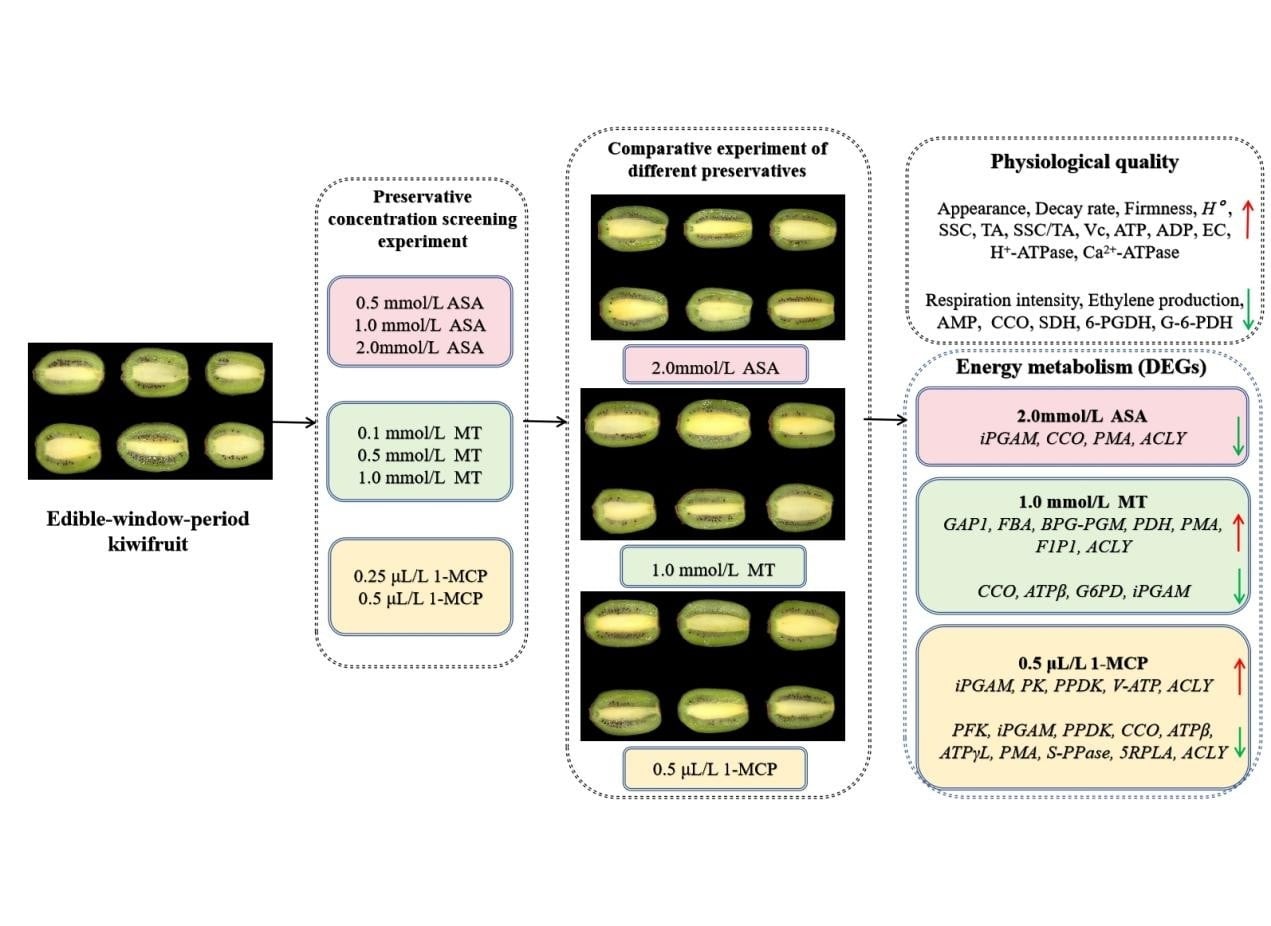
The narrow edible window period of kiwifruit poses significant challenges for the high-value fresh fruit industry. This study comparatively evaluated the effects of 1-methylcyclopropene (1-MCP), melatonin (MT), and acetylsalicylic acid (ASA) on “Guichang” kiwifruit by analyzing their physiology, energy metabolism, and transcriptomic profiles. The results indicated that 0.5 μL/L 1-MCP, 1.0 mmol/L MT, and 2.0 mmol/L ASA were the optimal concentrations, all of which significantly inhibited ethylene production and respiration intensity. These treatments effectively maintained fruit firmness, vitamin C content, and high energy status by preserving ATP levels and the activities of H+-ATPase and Ca2+-ATPase while suppressing the activities of CCO, SDH, 6-PGDH, and G-6-PDH. Transcriptomic analysis and RT-qPCR verification revealed that these preservatives re-programmed key respiratory pathways, including glycolysis, the TCA cycle, the pentose phosphate pathway, and oxidative phosphorylation. MT exhibited transcriptomic responses highly similar to 1-MCP (sharing 13 KEGG pathways) and resulted in the lowest decay rate among treatments, whereas 1-MCP showed the strongest maintenance of core firmness. Our findings suggested that MT exhibited promising performance across multiple quality- and energy-related parameters and may serve as a potential alternative treatment for maintaining kiwifruit quality during the edible window period. Future studies should functionally validate the identified candidate genes and evaluate the effects of MT on sensory and flavor attributes under commercial storage and distribution conditions.
Keywords: energy metabolism; ethylene production rate; postharvest management; preservative; shelf-life energy metabolism; ethylene production rate; postharvest management; preservative; shelf-life
Graphical Abstract