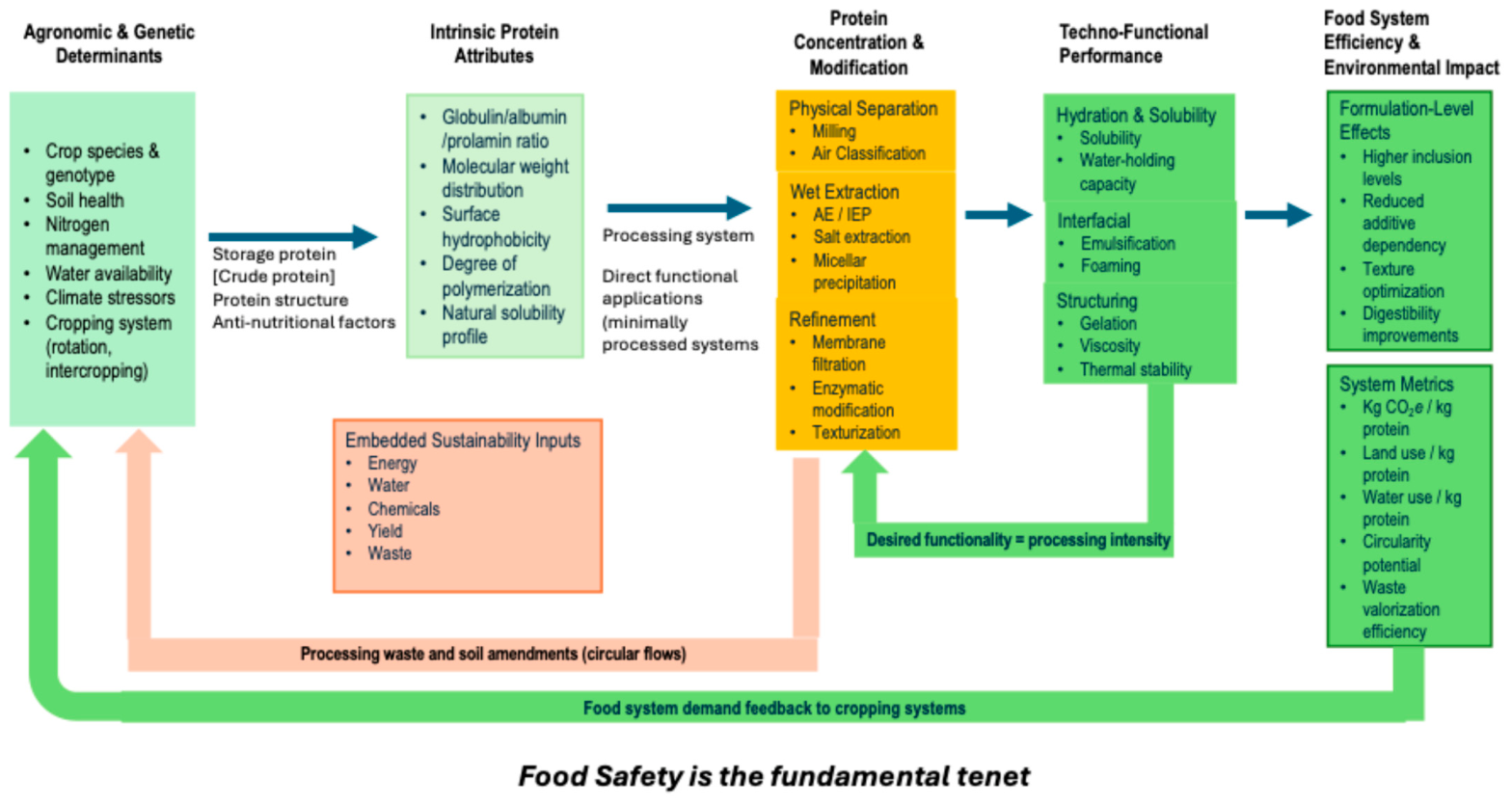
Rethinking Sustainability in Plant-Based Proteins: A Systems Perspective from Crop to Consumer
 , , ,
, , ,  and
and
Abstract
1. Introduction
2. Protein-Rich Crop Systems in the Alternative Protein Value Chain
2.1. Key Crops for Plant-Based Proteins


| Crop | Preferred Soil and pH | Global Harvest (MMT) | Typical Total Crude Protein (%) | Acreage Cultivated to Yield 1 MT of Crude Protein (Acres) | Soil Nutrient Required/MT TCP (Kg) | Water Demand (MM Liters/MT TCP) | Range and Optimum Daytime Growing Temperature (°C) |
|---|---|---|---|---|---|---|---|
| Soybean | Well-drained loam or silt loam, pH 6.0–7.5 | ~422 | ~35–40 | 1.2–1.3 | N: 80 P: 25 K: 53 | 3.5–6.0 | Range: 20–30 Optimum: 29–30 |
| Wheat | Well-drained loam or clay loam, pH 6.0–7.5 | 818–837.8 | 12–14 | 2.5–4.0 | N: 100–150 P: 20–30 K: 25–40 | 10.0–15.0 | Range: 15–24 Optimum: 21–24 |
| Yellow Pea | Sandy loam or texture loam, pH 5.5–7.5 | 12.6 (includes green peas) | 20–25 | 1.6–2.2 | N: 15–40 P: 2–4 K: 9 | 7.9–9.9 | Range: 13–21 Optimum: 15–24 |
| Rice | Heavy clay or silt loam with high water retention (preferably flooded), pH 5.0–7.5 | 770 | 7–8 | 4.5–5.5 | N: 130–170 P: 30–40 K: 130–170 | 175.0–350.0 | Range: 15–38 Optimum: 21–31 |
| Chickpea | Well-drained sandy loam to silt loam, pH 6.0–7.5 | 18.1 | 18–25 | 4–6 | N: 10–20 P: 50–60 K: 20–40 | 35.0–40.0 | Range: 10–29 Optimum: 21–27 |
| Faba Bean | Heavy silt or clay loams, pH 6.0–7.0 | 5.67 | 25–30 | 1.1–2.5 | N: 4.5–9.1 P: 22.7–68.2 K: 22.7–54.5 | 6.0–8.0 | Range: 4.5–27.0 Optimum: 15–21 |
| Yellow Lentil | Well-drained, deep, sandy loam; pH 6.0–7.0 | 6.6–6.7 | 24.5–27.5 | 3.3–4.5 | N: 0–17 P: 112–168 K: 56–112 | 4.9–5.0 | Range: 4–29 Optimum: 15–24 |
| Corn | Deep, well-drained sandy loam or loamy soil, pH 6.0–6.8 | 1,233 | 16.5 | 1.2–1.5 | N: 150–200 P: 60–80 K: 70–90 | 9.0–12.0 | Range: 10–35 Optimum: 24–32 |
2.2. Environmental Performance and Agronomic Considerations
3. Protein Concentration, Isolation, and Structuring Technologies
3.1. Protein Concentration and Isolation
3.2. Protein Structuring and Texturization
4. Ingredient Functionality and the Colloidal State of Plant Proteins
4.1. Multiscale Structure–Function Relationships
4.2. Influence of Protein Extraction on Colloidal State
4.3. Protein Aggregation: Liability or Opportunity?
4.4. Interfacial Behavior and Mixed Biopolymer Systems
4.5. Lack of Standardization in Functional Metrics
5. Climate-Driven Impacts Across the Plant-Based Protein Value Chain
5.1. Climate Effects on Protein Yield and Composition
5.2. Implications for Protein Extraction and Ingredient Yield
5.3. Climate Impacts on Functional Performance and Texturization
5.4. Interaction Between Climate Change and Food Safety Risks
5.5. Consequences for Sustainability Assessment and System Resilience
6. Nutrition and Health Implications of Plant-Based Proteins
6.1. Protein Quality Beyond Crude Protein Content
6.2. Digestibility Constraints and Bioavailability
6.3. Micronutrient Interactions and Antinutritional Factors
6.4. Health Outcomes and Epidemiological Evidence
6.5. Ultra-Processing, Functionality, and Nutrition Trade-Offs
6.6. Climate Change and Long-Term Nutritional Resilience
7. Food Safety and Sustainability Interactions in Plant-Based Protein Systems
7.1. Microbial Hazards Across the Plant-Based Protein Value Chain
7.2. Clean-Label Trends and Unintended Safety Trade-Offs
7.3. Mycotoxins and Climate-Driven Chemical Hazards
7.4. Processing Intensity as a Safety–Sustainability Lever
7.5. Allergenicity as a Sustainability Concern
8. System-Level Synthesis and Future Directions
8.1. Sustainability as an Emergent System Property
8.2. Climate Change as a Force Multiplier Across Protein Systems
8.3. Implications for Sustainability Assessment and Life-Cycle Analysis
8.4. Research Priorities at the Crop–Processing–Nutrition Interface
8.5. Implications for Food Industry Strategy
8.6. Policy and Governance Considerations
8.7. Concluding Perspective
Author Contributions
Funding
Institutional Review Board Statement
Informed Consent Statement
Data Availability Statement
Acknowledgments
Conflicts of Interest
References
- Garnett, T. Food sustainability: Problems, perspectives and solutions. Proc. Nutr. Soc. 2013, 72, 29–39. [Google Scholar] [CrossRef] [PubMed]
- Friel, S.; Barosh, L.J.; Lawrence, M. Towards healthy and sustainable food consumption: An Australian case study. Public Health Nutr. 2013, 17, 1156–1166. [Google Scholar] [CrossRef] [PubMed]
- Clune, S.; Crossin, E.; Verghese, K. Systematic review of greenhouse gas emissions for different fresh food categories. J. Clean. Prod. 2017, 140, 766–783. [Google Scholar] [CrossRef]
- Hallström, E.; Carlsson-Kanyama, A.; Börjesson, P. Environmental impact of dietary change: A systematic review. J. Clean. Prod. 2015, 91, 1–11. [Google Scholar] [CrossRef]
- How, S.; Brousseau, V.D.; Agarwal, D.; Kaye-Blake, W.; Buckow, R.; Weeks, M. Integrative modelling of fractionation, functionality, and environmental-economic trade-offs to support the transition to sustainable plant based ingredients. Trends Food Sci. Technol. 2025, 164, 105257. [Google Scholar] [CrossRef]
- Poore, J.; Nemecek, T. Reducing food’s environmental impacts through producers and consumers. Science 2018, 360, 987–992. [Google Scholar] [CrossRef] [PubMed]
- Jiménez, M.D.C.F.-F.; López-Moreno, M. Ultra-processed Plant Foods: Are They Worse than their Unprocessed Animal-Based Counterparts? Curr. Nutr. Rep. 2025, 14, 115. [Google Scholar] [CrossRef] [PubMed]
- Keeling, R.F.; Graven, H.D.; Welp, L.R.; Resplandy, L.; Bi, J.; Piper, S.C.; Sun, Y.; Bollenbacher, A.; Meijer, H.A.J. Atmospheric evidence for a global secular increase in carbon isotopic discrimination of land photosynthesis. Proc. Natl. Acad. Sci. USA 2017, 114, 10361–10366. [Google Scholar] [CrossRef] [PubMed]
- Sionit, N. Response of Soybean to Two Levels of Mineral Nutrition in CO2-Enriched Atmosphere. Crop. Sci. 1983, 23, 329–333. [Google Scholar] [CrossRef]
- Sionit, N.; Mortensen, D.A.; Strain, B.R.; Hellmers, H. Growth Response of Wheat to CO2 Enrichment and Different Levels of Mineral Nutrition. Agron. J. 1981, 73, 1023–1027. [Google Scholar] [CrossRef]
- Bartula, K.; Begley, M.; Latour, N.; Callanan, M. Growth of food-borne pathogens Listeria and Salmonella and spore-forming Paenibacillus and Bacillus in commercial plant-based milk alternatives. Food Microbiol. 2022, 109, 104143. [Google Scholar] [CrossRef] [PubMed]
- Food and Agriculture Organization of the United Nations (FAO). The State of Food and Agriculture 2023; Food and Agriculture Organization of the United Nations (FAO): Rome, Italy, 2023. [Google Scholar] [CrossRef]
- Aly, A.A.; Borik, Z.M. Food Crops, Growth and Productivity as an Important Focus for Sustainable Agriculture. In Plant Small RNA in Food Crops; Elsevier: Amsterdam, The Netherlands, 2023; pp. 3–23. [Google Scholar] [CrossRef]
- Schröder, J.J.; Schulte, R.P.O.; Creamer, R.E.; Delgado, A.; van Leeuwen, J.; Lehtinen, T.; Rutgers, M.; Spiegel, H.; Staes, J.; Tóth, G.; et al. The elusive role of soil quality in nutrient cycling: A review. Soil Use Manag. 2016, 32, 476–486. [Google Scholar] [CrossRef]
- Hill, K.W. Protein Content of Wheat as Affected by Agronomic Practices. Can. J. Plant Sci. 1964, 44, 115–122. [Google Scholar] [CrossRef]
- Sellami, M.H.; Pulvento, C.; Aria, M.; Stellacci, A.M.; Lavini, A. A Systematic Review of Field Trials to Synthesize Existing Knowledge and Agronomic Practices on Protein Crops in Europe. Agronomy 2019, 9, 292. [Google Scholar] [CrossRef]
- Zheng, B.; Zhang, X.; Wang, Q.; Li, W.; Huang, M.; Zhou, Q.; Cai, J.; Wang, X.; Cao, W.; Dai, T.; et al. Increasing plant density improves grain yield, protein quality and nitrogen agronomic efficiency of soft wheat cultivars with reduced nitrogen rate. Field Crop. Res. 2021, 267, 108145. [Google Scholar] [CrossRef]
- Qin, P.; Wang, T.; Luo, Y. A review on plant-based proteins from soybean: Health benefits and soy product development. J. Agric. Food Res. 2022, 7, 100265. [Google Scholar] [CrossRef]
- Searchinger, T.; Waite, R.; Hanson, C.; Ranganathan, J. Creating a Sustainable Food Future; World Resources Institute: Washington, DC, USA, 2019; 564p, Available online: https://research.wri.org/sites/default/files/2019-07/WRR_Food_Full_Report_0.pdf (accessed on 17 March 2026).
- Godfray, H.C.J.; Aveyard, P.; Garnett, T.; Hall, J.W.; Key, T.J.; Lorimer, J.; Pierrehumbert, R.T.; Scarborough, P.; Springmann, M.; Jebb, S.A. Meat consumption, health, and the environment. Science 2018, 361, eaam5324. [Google Scholar] [CrossRef] [PubMed]
- Wiederstein, M.; Baumgartner, S.; Lauter, K. Soybean (Glycine max) allergens─A Review on an Outstanding Plant Food with Allergenic Potential. ACS Food Sci. Technol. 2023, 3, 363–378. [Google Scholar] [CrossRef]
- Gerbens-Leenes, P.W.; Mekonnen, M.M.; Hoekstra, A.Y. The water footprint of poultry, pork and beef: A comparative study in different countries and production systems. Water Resour. Ind. 2013, 1–2, 25–36. [Google Scholar] [CrossRef]
- Nemecek, T.; Jungbluth, N.; i Canals, L.M.; Schenck, R. Environmental impacts of food consumption and nutrition: Where are we and what is next? Int. J. Life Cycle Assess. 2016, 21, 607–620. [Google Scholar] [CrossRef]
- Springmann, M.; Godfray, H.C.J.; Rayner, M.; Scarborough, P. Analysis and valuation of the health and climate change cobenefits of dietary change. Proc. Natl. Acad. Sci. USA 2016, 113, 4146–4151. [Google Scholar] [CrossRef] [PubMed]
- Grovermann, C.; Wossen, T.; Muller, A.; Nichterlein, K. Eco-efficiency and agricultural innovation systems in developing countries: Evidence from macro-level analysis. PLoS ONE 2019, 14, e0214115. [Google Scholar] [CrossRef] [PubMed]
- Medina, G.d.S.; da Silveira, F.A.; de Freitas, E.M.; Resende, V.H.S.; Martins, É.d.S. Agrochemicals and Biological Inputs in Soybean Farms in Brazil: Cases of Substitutive, Incremental, and Alternative Uses. Agrochemicals 2026, 5, 13. [Google Scholar] [CrossRef]
- Pelgrom, P.J.; Boom, R.M.; Schutyser, M.A. Functional analysis of mildly refined fractions from yellow pea. Food Hydrocoll. 2015, 44, 12–22. [Google Scholar] [CrossRef]
- Zhang, X.; Shi, Z.; Jiang, D.; Högy, P.; Fangmeier, A. Independent and combined effects of elevated CO2 and post-anthesis heat stress on protein quantity and quality in spring wheat grains. Food Chem. 2019, 277, 524–530. [Google Scholar] [CrossRef] [PubMed]
- Dekkers, B.L.; Boom, R.M.; van der Goot, A.J. Structuring processes for meat analogues. Trends Food Sci. Technol. 2018, 81, 25–36. [Google Scholar] [CrossRef]
- Lee, S.Y.; Lee, D.Y.; Jeong, J.W.; Kim, J.H.; Yun, S.H.; Joo, S.-T.; Choi, I.; Choi, J.S.; Kim, G.-D.; Hur, S.J. Studies on Meat Alternatives with a Focus on Structuring Technologies. Food Bioprocess Technol. 2023, 16, 1389–1412. [Google Scholar] [CrossRef]
- Chou, D.H.; Morr, C.V. Protein-water interactions and functional properties. J. Am. Oil Chem. Soc. 1979, 56, A53–A62. [Google Scholar] [CrossRef]
- Ma, K.K.; Greis, M.; Lu, J.; Nolden, A.A.; McClements, D.J.; Kinchla, A.J. Functional Performance of Plant Proteins. Foods 2022, 11, 594. [Google Scholar] [CrossRef] [PubMed]
- Ubbink, J.; Burbidge, A.; Mezzenga, R. Food structure and functionality: A soft matter perspective. Soft Matter 2008, 4, 1569–1581. [Google Scholar] [CrossRef] [PubMed]
- van der Sman, R. Soft matter approaches to food structuring. Adv. Colloid Interface Sci. 2012, 176–177, 18–30. [Google Scholar] [CrossRef] [PubMed]
- van der Sman, R.G.M.; van der Goot, A.J. The science of food structuring. Soft Matter 2008, 5, 501–510. [Google Scholar] [CrossRef]
- Foegeding, E.A. Food Protein Functionality—A New Model. J. Food Sci. 2015, 80, C2670–C2677. [Google Scholar] [CrossRef] [PubMed]
- Lin, Y.; Maloney, K.; Drake, M.; Zheng, H. Synergistic functionality of transglutaminase and protease on modulating texture of pea protein based yogurt alternative: From rheological and tribological characterizations to sensory perception. Food Hydrocoll. 2023, 150, 109652. [Google Scholar] [CrossRef]
- Mishra, S.; Singh, R.; Upadhyay, A.; Mishra, S.; Shukla, S. Emerging trends in processing for cereal and legume-based beverages: A review. Futur. Foods 2023, 8, 100257. [Google Scholar] [CrossRef]
- Schmitt, C.; Bovetto, L.; Buczkowski, J.; De Oliveira Reis, G.; Pibarot, P.; Amagliani, L.; Dombrowski, J. Plant proteins and their colloidal state. Curr. Opin. Colloid Interface Sci. 2021, 56, 101510. [Google Scholar] [CrossRef]
- Lin, Y.; Cheng, N.; Jiang, Y.; Grace, M.H.; Lila, M.A.; Hoskin, R.T.; Zheng, H. Colloidal and interfacial properties of spray dried pulse protein-blueberry polyphenol particles in model dispersion systems. Food Chem. 2024, 457, 140073. [Google Scholar] [CrossRef] [PubMed]
- Wang, C.; Wu, J.; Wang, C.; Mu, C.; Ngai, T.; Lin, W. Advances in Pickering emulsions stabilized by protein particles: Toward particle fabrication, interaction and arrangement. Food Res. Int. 2022, 157, 111380. [Google Scholar] [CrossRef] [PubMed]
- Zheng, H. Polymers for Structure Design of Dairy Foods. In Polymers for Food Applications; Springer: Cham, Switzerland, 2018; pp. 509–528. [Google Scholar]
- Yang, J.; Kornet, R.; Ntone, E.; Meijers, M.G.; van Den Hoek, I.A.; Sagis, L.M.; Venema, P.; Meinders, M.B.; Berton-Carabin, C.C.; Nikiforidis, C.V.; et al. Plant protein aggregates induced by extraction and fractionation processes: Impact on techno-functional properties. Food Hydrocoll. 2024, 155, 110223. [Google Scholar] [CrossRef]
- Yang, J.; Sagis, L.M. Interfacial behavior of plant proteins—Novel sources and extraction methods. Curr. Opin. Colloid Interface Sci. 2021, 56, 101499. [Google Scholar] [CrossRef]
- Sarantis, S.D.; Eren, N.M.; Kowalcyk, B.; Jimenez–Flores, R.; Alvarez, V.B. Thermodynamic interactions of micellar casein and oat β-glucan in a model food system. Food Hydrocoll. 2021, 115, 106559. [Google Scholar] [CrossRef]
- Tolstoguzov, V. Some thermodynamic considerations in food formulation. Food Hydrocoll. 2003, 17, 1–23. [Google Scholar] [CrossRef]
- Tolstoguzov, V. Thermodynamic considerations of starch functionality in foods. Carbohydr. Polym. 2003, 51, 99–111. [Google Scholar] [CrossRef]
- Turgeon, S.; Beaulieu, M.; Schmitt, C.; Sanchez, C. Protein–polysaccharide interactions: Phase-ordering kinetics, thermodynamic and structural aspects. Curr. Opin. Colloid Interface Sci. 2003, 8, 401–414. [Google Scholar] [CrossRef]
- Stone, A.K.; Karalash, A.; Tyler, R.T.; Warkentin, T.D.; Nickerson, M.T. Functional attributes of pea protein isolates prepared using different extraction methods and cultivars. Food Res. Int. 2015, 76, 31–38. [Google Scholar] [CrossRef]
- Tanger, C.; Engel, J.; Kulozik, U. Influence of extraction conditions on the conformational alteration of pea protein extracted from pea flour. Food Hydrocoll. 2020, 107, 105949. [Google Scholar] [CrossRef]
- Kornet, R.; Veenemans, J.; Venema, P.; van der Goot, A.J.; Meinders, M.; Sagis, L.; van der Linden, E. Less is more: Limited fractionation yields stronger gels for pea proteins. Food Hydrocoll. 2021, 112, 106285. [Google Scholar] [CrossRef]
- Ebert, S.; Gibis, M.; Terjung, N.; Weiss, J. Survey of aqueous solubility, appearance, and pH of plant protein powders from carbohydrate and vegetable oil production. LWT 2020, 133, 110078. [Google Scholar] [CrossRef]
- Akharume, F.U.; Aluko, R.E.; Adedeji, A.A. Modification of plant proteins for improved functionality: A review. Compr. Rev. Food Sci. Food Saf. 2021, 20, 198–224. [Google Scholar] [CrossRef] [PubMed]
- Chen, S.; Jiao, W.; Wu, J. Current insights into heat treatment for improving functionalities of soy protein: A review. Compr. Rev. Food Sci. Food Saf. 2025, 24, e70141. [Google Scholar] [CrossRef] [PubMed]
- Peng, Y.; Kyriakopoulou, K.; Rahmani, A.; Venema, P.; van der Goot, A.J. Isochoric moisture heating as a tool to control the functionality of soy protein. LWT 2021, 150, 111979. [Google Scholar] [CrossRef]
- Rashwan, A.K.; Osman, A.I.; Abdelshafy, A.M.; Mo, J.; Chen, W. Plant-based proteins: Advanced extraction technologies, interactions, physicochemical and functional properties, food and related applications, and health benefits. Crit. Rev. Food Sci. Nutr. 2023, 65, 667–694. [Google Scholar] [CrossRef] [PubMed]
- De Angelis, D.; Latrofa, V.; Caponio, F.; Pasqualone, A.; Summo, C. Techno-functional properties of dry-fractionated plant-based proteins and application in food product development: A review. J. Sci. Food Agric. 2023, 104, 1884–1896. [Google Scholar] [CrossRef] [PubMed]
- Kottage, S.M.; Samaranayaka, A.G.P.; Bhowmik, P.; Chen, L. Comparison of dry (air classification) and wet fractionated pea protein on protein molecular structure and gelling properties. Sustain. Food Proteins 2024, 2, 141–158. [Google Scholar] [CrossRef]
- Amin, U.; Lin, Y.; Zuo, X.; Zheng, H. Soft matter approach for creating novel protein hydrogels using fractal whey protein assemblies as building blocks. Food Hydrocoll. 2024, 151, 109828. [Google Scholar] [CrossRef]
- Quevedo, M.; Karbstein, H.P.; Emin, M.A. Concentration-dependent changes in the reaction behavior of whey proteins: Diffusion-controlled or transition state-controlled reactions? Food Hydrocoll. 2021, 118, 106745. [Google Scholar] [CrossRef]
- Ryan, K.N.; Zhong, Q.; Foegeding, E.A. Use of Whey Protein Soluble Aggregates for Thermal Stability—A Hypothesis Paper. J. Food Sci. 2013, 78, R1105–R1115. [Google Scholar] [CrossRef] [PubMed]
- Wolz, M.; Mersch, E.; Kulozik, U. Thermal aggregation of whey proteins under shear stress. Food Hydrocoll. 2016, 56, 396–404. [Google Scholar] [CrossRef]
- Caicedo Chacon, W.D.; Verruck, S.; Monteiro, A.R.; Valencia, G.A. The mechanism, biopolymers and active compounds for the production of nanoparticles by anti-solvent precipitation: A review. Food Res. Int. 2023, 168, 112728. [Google Scholar] [CrossRef] [PubMed]
- Chen, N.; Chassenieux, C.; Nicolai, T. Kinetics of NaCl induced gelation of soy protein aggregates: Effects of temperature, aggregate size, and protein concentration. Food Hydrocoll. 2018, 77, 66–74. [Google Scholar] [CrossRef]
- Cochereau, R.; Nicolai, T.; Chassenieux, C.; Silva, J.V. Mechanism of the spontaneous formation of plant protein microcapsules in aqueous solution. Colloids Surf. A Physicochem. Eng. Asp. 2019, 562, 213–219. [Google Scholar] [CrossRef]
- Mattice, K.D.; Marangoni, A.G. Functionalizing zein through antisolvent precipitation from ethanol or aetic acid. Food Chem. 2020, 313, 126127. [Google Scholar] [CrossRef] [PubMed]
- Nicolai, T.; Chassenieux, C. Heat-induced gelation of plant globulins. Curr. Opin. Food Sci. 2019, 27, 18–22. [Google Scholar] [CrossRef]
- Nicolai, T.; Durand, D. Controlled food protein aggregation for new functionality. Curr. Opin. Colloid Interface Sci. 2013, 18, 249–256. [Google Scholar] [CrossRef]
- Zhu, Z.; Bassey, A.P.; Cao, Y.; Ma, Y.; Huang, M.; Yang, H. Food protein aggregation and its application. Food Res. Int. 2022, 160, 111725. [Google Scholar] [CrossRef] [PubMed]
- Sarkar, A.; Dickinson, E. Sustainable food-grade Pickering emulsions stabilized by plant-based particles. Curr. Opin. Colloid Interface Sci. 2020, 49, 69–81. [Google Scholar] [CrossRef]
- Song, J.; Yang, Z.; Zeng, J.; Hassan, M.E.; Cheng, S.; Yu, F.; Wang, Y.; Yu, X.; Wang, P.; Wang, L.; et al. Aggregation mechanism of soybean protein isolate for the formation of plant protein-based meat analogs during high moisture extrusion. Int. J. Biol. Macromol. 2025, 337, 149524. [Google Scholar] [CrossRef] [PubMed]
- Tao, Y.; Chen, Y.; Howard, W.; Ibrahim, M.; Patel, S.M.; McMahon, W.P.; Kim, Y.J.; Delmar, J.A.; Davis, D. Mechanism of Insoluble Aggregate Formation in a Reconstituted Solution of Spray-Dried Protein Powder. Pharm. Res. 2023, 40, 2355–2370. [Google Scholar] [CrossRef] [PubMed]
- Guo, F.; Lin, L.; He, Z.; Zheng, Z. Storage stability of soy protein isolate powders containing soluble protein aggregates formed at varying pH. Food Sci. Nutr. 2020, 8, 5275–5283. [Google Scholar] [CrossRef] [PubMed]
- Fu, L.; Wang, Z.; He, Z.; Zeng, M.; Qin, F.; Chen, J. Effects of soluble aggregates sizes on rheological properties of soybean protein isolate under high temperature. LWT 2023, 182, 114793. [Google Scholar] [CrossRef]
- Shen, P.; Peng, J.; Landman, J.; Sagis, L.M. Protein pre-aggregation as a strategy to reinforce heat-set emulsion-filled faba bean globulin gels. Food Hydrocoll. 2026, 176, 112537. [Google Scholar] [CrossRef]
- Wang, X.; Yu, M.; Wang, Z.; Luo, K.; Adhikari, B.; Miao, S.; Liu, S. Modulation of soy protein isolate gel properties by a novel “two-step” gelation process: Effects of pre-aggregation with different divalent sulfates. Food Chem. 2022, 394, 133515. [Google Scholar] [CrossRef] [PubMed]
- Zhou, X.; Sala, G.; Sagis, L.M. Bulk and interfacial properties of milk fat emulsions stabilized by whey protein isolate and whey protein aggregates. Food Hydrocoll. 2020, 109, 106100. [Google Scholar] [CrossRef]
- Grasberger, K.F.; Lund, F.W.; Simonsen, A.C.; Hammershøj, M.; Fischer, P.; Corredig, M. Role of the pea protein aggregation state on their interfacial properties. J. Colloid Interface Sci. 2023, 658, 156–166. [Google Scholar] [CrossRef] [PubMed]
- Braudo, E.E.; Plashchina, I.G.; Schwenke, K.D. Plant protein interactions with polysaccharides and their influence on legume protein functionality A Review. Mol. Nutr. Food Res. 2001, 45, 382–384. [Google Scholar] [CrossRef]
- McArthur, S.L.; McLean, K.M.; Kingshott, P.; John, H.A.S.; Chatelier, R.C.; Griesser, H.J. Effect of polysaccharide structure on protein adsorption. Colloids Surf. B Biointerfaces 2000, 17, 37–48. [Google Scholar] [CrossRef]
- Rodríguez Patino, J.M.; Pilosof, A.M. Protein–polysaccharide interactions at fluid interfaces. Food Hydrocoll. 2011, 25, 1925–1937. [Google Scholar] [CrossRef]
- Zhang, Y.; Sharan, S.; Rinnan, Å.; Orlien, V. Survey on Methods for Investigating Protein Functionality and Related Molecular Characteristics. Foods 2021, 10, 2848. [Google Scholar] [CrossRef] [PubMed]
- Listov, D.; Goverde, C.A.; Correia, B.E.; Fleishman, S.J. Opportunities and challenges in design and optimization of protein function. Nat. Rev. Mol. Cell Biol. 2024, 25, 639–653. [Google Scholar] [CrossRef] [PubMed]
- Alasi, S.O.; Sanusi, M.S.; Sunmonu, M.O.; Odewole, M.M.; Adepoju, A.L. Exploring recent developments in novel technologies and AI integration for plant-based protein functionality: A review. J. Agric. Food Res. 2024, 15, 101036. [Google Scholar] [CrossRef]
- McClements, D.J.; Grossmann, L. Next-Generation Plant-Based Foods: Challenges and Opportunities. Annu. Rev. Food Sci. Technol. 2024, 15, 79–101. [Google Scholar] [CrossRef] [PubMed]
- Garmendia, I.; Rashidi, S.; Quezada-Salirrosas, M.R.; Goicoechea, N. Atmospheric CO2 concentration affects the life cycle, yield, and fruit quality of early maturing edible legume cultivars. J. Sci. Food Agric. 2021, 102, 3964–3971. [Google Scholar] [CrossRef] [PubMed]
- Guo, X.; Huang, B.; Zhang, H.; Cai, C.; Li, G.; Li, H.; Zhang, Y.; Struik, P.C.; Liu, Z.; Dong, M.; et al. T-FACE studies reveal that increased temperature exerts an effect opposite to that of elevated CO2 on nutrient concentration and bioavailability in rice and wheat grains. Food Energy Secur. 2021, 11, e336. [Google Scholar] [CrossRef]
- Jing, L.; Wang, J.; Shen, S.; Wang, Y.; Zhu, J.; Wang, Y.; Yang, L. The impact of elevated CO2 and temperature on grain quality of rice grown under open-air field conditions. J. Sci. Food Agric. 2015, 96, 3658–3667. [Google Scholar] [CrossRef] [PubMed]
- Kong, X.; Hou, R.; Yang, G. Effects of climactic warming on the starch and protein content of winter wheat grain under conservation tillage in the North China Plain. Soil Tillage Res. 2024, 238, 105995. [Google Scholar] [CrossRef]
- Chiluwal, A. US soybean seed protein concentrations—Current status, challenges, and some potential crop management solutions. Agron. J. 2024, 117, e21731. [Google Scholar] [CrossRef]
- Olckers, S.-L.; Osthoff, G.; Guzmán, C.; Wentzel, B.; van Biljon, A.; Labuschagne, M. Drought and heat stress effects on gluten protein composition and its relation to bread-making quality in wheat. J. Cereal Sci. 2022, 108, 103562. [Google Scholar] [CrossRef]
- Sarkar, S.; Khatun, M.; Era, F.M.; Islam, A.K.M.M.; Anwar, P.; Danish, S.; Datta, R.; Islam, A.K.M.A. Abiotic Stresses: Alteration of Composition and Grain Quality in Food Legumes. Agronomy 2021, 11, 2238. [Google Scholar] [CrossRef]
- Šola, I.; Poljuha, D.; Pavičić, I.; Jurinjak Tušek, A.; Šamec, D. Climate Change and Plant Foods: The Influence of Environmental Stressors on Plant Metabolites and Future Food Sources. Foods 2025, 14, 416. [Google Scholar] [CrossRef] [PubMed]
- Han, P.; Wang, Y.; Sun, H. Impact of Temperature Stresses on Wheat Quality: A Focus on Starch and Protein Composition. Foods 2025, 14, 2178. [Google Scholar] [CrossRef] [PubMed]
- Hurkman, W.J.; Vensel, W.H.; Tanaka, C.K.; Whitehand, L.; Altenbach, S.B. Effect of high temperature on albumin and globulin accumulation in the endosperm proteome of the developing wheat grain. J. Cereal Sci. 2009, 49, 12–23. [Google Scholar] [CrossRef]
- Abasi, F.; Ehsan, M.; Raja, N.I.; Mashwani, Z.-U.; Sohail, M.; Iqbal, M.; Shahbaz, M.; Mehmood, A.; Raza, M.U. Physiological and Molecular Pathways of Crop Plants in Response to Heat Stress. In Improving Stress Resilience in Plants; Elsevier: Amsterdam, The Netherlands, 2024; pp. 459–479. [Google Scholar] [CrossRef]
- Bhandari, K.; Siddique, K.H.M.; Turner, N.C.; Kaur, J.; Singh, S.; Agrawal, S.K.; Nayyar, H. Heat Stress at Reproductive Stage Disrupts Leaf Carbohydrate Metabolism, Impairs Reproductive Function, and Severely Reduces Seed Yield in Lentil. J. Crop. Improv. 2016, 30, 118–151. [Google Scholar] [CrossRef]
- Devi, P.; Awasthi, R.; Jha, U.; Sharma, K.D.; Prasad, P.V.V.; Siddique, K.H.M.; Roorkiwal, M.; Nayyar, H. Understanding the effect of heat stress during seed filling on nutritional composition and seed yield in chickpea (Cicer arietinum L.). Sci. Rep. 2023, 13, 15450. [Google Scholar] [CrossRef] [PubMed]
- Sita, K.; Sehgal, A.; Bhandari, K.; Kumar, J.; Kumar, S.; Singh, S.; Siddique, K.H.; Nayyar, H. Impact of heat stress during seed filling on seed quality and seed yield in lentil (Lens culinaris Medikus) genotypes. J. Sci. Food Agric. 2018, 98, 5134–5141. [Google Scholar] [CrossRef] [PubMed]
- Hajibarat, Z.; Saidi, A. Senescence-associated proteins and nitrogen remobilization in grain filling under drought stress condition. J. Genet. Eng. Biotechnol. 2022, 20, 101–114. [Google Scholar] [CrossRef] [PubMed]
- Wolfe, D.W.; Henderson, D.W.; Hsiao, T.C.; Alvino, A. Interactive Water and Nitrogen Effects on Senescence of Maize. II. Photosynthetic Decline and Longevity of Individual Leaves. Agron. J. 1988, 80, 865–870. [Google Scholar] [CrossRef]
- Heinemann, B.; Künzler, P.; Eubel, H.; Braun, H.-P.; Hildebrandt, T.M. Estimating the number of protein molecules in a plant cell: Protein and amino acid homeostasis during drought. Plant Physiol. 2020, 185, 385–404. [Google Scholar] [CrossRef] [PubMed]
- Saeedipour, S. Stress-induced changes in the free amino acid composition of two wheat cultivars with difference in drought resistance. Afr. J. Biotechnol. 2012, 11, 9559. [Google Scholar] [CrossRef]
- Awasthi, R.; Gaur, P.; Turner, N.C.; Vadez, V.; Siddique, K.H.M.; Nayyar, H. Effects of individual and combined heat and drought stress during seed filling on the oxidative metabolism and yield of chickpea (Cicer arietinum) genotypes differing in heat and drought tolerance. Crop. Pasture Sci. 2017, 68, 823–841. [Google Scholar] [CrossRef]
- Lawas, L.M.F.; Zuther, E.; Jagadish, S.K.; Hincha, D.K. Molecular mechanisms of combined heat and drought stress resilience in cereals. Curr. Opin. Plant Biol. 2018, 45, 212–217. [Google Scholar] [CrossRef] [PubMed]
- Kashyap, S.; Reddy, B.H.R.; Devi, S.; Kurpad, A.V. Potential impact of climate change on dietary grain protein content and its bioavailability-a mini review. Front. Nutr. 2024, 11, 1397219. [Google Scholar] [CrossRef] [PubMed]
- Kumari, V.V.; Banerjee, P.; Verma, V.C.; Sukumaran, S.; Chandran, M.A.S.; Gopinath, K.A.; Venkatesh, G.; Yadav, S.K.; Singh, V.K.; Awasthi, N.K. Plant Nutrition: An Effective Way to Alleviate Abiotic Stress in Agricultural Crops. Int. J. Mol. Sci. 2022, 23, 8519. [Google Scholar] [CrossRef] [PubMed]
- Singh, R.K.; Gupta, V.; Prasad, M. Plant Molecular Chaperones: Structural Organization and Their Roles in Abiotic Stress Tolerance. In Molecular Plant Abiotic Stress; Roychoudhury, A., Tripathi, D., Eds.; Wiley: Hoboken, NJ, USA, 2019; pp. 221–239. [Google Scholar] [CrossRef]
- Dong, C.; Zhao, J.; Jiang, J. Cysteine-induced disulfide cleavage enhances the solubility of alkali-treated pea protein and its elasticity contribution in low-salt hybrid meat gels. Food Chem. 2024, 469, 142572. [Google Scholar] [CrossRef] [PubMed]
- Hiraiwa, N.; Kondo, M.; Nishimura, M.; Hara-Nishimura, I. An Aspartic Endopeptidase is Involved in the Breakdown of Propeptides of Storage Proteins in Protein-Storage Vacuoles of Plants. Eur. J. Biochem. 1997, 246, 133–141. [Google Scholar] [CrossRef] [PubMed]
- Qing, R.; Hao, S.; Smorodina, E.; Jin, D.; Zalevsky, A.; Zhang, S. Protein Design: From the Aspect of Water Solubility and Stability. Chem. Rev. 2022, 122, 14085–14179. [Google Scholar] [CrossRef] [PubMed]
- Voigt, G.; Biehl, B.; Heinrichs, H.; Voigt, J. Aspartic proteinase levels in seeds of different angiosperms. Phytochemistry 1997, 44, 389–392. [Google Scholar] [CrossRef]
- Wolfenden, R.; Andersson, L.; Cullis, P.M.; Southgate, C.C.B. Affinities of amino acid side chains for solvent water. Biochemistry 1981, 20, 849–855. [Google Scholar] [CrossRef] [PubMed]
- Aono, S.; Nishitsuji, Y.; Iwaki, S.; Hayakawa, K. Effects of environmental temperature during maturation on protein characteristics in spring wheat (Triticum aestivum cv. Haruyokoi). J. Cereal Sci. 2024, 116, 103838. [Google Scholar] [CrossRef]
- Shewry, P.R.; Halford, N.G.; Belton, P.S.; Tatham, A.S. The structure and properties of gluten: An elastic protein from wheat grain. Philos. Trans. R. Soc. B Biol. Sci. 2002, 357, 133–142. [Google Scholar] [CrossRef] [PubMed]
- Feng, J.; Zhao, Y.; Jiang, L.; Zhang, Y.; Sui, X. The effect of Hofmeister series anions on the critical overlap concentration of soybean isolate protein. Food Hydrocoll. 2023, 149, 109577. [Google Scholar] [CrossRef]
- Barik, S. Evolution of Protein Structure and Stability in Global Warming. Int. J. Mol. Sci. 2020, 21, 9662. [Google Scholar] [CrossRef] [PubMed]
- See, X.Y.; Chiang, J.H.; Law, L.M.; Osen, R. High moisture extrusion of plant proteins: Advances, challenges, and opportunities. Crit. Rev. Food Sci. Nutr. 2023, 65, 143–164. [Google Scholar] [CrossRef] [PubMed]
- Mirón, I.J.; Linares, C.; Díaz, J. The influence of climate change on food production and food safety. Environ. Res. 2022, 216, 114674. [Google Scholar] [CrossRef] [PubMed]
- Thornton, P.K.; Ericksen, P.J.; Herrero, M.; Challinor, A.J. Climate variability and vulnerability to climate change: A review. Glob. Change Biol. 2014, 20, 3313–3328. [Google Scholar] [CrossRef] [PubMed]
- Lehmann, P.; Ammunét, T.; Barton, M.; Battisti, A.; Eigenbrode, S.D.; Jepsen, J.U.; Kalinkat, G.; Neuvonen, S.; Niemelä, P.; Terblanche, J.S.; et al. Complex responses of global insect pests to climate warming. Front. Ecol. Environ. 2020, 18, 141–150. [Google Scholar] [CrossRef]
- Skendžić, S.; Zovko, M.; Živković, I.P.; Lešić, V.; Lemić, D. The impact of climate change on agricultural insects pests. Insects 2021, 12, 440. [Google Scholar] [CrossRef] [PubMed]
- Bullerman, L.B.; Bianchini, A. Stability of mycotoxins during food processing. Int. J. Food Microbiol. 2007, 119, 140–146. [Google Scholar] [CrossRef] [PubMed]
- Kain, T.; Albahri, M.; Plötz, M.; Jessberger, N. Growth, persistence and toxin production of pathogenic bacteria in plant-based drinking milk alternatives. J. Food Sci. 2024, 89, 5799–5811. [Google Scholar] [CrossRef] [PubMed]
- O’MAhony, M.; Mitchell, E.; Gilbert, R.J.; Hutchinson, D.N.; Begg, N.T.; Rodhouse, J.C.; Morris, J.E. An outbreak of foodborne botulism associated with contaminated hazelnut yoghurt. Epidemiol. Infect. 1990, 104, 389–395. [Google Scholar] [CrossRef] [PubMed]
- Azizi, R.; Baggio, A.; Capuano, E.; Pellegrini, N. Protein transition: Focus on protein quality in sustainable alternative sources. Crit. Rev. Food Sci. Nutr. 2024, 65, 3401–3421. [Google Scholar] [CrossRef] [PubMed]
- Chaudhary, A.; Gustafson, D.; Mathys, A. Multi-indicator sustainability assessment of global food systems. Nat. Commun. 2018, 9, 848. [Google Scholar] [CrossRef] [PubMed]
- Drewnowski, A. Adjusting for protein quality by food source may affect nutrient density metrics. Nutr. Rev. 2020, 79, 1134–1144. [Google Scholar] [CrossRef] [PubMed]
- Masset, G.; Soler, L.-G.; Vieux, F.; Darmon, N. Identifying Sustainable Foods: The Relationship between Environmental Impact, Nutritional Quality, and Prices of Foods Representative of the French Diet. J. Acad. Nutr. Diet. 2014, 114, 862–869. [Google Scholar] [CrossRef] [PubMed]
- Boland, M.J.; Rae, A.N.; Vereijken, J.M.; Meuwissen, M.P.M.; Fischer, A.R.H.; van Boekel, M.A.J.S.; Rutherfurd, S.M.; Gruppen, H.; Moughan, P.J.; Hendriks, W.H. The future supply of animal-derived protein for human consumption. Trends Food Sci. Technol. 2013, 29, 62–73. [Google Scholar] [CrossRef]
- Davis, K.F.; Gephart, J.A.; Emery, K.A.; Leach, A.M.; Galloway, J.N.; D’oDorico, P. Meeting future food demand with current agricultural resources. Glob. Environ. Change 2016, 39, 125–132. [Google Scholar] [CrossRef]
- Sabaté, J.; Soret, S. Sustainability of plant-based diets: Back to the future. Am. J. Clin. Nutr. 2014, 100, 476S–482S. [Google Scholar] [CrossRef] [PubMed]
- Xu, X.; Sharma, P.; Shu, S.; Lin, T.-S.; Ciais, P.; Tubiello, F.N.; Smith, P.; Campbell, N.; Jain, A.K. Global greenhouse gas emissions from animal-based foods are twice those of plant-based foods. Nat. Food 2021, 2, 724–732. [Google Scholar] [CrossRef] [PubMed]
- Boye, J.; Wijesinha-Bettoni, R.; Burlingame, B. Protein quality evaluation twenty years after the introduction of the protein digestibility corrected amino acid score method. Br. J. Nutr. 2012, 108, S183–S211. [Google Scholar] [CrossRef] [PubMed]
- Hertzler, S.R.; Lieblein-Boff, J.C.; Weiler, M.; Allgeier, C. Plant Proteins: Assessing Their Nutritional Quality and Effects on Health and Physical Function. Nutrients 2020, 12, 3704. [Google Scholar] [CrossRef] [PubMed]
- Sá, A.G.A.; Moreno, Y.M.F.; Carciofi, B.A.M. Plant proteins as high-quality nutritional source for human diet. Trends Food Sci. Technol. 2020, 97, 170–184. [Google Scholar] [CrossRef]
- Ismail, B.P.; Senaratne-Lenagala, L.; Stube, A.; Brackenridge, A. Protein demand: Review of plant and animal proteins used in alternative protein product development and production. Anim. Front. 2020, 10, 53–63. [Google Scholar] [CrossRef] [PubMed]
- Poutanen, K.S.; Kårlund, A.O.; Gómez-Gallego, C.; Johansson, D.P.; Scheers, N.M.; Marklinder, I.M.; Eriksen, A.K.; Silventoinen, P.C.; Nordlund, E.; Sozer, N.; et al. Grains—A major source of sustainable protein for health. Nutr. Rev. 2022, 80, 1648–1663. [Google Scholar] [CrossRef] [PubMed]
- Zhang, X.; Zhang, Z.; Shen, A.; Zhang, T.; Jiang, L.; El-Seedi, H.; Zhang, G.; Sui, X. Legumes as an alternative protein source in plant-based foods: Applications, challenges, and strategies. Curr. Res. Food Sci. 2024, 9, 100876. [Google Scholar] [CrossRef] [PubMed]
- Lumsden, C.L.; Jägermeyr, J.; Ziska, L.; Fanzo, J. Critical overview of the implications of a global protein transition in the face of climate change: Key unknowns and research imperatives. One Earth 2024, 7, 1187–1201. [Google Scholar] [CrossRef]
- Townsend, D.M.; Tew, K.D.; Tapiero, H. Sulfur containing amino acids and human disease. Biomed. Pharmacother. 2004, 58, 47–55. [Google Scholar] [CrossRef] [PubMed]
- Fekadu Gemede, H.; Ratta, N. Antinutritional factors in plant foods: Potential health benefits and adverse effects. Glob. Adv. Res. Food Sci. Technol. 2014, 3, 103–117. [Google Scholar] [CrossRef]
- Nath, H.; Samtiya, M.; Dhewa, T. Beneficial attributes and adverse effects of major plant-based foods anti-nutrients on health: A review. Hum. Nutr. Metab. 2022, 28, 200147. [Google Scholar] [CrossRef]
- Popova, A.; Mihaylova, D. Antinutrients in Plant-based Foods: A Review. Open Biotechnol. J. 2019, 13, 68–76. [Google Scholar] [CrossRef]
- Samtiya, M.; Aluko, R.E.; Dhewa, T. Plant food anti-nutritional factors and their reduction strategies: An overview. Food Prod. Process. Nutr. 2020, 2, 6. [Google Scholar] [CrossRef]
- Li, T.; Chen, Y.; Gua, C.; Li, X. Elevated Circulating Trimethylamine N-Oxide Levels Contribute to Endothelial Dysfunction in Aged Rats through Vascular Inflammation and Oxidative Stress. Front. Physiol. 2017, 8, 350. [Google Scholar] [CrossRef] [PubMed]
- Zhang, J.; Wang, J.; Li, M.; Guo, S.; Lv, Y. Effects of heat treatment on protein molecular structure and in vitro digestion in whole soybeans with different moisture content. Food Res. Int. 2022, 155, 111115. [Google Scholar] [CrossRef] [PubMed]
- Mehak, M.; Deepti, S.; Kumar, A.G.; Singh, S.J.; Shilpa, V.; Deepansh, S. Role of lacto-fermentation in reduction of antinutrients in plant-based foods. J. Appl. Biol. Biotechnol. 2021, 9, 7–16. [Google Scholar] [CrossRef]
- Gomes, A.; Sobral, P.J.D.A. Plant Protein-Based Delivery Systems: An Emerging Approach for Increasing the Efficacy of Lipophilic Bioactive Compounds. Molecules 2021, 27, 60. [Google Scholar] [CrossRef] [PubMed]
- Sarwar Gilani, G.; Xiao, C.W.; Cockell, K.A. Impact of Antinutritional Factors in Food Proteins on the Digestibility of Protein and the Bioavailability of Amino Acids and on Protein Quality. Br. J. Nutr. 2012, 108, S315–S332. [Google Scholar] [CrossRef] [PubMed]
- Ośko, J.; Nasierowska, K.; Grembecka, M. Application of In Vitro Digestion Models in the Evaluation of Dietary Supplements. Foods 2024, 13, 2135. [Google Scholar] [CrossRef] [PubMed]
- Kaur, L.; Mao, B.; Beniwal, A.S.; Abhilasha; Kaur, R.; Chian, F.M.; Singh, J. Alternative proteins vs animal proteins: The influence of structure and processing on their gastro-small intestinal digestion. Trends Food Sci. Technol. 2022, 122, 275–286. [Google Scholar] [CrossRef]
- Neufingerl, N.; Eilander, A. Nutrient Intake and Status in Adults Consuming Plant-Based Diets Compared to Meat-Eaters: A Systematic Review. Nutrients 2021, 14, 29. [Google Scholar] [CrossRef] [PubMed]
- Pires, S.M.G.; Reis, R.S.; Cardoso, S.M.; Pezzani, R.; Paredes-Osses, E.; Seilkhan, A.; Ydyrys, A.; Martorell, M.; Sönmez Gürer, E.; Setzer, W.N.; et al. Phytates as a natural source for health promotion: A critical evaluation of clinical trials. Front. Chem. 2023, 11, 1174109. [Google Scholar] [CrossRef] [PubMed]
- Langyan, S.; Yadava, P.; Khan, F.N.; Dar, Z.A.; Singh, R.; Kumar, A. Sustaining Protein Nutrition Through Plant-Based Foods. Front. Nutr. 2022, 8, 772573. [Google Scholar] [CrossRef] [PubMed]
- Knez, E.; Kadac-Czapska, K.; Grembecka, M. Effect of Fermentation on the Nutritional Quality of the Selected Vegetables and Legumes and Their Health Effects. Life 2023, 13, 655. [Google Scholar] [CrossRef] [PubMed]
- Grasso, A.C.; Besselink, J.J.F.; Tyszler, M.; Bruins, M.J. The Potential of Food Fortification as an Enabler of More Environmentally Sustainable, Nutritionally Adequate Diets. Nutrients 2023, 15, 2473. [Google Scholar] [CrossRef] [PubMed]
- Kiani, A.K.; Dhuli, K.; Donato, K.; Aquilanti, B.; Velluti, V.; Matera, G.; Iaconelli, A.; Connelly, S.T.; Bellinato, F.; Gisondi, P.; et al. Main nutritional deficiencies. J. Prev. Med. Hyg. 2022, 63, E93–E101. [Google Scholar] [CrossRef] [PubMed]
- Meng, S.; Cui, Z.; Li, M.; Li, T.; Wu, F.; Kang, T.; Meng, H. Associations between Dietary Animal and Plant Protein Intake and Cardiometabolic Risk Factors—A Cross-Sectional Study in China Health and Nutrition Survey. Nutrients 2021, 13, 336. [Google Scholar] [CrossRef] [PubMed]
- Fernández-Rodríguez, R.; Bizzozero-Peroni, B.; Díaz-Goñi, V.; Garrido-Miguel, M.; Bertotti, G.; Roldán-Ruiz, A.; López-Moreno, M. Plant-based meat alternatives and cardiometabolic health: A systematic review and meta-analysis. Am. J. Clin. Nutr. 2024, 121, 274–283. [Google Scholar] [CrossRef] [PubMed]
- Fedde, S.; Wießner, M.; Hägele, F.A.; Müller, M.J.; Bosy-Westphal, A. Ultra-processed foods and plant-based alternatives impair nutritional quality of omnivorous and plant-forward dietary patterns in college students. Sci. Rep. 2025, 15, 4233. [Google Scholar] [CrossRef] [PubMed]
- Lim, M.T.; Pan, B.J.; Toh, D.W.K.; Sutanto, C.N.; Kim, J.E. Animal Protein versus Plant Protein in Supporting Lean Mass and Muscle Strength: A Systematic Review and Meta-Analysis of Randomized Controlled Trials. Nutrients 2021, 13, 661. [Google Scholar] [CrossRef] [PubMed]
- Markova, M.; Koelman, L.; Hornemann, S.; Pivovarova, O.; Sucher, S.; Machann, J.; Rudovich, N.; Thomann, R.; Schneeweiss, R.; Rohn, S.; et al. Effects of plant and animal high protein diets on immune-inflammatory biomarkers: A 6-week intervention trial. Clin. Nutr. 2020, 39, 862–869. [Google Scholar] [CrossRef] [PubMed]
- Ely, I.A.; Phillips, B.E.; Smith, K.; Wilkinson, D.J.; Piasecki, M.; Breen, L.; Larsen, M.S.; Atherton, P.J. A focus on leucine in the nutritional regulation of human skeletal muscle metabolism in ageing, exercise and unloading states. Clin. Nutr. 2023, 42, 1849–1865. [Google Scholar] [CrossRef] [PubMed]
- Weaver, C.M.; Dwyer, J.; Fulgoni, V.L., III; King, J.C.; Leveille, G.A.; MacDonald, R.S.; Ordovas, J.; Schnakenberg, D. Processed foods: Contributions to nutrition. Am. J. Clin. Nutr. 2014, 99, 1525–1542. [Google Scholar] [CrossRef] [PubMed]
- Gupta, S.; Hawk, T.; Aggarwal, A.; Drewnowski, A. Characterizing Ultra-Processed Foods by Energy Density, Nutrient Density, and Cost. Front. Nutr. 2019, 6, 70. [Google Scholar] [CrossRef] [PubMed]
- Bhardwaj, R.L.; Parashar, A.; Parewa, H.P.; Vyas, L. An Alarming Decline in the Nutritional Quality of Foods: The Biggest Challenge for Future Generations’ Health. Foods 2024, 13, 877. [Google Scholar] [CrossRef] [PubMed]
- Kirby, R.; Teixeira, P. Consumer food trends and food safety: Challenges in modern food systems. Trends Food Sci. Technol. 2025, 166, 105398. [Google Scholar] [CrossRef]
- Geng, Y.; Liu, Y.; Li, P.; Sun, J.; Jiang, Y.; Pan, Z.; Li, Y.-Z.; Zhang, Z. Anthropogenic activity and climate change exacerbate the spread of pathogenic bacteria in the environment. Sci. Adv. 2025, 11, eads4355. [Google Scholar] [CrossRef] [PubMed]
- Das, S.; Kumari, V.; Kumar Mohapatra, K.; Mukherjee, S.; Roy, P.; Panda, D.; Patra, A.; Rai, A.; Singh Meena, V. Soil Microbiome and Vegetable Crop Interaction in Climate Change Scenario. In Agricultural Sciences; Singh Meena, V., Swaroop Bana, R., Kishor Fagodiya, R., Hasanain, M., Eds.; IntechOpen: London, UK, 2025; Volume 19. [Google Scholar] [CrossRef]
- Du, J.; Gao, Q.; Sun, F.; Liu, B.; Jiao, Y.; Liu, Q. Agricultural soil microbiomes at the climate frontier: Nutrient-mediated adaptation strategies for sustainable farming. Ecotoxicol. Environ. Saf. 2025, 295, 118161. [Google Scholar] [CrossRef] [PubMed]
- Naga, N.G.; Taha, R.M.; Hamed, E.A.; Nawar, E.A.; Jaheen, H.O.; Mobarak, A.A.; Radwan, Y.M.; Faramawy, A.G.; Arayes, M.A. The silent microbial shift: Climate change amplifies pathogen evolution, microbiome dysbiosis, and antimicrobial resistance. Trop. Dis. Travel Med. Vaccines 2025, 11, 43. [Google Scholar] [CrossRef] [PubMed]
- Zhou, J.; Deng, Y.; Luo, F.; He, Z.; Yang, Y. Phylogenetic Molecular Ecological Network of Soil Microbial Communities in Response to Elevated CO2. mBio 2011, 2, e00122-11. [Google Scholar] [CrossRef] [PubMed]
- Pittia, P.; Antonello, P. Safety by Control of Water Activity: Drying, Smoking, and Salt or Sugar Addition. In Regulating Safety of Traditional and Ethnic Foods; Elsevier: Amsterdam, The Netherlands, 2016; pp. 7–28. [Google Scholar] [CrossRef]
- Hadi, J.; Brightwell, G. Safety of Alternative Proteins: Technological, Environmental and Regulatory Aspects of Cultured Meat, Plant-Based Meat, Insect Protein and Single-Cell Protein. Foods 2021, 10, 1226. [Google Scholar] [CrossRef] [PubMed]
- Hassan, R.; Seelman, S.; Peralta, V.; Booth, H.; Tewell, M.; Melius, B.; Whitney, B.; Sexton, R.; Dwarka, A.; Vugia, D.; et al. A Multistate Outbreak of E Coli O157:H7 Infections Linked to Soy Nut Butter. Pediatrics 2019, 144, e20183978. [Google Scholar] [CrossRef] [PubMed]
- Sinigaglia, M.; Bevilacqua, A.; Campaniello, D.; D’amato, D.; Corbo, M.R. Growth of Listeria monocytogenes in Fresh-Cut Coconut as Affected by Storage Conditions and Inoculum Size. J. Food Prot. 2006, 69, 820–825. [Google Scholar] [CrossRef] [PubMed]
- Asioli, D.; Aschemann-Witzel, J.; Caputo, V.; Vecchio, R.; Annunziata, A.; Næs, T.; Varela, P. Making sense of the “clean label” trends: A review of consumer food choice behavior and discussion of industry implications. Food Res. Int. 2017, 99, 58–71. [Google Scholar] [CrossRef] [PubMed]
- Banach, J.L.; van der Berg, J.P.; Kleter, G.; Van Bokhorst-van De Veen, H.; Bastiaan-Net, S.; Pouvreau, L.; van Asselt, E.D. Alternative proteins for meat and dairy replacers: Food safety and future trends. Crit. Rev. Food Sci. Nutr. 2022, 63, 11063–11080. [Google Scholar] [CrossRef] [PubMed]
- Schneidemann-Bostelmann, S.; Otting, Y.; Dick, F.; Lefever, T.; Asam, S.; Rychlik, M. Mycotoxin occurrence and risk assessment in plant-based meat, cheese, and fish alternatives based on an adapted UHPLC-MS/MS multi-method. Mycotoxin Res. 2026, 42, 22. [Google Scholar] [CrossRef] [PubMed]
- Schryvers, S.; Jung, C.; Pavicich, M.A.; De Saeger, S.; Lachat, C.; Jacxsens, L. Risk ranking of mycotoxins in plant-based meat and dairy alternatives under protein transition scenarios. Food Res. Int. 2024, 200, 115422. [Google Scholar] [CrossRef] [PubMed]
- Yu, J.; Pedroso, I.R. Mycotoxins in Cereal-Based Products and Their Impacts on the Health of Humans, Livestock Animals and Pets. Toxins 2023, 15, 480. [Google Scholar] [CrossRef] [PubMed]
- Kos, J.; Anić, M.; Radić, B.; Zadravec, M.; Janić Hajnal, E.; Pleadin, J. Climate Change—A Global Threat Resulting in Increasing Mycotoxin Occurrence. Foods 2023, 12, 2704. [Google Scholar] [CrossRef] [PubMed]
- Boscarol, G.; Petrussa, E.; Trotta, G.; Scarpin, D.; Braidot, E.; Boscutti, F.; Volpe, V.; Barbieri, S.; Caron, V.; Manzoni, L.; et al. Environmental stress, plant traits, and their phenological legacies determine mycotoxin content in maize. Agric. Ecosyst. Environ. 2026, 402, 110329. [Google Scholar] [CrossRef]
- Senna, C.; Cruz, M.; Kupski, L.; Badiale-Furlong, E. Impact of Protein Concentrate Production on Mycotoxin Mitigation: A Systematic Review. Toxins 2025, 17, 572. [Google Scholar] [CrossRef] [PubMed]
- Pandey, V.K.; Dar, A.H.; Rohilla, S.; Mahanta, C.L.; Shams, R.; Khan, S.A.; Singh, R. Recent Insights on the Role of Various Food Processing Operations Towards the Development of Sustainable Food Systems. Circ. Econ. Sustain. 2023, 3, 1491–1514. [Google Scholar] [CrossRef] [PubMed]
- Wang, Y.; Yuan, Z.; Tang, Y. Enhancing food security and environmental sustainability: A critical review of food loss and waste management. Resour. Environ. Sustain. 2021, 4, 100023. [Google Scholar] [CrossRef]
- Singh, A.B.; Kumar, P. Climate change and allergic diseases: An overview. Front. Allergy 2022, 3, 964987. [Google Scholar] [CrossRef] [PubMed]
- Sheehan, W.J.; Taylor, S.L.; Phipatanakul, W.; Brough, H.A. Environmental Food Exposure: What Is the Risk of Clinical Reactivity from Cross-Contact and What Is the Risk of Sensitization. J. Allergy Clin. Immunol. Pr. 2018, 6, 1825–1832. [Google Scholar] [CrossRef] [PubMed]
- Protudjer, J.L.; Davis, C.M.; Gupta, R.S.; Perry, T.T. Social Determinants and Quality of Life in Food Allergy Management and Treatment. J. Allergy Clin. Immunol. Pr. 2025, 13, 745–750. [Google Scholar] [CrossRef] [PubMed]
- Lama, S.; Leiva, F.; Vallenback, P.; Chawade, A.; Kuktaite, R. Impacts of heat, drought, and combined heat–drought stress on yield, phenotypic traits, and gluten protein traits: Capturing stability of spring wheat in excessive environments. Front. Plant Sci. 2023, 14, 1179701. [Google Scholar] [CrossRef] [PubMed]
- Rossi, S.; Huang, B. Regulatory mechanisms of amino acids for improving plant tolerance to drought and heat stress—A review. Grass Res. 2025, 5, e033. [Google Scholar] [CrossRef]
- Duchenne-Moutien, R.A.; Neetoo, H. Climate Change and Emerging Food Safety Issues: A Review. J. Food Prot. 2021, 84, 1884–1897. [Google Scholar] [CrossRef] [PubMed]
- Medina, A.; Akbar, A.; Baazeem, A.; Rodriguez, A.; Magan, N. Climate change, food security and mycotoxins: Do we know enough? Fungal Biol. Rev. 2017, 31, 143–154. [Google Scholar] [CrossRef]
- Linnenluecke, M.K.; Griffiths, A.; Winn, M. Extreme Weather Events and the Critical Importance of Anticipatory Adaptation and Organizational Resilience in Responding to Impacts. Bus. Strat. Environ. 2011, 21, 17–32. [Google Scholar] [CrossRef]
- Rickards, L.; Ison, R.; Fünfgeld, H.; Wiseman, J. Opening and Closing the Future: Climate Change, Adaptation, and Scenario Planning. Environ. Plan. C Gov. Policy 2014, 32, 587–602. [Google Scholar] [CrossRef]
- González, A.D.; Frostell, B.; Carlsson-Kanyama, A. Protein efficiency per unit energy and per unit greenhouse gas emissions: Potential contribution of diet choices to climate change mitigation. Food Policy 2011, 36, 562–570. [Google Scholar] [CrossRef]
- Aimutis, W.R.; Shirwaiker, R. A perspective on the environmental impact of plant-based protein concentrates and isolates. Proc. Natl. Acad. Sci. USA 2024, 121, e2319003121. [Google Scholar] [CrossRef] [PubMed]
- Tidåker, P.; Karlsson Potter, H.; Carlsson, G.; Röös, E. Towards sustainable consumption of legumes: How origin, processing and transport affect the environmental impact of pulses. Sustain. Prod. Consum. 2021, 27, 496–508. [Google Scholar] [CrossRef]
- Chen, Z.; An, C.; Fang, H.; Zhang, Y.; Zhou, Z.; Zhou, Y.; Zhao, S. Assessment of regional greenhouse gas emission from beef cattle production: A case study of Saskatchewan in Canada. J. Environ. Manag. 2020, 264, 110443. [Google Scholar] [CrossRef] [PubMed]
- Hoekstra, A.Y.; Mekonnen, M.M. The water footprint of humanity. Proc. Natl. Acad. Sci. USA 2012, 109, 3232–3237. [Google Scholar] [CrossRef] [PubMed]
- Tang, S.; Zhang, H.; Liu, W.; Dou, Z.; Zhou, Q.; Chen, W.; Wang, S.; Ding, Y. Nitrogen fertilizer at heading stage effectively compensates for the deterioration of rice quality by affecting the starch-related properties under elevated temperatures. Food Chem. 2019, 277, 455–462. [Google Scholar] [CrossRef] [PubMed]
- Becker-Reshef, I.; Barker, B.; Whitcraft, A.; Oliva, P.; Mobley, K.; Justice, C.; Sahajpal, R. Crop Type Maps for Operational Global Agricultural Monitoring. Sci. Data 2023, 10, 172. [Google Scholar] [CrossRef] [PubMed]
- Blanc, É. Statistical emulators of maize, rice, soybean and wheat yields from global gridded crop models. Agric. For. Meteorol. 2017, 236, 145–161. [Google Scholar] [CrossRef]
- Farooq, A.; Farooq, N.; Akbar, H.; Hassan, Z.U.; Gheewala, S.H. A Critical Review of Climate Change Impact at a Global Scale on Cereal Crop Production. Agronomy 2023, 13, 162. [Google Scholar] [CrossRef]
- Fernandez, E.; Mojahid, H.; Fadón, E.; Rodrigo, J.; Ruiz, D.; Egea, J.A.; Ben Mimoun, M.; Kodad, O.; El Yaacoubi, A.; Ghrab, M.; et al. Climate change impacts on winter chill in Mediterranean temperate fruit orchards. Reg. Environ. Change 2022, 23, 7. [Google Scholar] [CrossRef]
- Fodor, N.; Challinor, A.; Droutsas, I.; Ramirez-Villegas, J.; Zabel, F.; Koehler, A.-K.; Foyer, C.H. Integrating Plant Science and Crop Modeling: Assessment of the Impact of Climate Change on Soybean and Maize Production. Plant Cell Physiol. 2017, 58, 1833–1847. [Google Scholar] [CrossRef] [PubMed]
- Hultgren, A.; Carleton, T.; Delgado, M.; Gergel, D.R.; Greenstone, M.; Houser, T.; Hsiang, S.; Jina, A.; Kopp, R.E.; Malevich, S.B.; et al. Impacts of climate change on global agriculture accounting for adaptation. Nature 2025, 642, 644–652. [Google Scholar] [CrossRef] [PubMed]
- Keegan, L.; White, R.; Macinnis-Ng, C. Current knowledge and potential impacts of climate change on New Zealand’s biological heritage. N. Z. J. Ecol. 2022, 46, 3467. [Google Scholar] [CrossRef]
- Leff, B.; Ramankutty, N.; Foley, J.A. Geographic distribution of major crops across the world. Glob. Biogeochem. Cycles 2004, 18, GB1009. [Google Scholar] [CrossRef]
- Pal, S.C.; Chakrabortty, R.; Towfiqul Islam, A.R.M.; Roy, P.; Chowdhuri, I.; Saha, A.; Islam, A.; Costache, R.; Alam, E. Land use and climate change-induced soil erosion mapping in a sub-tropical environment. Geomat. Nat. Hazards Risk 2023, 14, 2270129. [Google Scholar] [CrossRef]
- Roussos, P.A. Climate Change Challenges in Temperate and Sub-Tropical Fruit Tree Cultivation. Encyclopedia 2024, 4, 558–582. [Google Scholar] [CrossRef]
- Schmidt, M.; Felsche, E. The effect of climate change on crop yield anomaly in Europe. Clim. Resil. Sustain. 2023, 3, e61. [Google Scholar] [CrossRef]
- van Leeuwen, C.; Sgubin, G.; Bois, B.; Ollat, N.; Swingedouw, D.; Zito, S.; Gambetta, G.A. Climate change impacts and adaptations of wine production. Nat. Rev. Earth Environ. 2024, 5, 258–275. [Google Scholar] [CrossRef]
- Zhao, J.; Bindi, M.; Eitzinger, J.; Ferrise, R.; Gaile, Z.; Gobin, A.; Holzkämper, A.; Kersebaum, K.-C.; Kozyra, J.; Kriaučiūnienė, Z.; et al. Priority for climate adaptation measures in European crop production systems. Eur. J. Agron. 2022, 138, 126516. [Google Scholar] [CrossRef]
- Drulyte, D.; Orlien, V. The Effect of Processing on Digestion of Legume Proteins. Foods 2019, 8, 224. [Google Scholar] [CrossRef] [PubMed]
- Guo, F.; Danielski, R.; Santhiravel, S.; Shahidi, F. Unlocking the Nutraceutical Potential of Legumes and Their By-Products: Paving the Way for the Circular Economy in the Agri-Food Industry. Antioxidants 2024, 13, 636. [Google Scholar] [CrossRef] [PubMed]
- Idate, A.; Shah, R.; Gaikwad, V.; Kumathekar, S.; Temgire, S. A comprehensive review on antinutritional factors of chickpea (Cicer arietinum L.). Pharma Innov. 2021, 10, 816–823. [Google Scholar] [CrossRef]
- Joehnke, M.S.; Jeske, S.; Ispiryan, L.; Zannini, E.; Arendt, E.K.; Bez, J.; Sørensen, J.C.; Petersen, I.L. Nutritional and anti-nutritional properties of lentil (Lens culinaris) protein isolates prepared by pilot-scale processing. Food Chem. X 2021, 9, 100112. [Google Scholar] [CrossRef] [PubMed]
- Jood, S.; Chauhan, B.M.; Kapoor, A.C. Protein digestibility (in vitro) of chickpea and blackgram seeds as affected by domestic processing and cooking. Plant Foods Hum. Nutr. 1989, 39, 149–154. [Google Scholar] [CrossRef] [PubMed]
- Ketnawa, S.; Ogawa, Y. In vitro protein digestibility and biochemical characteristics of soaked, boiled and fermented soybeans. Sci. Rep. 2021, 11, 14257. [Google Scholar] [CrossRef] [PubMed]
- Kohli, V.; Singha, S. Protein digestibility of soybean: How processing affects seed structure, protein and non-protein components. Discov. Food 2024, 4, 7. [Google Scholar] [CrossRef]
- Martineau-Côté, D.; Achouri, A.; Pitre, M.; Wanasundara, J.; Karboune, S.; L’HOcine, L. Investigation of the nutritional quality of raw and processed Canadian faba bean (Vicia faba L.) flours in comparison to pea and soy using a human in vitro gastrointestinal digestion model. Food Res. Int. 2023, 173, 113264. [Google Scholar] [CrossRef] [PubMed]
- Nosworthy, M.G.; Medina, G.; Franczyk, A.J.; Neufeld, J.; Appah, P.; Utioh, A.; Frohlich, P.; House, J.D. Effect of Processing on the In Vitro and In Vivo Protein Quality of Beans (Phaseolus vulgaris and Vicia Faba). Nutrients 2018, 10, 671. [Google Scholar] [CrossRef] [PubMed]
- van den Berg, L.A.; Mes, J.J.; Mensink, M.; Wanders, A.J. Protein quality of soy and the effect of processing: A quantitative review. Front. Nutr. 2022, 9, 1004754. [Google Scholar] [CrossRef] [PubMed]
- Xiao, T.; Duque-Estrada, P.; Larsen, M.E.; Petersen, I.L.; Jensen, P.E.; Larsen, L.B.; Poulsen, N.A. Effects of dehulling and boiling on protein digestibility in faba beans with high and low trypsin inhibitor activity. Food Funct. 2025, 17, 304–314. [Google Scholar] [CrossRef] [PubMed]
- Joye, I. Protein Digestibility of Cereal Products. Foods 2019, 8, 199. [Google Scholar] [CrossRef] [PubMed]
- Le Bourgot, C.; Liu, X.; Buffière, C.; Hafanaoui, N.; Salis, L.; Pouyet, C.; Dardevet, D.; Rémond, D. Development of a protein food based on texturized wheat proteins, with high protein digestibility and improved lysine content. Food Res. Int. 2023, 170, 112978. [Google Scholar] [CrossRef] [PubMed]
- Liu, K.; Zheng, J.; Chen, F. Effect of domestic cooking on rice protein digestibility. Food Sci. Nutr. 2019, 7, 608–616. [Google Scholar] [CrossRef] [PubMed]
- Sá, A.G.; House, J.D. Protein quality of cereals: Digestibility determination and processing impacts. J. Cereal Sci. 2024, 117, 103892. [Google Scholar] [CrossRef]
- Babatunde, O.O.; Cargo-Froom, C.L.; Ai, Y.; Newkirk, R.W.; Marinangeli, C.P.; Shoveller, A.K.; Columbus, D.A. Extrusion effects on the starch and fibre composition of Canadian pulses. Can. J. Anim. Sci. 2023, 103, 289–297. [Google Scholar] [CrossRef]
- Berrazaga, I.; Micard, V.; Gueugneau, M.; Walrand, S. The Role of the Anabolic Properties of Plant- versus Animal-Based Protein Sources in Supporting Muscle Mass Maintenance: A Critical Review. Nutrients 2019, 11, 1825. [Google Scholar] [CrossRef] [PubMed]
- Herreman, L.; Nommensen, P.; Pennings, B.; Laus, M.C. Comprehensive overview of the quality of plant- And animal-sourced proteins based on the digestible indispensable amino acid score. Food Sci. Nutr. 2020, 8, 5379–5391. [Google Scholar] [CrossRef] [PubMed]
- Mathai, J.K.; Liu, Y.; Stein, H.H. Values for digestible indispensable amino acid scores (DIAAS) for some dairy and plant proteins may better describe protein quality than values calculated using the concept for protein digestibility-corrected amino acid scores (PDCAAS). Br. J. Nutr. 2017, 117, 490–499. [Google Scholar] [CrossRef] [PubMed]
- Vissamsetti, N.; Simon-Collins, M.; Lin, S.; Bandyopadhyay, S.; Kuriyan, R.; Sybesma, W.; Tomé, D. Local Sources of Protein in Low- and Middle-Income Countries: How to Improve the Protein Quality? Curr. Dev. Nutr. 2023, 8, 102049. [Google Scholar] [CrossRef] [PubMed]
- Adom, F.; Maes, A.; Workman, C.; Clayton-Nierderman, Z.; Thoma, G.; Shonnard, D. Regional carbon footprint analysis of dairy feeds for milk production in the USA. Int. J. Life Cycle Assess. 2012, 17, 520–534. [Google Scholar] [CrossRef]
- Chukalla, A.D.; Mekonnen, M.M.; Gunathilake, D.; Wolkeba, F.T.; Gunasekara, B.; Vanham, D. Global spatially explicit crop water consumption shows an overall increase of 9% for 46 agricultural crops from 2010 to 2020. Nat. Food 2025, 6, 983–994. [Google Scholar] [CrossRef] [PubMed]
- United States Department of Agriculture. Crop Production 2024 Summary; United States Department of Agriculture: Washington, DC, USA, 2025. Available online: https://release.nass.usda.gov/reports/cropan25.pdf (accessed on 17 March 2026).
- Jwaideh, M.A.A.; Dalin, C. The multi-dimensional environmental impact of global crop commodities. Nat. Sustain. 2025, 8, 396–410. [Google Scholar] [CrossRef]
- Khangar, N.S.; Thangavel, M. Assessment of the environmental impacts of soybean production within fields in Madhya Pradesh: A life cycle analysis approach. Integr. Environ. Assess. Manag. 2025, 21, 688–701. [Google Scholar] [CrossRef] [PubMed]
- Lee, K.S.; Choe, Y.C. Environmental performance of organic farming: Evidence from Korean small-holder soybean production. J. Clean. Prod. 2019, 211, 742–748. [Google Scholar] [CrossRef]
- Li, H.; Sun, J.; Zhang, Y.; Wang, N.; Li, T.; Dong, H.; Yang, M.; Xu, C.; Hu, L.; Liu, C.; et al. Soybean Oil and Protein: Biosynthesis, Regulation and Strategies for Genetic Improvement. Plant. Cell Environ. 2024, 49, 3730–3746. [Google Scholar] [CrossRef] [PubMed]
- Peng, D.; Zhang, H.; Zhang, Y.; Yu, L.; Chen, M.; Chen, J.M.; You, L.; Li, P.; Liu, J.; Zhang, X.; et al. Global soybean trade dynamics: Drivers, impacts, and sustainability. Innovation 2025, 7, 101124. [Google Scholar] [CrossRef] [PubMed]
- Romeiko, X.X.; Lee, E.K.; Sorunmu, Y.; Zhang, X. Spatially and Temporally Explicit Life Cycle Environmental Impacts of Soybean Production in the U.S. Midwest. Environ. Sci. Technol. 2020, 54, 4758–4768. [Google Scholar] [CrossRef] [PubMed]
- González-García, S.; Almeida, F.; Moreira, M.T.; Brandão, M. Evaluating the environmental profiles of winter wheat rotation systems under different management strategies. Sci. Total. Environ. 2021, 770, 145270. [Google Scholar] [CrossRef] [PubMed]
- Kheiralipour, K.; Brandão, M.; Holka, M.; Choryński, A. A Review of Environmental Impacts of Wheat Production in Different Agrotechnical Systems. Resources 2024, 13, 93. [Google Scholar] [CrossRef]
- Pourmehdi, K.; Kheiralipour, K. Compression of input to total output index and environmental impacts of dryland and irrigated wheat production systems. Ecol. Indic. 2023, 148, 110048. [Google Scholar] [CrossRef]
- Sanders, K.T.; Webber, M.E. A comparative analysis of the greenhouse gas emissions intensity of wheat and beef in the United States. Environ. Res. Lett. 2014, 9, 044011. [Google Scholar] [CrossRef]
- Weidner, M.; Ziemens, C. Preadaptation of Protein Synthesis in Wheat Seedlings to High Temperature. Plant Physiol. 1975, 56, 590–594. [Google Scholar] [CrossRef] [PubMed]
- Zhai, Y.; Tan, X.; Ma, X.; An, M.; Zhao, Q.; Shen, X.; Hong, J. Water footprint analysis of wheat production. Ecol. Indic. 2019, 102, 95–102. [Google Scholar] [CrossRef]
- Bamber, N.; Arulnathan, V.; Puddu, L.; Smart, A.; Ferdous, J.; Pelletier, N. Life cycle inventory and assessment of Canadian faba bean and dry bean production. Sustain. Prod. Consum. 2024, 46, 442–459. [Google Scholar] [CrossRef]
- Chiarelli, D.D.; Passera, C.; Rosa, L.; Davis, K.F.; D’odorico, P.; Rulli, M.C. The green and blue crop water requirement WATNEEDS model and its global gridded outputs. Sci. Data 2020, 7, 273. [Google Scholar] [CrossRef] [PubMed]
- Gustafson, D.I. Greenhouse gas emissions and irrigation water use in the production of pulse crops in the United States. Cogent Food Agric. 2017, 3, 1334750. [Google Scholar] [CrossRef]
- Lie-Piang, A.; Braconi, N.; Boom, R.M.; van der Padt, A. Less refined ingredients have lower environmental impact—A life cycle assessment of protein-rich ingredients from oil- and starch-bearing crops. J. Clean. Prod. 2021, 292, 126046. [Google Scholar] [CrossRef]
- Amirahmadi, E.; Moudrý, J.; Konvalina, P.; Hörtenhuber, S.J.; Ghorbani, M.; Neugschwandtner, R.W.; Jiang, Z.; Krexner, T.; Kopecký, M. Environmental Life Cycle Assessment in Organic and Conventional Rice Farming Systems: Using a Cradle to Farm Gate Approach. Sustainability 2022, 14, 15870. [Google Scholar] [CrossRef]
- Balasuriya, B.T.G.; Ghose, A.; Gheewala, S.H.; Prapaspongsa, T. Assessment of eutrophication potential from fertiliser application in agricultural systems in Thailand. Sci. Total. Environ. 2022, 833, 154993. [Google Scholar] [CrossRef] [PubMed]
- El Shamey, E.; Yang, X.; Yang, J.; Xia, L.; Zeng, Y. A systems review of grain proteins in rice and barley: Biosynthesis, regulation, and impact on end-use quality. Front. Plant Sci. 2025, 16, 1658144. [Google Scholar] [CrossRef] [PubMed]
- Jukanti, A.K.; Karapati, D.; Bharali, V.; Gudla, M.; Thati, S.; Yadla, S.; Kumar, M.; Sundaram, R.M. From Gene to Plate: Molecular Insights into and Health Implications of Rice (Oryza sativa L.) Grain Protein. Int. J. Mol. Sci. 2025, 26, 3163. [Google Scholar] [CrossRef] [PubMed]
- Ko, C.; Asano, S.; Lin, M.; Ikeya, T.; Peralta, E.M.; Triño, E.M.C.; Uehara, Y.; Ishida, T.; Iwata, T.; Tayasu, I.; et al. Rice paddy irrigation seasonally impacts stream benthic macroinvertebrate diversity at the catchment level. Ecosphere 2021, 12, e03468. [Google Scholar] [CrossRef]
- Caldeira, R.F.; de Paiva Gouvêa, L.; Azevedo, T.d.L.; Wilhelm, A.E.; Freitas de Sá, D.d.G.C.; Galdeano, M.C.; Felberg, I.; Antoniassi, R.; Mellinger, C.G.; Lima, J.R. Chickpea processing to obtain a protein ingredient for the plant-based market. Front. Food Sci. Technol. 2025, 5, 1547684. [Google Scholar] [CrossRef]
- Pascual-Bustamante, S.; Raya-Pérez, J.C.; Aguirre-Mancilla, C.L.; Ramírez Pimentel, J.G.; Vargas-Martínez, M.G.; Trejo-Márquez, M.A. Chemical and Protein Characterization of Two Varieties of Chickpea (Cicer Arietinum): Costa 2004 and El Patrón. Plants 2024, 13, 2125. [Google Scholar] [CrossRef] [PubMed]
- Pradhan, B.K.; Prashad, A.; Das, B.; Ghosh, B. Changes in GHG emissions of protein substitution from conventional to alternative sources. Clean. Circ. Bioeconomy 2025, 12, 100174. [Google Scholar] [CrossRef]
- Yeasmen, N.; Orsat, V. Industrial processing of chickpeas (Cicer arietinum) for protein production. Crop. Sci. 2024, 65, e21361. [Google Scholar] [CrossRef]
- Bangar, S.P.; Kajla, P. Introduction: Global Status and Production of Faba-Bean. In Faba Bean: Chemistry, Properties and Functionality; Punia Bangar, S., Bala Dhull, S., Eds.; Springer: Cham, Switzerland, 2022; pp. 1–15. [Google Scholar] [CrossRef]
- Heusala, H.; Sinkko, T.; Sözer, N.; Hytönen, E.; Mogensen, L.; Knudsen, M.T. Carbon footprint and land use of oat and faba bean protein concentrates using a life cycle assessment approach. J. Clean. Prod. 2020, 242, 118376. [Google Scholar] [CrossRef]
- Jithesh, T.; James, E.K.; Iannetta, P.P.M.; Howard, B.; Dickin, E.; Monaghan, J.M. Recent progress and potential future directions to enhance biological nitrogen fixation in faba bean (Vicia faba L.). Plant-Environ. Interact. 2024, 5, e10145. [Google Scholar] [CrossRef] [PubMed]
- Klippenstein, S.R.; Khazaei, H.; Vandenberg, A.; Schoenau, J. Nitrogen and phosphorus uptake and nitrogen fixation estimation of faba bean in western Canada. Agron. J. 2021, 114, 811–824. [Google Scholar] [CrossRef]
- Małecka-Jankowiak, I.; Blecharczyk, A.; Sawinska, Z.; Piechota, T.; Idziak, R. The Effect of Sustainable Tillage Systems on Faba Bean Yield in a Long-Term Experiment in Poland. Sustainability 2025, 17, 4293. [Google Scholar] [CrossRef]
- Thomsen, J.; Rao, J.; Chen, B. Faba bean protein: Chemical composition, functionality, volatile compounds, and applications in food production. Trends Food Sci. Technol. 2024, 156, 104863. [Google Scholar] [CrossRef]
- Yasmin, W.; Paul, S.; Anwar, M. Growth, yield and quality of faba bean (Vicia faba L.) in response to sowing date and phosphorus fertilization. Arch. Agric. Environ. Sci. 2020, 5, 11–17. [Google Scholar] [CrossRef]
- Aghababaei, F.; McClements, D.J.; Pignitter, M.; Hadidi, M. A comprehensive review of processing, functionality, and potential applications of lentil proteins in the food industry. Adv. Colloid Interface Sci. 2024, 333, 103280. [Google Scholar] [CrossRef] [PubMed]
- Morales-Herrejón, Y.G.; Márquez-Benavides, L.; Herrera-Camacho, J.; Cortés-Penagos, C.d.J.; Yahuaca-Juárez, B. Harina de lenteja como fuente alternativa de proteínas. Rev. Mex. Cienc. Agric. 2025, 16, e3696. [Google Scholar] [CrossRef]
- Moresi, M.; Visioni, A.; Cimini, A. A Cradle-to-Retailer Environmental Profile of Yellow Lentils (Lens culinaris ssp. Orientalis) as Such or Malted. Appl. Sci. 2024, 14, 11207. [Google Scholar] [CrossRef]
- Hossein, H.Y.; Azizpanah, A.; Namdari, M.; Shirkhani, H. Environmental life cycle assessment of corn production in tropical regions. Sci. Rep. 2024, 14, 20036. [Google Scholar] [CrossRef] [PubMed]
- Koushki, R.; Sharma, S.; Warren, J.; Foltz, M.E. Life cycle greenhouse gas emissions for irrigated corn production in the U.S. great plains. Environ. Chall. 2023, 13, 100750. [Google Scholar] [CrossRef]
- Smith, T.M.; Goodkind, A.L.; Kim, T.; Pelton, R.E.O.; Suh, K.; Schmitt, J. Subnational mobility and consumption-based environmental accounting of US corn in animal protein and ethanol supply chains. Proc. Natl. Acad. Sci. USA 2017, 114, E7891–E7899. [Google Scholar] [CrossRef] [PubMed]
- Zhu, B.; He, H.; Hou, T. A Comprehensive Review of Corn Protein-derived Bioactive Peptides: Production, Characterization, Bioactivities, and Transport Pathways. Compr. Rev. Food Sci. Food Saf. 2018, 18, 329–345. [Google Scholar] [CrossRef] [PubMed]
- Amenumey, S.E.; Capel, P.D. Fertilizer Consumption and Energy Input for 16 Crops in the United States. Nat. Resour. Res. 2013, 23, 299–309. [Google Scholar] [CrossRef]
- Eckl, M.; Roiger, A.; Kostinek, J.; Fiehn, A.; Huntrieser, H.; Knote, C.; Barkley, Z.R.; Ogle, S.M.; Baier, B.C.; Sweeney, C.; et al. Quantifying Nitrous Oxide Emissions in the U.S. Midwest: A Top-Down Study Using High Resolution Airborne In-Situ Observations. Geophys. Res. Lett. 2021, 48, e2020GL091266. [Google Scholar] [CrossRef]
- Okolie, J.A.; Nanda, S.; Dalai, A.K.; Kozinski, J.A. Techno-economic evaluation and sensitivity analysis of a conceptual design for supercritical water gasification of soybean straw to produce hydrogen. Bioresour. Technol. 2021, 331, 125005. [Google Scholar] [CrossRef] [PubMed]
- Nasseri, A. Energy use and economic analysis for wheat production by conservation tillage along with sprinkler irrigation. Sci. Total. Environ. 2019, 648, 450–459. [Google Scholar] [CrossRef] [PubMed]
- Piringer, G.; Steinberg, L.J. Reevaluation of Energy Use in Wheat Production in the United States. J. Ind. Ecol. 2006, 10, 149–167. [Google Scholar] [CrossRef]
- Elsoragaby, S.; Yahya, A.; Mahadi, M.R.; Nawi, N.M.; Mairghany, M. Energy utilization in major crop cultivation. Energy 2019, 173, 1285–1303. [Google Scholar] [CrossRef]
- Chapagain, A.; Hoekstra, A. The blue, green and grey water footprint of rice from production and consumption perspectives. Ecol. Econ. 2011, 70, 749–758. [Google Scholar] [CrossRef]
- Jamali, M.; Bakhshandeh, E.; Emadi, M. Effects of Water Source and Technology on Energy Use and Environmental Impacts of Rice Production in Northern Iran. Water Resour. Res. 2022, 58, e2021WR031546. [Google Scholar] [CrossRef]
- Pimentel, D. Energy Inputs in Food Crop Production in Developing and Developed Nations. Energies 2009, 2, 1–24. [Google Scholar] [CrossRef]
- Quilty, J.R.; McKinley, J.; Pede, V.O.; Buresh, R.J.; Correa, T.Q., Jr.; Sandro, J.M. Energy efficiency of rice production in farmers’ fields and intensively cropped research fields in the Philippines. Field Crop. Res. 2014, 168, 8–18. [Google Scholar] [CrossRef]
- Zhou, M.; Wang, X.; Wang, Y.; Zhu, B. A three-year experiment of annual methane and nitrous oxide emissions from the subtropical permanently flooded rice paddy fields of China: Emission factor, temperature sensitivity and fertilizer nitrogen effect. Agric. For. Meteorol. 2018, 250–251, 299–307. [Google Scholar] [CrossRef]
- Mandal, K.G.; Saha, K.P.; Hati, K.M.; Singh, V.V.; Misra, A.K.; Ghosh, P.K.; Bandyopadhyay, K.K. Cropping Systems of Central India: An Energy and Economic Analysis. J. Sustain. Agric. 2005, 25, 117–140. [Google Scholar] [CrossRef]
- Schwenke, G.D.; Herridge, D.F.; Scheer, C.; Rowlings, D.W.; Haigh, B.M.; McMullen, K.G. Soil N2O emissions under N2-fixing legumes and N-fertilised canola: A reappraisal of emissions factor calculations. Agric. Ecosyst. Environ. 2015, 202, 232–242. [Google Scholar] [CrossRef]
- Aldulaimy, S.E.; Mohammed, H.J.; Aljoumani, B.; Salman, A.K. Water Footprint and Evapotranspiration Partitioning in Drip-Irrigated Faba Bean: Effects of Irrigation Regime and Planting Pattern. Agronomy 2025, 15, 2282. [Google Scholar] [CrossRef]
- Šarauskis, E.; Romaneckas, K.; Jasinskas, A.; Kimbirauskienė, R.; Naujokienė, V. Improving energy efficiency and environmental mitigation through tillage management in faba bean production. Energy 2020, 209, 118453. [Google Scholar] [CrossRef]
- Garnier, J.; Casquin, A.; Mercier, B.; Martinez, A.; Gréhan, E.; Azougui, A.; Bosc, S.; Pomet, A.; Billen, G.; Mary, B. Six years of nitrous oxide emissions from temperate cropping systems under real-farm rotational management. Agric. For. Meteorol. 2024, 354, 110085. [Google Scholar] [CrossRef]
- Gelfand, I.; Shcherbak, I.; Millar, N.; Kravchenko, A.N.; Robertson, G.P. Long-term nitrous oxide fluxes in annual and perennial agricultural and unmanaged ecosystems in the upper Midwest USA. Glob. Change Biol. 2016, 22, 3594–3607. [Google Scholar] [CrossRef] [PubMed]
- Warne, T.; Ahmed, S.; Byker Shanks, C.; Miller, P. Sustainability Dimensions of a North American Lentil System in a Changing World. Front. Sustain. Food Syst. 2019, 3, 88. [Google Scholar] [CrossRef]
- Fang, Q.; Ma, L.; Halvorson, A.; Malone, R.; Ahuja, L.; Del Grosso, S.; Hatfield, J. Evaluating four nitrous oxide emission algorithms in response to N rate on an irrigated corn field. Environ. Model. Softw. 2015, 72, 56–70. [Google Scholar] [CrossRef]
- Iqbal, J.; Khaliq, T.; Ahmad, A.; Khan, K.S.; Haider, A.; Ali, M.M.; Ahmad, N.; Rehmani, M.I.A. Productivity, profitability and energy use efficiency of wheat-maize cropping under different tillage systems. Farming Syst. 2024, 2, 100085. [Google Scholar] [CrossRef]
- Jayasundara, S.; Wagner-Riddle, C.; Dias, G.; Kariyapperuma, K.A. Energy and greenhouse gas intensity of corn (Zea mays L.) production in Ontario: A regional assessment. Can. J. Soil Sci. 2014, 94, 77–95. [Google Scholar] [CrossRef]
- Lawrence, N.C.; Tenesaca, C.G.; van Loocke, A.; Hall, S.J. Nitrous oxide emissions from agricultural soils challenge climate sustainability in the US Corn Belt. Proc. Natl. Acad. Sci. USA 2021, 118, e2112108118. [Google Scholar] [CrossRef] [PubMed]
- Mialyk, O.; Booij, M.J.; Schyns, J.F.; Berger, M. Evolution of global water footprints of crop production in 1990–2019. Environ. Res. Lett. 2024, 19, 114015. [Google Scholar] [CrossRef]
- Mubako, S.; Lant, C. Water resource requirements of corn-based ethanol. Water Resour. Res. 2008, 44, W00A02. [Google Scholar] [CrossRef]


| Protein Source | Crude Protein (%) | PDCAAS 2 | DIAAS 2 | Digestibility (%) | Limiting Amino Acids (In Relative Order) | Amino Acids as Good Source | Anti-Nutritional Factors 3 |
|---|---|---|---|---|---|---|---|
| Soybean | 36–56 | 0.9–1.0 | 80–90 | 89–95 | Met, Cys, Lys | Lys (vs. cereals) | Phytic acid, lectins, saponins, oligosaccharides, and trypsin/chymotrypsin inhibitors |
| Wheat | 12–15 | 0.4–0.45 | ~20 | 90–93 | Lys | Met, Cys, Leu | Phytic acid, enzyme inhibitors, lectins, tannins |
| Yellow pea | 19–25 | 0.6–0.7 | ~60–70 | 85–100 | Trp, Met, Cys | Lys | Phytates, tannins, lectins, ⍺-galactosides, trypsin/chymotrypsin inhibitors |
| Rice | 2–3 | 0.6 | 37–42 | 85–100 | Lys | Met, Cys | Phytic acid, phenolic compounds, enzyme inhibitors |
| Chickpea | 8.8–9.5 | 0.8–0.85 | ~40–60 | 75–89 | Met, Cys, Trp | Lys, Leu, Ile | Phytic acid, saponins, ⍺-galactosides, tannins, trypsin inhibitors |
| Faba bean | 25–30 | 0.6–0.65 | ~30–60 | 80–85 | Met, Cys, Trp | Lys, Leu, Ile, Thr | Vicine/convicine, phytic acid, lectins, tannins, trypsin inhibitors |
| Yellow lentil | 22–27 | 0.5–0.6 | ~58 | 66–86 | Trp, Lys | Leu, Ile, Val, Lys | Phytic acid, tannins, trypsin inhibitors, lectins, ⍺-galactosides |
| Corn | 3.3–3.5 | 0.4–0.5 | <50–60 | 62–90 | Lys, Trp | Leu, Ile, Val, Met, Cys | Phytic acid, tannins |
| Crop | Land Use Harvested (M ha) | Total Water Footprint (m3/T Grain) | GHGe (kg CO2 eq/kg Grain) | Energy Use (GJ/T) | Atmospheric N2O (Kg N/ha/yr) | Eutrophication Index 2 M: kg N-eq/ha F: kg P-eq/ha |
|---|---|---|---|---|---|---|
| Soybeans | 34.85 | 2249 | 0.3–0.4 | 1.1–2.2 | 0.7–1.85 | M: 0.38–0.80 F: 0.16–0.21 |
| Wheat | 15.6 | 500–4000 | 0.7 | 3.1–4.9 | 0.3–1.5 | M: 0.06–0.99 F: 0.135–3.04 |
| Total Peas | 0.44 | 1979 | 0.27 | 7.02–9.7 | 0.4–1.7 | M: 5.0–12.0 F: 0.3–1.0 |
| Rice | 1.15 | 1163 | 0.84–1.79 | 10–12 | 0.65–9.1 | M: 0.06–0.41 F: 1.24–1.33 |
| Chickpeas | 0.212 | 12,227 | 1.46 | 3–7 | 0.13–0.17 | M: 1.03 × 10⁻¹¹ F: 0.20–1.20 |
| Faba Bean | 0.016 | 638 | 0.23–0.71 | 4.25–5.6 | 0.3–1.5 | M: <15 F: 0.1–1.5 |
| Total Lentils | 0.384 | 1250 | 0.72–0.9 | 1.3–1.6 | 0.7–1.33 | M: 0.5–5.0 F: 0.1–2.0 |
| Corn | 34.5 | 489 | 0.12–0.44 | 1.5–2.5 | 2.3–7.8 | M: 10–60 F: 0.5–5 |
Disclaimer/Publisher’s Note: The statements, opinions and data contained in all publications are solely those of the individual author(s) and contributor(s) and not of MDPI and/or the editor(s). MDPI and/or the editor(s) disclaim responsibility for any injury to people or property resulting from any ideas, methods, instructions or products referred to in the content. |
© 2026 by the authors. Licensee MDPI, Basel, Switzerland. This article is an open access article distributed under the terms and conditions of the Creative Commons Attribution (CC BY) license.
Share and Cite
Aimutis, W.R.; Iglesias, C.; Moncada, M.; Neilson, A.; Zheng, H.; Shirwaiker, R.A. Rethinking Sustainability in Plant-Based Proteins: A Systems Perspective from Crop to Consumer. Foods 2026, 15, 2433. https://doi.org/10.3390/foods15142433
Aimutis WR, Iglesias C, Moncada M, Neilson A, Zheng H, Shirwaiker RA. Rethinking Sustainability in Plant-Based Proteins: A Systems Perspective from Crop to Consumer. Foods. 2026; 15(14):2433. https://doi.org/10.3390/foods15142433
Chicago/Turabian StyleAimutis, William R., Carlos Iglesias, Marvin Moncada, Andrew Neilson, Haotian Zheng, and Rohan A. Shirwaiker. 2026. "Rethinking Sustainability in Plant-Based Proteins: A Systems Perspective from Crop to Consumer" Foods 15, no. 14: 2433. https://doi.org/10.3390/foods15142433
APA StyleAimutis, W. R., Iglesias, C., Moncada, M., Neilson, A., Zheng, H., & Shirwaiker, R. A. (2026). Rethinking Sustainability in Plant-Based Proteins: A Systems Perspective from Crop to Consumer. Foods, 15(14), 2433. https://doi.org/10.3390/foods15142433