Enhancing HACCP Decisions: A Comparative Risk Assessment for Table Olive Processing

 , ,
, ,  ,
,  and
and 
Abstract
1. Introduction
2. Materials and Methods
2.1. Case Study Description
2.2. Control Measures Implemented
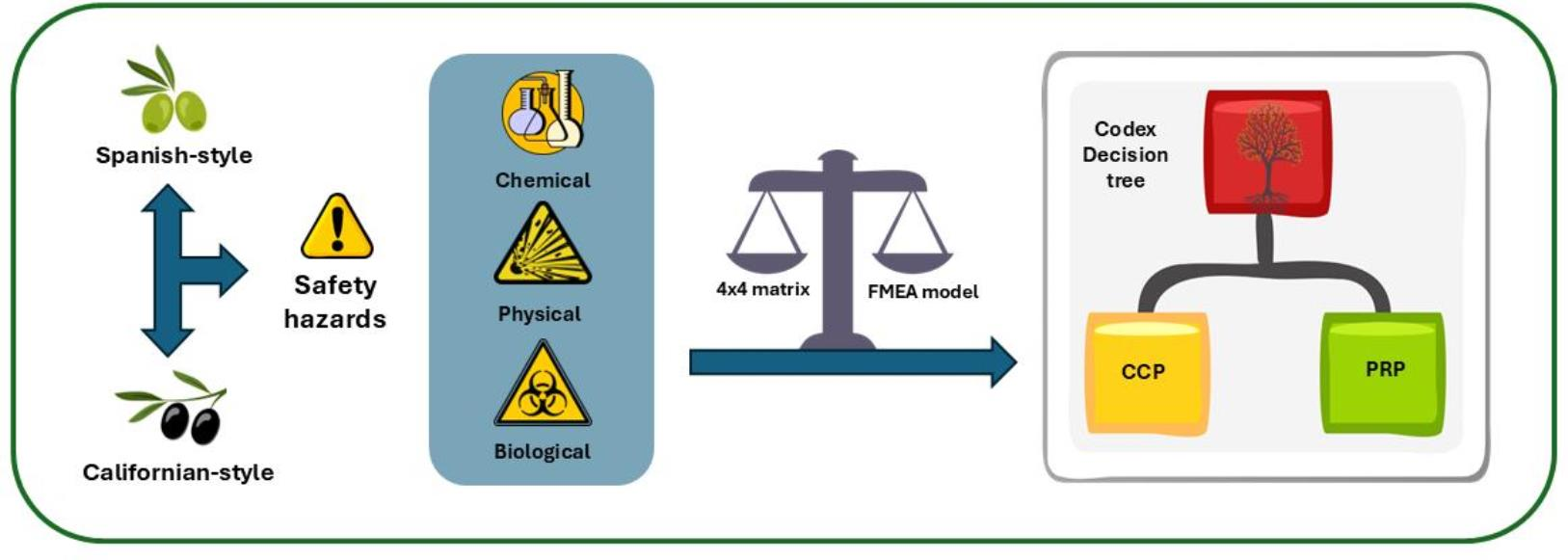
2.3. Risk Assessment Methodology
2.3.1. 4 × 4 Risk Matrix
2.3.2. FMEA Methodology
2.3.3. CCP and Stricter PRP Determination
3. Results and Discussion
3.1. Spanish-Style Processing
3.1.1. Hazard Identification
3.1.2. Risk Matrix Comparison
3.1.3. CCPs and Stricter PRP Definition
3.2. Californian-Style Processing
3.2.1. Hazard Identification
3.2.2. Risk Matrix Comparison
3.2.3. CCP and PRP Definition
4. Conclusions
Supplementary Materials
Author Contributions
Funding
Institutional Review Board Statement
Informed Consent Statement
Data Availability Statement
Conflicts of Interest
References
- International Olive Council. Economic Affairs & Promotion Unit. 2025. Available online: https://www.internationaloliveoil.org/what-we-do/economic-affairs-promotion-unit (accessed on 10 November 2025).
- Fernandez, A.G.; Fernandez-Diez, M.J.; Adams, M.R. Table Olives: Production and Processing; Springer Science & Business Media: Heidelberg, Germany, 1997; ISBN 9780412718106. [Google Scholar]
- Romero, C.; García-García, P.; Sánchez, A.H.; Brenes, M. Effect of Vacuum Impregnation on Physical Changes during Table Olive Processing. Grasas Aceites 2022, 73, 10. [Google Scholar] [CrossRef]
- RASFF. European Commission. 2025. Available online: https://webgate.ec.europa.eu/rasff-window/screen/search (accessed on 10 November 2025).
- Maximum Residue Level of Pesticides in Olives. EU Pesticides Database. 2025. Available online: https://ec.europa.eu/food/plant/pesticides/eu-pesticides-database/start/screen/products/details/59 (accessed on 10 November 2025).
- Rhoads, E. Center for Food Safety and Applied Nutrition Contents. In Center for Food Safety and Applied Nutrition; FDA: Silver Spring, MD, USA, 2007; pp. 1–47. [Google Scholar]
- Valero, A.; Medina, E.; Arroyo-López, F.N. Microbial Hazards and Their Implications in the Production of Table Olives. In Foodborne Pathogens and Antibiotic Resistance; Wiley: Hoboken, NJ, USA, 2017; pp. 119–138. ISBN 9781119139188. [Google Scholar]
- CAYS. Is HACCP Internationally Recognised? 2025. Available online: https://cays-scientific.com/2025/02/05/is-haccp-internationally-recognised/ (accessed on 20 September 2025).
- European Parliament; Council of the European Union. Regulation (EC) No 852/2004 on the Hygiene of Foodstuffs; Official Journal of the European Union: Luxembourg, 2004. [Google Scholar]
- Food Safety Institute. Principles of Food Safety and Quality Management—Comprehensive Guide to Risk Analysis in Food Safety. 2023. Available online: https://foodsafety.institute/fqs-principles-mgt/comprehensive-guide-risk-analysis-food-safety/ (accessed on 20 September 2025).
- Food Safety Magazine. Making Risk Assessments Practical: Spotting and Preventing Food Safety Hazards. 2025. Available online: https://digitaledition.food-safety.com/june-july-2025/column-risk-management/ (accessed on 20 September 2025).
- Risk Publishing. HACCP Risk Assessment Matrix: Common Challenges and Inconsistencies. 2024. Available online: https://riskpublishing.com/haccp-risk-assessment-matrix/ (accessed on 20 September 2025).
- International Olive Council. Quality Management Guide for the Table Olive Industry (T.OT/Doc. No. 14); International Olive Council: Madrid, Spain, 2005; pp. 1–30. [Google Scholar]
- Surareungchai, S.; Borompichaichartkul, C.; Rachtanapun, C.; Pongprasert, N.; Jitareerat, P.; Srilaong, V. Simplify Product Safety and Quality Risk Analysis of Raw Materials for Conventional, Soilless Culture and Organic Salads. Food Control 2021, 130, 108359. [Google Scholar] [CrossRef]
- Cartín-Rojas, A.; Villarreal-Tello, A.; Morera, A. Implementing Risk Analysis in Food Industry through Modal Analysis of Effects and Failures (MAEF): Practical and Conceptual Approach. Rev. Med. Vet. 2014, 27, 133–148. [Google Scholar] [CrossRef]
- Asehraou, A.; Faid, M.; Jana, M. Physico-Chemical Properties and the Microflora of Moroccan Black Table Olives. Grasas Aceites 1992, 43, 130–133. [Google Scholar] [CrossRef]
- Caggia, C.; Randazzo, C.L.; Salvo, M.D.I.; Romeo, F.; Giudici, P. Occurrence of Listeria Monocytogenes in Green Table Olives. J. Food Prot. 2004, 67, 2189–2194. [Google Scholar] [CrossRef] [PubMed]
- Debord, G.G.; Edmondson, R.B.; Thom, C. Summary of Bureau of Chemistry Investigations of Poisoning Due to Ripe Olives. J. Am. Med. Assoc. 1920, 74, 1220–1221. [Google Scholar] [CrossRef]
- Alengebawy, A.; Abdelkhalek, S.T.; Qureshi, S.R.; Wang, M.-Q. Heavy Metals and Pesticides Toxicity in Agricultural Soil and Plants: Ecological Risks and Human Health Implications. Toxics 2021, 9, 42. [Google Scholar] [CrossRef] [PubMed]
- Farber, J.M.; Daley, E.M.; Mackie, M.T.; Limerick, B. A Small Outbreak of Listeriosis Potentially Linked to the Consumption of Imitation Crab Meat. Lett. Appl. Microbiol. 2000, 31, 100–104. [Google Scholar] [CrossRef]
- Franzetti, L.; Scarpellini, M.; Vecchio, A.; Planeta, D. Microbiological and Safety Evaluation of Green Table Olives Marketed in Italy. Ann. Microbiol. 2011, 61, 843–851. [Google Scholar] [CrossRef]
- González, S.C.; Possas, A.; Carrasco, E.; Valero, A.; Bolívar, A.; Posada-Izquierdo, G.D.; García-Gimeno, R.M.; Zurera, G.; Pérez-Rodríguez, F. ‘MicroHibro’: A Software Tool for Predictive Microbiology and Microbial Risk Assessment in Foods. Int. J. Food Microbiol. 2019, 290, 226–236. [Google Scholar] [CrossRef]
- Grounta, A.; Harizanis, P.; Mylonakis, E.; Nychas, G.J.E.; Panagou, E.Z. Investigating the Effect of Different Treatments with Lactic Acid Bacteria on the Fate of Listeria Monocytogenes and Staphylococcus Aureus Infection in Galleria Mellonella Larvae. PLoS ONE 2016, 11, e0161263. [Google Scholar] [CrossRef] [PubMed]
- Jalava, K.; Selby, K.; Pihlajasaari, A.; Kolho, E.; Dahlsten, E.; Forss, N.; Bäcklund, T.; Korkeala, H.; Honkanen-Buzalski, T.; Hulkko, T.; et al. Two Cases of Food-Borne Botulism in Finland Caused by Conserved Olives. Euro Surveill. 2011, 16, 20034. [Google Scholar] [CrossRef]
- Lucena-Padrόs, H.; González, J.M.; Caballero-Guerrero, B.; Ruiz-Barba, J.L.; Maldonado-Barragán, A. Propionibacterium olivae Sp. Nov. and Propionibacterium damnosum Sp. Nov., Isolated from Spoiled Packaged Spanish-Style Green Olives. Int. J. Syst. Evol. Microbiol. 2014, 64, 2980–2985. [Google Scholar] [CrossRef]
- Medina, E.; Brenes, M.; Romero, C.; Ramírez, E.; De Castro, A. Survival of Foodborne Pathogenic Bacteria in Table Olive Brines. Food Control 2013, 34, 719–724. [Google Scholar] [CrossRef]
- Medina-Pradas, E.; Arroyo-López, F.N. Presence of Toxic Microbial Metabolites in Table Olives. Front. Microbiol. 2015, 6, 873. [Google Scholar] [CrossRef] [PubMed]
- Medina, E.; Romero-Gil, V.; Garrido-Fernández, A.; Arroyo-López, F.N. Survival of Foodborne Pathogens in Natural Cracked Olive Brines. Food Microbiol. 2016, 59, 104–111. [Google Scholar] [CrossRef]
- Pereira, A.P.; Pereira, J.A.; Bento, A.; Estevinho, M.L. Microbiological Characterization of Table Olives Commercialized in Portugal in Respect to Safety Aspects. Food Chem. Toxicol. 2008, 46, 2895–2902. [Google Scholar] [CrossRef]
- Randazzo, C.L.; Ribbera, A.; Pitino, I.; Romeo, F.V.; Caggia, C. Diversity of Bacterial Population of Table Olives Assessed by PCR-DGGE Analysis. Food Microbiol. 2012, 32, 87–96. [Google Scholar] [CrossRef] [PubMed]
- Romero-Gil, V.; Medina, E.; Garrido-Fernández, A.; Arroyo-López, F.N. Foodborne Pathogen Survival in Commercial Aloreña de Málaga Table Olive Packaging. Front. Microbiol. 2018, 9, 418310. [Google Scholar] [CrossRef]
- Tataridou, M.; Kotzekidou, P. Fermentation of Table Olives by Oleuropeinolytic Starter Culture in Reduced Salt Brines and Inactivation of Escherichia Coli O157:H7 and Listeria Monocytogenes. Int. J. Food Microbiol. 2015, 208, 122–130. [Google Scholar] [CrossRef]
- European Parliament; Council of the European Union. Commission Regulation (EU) No 1935/2004 on Materials and Articles Intended to Come into Contact with Food; Official Journal of the European Union: Luxembourg, 2004. [Google Scholar]
- European Parliament; Council of the European Union. Commission Regulation (EU) No 2023/2006 on Good Manufacturing Practice for Materials and Articles Intended to Come into Contact with Food; Official Journal of the European Union: Luxembourg, 2006. [Google Scholar]
- European Parliament; Council of the European Union. Commission Regulation (EU) 1333/2008 on Food Additives; Official Journal of the European Union: Luxembourg, 2008. [Google Scholar]
- European Parliament; Council of the European Union. Commission Regulation (EU) 2023/915 on Maximum Levels for Certain Contaminants in Food; Official Journal of the European Union: Luxembourg, 2023. [Google Scholar]
- European Parliament; Council of the European Union. Commission Regulation (EU) No 10/2011 on Plastic Materials and Articles Intended to Come into Contact with Food; Official Journal of the European Union: Luxembourg, 2011. [Google Scholar]
- Gobierno de España. BOE Real Decreto 3/2023, de 10 de Enero, Por El Que Se Establecen Los Criterios Técnicosanitarios de La Calidad Del Agua de Consumo, Su Control y Suministro; Boletín Oficial del Estado: Madrid, Spain, 2023. [Google Scholar]
- FAO; WHO. General Principles of Food Hygiene; Codex Alimentarius Code of Practice, No.CXC 1-1969; Codex Alimentarius Commission: Rome, Italy, 2023. [Google Scholar] [CrossRef]
- Singh, P.K.; Singh, R.P.; Singh, P.; Singh, R.L. Food Hazards: Physical, Chemical, and Biological. In Food Safety and Human Health; Academic Press: Cambridge, MA, USA, 2019; pp. 15–65. ISBN 9780128163337. [Google Scholar]
- Mohamed, W.; Omer Fouad Abou-Zaid, F.; Helmy El-Kalyoubi, M.; Mostafa Abd El-Razik, M. Hazard Analysis Critical Control Points (HACCP) Application during Olive Oil Centrifugal Extraction. IOSR J. Environ. Sci. Toxicol. Food Technol. 2015, 9, 50–56. [Google Scholar]
- Rejeb, A.; Keogh, J.G. Applying HACCP in the Tunisian Olive Oil Industry: A Theoretical Background. J. Bus. Manag. Econ. Res. 2019, 3, 1–18. [Google Scholar] [CrossRef]
- Wadhera, A. Preparatory Operations in Fruits and Vegetables. In Technology of Processed Foods: Fruits, Vegetables, Bakery and Confectionery; INFLIBNET Centre: Gandhinagar, India, 2018. [Google Scholar]
- Onyeaka, H.; Jalata, D.D.; Mekonnen, S.A. Mitigating Physical Hazards in Food Processing: Risk Assessment and Preventive Strategies. Food Sci. Nutr. 2023, 11, 7515–7522. [Google Scholar] [CrossRef] [PubMed]
- Taghizadeh, S.F.; Azizi, M.; Rezaee, R.; Giesy, J.P.; Karimi, G. Polycyclic Aromatic Hydrocarbons, Pesticides, and Metals in Olive: Analysis and Probabilistic Risk Assessment. Environ. Sci. Pollut. Res. 2021, 28, 39723–39741. [Google Scholar] [CrossRef] [PubMed]
- Hakme, E.; Lozano, A.; Ferrer, C.; Díaz-Galiano, F.J.; Fernández-Alba, A.R. Analysis of Pesticide Residues in Olive Oil and Other Vegetable Oils. TrAC Trends Anal. Chem. 2018, 100, 167–179. [Google Scholar] [CrossRef]
- Carvalho, F.P. Pesticides, Environment, and Food Safety. Food Energy Secur. 2017, 6, 48–60. [Google Scholar] [CrossRef]
- Ma, F.; Wu, R.; Li, P.; Yu, L. Analytical Approaches for Measuring Pesticides, Mycotoxins and Heavy Metals in Vegetable Oils: A Review. Eur. J. Lipid Sci. Technol. 2016, 118, 339–352. [Google Scholar] [CrossRef]
- Suhani, I.; Sahab, S.; Srivastava, V.; Singh, R.P. Impact of Cadmium Pollution on Food Safety and Human Health. Curr. Opin. Toxicol. 2021, 27, 1–7. [Google Scholar] [CrossRef]
- Chen, X.; Hossain, M.F.; Duan, C.; Lu, J.; Tsang, Y.F.; Islam, M.S.; Zhou, Y. Isotherm Models for Adsorption of Heavy Metals from Water—A Review. Chemosphere 2022, 307, 135545. [Google Scholar] [CrossRef]
- European Parliament; Council of the European Union. Directive 2000/60/EC of the European Parliament and of the Council Establishing a Framework for Community Action in the Field of Water Policy; Journal of the European Union: Luxembourg, 2000. [Google Scholar]
- Cammerata, A.; Del Frate, V.; Monforte, T.; Scarfone, A.; Romano, E. Enhancing Mycotoxin Detection in Table Olives: The Role of Enzyme-Linked Immunosorbent Assay and Method Optimization. Appl. Sci. 2024, 14, 10936. [Google Scholar] [CrossRef]
- Ardic, M.; Kahve, I.; Duran, A. Chemical Migration in Food Technology. Acad. J. Sci. 2015, 4, 163–168. [Google Scholar]
- Seref, N.; Cufaoglu, G. Food Packaging and Chemical Migration: A Food Safety Perspective. J. Food Sci. 2025, 90, e70265. [Google Scholar] [CrossRef] [PubMed]
- Schmid, P.; Welle, F. Chemical Migration from Beverage Packaging Materials—A Review. Beverages 2020, 6, 37. [Google Scholar] [CrossRef]
- Lebelo, K.; Malebo, N.; Jonas Mochane, M.; Masinde, M.; Hardisson de la Torre, A.; Rubio, C.; Javier Carrascosa Iruzubieta, C. Chemical Contamination Pathways and the Food Safety Implications along the Various Stages of Food Production: A Review. Int. J. Environ. Res. Public Health 2021, 18, 5795. [Google Scholar] [CrossRef] [PubMed]
- European Parliament; Council of the European Union. Regulation (EU) No 528/2012 of the European Pararliament and of the Council Concerning the Making Available on the Market and Use of Biocidal Products; Official Journal of the European Union: Luxembourg, 2012. [Google Scholar]
- Global Food Safety Initiative. Chemicals in Food Hygiene Volume 1 The Optimal Usage of Cleaning Agents, Sanitisers and Disinfectants to Minimise the Risk of Traces in Foods. Consum. Goods Forum 2019, 1, 1–32. [Google Scholar] [CrossRef]
- Johnson, R.L.; Mitchell, A.E. Reducing Phenolics Related to Bitterness in Table Olives. J. Food Qual. 2018, 2018, 3193185. [Google Scholar] [CrossRef]
- ASEMESA. Guía de Aplicación Del Sistema de Análisis de Riesgos y Control de Puntos Críticos En El Sector de La Aceituna de Mesa. Asociación Española de Exportadores e Industriales de Aceitunas de Mesa. 2025. Available online: http://coli.usal.es/web/Guias/pdf/appcc_aceituna_mesa_asemesa.pdf (accessed on 10 November 2025).
- Nguyen-The, C. Biological Hazards in Processed Fruits and Vegetables—Risk Factors and Impact of Processing Techniques. LWT—Food Sci. Technol. 2012, 49, 172–177. [Google Scholar] [CrossRef]
- Mantzouridou, F.T.; Mastralexi, A.; Filippidou, M.; Tsimidou, M.Z. Challenges in the Processing Line of Spanish Style Cv. Chalkidiki Green Table Olives Spontaneously Fermented in Reduced NaCl Content Brines. Eur. J. Lipid Sci. Technol. 2020, 122, 1900453. [Google Scholar] [CrossRef]
- Flores-Kim, J.; Dobihal, G.S.; Bernhardt, T.G.; Rudner, D.Z. WhyD Tailors Surface Polymers to Prevent Premature Bacteriolysis and Direct Cell Elongation in Streptococcus Pneumoniae. eLife 2022, 11, e76392. [Google Scholar] [CrossRef]
- Perpetuini, G.; Prete, R.; Garcia-Gonzalez, N.; Alam, M.K.; Corsetti, A. Table Olives More than a Fermented Food. Foods 2020, 9, 178. [Google Scholar] [CrossRef]
- Cese, F.D. Effect of Liquid Contamination on Hermeticity and Seal Strength of Flexible Pouches with LLDPE Sealant. Master’s Thesis, California Polytechnic State University, San Luis Obispo, CA, USA, 2014. [Google Scholar]
- Tarantini, A.; Crupi, P.; Ramires, F.A.; D’Amico, L.; Romano, G.; Blando, F.; Branco, P.; Clodoveo, M.L.; Corbo, F.; Cardinali, A.; et al. Study of the Effects of Pasteurization and Selected Microbial Starters on Functional Traits of Fermented Table Olives. Food Microbiol. 2024, 122, 104537. [Google Scholar] [CrossRef]
- Wirtanen, G.; Salo, S. Cleaning and Disinfection. In Food Chain Integrity: A Holistic Approach to Food Traceability, Safety, Quality and Authenticity; Wiley Blackwell: Hoboken, NJ, USA, 2014; Volume 9781118525869, pp. 453–471. ISBN 9781118525821. [Google Scholar]
- Szczyrba, A.; Ingaldi, M.; Szczyrba, A.; Ingaldi, M. Implementation of the FMEA Method as a Support for the HACCP System in the Polish Food Industry. Manag. Syst. Prod. Eng. 2024, 32, 357–371. [Google Scholar] [CrossRef]
- Wu, J.Y.; Hsiao, H.I. Food Quality and Safety Risk Diagnosis in the Food Cold Chain through Failure Mode and Effect Analysis. Food Control 2021, 120, 107501. [Google Scholar] [CrossRef]
- Khokhar, P.; Pawar, K. Chemical Migration from Packaging Materials into Consumable Food Matrices: A Mini Review. Int. J. Agric. Food Sci. 2025, 7, 21–25. [Google Scholar] [CrossRef]
- Motarjemi, Y.; Lelieveld, H. Food Safety Management—A Practical Guide for the Food Industry; Elsevier: Amsterdam, The Netherlands, 2014; ISBN 978-0-12-381504-0. [Google Scholar]
- Mortimore, S.; Wallace, C. HACCP A Practical Approach; Springer: New York, NY, USA, 1998; ISBN 978-1-4615-5781-4. [Google Scholar]
- Suherman, S.; Janitra, A.A.; Budhiary, K.N.S.; Pratiwi, W.Z.; Idris, F.A. Review on Hazard Analysis and Critical Control Point (HACCP) in the Dairy Product: Cheese. IOP Conf. Ser. Mater. Sci. Eng. 2021, 1053, 012081. [Google Scholar] [CrossRef]
- Chen, H.; Liou, B.K.; Dai, F.J.; Chuang, P.T.; Chen, C.S. Study on the Risks of Metal Detection in Food Solid Seasoning Powder and Liquid Sauce to Meet the Core Concepts of ISO 22000:2018 Based on the Taiwanese Experience. Food Control 2020, 111, 107071. [Google Scholar] [CrossRef]
- Allende, A.; Alvarez-Ordóñez, A.; Bortolaia, V.; Bover-Cid, S.; De Cesare, A.; Dohmen, W.; Guillier, L.; Herman, L.; Jacxsens, L.; Mughini-Gras, L.; et al. Microbiological Hazards Associated with the Use of Water in the Post-Harvest Handling and Processing Operations of Fresh and Frozen Fruits, Vegetables and Herbs (FfFVH). Part 4 (Fresh-Cut FVH Process Water Management Plan). EFSA J. 2025, 23, e9171. [Google Scholar] [CrossRef]
- Mohammad, Z.H.; Rios, E.V.A.; Ahmad, F.; Juneja, V.K. Microbial Contamination in the Food Processing Environment. In Microbial Biotechnology in the Food Industry; Springer: Berlin/Heidelberg, Germany, 2024; pp. 15–43. ISBN 978-3-031-51417-3. [Google Scholar]
- Zhou, Z.J.; Zhou, B.; Tseng, C.H.; Hu, S.C.; Shiue, A.; Leggett, G. Evaluation of Characterization and Filtration Performance of Air Cleaner Materials. Int. J. Environ. Sci. Technol. 2021, 18, 2209–2220. [Google Scholar] [CrossRef]
- Ferrous Gluconate. 1987. Available online: https://apps.who.int/food-additives-contaminants-jecfa-database/Home/Chemical/1395 (accessed on 10 November 2025).
- FDA 21 CFR 184.1308—Ferrous Gluconate. Available online: https://www.ecfr.gov/current/title-21/chapter-I/subchapter-B/part-184/subpart-B/section-184.1308 (accessed on 10 November 2025).
- European Parliament; Council of the European Union. Commission Regulation (EU) No 1129/2011 of Food Additives; Official Journal of the European Union: Luxembourg, 2011. [Google Scholar]
- Chavarría-Fernández, S.M.; Jiménez-Alvarado, R.; Santos-López, E.M.; Hernández-Hernandez, A.A.; Cariño-Cortés, R. Iron Nanoparticles as Food Additives and Food Supplements, Regulatory and Legislative Perspectives. Food Sci. Biotechnol. 2024, 33, 1295–1305. [Google Scholar] [CrossRef]

| Stage | Hazards | Control Measures Already Implemented |
|---|---|---|
| Olive receiving hopper | (P) Large debris, such as branches and leaves | Separation of large debris in receiving hoppers |
| (C) Heavy metals, pesticides and mycotoxins | Supplier approval plan Reception plan | |
| (B) Microorganisms (Escherichia coli, Salmonella, Clostridium…) | ||
| Reception of packaging and labeling materials | (P) Foreign bodies | Supplier approval plan Reception control plan |
| (C) Chemical migration | ||
| (B) Microorganisms (bacteria, viruses, molds, and yeasts) and pests | ||
| Washing (I) | (P) Foreign bodies | Preventative maintenance |
| (C) Heavy metals | Water control plan | |
| (B) Microorganisms (Escherichia coli, Clostridium perfringens…) | Water control plan | |
| Lye treatment | (P) Foreign bodies | Preventative maintenance |
| (C) Equipment, chemicals, and remains of cleaning and disinfection products | Preventative maintenance Cleaning and disinfection plan | |
| (B) None | None | |
| Fermentation | (P) Foreign bodies | Preventative maintenance |
| (Q) Remains of cleaning and disinfection products | Cleaning and disinfection plan | |
| (B) Microorganisms (Enterobacteriaceae, Clostridium, Pseudomonas, Staphylococcus, etc.) | Control of pH, salt, and free and combined acidity Control of the absence of bad odors and flavors Removal of fermenting surface veils | |
| Storage in fermentation vessels | (P) Foreign bodies | Preventative maintenance |
| (Q) Remains of cleaning and disinfection products | Cleaning and disinfection plan | |
| (B) Microorganisms (Propionibacteria, aerobic fungi, Clostridium) | Control of pH (<4.3) and NaCl (>8%) Removal of fermenting surface veils | |
| Fruit conditioning after storage | (P) Foreign bodies | Preventative maintenance |
| (Q) Equipment, chemicals, and remains of cleaning and disinfection products | Preventative maintenance Cleaning and disinfection plan | |
| (B) Microorganisms (Clostridium, Staphylococcus, Pseudomonas, Enterobacteriaceae) | Control of pH (<4.3) and NaCl (4–5%) | |
| Fruit reception and discharge | (P) Foreign bodies | Preventative maintenance |
| (Q) Remains of cleaning and disinfection products | Cleaning and disinfection plan | |
| (B) Microorganisms (Clostridium, Staphylococcus, Pseudomonas, Enterobacteriaceae) | Control of pH and NaCl Cleaning and disinfection plan | |
| Metal detection | (P) Foreign metal bodies | Metal detection |
| (C) Remains of cleaning and disinfection products | Cleaning and disinfection plan | |
| (B) Microorganisms present on machinery (mainly mesophilic aerobes) | Cleaning and disinfection plan | |
| Brine addition | (P) Foreign bodies | Preventative maintenance |
| (C) Equipment, chemicals, and remains of cleaning and disinfection products | Preventative maintenance Cleaning and disinfection plan | |
| (B) Microorganisms present on machinery (mainly mesophilic aerobes) and brine | Cleaning and disinfection plan Control of the brine [NaCl (4–5%), pH (<4.3) and acidity (0.3–0.5%)] | |
| Container sealing | (P) Foreign bodies | Preventative maintenance |
| (C) Equipment, chemicals, and remains of cleaning and disinfection products | Preventative maintenance Cleaning and disinfection plan | |
| (B) Microorganisms | Control of hermetic sealing | |
| Pasteurization | (P) None | None |
| (C) None | None | |
| (B) Microorganisms (Clostridium, aerobic mesophiles, fungal spores) | Temperature: 70–85 °C Time: 5–20 min 15 PU units | |
| X-ray detection | (P) Foreign bodies | X-ray detection |
| (C) None | None | |
| (B) None | None | |
| Labeling Palletizing Storage Shipping | (P) Glass | Good manufacturing practices |
| (C) None | None | |
| (B) None | None |
| Stage | Hazard | Control Measures | 4 × 4 Matrix Model | FMEA Model | |||||||
|---|---|---|---|---|---|---|---|---|---|---|---|
| Probability | Severity | Risk | SIG | Probability | Severity | Detection | CI | SIG | |||
| Olive receiving hopper | (C) Heavy metals, pesticides, and mycotoxins | Supplier approval plan Reception plan | 3 Probably | B Severe, not imminent | 3B Major | Yes | 3 Occasional | 5 Very severe | 1 Existing detection measures | 15 | Yes S = 5 |
| (B) Microorganisms (Escherichia coli, Salmonella, Clostridium…) | Supplier approval plan Reception plan | 2 Possible | A Severe | 2A Major | Yes | 3 Occasional | 5 Very severe | 1 Existing detection measures | 15 | Yes S = 5 | |
| Reception of packaging and labeling materials | (P) Foreign bodies | Supplier approval plan Reception control plan | 2 Possible | A Severe | 2A Major | Yes | 3 Occasional | 5 Very severe | 1 Existing detection measures | 15 | Yes S = 5 |
| (C) Chemical migration | Supplier approval plan Reception control plan | 2 Possible | B Severe, not imminent | 2B Medium | Yes | 2 Unlikely | 5 Very severe | 1 Existing detection measures | 10 | Yes S = 5 | |
| Reception of sodium hydroxide (NaOH) and salt (NaCl) reception | (C) Incorrect chemical | Supplier approval plan Reception control plan | 1 Unlikely | A Severe | 1A Medium | Yes | 2 Unlikely | 5 Very severe | 1 Existing detection measures | 10 | Yes S = 5 |
| Washing (I) | (P) Foreign bodies | Preventative maintenance | 2 Possible | A Severe | 2A Major | Yes | 3 Occasional | 5 Very severe | 1 Existing detection measures | 15 | Yes S = 5 |
| (C) Heavy metals | Water control plan | 2 Possible | B Severe not imminent | 2B Medium | Yes | 3 Occasional | 5 Very severe | 1 Existing detection measures | 15 | Yes S = 5 | |
| (B) Microorganisms (Escherichia coli, Clostridium perfringens…) | Water control plan | 2 Possible | A Severe | 2A Major | Yes | 3 Occasional | 5 Very severe | 1 Existing detection measures | 15 | Yes S = 5 | |
| Washing (II) | (P) Foreign bodies | Preventative maintenance | 2 Possible | A Severe | 2A Major | Yes | 3 Occasional | 5 Very severe | 1 Existing detection measures | 15 | Yes S = 5 |
| (C) Heavy metals | Water control plan | 2 Possible | B Severe not imminent | 2B Medium | Yes | 3 Occasional | 5 Very severe | 1 Existing detection measures | 15 | Yes S = 5 | |
| (B) Microorganisms (Escherichia coli, Clostridium perfringens…) | Water control plan | 2 Possible | A Severe | 2A Major | Yes | 3 Occasional | 5 Very severe | 1 Existing detection measures | 15 | Yes S = 5 | |
| Transport channels | (P) Foreign bodies | Preventative maintenance | 2 Possible | A Severe | 2A Major | Yes | 3 Occasional | 5 Very severe | 1 Existing detection measures | 15 | Yes S = 5 |
| (C) Equipment chemicals and remains of cleaning and disinfection products Heavy metals in water | Preventative maintenance Cleaning and disinfection plan Water control plan | 2 Possible | B Severe not imminent | 2B Medium | Yes | 3 Occasional | 5 Very severe | 1 Existing detection measures | 15 | Yes S = 5 | |
| (B) Microorganisms | Cleaning and disinfection plan Water plan control | 2 Possible | A Severe | 2A Major | Yes | 3 Occasional | 5 Very severe | 1 Existing detection measures | 15 | Yes S = 5 | |
| Flotation/vibrator tank | (P) Foreign bodies | Preventative maintenance | 2 Possible | A Severe | 2A Major | Yes | 3 Occasional | 5 Very severe | 1 Existing detection measures | 15 | Yes S = 5 |
| (C) Equipment chemicals and remains of cleaning and disinfection products Heavy metals in water | Preventative maintenance Cleaning and disinfection plan Water control plan | 2 Possible | B Severe, not imminent | 2B Medium | Yes | 3 Occasional | 5 Very severe | 1 Existing detection measures | 15 | Yes S = 5 | |
| (B) Microorganisms | Cleaning and disinfection plan Water plan control | 2 Possible | A Severe | 2A Major | Yes | 3 Occasional | 5 Very severe | 1 Existing detection measures | 15 | Yes S = 5 | |
| Metal detection | (P) Foreign metal bodies | Metal detection | 3 Probably | A Severe | 3A Major | Yes | 3 Occasional | 5 Very severe | 1 Existing detection measures | 15 | Yes S = 5 |
| Container sealing | (P) Foreign bodies | Preventative maintenance | 2 Possible | A Severe | 2A Major | Yes | 3 Occasional | 5 Very severe | 1 Existing detection measures | 15 | Yes S = 5 |
| (B) Microorganisms | Control of hermetic sealing | 2 Minor | A Severe | 2A Major | Yes | 3 Occasional | 5 Very severe | 1 Existing detection measures | 15 | Yes S = 5 | |
| Pasteurization | (B) Microorganisms (Clostridium, aerobic mesophiles, fungal spores) | Temperature: 70–85 °C Time: 5–20 min 15 PU units | 2 Possible | A Severe | 2A Major | Yes | 3 Occasional | 5 Very severe | 1 Existing detection measures | 15 | Yes S = 5 |
| Container drying | (P) Glass splinter | Good manufacturing practices | 2 Possible | A Severe | 2A Major | Yes | 3 Occasional | 5 Very severe | 1 Existing detection measures | 15 | Yes S = 5 |
| X-ray detection | (P) Foreign bodies | X-ray detection | 3 Probably | A Severe | 3A Major | Yes | 3 Occasional | 5 Very severe | 1 Existing detection measures | 15 | Yes S = 5 |
| Labelling | (P) Glass splinter | Good manufacturing practices | 3 Probably | A Severe | 3A Major | Yes | 3 Occasional | 5 Very severe | 5 There are no detection measures | 75 | Yes |
| Stage/Hazard | Risk 4 × 4 Matrix | Risk FMEA Method * | Q1 | Q2 | Q3 | Q4 | CCP/Stricter PRP |
|---|---|---|---|---|---|---|---|
| Olive receiving hopper (C) Heavy metals, pesticides and mycotoxins | Major | CI = 15 S = 5 | Yes (SAP, RP) | - | - | - | Stricter PRP |
| Olive receiving hopper (B) Microorganisms (Escherichia coli, Salmonella, Clostridium…) | Major | CI = 15 S = 5 | Yes (SAP, RP) | - | - | - | Stricter PRP |
| Washing (II) (C) Heavy metals | Medium | CI = 15 S = 5 | Yes (WCP) | - | - | - | Stricter PRP |
| Washing (II) Microorganisms (Escherichia coli, Clostridium perfringens…) | Major | CI = 15 S = 5 | Yes (WCP) | - | - | - | Stricter PRP |
| Fermentation (B) Microorganisms (Enterobacteriaceae, Clostridium, Pseudomonas, Staphylococcus, etc.) | Major | CI = 15 S = 5 | No | Yes | Yes (P) | - | ** CCP |
| Storage in fermentation vessels (P) Foreign bodies | Major | CI = 15 S = 5 | Yes (PM) | - | - | - | Stricter PRP |
| Storage in fermentation vessels (B) Microorganisms (Enterobacteriaceae, Clostridium, Pseudomonas, Staphylococcus, etc.) | Major | CI = 15 S = 5 | No | Yes | Yes (P) | - | ** CCP |
| Fruit conditioning after storage (P) Foreign bodies | Major | CI = 15 S = 5 | Yes (PM) | - | - | - | Stricter PRP |
| Fruit conditioning after storage (B) Microorganisms (Enterobacteriaceae, Clostridium, Pseudomonas, Staphylococcus, etc.) | Major | CI = 15 S = 5 | No | Yes | Yes (P) | - | ** CCP |
| Fruit reception and discharge (P) Foreign bodies | Major | CI = 15 S = 5 | Yes (PM) | - | - | - | Stricter PRP |
| Fruit reception and discharge (B) Microorganisms (Enterobacteriaceae, Clostridium, Pseudomonas, Staphylococcus, etc.) | Major | CI = 15 S = 5 | No | Yes | Yes (P) | - | ** CCP |
| Metal detection (P) Foreign metal bodies | Major | CI = 15 S = 5 | No | Yes | No | Yes | CCP |
| Brine addition Microorganisms | Major | CI = 15 S = 5 | No | Yes | Yes (P) | - | ** CCP |
| Container sealing (B) Microorganisms | Major | CI = 15 S = 5 | No | Yes | Yes (P) | - | ** CCP |
| Pasteurization (B) Microorganisms (Clostridium, aerobic mesophiles, fungal spores) | Major | CI = 15 S = 5 | No | Yes | No | Yes | CCP |
| X-ray detection (P) Foreign bodies | Major | CI = 15 S = 5 | No | Yes | No | Yes | CCP |
| Labelling (P) Glass splinter | Major | CI = 15 S = 5 | Yes (GMP) | - | - | - | Stricter PRP |
| Stage | Hazards | Control Measures Already Implemented |
|---|---|---|
| I.-Storage in fiberglass tanks with acidified brine and air blowing | (P) Foreign bodies | Preventative maintenance |
| (C) Heavy metals in water | Water control plan | |
| (B) Microorganisms (Escherichia, Clostridium, molds, etc.) | Control of pH (pH < 4.3), free acidity (>1%), air blowing control. | |
| II.-Oxidation, lye treatment, and color fixation in aeration tanks | (P) Foreign bodies | Preventative maintenance |
| (C) Residual iron salts (ferrous gluconate) in excessive amounts | Iron salt control (110 ppm) | |
| (B) Microorganisms (Escherichia, Clostridium, etc.) | Absence of bad odors and flavors. | |
| III.-Sterilization | (P) N/A | --- |
| (C) N/A | --- | |
| (B) Survival of heat-resistant bacteria (sporulated) if the process is inadequate | Temperature: 121 °C Time: >15 min |
Disclaimer/Publisher’s Note: The statements, opinions and data contained in all publications are solely those of the individual author(s) and contributor(s) and not of MDPI and/or the editor(s). MDPI and/or the editor(s) disclaim responsibility for any injury to people or property resulting from any ideas, methods, instructions or products referred to in the content. |
© 2026 by the authors. Licensee MDPI, Basel, Switzerland. This article is an open access article distributed under the terms and conditions of the Creative Commons Attribution (CC BY) license.
Share and Cite
Pintado, C.C.; Segovia Bravo, K.A.; Cabello, A.B.; Arroyo-López, F.N.; Pérez-Santín, E. Enhancing HACCP Decisions: A Comparative Risk Assessment for Table Olive Processing. Foods 2026, 15, 2153. https://doi.org/10.3390/foods15122153
Pintado CC, Segovia Bravo KA, Cabello AB, Arroyo-López FN, Pérez-Santín E. Enhancing HACCP Decisions: A Comparative Risk Assessment for Table Olive Processing. Foods. 2026; 15(12):2153. https://doi.org/10.3390/foods15122153
Chicago/Turabian StylePintado, Cristina Campanero, Kharla Andreina Segovia Bravo, Antonio Benítez Cabello, Francisco Noé Arroyo-López, and Efrén Pérez-Santín. 2026. "Enhancing HACCP Decisions: A Comparative Risk Assessment for Table Olive Processing" Foods 15, no. 12: 2153. https://doi.org/10.3390/foods15122153
APA StylePintado, C. C., Segovia Bravo, K. A., Cabello, A. B., Arroyo-López, F. N., & Pérez-Santín, E. (2026). Enhancing HACCP Decisions: A Comparative Risk Assessment for Table Olive Processing. Foods, 15(12), 2153. https://doi.org/10.3390/foods15122153