Article

Understanding the Food Waste Reduction Intentions of Consumers in Turkiye Through the Value–Attitude–Behavior Framework

1
Department of Nutrition and Dietetics, Faculty of Health Sciences, Acibadem Mehmet Ali Aydinlar University, İstanbul 34755, Türkiye
2
Department of Nutrition and Dietetics, Faculty of Health Sciences, Gedik University, İstanbul 34876, Türkiye
3
Department of Nutrition and Dietetics, Graduate School of Health Sciences, Acibadem Mehmet Ali Aydinlar University, İstanbul 34755, Türkiye
*
Author to whom correspondence should be addressed.
Foods 2026, 15(12), 2127; https://doi.org/10.3390/foods15122127 (registering DOI)
Submission received: 21 April 2026 / Revised: 18 May 2026 / Accepted: 22 May 2026 / Published: 12 June 2026
(This article belongs to the Special Issue Food Loss and Waste: Impact, Measurement, and Management)

Abstract

Food loss and waste are a major global problem as reflected in the United Nations Sustainable Development Goal 12. Households constitute the primary source of food waste worldwide. The development of effective solutions depends on a comprehensive understanding of consumer attitudes and behaviors. This cross-sectional study used the Value–Attitude–Behavior (VAB) hierarchy to examine consumers’ food waste reduction intentions. It was conducted on individuals in Turkiye via an online survey. The results showed that consumers’ hedonic value and attitudes were positively associated with food waste reduction intentions. The strongest associations with intentions were observed for anticipated guilt, attitude toward reducing food waste, and hedonic value. Furthermore, education level and household size showed significant effects on food waste reduction intentions. In conclusion, these findings based on the VAB model showed the central role of anticipated guilt in shaping food waste reduction intentions, suggesting that emotionally driven intervention strategies may be more effective than approaches focusing solely on attitudes.

1. Introduction

The food loss and waste (FLW) is defined as a decrease in the quantity or quality of edible food intended for human consumption by the Food and Agriculture Organization (FAO) of the United Nations. In other words, it represents the removal of food intended for human consumption from the supply chain [1]. It is also crucial to distinguish between food loss and food waste. Food loss results from the decisions and actions of suppliers at earlier stages of the supply chain, such as harvesting, storage, transportation, etc. In contrast, food waste typically occurs at the retail and consumer levels [2].
FLW significantly impacts economic, environmental, and social costs [3]. According to the FAO, one-third of the food produced for human consumption is either lost or wasted. It corresponds to 1.3 billion tons and about $1 trillion in economic losses annually, while generating about 8% of global greenhouse gas emissions [4]. Food waste (FW) in the European Union is estimated at 88 million tonnes annually, one-fifth of the total food produced, with economic costs of €143 billion. Two-thirds of such a loss was attributed to households, indicating their impact on FLW [5]. In the United States, 62 million tonnes of food are lost or wasted, corresponding to $218 trillion a year [6]. A study estimated FLW in Turkiye to be 26 million tonnes per year [7]. A countrywide FLW report indicates that food losses are predominant during agricultural production, with fruits and vegetables representing the most frequently lost commodities [8].
At the environmental level, FLW also impacts climate, water foodprint, land use, and biodiversity. In 2007, the global blue water footprint of agriculture-related food wastage was about 250 km3, roughly 3.6 times that of the U.S. In addition, nearly 1.4 billion hectares of land were utilized to produce food that was never consumed, an area exceeding Canada and India combined [9]. Such inefficiency drives deforestation, diminishes biodiversity, and accelerates ecosystem degradation, each of which carries significant long-term environmental consequences [10]. According to the Waste and Resources Action Program (WRAP), until 2024, FLW was responsible for 8–10% of total greenhouse gas (GHG) emissions. If FW were considered a country, it would rank as the world’s third-largest emitter of GHGs, following China and the United States [11].
FLW also threatens food security; even as it causes global demand for food to rise continuously, millions of people remain undernourished. Recently, the FAO has estimated that approximately 828 million people face food insecurity, with one-third of global food production being lost or wasted annually [12]. Similarly, in the United States, almost 40% of all food produced goes uneaten, while more than 34 million people struggle with food insecurity [13]. This widespread wastage results in missed opportunities to feed vulnerable populations. If FLW could be reduced or repurposed, it could help reduce global hunger and improve food security. For instance, recovering just one-quarter of the food currently wasted would be enough to feed approximately 870 million people, solving global hunger [14].
Food loss is primarily observed in the supply chains of developing countries, whereas FW is more commonly experienced in highly urbanized and economically developed regions. Approximately 56% of global FLW occurs in developed countries [1,15]. FLW varies in magnitude through the stages of a food supply chain. Based on World Resource Institute analysis, 35 percent of global FLW occurs at consumption level [16]. According to the “2021 Food Waste Index Report” published by the United Nations Environment Program (UNEP) in 2019, 931 million tons of food were wasted at this level, and proportionately 61% came from households, 26% from food service, and 13% from retail, corresponding to 17% of total food production [17]. A 2024 FWIR report indicates that the problem continues to rise; in 2022, the total global food waste reached 1.05 billion tonnes, approximately 132 kg/person and representing nearly one-fifth of all food available for consumption. Similarly, a majority of FW occurred at the household level (60%), followed by food services (28%) and retail (12%) [18]. In addition, the 2024 FWIR data show that food waste is not only a problem in developed countries, as household food waste levels vary by only 7 kg per person across high-, upper-, and lower-middle-income countries. This highlights the critical importance of consumer behavior in addressing food waste reduction.
A growing recognition of FLW as a major global problem is reflected in its inclusion in the United Nations Sustainable Development Goal (SDG) 12, wherein a dedicated target focuses on minimizing such losses. Target 12.3 aims to halve global per capita FW and reduce food losses throughout the production and supply chains by 2030 [19]. Effective solutions to reduce FLW require an understanding of how the stages of the food supply chain are connected.
Despite the growing body of research on food waste, the psychological mechanisms underlying consumers’ food waste reduction intentions remain insufficiently understood. Previous studies have predominantly relied on cognitive frameworks, while the role of emotionally driven factors has received comparatively less attention. In particular, limited research has examined how hedonic value, sense of community, social norms, and anticipated guilt interact within the Value–Attitude–Behavior framework to shape food waste reduction intentions. Addressing this gap, the present study proposes an integrated model to better explain consumers’ intentions to reduce food waste.

2. Theoretical Framework

A diverse set of strategies has been implemented to mitigate FLW. They must account for all stages of the food supply chain, spanning from agricultural production to household consumption [16]. Policy recommendations for reducing FW should be based on an analysis of its root causes. Considering the extent of food wasted by households, understanding the drivers and implementing consumer-targeted campaigns and educational programs represents a crucial strategy [20]. While knowledge and awareness are vital for decreasing household FW, Richetin et al. (2012) note that they may not be decisive in changing behavior [21]. Although the literature recognizes reduction behavior as a critical component in addressing FW, research on consumer behavior related to FW remains limited [22]. Previous studies suggest that FW is driven by a range of causes and behaviors, reflecting its complex nature. Some studies have employed the Theory of Planned Behavior (TPB) to analyze FW behavior [23]. According to the TPB, the intention to act is considered the primary determinant of behavior [24]. However, recent reports have found its explanatory power limited, as, from a cognitive perspective, it fails to consider emotion-related factors essential for understanding FW behavior [25,26,27]. A recently published meta-analysis compiled 56 studies that examined FW behavior through TPB and demonstrated that its theoretical limitations in explaining FW reduction behavior [28]. Nevertheless, this limitation does not imply that TPB-related constructs are irrelevant in explaining food waste behavior. Rather, integrating socio-cognitive determinants such as attitudes and social norms with value-based and emotion-related factors may provide a more comprehensive understanding of food waste reduction intentions.
Demographic factors are also vital determinants in driving FW behavior. However, the literature presents conflicting findings on this issue. In terms of age, studies show that older adults (50 and above) tend to waste less food than younger individuals [29]. In contrast, young consumers exhibit greater awareness and concerns regarding FW [30]. Education is another determining factor, with studies indicating that higher education levels are associated with less FW. However, the effectiveness of education depends on infrastructural conditions [31]. Gender has also been identified as an important factor influencing food-related attitudes and waste behaviors at the consumer level [32]. On the other hand, although women are generally more involved in meal planning, factors such as marital status and household composition can influence portioning and meal preparation practices, which may in turn contribute to food waste depending on family size and household dynamics [33].
Food waste behavior is also influenced by broader contextual factors beyond individual-level psychological determinants. These include access to food retail environments, characteristics of short supply chains, and changes in food distribution and consumption systems [34]. However, the present study focuses specifically on individual-level psychological determinants within the Value–Attitude–Behavior framework.

2.1. Value–Attitude–Behavior (VAB) Model

Researchers argue that individuals are guided by certain values, which are reflected in their behavior and goals. Based on the idea that values play a central role in the formation of personal identity, they are considered internal influencers of behavior and attitudes [35]. The VAB model is a cognitive hierarchy that examines the relationship between values, attitudes, and behavior, developed by Homer and Kahle [36]. It assumes that values directly affect attitudes, which eventually influence behaviors. In this situation, it is assumed that values may indirectly impact behaviors. It has been widely used for understanding environmental behaviors over the last few decades. For example, studies on sustainability/pro-environmental behavior [36,37], FW [25,38], and organic food consumption [39] included the VAB model as a method.

2.2. Hypothesis Development

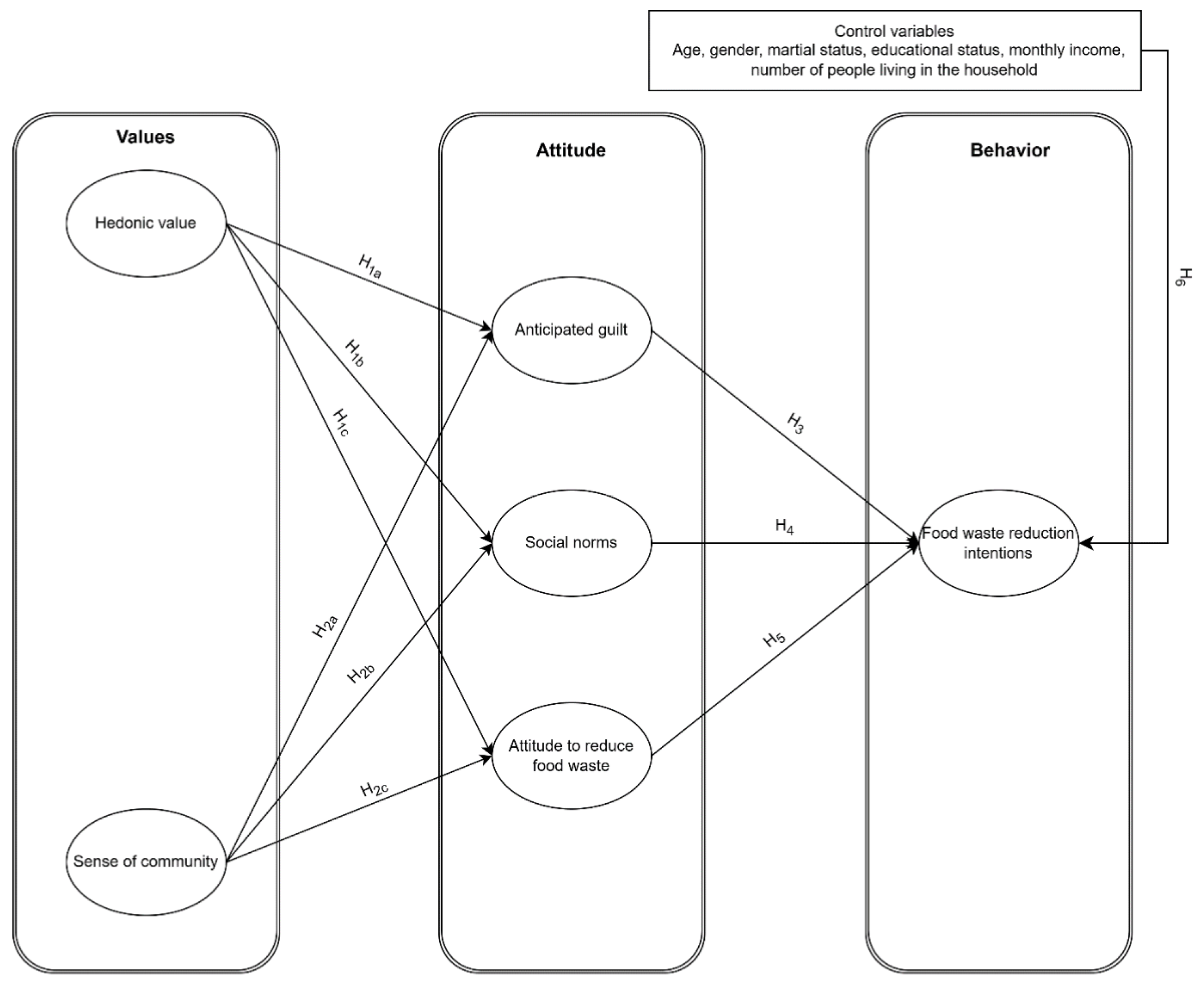
Values vary in relative importance; when a person attributes significance to a particular value, behavior is shaped in the associated direction. In terms of pro-environmental behaviors, recent studies identified four values: altruistic, hedonistic, egoistic, and biospheric [40]. Among these value orientations, hedonic value was prioritized in the present study because the previous food waste literature has more frequently associated food-related decision making and waste reduction behavior with pleasure-oriented and experiential motivations [25,38]. Consumers with HVs prioritize pleasure as their defining goal. Pro-environmental food preference may also be associated with pleasure. Therefore, it may be positively related to attitudes and behaviors [41,42]. Based on the literature mentioned, we hypothesize as follows:
H1a. 
HV is positively associated with anticipated guilt (ANG).
H1b. 
HV is positively associated with social norms (SN).
H1c. 
HV is positively associated with attitude to reduce FW (ATT).
Sense of community (SOC) is a term coined by McMillan and Davis [43] and has four elements: membership, influence, integration and fulfillment of needs, and shared emotional connection [43]. SOCs play a regulatory role in social environments by strengthening social ties and identity [44]. Belonging to a particular group/community also evokes collective action. In terms of FW reduction behavior, SOC is found to be a positive motive through attitudes. Individuals with a stronger sense of community tend to internalize collective values and shared responsibilities more strongly. As a result, behaviors perceived as socially or environmentally irresponsible, such as food waste, may evoke stronger anticipated guilt due to concerns about violating collective expectations and social responsibility norms [27,45]. Based on the literature discussed above, our hypotheses were as follows:
H2a. 
SOC is positively associated with ANG.
H2b. 
SOC is positively associated with SN.
H2c. 
SOC is positively associated with ATT.
It is widely accepted that attitudes have a critical role in shaping human behavior [46]. A positive relationship also occurs between pro-environmental attitudes and behaviors [47]. However, even when individuals are positive toward a behavior, they do not always engage in it. To address this attitude–behavior gap, the literature has examined a range of individual, social, and contextual factors as moderators of pro-environmental behavior, including social norms, environmental concern, trust, price, etc. [47,48,49]. From a cognitive perspective, social norms are an effective tool to promote behavior by motivating individuals toward collective pro-environmental goals [50]. In addition to cognitive factors, emotions are also thought to be an influential tool promoting such behavior. Evidence indicates that anticipated guilt can accurately predict consumer behaviors related to FW [27]. Feeling guilty markedly affects consumer intention to reduce FW. It usually stems from cultural standards that prioritize FW reduction and optimal resource utilization [51]. ATT refers to individuals’ evaluations of FW and recycling behavior; positive attitudes encourage FW reduction behavior [52].
H3. 
ANG is positively associated with an intention to reduce food waste.
H4. 
SN is positively associated with FW reduction intention.
H5. 
ATT is positively associated with FW reduction intention.
Therefore, this study aimed to better understand the relationship between HV, SOC, social norms, anticipated guilt, attitude to reduce FW, and FW reduction intentions based on the VAB model. The proposed research model is shown in Figure 1.

3. Research Methods

3.1. Data Collection and Study Sampling

Participants were selected using snowball sampling, a non-probabilistic sampling method. During the data collection process, a survey link created via Google Forms was shared on social media platforms, and initial participants were asked to share the survey with their networks. This method allowed for a gradual expansion of the sample, and voluntary participation was prioritized. Individuals aged 18 and over were included. Before starting, the participants were requested to complete an informed consent form, and approval (2024-8/325) was obtained from the Acibadem Mehmet Ali Aydinlar University Medical Research Ethics Committee.
When administering a scale, the sample size must be sufficiently large to represent the complete population. Muthén and Muthén (2002) recommended a sample size of at least 5–10 times the number of items in the scale [53]. While higher ratios are generally preferred for greater statistical robustness, a minimum ratio of 5:1 is considered acceptable, particularly in exploratory studies.
In line with this recommendation, the minimum sample size required for this study was calculated based on the lower limit of this range. Given that the scale consists of 18 items, the goal was to include a minimum of 90 to 180 participants in the study.
The study included 1392 participants: 44.1% male and 55.9% female. The mean age of the men was 34.27 ± 10.20 years, 70.5% were single, 50.2% worked in the private sector, 41% held a postgraduate degree, 55.9% reported purchasing some environmentally friendly (green) products during their monthly shopping, 46.7% paid some attention to whether the products they bought were sustainable or environmentally friendly, 53.6% paid close attention to whether the products they purchased were healthy, 44.6% sometimes had problems with food leftovers, and 29.5% sometimes shared leftovers (Table 1).
The mean age of the women was 30.03 ± 8.53 years, 74.2% were single, 48.6% worked in the private sector, 39.7% had postgraduate education, 57.6% reported purchasing some environmentally friendly (green) products during their monthly shopping, 48.8% paid some attention to whether the products they bought were sustainable or environmentally friendly, 54.2% paid great attention to whether the products they purchased were healthy, 43.8% sometimes had problems with food leftovers, and 28.7% sometimes shared leftovers.

3.2. Measurement Scale

The questionnaire used in the study consisted of two parts. The first part included questions about the demographic information of the participants, and the second part included questions investigating specific variables related to the intention to reduce food waste. The second part consisted of items measuring 6 variables related to the intention to reduce food waste: hedonic value, sense of community, anticipated guilt, social norms, attitude to reduce food waste, and food waste reduction intentions (Table 2). These items were adapted from previous studies [27,54,55,56] by making the necessary changes to fit the context of food waste reduction, as reported by Habib et al. (2023) [25]. In total, 18 items were measured using a five-point Likert scale ranging from 1 (strongly disagree) to 5 (strongly agree).

3.3. Data Analysis

Descriptive statistics for categorical variables are presented as frequencies and percentages. The Shapiro–Wilk Test confirmed whether numerical variables followed a normal distribution. Descriptive statistics for numerical variables are presented as mean ± standard deviation ( X ¯ ± SD) for normally distributed data and as median (min–max) for non-normally distributed data.
Convergent validity accounts for the construct validity of the scale [57]. It means that the statements regarding variables are related to each other and the factors they constitute [58].
For convergent validity, all composite reliability (CR) values for a scale must be greater than the average verified and extracted values, the AVE must be >0.5, the standardized factor loadings of the items must be >0.5, and the CR must be >0.7 [57]. The AVE is evaluated by dividing the sum of the squares of the item loadings for a factor by the number of items [59]. The coefficient Cronbach’s Alpha was calculated to assess the reliability of the scales studied.
For discriminant validity, two new values must be calculated. The maximum squared variance (MSV) is the square of the highest variance shared by a factor with any other factor. The average shared square variance (ASV) is obtained by dividing the sum of the squares of the variance shared by a factor with other factors by the number of shared variances. To speak of discriminant validity, the condition MSV < AVE; ASV < MSV must be met, and the square root of AVE must be greater than the correlation between the factors [58].
Structural equation modeling (SEM) was employed to test the hypothesized relationships and mediation effects. The model was estimated using the maximum likelihood (ML) estimator. Model fit was assessed using multiple goodness-of-fit indices, including the Comparative Fit Index (CFI), Tucker–Lewis Index (TLI), Root Mean Square Error of Approximation (RMSEA), and Standardized Root Mean Square Residual (SRMR). Demographic variables were incorporated as control variables in the analysis to assess their effects on food waste reduction intention. SEM analyses were conducted using the lavaan and sem packages of R Project v3.6.1 (R Core Team, Vienna, Austria) [60].
Pearson’s correlation coefficient was used to examine the relationships between scales for normally distributed data. The criteria used to interpret the correlation coefficient included- “<0.2: very weak correlation,” “0.2–0.4: weak correlation,” “0.4–0.6: moderate correlation,” “0.6–0.8: high correlation,” and “>0.8: very high correlation” [61].
Multiple regression analysis was used to test the effects of variables. It is the mathematical equivalence of the effects of two or more dependent variables [62]. In all calculations and interpretations, the statistical significance level was considered p < 0.05, p < 0.01, p < 0.001, and hypotheses were established in two directions. Statistical analyses of the data were performed using SPSS v26 (IBM Inc., Chicago, IL, USA) and the R Project v3.6.1 (R Core Team, Vienna, Austria) package programs.

4. Results

This correlation analysis (Table 3) indicated that FW reduction intentions were positively associated with all factors (p < 0.001). The strongest relations with intentions were observed for anticipated guilt (r = 0.594), attitude toward reducing FW (r = 0.546), and hedonic value (r = 0.514).
When convergent validity was examined (Table 4), the standardized factor loadings ranged between 0.821 and 0.980, the CR values exceeded the recommended threshold of 0.7, and all AVE values were above 0.5. These findings indicated that the scale demonstrated convergent validity. Regarding reliability, CR and Cronbach’s-α values exceeded the recommended threshold of 0.7, indicating robust internal consistency across all constructs.
Examination of discriminant validity (Table 5) showed that the AVE values for all constructs exceeded their corresponding MSV and ASV values.
Table 6 summarizes the descriptive statistics of the study variables, indicating that FW reduction intentions exhibited the maximum mean score (16.87 ± 5.14), whereas attitude to reduce FW displayed the lowest (8.40 ± 2.05).
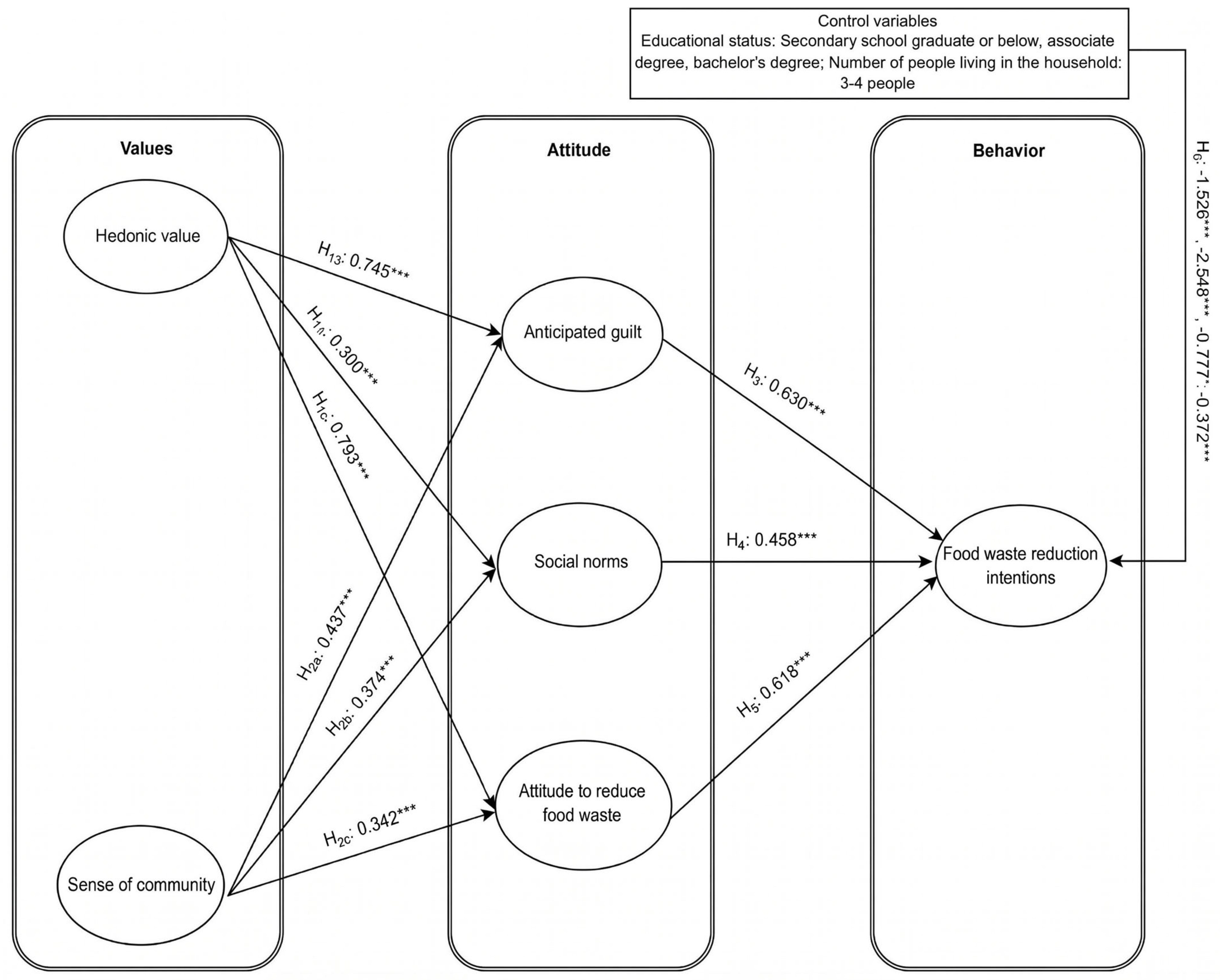
Hedonic value and SOC directly and significantly affected anticipated guilt, social norms, and attitudes toward reducing FW (p < 0.001 for all). Specifically, hedonic value had positive effects of 74.5% on anticipated guilt, 30% on social norms, and 79.3% on attitudes. SOC exhibited positive impacts of 43.7% on anticipated guilt, 37.4% on social norms, and 34.2% on attitudes toward reducing FW (Table 7; Figure 2).
Anticipated guilt, social norms, and attitudes toward reducing FW each showed direct and significant effects on FW reduction intentions (p < 0.001). Anticipated guilt had a positive influence of 63%, social norms of 45.8%, and attitudes of 61.8% on intentions (Table 8; Figure 2).
When examining the effects of demographic variables on FW reduction intentions, age, gender, marital status, and monthly income were found to have no significant influence on intention scores (p > 0.05). In contrast, education level and household size showed statistically significant effects on FW reduction intentions (p < 0.05; p < 0.001).
According to the regression coefficients, individuals educated up to lower secondary or associate degree had intention scores that were 1.526 and 2.548 points lower than those of postgraduate graduates. Bachelor’s degree holders, however, scored 0.777 points higher than postgraduate graduates. In addition, individuals living in households with 3–4 members had intention scores 1.146 points greater than those living in households with 1–2 persons. No significant variation was observed for households with ≥five members (p = 0.459) (Table 9; Figure 2).

5. Discussion

This study provides an integrated psychosocial perspective on consumers’ food waste reduction intentions by combining emotional, social, and attitudinal determinants. The research combines the explanatory power of the VAB model with core components of the TPB, proposing a comprehensive and complementary approach to understanding food waste-associated behaviors. The VAB model, built upon the Value–Attitude–Behavior hierarchy, offers a robust theoretical foundation for explaining individuals’ behavioral tendencies [63] and its utilization in FW studies has increased in recent years [25]. The findings particularly highlight the role of hedonic value and anticipated guilt in shaping food waste reduction intentions.
This study positions HV as a multifaceted psychological construct central to behavioral processes aimed at reducing FW. HV may indirectly shape sustainable behavioral tendencies through emotional (anticipated guilt) and cognitive/normative (ATT and SN) mechanisms. In this context, HV is not a direct determinant of intention; instead, it may reinforce intention by strengthening sensitivity to guilt, social expectations, and positive attitudes toward food waste reduction. These findings are consistent with previous VAB-based studies suggesting that hedonic value may strengthen food waste reduction intentions through emotional and attitudinal pathways.
These findings suggest that hedonic value may function as an important psychological motivator in strengthening food waste reduction intentions. Supporting the hedonic experience is an essential factor while designing interventions to reduce FW. Future research should examine whether the VAB model’s predictive power varies across food categories. For example, hedonic value may more strongly predict intention for fresh produce (associated with quality, health, pleasure) compared to shelf-stable items (associated with practicality, budgeting). Tailored interventions accounting for category-specific consumer psychology could enhance effectiveness.
The remarkable influence of moral and social factors on the intention to reduce FW represents a key finding. Among the variables included in the model, anticipated guilt emerged as one of the strongest factors associated with food waste reduction intentions. This result suggests that individuals’ internalized emotional responses to wasteful behavior can markedly motivate sustainable actions. Guilt-related emotions may also encourage individuals to align their behaviors with perceived social and environmental responsibilities.
Social norms also appeared to play an important role in shaping food waste reduction intentions. This observation indicates that individuals are significantly affected by societal expectations and social approval mechanisms, with the reduction in FW viewed as a behavior partially considered “socially expected.” The influence of SN may also be strengthened by connections to hedonic value and a SOC, suggesting that the potential for social approval or disapproval serves a regulatory function in individual behavior.
The SOC has emerged as a higher-level construct that specifically supports emotional (anticipated guilt) and normative (social norms) processes. These findings suggest that a stronger sense of community may enhance individuals’ emotional and normative sensitivity toward food waste reduction. Although SOC was not directly associated with attitudes, it serves as a crucial background mechanism that enhances intention via guilt and SN.
These findings are consistent with previous research highlighting the role of moral–emotional processes in sustainable behavior. Attiq et al. (2021) indicate that negative emotions, including guilt and awareness of consequences, significantly predict reduction, reuse, and recycling behaviors in households and young consumers [64,65]. Similarly, moral obligation and anticipated pride, a positive self-conscious emotion, markedly impact intention, demonstrating that moral emotions function through self-reward and guilt avoidance [66]; pride and guilt are powerful indicators of intention [67]. Additionally, longitudinal data indicate that regret produced more variable outcomes in a context-dependent manner, whereas the effect of guilt was very stable over time [51]. Taken together, these studies imply that individual dispositions and features of the consumption context influence emotional processes.
Overall, the findings suggest that the intention to reduce FW is significantly influenced by moral emotions (guilt, pride, and regret), a SOC, and SN. In addition to being an environmental issue, people consider waste a moral and social concern, as evidenced by the intersection of emotional reactions and social expectations. As a result, people are more likely to develop a stronger intention to reduce waste in social environments where normative pressure and a sense of belonging to a community are prominent.
The findings further support the idea that food waste reduction intention is shaped by both emotional and normative-cognitive processes. In particular, anticipated guilt appears to play an important role in motivating sustainable behavioral intentions.
Social norms also appeared to contribute to food waste reduction intentions, suggesting that waste reduction may be perceived as a socially encouraged behavior. Attitudes toward reducing food waste similarly supported behavioral intention, highlighting the continued relevance of key TPB components in explaining food waste-related behaviors.
These results mostly align with earlier research outlining the factors influencing food waste reduction intentions. According to [68], the extended TPB model demonstrates that attitude, subjective norm, moral norm, anticipated regret, and self-identity all significantly explain intention. Similarly, waste reduction practices are influenced by SN and evaluative attitudes in norm-sensitive and habit-based consumer segments [56]. Furthermore, a thorough systematic review has verified that the most trustworthy direct predictors of intention are attitude, SN, and self-conscious feelings like regret or guilt [33].
Complementary research also highlights the important role of moral–emotional components, demonstrating that within extended norm-activation frameworks, intention was significantly influenced by personal beliefs and self-efficacy. Evidence from Chinese households also shows that moral attitudes and anticipated guilt are among the most vital factors associated with intentions to reduce food waste, underscoring the transformative role of emotional processes when moral responsibility is activated [69].
One notable finding of this study is that anticipated guilt appeared to be a stronger predictor than several traditional TPB-related components. Such a result supports the Theory of Interpersonal Behavior’s emphasis on emotional and personal norm-based components; it implies that adding emotional variables to TPB-based models can greatly enhance their explanatory power when it relates to FW. Emotional factors, especially guilt-based mechanisms, consistently exert greater effects on intention than cognitive predictors, according to systematic evidence [33].
When all this evidence is evaluated together, it is evident that the intention to reduce FW is fueled not only by cognitive processes but also by intense moral–emotional evaluations. This observation suggests that emotion- and identity-based interventions may be more effective than those that merely provide information or improve general awareness.
Taken together, these global trends align with evidence collected at the national level. Similar dynamics have been documented in Turkiye. According to reports, moral norms acted as a mediating factor, and subjective norms and perceived behavioral control were strong predictors in TPB-based models, whereas attitude was comparatively weak [70]. Similarly, in an extended TPB model, subjective norms and perceived control were the most effective variables regarding intention and behavior [71]. These findings imply that social norm-based effects predominate in the formation of intentions in Turkiye, particularly due to the collective nature of family structures, the social environment’s directive role, and intense community pressure. This pattern may reflect the relatively stronger influence of social and community-based factors in the Turkish context.
To better understand the factors influencing the intention to reduce FW, this study included demographic characteristics as control variables. The results demonstrate that intention is not significantly impacted by age, gender, marital status, or income level. Nevertheless, important connections emerged between these factors and psychosocial constructs that can influence behavior. For instance, women and younger individuals appeared to be more sensitive to social expectations related to food waste reduction. This trend suggests that different demographic subgroups may experience varying degrees of the impact of SN on behavioral intention.
Household size and educational status are the two demographic factors that markedly influence intention. The idea that higher education is linked to greater environmental awareness and sustainability consciousness is supported by postgraduate and graduate degree holders having a stronger intention to reduce waste [72]. In a similar vein, higher intention levels among individuals living in households with 3–4 members may reflect a greater sense of shared responsibility and conformity to social norms. These results are in line with earlier studies showing that household size influences waste behaviors [73].
These findings show that demographic factors can influence behavioral intentions by indirectly affecting psychosocial mechanisms, even though they may not always function as direct predictors. Wastage-related behaviors are influenced by age, gender, education, and household size through intermediary variables such as perceived behavioral control and environmental concern [26].
A systematic review of more than 100 empirical studies offered a more thorough evaluation of how demographic factors affect FW behavior. While sociodemographic factors like age, gender, income, educational status, and household size frequently do not directly determine FW, they do have a remarkable impact on behavioral outcomes through indirect pathways [74]. According to the review, these elements influence waste through practical and psychological mechanisms, including planning abilities, stock management, shopping habits, degree of environmental concern, and sensitivity to SN. Additionally, demographic profiles need to be considered in both research and intervention designs because younger people, larger households, and groups with lower educational levels tend to have higher waste inclinations.
Taken together, these findings suggest that rather than directly influencing FW behavior, demographic factors function as important contextual elements shaping psychosocial processes. To improve behavioral impact, policymakers and practitioners believe that customizing interventions to demographic segments like education level, age, and household structure is essential. Household-based approaches and communication strategies tailored to educational levels can greatly boost the efficacy of FW reduction programs, particularly in societies like Turkiye with strong family structures.

5.1. Theoretical Implications

These findings indicate that enriching the VAB model with emotional and normative components enhances explanatory power in the field of household FW compared to using the classical TPB alone. Specifically, the dominant effect of anticipated guilt on intention suggests the necessity of extended models centered on personal norms and self-conscious emotions in FW research. Furthermore, in the context of Turkiye, the decisive role of SN and household structure underscores the importance of systematically integrating the cultural context into behavioral intention models.

5.2. Practical Implications

In terms of application, the findings show that interventions aimed at reducing FW should focus not only on cognitive information transfer but also on emotional (guilt, pride) and hedonic components. Simultaneously emphasizing the moral dimension of waste and the “feel-good” effect (satisfaction from sustainable behavior) in campaigns can more robustly impact intention. Findings related to household size and educational status suggest that programs in Turkiye—especially those targeting multi-member and highly educated households and emphasizing intra-family collective decision-making processes and community norms—may be more effective.
At the same time, food waste reduction strategies should avoid placing the entire moral responsibility on consumers through excessive guilt- or shame-based messaging. Although anticipated guilt and emotional engagement emerged as important predictors of intention in the present study, consumers’ ability to reduce food waste is also influenced by structural and contextual factors beyond individual control. Economic limitations, time constraints, irregular work schedules, limited storage capacity, and modern convenience-oriented lifestyles may contribute to food waste despite positive environmental attitudes and intentions. Therefore, interventions should combine consumer-focused educational and emotional approaches with broader improvements in food supply, retail, storage, and distribution systems. Policies supporting practical food planning resources and more efficient supply-chain practices may help reduce the intention–behavior gap reported in previous food waste research.

6. Conclusions

This study advances the understanding of FW reduction behavior by offering an integrated psychosocial perspective grounded in the Value–Attitude–Behavior framework and supported by key constructs of the TPB. The findings demonstrate that FW reduction intentions are shaped through a hierarchical structure in which underlying values influence attitudes and, ultimately, behavioral intentions. In particular, anticipated guilt, social norms, and attitudes emerged as the most salient direct predictors of intention, while hedonic value and SOC function as important underlying factors operating through emotional and normative pathways.
The findings also suggest that FW is not merely a matter of rational decision making but rather a behavior deeply embedded in emotional responses and social expectations. These findings support the view that incorporating moral–emotional constructs into behavioral models may enhance explanatory power beyond traditional cognitive approaches. Furthermore, the findings suggest that demographic characteristics influence intention indirectly by shaping these psychosocial mechanisms rather than acting as primary determinants.
Overall, this study contributes to the environmental behavior literature by demonstrating the importance of integrating emotional, social, and value-based dimensions in explaining sustainable consumption practices. From a practical perspective, the results underline that interventions aimed at reducing FW should move beyond awareness-based strategies and instead leverage emotional engagement, social norms, and community-based approaches to foster meaningful behavioral change.

6.1. Applicability of the Model

The present findings suggest that the VAB framework may provide a useful approach for understanding household food waste reduction intentions in contexts where emotional, social, and community-related factors influence consumer behavior. In particular, the model may be applicable in societies characterized by strong family structures, collective social norms, and increasing environmental awareness, such as Turkiye. However, the applicability of the model may vary across different cultural, economic, and policy contexts. Future cross-cultural studies are needed to evaluate whether the observed psychosocial pathways remain consistent across populations with different social structures and sustainability practices.

6.2. Limitations and Future Directions

This study has several limitations. First, its cross-sectional design limits causal interpretation of the observed associations. Longitudinal and experimental studies are needed to better evaluate causal pathways between psychosocial factors and food waste reduction behavior. Second, the study relied on self-reported intentions rather than objectively measured food waste behavior. Future studies should therefore include behavioral assessments such as household food waste audits or purchasing records. Third, the online survey method may have introduced sampling bias toward younger and more digitally engaged individuals. More diverse sampling strategies may improve representativeness in future research. Finally, the findings are based on a Turkish sample and may not be fully generalizable to populations with different cultural or socioeconomic characteristics. Cross-cultural validation studies are therefore recommended.


Author Contributions

Conceptualization, M.B. and P.F.T.; methodology, M.K. and C.G.; investigation, Ş.E.Ö. and E.Ş.; resources, M.N.U.; writing—original draft preparation, Ş.E.Ö., M.N.U., E.Ö., M.K. and C.G.; writing—review and editing, M.B. and P.F.T.; visualization, P.F.T.; supervision, M.B.; All authors have read and agreed to the published version of the manuscript.

Funding

This research received no external funding.

Institutional Review Board Statement

The study was conducted in accordance with the Declaration of Helsinki, and approved by Acibadem Mehmet Ali Aydinlar University Medical Research Ethics Committee (protocol code: 2024-8/325 and approval date: 16 May 2024).

Informed Consent Statement

Informed consent was obtained from all subjects involved in the study.

Data Availability Statement

The original contributions presented in this study are included in the article. Further inquiries can be directed to the corresponding author.

Acknowledgments

The authors have reviewed and edited the output and take full responsibility for the content of this publication.

Conflicts of Interest

The authors declare no conflicts of interest.

Abbreviations

The following abbreviations are used in this manuscript:
VABValue–Attitude–Behavior
FLWFood Loss And Waste
FAOFood and Agriculture Organization
FWFood Waste
WRAPWaste And Resources Action Program
GHGGreenhouse Gas
UNEPUnited Nations Environment Program
SDGSustainable Development Goal
TPBTheory Of Planned Behavior
HVHedonic Value
ANGAnticipated Guilt
SNSocial Norms
SOCSense Of Community
ATTAttitude
CRComposite Reliability
MSVMaximum Squared Variance
ASVAverage Shared Square Variance
SEMStructural Equation Modeling
AVEAverage Variance Extracted
FWRIFood Waste Reduction Intentions
SFLStandardized Factor Loadings

References

  1. FAO. Moving Forward on Food Loss and Waste Reduction; Food and Agriculture Organization of the United Nations: Rome, Italy, 2019. [Google Scholar]
  2. Santeramo, F.G.; Lamonaca, E. Food loss–food waste–food security: A new research agenda. Sustainability 2021, 13, 4642. [Google Scholar] [CrossRef]
  3. Spang, E.S.; Moreno, L.C.; Pace, S.A.; Achmon, Y.; Donis-Gonzalez, I.; Gosliner, W.A.; Jablonski-Sheffield, M.P.; Momin, M.A.; Quested, T.E.; Winans, K.S. Food loss and waste: Measurement, drivers, and solutions. Annu. Rev. Environ. Resour. 2019, 44, 117–156. [Google Scholar] [CrossRef]
  4. Kenny, S.; Stephenson, J.; Jaglo, K. From Farm to Kitchen: Environmental Impacts of Food Waste (Part 1); US EPA Office of Research and Development: Washington, DC, USA, 2021.
  5. Stenmarck, Å.; Jensen, C.; Quested, T.; Moates, G. Estimates of European Food Waste Levels; European Commission: Brussels, Belgium, 2016. [Google Scholar]
  6. ReFED. Foundation Action Guide: Foundation Opportunities to Drive Food Waste Reduction; ReFED: Chicago, IL, USA, 2016. [Google Scholar]
  7. Salihoglu, G.; Salihoglu, N.K.; Ucaroglu, S.; Banar, M. Food loss and waste management in Turkey. Bioresour. Technol. 2018, 248, 88–99. [Google Scholar] [CrossRef] [PubMed]
  8. Tatlıdil, F.F.; Dellal, İ.; Bayramoğlu, Z. Food Losses and Waste in Turkey; Food and Agriculture Organization: Rome, Italy, 2013. [Google Scholar]
  9. Food Wastage Footprint. Food Wastage Footprint: Impacts on Natural Resources: Summary Report; Food & Agriculture Organization of the UN (FAO): Rome, Italy, 2013. [Google Scholar]
  10. Abdul Rahman, R.; Ismail, M.; Rasid, R.; Ahamad Nordin, N. Torrefaction of Food Waste as a Potential Biomass Energy Source. Indones. J. Chem. 2019, 19, 993. [Google Scholar] [CrossRef]
  11. WRAP. Global Action Drive for Food Loss and Waste Reduction; WRAP: London, UK, 2024. [Google Scholar]
  12. Lai, M.; Rangan, A.; Grech, A. Enablers and barriers of harnessing food waste to address food insecurity: A scoping review. Nutr. Rev. 2022, 80, 1836–1855. [Google Scholar] [CrossRef] [PubMed]
  13. Zhang, X. A systematic literature review on individuals’ waste separation behavior. Resour. Environ. Sustain. 2023, 14, 100137. [Google Scholar] [CrossRef]
  14. Kumar, D.; Choudhuri, S.; Shandilya, A.K.; Singh, R.; Tyagi, P.; Singh, A.K. Food waste & sustainability through a lens of bibliometric review: A step towards achieving SDG 2030. In Proceedings of the 2022 International Conference on Innovations in Science and Technology for Sustainable Development (ICISTSD), Kollam, India, 25–26 August 2022; pp. 185–192. [Google Scholar]
  15. Baykoca, B.; Yılmaz, S. Understanding food loss patterns across developed and developing countries using a GDP, growth rate, and health expenditure-based typology. Sci. Rep. 2025, 15, 27597. [Google Scholar] [CrossRef]
  16. Lipinski, B.; Hanson, C.; Waite, R.; Searchinger, T.; Lomax, J. Reducing Food Loss and Waste; World Resources Institute: Washington, DC, USA, 2013. [Google Scholar]
  17. United Nations Environment Programme. Food Waste Index Report 2021; United Nations Environment Programme: Nairobi, Kenya, 2021. [Google Scholar]
  18. United Nations Environment Programme. Food Waste Index Report 2024; United Nations Environment Programme: Nairobi, Kenya, 2024. [Google Scholar]
  19. Zervoudi, E.K.; Christopoulos, A.G.; Niotis, I. Food Waste and the Three Pillars of Sustainability: Economic, Environmental and Social Perspectives from Greece’s Food Service and Retail Sectors. Sustainability 2025, 17, 9954. [Google Scholar] [CrossRef]
  20. Hebrok, M.; Heidenstrøm, N. Contextualising food waste prevention-Decisive moments within everyday practices. J. Clean. Prod. 2019, 210, 1435–1448. [Google Scholar] [CrossRef]
  21. Richetin, J.; Perugini, M.; Conner, M.; Adjali, I.; Hurling, R.; Sengupta, A.; Greetham, D. To reduce and not to reduce resource consumption? That is two questions. J. Environ. Psychol. 2012, 32, 112–122. [Google Scholar] [CrossRef]
  22. Visschers, V.H.; Wickli, N.; Siegrist, M. Sorting out food waste behaviour: A survey on the motivators and barriers of self-reported amounts of food waste in households. J. Environ. Psychol. 2016, 45, 66–78. [Google Scholar] [CrossRef]
  23. Heidari, A.; Mirzaii, F.; Rahnama, M.; Alidoost, F. A theoretical framework for explaining the determinants of food waste reduction in residential households: A case study of Mashhad, Iran. Environ. Sci. Pollut. Res. 2020, 27, 6774–6784. [Google Scholar] [CrossRef]
  24. Ajzen, I. The theory of planned behavior. Organ. Behav. Hum. Decis. Process. 1991, 50, 179–211. [Google Scholar] [CrossRef]
  25. Habib, M.D.; Kaur, P.; Sharma, V.; Talwar, S. Analyzing the food waste reduction intentions of UK households. A Value-Attitude-Behavior (VAB) theory perspective. J. Retail. Consum. Serv. 2023, 75, 103486. [Google Scholar] [CrossRef]
  26. Ma, Y.; Al Mamun, A.; Ali, M.H.; Hoque, M.E.; Lili, Z. Modeling the intention and adoption of food waste prevention practices among Chinese households. Humanit. Soc. Sci. Commun. 2023, 10, 840. [Google Scholar] [CrossRef]
  27. Attiq, S.; Habib, M.D.; Kaur, P.; Hasni, M.J.S.; Dhir, A. Drivers of food waste reduction behaviour in the household context. Food Qual. Prefer. 2021, 94, 104300. [Google Scholar] [CrossRef]
  28. Malau, L.R.E.; Khaliqi, M.; Yulni, T.; Rambe, K.R.; Novanda, R.R.; Wibowo, R.P. Why we waste: A meta-analysis of food waste behavior using the Theory of Planned Behavior (TPB). Sustain. Futures 2025, 10, 101421. [Google Scholar] [CrossRef]
  29. Ahmad, N.; Rahman, N.Z.A.; Vaiappuri, S.K. Demographic Influences on Food Waste Reduction: A Review. J. Adv. Res. Bus. Manag. Stud. 2025, 40, 206–211. [Google Scholar]
  30. Tarczyńska, A.S.; Malinowska, E.; Urbanowicz, A. Attitudes and behaviours of young consumers towards wasting food: Case study based on polish students. Sustainability 2023, 15, 3328. [Google Scholar] [CrossRef]
  31. Kasavan, S.; Mohamed, A.F.; Halim, S.A. Drivers of food waste generation: Case study of island-based hotels in Langkawi, Malaysia. Waste Manag. 2019, 91, 72–79. [Google Scholar] [CrossRef]
  32. Cantaragiu, R. The impact of gender on food waste at the consumer level. Stud. Univ. Vasile Goldiş Arad-Ser. Ştiinţe Econ. 2019, 29, 41–57. [Google Scholar] [CrossRef]
  33. Etim, E.; Choedron, K.T.; Ajai, O.; Duke, O.; Jijingi, H.E. Systematic review of factors influencing household food waste behaviour: Applying the theory of planned behaviour. Waste Manag. Res. 2025, 43, 803–827. [Google Scholar] [CrossRef] [PubMed]
  34. Özbük, R.M.Y.; Coşkun, A. Factors affecting food waste at the downstream entities of the supply chain: A critical review. J. Clean. Prod. 2020, 244, 118628. [Google Scholar] [CrossRef]
  35. Nazirova, Z.; Borbala, S. Values, attitudes and the behaviour paradigm: A systematic literature review. J. Hum. Values 2024, 30, 214–239. [Google Scholar] [CrossRef]
  36. Sheikh, A.A.; Yousaf, M.F.; Alshuaibi, M.S.; Tariq, B.; Durrani, S.; Hameed, I.; Raza, S.H.; Yousaf, M.; Badawy, M. Modeling a value-attitude-behavior framework and personality traits: Examining consumers’ green purchase behavior for environmentally friendly technology products. Discov. Sustain. 2025, 6, 779. [Google Scholar] [CrossRef]
  37. Ma, C.-C.; Chang, H.-P. The effect of novel and environmentally friendly foods on consumer attitude and behavior: A value-attitude-behavioral model. Foods 2022, 11, 2423. [Google Scholar] [CrossRef]
  38. Long, F.; Ooi, C.-S.; Gui, T.; Ngah, A.H. Restaurant food waste among Chinese consumers in a group context: An extended value-attitude-behaviour (VAB) hierarchy with information publicity. Br. Food J. 2024, 126, 795–811. [Google Scholar] [CrossRef]
  39. Shin, Y.H.; Moon, H.; Jung, S.E.; Severt, K. The effect of environmental values and attitudes on consumer willingness to pay more for organic menus: A value-attitude-behavior approach. J. Hosp. Tour. Manag. 2017, 33, 113–121. [Google Scholar] [CrossRef]
  40. Steg, L.; Perlaviciute, G.; Van der Werff, E.; Lurvink, J. The significance of hedonic values for environmentally relevant attitudes, preferences, and actions. Environ. Behav. 2014, 46, 163–192. [Google Scholar] [CrossRef]
  41. Vermeir, I.; Weijters, B.; De Houwer, J.; Geuens, M.; Slabbinck, H.; Spruyt, A.; Van Kerckhove, A.; Van Lippevelde, W.; De Steur, H.; Verbeke, W. Environmentally sustainable food consumption: A review and research agenda from a goal-directed perspective. Front. Psychol. 2020, 11, 1603. [Google Scholar]
  42. Bryła, P. Organic food consumption in Poland: Motives and barriers. Appetite 2016, 105, 737–746. [Google Scholar] [CrossRef]
  43. McMillan, D.W.; Chavis, D.M. Sense of community: A definition and theory. J. Community Psychol. 1986, 14, 6–23. [Google Scholar] [CrossRef]
  44. Cicognani, E.; Pirini, C.; Keyes, C.; Joshanloo, M.; Rostami, R.; Nosratabadi, M. Social participation, sense of community and social well being: A study on American, Italian and Iranian university students. Soc. Indic. Res. 2008, 89, 97–112. [Google Scholar] [CrossRef]
  45. Schanes, K.; Stagl, S. Food waste fighters: What motivates people to engage in food sharing? J. Clean. Prod. 2019, 211, 1491–1501. [Google Scholar] [CrossRef]
  46. Glasman, L.R.; Albarracín, D. Forming attitudes that predict future behavior: A meta-analysis of the attitude-behavior relation. Psychol. Bull. 2006, 132, 778–822. [Google Scholar] [CrossRef] [PubMed]
  47. Wyss, A.M.; Knoch, D.; Berger, S. When and how pro-environmental attitudes turn into behavior: The role of costs, benefits, and self-control. J. Environ. Psychol. 2022, 79, 101748. [Google Scholar] [CrossRef]
  48. Langenbach, B.P.; Berger, S.; Baumgartner, T.; Knoch, D. Cognitive resources moderate the relationship between pro-environmental attitudes and green behavior. Environ. Behav. 2020, 52, 979–995. [Google Scholar] [CrossRef]
  49. ElHaffar, G.; Durif, F.; Dubé, L. Towards closing the attitude-intention-behavior gap in green consumption: A narrative review of the literature and an overview of future research directions. J. Clean. Prod. 2020, 275, 122556. [Google Scholar] [CrossRef]
  50. Helferich, M.; Thøgersen, J.; Bergquist, M. Direct and mediated impacts of social norms on pro-environmental behavior. Glob. Environ. Change 2023, 80, 102680. [Google Scholar] [CrossRef]
  51. Chakraborty, D.; Mattila, A.S. The effect of self-conscious emotions of guilt and regret on consumers’ intentions to reduce food waste. J. Sustain. Tour. 2025, 33, 1871–1889. [Google Scholar] [CrossRef]
  52. Coşkun, A.; Özbük, R.M.Y. What influences consumer food waste behavior in restaurants? An application of the extended theory of planned behavior. Waste Manag. 2020, 117, 170–178. [Google Scholar] [CrossRef]
  53. Muthén, L.K.; Muthén, B.O. How to use a Monte Carlo study to decide on sample size and determine power. Struct. Equ. Model. 2002, 9, 599–620. [Google Scholar] [CrossRef]
  54. Kim, M.J.; Hall, C.M.; Kim, D.-K. Predicting environmentally friendly eating out behavior by value-attitude-behavior theory: Does being vegetarian reduce food waste? J. Sustain. Tour. 2020, 28, 797–815. [Google Scholar] [CrossRef]
  55. Han, H.; Hwang, J.; Lee, M.J.; Kim, J. Word-of-mouth, buying, and sacrifice intentions for eco-cruises: Exploring the function of norm activation and value-attitude-behavior. Tour. Manag. 2019, 70, 430–443. [Google Scholar] [CrossRef]
  56. Stancu, V.; Haugaard, P.; Lähteenmäki, L. Determinants of consumer food waste behaviour: Two routes to food waste. Appetite 2016, 96, 7–17. [Google Scholar] [CrossRef]
  57. Hair, J.F.; Black, W.C.; Babin, B.J.; Anderson, R.E. Multivariate Data Analysis; Pearson: New York, NY, USA, 2010. [Google Scholar]
  58. Yaşlıoğlu, M.M. Sosyal bilimlerde faktör analizi ve geçerlilik: Keşfedici ve doğrulayıcı faktör analizlerinin kullanılması. İstanbul Üniversitesi İşletme Fakültesi Derg. 2017, 46, 74–85. [Google Scholar]
  59. Bagozzi, R.P.; Yi, Y. On the evaluation of structural equation models. J. Acad. Mark. Sci. 1988, 16, 74–94. [Google Scholar] [CrossRef]
  60. Rosseel, Y. lavaan: An R package for structural equation modeling. J. Stat. Softw. 2012, 48, 1–36. [Google Scholar] [CrossRef]
  61. Choi, J.; Peters, M.; Mueller, R.O. Correlational analysis of ordinal data: From Pearson’sr to Bayesian polychoric correlation. Asia Pac. Educ. Rev. 2010, 11, 459–466. [Google Scholar] [CrossRef]
  62. Büyüköztürk, Ş. Sosyal Bilimler Için Veri Analizi El Kitabı; Pegem Akademi Yayıncılık: Ankara, Türkiye, 2018; pp. 1–214. [Google Scholar]
  63. Kim, M.J.; Hall, C.M. Do value-attitude-behavior and personality affect sustainability crowdfunding initiatives? J. Environ. Manag. 2021, 280, 111827. [Google Scholar] [CrossRef]
  64. Attiq, S.; Chau, K.Y.; Bashir, S.; Habib, M.D.; Azam, R.I.; Wong, W.-K. Sustainability of household food waste reduction: A fresh insight on youth’s emotional and cognitive behaviors. Int. J. Environ. Res. Public Health 2021, 18, 7013. [Google Scholar] [CrossRef]
  65. Attiq, S.; Chu, A.M.; Azam, R.I.; Wong, W.-K.; Mumtaz, S. Antecedents of consumer food waste reduction behavior: Psychological and financial concerns through the lens of the theory of interpersonal behavior. Int. J. Environ. Res. Public Health 2021, 18, 12457. [Google Scholar] [CrossRef]
  66. Talwar, S.; Kaur, P.; Kumar, S.; Salo, J.; Dhir, A. The balancing act: How do moral norms and anticipated pride drive food waste/reduction behaviour? J. Retail. Consum. Serv. 2022, 66, 102901. [Google Scholar] [CrossRef]
  67. Floriano, M.D.P. The role of emotions in reducing food waste. Rev. Adm. Empresas 2024, 64, e2023-0523. [Google Scholar] [CrossRef]
  68. Graham-Rowe, E.; Jessop, D.C.; Sparks, P. Predicting household food waste reduction using an extended theory of planned behaviour. Resour. Conserv. Recycl. 2015, 101, 194–202. [Google Scholar] [CrossRef]
  69. Wang, J.; Li, M.; Li, S.; Chen, K. Understanding consumers’ food waste reduction behavior—A study based on extended norm activation theory. Int. J. Environ. Res. Public Health 2022, 19, 4187. [Google Scholar] [CrossRef]
  70. Özkan, B.; Koçoğlu, B.; Koç, F. The Effect of Individuals’ Attitudes Towards Food Waste on Their Intention Not to Waste: The Mediating Role of Moral Norm. OPUS J. Soc. Res. 2024, 21, 490–504. [Google Scholar] [CrossRef]
  71. Toklu, A.T.; Toklu, İ.T. Tüketicilerin Gıda İsrafına Yönelik Davranışsal Niyetinin Öncülleri ve Ardılları: Planlı Davranış Teorisi Yaklaşımı. Turk. J. Agric. Food Sci. Technol. 2025, 13, 1486–1497. [Google Scholar]
  72. Akay, A.; Akçaova, A. Measuring Environmental Awareness and Sensitivity of University Students: The Case of a Faculty of Architecture and Design. SAGE Open 2025, 15, 21582440251383809. [Google Scholar] [CrossRef]
  73. Srijuntrapun, P.; Ket-Um, P.; Attavanich, W. Socio-demographic drivers of household food waste management practices in Thailand. PLoS ONE 2025, 20, e0321054. [Google Scholar] [CrossRef]
  74. Schanes, K.; Dobernig, K.; Gözet, B. Food waste matters-A systematic review of household food waste practices and their policy implications. J. Clean. Prod. 2018, 182, 978–991. [Google Scholar] [CrossRef]
Figure 1. The proposed research model.
Foods 15 02127 g001
Figure 2. Results of hypothesis testing (* p < 0.05; *** p < 0.001).
Foods 15 02127 g002
Table 1. Demographic characteristics of the participants.
MenWomenTotal
n%n%n%
Age (year) ( X ¯ ± S D )34.27 ± 10.2030.03 ± 8.5331.90 ± 9.54
Marital Status
Single43370.557774.2101072.6
Married18129.520125.838227.4
Occupation
Civil servant7311.98410.815711.3
Private sector employees30850.237848.668649.3
Freelance386.2486.2866.2
Employer101.6162.1261.9
Housewife142.3212.7352.5
Retired294.7273.5564.0
Student13021.218824.231822.8
Unemployed/unemployed122.0162.1282.0
Education Level
Primary school/middle school graduate132.1162.1292.1
Secondary school (high school) graduates7011.414018.021015.1
Associate degree graduate386.2445.7825.9
Bachelor’s degree graduate24139.326934.651036.6
Postgraduate (master’s, doctorate, specialization)25241.030939.756140.3
Environmentally Friendly (Green) Product Purchase Rate in Monthly Shopping
None/Very little437.0445.7876.3
Little10517.112015.422516.2
Some34355.944857.679156.8
A lot10517.114118.124617.7
Very much182.9253.2433.1
Attention to Sustainability and Environmentally Friendly Products Purchased
None/Very little6510.6698.91349.6
Little10717.413617.524317.5
Some28746.738048.866747.9
A lot13421.816921.730321.8
Very much213.4243.1453.2
Attention to the Health of the Products Purchased
None/Very little243.9253.2493.5
Little264.2293.7554.0
Some14523.617722.832223.1
A lot32953.642254.275154.0
Very much9014.712516.121515.4
Monthly Income Status
My income is less than my expenses.22737.030138.752837.9
My income is equal to my expenses.19531.823830.643331.1
My income is greater than my expenses.19231.323930.743131.0
Number of People Living in the House
1−2 people22937.328736.951637.1
3–4 people32352.641353.173652.8
5 people and above6210.17810.014010.1
Self-Definition Status of the Person
I live alone.7412.18811.316211.6
I am single and live with my child(ren).50.870.9120.9
I am unmarried and live with family members.29748.439951.369650.0
I live with roommates.386.2587.5966.9
I live with my spouse/partner, and we have children.9114.89912.719013.6
I live with my spouse/partner, and we do not have children.10917.812716.323617.0
Having Food Leftovers Problem
Yes15425.120025.735425.4
No18630.323730.542330.4
Sometimes27444.634143.861544.2
Increased Frequency of Leftover Sharing
Never16326.517722.834024.4
Occasionally13021.217122.030121.6
Sometimes18129.522328.740429.0
Frequently9615.614118.123717.0
Always447.2668.51107.9
Table 2. Variables and related items evaluated in the study.
VariableItem
Hedonic Value [52]
  • I feel happy when I reduce household food waste.
  • I feel pleasant when I reduce household food waste.
Sense of Community [27]
  • I feel a sense of community with the people living in my suburbs/neighborhood.
  • I feel a sense of community with the people living in my city.
  • I feel a sense of community with the people living in my country.
Anticipated Guilt [27]
  • I feel guilty when I waste household food as it has an adverse effect on the environment.
  • I feel guilty when I waste household food as it has severe negative implications on the economy and society.
  • I feel ashamed when I waste household food as it has a negative impact on our environment.
Social Norm [53]
  • Most people who are important to me think I should reduce the household food waste.
  • Most people who are important to me would want me to reduce the household food waste.
  • People whose opinions I value would prefer me to reduce the household food waste.
Attitude to Reduce Food Waste [54]
  • In my opinion, wasting household food is an extremely negative thing.
  • In my opinion, wasting household food is an extremely unpleasant thing.
Food Waste Reduction Intentions [27]
  • In the near future, I intend to encourage colleagues and friends to reduce household food waste.
  • I plan to take part in activities related to recycling household food waste.
  • I will take part in household food waste recycling activities advocated in social media in the near future.
  • I plan to promote recycling of household food waste to my friends, family, and peers.
  • I will encourage my friends, colleagues and family to reduce the household food waste.
Table 3. Correlation coefficients among the study variables.
HVSOCANGSNATT
SOCs0.300
p<0.001 ***
ANGs0.6240.389
p<0.001 ***<0.001 ***
SNs0.2550.3830.342
p<0.001 ***<0.001 ***<0.001 ***
ATTs0.6920.2960.6930.241
p<0.001 ***<0.001 ***<0.001 ***<0.001 ***
FWRIs0.5140.4410.5940.4680.546
p<0.001 ***<0.001 ***<0.001 ***<0.001 ***<0.001 ***
s = Spearman correlation; *** p < 0.001. ANG: anticipated guilt; ATT: attitude to reduce food waste; FWRI: food waste reduction intentions; HV: hedonic value; SN: social norms; and SOC: sense of community.
Table 4. Convergent validity and reliability.
ConstructsItemsSFLCRAVECronbach’s α
HVHV10.9770.9770.9550.952
HV20.977
SOCSOC10.8850.9400.8280.895
SOC20.959
SOC30.883
ANGANG10.9470.9590.8860.934
ANG20.950
ANG30.926
SNSN10.8730.9390.8370.892
SN20.947
SN30.902
ATTATT10.9800.9790.9600.959
ATT20.980
FWRIFWRI10.8210.9480.7840.931
FWRI20.914
FWRI30.877
FWRI40.912
FWRI50.901
ANG: anticipated guilt; ATT: attitude to reduce food waste; AVE: average variance extracted; CR: composite reliability; FWRI: food waste reduction intentions; HV: hedonic value; SFL: standardized factor loadings; SN: social norms; and SOC: sense of community.
Table 5. Discriminant validity.
CRAVEMSVASVHVSOCANGSNATTFWRI
HV0.9770.9550.6290.3561.000
SOC0.9400.8280.2060.1610.3871.000
ANG0.9590.8860.5810.3730.7450.4371.000
SN0.9390.8370.2100.1300.3000.3740.3581.000
ATT0.9790.9600.3820.3590.7930.3420.7620.2911.000
FWRI0.9480.7840.3970.3070.5840.4540.6300.4580.6181.000
ANG: anticipated guilt; ATT: attitude to reduce food waste; ASV: average shared variance; AVE: average variance extracted; CR: composite reliability; FWRI: food waste reduction intentions; HV: hedonic value; MSV: maximum shared variance; SFL: standardized factor loadings; SN: social norms; and SOC: sense of community.
Table 6. Descriptive statistics of the variables.
ConstructItems X ¯ ± S D Median (Min–Max)
HV28.45 ± 1.899 (2–10)
SOC38.92 ± 3.489 (3–15)
ANG311.81 ± 3.0112 (3–15)
SN39.42 ± 3.5610 (3–15)
ATT28.40 ± 2.059 (2–10)
FWRI516.87 ± 5.1417 (5–25)
Table 7. The effects of hedonic value and sense of community on anticipated guilt, social norms, and attitudes toward reducing food waste.
β t-Valuep-Value
HV ANG0.74541.591<0.001 ***
HV SN0.30011.704<0.001 ***
HV ATT0.79348.582<0.001 ***
SOC ANG0.43718.090<0.001 ***
SOC SN0.37415.026<0.001 ***
SOC ATT0.34213.578<0.001 ***
*** p < 0.001. ANG: anticipated guilt; ATT: attitude to reduce food waste; HV: hedonic value; SN: social norms; and SOC: sense of community.
Table 8. The effects of anticipated guilt, social norms, and attitudes on food waste reduction intentions.
β t-Valuep-Value
ANG FWRI0.63030.261<0.001 ***
SN FWRI0.45819.185<0.001 ***
ATT FWRI0.61829.321<0.001 ***
*** p < 0.001. ANG: anticipated guilt; ATT: attitude to reduce food waste; SN: social norms; and FWRI: food waste reduction intentions.
Table 9. Effects of participants’ demographic characteristics on food waste reduction intention.
Unstandardized Coefficients 95.0% Confidence Interval for B
BSEtpLower-BoundUpper-Bound
Constant16.5250.62826.327<0.001 ***15.29417.756
Age (year)−0.0140.015−0.8980.369−0.0440.016
(Ref: Woman)
Man−0.2400.278−0.8630.389−0.7860.306
Marital status (Ref: Married)
Single0.4930.3261.5140.130−0.1461.132
Education level (Ref: Postgraduate)
Secondary school or below−1.5260.416−3.673<0.001 ***−2.341−0.711
Associate degree−2.5480.610−4.179<0.001 ***−3.745−1.352
Bachelor’s degree0.7770.3112.5010.012 *0.1681.386
Income (Ref: My income is higher than my expenses)
My income is less than my expenses.0.1250.3700.3380.735−0.6010.851
My income equals my expenses.0.1430.3540.4030.687−0.5510.836
Number of people living in the house (Ref: a family of 1–2 people)
3–41.1460.2963.868<0.001 ***0.5651.726
>5−0.3720.502−0.7400.459−1.3570.614
SE: standard error. * p < 0.05; and *** p < 0.001.
Disclaimer/Publisher’s Note: The statements, opinions and data contained in all publications are solely those of the individual author(s) and contributor(s) and not of MDPI and/or the editor(s). MDPI and/or the editor(s) disclaim responsibility for any injury to people or property resulting from any ideas, methods, instructions or products referred to in the content.