Impact of Warm-Air Withering Methods on Aroma Quality of White Teas from Four Tea Cultivars
Abstract
1. Introduction
2. Materials and Methods
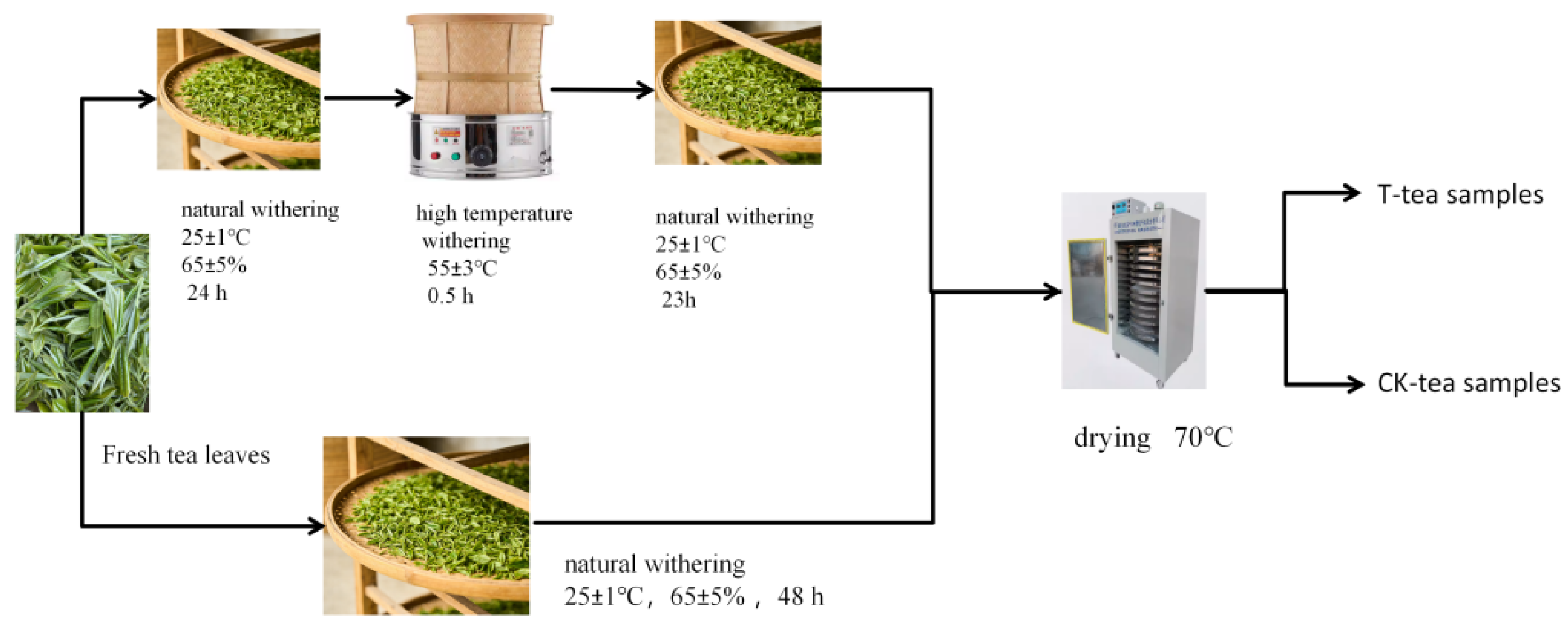
2.1. Tea Samples Treatment

2.2. Sensory Evaluation Merged with Quantitative Descriptive Analysis (QDA)
2.3. Analysis of Volatile Metabolites
2.4. Calculation of Odor Activity Values (OAVs)
2.5. Statistical Analysis
3. Results and Discussion
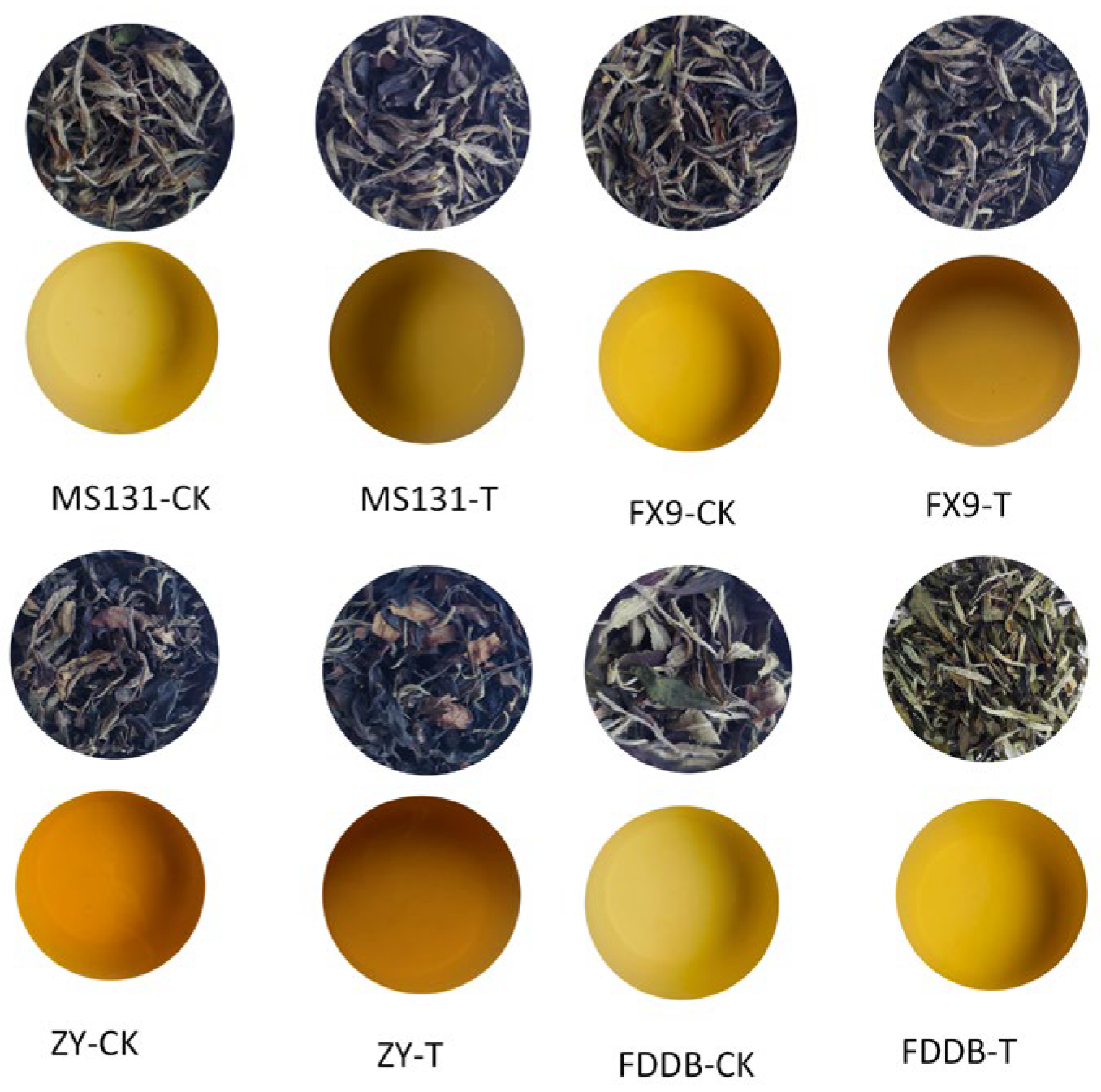
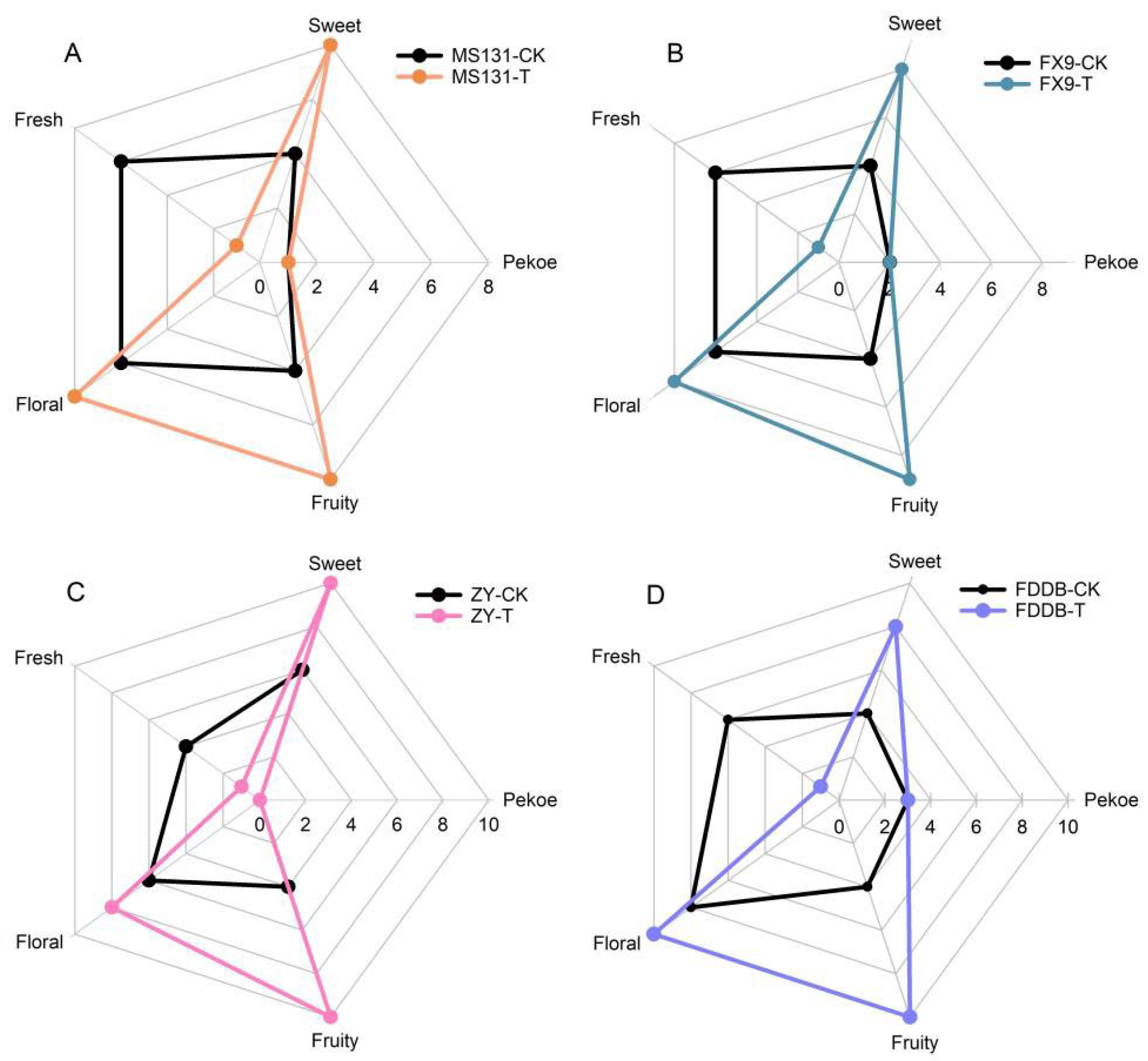
3.1. Sensory Quality Analysis
3.2. Overall Situation of Aroma Composition
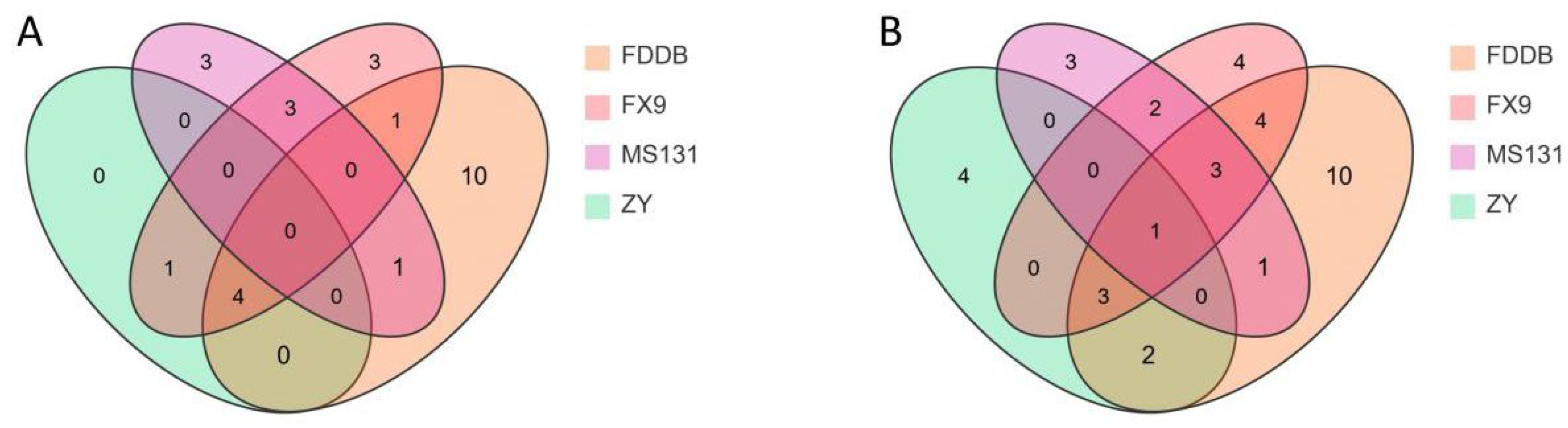
3.2.1. The Quantity of Aroma Substances
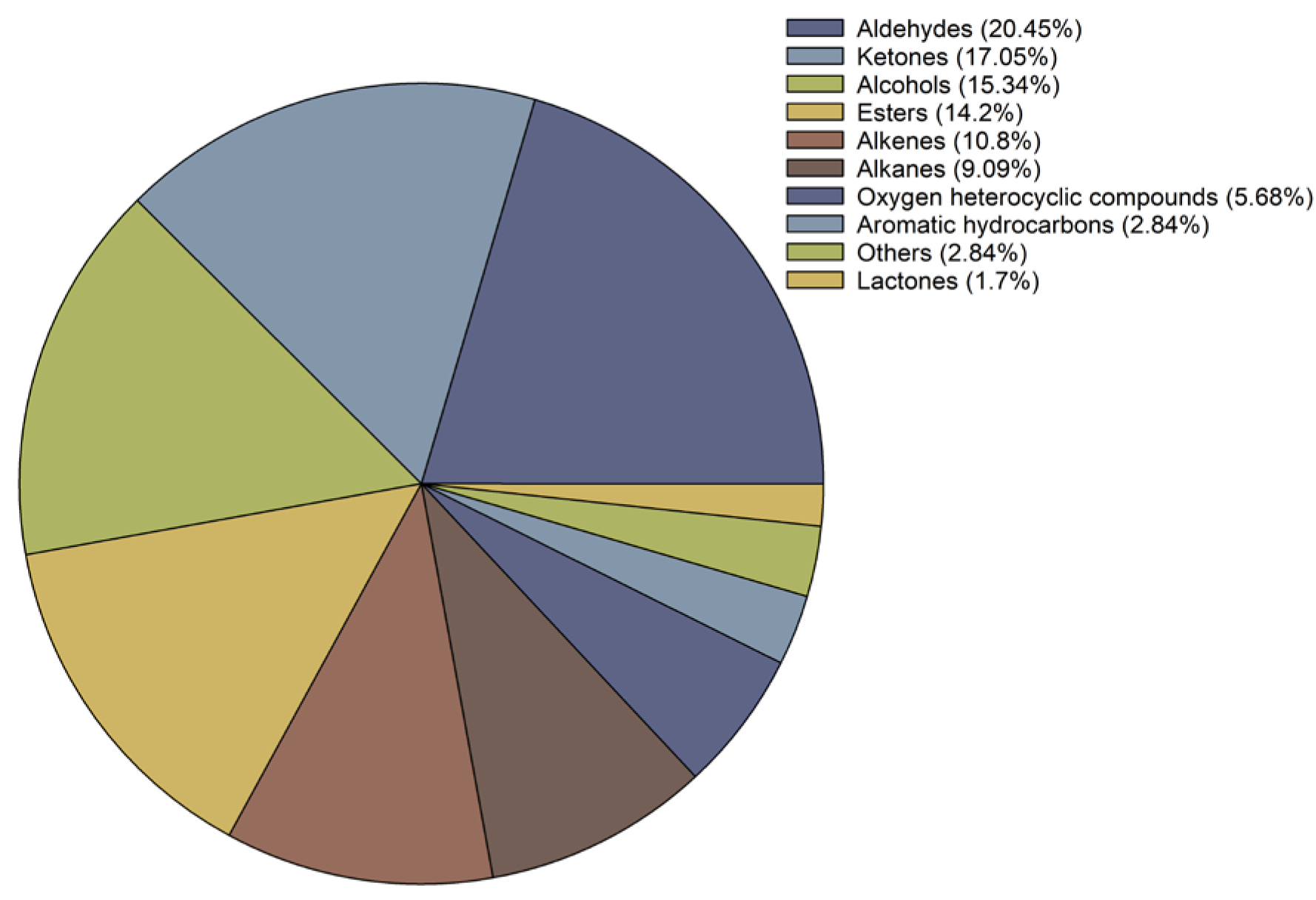
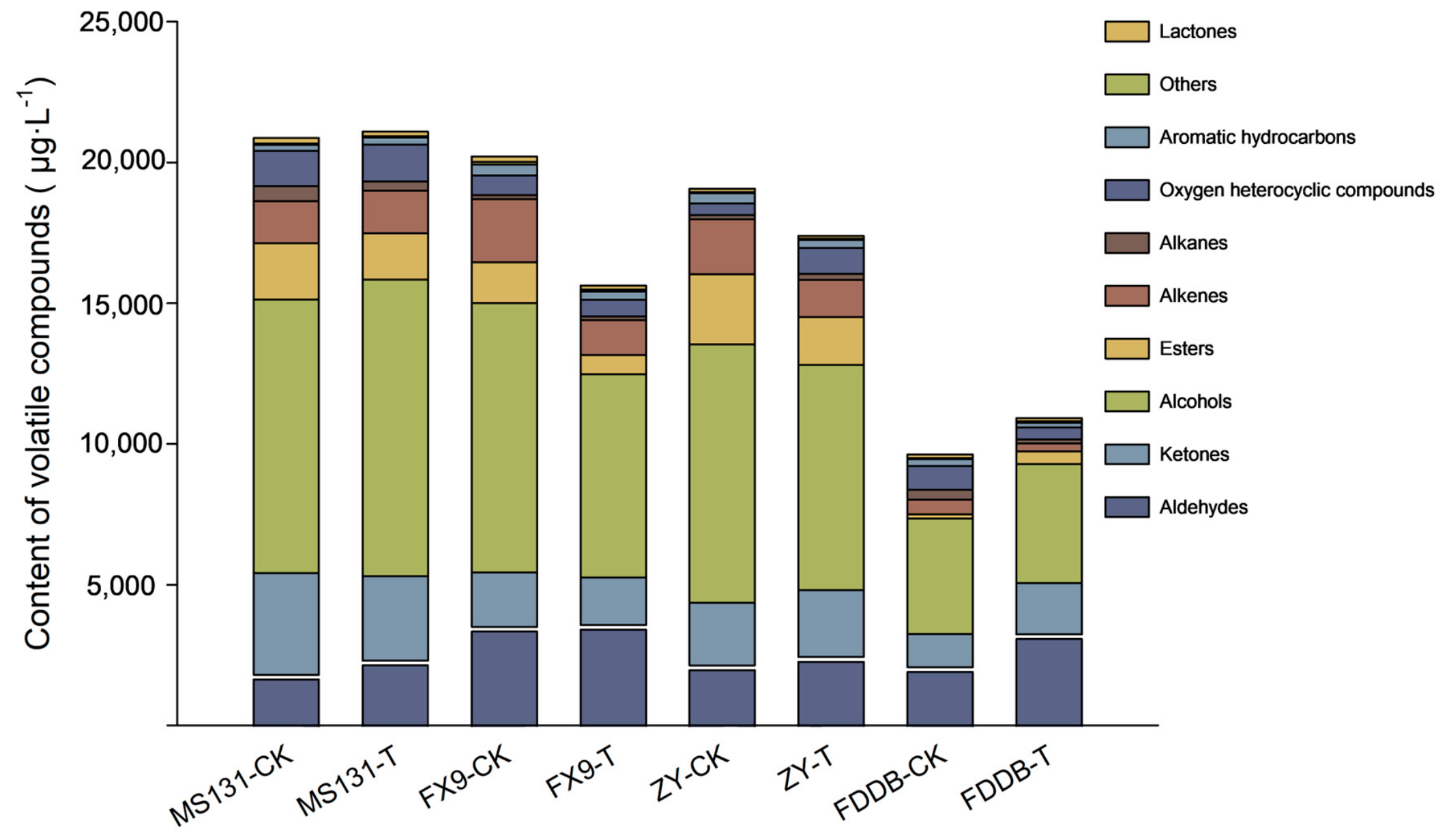
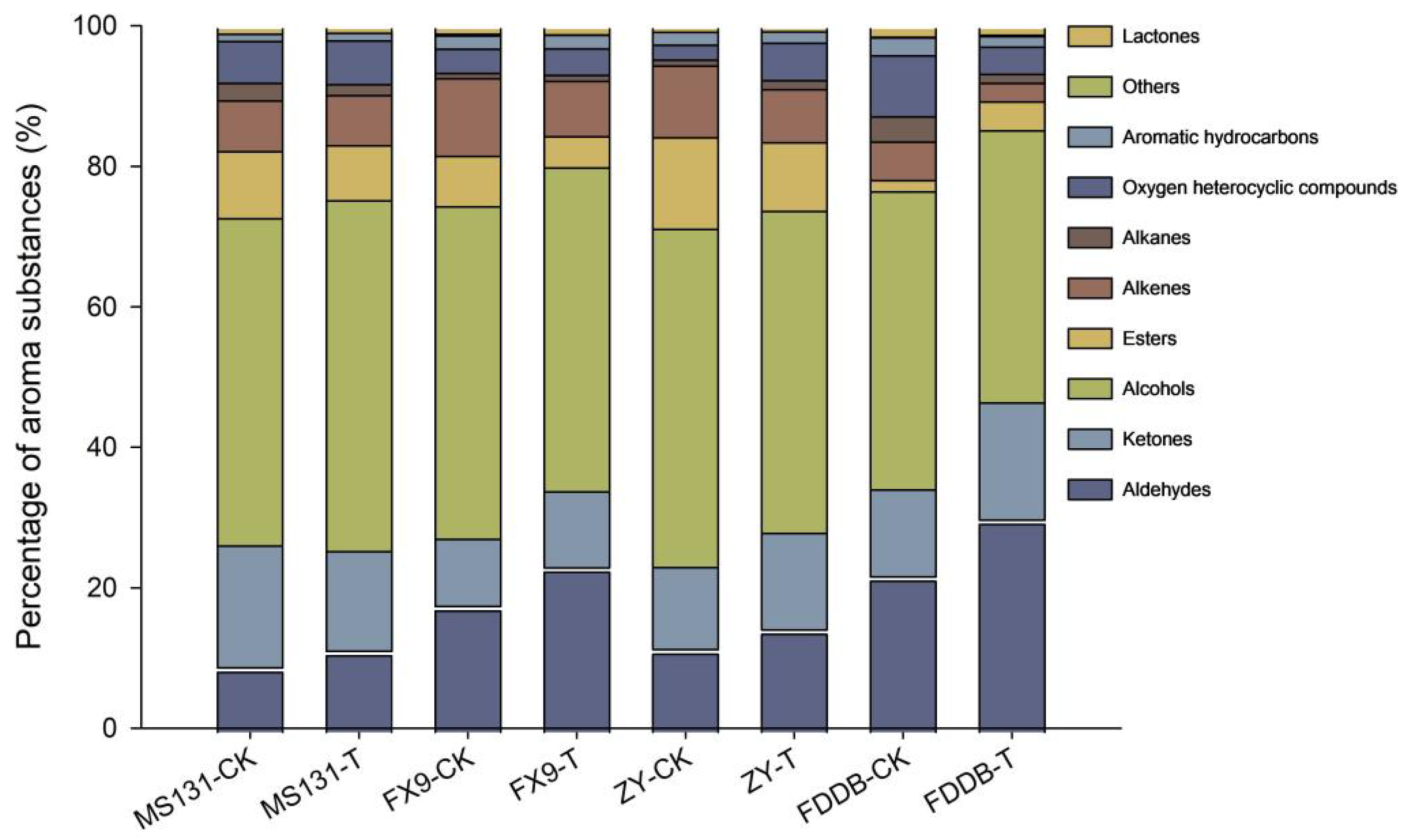
3.2.2. The Content and Percentage of Volatile Compounds
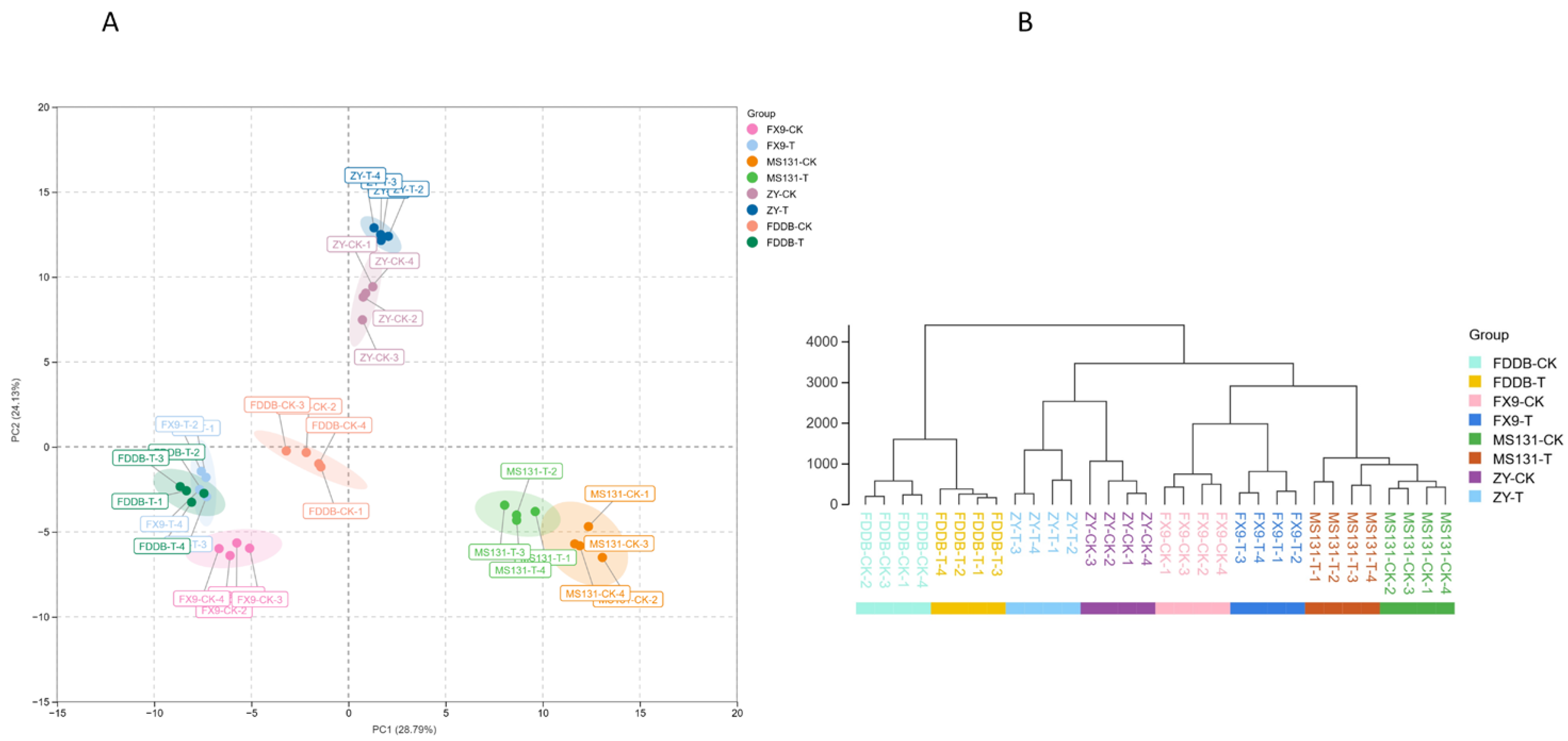
3.2.3. PCA Statistical Analyses of the Volatile Compounds
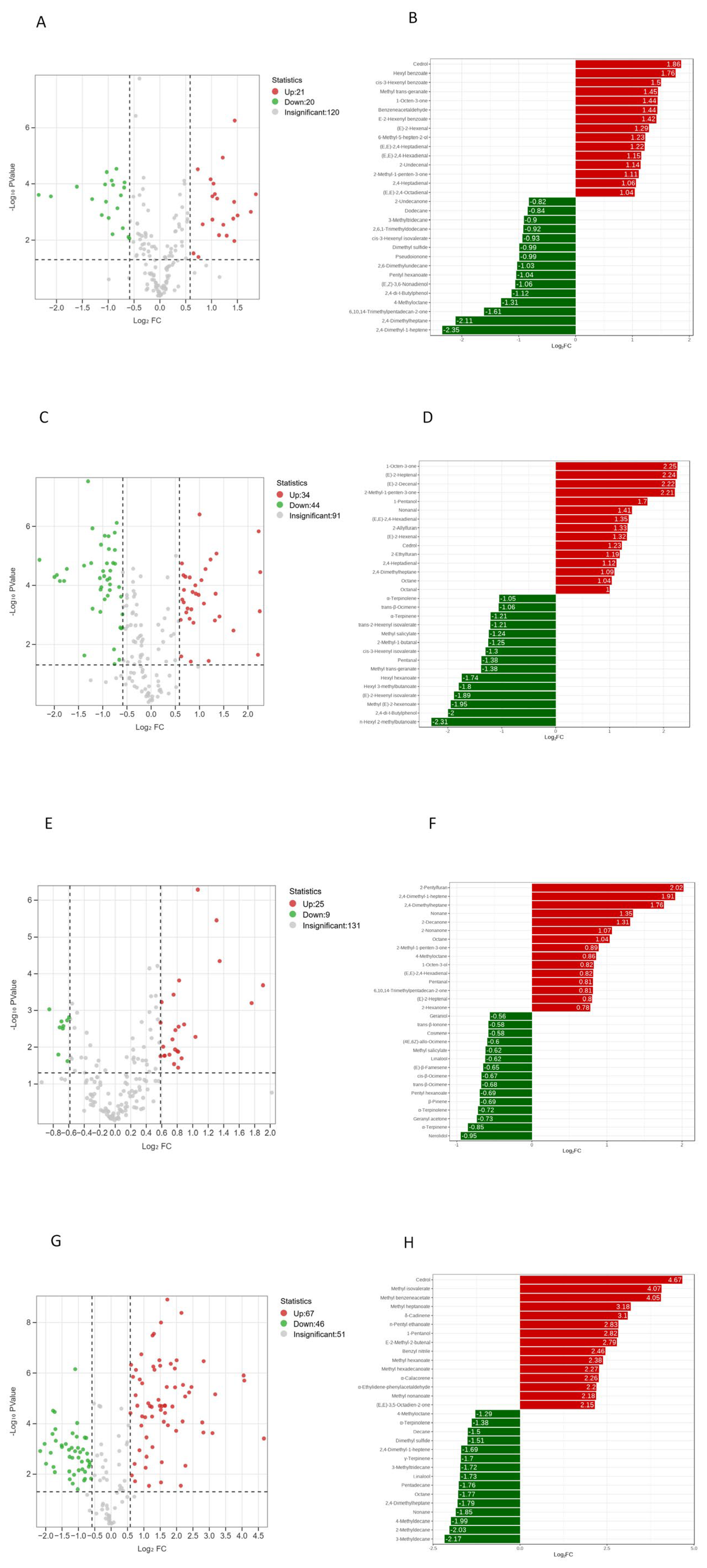
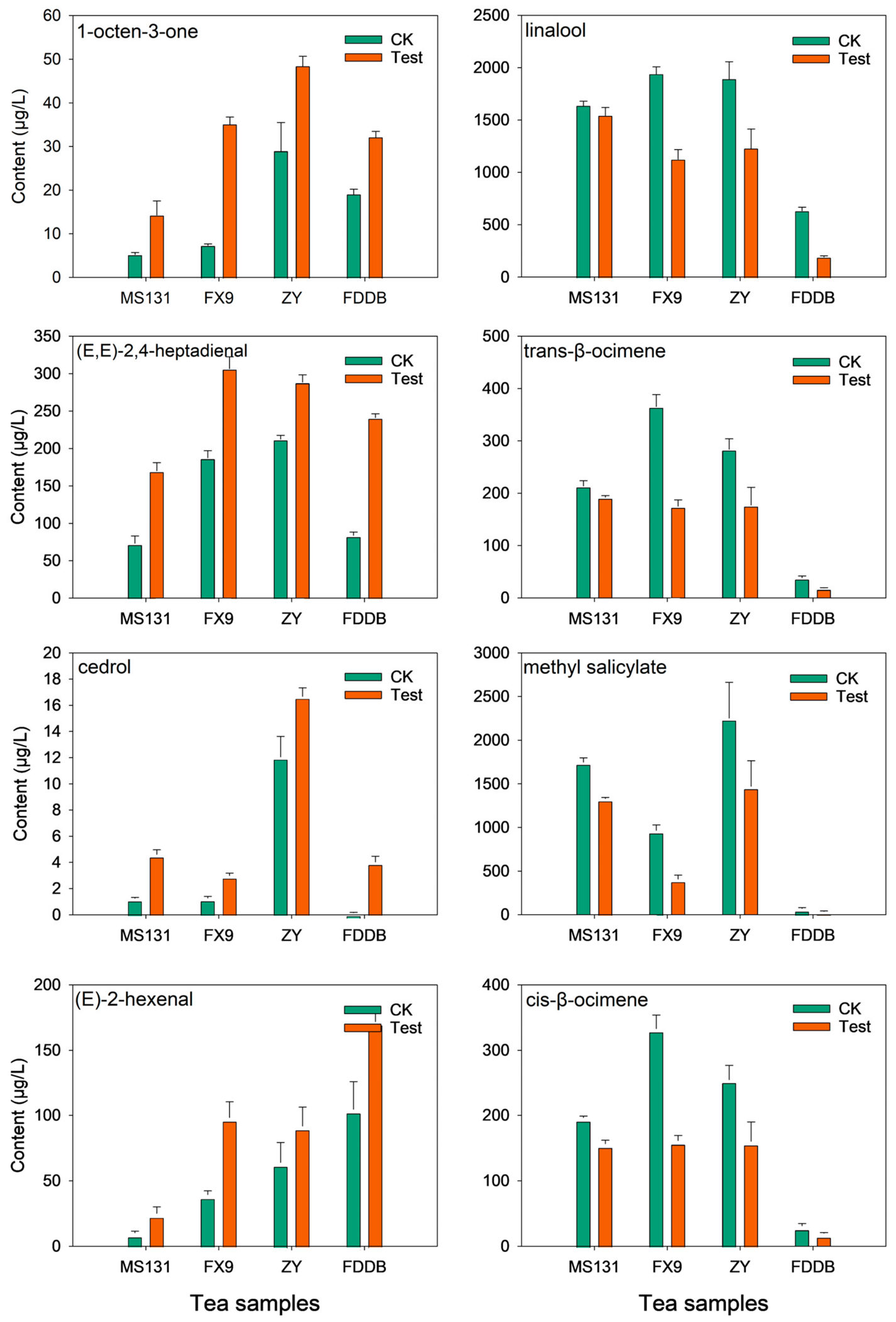
3.3. Statistically Analyze the Degree of Change
3.4. Key Aroma-Active Volatiles Based on OAV Analysis
3.5. The Common Key Aroma Volatiles in Four Tea Varieties
4. Conclusions
Supplementary Materials
Author Contributions
Funding
Institutional Review Board Statement
Informed Consent Statement
Data Availability Statement
Conflicts of Interest
Abbreviations
| MS131 | Mingshan No. 131 |
| FX9 | Fuxuan No. 9 |
| ZY | Ziyan |
| FDDB | Fudingdabai |
| FX9-CK | CK samples of ‘Fuxuan No. 9’ tea cultivar |
| FX9-T | Test samples of ‘Fuxuan No. 9’ tea cultivar |
| MS131-CK | CK samples of ‘Mingshan No. 131’ tea cultivar |
| MS131-T | Test samples of ‘Mingshan No. 131’ tea cultivar |
| ZY-CK | CK samples of ‘Ziyan’ tea cultivar |
| ZY-T | Test samples of ‘Ziyan’ tea cultivar |
| FDDB-CK | CK samples of ‘Fudingdabai’ tea cultivar |
| FDDB-T | Test samples of ‘Fudingdabai’ tea cultivar |
| PCA | Principal component analysis |
| OPLS-DA | Orthogonal projections to latent structures—discriminant analysis |
| OAV | Odor activity values |
References
- Fang, J.; Sureda, A.; Silva, A.S.; Khan, F.; Xu, S.; Nabavi, S.M. Trends of tea in cardiovascular health and disease: A critical review. Trends Food Sci. Technol. 2019, 88, 385–396. [Google Scholar] [CrossRef]
- Chen, X.; Dai, P.; Zhu, Y.; Jin, W.; Xie, Y.; Yang, Z.; Wang, Z.; Jin, X.; Lei, M.; Shi, L. A triple-helix white tea polysaccharide alleviates ulcerative colitis via the gut microbiota–metabolites–inflammation regulatory axis. Carbohydr. Polym. 2025, 374, 124716. [Google Scholar] [CrossRef]
- Feng, Z.; Li, M.; Li, Y.; Yin, J.; Wan, X.; Yang, X. Characterization of the key aroma compounds in infusions of four white teas by the sensomics approach. Eur. Food Res. Technol. 2022, 248, 1299–1309. [Google Scholar] [CrossRef]
- Feng, J.; Zhuang, J.; Chen, Q.; Lin, H.; Chu, Q.; Chen, P.; Wang, F.; Yu, B.; Hao, Z. The effect of maturity of tea leaves and processing methods on the formation of milky flavor in white tea-a metabolomic study. Food Chem. 2024, 447, 139080. [Google Scholar] [CrossRef]
- Shen, S.; Zhang, J.; Sun, H.; Zu, Z.; Fu, J.; Fan, R.; Chen, Q.; Wang, Y.; Yue, P.; Ning, J. Sensomics-assisted characterization of fungal-flowery aroma components in fermented tea using Eurotium cristatum. J. Agric. Food Chem. 2023, 71, 18963–18972. [Google Scholar] [CrossRef]
- Zhu, W.; Zhou, S.; Guo, H.; Hu, J.; Cao, Y.; Xu, Y.; Lin, X.; Tian, B.; Fan, F.; Gong, S. Golden-flower fungus (Eurotiwm cristatum) presents fungal flower aroma as well as accelerates the aging of white tea (Shoumei). Food Chem. 2024, 451, 139452. [Google Scholar] [CrossRef] [PubMed]
- Zheng, Z.; Wu, W.; Wang, Z.; Zhang, P.; Ma, B.; Huang, Y.; Sun, W. Molecular sensory basis of the unique “cocoa aroma” in white tea: An integrated study combining HS-SPME-GC–MS, GC-O, molecular docking, and addition tests. Food Res. Int. 2025, 211, 116413. [Google Scholar] [CrossRef]
- Zhou, S.; Zhang, J.; Ma, S.; Ou, C.; Feng, X.; Pan, Y.; Gong, S.; Fan, F.; Chen, P.; Chu, Q. Recent advances on white tea: Manufacturing, compositions, aging characteristics and bioactivities. Trends Food Sci. Technol. 2023, 134, 41–55. [Google Scholar] [CrossRef]
- Tan, J.; Engelhardt, U.H.; Lin, Z.; Kaiser, N.; Maiwald, B. Flavonoids, phenolic acids, alkaloids and theanine in different types of authentic Chinese white tea samples. J. Food Compos. Anal. 2017, 57, 8–15. [Google Scholar] [CrossRef]
- Wang, Y.; Yasir, M.; Walayat, N.; Ahmed, I.A.M.; Zhang, W.; Zheng, J.; Su, Z.; Wei, R. Exploring the impact of diverse combinations of withering methods and drying temperatures on the quality characteristics of white tea. Ind. Crops Prod. 2025, 237, 122196. [Google Scholar] [CrossRef]
- Tan, J.; Fang, Z.; Tian, C.; Zhou, C.; Zhang, C.; Jiang, L.; Zheng, A.; Yang, N.; Guo, Y. Improving flavor of Wuyi rock tea processed from rain-soaked leaves by optimizing withering conditions. Food Chem. 2025, 471, 142762. [Google Scholar] [CrossRef] [PubMed]
- Wang, Y.; Zheng, P.-C.; Liu, P.-P.; Song, X.-W.; Guo, F.; Li, Y.-Y.; Ni, D.-J.; Jiang, C.-J. Novel insight into the role of withering process in characteristic flavor formation of teas using transcriptome analysis and metabolite profiling. Food Chem. 2019, 272, 313–322. [Google Scholar] [CrossRef]
- Feng, J.; Ye, S.; Wang, J.; Wu, J.; Zhao, J.; Tian, W.; Pan, G.; Yu, B.; Qiu, D.; Lin, H. From water migration to aroma development: Revealing the influence of environmental airflow on the aroma of white tea during withering. Food Chem. 2025, 479, 143797. [Google Scholar] [CrossRef]
- Fan, Y.; Yu, T.; Wang, W.; Zuo, Y.; Wang, J.; Ning, J. LED spectral tailoring directs flavor metabolites during white tea withering. LWT 2025, 231, 118316. [Google Scholar] [CrossRef]
- Hua, J.; Yuan, H.; Jiang, Y.; Cheng, G.; Wang, W.; Liu, P. Effect of withering light intensity on physical characteristics and respiration of tea fresh leaves. J. Tea Sci. 2014, 34, 288–296. [Google Scholar]
- Yu, X.; Li, Y.; He, C.; Zhou, J.; Chen, Y.; Yu, Z.; Wang, P.; Ni, D. Nonvolatile metabolism in postharvest tea (Camellia sinensis L.) leaves: Effects of different withering treatments on nonvolatile metabolites, gene expression levels, and enzyme activity. Food Chem. 2020, 327, 126992. [Google Scholar] [CrossRef]
- You, F.-N.; Deng, H.-L.; Hu, J.; Yao, Z.-L.; Wu, S.-Q.; Qin, Y.-J.; Tang, T.-H.; Sun, Y. Effects of LED light withering at different temperatures on expression of key genes in the upstream of MEP and formation of volatiles in Tieguanyin tea. J. Integr. Agric. 2020, 53, 346–356. [Google Scholar]
- Muthumani, T.; Kumar, R.S. Studies on freeze-withering in black tea manufacturing. Food Chem. 2007, 101, 103–106. [Google Scholar] [CrossRef]
- Xia, E.-H.; Zhang, H.-B.; Sheng, J.; Li, K.; Zhang, Q.-J.; Kim, C.; Zhang, Y.; Liu, Y.; Zhu, T.; Li, W. The tea tree genome provides insights into tea flavor and independent evolution of caffeine biosynthesis. Mol. Plant 2017, 10, 866–877. [Google Scholar] [CrossRef]
- Jia, X.; Zhang, Q.; Chen, M.; Wang, Y.; Lin, S.; Pan, Y.; Cheng, P.; Li, M.; Zhang, Y.; Ye, J. Analysis of the effect of different withering methods on tea quality based on transcriptomics and metabolomics. Front. Plant Sci. 2023, 14, 1235687. [Google Scholar] [CrossRef] [PubMed]
- Fang, X.; Liu, Y.; Xiao, J.; Ma, C.; Huang, Y. GC–MS and LC-MS/MS metabolomics revealed dynamic changes of volatile and non-volatile compounds during withering process of black tea. Food Chem. 2023, 410, 135396. [Google Scholar] [CrossRef] [PubMed]
- Zhang, X.; Ling, Z.; Hu, W.; Xiang, C.; Cui, L.; Xu, W.; Xiao, W. Effects of Different Temperature Hot Air Withering on Withered Leaves and Tea Quality of Black Tea. J. Tea Sci. 2024, 44, 483–492. [Google Scholar]
- Wu, H.; Sheng, C.; Lu, M.; Ke, H.; Li, T.; Wei, Y.; Shen, S.; Yin, X.; Lu, C.; Wang, Y.; et al. Identification of the causes of aroma differences in white tea under different withering methods by targeted metabolomics. Food Biosci. 2024, 59, 104020. [Google Scholar] [CrossRef]
- Xu, Y.; Chen, X.; Mei, L.; You, H.; Lin, Z.; Guo, H.; Chu, Q.; Gong, S.; Fan, F.J.F.F. Unveiling the Impact of Withering Methods on Aroma Profile of White Peony Tea Through Integrating Metabonomics and Sensomics. Food Front. 2026, 7, e70128. [Google Scholar] [CrossRef]
- Lin, Y.; Huang, Y.; Zhou, S.; Li, X.; Tao, Y.; Pan, Y.; Feng, X.; Guo, H.; Chen, P.; Chu, Q. A newly-discovered tea population variety processed Bai Mu Dan white tea: Flavor characteristics and chemical basis. Food Chem. 2024, 446, 138851. [Google Scholar] [CrossRef]
- Jin, L.; Lian, X.; Yang, Z.; Li, T.; Li, Y.; He, Q.; Li, D. Differences in aroma of Chuanhong Congou black tea of different tea plant varieties based on HS-SPME-GC-MS analysis. Shipin Gongye Ke-Ji 2024, 45, 268–277. [Google Scholar]
- Liu, C.; Ren, M.; Ning, M.; Liao, Y.; Du, X.; Qin, L.; Chen, W.; Liu, X.; Wu, A.; Feng, D. Cultivar-dependent variation in metabolomic profiles and sensory characteristics of Zhuyeqing green tea (Camellia sinensis). Food Biosci. 2025, 71, 107023. [Google Scholar] [CrossRef]
- Lai, Y.-S.; Li, S.; Tang, Q.; Li, H.-X.; Chen, S.-X.; Li, P.-W.; Xu, J.-Y.; Xu, Y.; Guo, X. The dark-purple tea cultivar ‘Ziyan’accumulates a large amount of delphinidin-related anthocyanins. J. Agric. Food Chem. 2016, 64, 2719–2726. [Google Scholar] [CrossRef]
- Lin, L.; Li, K.; Hua, Y.; Liao, S.; Chen, J.; Tan, L.; Yang, Y.; Sun, B.; Tang, Q.; Xu, W. Dynamic changes of anthocyanins during ‘Ziyan’tea wine processing. Food Chem. X 2024, 24, 101799. [Google Scholar] [CrossRef]
- Yuan, X.; Xue, R.; Jiang, H.; Luo, X.; Huang, H.; Li, P. Purification and components identification of ‘Ziyan’anthocyanins. J. Food Compos. Anal. 2024, 132, 106381. [Google Scholar] [CrossRef]
- GB/T 23776-2018; Tea Sensory Evaluation Methods. Standardization Administration of China (SAC): Beijing, China, 2018.
- GB/T 8303-2013; Tea—Preparation of Ground Sample and Determination of Dry Matter Content. Standardization Administration of China (SAC): Beijing, China, 2013.
- Xu, H.; Pan, S.; Wang, J.; Ye, T.; Yan, M.; Liang, X.; Qian, G.; Yan, T.; Xin, G. Comparative characterization of volatile organic compounds and aroma profiles in 10 Actinidia arguta cultivars by gas chromatography-mass spectrometry (GC–MS), sensory analysis, and odor activity value (OAV) combined with chemometrics. J. Food Compos. Anal. 2024, 133, 106450. [Google Scholar] [CrossRef]
- Lin, H.; Ye, S.; Feng, J.; Wang, J.; Kong, W.; Wu, J.; Zhang, F.; Zhao, J.; Guo, J.; Chen, K. Impact of compression methods on flavor profile of white tea: Integrated analysis of appearance, aroma, and taste. Food Chem. X 2025, 28, 102510. [Google Scholar] [CrossRef]
- Zhai, X.; Zhang, L.; Granvogl, M.; Ho, C.T.; Wan, X. Flavor of tea (Camellia sinensis): A review on odorants and analytical techniques. Compr. Rev. Food Sci. Food Saf. 2022, 21, 3867–3909. [Google Scholar] [CrossRef] [PubMed]
- Yin, X.-L.; Fu, W.-J.; Chen, Y.; Zhou, R.-F.; Sun, W.; Ding, B.; Peng, X.-T.; Gu, H.-W. GC-MS-based untargeted metabolomics reveals the key volatile organic compounds for discriminating grades of Yichang big-leaf green tea. LWT 2022, 171, 114148. [Google Scholar] [CrossRef]
- Chen, L.; Shi, Y.; Sun, J.; Wang, H.; Wang, Y.; Shu, Z.; He, W.; Dong, C.; Xu, P. Deciphering the flavor profile and seasonal variation of black tea processed from cultivar ‘Baiye 1’. Food Res. Int. 2025, 208, 116181. [Google Scholar] [CrossRef] [PubMed]
- Zhang, J.; Wang, Z.; Zhang, L.; Huang, W.; Lin, F.; Xiao, C.; Zheng, Z.; Huang, Y.; Sun, W. Underlying characteristic aroma of white tea from diverse geographical origins and its prediction. J. Sci. Food Agric. 2025, 105, 4558–4568. [Google Scholar] [CrossRef]
- Yao, M.; Lakey, P.S.; Shiraiwa, M.; Zhao, B. Volatile products generated from reactions between ozone and human skin lipids: A modelling estimation. Build. Environ. 2022, 217, 109068. [Google Scholar] [CrossRef]
- Chen, H.; Zhang, X.; Jiang, R.; Ouyang, J.; Liu, Q.; Li, J.; Wen, H.; Li, Q.; Chen, J.; Xiong, L. Characterization of aroma differences on three drying treatments in Rucheng Baimao (Camellia pubescens) white tea. LWT 2023, 179, 114659. [Google Scholar] [CrossRef]
- Sun, X.; Wang, C.; Long, X.; Han, S.; Xu, W.; Chen, T.; Liu, J.; Wen, B.; Li, M. The impact of the unique two-stage bunch-drying on the formation of the floral aroma of Niangniang tea. Food Chem. X 2025, 32, 103345. [Google Scholar] [CrossRef]
- Ni, H.; Jiang, Q.; Lin, Q.; Ma, Q.; Wang, L.; Weng, S.; Huang, G.; Li, L.; Chen, F. Enzymatic hydrolysis and auto-isomerization during β-glucosidase treatment improve the aroma of instant white tea infusion. Food Chem. 2021, 342, 128565. [Google Scholar] [CrossRef]
- Xu, K.; Tian, C.; Zhou, C.; Zhu, C.; Weng, J.; Sun, Y.; Lin, Y.; Lai, Z.; Guo, Y. Non-targeted metabolomics analysis revealed the characteristic non-volatile and volatile metabolites in the Rougui Wuyi rock tea (Camellia sinensis) from different culturing regions. Foods 2022, 11, 1694. [Google Scholar] [CrossRef]
- Mosaferi, S.; Jelley, R.E.; Fedrizzi, B.; Barker, D. Synthesis of d6-deuterated analogues of aroma molecules-β-damascenone, β-damascone and safranal. Results Chem. 2022, 4, 100264. [Google Scholar] [CrossRef]
- Wei, Y.; Yu, Y.-Y.; Li, Y.-C.; Zhong, X.-Y.; Zou, C.; Ning, J.; Dong, W.-J.; Wu, K.; Xu, Y.-Q. Aroma compounds with enhanced sweet perception in tea infusions: Screening, characterization, and sweetening mechanism. J. Adv. Res. 2025, 81, 1–12. [Google Scholar] [CrossRef] [PubMed]
- Wu, H.; Cui, Y.; Chen, Y.; Ren, Q.; Ge, Z.; Wang, X.; Yang, X.; Meng, J.; Chen, M.; Liao, Y. Characterization of key aroma components of low-caffeine, high-theobromine, and high-polyphenol Camellia yungkianensis ‘Rongjiangcha’tea. LWT 2025, 237, 118758. [Google Scholar] [CrossRef]
- Wang, Q.; Jiang, X.; Qin, D.; Liu, S.; Li, H.; Fang, K.; Wang, Q.; Li, B.; Pan, C.; Chen, D. Metabolic profiling of flavor compounds in black teas with almond odor during processing. Eur. Food Res. Technol. 2020, 246, 2039–2053. [Google Scholar] [CrossRef]
- Yang, Z.; Baldermann, S.; Watanabe, N. Recent studies of the volatile compounds in tea. Food Res. Int. 2013, 53, 585–599. [Google Scholar] [CrossRef]
- Guo, X.; Schwab, W.; Ho, C.-T.; Song, C.; Wan, X. Characterization of the aroma profiles of oolong tea made from three tea cultivars by both GC–MS and GC-IMS. Food Chem. 2022, 376, 131933. [Google Scholar] [CrossRef]
- Li, Q.; Li, Y.; Luo, Y.; Xiao, L.; Wang, K.; Huang, J.; Liu, Z. Characterization of the key aroma compounds and microorganisms during the manufacturing process of Fu brick tea. LWT 2020, 127, 109355. [Google Scholar] [CrossRef]
- Yu, Z.; Yang, Z. Understanding different regulatory mechanisms of proteinaceous and non-proteinaceous amino acid formation in tea (Camellia sinensis) provides new insights into the safe and effective alteration of tea flavor and function. Crit. Rev. Food Sci. Nutr. 2020, 60, 844–858. [Google Scholar] [CrossRef] [PubMed]
- Huang, F.; Wu, H.; Luo, F.; Wang, Y.; Ye, Y.; Gong, Y.; Ye, X. Effect of harvest seasons on biochemical components and volatile compounds in white teas from two cultivars. Foods 2025, 14, 1795. [Google Scholar] [CrossRef] [PubMed]
- Dong, F.; Lai, H.; Sun, Q.; Yu, W.; Zhang, G.; Du, S.; Zhuang, S.; Liu, T.; Li, Y.; Fan, X. Dynamic changes in metabolic compounds and their effects on flavor quality of Fuliang black tea and green tea during processing. Food Biosci. 2025, 71, 107332. [Google Scholar] [CrossRef]
- Wu, W.; Zheng, Z.; Wang, Z.; He, B.; Du, S.; Zeng, W.; Sun, W. Identification of key aroma compounds contributing to the pleasurable sensory experience of white Peony tea using GC–MS, computational modeling, and sensory evaluation. Food Res. Int. 2025, 208, 116280. [Google Scholar] [CrossRef]
- Flaig, M.; Qi, S.C.; Wei, G.; Yang, X.; Schieberle, P. Characterisation of the key aroma compounds in a Longjing green tea infusion (Camellia sinensis) by the sensomics approach and their quantitative changes during processing of the tea leaves. Eur. Food Res. Technol. 2020, 246, 2411–2425. [Google Scholar] [CrossRef]
- Liu, Y.; Zhang, X.; Han, M.; Zhou, H.; Wang, H.; Yang, J.; Xu, Y.; Lei, P. Effects of drying methods on volatile profiles of Chloranthus spicatus and quality of its scented tea: Chemometric approaches. Food Chem. X 2025, 33, 103424. [Google Scholar] [CrossRef]
- Zhu, Z.; Yu, J.; Chen, Y.; Wang, W.; Du, S.; Wang, D.; Xue, J.; Tao, Y. Characterization of key aroma compounds contributing to tea-aroma in green tea-flavor liquor. J. Food Compos. Anal. 2025, 148, 108235. [Google Scholar] [CrossRef]
- Zhao, Y.; Xiao, K.; Chen, Y.; Ma, M.; Tan, J.; Liu, Z.; Wang, K.; Huang, J.; Zhu, M. Aroma Evolution and Key Volatile Profiles of Aged Raw Pu-erh Tea: Insights from Volatilomics, Electronic Sensing, and Microbiomics. J. Food Compos. Anal. 2025, 148, 108507. [Google Scholar] [CrossRef]
- Li, Y.; Zhou, J.; Xu, W.; He, C.; Zhu, J.; Zhang, D.; Chen, Y.; Yu, Z.; Wan, X.; Ni, D. Key aroma components in Lu’an guapian green tea with different aroma types from five tea tree varieties decoded by sensomics. Food Biosci. 2024, 61, 104551. [Google Scholar] [CrossRef]
- Zhang, L.; Chen, J.; Zhang, J.; Sagymbek, A.; Li, Q.; Gao, Y.; Du, S.; Yu, X. Lipid oxidation in fragrant rapeseed oil: Impact of seed roasting on the generation of key volatile compounds. Food Chem. X 2022, 16, 100491. [Google Scholar] [CrossRef]
- Liu, C.; Wang, C.; Wei, M.; Ning, M.; Xu, Z.; Chen, S.; Cui, J.; Song, C.; Tang, Q. Influence of leaf tenderness on the aroma and taste characteristics of green tea from Camellia sinensis cv. Chuancha No. 2: Integrated sensory and chemical profiling. Food Chem. X 2026, 35, 103754. [Google Scholar] [CrossRef]
- Yang, C.; Lu, X.; Ho, C.-T.; Ma, J.; Wang, Y.; Chen, Y.; Yi, Y.; Zhu, M.; Wang, Y.; Liu, Z. Comparison of solid-state fermentation with different Bacillus species on the volatile organic compounds and non-volatile metabolites of dark teas. Food Res. Int. 2025, 214, 116574. [Google Scholar] [CrossRef]
- Wu, H.; Wang, X.; Kong, X.; Shan, R.; Chen, C.; Li, Z.; Yu, W. Impact of Aspergillus cristatus on Microbial Community and Flavor Profile of Fermented White Tea. LWT 2026, 242, 119126. [Google Scholar] [CrossRef]


Disclaimer/Publisher’s Note: The statements, opinions and data contained in all publications are solely those of the individual author(s) and contributor(s) and not of MDPI and/or the editor(s). MDPI and/or the editor(s) disclaim responsibility for any injury to people or property resulting from any ideas, methods, instructions or products referred to in the content. |
© 2026 by the authors. Licensee MDPI, Basel, Switzerland. This article is an open access article distributed under the terms and conditions of the Creative Commons Attribution (CC BY) license.
Share and Cite
Huang, F.; Huang, Y.; Gong, X.; Chen, B.; Zhang, J.; Guo, Q.; Zhang, W.; Ye, Y.; Ma, Z.; Wang, Y. Impact of Warm-Air Withering Methods on Aroma Quality of White Teas from Four Tea Cultivars. Foods 2026, 15, 2120. https://doi.org/10.3390/foods15122120
Huang F, Huang Y, Gong X, Chen B, Zhang J, Guo Q, Zhang W, Ye Y, Ma Z, Wang Y. Impact of Warm-Air Withering Methods on Aroma Quality of White Teas from Four Tea Cultivars. Foods. 2026; 15(12):2120. https://doi.org/10.3390/foods15122120
Chicago/Turabian StyleHuang, Fan, Yingbo Huang, Xuejiao Gong, Bowen Chen, Juan Zhang, Qian Guo, Wenyi Zhang, Yulong Ye, Zeqiang Ma, and Yingchun Wang. 2026. "Impact of Warm-Air Withering Methods on Aroma Quality of White Teas from Four Tea Cultivars" Foods 15, no. 12: 2120. https://doi.org/10.3390/foods15122120
APA StyleHuang, F., Huang, Y., Gong, X., Chen, B., Zhang, J., Guo, Q., Zhang, W., Ye, Y., Ma, Z., & Wang, Y. (2026). Impact of Warm-Air Withering Methods on Aroma Quality of White Teas from Four Tea Cultivars. Foods, 15(12), 2120. https://doi.org/10.3390/foods15122120