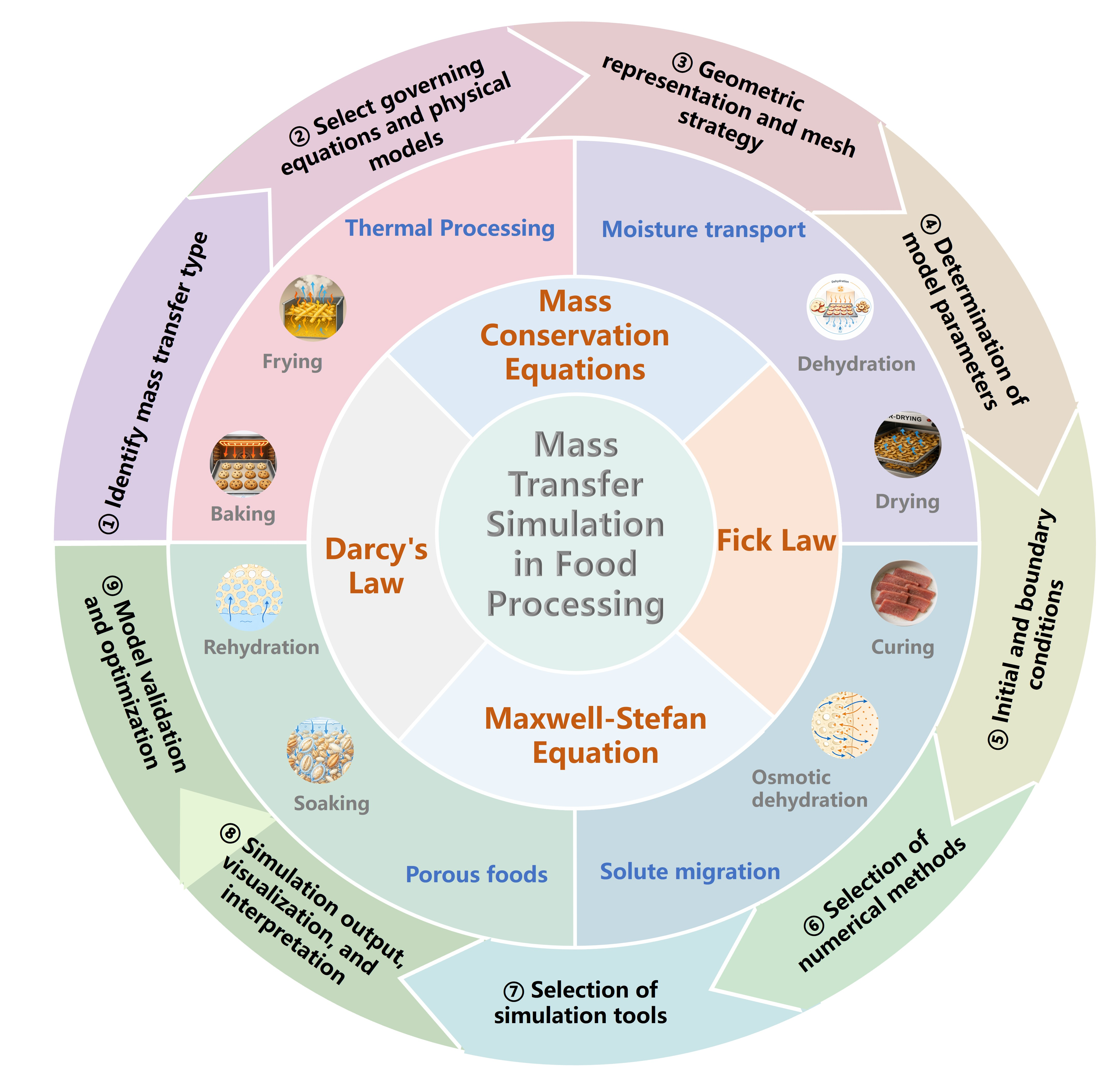
Modeling and Simulation of Mass Transfer in Food Processing: Recent Advances in Governing Equations, Workflow, and Applications



Abstract
1. Introduction
2. Governing Equations and Physical Basis of Coupled Transport in Food Processing
2.1. Fundamental Transport Laws and Dimensionless Criteria
2.2. Fick’s Laws
2.2.1. Fick’s First Law
2.2.2. Fick’s Second Law
2.3. Mass Conservation Equations
2.4. Maxwell–Stefan Equations
2.5. Darcy’s Law
2.6. Key Transport Parameters
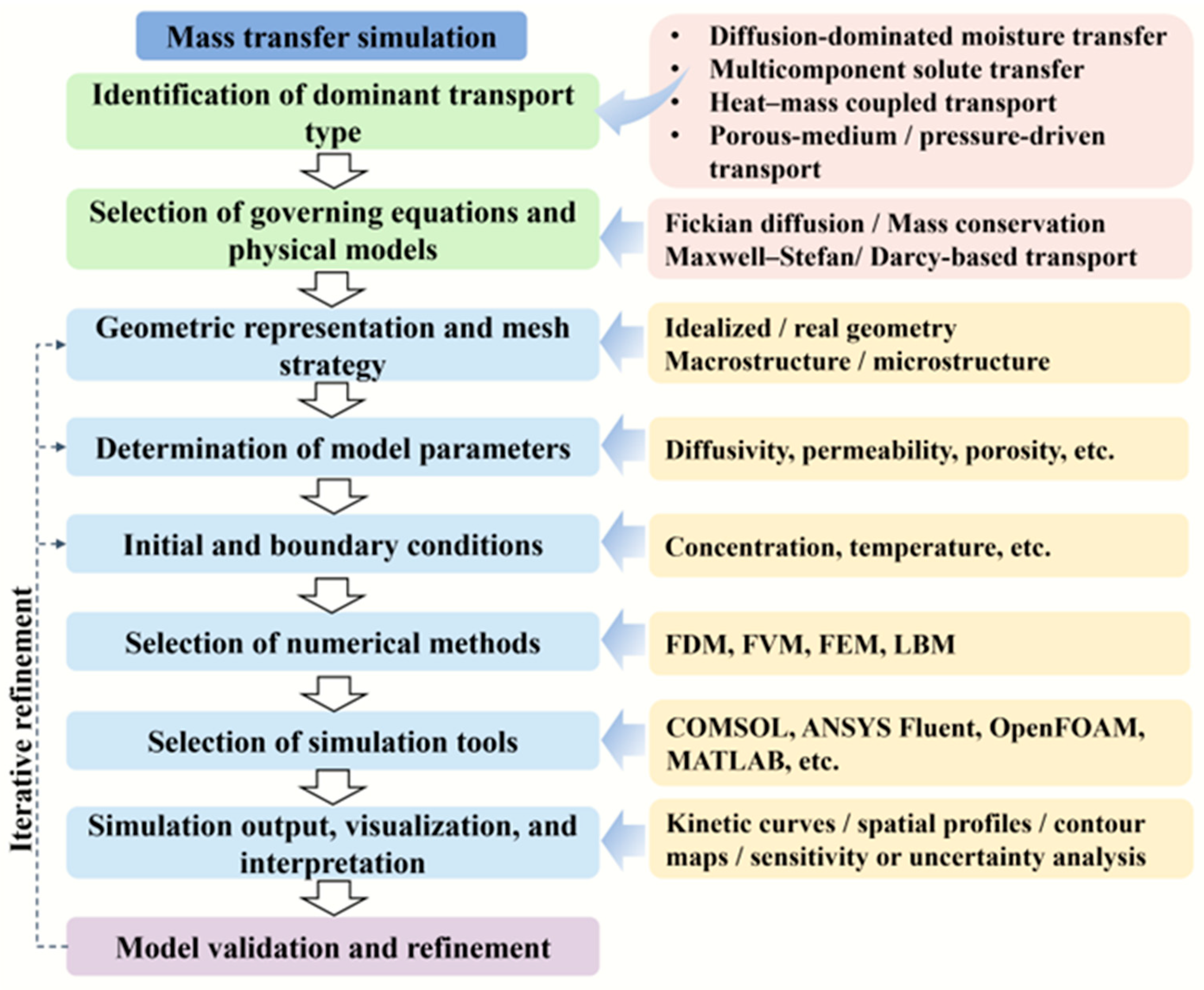
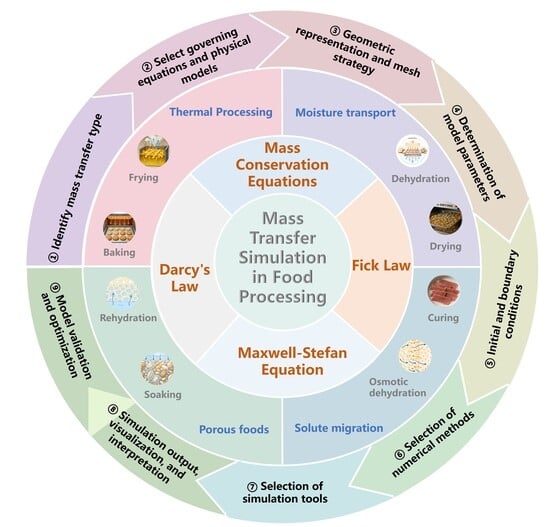
3. A Unified Simulation Workflow for Mass Transfer in Food Processing
3.1. Identification of Dominant Transport Type
3.2. Selection of Governing Equations and Physical Models
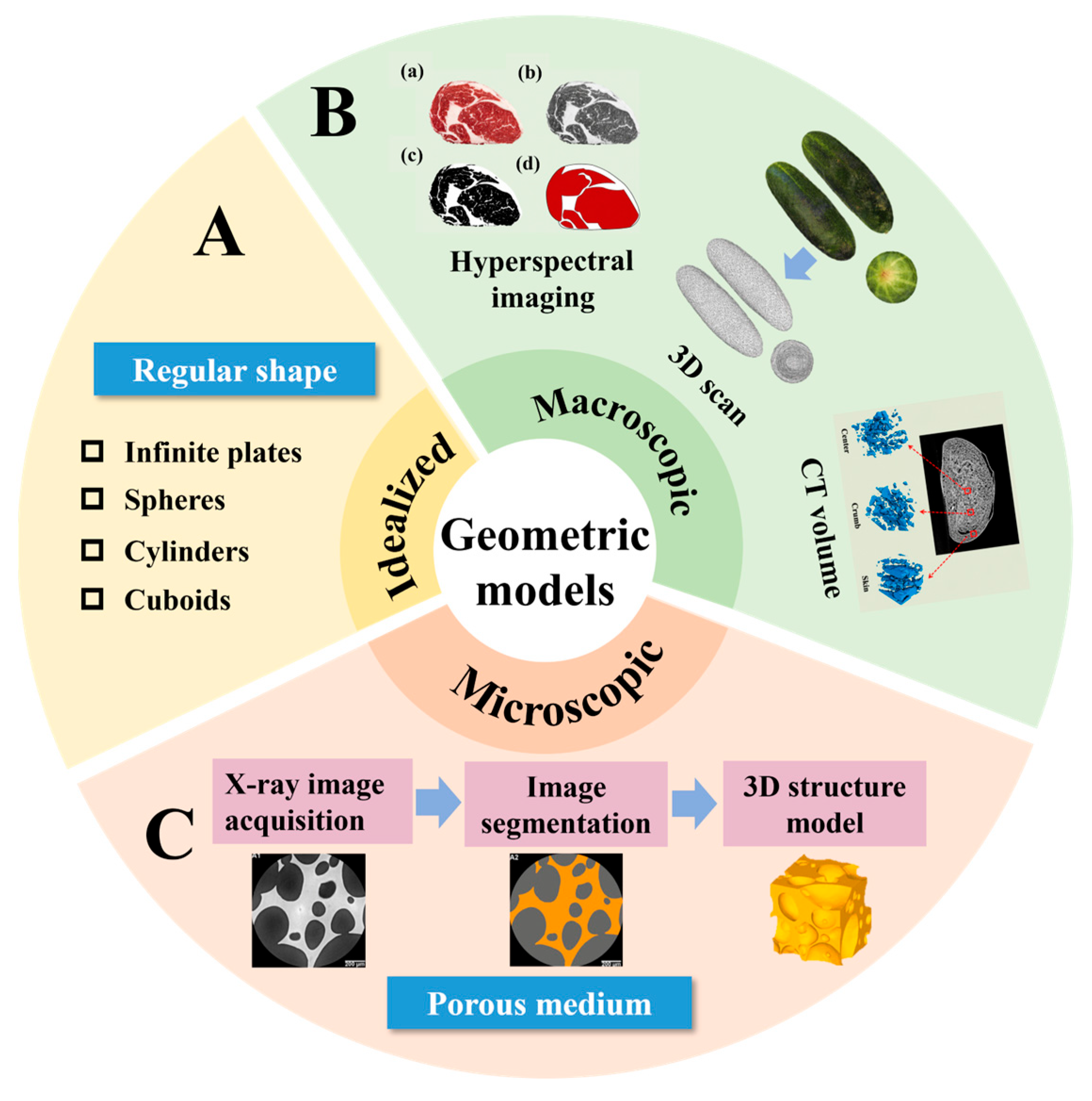
3.3. Geometric Representation and Mesh Strategy
3.4. Determination of Model Parameters
3.5. Initial and Boundary Conditions
3.6. Selection of Numerical Methods
3.7. Selection of Simulation Tools
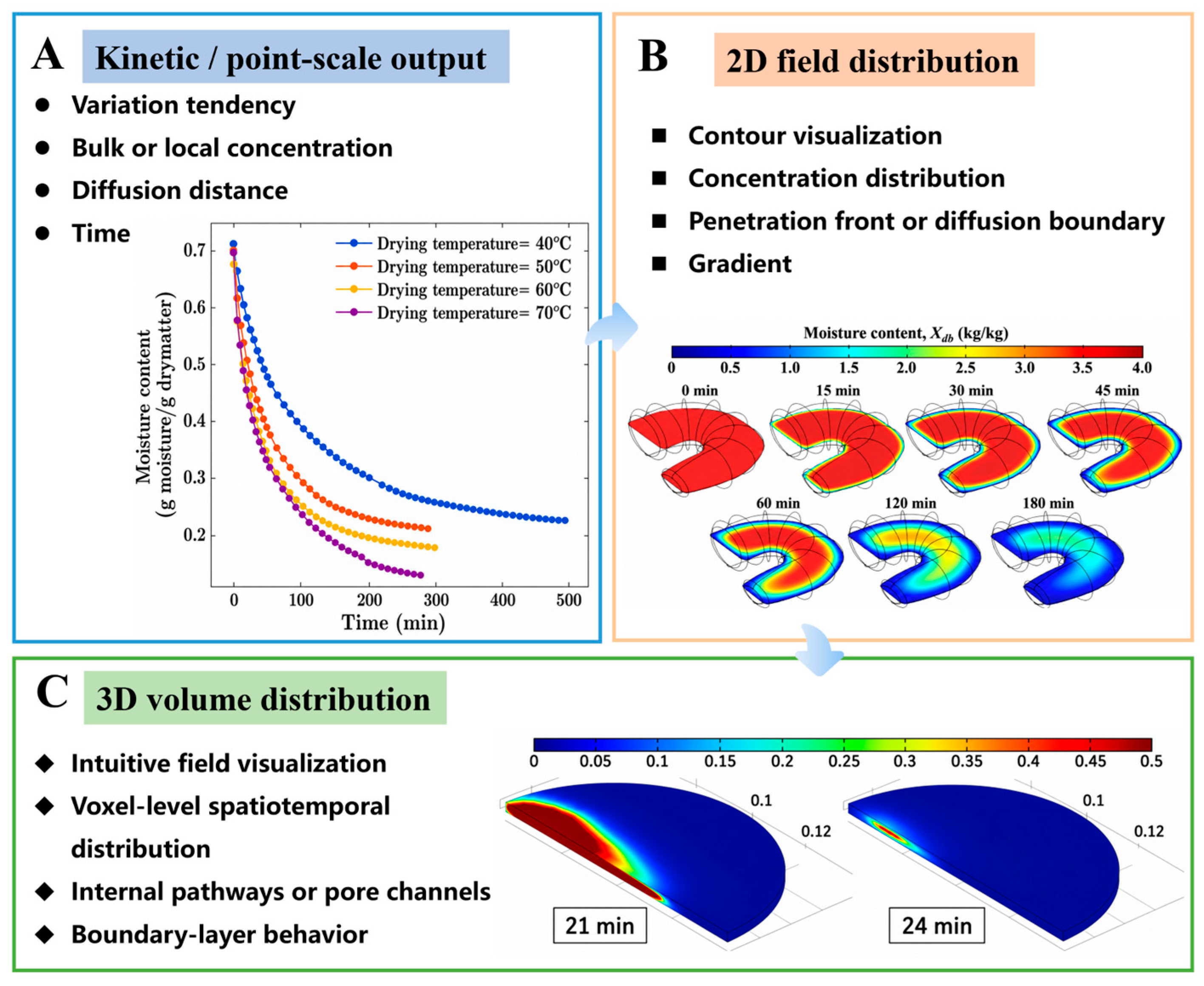
3.8. Simulation Output, Visualization, and Interpretation
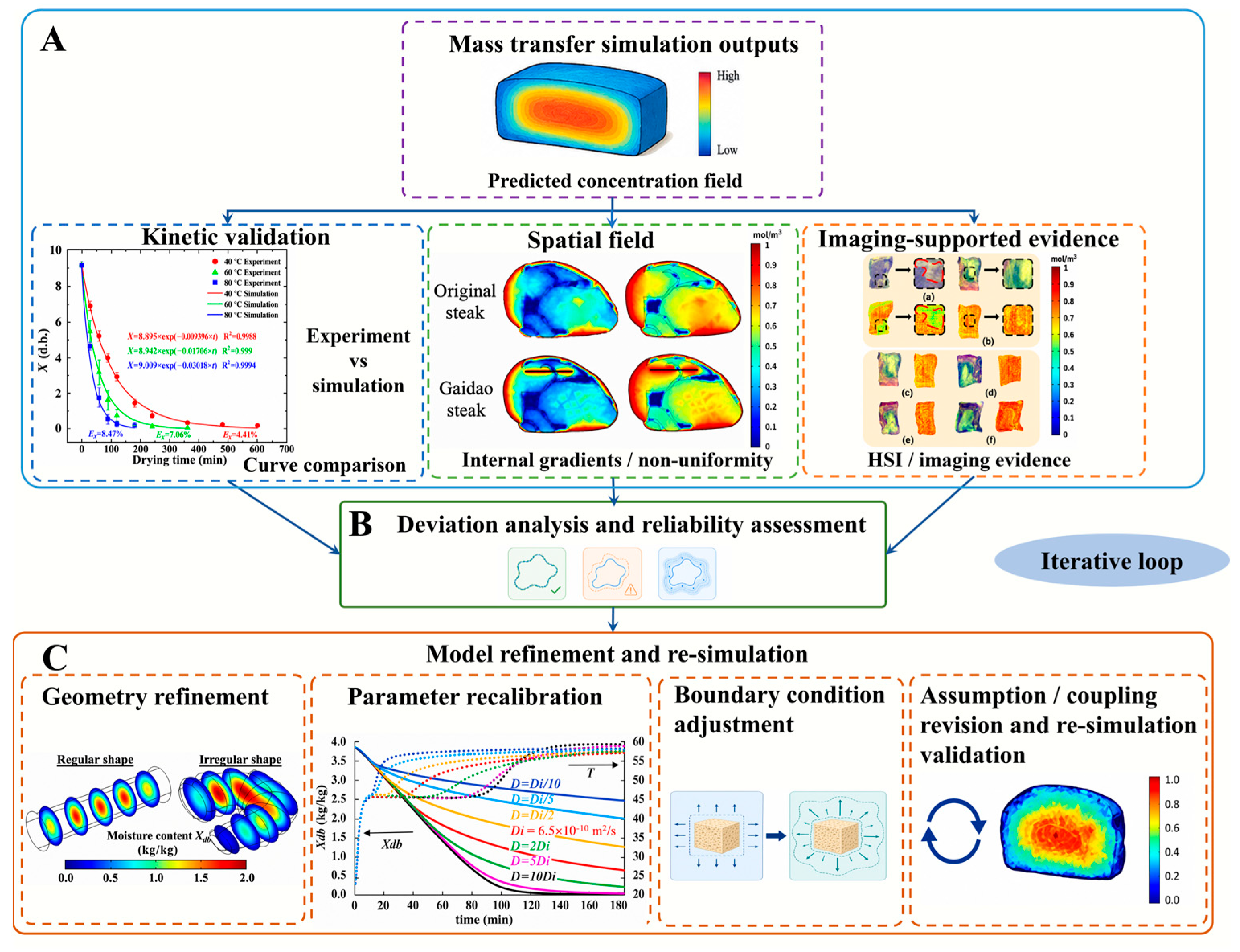
3.9. Model Validation and Refinement
4. Applications of Mass Transfer Simulation in Representative Food Processing Operations
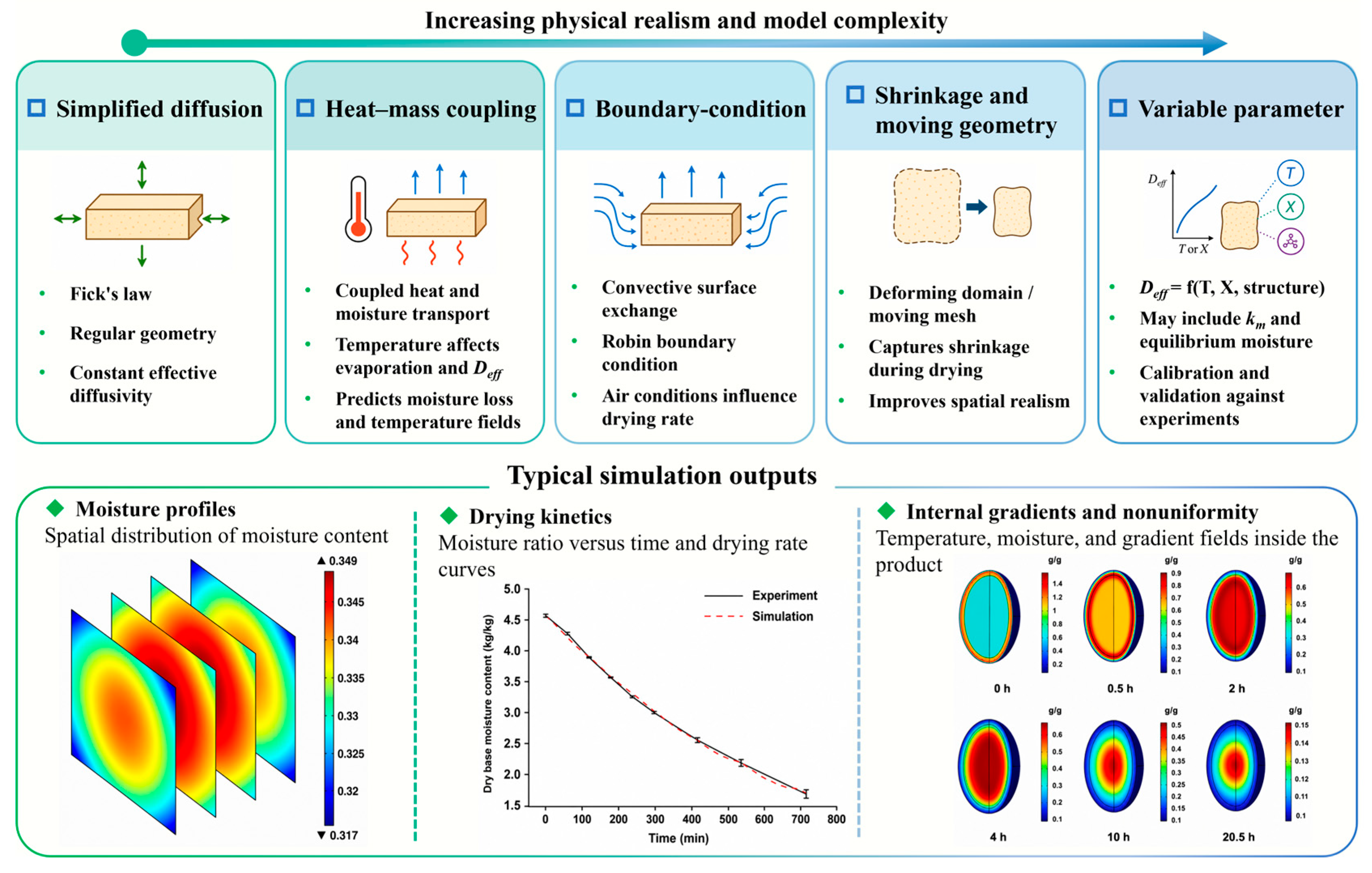
4.1. Simulation of Drying, Dehydration, and Moisture Redistribution
4.2. Simulation of Frying, Baking, and Other Heat–Mass Coupled Processes
4.3. Simulation of Curing, Osmotic Dehydration, and Solute Migration
4.4. Simulation of Rehydration, Soaking, and Transport in Porous Foods
4.5. Simulation of Moisture Migration in Multi-Ingredient and Multilayer Foods

| Representative Processes | Representative PDEs or Governing Formulations | Typical Initial and Boundary Conditions | Mathematical or Numerical Method | Main Practical Limitation | Practical Impact on Application | Possible Mitigation or Appropriate Use | References |
|---|---|---|---|---|---|---|---|
| Drying, dehydration, and moisture redistribution | Moisture diffusion: Coupled heat–mass transfer may include . | Initial moisture M = M0; initial temperature T = T0 if heat transfer is coupled. Surface moisture flux: . Convective heat boundary: . | Analytical solutions for ideal one-dimensional slabs or cylinders; FDM for regular domains; FEM or FVM for irregular geometries, coupled heat–mass transfer, shrinkage-aware domains, or multidirectional transport. | Over-simplified geometry, constant Deff, uncertain surface transfer coefficient, shrinkage, structural evolution, and pretreatment-dependent tissue changes may reduce model reliability; inappropriate use of one-dimensional geometry for finite solids with comparable dimensions is also a major source of error. | High when the objective is to predict internal moisture gradients, drying uniformity, shrinkage, multidirectional resistance, or scale-up behavior, especially in intact tissues, thick pieces, cubes, fries, or irregular foods. Moderate to low when the objective is limited to overall drying-curve fitting or effective diffusivity estimation under narrow operating conditions. | Constant Deff and simple geometry are acceptable for preliminary kinetic fitting under limited temperature, moisture, and shrinkage ranges. State-dependent diffusivity, shrinkage-aware geometry, 2D/3D FEM or FVM, pretreatment-specific parameters, and independent validation under different temperatures, air velocities, thicknesses, and material batches are needed for predictive or design-oriented use. | [51,52] |
| Frying, baking, and other heat–mass coupled processes | Energy equation: Moisture conservation: Oil, vapor, or pressure transport may be added when needed. | Initial temperature T = T0; initial moisture M = M0; initial oil content may be zero or a measured baseline. Convective heat boundary: . Surface moisture flux: . Oil uptake, vapor pressure, or crust-related boundary conditions may be added in frying or baking. | FEM for coupled heat–mass and deformation problems; FVM or CFD for airflow, oil flow, or equipment-scale simulations; moving mesh may be used when deformation, crust evolution, or geometry change is important. | Strong coupling among heat transfer, evaporation, vapor migration, crust formation, oil uptake, tissue structure, and dynamic boundary conditions makes model parameterization difficult. One-dimensional heat–mass assumptions may be insufficient for thick or proportionally shaped products. | Very high for quantitative prediction of oil uptake, crust formation, internal temperature, moisture redistribution, and product quality. These limitations strongly restrict direct transfer from laboratory models to industrial fryers or ovens. Moderate when the model is used only for endpoint comparison or qualitative mechanism interpretation. | Reduced models may be sufficient for endpoint comparison. Coupled heat–mass formulations, temperature-dependent properties, dynamic boundary conditions, 2D/3D numerical domains, and validation under different oil/air temperatures, product dimensions, and equipment configurations are required for process design or scale-up. Tissue state and pretreatment history should be reported when fitted water/oil transfer parameters are used. | [24,61] |
| Curing, osmotic dehydration, and solute migration | Species conservation: ; Fickian flux: ; Maxwell–Stefan formulations can be used when water–solute or solute–solute interactions are important. | Initial concentration Ci = Ci,0 in the food matrix; surface concentration, partition, or interfacial mass transfer boundary defined by brine, curing solution, or osmotic medium. | FDM for simple one-dimensional diffusion; FEM for finite, multilayer, or heterogeneous geometries; numerical solvers are required for coupled Maxwell–Stefan systems. | Species diffusivities, interaction parameters, partition coefficients, interfacial mass transfer resistance, and component-specific concentration profiles are difficult to determine and validate. | High when the goal is to predict local salt, sugar, or water distributions, product uniformity, or safety-related concentration gradients. Moderate to low when only total water loss or total solid gain is required. | Fickian or lumped approaches are acceptable for bulk uptake or loss prediction. Maxwell–Stefan or multicomponent models are more appropriate when competitive diffusion, cross-effects, and internal composition profiles are central. Both bulk mass changes and local concentration profiles should be validated when product uniformity is claimed. | [29,42] |
| Rehydration, soaking, and transport in porous foods | Diffusion-based uptake: . Darcy-type flow: . Liquid conservation may be coupled with saturation, swelling, or capillary transport equations. | Initial dry or partially hydrated state M = M0; initial saturation or pressure field if porous-medium flow is modeled. Surface water concentration, water activity, saturation, or pressure boundary; no-flux boundary for impermeable surfaces; moving boundary may be used when swelling is significant. | FEM or FVM for continuum porous-medium models; LBM or pore-network methods for pore-scale transport; image-based meshes when pore geometry is reconstructed from CT, MRI, or other imaging methods. | Porosity, permeability, tortuosity, pore connectivity, swelling, membrane disruption, and pretreatment-induced structural changes are strongly material-dependent and difficult to parameterize. Pore-scale validation is also difficult. | High when predicting liquid penetration pathways, local hydration heterogeneity, swelling, or texture recovery. Moderate when only the total water uptake or the empirical rehydration ratio is needed. | Continuum diffusion models are suitable for overall water uptake. Porous-medium, pore-network, LBM, or image-based models are needed when structure-dependent pathways, capillary transport, swelling, or pore connectivity determine process performance. Parameters should be validated across different porosities, pretreatments, maturity, and drying histories. | [35,36] |
| Multi-ingredient and multilayer foods | Diffusion/conservation equations specific to layers or components, where Mi and Di denote the moisture content and effective diffusivity of the i-th component or layer. | Initial moisture or water activity differs among components. Interfacial conditions require continuity of moisture flux and compatibility of water activity or sorption equilibrium. External packaging or storage humidity may define outer boundary conditions. | Analytical or FDM-based one-dimensional models are suitable for planar-layered systems when moisture transfer is mainly perpendicular to the layers. FEM is more appropriate for finite filled products, irregular interfaces, heterogeneous component arrangements, or multidirectional moisture redistribution. | Component-specific diffusivities, sorption isotherms, interfacial resistance, glass transition behavior, and storage-dependent structural changes are difficult to determine and validate. | High for shelf-life prediction when moisture redistribution causes crispness loss, filling hardening, microbial risk, or interfacial instability. Moderate when only average moisture equilibration is required. | Use layer-specific parameters and sorption isotherms. Validate moisture profiles and water activity changes during storage, especially at interfaces. Use simplified 1D models for planar-layered products and FEM for finite or irregular composite products. | [131,132] |
5. Challenges and Future Perspectives
6. Conclusions
Author Contributions
Funding
Institutional Review Board Statement
Informed Consent Statement
Data Availability Statement
Acknowledgments
Conflicts of Interest
References
- Zhu, Y.; Wang, P.; Sun, D.; Qu, Z.; Yu, B. Multiphase porous media model with thermo-hydro and mechanical bidirectional coupling for food convective drying. Int. J. Heat Mass Transf. 2021, 175, 121356. [Google Scholar] [CrossRef]
- Zewdie, T.A.; Delele, M.A.; Fanta, S.W.; Alemayehu, M.; Alemayehu, G.; Adgo, E.; Nyssen, J.; Verboven, P.; Nicolai, B.M. Optimisation of onion bulb curing using a heat and mass transfer model. Biosyst. Eng. 2022, 214, 42–57. [Google Scholar] [CrossRef]
- Gao, H.; Zhu, Z.; Sun, D.-W. Determination of porosity and permeability correlation of leafy vegetable based on X-ray computed tomography and cell segmentation. J. Food Eng. 2025, 401, 112545. [Google Scholar] [CrossRef]
- Dai, B.; Kan, A.; Li, F.; Gao, J.; Yi, B.; Cao, D. A cross-regional thermo-hydro transport model for vacuum pre-cooling. J. Food Eng. 2022, 329, 111066. [Google Scholar] [CrossRef]
- Huang, Z.; Kan, A.; Lu, J.; Li, F.; Wang, T. Numerical simulation and experimental study of heat and mass transfer in cylinder-like vegetables during vacuum cooling. Innov. Food Sci. Emerg. Technol. 2021, 68, 102607. [Google Scholar] [CrossRef]
- Lee, S.H.; Choi, W.; Jun, S. Conventional and Emerging Combination Technologies for Food Processing. Food Eng. Rev. 2016, 8, 414–434. [Google Scholar] [CrossRef]
- Knorr, D.; Augustin, M.A. Food processing needs, advantages and misconceptions. Trends Food Sci. Technol. 2021, 108, 103–110. [Google Scholar] [CrossRef]
- Dadmohammadi, Y.; Datta, A.K. Food as porous media: A review of the dynamics of porous properties during processing. Food Rev. Int. 2022, 38, 953–985. [Google Scholar] [CrossRef]
- Datta, A.; Nicolaï, B.; Vitrac, O.; Verboven, P.; Erdogdu, F.; Marra, F.; Sarghini, F.; Koh, C. Computer-aided food engineering. Nat. Food 2022, 3, 894–904. [Google Scholar] [CrossRef]
- Li, J.; Shi, J.; Wang, T.; Huang, X.; Zou, X.; Li, Z.; Zhang, D.; Zhang, W.; Xu, Y. Effects of pulsed electric field pretreatment on mass transfer kinetics of pickled lotus root (Nelumbo nucifera Gaertn.). LWT 2021, 151, 112205. [Google Scholar] [CrossRef]
- Ni, J.-B.; Zielinska, M.; Wang, J.; Fang, X.-M.; Prakash Sutar, P.; Li, S.-B.; Li, X.-X.; Wang, H.; Xiao, H.-W. Post-harvest ripening affects drying behavior, antioxidant capacity and flavor release of peach via alteration of cell wall polysaccharides content and nanostructures, water distribution and status. Food Res. Int. 2023, 170, 113037. [Google Scholar] [CrossRef]
- Fadiji, T.; Ashtiani, S.H.M.; Onwude, D.I.; Li, Z.; Opara, U.L. Finite Element Method for Freezing and Thawing Industrial Food Processes. Foods 2021, 10, 869. [Google Scholar] [CrossRef]
- Chigwaya, K.; Plessis, A.D.; Viljoen, D.W.; Crouch, I.J.; Crouch, E.M. Use of X-ray computed tomography and 3D image analysis to characterize internal browning in ‘Fuji’ apples after exposure to CO2 stress. Sci. Hortic. 2021, 277, 109840. [Google Scholar] [CrossRef]
- Monod, R.; Clerjon, S.; Sicard, J.; Pagés, G.; Bonny, J.-M. Spatiotemporal quantification of sodium concentration in food using magnetic resonance imaging. Food Res. Int. 2025, 210, 116416. [Google Scholar] [CrossRef]
- Shi, Y.; Wang, Y.; Hu, X.; Li, Z.; Huang, X.; Liang, J.; Zhang, X.; Zhang, D.; Zou, X.; Shi, J. Quantitative characterization of the diffusion behavior of sucrose in marinated beef by HSI and FEA. Meat Sci. 2023, 195, 109002. [Google Scholar] [CrossRef] [PubMed]
- Szpicer, A.; Bińkowska, W.; Stelmasiak, A.; Zalewska, M.; Wojtasik-Kalinowska, I.; Piwowarski, K.; Piepiórka-Stepuk, J.; Półtorak, A. Computational Fluid Dynamics Simulation of Thermal Processes in Food Technology and Their Applications in the Food Industry. Appl. Sci. 2025, 15, 424. [Google Scholar] [CrossRef]
- Akter, F.; Muhury, R.; Sultana, A.; Deb, U.K. A Comprehensive Review of Mathematical Modeling for Drying Processes of Fruits and Vegetables. Int. J. Food Sci. 2022, 2022, 6195257. [Google Scholar] [CrossRef] [PubMed]
- Baidhe, E.; Clementson, C.L. A review of the application of modeling and simulation to drying systems for improved grain and seed quality. Comput. Electron. Agric. 2024, 222, 109094. [Google Scholar] [CrossRef]
- Dehghannya, J.; Ngadi, M. Recent advances in microstructure characterization of fried foods: Different frying techniques and process modeling. Trends Food Sci. Technol. 2021, 116, 786–801. [Google Scholar] [CrossRef]
- Wijerathne, A.D.H.T.; Joardder, M.U.H.; Welsh, Z.G.; Nayak, R.; Sablani, S.S.; Karim, A. Recent Advances in Food Drying Modeling: Empirical to Multiscale Physics-Informed Neural Networks. Compr. Rev. Food Sci. Food Saf. 2025, 24, e70194. [Google Scholar] [CrossRef]
- Li, J.; Deng, Y.; Xu, W.; Zhao, R.; Chen, T.; Wang, M.; Xu, E.; Zhou, J.; Wang, W.; Liu, D. Multiscale modeling of food thermal processing for insight, comprehension, and utilization of heat and mass transfer: A state-of-the-art review. Trends Food Sci. Technol. 2023, 131, 31–45. [Google Scholar] [CrossRef]
- González-Pérez, J.E.; Ramírez-Corona, N.; López-Malo, A. Mass Transfer During Osmotic Dehydration of Fruits and Vegetables: Process Factors and Non-Thermal Methods. Food Eng. Rev. 2021, 13, 344–374. [Google Scholar] [CrossRef]
- Welsh, Z.G.; Khan, M.I.H.; Karim, M.A. Multiscale modeling for food drying: A homogenized diffusion approach. J. Food Eng. 2021, 292, 110252. [Google Scholar] [CrossRef]
- Dash, K.K.; Sharma, M.; Tiwari, A. Heat and mass transfer modeling and quality changes during deep fat frying: A comprehensive review. J. Food Process Eng. 2022, 45, e13999. [Google Scholar] [CrossRef]
- Rana, A.; Dhiman, A.; Kumar, S.; Suhag, R.; Saini, R. Osmosonication for dehydration of fruits and vegetables: Mechanistic understanding, mathematical models and comprehensive applications in processing. Trends Food Sci. Technol. 2024, 152, 104688. [Google Scholar] [CrossRef]
- Szpicer, A.; Bińkowska, W.; Wojtasik-Kalinowska, I.; Salih, S.M.; Półtorak, A. Application of computational fluid dynamics simulations in food industry. Eur. Food Res. Technol. 2023, 249, 1411–1430. [Google Scholar] [CrossRef]
- Ghaitaranpour, A.; Koocheki, A.; Mohebbi, M. Simulation of bread baking with a conceptual agent-based model: An approach to study the effect of proofing time on baking behavior. J. Food Eng. 2024, 368, 111920. [Google Scholar] [CrossRef]
- Al-Najjar, S.Z.; Al-Sharify, Z.T.; Onyeaka, H.; Miri, T.; Obileke, K.; Anumudu, C.K. Advances in mass transfer and fluid flows in non-thermal food processing industry—A review. Food Prod. Process. Nutr. 2023, 5, 50. [Google Scholar] [CrossRef]
- Ramos-Morales, M.; Estévez-Sánchez, K.H.; Corona-Jiménez, E.; Sánchez-Cantú, M.; Cortés-Zavaleta, O.; Ochoa-Velasco, C.E.; Ruiz-López, I.I. Exploring multicomponent equilibrium and cross-diffusion in osmotic dehydration: A new perspective on mass transfer. J. Food Eng. 2026, 409, 112897. [Google Scholar] [CrossRef]
- Khan, M.I.H.; Batuwatta-Gamage, C.P.; Karim, M.A.; Gu, Y. Fundamental Understanding of Heat and Mass Transfer Processes for Physics-Informed Machine Learning-Based Drying Modelling. Energies 2022, 15, 9347. [Google Scholar] [CrossRef]
- Nguyen, T.T.; Rosselló, C.; Ratti, C. Simple mathematical modelling to represent air-drying kinetics of potato peel. J. Food Eng. 2023, 357, 111634. [Google Scholar] [CrossRef]
- Zhou, L.; Nyberg, K.; Rowat, A.C. Understanding diffusion theory and Fick’s law through food and cooking. Adv. Physiol. Educ. 2015, 39, 192–197. [Google Scholar] [CrossRef] [PubMed]
- Vahidhosseini, S.M.; Barati, E.; Esfahani, J.A. Green’s function method (GFM) and mathematical solution for coupled equations of transport problem during convective drying. J. Food Eng. 2016, 187, 24–36. [Google Scholar] [CrossRef]
- Vega-Castro, O.; Osorio-Arias, J.; Duarte-Correa, Y.; Jaques, A.; Ramírez, C.; Núñez, H.; Simpson, R. Critical Analysis of the Use of Semiempirical Models on the Dehydration of Thin-Layer Foods Based on Two Study Cases. Arab. J. Sci. Eng. 2023, 48, 15851–15863. [Google Scholar] [CrossRef]
- Prudhvi, P.V.V.P.; Deepika, S.; Sutar, P.P. Modeling moisture and solids transfer kinetics during a novel microwave assisted water absorption-desorption process of dry red gram (Cajanus cajan L.) splits. J. Food Eng. 2022, 318, 110891. [Google Scholar] [CrossRef]
- Da Silva, W.P.; De Lima, A.G.; Pereira, J.C.; Gomes, J.P.; Queiroz, A.J.; De Figueirêdo, R.M.; Paiva, Y.F.; Dos Santos, F.S.; De Melo, B.A.; Moura, H.V.; et al. A Diffusion Model to Describe Water Absorption by Red Rice during Soaking: Variable Mass Diffusivity, Variable Volume, Use of Boundary-Fitted Coordinates. Processes 2024, 12, 1696. [Google Scholar] [CrossRef]
- Adduci, G.; Petrosino, F.; Manoli, E.; Cardaropoli, E.; Coppola, G.; Curcio, S. Transport phenomena in pasta drying: A dough-air double domain advanced modeling. J. Food Eng. 2024, 376, 112052. [Google Scholar] [CrossRef]
- Ge, M.; Chen, G.; Liu, W.; Liu, C. Study of heat and mass transfer during drying process of maize grain pile based on computed tomography. Biosyst. Eng. 2024, 248, 82–96. [Google Scholar] [CrossRef]
- Wang, X.; Zhou, Y.; Shi, Y.; Wang, Q.; Hui, Y.; Ding, H. Permeability prediction of bulk wheat for storage based on micro-computed tomography and lattice Boltzmann method. Biosyst. Eng. 2025, 253, 104124. [Google Scholar] [CrossRef]
- Datta, A.K. Porous media approaches to studying simultaneous heat and mass transfer in food processes. I: Problem formulations. J. Food Eng. 2007, 80, 80–95. [Google Scholar] [CrossRef]
- Claessens, B.; Hitsov, I.; Verliefde, A.; Nopens, I. Analyzing transport in ceramic membranes for organic solvent nanofiltration using Maxwell-Stefan theory. Chem. Eng. Sci. 2022, 264, 118133. [Google Scholar] [CrossRef]
- Costa-Corredor, A.; Pakowski, Z.; Lenczewski, T.; Gou, P. Simulation of simultaneous water and salt diffusion in dry fermented sausages by the Stefan–Maxwell equation. J. Food Eng. 2010, 97, 311–318. [Google Scholar] [CrossRef]
- Wu, S.; Wang, J.; Zhang, L.; Liu, S.; Li, C. Effects of Osmotic Dehydration on Mass Transfer of Tender Coconut Kernel. Foods 2024, 13, 2188. [Google Scholar] [CrossRef] [PubMed]
- Vitrac, O.; Nguyen, P.-M.; Hayert, M. In Silico Prediction of Food Properties: A Multiscale Perspective. Front. Chem. Eng. 2022, 3, 786879. [Google Scholar] [CrossRef]
- Ajani, C.K.; Zhu, Z.; Sun, D.-W. Microscale Modelling of Flow, Heat and Mass Transport During Vacuum Cooling of Porous Foods: Effective Property Computation. Transp. Porous Media 2023, 148, 433–458. [Google Scholar] [CrossRef]
- Li, P.; Ma, C.; Chen, Z.; Wang, H.; Wang, Y.; Bai, H. A Review: Study on the Enhancement Mechanism of Heat and Moisture Transfer in Deformable Porous Media. Processes 2023, 11, 2699. [Google Scholar] [CrossRef]
- Van Der Sman, R.G.M. MULTICUBED: Multiscale-multiphysics simulation of food processing. Food Struct. 2022, 33, 100278. [Google Scholar] [CrossRef]
- Golpour, I.; Guiné, R.P.F.; Poncet, S.; Golpour, H.; Amiri Chayjan, R.; Amiri Parian, J. Evaluating the heat and mass transfer effective coefficients during the convective drying process of paddy (Oryza sativa L.). J. Food Process Eng. 2021, 44, e13771. [Google Scholar] [CrossRef]
- Niu, X.-X.; Deng, L.-Z.; Wang, H.; Wang, Q.-H.; Xu, M.-Q.; Li, S.-B.; Okaiyeto, S.A.; Xiao, H.-W. Transformation of cell wall pectin profile during postharvest ripening process alters drying behavior and regulates the sugar content of dried plums. Food Chem. 2024, 458, 140093. [Google Scholar] [CrossRef]
- Gautam, S.; Kathuria, D.; Hamid; Dobhal, A.; Singh, N. Vacuum impregnation: Effect on food quality, application and use of novel techniques for improving its efficiency. Food Chem. 2024, 460, 140729. [Google Scholar] [CrossRef]
- Welsh, Z.G.; Simpson, M.J.; Khan, M.I.H.; Karim, M.A. Generalized moisture diffusivity for food drying through multiscale modeling. J. Food Eng. 2023, 340, 111309. [Google Scholar] [CrossRef]
- Martínez Vera, C.; Vizcarra Mendoza, M.G. Concentration-dependent moisture diffusion coefficient estimation in peas drying considering shrinkage: An observer approach. Biosyst. Eng. 2022, 218, 256–273. [Google Scholar] [CrossRef]
- Nemati, R.; Takhar, P.S. Microstructural characterization of a wheat-based food material using image analysis and pore network modeling during baking. J. Food Sci. 2025, 90, e17640. [Google Scholar] [CrossRef] [PubMed]
- Dadmohammadi, Y.; Kantzas, A.; Yu, X.; Datta, A.K. Estimating permeability and porosity of plant tissues: Evolution from raw to the processed states of potato. J. Food Eng. 2020, 277, 109912. [Google Scholar] [CrossRef]
- Aghajanzadeh, S.; Sultana, A.; Mohammad Ziaiifar, A.; Khalloufi, S. Formation of pores and bubbles and their impacts on the quality attributes of processed foods: A review. Food Res. Int. 2024, 188, 114494. [Google Scholar] [CrossRef]
- Sánchez-Torres, E.A.; Giacomozzi, A.S.; Abril, B.; Benedito, J.; Bon, J.; García-Pérez, J.V. Analysis of the Induced Mild Heating by Airborne Ultrasound Application on the Convective Drying of Pork Liver. Food Bioprocess Technol. 2025, 18, 4502–4512. [Google Scholar] [CrossRef]
- Wang, J.; Chen, Y.; Wang, H.; Wang, S.; Lin, Z.; Zhao, L.; Xu, H. Ethanol and blanching pretreatments change the moisture transfer and physicochemical properties of apple slices via microstructure and cell-wall polysaccharides nanostructure modification. Food Chem. 2022, 381, 132274. [Google Scholar] [CrossRef]
- Zhang, C.; Lyu, X.; Zhao, W.; Yan, W.; Wang, M.; Kuan Rei, N.G.; Yang, R. Effects of combined pulsed electric field and blanching pretreatment on the physiochemical properties of French fries. Innov. Food Sci. Emerg. Technol. 2021, 67, 102561. [Google Scholar] [CrossRef]
- Shorstkii, I.; Sosnin, M.; Smetana, S.; Toepfl, S.; Parniakov, O.; Wiktor, A. Correlation of the cell disintegration index with Luikov’s heat and mass transfer parameters for drying of pulsed electric field (PEF) pretreated plant materials. J. Food Eng. 2022, 316, 110822. [Google Scholar] [CrossRef]
- Shi, Y.; Wang, Y.; Shi, J.; Li, Z.; Huang, X.; Liang, J.; Zhang, X.; Zhang, D.; Zou, X.; Hu, X. Simulation of diffusion behavior of NaCl in multi-tissue beef marination process. Food Chem. 2023, 402, 134164. [Google Scholar] [CrossRef] [PubMed]
- Gouyo, T.; Goujot, D.; Bohuon, P.; Courtois, F. Multi-compartment model for heat and mass transfer during the frying of frozen pre-fried French fries. J. Food Eng. 2021, 305, 110587. [Google Scholar] [CrossRef]
- Welsh, Z.G.; Simpson, M.J.; Khan, M.I.H.; Karim, A. A multiscale approach to estimate the cellular diffusivity during food drying. Biosyst. Eng. 2021, 212, 273–289. [Google Scholar] [CrossRef]
- Guo, Y.; Gao, J.; Bai, Y.; Wang, X.; Xu, X.; Lu, X.; Yue, J.; Han, M. Effect of pulsed electric field (PEF) on NaCl diffusion in beef and consequence on meat quality. Meat Sci. 2024, 213, 109507. [Google Scholar] [CrossRef]
- Aguirre-García, M.; Cortés-Zavaleta, O.; Ruiz-Espinosa, H.; Ochoa-Velasco, C.E.; Ruiz-López, I.I. The role of coupled water and solute diffusion and product shrinkage during osmotic dehydration. J. Food Eng. 2022, 331, 111121. [Google Scholar] [CrossRef]
- Dehghannya, J.; Habibi-Ghods, M. Computer simulation of microwave-assisted drying: Coupled influence of microwave power and pulse ratio on product and process characteristics. Curr. Res. Food Sci. 2025, 10, 101013. [Google Scholar] [CrossRef]
- Purlis, E. Modelling convective drying of foods: A multiphase porous media model considering heat of sorption. J. Food Eng. 2019, 263, 132–146. [Google Scholar] [CrossRef]
- Rani, P.; Tripathy, P.P. CFD coupled heat and mass transfer simulation of pineapple drying process using mixed-mode solar dryers integrated with flat plate and finned collector. Renew. Energy 2023, 217, 119210. [Google Scholar] [CrossRef]
- Joardder, M.U.H.; Karim, A. Dynamic Temperature-Responsive MW Pulsing for Uniform and Energy-Efficient Plant-Based Food Drying. Energies 2025, 18, 4391. [Google Scholar] [CrossRef]
- Oladejo, A.O.; Gruber, S.; Foerst, P. Applications of non-invasive measuring techniques of internal changes during drying of food products. J. Food Eng. 2025, 396, 112558. [Google Scholar] [CrossRef]
- Teleken, J.T.; Amorim, S.M.; Rodrigues, S.S.S.; De Souza, T.W.P.; Ferreira, J.P.; Carciofi, B.a.M. Heat and Mass Transfer in Shrimp Hot-Air Drying: Experimental Evaluation and Numerical Simulation. Foods 2025, 14, 428. [Google Scholar] [CrossRef]
- Zhao, J.; Qin, F.; Kang, Q.; Derome, D.; Carmeliet, J. Pore-scale simulation of drying in porous media using a hybrid lattice Boltzmann: Pore network model. Dry. Technol. 2021, 40, 719–734. [Google Scholar] [CrossRef]
- Batuwatta-Gamage, C.P.; Rathnayaka, C.; Karunasena, H.C.P.; Jeong, H.; Karim, A.; Gu, Y.T. A novel physics-informed neural networks approach (PINN-MT) to solve mass transfer in plant cells during drying. Biosyst. Eng. 2023, 230, 219–241. [Google Scholar] [CrossRef]
- Sakin-Yilmazer, M.; Kaymak-Ertekin, F.; Ilicali, C. Modeling of simultaneous heat and mass transfer during convective oven ring cake baking. J. Food Eng. 2012, 111, 289–298. [Google Scholar] [CrossRef]
- Pacheco Plata, F.; Gutiérrez Dorado, R.; Iribe Salazar, R.; Carrazco Escalante, M.; Caro Hernández, O.; Camacho Hernández, L.; Vázquez López, Y.; Cronin, K.; Caro Corrales, J. Modeling of moisture content during baking with different approaches for effective diffusivity and evaluation of quality variables in baked potato slices. J. Food Sci. 2024, 89, 5763–5773. [Google Scholar] [CrossRef]
- Reddy, R.S.; Arepally, D.; Datta, A.K. Inverse problems in food engineering: A review. J. Food Eng. 2022, 319, 110909. [Google Scholar] [CrossRef]
- Zhang, R.; Li, F.; Tang, J.; Koral, T.; Jiao, Y. Improved accuracy of radio frequency (RF) heating simulations using 3D scanning techniques for irregular-shape food. LWT 2020, 121, 108951. [Google Scholar] [CrossRef]
- Zheng, Z.; Ren, L.; Xie, W.; Wei, S.; Fu, H.; Yang, P.; Xu, J.; Yang, D. Drying stress analysis and cracking prediction of the component of maize based on viscoelastic stress-strain model. Innov. Food Sci. Emerg. Technol. 2024, 94, 103682. [Google Scholar] [CrossRef]
- Li, W.; Shi, Y.; Huang, X.; Li, Z.; Zhang, X.; Zou, X.; Hu, X.; Shi, J. Study on the Diffusion and Optimization of Sucrose in Gaido Seak Based on Finite Element Analysis and Hyperspectral Imaging Technology. Foods 2024, 13, 249. [Google Scholar] [CrossRef]
- Anders, A.; Choszcz, D.; Markowski, P.; Lipiński, A.J.; Kaliniewicz, Z.; Ślesicka, E. Numerical Modeling of the Shape of Agricultural Products on the Example of Cucumber Fruits. Sustainability 2019, 11, 2798. [Google Scholar] [CrossRef]
- Zennoune, A.; Latil, P.; Ndoye, F.-T.; Flin, F.; Perrin, J.; Geindreau, C.; Benkhelifa, H. 3D Characterization of Sponge Cake as Affected by Freezing Conditions Using Synchrotron X-ray Microtomography at Negative Temperature. Foods 2021, 10, 2915. [Google Scholar] [CrossRef]
- Yu, Y.; Jia, C.; Wang, J.; Pi, F.; Dai, H.; Liu, X. Characterizing the Internal Structure of Chinese Steamed Bread during Storage for Quality Evaluation Using X-ray Computer Tomography. Sensors 2023, 23, 8804. [Google Scholar] [CrossRef]
- Zare, D.; Akbarzadeh, S.; Nematollahi, M.A.; Loghavi, M. Simulation of hot air infrared-assisted green peas drying using finite element method. J. Food Process Eng. 2020, 43, e13500. [Google Scholar] [CrossRef]
- Silva Júnior, M.a.V.; Leite, M.A.; Dacanal, G.C. Modelling of convective drying of potatoes polyhedrons. Int. J. Food Eng. 2023, 19, 605–617. [Google Scholar] [CrossRef]
- Das, R.; Prasad, K. Finite element modeling in heat and mass transfer of potato slice dehydration, nonisotropic shrinkage kinetics using arbitrary Lagrangian–Eulerian algorithm and artificial neural network. J. Food Process Eng. 2024, 47, e14545. [Google Scholar] [CrossRef]
- Al Faruq, A.; Farahnaky, A.; Dokouhaki, M.; Khatun, H.A.; Trujillo, F.J.; Majzoobi, M. Technological Innovations in Freeze Drying: Enhancing Efficiency, Sustainability, and Food Quality. Food Eng. Rev. 2025, 17, 859–883. [Google Scholar] [CrossRef]
- Cevoli, C.; Panarese, V.; Catalogne, C.; Fabbri, A. Estimation of the effective moisture diffusivity in cake baking by the inversion of a finite element model. J. Food Eng. 2020, 270, 109769. [Google Scholar] [CrossRef]
- Buzrul, S. Reassessment of Thin-Layer Drying Models for Foods: A Critical Short Communication. Processes 2022, 10, 118. [Google Scholar] [CrossRef]
- Iribe-Salazar, R.; Caro-Corrales, J.; Vázquez-López, Y. Analysis of random variability in Tortilla shells baking. J. Food Eng. 2021, 293, 110372. [Google Scholar] [CrossRef]
- Rurush, E.; Alvarado, M.; Palacios, P.; Flores, Y.; Rojas, M.L.; Miano, A.C. Drying kinetics of blueberry pulp and mass transfer parameters: Effect of hot air and refractance window drying at different temperatures. J. Food Eng. 2022, 320, 110929. [Google Scholar] [CrossRef]
- Moradi Maryamnegari, S.; Ashrafizadeh, A.; Baake, E.; Guglielmi, M. Effects of thermal boundary conditions on the performance of spray dryers. J. Food Eng. 2023, 338, 111250. [Google Scholar] [CrossRef]
- González-Camacho, M.; Iribe-Salazar, R.; Vázquez-López, Y.; Carrazco-Escalante, M.; Caro-Hernández, O.; Gil-Gaxiola, M.; Gutiérrez-Dorado, R.; Cronin, K.; Caro-Corrales, J. Modelling of moisture content during baking of beetroot slices via Fick’s law: A comparison of constant and variable effective diffusivity. J. Food Eng. 2026, 404, 112745. [Google Scholar] [CrossRef]
- Wang, N.; Kan, A.; Mao, S.; Huang, Z.; Li, F. Study on heat and mass transfer of sugarcane stem during vacuum pre-cooling. J. Food Eng. 2021, 292, 110288. [Google Scholar] [CrossRef]
- Hassan, A.; Joardder, M.U.H.; Karim, A. A CFD integrated drying model for improving drying conditions in industry Scale dryers. Therm. Sci. Eng. Prog. 2025, 61, 103533. [Google Scholar] [CrossRef]
- Sourya, D.P.; Panda, D.; Kharaghani, A.; Tsotsas, E.; Gurugubelli, P.S.; Surasani, V.K. Lattice Boltzmann simulations for the drying of porous media with gas–side convection–diffusion boundary. Phys. Fluids 2023, 35, 113324. [Google Scholar] [CrossRef]
- Yin, J.; Guo, M.; Liu, G.; Ma, Y.; Chen, S.; Jia, L.; Liu, M. Research Progress in Simultaneous Heat and Mass Transfer of Fruits and Vegetables During Precooling. Food Eng. Rev. 2022, 14, 307–327. [Google Scholar] [CrossRef]
- Shahari, N.; Hasnan, H.A.; Hanan, A.Y.; Noor Ishak, N.a.H. Analysis of two-dimensional (2D) Fruit Drying Process through Heat and Mass Transfer Model. IOP Conf. Ser. Mater. Sci. Eng. 2019, 477, 012024. [Google Scholar] [CrossRef]
- Van Der Sman, R.G.M. Lattice Boltzmann model for freezing of French fries. Curr. Res. Food Sci. 2023, 6, 100497. [Google Scholar] [CrossRef]
- Beltran, J.; Mayorga, E.; Jalabe, G.; Moreno, F. Mathematical modelling of freezing of vacuum-packed beef with irregular geometries and structures. Int. J. Refrig. 2025, 179, 393–404. [Google Scholar] [CrossRef]
- Chokngamvong, S.; Suvanjumrat, C. Development of conjugate heat- and moisture-transfer model for pineapple drying using OpenFOAM. Case Stud. Therm. Eng. 2024, 60, 104770. [Google Scholar] [CrossRef]
- Chen, X.; Liu, Y.; Zhang, R.; Zhu, H.; Li, F.; Yang, D.; Jiao, Y. Radio Frequency Drying Behavior in Porous Media: A Case Study of Potato Cube with Computer Modeling. Foods 2022, 11, 3279. [Google Scholar] [CrossRef]
- Ramírez-Rivera, M.J.; Díaz-Ovalle, C.O.; Ramos-Ojeda, E.; Castrejón-González, E.O. CFD simulation analysis of fouling formation in a milk falling-film evaporator. Food Bioprod. Process. 2024, 143, 242–254. [Google Scholar] [CrossRef]
- Joshi, A.; Pratihar, A.K. Experimental and simulation studies on blanching and its impact on the drying rate of carrot. J. Food Process Eng. 2023, 46, e14490. [Google Scholar] [CrossRef]
- Kapil, A.; Wombwell, C.; Kegel, L.L.; Hamlin, M.D. Model-aided process development for scalable spray drying of sticky substances. Front. Chem. Eng. 2025, 7, 1565916. [Google Scholar] [CrossRef]
- Maidannyk, V.A.; Simonov, Y.; Mccarthy, N.A.; Ho, Q.T. Water Effective Diffusion Coefficient in Dairy Powder Calculated by Digital Image Processing and Through Machine Learning Algorithms of CLSM Micrographs. Foods 2024, 13, 94. [Google Scholar] [CrossRef]
- Carrillo Luis, V.; Beristain Rios, D.; Hernández-Flores, O.A.; Romero-Salazar, C.; Sandoval-Torres, S. Mathematical Modeling of Goat Meat Drying Kinetics with Thermal Oscillations. Foods 2024, 13, 3836. [Google Scholar] [CrossRef]
- Guo, J.; Zhang, X.; Liu, Y.; Wu, J.; Xu, H.; Xiao, H.; Ai, Z.; Gong, P. Intelligent monitoring, predicting, and control technology of food drying: Recent advances, challenges, and future prospects. Food Control 2026, 180, 111666. [Google Scholar] [CrossRef]
- Mansour, Y.; Rouaud, O.; Slim, R.; Rahmé, P. Thermal characterization of a high-temperature industrial bread-baking oven: A comprehensive experimental and numerical study. Appl. Therm. Eng. 2024, 236, 121467. [Google Scholar] [CrossRef]
- Chakraborty, S.; Dash, K.K. A comprehensive review on heat and mass transfer simulation and measurement module during the baking process. Appl. Food Res. 2023, 3, 100270. [Google Scholar] [CrossRef]
- Do, T.C.; Le, Q.T.; Tran, T.T. Modeling for Apple-Slice Drying in Carbon Dioxide Gas. Agriculture 2024, 14, 1642. [Google Scholar] [CrossRef]
- Ajani, C.K.; Zhu, Z.; Sun, D. Shrinkage during vacuum cooling of porous foods: Conjugate mechanistic modelling and experimental validation. J. Food Eng. 2023, 337, 111220. [Google Scholar] [CrossRef]
- Ghaderi, A.; Dehghannya, J.; Ghanbarzadeh, B. Multiphase flow, heat and mass transfer modeling during frying of potato: Effect of food sample to oil ratio. Int. J. Food Eng. 2022, 18, 337–358. [Google Scholar] [CrossRef]
- Ali, I.; Saleem, M.T. Applications of Orthogonal Polynomials in Simulations of Mass Transfer Diffusion Equation Arising in Food Engineering. Symmetry 2023, 15, 527. [Google Scholar] [CrossRef]
- Park, H.W.; Yoon, W.B. Development of a Novel Image Analysis Technique to Detect the Moisture Diffusion of Soybeans [Glycine max (L.)] During Rehydration Using a Mass Transfer Simulation Model. Food Bioprocess Technol. 2018, 11, 1887–1894. [Google Scholar] [CrossRef]
- Li, Y.; Liang, M.; Li, J.; Jiang, K.; Li, X.; Zheng, Z. Simulation and Experimental Studies of Heat-Mass Transfer and Stress–Strain in Carrots During Hot Air Drying. Agriculture 2025, 15, 484. [Google Scholar] [CrossRef]
- Tegenaw, P.D.; Verboven, P.; Vanierschot, M. Numerical and experimental study of airflow resistance across an array of sliced food items during drying. J. Food Eng. 2022, 312, 110739. [Google Scholar] [CrossRef]
- Batuwatta-Gamage, C.P.; Rathnayaka, C.M.; Karunasena, H.C.P.; Wijerathne, W.D.C.C.; Jeong, H.; Welsh, Z.G.; Karim, M.A.; Gu, Y.T. A physics-informed neural network-based surrogate framework to predict moisture concentration and shrinkage of a plant cell during drying. J. Food Eng. 2022, 332, 111137. [Google Scholar] [CrossRef]
- Cao, S.; Yang, C.; Zang, Y.; Li, Y.; Gu, J.; Ding, H.; Yao, X.; Zhu, R.; Wang, Q.; Dong, W.; et al. Simulated and Verification of Mass and Heat Transfer Coupled Model of Jujube Slices Dried by Hot Air Combined with Radio Frequency Heat Treatment at Different Drying Stages. Foods 2023, 12, 3025. [Google Scholar] [CrossRef]
- Chen, P.; Chen, N.; Zhu, W.; Wang, D.; Jiang, M.; Qu, C.; Li, Y.; Zou, Z. A Heat and Mass Transfer Model of Peanut Convective Drying Based on a Two-Component Structure. Foods 2023, 12, 1823. [Google Scholar] [CrossRef]
- Seranthian, K.; Datta, A. Dynamics of cupcake baking: Coupled multiphase heat and mass transport in a deformable porous material. Chem. Eng. Sci. 2023, 277, 118802. [Google Scholar] [CrossRef]
- Dehghannya, J.; Ghaderi, A.; Ghanbarzadeh, B. Three-dimensional modeling of coupled momentum, heat, and mass transfer during potato frying: Effects of oil temperature, type, frying load, and fryer heating cycles. Curr. Res. Food Sci. 2025, 10, 101097. [Google Scholar] [CrossRef]
- Yang, W.; Long, L.; Zhang, L.; Xu, K.; Huang, Z.; Ye, H. Heat and mass transfer and deformation during chiffon cake baking. J. Food Eng. 2025, 388, 112361. [Google Scholar] [CrossRef]
- Seranthian, K.; Datta, A.; Clanton, A. Ingredient functionality in batter-type cake baking: Coupled multiphase poro-hygro-viscoelastic model. J. Food Eng. 2024, 370, 111867. [Google Scholar] [CrossRef]
- Dehghannya, J.; Ngadi, M. The application of pretreatments for producing low-fat fried foods: A review. Trends Food Sci. Technol. 2023, 140, 104150. [Google Scholar] [CrossRef]
- Tena, J.; Fueyo, N. A Computational Fluid Dynamics model for predicting food browning through melanoidin kinetics during baking. J. Food Eng. 2026, 407, 112826. [Google Scholar] [CrossRef]
- Payne, M.R.; Morison, K.R. A multi-component approach to salt and water diffusion in cheese. Int. Dairy J. 1999, 9, 887–894. [Google Scholar] [CrossRef]
- Yang, H.; Min, S.; Yang, J.; Lee, M.; Park, S.; Eun, J.; Chung, Y. Predictive modeling and mass transfer kinetics of tumbling-assisted dry salting of kimchi cabbage. J. Food Eng. 2024, 361, 111742. [Google Scholar] [CrossRef]
- Dutta, A.; Subramanian, A.S.; Chakraborty, R.; Erdogdu, F. Numerical modeling of water uptake in white rice (Oryza sativa L.) using variable diffusivity approach. Biosyst. Eng. 2020, 191, 116–128. [Google Scholar] [CrossRef]
- Zhang, J.; Zhao, F.; Li, C.; Ban, X.; Gu, Z.; Li, Z. Acceleration mechanism of the rehydration process of dried rice noodles by the porous structure. Food Chem. 2024, 431, 137050. [Google Scholar] [CrossRef] [PubMed]
- Sam Saguy, I.; Marabi, A.; Wallach, R. New approach to model rehydration of dry food particulates utilizing principles of liquid transport in porous media. Trends Food Sci. Technol. 2005, 16, 495–506. [Google Scholar] [CrossRef]
- Van Der Sman, R.G.M.; Vergeldt, F.J.; Van As, H.; Van Dalen, G.; Voda, A.; Van Duynhoven, J.P.M. Multiphysics pore-scale model for the rehydration of porous foods. Innov. Food Sci. Emerg. Technol. 2014, 24, 69–79. [Google Scholar] [CrossRef]
- Nugrahedi, P.Y.; Soesilo, S.A.; Perdana, J.; Yudiar, H.; Sanyoto, G.J. Moisture Migration and Its Prevention in Multi-Domain Bakery Products: A Review. Food Rev. Int. 2025, 41, 3506–3529. [Google Scholar] [CrossRef]
- Zardetto, S.; Martello, A.D.; Pasini, G. Moisture migration model of packed fresh-filled pasta during storage under different humidity conditions. Innov. Food Sci. Emerg. Technol. 2025, 100, 103930. [Google Scholar] [CrossRef]
- Shetty, H.; Patel, B.; Saibene, D.; Vodovotz, Y.; Campanella, O.H. Predicting equilibrium water activity using different moisture isotherms and estimating moisture transfer in a multicomponent mixture for vegetable chips. LWT 2025, 224, 117732. [Google Scholar] [CrossRef]
- Linnenkugel, S.; Paterson, A.H.J.; Huffman, L.M.; Bronlund, J.E. Prediction of the effect of water on the glass transition temperature of low molecular weight and polysaccharide mixtures. Food Hydrocoll. 2022, 128, 107573. [Google Scholar] [CrossRef]
- Xie, Y.; Jin, X.; Bi, J. Enhanced freeze-drying efficiency in restructured peach: Multiscale insights into heat and mass transfer mechanisms from experiments and computational simulations. Food Res. Int. 2025, 219, 116989. [Google Scholar] [CrossRef] [PubMed]
- Kannapinn, M.; Dorer, D.; Schäfer, M.; Weeger, O. Digital twins for autonomous thermal food processing: A model predictive control study with reduced-order models of augmented neural ordinary differential equation type. J. Food Eng. 2026, 410, 112918. [Google Scholar] [CrossRef]
- Raissi, M.; Perdikaris, P.; Karniadakis, G.E. Physics-informed neural networks: A deep learning framework for solving forward and inverse problems involving nonlinear partial differential equations. J. Comput. Phys. 2019, 378, 686–707. [Google Scholar] [CrossRef]


| Transport Process | Governing Law or Formulation | Representative Equation | Definition of Terms | Steady/Unsteady Use | Geometry/Application Criterion | References |
|---|---|---|---|---|---|---|
| Momentum transfer | Newton’s law of viscosity | : shear stress; μ: dynamic viscosity; u: velocity; y: coordinate normal to flow direction | Describes local viscous momentum transfer under steady or transient flow conditions; often used as a constitutive relation in flow models | Relevant to external airflow, oil flow, vapor movement, boundary layers, pores, or channels; geometry is defined by the fluid domain or pore structure rather than by the solid food shape alone | [1,28] | |
| Heat conduction | Fourier’s law | qn: conductive heat flux; k: thermal conductivity; T: temperature | Steady conduction can be described when the temperature does not change with time; unsteady conduction is used when T evolves during processing | Applicable to slabs, cylinders, spheres, finite solids, or irregular geometries; multidimensional models are required when temperature gradients exist in several directions | [21,27] | |
| Convective heat transfer | Newton’s law of cooling | h: convective heat-transfer coefficient; : surrounding medium temperature; Ts: surface temperature | Usually used as a boundary condition for steady or unsteady heat-transfer problems | Applies to exposed food surfaces in contact with hot air, steam, oil, or cooling medium; depends on surface geometry, flow regime, and characteristic length | [24,26] | |
| Steady mass diffusion | Fick’s first law | J: diffusion flux; D: diffusion coefficient; C: concentration of the diffusing component | Used for steady or quasi-steady diffusion flux driven by a concentration gradient | Suitable when a dominant diffusion direction can be defined; common in thin slabs or simplified one-dimensional diffusion paths | [22,23] | |
| Transient mass diffusion | Fick’s second law | C: concentration; t: time; D: diffusion coefficient | Used for unsteady diffusion when concentration changes with time | One-dimensional analytical forms are appropriate only when one transport direction dominates, such as infinite slabs/plates or infinite cylinders. Finite solids with comparable dimensions require 2D or 3D formulations because heat and mass resistance may be significant in multiple directions | [21,23] | |
| General species conservation | Conservation-based mass balance | CA: concentration of component A; NA: total flux of component A; RA: source or sink term of component A | Used mainly for unsteady transport with convection, diffusion, source terms, phase change, or reaction | Suitable for coupled heat–mass transfer, vapor migration, oil uptake, phase transition, or interfacial exchange; geometry depends on the simulated food domain | [1,24] | |
| Pressure-driven flow in porous foods | Darcy’s law | q: Darcy velocity; k: permeability; μ: dynamic viscosity; p: pressure | Can be used under steady or transient pressure-driven flow when inertial effects are limited | Applicable to porous foods such as bread, cakes, dried fruits, grains, and rehydrated matrices; requires a representative porous-medium description | [1,27] | |
| Multicomponent diffusion | Maxwell–Stefan formulation | : mole fraction of component i, : molar flux, : total molar concentration; : Maxwell–Stefan diffusivity | Used for steady or unsteady multicomponent systems when species interactions are important | Relevant to osmotic dehydration, curing, marination, salting, and sugar/salt/water redistribution; usually requires a numerical solution in finite or irregular geometries | [22,29] |
| Dimensionless Number | Symbol | Equation | Related Transfer Process | Physical Meaning in Food Processing | References |
|---|---|---|---|---|---|
| Reynolds number | Momentum transfer | Ratio of inertial to viscous forces; indicates flow regime around or through food materials | [26] | ||
| Prandtl number | Momentum–heat transfer | Ratio of momentum diffusivity to thermal diffusivity; relates the velocity boundary layer to the thermal boundary layer | [26] | ||
| Schmidt number | Momentum–mass transfer | Ratio of momentum diffusivity to mass diffusivity; relates the velocity boundary layer to the concentration boundary layer | [22] | ||
| Nusselt number | Heat transfer | Ratio of convective to conductive heat transfer; used to estimate the external heat-transfer coefficient | [24,26] | ||
| Sherwood number | Mass transfer | Ratio of convective to diffusive mass transfer; used to estimate the external mass-transfer coefficient | [22,24] | ||
| Heat Biot number | Heat transfer | Ratio of internal conductive resistance to external convective resistance; helps judge whether internal temperature gradients are important | [21,24] | ||
| Mass Biot number | Mass transfer | Ratio of internal diffusive resistance to external mass transfer resistance; helps evaluate surface resistance versus internal diffusion control | [22,23] | ||
| Heat Fourier number | Unsteady heat transfer | Dimensionless time for heat conduction; indicates the progress of transient temperature equalization | [24,27] | ||
| Mass Fourier number | Unsteady mass transfer | Dimensionless time for diffusion; indicates the progress of transient moisture or solute redistribution | [22,23] | ||
| Peclet number | Convection–diffusion mass transfer | Ratio of convective to diffusive transport; important when flow contributes to internal or external mass transfer | [1,29] | ||
| Lewis number | Coupled heat–mass transfer | Ratio of thermal diffusivity to mass diffusivity; indicates whether heat and mass transfer occur at comparable rates | [1,21] |
| Governing Equation Framework | Transport Conditions | Main Assumptions | Representative Food Processing Applications | Main Advantages | Main Limitations or Cautions | References |
|---|---|---|---|---|---|---|
| Fick’s first law | Steady or quasi-steady diffusion driven by a concentration or moisture gradient | Diffusion is the dominant mechanism; flux is proportional to the concentration gradient; material properties are often treated as constant or apparent | Steady moisture or solute diffusion; preliminary interpretation of diffusion flux; simplified drying, soaking, curing, or rehydration analysis | Simple physical meaning; few parameters; useful for estimating flux and interpreting gradient-driven transport | Not suitable for strongly transient, coupled, multicomponent, pressure-driven, or structurally evolving systems unless used as a local or simplified approximation | [22,51] |
| Fick’s second law | Unsteady diffusion with time-dependent concentration or moisture fields | Diffusion dominates; convection, pressure-driven flow, phase change, and strong multicomponent interactions are negligible or incorporated into an effective diffusivity | Drying curves, moisture redistribution, soaking, rehydration, curing, and dehydration of simple geometries | Widely used; supports analytical and numerical solutions; useful for estimating effective diffusivity and predicting overall kinetics | One-dimensional analytical forms are valid mainly for thin slabs, plates, or long cylinders. Finite solids with comparable dimensions require 2D or 3D formulations. Constant Deff is acceptable mainly under narrow temperature/moisture ranges and limited structural change | [34,52] |
| General species conservation equation | Diffusion coupled with convection, phase change, source/sink terms, interfacial exchange, or reaction | Mass balance is written for each transported component; total flux may include diffusive and convective contributions; source terms are defined according to the process | Coupled drying, frying, baking, vapor migration, oil uptake, evaporation, condensation, and reaction-related transport | More flexible than pure Fickian diffusion; can incorporate flow, generation/consumption terms, and boundary exchange | Requires more parameters, boundary conditions, and validation data; poorly defined source terms or flux expressions may reduce physical interpretability | [1,21] |
| Coupled heat–mass transfer equations | Moisture or solute transport is strongly coupled with temperature evolution, evaporation, or phase change | Heat transfer affects diffusivity, vapor pressure, evaporation rate, and boundary flux; mass transfer may feed back through latent heat or structural change | Hot-air drying, microwave drying, baking, frying, roasting, and other thermal processes | Captures interaction between temperature fields and moisture redistribution; useful for predicting internal gradients and non-uniformity | Requires thermal properties, latent heat terms, heat-transfer coefficients, and moisture-dependent parameters; model transferability is limited if boundary conditions are equipment-specific | [1,24] |
| Maxwell–Stefan equations | Multicomponent diffusion with strong species interactions or coupled driving forces | Frictional interactions among species are considered; the flux of one species depends on the movement and concentration of others | Osmotic dehydration, curing, salting, marination, brining, sugar/salt/water redistribution | More physically rigorous than independent Fickian diffusion for coupled multicomponent systems | Requires interaction diffusivities and concentration-dependent parameters; a numerical solution is often needed; validation of local concentration profiles is difficult | [22,29] |
| Darcy’s law | Pressure-driven liquid or gas flow through porous foods | Flow occurs through a representative porous medium; permeability and viscosity govern pressure-driven transport; inertial effects are limited | Rehydration, soaking, porous drying, liquid penetration, and gas movement in porous bakery or dried foods | Provides a simple framework for linking pressure gradients, permeability, and flow in porous structures | Permeability is material- and structure-dependent; pore connectivity, swelling, shrinkage, and multiphase effects may require additional equations | [1,51] |
| Porous-medium or multiphase transport models | Coupled liquid, vapor, gas, or capillary transport in porous matrices | Phases are represented by saturation, pressure, permeability, capillary pressure, or phase-change terms | Drying of porous foods, grains, bakery products, rehydration of dried porous materials, and capillary liquid ingress | Can represent liquid/vapor movement, pore resistance, capillary effects, and structure-dependent pathways | Parameterization is difficult; porosity, tortuosity, permeability, saturation, and capillary parameters may change during processing | [1,51] |
| Empirical, inverse, or hybrid parameterized models | Mechanistic equations combined with fitted parameters, correction functions, or data-driven components | Model structure is partly physics-based, but key parameters are fitted from experimental data | Drying kinetics, hydration curves, salting/osmotic uptake, process comparison, surrogate modeling | Useful when direct parameter measurement is difficult; can improve fitting and practical prediction within calibrated ranges | Fitting should not be confused with independent validation; transferability to new materials, geometries, equipment, or boundary conditions requires additional testing | [34,52] |
| Modeling Advance | Representative Formulation or Equation | Main Improvement over Classical Fickian Models | Target Drying Issue or Application Scenario | Workflow Implication | References |
|---|---|---|---|---|---|
| State-dependent effective diffusivity | Replaces a constant effective diffusivity with a function of temperature, moisture content, or local material state | Nonlinear drying kinetics caused by changing moisture content and temperature | Requires parameter functions, sensitivity analysis, and validation under multiple drying conditions | [51,52] | |
| Coupled heat–mass transfer | Links temperature evolution, evaporation, and moisture migration instead of treating moisture diffusion alone | Drying processes where temperature gradients and evaporation strongly affect moisture movement | Requires simultaneous solution of heat and mass equations and consistent thermal and moisture boundary conditions | [1,21] | |
| Shrinkage- or deformation-coupled drying model | in a moving domain Ω(t); V/V0 = f (M) | Updates the computational domain as the food shrinks or deforms during moisture loss | Fruit, vegetables, potatoes, and gel drying, with significant volume or shape change | Requires geometry updating, moving mesh, adaptive mesh, or empirical shrinkage functions | [1,65] |
| Porous-medium and multiphase transport | Represents liquid/vapor movement, capillary effects, pressure gradients, and pore resistance | Drying of porous foods, grains, bakery products, and high-porosity matrices and pressure gradients are important | Requires porosity, permeability, saturation, pressure, and phase-change parameters | [1,66] | |
| CFD-coupled drying model | Navier–Stokes equations + energy equation + species transport equation, coupled with surface heat and moisture fluxes | Couples external airflow with product surface heat and mass transfer | Convective drying is affected by airflow distribution, turbulence, tray position, or dryer design | Requires an external fluid domain, turbulence model, surface-flux boundary, and mesh-independence test | [26,67] |
| Electromagnetic-assisted drying model | Adds volumetric heat generation from microwave or radiofrequency energy | Microwave, radiofrequency, or hybrid drying with nonuniform internal heating | Requires an electromagnetic power-absorption term and coupling with heat–mass transfer | [65,68] | |
| Image-based or structure-informed geometry | Classical transport equations solved in domains derived from CT, MRI, HSI, or 3D scans | Improves representation of irregular shape, tissue heterogeneity, pores, or anisotropic pathways | Drying of irregular, porous, or structurally heterogeneous foods | Requires image segmentation, geometry reconstruction, mesh generation, and field-level validation | [69,70] |
| Pore-scale or lattice-based transport | LBM, pore-network, or microstructure-resolved diffusion/convection formulations | Resolves local transport pathways rather than treating the food as a homogeneous continuum | Drying in highly porous or heterogeneous microstructures | Requires pore-scale geometry, high computational cost, and multiscale interpretation | [71,72] |
| Hybrid or inverse-parameterized models | Mechanistic PDE + fitted Deff, hm, h, or correction functions. | Improves fitting and prediction when direct parameter measurement is difficult | Drying systems with unknown or state-dependent transport parameters | Requires independent validation to avoid overfitting and to test transferability | [52,73] |
| Simulation Tools | Model Types/Physical Modules | Representative Applications | References |
|---|---|---|---|
| COMSOL Multiphysics | Transport of diluted species; Darcy or porous-medium flow; heat transfer; custom PDE modules for Maxwell–Stefan and osmotic transport | Potato drying; freezing of vacuum-packed beef | [98,100] |
| ANSYS Fluent | CFD-based momentum, heat, and species transport; turbulence; multiphase flow; conjugate heat transfer | Milk concentration; carrot drying | [101,102] |
| OpenFOAM | CFD-based heat–mass transfer; multiphase and porous-medium flow; conjugate transport | Drying of pineapple with hot air; spray drying | [99,103] |
| MATLAB | Fickian diffusion; parameter inversion and diffusivity fitting; custom PDE/ODE solvers | Estimation of water diffusivity in milk powder; goat meat drying kinetics | [104,105] |
| Validation Level | Validation Evidence | What It Can Support | Main Limitation | Transferability Implication | References |
|---|---|---|---|---|---|
| Curve fitting to calibration data | Model output is compared with the same data used for parameter estimation, such as drying curves, water uptake curves, or solute gain/loss curves | Descriptive agreement under one specific material and process condition | Does not prove prediction ability because parameters may be overfitted | Low transferability; valid mainly for the calibrated condition | [34,87] |
| Independent validation under the same conditions | Parameters are estimated from one dataset and tested using independent replicates under the same material and operating conditions | Reproducibility of the model under controlled conditions | Still limited to the same material, geometry, and equipment setup | Moderate transferability within the same process window | [34,51] |
| Cross-condition validation | The model is tested under different temperatures, air velocities, oil temperatures, humidity levels, solution concentrations, and process durations | Predictive ability across operating conditions | Requires state-dependent parameters or a robust boundary condition description | Higher transferability within the same material and equipment type | [34,52] |
| Cross-material validation | The model is tested on materials with different varieties, maturity, composition, tissue integrity, pretreatment, or structure | Robustness to biological and structural variability | Difficult because diffusivity, permeability, and sorption properties may change substantially | Essential before generalizing the model to different foods or raw material batches | [20,51] |
| Cross-geometry or cross-scale validation | The model is tested on different sample sizes, shapes, thicknesses, and scale-up conditions | Ability to represent multidirectional transport and scale effects | One-dimensional assumptions or fitted coefficients may fail when geometry changes | Important for process design and industrial scaling | [107,115] |
| Cross-equipment validation | The model is tested in different dryers, fryers, ovens, soaking systems, or airflow/oil flow configurations | Practical usefulness beyond a single apparatus | Boundary conditions and transfer coefficients may be equipment-specific | Required for industrial application or equipment design | [26,107] |
| Field-level or spatial validation | Predicted moisture, temperature, solute, or oil distributions are compared with imaging, spatial sampling, MRI, CT, HSI, or other field-resolved measurements | Reliability of internal gradients and nonuniform distribution predictions | More expensive and technically demanding than bulk validation | Strong evidence for structure-aware and mechanism-oriented models | [69,116] |
Disclaimer/Publisher’s Note: The statements, opinions and data contained in all publications are solely those of the individual author(s) and contributor(s) and not of MDPI and/or the editor(s). MDPI and/or the editor(s) disclaim responsibility for any injury to people or property resulting from any ideas, methods, instructions or products referred to in the content. |
© 2026 by the authors. Licensee MDPI, Basel, Switzerland. This article is an open access article distributed under the terms and conditions of the Creative Commons Attribution (CC BY) license.
Share and Cite
Chen, S.; Qin, Z.; Wang, T.; Zhang, J.; Zhang, R.; Zou, Y.; Shi, J. Modeling and Simulation of Mass Transfer in Food Processing: Recent Advances in Governing Equations, Workflow, and Applications. Foods 2026, 15, 2084. https://doi.org/10.3390/foods15122084
Chen S, Qin Z, Wang T, Zhang J, Zhang R, Zou Y, Shi J. Modeling and Simulation of Mass Transfer in Food Processing: Recent Advances in Governing Equations, Workflow, and Applications. Foods. 2026; 15(12):2084. https://doi.org/10.3390/foods15122084
Chicago/Turabian StyleChen, Sihui, Zhou Qin, Tianxing Wang, Junjun Zhang, Roujia Zhang, Yucheng Zou, and Jiyong Shi. 2026. "Modeling and Simulation of Mass Transfer in Food Processing: Recent Advances in Governing Equations, Workflow, and Applications" Foods 15, no. 12: 2084. https://doi.org/10.3390/foods15122084
APA StyleChen, S., Qin, Z., Wang, T., Zhang, J., Zhang, R., Zou, Y., & Shi, J. (2026). Modeling and Simulation of Mass Transfer in Food Processing: Recent Advances in Governing Equations, Workflow, and Applications. Foods, 15(12), 2084. https://doi.org/10.3390/foods15122084