Article

Suspected and Non-Targeted Screening of Non-Edible Substances in Food by UPLC-Q-TOF-MS

1
Technical Center of Xiamen Customs, Xiamen 361026, China
2
College of Food Science, Fujian Agriculture and Forestry University, Fuzhou 350002, China
3
Technical Center of Chongqing Customs, Chongqing 401147, China
*
Author to whom correspondence should be addressed.
Foods 2026, 15(11), 2001; https://doi.org/10.3390/foods15112001
Submission received: 27 February 2026 / Revised: 1 April 2026 / Accepted: 2 April 2026 / Published: 3 June 2026
(This article belongs to the Section Food Analytical Methods)

Abstract

A screening method based on dispersive solid-phase extraction (DSPE) coupled with ultra-performance liquid chromatography–quadrupole-time-of-flight mass spectrometry (UPLC-Q-TOF-MS) was established for the analysis of non-edible substances in food. This method is applicable to a wide range of non-edible substances, including but not limited to antihypertensive, hypoglycemic, weight-loss, antimicrobial, antipyretic–analgesic, sedative–hypnotic, and antifatigue agents. Through systematic optimization of sample pretreatment and UPLC-Q-TOF-MS conditions, ultrasonic extraction with methanol followed by cleanup using 25 mg Primary Secondary Amine (PSA) and 50 mg C18 was identified as the optimal procedure. The methodological validation demonstrated that all 38 quality control compounds exhibited excellent linear correlation coefficients (R2 > 0.99) across a concentration range of 0.005~5.0 mg/kg. At three spiking levels, the mean recoveries and relative standard deviations (RSDs) in four matrices ranged from 67.79% to 110.93% and from 0.23% to 9.37%, respectively. The screening detection limits (SDLs) and limits of quantification (LOQs) were within the range of 0.003~0.5 mg/kg. A screening database comprising 390 substances was constructed. In addition, an identification strategy for the unknown structural analogues was established by summarizing the mass spectrometric fragmentation patterns of the phosphodiesterase-5 (PDE-5) inhibitor analogues. Applied to 110 batches of samples, the method screened 12 known non-edible substances and identified a new PDE-5 inhibitor analogue, phenyl 3-desethyl 3-propyl carbodenafil. The workflow integrates suspected screening using a comprehensive database with a non-targeted identification strategy for unknown analogues. Overall, this strategy is efficient, sensitive and accurate, providing a robust analytical platform for high-throughput screening and discovery of illegally added unknown substances in food.

1. Introduction

With rapid socio-economic development and changes in lifestyle, public awareness of health has increased substantially, leading to a growing demand for functional food that extends beyond traditional health supplements to ordinary food products. However, in pursuit of exaggerated efficacy and market competitiveness, some unscrupulous manufacturers and distributors illegally add non-edible substances to food products. Non-edible substances are defined as chemical compounds that are not included in the national food safety standard approval list, lack any nutritional function or processing necessity, and are illegally added to food products. Moreover, these substances do not fall under the category of “dual-use food and medicinal substances” as designated by the National Health Commission of China, nor are they approved as ordinary food ingredients. They are also not listed in the National Food Safety Standard for Uses of Food Additives (GB 2760–2014), the relevant announcements on food additives issued by the National Health Commission, or the categories of nutrient fortifiers specified in the National Food Safety Standard for Uses of Food Nutrient Fortifiers (GB 14880–2012), nor do they comply with any other applicable laws and regulations [1]. Currently, illegally added non-edible substances can be generally classified into two major categories. The first category comprises industrial chemicals, such as melamine, malachite green, and Sudan Red, which are used to falsify sensory attributes or quality indicators for illicit economic gain [2,3]. The second category includes pharmacologically active substances, such as ephedrine, diazepam, and sildenafil, which are deliberately incorporated into functional foods to mislead consumers by enhancing their apparent physiological effects [4,5].
To safeguard food safety, regulatory authorities and relevant industries commit significant resources each year to systematic risk surveillance. In China, the current monitoring framework relies on a series of supplementary food testing standards issued by the State Administration for Market Regulation, for example, BJS201901 [6] and BJS201805 [7], which serve as the core technical guidelines [8,9]. These analytical methods are predominantly based on liquid chromatography–triple-quadrupole mass spectrometry (LC-MS/MS) operated in multiple-reaction monitoring (MRM) mode. By monitoring specific precursor-to-product ion transitions, MRM-based methods provide excellent selectivity and sensitivity in complex food matrices, enabling reliable qualitative and quantitative analysis [10,11].
Nevertheless, the high selectivity of LC-MS/MS also represents an inherent limitation when addressing unknown or emerging risks. Method development relies heavily on reference material, typically allowing only a limited and predefined set of target compounds—ranging from dozens to several hundred—to be monitored. Moreover, each MRM transition requires a finite dwell time; consequently, expanding the target list prolongs the overall scan cycle and results in an insufficient number of data points across chromatographic peaks, thereby adversely affecting quantitative accuracy and reproducibility [12]. As a result, conventional methods exhibit a distinct “regulatory gap” in response to the continual emergence of novel non-edible substances, limiting their capacity for comprehensive non-targeted or high-throughput screening.
To address these limitations, high-resolution mass spectrometry (HRMS), characterized by ultra-high resolving power, accurate mass measurement, and high sensitivity, has attracted increasing attention for the analysis of complex food matrices [13]. HRMS not only effectively discriminates against matrix interference but also enables the screening and identification of trace-level components, thereby offering both qualitative and quantitative analysis [14,15]. In the context of HRMS-based workflows, analytical strategies can be broadly categorized into targeted, suspected, and non-targeted screening. Targeted screening involves the quantification of predefined compounds using reference standards. Suspected screening relies on precursor exact mass error and MS/MS spectral libraries to identify compounds from a suspect list without necessarily having the standards at the time of screening. True non-targeted screening aims to identify completely unknown compounds without any prior information, often through sophisticated data analysis tools. For instance, Kapsi et al. developed a combined HPLC-HRMS and ICP-MS approach for the targeted and non-targeted detection of arsenolipids in tuna fish reference material (BCR-627), successfully confirming 11 known arsenolipids and revealing 26 unknown analogues [16]. Similarly, Huang et al. applied electron-activated dissociation (EDA) technology to analyze 181 synthetic cannabinoids and proposed an intelligent parsing algorithm, enabling non-targeted screening and automated structural elucidation of new psychoactive substances based on diagnostic fragment ions [17]. Furthermore, Gao et al. established a qualitative screening method for mycotoxins in maize using HPLC-HRMS with data-dependent acquisition. They developed a quantitative structure–retention relationship (QSRR) prediction model using machine learning to improve the confidence of suspect and non-targeted screening, while systematically optimizing key parameters and introducing a multi-metric evaluation system (accuracy, F1 score, MCC) to assess method performance [18].
Current research has largely focused on the development of screening databases for individual or limited classes of known drugs, whereas integrated approaches that combine database-driven broad-spectrum screening with systematic analysis of mass spectrometric fragmentation patterns to establish identification strategies for unknown structural analogues remain scarce. In this study, we developed a comprehensive workflow that combines suspected screening against a multi-category database of 390 non-edible substances with a non-targeted identification strategy for unknown structural analogues based on fragmentation pattern analysis.
Within the UPLC-Q-TOF-MS platform, information-dependent acquisition (IDA) mode triggers MS/MS fragmentation of qualified precursor ions during primary full-scan MS, allowing the simultaneous acquisition of extract ion chromatogram (XIC) data, precursor exact-mass (MS) information, isotope pattern and fragment ion (MS/MS) spectra from a single injection. This multidimensional data acquisition substantially enhances the confidence of compound identification and the characterization of unknown substances [19]. Data acquired via IDA enable rapid and high-confidence library matching of suspected compounds by integrating accurate mass measurements with MS/MS fragmentation information. For unknown compounds, the precursor exact mass, together with its isotope pattern and MS/MS fragmentation data, can be collectively analyzed to infer the elemental composition and plausible structural features, thereby facilitating effective non-targeted identification [20].
Furthermore, effective sample pretreatment is essential for removing interferences and minimizing instrument contamination. While the traditional dilute-and-shoot approach is operationally simple, it introduces substantial matrix components into the analytical system, potentially compromising long-term performance [21]. Conventional solid-phase extraction offers satisfactory cleanup but is often hampered by cumbersome procedures, intensity of retention time, and high solvent consumption, rendering it less suitable for high-throughput screening demands. Dispersive solid-phase extraction (DSPE) has emerged as an advanced sample pretreatment technique derived from traditional solid-phase extraction. In DSPE, the adsorbent is directly dispersed into the sample extract after organic solvent extraction. Through vigorous mixing such as vortexing or shaking, the adsorbent achieves intimate contact with the sample matrix, allowing efficient adsorption of various interfering substances. The adsorbent is subsequently separated from the extract by centrifugation. Recent studies have demonstrated the successful application of DSPE combined with LC-MS/MS for the determination of various substances in complex food matrices. For instance, Li et al. developed a DSPE-UPLC-MS/MS method for the determination of six diuretic stimulants in health tea using a combination of C18 and HLB as dispersive sorbents [22]. Niu et al. synthesized a novel metal–organic framework-based molecularly imprinted polymer (UiO-66-NH2@MIPs) and applied it as a selective DSPE adsorbent for the enrichment of fluoroquinolones in aquatic products prior to LC-MS/MS analysis [23]. These studies highlight the versatility and effectiveness of DSPE as a sample pretreatment technique for food safety monitoring. DSPE has received significant attention due to its notable advantages in extraction efficiency, reduced solvent usage, operational simplicity, and broad applicability across diverse food matrices, and has been successfully implemented in food testing applications [24,25,26].
In this study, 38 representative non-edible substances with diverse physicochemical properties were selected as quality control compounds. The DSPE technique was integrated with UPLC-Q-TOF-MS operated in IDA mode, and chromatographic, mass spectrometric, and sample pretreatment conditions were systematically optimized. On this basis, a comprehensive screening database comprising 390 non-edible substances was established, encompassing multiple categories such as antihypertensive, hypoglycemic, weight-loss, antimicrobial, antipyretic–analgesic, sedative–hypnotic, and antifatigue compounds. The established method is simple to operate and rapid in analysis, enabling the screening of illegally added non-edible substances in food with a single injection and without the need for reference standards, thereby rendering it suitable for high-throughput analysis of large sample sets. Furthermore, leveraging the rich MS/MS information acquired under IDA mode, the mass spectrometric fragmentation patterns of PDE-5 inhibitor analogues were systematically summarized, and a strategy was developed for the identification and confirmation of unknown structural analogues in samples. Finally, the method was applied to 110 commercially available food samples, resulting in the successful screening and identification of 13 known and unknown non-edible substances. These results demonstrate the practical applicability of the proposed method for both suspected screening and non-targeted identification.

2. Materials and Methods

2.1. Instruments

An X500R QTOF mass spectrometer and Exion LC system were provided by SCIEX Co., Ltd., Framingham, MA, USA. An ultrapure water system was purchased from Jingyi Xingye Technology Co., Ltd., Beijing, China. A JY5002 electronic balance was purchased from Shanghai Sanheng Scientific Instrument Co., Ltd., Shanghai, China. An XS105DU electronic balance was purchased from Mettler Toledo, Greifensee, Switzerland. Sigma2-16PK and Sigma2-15PK centrifuges were purchased from Shanghai Bomaixing Instrument Co., Ltd., Shanghai, China. The MS200 multi-tube vortex mixer was purchased from Hangzhou Ruicheng Instrument Co., Ltd., Hangzhou, China. The MTV-100 vortex mixer was purchased from Hangzhou Aosheng Instrument Co., Ltd., Hangzhou, China. The KQ-700DE CNC ultrasonic cleaner was purchased from Kunshan Ultrasonic Instrument Co., Ltd., Kunshan, China.

2.2. Reagents and Materials

A Kinetex F5 chromatographic column (100 × 3.0 mm, 2.6 μm) was purchased from Phenomenex, Torrance, CA, USA. Nylon syringe filters (0.22 μm) were obtained from Beijing Naou Technology Co., Ltd., Beijing, China, and 1 mL sterile syringes were purchased from Jiangsu Kangyou Medical Equipment Co., Ltd., Taizhou, China. Methanol and acetonitrile (HPLC grade) were purchased from Merck KGaA, Darmstadt, Germany, while formic acid and ammonium formate (LC–MS grade) were obtained from Honeywell Trading Co., Ltd., Shanghai, China. PSA, C18, GCB, NH2, Al-A, Al-N, and Al-B were purchased from Beijing Naou Technology Co., Ltd., Beijing, China. GCB was purchased from Shanghai Anpu Experimental Technology Co., Ltd., Shanghai, China.
Reference standards including clonidine, tadalafil, phenolphthalein, glibenclamide, nifedipine, pseudovardenafil, gliclazide, norneosildenafil, sildenafil, acetildenafil, dimethylreddenafil, and acetylvardenafil were purchased from Guangzhou Jiatu Technology Co., Ltd., Guangzhou, China. Bupropion, phenformin, hydroxyhomosildenafil, atenolol, alprazolam, triazolam, estazolam, and amobarbital were obtained from TMRM Quality Inspection Technology Co., Ltd., Tianjin, China. Tolazamide, glipizide, and noracetildenafil were purchased from Beijing Manhage Biotechnology Co., Ltd., Beijing, China. Prazosin, reserpine, rimonabant, and homosildenafil were purchased from Shanghai ANPEL-TRACE Standard Technical Service Co., Ltd., Shanghai, China. Diazepam, nitrazepam, lorazepam, zolpidem, and secobarbital were purchased from Tianjin Scientific Standard Co., Ltd., Tianjin, China. Orlistat, benfluorex, aininidipine, naturetin, alapuli, and candesartan cilexetil were obtained from Tianjin Alta Scientific Co., Ltd., Tianjin, China.
All reference standards had purities greater than 95%. Individual stock solutions (100 mg/L) were prepared in methanol and stored at −18 °C in the dark. Appropriate volumes of stock solutions were mixed and diluted with methanol to obtain a mixed standard solution at 1 mg/L. Working solutions were prepared by further dilution with blank matrix extracts and stored at 4 °C prior to analysis. All samples analyzed in this study were collected and provided by the Technical Center of Xiamen Customs. A total of 110 samples were included; each claimed to possess one or more functional properties, such as enhancing immunity, improving metabolism, promoting weight loss, supporting intestinal health, improving sleep quality, alleviating fatigue, regulating bodily functions, clearing heat and dampness, exerting anti-inflammatory and detoxifying effects, protecting the cardiovascular system, relieving cough and asthma, and assisting in the regulation of blood pressure and blood lipids. The sample types comprised solid beverages (n = 56), liquid beverages (n = 20), jellies (n = 17), tablets (n = 16), and oral liquid (n = 1).

2.3. Liquid Chromatography Conditions

Chromatographic separation was performed using a Kinetex F5 column. In positive-ion mode, the mobile phase consisted of 5 mmol/L ammonium formate with 0.1% formic acid in water (Mobile phase A) and methanol: acetonitrile (1:1, v/v) (Mobile phase B). In negative-ion mode, the aqueous phase (Mobile phase A) was ultrapure water, and the organic phase (Mobile phase B) was methanol: acetonitrile (1:1, v/v). The flow rate was set at 0.5 mL/min, the injection volume was 5 μL, and the column temperature was maintained at 40 °C. The gradient elution procedure is shown in Table 1. The same gradient profile was applied in both positive- and negative-ion modes, with differences only in mobile phase composition.

2.4. Mass Spectrometry Conditions

The X500R QTOF mass spectrometer was operated in both positive- and negative-ESI modes with IDA(). The ion source temperature was set to 550 °C, with a nebulizer gas pressure of 55 psi, an auxiliary heating gas pressure of 55 psi, an air curtain gas pressure of 35 psi, and voltages of 5500 V and −4500 V, respectively. The full scanning range for the first-stage TOF-MS is 50–1200 Da, while the accurate mass fragment scanning range for the second-stage TOF-MS/MS is also 50–1200 Da. The accumulation time was 0.10 s for TOF-MS and 0.05 s for TOF-MS/MS, resulting in a total cycle time of 0.662 s. The IDA trigger threshold was set at 100 cps. Dynamic background subtraction (DBS) was enabled. Collision energy is maintained at 40 ± 20 V.

2.5. Sample Pretreatment

Solid samples were ground and homogenized prior to analysis. Approximately 1.0 g of homogenized solid sample (accurate to 0.01 g) or 1.0 mL of liquid sample was transferred into a 50 mL PTFE centrifuge tube. Methanol (20 mL) was added, and the mixture was sonicated for 10 min. After cooling to room temperature, the extract was centrifuged at 8000 r/min for 5 min. The supernatant was transferred to a 25 mL volumetric flask and diluted to volume with methanol.
An aliquot of 1.5 mL of the extract was transferred into a 5 mL centrifuge tube, followed by the addition of 25 mg primary secondary amine (PSA) and 50 mg C18 sorbent. The mixture was vortexed for 1 min and centrifuged at 15,000 r/min for 5 min. The supernatant (1.0 mL) was filtered through a 0.22 μm nylon membrane prior to UPLC-Q-TOF-MS analysis.

2.6. Database Establishment and Screening Criteria

A single-compound standard solution at a concentration of 500 ng/mL was analyzed by UPLC-QTOF-MS. Data were acquired in IDA mode at collision energies of 20, 40, and 60 eV. Background ions were automatically removed using the DBS function.
A screening database was established containing compound names (Chinese and English), CAS numbers, precursor ion exact masses, and MS/MS spectra.
The positive identification criteria for 38 quality control compounds are as follows: On the basis of ensuring a signal-to-noise (S/N) ratio greater than 3, the standard for positive-confirmation parameters is: retention time error ≤ ±2.5%, mass error ≤ 5 × 10⁻⁶ (5 ppm), isotope pattern deviation ≤ 10%, and library score ≥ 80. These parameters were weighted at 30%, 30%, 10% and 30%, respectively, in the final identification score.
It is important to note that full quantitative validation (linearity, recoveries, precisions, SDLs, LOQs) was performed for the 38 quality control compounds, as described in Section 3.4. For the remaining 352 compounds in the screening database, which were not supported by reference standards during the validation phase, mass error ≤ 5 ppm, isotope deviation ≤ 10%, and library score ≥ 80 serve as the criteria for suspected screening. These parameters were weighted at 40%, 20% and 40%, respectively, in the final identification score.

2.7. Identification of Unknown Structural Analogues

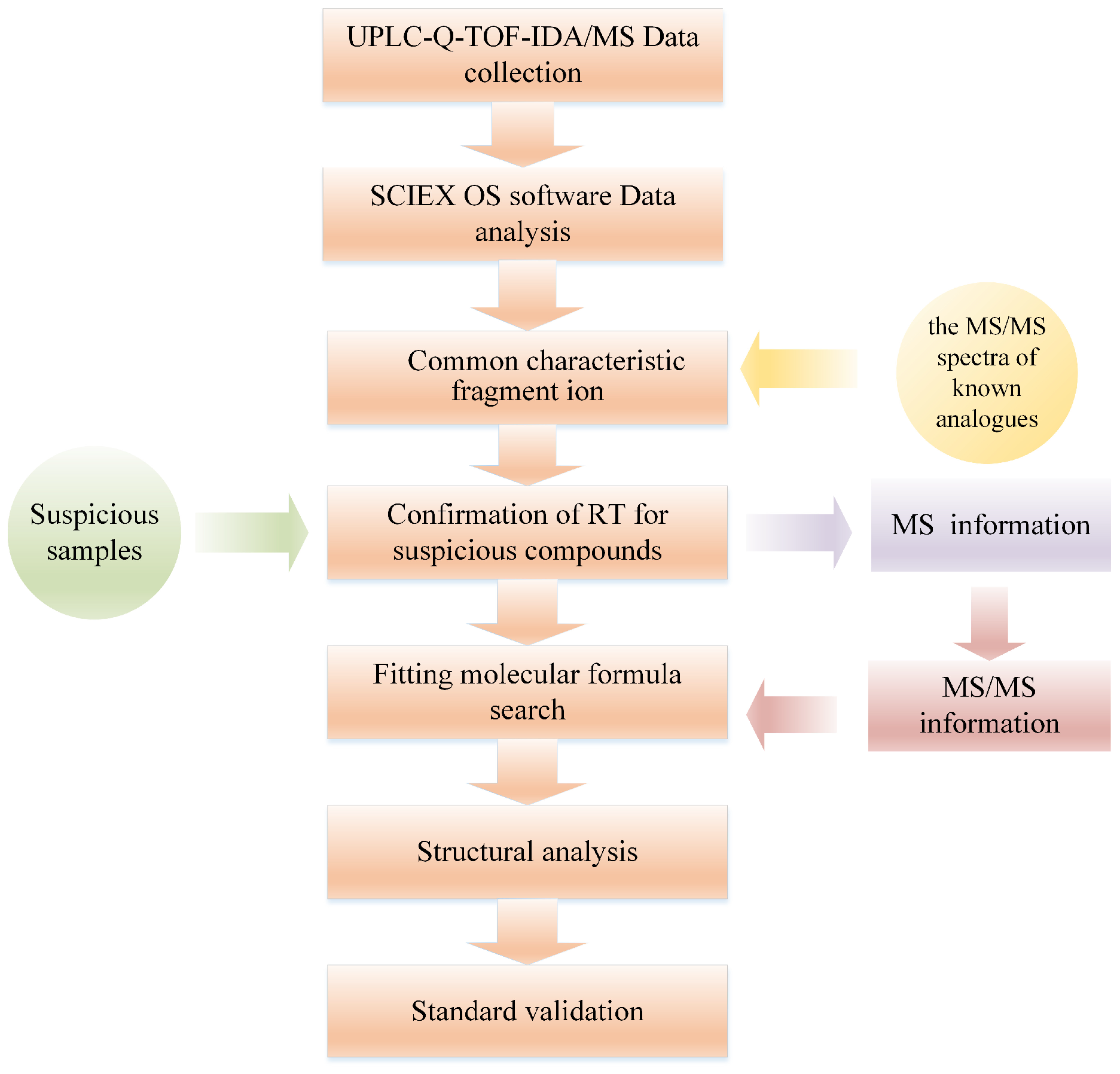
Samples were prepared according to the procedure described in Section 2.5 and analyzed using IDA. Analyze the MS/MS spectra of known analogues, extract characteristic fragment ions of known scaffold structures to generate extraction ion chromatograms (XICs) to determine the retention time of unknown substances and use quasi-molecular ions to determine the molecular formula. Obtain MS/MS spectra of precursor ions to elucidate characteristic neutral losses and fragment ions, in order to infer the core scaffold structure and substituents. Characteristic fragment ions of PDE-5 inhibitor analogues are summarized in Table 2.

2.8. Data Processing

All data acquisition and processing were performed using SCIEX OS Software (Version 1.7.0.36606). Data visualization and plotting were carried out using Origin 2024 and ChemDraw 2.1.1.

3. Results

3.1. Database Establishment and Basis for the Selection of Representative Quality Control Compounds

A comprehensive in-house screening database comprising 390 non-edible substances was constructed to support both suspected and non-targeted screening workflows. The compounds were selected from multiple sources to ensure broad applicability and regulatory relevance. The compounds were primarily derived from official regulatory lists issued by the State Administration for Market Regulation of China, specifically the supplementary testing methods (BJS series) and the national food safety standards for the determination of non-edible substances in food, as well as from the peer-reviewed literature reporting cases of food adulteration and emerging non-edible substances in functional foods, with an emphasis on compounds frequently detected in solid beverages, tablets, and other high-risk product categories. The database encompasses both internationally reported non-edible substances (e.g., sildenafil, tadalafil, phenolphthalein) and compounds specifically relevant to the Chinese regulatory context, thereby aligning with domestic surveillance priorities and global food safety concerns.
To comprehensively validate the analytical method, 38 quality control compounds were strategically selected from the 390-compound database to represent the full range of physicochemical properties encountered in the broader compound list. On the one hand, as representatives of the major pharmacological categories present in the database, the selected compounds encompass antihypertensives, hypoglycemics, weight-loss agents, sedatives–hypnotics, and antifatigue compounds, ensuring coverage of the primary regulatory concerns. On the other hand, to ensure the method is applicable across a wide range of chemical structures, chemical diversity was taken into consideration, ensuring coverage of m/z from 206 to 609, a logP range from –0.16 to 7.12, and retention times uniformly distributed from 3.80 min to 20.86 min, with the inclusion of two pairs of isomers (pseudovardenafil and norneosildenafil; acetildenafil, dimethylacetildenafil, and acetylvardenafil) to assess chromatographic resolution. Additionally, the ionization mode distribution (32 ESI+ and 6 ESI−) was selected to mirror that of the full database (Table S1 and Table 3). Through this systematic selection, the 38 quality control compounds comprehensively represent the physicochemical diversity of the full 390-compound database. The successful validation of these representative compounds provides high confidence that the method exhibits comparable analytical performance across the entire database.

3.2. Optimization of Chromatographic Conditions

The chromatographic conditions were systematically optimized using three difficult-to-separate isomeric compounds—acetildenafil, dimethyl acetildenafil, and acetylvardenafil—selected from the quality control set as model analytes. With methanol as the organic phase, the effect of ammonium formate concentration in the aqueous phase was investigated. Varying the concentration from 2.5 to 10 mmol/L markedly influenced chromatographic behavior, among which 5 mmol/L ammonium formate provided the most favorable compromise between retention and separation. Accordingly, 5 mmol/L ammonium formate was selected for subsequent optimization. Methanol and acetonitrile were then evaluated as organic phases. Although acetonitrile afforded improved peak shape and signal response, satisfactory separation of the target isomers was not achieved. To balance peak shape, response, and separation, a methanol–acetonitrile mixture was further assessed. At a 1:1 (v/v) ratio, three chromatographic peaks were clearly detected, although baseline separation was not fully achieved. Given the significant influence of mobile-phase pH on chromatographic separation, formic acid was added to the aqueous phase at concentrations ranging from 0.01% to 0.1%. The addition of 0.1% formic acid resulted in the optimal separation performance. Consequently, the final chromatographic conditions were established as follows: in positive-ion mode, the mobile phase consisted of 5 mmol/L ammonium formate containing 0.1% formic acid in water and methanol: acetonitrile (1:1, v/v); in negative-ion mode, water and methanol: acetonitrile (1:1, v/v) were employed. Representative chromatograms obtained at each optimization stage are shown in Figure S1A–H.

3.3. Optimization of Mass Spectrometry Conditions

Following the established optimal chromatographic parameters, a mixed standard solution was prepared as detailed in Section 2.2 and subsequently analyzed in both ESI+ and ESI− modes. The results showed that thirty-two compounds exhibited predominant signal intensity in ESI+ mode, whereas the remaining six compounds demonstrated superior intensity in ESI− mode. The chromatograms of 38 quality control compounds are shown in Figure S2. High-resolution mass spectrometric data for all 38 quality control compounds are detailed in Table 3, HRMS data information of quality control compounds.

3.4. Pretreatment Optimization Analysis

3.4.1. Optimization of Solvent Extraction

Blank samples were spiked with standard solutions to obtain a final concentration of each target compound of 30 ng/mL. In the analysis of non-edible substances in food matrices, methanol and acetonitrile—used either as pure solvents or in mixtures with water or acid solutions—are commonly employed as extraction solvents [27,28,29]. In this study, methanol and acetonitrile were evaluated as extraction solvents. Using an average recovery range of 60–120% as the acceptability criterion, twelve representative compounds were selected to assess the extraction performance of each solvent (Figure S3). The results demonstrated that methanol consistently provided higher extraction recoveries for the target compounds compared with acetonitrile. This superior performance is likely attributed to the higher polarity of methanol, which facilitates more efficient extraction through mechanisms such as hydrogen bonding and van der Waals interactions [30]. In addition to its superior extraction efficiency, methanol also offers advantages over acetonitrile in terms of safety and cost. Therefore, methanol was selected as the extraction solvent for all subsequent experiments in this study.

3.4.2. Optimization of Extraction Method

Optimization of sample pretreatment is essential to ensure complete dissolution of target compounds and to maximize extraction efficiency for subsequent analysis. In this study, methanol was used as the extraction solvent to systematically evaluate and compare two commonly employed techniques—vortex mixing and ultrasound-assisted extraction—with respect to their extraction efficiency for the target compounds. Using the average recovery rate of 60–120% as the acceptability criterion, twelve representative compounds were selected to assess the performance of each extraction method (Figure S4). Ultrasound-assisted extraction operates via cavitation, where the formation and violent collapse of microscopic bubbles generate localized high pressure and temperature. This process significantly enhances solvent penetration into the sample matrix, improves interfacial mass transfer, and promotes analyte desorption and dissolution [31]. In contrast, vortex mixing primarily relies on mechanical shear and convective forces, which generally provide lower extraction intensity and more limited penetration depth than ultrasonication [32]. The results indicated that although both methods effectively extracted the target compounds, recoveries obtained by vortex mixing were consistently lower than those achieved with ultrasound-assisted extraction. Notably, the ultrasound-assisted method demonstrated superior overall performance, yielding higher average recoveries with improved stability and reproducibility across replicate samples.
Based on these findings, ultrasound-assisted extraction was selected as the standardized pretreatment protocol. This choice enhances overall method sensitivity, reproducibility, and analytical throughput, thereby establishing a robust foundation for the detection of nonfood substances in complex food matrices.

3.4.3. Optimization of Extraction Time

Following the selection of methanol as the extraction solvent and ultrasonication as the extraction mode, the extraction time was systematically optimized as a key parameter influencing the efficiency of target compound recoveries. Insufficient sonication time prevents the extraction system from reaching equilibrium, resulting in incomplete recovery as a portion of the analytes may remain in the pellet after centrifugation. Conversely, excessive sonication unnecessarily prolongs the pretreatment cycle and increases co-extraction of matrix interferents through enhanced solubilization of impurities, thereby elevating matrix effects and complicating subsequent cleanup [33,34]. Therefore, the average recoveries of target compounds were evaluated at sonication durations of 10, 20, 30, 40, and 50 min. Using the average recovery rate of 60–120% (n = 3) as the acceptability criterion, twelve representative compounds were selected to evaluate the performance of each extraction time (Figure S5). The results indicated that satisfactory recoveries for all target compounds were achieved within 10 min of ultrasonication. Further extension of sonication time did not result in a significant overall improvement in average recovery. Balancing analytical efficiency and effectiveness, a sonication time of 10 min was selected as optimal.

3.4.4. Selection of Purification Agent Types

This study evaluated the purification efficacy of seven DSPE adsorbents, namely Al-A, Al-N, Al-B, C18, NH2, GCB, and PSA. Among these, PSA, NH2, Al-A, Al-B, and Al-N possess amino functional groups and are primarily employed to remove polar interferences, including organic acids, sugars, phenols, and certain pigments. C18, a reversed-phase adsorbent, effectively retains nonpolar and moderately polar compounds, such as lipids, sterols, waxes, and nonpolar pigments. GCB exhibits a strong affinity for planar molecules, particularly pigments, due to its highly ordered graphitic surface structure [35,36]. Using an average recovery rate of 60–120% as the acceptability criterion, twelve representative compounds were selected to evaluate the performance of each purification strategy (Figure S6). The results demonstrated that C18 provided the optimal overall recoveries among the seven tested adsorbents, followed by PSA, NH2, Al-A, Al-B, and Al-N. GCB yielded the poorest recoveries, particularly for hypoglycemic agents such as glibenclamide and antifatigue agents such as sildenafil. The strong adsorption of these compounds by GCB is attributed to efficient π–π stacking interactions between their electron-rich planar rings and the graphitic surface of the adsorbent [37]. Although sulfonylurea drugs possess less overall planarity, the presence of aromatic rings in their structures still facilitates detectable, albeit weaker, interactions with GCB. Recoveries exceeding 120% were observed for certain compounds when using the amino-functional groups (NH2, Al-A, Al-B, Al-N), potentially due to their limited capacity to remove lipids and sugars, leading to significant matrix enhancement effects. Conversely, PSA showed pronounced adsorption of some sulfonylurea drugs, resulting in recoveries below 60%. This may be attributed to the use of an excessive PSA amount, where the adsorbent, after removing matrix interferences, retained additional capacity to strongly retain the target analytes, hindering their elution. Given the complexity and variability of food matrices, which contain pigments, fats, and sugars that can interfere with detection, contaminate instrumentation, and reduce column lifetime, effective cleanup is essential. Furthermore, combined adsorbents often provide superior purification compared to single adsorbents. Therefore, based on their complementary purification profiles and favorable recovery performance, C18 and PSA were selected as the optimal combination for further optimization of adsorbent dosage in subsequent experiments. Although the sample extract used for DSPE cleanup was composed entirely of methanol (1.5 mL of extract diluted to 25 mL with methanol), C18 still effectively retained nonpolar interferents such as lipids, sterols, and nonpolar pigments. This is attributed to the limited solubility of these compounds in pure methanol, which drives their partitioning onto the hydrophobic surface of the C18 sorbent. The effectiveness of C18 under these conditions was supported by the visibly cleaner extracts after treatment and by the low matrix effects observed for most target compounds (Table 4). PSA, containing primary and secondary amine groups, acted as a weak anion exchange sorbent. In the pure methanol matrix, the amine groups remained partially protonated and retained acidic interferents (e.g., free fatty acids, organic acids, polyphenols) via hydrogen bonding and dipole–dipole interactions. The complementary roles of C18 and PSA—removing nonpolar and polar interferents, respectively—ensured effective cleanup across the diverse food matrices analyzed in this study.

3.4.5. PSA and C18 Purification Agent Dosage

This study systematically evaluated the effect of varying PSA and C18 sorbent dosages (25, 50, 75, 100, and 125 mg) on the recovery of target compounds. Using an average recovery rate ranging from 60% to 120% as the acceptability criterion, twelve representative compounds were selected to assess the performance of each purification agent dosage (Figures S7 and S8). The findings revealed that at a PSA dosage of 25 mg, recoveries for the majority of target compounds exceeded 70%. However, upon increasing the PSA dosage, compound-dependent trends in recovery were observed. Notably, the recovery rates of sulfonylurea compounds significantly decreased, aligning with prior speculation regarding their low recovery (below 60%) when exposed to higher PSA amounts. Conversely, with increasing C18 dosages, recoveries typically demonstrated an initial enhancement followed by a subsequent reduction. Specifically, a C18 dosage of 50 mg ensured that recoveries for all target compounds met the acceptability criterion, with no significant performance improvement observed at higher sorbent amounts. Following the principles of green economy, which favor minimal sorbent usage without compromising cleanup efficacy, the optimal combination of purification agents was determined to be 25 mg of PSA and 50 mg of C18.

3.4.6. Matrix Effect Evaluation

The matrix effect (ME) is a prevalent interference phenomenon encountered in the detection of trace substances during mass spectrometry analysis. The intensity of matrix effects can be systematically classified according to the absolute value of |ME|: |ME| ≤ 20% represents a weak matrix effect, 20% < |ME| ≤ 50% indicates a moderate matrix effect, and |ME| > 50% is classified as a strong matrix effect [37]. This study examined four distinct food matrices—tablet, liquid beverage, solid powder, and oral liquid—for injection analysis. The matrix effect was quantitatively assessed using the formula: matrix effect (ME%) = [((slope of matrix-matching standard curve)/(slope of pure solvent standard curve)) − 1] × 100%. The specific results are presented in Table 4. In mass spectrometry analysis, commonly employed methods for compensating for matrix effects include the isotope internal standard method and the matrix-matching standard solution method. Given the current challenges in obtaining commercial isotope internal standard solutions that encompass all target substances, this study utilized matrix matching.

3.5. Methodological Evaluation

3.5.1. Linear Range, Standard Curve, R2, SDLs and LOQs

Under the optimal instrument analysis conditions, a series of standard working solutions spanning concentrations from 0.005 to 5.0 mg/kg (0.005, 0.05, 0.125, 0.25, 0.5, 1.25, 2.5, 5.0 mg/kg) were prepared to assess the linearity of the method. Matrix-matched calibration standards were prepared by spiking appropriate volumes of the mixed standard solution into a blank matrix, followed by stepwise dilution. Calibration curves were then constructed by plotting analyte concentration (x-axis) against the corresponding peak area (y-axis). The results demonstrated exceptional linearity for all target compounds within the specified range, with R2 > 0.99. The SDLs and LOQs of the method were determined by incorporating mixed standard solutions with varying concentrations into matrix samples. Detailed results are summarized in Table 5. In accordance with SANTE/11312/2021 guidelines, the SDL is defined as the lowest mass concentration detectable at various spiking levels. Conversely, the lowest spiked level with S/N ≥ 10 is considered the LOQ of the compound [38]. Results indicate that 92.1% of the quality control compounds exhibited SDLs within the range of 0.003–0.1 mg/kg, whereas 7.9% were between 0.1 and 0.5 mg/kg, demonstrating the method’s high sensitivity. Considering that the concentration of illegal additives in actual samples is typically elevated, this method is particularly well-suited for the non-targeted screening of non-edible substances in food. It is important to note that the method for determining the screening limit in this study diverges from the traditional approach based on S/N ≥ 3. Although a direct mathematical correlation between SDLs and LOQs is not explicitly established by this method, all determined SDLs consistently remain below the corresponding matrix-matched LOQs [39].

3.5.2. Method Precision and Spiked Recovery Rates

This study examined the recovery rates of the target substance across diverse sample matrices at spiked concentrations of 0.1, 0.2, and 1.0 mg/kg. The external standard method was employed to quantitatively assess each concentration, facilitating the calculation of the average recovery rates (n = 6) and RSD to evaluate the method’s accuracy and precision. As presented in Table 6, the average recovery rates for tablets ranged from 70.09% to 110.93%, accompanied by RSD values spanning 0.71% to 7.66%. For liquid beverages, the average recovery rates were observed between 69.76% and 102.5%, with corresponding RSD values from 0.67% to 6.30%. Solid beverages exhibited average recovery rates ranging from 77.58% to 103.67%, with RSD values from 0.23% to 8.20%. Oral liquids yielded average recovery rates ranging from 67.79% to 113.59%, with RSD values between 0.74% and 9.37%. Overall, the average recovery rates for spiked samples across different matrices fell within the acceptable range of 60% to 120%, with RSD values ≤ 20%. Consequently, this method exhibits satisfactory precision and is well-suited for the rapid screening of non-edible substances in food matrices.

4. Development of a Screening and Identification Workflow

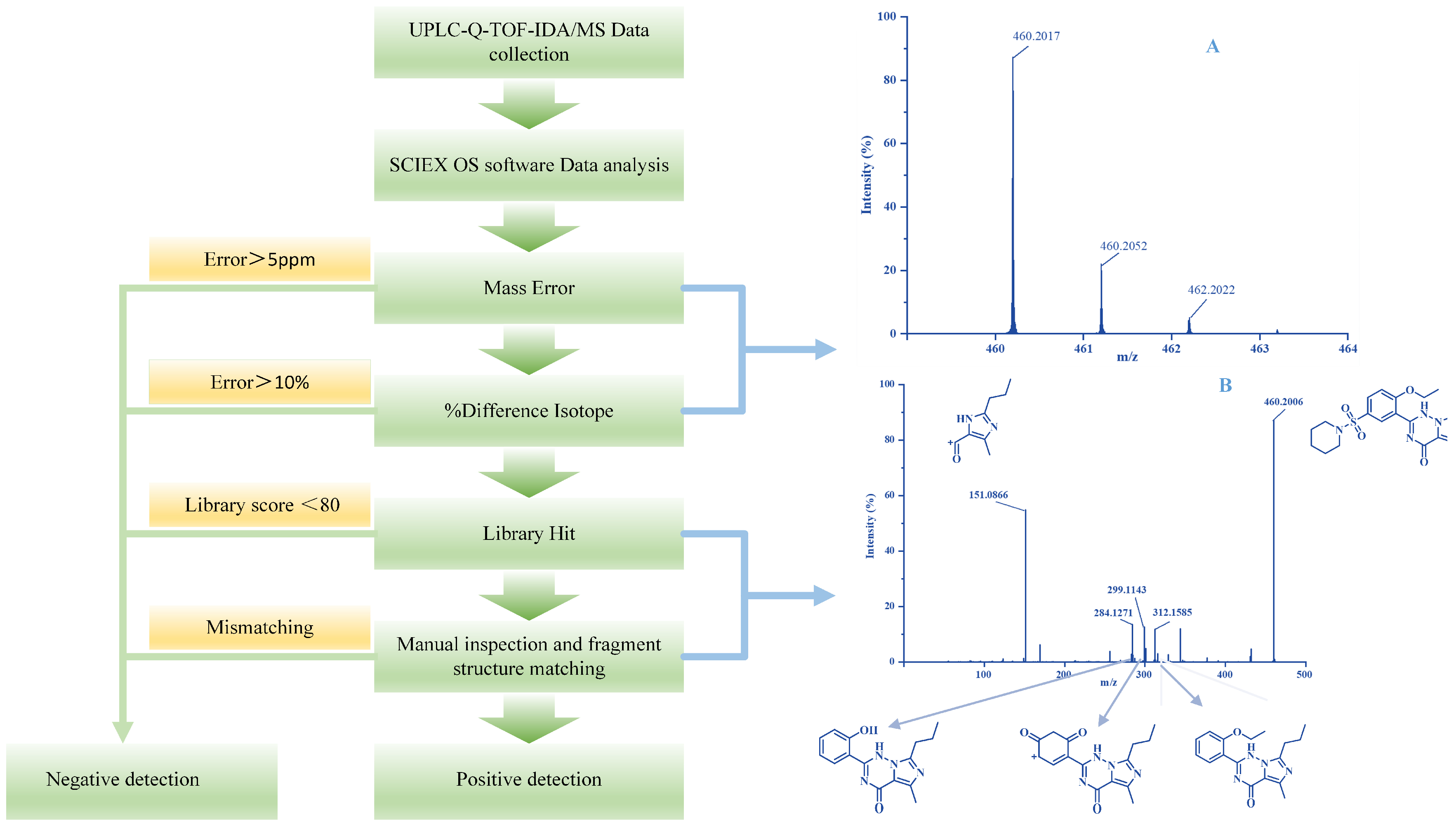
The research findings consistently demonstrate that this screening method possesses both stability and high sensitivity, making it suitable for the non-targeted screening of non-edible substances in food matrices. Subsequent to sample pretreatment, the method is applicable for UPLC-Q-TOF-MS analysis. As an illustrative example, the screening of pseudovardenafil was utilized to demonstrate the non-targeted screening workflow for the analysis of non-edible substances. The data was imported into SCIEX OS software for analysis, the molecular formula was input into the screening list, and the ionization mode was defined as [M+H]+ to obtain the XIC, MS, and MS/MS spectrum of the suspicious substance. Firstly, the information was matched in the MS spectrum, with a precursor exact-mass error of less than 5 ppm and an isotope distribution deviation of less than 10%, as shown in Figure 1A. Due to the successful matching of the first-level precise-mass number and isotope distribution of the suspicious target peak with the pseudo vardenafil, further matching the MS/MS spectra of pseudo vardenafil in the database resulted in a matching score of 92.2 points. Finally, based on the structural formula of pseudo vardenafil, the five main fragment structures were completely matched, as shown in Figure 1B. It was determined to be a positive detection. The comprehensive screening workflow, applied to the actual sample database within this study, is delineated in Figure 1, while the strategy for unknown analyte identification is presented in Figure 2.

Sample Screening

This study involved the selection of 110 batches of commercially available samples collected from the Xiamen Customs Technical Center. The samples were analyzed using the method established by our research institute. Positive samples were screened and quantitatively assessed through the external standard method.
Phenolphthalein (7.82 mg/g) was identified in a solid beverage. Lacidipine (68.15 mg/g) was identified in a solid beverage. Sennoside A (143.08 mg/g) and sennoside B (69.39 mg/g) were detected in an enzyme beverage. A sample of enzyme jelly was found to contain deacetylbisacodyl (8.54 mg/g). Theophylline (14.51 mg/g) was detected in a protein nutrient solid beverage devoid of tea ingredients. Atropine (0.16 mg/g) and scopolamine (0.09 mg/g), both tropane alkaloids, were concurrently identified in an alcoholic beverage. A tablet was found to contain higenamine (63.65 mg/g), a member of the benzylisoquinoline alkaloid class. Acetaminophen (204.54 mg/g) was identified in a tablet sample. Currently, research has shown that it is often illegally added to plant-based beverages claiming to have anti-inflammatory and pain-relieving properties [40]. Aurantio-obtusin (18.15 mg/g), a lipophilic anthraquinone compound extracted from Semen Cassiae, was detected in solid drinks. Research has demonstrated that it can induce diarrhea, lower blood pressure, and reduce blood lipids. It is commonly employed in the treatment of obesity, diabetes, and related complications [41]. Tadalafil (227.12 mg/g) was identified in a tablet sample. The unauthorized inclusion of these substances in functional foods purporting to offer benefits like “antifatigue” and “enhancing sexual function” remains prevalent. Prolonged consumption could significantly jeopardize consumer health, making it a primary focus for regulatory efforts in food safety oversight [42].
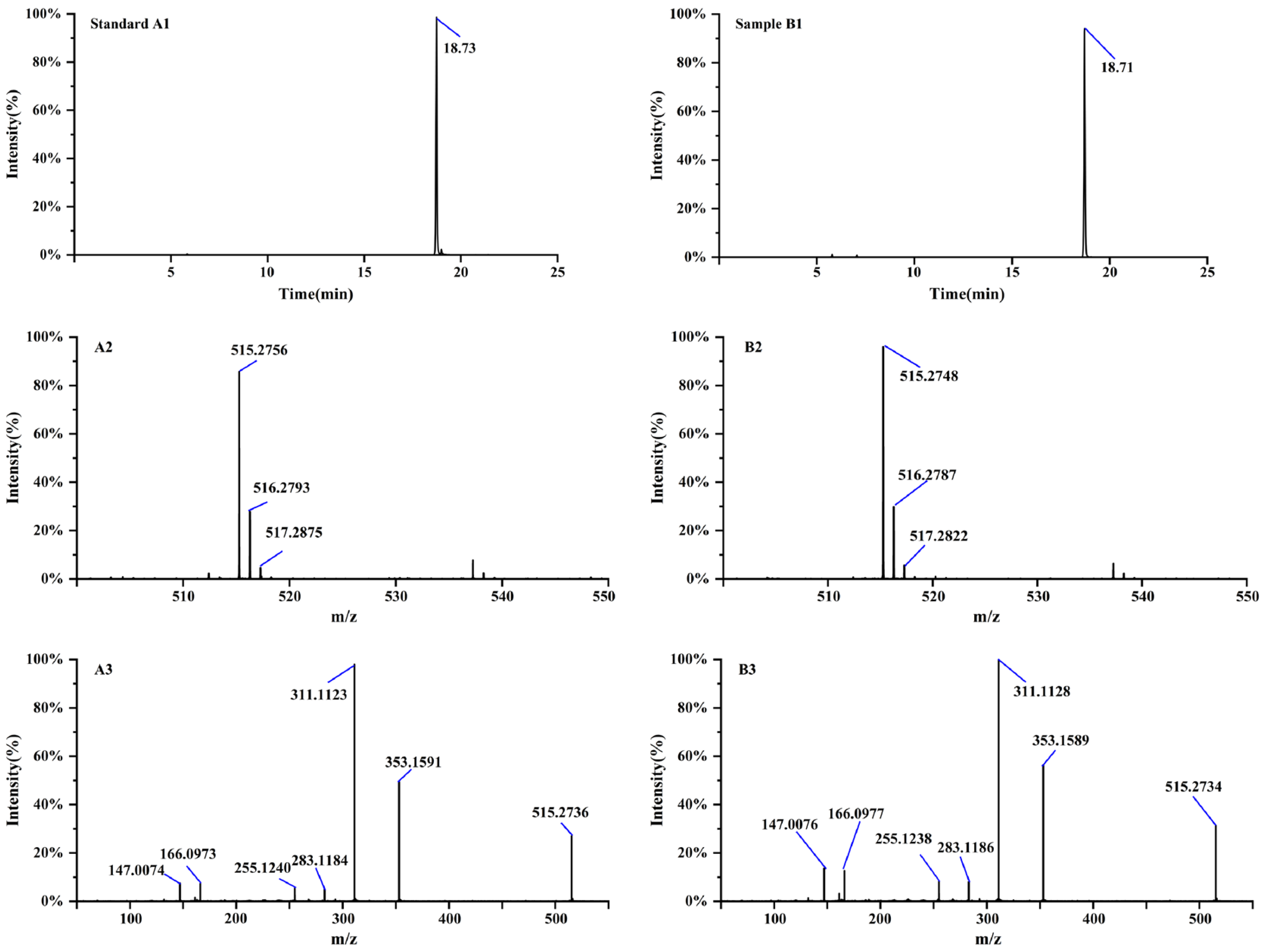
In addition, the unknown identification strategy developed in this study was applied to real-sample analysis, successfully identifying a structural analogue of carbodenafil in a tablet sample. The suspect compound was detected at a retention time of 18.71 min, as shown in Figure 3(B1). Primary full-scan MS data at this retention time revealed a quasi-molecular ion [M+H]+ at m/z 515.2748, as shown in Figure 3(B2). Molecular-formula fitting of this ion using MS analysis software (SCIEX OS Software (Version 1.7.0.36606)) suggested a composition of C29H34N6O3. Subsequent acquisition of its MS/MS spectrum information showed common fragment ions with carbodenafil analogues, including m/z 147.0076, 166.0977, 255.1238, 283.1186, and 311.1128, indicating that it shares the core structure with carbodenafil analogues, as shown in Figure 3(B3).
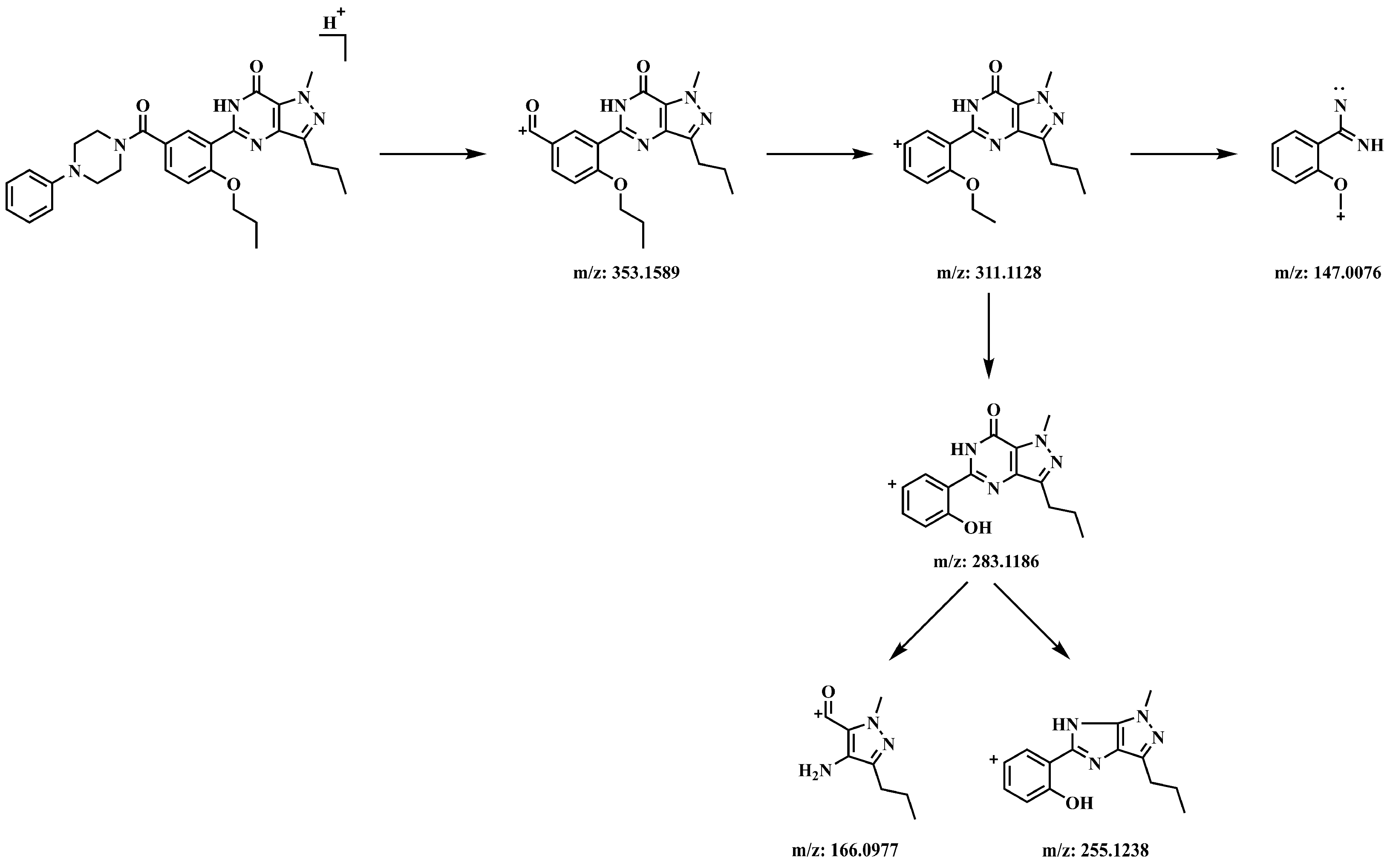
A ChemSpider search using the proposed molecular formula (C29H34N6O3) indicated that the suspect compound was likely phenyl 3-desethyl 3-propyl carbodenafil. This preliminary assignment was further supported by structural elucidation of its MS/MS spectrum. A key characteristic fragment ion was observed at m/z 353.1589, which is 14 Da higher than a common fragment ion (m/z 339) found in typical carbodenafil analogues. The mass difference corresponds precisely to an additional methylene (-CH2-) unit, consistent with the proposed phenylpropyl substitution on the core scaffold. The identity of the compound was conclusively confirmed by comparison with an authentic phenylpropyl carbodenafil standard, which showed identical chromatographic retention time and matching multi-level MS/MS fragmentation patterns. The comparison information between suspicious substances in the sample and standard samples XIC, MS, and MS/MS is shown in Figure 3. The fragmentation pattern of suspicious substances in the sample by mass spectrometry is shown in Figure 4.
In summary, among the 110 actual samples analyzed, a total of 13 non-edible substances were detected, corresponding to a detection rate of 11.81%. The positive samples involved multiple product categories, including solid beverages (four samples), jellies (one sample), liquid beverages (three samples), and tablets (four samples).
For most non-edible substances, a clear association was observed between the detected compounds and the claimed product functions. Compounds associated with weight-loss effects—such as phenolphthalein, sennoside A, sennoside B, and deacetylbisacodyl—were predominantly detected in solid beverages and enzyme jellies marketed with weight-loss claims. Similarly, tadalafil was identified in tablets labeled with antifatigue and sexual-enhancement functions. These findings suggest that the illegal addition of most non-edible substances aligns with the purported functional benefits of the products in which they were found. However, the study also identified notable exceptions that underscore the limitations of function-oriented targeted screening. Atropine and scopolamine—tropane alkaloids with potent sedative, hypnotic, and amnesic effects—were detected in an alcoholic beverage marketed with claims of “immunity enhancement” and “fatigue relief.” The pharmacological effects of these compounds are unrelated to the claimed functions of the product. Instead, unscrupulous manufacturers may exploit the initial excitement, disorientation, and subsequent sedation and amnesia induced by these substances to mimic the effects of ordinary alcohol intoxication, thereby concealing the illicit addition and their underlying intent. This case exemplifies how non-edible substances may be added for ulterior motives unrelated to product efficacy, further demonstrating that targeted screening methods relying solely on product label claims carry a substantial risk of omission.
The detection of both function-aligned and function-unrelated non-edible substances across multiple product categories highlights the critical need for broad-spectrum, non-targeted screening methodologies in routine food safety surveillance.

5. Conclusions

This study successfully developed a UPLC-Q-TOF-MS method, integrating DSPE pretreatment and an IDA mode, for the comprehensive high-throughput screening of 390 non-edible substances in food. Under the systematically optimized conditions, the DSPE pretreatment efficiently cleans up complex food matrices while simultaneously extracting multi-category non-edible substances with diverse physicochemical properties. Rigorous validation across four representative food matrices confirmed the method’s reliability and applicability, with all key analytical parameters—including ME, linearity, recoveries, precisions, SDLs and LOQs—fully complying with established criteria. Furthermore, by systematically elucidating the mass spectrometric fragmentation pathways of PDE-5 inhibitor analogues, a novel non-targeted identification strategy for unknown structural analogues was developed, substantially enhancing the method’s capability for detecting emerging non-edible substances. The developed method was subsequently applied to 110 commercially sourced food samples obtained from diverse regions. This application led to the identification of 12 known non-edible substances via database matching. Moreover, by employing the aforementioned unknown-compound identification strategy, a novel carbodenafil analogue—phenyl 3-desethyl 3-propyl carbodenafil—was successfully identified. These findings reveal a potential risk of illegal addition in some commercially available conventional foods marketed with specific functional claims (often described as containing only natural ingredients), suggesting that regulatory authorities should strengthen monitoring and control of such products. The detection of atropine and scopolamine in an alcoholic beverage marketed with unrelated functional claims highlights the limitations of function-oriented targeted screening and underscores the necessity of broad-spectrum, non-targeted approaches. By integrating database-driven suspected screening with fragmentation pattern-based non-targeted identification, this work provides a practical analytical platform that effectively bridges the regulatory gap posed by emerging structural analogues, offering an efficient solution for high-throughput screening of non-edible substances and serving as a robust tool for advancing food safety monitoring and risk assessment.

Supplementary Materials

The following supporting information can be downloaded at https://www.mdpi.com/article/10.3390/foods15112001/s1: Figure S1: Separation chromatogram of isomers under different mobile phase conditions. Figure S2: Chromatograms of the 38 quality control compounds acquired in ESI+ and ESI− modes. Figure S3: Comparison of solvent extraction effects for representative compounds. Figure S4: Comparison of extraction methods and effects for representative compounds. Figure S5: Comparison of extraction time effects for representative compounds. Figure S6: Comparison of purification effects of representative compounds. Figure S7: Comparison of PSA dosage effects for representative compounds. Figure S8: Comparison of C18 dosage effects for representative compounds. Table S1: logP, pKa, and category information of the 38 quality control compounds.

Author Contributions

Conceptualization, T.W.; methodology, T.W.; validation, F.C., L.P. and W.Y.; formal analysis, T.W.; investigation, T.W.; resources, J.P., X.L. and C.X.; data curation, T.W.; writing—original draft preparation, T.W.; writing—review and editing, D.X.; supervision, D.X.; funding acquisition, D.X. All authors have read and agreed to the published version of the manuscript.

Funding

This research was funded by the National Key Research and Development Program of China, grant number 2023YFF1104900, the Fujian Provincial Science & Technology Foundation, grant number 2025Y0051, the Chongqing Technology Key Foundation, grant number CSTB2025TIAD-KPX0080, and the Xiamen Customs Research Project, grant number 2024XK12.

Institutional Review Board Statement

Not applicable.

Informed Consent Statement

Not applicable.

Data Availability Statement

The original contributions presented in the study are included in the article/Supplementary Materials. Further inquiries can be directed to the corresponding author.

Conflicts of Interest

The authors declare no conflicts of interest.

Abbreviations

The following abbreviations are used in this manuscript:
DSPEdispersive solid-phase extraction
UPLC-Q-TOF-MSultra-performance liquid chromatography–quadrupole-time-of-flight mass spectrometry
RSDsrelative standard deviations
SDLsscreening detection limits
LOQslimits of quantifications
LC-MS/MSliquid chromatography–triple-quadrupole mass spectrometry
MRMmultiple-reaction monitoring
HRMShigh-resolution mass spectrometry
IDAinformation-dependent acquisition
S/Nsignal-to-noise ratio
XICextract ion chromatogram
MEmatrix Effect
R2linear correlation coefficient
DBSdynamic background subtraction
MSprecursor exact mass
MS/MSfragment ion mass

References

  1. Tian, J. Necessary to define “non edible substances”. China Food Safety News, 25 July 2013; p. A02. Available online: http://paper.cfsn.cn (accessed on 1 April 2026).
  2. He, G.; Han, M.; Qiu, S.; Wu, Y.; Li, Y.; Qin, S.; Xia, S.; Chen, S.; Hou, X.; Fu, C. Rapid determination of twenty synthetic dyes in chilli powders by a dilute-and-shoot approach coupled with UPLC-QTOF-MS. China Meas. Test 2023, 49, 110–118. [Google Scholar] [CrossRef]
  3. Mohamed, M.E.B.; Mohamed, A.S.; Shaker, S.F.; Matrawy, M.E.; Sayed, M.M.; Elrabeiy, N.B. A Comprehensive Review of the Developments in the Electroanalytical Methods for the Detection of Illegal Food Colorants in Food and Spices. Food Chem. 2026, 498, 147219. [Google Scholar] [CrossRef]
  4. Wang, T.; Chen, F.; Luo, Y.; Zhao, Z.; Pang, J.; Xu, D. Research Progress on Detection Technology for Non Edible Substances in Food. J. Food Saf. Qual. 2025, 16, 189–198. [Google Scholar] [CrossRef]
  5. Wu, W.; Xia, B.; Liu, S.; Huang, X.; Guo, T.; Shi, P.; Chen, X.; Xiao, Q.; Zhang, M.; Wan, Y.; et al. High-Throughput Screening of New Psychoactive Substances and Related Compounds in Food by UHPLC-Q/Orbitrap. Food Chem. 2025, 476, 143278. [Google Scholar] [CrossRef] [PubMed]
  6. BJS 201901; Determination of Metformin and Other Non-Food Chemical Substances in Foods. State Administration for Market Regulation: Beijing, China, 2019.
  7. BJS 201805; Determination of Nafil Compounds in Food. State Administration for Market Regulation: Beijing, China, 2018.
  8. The State Administration for Market Regulation. Announcement of the State Administration for Market Regulation on the Release of Food Supplementary Inspection Methods for the Determination of Non Class Substances in Food [2018 No. 14]. Chin. J. Food Hyg. 2018, 30, 424. [Google Scholar]
  9. The State Administration for Market Regulation. Announcement by the State Administration for Market Regulation on the Release of Four Food Supplementary Inspection Methods, Including “Determination of Metformin and Other Non Food Chemical Substances in Food”. Chin. J. Food Hyg. 2019, 31, 145. [Google Scholar]
  10. Kondrat, R.W.; McClusky, G.A.; Cooks, R.G. Multiple Reaction Monitoring in Mass Spectrometry/Mass Spectrometry for Direct Analysis of Complex Mixtures. Anal. Chem. 1978, 50, 2017–2021. [Google Scholar] [CrossRef]
  11. Nimer, R.M.; Sumaily, K.M.; Almuslat, A.; Jabar, M.A.; Sabi, E.M.; Al-Muhaizea, M.A.; Rahman, A.M.A. Dystrophin Protein Quantification as a Duchenne Muscular Dystrophy Diagnostic Biomarker in Dried Blood Spots Using Multiple Reaction Monitoring Tandem Mass Spectrometry: A Preliminary Study. Molecules 2022, 27, 3662. [Google Scholar] [CrossRef]
  12. Huang, H.; Li, Z.; He, Y.; Huang, L.; Xu, X.; Pan, C.; Guo, F.; Yang, H.; Tang, S. Nontarget and High-Throughput Screening of Pesticides and Metabolites Residues in Tea Using Ultra-High-Performance Liquid Chromatography and Quadrupole-Orbitrap High-Resolution Mass Spectrometry. J. Chromatogr. B 2021, 1179, 122847. [Google Scholar] [CrossRef]
  13. Yang, Y.; Chen, J.; Li, G.; Koidis, A.; Yao, Z.; Lei, H.; Wei, X. Recent Developments and Workflows of Non-Targeted LC-HRMS Screening in the Detection of Veterinary Drug Residues in Foods. TrAC Trends Anal. Chem. 2025, 191, 118314. [Google Scholar] [CrossRef]
  14. Rab, E.; Martin, S.; Freemont, A.; Maslin, S.; Marr, R.; Kanu, M.-S. Simultaneous Screening and Quantitation of Drugs and Their Metabolites in Post-Mortem Samples by Liquid Chromatography-High-Resolution Mass Spectrometry: Does It Provide Any Benefits? J. Anal. Toxicol. 2023, 47, 317–323. [Google Scholar] [CrossRef]
  15. Turnipseed, S.B.; Casey, C.R.; Rafson, J.P. Investigation of Nanoflow Liquid Chromatography High-Resolution MS (nanoLC-HRMS) for the Analysis of Veterinary Drug Residues in Fish and Shrimp. J. AOAC Int. 2025, qsaf018. [Google Scholar] [CrossRef] [PubMed]
  16. Kapsi, M.; Stergiou, E.; Drakonaki, C.; Marmatakis, K.; Panagou, G.; Kalantzi, I.; Tsapakis, M.; Pergantis, S.A. Targeted and Nontargeted Detection and Quantitation of Arsenolipids in a Tuna Fish Reference Material (BCR-627) Using Reversed-Phase HPLC with High-Resolution Electrospray Mass Spectrometry and Inductively Coupled Plasma Mass Spectrometry. Anal. Chem. 2026. ahead of print. [Google Scholar] [CrossRef] [PubMed]
  17. Huang, Y.; Du, Y.; Hua, Z.; Liu, C.; Jia, W.; Di, B.; Su, M. A Novel Nontargeted Screening Strategy for New Psychoactive Substances: A Case Study of Synthetic Cannabinoids Based on Electron-Activated Dissociation High-Resolution Mass Spectrometry and Intelligent Elucidation. Anal. Chem. 2025, 97, 16841–16850. [Google Scholar] [CrossRef]
  18. Gao, Y.; Feng, M.; Li, X.; Zhang, Y.; Hu, J.; Li, K.; Duan, J.; Zhang, Q. Strategy to Improve the Confidence Level of Qualitative Screening by High Resolution Mass Spectrometry: A Case Study of Mycotoxins in Maize. Food Chem. X 2025, 27, 102467. [Google Scholar] [CrossRef]
  19. Khan, H.; Ali, J. UHPLC/Q-TOF-MS Technique: Introduction and Applications. Lett. Org. Chem. 2015, 12, 371–378. [Google Scholar] [CrossRef]
  20. Guan, J.; Yang, Y.; Zhou, D.; Long, X.; Zhou, C.; Zhang, G.; Zhang, R.; Hu, J.; Li, S. Rapid Screening of 302 Kinds of Illegal Additives in Traditional Chinese Veterinary Medicine by Ultra Performance Liquid Chromatography-Quadrupole Time of Flight High Resolution-Mass Spectrometry. J. Food Saf. Qual. 2025, 16, 107–114. [Google Scholar] [CrossRef]
  21. Tamama, K. Dilute and Shoot Approach for Toxicology Testing. Front. Chem. 2023, 11, 1278313. [Google Scholar] [CrossRef]
  22. Li, T.; Yang, Q.; Wang, L.; Zhou, Y.; Li, Z. Determination of Six Diuretics in Health Teas by DSPE-UPLC-MS/MS. China Food Addit. 2025, 36, 108–113. [Google Scholar] [CrossRef]
  23. Niu, C.; Ye, S.; Hu, Y.; Lou, J.; Zhu, Q.; Lv, Z. Determination of Fluoroquinolone Residues in Aquatic Products by Dispersive Solid Phase Extraction with Metal-Organic Framework-Based Molecularly Imprinted Polymer and Liquid Chromatography-Tandem Mass Spectrometry. Food Sci. 2025, 46, 353–361. [Google Scholar] [CrossRef]
  24. Tang, X.; Fan, G.; Li, P.; Wang, W.; Song, S. Research Progress of Dispersive Solid Phase Extraction in the Detection of Quinolone Residues in Animal-Derived Foods. Food Sci. Technol. 2021, 46, 296–302. [Google Scholar] [CrossRef]
  25. Wang, L.; Lin, X.; Wei, M.; Chen, X.; Lin, T.; Liu, H. Determination of Pesticides and Metabolites Residues in Panax Notoginseng by Dispersive Solid Phase Extraction Purification–Ultra High Performance Liquid Chromatography–Tandem Mass Spectrometry. Chem. Anal. Meterage 2022, 31, 43–47. [Google Scholar] [CrossRef]
  26. Gao, M.G.; Yao, Y.; Lu, Y.; Pan, C.; Xie, J. Simultaneous Determination of Canthaxanthin and Sudan Dyes in Poultry Eggs by HPLC Coupled with Cold-Induced Liquid-Liquid Extraction and Dispersive Solid Phase Extraction Purification. Chin. Food Addit. 2022, 33, 241–248. [Google Scholar] [CrossRef]
  27. Lebel, P.; Gagnon, J.; Furtos, A.; Waldron, K.C. A Rapid, Quantitative Liquid Chromatography-Mass Spectrometry Screening Method for 71 Active and 11 Natural Erectile Dysfunction Ingredients Present in Potentially Adulterated or Counterfeit Products. J. Chromatogr. A 2014, 1343, 143–151. [Google Scholar] [CrossRef]
  28. Yang, Y.; Li, X.; Lin, J.; Bao, R. A Modified QuEChERS-Based UPLC-MS/MS Method for Rapid Determination of Multiple Antibiotics and Sedative Residues in Freshwater Fish. Food Chem. X 2024, 22, 101268. [Google Scholar] [CrossRef]
  29. Zhang, J.; Li, J.; Zhang, P.; Yang, M.; Zhou, D. Accurate Determination of Three New Antihypertensive Drugs Illegally Added to Food Using Ultra⁃high Performance Liquid Chromatography-tandem Mass Spectrometry. Chin. J. Chromatogr. 2024, 42, 954–962. [Google Scholar] [CrossRef] [PubMed]
  30. Wu, Z.; Huang, J.; Huang, J. Determination of Seven Nicotinamide Compounds Inhealth Products. Food Mach. 2024, 40, 67–72. [Google Scholar] [CrossRef]
  31. Acquavia, M.; Pascale, R.; Foti, L.; Carlucci, G.; Scrano, L.; Martelli, G.; Brienza, M.; Coviello, D.; Bianco, G.; Lelario, F. Analytical Methods for Extraction and Identification of Primary and Secondary Metabolites of Apple (Malus domestica) Fruits: A Review. Separations 2021, 8, 91. [Google Scholar] [CrossRef]
  32. Zhang, R.; Tan, Z.-C.; Huang, K.-C.; Wen, Y.; Li, X.-Y.; Zhao, J.-L.; Liu, C.-L. A Vortex-Assisted Dispersive Liquid-Liquid Microextraction Followed by UPLC-MS/MS for Simultaneous Determination of Pesticides and Aflatoxins in Herbal Tea. Molecules 2019, 24, 1029. [Google Scholar] [CrossRef]
  33. Berton, P.; Mammana, S.B.; Locatelli, D.A.; Lana, N.B.; Hapon, M.B.; Camargo, A.B.; Altamirano, J.C. Determination of Polybrominated Diphenyl Ethers in Milk Samples. Development of Green Extraction Coupled Techniques for Sample Preparation. Electrophoresis 2017, 38, 460–468. [Google Scholar] [CrossRef]
  34. Chemat, F.; Rombaut, N.; Sicaire, A.-G.; Meullemiestre, A.; Fabiano-Tixier, A.-S.; Abert-Vian, M. Ultrasound Assisted Extraction of Food and Natural Products. Mechanisms, Techniques, Combinations, Protocols and Applications. A Review. Ultrason. Sonochem. 2017, 34, 540–560. [Google Scholar] [CrossRef]
  35. Xing, L.; Liu, Y.; Li, W.; Zou, L.; Wang, Y.; Luo, R. Simultaneous Determination of Triazole Fungicides in Animal-Origin Food by Ultra-High-Performance Liquid Chromatography Coupled with Tandem Mass Spectrometry. Food Chem. X 2023, 20, 100956. [Google Scholar] [CrossRef]
  36. Guo, X.; Tian, H.; Yang, F.; Fan, S.; Zhang, J.; Ma, J.; Ai, L.; Zhang, Y. Rapid determination of 103 common veterinary drug residues in milk and dairy products by ultra performance liquid chromatography tandem mass spectrometry. Front. Nutr. 2022, 9, 879518. [Google Scholar] [CrossRef] [PubMed]
  37. Peter, M.; Müller, C. Systematic Comparison of Extract Clean-up with Currently Used Sorbents for Dispersive Solid-Phase Extraction. Molecules 2024, 29, 4656. [Google Scholar] [CrossRef] [PubMed]
  38. European Commision. Analytical Quality Control and Method ValidationProcedures for Pesticides Residues Analysis in Food and Feed; SANTE 11312/2021; European Commission: Brussels, Belgium, 2022.
  39. Tong, K.; Ge, L.; Huo, S.; Xie, Y.; Wu, X.; Fan, C.; Cheng, H.; Lyu, M. Rapid screening of 173 pesticide residues in onion by liquid chromatographyquadrupole time-of-flight mass spectrometry. Chin. J. Pestic. Sci. 2023, 25, 210–219. [Google Scholar] [CrossRef]
  40. Qi, C.; Zeng, X.; Ye, J.; Lin, J.; Zhang, W.; Zhang, W.; Zhang, J. Rapid Screening of 21 Kinds of Antipyretics and Analgesics Drugs Illegally Added in Herbal Tea by Direct Analysis in Real Time-High Resolution Mass Spectrometry. J. Food Saf. Qual. 2021, 12, 8451–8457. [Google Scholar] [CrossRef]
  41. Liu, Y.; Sun, X.; Hu, X.; Xu, Y.; Li, T.; Wu, Z. Pharmacological Properties and Underlying Mechanisms of Aurantio-obtusin (Review). Exp. Ther. Med. 2023, 26, 380. [Google Scholar] [CrossRef]
  42. Feng, F.; Chang, Q.; Sun, X.; Du, R.; Zhang, F. Rapid Determination of 107 Illegally Added Nafils in Foods by Ultra-High Performance Liquid Chromatography High Resolution Mass Spectrometry. Food Sci. 2025, 46, 290–298. [Google Scholar] [CrossRef]
Figure 1. Suspected screening strategy process.
Foods 15 02001 g001
Figure 2. Non-targeted identification strategy process.
Foods 15 02001 g002
Figure 3. Comparison of suspicious substances in the sample with standard information. (A1) Extracted ion chromatogram of the reference standard; (A2) MS1 spectrum of the reference standard; (A3) MS2 spectrum of the reference standard; (B1) Extracted ion chromatogram of the unknown compound in the sample; (B2) MS1 spectrum of the unknown compound in the sample; (B3) MS2 spectrum of the unknown compound in the sample.
Foods 15 02001 g003
Figure 4. The fragmentation pattern of suspicious substances in the sample by mass spectrometry. Note: the “..” above the nitrogen atom in the figure represents a lone pair of electrons.
Foods 15 02001 g004
Table 1. Gradient elution program.
Time (min)Flow (mL/min)Mobile Phase A (%)Mobile Phase B (%)
0.00.5955
1.00.5955
8.00.55545
17.00.54060
20.00.5595
22.00.5595
22.10.5955
25.00.5955
Table 2. Common characteristic fragment ion.
CategoryCommon Characteristic Fragment Ion
Sildenafil analoguesm/z 377; m/z 311; m/z 283; m/z 255
Vardenafil analoguesm/z 376; m/z 377; m/z 312; m/z 299; m/z 284; m/z 169; m/z 151
Hongdenafil analoguesm/z 353; m/z 341; m/z 325; m/z 311; m/z 297; m/z 166
Carbodenafil analoguesm/z 339; m/z 311; m/z 283; m/z 255; m/z 166; m/z 147
Tadalafil analoguesm/z 302; m/z 274; m/z 262; m/z 250; m/z 204; m/z 197; m/z 169; m/z 135
Table 3. HRMS data information of quality control compounds.
IndexCompoundsFormulaRetention TimeAdduct/ChargePrecursor MassFound at MassMass ErrorFragment Mass
1ClonidineC9H9Cl2N34.45[M+H]+230.025230.0245−0.5212.9986194.0482159.9719132.9609
2TadalafilC22H19N3O410.60[M+H]+390.145390.1447−0.4268.1079262.0861169.0758135.0439
3PhenolphthaleinC20H14O49.77[M+H]+319.096319.0963−0.6225.0544197.0598141.0702105.0333
4GlibenclamideC23H28ClN3O5S16.21[M+H]+494.151494.15110.0395.0474369.0671304.0735169.0051
5NifedipineC17H18N2O611.96[M+H]+347.124347.12380.2254.1042241.0972195.0913168.0804
6PseudovardenafilC22H29N5O4S15.41[M+H]+460.201460.20170.8432.1708344.1483284.1271151.0866
7GliclazideC15H21N3O3S11.86[M+H]+324.138324.1375−0.5168.1131153.1024127.1229110.0961
8NorneosildenafilC22H29N5O4S17.29[M+H]+460.201460.2011−0.5469.2006311.1506283.1191256.0957
9SildenafilC22H30N6O4S9.97[M+H]+475.212475.2119−0.7311.1503299.1141283.119099.0916
10AcetildenafilC25H34N6O38.45[M+H]+467.277467.2762−0.7396.2026353.1608297.1341127.1229
11Dimethyl acetildenafilC25H34N6O39.38[M+H]+467.277467.2762−0.7410.2193353.1612297.1351127.1235
12AcetylvardenafilC25H34N6O39.05[M+H]+467.277467.2762−0.6325.1308341.1619297.1352127.1231
13BupropionC13H18ClNO8.03[M+H]+240.115240.1147−1.2166.0417139.0310130.0649103.0542
14PhenforminC10H15N54.98[M+H]+206.14206.1399−0.6206.1402147.0921130.0653105.0698
15HydroxyhomosildenafilC23H32N6O5S9.86[M+H]+505.223505.2280.1487.2126377.1275311.1514283.1200
16AtenololC14H22N2O33.80[M+H]+267.17267.1701−0.8225.1239190.0866145.0650133.0651
17PrazosinC19H21N5O47.71[M+H]+384.167384.1661−1.4368.1352247.1184231.0873138.0550
18ReserpineC33H40N2O914.39[M+H]+609.281609.2801−1.0448.1976397.2126265.1867195.0655
19RimonabantC22H21Cl3N4O19.29[M+H]+463.085463.085−0.7380.9956362.9841300.0220164.0261
20TolazamideC14H21N3O3S10.69[M+H]+312.138312.1374−0.8172.0421155.0161141.1021115.1227
21GlipizideC21H27N5O4S10.97[M+H]+446.186446.1857−0.6347.0813321.1015286.0644167.0161
22OrlistatC29H53NO520.86[M+H]+496.4496.3986−2.1337.3095319.2991160.0967114.0911
23BenfluorexC19H20F3NO213.3[M+H]+352.152352.1518−0.2230.1152187.0733159.0417149.0599
24DiazepamC16H13ClN2O11.65[M+H]+285.079285.07890.0257.0853222.1155193.0987154.0419
25NoracetildenafilC24H32N6O38.83[M+H]+453.261483.26090.1396.2037297.1349285.1351113.1075
26AlprazolamC17H13ClN410.2[M+H]+309.09309.0901−0.3281.0761274.1216205.0762165.0215
27TriazolamC17H12Cl2N410.21[M+H]+343.051343.0512−0.1315.0327253.0651239.0374165.0215
28NitrazepamC15H11N3O39.72[M+H]+282.087282.0871−0.6268.0848236.0947207.0920180.0811
29LorazepamC15H10Cl2N2O29.58[M+H]+321.019321.01930.2303.0087275.0135229.0526163.0054
30ZolpidemC19H21N3O7.77[M+H]+308.176308.1750−2.3263.1169235.1223221.1069145.0760
31HomosildenafilC23H32N6O4S10.23[M+H]+489.228489.22790.2461.1977283.1196311.150699.0916
32EstazolamC16H11ClN49.57[M+H]+295.075295.0743−0.8267.0554241.0530205.0757165.0218
33SecobarbitalC12H18N2O39.17[M−H]237.124237.1244−0.3194.1177150.1277108.08285.0044
34AmobarbitalC11H18N2O38.68[M−H]225.124225.1243−0.7182.1179138.128096.980985.0047
35CilnidipineC27H28N2O719.28[M−H]491.182491.1813−2.2357.1075237.0659208.0968122.0242
36NaturetinC15H14F3N3O4S210.61[M−H]420.031420.0288−4.2327.9667223.9929196.982160.0373
37AlapuliC20H26N2O5S6.32[M−H]405.149405.1478−3.0363.1379329.1506217.134164.0718
38CandesartanCilexetilC33H34N6O617.87[M−H]567.152567.1500−3.8411.1147383.1136340.1081113.0404
Table 4. ME (%) evaluation of 38 quality control compounds in diverse food matrices.
IndexCompoundsME (%)
TabletsLiquid BeveragesOral LiquidsSolid Beverages
1Clonidine7.174.69−29.13−24.71
2Tadalafil0.390.366.9−0.29
3Phenolphthalein1.138.9411.89−5.96
4Glibenclamide3.2812.793.7−7.50
5Nifedipine2.527.97−2.7−6.21
6Pseudovardenafil1.2914.3716.7−1.27
7Gliclazide1.899.6111.266.17
8Norneosildenafil0.7813.370.43−2.15
9Sildenafil2.7712.113.50−3.59
10Acetildenafil1.498.26−21.388.96
11Dimethyl acetildenafi2.6714.44−12.200.80
12Acetylvardenafil3.0326.47−0.636.45
13Bupropion8.108.86−20.64−20.29
14Phenformin7.606.67−39.07−25.97
15Hydroxyhomosildenafil0.1912.0610.22−0.95
16Atenolol6.275.86−31.76−25.16
17Prazosin1.689.56−17.25−17.22
18Reserpine11.371.8511.570.19
19Rimonabant2.1817.0921.6619.55
20Tolazamide2.0717.2121.6621.34
21Glipizide1.7517.989.91−0.20
22Orlistat28.6310.65−6.36−1.47
23Benfluorex6.0118.9532.624.26
24Diazepam12.461.84−21.23−21.07
25Noracetildenafil1.3213.25−8.19−7.05
26Alprazolam1.835.75−8.49−12.65
27Triazolam5.056.55−5.27−8.87
28Nitrazepam2.466.36−11.84−14.15
29Lorazepam1.5012.2910.38−3.16
30Zolpidem5.2611.03−25.43−18.66
31Homosildenafil0.7515.249.73−5.65
32Estazolam1.736.88−9.71−12.07
33Secobarbital2.376.424.55−13.92
34Amobarbital2.427.045.95−12.17
35Cilnidipine−15.04−18.09−20.50−20.97
36Naturetin37.2525.6947.3130.57
37Alapuli31.1425.87−5.07−42.29
38Candesartan Cilexetil3.869.3613.88−15.36
Table 5. The calibration curve, R2, linear range, SDL, and LOQ of quality control compounds.
IndexCompoundsCalibration CurveR2Linear Range
(mg/kg)
SDLs
(mg/kg)
LOQs
(mg/kg)
1Clonidiney = 1.357 × 10⁴ x + 5.645 × 1030.9970.005–1.250.020.02
2Tadalafily = 1.690 × 10³ x + 2.992 × 1020.9980.05–1.250.060.06
3Phenolphthaleiny = 3.082 × 10³ x + 1.863 × 1030.9990.05–1.250.020.06
4Glibenclamidey = 5.736 × 10³ x + 6.537 × 1020.9970.005–1.250.030.03
5Nifedipiney = 1.148 × 10⁴ x + 5.459 × 1030.9990.050–1.250.020.06
6Pseudovardenafily = 2.097 × 10⁴ x + 3.956 × 1030.9990.005–1.250.010.01
7Gliclazidey = 1.415 × 10⁴ x + 2.926 × 1030.9980.005–1.250.020.02
8Norneosildenafily = 3.757 × 10³ x + 3.676 × 1030.9980.250–5.000.250.25
9Sildenafily = 1.201 × 10⁴ x + 1.425 × 1030.9980.005–1.250.010.01
10Acetildenafily = 1.904 × 10⁴ x + 6.133 × 1030.9990.005–1.250.010.01
11Dimethylacetildenafiy = 2.807 × 10⁴ x + 1.151 × 1040.9980.005–1.250.030.03
12Acetylvardenafily = 3.075 × 10⁴ x + 4.740 × 1030.9990.005–1.250.030.03
13Bupropiony = 9.165 × 10³ x + 5.981 × 1020.9980.050–1.250.060.06
14Phenforminy = 1.563 × 10⁴ x + 7.821 × 1030.9980.005–1.250.020.02
15Hydroxyhomosildenafily = 6.718 × 10³ x + 6.591 × 1020.9970.005–1.250.010.01
16Atenololy = 7.130 × 10³ x + 1.404 × 1030.9980.05–1.2500.060.06
17Prazosiny = 4.231 × 10⁴ x + 1.204 × 1040.9980.005–1.250.020.02
18Reserpiney = 7.438 × 10³ x ± 4.193 × 1030.9970.050–1.250.10.1
19Rimonabanty = 1.167 × 10⁴ x + 2.931 × 1030.9980.005–1.250.030.03
20Tolazamidey = 1.196 × 10⁴ x + 4.262 × 1030.9980.005–1.250.020.02
21Glipizidey = 4.080 × 10³ x + 3.622 × 1020.9980.050–1.250.030.06
22Orlistaty = 5.185 × 10⁴ x + 1.409 × 1050.9990.250–5.000.250.25
23Benfluorexy = 3.164 × 10⁴ x + 6.754 × 1030.9980.005–1.250.010.01
24Diazepamy = 1.555 × 10⁴ x + 1.074 × 1040.9980.005–1.250.010.01
25Noracetildenafily = 1.957 × 10⁴ x + 8.716 × 1040.9990.250–5.000.50.5
26Alprazolamy = 1.984 × 10⁴ x + 8.650 × 1030.9970.005–1.250.010.01
27Triazolamy = 1.544 × 10⁴ x + 6.287 × 1030.9980.005–1.250.010.01
28Nitrazepamy = 2.273 × 10³ x + 1.218 × 1030.9980.050–1.250.060.06
29Lorazepamy = 1.900 × 10³ x ± 9.330 × 1010.9970.050–1.250.060.06
30Zolpidemy = 7.147 × 10⁴ x + 2.057 × 1040.9970.005–1.250.0030.003
31Homosildenafily = 1.028 × 10⁴ x + 3.776 × 1030.9970.005–1.250.020.02
32Estazolamy = 6.358 × 10³ x + 1.294 × 1030.9980.005–1.250.030.03
33Secobarbitaly = 3.220 × 10³ x + 1.158 × 1030.9990.250–5.000.50.5
34Amobarbitaly = 2.826 × 10³ x + 9.493 × 1030.9980.250–5.000.50.5
35Cilnidipiney = 4.089 × 10⁴ x + 3.133 × 1030.9980.005–1.250.030.03
36Naturetiny = 5.955 × 10⁴ x + 2.971 × 1040.9990.050–1.250.10.1
37Alapuliy = 6.232 × 10³ x + 4.108 × 1020.9990.050–1.250.10.1
38Candesartan Cilexetily = 2.044 × 10⁴ x + 2.265 × 1020.9990.050–1.250.10.1
Table 6. The spiked recoveries and relative standard deviations of quality control compounds.
CompoundsSpiked LevelsTabletsLiquid BeveragesSolid BeveragesOral Liquids
Recoveries
(%)
RSD
(%)
Recoveries
(%)
RSD
(%)
Recoveries
(%)
RSD
(%)
Recoveries
(%)
RSD
(%)
Clonidine0.192.112.8991.361.7380.113.2395.36.13
0.2107.192.991.841.391.014.3592.143.24
1.096.213.7487.973.7484.52.2490.75.4
Tadalafil0.190.775.2594.121.783.124.6987.82.58
0.2108.333.4297.912.7489.544.5493.415.67
1.093.432.5698.721.7889.050.6392.964.83
Phenolphthalein0.192.453.4493.214.5788.274.1193.243.69
0.2103.646.1996.85.2297.082.6596.335.91
1.095.314.1192.222.9389.211.5395.924.03
Glibenclamide0.181.55.485.863.7581.734.8482.524.16
0.290.922.5187.081.4289.252.3582.713.99
1.080.962.9484.552.0986.590.3180.10.74
Nifedipine0.186.565.1287.224.0683.283.2991.365.24
0.2100.852.7989.612.3494.455.7598.121.7
1.094.241.6590.163.293.151.0696.952.93
Pseudovardenafil0.193.711.9488.531.7983.055.0792.731.55
0.2106.121.4191.842.9293.785.1697.264.92
1.096.282.8191.943.8391.67186.932.14
Gliclazide0.180.144.7581.22.4580.312.6780.363.51
0.285.811.9584.532.2287.782.5882.353.37
1.080.654.6485.224.2381.171.0580.522.73
Norneosildenafil0.197.463.1892.625.2581.564.1692.842.83
0.2110.211.694.692.498.442.3894.42.71
1.0100.761.5191.232.5296.970.8296.480.98
Sildenafil0.192.142.9390.281.0581.971.9589.931.92
0.2106.312.291.480.6789.752.4992.671.48
1.096.181.9988.943.186.131.8591.173.77
Acetildenafil0.187.52.7192.010.9782.244.1986.452.83
0.2100.573.2396.663.3592.772.6989.311.44
1.092.511.0296.584.3689.921.5285.722.4
Dimethylacetildenafi0.193.872.9191.253.45102.164.44102.43.93
0.295.533.6391.426.0695.565.29113.593.55
1.090.495.5591.432.6297.571.56100.592.7
Acetylvardenafil0.198.142.588.42.6897.644.75101.832.82
0.298.431.287.314.6591.498.3699.663.36
1.093.872.9192.741.9795.883.2491.892.27
Bupropion0.192.553.7495.844.880.895.1394.773.55
0.2104.681.0398.015.0994.844.394.882.45
1.092.356.1995.771.6889.63.5686.763.91
Phenformin0.190.832.6180.44.0480.635.6198.24.2
0.2103.232.6790.23.7292.422.8187.114.73
1.095.931.985.383.5884.170.5480.42.77
Hydroxyhomosildenafil0.194.642.0590.592.1887.694.1998.32.75
0.2103.790.7191.141.7993.154.0992.035.01
1.095.282.3489.573.290.730.6491.541.57
Atenolol0.190.365.195.324.85814.3194.932.64
0.2101.564.4798.183.4893.222.4191.584.82
1.0853.9590.412.6989.041.7286.215.48
Prazosin0.189.651.3292.42.4780.273.1785.612.22
0.2105.811.7594.22.4190.472.2788.412.78
1.092.984.3191.053.2890.095.4287.062.22
Reserpine0.194.095.1186.965.2484.25.1192.153.52
0.2102.364.2885.334.6694.268.286.614.2
1.093.082.0991.582.0891.521.2982.031.9
Rimonabant0.189.223.989.082.7681.934.5790.32.4
0.2104.412.8189.774.0196.55.2394.142.96
1.097.112.0987.262.5896.811.4593.221.42
Tolazamide0.181.851.8686.324.3280.433.6482.012.58
0.285.922.1285.192.1686.973.7381.913.6
1.080.033.5680.923.9784.790.8280.173.42
Glipizide0.180.674.17843.6480.24.6587.753.41
0.288.741.8783.841.8690.525.9584.352.99
1.083.654.7982.662.0887.810.4880.382.38
Orlistat0.191.835.4785.874.2692.574.9789.935.69
0.295.534.0498.244.11101.394.4783.565.78
1.086.513.1190.54.0795.642.9587.322.74
Benfluorex0.190.322.1484.722.5380.151.8388.171.71
0.2102.911.3487.142.190.163.4289.333.31
1.092.262.7587.422.1384.981.8186.933.01
Diazepam0.193.431.5594.162.1780.043.2995.931.39
0.2109.561.498.741.8393.732.5599.252.47
1.098.442.94932.3790.011.5392.641.9
Noracetildenafil0.183.050.8494.853.181.785.7188.152.24
0.296.72.3196.073.0492.473.0392.051.5
1.087.11.990.082.786.222.2184.124.6
Alprazolam0.190.491.4695.132.6786.792.4392.982.67
0.2107.342.2899.32.11100.911.8292.193.48
1.098.932.77973.0798.860.2390.372.44
Triazolam0.191.32.7395.483.2687.173.1493.62.62
0.2107.552.5998.562.2102.081.4893.154.43
1.0101.161.4596.522.5397.591.1791.72.53
Nitrazepam0.188.254.3492.552.1186.137.4987.652.37
0.2105.961.3293.192.1891.523.5293.244.8
1.096.732.6990.662.4189.312.1894.22.22
Lorazepam0.191.643.690.384.2283.995.0785.679.37
0.2107.954.0692.35.3195.124.1688.865.87
1.097.513.4592.033.2296.911.32953.01
Zolpidem0.194.972.3688.732.2181.914.1591.972.51
0.2110.932.8691.264.1497.984.5496.782.91
1.0100.663.5987.443.7590.582.296.924.5
Homosildenafil0.189.222.8190.782.2785.532.4790.491.44
0.2106.661.0791.002.2993.153.7190.823.39
1.099.391.9488.001.889.892.1585.453.19
Estazolam0.187.694.0293.264.3584.094.8594.134.64
0.2107.292.4995.053.3897.072.68100.294.9
1.095.951.4691.613.89103.670.8988.992.62
Secobarbital0.1102.473.4291.622.7682.472.5185.493.44
0.2109.214.2999.462.6295.544.9184.714.71
1.095.72.97101.882.8889.245.6082.073.96
Amobarbital0.198.43.7198.513.4481.644.7792.365.24
0.2108.895.23102.55.83100.483.8687.754.83
1.097.763.47100.210.9593.375.1481.233.62
Cilnidipine0.179.834.4978.103.9382.394.0181.063.73
0.279.387.6686.363.9692.813.3491.453.08
1.075.627.3685.881.7489.435.3993.168.26
Naturetin0.182.916.5281.895.7583.622.2483.952.90
0.290.634.1192.372.3291.914.3089.635.11
1.090.903.2284.615.3184.441.5085.452.51
Alapuli0.170.824.5078.985.0377.582.9774.416.55
0.271.322.9578.456.3079.616.1579.854.32
1.074.301.8379.952.1978.483.8173.793.08
Candesartan Cilexetil0.170.095.8369.764.6082.693.7367.977.48
0.272.956.1078.253.0288.842.3870.185.85
1.080.325.0181.173.2084.442.6171.676.96
Disclaimer/Publisher’s Note: The statements, opinions and data contained in all publications are solely those of the individual author(s) and contributor(s) and not of MDPI and/or the editor(s). MDPI and/or the editor(s) disclaim responsibility for any injury to people or property resulting from any ideas, methods, instructions or products referred to in the content.