Article

Intra-Species Response Variability of Listeria monocytogenes and Salmonella enterica to Lemon Essential Oils in Cheese- and Fish-Based Spreadable Foods


1
Department of Agricultural, Food and Forest Sciences, University of Palermo, Viale Delle Scienze 4, 90128 Palermo, Italy
2
Institute of Biophysics, National Research Council, Via Ugo La Malfa 153, 90146 Palermo, Italy
*
Authors to whom correspondence should be addressed.
Foods 2026, 15(11), 1998; https://doi.org/10.3390/foods15111998 (registering DOI)
Submission received: 8 May 2026 / Revised: 28 May 2026 / Accepted: 2 June 2026 / Published: 3 June 2026
(This article belongs to the Special Issue Preservation and Shelf Life Extension of Food Products)

Abstract

This study examined the growth dynamics of Salmonella enterica and Listeria monocytogenes in two food matrices, cheddar cheese sauce (CCS) and salmon spreadable paste (SSP), and assessed the antimicrobial efficacy of freshly extracted essential oils (EOs) from Citrus limon cv. Femminello Santa Teresa (FST) compared with commercial (COM) EOs. Sensory sniffing tests indicated that lemon EOs were unsuitable for bio-preserving CCS. SSP supported rapid growth of both pathogens, whereas CCS caused an immediate and progressive population decline, highlighting strong matrix-dependent effects mainly related to pH. When applied to SSP, FST EOs significantly modified microbial behaviour, showing bacteriostatic activity against S. enterica and a rapid, irreversible bactericidal effect against L. monocytogenes, with complete inactivation within 24 h and no regrowth. In contrast, COM EOs showed weaker antimicrobial activity, producing limited growth reductions. SSP exhibited high growth potential (δ > 0.5) for both pathogens, with intra-species variability. FST EOs eliminated L. monocytogenes growth, yielding strongly negative δ values, while Salmonella δ values remained > 0.5, indicating reduced yet persistent growth. Throughout the experiments, pH and water activity (aw) remained nearly unchanged after EO addition, confirming that inhibition depended on EO bioactivity rather than matrix modification. Overall, FST lemon EOs represent a promising preservation strategy for fish spreads.

1. Introduction

The control of foodborne pathogens remains a major challenge for the food industry [1]. Among the most relevant bacterial hazards, Salmonella enterica and Listeria monocytogenes continue to be responsible for numerous outbreaks and product withdrawals worldwide due to their ability to survive and proliferate under a wide range of environmental conditions, including refrigeration [2,3]. Their persistence in high-moisture and protein- and fat-rich foods underscores the need for effective and consumer acceptable antimicrobial strategies [4,5]. In recent years, growing consumer demand for “clean label” products and concerns regarding synthetic preservatives have stimulated interest in natural antimicrobial compounds [6], particularly essential oils (EOs) extracted from aromatic plants and citrus fruits [7]. EOs are recognized for their broad-spectrum antimicrobial, antioxidant, and antifungal properties, making them promising candidates for incorporation into food preservation systems [8]. Citrus-derived EOs, and lemon EOs in particular, have attracted attention due to their high content of bioactive monoterpenes such as limonene, β pinene, and γ terpinene, which contribute to their antimicrobial efficacy against a variety of foodborne microorganisms [9,10].
Several studies have demonstrated the inhibitory activity of lemon EOs against pathogens including Salmonella spp. and L. monocytogenes in different food matrices and model systems. For example, emulsion-based formulations containing lemon EOs have shown significant antimicrobial effects against Salmonella Paratyphi A and L. monocytogenes [9]. Similarly, lemon EOs has been reported to reduce L. monocytogenes viability in meat products, highlighting its potential as a natural preservative in high-risk foods [10]. These findings support the exploration of lemon EOs as a functional ingredient capable of enhancing the microbiological safety of ready-to-eat foods.
Despite these promising results, the antimicrobial performance of EOs can vary considerably depending on the food matrix, due to interactions with lipids, proteins, and other components that may reduce their bioavailability and efficacy [11]. Therefore, evaluating EOs activity directly within real food systems is essential to determine their practical applicability. In this context, gluten-free Cheddar cheese sauce and spreadable salmon paste represent relevant matrices, as both are widely consumed, refrigerated for several days after opening, used as salad dressings, and may be potential vehicles for Salmonella and L. monocytogenes contamination.
The present study investigates the antimicrobial activity of lemon EOs, both a cultivar-specific extract (Femminello Santa Teresa) and a commercial formulation, against S. enterica serovars and L. monocytogenes strains inoculated into two different food models (an acidic cheese sauce and a salmon paste). By monitoring bacterial growth dynamics over a 14-day room-temperature storage period, this work aims to provide insight into the potential application of lemon EOs as a natural preservative in dressing sauces.

2. Materials and Methods

2.1. Raw Materials and Bacterial Strains

The essential oils (EOs) evaluated in this study were extracted from lemon (Citrus limon L. Burm.) fruits. Specifically, fruits of the cultivar Femminello Santa Teresa (FST) were harvested from the orchard “Parco d’Orleans” belonging to the Department of Agricultural, Food and Forest Science (SAAF), University of Palermo (Italy). This cultivar has previously demonstrated high antimicrobial efficacy against major foodborne pathogens, including Listeria monocytogenes, Staphylococcus aureus, Salmonella enterica, and Enterobacter spp. [12,13]. EOs were extracted from freshly peeled fruit flavedo by hydrodistillation using a Clevenger-type apparatus (Comandè, Palermo, Italy). Distillation was carried out for 3 h, and the EOs fraction was collected in hexane and stored in amber vials at 4 °C until use. A commercial lemon EOs (COM) was also included for comparison and was kindly provided by Eurofood s.r.l. (Capo d’Orlando, ME, Italy).
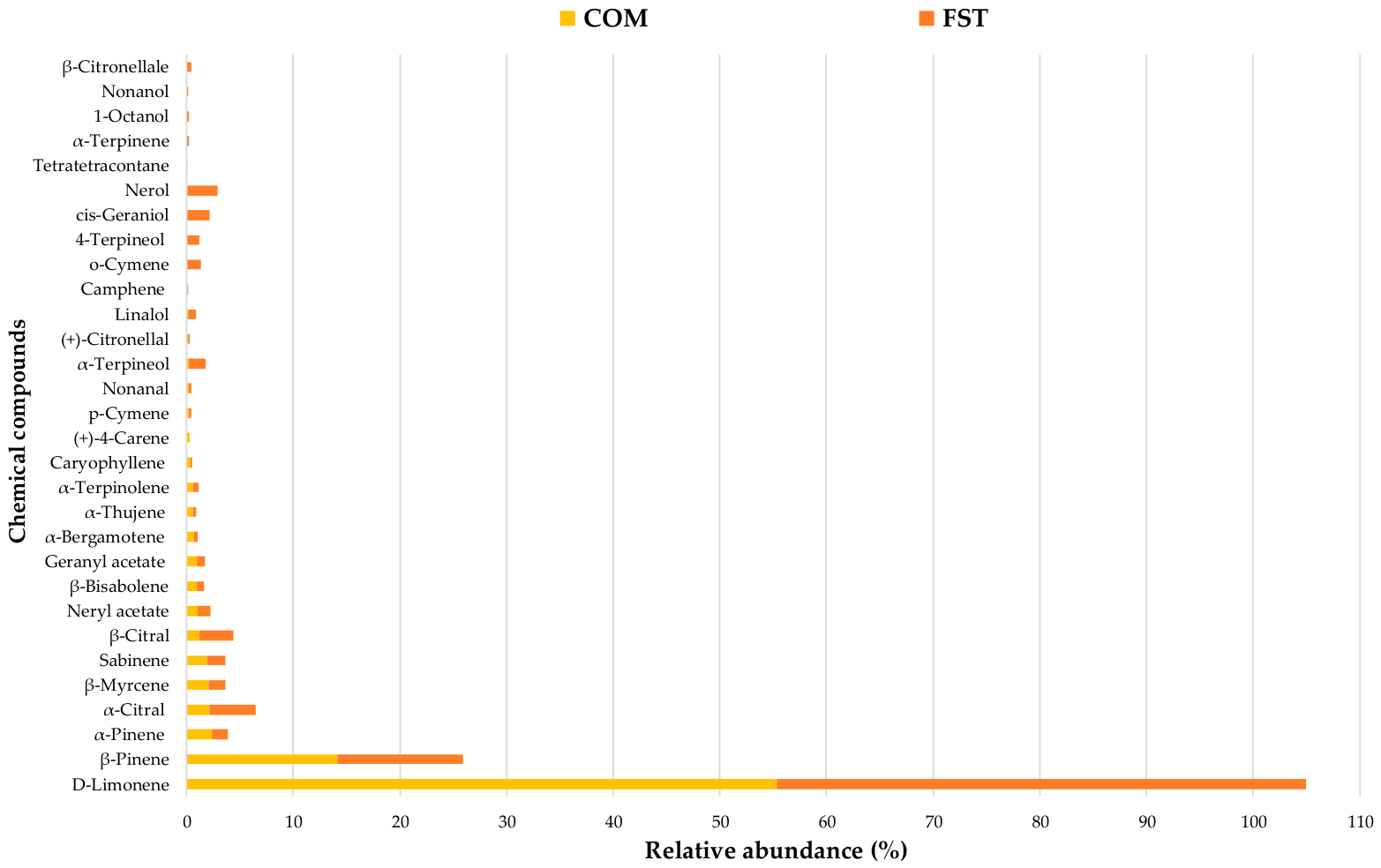
The composition of both essential oils (COM and FST) was previously characterized by gas chromatography–mass spectrometry (GC-MS) [12] and is graphically presented in Figure 1.
The bacterial panel consisted of seven S. enterica serovars, S. Agona 50360, S. Derby 50399, S. Hadar 50272, S. Muenchen 50393, S. Enteritidis 50339 and ATCC 13076, and S. Newport 50404, and seven L. monocytogenes strains (ATCC 19114, 14BO, 133, 136, 185, 187, and 188). Except ATCC (American Type Culture Collection) coded strains, all other strains originated from the culture collection of the SAAF Department. Prior to experimentation, the isolates were reactivated and sub-cultured on Brain Heart Infusion (BHI) agar (Oxoid, Basingstoke, UK), and incubated at 37 °C for 16 h to obtain fresh cultures in the exponential growth phase.
Two food matrices were selected as model systems for subsequent assays: gluten-free Cheddar cheese sauce (Calvé®, Unilever Italia Mkt Operations S.r.l., Rome, Italy) and spreadable salmon paste (Rio Mare, Bolton Food s.p.a., Cermenate, Italy). These products were chosen to simulate potential vehicles for Salmonella and L. monocytogenes contamination.

2.2. Experimental Plan

The antimicrobial activity of the lemon EOs was assessed using the two distinct ready-to-eat food matrices gluten-free Cheddar cheese sauce (CCS) and spreadable salmon paste (SSP). Each matrix was evaluated independently to account for the potential influence of intrinsic product characteristics, such as pH, fat content, and water activity (aw), on bacterial behaviour and EOs efficacy. For each food model, an uninoculated sample was included as a negative control (CTR) to monitor background microbiota and ensure the absence of natural contamination throughout the experimental period.
Each of the fourteen bacterial strains (seven Salmonella enterica serovars and seven L. monocytogenes) was individually inoculated into CCS and SSP. The inoculation level was standardized to achieve an initial cell density of approximately 104 colony forming units (CFU)/g, a value selected to simulate realistic massive contamination scenarios in processed foods and salad dressings. Following inoculation, three aliquots of 50 g were prepared for each strain and for the CTR samples. The aliquots were transferred into sterile 200 g plastic cups (Anicrin, Scorzé, Italy), which were then assigned to the different treatment conditions.
For each bacterial strain and food matrix, one set of cups was left untreated and served as the inoculated control. The remaining two sets were supplemented with either the FST or COM EOs, both applied at a final concentration of 1 mL/kg.
The inoculated and EO-treated samples were stored at ambient temperature to simulate a massive thermal abuse and monitored for a 14-day period. Microbiological analyses were carried out at several defined intervals: immediately after inoculation (t0), every 2 h during the first 8 h (t2 h–t8 h), and then every 24 h from day 1 to day 14 (t1 d–t14 d). These time points were selected to capture both the early microbial response to the EOs treatments and any subsequent regrowth or adaptation over time. The 14-day monitoring period exceeds the typical refrigerated shelf-life of products such as salad dressings and other ready-to-use foods, which are generally consumed within one week [14], and was chosen to better evaluate the behaviour of the added strains under extended storage conditions.
To ensure robustness and reproducibility of the results, the entire experimental procedure was performed in duplicate (technical replicates). Additionally, the full experiment was repeated after one month under identical conditions, generating two independent experimental replicates. In total, four replicate samples were obtained for each combination of bacterial strain, food matrix, and treatment condition.

2.3. Acceptability of Lemon EOs in Food Models

The sensory acceptability of lemon EOs incorporated into CCS and SSP was evaluated using COM EOs through a sniffing assay. The assessment was conducted by a trained sensory panel consisting of 15 judges (8 males and 7 females, aged 25–85 years). All panellists were familiar with the consumption of cheese and fish products, although they reported a lower habitual intake of cheese sauces and fish-based spreads. The sensory protocol was based on an empirical approach inspired by a previously published study [15] and structured according to a more recent application proposed by Garofalo et al. [16] for the evaluation of newly formulated food products. In particular, Klein and co-workers [15] described a sniffing-based sensory evaluation using a simplified scoring system to assess odour attributes. Building on this approach, the method adopted in the present study employs a descriptive scale specifically designed for preliminary acceptability screening. Samples of CCS and SSP supplemented with EOs were presented to the panel, and odour acceptability was rated using a five-point descriptive scale, where a score of 5 indicated maximum acceptability and a score of 1 corresponded to complete unacceptability due to odours inconsistent with the typical sensory profile of cheese- or fish-based products. A score of 3 was established as the minimum threshold for acceptability. Control samples consisting of CCS and SSP without EOs addition were included for comparison. The use of COM EO in this assay was intended to reflect realistic application conditions, as commercially available essential oils are more relevant for industrial use. This sensory evaluation aimed to determine whether the incorporation of lemon EOs at the tested concentration could be sensory tolerated without adversely affecting the characteristic aroma of the food matrices.

2.4. Microbiological Analysis

Quantification of bacterial populations in the food matrices was performed through standard serial dilution and plate count techniques. Sample preparation began by transferring 10 g of each homogenized food aliquot into sterile bags containing 90 mL of Ringer’s solution (Sigma-Aldrich, Milan, Italy). The mixtures were homogenized using a stomacher (BagMixer® 400, Interscience, Saint-Nom, France) at maximum speed for 2 min to ensure thorough dispersion of microbial cells. Subsequent decimal dilutions were prepared in sterile test tubes containing 9 mL of Ringer’s solution. From each dilution, appropriate volumes were spread-plated onto selective agar media specific for the target microorganisms. Enumeration of L. monocytogenes was performed using Listeria Agar according to Ottaviani and Agosti (ALOA), with plates incubated at 37 °C for 24 h, following the guidelines of ISO 11290-2 [17]. For Salmonella spp., enumeration was carried out on xylose lysine desoxycholate (XLD) agar, with incubation at 37 °C for 24 h, in accordance with ISO 6579-2 [18]. All media has been purchased from Oxoid. Characteristic colonies were counted from both media and expressed as CFU/g of product.

2.5. Assessment of Growth Potential (δ) of L. monocytogenes and S. enterica in Spreadable Salmon

The growth potential (δ) of the 14 cultures belonging to the two pathogenic species investigated in SSP with and without lemon EOs was determined according to the approach described by Alegbeleye and Sant’Ana [19]. Growth potential was calculated as the difference between the levels (log CFU/g) measured at 144 h (six days) and those recorded immediately after inoculation (0 h). A δ value exceeding 0.5 log CFU/g was interpreted as indicative of a food system capable of supporting bacterial growth, whereas a δ value equal to or below 0.5 log CFU/g was considered representative of a system unable to support growth. Growth potential was calculated individually for each L. monocytogenes strain and each S. enterica serovar, allowing the assessment of intra-species variability in growth behavior within the SSP matrix.

2.6. Physicochemical Determinations

The pH of each sample was determined using a portable pH meter (Russell RL060P, Thermo Fisher Scientific, Beverly, MA, USA), previously calibrated with standard buffer solutions to ensure measurement accuracy. Water activity (aw) was assessed using a Rotronic Hygropalm HC2 AW meter (Rotronic AG, Bassersdorf, Switzerland). All measurements were taken after allowing the samples to equilibrate to room temperature and were conducted in duplicate.

2.7. Statistical Analysis

Differences among trials in sensory acceptability and microbiological datasets were evaluated by means of one-way analysis of variance (ANOVA). Tukey’s multiple comparison test was subsequently employed for pairwise comparisons, considering a significance level of p < 0.05. All statistical procedures were carried out using XLStat software (version 2019.2.2; Addinsoft, New York, NY, USA).

3. Results and Discussion

3.1. Acceptability of Lemon EOs in CCS and SSP

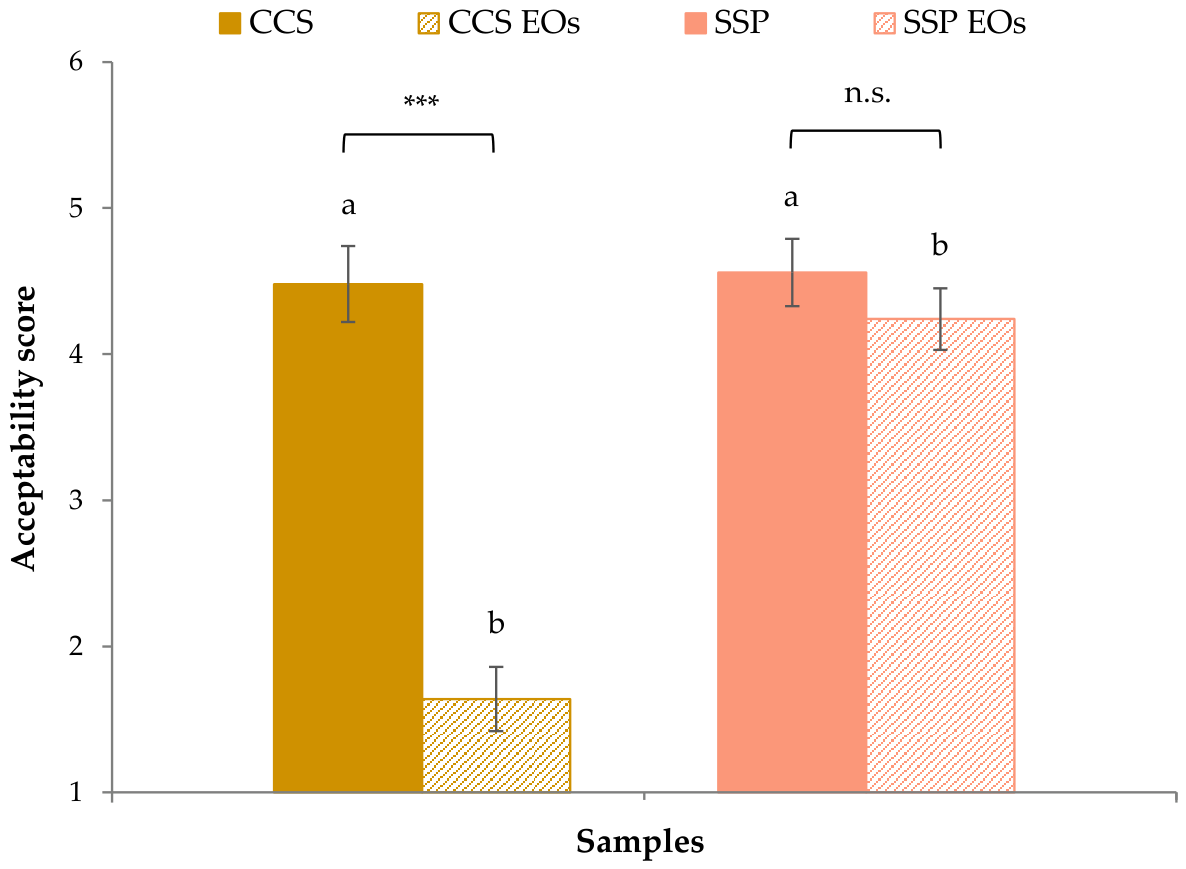
The results of the acceptability test are presented in Figure 2.
The food models without EOs addition exhibited generally high levels of acceptability for both matrices. None of the control samples reached the maximum score of 5, likely because some panellists were not fully accustomed to consuming cheese sauces or spreadable fish-based products.
The addition of lemon COM EOs markedly influenced the sensory perception of the two food models. In SSP, acceptability decreased slightly due to the pronounced lemon aroma perceived during sniffing. However, this reduction was not statistically significant, and the final acceptability score remained high (4.24 and 4.56 with and without EOs, respectively). This result is consistent with the intended formulation strategy, as citrus notes are commonly associated with fish-based products [9,20] and were generally well tolerated by the panellists. In contrast, the incorporation of EOs into CCS led to a drastic decline in sensory appreciation. The strong lemon odour was perceived as incompatible with the characteristic aroma profile of cheese sauce, resulting in a very low acceptability score (1.64), which was well below the established acceptability threshold of 3.
The sniffing approach adopted in this study, although empirical, is in line with previous literature [15,21], where simplified sensory scoring systems have been successfully applied to assess odour acceptability and discriminate sensory differences in food matrices, particularly in dairy-based products.

3.2. Kinetics of Growth

3.2.1. Kinetics of Growth of the Selected Food-Borne Pathogens in Food Models

The behaviour of S. enterica and L. monocytogenes differed substantially between the two food matrices tested. For both species, SSP supported active bacterial growth, whereas CCS induced rapid and progressive inactivation (Figure S1). These matrix-dependent responses highlight the strong influence of physicochemical properties on bacterial physiology and survival, primarily attributable to the low pH of CCS (3.57; see Section 3.3). Taken together with the acceptability test outcomes, these results indicated that CCS was not a suitable matrix for further experimentation; consequently, all subsequent analyses were conducted using SSP.
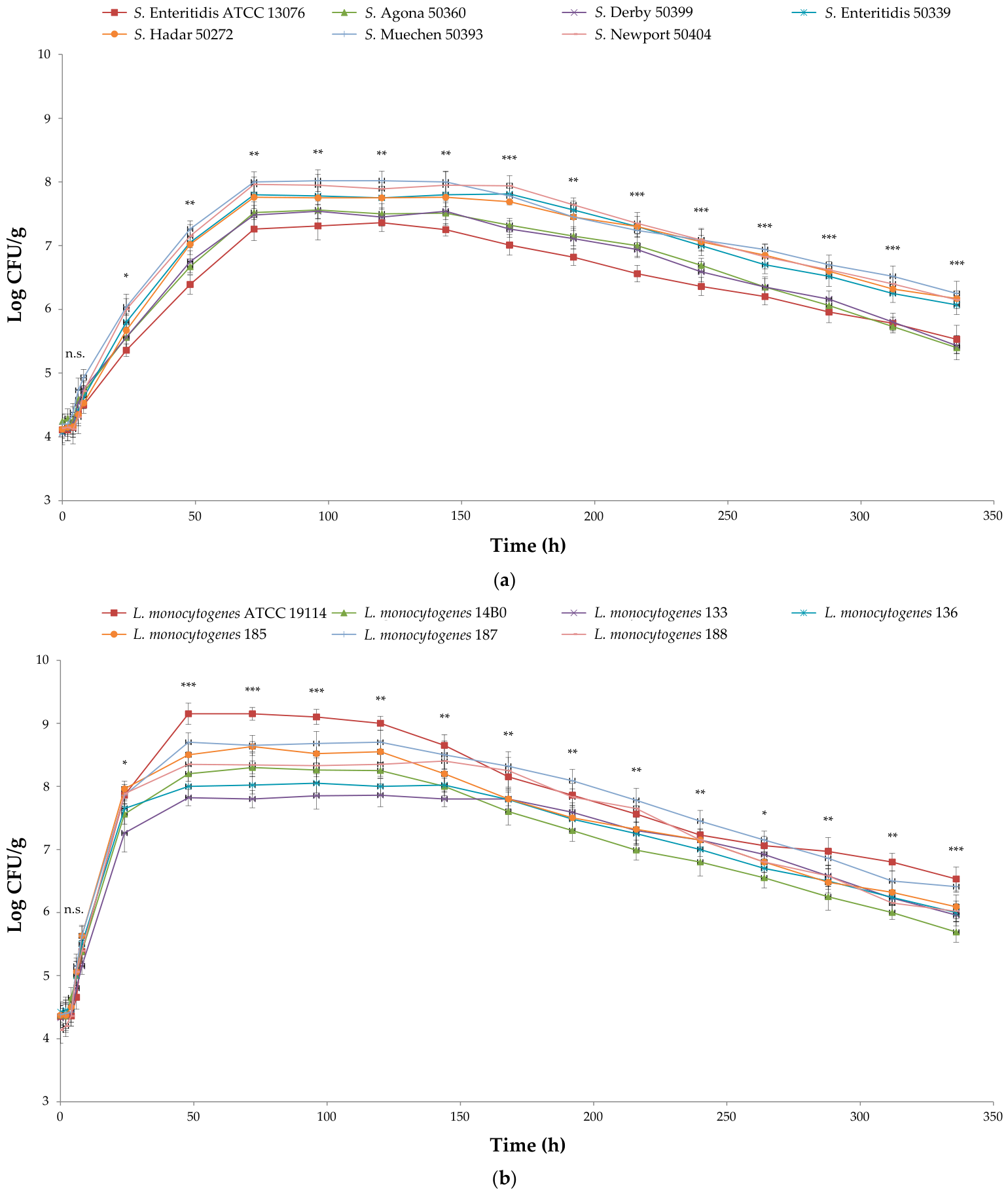
Both pathogens demonstrated robust proliferation in SSP (Figure 3). For S. enterica (Figure 3a), initial counts (ca. 4.0 log CFU/g) were followed by a short lag phase (0–8 h), after which all serovars entered exponential growth. By 24 h, populations reached 5.3–6.0 log CFU/g, and maximum densities of 7.3–8.0 log CFU/g were achieved between 72 and 96 h. Strains such as S. Muenchen 50393, S. Newport 50404 and S. Enteritidis 50339 showed the fastest growth, whereas the reference strain S. Enteritidis ATCC 13076 reached lower maxima, consistent with its lower stress tolerance documented in the literature [22].
A similar pattern was observed for L. monocytogenes (Figure 3b), but with even more pronounced growth. After a brief adaptation phase, all strains entered the log phase by 6–8 h, reaching 7.2–7.9 log CFU/g at 24 h. Several isolates, particularly ATCC 19114, 185, 187 and 188, continued growing to >8.5–9.0 log CFU/g by 48–72 h, exceeding the maxima observed for Salmonella. This outcome is expected given the ability of L. monocytogenes to multiply rapidly in fish-based, nutrient-rich matrices [23,24].
After reaching stationary phase, both pathogens maintained stable populations for several days before showing a slow decline of approximately 1.5–3 log units by day 14. The persistence observed here mirrors previous findings that high-protein foods support long-term survival of both species due to their high aw and protective lipid/protein matrix [25,26]. In contrast to SSP, CCS did not support growth of either pathogen. Instead, both Salmonella and L. monocytogenes exhibited progressive declines from the initial inoculum (4.0–4.3 log CFU/g) within the first 24 h (Figure S1). Although L. monocytogenes is generally more tolerant to acidic and osmotic stresses than Salmonella, both pathogens experienced similar declining trends. Final counts were consistently lower than the starting inoculum, with reductions above 2.0–3.0 log units depending on the strain.
The strong inhibitory effect of CCS likely results from the combined impact of intrinsic hurdles, including pH below growth-permissive thresholds, cheese-derived organic acids, high fat content, which can induce oxidative and membrane stresses, salt, and emulsifying salts (e.g., citrates, phosphates) known to destabilize bacterial cell envelopes. Similar inhibitory behaviour has been reported in processed cheese products, where Listeria and Salmonella fail to grow, especially when pH is low and emulsifiers are present [27,28]. The inactivation patterns observed here are therefore consistent with the literature and reinforce the role of CCS as an unfavourable matrix for pathogen proliferation.
The combined results highlight that matrix composition was the dominant factor shaping microbial behaviour in CCS and SSP. While SSP supported rapid growth of both pathogens, although L. monocytogenes reached higher maxima and exhibited faster early growth, CCS imposed multi-factorial stress leading to inactivation of both species. The persistence of pathogens in SSP for more than 14 days underscores the microbiological risk associated with fish-based spreads. The strong contrast between matrices justifies the need to test the antimicrobial effectiveness of essential oils under realistic food conditions. Due to the inactivation of CCS, these tests were only conducted in SSP.

3.2.2. Effect of FST EOs on the Kinetics of S. enterica and L. monocytogenes in SSP

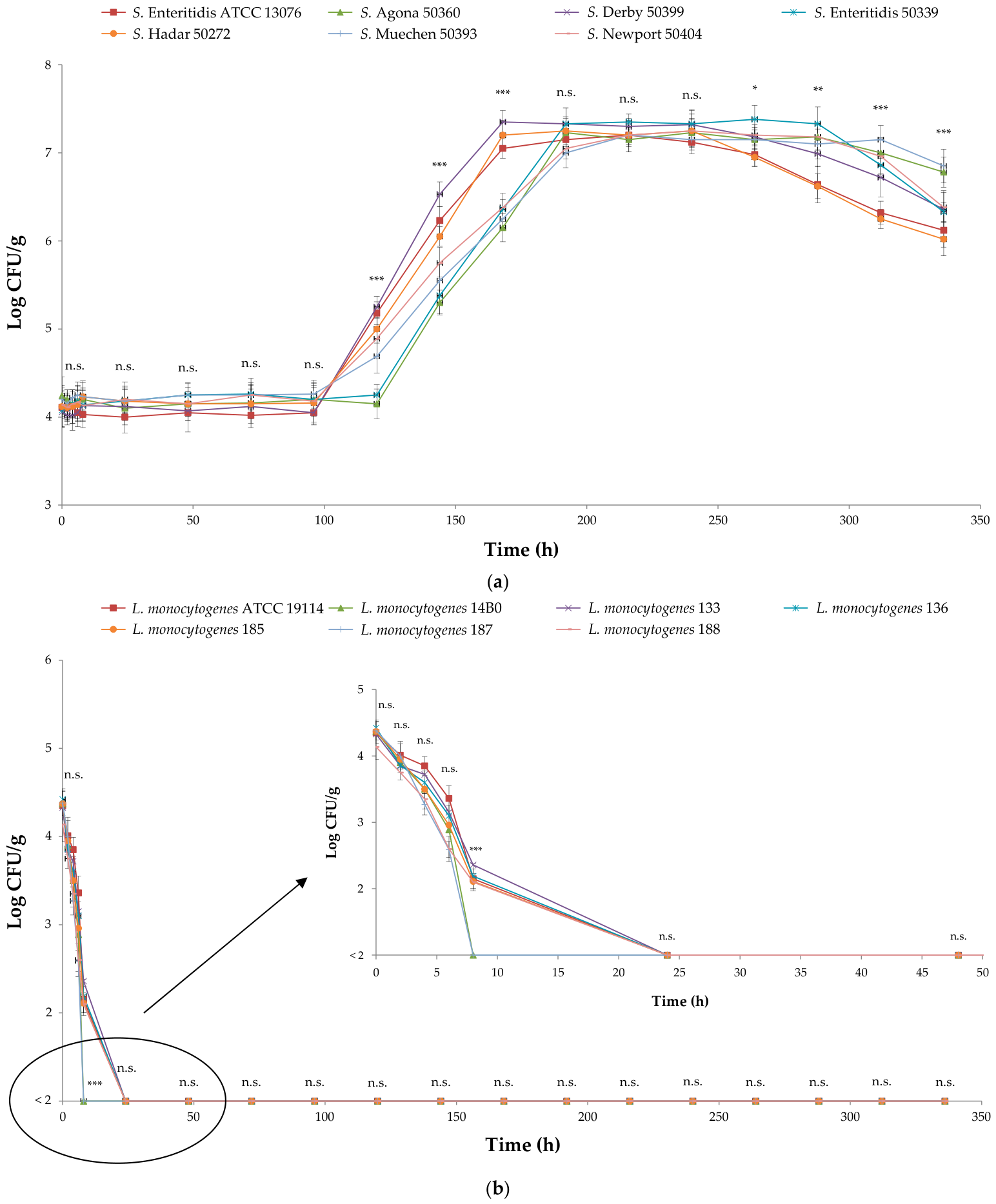
The addition of the FST EOs markedly modified the microbial dynamics of both pathogens in SSP (Figure 4), although the magnitude and nature of inhibition differed substantially between S. enterica and L. monocytogenes. FST EOs determined bacteriostatic activity against Salmonella serovars whereas it exerted an almost immediate and dramatic bactericidal effect on L. monocytogenes.
In the FST EOs treated SSP, Salmonella exhibited a pronounced slowdown from the growth trends observed in the untreated matrix (Figure 4a). During the first 96 h, all serovars remained essentially unchanged around 4.0–4.2 log CFU/g, showing no evidence of growth. This plateau clearly indicates an extension of the lag phases. Only after 120 h did some strains show limited increases (e.g., S. Enteritidis ATCC 13076 rising to 5.18 log CFU/g and S. Derby reaching 5.25 log CFU/g). However, growth remained substantially below the levels recorded in untreated SSP, where the same strains exceeded 7.5–8.0 log CFU/g. At 144–168 h, populations rose moderately (5.3–7.3 log CFU/g depending on the strain), but still remained 1.5–2.0 log units lower than in the control. The following days showed stabilization and a slow decline (to 6.0–6.8 log CFU/g by day 14). These results indicate that FST EOs exerted a clear growth-delaying effect on Salmonella, although the magnitude of inhibition varied among serovars. In all cases, the maximum population levels remained substantially lower than those of the untreated controls, indicating only partial recovery. Notably, no strain exhibited signs of rapid adaptation or resistance development during the initial days of incubation. This pattern is consistent with a bacteriostatic mode of action, in which EOs primarily interferes with bacterial proliferation rather than inducing immediate cell death. The observed delay is likely associated with an extended lag phase, reflecting the time required for cells to recover from sublethal injury. Although growth eventually resumed, it proceeded more slowly and did not reach the levels observed in the absence of treatment. Such behavior aligns with previous studies reporting that lemon and other citrus EOs disrupt membrane integrity, interfere with quorum sensing, and impair ATP production in Salmonella, ultimately resulting in prolonged lag phases and reduced growth rates [29,30,31].
The application of FST EOs on L. monocytogenes was most effective (Figure 4b). After inoculation at almost 4.3 log CFU/g, all strains showed a steep decline already within 2–4 h (falling to 3.5–4.0 log CFU/g). By 6–8 h, populations dropped drastically, with several strains reaching 2.0–2.3 log CFU/g, and two isolates (14BO and 187) even falling below the detection limit at 8 h. By 24 h, all seven strains were undetectable, and counts remained at undetectable levels (reported as <2 log CFU/g) for the remaining 14 days. This represents a 4-log inactivation within 24 h and a stable inhibitory effect with no regrowth. Similar inactivation trends were registered with L. monocytogenes ATCC 19118 in minced beef meat using EOs from Thymus capitata [32] or with a cocktail of five L. monocytogenes strains inoculated onto the surface of frankfurters and treated with plant-derived β-resorcylic acid, carvacrol, and trans-cinnamaldehyde [33]. Thus, FST EOs caused rapid and irreversible death of all isolates; no strain exhibited tolerance, recovery or persistence. In this case, the application of these EOs was overwhelmingly bactericidal, not merely bacteriostatic and the response was faster and stronger than that observed for Salmonella. This effect aligns with known high susceptibility of L. monocytongenes to monoterpenes, which induce massive leakage of intracellular ions, protein denaturation, and autolytic enzyme activation in Gram-positive bacteria [34]. In particular, the FST EOs used in this study is characterized by high levels of monoterpenes such as β-pinene and, especially, D-limonene and was particularly effective in vitro against L. monocytogenes, Staphylococcus aureus, S. enterica, and Enterobacter spp. [12,13]. The FST EOs showed a bacteriostatic mode of action against Salmonella (partial inhibition) and a bactericidal mode of action against L. monocytogenes (complete and rapid inactivation). This differential susceptibility is well documented.
Gram-negative bacteria possess an outer membrane enriched in lipopolysaccharides, which reduces permeability to hydrophobic EOs [35]. In contrast, Gram-positive bacteria lack this barrier, allowing rapid diffusion of oil components into the cell membrane and cytoplasm. Thus, Listeria is highly vulnerable, showing rapid cell lysis even at low concentrations [36,37]. The results suggested that the FST EOs possess sufficiently high terpene bioavailability to retain antimicrobial functionality even in a challenging, high-fat, protein-rich matrix. These findings reinforce the potential application of FST EOs as an effective natural preservative in high-risk fish-based preparations. For this reason, the test was extended to commercial lemon EOs.

3.2.3. Effect of Commercial EOs on the Kinetics of S. enterica and L. monocytogenes in SSP

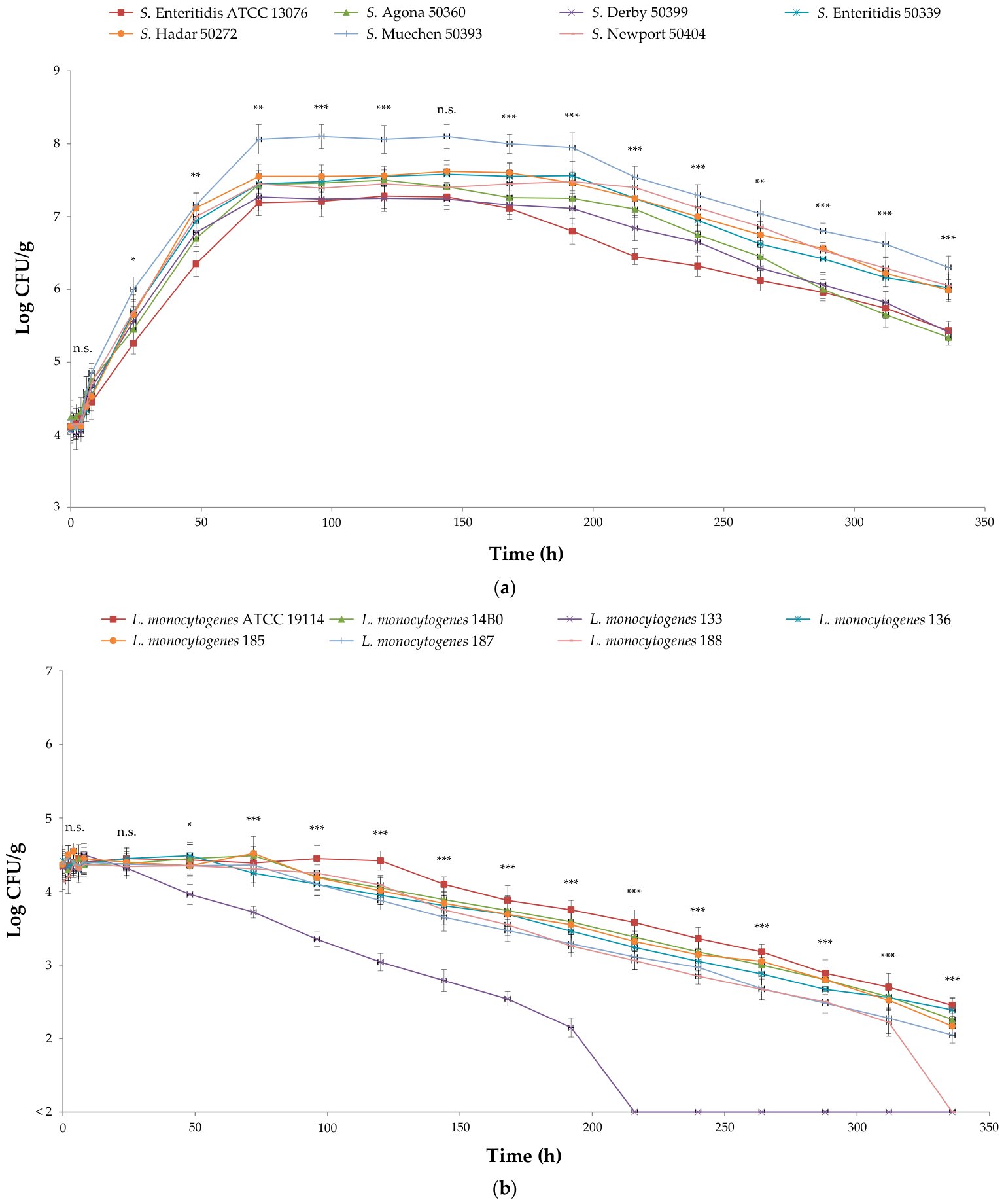
The commercial EOs produced antimicrobial effects notably weaker than those observed with the freshly extracted FST EOs (Figure 5). While COM EOs exerted moderate inhibition on Salmonella and a slow, progressive reduction in L. monocytogenes, it did not generate the rapid bactericidal activity observed with FST EOs. These differences reflect both the chemical variability characteristic of commercial citrus oils and the distinct physiological responses of Gram-negative and Gram-positive bacteria. In this study, the greater inhibitory activity observed for FST EOs can be attributed to its distinct chemical composition compared to COM (Figure 1). In particular, FST is richer in oxygenated monoterpenes, such as 4-terpineol, α-terpineol, cis-geraniol, β-citral, nerol, and α-citral, which are absent or present only in low amounts in the commercial lemon EOs [12].
In the COM EOs treated SSP (Figure 5a), Salmonella displayed growth patterns that were moderately inhibited but not suppressed. During the first 8 h, all strains increased slightly from 4.1 to 4.5 log CFU/g, which mirrors the early adaptation observed in the untreated control. Between 24 and 48 h, all seven strains entered exponential growth. By 72–120 h, populations peaked between 7.2 and 7.6 log CFU/g for most strains and 8.0 log CFU/g for S. Muenchen 50393 which was the highest performer. Compared with the untreated control, these maxima remain only marginally reduced, generally by 0.2–0.4 log units, indicating limited growth inhibition. After day 7, populations gradually declined, reaching 5.3–6.3 log CFU/g by day 14, following a pattern comparable to the control and significantly less pronounced than in FST EOs treated samples.
Unlike the strong bactericidal effect observed with FST EOs, COM EOs produced only a slow and progressive reduction in L. monocytogenes (Figure 5b). In the first 24–48 h, bacterial populations remained stable, fluctuating around 4.3–4.5 log CFU/g with minimal reductions. After 48 h, a gradual decline began, becoming more pronounced after 72–96 h. In particular, strain 133 decreased steadily to 3.35 log CFU/g at 96 h. From 120 h onward, all strains underwent a slow but consistent decline of approximately 0.2–0.4 log every 24 h.
The key efficacy differences between COM and FTS EOs are summarized in Table 1.
The reduced efficacy of COM EOs in comparison to FST EOs likely stems from a lower monoterpene content due to distillation differences, commercial blending, oxidation during storage, fraction removal (typical in industrial-grade oils), higher hydrophobic partitioning into SSP lipids which determines a reduced bioavailability, and a weaker membrane active properties, insufficient to rapidly kill Gram-positive cells [38,39]. These results clearly demonstrate that oil quality and chemical profile strongly influence antimicrobial effectiveness, and that FST represents a more promising candidate for real food preservation applications.

3.3. Impact of Lemon EOs on δ of L. monocytogenes and S. enterica in SSP

The results of the growth potential determination are reported in Table 2.
In the absence of EOs, both S. enterica and L. monocytogenes displayed high δ with values ranging from 3.14 to 3.81 log CFU/g for S. enterica and from 3.47 to 4.30 log CFU/g for L. monocytogenes. All strains largely exceeded the 0.5 log CFU/g threshold, clearly indicating that SSP is a highly permissive matrix for both pathogens. The slightly higher δ values observed for L. monocytogenes are consistent with its well-known ability to grow efficiently in seafood-based ready-to-eat products [40]. Notably, an intra-species variability is evident in SSP, particularly for L. monocytogenes (range ca. 0.8 log units), reflecting strain-dependent differences in performance and stress adaptation [41]. The addition of FST EOs resulted in markedly different responses between the two species. In case of S. enterica the growth potential was significantly reduced but not prevented. In fact, δ values decreased to 1.06–2.47 log CFU/g, corresponding to a reduction of approximately 1.0–2.0 log units compared to the untreated SSP. Importantly, all strains showed δ > 0.5, meaning the system remained capable of supporting growth, albeit at a slower rate. A pronounced intra-species variability emerged: S. Agona (δ = 1.06) and S. Enteritidis strains (ca. 1.3–1.4) were much more affected than other salmonellas. In contrast, FST EOs completely suppressed the growth of all L. monocytogenes strains, with δ values strongly negative (from −4.14 to −4.42 log CFU/g). This indicates not only an inability to support growth but an overall inactivation effect. Strikingly, the intra-species variability almost disappeared, suggesting that FST EOs exerted a uniform and dominant antimicrobial effect across L. monocytogenes strains.
The antimicrobial impact of COM EOs was noticeably weaker and was species-dependent. δ values (3.16–3.90 log CFU/g) were comparable to or even slightly higher those registered in SSP without EOs, indicating that COM EOs bacteriostatic effect was completely overcome in SSP. L. monocytogenes growth was partially inhibited, with δ values ranging from −0.25 to −1.54 log CFU/g. Data clearly showed that although growth was prevented (δ ≤ 0.5), the effect was clearly less intense than that observed with FST EOs. Within this species, the intra-species variability re-emerged, with strain 133 being more sensitive, with a δ of −1.54, than other isolates.
The application of lemon EOs revealed a species- and strain-dependent antimicrobial efficacy, with L. monocytogenes being markedly more sensitive than S. enterica. This observation is consistent with previous studies highlighting the higher susceptibility of Gram-positive bacteria to EOs than Gram-negative. The consistently high δ values (>0.5) observed across all Salmonella serovars indicate that, under the conditions tested, SSP remains supportive of Salmonella growth despite the presence of lemon EOs. In contrast, δ values suggest that SSP enriched with FST EOs may be considered unable to support the growth of L. monocytogenes.

3.4. Monitoring of pH and aw

The two food matrices exhibited markedly different intrinsic physicochemical properties prior to bacterial inoculation. CCS displayed a highly acidic environment with a pH of 3.57 ± 0.01, whereas SSP showed an almost neutral pH of 6.19 ± 0.02. aw values followed the same pattern, with CCS at 0.950 ± 0.001 and SSP at 0.972 ± 0.001. These parameters are consistent with known characteristics of high-moisture dairy systems and protein-rich seafood emulsions, respectively, where water availability and buffering capacity differ substantially.
During the initial screening phase, CCS demonstrated complete inhibition of all 14 bacterial strains tested, including S. enterica and L. monocytogenes. The strong intrinsic antimicrobial barrier of CCS is consistent with the well-established limited growth potential of L. monocytogenes at low pH values approaching the lower end of its viable range (ca. pH 4.0) [42]. Likewise, Salmonella spp. requires a minimum aw of approximately 0.93 for growth [43], a threshold slightly below the aw measured in CCS. These intrinsic barriers likely account for the universal growth suppression observed, making CCS unsuitable for kinetic EOs modulation studies.
For these reasons, growth kinetics in the presence of EOs were conducted exclusively in SSP (pH 6.19, aw 0.972), where both pathogens showed to be metabolically active over time.
The incorporation of lemon EOs (both COM or FST) did not induce meaningful changes in either pH or aw immediately after treatment or following bacterial inoculation. This stability suggests that the oils did not interact strongly with the bulk matrix in ways that alter acidity or aw, an important observation in view of their food application as antimicrobial agents. EOs/food matrix interactions are known to depend on intrinsic matrix factors such as pH, lipid content, and water phase distribution, which can modulate EO solubility and antimicrobial efficacy [44]. However, in this case, SSP properties remained stable enough that pH and aw were not primary variables influencing bacterial behaviour.
During the 14-day monitoring period, only minor changes in pH were observed; therefore, the corresponding graphs are not presented. Among Salmonella strains, the lowest average pH reached 6.08 ± 0.07, while L. monocytogenes exhibited a slightly greater acidification to 5.97 ± 0.06. This is consistent with reports that L. monocytogenes can generate acidic metabolites during growth through fermentative pathways, showing greater acidification capacity than Salmonella, which exhibits a more limited response under mild acid conditions [45]. The pattern for aw differed from that of pH; Salmonella strains exhibited a more pronounced decline to 0.927 ± 0.014, whereas L. monocytogenes reached 0.943 ± 0.005. These shifts remain within the documented ranges permitting survival for both pathogens but approach the minimum aw limit for the pathogens tested in this study. The greater aw reduction associated with Salmonella may reflect strain-specific water-binding or matrix-interaction dynamics, while L. monocytogenes maintained slightly higher aw values.
Importantly, the stability of pH and aw in EOs treated SSP indicates that the antimicrobial effects observed in kinetic assays are attributable to the intrinsic bioactivity of the essential oils, rather than indirect effects mediated through modifications of environmental growth parameters. This is particularly critical because EOs often show reduced antimicrobial performance in real food matrices.

4. Conclusions

This study demonstrates that matrix composition exerts a decisive influence on pathogen behaviour, with SSP supporting prolonged growth of S. enterica and L. monocytogenes, while CCS induced rapid inactivation. Sensory evaluation unequivocally indicated that the incorporation of lemon EOs into cheese sauce was not acceptable to judges, due to a marked mismatch with its characteristic aromatic profile. Lemon FST EOs exhibited superior antimicrobial performance compared with commercial EOs, producing bacteriostatic effects against Salmonella and rapid bactericidal action against L. monocytogenes, even within a high-fat, protein-rich matrix. Accordingly, SSP supplemented with FST EOs could be classified as unable to support L. monocytogenes growth, as indicated by strongly negative δ values and minimal strain variability. In contrast, δ values consistently exceeding 0.5 confirmed that SSP remains supportive of Salmonella growth, with pronounced strain-dependent responses, highlighting persistent growth potential and the need for additional safety hurdles. Moreover, the use of lemon EOs in SSP is likely sensory acceptable, since lemon is traditionally added to seafood preparations, making its incorporation suitable for food applications from both technological and organoleptic perspectives.
A limitation of this study lies in the simplified experimental design, which did not account for the potential influence of additional food matrix components and their interactions with EOs. Therefore, further research is needed to explore these aspects under more complex and realistic conditions.

Supplementary Materials

The following supporting information can be downloaded at: https://www.mdpi.com/article/10.3390/foods15111998/s1, Figure S1: Growth kinetics of Salmonella enterica (a) and Listeria monocytogenes (b) in cheddar cheese sauce.

Author Contributions

Conceptualization, R.G. (Raimondo Gaglio) and L.S.; methodology, R.G. (Raimondo Gaglio), V.G., N.F. and G.M.; software, G.G. and A.A.; validation, R.G. (Raimondo Gaglio), G.M. and L.S.; formal analysis, G.G. and R.G. (Rosa Guarcello); investigation, G.G., V.G. and R.G. (Rosa Guarcello); resources, L.S.; data curation, G.G. and A.A.; validation, R.G. (Rosa Guarcello); writing—original draft preparation, G.G. and L.S.; writing—review and editing, R.G. (Raimondo Gaglio), A.A., N.F., G.M. and L.S.; project administration, L.S.; funding acquisition, L.S. All authors have read and agreed to the published version of the manuscript.

Funding

This research was partially supported by the personal research funds of L. Settanni, provided by the University of Palermo through the Fondo Finalizzato alla Ricerca di Ateneo (FFR_2025).

Institutional Review Board Statement

This study did not fall within the categories of research requiring evaluation by the Ethics Committee of the University of Palermo. According to both Italian and European regulatory frameworks, ethical approval is mandatory only for biomedical research, including clinical trials involving medicinal products or medical devices, and does not apply to sensory evaluations of food conducted for non-medical purposes. In the present work, the sensory assessment of spreadable products based on cheese and fish focused exclusively on olfactory characteristics and did not involve the use of pharmaceuticals or medical devices, nor did it include biological sampling or the processing of personal data. In accordance with the applicable legislation, namely Regulation (EU) No 536/2014 and the corresponding Italian provisions (Law No 3/2018, Legislative Decree No 52/2019, and the Ministry of Health Decree of 26 January 2023), no formal ethical approval was required.

Informed Consent Statement

Informed consent was obtained from all subjects involved in the study.

Data Availability Statement

The original contributions presented in this study are included in the article/Supplementary Material. Further inquiries can be directed to the corresponding authors.

Conflicts of Interest

The authors declare no conflicts of interest.

References

  1. Shafi, Z.; Shahid, M.; Singh, R. Food-Borne Bacterial Pathogens: Emerging Approaches in Detection and Prevention. Arch. Microbiol. 2026, 208, 109. [Google Scholar] [CrossRef]
  2. Fox, P.F.; Guinee, T.P.; Cogan, T.M.; McSweeney, P.L.H. Processed Cheese and Substitute/Imitation Cheese Products. In Fundamentals of Cheese Science; Springer: Boston, MA, USA, 2017; pp. 589–627. ISBN 978-1-4899-7679-6. [Google Scholar]
  3. Sheng, L.; Wang, L. The Microbial Safety of Fish and Fish Products: Recent Advances in Understanding Its Significance, Contamination Sources, and Control Strategies. Compr. Rev. Food Sci. Food Saf. 2021, 20, 738–786. [Google Scholar] [CrossRef]
  4. Costa, C.; Lucera, A.; Licciardello, F.; Conte, A.; Del Nobile Matteo, A. Application of Preservation Strategies to Improve the Shelf Life of Spreadable Cheese. Food Packag. Shelf Life 2017, 11, 16–20. [Google Scholar] [CrossRef]
  5. Samarakoon, H.M.M.C.; Patabandi, P.P.S.K.P.; Walpita, C.N.; Priyadarshana, M.K.C.; Udayathilake, E. Development of Ready to Eat Fish Paste Using Chub Mackerel (Scomber japonicus) Tail Off Cuts. J. Agric. Sci.–Sri Lanka 2021, 16, 247–259. [Google Scholar] [CrossRef]
  6. Chauhan, K.; Rao, A. Clean-Label Alternatives for Food Preservation: An Emerging Trend. Heliyon 2024, 10, e35815. [Google Scholar] [CrossRef]
  7. Nabeshima, E.H.; Tavares, P.E.D.R.; Lemos, A.L.D.S.C.; Moura, S.C.S.R.D. Emerging Ingredients for Clean Label Products and Food Safety. Braz. J. Food Technol. 2024, 27, e2023160. [Google Scholar] [CrossRef]
  8. Bibow, A.; Oleszek, W. Essential Oils as Potential Natural Antioxidants, Antimicrobial, and Antifungal Agents in Active Food Packaging. Antibiotics 2024, 13, 1168. [Google Scholar] [CrossRef]
  9. Yazgan, H. Antimicrobial Activities of Emulsion-Based Edible Solutions Incorporating Lemon Essential Oil and Sodium Caseinate against Some Food-Borne Bacteria. J. Food Sci. Technol. 2022, 59, 4695–4705. [Google Scholar] [CrossRef]
  10. Kačániová, M.; Kunová, S.; Čmiková, N. Green Lemon Essential Oil Antimicrobial Activity against Listeria monocytogenes Inoculated in Chicken Meat. Sci. Pap. Anim. Sci. Biotechnol. 2023, 56, 237. [Google Scholar]
  11. Zhu, Y.; Li, C.; Cui, H.; Lin, L. Encapsulation Strategies to Enhance the Antibacterial Properties of Essential Oils in Food System. Food Control 2021, 123, 107856. [Google Scholar] [CrossRef]
  12. Settanni, L.; Palazzolo, E.; Guarrasi, V.; Aleo, A.; Mammina, C.; Moschetti, G.; Germanà, M.A. Inhibition of Foodborne Pathogen Bacteria by Essential Oils Extracted from Citrus Fruits Cultivated in Sicily. Food Control 2012, 26, 326–330. [Google Scholar] [CrossRef]
  13. Settanni, L.; Randazzo, W.; Palazzolo, E.; Moschetti, M.; Aleo, A.; Guarrasi, V.; Mammina, C.; San Biagio, P.L.; Marra, F.P.; Moschetti, G.; et al. Seasonal Variations of Antimicrobial Activity and Chemical Composition of Essential Oils Extracted from Three Citrus limon L. Burm. Cultivars. Nat. Prod. Res. 2014, 28, 383–391. [Google Scholar] [CrossRef] [PubMed]
  14. Arienzo, A.; Murgia, L.; Fraudentali, I.; Gallo, V.; Angelini, R.; Antonini, G. Microbiological Quality of Ready-to-Eat Leafy Green Salads during Shelf-Life and Home-Refrigeration. Foods 2020, 9, 1421. [Google Scholar] [CrossRef]
  15. Klein, N.; Maillard, M.-B.; Thierry, A.; Lortal, S. Conversion of Amino Acids into Aroma Compounds by Cell-Free Extracts of Lactobacillus helveticus. J. Appl. Microbiol. 2001, 91, 404–411. [Google Scholar] [CrossRef] [PubMed]
  16. Garofalo, G.; Pisana, C.; Caccamo, M.; Busetta, G.; Donà, G.; Cappellaro, A.; Marcelli, B.; Wouters, J.A.; Settanni, L.; Gaglio, R.; et al. Phage-Activated Edible Biopackaging for Listeria monocytogenes Control in Cheese: In Vitro and In Vivo Assessment of Whey Protein- and Tapioca Starch-Based Solutions. Food Microbiol. 2026, 138, 105087. [Google Scholar] [CrossRef]
  17. ISO 11290-2; Microbiology of the Food Chain—Horizontal Method for the Detection and Enumeration of Listeria monocytogenes and of Listeria spp.—Part 2: Enumeration Method. International Organization for Standardization: Geneva, Switzerland, 2017.
  18. ISO 6579-2; Microbiology of the Food Chain—Horizontal Method for the Detection, Enumeration and Serotyping of Salmonella—Part 2: Enumeration by a Miniaturized Most Probable Number Technique. International Organization for Standardization: Geneva, Switzerland, 2017.
  19. Alegbeleye, O.; Sant’Ana, A.S. Survival and Growth Behaviour of Listeria Monocytogenes in Ready-to-Eat Vegetable Salads. Food Control 2022, 138, 109023. [Google Scholar] [CrossRef]
  20. Alfonzo, A.; Martorana, A.; Guarrasi, V.; Barbera, M.; Gaglio, R.; Santulli, A.; Settanni, L.; Galati, A.; Moschetti, G.; Francesca, N. Effect of the Lemon Essential Oils on the Safety and Sensory Quality of Salted Sardines (Sardina pilchardus Walbaum 1792). Food Control 2017, 73, 1265–1274. [Google Scholar] [CrossRef]
  21. Franciosi, E.; Settanni, L.; Cavazza, A.; Poznanski, E. Biodiversity and Technological Potential of Wild Lactic Acid Bacteria from Raw Cows’ Milk. Int. Dairy J. 2009, 19, 3–11. [Google Scholar] [CrossRef]
  22. Andino, A.; Hanning, I. Salmonella enterica: Survival, Colonization, and Virulence Differences among Serovars. Sci. World J. 2015, 2015, 520179. [Google Scholar] [CrossRef]
  23. Leong, D.; Alvarez-Ordóñez, A.; Zaouali, S.; Jordan, K. Examination of Listeria monocytogenes in Seafood Processing Facilities and Smoked Salmon in the Republic of Ireland. J. Food Prot. 2015, 78, 2184–2190. [Google Scholar] [CrossRef]
  24. Kuzmanovic, J.; Asanin, R.; Baltic, M.; Misic, D.; Dimitrijevic, M.; Stojanovic, M.; Asanin, N.; Kovacevic, I. Presence of Listeria spp. in Fish Samples, Fish Products and Sea Products. Acta Vet. 2011, 61, 193–203. [Google Scholar] [CrossRef]
  25. Beales, N. Adaptation of Microorganisms to Cold Temperatures, Weak Acid Preservatives, Low pH, and Osmotic Stress: A Review. Compr. Rev. Food Sci. Food Saf. 2004, 3, 1–20. [Google Scholar] [CrossRef] [PubMed]
  26. Ferreira, V.; Wiedmann, M.; Teixeira, P.; Stasiewicz, M.J. Listeria monocytogenes Persistence in Food-Associated Environments: Epidemiology, Strain Characteristics, and Implications for Public Health. J. Food Prot. 2014, 77, 150–170. [Google Scholar] [CrossRef]
  27. Verheyen, D.; Bolívar, A.; Pérez-Rodríguez, F.; Baka, M.; Skåra, T.; Van Impe, J.F. Effect of Food Microstructure on Growth Dynamics of Listeria monocytogenes in Fish-Based Model Systems. Int. J. Food Microbiol. 2018, 283, 7–13. [Google Scholar] [CrossRef]
  28. Leong, W.M.; Geier, R.; Engstrom, S.; Ingham, S.; Ingham, B.; Smukowski, M. Growth of Listeria monocytogenes, Salmonella spp., Escherichia coli O157:H7, and Staphylococcus aureus on Cheese during Extended Storage at 25 °C. J. Food Prot. 2014, 77, 1275–1288. [Google Scholar] [CrossRef]
  29. Bansal, V.; Veena, N. Understanding the Role of pH in Cheese Manufacturing: General Aspects of Cheese Quality and Safety. J. Food Sci. Technol. 2024, 61, 16–26. [Google Scholar] [CrossRef]
  30. Kačániová, M.; Čmiková, N.; Vukovic, N.L.; Verešová, A.; Bianchi, A.; Garzoli, S.; Ben Saad, R.; Ben Hsouna, A.; Ban, Z.; Vukic, M.D. Citrus Limon Essential Oil: Chemical Composition and Selected Biological Properties Focusing on the Antimicrobial (In Vitro, In Situ), Antibiofilm, Insecticidal Activity and Preservative Effect against Salmonella enterica Inoculated in Carrot. Plants 2024, 13, 524. [Google Scholar] [CrossRef]
  31. Guillín, Y.; Cáceres, M.; Torres, R.; Stashenko, E.; Ortiz, C. Effect of Essential Oils on the Inhibition of Biofilm and Quorum Sensing in Salmonella Enteritidis 13076 and Salmonella Typhimurium 14028. Antibiotics 2021, 10, 1191. [Google Scholar] [CrossRef]
  32. El Abed, N.; Kaabi, B.; Smaali, M.I.; Chabbouh, M.; Habibi, K.; Mejri, M.; Marzouki, M.N.; Ben Hadj Ahmed, S. Chemical Composition, Antioxidant and Antimicrobial Activities of Thymus capitata Essential Oil with Its Preservative Effect against Listeria monocytogenes Inoculated in Minced Beef Meat. Evid. Based Complement. Alternat. Med. 2014, 2014, 152487. [Google Scholar] [CrossRef] [PubMed]
  33. Upadhyay, A.; Upadhyaya, I.; Kollanoor-Johny, A.; Ananda Baskaran, S.; Mooyottu, S.; Karumathil, D.; Venkitanarayanan, K. Inactivation of Listeria monocytogenes on Frankfurters by Plant-Derived Antimicrobials Alone or in Combination with Hydrogen Peroxide. Int. J. Food Microbiol. 2013, 163, 114–118. [Google Scholar] [CrossRef] [PubMed]
  34. Han, Y.; Sun, Z.; Chen, W. Antimicrobial Susceptibility and Antibacterial Mechanism of Limonene against Listeria monocytogenes. Molecules 2019, 25, 33. [Google Scholar] [CrossRef]
  35. Tongnuanchan, P.; Benjakul, S. Essential Oils: Extraction, Bioactivities, and Their Uses for Food Preservation. J. Food Sci. 2014, 79, R1231–R1249. [Google Scholar] [CrossRef] [PubMed]
  36. Vidaković Knežević, S.; Knežević, S.; Vranešević, J.; Kravić, S.Ž.; Lakićević, B.; Kocić-Tanackov, S.; Karabasil, N. Effects of Selected Essential Oils on Listeria monocytogenes in Biofilms and in a Model Food System. Foods 2023, 12, 1930. [Google Scholar] [CrossRef]
  37. Yousefi, M.; Khorshidian, N.; Hosseini, H. Potential Application of Essential Oils for Mitigation of Listeria monocytogenes in Meat and Poultry Products. Front. Nutr. 2020, 7, 577287. [Google Scholar] [CrossRef] [PubMed]
  38. Donaldson, J.R.; Warner, S.L.; Cates, R.G.; Gary Young, D. Assessment of Antimicrobial Activity of Fourteen Essential Oils When Using Dilution and Diffusion Methods. Pharm. Biol. 2005, 43, 687–695. [Google Scholar] [CrossRef]
  39. Hegazy, M.M.; Mekky, R.H.; Ibrahim, A.E.; Abouelela, M.E.; Kedra, T.A.; Al-Harrasi, A. Essential Oils: The Science of Extraction and Its Implications for Composition and Biological Activity—A Review. Food Anal. Methods 2025, 18, 1483–1513. [Google Scholar] [CrossRef]
  40. Gambarin, P.; Magnabosco, C.; Losio, M.N.; Pavoni, E.; Gattuso, A.; Arcangeli, G.; Favretti, M. Listeria monocytogenes in Ready-to-Eat Seafood and Potential Hazards for the Consumers. Int. J. Microbiol. 2012, 2012, 497635. [Google Scholar] [CrossRef]
  41. Wiktorczyk-Kapischke, N.; Skowron, K.; Grudlewska-Buda, K.; Wałecka-Zacharska, E.; Korkus, J.; Gospodarek-Komkowska, E. Adaptive Response of Listeria monocytogenes to the Stress Factors in the Food Processing Environment. Front. Microbiol. 2021, 12, 710085. [Google Scholar] [CrossRef]
  42. Cunningham, E.; O’Byrne, C.; Oliver, J.D. Effect of Weak Acids on Listeria monocytogenes Survival: Evidence for a Viable but Nonculturable State in Response to Low pH. Food Control 2009, 20, 1141–1144. [Google Scholar] [CrossRef]
  43. Seeras, A. Survival and Persistence of Dried Salmonella enterica in Low Water Activity Conditions. Master’s Thesis, University of Alberta Library, Edmonton, AB, Canada, 2017. [Google Scholar]
  44. Zheng, L.; Guo, H.; Zhu, M.; Xie, L.; Jin, J.; Korma, S.A.; Jin, Q.; Wang, X.; Cacciotti, I. Intrinsic Properties and Extrinsic Factors of Food Matrix System Affecting the Effectiveness of Essential Oils in Foods: A Comprehensive Review. Crit. Rev. Food Sci. Nutr. 2024, 64, 7363–7396. [Google Scholar] [CrossRef]
  45. Koutsoumanis, K.P.; Sofos, J.N. Comparative Acid Stress Response of Listeria monocytogenes, Escherichia coli O157:H7 and Salmonella Typhimurium after Habituation at Different pH Conditions. Lett. Appl. Microbiol. 2004, 38, 321–326. [Google Scholar] [CrossRef] [PubMed]
Figure 1. Chemical composition of Commercial (COM) and Femminello Santa Teresa (FST) essential oils.
Foods 15 01998 g001
Figure 2. Acceptability test. Abbreviations: CCS, Cheddar cheese sauce; EOs, essential oils; SSP, spreadable salmon paste. Different lowercase letters indicate significant differences among samples. ***, p ≤ 0.001; n.s., not significant.
Foods 15 01998 g002
Figure 3. Growth kinetics of Salmonella enterica (a) and Listeria monocytogenes (b) in spreadable salmon paste. * p < 0.05; ** p < 0.01; *** p < 0.001; n.s., not significant (p > 0.05).
Foods 15 01998 g003
Figure 4. Growth kinetics of Salmonella enterica (a) and Listeria monocytogenes (b) in spreadable salmon paste added with lemon Femminello Santa Teresa (FST) essential oils. An inset in panel (b) shows a magnified view of the first 50 h of incubation to better highlight the bactericidal effect. * p < 0.05; ** p < 0.01; *** p < 0.001; n.s., not significant (p > 0.05).
Foods 15 01998 g004
Figure 5. Growth kinetics of Salmonella enterica (a) and Listeria monocytogenes (b) in spreadable salmon paste added with lemon commercial (COM) essential oils. * p < 0.05; ** p < 0.01; *** p < 0.001; n.s., not significant (p > 0.05).
Foods 15 01998 g005
Table 1. Comparative analysis of in vivo efficacy of lemon COM and FST essential oils.
ParametersEssential Oils
Commercial (COM)Femminello Santa Teresa (FST)
Effect on Salmonella entericaMild inhibition, full growthStrong bacteriostasis (5 d), reduced maxima
Effect on Listeria monocytogenesSlow decline, incomplete killRapid full kill (≤24 h)
Onset of inhibitionLate (after 48–72 h)Immediate (≤2 h)
Max reduction2–3 log units4 log units, permanent
Intra-species variabilityHighLow
Table 2. Growth potential (δ) of L. monocytogenes and S. enterica in spreadable salmon paste.
Bacteriaδ (Calculated on the Average Values)
SSPSSP + FST EOsSSP + COM EOs
S. Enteritidis ATCC 130763.142.123.16
S. Agona 503603.271.063.17
S. Derby 503993.482.473.18
S. Hadar 502723.721.303.50
S. Muenchen 503933.641.933.50
S. Enteritidis 503393.801.353.90
S. Newport 504043.811.613.26
L. monocytogenes ATCC 191144.30−4.35−0.25
L. monocytogenes 14BO3.63−4.37−0.48
L. monocytogenes 1333.47−4.33−1.54
L. monocytogenes 1363.60−4.42−0.61
L. monocytogenes 1853.83−4.37−0.53
L. monocytogenes 1874.12−4.38−0.73
L. monocytogenes 1884.26−4.14−0.39
Abbreviations: SSP, spreadable salmon paste; FST, Femminello Santa Teresa cultivar; EOs, essential oils; COM, commercial; S., Salmonella; L., Listeria.
Disclaimer/Publisher’s Note: The statements, opinions and data contained in all publications are solely those of the individual author(s) and contributor(s) and not of MDPI and/or the editor(s). MDPI and/or the editor(s) disclaim responsibility for any injury to people or property resulting from any ideas, methods, instructions or products referred to in the content.