Systematic Review

QuEChERS-Based LC-MS/MS and HRMS Methods for PFAS Determination in Food: A Systematic Review

by
Francesco Giuseppe Galluzzo
1,
Gaetano Cammilleri
1,
Licia Pantano
1,
Vittorio Calabrese
2,
Maria Drussilla Buscemi
1,
Elisa Maria Domenica Messina
1,*,
Calogero Alfano
1,
Dario Bonomo
1,
Andrea Pulvirenti
3,
Andrea Macaluso
1,
Vincenzo Ferrantelli
1 and
Gianluigi Maria Lo Dico
1
1
Istituto Zooprofilattico Sperimentale della Sicilia “A. Mirri”, Via Gino Marinuzzi n. 3, 90129 Palermo, Italy
2
Dipartimento di Scienze Biomediche e Biotecnologiche, Università Degli Studi di Catania, 95123 Catania, Italy
3
Dipartimento Scienze della Vita, Università Degli Studi di Modena e Reggio Emilia, 41125 Modena, Italy
*
Author to whom correspondence should be addressed.
Foods 2026, 15(11), 1872; https://doi.org/10.3390/foods15111872
Submission received: 27 March 2026 / Revised: 16 May 2026 / Accepted: 19 May 2026 / Published: 25 May 2026
(This article belongs to the Special Issue Applications of Mass Spectrometry in Food Analysis)

Abstract

Per- and polyfluoroalkyl substances (PFAS) are persistent contaminants that require very strict performance criteria from the methods that want to analyze them in food for research or regulatory purposes. This systematic literature review tried to evaluate Quick, Easy, Cheap, Effective, Rugged, Safe (QuEChERS) extraction methodologies coupled with liquid chromatography-tandem mass spectrometry (LC-MS/MS) and high-resolution mass spectrometry (HRMS) for PFAS determination in food. Peer-reviewed articles (2010–2025) were eligible if they analyzed PFAS in food matrices using QuEChERS extraction protocols with LC-MS/MS or HRMS and reported performance and/or validation data. Scopus, WoS and Google Scholar were searched up to 18 December 2025. Due to heterogeneity in matrices, PFAS panels and reported validation metrics, no meta-analysis was performed, and the results were synthesized narratively. Twenty-four studies met the inclusion criteria. Most methods used acidified acetonitrile (ACN)-based QuEChERS workflows and achieved limits of quantification (LOQ) reported to be compatible with EU Regulation 2023/915 and Commission Implementing Regulation 2022/1428. Analytical scope expanded from 9 to 15 legacy PFAS to >40 analytes. Short-chain PFAS analyses in vegetable matrices and methods from developing countries are underrepresented. QuEChERS-based LC-MS/MS and HRMS methods support regulatory PFAS monitoring and PFAS research. The main limitation of this review is the heterogeneity of included studies and the absence of formal meta-analysis.

1. Introduction

PFAS, designated “forever chemicals”, represent critical environmental contaminants due to exceptional persistence and resistance to degradation [1,2,3,4,5]. One of the causes of these properties is the carbon–fluorine bond (Cδ+-Fδ), which is one of the strongest in organic chemistry [6]. PFAS have been extensively used since the 1950s in industries (e.g., non-stick cookware, food packaging, and firefighting foams) [7]. Major producers have been reported to conceal health hazard evidence for decades despite PFAS toxicological effects such as liver damage, decreased fertility, and immune dysfunction [8,9,10,11,12,13,14]. The Stockholm Convention (2001/2004) was one of the first legal conventions for global PFAS regulation. The ubiquitous presence of PFAS in the food chain represents a critical food safety concern [15]. Contamination pathways include direct application in food-contact materials, environmental contamination of agricultural systems, and bioaccumulation in livestock and aquatic organisms [3,16,17,18,19,20,21]. PFAS have been detected and reported over the regulatory limits in seafood, meat, dairy, eggs, fruits, vegetables, and processed foods, often exceeding regulatory limits [22,23,24,25,26]. The IARC classified PFOA as carcinogenic to humans (Group 1), and PFOS as possibly carcinogenic (Group 2B), and the EFSA established a tolerable weekly intake of 4.4 ng/kg body weight for four priority PFAS (PFOA, PFOS, PFNA, PFHxS) [27,28,29]. In Europe, Commission Regulation (EU) 2022/2388 (confirmed by Regulation 2023/915) set maximum levels for these four PFAS in specific foodstuffs [30].
The EURL provided harmonized analytical performance guidance in 2022 [30,31,32,33,34]. LC-MS/MS represents the gold standard for quantitative PFAS analysis for regulatory purposes [35]. HRMS (e.g., Orbitrap, TOF) can do non-target screening (NTS) and unknown compound identification, expanding analytical scope beyond regulatory purposes [36,37]. Other analytical techniques have been successfully adopted to overcome the challenges associated with PFAS analysis. The orthogonal separation mechanism of 2D-LC has been used to resolve related homologues and isomeric structures that can remain unresolved in one-dimensional LC [38]. IM-MS enhances spectral quality in complex matrices by introducing an additional gas-phase separation step [39]. Regardless of the analytical method, isotopically labeled internal standards are essential for accurate quantification and for compensating matrix effects and analyte losses [40,41,42,43,44,45,46].
QuEChERS methodology, originally developed for pesticides, has been applied for the analysis of a wide range of analytes with different polarities (pesticides, mycotoxins, and antibiotics) in different matrices, and it is not surprising that several authors tried to transfer this extraction technique to PFAS determination [47,48,49,50,51,52,53,54,55,56]. The main drawback of QuEChERS is that its versatility can result in losses of analytes when conditions are adjusted to maximize the recovery of others [57].
New regulations setting MLs for PFAS in foodstuffs pushed researchers to validate new methods that meet performance criteria [32]. At the same time, some countries, such as France, are progressively restricting the use of PFAS in industries [58]. In the USA, federal methods and regulations establish regulatory frameworks that cover not only PFAS in food and beverages but also PFAS in food-contact and packaging materials [59]. China is continually introducing new regulations aimed at preventing, monitoring and controlling PFAS contamination in the environment and in food [60].
This systematic literature review with qualitative methodological appraisal examines LC-MS/MS and HRMS approaches coupled with QuEChERS extraction protocols for PFAS determination in food matrices. There are other systematic reviews that report different aspects of PFAS (e.g., toxicology, NTS), [37,61,62,63,64,65,66]. However, as far as we know, a validation-oriented synthesis specifically focused on QuEChERS-LC-MS/MS and HRMS applications in food matrices, with a comparison against current EU regulatory criteria, has not previously been conducted. In using an EU benchmark, we tried to establish a reference point for method performance while also recognizing that this perspective has several limitations when extrapolated to non-European regulatory contexts.

2. Methods

2.1. Objective

The objective of this systematic review was to synthesize QuEChERS-based LC-MS/MS and HRMS methods for PFAS determination in food matrices and to benchmark their validation performance against current EU analytical performance criteria for PFAS in food. This systematic literature review with qualitative methodological appraisal was conducted following Preferred Reporting Items for Systematic Reviews and Meta-Analyses (PRISMA) guidelines (Figure S1, Table S1) [67]. The review was conducted according to an internal protocol that was not registered. Meta-analyses were not performed because of substantial heterogeneity in PFAS panels, food matrices, and reported validation metrics.

2.2. Information Sources and Search Strategy, Eligibility Criteria, Study Selection, and Data Collection

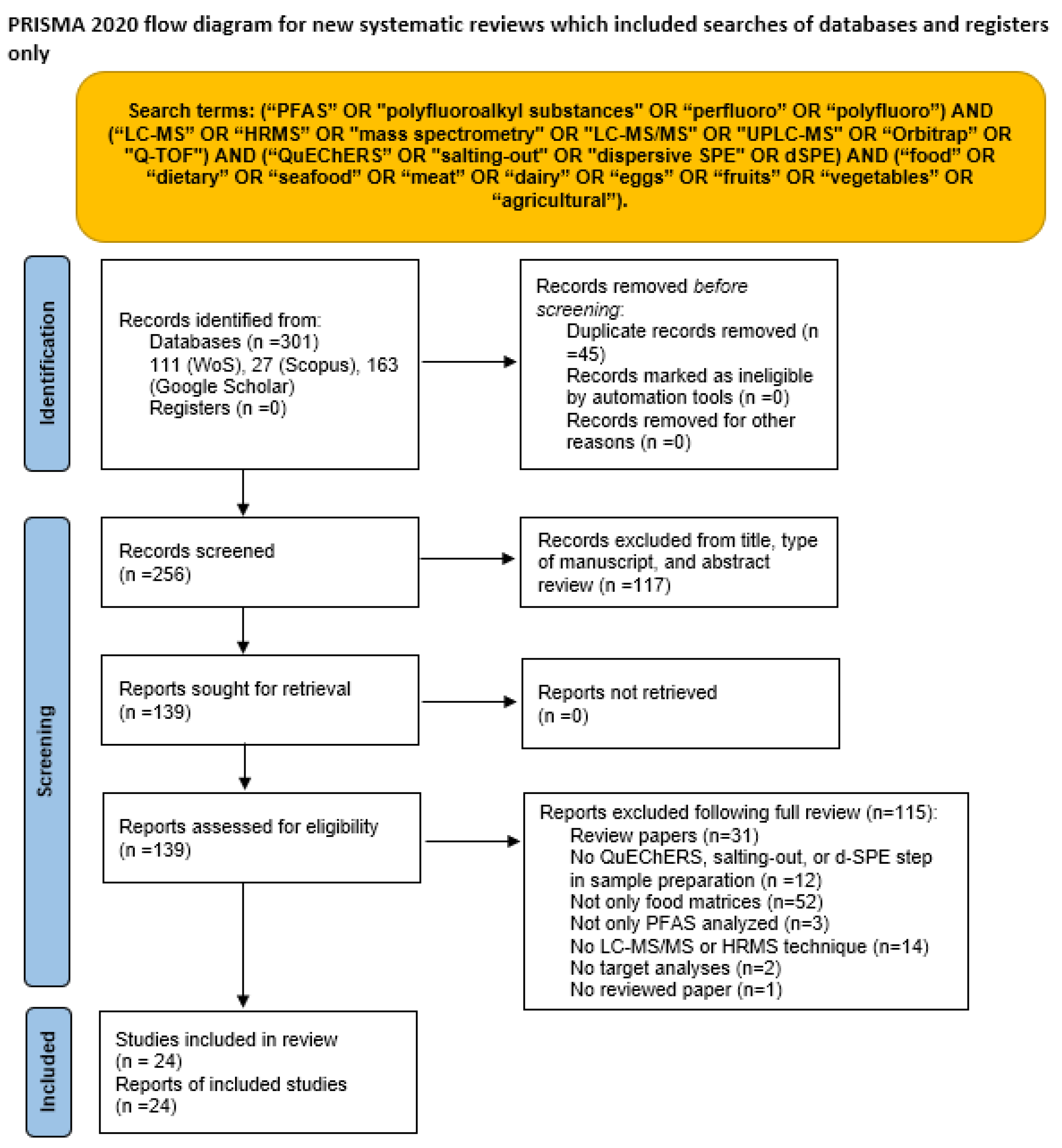
The search engines used for the manuscript selection were: Scopus, Web of Science (WOS), and Google Scholar. Search strings used were: (“PFAS” OR “polyfluoroalkyl substances” OR “perfluoro” OR “polyfluoro”) AND (“LC-MS” OR “HRMS” OR “mass spectrometry” OR “LC-MS/MS” OR “UPLC-MS” OR “Orbitrap” OR “Q-TOF”) AND (“QuEChERS” OR “salting-out” OR “dispersive SPE” OR dSPE) AND (“food” OR “dietary” OR “seafood” OR “meat” OR “dairy” OR “eggs” OR “fruits” OR “vegetables” OR “agricultural”). The research was performed on 18 December 2025 for all the databases. For Google Scholar, the first 100 records sorted by relevance were screened. Only manuscripts from 2010 to 2025 were considered for the review. The export from WOS gave 111 results, the export from Google Scholar gave 163 results, and the export from Scopus resulted in 27 documents. Articles from each search engine were combined, and duplicates (n = 45) were identified and removed using reference management software (Zotero 9) based on title, authors, year, and DOI, followed by manual verification. Two independent reviewers screened titles/abstracts and full texts against the eligibility criteria (Table S2); a third reviewer resolved any disagreements. Studies were eligible if they reported sufficient methodological detail to assess extraction, clean-up, and validation performance, and provided data that could be used to evaluate or discuss compliance with EU Regulation 2023/915 and/or Implementing Regulation 2022/1428. We excluded reviews, conference abstracts, books, theses, non-peer-reviewed material, studies outside the 2010–2025 time window, non-food or non-dietary matrices (e.g., serum, environmental or drinking water without a food context), multiclass methods without PFAS-specific performance data, methods lacking any QuEChERS/salting-out/d-SPE step, no MS studies, no English articles, and studies with insufficient methodological detail or no relevance to regulatory contaminant limits.
No automation tools were used for screening. After removal of duplicates (Figure 1), 256 records were screened by title, document type, and abstract, and 117 were excluded as not relevant. The remaining 139 reports were retrieved and assessed for eligibility. Of these, 115 full-text articles were excluded for the following reasons: review papers (n = 31); no QuEChERS, salting-out, or d-SPE step in sample preparation (n = 12); non-food or non-dietary matrices only (e.g., environmental water) (n = 52); methods without PFAS-specific validation data (n = 3); no LC-MS/MS or HRMS technique (n = 14); no targeted PFAS analysis (n = 2); and not a peer-reviewed article (n = 1). This resulted in a total of 24 articles.

2.3. Synthesis Methods

Sources were reviewed considering the matrices analyzed, the extraction procedure, the dSPE utilized for extraction and clean-up, the chromatography and spectrometry parts, the validation procedure, and the compliance with EU Regulation 2023/915 and EU Regulation 2022/1428. Data were systematically collected and organized across four main thematic areas (Table S4): (1) sample matrices and extraction techniques: animal-derived tissues (e.g., fish muscle, poultry muscle), plant-based matrices (coffee, rice, vegetables, fruits), food categories (infant formula, milk, water, edible oils). For each matrix, extraction techniques and physical sample preparation operations employed were considered (e.g., extraction solvents, sample treatment, and separation steps; (2) dSPE characteristics: salt used (e.g., sodium acetate, sodium chloride, magnesium sulfate), mineral phases (magnetite-silica, zirconium dioxide), sorbent materials (PSA, GCB, C18-bonded silica), specific quantities (g or mg) and combination of these reagents; (3) instrumental analyses and quality assurance/quality control (QC): analytical instrumentation (high performance liquid chromatography HPLC column, mobile phase), ionization techniques (ESI, APCI), MS types (triple quadrupole QqQ, Q-TOF, HRMS), quality control procedures (e.g., laboratory blanks, field blanks, procedural blanks, quantitative recovery standards, internal standards, standard reference material SRM); (4) compliance with European regulatory frameworks: EU Regulation 2023/915 MLs, EU Regulation 2022/1428 Table 5 for analytical method performance requirements (selectivity, RSD ≤ 20%, trueness 100 ± 20%, LOQ ≤ maximum level), EU Recommendation 2022/1431 for LOQ in matrices not regulated by EU Regulation 2023/915. If only unregulated matrices by EU Regulation 2023/915 were analyzed, the EU Recommendation 2022/1431 was considered instead for LOQ, even if a recommendation is not mandatory.
Where compliance with EU legislation was not explicitly stated by the authors, the method was classified as “Apparent compliant” if its performance characteristics would meet the criteria in Table 5 of Implementing Regulation (EU) 2022/1428 (applicability regarding foods specified in Regulation (EC) No 1881/2006, selectivity, RSD ≤ 20%, trueness (100 ± 20%, LOQs ≤ MLs, evaluated per analyte) and MLs of EU Regulation 2023/915 [30,68].
“Explicitly claimed compliance” classification was applied when authors stated their method met regulatory criteria. If neither of the two criteria was met, methods were classified as “non-compliant”. The total number of PFAS detected and PFAS classes reported was collected. When several optimization steps were presented, data from the final validated configuration were considered. All extracted data have been tabulated and are reported in Supplementary Information (Tables S4–S7). Data extracted were tabulated and summarized on Excel (Microsoft Office LTSC Standard 2021, v. 2108) in .csv format. Graphs were prepared with R software (4.1.2) (R Core Team).

2.4. Risk of Bias (RoB)

A methodological quality and RoB checklist was developed for analytical methods and applied to all included studies. This checklist covered three domains: (A) reporting and transparency, (B) validation criteria and optimization, and (C) quality control and external testing with predefined signaling questions and domain-level ratings (low risk, some concerns, high risk). The overall rating among the three domains was evaluated by the most frequent classification among the three domains. Domain-level scores and overall RoB judgements for each method are reported in Tables S3 and S4 and were used to inform the interpretation of the findings. Potential methodological limitations of individual methods (e.g., low recoveries, matrix effects, limited QC information) were considered qualitatively in the narrative synthesis and are discussed in the limitations section, consistent with similar methodological reviews [69].

3. Results and Discussions

3.1. Bias Assessment

The results of the RoB of the 24 sources (Tables S3 and S4) reporting for domain A (reporting and transparency, low risks n = 21, some concern n = 3, high concern n = 0) described in a reproducible way a validation design, provided raw data, chromatograms, and analytical parameters (precision, LOQ, accuracy). Domain B (validation criteria and optimization, low risks n = 21, some concern n = 3, high concern n = 0) was usually established a priori and met for the majority of target PFAS, and optimization steps (extraction conditions, dSPE sorbents, matrix-effect control) were documented sufficiently. Domain C (QC and external testing, low risks n = 20, some concern n = 4, high concern n = 0) was at a higher RoB because, despite sources describing blank strategies and applying the method to real food samples, a minority reported participation in interlaboratory studies, use of SRM, or other forms of external verification. However, SRMs, as described in some sources, are not always for matrices (especially fruits and vegetables) [70,71,72].
Most methods combine different PFAS analyses (20–40) in different matrices and achieve recoveries and RSD according to these necessities. In addition, recovery differences are strongly influenced by isotope dilution internal standards, and methods that apply a strict isotope dilution approach could report lower, but more accurate, recoveries. Each method has been optimized for PFAS panel size, matrix size, objectives (regulatory/research objectives), different regulatory limits, study design (QC, QA), instruments, and necessities. For these reasons, we strongly suggest that readers consult our Supplementary Materials, all the sources, and their Supplementary Materials.

3.2. Geographical Distribution

The 24 reviewed manuscripts originated from 11 countries, with almost all the sources from developed nations in the Northern Hemisphere (>95% from North America, Europe, and Asia-Pacific). The United States researchers contributed to 20.8% of the manuscripts (n = 5), some of whom were FDA employees who analyzed a wide range of matrices (e.g., cereals, meat, and seafood) [57,71,72,73,74]. Almost all the authors from Asia were from China, and they have contributed equally to the USA (20.8%, five manuscripts), analyzing PFAS in cereals, meat, and dairy [53,75,76,77,78]. Authors from the Republic of Korea investigated the presence of PFAS in rice and coffee in two separate manuscripts (8.3%), while researchers from Australia wrote a single manuscript about PFAS in vegetables [47,79,80]. Collectively, researchers from the Asia-Pacific region accounted for 37.5% of the global output, with authors based in China and the USA together represented 41.6% of the total origin of the manuscripts.
Authors from Europe were the most represented; they contributed 45.8% (10 manuscripts) from six countries. Authors from Italy contributed 12.5% (three manuscripts) and developed methods for the analysis of PFAS in animal matrices and fruits using UHPLC-HRMS [48,70,81]. Two studies conducted in Poland analyzed PFAS in high-protein foods and edible oils [82,83]. Scottish researcher (two manuscripts) analyzed PFAS in milk and processed foods [84,85]. Other European countries represented were France, Belgium, and Switzerland, each of which contributed with one manuscript [15,81,86]. A single manuscript was reported from South Africa, where authors validated a method that allows the analysis of PFAS for milk and infant formula [87]. This represents a fundamental limitation in monitoring the presence of PFAS globally, especially in African countries [88,89,90]. The geographical distribution of references is heavily skewed towards developed countries due to economic cost and regulatory pressure. No references were found from Latin American or Southeast Asian countries. This pattern could reflect not only differences in regulatory systems, but also unequal access to instruments (e.g., LC-MS/MS, HRMS) and funding that is more available in high-income regions [88,91]. Europe, China, and the USA engage in significant food trade, and each has its own regulations about PFAS in food that could influence the analytical focus in these regions. The acceleration of European method publications between 2023 and 2025 could be correlated with the implementation of EU Regulation 2023/915 MLs and EURL-POPs reference laboratory harmonization guidance, demonstrating that regulatory enforcement drives analytical method development and validation cycles [51,92,93,94]. Therefore, the geographical distribution of references does not primarily reflect PFAS exposure but rather where economic resources and regulatory pressure are sufficient to increase PFAS food-monitoring and method-validation activities.

3.3. Sample Matrices and Extraction Procedures

3.3.1. Sample Matrices Analyzed

PFAS determination in food requires sample preparation protocols that can extract a wide range of analytes while minimizing matrix interferences [71,95,96]. One of the most complex analytical challenges in determining PFAS in food is the need to cover a wide range of PFAS in diverse food products. Regarding PFAS, they can have different hydrophilic/lipophilic properties; in fact, they can span from short-chain (C4) to long-chain (C18) PFAS. For foods, nutritional properties and physical state can influence PFAS extraction and PFAS–matrix interaction. Despite this challenge, QuEChERS extraction and clean-up steps have been used successfully for routine analysis of PFAS in multi-matrix workflows, including products of both animal and plant origin [97,98,99,100,101,102].
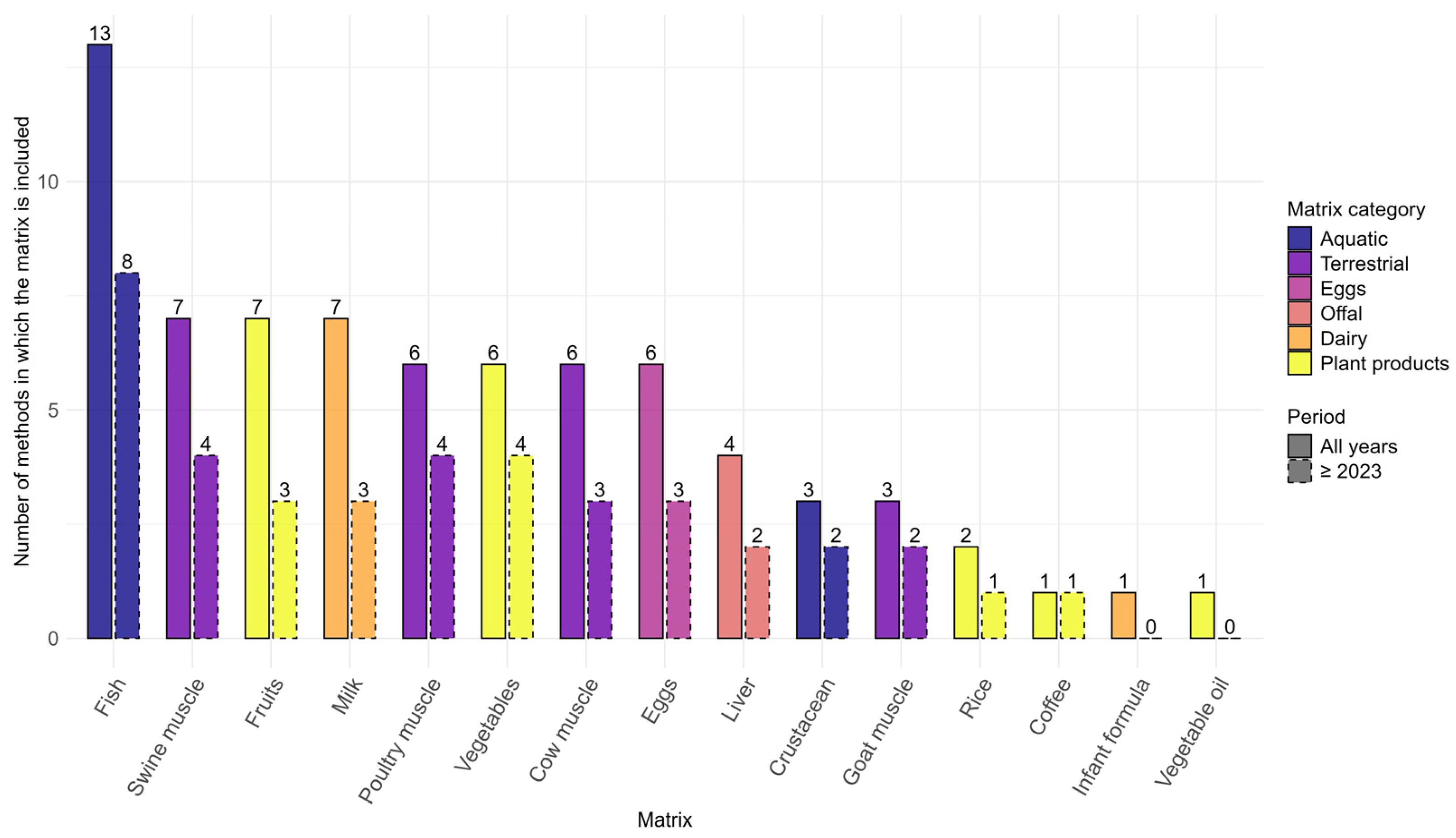
Foods of animal origin analyzed in the literature (Figure 2) for PFAS with the QuEChERS extraction included animal muscle, eggs, dairy products (milk, cheese, and yogurt), and offal (liver) (Table S3). Other matrices analyzed were fruits, rice, coffee, oil, and infant formula. Food matrices are not equally tested, and some of them are more analyzed for regulatory priorities and/or toxicological relevance [74]. Fish muscle is the most common matrix analyzed. This could be correlated to the fact that fish have a unique position in aquatic food webs and are linked to human dietary exposure [86,103,104]. In fact, fish can bioaccumulate PFAS (particularly PFOA and PFOS) in their tissues, especially in the liver and muscle, in higher concentrations than surrounding water or sediment [103,105,106]. The same pattern is observed in other animals (cow, goat, swine, poultry), which can accumulate PFAS in their meat and organs [107,108]. Plant product matrices are less frequently analyzed for several reasons. They generally exhibit lower PFAS concentrations and a less diverse profile of PFAS found compared to animal tissues [74].
Plants can take up PFAS from soil and water but generally lack complex bioaccumulation mechanisms found in higher trophic-level animals [109]. However, there is increasing evidence that these matrices can contain PFAS. Surveys in Australia reported that vegetables and fruits can be a reservoir of short-chain PFAS (C4-C7 PFCAs); PFBA was detected in over two-thirds of contaminated samples [80]. Furthermore, long-chain PFAS can bind to plant tissues (e.g., dill, garlic) that contain protein or can deposit on the surface of fruits in addition to root uptake [18]. Another factor that could be correlated with the presence of PFAS in plant-based foods is the packaging. In fact, packaging can be a source of emerging precursors that migrate under specific thermodynamic stresses. Hwang et al. (2025) reported that high pressure and high temperature (61 °C) of espresso machines significantly enhance the migration of 8:2 FTS and PFOA from polypropylene (PP) capsules compared to manual paper-filter brewing [79]. Similarly, boiling instant rice in its original PP packaging resulted in higher PFAS transfer compared to microwave heating [47]. Another reason why these matrices can contain PFAS is that supermarket vegetable bags can be a source of PFAS, especially PFOS, which was found in almost all tested bags [80]. Then, unlike animal tissues, plant matrices contain a broader and more heterogeneous co-extractives compounds (e.g., phenolic compounds and photosynthetic pigments) and are often considered as “matrix-rich and difficult to process”. Some studies adapted QuEChERS workflows originally developed for soil or animal biota to vegetables [72,110]. Furthermore, plant product matrices have heterogeneous PFAS translocation, with short-chain PFAS accumulating in aerial tissues and long-chain PFAS retained in roots [72,111]. These factors complicate the extraction and quantification of PFAS even when using QuEChERS protocols that were originally intended for the extraction of pesticides in fruits and vegetables [70]. Modifications in extraction solvents and clean-up sorbents are required to address the unique chemical compositions of different food groups [70,74]. Matrices such as fish, meat, and milk are characterized by high-protein and lipid contents that can retain long-chain PFAS [53,70,74]. In milk, proteins with binding properties can bind to long-chain PFAS, reducing extraction efficiency [53,70,74]. Lipids and fatty acids are frequently coextracted with PFAS and can reduce the instrumental signal (ion suppression) or coelute with them if not properly removed [53,70,74]. However, animal matrices have been validated in different protocols (EPA/FDA) due to the regulatory pressure, and they are more standardized. To date, there is a scarcity of methods specifically for plant matrices and a lack of comprehensive optimization and validation for PFAS across the wide variety of plant species compared to the work done for animal tissues [110]. Many of the reviewed methods were developed before the current European legislation entered into force. Therefore, further methods are still required to ensure compliance with EU requirements, plant-based matrices remain underrepresented and often rely on adapted protocols that do not fully address their complex co-extractive profiles or the distinct distribution of short- versus long-chain PFAS.

3.3.2. QuEChERS Protocols: General Considerations, Strengths and Challenges

Most methods used ACN-based QuEChERS extractions with EN-type salt mixtures (NaCl, MgSO4, and acetate/citrate buffers). ACN is the primary solvent used for the extraction of PFAS (95% of reviewed QuEChERS methods) because it precipitates proteins, solubilizes both short and long-chain PFAS, and is compatible with the salting-out precipitation. Mild acidification with FA, AA, or HCl at 0.1–1.5% (v/v) improves recoveries by reducing PFAS–matrix interactions; hydrophobic or electrostatic interactions can be disrupted by acid hydrolysis and promoting migration of partially protonated PFAS into the organic phase [70,77,78,83,112]. However, higher acidification (e.g., 2% of FA) can lead to lower recoveries, and a percentage of 0.1–1% is considered a good compromise [73,84]. This could be useful for lowering the recovery rates as a deliberate strategy to stay within the range of ±20% [53]. MeOH, often in combination with KOH at 0.01 M concentration, represents an alternative approach for protein-rich matrices because the alkaline conditions facilitate protein solubilization and can improve the recoveries for certain PFAS [51,73,81,113,114]; ACN provides broader applicability [101,115,116,117]. Mixtures of water and organic solvents (typically ACN or MeOH) in ratios ranging from 1:1 to 1:5 (v/v) have been used for improving extraction efficiency for PFAS [73,81]. Jeannot et al. reported that an ACN:H2O mixture with 1% FA achieved optimal signal intensity and signal-to-noise ratios for 28 target PFAS, outperforming other solvents [81]. The sample/volume ratio depends on the hydration of the sample and the method scope.
The first centrifugation, performed after the salting-out extraction step, separates the ACN phase from the aqueous phase and pellets precipitated proteins and salts. The second centrifugation, carried out after the d-SPE clean-up, separates the pellets from the sorbent materials [118,119,120]. Most methods reviewed have one or more steps of centrifugation that can initially separate the crude extract and then remove any residual particulates before instrumental injection (Table S4). Recent advancements have introduced integrated QuEChERS methods that eliminate the need for centrifugation entirely [53,84]. Magnetic separation reduces total sample preparation time; an external magnetic field applied in a range of 3 to 30 s can achieve solid–liquid separation much faster than traditional centrifugation while maintaining equivalent high recoveries [53,84]. Improper homogenization is a major source of imprecision [116,121]. For liquid samples, vortex mixing can be used instead [87].
The most common QuEChERS salts for salting-out are NaCl and MgSO4 in a 4:1 ratio, and this ratio is often commercially available in “salting-out” kits [53,57,75,82,87]. NaCl alone (600 mg) can increase the signal-to-noise ratios up to 2.5 times higher than the combined use with MgSO4 [81]. The use of buffers can increase the recovery of acid-sensitive PFAS precursors. A “safe” starting point could be 5 g of sample +0.5 g of disodium citrate sesquihydrate +1 g of sodium citrate +4 g of MgSO4 and 1 g of NaCl [53,74].
Despite different validated methods for the extraction of PFAS with QuEChERS techniques, there are some limitations that must be noted. Sorbent selection represents a critical choice in all QuEChERS-based extraction techniques, especially in PFAS, considering structural classes as different sorbent materials exhibit compound-specific adsorption characteristics which can impact accuracy [53]. PSA serves as a weak anion exchanger designed to remove organic acids, fatty acids, and polar interferences (e.g., sugar) through electrostatic interactions [81,122]. Therefore, PSA’s ion-exchange properties can retain ionizable PFAS (e.g., PFCAs, PFSAs), and they decrease recoveries if used in high quantities (e.g., 400 mg) [71,76,78]. It can cause significant loss of acidic PFAS (with recoveries falling below 50% for some carboxylates), requiring a reduction in its amount or its replacement with neutral polymers like PS-DVB [53,78].
Anionic PFAS, such as PFPAs and 8:2 PAP, are often completely lost during SPE or dSPE clean-up involving a weak anion exchanger (WAX) or GCB [123]. Recently, the use of other sorbents (PS-DVB, MWCNTs), magnetic nanomaterials like Fe3O4-TiO2, Florisil, and carbon X can target specific matrix interferences that traditional sorbents like PSA or C18 may fail to remove without analytical losses [53,71,75,77,78]. Multiple sorbents can produce interactive effects distinct from individual components and individual interactions with solvent and matrices [73]. The use of buffering agents (e.g., disodium citrate sesquihydrate, sodium acetate) can help to increase recovery of acid-sensitive PFAS precursors (N-MeFOSAA and N-EtFOSAA, FTS) [47,86].
In the next sections, we will discuss general strengths and challenges for each matrix with the aim of guiding ready-to-validate method development for a specific food.

3.3.3. Aquatic Animals’ Products (Fish, Crustaceans)

As mentioned in Section 3.3.1, aquatic animals’ products are the most studied matrices for the extraction of PFAS with the QuEChERS protocol. There are already validated methods that analyze the EU-regulated PFAS, in accordance with EU regulation performance criteria, in fish muscle as well as for NTS analyses [15,51,74,81]. For fresh tissue, the sample/solvent ratio ranges from 1:2 to 1:11 (w/v) [15,48,51,53,57,71,73,74,75,78,83,86,92], while up to 1:66 was used for freeze-dried samples and NTS analyses [73,81]. Mechanical homogenization, mechanical mincing and cryogenic grinding are used to reduce the interaction of PFAS–matrix and to increase the homogenization of the sample [53,57,71,74,86,123]. Sonication is also used to increase recovery and precision, both pre and post-extraction, and up to one hour of sonication at 30 °C was used to have better analytical parameters [73,83]. For fish and crustaceans, most authors applied the standard acidified ACN/EN salt template described in Section 3.3.2. Proteins and lipids are the primary contributors to the matrix effect and PSA (0.012–300 mg), GCB (0.012–300 mg), C18 (0.012–200 mg), followed by Envi-CARB (5–500 mg), UCT (150 mg), Florisil (100), PS-DVB (50 mg), Fe3O4-TiO2 (20 mg) and CarbonX (0.001 mg) can help to reduce these effects [53,74].
Liu et al. (2024) reported that more than 20 mg of C18 can decrease the recoveries of FTS, while less than 10 cannot be sufficient to remove lipid [53]; Gao et al. (2018) used 100 mg of C18 (+200 mg of PSA +100 mg of Florisil +50 mg of Envi-carb) to analyze legacy and emerging analytes (FTS included) [75]. An alternative strategy within QuEChERS workflows is to add an SPE clean-up step, which can efficiently remove lipids while preserving PFAS recoveries [76]. Filtration passage is also common (Table S5) with nylon filters at 0.22 μm, which is preferred because they can be used with no teflon rubber packaging that is a possible source of contamination [71,75,81]. Other materials involved in filtration are PES, PVDF, PP, and paper filters [15,48,78,83,86]. Crustaceans were validated in three sources and represent an analytical challenge despite the highest level of PFSA reported with co-occurrence and a PFOA content higher than MLs limits [15,71,81]. In particular, wild shrimp contained more PFAS than farmed [15]. Regarding matrix effects, FOSA and FOSE compounds can coelute with hydrophobic interferences and cause signal suppression, while FTS and FOSAA can have matrix enhancement [53,73,74]. The length of the PFSA’s chain seems to influence suppression (≤10 carbons) or enhancement (>10 carbons) of the signal [75].
Few methods are currently available for PFAS determination in crustaceans [15,71,81], and most sources focus on fish filets (muscle) rather than other tissues (viscera, fish organs) that might contain higher concentrations of PFAS. There is a clear need for additional methods targeting these matrices.

3.3.4. Terrestrial Animal Tissues (Muscles, Offal)

All reviewed methods that include terrestrial animal tissues (poultry, swine, bovine, goat muscle) also analyze fish muscle and/or crustaceans (Table S4). Most of the considerations described for aquatic animal products can also be extended to terrestrial animal muscle, considering the higher MLs permitted for these matrices. The same does not apply to offal, which has been validated in four studies and is considered a challenging matrix [15,48,71,83]. Three of them used HRMS that performs better than QqQ because cholic bile acids are isobaric interferences for PFOS and can cause false positives in low resolution [57,82,123]. Gallocchio et al. (2022) separate PFOS from taurodeoxycholic acid chromatographically [48].
While a simple QuEChERS extraction may be sufficient for muscle tissue, offal requires a more aggressive purification. Methods that included offal typically used higher PSA and C18 quantities (≥150–300 mg PSA and 150–500 mg C18) that are used specifically to remove fatty acids and cholic acid included in these matrices [15,81]. dSPE is often conducted twice or followed by a SPE scheme, such as 500 mg ENVI-Carb (or Bond Elut Carbon S) followed by 500 mg PFAS-WAX cartridges [15,81]. Regarding matrix effect, pork muscle contains higher lipid levels that can interfere [123]. Offal has signal suppression for next-generation PFAS like HPFO-DA [123]. All methods that include offal have a filtration step prior to analysis, and therefore, filtration is highly suggested (Table S4).

3.3.5. Eggs

Eggs represent not only one of the major dietary contributors to human PFSA exposure, but also a challenging matrix. All methods in this review that include offal in their matrix panel also analyze eggs, reflecting the related analytical issues [18,48,71,83]. Two other authors analyze eggs but with no offal [57,81]. However, eggs have lower MLs than offal, which increases the analytical challenge. Cholic acid and bile acids are also present in eggs and can cause false positives in QqQ for the PFOS analyte [57]. For purification purposes, a two-step SPE (500 mg of ENVI-Carb and WAX cartridge) can be useful to remove fatty acids and pigments from this matrix [15].
Typical workflows use a fully buffered EN-type salt packet (≈0.5–1.5 g disodium citrate sesquihydrate, 1 g sodium citrate, 4–6 g MgSO4, 1 g NaCl). The dSPE phase includes PSA (to remove organic acids, 150–300 mg), C18 (for lipids, >150 mg), and GCB (for pigments) [15,57,81].
Alternative clean-up strategies for egg extracts included freeze-out steps and membrane filtration or ultrafiltration to reduce the lipid load before injection [57,81,83,123]. However, these passages can retain long-chain PFAS or certain PFAS (HFPO-DA, NEtFOSAA, NMeFOSAA) that show poor sensitivity or low recoveries in eggs compared to beef or fish [15,57]. Eggs can induce both ion suppression for long-chain PFAS and ion enhancement for others [15,85].

3.3.6. Dairy and Infant Foods (Milk, Infant Formula)

Only Abafe et al. (2021) validated a QuEChERS method for infant foods successfully, while different authors developed a QuEChERS method for milk [18,48,71,76,84,85,87]. Considering the high-protein content, especially albumin in milk, ACN or MeOH are preferred [15,48]. Regarding salts used for the extraction salting-out step, NaCl (600 mg) can increase the signal-to-noise ratio up to 2.5 times higher than with other salts [81]. dSPE clean-up is performed combining PSA (150–300 mg) and C18 (150 mg), sometimes in addition with GCB or magnetic sorbent (50 mg magnetite–silica and 40 mg ZrO2), to reduce residual lipids [76]. Further passages may not be needed. Gallocchio et al. (2022), Abafe et al. (2021) and Shi et al. (2023) validated a confirmatory method for milk with QuEChERS protocol without any SPE step on QqQ in accordance with Commission Decision 2002/657/EC [48,84,87]. Other authors used a multistep clean-up scheme for the simultaneous analysis of milk with other matrices [18,71,85]. Regarding matrix effect, an ion suppression/enhancement is reported for different PFAS (e.g., PFBS +29%, PFDoA −45%) that can increase the difficulties to obtain acceptable performance criteria [48,87]. Milk contains later-eluting compounds that can interfere with long-chain PFAS [85].

3.3.7. Plant Products (Fruit, Vegetables, Rice, Coffee, and Vegetable Oil)

As mentioned in Section 3.3.1, plant products are underreported and represent one of the most difficult matrices for the PFAS extraction with QuEChERS protocols. They are characterized by different chemical profiles, ranging from the high-water content of berries to the high-fat level found in olives. However, QuEChERS protocols have been applied successfully to different fruits and vegetables [15,47,71,72,73,74,78,80,81,84,86].
Solvent ratio ranged from 1:1 to 1:6 for fresh samples and 1:15–1:110 for the freeze-dried [15,70,71,72,73,77,80,82]. Sonication procedure, from brief pulses to one hour, can also increase the recoveries and separate the matrix from the pigments, especially in olive fruits [48].
Plant products shared the same basic QuEChERS design but required greater adaptation of sorbent blends due to heterogeneity. Buffered ACN (often with 1% FA or AA) and EN-type salts combined with PSA (90–300 mg) and GCB (60–150 mg), or polymeric carbon sorbents (ENVI-Carb), can remove chlorophyll and phenolic compounds present in leafy vegetables and fruits while preserving PFAS recoveries [70,72,77]. This is extremely important in cranberries, where anthocyanins can cause matrix suppression [70,72]. Triglycerides and lipid content of olive fruits and edible oils require up to 400 mg GCB and 120–200 mg PSA or C18 for reducing the matrix effect below 10% or a combination of ENVI-Carb/C18/GCB or Agilent EMR-Lipid dSPE before instrumental analyses [70,82]. For rice, the extraction solvent was a mixture of water: ACN (1:2, pH ≈ 2.4) with NaOAc, MgSO4, and NaCl and 300 mg PSA + 150 mg GCB [79].
For coffee and other brewed beverages, solvent systems based on ACN (often with 0.1–1.5% FA or AA) and the 4 g MgSO4/1 g NaCl salt combination are used, with dSPE recipes such as MgSO4 + PSA or more complex ENVI-Carb/C18/GCB mixtures to address caffeine, Maillard products, and other components [79].

3.3.8. Take Home Messages

There is no “best solution” for all the matrices, and all the methods must be optimized for instruments, PFAS, and matrix panels, the aim of the method. A common start for the extraction procedure could be acidified ACN + EN-type salt template. Use ACN with 0.1–1% FA/AA/HCl and a standard EN-type salt packet per 5 g equivalent (≈0.5–1.5 g disodium citrate, 1 g sodium citrate, 4–6 g MgSO4, 1 g NaCl). Homogenization, sonication, and the phase separation step (centrifugation) are passages that can help before the dSPE step. Poor tissue disruption and incomplete phase separation are major sources of imprecision and matrix effects. Olive oil, eggs, and offal can be a challenging matrix. For dSPE steps, a common start could be PSA/C18, which can be sufficient and increase or diversify sorbents (GCB, ENVI-Carb, PS-DVB, EMR-Lipid, WAX) only when recoveries, LOQs, or matrix effects fail regulatory or validation criteria. Reserve heavy sorbent loads and two-step SPE (e.g., ENVI-Carb + WAX) for the most challenging matrices (offal, eggs, olives) and consider HRMS for these matrices. Prefer nylon or PES if filtration is needed.

3.4. Instrumental Analyses and Quality Assurance/Quality Control (QC)

3.4.1. Instrument Choice: LC-MS/MS or HRMS

Across the reviewed methods, ESI in negative mode was used almost exclusively, reflecting the acidic nature of PFAS and their efficient deprotonation under typical LC conditions. LC-MS/MS is the most common instrument for the quantitative PFAS determination in food and provides broader linear ranges for certain PFAS (e.g., FOSAAs, HFPO-DA) [57]. These performances require the use of isotopically labeled compounds [57,81].
HRMS offers clear advantages for suspect and NTS, retrospective analyses and can cope with isobaric compounds more easily, which can lead to false positives (cholic acid for PFOS) [51,57]. Taylor and Sapozhnikova developed a QuEChERSER method (where the last two letters stand for efficient and robust), and they compared HRMS and QqQ directly for the analyses of the same samples. While HRMS can differentiate isobaric compounds, QqQ requires changing the PFOS transition from m/z 499 > 80 to 499 > 99 in egg extracts to avoid false positives [57].
HRMS is the only effective tool for identifying unknown or previously unlisted PFAS. The use of HRMS allowed researchers to detect PFPrA in an egg sample for the first time, a compound that would have remained invisible to a targeted LC-MS/MS method [81]. Furthermore, HRMS is essential for branched isomers that were resolved in five studies, with four of them in HRMS [15,57,71,73,74]. Short-chain PFAS can hardly be detected in QqQ because some of them (PFBA, PFPeA) have one ion transition and can be difficult to confirm without a secondary ion [71,81].
Both instruments play complementary roles. LC-MS/MS is useful for analyzing already regulated PFAS and increasing the matrices validated for regulatory purposes, whereas HRMS is used to investigate and expand the analytical scope for emerging PFAS or unexplained signals in particularly challenging matrices.

3.4.2. Columns and Mobile Phases

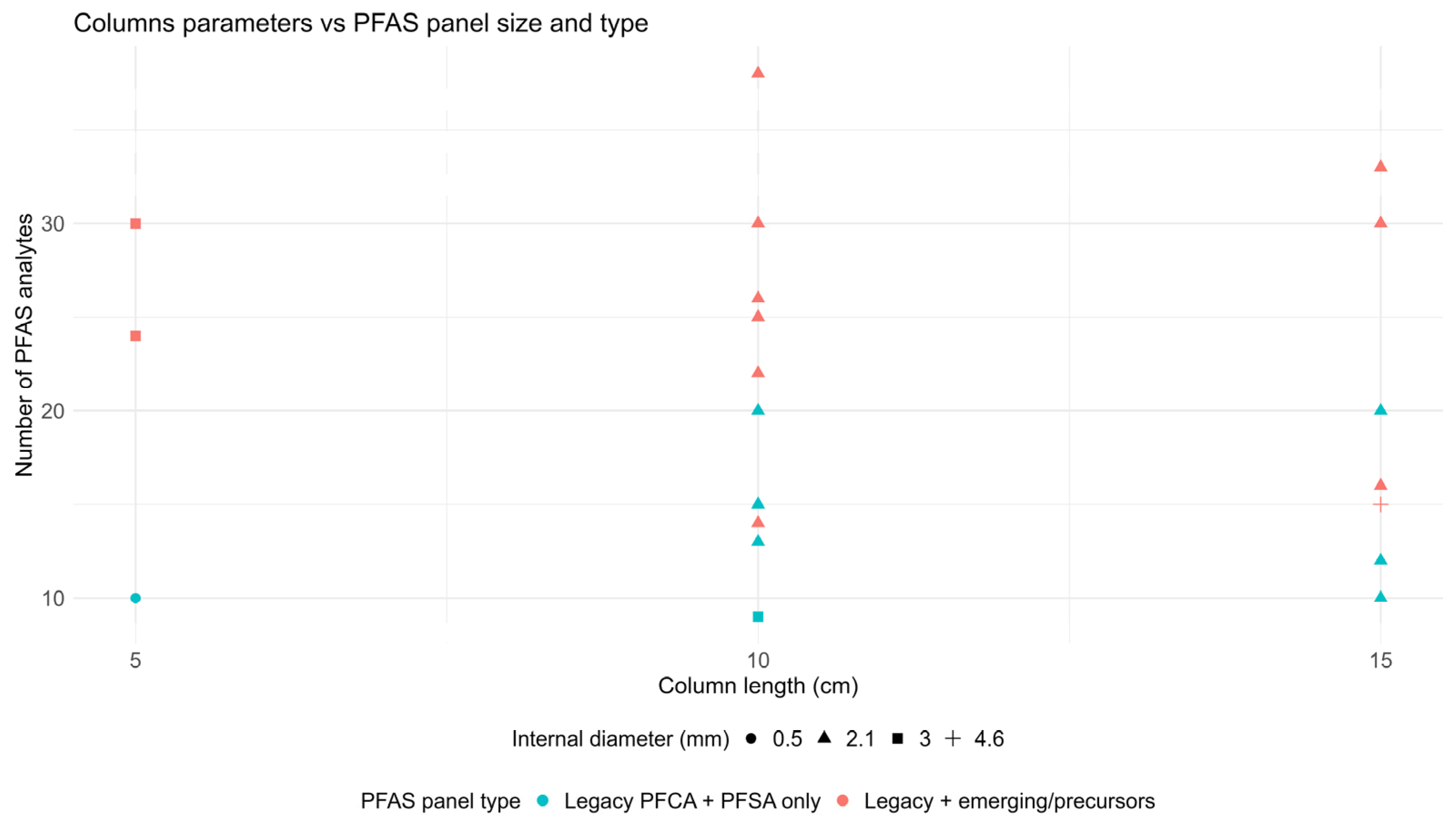
For most of the reviewed methods, PFAS were separated almost exclusively on reversed-phase C18 columns with lengths between 50 and 150 mm, internal diameters of 2.1–3.0 mm, and particle sizes from sub-2 µm (1.7–1.9 µm) to conventional 2.5–5 µm (Figure 3, Table S3). Columns of 50–150 mm × 2.1 mm are the dominant configuration across food matrices, and this makes methods more transferable across laboratories and agencies. These columns provide sufficient resolving power to baseline-separate homologues and branched/linear isomers within 10–20 min runs [15,47,51,53,57,70,71,72,76,77,78,79,81,84,85,86,87,112]. The length of the column (>50 mm) is important only when the PFAS panel is n > 30. If the number of PFAS to be analyzed is fewer, improvements in sample preparation or instrumental methods can be sufficient even for the analyses of PFECAs. Standard C18 phases can struggle with ultra-short-chain PFAS, and this can be one of the reasons why these compounds are not studied enough. Shorter columns are used where faster analyses are prioritized over PFAS panels [73,80,82,83,124]. Sub-2 µm particles deliver narrow peaks and high plate counts at UHPLC pressures, whereas 2.5–5 µm particles of similar dimensions offer greater robustness and compatibility with conventional HPLC systems for routine food-monitoring capacity [15,47,51,53,57,71,72,75,76,77,78,79,81,84,85,87,112,125].
Because PFAS leach from LC hardware, most methods include a PFAS delay column and/or a short guard column (typically 2.1 × 5–50 mm) between the mixer and analytical column to trap system-derived PFAS and protect the main column from matrix lipids and proteins over long injection sequences [15,47,71,74,76,78,79,80,85]. These columns help to mitigate the contamination of PFAS into LC systems or delay the elution of high lipid and protein content of complex food extracts. Genualdi et al. noted that using a guard column with a smaller internal diameter (e.g., 2.1 × 5 mm, 1.7 μm) was more effective at preventing matrix breakthrough to the analytical column than larger versions [71].
The selection and composition of the mobile phase can influence ionization efficiency, peak shape, and the resolution of analytes from complex matrix interferences [48,77]. Mobile phases were made by an aqueous phase (A) of water with 2–20 mM ammonium acetate or ammonium formate, sometimes with 1-methylpiperidine or a small amount of formic/acetic acid, and an organic phase (B) of methanol or acetonitrile containing the same volatile buffer and/or 0.1–0.3% acid [48,51,70,71,74,75,82,84].
Methanol is generally preferred when broad separation of PFAS homologous series and isomers is needed, while ACN is often selected for vegetable screening, high PFAS panels such as NTS applications, where lower backpressure is advantageous [48,74,76,77,81,85]. Acid conditions (0.1% v/v) of the mobile phases can increase the peak symmetry of short-chain carboxylic acids like PFBA, the performance of early-eluting compounds, and sensitivity in ESI. Ammonium acetate is the most common additive; pH adjusting (2.4 to 3.5) using formic acid can stabilize short-chain PFCAs [47,70,73,123].
Gradient programs started with a high aqueous percentage (typically 90% to 95% Phase A) to allow the initial retention of polar PFAS, followed by a linear increase in the organic phase to elute long-chain compounds [51,74,76]. Flow rates for methods with columns of 2.1 mm internal diameters are typically maintained between 0.2 and 0.4 mL/min, while some specialized micro-HPLC methods utilize much lower flow rates of approximately 20 µL/min [15,82,83].
Taken together, the data in Figure 3 suggest that laboratories analyzing broader PFAS panels (>30) tend to adopt longer columns (>100 mm) with an internal diameter of 2.1 mm. Shorter columns (50 mm) and larger particle sizes (2.5–5 µm) may compromise the resolution of complex PFAS panels, and methods developed with these columns are less frequent. Standard C18 columns can struggle to retain ultra-short-chain PFAS like PFBA and PFPeA that can elute near the solvent front, while columns with polar embedded groups enhance the retention of these early-eluting acids. Few studies systematically assess how changes in organic modifier, buffer strength, or pH translate into gains in detection limits, selectivity for isomeric species, or tolerance to matrix effects.

3.4.3. Quality Assurance and Quality Control

PFAS analyses can be tedious, considering the necessity to monitor analytical performances, PFAS leaks from the instrument, strong matrix effects, and the possible presence of PFAS in blanks. Most of the reviewed PFAS methods implemented QA/QC practices (Table 1 and Table S6). Isotopically labeled internal standards or surrogates were used in all the sources reviewed to correct one or more parameters such as extraction losses, volumetric deviations, and matrix effects (suppress or enhance) [18,47,48,51,53,57,70,71,72,73,74,75,76,77,78,79,80,81,82,83,84,85,86,87]. Both extracted internal standards (EIS) and non-extracted internal standards (NIS) were used to monitor the entire extraction efficiency and evaluate ionization variations. Contamination control was also widely addressed, with 83% of methods reporting at least one blank strategy (procedural and/or solvent blanks per batch), frequently combined with PFAS-free hardware, delay or guard columns, and replacing PTFE or Teflon with PEEK or HDPE to mitigate system background [15,16,50,71,72,74,75,78,79,81,122,123]. When these strategies were not possible, the signal of the blanks was subtracted from the signal of the samples to calculate the concentrations [78]. About half of the methods (46%) incorporated matrix spikes and/or duplicate samples per batch, and 20% performed continuing calibration checks (ICV/CCV) at the beginning/end of the batch or every 20 injections, supporting ongoing verification of calibration stability [47,48,53,57,73,74,76,77,80,86,87]. Matrix effects were explicitly evaluated in 79% of the studies, mostly by comparing slopes of matrix-matched and solvent calibration curves or by calculating matrix factors/SSE% or by direct comparison of peak areas [48,51,53,57,70,71,73,74,76,77,78,79,80,82,83,84,85,87]. LOQs were calculated by an S/N ratio of 10, as 3.3 × LOD or as the lowest spiking level meeting predefined performance criteria [15,47,48,72,74,75,76,79,80,81,83,84,86]. Regarding accuracy and precision, the biggest problem of QuEChERS extraction is maintaining them in an acceptable range for all the analytes. Several authors dropped some PFAS (e.g., PFNS, PFDS, FBSA, NFDHA, PFOS) in the PFAS panel analyzed because it was impossible to maintain recovery or precision in the range of predefined performance criteria [15,57,73,85]. Regarding precision, it was reported as RSD, and only some sources explicitly reported precision calculated over different days (intermediate precision, RSDR) [53,70,84,85,87,113]. Only 20% of the methods used SRMs to verify accuracy or assess matrix effects, 8.3% reported formal robustness studies (e.g., varying sample weight or chromatographic conditions), 12.5% provided expanded uncertainties (often using U = k × u or Nordtest-type approaches), and 16% reported participation in interlaboratory studies [15,48,57,71,73,74,75,87]. Finally, only 16% of the methods explicitly addressed the chromatographic separation of linear and branched PFAS isomers, mostly with HRMS [15,57,71,74].

3.4.4. Compliance with European Regulatory Frameworks

QuEChERS protocols can obtain performance criteria that are required by guidelines or regulations all over the world. The primary performance criteria that must be addressed in PFAS analytical method validation include linearity, accuracy (trueness), precision (repeatability and reproducibility), sensitivity (LOD/LOQ), selectivity (specificity), and the characterization of matrix effects. Acceptance criteria for these methods are often dictated by regulatory guidelines such as Commission Decision 2002/657/EC, the AOAC SMPR, or EPA Method 1633 [15,30,51,74,80]. The transition from the more permissive Commission Recommendation 2010/161/EU (which allowed 70–120% recovery) to the current EU 2022/1428 standard (requiring 80–120% trueness and ≤20% RSD) represents a significant increase in validation difficulty [68,83]. The results of the classification procedure between “Explicitly claimed compliant”, “Non-compliant”, and “Apparently compliant” are presented in Table S6, and the analytical performance of the method can be seen in Tables S6 and S7. Recent methods explicitly align their validation with Regulation (EU) 2023/915 MLs and Regulation (EU) 2022/1428, reporting LOQs at or below the MLs, trueness within 80–120%, and RSDs ≤ 20% [15,51,74]. However, only two reported branched/linear differences and one reported both branched/linear quantification and expanded uncertainties as required by Regulation (EU) 2022/1428 [15,51,74]. A larger group of studies can be considered “apparently compliant” in their analytical parameters for the four regulated PFAS and meet the numerical criteria in Table 5 of Regulation (EU) 2022/1428 and/or (EU) (2022/1431) for the corresponding matrices [48,57,73,75,76,78,83,84,87]. Some of them reported expanded uncertainties [48,87] while others differentiate branched/linear PFAS [57,73].
Finally, there are different “non-compliant” methods that are valid but were developed before the actual European regulations, outside the EU, and for research purposes [71,80]. Even if the EU Recommendation (2022/1431) is not mandatory, the LOQ limits can be really hard to obtain, especially for fruits and vegetables, and represent one of the most common causes of non-compliance [47,70,71,72,77,79,80,82,85,86]. Using EU regulation as a reference has important limitations outside Europe. Laboratories in other regions could validate methods according to alternative guidelines (e.g., EPA, GB 5009.253–2016) and could terminate the validation process once they have met their own predefined objectives, which are not necessarily aligned with EU requirements [126,127]. Furthermore, the geographical bias limits the global applicability of the findings.
However, EU regulation on PFAS in food is among the most stringent worldwide, and for this reason, we adopt it as the primary benchmark for evaluating analytical methods for performance criteria.
Older studies utilized remain robust, but a re-validation is needed for the tighter acceptance criteria. The branched/linear PFAS question remains a problem that needs more solutions.

3.4.5. Take Home Messages

For the four regulated PFAS, LC-MS/MS methods achieve the performance criteria of Regulation (EU) 2023/915 and 2022/1428 when appropriate QA/QC is applied, and isotopic standards are available. HRMS adds unique value for branched/linear isomers. Across the 24 sources reviewed, analytical parameters compliant with EU regulation can be obtained for the regulated PFAS (PFOS, PFOA, PFNA, and PFHxS) in high-protein matrices such as fish, meat, eggs, and milk. The predominant cause of non-compliance is insufficient LOQ, particularly for fruits and vegetables, where the 0.001 µg/kg targets in Recommendation 2022/1431 remain technically challenging. This gap reflects the combined effect of strong matrix effects in plant matrices, background contamination, and instrumental limits, rather than a fundamental inability of QuEChERS-based methods to deliver accurate and precise data. Quantification of branched/linear isomers remains an open challenge for regulatory purposes.

3.5. PFAS Analyzed

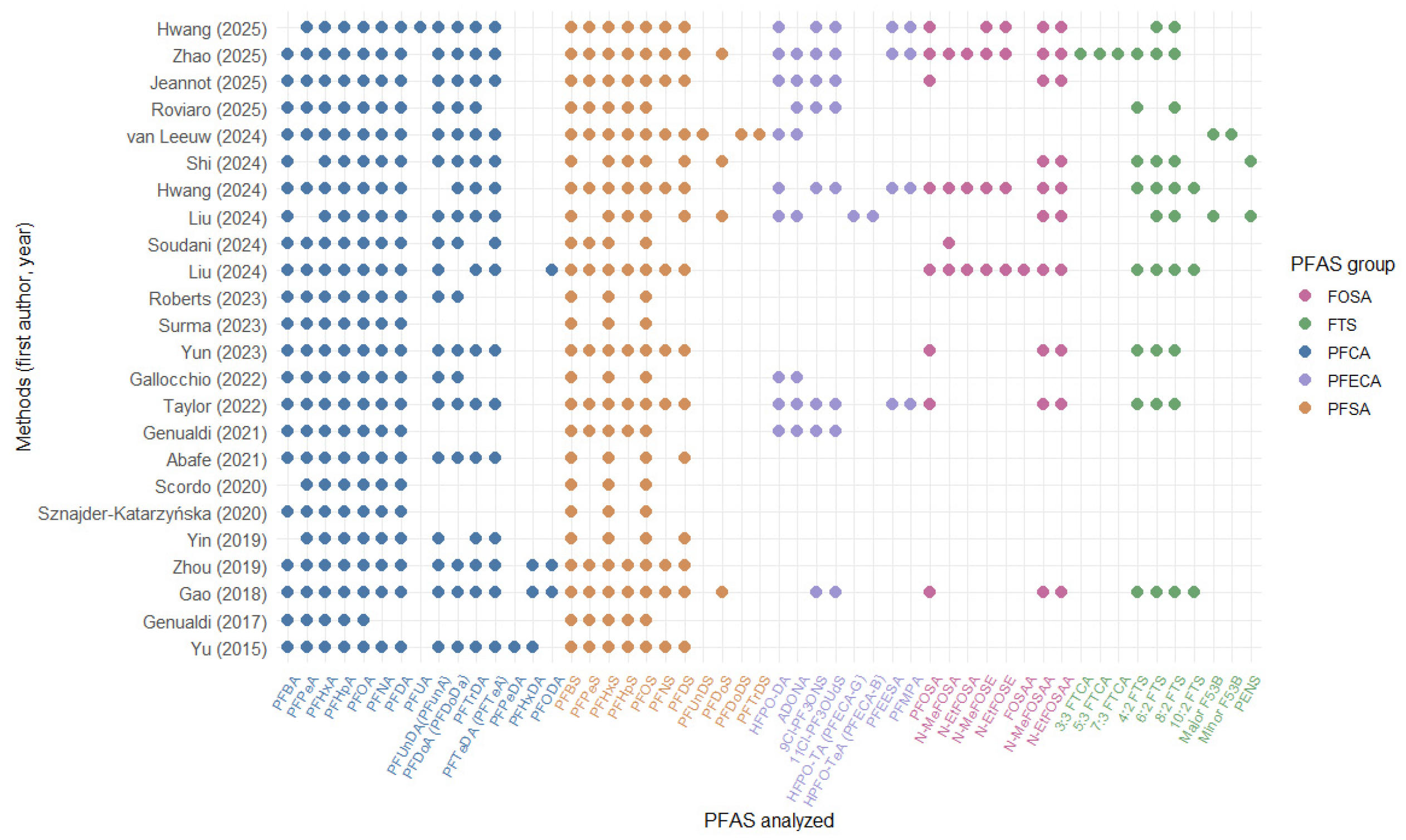
The analysis of PFAS in food matrices with QuEChERS protocols has expanded from nine compounds to more than 40 simultaneous quantification (Figure 4, Table S6) [70,74]. Almost all studies prioritize the four compounds frequently regulated that are 4-EFSA-PFAS: PFOS, PFOA, PFNA, and PFHxS [15,51,74,81,83,86]. These four compounds appear in the major part of the reviewed studies. The inclusion of branched and linear isomers for compounds like PFOS is also highlighted as essential for accurate quantification in complex animal tissues [15,74]. PFCAs represent the most frequently analyzed PFAS class across all food matrices, present in almost all reviewed studies. This homologous series features a perfluorinated carbon chain terminated by a carboxylic acid functional group (-CF2COOH), with chain lengths ranging from C4 to C18 carbons. Short PFCAs (C4–C7) and long-chain compounds (PFHxDA, PFODA/PFOcDA) were successfully detected and quantified in different food matrices [51,70,76,77]. Researchers developed QuEChERS protocols that targeted precursor compounds that can transform into persistent PFAS, such as FTSs ranging from 4:2 to 10:2, and perfluorooctane sulfonamido acetic acids like (N-MeFOSAA and N-EtFOSAA) [73,81]. Investigations were conducted into matrices like rice and brewed capsule coffee that have also included sulfonamides and sulfonamidoethanols such as FOSA, N-MeFOSE, and N-EtFOSE [47,79]. Also, “next-generation” industrial alternatives designed to replace legacy chemicals, such as ether acids like GenX (HFPO-DA), ADONA, and NaDONA, have been analyzed successfully [15,51]. Polyfluoroalkyl ether sulfonates, such as 6:2 and 8:2 Cl-PFAES (the components of F-53B), have emerged as significant contaminants in aquatic and marine environments. [53] While some methodologies remain focused on a core set of 9 to 15 legacy PFAAs to meet specific regulatory benchmarks in fish or milk, others adopt high-capacity target lists, such as the 40 analytes specified in EPA Method 1633, to provide a broader view of contamination [48,74,83,86]. There are different strategies to expand PFAS panels and to detect compounds that were not included in the original target list. Jeannot et al. (2025) combine HRMS with Kendrick Mass Defect (KMD) plots to identify previously unlisted PFAS, in fact PFAS of the same homologous series align horizontally in KMD space [81]. Another approach is the use of “sandwiched injection”, which can mitigate solvent-peak distortion for early-eluting, short-chain PFAS and improve their detection and quantification [74]. Another strategy that recent methods use to improve the analysis of short-chain PFAS is EMR, which can remove lipid and improve the short-chain PFAS signal [53,74].

4. Conclusions and Perspectives

This review has limitations. Analytical methods published after December 2025 were not captured by the search strategy and are therefore not included; only methods explicitly describing a QuEChERS or d-SPE step with salts were considered. Methods that analyze more types of analytes or non-food matrices were not included. However, there are methods that do not meet the eligibility criteria of the selection process but allow the analysis of different PFAS in multiple matrices without the use of salting-out mixtures [123]. Then, considering heterogeneity in food matrices and PFAS panels, as well as report validation parameters, a formal meta-analysis is precluded. Other than a customized RoB, no formal tool (e.g., risk-of-bias or certainty-of-evidence framework) was applied to grade the methodological quality of individual studies, and the assessment of robustness and generalizability of the reviewed methods is therefore qualitative.
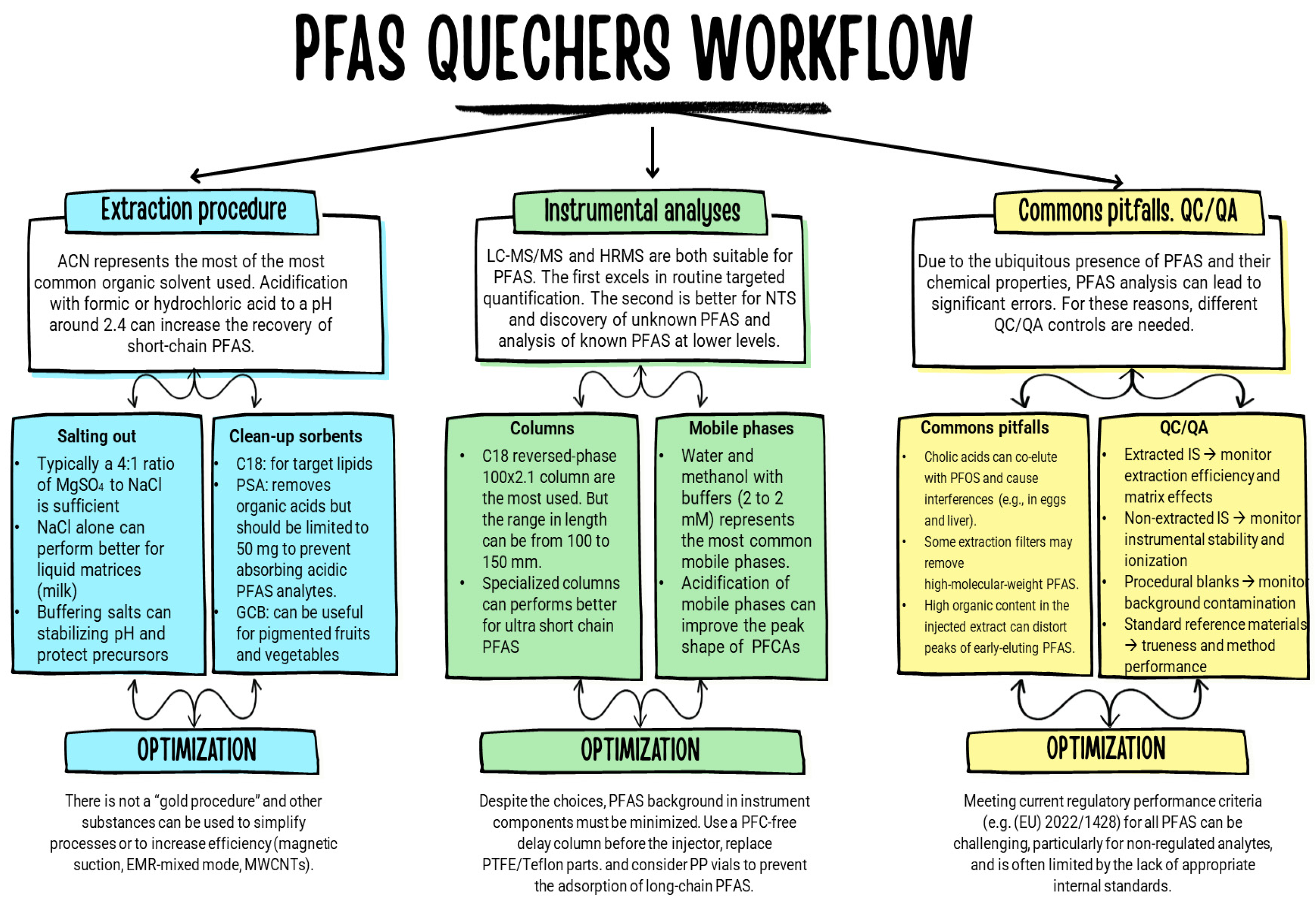
This review shows that the QuEChERS extraction can be used for PFAS determination in LC-MS/MS and HRMS (Table 2) from more than 45 PFAS panels (Figure 4). Methods are converging in matrices analyzed (Figure 2), salts, chromatographic conditions (Figure 3), and QA/QC practices (Table 1). The sorbent choice is not included in this “comfort zone” and remains matrix/PFAS/method dependent without a common strategy. At the same time, these methods have struggled to analyze certain PFAS (Figure 4) or some matrices (Figure 2) for the past 10 years. Critical aspects remain commercially available isotope standards and SRMs that can limit study comparability as assessed by RoB. Recent publications demonstrate that vegetables, berries, and packaged foods can be relevant contributors to dietary exposure, especially for C4–C7 PFCAs and packaging-derived precursors. Extended PFAS panels and advanced HRMS instrumentation are needed to capture these fractions. The major part of the current literature cannot demonstrate compliance with new EU regulations and therefore cannot be directly used for food monitoring, and the quantification of branched/linear isomers remains an open challenge, as well as short-chain PFAS.
Future work should therefore move beyond incremental adaptations of existing protocols and focus on targeted optimization and harmonization efforts. A good strategy could be to have a common procedure of validation for RSD (RSD and RSDR), LOQ, robustness, uncertainty, and proficiency test participation. Common performance criteria will not only improve data quality for current regulatory targets but also serve as an incentive for harmonizing future legislation. NTS by HRMS is a crucial complement for PFAS in food. Target analyses can be used in food safety labs, but they are blind to the vast majority of unknown or transformation products that may be present in food. NTS workflows offer the unique capability to uncover previously unmonitored PFAS, to track changes in industrial usage over time, and to flag candidates for future regulatory consideration. Future method development should prioritize integration between targeted quantification and NTS (e.g., shared sample preparation and harmonized QA/QC and reporting criteria) so that regulatory compliance data can be systematically complemented by broader PFAS fingerprinting and suspect/non-target discovery in food. Future work should prioritize plant-based matrices and short-chain PFAS, also. However, these two parameters combine difficult matrices with difficult analytes that are challenging to detect analytically. For method developers, the following practical recommendations emerge from this review (Figure 5): (1) acidified ACN-based QuEChERS with a 1:1–1:3 (w/v) sample-to-solvent ratio represents a starting point for most food matrices; (2) dSPE sorbent selection should be guided by matrix lipid and pigment content, C18/PSA combinations for animal tissues, and GCB-free protocols for plant matrices to avoid PFAS adsorption losses; (3) isotope-labeled internal standards covering all PFAS subclasses are essential for accurate quantification; (4) HRMS should be considered when the analytical scope includes PFAS precursors or difficult matrices that contain isobaric compounds or ultra-short-chain species; and (5) future method development should prioritize plant-based matrices, short-chain PFAS (C4–C6), branched/linear isomer separation, and geographically underrepresented regions, particularly Africa and South America.

Supplementary Materials

The following supporting information can be downloaded at: https://www.mdpi.com/article/10.3390/foods15111872/s1, Table S1: PRIMA Abstract checklist; Table S2: Inclusion and exclusion criteria applied during the systematic literature screening following PRISMA guidelines; Table S3: RoB; Table S4: RoB Guidance and legend; Table S5: Methods; Table S6: PFAS Panels; Table S7: QA/QC methods; Table S8: Compliance with EU regulation.

Author Contributions

All authors contributed substantially to the conception and development of this review. F.G.G. and E.M.D.M. had the idea of the article and defined the overall scope and structure. G.C., L.P., C.A., D.B. and A.M. performed the systematic literature search, screened the records, and extracted and organized the data. M.D.B., L.P., C.A. and D.B. carried out the comparative data analysis of QuEChERS-based methods for LC-MS/MS and HRMS. F.G.G. drafted the first version of the manuscript. E.M.D.M., V.C., A.P., G.M.L.D., and V.F. critically revised the work. All authors discussed the results, contributed to the interpretation of the findings, revised subsequent versions of the manuscript, and approved the final version for submission. All authors have read and agreed to the published version of the manuscript.

Funding

This study was supported by the Italian Ministry of Health—Ricerca Corrente IZSSI 05/24 C.U.P. H77G24000250001.

Institutional Review Board Statement

Not applicable.

Informed Consent Statement

Not applicable.

Data Availability Statement

No new data were created or analyzed in this study. Data sharing is not applicable to this article.

Acknowledgments

During the preparation of this work, the authors used Perplexity pro to review the grammar and the English form of the manuscript. The output was reviewed and edited by authors who take full responsibility for the content.

Conflicts of Interest

The authors declare no conflicts of interest.

Abbreviations

The following abbreviations are used in this manuscript:
PFASPer- and polyfluoroalkyl substances
PFOSPerfluorooctane sulfonic acid
PFOAPerfluorooctanoic acid
EU POPsEuropean Union Reference Laboratory for Halogenated Persistent Organic Pollutants
IARCInternational Agency for Research on Cancer
EFSAEuropean Food Safety Authority
PFNAperfluorononanoic acid
PFHxSperfluorohexane sulfonic acid
EURLEuropean Union Reference Laboratory
LC-MS/MSLiquid chromatography coupled with tandem mass spectrometry
TOFTime-of-flight
NTSnon-targeted screening
ACNacetonitrile
dSPEdispersive solid-phase extraction
QuEChERSQuick, Easy, Cheap, Effective, Rugged, Safe
HRMShigh-resolution mass spectrometry
PRISMAPreferred Reporting Items for Systematic Reviews and Meta-Analyses
PSAprimary–secondary amine
GCBgraphitized carbon black
QCquality control
ESIelectrospray ionization
APCIatmospheric pressure chemical ionization
QqQtriple quadrupole
Q-TOFquadrupole time of flight
RSDrelative standard deviation
LOQlimit of quantification
FAFormic acid
AAAcetic acid
HClhydrochloric acid
PFBAperfluorobutanoic acid
PFPrSperfluoropropanesulfonic acid
N-MeFOSAAN-methyl perfluorooctane sulfonamidoacetic acid
N-EtFOSAAN-ethyl-perfluorooctane sulfonamidoacetic acid
MeOHMethanol
KOHpotassium hydroxide
H2Owater
MTBEmethyl tert-butyl ether
QuEChERSERQuick, Easy, Cheap, Effective, Rugged, Safe, Efficient, Robust
FDAFood and Drug Administration
PESpolyether sulfone
PVDFpolyvinylidene fluoride
PPpolypropylene
NaClSodium chloride
MgSO4magnesium sulfate
FTSfluorotelomer sulfonates
PSAPrimary secondary amine
PFCAsPerfluoroalkyl carboxylic acids
PFSAsPerfluorosulfonic acids
PFTeDAPerfluorotetradecanoic acid
PFBSPerfluorobutanesulfonic acid
PFDSPerfluorodecanesulfonic acid
PS-DVBstyrene-divinylbenzene copolymer
C18Octadecylsilane
MWCNTsmulti-walled carbon nanotubes
PEEKpolyether ether ketone
AOACAssociation of Official Analytical Collaboration
SMPRStandard Method Performance Requirements
EPAEnvironmental Protection Agency
MLmaximum level
TWITolerable weekly intake
FOSAPerfluorooctanesulfonamide
N-MeFOSEN-methyl perfluorooctanesulfonamidoethanol
N-EtFOSEN-ethyl perfluorooctanesulfonamidoethanol
ADONA4,8-dioxa-3H-perfluorononanoic acid
NaDONASodium 4,8-dioxa-3H-perfluorononanoate
PFPrAperfluoropropanoic acid
PFAAsperfluoroalkyl acids
WAXweak anion exchange
2D-LCTwo-dimensional liquid chromatography
IMIon mobility
RoBRisk of bias
ICVInitial calibration verification
CCVContinuing calibration verification
SSESignal suppression/enhancement
SRMStandard reference material
RSDRIntermediate precision
USDAUnited States Department of Agriculture
KMDKendrick Mass Defect
EMREnhanced Matrix Removal

References

  1. Shen, C.; Zhang, J. Exposure Pathways and Human Health Risks of PFAS. In Ecological and Human Health Impacts of Contaminated Food and Environments; Wong, M.H., Ed.; CRC Press: Boca Raton, FL, USA, 2025; pp. 119–134. ISBN 978-1-040-36518-2. [Google Scholar]
  2. John, J.; Coulon, F.; Chellam, P.V. Detection and Treatment Strategies of Per- and Polyfluoroalkyl Substances (PFAS): Fate of PFAS through DPSIR Framework Analysis. J. Water Process Eng. 2022, 45, 102463. [Google Scholar] [CrossRef]
  3. Wee, S.Y.; Aris, A.Z. Revisiting the “Forever Chemicals”, PFOA and PFOS Exposure in Drinking Water. npj Clean Water 2023, 6, 57. [Google Scholar] [CrossRef]
  4. Klingelhöfer, D.; Braun, M.; Groneberg, D.A.; Brüggmann, D. The “Forever” per- and Polyfluoroalkyl Substances (PFAS): A Critical Accounting of Global Research on a Major Threat under Changing Regulations. Chemosphere 2024, 354, 141694. [Google Scholar] [CrossRef] [PubMed]
  5. Wackett, L.P. Nothing Lasts Forever: Understanding Microbial Biodegradation of Polyfluorinated Compounds and Perfluorinated Alkyl Substances. Microb. Biotechnol. 2022, 15, 773–792. [Google Scholar] [CrossRef] [PubMed]
  6. Arana Juve, J.-M.; Wang, B.; Wong, M.S.; Ateia, M.; Wei, Z. Complete Defluorination of Per- and Polyfluoroalkyl Substances—Dream or Reality? Curr. Opin. Chem. Eng. 2023, 41, 100943. [Google Scholar] [CrossRef]
  7. Mazumder, N.-U.-S.; Hossain, M.T.; Jahura, F.T.; Girase, A.; Hall, A.S.; Lu, J.; Ormond, R.B. Firefighters’ Exposure to per-and Polyfluoroalkyl Substances (PFAS) as an Occupational Hazard: A Review. Front. Mater. 2023, 10, 1143411. [Google Scholar] [CrossRef]
  8. Laitinen, J.A.; Koponen, J.; Koikkalainen, J.; Kiviranta, H. Firefighters’ Exposure to Perfluoroalkyl Acids and 2-Butoxyethanol Present in Firefighting Foams. Toxicol. Lett. 2014, 231, 227–232. [Google Scholar] [CrossRef]
  9. Sugiishi, T. Drastic influence of fluorine substitution in the organic molecules on regio- and enantioselective catalytic reactions. Yuki Gosei Kagaku Kyokaishi 2015, 73, 751–752. [Google Scholar] [CrossRef]
  10. Zorc, B.; Pavić, K. Organofluorine drugs. Farm. Glas. 2018, 74, 351–360. Available online: https://repozitorij.pharma.unizg.hr/object/pharma%253A918/FILE0 (accessed on 16 March 2026).
  11. Glüge, J.; Scheringer, M.; Cousins, I.T.; Dewitt, J.C.; Goldenman, G.; Herzke, D.; Lohmann, R.; Ng, C.A.; Trier, X.; Wang, Z. An Overview of the Uses of Per- And Polyfluoroalkyl Substances (PFAS). Environ. Sci. Process. Impacts 2020, 22, 2345–2373. [Google Scholar] [CrossRef]
  12. Reddy, V.P. Organofluorine Chemistry: Synthesis and Applications; Elsevier: Amsterdam, The Netherlands, 2020; ISBN 978-0-12-813286-9. [Google Scholar]
  13. Mulka, R.; Su, D.; Huang, W.-S.; Zhang, L.; Huang, H.; Lai, X.; Li, Y.; Xue, X.-S. FluoBase: A Fluorinated Agents Database. J. Cheminform. 2025, 17, 19. [Google Scholar] [CrossRef] [PubMed]
  14. Gaber, N.; Bero, L.; Woodruff, T.J. The Devil They Knew: Chemical Documents Analysis of Industry Influence on PFAS Science. Ann. Glob. Health 2023, 89, 37. [Google Scholar] [CrossRef] [PubMed]
  15. Van Leeuw, V.; Malysheva, S.V.; Fosseprez, G.; Murphy, A.; El Amraoui Aarab, C.; Andjelkovic, M.; Waegeneers, N.; Van Hoeck, E. Per- and Polyfluoroalkyl Substances in Food and Beverages: Determination by LC-HRMS and Occurrence in Products from the Belgian Market. Chemosphere 2024, 366, 143543. [Google Scholar] [CrossRef]
  16. De Silva, S.; Ball, A.S.; Indrapala, D.V.; Reichman, S.M. Review of the Interactions between Vehicular Emitted Potentially Toxic Elements, Roadside Soils, and Associated Biota. Chemosphere 2021, 263, 128135. [Google Scholar] [CrossRef]
  17. Piva, E.; Fais, P.; Ioime, P.; Forcato, M.; Viel, G.; Cecchetto, G.; Pascali, J.P. Per- and Polyfluoroalkyl Substances (PFAS) Presence in Food: Comparison among Fresh, Frozen and Ready-to-Eat Vegetables. Food Chem. 2023, 410, 135415. [Google Scholar] [CrossRef]
  18. Di Mario, M.; Bernard, L.; Legros, M.; Peltier, F.; Ciano, S.; Goscinny, S.; Focant, J.-F.; Van Hoeck, E. Risks Associated with the Presence of PFAS in FCM: An Investigation of the Belgian Market. Chemosphere 2024, 363, 142907. [Google Scholar] [CrossRef]
  19. Dimitrakopoulou, M.-E.; Karvounis, M.; Marinos, G.; Theodorakopoulou, Z.; Aloizou, E.; Petsangourakis, G.; Papakonstantinou, M.; Stoitsis, G. Comprehensive Analysis of PFAS Presence from Environment to Plate. npj Sci. Food 2024, 8, 80. [Google Scholar] [CrossRef]
  20. Jovanović, M.; Müller, V.; Feldmann, J.; Leitner, E. Analysis of Per- and Polyfluoroalkyl Substances (PFAS) in Raw Materials Intended for the Production of Paper-Based Food Contact Materials–Evaluating LC-MS/MS versus Total Fluorine and Extractable Organic Fluorine. Food Addit. Contam. Part A 2024, 41, 525–536. [Google Scholar] [CrossRef] [PubMed]
  21. Bonato, T.; Pal, T.; Benna, C.; Di Maria, F. Contamination of the Terrestrial Food Chain by Per- and Polyfluoroalkyl Substances (PFAS) and Related Human Health Risks: A Systematic Review. Sci. Total Environ. 2025, 961, 178337. [Google Scholar] [CrossRef]
  22. Sunderland, E.M.; Hu, X.C.; Dassuncao, C.; Tokranov, A.K.; Wagner, C.C.; Allen, J.G. A Review of the Pathways of Human Exposure to Poly- and Perfluoroalkyl Substances (PFASs) and Present Understanding of Health Effects. J. Expo. Sci. Environ. Epidemiol. 2019, 29, 131–147. [Google Scholar] [CrossRef]
  23. Hlouskova, V.; Hradkova, P.; Poustka, J.; Brambilla, G.; De Filipps, S.P.; D’Hollander, W.; Bervoets, L.; Herzke, D.; Huber, S.; de Voogt, P.; et al. Occurrence of Perfluoroalkyl Substances (PFASs) in Various Food Items of Animal Origin Collected in Four European Countries. Food Addit. Contam. Part A Chem. Anal. Control Exposure Risk Assess. 2013, 30, 1918–1932. [Google Scholar] [CrossRef]
  24. Pérez, F.; Llorca, M.; Köck-Schulmeyer, M.; Škrbić, B.; Silva, L.F.O.; da Boit Martinello, K.; Al-Dhabi, N.A.; Antić, I.; Farré, M.; Barceló, D. Assessment of Perfluoroalkyl Substances in Food Items at Global Scale. Environ. Res. 2014, 135, 181–189. [Google Scholar] [CrossRef] [PubMed]
  25. Qin, M.; Cheng, L.; Li, L.; Gan, Y.; Huo, J.; He, J.; Zhao, J.; He, L.-Y.; Tang, X.-Q. Contamination levels of per- and polyfluoroalkyl substances in animal-derived food and the associated health risk to the population, Chongqing. Mod. Prev. Med. 2025, 52, 1050–1057. [Google Scholar] [CrossRef]
  26. Bedi, M.; Sapozhnikova, Y.; Taylor, R.B.; Ng, C. Per- and Polyfluoroalkyl Substances (PFAS) Measured in Seafood from a Cross-Section of Retail Stores in the United States. J. Hazard. Mater. 2023, 459, 132062. [Google Scholar] [CrossRef] [PubMed]
  27. EFSA CONTAM Panel (EFSA Panel on Contaminants in the Food Chain); Knutsen, H.K.; Alexander, J.; Barregård, L.; Bignami, M.; Brüschweiler, B.; Ceccatelli, S.; Cottrill, B.; Dinovi, M.; Edler, L.; et al. Risk to Human Health Related to the Presence of Perfluorooctane Sulfonic Acid and Perfluorooctanoic Acid in Food. EFSA J. 2018, 16, e05194. [Google Scholar] [CrossRef]
  28. Pasecnaja, E.; Bartkevics, V.; Zacs, D. Occurrence of Selected Per- and Polyfluorinated Alkyl Substances (PFASs) in Food Available on the European Market—A Review on Levels and Human Exposure Assessment. Chemosphere 2022, 287, 132378. [Google Scholar] [CrossRef]
  29. International Agency for Research on Cancer. IARC Monographs Evaluate the Carcinogenicity of Perfluorooctanoic Acid (PFOA) and Perfluorooctanesulfonic Acid (PFOS). Available online: https://www.iarc.who.int/news-events/iarc-monographs-evaluate-the-carcinogenicity-of-perfluorooctanoic-acid-pfoa-and-perfluorooctanesulfonic-acid-pfos/ (accessed on 19 January 2026).
  30. No 1881/2006; Commission Regulation (EU) 2023/915 of 25 April 2023 on Maximum Levels for Certain Contaminants in Food and Repealing Regulation (EC). European Commission: Brussels, Belgium, 2023; Volume 119, p. 157.
  31. Panieri, E.; Baralic, K.; Djukic-Cosic, D.; Buha Djordjevic, A.; Saso, L. PFAS Molecules: A Major Concern for the Human Health and the Environment. Toxics 2022, 10, 44. [Google Scholar] [CrossRef]
  32. European Commission. Commission Regulation (EU) 2022/2388 of 7 December 2022 Amending Regulation (EC) No 1881/2006 as Regards Maximum Levels of Perfluoroalkyl Substances in Certain Foodstuffs. Off. J. Eur. Union 2022, 316, 38–41. [Google Scholar]
  33. Stecconi, T.; Tavoloni, T.; Stramenga, A.; Bacchiocchi, S.; Barola, C.; Dubbini, A.; Galarini, R.; Moretti, S.; Sagratini, G.; Piersanti, A. A LC-MS/MS Procedure for the Analysis of 19 Perfluoroalkyl Substances in Food Fulfilling Recent EU Regulations Requests. Talanta 2024, 266, 125054. [Google Scholar] [CrossRef]
  34. EUR-Lex—32010H0161—EN—EUR-Lex. Available online: https://eur-lex.europa.eu/eli/reco/2010/161/oj/eng (accessed on 23 September 2025).
  35. Delatour, T.; Theurillat, X.; Eriksen, B.; Mujahid, C.; Mottier, P. Inadequate Definition of the Limit of Quantification Used for the Analysis of Perfluoroalkyl Substances in Food by Liquid Chromatography–Tandem Mass Spectrometry May Compromise the Reliability of the Data Requested by the European Regulation. Rapid Commun. Mass Spectrom. 2023, 37, e9507. [Google Scholar] [CrossRef]
  36. Dodds, J.N.; Alexander, N.L.M.; Kirkwood, K.I.; Foster, M.R.; Hopkins, Z.R.; Knappe, D.R.U.; Baker, E.S. From Pesticides to Per- and Polyfluoroalkyl Substances: An Evaluation of Recent Targeted and Untargeted Mass Spectrometry Methods for Xenobiotics. Anal. Chem. 2021, 93, 641–656. [Google Scholar] [CrossRef]
  37. Megson, D.; Bruce-Vanderpuije, P.; Idowu, I.G.; Ekpe, O.D.; Sandau, C.D. A Systematic Review for Non-Targeted Analysis of per- and Polyfluoroalkyl Substances (PFAS). Sci. Total Environ. 2025, 960, 178240. [Google Scholar] [CrossRef]
  38. Ryan, C.R.M.; Nazdrajić, E.; Campbell, J.L.; Bell, K.Y.; Hopkins, W.S. Two-Dimensional LC × DMS Analysis of 34 PFAS Compounds. Anal. Chem. 2025, 97, 21050–21059. [Google Scholar] [CrossRef]
  39. Dodds, J.N.; Hopkins, Z.R.; Knappe, D.R.U.; Baker, E.S. Rapid Characterization of Per- and Polyfluoroalkyl Substances (PFAS) by Ion Mobility Spectrometry–Mass Spectrometry (IMS-MS). Anal. Chem. 2020, 92, 4427–4435. [Google Scholar] [CrossRef] [PubMed]
  40. Zweigle, J.; Bugsel, B.; Zwiener, C. FindPFΔS: Non-Target Screening for PFAS-Comprehensive Data Mining for MS2Fragment Mass Differences. Anal. Chem. 2022, 94, 10788–10796. [Google Scholar] [CrossRef]
  41. Pathak, D. Parmanu-Gunak: Data Reduction Software for Isotope Dilution Analysis. Geostand. Geoanalyt. Res. 2023, 47, 185–197. [Google Scholar] [CrossRef]
  42. Williams, M.L.; Olomukoro, A.A.; Emmons, R.V.; Godage, N.H.; Gionfriddo, E. Matrix Effects Demystified: Strategies for Resolving Challenges in Analytical Separations of Complex Samples. J. Sep. Sci. 2023, 46, e2300571. [Google Scholar] [CrossRef] [PubMed]
  43. Mofokeng, N.N.; Madikizela, L.M.; Tiggelman, I.; Sanganyado, E.; Chimuka, L. Suspect Screening of Per-and Polyfluoroalkyl Substances in Paper by Selective and Non-Selective Extraction with UHPLC-Q Orbitrap MS. Chemosphere 2024, 363, 142904. [Google Scholar] [CrossRef]
  44. Mu, H.; Yang, Z.; Chen, L.; Gu, C.; Ren, H.; Wu, B. Suspect and Nontarget Screening of Per- and Polyfluoroalkyl Substances Based on Ion Mobility Mass Spectrometry and Machine Learning Techniques. J. Hazard. Mater. 2024, 461, 132669. [Google Scholar] [CrossRef]
  45. Liu, X.; Zhang, T.; Tao, Y.; Lyu, Y. A Review of Research Progress on Detection and Screening Techniques for Perfluoroalkyl and Polyfluoroalkyl Substances. Yankuang Ceshi 2025, 44, 546–561. [Google Scholar] [CrossRef]
  46. Di Marcantonio, E.; Shouakar-Stash, O.; Marchesi, M.; Dallai, L. Compound-Specific Carbon Isotope Analysis of Perfluorocarboxylic Acids (PFCAs) by Gas Chromatography-Isotope Ratio Mass Spectrometry. Sci. Total Environ. 2025, 1001, 180564. [Google Scholar] [CrossRef]
  47. Hwang, S.H.; Ryu, S.Y.; Seo, D.; Kim, S.Y.; Lee, J.H.; Cho, Y.S. Development of a Method Using QuEChERS and LC-MS/MS for Analysis of per- and Polyfluoroalkyl Substances in Rice Matrix. Food Chem. 2024, 445, 138687. [Google Scholar] [CrossRef] [PubMed]
  48. Gallocchio, F.; Moressa, A.; Zonta, G.; Angeletti, R.; Lega, F. Fast and Sensitive Analysis of Short- and Long-Chain Perfluoroalkyl Substances in Foods of Animal Origin. Molecules 2022, 27, 7899. [Google Scholar] [CrossRef] [PubMed]
  49. Rawn, D.F.K.; Ménard, C.; Feng, S.Y. Method Development and Evaluation for the Determination of Perfluoroalkyl and Polyfluoroalkyl Substances in Multiple Food Matrices. Food Addit. Contam. Part A Chem. Anal. Control. Expo. Risk Assess. 2022, 39, 752–776. [Google Scholar] [CrossRef] [PubMed]
  50. Kubica, P.; Majchrzak, T.; Vakh, C. Unveiling Per- and Polyfluoroalkyl Substances Contamination in e-Cigarette Refill Liquids: A Comprehensive Analytical Assessment. Sci. Total Environ. 2025, 960, 178297. [Google Scholar] [CrossRef]
  51. Roviaro, A.; Scarduzio, A.; Savini, S.; Sannino, A. A Method for Determining PFAS in Bovine Meat and Tuna Fish by UHPLC-HRMS Orbitrap. J. Mass Spectrom. 2025, 60, e5151. [Google Scholar] [CrossRef]
  52. Liang, Z.; Feng, C.; You, J.; Qian, Z.; Le, S.; Lu, D. A comprehensive method for determination of 55 traditional and emerging per-and polyfluoroalkyl substances in infant complementary foods using liquid chromatography-high resolution mass spectrometry. J. Environ. Occup. Med. 2025, 42, 211–217. [Google Scholar] [CrossRef]
  53. Liu, X.; Liu, Z.; Zhao, H.; Shi, R.; Wang, J.; Liu, J.; Di, S.; Wang, Z.; Wang, X.; Liu, L.; et al. Development and Validation of Modified QuEChERS Method Combined with LC-MS/MS for High-Throughput Analysis of per- and Polyfluoroalkyl Substances in Fish Samples. Microchem. J. 2024, 199, 110037. [Google Scholar] [CrossRef]
  54. Pantano, L.; La Scala, L.; Olibrio, F.; Galluzzo, F.G.; Bongiorno, C.; Buscemi, M.D.; Macaluso, A.; Vella, A. QuEChERS LC–MS/MS Screening Method for Mycotoxin Detection in Cereal Products and Spices. Int. J. Environ. Res. Public Health 2021, 18, 3774. [Google Scholar] [CrossRef]
  55. Cammilleri, G.; Pulvirenti, A.; Vella, A.; Macaluso, A.; Lo Dico, G.M.; Giaccone, V.; Giordano, V.; Vinciguerra, M.; Cicero, N.; Cicero, A.; et al. Tetracycline Residues in Bovine Muscle and Liver Samples from Sicily (Southern Italy) by LC-MS/MS Method: A Six-Year Study. Molecules 2019, 24, 695. [Google Scholar] [CrossRef]
  56. Calvaruso, E.; Cammilleri, G.; Pulvirenti, A.; Dico, G.M.L.; Cascio, G.L.; Giaccone, V.; Badaco, V.V.; Ciprì, V.; Alessandra, M.M.; Vella, A.; et al. Residues of 165 Pesticides in Citrus Fruits Using LC-MS/MS: A Study of the Pesticides Distribution from the Peel to the Pulp. Nat. Prod. Res. 2020, 34, 34–38. [Google Scholar] [CrossRef]
  57. Taylor, R.B.; Sapozhnikova, Y. Comparison and Validation of the QuEChERSER Mega-Method for Determination of per- and Polyfluoroalkyl Substances in Foods by Liquid Chromatography with High-Resolution and Triple Quadrupole Mass Spectrometry. Anal. Chim. Acta 2022, 1230, 340400. [Google Scholar] [CrossRef] [PubMed]
  58. France Enacts Ban on ‘Forever Chemicals’—With One Big Exception. Available online: https://www.euronews.com/2026/01/01/frances-ban-on-forever-chemicals-comes-into-force-tomorrow-heres-what-will-change (accessed on 16 March 2026).
  59. Authorized Uses of PFAS in Food Contact Applications. FDA. 2025. Available online: https://www.fda.gov/food/process-contaminants-food/authorized-uses-pfas-food-contact-applications (accessed on 13 February 2026).
  60. News China Announces New Mandatory Standards for Food Contact Materials. Available online: https://www.sgs.com/en-ug/news/2025/04/safeguards-05525-china-announces-new-mandatory-standards-for-food-contact-materials (accessed on 9 May 2026).
  61. Al Amin, M.; Sobhani, Z.; Liu, Y.; Dharmaraja, R.; Chadalavada, S.; Naidu, R.; Chalker, J.M.; Fang, C. Recent Advances in the Analysis of Per-and Polyfluoroalkyl Substances (PFAS)—A Review. Environ. Technol. Innov. 2020, 19, 100879. [Google Scholar] [CrossRef]
  62. Jahnke, A.; Berger, U. Trace Analysis of Per-and Polyfluorinated Alkyl Substances in Various Matrices—How Do Current Methods Perform? J. Chromatogr. A 2009, 1216, 410–421. [Google Scholar] [CrossRef]
  63. Jiménez-Skrzypek, G.; González-Sálamo, J.; Hernández-Borges, J. Analytical Methodologies and Occurrence of Per-and Polyfluorinated Alkyl Substances–a Review. J. Chromatogr. Open 2023, 4, 100089. [Google Scholar] [CrossRef]
  64. Strynar, M.; McCord, J.; Newton, S.; Washington, J.; Barzen-Hanson, K.; Trier, X.; Liu, Y.; Dimzon, I.; Bugsel, B.; Zwiener, C.; et al. Practical Application Guide for the Discovery of Novel PFAS in Environmental Samples Using High Resolution Mass Spectrometry. J. Expo. Sci. Environ. Epidemiol. 2023, 33, 575–588. [Google Scholar] [CrossRef]
  65. Blake, B.E.; Fenton, S.E. Early Life Exposure to Per-and Polyfluoroalkyl Substances (PFAS) and Latent Health Outcomes: A Review Including the Placenta as a Target Tissue and Possible Driver of Peri-and Postnatal Effects. Toxicology 2020, 443, 152565. [Google Scholar] [CrossRef]
  66. Liu, Y.; D’Agostino, L.A.; Qu, G.; Jiang, G.; Martin, J.W. High-Resolution Mass Spectrometry (HRMS) Methods for Nontarget Discovery and Characterization of Poly-and per-Fluoroalkyl Substances (PFASs) in Environmental and Human Samples. TrAC Trends Anal. Chem. 2019, 121, 115420. [Google Scholar] [CrossRef]
  67. Page, M.J.; Moher, D.; Bossuyt, P.M.; Boutron, I.; Hoffmann, T.C.; Mulrow, C.D.; Shamseer, L.; Tetzlaff, J.M.; Akl, E.A.; Brennan, S.E. PRISMA 2020 Explanation and Elaboration: Updated Guidance and Exemplars for Reporting Systematic Reviews. Br. Med. J. 2021, 372, n160. [Google Scholar] [CrossRef] [PubMed]
  68. European Union. Regolamento di Esecuzione (UE) 2022/1428 della Commissione del 24 Agosto 2022 che Stabilisce Metodi di Campionamento e di Analisi per il Controllo delle Sostanze Perfluoroalchiliche in Alcuni Prodotti Alimentari. Off. J. Eur. Union 2022, 221, 66. [Google Scholar]
  69. Idowu, I.G.; Ekpe, O.D.; Megson, D.; Bruce-Vanderpuije, P.; Sandau, C.D. A Systematic Review of Methods for the Analysis of Total Per- and Polyfluoroalkyl Substances (PFAS). Sci. Total Environ. 2025, 967, 178644. [Google Scholar] [CrossRef]
  70. Scordo, C.V.A.; Checchini, L.; Renai, L.; Orlandini, S.; Bruzzoniti, M.C.; Fibbi, D.; Mandi, L.; Ouazzani, N.; Del Bubba, M. Optimization and Validation of a Method Based on QuEChERS Extraction and Liquid Chromatographic–Tandem Mass Spectrometric Analysis for the Determination of Perfluoroalkyl Acids in Strawberry and Olive Fruits, as Model Crops with Different Matrix Characteristics. J. Chromatogr. A 2020, 1621, 461038. [Google Scholar] [CrossRef]
  71. Genualdi, S.; Young, W.; DeJager, L.; Begley, T.H. Method Development and Validation of Per- and Polyfluoroalkyl Substances in Foods from FDA’s Total Diet Study Program. J. Agric. Food Chem. 2021, 69, 5599–5606. [Google Scholar] [CrossRef]
  72. Genualdi, S.; Jeong, N.; deJager, L.; Begley, T. Investigation into Perfluoroalkyl Substances (PFASs) in a Cranberry Bog: Method Development and Sampling Results. Food Addit. Contam. Part A Chem. Anal. Control. Expo. Risk Assess. 2017, 34, 2181–2189. [Google Scholar] [CrossRef]
  73. Yun, X.; Kurz, M.J.; Suri, R.; McKenzie, E.R. A Modified QuEChERS Sample Processing Method for the Determination of Per- and Polyfluoroalkyl Substances (PFAS) in Environmental Biological Matrices. MethodsX 2023, 11, 102290. [Google Scholar] [CrossRef]
  74. Zhao, L.; Xu, C.; Parry, E.; Giardina, M. Determination of Per-and Polyfluoroalkyl Substances in Tissue Using QuEChERS Extraction Followed by Novel Enhanced Matrix Removal Mixed-Mode Passthrough Cleanup with LC-MS/MS Detection. J. Chromatogr. A 2025, 1758, 466150. [Google Scholar] [CrossRef] [PubMed]
  75. Gao, Y.; Zhang, Q.; Li, X.; Li, X.; Li, H. Simultaneous Determination of Legacy and Emerging Per- and Polyfluoroalkyl Substances in Fish by QuEChERS Coupled with Ultrahigh Performance Liquid Chromatography Tandem Mass Spectrometry. Anal. Methods 2018, 10, 5715–5722. [Google Scholar] [CrossRef]
  76. Yu, Y.; Xu, D.; Lu, M.; Zhou, S.; Peng, T.; Yue, Z.; Zhou, Y. QuEChERs Combined with Online Interference Trapping LC-MS/MS Method for the Simultaneous Determination of 20 Polyfluoroalkane Substances in Dietary Milk. J. Agric. Food Chem. 2015, 63, 4087–4095. [Google Scholar] [CrossRef]
  77. Zhou, Y.; Lian, Y.; Sun, X.; Fu, L.; Duan, S.; Shang, C.; Jia, X.; Wu, Y.; Wang, M. Determination of 20 Perfluoroalkyl Substances in Greenhouse Vegetables with a Modified One-Step Pretreatment Approach Coupled with Ultra Performance Liquid Chromatography Tandem Mass Spectrometry(UPLC-MS-MS). Chemosphere 2019, 227, 470–479. [Google Scholar] [CrossRef] [PubMed]
  78. Yin, Y.; Zhao, C.; Zheng, G.; Li, L.; Liu, S.; Shan, Q.; Ma, L.; Zhu, X. Development of Styrene-Divinylbenzene Copolymer Beads Using QuEChERS for Simultaneous Detection and Quantification of 13 Perfluorinated Compounds in Aquatic Samples. Microchem. J. 2019, 144, 166–171. [Google Scholar] [CrossRef]
  79. Hwang, S.; Kim, S.Y.; Jeon, M.; Cho, Y.S. Perfluoroalkyl and Polyfluoroalkyl Substance Detection in Brewed Capsule Coffee. Foods 2025, 14, 980. [Google Scholar] [CrossRef]
  80. Liu, S.; Duan, L.; Shi, F.; Filippelli, G.M.; Naidu, R. Concentrations of Per- and Polyfluoroalkyl Substances in Vegetables from Sydney and Newcastle, Australia. J. Sci. Food Agric. 2024, 104, 6667–6675. [Google Scholar] [CrossRef]
  81. Jeannot, C.; Macorps, N.; Le Bizec, B.; Parinet, J.; Dervilly, G. Advancing PFASs Monitoring in Food: From Targeted SPE-LC-MS/MS to Non-Targeted QuEChERS-LC-HRMS Approaches. Food Chem. X 2025, 29, 102674. [Google Scholar] [CrossRef] [PubMed]
  82. Sznajder-Katarzyńska, K.; Surma, M.; Wiczkowski, W.; Piskuła, M. Determination of Perfluoroalkyl Substances (PFASs) in Fats and Oils by QuEChERS/Micro-HPLC-MS/MS. Food Res. Int. 2022, 137, 109583. [Google Scholar] [CrossRef]
  83. Surma, M.; Sznajder-Katarzyńska, K.; Wiczkowski, W.; Piskuła, M.; Zieliński, H. Detection of Per- and Polyfluoroalkyl Substances in High-Protein Food Products. Environ. Toxicol. Chem. 2023, 42, 2589–2598. [Google Scholar] [CrossRef]
  84. Shi, R.; Liu, L.; Liu, X.; Liu, Z.; Liu, J.; Wang, J.; Di, S.; Qi, P.; Wang, X. Integrated QuEChERS Combined with LC–MS/MS for High-Throughput Analysis of per- and Polyfluoroalkyl Substances in Milk. Anal. Bioanal. Chem. 2024, 416, 203–214. [Google Scholar] [CrossRef] [PubMed]
  85. Roberts, J.; McNaughtan, M.; de las Heras Prieto, H. Unwanted Ingredients—Highly Specific and Sensitive Method for the Extraction and Quantification of PFAS in Everyday Foods. Food Anal. Methods 2023, 16, 857–866. [Google Scholar] [CrossRef]
  86. Soudani, M.; Hegg, L.; Rime, C.; Coquoz, C.; Grosjean, D.B.; Danza, F.; Solcà, N.; Lucarini, F.; Staedler, D. Determination of Per- and Polyfluoroalkyl Substances (PFAS) in Six Different Fish Species from Swiss Lakes. Anal. Bioanal. Chem. 2024, 416, 6377–6386. [Google Scholar] [CrossRef]
  87. Abafe, O.A.; Macheka, L.R.; Olowoyo, J.O. Confirmatory Analysis of Per and Polyfluoroalkyl Substances in Milk and Infant Formula Using UHPLC-MS/MS. Molecules 2021, 26, 3664. [Google Scholar] [CrossRef]
  88. Aborode, A.T.; Adesola, R.O.; Idris, I.; Sakariyau Adio, W.; Olapade, S.; Oluwafisayo, G.; Onifade, I.A.; Fakorede, S.; Bakare-Abidola, T.; Olaoye, J.; et al. Challenges Associated With PFAS Detection Method in Africa. Environ. Health Insights 2025, 19, 11786302241310430. [Google Scholar] [CrossRef] [PubMed]
  89. Chokwe, T.B.; Themba, N.; Mahlambi, P.N.; Mngadi, S.V.; Sibali, L.L. Poly- and per-Fluoroalkyl Substances (PFAS) in the African Environments: Progress, Challenges, and Future Perspectives. Environ. Sci. Pollut. Res. 2024, 31, 65993–66008. [Google Scholar] [CrossRef] [PubMed]
  90. Vogel, C.; Slee, D. Analytical Techniques for Perand Polyfluoroalkyl Substances (PFAS). In Per- and Polyfluorinated Alkyl Substances: Occurrence, Toxicity and Remediation of PFAS; Naidu, R., Megharaj, M., Liu, Y., Umeh, A., Eds.; De Gruyter: Berlin, Germany, 2025; pp. 143–168. ISBN 978-3-11-079679-7. [Google Scholar]
  91. Joubert, B.R.; Mantooth, S.N.; McAllister, K.A. Environmental Health Research in Africa: Important Progress and Promising Opportunities. Front. Genet. 2020, 10, 1166. [Google Scholar] [CrossRef]
  92. Genualdi, S.; Young, W.; Peprah, E.; Srigley, C.; Fisher, C.M.; Ng, B.; deJager, L. Analyte and Matrix Method Extension of Per- and Polyfluoroalkyl Substances in Food and Feed. Anal. Bioanal. Chem. 2024, 416, 627–633. [Google Scholar] [CrossRef]
  93. Theurillat, X.; Mujahid, C.; Eriksen, B.; Griffin, A.; Savage, A.; Delatour, T.; Mottier, P. An LC-MS/MS Method for the Quantitative Determination of 57 per- and Polyfluoroalkyl Substances at Ng/Kg Levels in Different Food Matrices. Food Addit. Contam. Part A 2023, 40, 862–877. [Google Scholar] [CrossRef]
  94. Pasecnaja, E.; Zacs, D. Determination of Perfluorinated Substances (PFAS) Using LC-ORBITRAP-MS in Certain Foodstuffs of Animal Origin According to Newly Established EU Legislation. Food Anal. Methods 2024, 17, 640–649. [Google Scholar] [CrossRef]
  95. Schiavone, C.; Romaniello, F.; Brizio, P.; Suman, M.; Rossi, A.M.; Portesi, C. Reliable and Sensitive Ultra-Short Chain per- and Polyfluorinated Alkyl Substances (PFAS) Analysis in Food: A Polar Reverse-Phase Chromatography Approach. J. Chromatogr. A 2025, 1761, 466332. [Google Scholar] [CrossRef]
  96. Meng, P.; Destefano, N.J.; Knappe, D.R.U. Extraction and Matrix Cleanup Method for Analyzing Novel Per- and Polyfluoroalkyl Ether Acids and Other Per- and Polyfluoroalkyl Substances in Fruits and Vegetables. J. Agric. Food Chem. 2022, 70, 4792–4804. [Google Scholar] [CrossRef] [PubMed]
  97. Pareja, L.; Pérez-Parada, A.; Azcune, G.; Muela, A.; Colazzo, M. Determination of Multiclass Emerging Contaminants Using QuEChERS Method. In Emerging Contaminants in the Environment: Challenges and Sustainable Practices; Elsevier: Amsterdam, The Netherlands, 2022; pp. 335–380. ISBN 978-032385160-2. [Google Scholar]
  98. Chiang, C.-F.; Liao, P.-L.; Hsu, K.-C.; Shen, J.-Y.; Lin, J.-T.; Yang, D.-J. Establishment of Optimal QuEChERS Conditions of Various Food Matrices for Rapid Measurement of Heterocyclic Amines in Various Foods. Food Chem. 2022, 380, 132184. [Google Scholar] [CrossRef] [PubMed]
  99. Kaufmann, A.; Butcher, P.; Maden, K.; Walker, S.; Widmer, M. Assessment and Validation of the P-QuEChERS Sample Preparation Methodology for the Analysis of >200 Veterinary Drugs in Various Animal-Based Food Matrices. Food Addit. Contam. Part A 2023, 40, 356–372. [Google Scholar] [CrossRef]
  100. Samarasinghe, S.V.A.C.; Wijayawardena, A.; Khan, A.U.H.; Liu, Y.; Naidu, R. PFAS: An Overview of Their Physicochemical Properties and Implications. In Per- and Polyfluorinated Alkyl Substances: Occurrence, Toxicity and Remediation of PFAS; Naidu, R., Megharaj, M., Liu, Y., Umeh, A., Eds.; De Gruyter: Berlin, Germany, 2025; pp. 13–60. ISBN 978-3-11-079679-7. [Google Scholar]
  101. Lamb, B.G.; Ma, B. PFAS Self-Assembly and Adsorption Dynamics on Graphene: Molecular Insights into Chemical and Environmental Influences. Nanoscale 2025, 17, 10632–10643. [Google Scholar] [CrossRef]
  102. Leung, S.C.E.; Wanninayake, D.; Chen, D.; Nguyen, N.-T.; Li, Q. Physicochemical Properties and Interactions of Perfluoroalkyl Substances (PFAS)—Challenges and Opportunities in Sensing and Remediation. Sci. Total Environ. 2023, 905, 166764. [Google Scholar] [CrossRef]
  103. Walsh, H.L.; Blazer, V.S.; Lord, E.; Hurley, S.T.; LeBlanc, D.R. Occurrence and Tissue Distribution of Per- and Polyfluoroalkyl Substances (PFAS) in Fishes from Waterbodies with Point and Non-Point Sources in Massachusetts, USA. Aquat. Toxicol. 2025, 287, 107499. [Google Scholar] [CrossRef] [PubMed]
  104. Figueroa-Muñoz, G.; Murphy, C.A.; Whittum, K.; Zydlewski, J. Cleaner Cuts: Farmed Fish and Skin-off Fillets Are Lower in per- and Polyfluoroalkyl Substances (PFAS). Sci. Total Environ. 2025, 959, 178266. [Google Scholar] [CrossRef]
  105. Taiwo, M.D.; Kafeenah, H.; Duvernell, D.D.; Eze, M.O. Bioaccumulation Pattern of Per- and Polyfluoroalkyl Substances (PFAS) in Fish Tissues from Two Freshwater Systems. J. Hazard. Mater. Adv. 2025, 20, 100875. [Google Scholar] [CrossRef]
  106. Surma, M.; Hliwa, P.; Sznajder-Katarzyńska, K.; Wiczkowski, W.; Topolska, J.; Zieliński, H. Perfluoroalkyl Substance Contamination Levels of Pike (Esox lucius L.) and Roach (Rutilus rutilus, L.) from Selected Masurian Lakes in Eastern Europe. Environ. Toxicol. Chem. 2021, 40, 3317–3327. [Google Scholar] [CrossRef]
  107. George, S.E.; Baker, T.R.; Baker, B.B. Nonlethal Detection of PFAS Bioaccumulation and Biomagnification within Fishes in an Urban- and Wastewater-Dominant Great Lakes Watershed. Environ. Pollut. 2023, 321, 121123. [Google Scholar] [CrossRef]
  108. Chou, W.-C.; Tell, L.A.; Baynes, R.E.; Davis, J.L.; Cheng, Y.-H.; Maunsell, F.P.; Riviere, J.E.; Lin, Z. Development and Application of an Interactive Generic Physiologically Based Pharmacokinetic (igPBPK) Model for Adult Beef Cattle and Lactating Dairy Cows to Estimate Tissue Distribution and Edible Tissue and Milk Withdrawal Intervals for per- and Polyfluoroalkyl Substances (PFAS). Food Chem. Toxicol. 2023, 181, 114062. [Google Scholar] [CrossRef]
  109. Li, J.; Sun, J.; Li, P. Exposure Routes, Bioaccumulation and Toxic Effects of per- and Polyfluoroalkyl Substances (PFASs) on Plants: A Critical Review. Environ. Int. 2022, 158, 106891. [Google Scholar] [CrossRef]
  110. Nassazzi, W.; Lai, F.Y.; Ahrens, L. A Novel Method for Extraction, Clean-up and Analysis of per- and Polyfluoroalkyl Substances (PFAS) in Different Plant Matrices Using LC-MS/MS. J. Chromatogr. B 2022, 1212, 123514. [Google Scholar] [CrossRef] [PubMed]
  111. Sznajder-Katarzyńska, K.; Surma, M.; Cieślik, E.; Wiczkowski, W. The Perfluoroalkyl Substances (PFASs) Contamination of Fruits and Vegetables. Food Addit. Contam. Part A 2018, 35, 1776–1786. [Google Scholar] [CrossRef] [PubMed]
  112. Zhu, P.; Yue, Z.; Zheng, Z.; Zhang, Y.; Li, W.; Zhao, F.; Xiao, C.; Bai, R.; Lin, W. Determination of perfluoroalkyl acids in lamb liver by high performance liquid chromatography-tandem mass spectrometry combined with dispersive solid phase extraction. Chin. J. Chromatogr. 2015, 33, 494–500. [Google Scholar] [CrossRef][Green Version]
  113. Gao, Z.; Shen, P.; Lan, Y.; Cui, L.; Ohm, J.-B.; Chen, B.; Rao, J. Effect of Alkaline Extraction pH on Structure Properties, Solubility, and Beany Flavor of Yellow Pea Protein Isolate. Food Res. Int. 2020, 131, 109045. [Google Scholar] [CrossRef]
  114. Park, H.-J.; Oh, Y.-G.; Chun, A.; Seo, J.H.; Oh, E.; Chu, J.H.; Ju, Y.K.; Ye, S.-J. Functional Properties Modulation of Soybean, Adzuki Bean, Mung Bean, and Peanut Proteins Through Alkaline Extraction pH. Food Sci. Nutr. 2025, 13, e71140. [Google Scholar] [CrossRef]
  115. Ahmadireskety, A.; Da Silva, B.F.; Townsend, T.G.; Yost, R.A.; Solo-Gabriele, H.M.; Bowden, J.A. Evaluation of Extraction Workflows for Quantitative Analysis of Per- and Polyfluoroalkyl Substances: A Case Study Using Soil Adjacent to a Landfill. Sci. Total Environ. 2021, 760, 143944. [Google Scholar] [CrossRef]
  116. Mertens, H.; Noll, B.; Schwerdtle, T.; Abraham, K.; Monien, B.H. Less Is More: A Methodological Assessment of Extraction Techniques for per- and Polyfluoroalkyl Substances (PFAS) Analysis in Mammalian Tissues. Anal. Bioanal. Chem. 2023, 415, 5925–5938. [Google Scholar] [CrossRef]
  117. Shojaei, M.; Kumar, N.; Guelfo, J.L. An Integrated Approach for Determination of Total Per- and Polyfluoroalkyl Substances (PFAS). Environ. Sci. Technol. 2022, 56, 14517–14527. [Google Scholar] [CrossRef] [PubMed]
  118. Qian, X.; Gong, R.; Zhang, F. A Centrifuge-Free, High-Throughput Liquid-Liquid Extraction Phase Separation Filter Column and Its Application in the Detection of Dihydrotestosterone in Plasma. Curr. Pharm. Anal. 2025, 21, 366–374. [Google Scholar] [CrossRef]
  119. Musarurwa, H.; Chimuka, L.; Pakade, V.E.; Tavengwa, N.T. Recent Developments and Applications of QuEChERS Based Techniques on Food Samples during Pesticide Analysis. J. Food Compos. Anal. 2019, 84, 103314. [Google Scholar] [CrossRef]
  120. Wang, J.; He, Z.; Wang, L.; Xu, Y.; Peng, Y.; Liu, X. Automatic Single-Step Quick, Easy, Cheap, Effective, Rugged and Safe Sample Preparation Devices for Analysis of Pesticide Residues in Foods. J. Chromatogr. A 2017, 1521, 10–18. [Google Scholar] [CrossRef]
  121. Li, S.; Yan, J.; Zhai, W.; Yu, W.; Jiang, T.; Chen, J.; Bai, X.; Liang, S.; Yuan, S.; Duan, H.; et al. Enhanced Full-Process Method for the Quantitative Analysis of PFAS in Sludge: Robust Extraction and Matrix Effect-Minimized Method. Water Res. 2026, 288, 124666. [Google Scholar] [CrossRef] [PubMed]
  122. Casado, N.; Morante-Zarcero, S.; Sierra, I. Application of the QuEChERS Strategy as a Useful Sample Preparation Tool for the Multiresidue Determination of Pyrrolizidine Alkaloids in Food and Feed Samples: A Critical Overview. Appl. Sci. 2022, 12, 4325. [Google Scholar] [CrossRef]
  123. Stroski, K.M.; Sapozhnikova, Y. Method Development and Validation for Analysis of 74 Per- and Polyfluoroalkyl Substances (PFAS) in Food of Animal Origin Using QuEChERSER Method and LC-MS/MS. Anal. Chim. Acta 2025, 1364, 344216. [Google Scholar] [CrossRef] [PubMed]
  124. Koloka, O.; Boti, V.; Hela, D.; Albanis, T.; Konstantinou, I. PFAS Residue Analysis in Fish and Fish Feed by Applying a Modified QuEChERS Method in Combination with LC-HRMS Detection. Emerg. Contam. 2025, 11, 100467. [Google Scholar] [CrossRef]
  125. Genualdi, S. Determination of 30 Per and Polyfluoroalkyl Substances (PFAS) in Food and Feed Using Liquid Chromatography-Tandem Mass Spectrometry (LC-MS/MS). Available online: https://www.fda.gov/media/131510/download (accessed on 13 February 2026).
  126. Guidelines for the Validation of Microbiological Methods for the FDA Foods Program, 3rd Edition. Available online: https://www.fda.gov/media/83812/download (accessed on 13 February 2026).
  127. GB 5009.253-2016; National Food Safety Standard—Determination of Perfluorooctane Sulfonate (PFOS) and Per-Fluorooctanoic Acid (PFOA) in Animal-Derived Food. National Health and Family Planning Commission of the People’s Republic of China: Beijing, China, 2016.
Figure 1. Selection and exclusion processes for the literature review, The flow diagram is adapted from Page, M.J. et al. [67].
Foods 15 01872 g001
Figure 2. Number of QuEChERS-based PFAS methods in which each food matrix is included. For every matrix, bars represent all identified methods (solid line) and those published from 2023 onwards (dashed line).
Foods 15 01872 g002
Figure 3. Column parameters vs. PFAS panel size and type. Scatter plot showing the number of targeted PFAS analytes as a function of LC column length, with symbols indicating column internal diameter and colors distinguishing PFAS panel classes. Methods were classified as “legacy PFCA + PFSA only” when targeting PFCA and PFSA exclusively, and as “legacy + emerging/precursors” when the panel also included PFECA, FTS, FOSA and related compounds, and/or other emerging PFAS. The 2.1 × 100 mm columns represent the most common column used for the analysis of PFAS.
Foods 15 01872 g003
Figure 4. Span and composition of PFAS panels in the 24 validated LC–MS/MS methods reviewed. Each row represents a method (ordered chronologically), and each point marks an individual PFAS included in the corresponding analytical panel, with point position along the x-axis indicating the specific compound. Colors identify chemical class (PFCA, PFSA, PFECA, FOSA derivatives, FTS, or other PFAS). From 2015 to 2025, methods have been developed to increase the range of PFAS analyzed, considering the new compounds discovered. Early protocols (2015–2018) targeted relatively small panels dominated by PFSAs and PFCAs, whereas recent methods (2022–2025) consistently include FTSs, PFECAs and FOSA, often exceeding 30 analytes. Despite the temporal expansion of the PFAS panel, there are persistent gaps, such as the limited inclusion of PFECAs and short-chain PFAS [15,47,48,51,53,57,70,71,72,73,74,75,76,77,78,79,80,81,82,83,84,85,86,87].
Foods 15 01872 g004
Figure 5. Overview of the PFAS QuEChERS workflow with key steps in extraction, instrumental analysis, and QC/QA, with common pitfalls and optimization strategies for PFAS determination in food matrices.
Foods 15 01872 g005
Table 1. Quality assurance and quality control (QA/QC) strategies reported across the sources.
Strategies for Monitoring PFAS Analyses%Notes
Isotope utilized100To validate the method, the authors used isotope standards when possible. If not commercially available, authors used a surrogate instead.
Blank strategy during analyses83Common strategies include procedural or/and/or solvent blanks for each batch or when needed. If the instrumental system leaches PFAS, the signal of blanks was subtracted from the calibration curve. The guard and delay columns are also applied.
Spikes/Duplicates during analyses46One/two matrix spiked standards in each batch or after some injections.
Continuing Calibration Verification (ICV/CCV)20At the beginning and at the end of the batch, or every 20 injections.
Matrix effect assessment79Almost calculated by the ratio of the slope of the matrix-matched calibration curve and the slope of the calibration curve of the standard solution in solvent at the same spiking range. Some authors compare the area.
Recovery/trueness (%)95Most sources calculate recovery as the ratio between the measured concentration in spiked samples/spiked concentrations.
Precision (%RSD)83Precision was calculated as the population standard deviation divided by the population mean. It is calculated by replicates (from 3 to 7), often in a single day. Some sources report inter-day precision evaluated from 3 to 5 days.
LOD/LOQ95Calculated from the S/N ratio of 10, 3.3 × LOD (3.3 times the standard deviation of the blank), or some studies report the LOQ as the lowest spiked level that respects performance criteria.
SRM20Reference material was used for evaluating the performance of the method or to calculate the matrix effect.
Robustness8.3Reported by 2 sources. Calculated by varying sample weight, particle size of chromatographic columns, or mobile phases.
Expanded uncertainties12.5The expanded measurement uncertainty was calculated with the U = k × u, where u is the combined standard measurement uncertainty and k (2) is the covering factor, or through the Nordtest Approach.
Participation in interlaboratory studies16Four sources participate in interlaboratory studies.
Branched/linear separation16Separation between branched and linear isomers of PFAS was performed by four sources. Three of them were obtained by HRMS.
Table 2. Summary of QuEChERS-based LC–MS/MS and HRMS methods for PFAS determination in food matrices analyzed in this study. The table reports, for each study (S), the food matrix, country, number of PFAS analyzed analytes (N), extraction solvent, clean-up sorbent(s), instrument (LC–MS/MS or HRMS), limits of quantitation (LOQ range), recovery (R%) and precision (RSD) ranges, number of isotope-labeled internal standards (NIS), application of matrix-matched calibration, and classification of European compliance with current performance criteria.
SMatrix TypeCountryNExtraction
Solvent
Salting-Out Salt
and Clean-up Sorbent
InstrumentationLOQR%RSDNISMatrix Matched
Calibration
Regulatory Compliance
[51]Fish muscle, Cow muscleItaly20ACN with 1.5% AA and watersodium chloride; magnesium sulfate; magnesium sulfa
e; PSA; C18
Orbitrap Q-Exactive (Thermo Fisher Scientific, Bremen, Germany)0.1–1.0 μg/kg80–120%RSD ≤ 20%20Not performedExplicitly claimed compliant
[73]Fish muscle, VegetablesUSA24ACN:H2Osodium chloride; magnesium sulfate; PSA; C18; ENVI-CarbX500R QTOF (SCIEX, Framingham, MA, USA)0.67–10.0 ng/g73 ± 131% (TU),
51 ± 125% (ELAP)
(N-MeFOSAA, N-EtFOSAA were excluded)
RSD% 5–15%; some precursors (FTSs, N-MeFOSAA, N-EtFOSAA, PFOSA) extraction standard recoveries were <30% or >150%, so no RSD could be established19Not performedApparently compliant
[81]Fish muscle, Poultry muscle, Swine muscle, Cow muscle, Goat muscle, Crustacean, EggsFrance25ACN:H2O + 1%FAsodium chloride; magnesium sulfate; C18; GCBQqQ 6495c (Agilent Technologies, Santa Clara, California, USA), Orbitrap Q-Exactive (Thermo Fisher Scientific, Bremen, Germany)Not reportedNot reportedNot reported16Not performedNon compliant
[57]Fish muscle, Poultry muscle, Swine muscle, Cow muscle, EggsUSA335 mL of 4:1 (v/v) acetonitrile/watersodium chloride; magnesium sulfate; PSA; C18; CarbonXSCIEX 6500 QTRAP™ MS/MS system (SCIEX, Framingham, MA, USA); Q-Exactive Plus Hybrid Quadrupole-Orbitrap™ system (Thermo Fisher Scientific, Bremen, Germany)
HRMS: 0.9–938.3 ng/g
QqQ: 0.9–916.9 ng/g
70–120%RSDs ≤ 20%20PerformedApparently compliant
[80]Vegetables, FruitsAustralia30ACN:H2Osodium chloride; magnesium sulfateAgilent 6470 triple quadrupole mass spectrometer (Agilent Technologies, Santa Clara, CA, USA)
0.0245–3.6323 ng/g71.0–128.1%RSDs ≤ 20%22Not performedNon compliant
[87]Infant formula, MilkSouth Africa15ACN:H2Osodium chloride; magnesium sulfatePerkinElmer® QSight™ 220 (PerkinElmer, Waltham, MA, USA)5–50 ng/kg60–121%5–28%2PerformedApparently compliant
[83]Fish muscle, Poultry muscle, Swine muscle, Cow muscle, Goat muscle, Eggs, Liver, VegetablesPoland10ACN 1.36% AA and watersodium chloride; magnesium sulfate; ENVI-CarbQTRAP 5500 (SCIEX, Framingham, MA, USA)0.013–0.028 ng/g82–102%RSDs ≤ 20%2PerformedApparently compliant
[77]Vegetables, FruitsChina20ACN with 1% FAsodium acetate; magnesium sulfate; PSA; C18; GCB; MWCNTsMicromass Quattro Premier XE (Waters Corporation, Milford, MA, USA)0.003–0.034 μg/kg55.3–118.7%RSDs ≤ 20%13Not performedNon compliant
[86]Fish muscleSwitzerland15ACN with 1.5% AA and waterDisodium citrate sesquihydrate; sodium citrate; sodium chloride; magnesium sulfate; PSALCMS-8060NX (Shimadzu Corporation, Kyoto, Japan)0.007–0.05 mg/kg70–130%Not reported3Not performedNon compliant
[74]Fish muscle, Poultry muscle, Swine muscleUSA40ACN with 1% AA and waterDisodium citrate sesquihydrate; sodium citrate; sodium chloride; magnesium sulfateAgilent 6495D (Agilent Technologies, Santa Clara, CA, USA)0.05–1.25 ng/g72–151%RSDs ≤ 2031Not performedExplicitly claimed compliant
[82]OilPoland10Acetonitrile (MeCN) + 0.15% formic acid (FA), watersodium chloride; magnesium sulfate; ENVI-CarbQTRAP 5500 (SCIEX, Framingham, MA, USA)0.002–0.075 ng/g72–104%RSDs ≤ 202PerformedNon compliant
[53]Fish muscleChina26Water:ACN (2% v/v FA)sodium chloride; magnesium sulfate; PSA; C18; Fe3O4-TiOShimadzu 8050 (Shimadzu Corporation, Kyoto, Japan)0.025–0.050 μg/kg71.3–116.3%RSDs ≤ 202PerformedNon compliant
[47]RiceRepublic of Korea35Water:ACN (1:2), pH 2.4sodium acetate; sodium chloride; magnesium sulfate; PSA; GCBSCIEX Triple Quad 4500 (SCIEX, Framingham, MA, USA)0.005–0.100 ng/g86.5–126.4%0.3–23.8%21PerformedNon compliant
[78]Fish muscleChina13Acetonitrile (MeCN) + 0.10% HCl, MeOHsodium chloride; PS-DVBAB Sciex 4000 mass spectrometer (SCIEX, Framingham, MA, USA)0.001–0.070 μg/kg71.7–120%RSDs ≤ 202PerformedApparently compliant
[48]Fish muscle, Swine muscle, Cow muscle, Eggs, Liver, MilkItaly14ACN, MeOH, Ammonium acetate, waterDisodium citrate sesquihydrate; sodium citrate; sodium chloride; magnesium sulfate; PSA; C18API 6500 AB SCIEX (SCIEX, Framingham, MA, USA)50–100 ng/kg57–120%RSDs ≤ 2012Not performedApparently compliant
[84]MilkUK (Scotland)22ACN with 0.1% FAsodium acetate; Manetite-silica; Zirconiu dioxide; magnesium sulfateShimadzu 8050 (Shimadzu Corporation, Kyoto, Japan) 0.014–0.263 μg/kg71.7–116%RSDs ≤ 202PerformedApparently compliant
[72]FruitsUsa10Acetonitrile (MeCN) + Formic acid 1.5% v/vsodium chloride; magnesium sulfa
e; PSA; GCB
ABSciex 6500 QTRAP (SCIEX, Framingham, MA, USA)0.2–5.6 ng/g.60–115%Not reported3Not performedNon compliant
[71]Fish muscle, Poultry muscle, Swine muscle, Cow muscle, Goat muscle, Crustacean, Eggs, Liver, Vegetables, Fruits, Milk, RiceUSA16Acetonitrile 0.15% FA, water
odium chloride; magnesium sulfate; PSA; UCT
ABScieX 6500 plus QTRAP (SCIEX, Framingham, MA, USA)7–107 ppt40–120%Not reported8PerformedNon compliant
[70]FruitsItaly9Acetonitrile (MeCN) + 0.1% FAsodium chloride; magnesium sulfate; GCB; ENVI-CarbSciex API 4000 (SCIEX, Framingham, MA, USA)26–393 pg/g75–97%RSDs ≤ 209Not performedNon compliant
[15]Fish muscle, Poultry muscle, Swine muscle, Crustacean, Eggs, Liver, Milk, Fruits, VegetablesBelgium25ACN + NH4OH (1%)Disodium citrate sesquihydrate; magnesium sulfate; PSA; ENVI-CarbQ Exactive Focus™ Orbitrap (Thermo Fisher Scientific, Bremen, Germany)0.002–1 μg/kg (not estimated for PFTrDS in tissue of animal origin, PFunDS in liver)65–135%RSD ≤ 25% with the exception of PFTrDS in animal-origin tissue and PFUnDS in liver17Not performedExplicitly claimed compliant
[79]CoffeeRepublic of Korea31ACN + FAsodium chloride; magnesium sulfate; PSATriple Quad 4500 system (SCIEX, Framingham, MA, USA)0.012–0.260 ng/g71.6–126.0%RSD range 0.6 to 30%19Not performedNon compliant
[76]MilkChina20Water and ACN with 0.3% HClsodium chloride; PSA; C18; GCBSCIEX Triple Quad 4500 (SCIEX, Framingham, MA, USA)0.01–0.05 μg/L72.8–111%RSDs ≤ 209Not performedApparently compliant
[75]Fish muscleChina30ACNsodium chloride; magnesium sulfate; PSA; C18; ENVI-Carb; FlorisilAgilent 6460 QQQ (Agilent Technologies, Santa Clara, CA, USA)0.005–2.0 ng/g64.5–128.0%RSDs range 0.78–24.2%.17PerformedApparently compliant
[85]Fruits, MilkUK (Scotland)12ACNsodium chlorideQTRAP 5500 (SCIEX, Framingham, MA, USA)0.25–0.1 ng/mL80–120% with the exception of PFOS (69.3%)RSD range 13.91–126.45%4PerformedNon compliant
Disclaimer/Publisher’s Note: The statements, opinions and data contained in all publications are solely those of the individual author(s) and contributor(s) and not of MDPI and/or the editor(s). MDPI and/or the editor(s) disclaim responsibility for any injury to people or property resulting from any ideas, methods, instructions or products referred to in the content.