Multimodal Sensor Fusion for Non-Destructive Tea Quality Evaluation: Deep Learning-Enabled Methods, Applications, and Challenges


Abstract
1. Introduction
2. Framework of Multimodal Sensing and Deep Learning for Tea Quality Evaluation
2.1. Tea Quality Attributes and Target Substance Groups

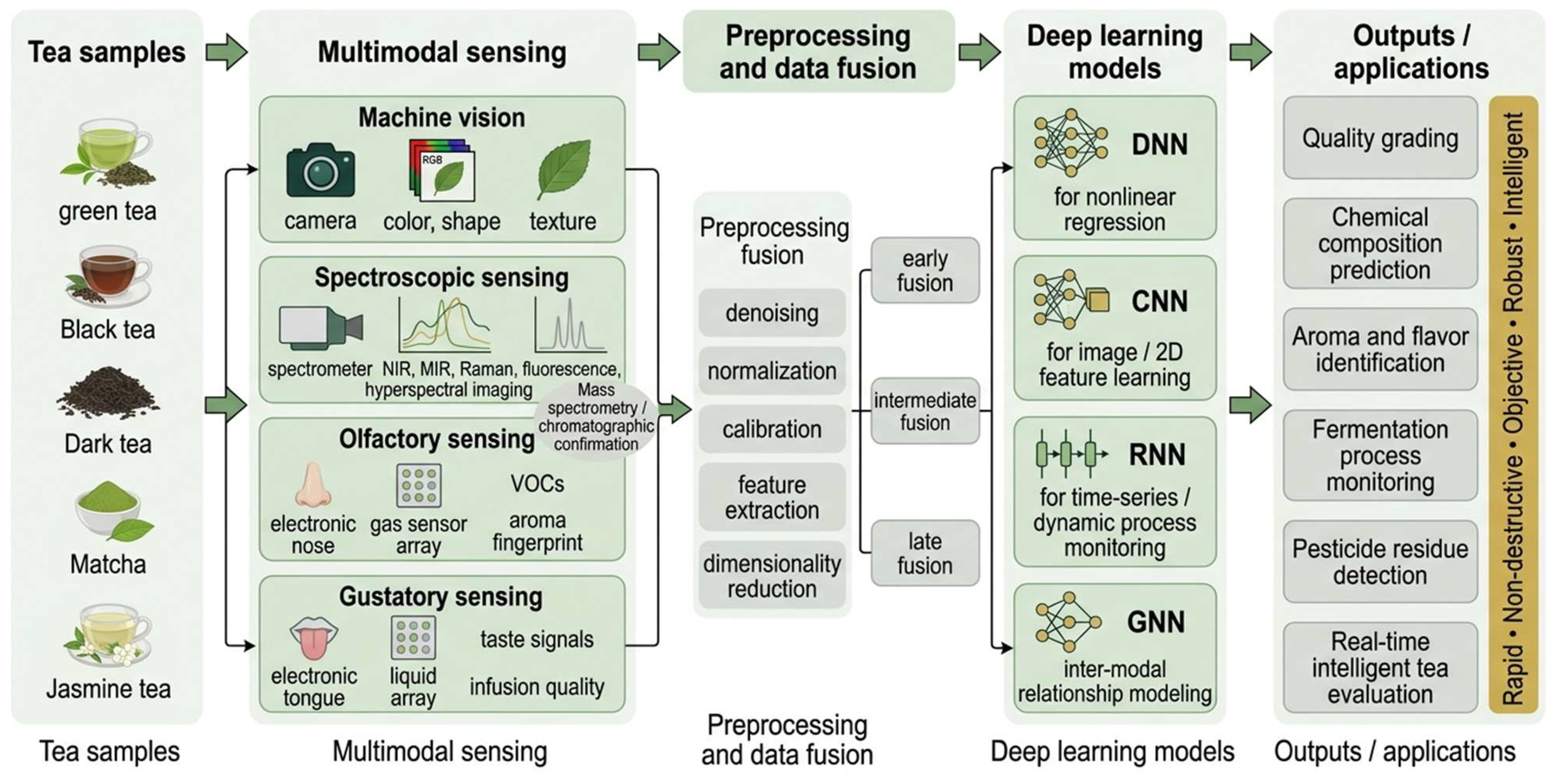
| Quality Attribute | Target Indicators | Dominant Modalities | Complementary Modalities | Suitable Fusion Strategies | Main Limitations |
|---|---|---|---|---|---|
| Appearance and color | Leaf shape/strip appearance, particle size, color uniformity, liquor color, surface defects | Machine vision, microscopic imaging | HSI/MSI, GLCM texture features | Early/intermediate fusion | Sensitive to illumination, background, and sample stacking |
| Intrinsic chemical composition | Tea polyphenols, catechins, caffeine, free amino acids, soluble sugars, moisture | NIR/MIR | Raman/SERS, HSI, fluorescence | Intermediate fusion | Difficult cross-instrument transfer and pronounced matrix effects |
| Aroma quality | VOC fingerprints, floral/fresh/roasted aroma, scenting intensity | Electronic nose, colorimetric sensor array, GC–IMS | GC–MS, Vis-NIR/HSI | Late/intermediate fusion | Sensor drift and insufficient specificity for low-abundance key aroma compounds |
| Taste and mouthfeel | Freshness/umami, bitterness, astringency, mellow mouthfeel, soluble taste-active compounds | Electronic tongue, electrochemical sensor array | NIR, FT-NIR, reference chemical analysis | Intermediate/late fusion | Electrode fouling and strong matrix effects in tea infusion |
| Processing status | Fixation/drying endpoint, fermentation degree, aging stage | HSI, NIR, electronic nose | IoT-based environmental sensing, machine vision | Temporal intermediate/late fusion | Difficulty in continuous annotation and high requirements for temporal synchronization |
| Safety-related extensions | Screening of pesticide residues, contaminants, adulteration, or abnormal samples | SERS, fluorescence, HSI | NIR, imaging, mass spectrometry confirmation | Late fusion | Diverse targets, insufficient databases, and some methods are not strictly non-destructive |
2.2. Complementarity Among Sensing Modalities
2.3. Data Fusion Strategies for Heterogeneous Tea-Sensing Data
2.4. Deep Learning Architectures for Multimodal Tea Evaluation
2.5. Emerging Sensor Models and Image-Feature Techniques
2.6. Dataset Standardization, Model Generalization, and Industrial Deployment
3. Applications in Representative Tea Products
3.1. Green Tea
3.1.1. Appearance Quality Monitoring
3.1.2. Intrinsic Composition and Sensory Quality Prediction
3.2. Black Tea
3.2.1. Intelligent Aroma Quality Discrimination
3.2.2. Rapid Determination of Chemical Composition
3.2.3. Fermentation Process Monitoring
3.3. Dark Tea
3.3.1. Intelligent Identification of Aroma and Taste Qualities
3.3.2. Internal Components and Quality Indicator Detection
3.3.3. Fermentation and Aging Process Monitoring
3.4. Matcha
3.4.1. Visualized Analysis of Color and Composition
3.4.2. Volatile Aroma and Grade Identification
3.4.3. Quality Monitoring During Processing
3.5. Jasmine Tea
3.5.1. Aroma Intensity and Purity Detection
3.5.2. Intelligent Control of the Scenting Process
3.5.3. Evaluation of Appearance Quality
3.6. Safety-Related Extensions: Rapid Screening of Pesticide Residues
4. Actionable Methodological Roadmap for Multimodal Tea Quality Evaluation
4.1. Dataset Curation, Harmonization, and Leakage-Free Validation
4.2. Model Interpretability, External Validation, and Industrial Readiness
5. Conclusions and Perspectives
Author Contributions
Funding
Institutional Review Board Statement
Informed Consent Statement
Data Availability Statement
Acknowledgments
Conflicts of Interest
References
- Zhang, C.; Zhou, C.; Tian, C.; Xu, K.; Lai, Z.; Lin, Y.; Guo, Y. Volatilomics Analysis of Jasmine Tea During Multiple Rounds of Scenting Processes. Foods 2023, 12, 812. [Google Scholar] [CrossRef] [PubMed]
- Wang, S.; Zhao, F.; Wu, W.; Wang, P.; Ye, N. Comparison of Volatiles in Different Jasmine Tea Grade Samples Using Electronic Nose and Automatic Thermal Desorption-Gas Chromatography-Mass Spectrometry Followed by Multivariate Statistical Analysis. Molecules 2020, 25, 380. [Google Scholar] [CrossRef] [PubMed]
- Wang, Z.; Ahmad, W.; Zhu, A.; Geng, W.; Kang, W.; Ouyang, Q.; Chen, Q. Identification of Volatile Compounds and Metabolic Pathway During Ultrasound-Assisted Kombucha Fermentation by HS-SPME-GC/MS Combined with Metabolomic Analysis. Ultrason. Sonochem. 2023, 94, 106339. [Google Scholar] [CrossRef]
- Wang, D.; Gao, Q.; Wang, T.; Zhao, G.; Qian, F.; Huang, J.; Wang, H.; Zhang, X.; Wang, Y. Green tea infusion protects against alcoholic liver injury by attenuating inflammation and regulating the PI3K/Akt/eNOS pathway in C57BL/6 mice. Food Funct. 2017, 8, 3165–3177. [Google Scholar] [CrossRef]
- Mao, H.; Du, X.; Yan, Y.; Zhang, X.; Ma, G.; Wang, Y.; Liu, Y.; Wang, B.; Yang, X.; Shi, Q. Highly Sensitive Detection of Daminozide Using Terahertz Metamaterial Sensors. Int. J. Agric. Biol. Eng. 2022, 15, 180–188. [Google Scholar] [CrossRef]
- Zhang, Z.; Zhang, Y.; Jayan, H.; Gao, S.; Zhou, R.; Yosri, N.; Zou, X.; Guo, Z. Recent and Emerging Trends of Metal-Organic Frameworks (MOFs)-Based Sensors for Detecting Food Contaminants: A Critical and Comprehensive Review. Food Chem. 2024, 448, 139051. [Google Scholar] [CrossRef]
- Lin, H.; Xu, P.-T.; Sun, L.; Bi, X.; Zhao, J.; Cai, J. Identification of Eggshell Crack Using Multiple Vibration Sensors and Correlative Information Analysis. J. Food Process Eng. 2018, 41, e12894. [Google Scholar] [CrossRef]
- Qi, S.; Ouyang, Q.; Chen, Q.; Zhao, J. Real-Time Monitoring of Total Polyphenols Content in Tea Using a Developed Optical Sensors System. J. Pharm. Biomed. Anal. 2014, 97, 116–122. [Google Scholar] [CrossRef]
- Ouyang, Q.; Liu, Y.; Chen, Q.; Zhang, Z.; Zhao, J.; Guo, Z.; Gu, H. Intelligent Evaluation of Color Sensory Quality of Black Tea by Visible-Near Infrared Spectroscopy Technology: A Comparison of Spectra and Color Data Information. Spectrochim. Acta Part A 2017, 180, 91–96. [Google Scholar] [CrossRef]
- Hongyang, T.; Daming, H.; Xingyi, H.; Aheto, J.H.; Yi, R.; Yu, W.; Ji, L.; Shuai, N.; Mengqi, X. Detection of Browning of Fresh-Cut Potato Chips Based on Machine Vision and Electronic Nose. J. Food Process Eng. 2021, 44, e13631. [Google Scholar] [CrossRef]
- Zareef, M.; Chen, Q.; Ouyang, Q.; Arslan, M.; Hassan, M.M.; Ahmad, W.; Viswadevarayalu, A.; Wang, P.; Ancheng, W. Rapid Screening of Phenolic Compounds in Congou Black Tea (Camellia sinensis) During In Vitro Fermentation Process Using Portable Spectral Analytical System Coupled Chemometrics. J. Food Process. Preserv. 2019, 43, e13996. [Google Scholar] [CrossRef]
- Wang, J.; Zareef, M.; He, P.; Sun, H.; Chen, Q.; Li, H.; Ouyang, Q.; Guo, Z.; Zhang, Z.; Xu, D. Evaluation of Matcha Tea Quality Index Using Portable NIR Spectroscopy Coupled with Chemometric Algorithms. J. Sci. Food Agric. 2019, 99, 5019–5027. [Google Scholar] [CrossRef]
- Zhao, S.; Adade, S.Y.-S.S.; Wang, Z.; Wu, J.; Jiao, T.; Li, H.; Chen, Q. On-Line Monitoring of Total Sugar During Kombucha Fermentation Process by near-Infrared Spectroscopy: Comparison of Linear and Non-Linear Multiple Calibration Methods. Food Chem. 2023, 423, 136208. [Google Scholar] [CrossRef]
- Chen, Q.; Zhang, D.; Pan, W.; Ouyang, Q.; Li, H.; Urmila, K.; Zhao, J. Recent Developments of Green Analytical Techniques in Analysis of Tea’s Quality and Nutrition. Trends Food Sci. Technol. 2015, 43, 63–82. [Google Scholar] [CrossRef]
- Yu, S.; Huang, X.; Wang, L.; Ren, Y.; Zhang, X.; Wang, Y. Characterization of Selected Chinese Soybean Paste Based on Flavor Profiles Using HS-SPME-GC/MS, E-Nose and E-Tongue Combined with Chemometrics. Food Chem. 2022, 375, 131840. [Google Scholar] [CrossRef]
- Zhou, X.; Sun, J.; Tian, Y.; Lu, B.; Hang, Y.; Chen, Q. Hyperspectral Technique Combined with Deep Learning Algorithm for Detection of Compound Heavy Metals in Lettuce. Food Chem. 2020, 321, 126503. [Google Scholar] [CrossRef]
- Huang, Y.; Li, Z.; Bian, Z.; Jin, H.; Zheng, G.; Hu, D.; Sun, Y.; Fan, C.; Xie, W.; Fang, H. Overview of Deep Learning and Nondestructive Detection Technology for Quality Assessment of Tomatoes. Foods 2025, 14, 286. [Google Scholar] [CrossRef]
- Adade, S.Y.-S.S.; Lin, H.; Nunekpeku, X.; Johnson, N.A.N.; Agyekum, A.A.; Zhao, S.; Teye, E.; Qianqian, S.; Kwadzokpui, B.A.; Ekumah, J.-N.; et al. Flexible Paper-Based AuNP Sensor for Rapid Detection of Diabenz (a,h)Anthracene (DbA) and Benzo(b)Fluoranthene (BbF) in Mussels Coupled with Deep Learning Algorithms. Food Control 2025, 168, 110966. [Google Scholar] [CrossRef]
- Zhi, S.; An, T.; Zhang, H.; Bai, Y.; Zhang, B.; Tian, G. Recent Advances and Applications of Imaging and Spectroscopy Technologies for Tea Quality Assessment: A Review. Agronomy 2025, 15, 1507. [Google Scholar] [CrossRef]
- Chang, H.; Cai, J.; Ouyang, Q. Intelligent Chlorophyll Estimation by Attention-Integrated Deep Learning and Dual-Modal Fusion in Tencha Drying Using Snapshot Multispectral Camera. J. Sci. Food Agric. 2025, 105, 6737–6745. [Google Scholar] [CrossRef] [PubMed]
- Wu, T.; Zhou, L.; Zhao, Y.; Qi, H.; Pu, Y.; Zhang, C.; Liu, Y. Applications of Deep Learning in Tea Quality Monitoring: A Review. Artif. Intell. Rev. 2025, 58, 342. [Google Scholar] [CrossRef]
- You, J.; Li, D.; Wang, Z.; Chen, Q.; Ouyang, Q. Prediction and Visualization of Moisture Content in Tencha Drying Processes by Computer Vision and Deep Learning. J. Sci. Food Agric. 2024, 104, 5486–5494. [Google Scholar] [CrossRef] [PubMed]
- Ramola, A.; Shakya, A.K.; Van Pham, D. Study of statistical methods for texture analysis and their modern evolutions. Eng. Rep. 2020, 2, e12149. [Google Scholar] [CrossRef]
- Tang, Z.; Su, Y.; Er, M.J.; Qi, F.; Zhang, L.; Zhou, J. A local binary pattern based texture descriptors for classification of tea leaves. Neurocomputing 2015, 168, 1011–1023. [Google Scholar] [CrossRef]
- Li, D.; Park, B.; Kang, R.; Chen, Q.; Ouyang, Q. Quantitative Prediction and Visualization of Matcha Color Physicochemical Indicators Using Hyperspectral Microscope Imaging Technology. Food Control 2024, 163, 110531. [Google Scholar] [CrossRef]
- Rong, Y.; Riaz, T.; Lin, H.; Wang, Z.; Chen, Q.; Ouyang, Q. Application of Visible Near-Infrared Spectroscopy Combined with Colorimetric Sensor Array for the Aroma Quality Evaluation in Tencha Drying Process. Spectrochim. Acta Part A 2024, 304, 123385. [Google Scholar] [CrossRef]
- Xu, Y.; Hassan, M.M.; Ali, S.; Li, H.; Ouyang, Q.; Chen, Q. Self-Cleaning-Mediated SERS Chip Coupled Chemometric Algorithms for Detection and Photocatalytic Degradation of Pesticides in Food. J. Agric. Food Chem. 2021, 69, 1667–1674. [Google Scholar] [CrossRef]
- Sun, J.; Hu, Y.; Zou, Y.; Geng, J.; Wu, Y.; Fan, R.; Kang, Z. Identification of Pesticide Residues on Black Tea by Fluorescence Hyperspectral Technology Combined with Machine Learning. Food Sci. Technol. 2022, 42, e55822. [Google Scholar] [CrossRef]
- Zhao, J.; Wang, K.; Ouyang, Q.; Chen, Q. Measurement of Chlorophyll Content and Distribution in Tea Plant’s Leaf Using Hyperspectral Imaging Technique. Spectrosc. Spectr. Anal. 2011, 31, 512–515. [Google Scholar]
- Han, Z.; Ahmad, W.; Rong, Y.; Chen, X.; Zhao, S.; Yu, J.; Zheng, P.; Huang, C.; Li, H. A Gas Sensors Detection System for Real-Time Monitoring of Changes in Volatile Organic Compounds During Oolong Tea Processing. Foods 2024, 13, 1721. [Google Scholar] [CrossRef] [PubMed]
- Chen, Q.; Sun, C.; Ouyang, Q.; Wang, Y.; Liu, A.; Li, H.; Zhao, J. Classification of Different Varieties of Oolong Tea Using Novel Artificial Sensing Tools and Data Fusion. LWT-Food Sci. Technol. 2015, 60, 781–787. [Google Scholar] [CrossRef]
- Chen, C.; Zhu, W.; Steibel, J.; Siegford, J.; Han, J.; Norton, T. Classification of Drinking and Drinker-Playing in Pigs by a Video-Based Deep Learning Method. Biosyst. Eng. 2020, 196, 1–14. [Google Scholar] [CrossRef]
- Zhou, X.; Zhao, C.; Sun, J.; Cao, Y.; Yao, K.; Xu, M. A Deep Learning Method for Predicting Lead Content in Oilseed Rape Leaves Using Fluorescence Hyperspectral Imaging. Food Chem. 2023, 409, 135251. [Google Scholar] [CrossRef]
- Liu, J.; Abbas, I.; Noor, R.S. Development of Deep Learning-Based Variable Rate Agrochemical Spraying System for Targeted Weeds Control in Strawberry Crop. Agronomy 2021, 11, 1480. [Google Scholar] [CrossRef]
- Li, L.; Xie, S.; Zhu, F.; Ning, J.; Chen, Q.; Zhang, Z. Colorimetric sensor array-based artificial olfactory system for sensing Chinese green tea’s quality: A method of fabrication. Int. J. Food Prop. 2017, 20, 1762–1773. [Google Scholar] [CrossRef]
- Chen, Q.; Guo, Z.; Zhao, J.; Ouyang, Q. Comparisons of Different Regressions Tools in Measurement of Antioxidant Activity in Green Tea Using Near Infrared Spectroscopy. J. Pharm. Biomed. Anal. 2012, 60, 92–97. [Google Scholar] [CrossRef] [PubMed]
- Tseng, T.-S.; Hsiao, M.-H.; Chen, P.-A.; Lin, S.-Y.; Chiu, S.-W.; Yao, D.-J. Utilization of a Gas-Sensing System to Discriminate Smell and to Monitor Fermentation During the Manufacture of Oolong Tea Leaves. Micromachines 2021, 12, 93. [Google Scholar] [CrossRef] [PubMed]
- Liu, M.; Jiang, C.; Hassan, M.M.; Zhang, X.; Wang, R.; Cao, R.; Sheng, W.; Li, H. Investigation of Microbial Fermentation Degree of Pu-Erh Tea Using Deep Learning Coupled Colorimetric Sensor Array via Prediction of Total Polyphenols. Chemosensors 2024, 12, 265. [Google Scholar] [CrossRef]
- Otto, A. Excitation of nonradiative surface plasma waves in silver by the method of frustrated total reflection. Z. Phys. A Hadron. Nucl. 1968, 216, 398–410. [Google Scholar] [CrossRef]
- Liu, C.; Su, W.; Liu, Q.; Lu, X.; Wang, F.; Sun, T.; Chu, P.K. Symmetrical dual D-shape photonic crystal fibers for surface plasmon resonance sensing. Opt. Express 2018, 26, 9039–9049. [Google Scholar] [CrossRef]
- Kimutai, G.; Ngenzi, A.; Rutabayiro Ngoga, S.; Ramkat, R.C.; Förster, A. An internet of things (IoT)-based optimum tea fermentation detection model using convolutional neural networks (CNNs) and majority voting techniques. J. Sens. Sens. Syst. 2021, 10, 153–162. [Google Scholar] [CrossRef]
- Lan, T.; Shen, S.; Yuan, H.; Jiang, Y.; Tong, H.; Ye, Y. A Rapid Prediction Method of Moisture Content for Green Tea Fixation Based on WOA-Elman. Foods 2022, 11, 2928. [Google Scholar] [CrossRef]
- Li, H.; Hu, Y.; Ma, S.; Haruna, S.A.; Chen, Q.; Zhu, W.; Xia, A. Porphyrin and pH Sensitive Dye-Based Colorimetric Sensor Array Coupled Chemometrics for Dynamic Monitoring of Tea Quality During Ultrasound-Assisted Fermentation. Microchem. J. 2024, 197, 109813. [Google Scholar] [CrossRef]
- Jiang, Y.; Zareef, M.; Liu, L.; Ouyang, Q. Monitoring of Carotenoids Changes During the Matcha Drying Process Using a Portable Developed Spectral Analytical System. J. Food Compos. Anal. 2024, 125, 105849. [Google Scholar] [CrossRef]
- Gharibzahedi, S.M.T.; Barba, F.J.; Zhou, J.; Wang, M.; Altintas, Z. Electronic Sensor Technologies in Monitoring Quality of Tea: A Review. Biosensors 2022, 12, 356. [Google Scholar] [CrossRef]
- Zhao, J.; Chen, Q.; Cai, J.; Ouyang, Q. Automated Tea Quality Classification by Hyperspectral Imaging. Appl. Opt. 2009, 48, 3557–3564. [Google Scholar] [CrossRef]
- Li, Y.; Sun, J.; Wu, X.; Lu, B.; Wu, M.; Dai, C. Grade Identification of Tieguanyin Tea Using Fluorescence Hyperspectra and Different Statistical Algorithms. J. Food Sci. 2019, 84, 2234–2241. [Google Scholar] [CrossRef]
- He, F.; Wu, X.; Wu, B.; Zeng, S.; Zhu, X. Green Tea Grades Identification via Fourier Transform Near-Infrared Spectroscopy and Weighted Global Fuzzy Uncorrelated Discriminant Transform. J. Food Process Eng. 2022, 45, e14109. [Google Scholar] [CrossRef]
- Li, H.; Wu, P.; Dai, J.; Pan, T.; Holmes, M.; Chen, T.; Zou, X. Discriminating Compounds Identification Based on the Innovative Sparse Representation Chemometrics to Assess the Quality of Maofeng Tea. J. Food Compos. Anal. 2023, 123, 105590. [Google Scholar] [CrossRef]
- Zhao, S.; Adade, S.Y.-S.S.; Wang, Z.; Jiao, T.; Ouyang, Q.; Li, H.; Chen, Q. Deep Learning and Feature Reconstruction Assisted Vis-NIR Calibration Method for on-Line Monitoring of Key Growth Indicators During Kombucha Production. Food Chem. 2025, 463, 141411. [Google Scholar] [CrossRef] [PubMed]
- Jiang, Y.; Hua, J.; Wang, B.; Yuan, H.; Ma, H. Effects of Variety, Season, and Region on Theaflavins Content of Fermented Chinese Congou Black Tea. J. Food Qual. 2018, 2018, 5427302. [Google Scholar] [CrossRef]
- Guo, Z.; Barimah, A.O.; Yin, L.; Chen, Q.; Shi, J.; El-Seedi, H.R.; Zou, X. Intelligent Evaluation of Taste Constituents and Polyphenols-to-Amino Acids Ratio in Matcha Tea Powder Using Near Infrared Spectroscopy. Food Chem. 2021, 353, 129372. [Google Scholar] [CrossRef]
- Chai, Z.; Tian, L.; Yu, H.; Zhang, L.; Zeng, Q.; Wu, H.; Yan, Z.; Li, D.; Hutabarat, R.P.; Huang, W. Comparison on Chemical Compositions and Antioxidant Capacities of the Green, Oolong, and Red Tea from Blueberry Leaves. Food Sci. Nutr. 2020, 8, 1688–1699. [Google Scholar] [CrossRef]
- Jiang, H.; Xu, W.; Chen, Q. Determination of Tea Polyphenols in Green Tea by Homemade Color Sensitive Sensor Combined with Multivariate Analysis. Food Chem. 2020, 319, 126584. [Google Scholar] [CrossRef]
- Zhou, H.; Fu, H.; Wu, X.; Wu, B.; Dai, C. Discrimination of Tea Varieties Based on FTIR Spectroscopy and an Adaptive Improved Possibilistic C-Means Clustering. J. Food Process. Preserv. 2020, 44, e14795. [Google Scholar] [CrossRef]
- Chen, Q.; Chen, M.; Liu, Y.; Wu, J.; Wang, X.; Ouyang, Q.; Chen, X. Application of FT-NIR Spectroscopy for Simultaneous Estimation of Taste Quality and Taste-Related Compounds Content of Black Tea. J. Food Sci. Technol. 2018, 55, 4363–4368. [Google Scholar] [CrossRef]
- Zareef, M.; Hassan, M.M.; Arslan, M.; Ahmad, W.; Ali, S.; Ouyang, Q.; Li, H.; Wu, X.; Chen, Q. Rapid Prediction of Caffeine in Tea Based on Surface-Enhanced Raman Spectroscopy Coupled Multivariate Calibration. Microchem. J. 2020, 159, 105431. [Google Scholar] [CrossRef]
- Ouyang, Q.; Yang, Y.; Wu, J.; Chen, Q.; Guo, Z.; Li, H. Measurement of Total Free Amino Acids Content in Black Tea Using Electronic Tongue Technology Coupled with Chemometrics. LWT 2020, 118, 108768. [Google Scholar] [CrossRef]
- Sharmilan, T.; Premarathne, I.; Wanniarachchi, I.; Kumari, S.; Wanniarachchi, D. Application of Electronic Nose to Predict the Optimum Fermentation Time for Low-country Sri Lankan Tea. J. Food Qual. 2022, 2022, 7703352. [Google Scholar] [CrossRef]
- Li, H.; Zhang, B.; Hu, W.; Liu, Y.; Dong, C.; Chen, Q. Monitoring Black Tea Fermentation Using a Colorimetric Sensor Array-Based Artificial Olfaction System. J. Food Process. Preserv. 2018, 42, e13348. [Google Scholar] [CrossRef]
- Lv, H.; Zhang, Y.; Lin, Z.; Liang, Y. Processing and Chemical Constituents of Pu-Erh Tea: A Review. Food Res. Int. 2013, 53, 608–618. [Google Scholar] [CrossRef]
- Boateng, I.D.; Li, F.; Yang, X.-M.; Guo, D. Combinative Effect of Pulsed-Light Irradiation and Solid-State Fermentation on Ginkgolic Acids, Ginkgols, Ginkgolides, Bilobalide, Flavonoids, Product Quality and Sensory Assessment of Ginkgo biloba Dark Tea. Food Chem. 2024, 456, 139979. [Google Scholar] [CrossRef]
- Liu, Z.; Xie, H.; Chen, L.; Huang, J. An Improved Weighted Partial Least Squares Method Coupled with Near Infrared Spectroscopy for Rapid Determination of Multiple Components and Anti-Oxidant Activity of Pu-Erh Tea. Molecules 2018, 23, 1058. [Google Scholar] [CrossRef] [PubMed]
- Sharmilan, T.; Premarathne, I.; Wanniarachchi, I.; Kumari, S.; Wanniarachchi, D. Electronic Nose Technologies in Monitoring Black Tea Manufacturing Process. J. Sens. 2020, 11, 3073104. [Google Scholar] [CrossRef]
- Liu, L.; Zareef, M.; Wang, Z.; Li, H.; Chen, Q.; Ouyang, Q. Monitoring Chlorophyll Changes During Tencha Processing Using Portable Near-Infrared Spectroscopy. Food Chem. 2023, 412, 135505. [Google Scholar] [CrossRef]
- Ouyang, Q.; Wang, L.; Park, B.; Kang, R.; Wang, Z.; Chen, Q.; Guo, Z. Assessment of Matcha Sensory Quality Using Hyperspectral Microscope Imaging Technology. LWT 2020, 125, 109254. [Google Scholar] [CrossRef]
- Ouyang, Q.; Wang, L.; Park, B.; Kang, R.; Chen, Q. Simultaneous Quantification of Chemical Constituents in Matcha with Visible-Near Infrared Hyperspectral Imaging Technology. Food Chem. 2021, 350, 129141. [Google Scholar] [CrossRef]
- Liu, S.; Rong, Y.; Chen, Q.; Ouyang, Q. Colorimetric Sensor Array Combined with Chemometric Methods for the Assessment of Aroma Produced During the Drying of Tencha. Food Chem. 2024, 432, 137190. [Google Scholar] [CrossRef] [PubMed]
- Wang, Y.; Shoaib, M.; Wang, J.; Lin, H.; Chen, Q.; Ouyang, Q. A Novel ZIF-8 Mediated Nanocomposite Colorimetric Sensor Array for Rapid Identification of Matcha Grades, Validated by Density Functional Theory. J. Food Compos. Anal. 2025, 137, 106864. [Google Scholar] [CrossRef]
- Ouyang, Q.; Rong, Y.; Xia, G.; Chen, Q.; Ma, Y.; Liu, Z. Integrating Humidity-Resistant and Colorimetric COF-on-MOF Sensors with Artificial Intelligence Assisted Data Analysis for Visualization of Volatile Organic Compounds Sensing. Adv. Sci. 2025, 12, e2411621. [Google Scholar] [CrossRef] [PubMed]
- Ouyang, Q.; Rong, Y.; Wu, J.; Wang, Z.; Lin, H.; Chen, Q. Application of Colorimetric Sensor Array Combined with Visible Near-Infrared Spectroscopy for the Matcha Classification. Food Chem. 2023, 420, 136078. [Google Scholar] [CrossRef] [PubMed]
- Ouyang, Q.; Yang, Y.; Wu, J.; Liu, Z.; Chen, X.; Dong, C.; Chen, Q.; Zhang, Z.; Guo, Z. Rapid Sensing of Total Theaflavins Content in Black Tea Using a Portable Electronic Tongue System Coupled to Efficient Variables Selection Algorithms. J. Food Compos. Anal. 2019, 75, 43–48. [Google Scholar] [CrossRef]
- Wu, J.; Zareef, M.; Chen, Q.; Ouyang, Q. Application of Visible-Near Infrared Spectroscopy in Tandem with Multivariate Analysis for the Rapid Evaluation of Matcha Physicochemical Indicators. Food Chem. 2023, 421, 136185. [Google Scholar] [CrossRef] [PubMed]
- Hou, Z.; Chen, Z.; Li, L.; Chen, H.; Zhang, H.; Liu, S.; Zhang, R.; Song, Q.; Chen, Y.; Su, Z.; et al. Comparison of Volatile Compounds in Jingshan Green Tea Scented with Different Flowers Using GC–IMS and GC–MS Analyses. Foods 2024, 13, 2653. [Google Scholar] [CrossRef]
- Gu, M.; Zhang, Y.; Weng, Q.; Weng, W.; Ren, W.; Jin, S.; Lin, H.; Wang, P.; She, W.; Ye, N. Metabolomics Analysis Reveals Dynamic Changes of Volatile and Non-Volatile Metabolites During the Scenting Process of Jasmine Tea. Food Chem. X 2025, 28, 102617. [Google Scholar] [CrossRef]
- An, H.; Ou, X.; Zhang, Y.; Li, S.; Xiong, Y.; Li, Q.; Huang, J.; Liu, Z. Study on the Key Volatile Compounds and Aroma Quality of Jasmine Tea with Different Scenting Technology. Food Chem. 2022, 385, 132718. [Google Scholar] [CrossRef] [PubMed]
- Zhang, Y.; Gu, M.; Yang, S.; Fan, W.; Lin, H.; Jin, S.; Wang, P.; Ye, N. Dynamic Aroma Characteristics of Jasmine Tea Scented with Single-Petal Jasmine “Bijian”: A Comparative Study with Traditional Double-Petal Jasmine. Food Chem. 2025, 464, 141735. [Google Scholar] [CrossRef]
- Ouyang, Q.; Wang, L.; Ahmad, W.; Rong, Y.; Li, H.; Hu, Y.; Chen, Q. A Highly Sensitive Detection of Carbendazim Pesticide in Food Based on the Upconversion-MnO2 Luminescent Resonance Energy Transfer Biosensor. Food Chem. 2021, 349, 129157. [Google Scholar] [CrossRef]
- Marimuthu, M.; Xu, K.; Song, W.; Chen, Q.; Wen, H. Safeguarding Food Safety: Nanomaterials-Based Fluorescent Sensors for Pesticide Tracing. Food Chem. 2025, 463, 141288. [Google Scholar] [CrossRef]
- Zhu, J.; Sharma, A.S.; Xu, J.; Xu, Y.; Jiao, T.; Ouyang, Q.; Li, H.; Chen, Q. Rapid On-Site Identification of Pesticide Residues in Tea by One-Dimensional Convolutional Neural Network Coupled with Surface-Enhanced Raman Scattering. Spectrochim. Acta Part A 2021, 246, 118994. [Google Scholar] [CrossRef]
- Li, H.; Luo, X.; Haruna, S.A.; Zareef, M.; Chen, Q.; Ding, Z.; Yan, Y. Au-Ag OHCs-Based SERS Sensor Coupled with Deep Learning CNN Algorithm to Quantify Thiram and Pymetrozine in Tea. Food Chem. 2023, 428, 136798. [Google Scholar] [CrossRef]
- Kang, W.; Lin, H.; Adade, S.Y.-S.S.; Wang, Z.; Ouyang, Q.; Chen, Q. Advanced Sensing of Volatile Organic Compounds in the Fermentation of Kombucha Tea Extract Enabled by Nano-Colorimetric Sensor Array Based on Density Functional Theory. Food Chem. 2023, 405, 134193. [Google Scholar] [CrossRef]
- Hassan, M.M.; Li, H.; Ahmad, W.; Zareef, M.; Wang, J.; Xie, S.; Wang, P.; Ouyang, Q.; Wang, S.; Chen, Q. Au@Ag Nanostructure Based SERS Substrate for Simultaneous Determination of Pesticides Residue in Tea via Solid Phase Extraction Coupled Multivariate Calibration. LWT 2019, 105, 290–297. [Google Scholar] [CrossRef]
- Zhu, J.; Agyekum, A.A.; Kutsanedzie, F.Y.H.; Li, H.; Chen, Q.; Ouyang, Q.; Jiang, H. Qualitative and Quantitative Analysis of Chlorpyrifos Residues in Tea by Surface-Enhanced Raman Spectroscopy (SERS) Combined with Chemometric Models. LWT 2018, 97, 760–769. [Google Scholar] [CrossRef]
- Li, H.; Hu, W.; Hassan, M.M.; Zhang, Z.; Chen, Q. A Facile and Sensitive SERS-Based Biosensor for Colormetric Detection of Acetamiprid in Green Tea Based on Unmodified Gold Nanoparticles. J. Food Meas. Charact. 2019, 13, 259–268. [Google Scholar] [CrossRef]
- Xu, Y.; Kutsanedzie, F.Y.H.; Ali, S.; Wang, P.; Li, C.; Ouyang, Q.; Li, H.; Chen, Q. Cysteamine-Mediated Upconversion Sensor for Lead Ion Detection in Food. J. Food Meas. Charact. 2021, 15, 4849–4857. [Google Scholar] [CrossRef]
- Li, H.; Ali, S.; Wei, W.; Xu, Y.; Lu, H.; Hassan, M.M.; Wu, X.; Zuo, M.; Ouyang, Q.; Chen, Q. Rapid Detection of Organophosphorus in Tea Using NaY/GdF4:Yb, Er-Based Fluorescence Sensor. Microchem. J. 2020, 159, 105462. [Google Scholar] [CrossRef]
- Chen, Q.; Sheng, R.; Wang, P.; Ouyang, Q.; Wang, A.; Ali, S.; Zareef, M.; Hassan, M.M. Ultra-Sensitive Detection of Malathion Residues Using FRET-Based Upconversion Fluorescence Sensor in Food. Spectrochim. Acta Part A 2020, 241, 118654. [Google Scholar] [CrossRef]
- Varma, S.; Simon, R. Bias in error estimation when using cross-validation for model selection. BMC Bioinform. 2006, 7, 91. [Google Scholar] [CrossRef]
- Cawley, G.C.; Talbot, N.L.C. On over-fitting in model selection and subsequent selection bias in performance evaluation. J. Mach. Learn. Res. 2010, 11, 2079–2107. [Google Scholar]
- Efron, B. Bootstrap methods: Another look at the jackknife. Ann. Stat. 1979, 7, 1–26. [Google Scholar] [CrossRef]
- Rücker, C.; Rücker, G.; Meringer, M. y-Randomization and its variants in QSPR/QSAR. J. Chem. Inf. Model. 2007, 47, 2345–2357. [Google Scholar] [CrossRef] [PubMed]
- Breiman, L. Random forests. Mach. Learn. 2001, 45, 5–32. [Google Scholar] [CrossRef]
- Lundberg, S.M.; Lee, S.-I. A unified approach to interpreting model predictions. In Advances in Neural Information Processing Systems 30 (NeurIPS 2017); NIPS Foundation: San Diego, CA, USA, 2017. [Google Scholar]
- Selvaraju, R.R.; Cogswell, M.; Das, A.; Vedantam, R.; Parikh, D.; Batra, D. Grad-CAM: Visual explanations from deep networks via gradient-based localization. In Proceedings of the IEEE International Conference on Computer Vision (ICCV), Venice, Italy, 22–29 October 2017; pp. 618–626. [Google Scholar] [CrossRef]
- Ribeiro, M.T.; Singh, S.; Guestrin, C. “Why should I trust you?” Explaining the predictions of any classifier. In Proceedings of the 22nd ACM SIGKDD International Conference on Knowledge Discovery and Data Mining, San Francisco, CA, USA, 13–17 August 2016; pp. 1135–1144. [Google Scholar] [CrossRef]


| Tea Type | Main Quality Indicators | Sensing Modalities | Modeling Methods | References |
|---|---|---|---|---|
| Green Tea | Appearance uniformity and color; moisture content; polyphenols; amino acids | Machine vision; near-infrared spectroscopy; colorimetric sensor arrays | PLS regression; Elman neural network; CNN-based prediction | [37,38] |
| Black Tea | Aroma-compound abundance; theaflavin content; fermentation degree | Electronic nose; visible/near-infrared spectroscopy; machine vision (liquor color) | MOS-based e-nose + PLS-DA; NIR quantification of theaflavins; image-based color evaluation | [2] |
| Dark Tea | Aged-aroma purity and richness; taste fullness; polyphenols; caffeine; fermentation degree; post-fermentation age | Electronic nose/electronic tongue; near-infrared/Raman spectroscopy; colorimetric sensor arrays | Odor-pattern recognition; NIR + PLSR compound prediction; colorimetric array + CNN for fermentation evaluation | [38,62] |
| Matcha | Powder color and greenness; free amino acids; aroma quality | Hyperspectral imaging; nano-enabled colorimetric arrays; spectroscopy-based fusion sensing | HMI + PLSR for chlorophyll prediction; ZIF-8 colorimetric array + ANN for grade classification | [69] |
| Jasmine Tea | Aroma intensity and purity; appearance uniformity; flower-debris content | Electronic nose; GC–IMS fingerprinting; machine vision | E-nose + PLS-DA for grade discrimination; GC–IMS fingerprint analysis; image-based impurity detection | [2] |
| Method | Sensing Modality | Model Performance | References |
|---|---|---|---|
| Fluorescence hyperspectral imaging + CNN/RF | EEM fluorescence + 1D-CNN | Classification accuracy: 99.05% for identification of multiple pesticide residues | [28] |
| Handheld Raman spectroscopy + deep CNN | SERS Raman + 1D-CNN | Multi-pesticide classification accuracy > 95% | [80,81] |
| NIR + SERS fusion | NIR reflectance + SERS | Pesticide quantification with fused PLSR model, R2 ≈ 0.99 | [82] |
| Machine vision + electronic nose (conceptual) | Visible imaging + MOS gas sensors | Joint screening of suspicious residue spots and odor anomalies | [81] |
Disclaimer/Publisher’s Note: The statements, opinions and data contained in all publications are solely those of the individual author(s) and contributor(s) and not of MDPI and/or the editor(s). MDPI and/or the editor(s) disclaim responsibility for any injury to people or property resulting from any ideas, methods, instructions or products referred to in the content. |
© 2026 by the authors. Licensee MDPI, Basel, Switzerland. This article is an open access article distributed under the terms and conditions of the Creative Commons Attribution (CC BY) license.
Share and Cite
Hu, X.; Zhang, M.; Yang, B.; Tao, Y.; Wei, W. Multimodal Sensor Fusion for Non-Destructive Tea Quality Evaluation: Deep Learning-Enabled Methods, Applications, and Challenges. Foods 2026, 15, 1810. https://doi.org/10.3390/foods15101810
Hu X, Zhang M, Yang B, Tao Y, Wei W. Multimodal Sensor Fusion for Non-Destructive Tea Quality Evaluation: Deep Learning-Enabled Methods, Applications, and Challenges. Foods. 2026; 15(10):1810. https://doi.org/10.3390/foods15101810
Chicago/Turabian StyleHu, Xinyu, Meng Zhang, Biyue Yang, Yuefei Tao, and Wei Wei. 2026. "Multimodal Sensor Fusion for Non-Destructive Tea Quality Evaluation: Deep Learning-Enabled Methods, Applications, and Challenges" Foods 15, no. 10: 1810. https://doi.org/10.3390/foods15101810
APA StyleHu, X., Zhang, M., Yang, B., Tao, Y., & Wei, W. (2026). Multimodal Sensor Fusion for Non-Destructive Tea Quality Evaluation: Deep Learning-Enabled Methods, Applications, and Challenges. Foods, 15(10), 1810. https://doi.org/10.3390/foods15101810