Article

Dish-Choice, a Three-Color Food Label, Improves Subjective Perceptions of Nutrition Information Among Chinese Diners Compared with a Standard Nutrition Facts Label: A Self-Controlled Survey


1
School of Public Health, Fudan University, Shanghai 200032, China
2
Division of Health Risk Factors Monitoring and Control, Shanghai Municipal Center for Disease Control and Prevention, Shanghai 201107, China
3
Shanghai Pudong New Area Center for Disease Control and Prevention, Fudan University, Shanghai 200136, China
4
The Jiading District Center for Disease Control and Prevention, Tacheng Road, 264, Jiading District, Shanghai 201800, China
5
Shanghai Xuhui District Center for Disease Control and Prevention, Shanghai 200237, China
*
Authors to whom correspondence should be addressed.
These authors contributed equally to this work.
Foods 2026, 15(10), 1751; https://doi.org/10.3390/foods15101751
Submission received: 8 April 2026 / Revised: 29 April 2026 / Accepted: 11 May 2026 / Published: 15 May 2026
(This article belongs to the Section Sensory and Consumer Sciences)

Abstract

Background: Dining out has become increasingly prevalent in China, which is associated with higher intakes of energy, fat and sodium, elevating the risk of diet-related non-communicable diseases. However, evidence on color-coded nutrition labels for onsite prepared meals remains scarce. This study aimed to examine consumers’ perceptions of Dish-Choice, a three-color-coded onsite label, in comparison with the standard Nutrition Facts Label (NFL), to evaluate subjective perceptions of this novel label. Methods: A self-controlled trial was conducted among 3008 diners from canteens in Shanghai, with completing questionnaires twice: first on NFL perceptions, then three months later on Dish-Choice. Logistic regression and paired-sample comparison were used for analysis. Results: Compared with the NFL, Dish-Choice was associated with higher perceptual scores, with greater changes in overweight/obese, males, lower socio-economic status (SES) groups and those with poor dietary quality. Conclusions: The Dish-Choice label elicits more positive perceptual responses across multiple perceptual constructs. It is particularly well-received among vulnerable populations with lower health literacy, including men, lower-SES groups, and individuals with poor dietary habits. This supports its potential as a public health tool for on-site dining settings, though further research is needed to confirm its impact on actual food choices.

1. Introduction

Dining out in China has become increasingly prevalent, with the national average prevalence rising from 28.3% in 2002 to 48.3% by 2012 [1]. As a megacity in China, Shanghai’s prevalence of eating out was at 55.05% in 2012–2013 [1]; almost all the students and occupational population had at least one meal out of the home daily on average. In an investigation of 34 cities in China in 2017, the dining-out rate of urban adults in the past week was 55.6% [2]. This trend is concerning as it is associated with higher intakes of total energy, fat, oil, salt, and sugar, which are significant risk factors for diet-related non-communicable diseases (NCDs) and all-cause mortality [3]. The consumption at restaurants and company/school canteens has been linked to an increase in daily total energy intake by 140 kcal and 91 kcal, and fat intake by 6.0 g and 4.3 g, respectively [1]. There is an urgent need for measures that provide nutrition guidance to help residents choose healthier food options when eating out.
For nutrition labels to effectively change consumer behavior, they must first act on consumer perception. Labels function not merely as informational tools but also as perceptual cues that shape how consumers evaluate food quality and make dietary choices [4]. Research has consistently demonstrated that the way nutritional information is presented can significantly alter consumer attitudes and behavioral intentions [5]. According to the Theory of Planned Behavior (TPB), behavioral intentions—the most proximal determinant of actual behavior—are shaped by attitudes, subjective norms, and perceived behavioral control, all of which can be modified through label-induced perceptual changes [6]. Empirical evidence supports this pathway: nutritional label interventions have been shown to significantly improve participants’ knowledge, perceived behavioral control, behavioral intentions, and actual food choices [4]. The format and visual design of labels further modulate their perceptual impact; color-coded systems enable more efficient cognitive processing and stronger perceptual responses compared with text-based formats, thereby more effectively translating nutritional information into behavioral change [7]. Labels that are clear, credible, and intuitively designed are thus more likely to shift attitudes and build the motivational foundation necessary to translate nutritional awareness into healthier food choices [7]. The World Health Organization has identified nutrition labels as a “best-buy” measure for preventing NCDs [8].
Among all styles of nutrition labels, summarized indicator systems such as Nutri-Score are considered by the International Agency for Research on Cancer as effective tools for helping the general public choose food products of higher nutritional quality and reduce their risk of chronic diseases [9]. As a widely validated graded color-coded front-of-pack label, Nutri-Score has been shown to improve consumer understanding and the ability to identify healthier options across numerous countries and population groups [10]. However, nearly all evidence supporting Nutri-Score and similar summary labels focuses on pre-packaged retail foods, with limited application and evaluation in real-world collective catering settings.
Nutrition labels, increasingly adopted worldwide, predominantly target pre-packaged foods while paying less attention to onsite-prepared meals. To date, only a small number of studies have reported the effect of color-coded nutrition labels for onsite prepared food, including initiatives at Massachusetts General Hospital [11], healthy school canteens in New South Wales, Australia [12] and Google’s Canteen [13]. In Massachusetts General Hospital, a traffic-light labeling system demonstrated that the purchase of red-labeled items decreased from 24% to 21% while that of green-labeled items increased from 41% to 46%, with the change in purchasing remaining stable during a 24-month follow-up [11]. These findings highlight the potential of well-designed onsite nutrition labels to reshape consumer perceptions and drive sustained behavioral change in real-world food environments. Nevertheless, no large-scale real-world studies have evaluated a context-adapted three-color labeling system specifically designed for Chinese canteen environments, representing a key evidence gap compared with well-established pre-packaged labels such as Nutri-Score.
During the Shanghai Healthy Canteen Project, we developed a nutrient profiling model for on-site prepared food and a corresponding nutrition label named Dish-Choice, which is a summarized indicator system that categorizes food into three color-coded tiers. As a newly developed tool, Dish-Choice has not yet undergone systematic evaluation among local populations, leaving the attitudes and subjective perceptions towards it, as well as the sensitivity and potential for improvement among different groups, unclear. To fulfill its potential as a behavioral intervention, it is essential to first understand how it is perceived across populations with diverse characteristics.
Thus, this study seeks to investigate the perceptions and attitudes of individuals with diverse characteristics, including socioeconomic status and dietary quality, towards Dish-Choice, and to identify populations that may be more receptive to the label, establishing a basis for further research into its potential to induce behavioral changes.
It should be explicitly stated that this study focuses solely on perceptual outcomes. These outcomes include subjective understanding and ease of use, trust in label information, motivational activation induced by labels, and intention to discuss labels with others. These perceptual constructs are assessed in place of objective behavioral changes. Implications of Dish-Choice for actual dietary behaviors remain as hypotheses for future research and are not treated as confirmed outcomes in the current study.

2. Materials and Methods

2.1. Study Design

A self-controlled trial was conducted to evaluate the impact of two food label designs on consumer perceptions. All participants were exposed to both label designs—a Nutrition Facts Label (NFL) for dishes at baseline (December 2023) and the Dish-Choice label during the intervention phase (March 2024).

2.2. Participant Recruitment

The intervention was carried out through the Shanghai Healthy Canteen Project. From December 2023 to May 2024, 125 canteens/restaurants participated in the project, with a relatively stable diner population.
Sample size calculations were performed to ensure adequate statistical power for detecting significant differences in nutritional perceptions between the intervention and control groups. The calculations were based on the primary outcome: changes in nutritional perception scores. Using a two-sided test with a significance level (α) of 0.05 and a power (1 − β) of 0.80, the following formula was employed to determine the required sample size: n = ( Z 1 α / 2 + Z 1 β δ / σ d ) 2 . δ is the expected score difference between the two phases, which is defined as 1. σd is 1.6411, which is calculated from pilot trials. To account for potential dropouts and loss to follow-up, the calculated sample size was inflated by 10%, ensuring adequate power throughout the trial. The final estimated sample size was 2907, rounded up to the nearest whole number in line with standard statistical practices for sample size determination. The canteens involved in the Shanghai Healthy Canteen Project were distributed in different administrative regions of Shanghai, enhancing the sample’s representativeness of the general Shanghai population. Diners who agreed to participate in surveys completed one questionnaire in each phase.
Participants were included in the study if they met all of the following criteria: (1) aged 18 to 75 years; (2) dined frequently at the same canteen; (3) willing to provide written or verbal informed consent; (4) able to attend regular follow-up visits.
Participants were excluded if they met any of the following criteria: (1) visual impairment, color blindness, or color weakness; (2) inability to provide informed consent; (3) inability to complete the required follow-up visits.

2.3. Control and Intervention

2.3.1. Control

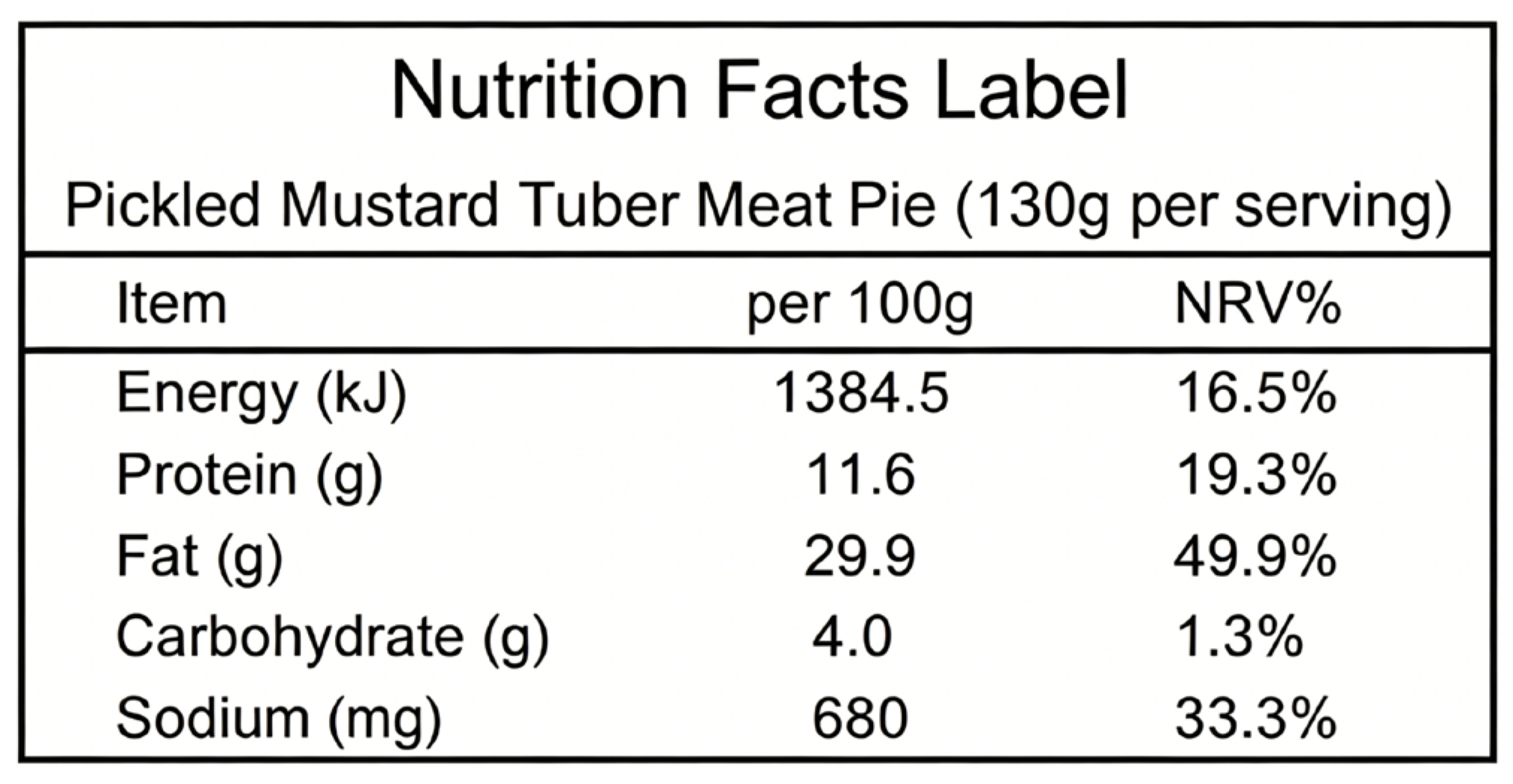
The NFL is the most familiar nutrition information label in China. It is a complex label currently mandatory only for pre-packaged foods, not for freshly prepared foods. It presents energy and nutrients by mass (g/100 g, kJ/100 g, mg/100 g) and NRV% in tabular form (see Figure 1).

2.3.2. Intervention

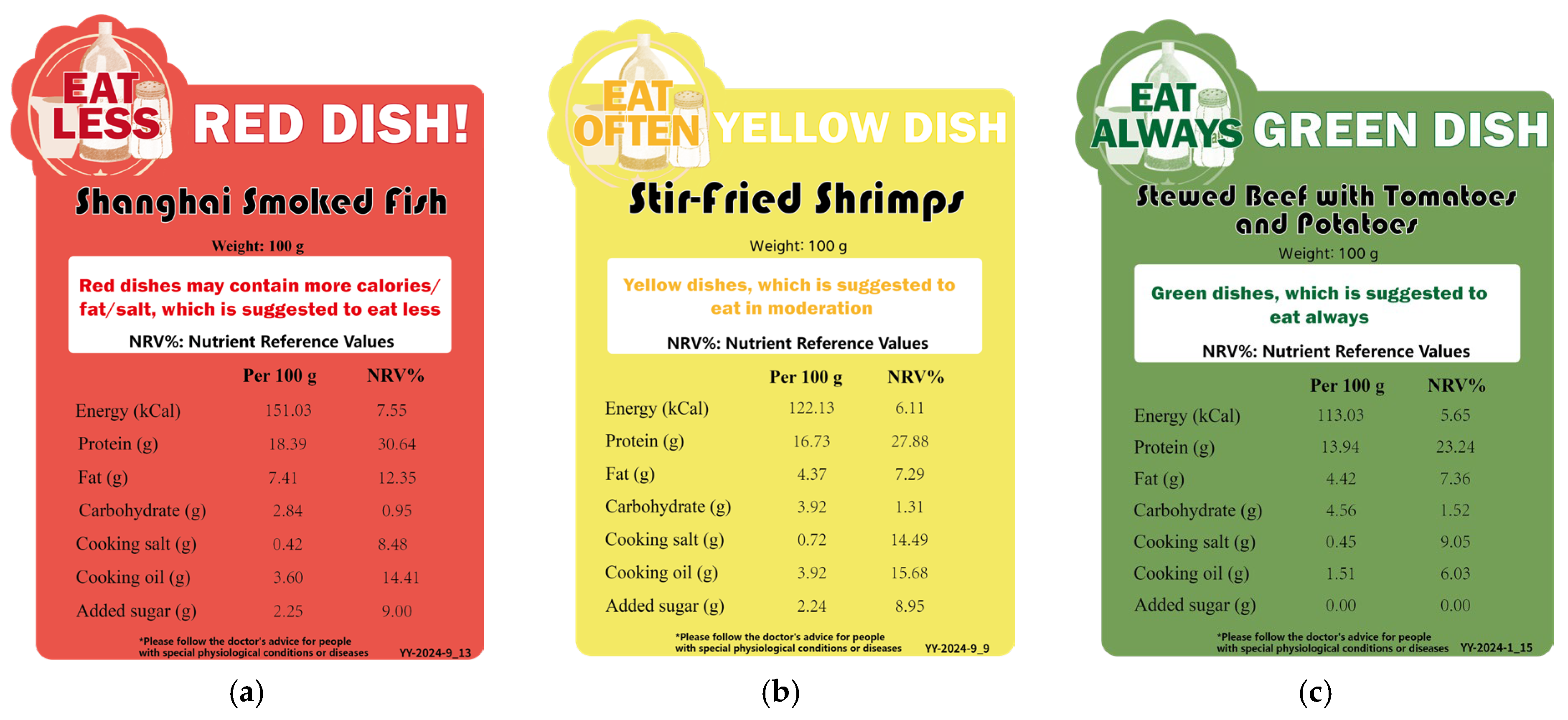
Dish-Choice, designed by Shanghai Municipal Center for Disease Control & Prevention, is a summarized and simplified label, providing extra color classification to present the healthiness of dishes. “Red dishes” are high in nutrients that require restriction (e.g., energy, salt, oil, sugar). In contrast, “yellow dishes” and “green dishes” indicate moderate and lower levels of these nutrients, respectively. Dish-Choice also provides dietary suggestions: “red dishes” should be consumed in limited quantities, “yellow dishes” in moderation, and “green dishes” should be promoted (see Figure 2).
Among 125 canteens/restaurants, Dish-Choice was displayed for 3699 dishes, placed at windows or on bulletin boards to enhance diner awareness. During the intervention period, Dish-Choice labels for each dish were arranged horizontally by color on canteen notice boards or near the dishes for easy visibility.
Dish-Choice labels were calculated and printed based on recipes submitted by each canteen and displayed at meal selection windows of restaurants participating in the Shanghai Healthy Canteen Project. The Project lasted approximately three months, with baseline and post-intervention surveys conducted over 1–2 weeks in each restaurant, separated by an interval of about 10–11 weeks. Participants were enrolled during the baseline phase and re-investigated after the intervention.

2.4. Questionnaire Design

The two phases of questionnaires shared on basic personal information, eating habits, recently consumed food groups, and perceptions of nutrition labels. The difference was that the baseline questionnaire focused on perceptions of the NFL, while the intervention questionnaire focused on the Dish-Choice label.
The first section collected self-reported demographic information, including age, sex, height, weight, education, occupation, and family income. The second section used the Diet Quality Questionnaire (DQQ) [14], a validated tool jointly developed by Harvard University and Peking University, widely applied in various populations. It mainly asked participants whether they consumed specific food groups the previous day.
The third section of the questionnaire was adapted from previously established scales that have been fully validated in prior studies [15,16,17,18,19], measuring four core perceptual constructs using seven-point Likert scales: subjective understanding and ease of use were measured as the perceived fluency in reading and processing label information, and difficulty of choosing food based on label information; trust was evaluated as perceived credibility and reliability of label information; motivational activation was captured as the inspirational effect of label content; intention to discuss labels was measured as the likelihood of talking about labels with others in the near future.
Perceptual constructs were assessed by the following dimensions:
-
Fluency in understanding and processing labels’ information: “How easy is it for you to read, understand, and quickly process the information on this label?” (1 = Extremely difficult to understand/process; 7 = Extremely easy to understand/process);
-
Ease of choosing food: “How difficult do you feel about choosing dishes using the above nutrition labels?” (1 = Extremely difficult; 7 = Extremely easy);
-
Credibility: “To what extent do you agree that this label provides reliable information?” (1 = Not credible at all; 7 = Extremely credible);
-
Inspiration from the label: “To what extent do you think the information conveyed by such nutrition labels is inspiring to you (usefulness, helpfulness, etc.)?” (1 = Not inspiring at all; 7 = Extremely inspiring);
-
Future social interaction about the label: “How likely are you to talk about the labels with others in the next week?” (1 = Extremely unlikely; 7 = Extremely likely).

2.5. Questionnaire Collection

A survey was developed for data collection and administered by trained canteen staff to better gain diners’ trust. After obtaining written consent, participants were invited to complete the questionnaire by scanning a QR code and reading questions on their own or the staff’s phone.
Municipal quality control staff organized regular training for district quality control staff. District quality controllers supervised questionnaire completion and reported progress regularly.
Given the nature of this on-site canteen-based intervention and self-reported questionnaire survey, two potential methodological biases should be noted in advance: the Hawthorne effect and social desirability bias. First, participants may alter their responses or dining-related perceptions due to the awareness of being observed and surveyed, which represents the Hawthorne effect. Second, as all outcomes relied on self-reported perceptual data, respondents might provide socially favorable and socially desirable answers rather than their real thoughts, leading to social desirability bias. Considering the repeated-measures and self-controlled study design in this research, such biases are highly relevant and may influence the consistency of subjective perception evaluation at baseline and follow-up stages.

2.6. Study Outcomes

The primary outcomes of the study were the proportions of participants who exhibited improvements in perceptions between the two phases. Continuous changes in perception scores were calculated as post-intervention score minus baseline score for each dimension. Positive values indicated an improvement in perception, negative values indicated a decline, and zero indicated no change. The secondary outcomes were continuous scores of the four perceptual constructs across different participant characteristics, analyzed via self-paired comparison.

2.7. Data Processing

Those self-reported values, such as age, weight and height, were all checked if they were validated and reasonable by researchers combining two questionnaires, in order to delete unqualified questionnaires and prepare for further data processing.
Age is divided into four levels, whose cut-offs are 30, 45, and 60, respectively. Occupation is classified according to the PRC Grand Classification of Occupation.
Socio-economic status (SES) is a composite score. First, three indicators (income, occupation and education level) were ranked and assigned scores from low to high, with an interval of 1 between adjacent levels. These scores were then summed, and SES was stratified into low (3–9 points) and high (10–12 points) [20].
Body mass index (BMI) was calculated from self-reported height and weight.
Several dietary scores with different focuses were calculated using the DQQ, including the Food Group Diversity Score (FGDS), ALL-5, NCD-Protect, NCD-Risk and Guideline-Derived Restaurant (GDR) scores:
-
FGDS evaluated overall food group diversity;
-
ALL-5 gauged minimal adherence to dietary guidelines, reflecting consumption across five recommended food groups [21];
-
NCD-Protect (also called GDR-Healthy) reflected adherence to global dietary recommendations for healthy diet components, with higher scores indicating more health-promoting food consumption [21];
-
NCD-Risk (also called GDR-Limit) reflected adherence to global dietary recommendations for components to be limited, with higher scores indicating higher consumption of restricted foods and ultra-processed foods [21];
-
GDR was a comprehensive dietary score [14] including NCD-preventive dietary factors, calculated as: NCD-Protect − NCD-Risk + 9 = GDR. Higher GDR scores indicate better adherence to dietary recommendations [21].
Baseline and post-intervention scores were calculated, and the final scores used in analysis were the average of the two time points. FGDS, NCD-Protect, and GDR scores were categorized into tertiles (low, medium, high). ALL-5 and NCD-Risk were divided into two groups (low, high) according to their definitions.

2.8. Data Analysis

Means and standard deviations were used to describe years of dining at the restaurant, participant age, and perception levels at baseline and post-intervention. Paired-T Tests were applied to compare perception scores between the two phases.
Univariate and multivariate logistic regression models were used to assess meaningful improvements in different perception dimensions across participant characteristics. Study hypotheses were tested using a two-tailed significance level of p < 0.05. All analyses were conducted using SAS 9.4 for Windows (SAS Institute Inc., Cary, NC, USA).

3. Results

4132 individuals were investigated in the first stage, and 5130 individuals were investigated in the second stage. Among them, 3008 were included in the analysis, who completed both surveys and were confirmed eligible. This group was 22.3% males, with a mean age of 42.60 ± 14.28 years and 50.9% holding a bachelor’s degree or higher. Office clerks were the largest occupational group (24.5%), and family per capita monthly income predominantly ranged from 3500 to 7000 yuan (37.6%), followed by 7000 to 14,000 yuan (34.9%), <3500 yuan (13.5%), 14,000 to 35,000 yuan (12.1%), and ≥35,000 yuan (1.8%) (Table 1).
Paired comparisons of perception scores between the NFL and the Dish-Choice label are presented in Table 2. Across all four perceptual constructs, Dish-Choice yielded significantly higher scores than the NFL in the total sample (all p < 0.001). At baseline, women reported higher scores than men on all four constructs, and this pattern persisted after the intervention. Subgroup analyses by age, BMI, SES, and dietary quality indicators showed that improvements in perception scores were consistent across nearly all subgroups. The only exception was the fluency dimension among underweight participants (BMI < 18.5), where the improvement was not statistically significant (p = 0.05). The magnitude of the improvements, measured by Cohen’s d, was generally small to moderate for most perception dimensions, ranging from 0.23 to 0.50. In contrast, the effect size for future social interaction about the label was notably large, with Cohen’s d values exceeding 1.0 across all subgroups, indicating a substantial shift in attitudes.
In the single-factor logistic regression analysis of nine individual variables, significant predictors of perception dimensions were identified, including sex, age, BMI, SES, FGDS, and GDR (Table 3 and Appendix A Table A1).
For subjective understanding and ease of use, significant improvements were observed across multiple participant subgroups. Specifically, for fluency in understanding labels’ information, the proportion of males who benefit from using Dish-Choice was higher compared with females, with OR = 1.20 (1.01, 1.43) (p = 0.043), and the proportion of those with high SES who benefit from using Dish-Choice was smaller compared with those with low SES, with OR = 0.84 (0.70, 0.998) (3 decimal places kept to reflect significance) (p = 0.047); the proportion of those with a low FGDS who benefit from using Dish-Choice was larger compared with those with a high FGDS, with OR = 1.29 (1.06, 1.57) (p = 0.013). Regarding the ease of food choice through labels, males had an OR of 1.24 (1.04, 1.48) (p = 0.017) compared to females. Participants with a BMI from 24 to 28 had an OR of 1.20 (1.004, 1.42) (3 decimal places kept to reflect significance) (p = 0.045) compared with those with a normal BMI, and those with high SES had an OR of 0.81 (0.68, 0.97) (p = 0.020) compared to those with low SES.
For the trust in labels, the OR for participants aged 30 to 45 and 45 to 60 were 0.71 (0.58, 0.88) (p = 0.001) and 0.80 (0.64, 0.99) (p = 0.039), respectively, compared with those under 30 years old. Dietary quality indicators showed significant ORs for low FGDS, ALL-5, and GDR, with ORs of 1.30 (1.07, 1.57) (p = 0.009), 1.20 (1.03, 1.39) (p = 0.021), and 1.26 (1.05, 1.51) (p = 0.011), respectively.
The motivational activation from labels was significantly higher for participants aged 30 to 45, with an OR of 0.79 (0.64, 0.97) (p = 0.024) compared with those under 30 years old, and for those with a BMI of 28 or above, with an OR of 1.38 (1.02, 1.86) (p = 0.038) compared with those with a normal BMI. Participants with a low FGDS had an OR of 1.26 (1.04, 1.53) (p = 0.019) compared with those with a high FGDS.
The intention to discuss labels was significantly impacted only by GDR, with low and medium GDR having ORs of 0.66 (0.52, 0.85) (p = 0.001) and 0.71 (0.55, 0.92) (p = 0.008), respectively, compared with high GDR.
Multivariate logistic regression models were constructed to examine the associations between each dietary quality indicator (FGDS, ALL-5, GDR, etc.) and improvements in perception dimensions, adjusted for demographic characteristics including age, sex, BMI, and socioeconomic status. FGDS, ALL-5, and GDR showed statistically significant associations with all perceptual constructs (Table 4 and Appendix A Table A2). In regard to subjective understanding and ease of use, those with low dietary quality showed better improvements than those with high dietary quality. Specifically, for fluency in understanding labels’ information, compared with participants with high-level FGDS, those with low-level FGDS had an OR of 1.28 (1.05, 1.56) (p = 0.016). Compared with participants with high-level ALL-5, those with low-level ALL-5 had an OR of 1.19 (1.01, 1.39) (p = 0.032). In relation to trust in labels, compared with participants with high-level FGDS, those with low-level FGDS had an OR of 1.27 (1.04, 1.54) (p = 0.018). Compared with participants with high-level GDR, those with low-level GDR had an OR of 1.22 (1.02, 1.47) (p = 0.033). For motivational activation, compared with participants with high-level FGDS, those with low-level FGDS had an OR of 1.25 (1.03, 1.52) (p = 0.016). Regarding intention to discuss labels, the pattern was reversed compared with other perceptions: compared with participants with high-level GDR, those with low-level GDR had an OR of 0.65 (0.51, 0.85) (p < 0.05), and those with medium-level GDR had an OR of 0.71 (0.55, 0.91) (p < 0.05), both indicating significantly lower odds of positive social interaction perceptions.

4. Discussion

Our study demonstrates that the Dish-Choice label significantly improves four key nutritional perceptual constructs: subjective understanding and ease of use, trust, motivational activation, and intention to discuss labels. Improvements were particularly evident among males, individuals with lower SES, those who were overweight, and those with poorer dietary quality [15,22]. It is important to note that this study adopted a self-controlled (pre–post) design, where all participants were first exposed to the Nutrition Facts Label (NFL) as the pretest condition, followed by the Dish-Choice label as the posttest condition. However, unlike randomized controlled trials (RCTs) with parallel control groups, it cannot fully rule out the influence of confounding factors such as learning effects, habituation to nutrition information, or time-related changes, which may contribute to the observed improvements in perceptual constructs alongside the unique effects of the Dish-Choice label itself. These limitations are further elaborated in the limitations section below.
The Dish-Choice label outperformed the NFL in enhancing subjective understanding and ease of use. Between 30% and 40% of participants had a better perception of Dish-Choice, and 83% indicated a tendency to discuss Dish-Choice within their social communities. Consumers gravitate towards comprehensible terms and simplified color-coded information, as opposed to complex numerical data, which would necessitate a higher cognitive workload. The physical aspects of nutrition labels, including format and color contrast, significantly affect usage frequency and ease of use [22]. Standardization of these aspects may enhance the perception of nutrition labels and, consequently, the likelihood of their use. Dish-Choice’s color-coding provides a nutritional snapshot, facilitating rapid consumer judgment and improving the interpretation and application of nutrition information [23,24]. This is similar to the traffic light system, which is favored for its efficiency and preference in nutritional assessments, especially under time constraints [25]. Notably, international evidence across 12 countries confirms that summary color-coded labels such as Nutri-Score consistently achieve superior objective understanding compared with purely numeric formats [10]. Moreover, labels that combine interpretive color guidance with detailed nutrient information—consistent with the structure of Dish-Choice—can further improve subjective understanding, trust, and acceptance [26].
A previous study in America showed that individuals with greater education and higher income (broadly indicative of higher SES) were more likely to use the NFL [27], implying a relationship between the ability to process complex nutrition information and cognitive capacity, and highlighting the need for more intuitive labeling, such as a red, yellow, and green “traffic light” system [27]. Lower SES participants showed greater gains in this domain. This may be due to the complexity of the NFL widening the information-processing gap between lower and higher SES groups. Since lower-income individuals are more likely to have limited nutrition knowledge, they may find nutritional terminology confusing [28]. Dish-Choice’s summarized information provides direct dietary guidance, mitigating the need for extensive nutritional knowledge and thereby benefiting those with lower SES. This pattern aligns with evidence that Nutri-Score and similar interpretive labels disproportionately assist low-SES and low-health-literacy populations by reducing cognitive burden [10,29,30].
Individuals with poorer dietary quality exhibited larger improvements across subjective understanding and ease of use, trust, and motivational activation, likely because economic determinants of diet cost potentially mediate the relationship between SES and dietary quality. A previous investigation demonstrated that the Nutri-Score, a nutritional labeling system akin to Dish-Choice, effectively enhanced purchasing inclination towards higher-quality foods among low-income consumers, compared with the reference intake labels advocated by food manufacturers [31]. Economic factors often hinder low-income individuals from adopting healthier diets [32]. Nutritious foods tend to be more expensive, with high fruit and vegetable diets having the highest cost per calorie, while foods of lower nutritional quality typically have lower costs and are often chosen by groups with lower SES [33]. This is consistent with a systematic review [34] finding that children and adolescents from lower-SES backgrounds tend to engage in unhealthy dietary behaviors—particularly the consumption of high-energy-dense foods—while those from higher-SES backgrounds show a higher prevalence of healthful behaviors, such as increased consumption of fruits, vegetables, and dairy products, as well as greater adherence to nutritious diets. The significant perception improvement among those with poorer dietary quality suggests that Dish-Choice could substantially enhance nutritional awareness in this group, thereby reducing health disparities.
Males showed greater improvements in subjective understanding, ease of use and trust than females. Previous research has found that women are more likely to use nutrition labeling on menus [35] and generally demonstrate superior nutrition knowledge, attitudes, and behaviors compared with men [36]. Research from Poland also suggests that women pay closer attention to food labels, possibly because they more frequently shop on behalf of their families [37]. While Dish-Choice’s new format aids understanding and use among all consumers, women’s already high level of engagement with nutrition labels means that their improvement following the label change is less dramatic than that observed in men.
Age differences were observed for trust and motivational activation. Facing increased health concerns [37], middle-aged individuals show greater interest in and more positive attitudes towards nutrition labels, leading to a higher likelihood of trusting and engaging with them. In contrast, younger adults, who lack immediate health concerns, show less motivation to interact with complex nutrition information despite possessing higher levels of nutritional knowledge. Nevertheless, following the introduction of the new label, younger individuals demonstrated higher recognition and gained further nutritional knowledge through their engagement with it.
Overweight individuals benefited notably from improved subjective understanding and ease of use and motivational activation—a demographic that faces the particular challenge of maintaining a balanced diet in restaurant settings, where meals cannot be prepared under the direct guidance of nutritionists or physicians. This simplified system aids in selecting meals lower in sugar, salt, and fat, thereby enhancing nutritional decision-making and aligning with weight management goals.
Finally, higher dietary quality predicted stronger intention to discuss labels. Individuals with better dietary habits may act as voluntary advocates to spread awareness of Dish-Choice, supporting its broader adoption and public health impact.
It should be clarified that the present study only measured subjective perceptual outcomes, including perceived ease, trust, inspiration and subjective comprehension. Objective nutritional understanding and actual food choice behaviors were not evaluated. Therefore, potential behavioral and public health implications are speculative and should be considered as hypotheses for further research, rather than empirically confirmed outcomes.

4.1. Strengths

This study features a multicenter, community-based sample that well represents regular canteen diners, enabling a comprehensive understanding of public perceptions toward a three-color-coded labeling system. The major novelty of this work lies in its unique contextual and practical setting: it focuses on on-site prepared meals in Chinese canteens and targets the locally developed, canteen-specific Dish-Choice labeling tool, rather than merely verifying the general notion that simplified color-coded labels outperform complex formats in subjective comprehension and acceptance.
Given the absence of standardized mandatory nutrition labeling for freshly served meals in domestic catering settings, the present research adopts the context-adapted Dish-Choice intervention, providing targeted evidence for onsite food labeling practice in China. Different from previous studies conducted in simulated environments, this on-site intervention was carried out under real canteen dining conditions, which strengthens the real-world applicability of the findings.
Furthermore, this study introduces the mature simplified indicator framework of front-of-pack labeling for pre-packaged foods into dish-specific nutrition information display, offering a contextually optimized labeling strategy for collective catering.

4.2. Limitations

Several limitations of this study warrant consideration. First, the self-controlled design, essentially a pretest–posttest design, limits the strength of causal inference compared with randomized controlled trials. Notably, this design lacks a parallel control group that would otherwise be exposed solely to the standard Nutrition Facts Label throughout the study. All participants first received the Nutrition Facts Label and then the Dish-Choice Label, without a separate group to isolate the independent effect of the Dish-Choice Label from other confounding factors, which further weakens the causal interpretation of the results.
Second, the fixed order of label exposure, in which the Nutrition Facts Label was assessed first and the Dish-Choice Label followed, introduces inherent bias. Observed improvements in perceptions may not stem from the unique design of the Dish-Choice Label itself, but rather from learning effects, habituation to nutrition information, or other time-related factors, which will be deeply investigated in the future.
Third, the study is susceptible to the Hawthorne effect. Participants, being aware of being observed, may consciously adjust their behaviors or perceptions, which could inflate the apparent effectiveness of the intervention. In addition, social desirability bias may affect self-reported perceptions, as commonly reported in nutrition label acceptability studies, including those evaluating Nutri-Score and combined label designs [26,29]. Future studies could adopt natural experiment designs or blinded data collection methods to mitigate this bias.
Fourth, and relatedly, the study relies heavily on self-reported data rather than objective behavioral outcomes. No objective measures of dietary choices or actual changes in food consumption were collected, meaning we cannot confirm whether the observed improvements in perceived usability translate to real-world behavioral changes. Future research should incorporate objective indicators such as food purchase records or dietary intake data to strengthen the validity of the findings.
Fifth, the study may be influenced by confounding factors from broader health promotion initiatives. Conducted amid the implementation of the Shanghai Healthy Canteen Project, the research was accompanied by various health promotion activities (e.g., health education campaigns, canteen service improvements). These factors may have independently affected participants’ perceptions and behaviors, making it difficult to isolate the unique effect of the Dish-Choice Label.
Sixth, the generalizability of the findings is limited by the geographic scope of the study. Data were collected exclusively from canteens in Shanghai, where participants typically have higher levels of health literacy and socioeconomic status compared with the general population. As such, the findings may not be fully applicable to populations in less economically developed regions or those with lower health literacy.
To address these limitations, subsequent research should adopt a randomized controlled design with a parallel control group, randomize the order of label exposure, collect objective behavioral data, control for external health promotion confounding factors, and expand the geographic scope of data collection to enhance the generalizability of the findings.

5. Conclusions

The most obvious finding to emerge from this study is that Dish-Choice improved subjective understanding and ease of use, trust, motivational activation, and intention to discuss labels among participants with diverse characteristics compared with NFL. Among all people, those with low SES had a greater promotion of perceptions through the Dish-Choice label, which improved health equity to some extent. This study was the first research in China to evaluate the perception of the summary indicator system for dishes in real scenes. While validated color-coded labels such as Nutri-Score work well for pre-packaged food, these standardized tools are designed for Western food contexts and lack tailored frameworks for traditional Chinese dishes and on-site catering. Accordingly, Dish-Choice fills an important gap in the development and application of context-specific color-coded labeling for Chinese cuisine, delivering targeted, intuitive guidance to strengthen diners’ comprehension and acceptance. Future research should delve deeper into the purchasing behavior change through the Dish-Choice to unravel additional effectiveness, and exploration of the effect on nutrient intake change may provide valuable insights.

Author Contributions

Conceptualization, J.Y. (Jiangyue Yu) and Z.S. (Zhuo Sun); methodology, J.Y. (Jiangyue Yu) and Z.S. (Zhuo Sun); software, Z.S. (Zhuo Sun); formal analysis, J.Y. (Jiangyue Yu); investigation, Q.S., S.M., T.W., H.P., J.Y. (Jiahui Yao), Y.R. and L.S.; data curation, Q.S., S.M., W.L., W.M., Z.S. (Zehuan Shi) and L.S.; writing—original draft preparation, J.Y. (Jiangyue Yu); writing—review and editing, Z.W. and J.Z.; project administration, J.Z.; funding acquisition, J.Z., Z.S. (Zhuo Sun) and Z.W. All authors have read and agreed to the published version of the manuscript.

Funding

This research was funded by Shanghai Oriental Talents (Excellent Academic Leader Program) (BJWS2024048), Shanghai Central Government-guided Local Science and Technology Development Fund Project (YDZX20253100003002).

Institutional Review Board Statement

The study was conducted in accordance with the Declaration of Helsinki and approved by Shanghai Municipal Center for Disease Control & Prevention Ethical Review Committee (protocol code 2024-80, date of approval: 20 November 2024).

Informed Consent Statement

Informed consent was obtained from all subjects involved in the study.

Data Availability Statement

The original contributions presented in this study are included in the article. Further inquiries can be directed to the corresponding authors.

Acknowledgments

This research has been conducted in the Shanghai Health Canteen/Restaurant Construction Project. We are grateful to all the participants and staff who have been involved in the programs.

Conflicts of Interest

The authors declare no conflicts of interest.

Abbreviations

The following abbreviations are used in this manuscript:
SESsocio-economic status
FGDSfood group diversity scores
NCDsnon-communicable diseases
FOPLfront-of-pack nutrition labeling
NHSCNational Healthy School Canteens Project of Australia
DQQDiet Quality Questionnaire
NFLNutrition Facts Label
GDRguideline-derived restaurant scores
BMIbody mass index
ORodds ratio
CIconfidence interval
CNYChinese Yuan

Appendix A

Table A1. Full single-factor logistic regression results for differences in perceptions between the NFL and Dish-Choice label (n = 3008).
Variablen (%)Fluency Ease of Use Credibility Inspiration Social Interaction
OR (95%CI)pOR (95%CI)pOR (95%CI)pOR (95%CI)pOR (95%CI)p
 Sex 
Male671 (22.3)1.199 (1.006, 1.430)0.043 1.238 (1.039, 1.476)0.017 1.140 (0.958, 1.356)0.141 1.066 (0.895, 1.270)0.473 0.891 (0.711, 1.116)0.315
Female
(ref)
2337 (77.7)           
Age (year)
<30
(ref)
521 (17.3) 
≥30, <451242 (41.3)0.893 (0.722, 1.104)0.295 0.829 (0.671, 1.024)0.081 0.713 (0.580, 0.877)0.001 0.787 (0.639, 0.968)0.024 0.863 (0.654, 1.138)0.297
≥45, <60934 (31.1)0.995 (0.797, 1.241)0.9630.898 (0.720, 1.119)0.3380.796 (0.641, 0.988)0.0390.852 (0.686, 1.059)0.15 0.984 (0.734, 1.320)0.915
≥60311 (10.3)1.229 (0.923, 1.636)0.1581.087 (0.816, 1.447)0.5680.830 (0.625, 1.102)0.1980.889 (0.669, 1.182)0.419 0.930 (0.636, 1.360)0.71
BMI
<18.5222 (7.4)0.940 (0.702, 1.259)0.68 0.890 (0.662, 1.197)0.441 0.905 (0.680, 1.206)0.496 1.103 (0.830 1.465)0.499 0.897 (0.626 1.286)0.553
≥18.5, <24
(ref)
1848 (61.4) 
≥24, <28751 (25.0)1.178 (0.990, 1.402)0.066 1.195 (1.004, 1.423)0.045 1.040 (0.875, 1.235)0.658 1.112 (0.935 1.323)0.228 1.008 (0.803 1.264)0.948
≥28187 (6.2)1.186 (0.872, 1.612)0.2781.329 (0.979, 1.804)0.0681.136 (0.839, 1.540)0.4091.377 (1.018 1.864)0.0381.316 (0.849 2.040)0.22
SES
Low (3–9)
(ref)
1191 (39.6)              
Medium (10–12)835 (27.8)0.939 (0.783, 1.127)0.5020.971 (0.809, 1.165)0.7520.980 (0.818, 1.173)0.8230.886 (0.739, 1.063)0.192 1.210 (0.946, 1.547)0.129
High (13–16)982 (32.6)0.837 (0.703, 0.998)0.0470.811 (0.680, 0.967)0.0200.953 (0.802, 1.132)0.5850.947 (0.797, 1.125)0.534 0.886 (0.711, 1.106)0.285
FGDS
Low (0–6.5)1207 (40.1)1.285 (1.055, 1.565)0.013 1.178 (0.968, 1.433)0.101 1.296 (1.068, 1.572)0.009 1.260 (1.039, 1.530)0.019 0.978 (0.760, 1.259)0.864
Medium (7–8)1126 (37.4)1.177 (0.964, 1.439)0.111.033 (0.846, 1.261)0.7511.092 (0.897, 1.329)0.3821.045 (0.858, 1.273)0.661 0.993 (0.768, 1.282)0.955
High (8.5–10)
(ref)
675 (22.4)           
ALL-5
Low (0–4)1906 (63.3)1.196 (1.024, 1.396)0.024 1.105 (0.947, 1.290)0.204 1.195 (1.027, 1.392)0.021 1.164 (0.999, 1.356)0.051 0.943 (0.773, 1.152)0.568
High (4.5–5)
(ref)
1102 (36.6)           
NCD-Protect
Low (0–3)925 (30.7)1.062 (0.883, 1.276)0.526 1.009 (0.838, 1.214)0.927 1.042 (0.868, 1.249)0.66 1.099 (0.916, 1.320)0.31 0.880 (0.694, 1.114)0.288
Medium (3.5–4.5)986 (32.7)0.882 (0.737, 1.054)0.1670.907 (0.759, 1.085)0.2870.879 (0.737, 1.048)0.1510.916 (0.767, 1.093)0.328 1.073 (0.849, 1.356)0.558
High (5–9)
(ref)
1097 (36.4)           
NCD-Risk
Low (0–1.5)1582 (52.5)0.969 (0.836, 1.124)0.679 1.031 (0.889, 1.196)0.687 0.962 (0.831, 1.113)0.6 0.963 (0.832, 1.115)0.611 1.155 (0.954, 1.398)0.141
High (2–13)
(ref)
1426 (47.5)          
GDR
Low (0–10.5)1147 (38.1)1.184 (0.985, 1.423)0.073 1.101 (0.916, 1.324)0.306 1.263 (1.054, 1.514)0.011 1.187 (0.990, 1.423)0.064 0.663 (0.518, 0.848)0.001
Medium (11–12)997 (33.1)1.191 (0.985, 1.440)0.0711.152 (0.953, 1.392)0.1441.178 (0.977, 1.420)0.0871.105 (0.916, 1.333)0.2950.709 (0.549, 0.916)0.008
High (12.5–18)
(ref)
864 (28.7)          
Note: OR = odds ratio; CI = confidence interval. Fluency and Ease of Use jointly represent subjective understanding and ease of use. Credibility represents trust. Inspiration represents motivational activation. Social Interaction represents the intention to discuss labels.
Table A2. Full multivariate logistic regression results for differences in perceptions between the NFL and Dish-Choice label (n = 3008).
Variablen (%)Fluency Ease of Use Credibility Inspiration Social Interaction
OR (95%CI)pOR (95%CI)pOR (95%CI)pOR (95%CI)pOR (95%CI)p
FGDS
Low (0–6.5)1207 (40.1)1.277 (1.046, 1.559)0.016 1.147 (0.941, 1.399)0.175 1.267 (1.042, 1.540)0.018 1.246 (1.025, 1.515)0.028 0.961 (0.745, 1.240)0.76
Medium (7–8)1126 (37.4)1.179 (0.964, 1.442)0.1081.029 (0.842, 1.258)0.781.082 (0.888, 1.317)0.4361.037 (0.850, 1.263)0.7220.982 (0.759, 1.269)0.888
High (8.5–10)
(ref)
675 (22.4)          
ALL-5
Low (0–4)1906 (63.3)1.186 (1.014, 1.387)0.032 1.081 (0.925, 1.264)0.329 1.164 (0.998, 1.357)0.053 1.143 (0.979, 1.333)0.09 0.932 (0.762, 1.141)0.496
High (4.5–5)
(ref)
1102 (36.6)          
NCD-Protect
Low (0–3)925 (30.7)1.171 (0.975, 1.407)0.091 1.063 (0.885, 1.278)0.513 1.147 (0.957, 1.374)0.137 1.174 (0.980, 1.407)0.082 0.807 (0.637, 1.021)0.074
Medium (3.5–4.5)986 (32.7)1.130 (0.945, 1.353)0.1811.090 (0.911, 1.305)0.3461.125 (0.943, 1.343)0.191.087 (0.910, 1.298)0.3590.922 (0.729, 1.167)0.502
High (5–9)
(ref)
1097 (36.4)          
NCD-Risk
Low (0–1.5)1582 (52.5)0.987 (0.847, 1.151)0.868 0.997 (0.855, 1.163)0.969 0.962 (0.827, 1.119)0.611 0.959 (0.824, 1.117)0.592 1.150 (0.943, 1.402)0.168
High (2–13)
(ref)
1426 (47.5)          
GDR
Low (0–10.5)1147 (38.1)1.198 (0.992, 1.447)0.061 1.083 (0.897, 1.309)0.406 1.224 (1.016, 1.473)0.033 1.163 (0.966, 1.401)0.111 0.654 (0.509, 0.842)0.001
Medium (11–12)997 (33.1)1.190 (0.983, 1.439)0.0741.139 (0.941, 1.378)0.1811.165 (0.965, 1.405)0.1121.094 (0.906, 1.320)0.3510.705 (0.545, 0.911)0.008
High (12.5–18)
(ref)
864 (28.7) 
Note: Multivariate logistic regression models were adjusted for age, sex, BMI, and socioeconomic status (SES). OR = odds ratio; CI = confidence interval. Fluency and Ease of Use jointly represent subjective understanding and ease of use. Credibility represents trust. Inspiration represents motivational activation. Social Interaction represents the intention to discuss labels.

References

  1. Zang, J.; Luo, B.; Wang, Y.; Zhu, Z.; Wang, Z.; He, X.; Wang, W.; Guo, Y.; Chen, X.; Wang, C.; et al. Eating Out-of-Home in Adult Residents in Shanghai and the Nutritional Differences among Dining Places. Nutrients 2018, 10, 951. [Google Scholar] [CrossRef]
  2. Pan, F.; Zhang, T.; Mao, W.; Liang, D.; Luan, D.; Su, C.; Li, J. Eating out of home of urban adults in eighteen provinces (autonomous regions, municipalities) of China in 2017. Wei Sheng Yan Jiu 2022, 51, 397–427. [Google Scholar] [CrossRef]
  3. Du, Y.; Rong, S.; Sun, Y.; Liu, B.; Wu, Y.; Snetselaar, L.G.; Wallace, R.B.; Bao, W. Association Between Frequency of Eating Away-From-Home Meals and Risk of All-Cause and Cause-Specific Mortality. J. Acad. Nutr. Diet 2021, 121, 1741–1749.e1. [Google Scholar] [CrossRef] [PubMed]
  4. Martini, D.; Menozzi, D. Food Labeling: Analysis, Understanding, and Perception. Nutrients 2021, 13, 268. [Google Scholar] [CrossRef]
  5. Song, J.; Brown, M.K.; Tan, M.; MacGregor, G.A.; Webster, J.; Campbell, N.R.C.; Trieu, K.; Ni Mhurchu, C.; Cobb, L.K.; He, F.J. Impact of color-coded and warning nutrition labelling schemes: A systematic review and network meta-analysis. PLoS Med. 2021, 18, e1003765. [Google Scholar] [CrossRef]
  6. Ajzen, I. The theory of planned behavior. Organ. Behav. Hum. Decis. Process. 1991, 50, 179–211. [Google Scholar] [CrossRef]
  7. Olszewska, J.M.; Falkowski, A.; Conway, S.; Jablonska, M.; Mackiewicz, R. Exploring the impact of color—Coded labeling on consumer perception: The role of positive and negative information in food choice. Curr. Psychol. 2026, 45, 246. [Google Scholar] [CrossRef]
  8. World Health Organization Regional Office for Europe. Manual to Develop and Implement Front-of-Pack Nutrition Labelling: Guidance for Countries on the Selection and Testing of Evidence-Informed Front-of-Pack Nutrition Labelling Systems in the WHO European Region; World Health Organization Regional Office for Europe: Copenhagen, Denmark, 2020. [Google Scholar]
  9. World Health Organization International Agency for Research on Cancer. The Nutri-Score: A Science-Based Front-of-Pack Nutrition Label. Available online: https://www.iarc.who.int/wp-content/uploads/2021/09/IARC_Evidence_Summary_Brief_2.pdf (accessed on 14 February 2025).
  10. Egnell, M.; Talati, Z.; Hercberg, S.; Pettigrew, S.; Julia, C. Objective Understanding of Front-of-Package Nutrition Labels: An International Comparative Experimental Study across 12 Countries. Nutrients 2018, 10, 1542. [Google Scholar] [CrossRef]
  11. Thorndike, A.N.; Riis, J.; Sonnenberg, L.M.; Levy, D.E. Traffic-light labels and choice architecture: Promoting healthy food choices. Am. J. Prev. Med. 2014, 46, 143–149. [Google Scholar] [CrossRef] [PubMed]
  12. Australian Government Department of Health. National Healthy School Canteens—Guidelines for Healthy Foods and Drinks Supplied in School Canteens. Available online: https://www.health.gov.au/resources/publications/national-healthy-school-canteens-guidelines-for-healthy-foods-and-drinks-supplied-in-school-canteens (accessed on 14 February 2025).
  13. The Google Diet: Search Giant’s Revamped Eating Habits. Available online: https://abcnews.go.com/Nightline/video/google-diet-search-giants-revamped-eating-habits-18321039 (accessed on 14 February 2025).
  14. Wang, H.; Herforth, A.W.; Xi, B.; Zou, Z. Validation of the Diet Quality Questionnaire in Chinese Children and Adolescents and Relationship with Pediatric Overweight and Obesity. Nutrients 2022, 14, 3551. [Google Scholar] [CrossRef] [PubMed]
  15. Huang, L. Effectiveness Evaluation of Front-of-Package Nutrition Labelling from Consumer Perspective. Ph.D. Thesis, Jilin University, Changchun, China, 2022. [Google Scholar]
  16. Littlewood, J.A.; Lourenço, S.; Iversen, C.L.; Hansen, G.L. Menu labelling is effective in reducing energy ordered and consumed: A systematic review and meta-analysis of recent studies. Public Health Nutr. 2016, 19, 2106–2121. [Google Scholar] [CrossRef]
  17. Julia, C.; Péneau, S.; Buscail, C.; Gonzalez, R.; Touvier, M.; Hercberg, S.; Kesse-Guyot, E. Perception of different formats of front-of-pack nutrition labels according to sociodemographic, lifestyle and dietary factors in a French population: Cross-sectional study among the NutriNet-Santé cohort participants. BMJ Open 2017, 7, e016108. [Google Scholar] [CrossRef] [PubMed]
  18. Grummon, A.H.; Taillie, L.S.; Golden, S.D.; Hall, M.G.; Ranney, L.M.; Brewer, N.T. Sugar-Sweetened Beverage Health Warnings and Purchases: A Randomized Controlled Trial. Am. J. Prev. Med. 2019, 57, 601–610. [Google Scholar] [CrossRef]
  19. Egnell, M.; Galan, P.; Farpour-Lambert, N.J.; Talati, Z.; Pettigrew, S.; Hercberg, S.; Julia, C. Compared to other front-of-pack nutrition labels, the Nutri-Score emerged as the most efficient to inform Swiss consumers on the nutritional quality of food products. PLoS ONE 2020, 15, e0228179. [Google Scholar] [CrossRef] [PubMed]
  20. Ma, H.; Liu, F.; Li, J.; Chen, J.; Cao, J.; Chen, S.; Liu, X.; Yang, X.; Huang, K.; Shen, C.; et al. Sex Differences in Associations Between Socioeconomic Status and Incident Hypertension Among Chinese Adults. Hypertension 2023, 80, 783–791. [Google Scholar] [CrossRef]
  21. Global Diet Quality Project. Measuring What the World Eats: Insights from a New Approach. Available online: https://www.dietquality.org/reports/dqq2022 (accessed on 30 January 2024).
  22. Besler, H.T.; Buyuktuncer, Z.; Uyar, M.F. Consumer understanding and use of food and nutrition labeling in Turkey. J. Nutr. Educ. Behav. 2012, 44, 584–591. [Google Scholar] [CrossRef]
  23. Antúnez, L.; Giménez, A.; Maiche, A.; Ares, G. Influence of Interpretation Aids on Attentional Capture, Visual Processing, and Understanding of Front-of-Package Nutrition Labels. J. Nutr. Educ. Behav. 2015, 47, 292–299.e1. [Google Scholar] [CrossRef] [PubMed]
  24. Jones, G.; Richardson, M. An objective examination of consumer perception of nutrition information based on healthiness ratings and eye movements. Public Health Nutr. 2007, 10, 238–244. [Google Scholar] [CrossRef]
  25. Li, X.; Wang, Q.; Zhang, C.Q. Do Individuals Use Nutrition Labels on Food Packages to Make Healthy Choices? Testing the Dual-Process Model in Two Laboratory-Based Experiments. Nutrients 2022, 14, 3732. [Google Scholar] [CrossRef]
  26. Mazzù, M.F.; Marozzo, V.; Baccelloni, A.; Giambarresi, A. The effects of combining front-of-pack nutritional labels on consumers’ subjective understanding, trust, and preferences. Psychol. Mark. 2023, 40, 1484–1500. [Google Scholar] [CrossRef]
  27. Ollberding, N.J.; Wolf, R.L.; Contento, I. Food label use and its relation to dietary intake among US adults. J. Am. Diet Assoc. 2010, 110, 1233–1237. [Google Scholar] [CrossRef]
  28. Campos, S.; Doxey, J.; Hammond, D. Nutrition labels on pre-packaged foods: A systematic review. Public Health Nutr. 2011, 14, 1496–1506. [Google Scholar] [CrossRef]
  29. Mazzù, M.F.; Romani, S.; Baccelloni, A.; Gambicorti, A. A cross-country experimental study on consumers’ subjective understanding and liking on front-of-pack nutrition labels. Int. J. Food Sci. Nutr. 2021, 72, 833–847. [Google Scholar] [CrossRef]
  30. Mazzù, M.F.; Baccelloni, A.; Finistauri, P. Uncovering the effect of European policy-making initiatives in addressing nutrition-related issues: A systematic literature review and bibliometric analysis on front-of-pack labels. Nutrients 2022, 14, 3423. [Google Scholar] [CrossRef] [PubMed]
  31. Egnell, M.; Boutron, I.; Péneau, S.; Ducrot, P.; Touvier, M.; Galan, P.; Buscail, C.; Porcher, R.; Ravaud, P.; Hercberg, S.; et al. Randomised controlled trial in an experimental online supermarket testing the effects of front-of-pack nutrition labelling on food purchasing intentions in a low-income population. BMJ Open 2021, 11, e041196. [Google Scholar] [CrossRef]
  32. Aggarwal, A.; Monsivais, P.; Cook, A.J.; Drewnowski, A. Does diet cost mediate the relation between socioeconomic position and diet quality? Eur. J. Clin. Nutr. 2011, 65, 1059–1066. [Google Scholar] [CrossRef] [PubMed]
  33. Darmon, N.; Drewnowski, A. Contribution of food prices and diet cost to socioeconomic disparities in diet quality and health: A systematic review and analysis. Nutr. Rev. 2015, 73, 643–660. [Google Scholar] [CrossRef] [PubMed]
  34. Gautam, N.; Dessie, G.; Rahman, M.M.; Khanam, R. Socioeconomic status and health behavior in children and adolescents: A systematic literature review. Front. Public Health 2023, 11, 1228632. [Google Scholar] [CrossRef]
  35. Driskell, J.A.; Schake, M.C.; Detter, H.A. Using nutrition labeling as a potential tool for changing eating habits of university dining hall patrons. J. Am. Diet Assoc. 2008, 108, 2071–2076. [Google Scholar] [CrossRef]
  36. Sanlier, N.; Kocaay, F.; Kocabas, S.; Ayyildiz, P. The Effect of Sociodemographic and Anthropometric Variables on Nutritional Knowledge and Nutrition Literacy. Foods 2024, 13, 346. [Google Scholar] [CrossRef]
  37. Żarnowski, A.; Jankowski, M.; Gujski, M. Nutrition Knowledge, Dietary Habits, and Food Labels Use-A Representative Cross-Sectional Survey among Adults in Poland. Int. J. Environ. Res. Public Health 2022, 19, 11364. [Google Scholar] [CrossRef]
Figure 1. The Nutrition Facts Label (NFL).
Foods 15 01751 g001
Figure 2. The Dish-Choice labels: (a) the red label; (b) the yellow label; (c) the green label.
Foods 15 01751 g002
Table 1. Individual characteristics of included diners (n = 3008).
ItemContent
Age (Year), Mean ± SD42.60 ± 14.28
Sex, n (%)Male671 (22.3)
 Female2337 (77.7)
Dining years in this restaurant, Mean ± SD6.41 ± 6.81
Occupation, n (%)Management personnel of organs, enterprises and institutions604 (20.1)
 Professional and technical personnel466 (15.5)
 Office clerk736 (24.5)
 Commercial/service personnel381 (12.7)
 Production personnel in agriculture, forestry, animal husbandry, fishery and water conservancy18 (0.6)
 Operator of production and transportation equipment18 (0.6)
 Student61 (2.0)
 Other724 (24.1)
Education level, n (%)Primary school or below131 (4.4)
Junior school544 (18.1)
 Senior high school393 (13.1)
 Junior college409 (13.6)
 Bachelor’s degree or above1531 (50.9)
Per capita monthly income of family (CNY), n (%)<3500406 (13.5)
3500–70001132 (37.6)
7000–14,0001051 (34.9)
 14,000–35,000364 (12.1)
 ≥35,00055 (1.8)
Table 2. Comparison between perceptions of NFL and Dish-Choice (n = 3008).
PerceptionVariable Promotion Rate (%)Score (Mean ± SD)pCohen’s d
NFLDish-Choice
Fluency Total 37.25.51 ± 1.806.06 ± 1.34***0.383
 SexMale40.575.26 ± 1.875.82 ± 1.41***0.379
  Female36.245.59 ± 1.776.12 ± 1.31***0.384
 Age (year)<3037.815.58 ± 1.616.01 ± 1.29***0.341
  ≥30, <4535.195.68 ± 1.666.15 ± 1.24***0.362
  ≥45, <6037.695.44 ± 1.876.04 ± 1.37***0.392
  ≥6042.774.96 ± 2.235.82 ± 1.62***0.496
 BMI<18.534.685.75 ± 1.655.97 ± 1.410.050.232
  ≥18.5, <2436.095.56 ± 1.766.05 ± 1.34***0.360
  ≥24, <2839.955.35 ± 1.916.08 ± 1.33***0.456
  ≥2840.115.46 ± 1.816.14 ± 1.20***0.466
 SESLow (3–9)38.965.37 ± 1.916.01 ± 1.42***0.411
  Medium (10–12)37.495.45 ± 1.786.00 ± 1.32***0.394
  High (13–16)34.835.74 ± 1.646.16 ± 1.24***0.336
 FGDSLow (0–6.5)39.275.35 ± 1.885.92 ± 1.39***0.383
  Medium (7–8)37.215.52 ± 1.786.06 ± 1.32***0.381
  High (8.5–10)33.485.79 ± 1.646.29 ± 1.23***0.386
 ALL-5Low (0–4)38.725.41 ± 1.835.98 ± 1.36***0.389
  High (4.5–5)34.575.69 ± 1.736.19 ± 1.28***0.371
 NCD-ProtectLow (0–3)39.245.33 ± 1.935.85 ± 1.42***0.356
  Medium (3.5–4.5)37.835.44 ± 1.796.02 ± 1.34***0.406
  High (5–9)34.915.74 ± 1.666.26 ± 1.23***0.386
 NCD-RiskLow (0–1.5)37.555.49 ± 1.866.07 ± 1.33***0.402
  High (2–13)36.825.54 ± 1.736.04 ± 1.34***0.361
 GDRLow (0–10.5)38.275.38 ± 1.825.86 ± 1.39***0.343
  Medium (11–12)38.425.39 ± 1.896.02 ± 1.38***0.410
  High (12.5–18)34.385.83 ± 1.626.36 ± 1.14***0.410
Ease of UseTotal36.775.53 ±1.645.98 ± 1.32***0.355
 SexMale40.695.30 ± 1.695.76 ± 1.38***0.345
  Female35.645.60 ± 1.626.04 ± 1.29***0.358
 Age (year)<3039.165.52 ± 1.506.00 ± 1.22***0.400
  ≥30, <4534.785.69 ± 1.526.08 ± 1.21***0.346
  ≥45, <6036.625.48 ± 1.685.92 ± 1.38***0.334
  ≥6041.165.08 ± 2.085.73 ± 1.63***0.418
 BMI<18.532.885.73 ± 1.495.96 ± 1.31*0.248
  ≥18.5, <2435.55.56 ± 1.625.98 ± 1.32***0.338
  ≥24, <2839.685.44 ± 1.705.98 ± 1.33***0.394
  ≥2842.255.38 ± 1.696.01 ± 1.24***0.476
 SESLow (3–9)38.545.44 ± 1.755.91 ± 1.41***0.351
  Medium (10–12)37.845.42 ± 1.655.94 ± 1.27***0.416
  High (13–16)33.715.75 ± 1.476.09 ± 1.23***0.309
 FGDSLow (0–6.5)38.775.36 ± 1.725.83 ± 1.37***0.356
  Medium (7–8)35.75.54 ± 1.625.98 ± 1.31***0.354
  High (8.5–10)34.965.83 ± 1.466.24 ± 1.18***0.354
 ALL-5Low (0–4)37.625.42 ± 1.675.87 ± 1.37***0.347
  High (4.5–5)35.35.72 ± 1.566.18 ± 1.18***0.370
 NCD-ProtectLow (0–3)37.735.32 ± 1.795.76 ± 1.40***0.331
  Medium (3.5–4.5)37.535.47 ± 1.635.93 ± 1.34***0.372
  High (5–9)35.285.77 ± 1.486.21 ± 1.18***0.363
 NCD-RiskLow (0–1.5)37.15.50 ± 1.715.99 ± 1.32***0.373
  High (2–13)36.45.57 ± 1.555.97 ± 1.31***0.333
 GDRLow (0–10.5)37.055.41 ± 1.665.80 ± 1.36***0.314
  Medium (11–12)38.115.41 ± 1.705.92 ± 1.36***0.381
  High (12.5–18)34.845.84 ± 1.496.30 ± 1.13***0.383
CredibilityTotal40.465.48 ± 1.566.01 ± 1.27***0.425
 SexMale42.925.31 ± 1.605.79 ± 1.32***0.375
  Female39.755.53 ± 1.556.08 ± 1.25***0.441
 Age (year)<3046.075.47 ± 1.416.05 ± 1.17***0.485
  ≥30, <4537.845.62 ± 1.486.09 ± 1.20***0.409
  ≥45, <6040.475.43 ± 1.575.98 ± 1.27***0.422
  ≥6041.485.10 ± 1.975.72 ± 1.61***0.417
 BMI<18.537.845.61 ± 1.425.91 ± 1.37***0.314
  ≥18.5, <2440.215.50 ± 1.556.03 ± 1.24***0.425
  ≥24, <2841.155.42 ± 1.626.00 ± 1.30***0.439
  ≥2843.325.35 ± 1.616.00 ± 1.26***0.495
 SESLow (3–9)40.975.40 ± 1.665.96 ± 1.35***0.417
  Medium (10–12)40.485.41 ± 1.575.98 ± 1.22***0.462
  High (13–16)39.825.63 ± 1.416.10 ± 1.20***0.408
 FGDSLow (0–6.5)43.415.27 ± 1.655.91 ± 1.30***0.457
  Medium (7–8)39.255.52 ± 1.526.01 ± 1.28***0.412
  High (8.5–10)37.195.78 ± 1.406.22 ± 1.17***0.388
 ALL-5Low (0–4)42.035.38 ± 1.585.94 ± 1.31***0.436
  High (4.5–5)37.755.66 ± 1.516.15 ± 1.18***0.406
 NCD-ProtectLow (0–3)42.275.24 ± 1.705.83 ± 1.34***0.431
  Medium (3.5–4.5)41.285.43 ± 1.545.99 ± 1.27***0.452
  High (5–9)38.25.73 ± 1.416.19 ± 1.17***0.397
 NCD-RiskLow (0–1.5)40.015.45 ± 1.646.01 ± 1.27***0.429
  High (2–13)40.955.51 ± 1.476.02 ± 1.27***0.421
 GDRLow (0–10.5)42.635.32 ± 1.575.87 ± 1.30***0.428
  Medium (11–12)40.925.37 ± 1.635.95 ± 1.33***0.436
  High (12.5–18)37.045.82 ± 1.426.29 ± 1.09***0.410
InspirationTotal39.495.43 ±1.595.95 ± 1.33***0.406
 SexMale40.695.23 ± 1.655.72 ± 1.37***0.369
  Female39.155.49 ± 1.576.02 ± 1.31***0.418
 Age (year)<3043.385.40 ± 1.475.95 ± 1.25***0.449
  ≥30, <4537.65.56 ± 1.526.02 ± 1.29***0.404
  ≥45, <6039.515.42 ± 1.595.92 ± 1.31***0.493
  ≥6040.515.04 ± 2.005.75 ± 1.60***0.462
 BMI<18.540.545.49 ± 1.535.79 ± 1.45**0.290
  ≥18.5, <2438.25.46 ± 1.595.98 ± 1.30***0.408
  ≥24, <2840.755.38 ± 1.625.92 ± 1.38***0.399
  ≥2845.995.28 ± 1.646.01 ± 1.21***0.564
 SESLow (3–9)40.725.36 ± 1.685.90 ± 1.40***0.401
  Medium (10–12)37.845.37 ± 1.605.92 ± 1.28***0.446
  High (13–16)39.415.58 ± 1.466.03 ± 1.28***0.380
 FGDSLow (0–6.5)42.425.23 ± 1.665.83 ± 1.35***0.448
  Medium (7–8)37.925.46 ± 1.585.93 ± 1.34***0.378
  High (8.5–10)36.895.75 ± 1.436.18 ± 1.25***0.375
 ALL-5Low (0–4)40.825.31 ± 1.625.85 ± 1.37***0.414
  High (4.5–5)37.215.64 ± 1.526.12 ± 1.24***0.392
 NCD-ProtectLow (0–3)41.845.19 ± 1.705.75 ± 1.37***0.425
  Medium (3.5–4.5)39.555.37 ± 1.605.91 ± 1.34***0.422
  High (5–9)37.475.70 ± 1.456.15 ± 1.25***0.374
 NCD-RiskLow (0–1.5)39.065.42 ± 1.665.97 ± 1.32***0.422
  High (2–13)39.975.45 ± 1.525.93 ± 1.34***0.388
 GDRLow (0–10.5)41.245.26 ± 1.605.77 ± 1.35***0.399
  Medium (11–12)39.525.35 ± 1.665.89 ± 1.40***0.399
  High (12.5–18)37.155.75 ± 1.476.27 ± 1.14***0.425
Social InteractionTotal83.243.65 ± 1.245.59 ± 1.55***1.176
 SexMale81.973.56 ± 1.275.43 ± 1.51***1.114
  Female83.613.67 ± 1.235.63 ± 1.55***1.195
 Age (year)<3084.263.66 ± 1.125.63 ± 1.51***1.205
  ≥30, <4582.213.72 ± 1.205.62 ± 1.55***1.167
  ≥45, <6084.053.60 ± 1.265.53 ± 1.53***1.182
  ≥6083.283.51 ± 1.465.55 ± 1.63***1.152
 BMI<18.581.533.49 ± 1.265.43 ± 1.65***1.165
  ≥18.5, <2483.123.70 ± 1.225.60 ± 1.55***1.157
  ≥24, <2883.223.60 ± 1.275.59 ± 1.53***1.192
  ≥2886.633.55 ± 1.235.59 ± 1.41***1.326
 SESLow (3–9)83.123.59 ± 1.295.56 ± 1.55***1.153
  Medium (10–12)85.633.62 ± 1.235.58 ± 1.52***1.254
  High (13–16)81.363.74 ± 1.175.62 ± 1.55***1.145
 FGDSLow (0–6.5)83.13.48 ± 1.275.46 ± 1.59***1.169
  Medium (7–8)83.33.67 ± 1.265.58 ± 1.53***1.168
  High (8.5–10)83.413.92 ± 1.095.82 ± 1.46***1.206
 ALL-5Low (0–4)82.953.54 ± 1.265.48 ± 1.59***1.154
  High (4.5–5)83.763.84 ± 1.175.77 ± 1.45***1.220
 NCD-ProtectLow (0–3)81.623.48 ± 1.305.37 ± 1.60***1.134
  Medium (3.5–4.5)83.473.57 ± 1.255.50 ± 1.59***1.120
  High (5–9)84.413.86 ± 1.145.84 ± 1.42***1.273
 NCD-RiskLow (0–1.5)84.23.64 ± 1.295.61 ± 1.55***1.204
  High (2–13)82.193.66 ± 1.185.56 ± 1.54***1.146
 GDRLow (0–10.5)81.343.52 ± 1.235.38 ± 1.58***1.105
  Medium (11–12)82.353.59 ± 1.285.52 ± 1.59***1.151
  High (12.5–18)86.813.89 ± 1.165.94 ± 1.39***1.316
Statistical methods: Paired-T Test; ***: p < 0.001, **: p < 0.01, *: p < 0.05; Fluency and Ease of Use jointly represent subjective understanding and ease of use. Credibility represents trust. Inspiration represents motivational activation. Social Interaction represents the intention to discuss labels.
Table 3. Significant predictors of improved perceptions of the Dish-Choice label, based on single-factor logistic regression (n = 3008).
PerceptionSignificant Predictors (p < 0.05)OR (95%CI)
FluencyMale (vs. Female)1.20 (1.01, 1.43)
 Low SES (vs. High SES)0.84 (0.70, 0.998)
 Low FGDS (vs. High FGDS)1.29 (1.06, 1.57)
 Low ALL-5 (vs. High ALL-5)1.20 (1.02, 1.40)
Ease of UseMale (vs. Female)1.24 (1.04, 1.48)
 ≥24, <28 BMI (vs. ≥18.5, <24)1.20 (1.004, 1.42)
 Low SES (vs. High SES)0.81 (0.68, 0.97)
Credibility<30 Age (vs. ≥60)0.71 (0.58, 0.88)
 ≥30, <45 Age (vs. ≥60)0.80 (0.64, 0.99)
 Low FGDS (vs. High FGDS)1.30 (1.07, 1.57)
 Low ALL-5 (vs. High ALL-5)1.20 (1.03, 1.39)
 Low GDR (vs. High GDR)1.26 (1.05, 1.51)
 Medium GDR (vs. High GDR)1.18 (0.98, 1.42)
Inspiration≥30, <45 Age (vs. ≥60)0.79 (0.64, 0.97)
 ≥24, <28 BMI (vs. ≥18.5, <24)1.38 (1.02, 1.86)
 Low FGDS (vs. High FGDS)1.26 (1.04, 1.53)
Social InteractionLow GDR (vs. High GDR)0.66 (0.52, 0.85)
 Medium GDR (vs. High GDR)0.71 (0.55, 0.92)
Note: OR = odds ratio; CI = confidence interval. Fluency and Ease of Use jointly represent subjective understanding and ease of use. Credibility represents trust. Inspiration represents motivational activation. Social Interaction represents the intention to discuss labels.
Table 4. Significant predictors of improved perceptions of the Dish-Choice label, based on multivariate logistic regression (n = 3008).
PerceptionSignificant Predictors (p < 0.05)OR (95%CI)
FluencyLow FGDS (vs. High FGDS)1.28 (1.05, 1.56)
Low ALL-5 (vs. High ALL-5)1.19 (1.01, 1.39)
CredibilityLow FGDS (vs. High FGDS)1.27 (1.042, 1.54)
Low GDR (vs. High GDR)1.22 (1.016, 1.47)
InspirationLow FGDS (vs. High FGDS)1.25 (1.03, 1.52)
Social InteractionLow GDR (vs. High GDR)0.65 (0.51, 0.85)
 Medium GDR (vs. High GDR)0.71 (0.55, 0.91)
Note: Multivariate logistic regression models were adjusted for age, sex, BMI, and socioeconomic status (SES). OR = odds ratio; CI = confidence interval. Fluency and Ease of Use jointly represent subjective understanding and ease of use. Credibility represents trust. Inspiration represents motivational activation. Social Interaction represents the intention to discuss labels.
Disclaimer/Publisher’s Note: The statements, opinions and data contained in all publications are solely those of the individual author(s) and contributor(s) and not of MDPI and/or the editor(s). MDPI and/or the editor(s) disclaim responsibility for any injury to people or property resulting from any ideas, methods, instructions or products referred to in the content.