Engineering a Compartmentalized Multi-Cell Co-Culture Hydrogel System Using Beeswax/Fucoidan/Alginate for Cultured Meat Modeling
 , , , , , and
Abstract
1. Introduction
2. Materials and Methods
2.1. Cell Culture
2.2. Biocomposite Bw/Algi Hydrogel
2.2.1. Preparation of the Hydrogel
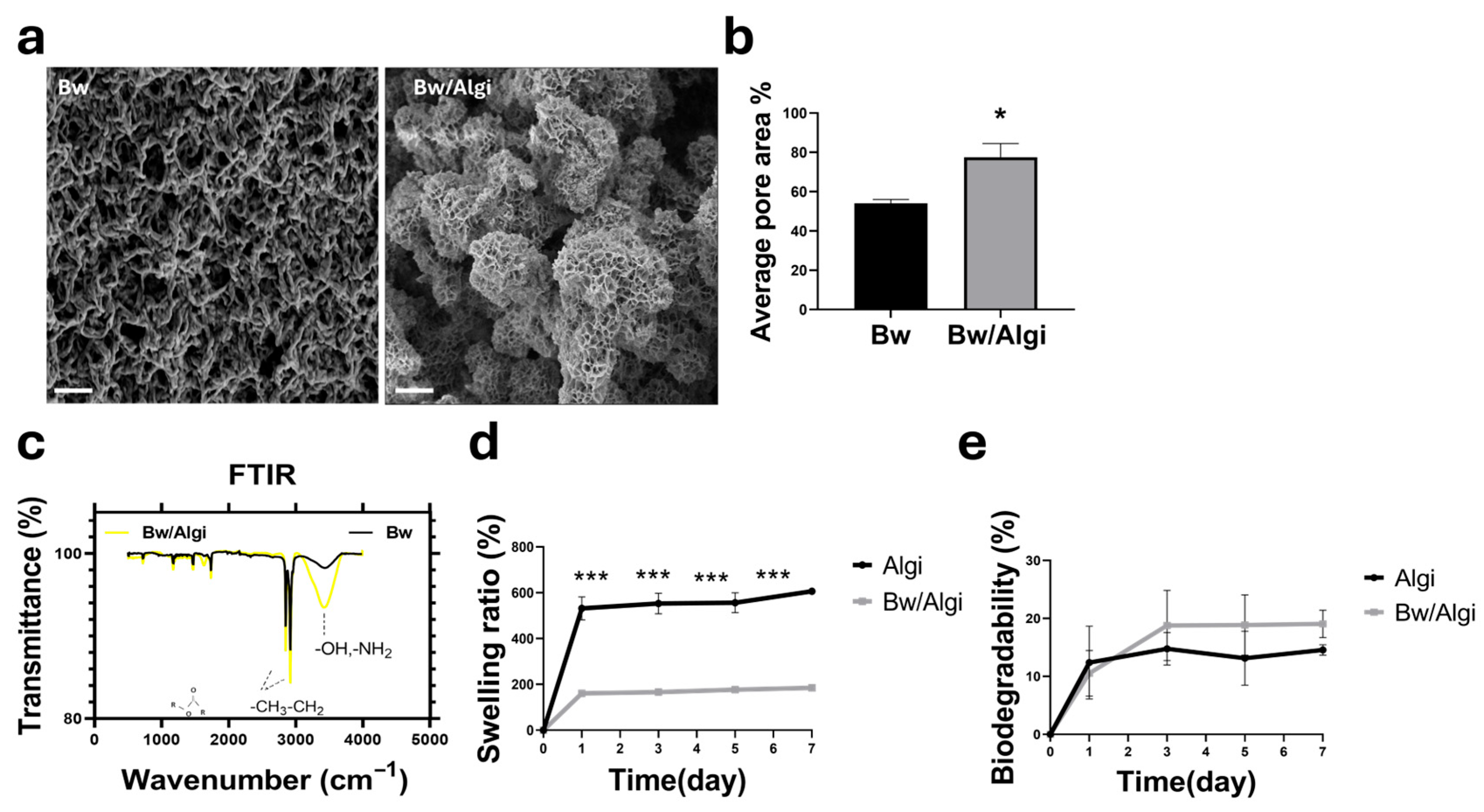
2.2.2. Physical Characteristics
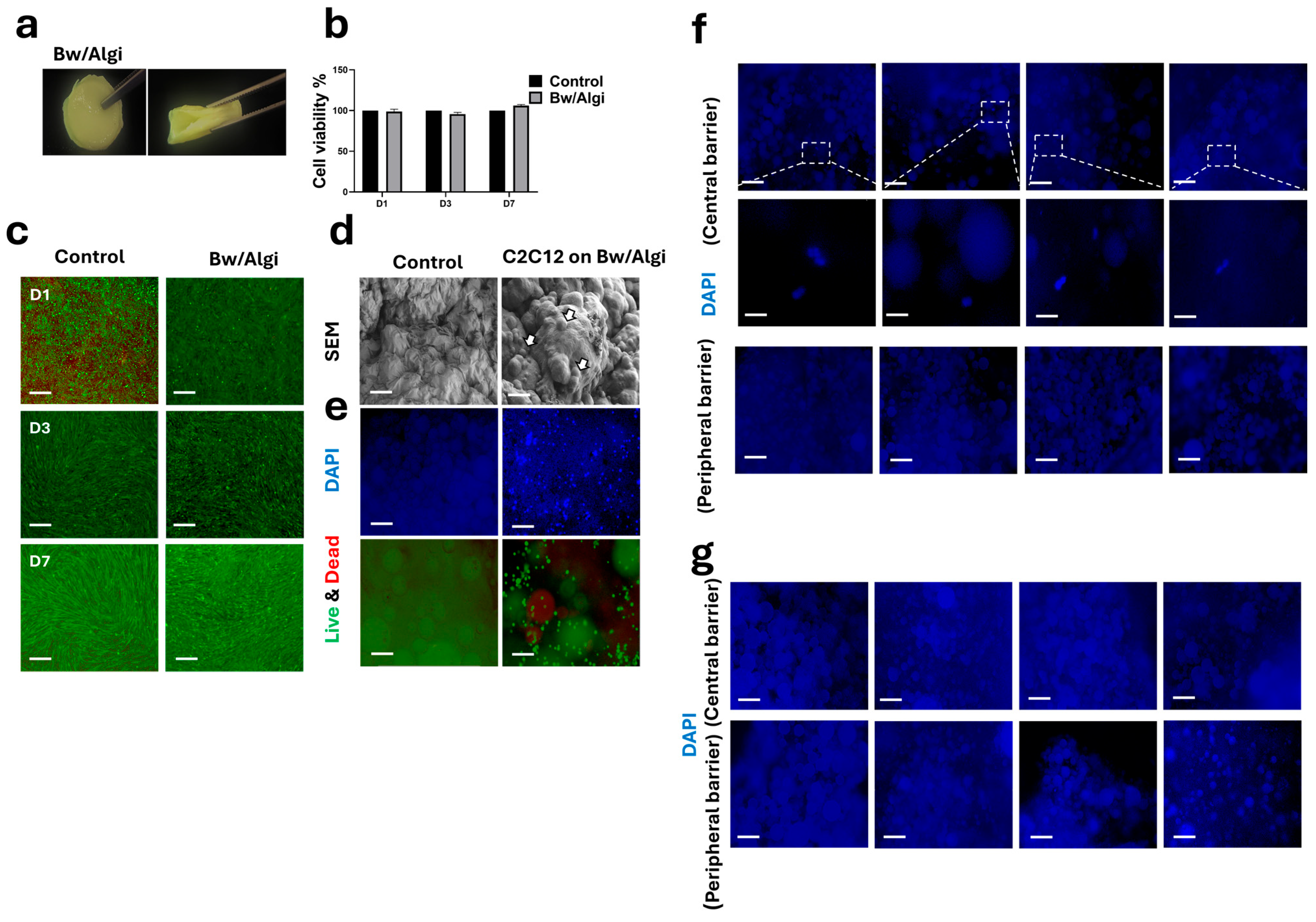
2.2.3. Cytotoxicity
2.2.4. Cell Seeding
2.2.5. Scanning Electron Microscopy (SEM)
2.2.6. Fourier Transform Infrared Spectrometer (FTIR)
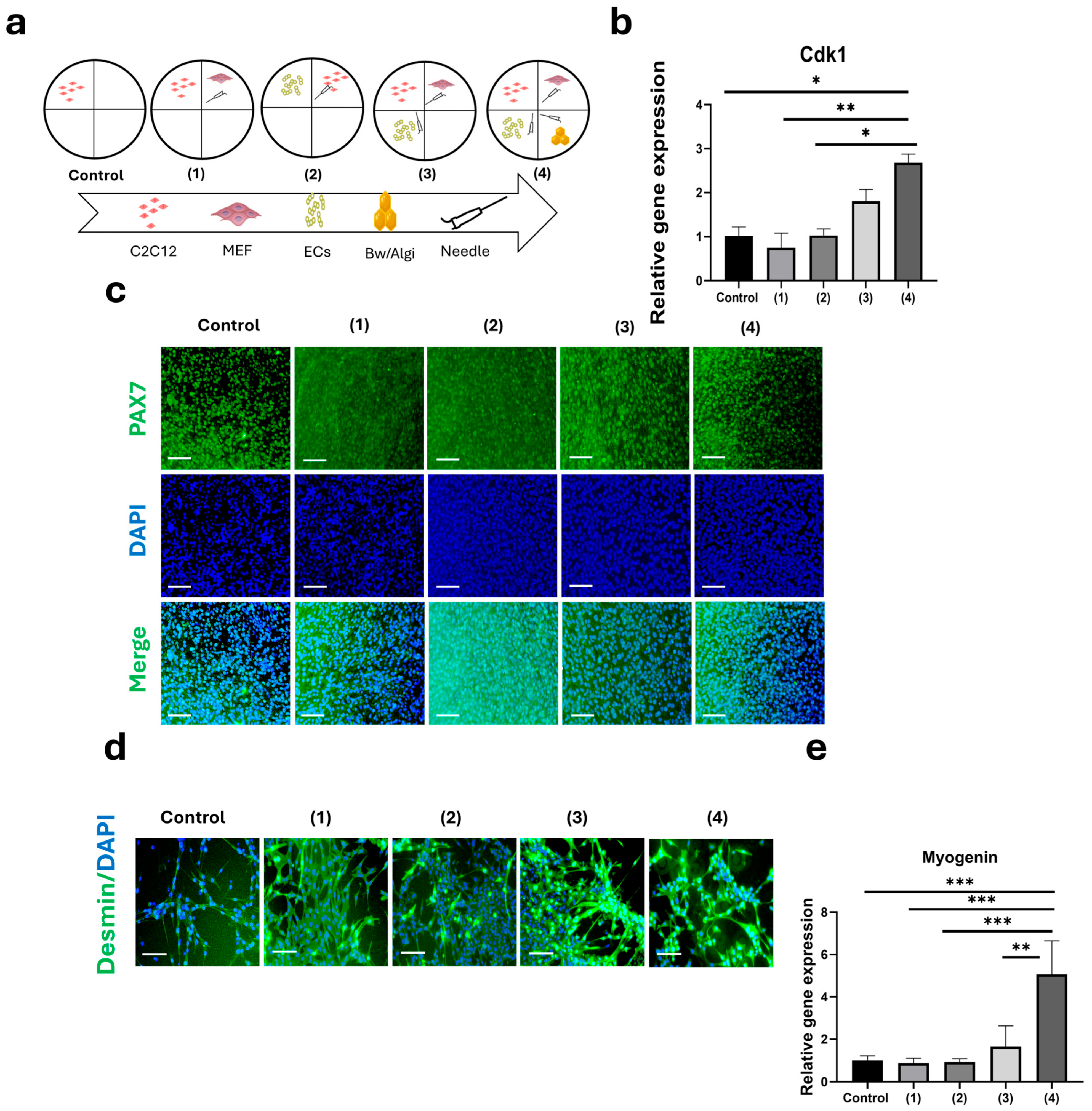
2.3. 2D Indirect Co-Culture of C2C12 Myoblasts, MEF, and HECs
- (1)
- C2C12 cultured alone (control)
- (2)
- C2C12 co-cultured with MEFs
- (3)
- C2C12 co-cultured with HECs
- (4)
- C2C12 co-cultured with MEFs and HECs
- (5)
- C2C12 co-cultured with MEFs, HECs, and Bw/Algi (quadrate co-culture system)
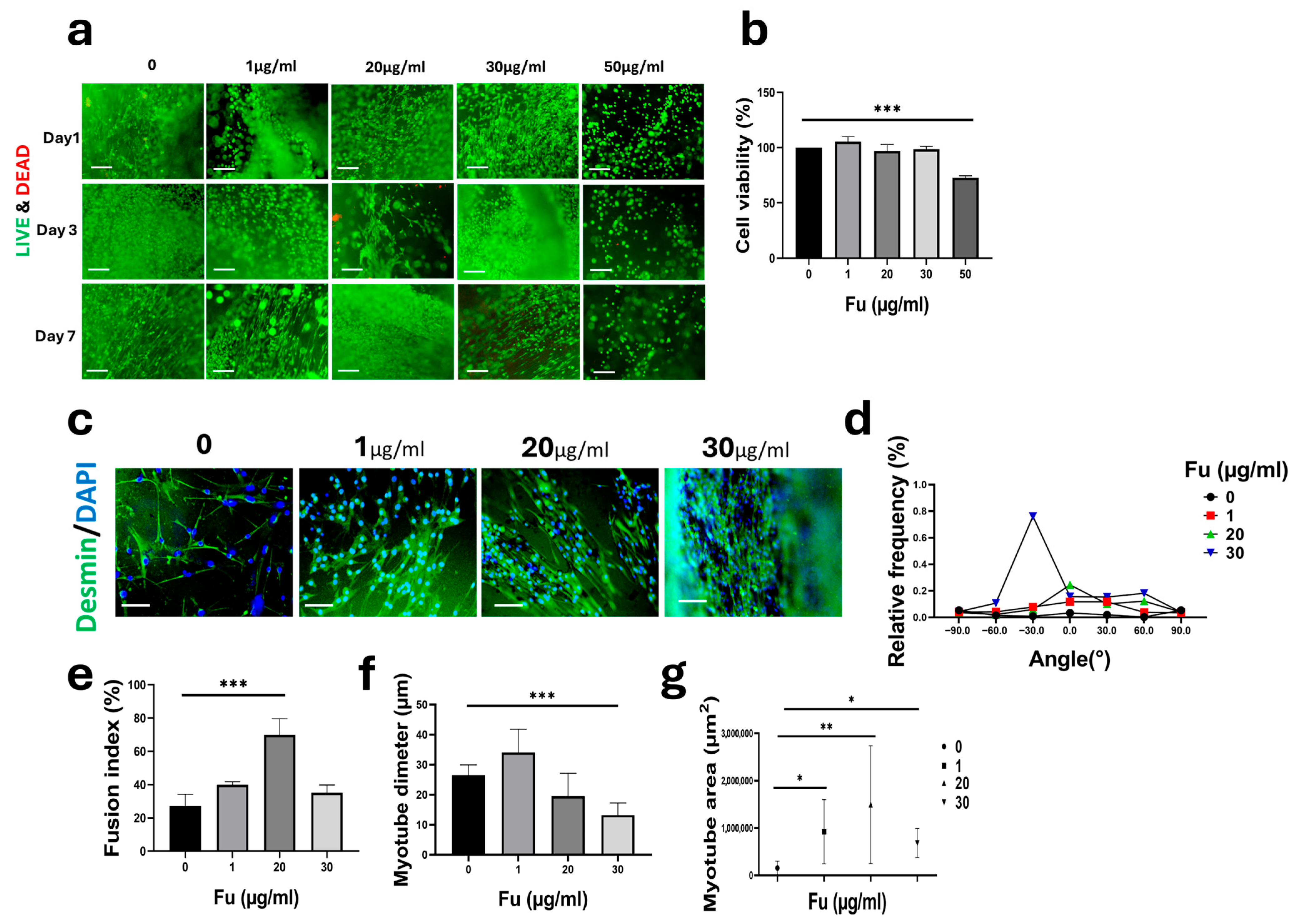
2.4. Optimization of Fucoidan (Fu) Concentration
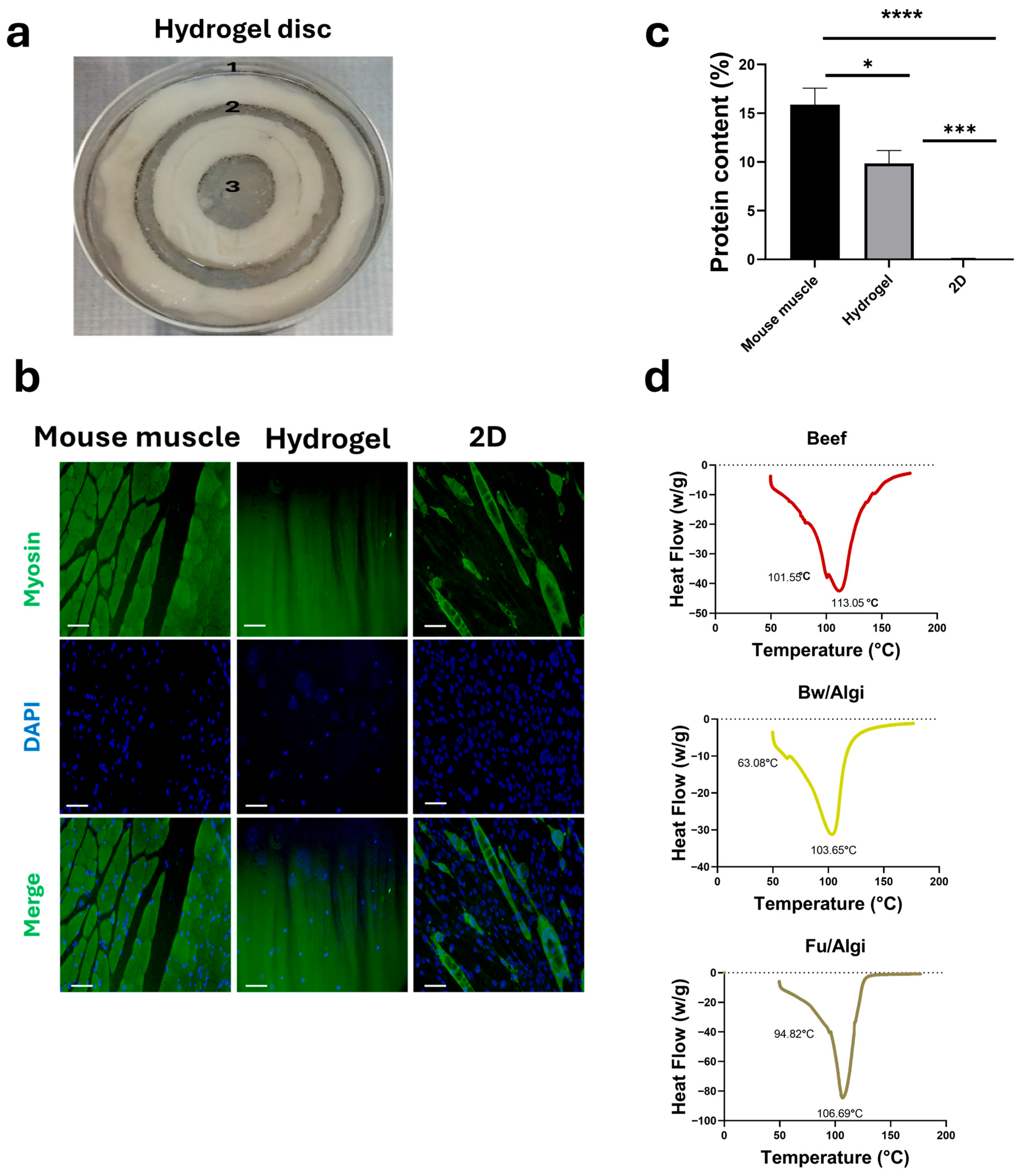
2.5. Fabrication of the Bw/Fu/Algi Hydrogel Disc
- (1)
- 6 mL Fu/Algi containing 2.5 × 10⁵ C2C12 cells.
- (2)
- 6 mL Bw/Algi.
- (3)
- 4 mL Fu/Algi containing 2.5 × 10⁵ MEF cells.
- (4)
- 6 mL Bw/Algi; and
- (5)
- 2 mL Fu/Algi containing 2.5 × 10⁵ HECs.
2.6. Immunofluorescence Staining
2.7. Quantitative PCR (qPCR)
2.8. Protein Content Evaluation
2.9. Thermal Properties of the 3D Scaffold
2.10. Statistical Analysis
3. Results
3.1. Physical and Chemical Properties of Bw/Algi Hydrogel
3.2. Cytotoxicity and Cell Attachment Through Bw/Algi Hydrogel
3.3. 2D Indirect Compartmentalized Co-Culture System
3.4. Effect of Fu Concentration on C2C12 Growth and Differentiation
3.5. Bw/Fu/Algi 3D Tri-Culture Hydrogel Disc
4. Discussion
5. Conclusions
Supplementary Materials
Author Contributions
Funding
Institutional Review Board Statement
Informed Consent Statement
Data Availability Statement
Acknowledgments
Conflicts of Interest
Abbreviations
| Algi | Alginate |
| Bw | Beeswax |
| Bw/Algi | Beeswax/alginate |
| Fu | Fucoidan |
| Fu/Algi | Fucoidan-alginate |
| MEF | Mouse embryonic fibroblast |
| HECs | Human endothelial cells |
| FI (%) | Fusion Index percentage |
References
- Jain, N.; Datta, S.; Singh, P.; Pathote, D.; Das, S.; Barua, R.; Player, D. Skeletal muscle tissue engineering using magnetic nanoparticles: A comprehensive review. J. Mater. Chem. B 2026, 14, 4228–4243. [Google Scholar] [CrossRef] [PubMed]
- Bomkamp, C.; Skaalure, S.C.; Fernando, G.F.; Ben-Arye, T.; Swartz, E.W.; Specht, E.A. Scaffolding biomaterials for 3D cultivated meat: Prospects and challenges. Adv. Sci. 2022, 9, 2102908. [Google Scholar] [CrossRef]
- Budharaju, H.; Praveenn Kumar, S.K.; Rajendran, M.; Sivasubramanian, M.; Sethuraman, S.; Sundaramurthi, D. Advances in 3D bioprinting of functional skeletal muscle constructs: Focus on preclinical models and evaluation strategies. ACS Biomater. Sci. Eng. 2026, 12, 1913–1946. [Google Scholar] [CrossRef]
- Bandara, G.C.; Boudreau, R.D.; Wyatt, W.; Caliari, S.R. Heparin-Modified Aligned Collagen Scaffolds Enhance In Vitro Myogenesis. J. Biomed. Mater. Res. Part A 2026, 114, e70048. [Google Scholar] [CrossRef]
- Kamel, J.; Lee, J.-Y.; Yadav, C.-J.; Afrin, S.; Yadav, U.; Han, S.S.; Park, K.-M. Myotube/Adipocyte Powder-Enriched Alginate–Zein Hydrogels Support Myotube Alignment for 3D Myoblast Culture. Foods 2026, 15, 522. [Google Scholar] [CrossRef]
- Haeriboroojeni, H.; Rabiee, N.; Ahmadi, S.; Nokhbatolfoghahaei, H. Current Challenges and Future Perspectives in Bone Tissue Engineering. In Handbook of Oral and Maxillofacial Surgery and Implantology; Springer: Cham, Switzerland, 2026; pp. 1–116. [Google Scholar]
- Lu, Y.; Chi, Z.; Wang, D. Metabolic symphony coordinates the muscle regeneration niche. Trends Mol. Med. 2025, 32, 211–230. [Google Scholar] [CrossRef]
- Seo, J.W.; Jung, W.K.; Park, Y.H.; Bae, H. Development of cultivable alginate fibers for an ideal cell-cultivated meat scaffold and production of hybrid cultured meat. Carbohydr. Polym. 2023, 321, 121287. [Google Scholar] [CrossRef]
- Seo, K.; Suzuki, T.; Kobayashi, K.; Nishimura, T. Adipocytes suppress differentiation of muscle cells in a co-culture system. Anim. Sci. J. 2019, 90, 423–434. [Google Scholar] [CrossRef] [PubMed]
- Cao, T.; Warren, C.R. From 2D myotube cultures to 3D engineered skeletal muscle constructs: A comprehensive review of in vitro skeletal muscle models and disease modeling applications. Cells 2025, 14, 882. [Google Scholar] [CrossRef] [PubMed]
- Su, Y.; Zhang, S.; Jiang, Y.; Xu, E.; Liu, D.; Chen, Q. Co-cultured spheroids of piscine cells as building blocks for cultured fish meat. Food Res. Int. 2026, 232, 118903. [Google Scholar] [CrossRef]
- Shang, S.; Huang, X.; Zhu, B.; Qin, L. Scaffolding Strategies in Mimicking Muscle and Fat Tissue: Focus on the Current Primary Challenge in Cultured Meat. J. Agric. Food Chem. 2025, 73, 30954–30974. [Google Scholar] [CrossRef]
- Iberite, F.; Gruppioni, E.; Ricotti, L. Skeletal muscle differentiation of human iPSCs meets bioengineering strategies: Perspectives and challenges. npj Regen. Med. 2022, 7, 23. [Google Scholar] [CrossRef] [PubMed]
- Dietrich, I.; Girdlestone, J.; Giele, H. Differential cytokine expression in direct and indirect co-culture of islets and mesenchymal stromal cells. Cytokine 2022, 150, 155779. [Google Scholar] [CrossRef]
- Rasouli, M.; Safari, F. Principles of indirect co-culture method using transwell. In Stem Cell Niche: Methods and Protocols; Springer: New York, NY, USA, 2024; pp. 257–263. [Google Scholar]
- Alencar, G.F.; Owsiany, K.M.; Karnewar, S.; Sukhavasi, K.; Mocci, G.; Nguyen, A.T.; Williams, C.M.; Shamsuzzaman, S.; Mokry, M.; Henderson, C.A.; et al. Stem cell pluripotency genes Klf4 and Oct4 regulate complex SMC phenotypic changes critical in late-stage atherosclerotic lesion pathogenesis. Circulation 2020, 142, 2045–2059. [Google Scholar] [CrossRef]
- Zhang, X.; Simmons, C.A.; Santerre, J.P. Paracrine signalling from monocytes enables desirable extracellular matrix accumulation and temporally appropriate phenotype of vascular smooth muscle cell-like cells derived from adipose stromal cells. Acta Biomater. 2020, 103, 129–141. [Google Scholar] [CrossRef] [PubMed]
- Qazi, T.H.; Blatchley, M.R.; Davidson, M.D.; Yavitt, F.M.; Cooke, M.E.; Anseth, K.S.; Burdick, J.A. Programming hydrogels to probe spatiotemporal cell biology. Cell Stem Cell 2022, 29, 678–691. [Google Scholar] [CrossRef]
- Lungu, C.N.; Gurau, G.; Mehedinti, M.C. Pro-Angiogenic Bioactive Molecules in Vascular Morphogenesis: Integrating Endothelial Cell Dynamics. Curr. Issues Mol. Biol. 2025, 47, 851. [Google Scholar] [CrossRef]
- Yun, J.; Robertson, S.; Kim, C.; Suzuki, M.; Murphy, W.L.; Gopalan, P. Aligned skeletal muscle assembly on a biofunctionalized plant leaf scaffold. Acta Biomater. 2023, 171, 327–335. [Google Scholar] [CrossRef]
- Hong, T.K.; Do, J.T. Generation of chicken contractile skeletal muscle structure using decellularized plant scaffolds. ACS Biomater. Sci. Eng. 2024, 10, 3500–3512. [Google Scholar] [CrossRef] [PubMed]
- Hasan, M.; Swapon, A.R.; Dipti, T.I.; Choi, Y.-J.; Yi, H.-G. Plant-based decellularization: A novel approach for perfusion-compatible tissue engineering structures. J. Microbiol. Biotechnol. 2024, 34, 1003. [Google Scholar] [CrossRef]
- Kuang, X.; Arıcan, M.O.; Zhou, T.; Zhao, X.; Zhang, Y.S. Functional tough hydrogels: Design, processing, and biomedical applications. Acc. Mater. Res. 2022, 4, 101–114. [Google Scholar] [CrossRef]
- Puza, F.; Lienkamp, K. 3D printing of polymer hydrogels—From basic techniques to programmable actuation. Adv. Funct. Mater. 2022, 32, 2205345. [Google Scholar] [CrossRef]
- Rao, S.-Q.; Jia, C.-C.; Du, L.; Zhou, W.-B.; Hu, W.-X.; Jiang, Y.; Wang, Z.-R.; Yang, Z.-Q. Contribution of phosphorylation modification by sodium tripolyphosphate to the functional properties of hollow zein nanoparticles. Food Res. Int. 2025, 203, 115845. [Google Scholar] [CrossRef]
- Cheng, Y.-W.; Shiwarski, D.J.; Ball, R.L.; Whitehead, K.A.; Feinberg, A.W.W. Engineering aligned skeletal muscle tissue using decellularized plant-derived scaffolds. ACS Biomater. Sci. Eng. 2020, 6, 3046–3054. [Google Scholar] [CrossRef]
- Liang, W.; Han, M.; Wu, H.; Dang, W.; Meng, X.; Zhen, Y.; An, Y. Deriving skeletal muscle cells from adipose-derived stem cells: Current differentiation strategies. Chin. Med. J. 2024, 137, 1498–1500. [Google Scholar] [CrossRef] [PubMed]
- Jiang, F.; Yang, L.; Wang, S.; Ying, X.; Ling, J.; Ouyang, X. Fabrication and characterization of zein-alginate oligosaccharide complex nanoparticles as delivery vehicles of curcumin. J. Mol. Liq. 2021, 342, 116937. [Google Scholar] [CrossRef]
- Melzener, L.; Spaans, S.; Hauck, N.; Pötgens, A.J.G.; Flack, J.E.; Post, M.J.; Doğan, A. Short-stranded zein fibers for muscle tissue engineering in alginate-based composite hydrogels. Gels 2023, 9, 914. [Google Scholar] [CrossRef]
- Gruškienė, R.; Galinskaitė, A.; Kavleiskaja, T.; Stanevičienė, R.; Servienė, E.; Sereikaitė, J. Fucoidan as a carrier of antimicrobial peptide: Preparation and characterization of nisin-loaded particles. Lwt 2024, 191, 115598. [Google Scholar] [CrossRef]
- Haggag, Y.A.; Elrahman, A.A.A.; Ulber, R.; Zayed, A. Fucoidan in pharmaceutical formulations: A comprehensive review for smart drug delivery systems. Mar. Drugs 2023, 21, 112. [Google Scholar] [CrossRef]
- Prova, O.S.; Afrin, S.; Tabish, T.A.; Rizwan, M. Fucoidan based hydrogel biomaterials for tissue engineering. Biomater. Sci. 2025, 13, 6572–6597. [Google Scholar] [CrossRef]
- Manivannan, K.; Jaganathan, G.; Sithique, M.A. Novel beeswax-chitosan/Zinc-hydroxyapatite biocomposite porous scaffolds: Preparation and biological evaluation. J. Sci. Adv. Mater. Devices 2021, 6, 197–201. [Google Scholar] [CrossRef]
- Zou, J.; Lu, M.; Chen, S.; Cai, C.; Yao, Z.; Cui, W.; Fan, C.; Liu, S. Beeswax-inspired superhydrophobic electrospun membranes for peritendinous anti-adhesion. Mater. Sci. Eng. C 2020, 116, 111166. [Google Scholar] [CrossRef] [PubMed]
- Brito-Pereira, R.; Ribeiro, C.; Tubio, C.R.; Castro, N.; Costa, P.; Lanceros-Mendez, S. Beeswax multifunctional composites with thermal-healing capability and recyclability. Chem. Eng. J. 2023, 453, 139840. [Google Scholar] [CrossRef]
- Sanyal, A.; Ghosh, A.; Roy, C.; Mazumder, I.; Marrazzo, P. Revolutionizing the use of honeybee products in healthcare: A focused review on using bee pollen as a potential adjunct material for biomaterial functionalization. J. Funct. Biomater. 2023, 14, 352. [Google Scholar] [CrossRef]
- Saretzky, I.; Cassini, M. Enhancing Skin Cicatrization with Natural Sources–The Role of Polyunsaturated Fatty Acids (PUFAs) and Beeswax. In Cosmetic Products and Industry-New Advances and Applications; IntechOpen: London, UK, 2023. [Google Scholar]
- Shabeer, M.; Mathew, M.; Olongal, M.; Athiyanathil, S. Beeswax-modified super hydrophobic acrylonitrile butadiene styrene/polyurethane electrospun membrane for effective oil–water separation. Mater. Adv. 2025, 6, 5991–6000. [Google Scholar] [CrossRef]
- Huanbutta, K.; Chuttong, B.; Danmek, K.; Sriamornsak, P.; Suwanpitak, K.; Sangnim, T. Beeswax in Pharmaceutical Sciences: A Comprehensive Review of Its Chemical Composition, Functional Applications, Types, and Formulation Roles. Int. J. Mol. Sci. 2026, 27, 3486. [Google Scholar] [CrossRef]
- Sahithi-Reddy, P.; Kaur, S.; Gill, P.S.; Jawandha, S.K.; Bajaj, K. Unravelling the potential of beeswax: A comprehensive investigation into its compositional insights, functional attributes, and fuit quality preservation. J. Food Meas. Charact. 2025, 19, 6193–6206. [Google Scholar] [CrossRef]
- Rizg, W.Y.; Albadn, Y.M.; Abdul Khalil, H.P.S.; Alghamdi, M.A.; Madkhali, O.A.; Baradwan, M.; Shazly, F.M.; Marwan, M.; Yahya, E.B. Beeswax-modified biopolymer aerogel: A sustainable approach to hydrophobic oil absorbing materials. Express Polym. Lett. 2025, 19, 544–553. [Google Scholar] [CrossRef]
- Kamel, J.; Lee, J.; Yadav, U.; Afrin, S.; Yadav, C.; Zo, S.M.; Han, S.S.; Park, K. Development of Polysaccharide Hydrogels Enriched With Protein and Starch for Bovine Myoblast Cell Culture. J. Food Sci. 2025, 90, e70350. [Google Scholar] [CrossRef]
- Mao, Y.; Li, Y.; Zheng, Z.; Xu, Y.; Ke, M.; He, A.; Liang, F.; Zhang, K.; Wang, X.; Gao, W.; et al. All-at-once spatial proteome profiling of complex tissue context with single-cell-type resolution by proximity proteomics. Cell Syst. 2025, 16, 101291. [Google Scholar] [CrossRef] [PubMed]
- Xia, D.; Wang, Y.; Wu, R.; Zheng, Q.; Zhang, G.; Xu, S.; Zhou, P. The effect of pore size on cell behavior in mesoporous bioglass scaffolds for bone regeneration. Appl. Mater. Today 2022, 29, 101607. [Google Scholar] [CrossRef]
- Singh, P.; Pandey, V.K.; Singh, R.; Singh, K.; Dash, K.K.; Malik, S. Unveiling the potential of starch-blended biodegradable polymers for substantializing the eco-friendly innovations. J. Agric. Food Res. 2024, 15, 101065. [Google Scholar] [CrossRef]
- Choi, B.; Park, S.; Lee, M.; Jung, S.; Lee, H.; Bang, G.; Kim, J.; Hwang, H.; Yoo, K.H.; Han, D.; et al. High protein-containing new food by cell powder meat. npj Sci. Food 2023, 7, 13. [Google Scholar] [CrossRef]
- Liu, R.; Meng, X.; Yu, X.; Wang, G.; Dong, Z.; Zhou, Z.; Qi, M.; Yu, X.; Ji, T.; Wang, F. From 2D to 3D co-culture systems: A review of co-culture models to study the neural cells interaction. Int. J. Mol. Sci. 2022, 23, 13116. [Google Scholar] [CrossRef]
- Padmanaban, A.M.; Ganesan, K.; Ramkumar, K.M. A co-culture system for studying cellular interactions in vascular disease. Bioengineering 2024, 11, 1090. [Google Scholar] [CrossRef]
- Selegato, D.M.; Castro-Gamboa, I. Enhancing chemical and biological diversity by co-cultivation. Front. Microbiol. 2023, 14, 1117559. [Google Scholar] [CrossRef]
- Kapoore, R.V.; Padmaperuma, G.; Maneein, S.; Vaidyanathan, S. Co-culturing microbial consortia: Approaches for applications in biomanufacturing and bioprocessing. Crit. Rev. Biotechnol. 2022, 42, 46–72. [Google Scholar] [CrossRef]
- Wu, J.; Yue, B. Regulation of myogenic cell proliferation and differentiation during mammalian skeletal myogenesis. Biomed. Pharmacother. 2024, 174, 116563. [Google Scholar] [CrossRef]
- Kuppusamy, P.; Kim, D.; Soundharrajan, I.; Hwang, I.; Choi, K.C. Adipose and muscle cell co-culture system: A novel in vitro tool to mimic the in vivo cellular environment. Biology 2020, 10, 6. [Google Scholar] [CrossRef]
- Du, M. Prenatal development of muscle and adipose and connective tissues and its impact on meat quality. Meat Muscle Biol. 2023, 7, 16230. [Google Scholar] [CrossRef]
- Martins, B.; Bister, A.; Dohmen, R.G.; Gouveia, M.A.; Hueber, R.; Melzener, L.; Messmer, T.; Papadopoulos, J.; Pimenta, J.; Raina, D.; et al. Advances and challenges in cell biology for cultured meat. Annu. Rev. Anim. Biosci. 2024, 12, 345–368. [Google Scholar] [CrossRef] [PubMed]
- Zschüntzsch, J.; Meyer, S.; Shahriyari, M.; Kummer, K.; Schmidt, M.; Kummer, S.; Tiburcy, M. The evolution of complex muscle cell in vitro models to study pathomechanisms and drug development of neuromuscular disease. Cells 2022, 11, 1233. [Google Scholar] [CrossRef]
- Som, L.; Smart, N. Bridging the Translational Gap: Rethinking Smooth Muscle Cell Plasticity in Atherosclerosis Through Human-Relevant In Vitro Models. Cells 2025, 14, 1913. [Google Scholar] [CrossRef] [PubMed]
- David, S.; Tsukerman, A.; Safina, D.; Maor-Shoshani, A.; Lavon, N.; Levenberg, S. Co-culture approaches for cultivated meat production. Nat. Rev. Bioeng. 2023, 1, 817–831. [Google Scholar] [CrossRef]
- Pierezan, M.D.; Verruck, S. Cattle, swine, poultry and fish cells for meat production: Addressing challenges of co-culture and the innovative approaches for muscle and fat integration. Curr. Opin. Food Sci. 2024, 60, 101230. [Google Scholar] [CrossRef]
- Guo, L.; Li, Y.; Xing, Z.; Zhang, J.; Zhang, J. Role of VEGFB in electrical pulse stimulation inhibits apoptosis in C2C12 myotubes. Peptides 2022, 154, 170823. [Google Scholar] [CrossRef]
- Liu, S.-Y.; Chen, L.-K.; Jhong, Y.-T.; Chen, C.-W.; Hsiao, L.-E.; Ku, H.-C.; Lee, P.-H.; Hwang, G.-S.; Juan, C.-C. Endothelin-1 impairs skeletal muscle myogenesis and development via ETB receptors and p38 MAPK signaling pathway. Clin. Sci. 2024, 138, 711–723. [Google Scholar] [CrossRef]
- Karoii, D.H.; Azizi, H. A review of protein-protein interaction and signaling pathway of Vimentin in cell regulation, morphology and cell differentiation in normal cells. J. Recept. Signal Transduct. 2022, 42, 512–520. [Google Scholar] [CrossRef]
- Rosellini, E.; Cascone, M.G. Microfluidic fabrication of natural polymer-based scaffolds for tissue engineering applications: A review. Biomimetics 2023, 8, 74. [Google Scholar] [CrossRef]
- Sari, M.; Aminatun; Suciati, T.; Sari, Y.W.; Yusuf, Y. Porous carbonated hydroxyapatite-based paraffin wax nanocomposite scaffold for bone tissue engineering: A physicochemical properties and cell viability assay analysis. Coatings 2021, 11, 1189. [Google Scholar] [CrossRef]
- Shi, S.; Xu, X.; Ren, Y.; Zhang, H.; Du, X.; Li, H.; Xia, X. Beeswax coating improves the hydrophobicity of sodium alginate/anthocyanin/cellulose nanocrystal indicator film. Food Hydrocoll. 2023, 144, 108930. [Google Scholar] [CrossRef]
- Zhu, J.; Yao, B.; Li, Z.; Liu, M.; Zhang, Z.; Qi, Y.; Wen, T. Mass transport characteristic of radial gradient porous scaffolds manufactured by selective laser melting. Int. J. Heat Mass Transf. 2025, 236, 126320. [Google Scholar] [CrossRef]
- Mukasheva, F.; Adilova, L.; Dyussenbinov, A.; Yernaimanova, B.; Abilev, M.; Akilbekova, D. Optimizing scaffold pore size for tissue engineering: Insights across various tissue types. Front. Bioeng. Biotechnol. 2024, 12, 1444986. [Google Scholar] [CrossRef]
- Farshidfar, N.; Iravani, S.; Varma, R.S. Alginate-based biomaterials in tissue engineering and regenerative medicine. Mar. Drugs 2023, 21, 189. [Google Scholar] [CrossRef]
- Wang, C.; Qiu, Y.; Yang, Y.; Dai, Q.; Cao, X.; Shao, L.; Zhao, F. Autologous myokine-loaded pre-vascularized bioactive scaffold enhances bone augmentation. Compos. Part B Eng. 2025, 290, 111967. [Google Scholar] [CrossRef]
- Xiong, W.; Zhou, Y.; Chai, M.; Chen, Y.; Dai, W.; Wang, L.; Ge, C.; Tan, W.-S.; Zhou, Y. Combining functional fucoidan with zein to enhance the adhesion and differentiation of myoblast cells. Food Res. Int. 2025, 221, 117153. [Google Scholar] [CrossRef]
- Maimaiti, D.; Ge, X.; Wang, C.; Liu, J.; Yang, G.; Zhang, D.; Xu, Y.; He, F.; Chen, X. Extracellular matrix-mimicking cryogels composed of methacrylated fucoidan enhance vascularized skeletal muscle regeneration following volumetric muscle loss. Int. J. Biol. Macromol. 2024, 283, 137122. [Google Scholar] [CrossRef]
- Sahebalzamani, M.; Ziminska, M.; McCarthy, H.O.; Levingstone, T.J.; Dunne, N.J.; Hamilton, A.R. Advancing bone tissue engineering one layer at a time: A layer-by-layer assembly approach to 3D bone scaffold materials. Biomater. Sci. 2022, 10, 2734–2758. [Google Scholar] [CrossRef]
- Park, S.-M.; Ryoo, J.-H.; Kwon, H.C.; Han, S.G. Scaffold biomaterials in the development of cultured meat: A review. Food Sci. Anim. Resour. 2025, 45, 688. [Google Scholar] [CrossRef]
- Schmid, E.-M. Development of Soy Protein Meat Analogues Using High Moisture Extrusion Cooking. Ph.D. Thesis, RMIT University, Melbourne, Australia, 2024. [Google Scholar]
- Qaiser, H.; Abdullah, R.; Kaleem, A.; Iqtedar, M.; Khalid, M. Advanced Technologies in the Processing of Textured Meat Analogs. In Innovative Technologies for Meat Processing; CRC Press: Boca Raton, FL, USA, 2025; pp. 271–288. [Google Scholar]
- Wang, N.; Yang, X. Plant protein/carbohydrate composites-based food gels for plant-based meat alternatives production: A review. J. Sci. Food Agric. 2026, 106, 1981–1993. [Google Scholar] [CrossRef] [PubMed]
- Tumova, S.; Milacek, M.; Šnajdr, I.; Muthu, M.; Tuma, R.; Reha, D.; Jedlicka, P.; Bittova, L.; Novotna, A.; Majer, P.; et al. Unique peptidic agonists of a juvenile hormone receptor with species-specific effects on insect development and reproduction. Proc. Natl. Acad. Sci. USA 2022, 119, e2215541119. [Google Scholar] [CrossRef] [PubMed]



| Gene | Primer Sequence (5′-3′) |
|---|---|
| GAPDH | F: CATCACTGCCACCCAGAAGACTG R: ATGCCAGTGCTTCCCGTTCAG |
| β-actin | F: GAAATCGTGCGTGACATCAAA R: TGTAGTTTCATGGATGCCACA |
| Cdk1 | F: TTGAGAGTGTGAGGCAGGAG R: TCCCAAGGAGTAGGCTAGGT |
| Myogenin | F: AGAGACATGAGTGCCCTGAC R: TTCCCGGTATCATCAGCACA |
Disclaimer/Publisher’s Note: The statements, opinions and data contained in all publications are solely those of the individual author(s) and contributor(s) and not of MDPI and/or the editor(s). MDPI and/or the editor(s) disclaim responsibility for any injury to people or property resulting from any ideas, methods, instructions or products referred to in the content. |
© 2026 by the authors. Licensee MDPI, Basel, Switzerland. This article is an open access article distributed under the terms and conditions of the Creative Commons Attribution (CC BY) license.
Share and Cite
Kamel, J.; Lee, J.-Y.; Afrin, S.; Yadav, U.; Yadav, C.J.; Han, S.S.; Park, K.-M. Engineering a Compartmentalized Multi-Cell Co-Culture Hydrogel System Using Beeswax/Fucoidan/Alginate for Cultured Meat Modeling. Foods 2026, 15, 1715. https://doi.org/10.3390/foods15101715
Kamel J, Lee J-Y, Afrin S, Yadav U, Yadav CJ, Han SS, Park K-M. Engineering a Compartmentalized Multi-Cell Co-Culture Hydrogel System Using Beeswax/Fucoidan/Alginate for Cultured Meat Modeling. Foods. 2026; 15(10):1715. https://doi.org/10.3390/foods15101715
Chicago/Turabian StyleKamel, Jihad, Jun-Yeong Lee, Sadia Afrin, Usha Yadav, Chandra Jit Yadav, Sung Soo Han, and Kyung-Mee Park. 2026. "Engineering a Compartmentalized Multi-Cell Co-Culture Hydrogel System Using Beeswax/Fucoidan/Alginate for Cultured Meat Modeling" Foods 15, no. 10: 1715. https://doi.org/10.3390/foods15101715
APA StyleKamel, J., Lee, J.-Y., Afrin, S., Yadav, U., Yadav, C. J., Han, S. S., & Park, K.-M. (2026). Engineering a Compartmentalized Multi-Cell Co-Culture Hydrogel System Using Beeswax/Fucoidan/Alginate for Cultured Meat Modeling. Foods, 15(10), 1715. https://doi.org/10.3390/foods15101715