Physical and Chemical Property Changes, Cooked-Off Flavor Formation, and Its Alleviation During Storage of Green Tea Beverages

 , ,
, ,  , and
, and
Abstract
1. Introduction
2. Materials and Methods
2.1. Chemicals
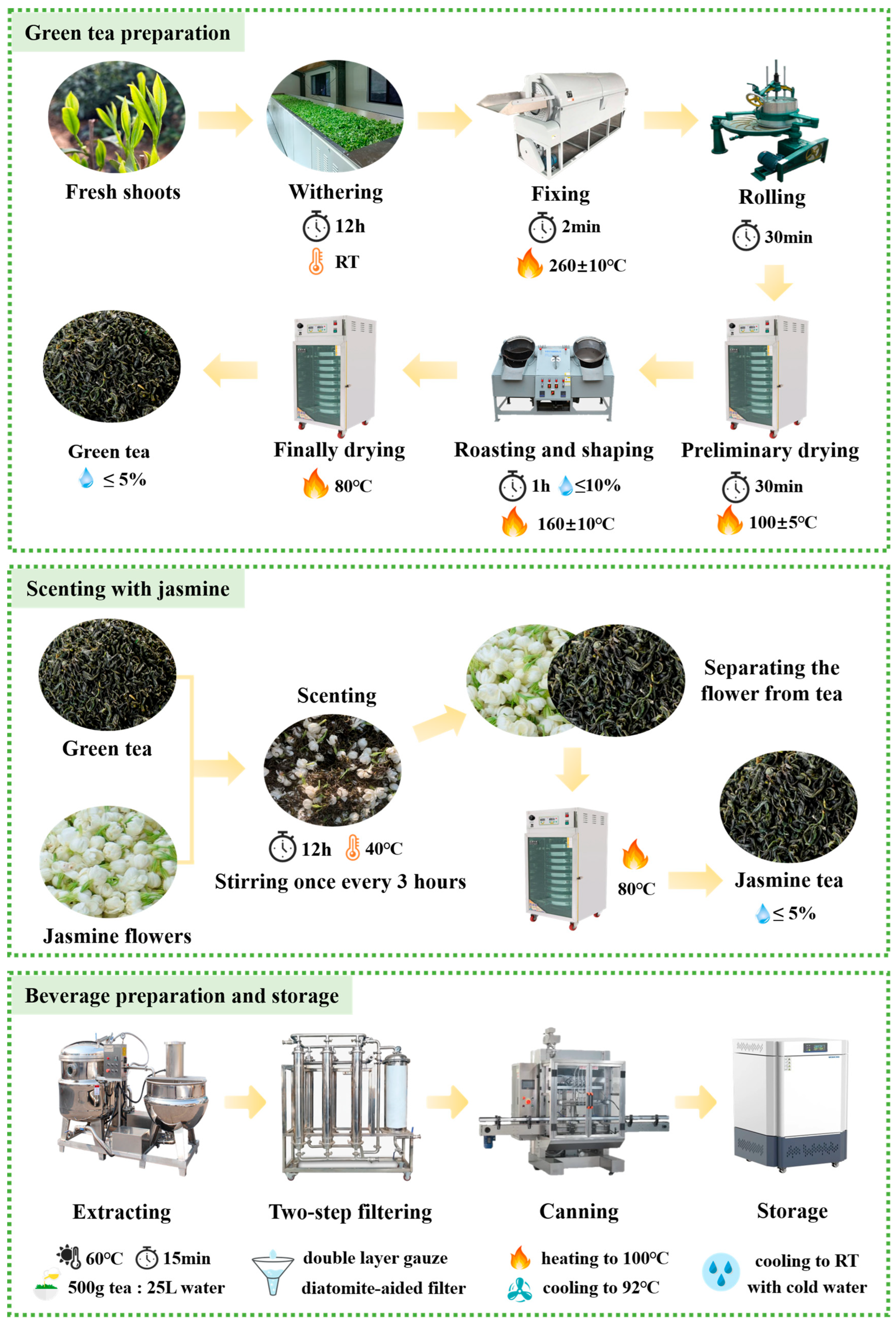
2.2. Tea Sample Preparation
2.3. RTD Beverage Preparation and Storage
2.4. Sensory Evaluation of the Beverage
2.5. Beverage Color Difference and Turbidity Assessment
2.6. Detection of Non-Volatile Compounds
2.7. Analysis of Volatile Compounds
2.8. Data Statistics and Plotting
3. Results and Discussion
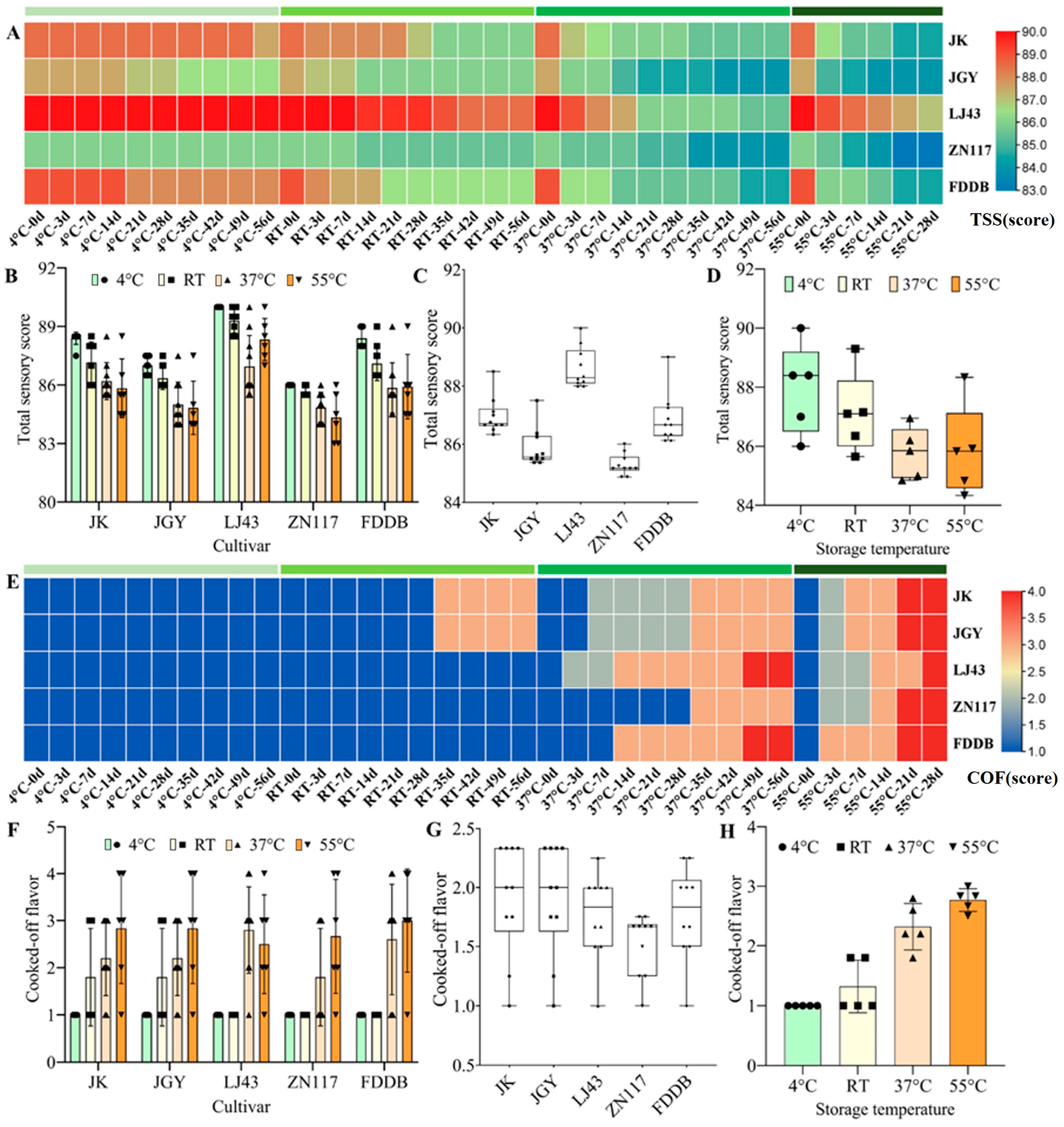
3.1. Change in Sensory Quality of the GTBs During Storage
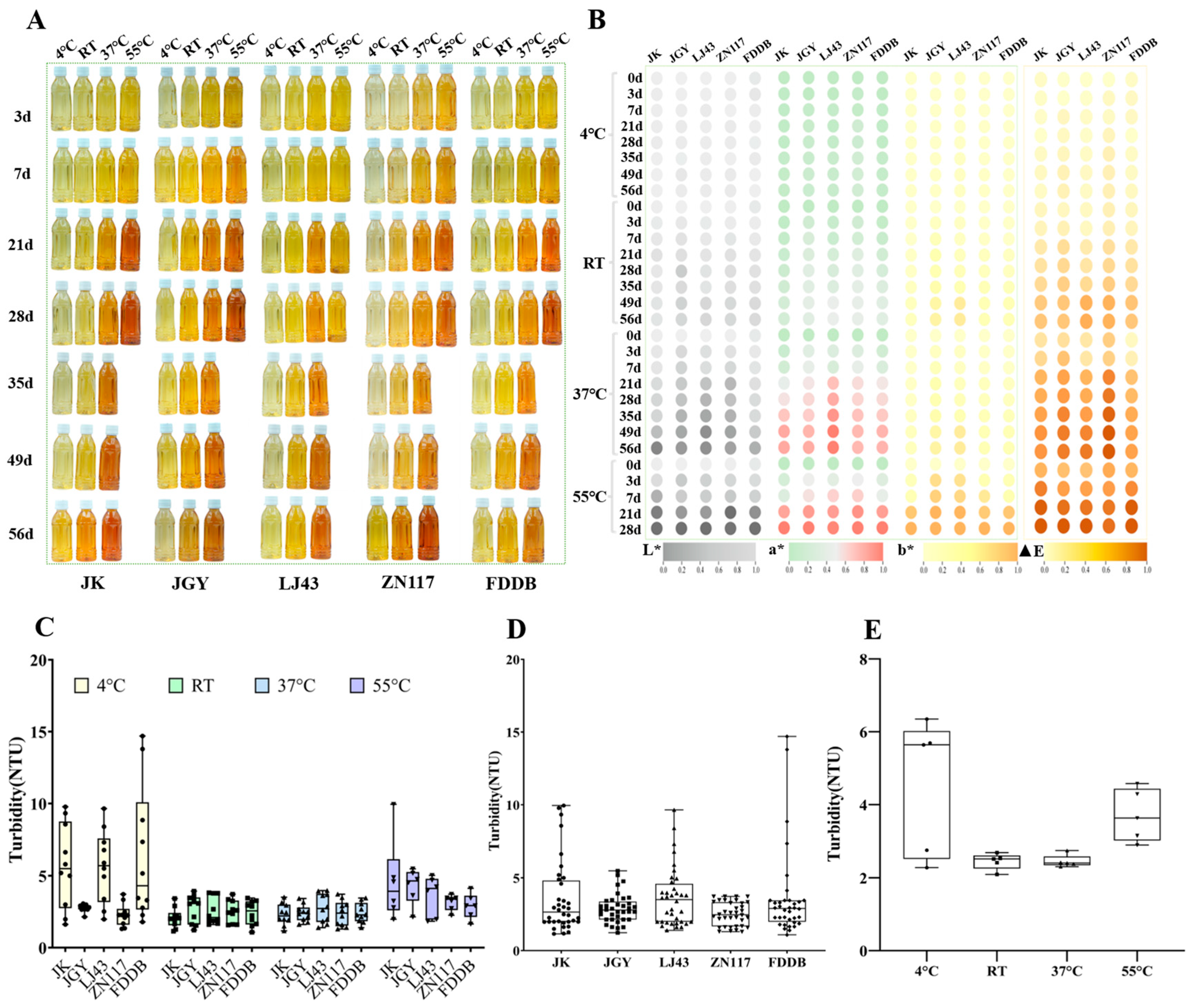
3.2. Changes in Color and Turbidity of the GTBs During Storage
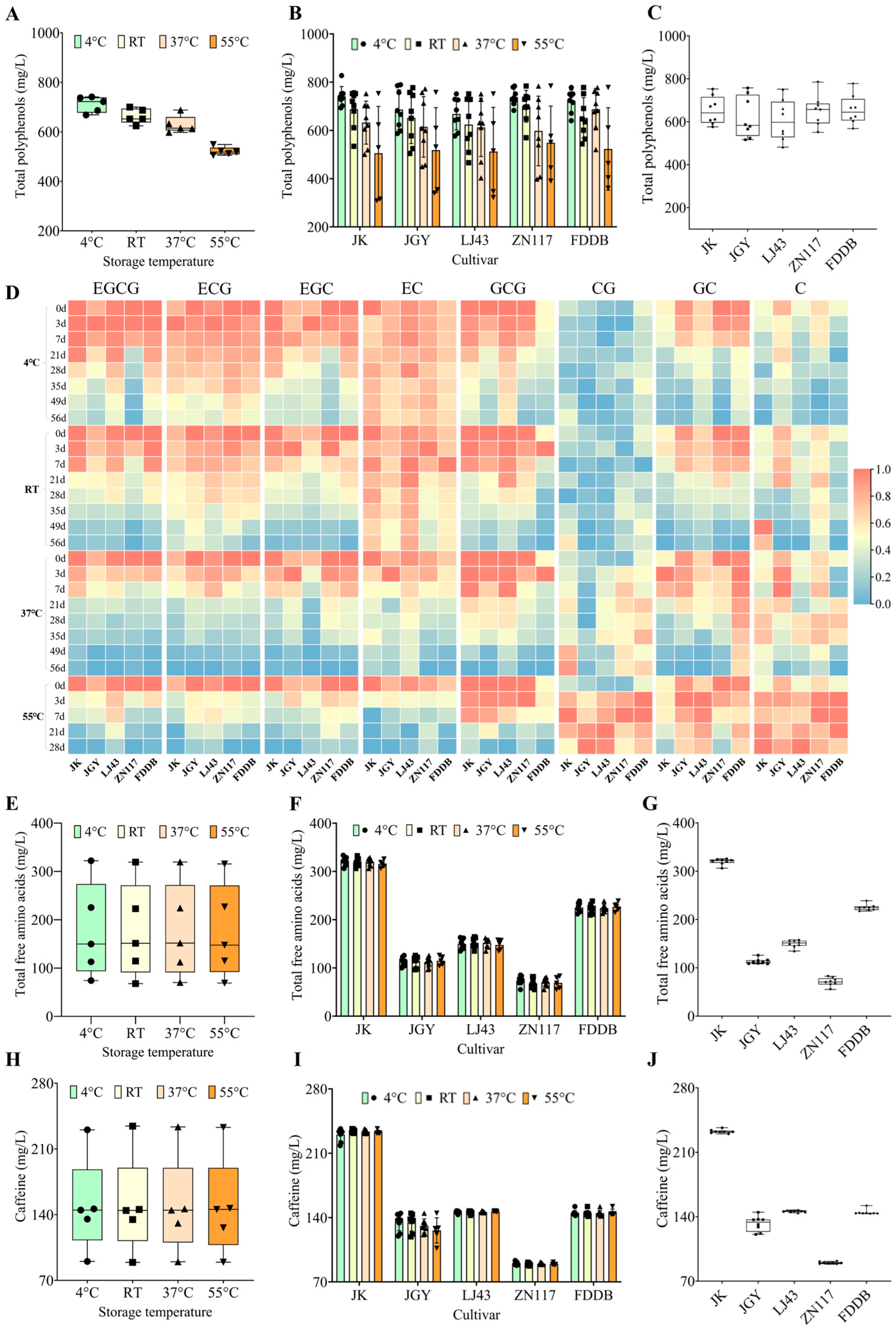
3.3. Changes in Taste-Related Components of the GTBs During Storage
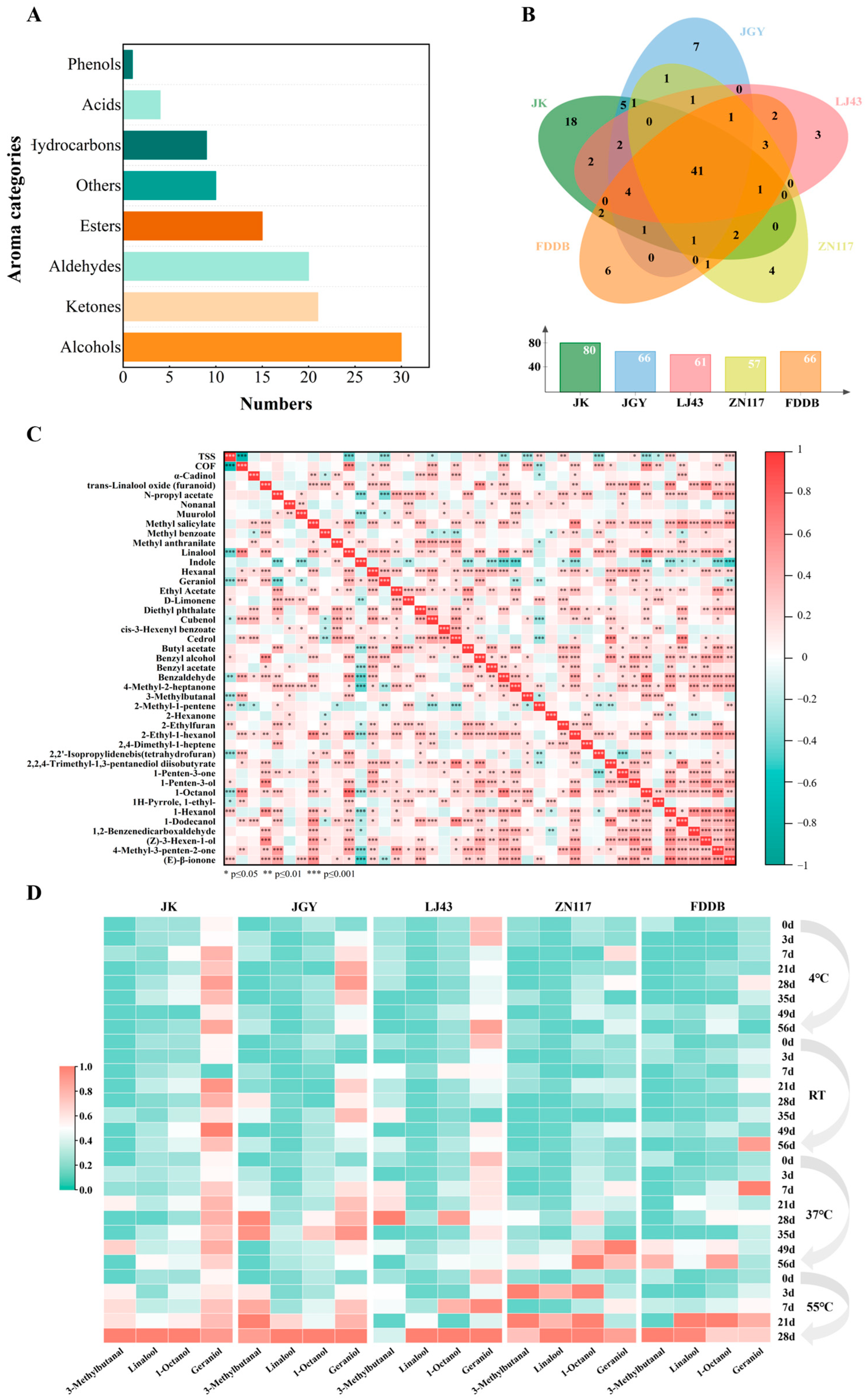
3.4. Change in Aroma-Related Components of the GTBs During Storage
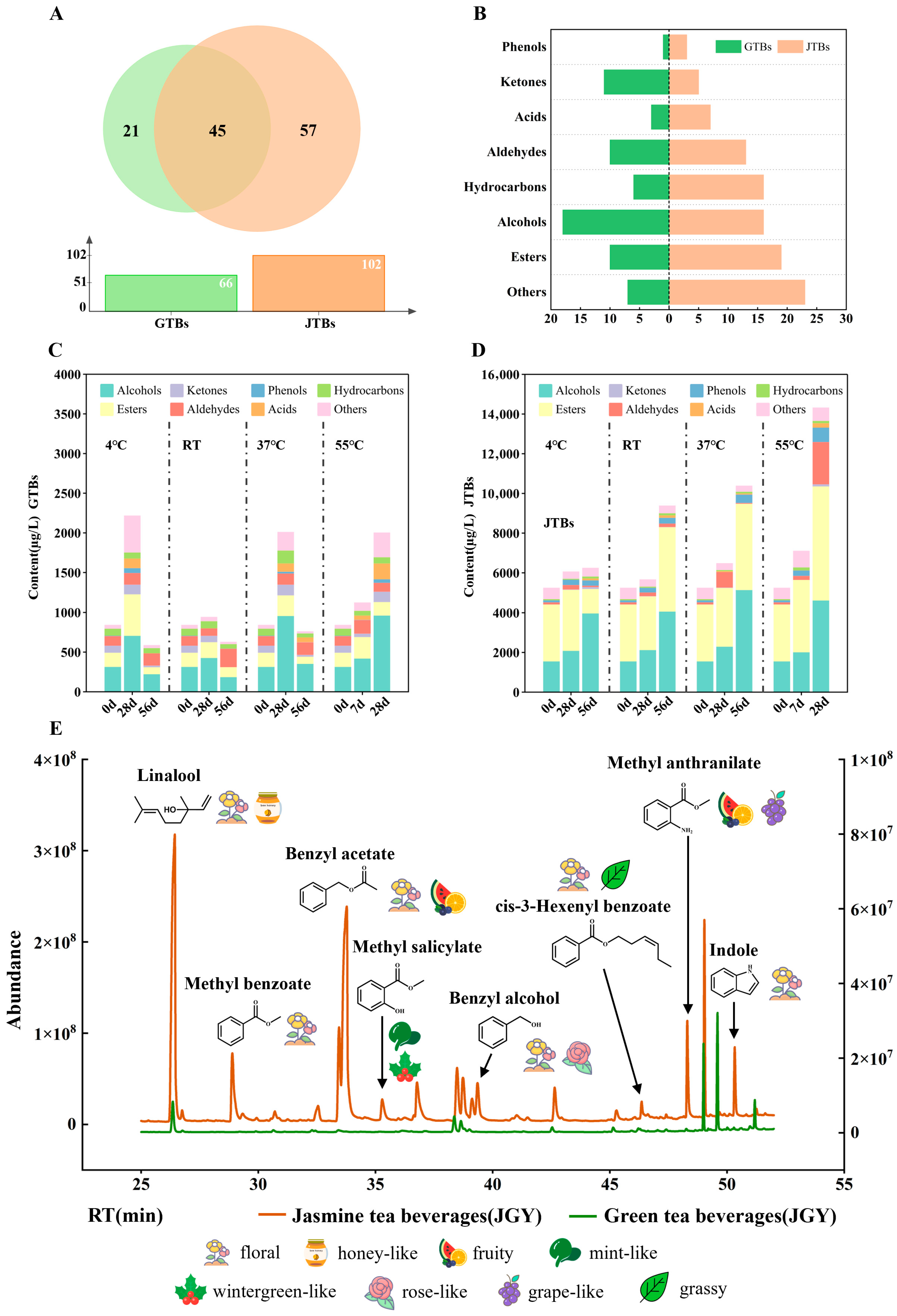
3.5. Influence of Scenting on Physical and Chemical Properties Changes of the GTBs
4. Conclusions
Supplementary Materials
Author Contributions
Funding
Institutional Review Board Statement
Informed Consent Statement
Data Availability Statement
Conflicts of Interest
References
- Zhang, L.; Ho, C.-T.; Zhou, J.; Santos, J.S.; Armstrong, L.; Granato, D. Chemistry and Biological Activities of Processed Camellia Sinensis Teas: A Comprehensive Review. Compr. Rev. Food Sci. Food Saf. 2019, 18, 1474–1495. [Google Scholar] [CrossRef]
- Wang, J.-Q.; Tang, B.-M.; Gao, Y.; Chen, J.-X.; Wang, F.; Yin, J.-F.; Zeng, L.; Zhou, W.-B.; Xu, Y.-Q. Impact of Heat Treatment on the Flavor Stability of Longjing Green Tea Beverages: Metabolomic Insights and Sensory Correlations. Food Res. Int. 2024, 193, 114867. [Google Scholar] [CrossRef] [PubMed]
- Liang, S.; Granato, D.; Zou, C.; Gao, Y.; Zhu, Y.; Zhang, L.; Yin, J.-F.; Zhou, W.; Xu, Y.-Q. Processing Technologies for Manufacturing Tea Beverages: From Traditional to Advanced Hybrid Processes. Trends Food Sci. Technol. 2021, 118, 431–446. [Google Scholar] [CrossRef]
- Murugesh, C.S.; Manoj, J.B.; Haware, D.J.; Ravi, R.; Subramanian, R. Influence of Water Quality on Nutritional and Sensory Characteristics of Green Tea Infusion. J. Food Process Eng. 2017, 40, e12532. [Google Scholar] [CrossRef]
- Oliveira, R.M.M.D. Quantification of Catechins and Caffeine from Green Tea (Camellia sinensis) Infusions, Extract, and Ready-to-Drink Beverages. Food Sci. Technol. 2012, 32, 163–166. [Google Scholar] [CrossRef]
- Dubey, K.K.; Janve, M.; Ray, A.; Singhal, R.S. Ready-to-Drink Tea. In Trends in Non-Alcoholic Beverages; Elsevier: Amsterdam, The Netherlands, 2020; pp. 101–140. [Google Scholar]
- Zhang, Y.-N.; Yin, J.-F.; Chen, J.-X.; Wang, F.; Du, Q.-Z.; Jiang, Y.-W.; Xu, Y.-Q. Improving the Sweet Aftertaste of Green Tea Infusion with Tannase. Food Chem. 2016, 192, 470–476. [Google Scholar] [CrossRef]
- Fernández, P.L.; Martín, M.J.; González, A.G.; Pablos, F. HPLC Determination of Catechins and Caffeine in Tea. Differentiation of Green, Black and Instant Teas. Analyst 2000, 125, 421–425. [Google Scholar] [CrossRef]
- Xu, Y.-Q.; Zhang, Y.-N.; Chen, J.-X.; Wang, F.; Du, Q.-Z.; Yin, J.-F. Quantitative Analyses of the Bitterness and Astringency of Catechins from Green Tea. Food Chem. 2018, 258, 16–24. [Google Scholar] [CrossRef] [PubMed]
- Ananingsih, V.K.; Sharma, A.; Zhou, W. Green Tea Catechins during Food Processing and Storage: A Review on Stability and Detection. Food Res. Int. 2013, 50, 469–479. [Google Scholar] [CrossRef]
- Fujiki, H.; Sueoka, E.; Watanabe, T.; Suganuma, M. Synergistic Enhancement of Anticancer Effects on Numerous Human Cancer Cell Lines Treated with the Combination of EGCG, Other Green Tea Catechins, and Anticancer Compounds. J. Cancer Res. Clin. Oncol. 2015, 141, 1511–1522. [Google Scholar] [CrossRef]
- Henning, S.M.; Niu, Y.; Lee, N.H.; Thames, G.D.; Minutti, R.R.; Wang, H.; Go, V.L.W.; Heber, D. Bioavailability and Antioxidant Activity of Tea Flavanols after Consumption of Green Tea, Black Tea, or a Green Tea Extract Supplement. Am. J. Clin. Nutr. 2004, 80, 1558–1564. [Google Scholar] [CrossRef]
- Zhang, L.; Cao, Q.-Q.; Granato, D.; Xu, Y.-Q.; Ho, C.-T. Association between Chemistry and Taste of Tea: A Review. Trends Food Sci. Technol. 2020, 101, 139–149. [Google Scholar] [CrossRef]
- Dou, H.; Li, C.; Hao, J.; Hu, W. Study on the change of the main biochemical components, representative aromatic compounds as well as their correlation of green tea beverages during storage. J. Tea Sci. 2008, 28, 181–188. [Google Scholar]
- Chen, J.; Gao, Y. Quality changes of different tea beverages during storage. Sci. Technol. Food Ind. 2021, 42, 281–289. [Google Scholar] [CrossRef]
- Fu, Y.-Q.; Wang, J.-Q.; Chen, J.-X.; Wang, F.; Yin, J.-F.; Zeng, L.; Shi, J.; Xu, Y.-Q. Effect of Baking on the Flavor Stability of Green Tea Beverages. Food Chem. 2020, 331, 127258. [Google Scholar] [CrossRef] [PubMed]
- Wang, L.-F.; Kim, D.-M.; Lee, C.Y. Effects of Heat Processing and Storage on Flavanols and Sensory Qualities of Green Tea Beverage. J. Agric. Food Chem. 2000, 48, 4227–4232. [Google Scholar] [CrossRef]
- Wang, J.-Q.; Dai, Z.-S.; Gao, Y.; Wang, F.; Chen, J.-X.; Feng, Z.-H.; Yin, J.-F.; Zeng, L.; Xu, Y.-Q. Untargeted Metabolomics Coupled with Chemometrics for Flavor Analysis of Dahongpao Oolong Tea Beverages under Different Storage Conditions. LWT 2023, 185, 115128. [Google Scholar] [CrossRef]
- Ito, Y.; Sugimoto, A.; Kakuda, T.; Kubota, K. Identification of Potent Odorants in Chinese Jasmine Green Tea Scented with Flowers of Jasminum Sambac. J. Agric. Food Chem. 2002, 50, 4878–4884. [Google Scholar] [CrossRef] [PubMed]
- An, H.; Ou, X.; Zhang, Y.; Li, S.; Xiong, Y.; Li, Q.; Huang, J.; Liu, Z. Study on the Key Volatile Compounds and Aroma Quality of Jasmine Tea with Different Scenting Technology. Food Chem. 2022, 385, 132718. [Google Scholar] [CrossRef]
- Shen, J.-X.; Rana, M.M.; Liu, G.-F.; Ling, T.-J.; Gruber, M.Y.; Wei, S. Differential Contribution of Jasmine Floral Volatiles to the Aroma of Scented Green Tea. J. Food Qual. 2017, 2017, 5849501. [Google Scholar] [CrossRef]
- Chen, Y.; An, H.; Huang, Y.; Liu, J.; Liu, Z.; Li, S.; Huang, J. Analysis of Non-Volatile Compounds in Jasmine Tea and Jasmine Based on Metabolomics and Sensory Evaluation. Foods 2023, 12, 3708. [Google Scholar] [CrossRef] [PubMed]
- GB/T 23776-2018; Methodology for Sensory Evaluation of Tea. General Administration of Quality Supervision, Inspection and Quarantine of the People’s Republic of China and Standardization Administration of China: Hangzhou, China, 2018.
- Filipe-Ribeiro, L.; Rodrigues, S.; Nunes, F.M.; Cosme, F. Reducing the Negative Effect on White Wine Chromatic Characteristics Due to the Oxygen Exposure during Transportation by the Deoxygenation Process. Foods 2021, 10, 2023. [Google Scholar] [CrossRef]
- Spagna, G.; Pifferi, P.G.; Rangoni, C.; Mattivi, F.; Nicolini, G.; Palmonari, R. The Stabilization of White Wines by Adsorption of Phenolic Compounds on Chitin and Chitosan. Food Res. Int. 1996, 29, 241–248. [Google Scholar] [CrossRef]
- GB/T 21733-2008; Tea Beverages. General Administration of Quality Supervision, Inspection and Quarantine of the People’s Republic of China and Standardization Administration of China: Beijing, China, 2008.
- GB/T 8314-2013; Tea—Determination of Free Amino Acids Content. General Administration of Quality Supervision, Inspection and Quarantine of the People’s Republic of China and Standardization Administration of China: Hangzhou, China, 2014.
- Hu, C.-J.; Li, D.; Ma, Y.-X.; Zhang, W.; Lin, C.; Zheng, X.-Q.; Liang, Y.-R.; Lu, J.-L. Formation Mechanism of the Oolong Tea Characteristic Aroma during Bruising and Withering Treatment. Food Chem. 2018, 269, 202–211. [Google Scholar] [CrossRef]
- Kumazawa, K.; Masuda, H. Change in the Flavor of Black Tea Drink during Heat Processing. J. Agric. Food Chem. 2001, 49, 3304–3309. [Google Scholar] [CrossRef]
- Wang, J.-Q.; Gao, Y.; Feng, Z.-H.; Deng, S.-H.; Chen, J.-X.; Wang, F.; Li, Y.-F.; Zhang, Y.-B.; Yin, J.-F.; Zeng, L.; et al. Chemometrics and Sensomics-Assisted Identification of Key Odorants Responsible for Retort Odor in Shelf-Stored Green Tea Infusion: A Case Study of Biluochun. Food Res. Int. 2024, 195, 114953. [Google Scholar] [CrossRef]
- Tian, H.; Zheng, G.; Yu, H.; Chen, C.; Lou, X. Research progress on the effect of the interaction between odor and taste on food flavor perception. Food Sci. 2023, 44, 259–269. [Google Scholar]
- Kim, E.S.; Liang, Y.R.; Jin, J.; Sun, Q.F.; Lu, J.L.; Du, Y.Y.; Lin, C. Impact of Heating on Chemical Compositions of Green Tea Liquor. Food Chem. 2007, 103, 1263–1267. [Google Scholar] [CrossRef]
- Bin, Q.; Peterson, D.G.; Elias, R.J. Influence of Phenolic Compounds on the Mechanisms of Pyrazinium Radical Generation in the Maillard Reaction. J. Agric. Food Chem. 2012, 60, 5482–5490. [Google Scholar] [CrossRef]
- Tan, J.; Vincken, J.-P.; Van Zadelhoff, A.; Hilgers, R.; Lin, Z.; De Bruijn, W.J.C. Presence of Free Gallic Acid and Gallate Moieties Reduces Auto-Oxidative Browning of Epicatechin (EC) and Epicatechin Gallate (ECg). Food Chem. 2023, 425, 136446. [Google Scholar] [CrossRef] [PubMed]
- Fan, F.-Y.; Shi, M.; Nie, Y.; Zhao, Y.; Ye, J.-H.; Liang, Y.-R. Differential Behaviors of Tea Catechins under Thermal Processing: Formation of Non-Enzymatic Oligomers. Food Chem. 2016, 196, 347–354. [Google Scholar] [CrossRef]
- Cao, Y.; Xu, A.; Tao, M.; Wang, S.; Yu, Q.; Li, S.; Tu, Z.; Liu, Z. Flavor Evolution of Unsweetened Green Tea Beverage during Actual Storage: Insights from Multi-Omics Analysis. Food Chem. 2025, 481, 144039. [Google Scholar] [CrossRef] [PubMed]
- Liang, Y.; Lu, J.; Zhang, L. Comparative Study of Cream in Infusions of Black Tea and Green Tea [Camellia sinensis (L.) O. Kuntze]. Int. J. Food Sci. Tech. 2002, 37, 627–634. [Google Scholar] [CrossRef]
- Xu, Y.; Chen, S.; Shen, D.; Yin, J. Effects of Chemical Components on the Amount of Green Tea Cream. Agric. Sci. China 2011, 10, 969–974. [Google Scholar] [CrossRef]
- Kim, Y.; Talcott, S.T. Tea Creaming in Nonfermented Teas from Camellia Sinensis and Ilex Vomitoria. J. Agric. Food Chem. 2012, 60, 11793–11799. [Google Scholar] [CrossRef]
- Li, Z.; Liu, Y.; Zhao, W.; Wu, X.; Jiang, X.; Yang, L.; Xing, C.; You, L.; Song, J.; Li, H. Pathogenic Effects and Potential Regulatory Mechanisms of Tea Polyphenols on Obesity. BioMed Res. Int. 2019, 2019, 2579734. [Google Scholar] [CrossRef]
- Tay, P.; Tan, C.; Abas, F.; Yim, H.; Ho, C. Assessment of Extraction Parameters on Antioxidant Capacity, Polyphenol Content, Epigallocatechin Gallate (EGCG), Epicatechin Gallate (ECG) and Iriflophenone 3-C-β-Glucoside of Agarwood (Aquilaria crassna) Young Leaves. Molecules 2014, 19, 12304–12319. [Google Scholar] [CrossRef]
- Liu, P.; Xu, Y.; Zou, C.; Gao, Y.; Wang, F.; Chen, J.; Yin, J. Studies on the quality change of tea infusion beverages during sterilization and storage. J. Chin. Inst. Food Sci. Technol. 2018, 18, 202–210. [Google Scholar] [CrossRef]
- Yu, Z.; Yang, Z. Understanding Different Regulatory Mechanisms of Proteinaceous and Non-Proteinaceous Amino Acid Formation in Tea (Camellia sinensis) Provides New Insights into the Safe and Effective Alteration of Tea Flavor and Function. Crit. Rev. Food Sci. Nutr. 2020, 60, 844–858. [Google Scholar] [CrossRef]
- Dai, W.; Xie, D.; Lü, M.; Tan, J.; Li, P.; Lü, H.; Lin, Z. Relationship of Flavonol Glycoside and Processing Suitability of Tea Varieties. Food Sci. 2017, 38, 104–109. [Google Scholar]
- Chen, D.; Sun, Z.; Gao, J.; Peng, J.; Wang, Z.; Zhao, Y.; Lin, Z.; Dai, W. Metabolomics Combined with Proteomics Provides a Novel Interpretation of the Compound Differences among Chinese Tea Cultivars (Camellia sinensis Var. Sinensis) with Different Manufacturing Suitabilities. Food Chem. 2022, 377, 131976. [Google Scholar] [CrossRef] [PubMed]
- Huang, F.-F.; Yang, P.-D.; Bai, S.-L.; Liu, Z.-H.; Li, J.; Huang, J.-A.; Xiong, L.-G. Lipids: A Noteworthy Role in Better Tea Quality. Food Chem. 2024, 431, 137071. [Google Scholar] [CrossRef] [PubMed]
- Kang, S.; Yan, H.; Zhu, Y.; Liu, X.; Lv, H.-P.; Zhang, Y.; Dai, W.-D.; Guo, L.; Tan, J.-F.; Peng, Q.-H.; et al. Identification and Quantification of Key Odorants in the World’s Four Most Famous Black Teas. Food Res. Int. 2019, 121, 73–83. [Google Scholar] [CrossRef]
- Yao, X.; Li, Y.; Tang, J.; Yu, J.; Zhang, Y.; Wan, X.; Zhang, G.; Zhai, X. Characterization of Cooked Off-Flavor Volatile Sulfur-Containing Compounds in Green Tea and Their Thermal Inhibition via (−)-Epigallocatechin Gallate. Food Chem. 2025, 463, 141143. [Google Scholar] [CrossRef]
- Wu, S.; Zhang, D.; Hu, S.; Li, C.; Dong, Z.; Hu, Y.; Fan, F.; Ye, J.; Zheng, X.; Liang, Y.; et al. Optimization of the Sealed Yellowing Parameters and Suitability Evaluation of the Different Cultivars for Manufacturing the Pingyang Huangtang Tea. Food Chem. X 2025, 28, 102615. [Google Scholar] [CrossRef]
- Yang, Y.; Xie, J.; Wang, Q.; Wang, L.; Shang, Y.; Jiang, Y.; Yuan, H. Volatolomics-Assisted Characterization of the Key Odorants in Green off-Flavor Black Tea and Their Dynamic Changes during Processing. Food Chem. X 2024, 22, 101432. [Google Scholar] [CrossRef] [PubMed]
- Yang, Z.; Baldermann, S.; Watanabe, N. Recent Studies of the Volatile Compounds in Tea. Food Res. Int. 2013, 53, 585–599. [Google Scholar] [CrossRef]
- Tao, M.; Guo, W.; Liang, J.; Liu, Z. Unraveling the Key Cooked Off-Flavor Compounds in Thermally Sterilized Green Tea Beverages, and Masking Effect of Tea Raw Material Baking. Food Chem. 2025, 464, 141671. [Google Scholar] [CrossRef]
- Zhai, X.; Hu, Y.; Pei, Z.; Yu, J.; Li, M.; Zhang, L.; Ho, C.-T.; Zhang, Y.; Wan, X. Insights into the Key Odorants in Large-Leaf Yellow Tea (Camellia sinensis) by Application of the Sensomics Approach. J. Agric. Food Chem. 2023, 71, 690–699. [Google Scholar] [CrossRef]
- Ho, C.-T.; Zheng, X.; Li, S. Tea Aroma Formation. Food Sci. Hum. Wellness 2015, 4, 9–27. [Google Scholar] [CrossRef]
- Feng, X.; Hua, Y. The Precursors of C8 Alcohols from Soybean: Purification, Distribution and Hydrolysis Properties of Glycosidically Bound Volatiles. J. Food Sci. 2022, 87, 178–192. [Google Scholar] [CrossRef]
- Matsui, K.; Takemoto, H.; Koeduka, T.; Ohnishi, T. 1-Octen-3-Ol Is Formed from Its Glycoside during Processing of Soybean [Glycine max (L.) Merr.] Seeds. J. Agric. Food Chem. 2018, 66, 7409–7416. [Google Scholar] [CrossRef]
- Wang, J.; Li, M.; Wang, H.; Huang, W.; Li, F.; Wang, L.; Ho, C.-T.; Zhang, Y.; Zhang, L.; Zhai, X.; et al. Decoding the Specific Roasty Aroma Wuyi Rock Tea (Camellia sinensis: Dahongpao) by the Sensomics Approach. J. Agric. Food Chem. 2022, 70, 10571–10583. [Google Scholar] [CrossRef] [PubMed]
- Guo, X.; Schwab, W.; Ho, C.-T.; Song, C.; Wan, X. Characterization of the Aroma Profiles of Oolong Tea Made from Three Tea Cultivars by Both GC–MS and GC-IMS. Food Chem. 2022, 376, 131933. [Google Scholar] [CrossRef]
- Kinugasa, H.; Takeo, T. Deterioration Mechanism for Tea Infusion Aroma by Retort Pasteurization. Agric. Biol. Chem. 1990, 54, 2537–2542. [Google Scholar] [CrossRef]
- Lin, J.; Chen, Y.; Zhang, P.; Ren, M.; Xu, H.; Wang, X. A Novel Quality Evaluation Index and Strategies to Identify Scenting Quality of Jasmine Tea Based on Headspace Volatiles Analysis. Food Sci. Biotechnol. 2013, 22, 331–340. [Google Scholar] [CrossRef]
- Chen, Y.; Huang, Y.; An, H.; Liu, J.; Jiang, Y.; Ying, J.; Li, S.; Liu, Z.; Huang, J. Effects of Isolated Scenting on the Taste Quality of Broken Green Tea Based on Metabolomics. Food Chem. X 2024, 22, 101454. [Google Scholar] [CrossRef]
- Wang, Y.; Huang, Z.; Zhou, T.; Li, C.; Sun, Y.; Pang, J. Progress of Research on Aroma Absorption Mechanism and Aroma Fixation Pathway of Jasmine Green Tea. J. Sci. Food Agric. 2024, 104, 9111–9127. [Google Scholar] [CrossRef]
- Pang, W.; Fu, Q.; Xu, C.; Zhang, C.; Wang, L.; Zheng, S.; Pang, J.; Chen, J. Analysis Key Aroma Compounds Based on the Aroma Quality and Infusion Durability of Jasmine Tea. Food Chem. 2025, 473, 143018. [Google Scholar] [CrossRef] [PubMed]
- Xie, J.; Wang, L.; Deng, Y.; Yuan, H.; Zhu, J.; Jiang, Y.; Yang, Y. Characterization of the Key Odorants in Floral Aroma Green Tea Based on GC-E-Nose, GC-IMS, GC-MS and Aroma Recombination and Investigation of the Dynamic Changes and Aroma Formation during Processing. Food Chem. 2023, 427, 136641. [Google Scholar] [CrossRef]
- Li, L.; Wen, M.; Zhang, H.; Long, P.; Qin, C.; Lai, G.; Li, W.; Wang, Z.; Zhang, L. Research Progress on Tea Aroma Components. China Tea Process. 2025, 5–21. [Google Scholar] [CrossRef]


Disclaimer/Publisher’s Note: The statements, opinions and data contained in all publications are solely those of the individual author(s) and contributor(s) and not of MDPI and/or the editor(s). MDPI and/or the editor(s) disclaim responsibility for any injury to people or property resulting from any ideas, methods, instructions or products referred to in the content. |
© 2026 by the authors. Licensee MDPI, Basel, Switzerland. This article is an open access article distributed under the terms and conditions of the Creative Commons Attribution (CC BY) license.
Share and Cite
Chi, N.; Hu, Y.-R.; Fang, Z.-T.; Li, C.-Y.; Yang, H.-Z.; Wu, S.-S.; Zheng, X.-Q.; Ye, J.-H.; Liang, Y.-R.; Zhang, D.-W.; et al. Physical and Chemical Property Changes, Cooked-Off Flavor Formation, and Its Alleviation During Storage of Green Tea Beverages. Foods 2026, 15, 1656. https://doi.org/10.3390/foods15101656
Chi N, Hu Y-R, Fang Z-T, Li C-Y, Yang H-Z, Wu S-S, Zheng X-Q, Ye J-H, Liang Y-R, Zhang D-W, et al. Physical and Chemical Property Changes, Cooked-Off Flavor Formation, and Its Alleviation During Storage of Green Tea Beverages. Foods. 2026; 15(10):1656. https://doi.org/10.3390/foods15101656
Chicago/Turabian StyleChi, Ning, Yu-Rong Hu, Zhou-Tao Fang, Cun-Yu Li, Hong-Zhiyuan Yang, Shan-Shan Wu, Xin-Qiang Zheng, Jian-Hui Ye, Yue-Rong Liang, Ding-Wu Zhang, and et al. 2026. "Physical and Chemical Property Changes, Cooked-Off Flavor Formation, and Its Alleviation During Storage of Green Tea Beverages" Foods 15, no. 10: 1656. https://doi.org/10.3390/foods15101656
APA StyleChi, N., Hu, Y.-R., Fang, Z.-T., Li, C.-Y., Yang, H.-Z., Wu, S.-S., Zheng, X.-Q., Ye, J.-H., Liang, Y.-R., Zhang, D.-W., & Lu, J.-L. (2026). Physical and Chemical Property Changes, Cooked-Off Flavor Formation, and Its Alleviation During Storage of Green Tea Beverages. Foods, 15(10), 1656. https://doi.org/10.3390/foods15101656