Article

Bioprotective Potential of Pediococcus acidilactici L1 and Lactiplantibacillus plantarum HG1-1 in Harbin Red Sausage Under Vacuum Packaging

College of Food Science, Northeast Agricultural University, Harbin 150030, China
*
Author to whom correspondence should be addressed.
Foods 2025, 14(24), 4293; https://doi.org/10.3390/foods14244293
Submission received: 16 November 2025 / Revised: 6 December 2025 / Accepted: 11 December 2025 / Published: 13 December 2025

Abstract

Effective biopreservation strategies are essential to maintain product quality and extend shelf life. However, the low storage temperature (4 °C) of low-temperature meat products limits the growth and activity of most protective cultures, highlighting the need for psychrotrophic strains. This study evaluated the impact of various bioprotective cultures on the bacterial counts, physicochemical quality, flavor profile, and sensory characteristics of the Harbin red sausage under vacuum packaging for 28 days. In comparison with the control (uninoculated) and B2 (commercial Latilactobacillus sakei B2) groups, individual and mixed (1:1) inoculations with psychrotrophic Pediococcus acidilactici L1 and Lactiplantibacillus plantarum HG1-1 significantly inhibited the growth of Acinetobacter and Staphylococcus (p < 0.05), providing the sausage with superior color and texture and delaying lipid oxidation, thereby improving the sausage’s overall acceptability on day 28. The electronic nose analyses indicated that Harbin red sausages inoculated with individual and mixed cultures of Pe. acidilactici L1 and Lac. plantarum HG1-1 exhibited less development of odor compounds during storage. Overall, both individual and mixed inoculations with Pe. acidilactici L1 and Lac. plantarum HG1-1 showed superior bioprotective effects on Harbin red sausages under vacuum packaging compared with commercial Lat. sakei B2, with the mixed inoculation treatment being the most effective.

1. Introduction

Harbin red sausage, as a characteristic meat product in northern China, is favored by consumers for its rich nutrients and unique smoked flavor. Harbin red sausage is a low-temperature meat product, generally heated until the center temperature reaches 74 °C to achieve the cooking requirements [1]. However, this temperature may allow the survival of residual microorganisms, which renders the product more susceptible to spoilage during transportation and retail. With advancements in science and technology, a range of preservation and packaging technologies has been developed to improve the shelf life of food products, including biological and chemical preservatives, high-pressure processing, intense pulse treatment, irradiation, and high-barrier packaging [2]. Among these, metal oxide-coated films such as ZnO-, TiO2-, AlOx, or SiOx-based coatings are commonly applied due to their strong barrier properties against oxygen and moisture and their ability to delay microbial spoilage [3]. However, these films can lose functionality when the coating develops cracks, pinholes, or delamination during handling (e.g., vacuum treatment and sterilization) or storage, resulting in increased gas permeability and reduced protective capacity [3]. High-pressure processing can also increase production costs and may cause undesired changes in color and texture; pulsed electric or pulsed light treatments may lead to lipid oxidation or surface discoloration; and irradiation, although effective, often suffers from low consumer acceptance and may induce off-flavors at higher doses [2]. In contrast, the addition of bioprotective bacteria is a reliable, green, healthy, and mild preservation strategy that has received widespread attention [4].
Bioprotective bacteria are live microorganisms that can be added to food products to extend the shelf life of and/or inhibit the growth of harmful microorganisms [5]. The performance of bioprotective cultures is associated with their colonization ability and growth adaptability. Currently, lactic acid bacteria (LAB) have become the focus of bioprotective bacterial screening and application. They possess bioprotective characteristics and have a generally recognized as safe status [6]. LAB can secrete multiple metabolites with bacteriostatic activity, including organic acids, bacteriocins, and cyclic peptides, etc. LAB can also effectively inhibit the growth of spoilage bacteria through their involvement in competitive exclusion and quorum sensing [6]. Effective biopreservation strategies are essential to maintain product quality and extend shelf life. However, the low storage temperature (4 °C) of low-temperature meat products limits the growth and activity of most protective cultures, highlighting the need for psychrotrophic strains. Some LAB possess psychrotrophic traits, enabling them to better adapt to the low-temperature storage environments of meat and meat products. De Andrade Cavalari et al. [7] demonstrated that Carnobacterium maltaromaticum (CM-824, CM-827, and CM-289) in ground beef and sliced cooked ham reduced the counts of indigenous spoilage bacteria (Pseudomonas fluorescens and Brochothrix thermosphacta). Xu et al. [6] reported that Latilactobacillus sakei and a mixture of Staphylococcus carnosus and Lat. sakei controlled microflora and effectively inhibited B. thermosphacta, Pseudomonas, and Enterobacteriaceae in mutton under vacuum packaging.
Regarding the application of bioprotective bacteria, our laboratory has also done some relevant research. Li et al. [8] demonstrated that inoculation with Staph. xylosus and Lactobacillus fermentum improved the color of raw minced meat and inhibited the growth of spoilage bacteria during the curing process. Wang et al. [5] found that inoculation with Lat. sakei B2 and Lat. curvatus B48 inhibited the growth of common spoilage bacteria, such as Ps. fragi, Weissella ceti, and Serratia proteamaculans, mitigated odor and color deterioration, and extended the shelf life of the smoked chicken legs under modified atmosphere packaging (MAP) by more than 7 days. Therefore, effective biopreservation strategies are essential to minimize edible meat waste, ensure product quality, and prolong shelf life. Despite the gradual increase in research on bioprotective cultures in recent years, psychrotrophic strains used for the preservation of meat and meat products are still relatively few and need to be developed. In a previous study, we screened Pediococcus acidilactici L1 and Lactiplantibacillus plantarum HG1-1 from psychrotrophic LAB strains preserved in our laboratory, which exhibited stronger inhibitory activity against Staph. epidermidis, B. thermosphacta, and Acinetobacter baumannii and excellent growth adaptability under low-temperature conditions compared with the commercial bioprotective bacterium Lat. sakei B2, suggesting their potential application as a psychrotrophic bioprotective culture in low-temperature meat products [9].
On this basis, this study was conducted to further validate the actual bioprotective ability of the screened Pe. acidilactici L1 and Lac. plantarum HG1-1 in a complex sausage matrix under commercial vacuum-packaging conditions during refrigerated storage. The aim of this study was to extend our previous findings. The effects of individual and mixed (1:1) inoculation with Pe. acidilactici L1 and Lac. plantarum HG1-1 on the bacterial counts, physicochemical properties, flavor characteristics, and sensory attributes of Harbin red sausage during storage at 4 °C were investigated. The uninoculated samples were used as the control, and Lat. sakei B2 was employed as the commercial control strain. Pe. acidilactici, Lac. plantarum, and Lat. sakei were officially listed in the “Inventory of bacterial species approved for food use” promulgated by the National Health Commission of the People’s Republic of China in 2024.

2. Materials and Methods

2.1. Bacteria Preparation

The freeze-dried Lat. sakei B2 was obtained from Chr. Hansen (Beijing, China). Pe. acidilactici L1 was isolated and purified from beef jerky (Harbin, China), and Lac. plantarum HG1-1 was isolated and purified from northeastern sauerkraut (Hegang, China). These bacteria were activated twice on Luria—Bertani broth (Hope Bio-Tech, Qingdao, China) at 37 °C. Subsequently, these bacteria were centrifuged at 3000× g for 10 min to obtain the bacterial pellet. The bacterial pellet was washed with sterile saline and centrifuged at 3000× g for 10 min to obtain the clean bacteria; this step was repeated twice. Finally, the clean bacteria (Lat. sakei B2, Pe. acidilactici L1, and Lac. plantarum HG1-1) were diluted with sterile saline, and approximately 7.0 log CFU/mL of bacterial solution was obtained. The mixed bioprotective bacteria (approximately 7.0 log CFU/mL) were obtained by mixing the bacterial solutions of Pe. acidilactici L1 and Lac. plantarum HG1-1 in a 1:1 ratio.

2.2. Preparation of Harbin Red Sausages

The experiment was conducted in three independent batches on different dates. In each batch, fresh pork and additives were purchased from a local supermarket (Biyoute) in Harbin, China. The Harbin red sausage was formulated with lean pork (10 kg), water (3.32 kg), fat (2.5 kg), starch (0.8 kg), salt (0.3 kg), garlic (132 g), pepper (26 g), monosodium glutamate (26 g), cinnamon (13 g), and sodium nitrite (1 g). According to the method of Wang et al. [10], the Harbin red sausage was prepared by following seven processes: (i) the lean pork and fat were minced separately using a meat grinder; (ii) the lean pork mince and fat were cured separately for 12 h at 4 °C; (iii) the cured lean pork mince and fat were combined with seasonings and subsequently blended with cold water; (iv) the mixture was stuffed into pig intestines to make sausages; (v) the sausages were baked at 65 °C for 60 min; (vi) the sausages were boiled at 85 °C for about 30 min to reach a core temperature of 74 °C; (vii) finally, the sausages were smoked at 60 °C for 3 h to obtain the Harbin red sausages. A total of 450 Harbin red sausages were prepared in three independent batches, with 150 sausages in each batch. The Harbin red sausage is about 18 cm in length, 3.5 cm in diameter, and 110 g in weight.

2.3. Inoculation of Bacteria

In each independent batch, the 150 Harbin red sausages were randomly and evenly divided into five groups: (i) without inoculation (control); (ii) inoculation with Lat. sakei B2 (B2); (iii) inoculation with Pe. acidilactici L1 (L1); (iv) inoculation with Lac. plantarum HG1-1 (HG1-1); and (v) inoculation with Pe. acidilactici L1 and Lac. plantarum HG1-1 (L1 + HG1-1). The 30 samples of each group were immersed in the corresponding bacterial solution (approximately 7.0 log CFU/mL) for 2 min. For each batch, fresh bacterial solution of Lat. sakei B2, Pe. acidilactici L1, Lac. plantarum HG1-1, and the mixed culture of Pe. acidilactici L1 and Lac. plantarum HG1-1 were independently prepared, ensuring three independent inoculation events. The inoculation amount of the bacteria was set at approximately 5.0 log CFU/g sausage. The actual level of inoculation was determined by the bacterial enumeration on day 0. The samples of the control were treated with sterile saline. In each batch, the raw materials and the inoculation procedures were independently prepared; the three batches represent replicates (n = 3).

2.4. Packaging and Storage

In each batch, all Harbin red sausages were individually vacuum-packed. After packaging, all sausages were stored at 4 °C and sampled at 0, 7, 14, 21, and 28 days for analysis. On each sampling day, six Harbin red sausages from each group were used for bacterial enumeration, physicochemical analysis, electronic tongue (E-tongue) analysis, electronic nose (E-nose) analysis, and sensory attribute evaluation.

2.5. Bacterial Enumeration

The plate count method was used for bacterial enumeration and to investigate the actual inoculation number and colonization capacity of bioprotective bacteria. For each chop, 25.0 g of Harbin red sausage was homogenized with 225 mL of sterile saline for 2 min. A series of 10-fold dilutions was prepared with sterilized saline. Each dilution was then inoculated onto the corresponding plate count agar, de Man-Rogosa-Sharpe (MRS) agar, mannitol salt agar, and Leeds Acinetobacter agar (Hope Bio-Tech, Qingdao, China) for incubation at 37 ± 1 °C for 48 h.

2.6. Physicochemical Analysis

The pH and moisture content of Harbin red sausage were determined according to the method of Nie et al. [11]. The color and lipid oxidation of Harbin red sausage were determined according to the methods of Lv et al. [12]. The texture profile analysis (TPA) of Harbin red sausage was conducted using a TA-XT2 plus Texture Analyzer (Stable Micro Systems Ltd., Godalming, UK) equipped with a P50 probe. The sausages were cut into cylinders with a diameter and a height both of 20 mm and a cycle of two compressions was performed with reference to 40% of the height of the sample to determine the texture profiles. The hardness (g), springiness, and cohesiveness of sausages were determined. The water activity of Harbin red sausage was measured using a water activity meter (Aqualab 4TE, Decagon Devices, Inc., Pullman, WA, USA).

2.7. Electronic Nose

According to the method of He et al. [13], the E-nose analysis of Harbin red sausages (3.0 g) was performed using a commercial PEN3.5 E-nose (WinMuster Airsense Analytics Inc., Schwerin, Germany). The E-nose was equipped with pattern recognition software and a sensor array unit. It had 10 metal oxide semiconductors, including W1C, W1S, W1W, W2S, W2W, W3C, W3S, W5C, W5S, and W6S, for the specific recognition of different volatile compounds. The sensors are described in Table 1. The measurement duration was 60 s.

2.8. Electronic Tongue

According to the method of He et al. [13], the minced Harbin red sausage (30.0 g) was mixed with 150 mL of distilled water. The mixed solution was heated in a 50 °C water bath for 30 min, followed by stirring for 1 min using a tissue masher. Subsequently, the mixed solution was centrifuged for 10 min (5000× g, 4 °C), and the supernatant was filtered and used for E-tongue analysis. The TS-5000Z E-tongue instrument (Insent Inc., Atsugi-shi, Japan) was used to analyze the taste attributes of Harbin red sausages. The E-tongue contained five chemical sensors: CA0 (sourness sensor), AE1 (astringency sensor), AAE (umami sensor), CT0 (saltiness sensor), and C00 (bitterness sensor), which are potentiometric sensors with an organic membrane coating with specific sensitivity and selectivity for each sensor.

2.9. Sensory Evaluation

Sensory evaluation was conducted in accordance with ISO 11037–2011 [14] standard, as described by Bassey et al. [15]. The sensory panel consisted of 20 fixed members, including faculty, staff, and graduate students. A total of 135 Harbin red sausages (3 batches × 3 sampling days × 5 treatments × 3 sausages) were randomly evaluated in 9 sessions (3 sampling days × 3 batches). In each session, the 20 panelists were trained for approximately 2 h, and 15 samples from all treatment groups (3 samples for each treatment) were randomly coded and evaluated. The samples were cut into 2 mm slices. All panelists participated in each sensory session and evaluated all the samples during the session. Panelists were given sufficient rest between samples to avoid sensory fatigue. The color, hardness, odor, and overall acceptability were evaluated using a 7-point scale. Color: 1 = pale pink; 4 = moderate red; 7 = deep red. Hardness: 1 = soft texture and no springiness; 4 = medium hardness and springiness; 7 = hardness and springiness similar to fresh samples. Odor: 1 = strong spoilage-odor; 4 = off-odor; 7 = no off-odor. Overall acceptability: 1 = low acceptability; 4 = moderate acceptability; 7 = high acceptability.

2.10. Statistical Analysis

Three independent experiments were carried out to evaluate the bioprotective potential of cryotolerant bacteria for use in Harbin red sausages. Results were expressed as mean ± standard error. The mixed model analysis was performed using the nlme packages in R software (version 4.3.0). The treatment type and storage time were included as fixed effects, and batch (experiment repeated three times) as a random effect. The two-way analyses of variance (ANOVA) and Duncan’s multiple-range test were used for statistical evaluation, with a statistical significance set at p < 0.05. The principal component analysis (PCA) was generated using Origin 2021 (version 9.8.0.200).

3. Results and Discussion

3.1. Bacterial Analysis

3.1.1. Total Viable Counts

A significant (p < 0.05) interaction between bacterial treatment and storage time was observed for the total viable counts (TVC) in Figure 1A. The TVC of L1, HG1-1, L1 + HG1-1, and B2 treatments were approximately 4.50 log CFU/g on day 0, which was significantly (p < 0.05) higher than that of the control (2.95 log CFU/g). This may be attributed to the inoculation of LAB. TVC values showed an increasing trend across all treatments, with the control group exhibiting the fastest growth. The B2 treatment demonstrated the highest TVC value (6.85 log CFU/g) at the end of storage, which may be attributed to its higher Acinetobacter count (6.84 log CFU/g). The TVC is frequently employed as a standard parameter to evaluate the microbiological quality and shelf life of food products. According to the national standard of the People’s Republic of China (GB, 2726–2016) [16], which considers that the TVCs in meat products below 5 log CFU/g is acceptable. However, TVC cannot differentiate between microbial species. When a bioprotective culture containing large numbers of bacteria is used as a preservative, conventional levels of TVC are no longer suitable for assessing spoilage in meat and meat products [5]. Thus, it is essential to simultaneously evaluate bacterial counts, physicochemical quality, flavor profile, and sensory characteristics.

3.1.2. Lactic Acid Bacteria Counts

A significant (p < 0.05) interaction between bacterial treatment and storage time was observed for the LAB counts in Figure 1B. The LAB counts in the control, L1, HG1-1, L1 + HG1-1, and B2 treatments were 3.23, 4.48, 4.37, 4.55, and 4.20 log CFU/g on day 0, respectively, and then showed a significant (p < 0.05) increasing trend and reached 7.70, 8.00, 7.94, 8.85, and 7.85 log CFU/g on day 28, respectively. This indicates that Pe. acidilactici L1 and Lac. plantarum HG1-1 possess excellent colonization ability and growth adaptability during the storage of Harbin red sausage at 4 °C, with the mixed inoculation group exhibiting the highest LAB count. Certainly, the proliferation of bioprotective bacteria may cause a decrease in the pH value of the product.

3.1.3. Staphylococcus Counts

Lv et al. [12] reported that the dominant spoilage bacteria in Harbin red sausage were Staphylococcus and Acinetobacter. It is effective to assess the bioprotective potential by investigating the inhibitory effect of the bioprotective culture on the dominant spoilage bacteria in the product. A significant (p < 0.05) interaction between bacterial treatment and storage time was observed for the Staphylococcus counts in Figure 1C. The count of Staphylococcus increased from 2.75, 2.78, 2.77, 2.78, and 2.77 log CFU/g on day 0 to 5.04, 4.25, 4.27, 4.02, and 4.85 log CFU/g on day 28 in the control, L1, HG1-1, L1 + HG1-1, and B2 treatments, respectively. Inoculation with Pe. acidilactici L1 and Lac. plantarum HG1-1 significantly (p < 0.05) decreased the count of Staphylococcus in the Harbin red sausages compared to the control and B2 treatments, especially the L1 + HG1-1 treatment. The L1 + HG1-1 treatment decreased the Staphylococcus count by more than 1.00 and 0.80 log CFU/g at the end of storage compared to the control and B2 treatments. The L1 and HG1-1 treatments also effectively reduced the Staphylococcus count by 0.60 and 0.58 log CFU/g, respectively, compared to the B2 treatment.

3.1.4. Acinetobacter Counts

A significant (p < 0.05) interaction between bacterial treatment and storage time was observed for the Acinetobacter counts in Figure 1D. The count of Acinetobacter in each treatment increased significantly (p < 0.05). Inoculation with Pe. acidilactici L1 and Lac. plantarum HG1-1 significantly (p < 0.05) decreased the count of Acinetobacter in the Harbin red sausages compared to the control treatments on day 28, especially the L1 + HG1-1 treatment, which decreased the count by more than 0.60 log CFU/g. Overall, the L1, HG1-1, and L1 + HG1-1 treatments showed excellent inhibitory ability against both Acinetobacter and Staphylococcus, which is consistent with the results of our previously published inhibition experiments conducted in plates [9]. Based on the spoilage bacteria predicted by Lv et al. [12] for Harbin red sausage, this study investigated the inhibitory effects of several bioprotective LAB strains against Staphylococcus and Acinetobacter. However, this approach still has certain limitations and cannot fully characterize the microbial ecosystem and spoilage succession within meat matrices. At present, most studies on bioprotection culture focus on the inhibition of foodborne pathogens such as Listeria monocytogenes, Staph. aureus, and Escherichia coli, as well as common spoilage organisms including B. thermosphacta, Pseudomonas, and Enterobacteriaceae. For example, Stefan and Predescu [17] investigated the efficacy of bioprotective cultures containing Pe. acidilactici, a bacteriocin-producing strain known for its antimicrobial activity against Lis. monocytogenes. This study demonstrated that Lis. monocytogenes counts decreased by 3.2 log CFU/g over 30 days in the batch inoculated with bioprotective cultures, whereas the reduction in the control batch (without bioprotective cultures) was only 1.03 log CFU/g. Casaburi et al. [18] reported that Lat. curvatus 54M16 is capable of producing multiple bacteriocins (sakacin X, T, and P) and exhibits antimicrobial activity against Lis. monocytogenes, Bacillus cereus, and B. thermosphacta. In contrast, little is known about the effects of bioprotective cultures on Staphylococcus and Acinetobacter in meat products. This may be partly attributed to the fact that Staphylococcus are often used as starter cultures in fermented meat products rather than considered as spoilage organisms.

3.2. pH

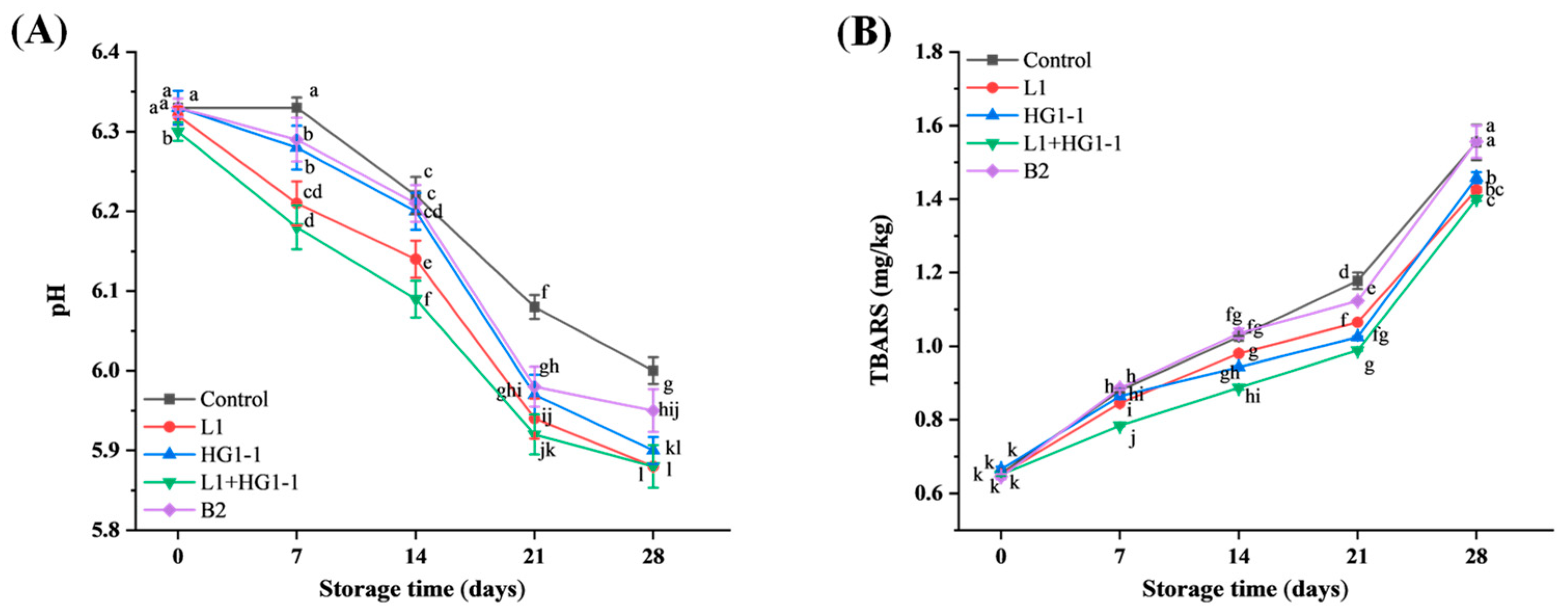
Although the antimicrobial effect of bioprotective cultures is the main focus, it is equally important to consider their impact on physicochemical quality of the food when evaluating the potential of bioprotective bacteria. A significant (p < 0.05) interaction between bacterial treatment and storage time was observed for the pH in Figure 2A. The pH in each treatment showed a significant decrease (p < 0.05). The decrease in pH may be due to the production and accumulation of acid by LAB during storage. The pH of each group was about 6.37 on day 0. Subsequently, the pH of the control, L1, HG1-1, L1 + HG1-1, and B2 treatments decreased to 6.01, 5.88, 5.90, 5.88, and 5.95 on day 28. Overall, the inoculation of bioprotective bacteria resulted in a significantly lower pH than the control during storage. The lower pH may also be contributing to the inhibition of spoilage bacteria. Similarly, Wang et al. [5] reported that inoculation with Lat. sakei and Lat. curvatus significantly decreased the pH of smoked chicken legs, but did not significantly affect the sensory attributes of the product. Trabelsi et al. [19] found that the decrease in pH values resulted from the inoculation of ground beef with the probiotic strain Lac. plantarum TN8. In addition, Ben Slima et al. [20] reported that the acidification of probiotic beef sausage samples was due to the production of lactic acid by the LAB.

3.3. Lipid Oxidation

Meat and meat products are susceptible to lipid oxidation during storage. Lipid oxidation generally produces volatile organic compounds (VOCs) such as aldehydes, alcohols, acids, and esters, which subsequently affect the odor and acceptability of the product. In general, the presence of oxygen tends to accelerate lipid oxidation. In this study, the Harbin red sausages were stored under vacuum packaging, which greatly reduced the extent of lipid oxidation by limiting oxygen availability. A significant (p < 0.05) interaction between bacterial treatment and storage time was observed for the thiobarbituric acid-reactive substances (TBARS) value in Figure 2B. The initial TBARS value for each treatment was about 0.65 mg/kg and then increased significantly (p < 0.05). On the one hand, this is partly due to the auto-oxidation of fats during storage; on the other hand, some bacteria produce lipoxygenase, which accelerates the oxidation of unsaturated fatty acids, leading to oxidative rancidity of red sausages [21]. The TBARS values were 1.55, 1.43, 1.46, 1.40, and 1.56 mg/kg on day 28 for the control, L1, HG1-1, L1 + HG1-1, and B2 treatments, respectively. Inoculation with Pe. acidilactici L1 and Lac. plantarum HG1-1 had an inhibitory effect on lipid oxidation in Harbin red sausage compared to the control and B2 treatments. This may be related to the antibacterial capacity and free radical scavenging activity of Pe. acidilactici and Lac. plantarum [22]. Similarly, İncili et al. [23] found that the cell-free supernatant of Pe. acidilactici significantly inhibited lipid oxidation in frankfurters during storage. Li et al. [24] found that Lac. plantarum had strong hydroxyl radical and DPPH free radical scavenging activity, and hydrogen peroxide (H2O2)-resistant ability. In addition, Trabelsi et al. [19] observed that the addition of Lac. plantarum TN8 did not promote lipid oxidation in raw minced beef; on the contrary, it delayed the increase in lipid oxidation compared to the uninoculated control. Katikou et al. [25] found that inoculation with Lat. curvatus CECT 904T and Lat. sakei CECT 4808 decreased the TBARS value of vacuum-packed beef kept at 4 ± 1 °C for 28 days. In this study, Pe. acidilactici L1 and Lac. plantarum HG1-1 demonstrated superior inhibitory effects on lipid oxidation compared to Lat. Sakei B2.

3.4. Moisture Content and Water Activity

Water content and water activity (aw) are key determinants of texture, microbial stability, and oxidative reactions in meat products. Variations in moisture and aw typically correlate with changes in hardness, chewiness, and surface color. Therefore, the moisture and aw of products were often analyzed together with texture profile, microbial counts, and lipid oxidation. In Table 2, the interaction between bacterial treatment and storage time on both moisture content and aw was not significant (p > 0.05). The moisture content of the Harbin red sausages in each treatment showed a slight decrease with storage. This may be due to a decline in the quality of the Harbin red sausage during storage, resulting in a decrease in water holding capacity, and then the exudation of water under the continuous negative pressure of the vacuum packaging. The aw of Harbin red sausages in all treatments decreased with storage. A similar trend was observed for moisture content. This suggests that the decrease in water activity may be caused by the decrease in moisture content [26].

3.5. Textural Properties

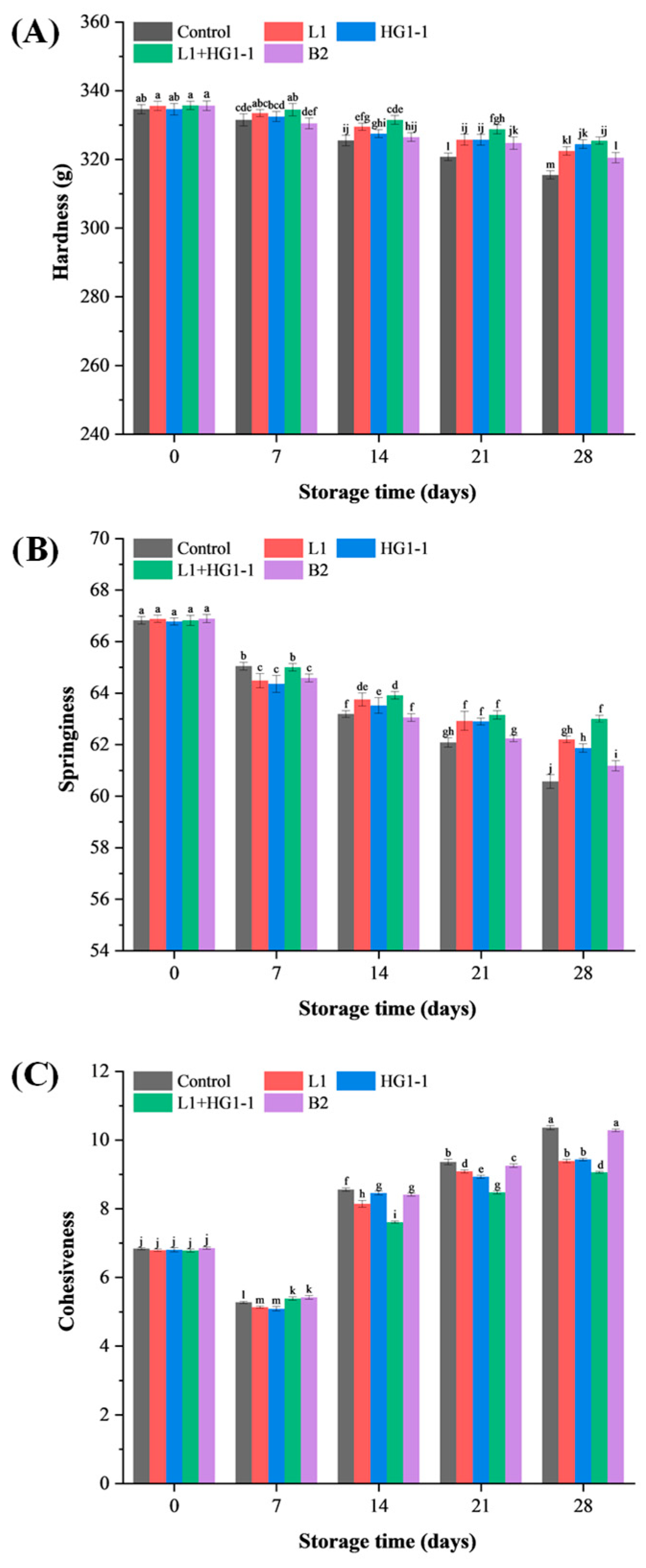
The changes in the textural properties of Harbin red sausage may be closely related to moisture content dissipation and quality deterioration. Generally, the dissipation of moisture content may increase the hardness of the product, while the deterioration of quality may decrease the hardness of the product. In Figure 3, a significant interaction between bacterial treatment and storage time was observed for hardness, springiness, and cohesiveness (p < 0.05). The L1, HG1-1, and L1 + HG1-1 treatments significantly (p < 0.05) delayed the decline in hardness during storage (Figure 3A). On the one hand, it is possible that they decreased the pH through lactic acid production, competitively inhibited the proliferation of spoilage bacteria, and reduced the release of exogenous proteases, thereby counteracting the decrease in hardness [5]. On the other hand, this may be attributed to the fact that a lower pH promotes gel formation. Similarly, Cui et al. [27] reported that inoculation with Pe. acidilactici and Lat. sakei in tilapia sausages caused acidification during fermentation, which promoted gel formation and resulted in improved hardness and springiness. Trabelsi et al. [19] reported that the addition of Lac. plantarum TN8 to minced beef increased hardness. Xu et al. [6] reported that inoculation with Lat. sakei had no significant main effect on the hardness of lamp during storage (p = 0.42). The springiness of all treatments decreased significantly (p < 0.05) with storage time, where the springiness of the L1, HG1-1, L1 + HG1-1, and B2 treatments was higher than that of the control, which may be related to the gelatinization effect mentioned above (Figure 3B). Cohesiveness in all treatment groups showed a trend of first decreasing (7 days) and then increasing (Figure 3C). Similarly, Cui et al. [27] reported that the cohesiveness of tilapia sausages inoculated with both Pe. acidilactici and Lat. sakei first decreased and then increased during storage.

3.6. Color

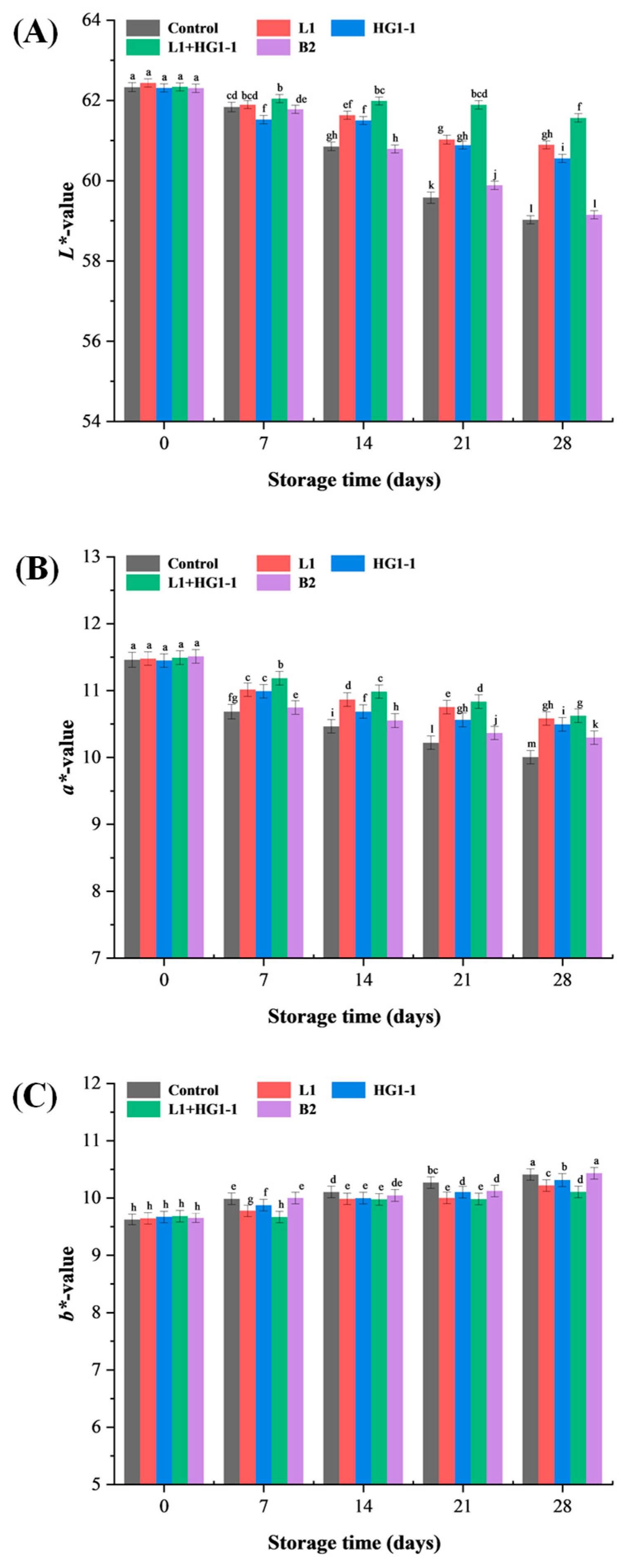
A significant (p < 0.05) interaction between bacterial treatment and storage time was observed for L* values, a* values, browning index, and total color change (ΔE). The L* values of all treatments decreased with increasing storage time (Figure 4A). The L* values of the L1, HG1-1, and L1 + HG1-1 treatments decreased slowly, and, in particular, the L1 + HG1-1 treatment had the most stable L* values, which decreased significantly (p < 0.05) after day 21. A significant reduction in a* values was observed across all treatments during storage (p < 0.05, Figure 4B), possibly caused by interaction between lipid oxidation products and pigments [12]. Chen et al. [28] also noted that lipid oxidation can contribute to the decline in the surface a* value of roasted duck legs stored under MAP. The a* values of the L1, HG1-1, and L1 + HG1-1 treatments were significantly (p < 0.05) higher than those of the control and B2 treatments at the end of the storage, which correlated with the TBARS, implying that the inoculation of Pe. acidilactici L1 and Lac. plantarum HG1-1 was effective in inhibiting lipid oxidation. The increase in b* values is likely attributable to yellow pigment formation through reactions between lipid oxidation products and amines in the phospholipid head groups or in the proteins [29].
The chroma values of all treatment groups showed minor fluctuations during storage (Table 3). The control and B2 treatments exhibited significant browning and total color changes during storage. Their ΔE values reached 3.70 and 3.49, respectively, on day 28. This may result in lower color and acceptability scores. Overall, inoculation with Pe. acidilactici L1 and Lac. plantarum HG1-1 did not compromise the color of the Harbin red sausages but instead conferred a bioprotective effect.

3.7. Electronic Nose

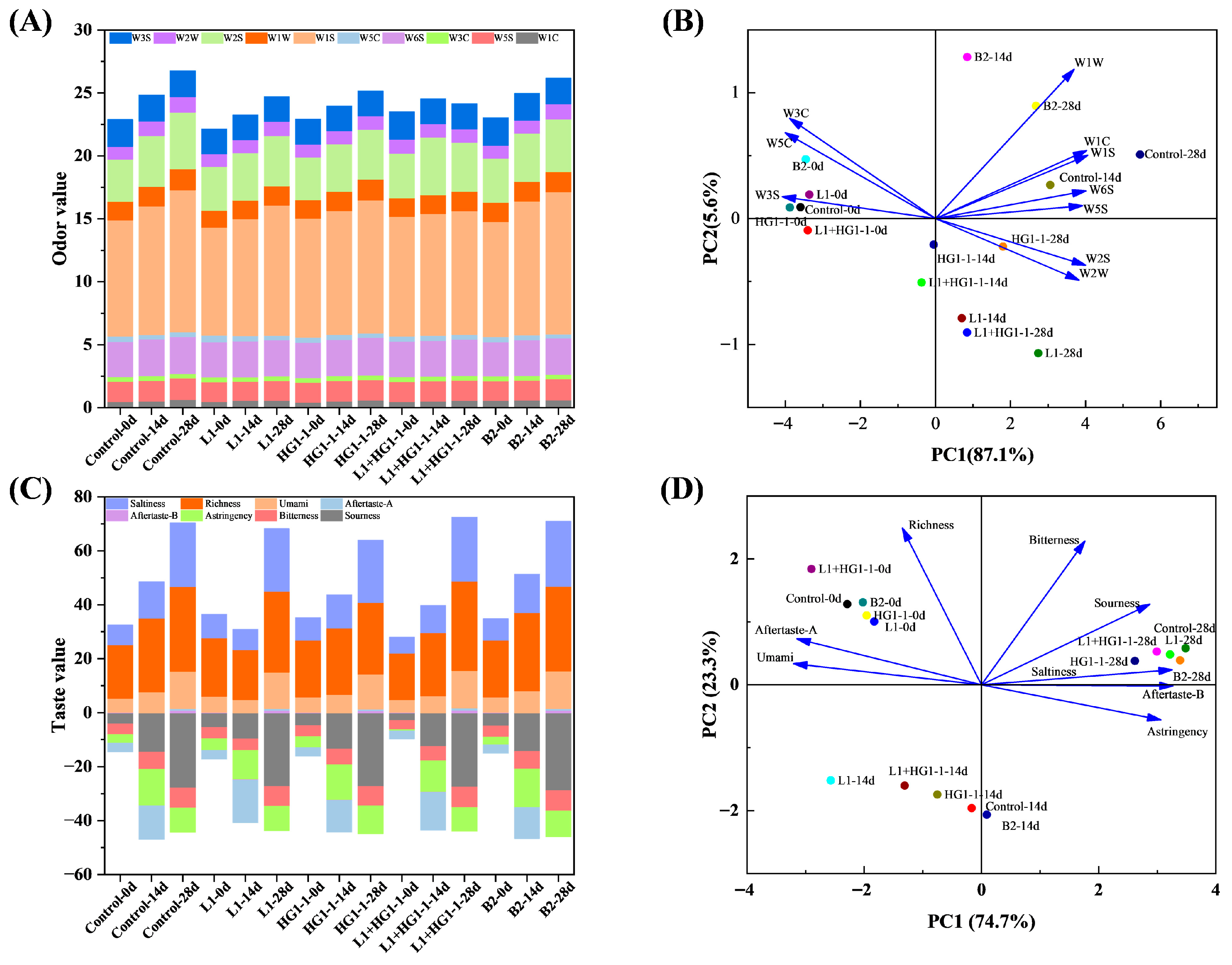
E-tongue and E-nose, as bionic devices, can effectively avoid the subjectivity of human response to taste and smell, as well as the variability between individuals, by providing a low-cost, non-invasive, and rapid means of objective taste and odor evaluation of food. In this study, an E-tongue and E-nose were employed to evaluate the taste and smell of Harbin red sausage. However, there are some limitations, as targeted volatile analysis (e.g., HS-SPME/GC-MS) to identify key odor-active compounds was not conducted, nor were taste-active molecules (such as organic acids, amino acids, and nucleotides) quantified. In Figure 5A, the response values of the sensors W3S, W2S, W1S, and W6S were more pronounced, indicating that the samples in all treatments contained elevated levels of long-chain alkanes, alcohols, aldehydes, ketones, alkanes, and hydrides. Similarly, Lv et al. [12] also observed that the contents of alcohols, aldehydes, ketones, and alkanes increased during the storage of Harbin red sausage, particularly ethanol, 3-methyl-1-butanol, 1-octen-3-ol, 2,3-butanediol, hexanal, 1-nonanal, acetoin, and 3-octanone. Most of these VOCs are associated with spoilage odors and are frequently detected in spoiled meat and meat products. The control had the highest total odor response values on days 14 and 28, followed by the B2 treatment. The total odor response values were most stable and lowest at the end of storage for the L1 + HG1-1 treatment. This implies that the inoculation of Pe. acidilactici L1 and Lac. plantarum HG1-1 did not promote the formation of odor-related substances, but rather inhibited their production to some extent. This may be attributed to the higher odor and overall acceptability scores.
As shown in Figure 5B, two principal components (PC1 and PC2) explained 87.1% and 5.6% of the total variance, respectively. The odor composition of the samples on day 0 of each treatment was relatively similar, all distributed along the negative half-axis of PC1. Notably, L1 + HG1-1-14d and HG1-1-14d were also located on the negative semi-axis of PC1, indicating that their odor compositions had changed less compared to day 0. In addition, L1-14d, L1 + HG1-1-28d, HG1-1-28d, and L1-28d were all in quadrant four, and B2-14d, B2-28d, control-14d, and control-28d were in quadrant one. This implies that Harbin red sausage inoculated with Pe. acidilactici L1 and Lac. plantarum HG1-1 had a more similar odor composition whether inoculated alone or in a mixture, while Harbin red sausage inoculated with Lat. sakei B2 had some similarity in odor to the control.

3.8. Electronic Tongue

The sourness, richness, umami, and saltiness of Harbin red sausage of the five groups were enhanced; meanwhile, the remaining taste characteristics fluctuated slightly during the storage period (Figure 5C). This may be related to the organic acids, amino acids, and flavor peptides produced during the storage of Harbin red sausage. In Figure 5D, PC1 and PC2 explained 74.7% and 23.3% of the total variance, respectively. The E-tongue results were distributed into three clusters. On day 0, all treatment groups were distributed in the second quadrant, correlating with richness, aftertaste A (astringent aftertaste), and umami, indicating these taste attributes were prominent at the initial stage. Taste characteristics on day 14 for each treatment group were mainly distributed on the negative half-axis of PC2. At the end of storage (day 28), all treatment groups were located in the first quadrant, correlating with saltiness and sourness, indicating taste alterations in Harbin red sausage during storage. Collectively, storage duration exerted a predominant influence on the taste characteristics of Harbin red sausage.

3.9. Sensory Evaluation

Although instrumental and chemical analyses provide essential objective insights into the application of bioprotective bacteria as preservation agents, sensory evaluation is crucial since it directly determines consumer acceptance. A significant (p < 0.05) interaction between bacterial treatment and storage time was observed for color, hardness, odor, and overall acceptability in Table 4. On day 0, there were no significant (p > 0.05) differences in sensory scores between the control and inoculated groups, indicating that the inoculation of bioprotective cultures did not affect the initial sensory properties of Harbin red sausages. With prolonged storage time, all treatment groups exhibited significant decreases (p < 0.05) in internal color, odor, hardness, and overall acceptability. On day 28, the internal color scores of the L1, HG1-1, L1 + HG1-1, and B2 treatments were significantly higher (p < 0.05) than those of the control group (2.98). These results demonstrate the color preservation effects of the bioprotective cultures. The L1, HG1-1, and L1 + HG1-1 treatments maintained superior hardness at storage termination, showing significant differences (p < 0.05) compared to the control treatments, which aligned with the texture profile analysis outcomes. The L1, HG1-1, and L1 + HG1-1 treatments demonstrated higher odor scores at storage termination. The results of overall acceptability revealed that the L1 and L1 + HG1-1 groups demonstrated the highest scores (3.86 and 3.95, respectively) at the end of storage, followed by the HG1-1 and B2 groups with values of 3.80 and 3.64. The control group exhibited the lowest score of 3.02. This might be attributed to the superior antibacterial capacity observed in L1 and L1 + HG1-1 treatments. Based on the overall acceptability scores, the bioprotective culture treatments delayed spoilage by approximately 14 days compared to the control treatment. In conclusion, the inoculation of bioprotective cultures Pe. acidilactici L1, Lac. plantarum HG1-1, and Lat. sakei B2 effectively extended the shelf life of Harbin red sausages, with Pe. acidilactici L1 and Lac. plantarum HG1-1 demonstrating superior bioprotective effects, particularly under mixed inoculation, where the most pronounced protection was observed.

3.10. General Discussion

The present study comprehensively evaluated the bioprotective potential of Pe. acidilactici L1 and Lac. plantarum HG1-1 in Harbin red sausages under vacuum packaging at 4 °C, integrating microbiological, physicochemical, and sensory assessments. The inoculation of these strains significantly inhibited the growth of Staphylococcus and Acinetobacter, which is consistent with their previously observed antimicrobial activity in vitro [9]. The mixed inoculation (L1 + HG1-1) exhibited the strongest inhibition, highlighting a synergistic effect in the co-culture system. The inhibitory effects on Staphylococcus and Acinetobacter may be associated with the acid production of Pe. acidilactici L1 and Lac. plantarum HG1-1. The lower pH may reinforce microbial inhibition. Correspondingly, hardness and springiness were better preserved in the L1, HG1-1, and L1 + HG1-1 groups, which may be attributed to the antimicrobial effects of Pe. acidilactici L1 and Lac. plantarum HG1-1, as well as the potential gelation effects [27].
Furthermore, the inoculation of Pe. acidilactici L1 and Lac. plantarum HG1-1 effectively delayed lipid oxidation, as indicated by lower TBARS values, which was likely associated with both free radical scavenging activity and microbial inhibition [22]. These biochemical changes were reflected in color stability, where L* and a* values were maintained more consistently, and browning and total color changes (ΔE) were minimized, supporting higher sensory scores.
The E-nose analyses further demonstrated that inoculated sausages exhibited less development of off-odor compounds during storage. This suggests that the bioprotective cultures contributed to the preservation of organoleptic quality. Overall, these results demonstrate that Pe. acidilactici L1 and Lac. plantarum HG1-1 extend the shelf life through multifactorial mechanisms, including microbial inhibition, acidification, antioxidant activity, and maintenance of texture and color.

4. Conclusions

This study demonstrated the potential of Pe. acidilactici L1 and Lac. plantarum HG1-1 as bioprotective cultures in Harbin red sausages stored in vacuum packaging at 4 °C. Compared with the control (uninoculated) and B2 treatments, the L1, HG1-1, and L1 + HG1-1 treatments significantly (p < 0.05) inhibited the growth of Acinetobacter and Staphylococcus, maintained better color and texture characteristics, delayed lipid oxidation, and delayed flavor deterioration, resulting in higher overall acceptability scores at the end of storage. The B2 group also showed a certain bioprotective effect compared with the control group, but its overall effect was relatively weaker. In summary, both the individual and mixed inoculations of the Pe. acidilactici L1 and Lac. plantarum HG1-1 provided superior bioprotective effects on Harbin red sausages under vacuum packaging compared with the commercial strain Lat. sakei B2. Based on the overall acceptability scores, the bioprotective culture treatments delayed spoilage by approximately 14 days compared to the control treatment. In conclusion, the inoculation of bioprotective cultures Pe. acidilactici L1, Lac. plantarum HG1-1, and Lat. sakei B2 effectively delayed the spoilage process of Harbin red sausages, with Pe. acidilactici L1 and Lac. plantarum HG1-1 demonstrating superior bioprotective effects, particularly under mixed inoculation. Based on these results, it can be deduced that Pe. acidilactici L1 and Lac. plantarum HG1-1 are capable of adapting to the complex matrices and refrigerated conditions of most meat products as bioprotective bacteria. This study validates the bioprotective capacity of Pe. acidilactici L1 and Lac. plantarum HG1-1, provides a useful reference for the selection of psychrotrophic bioprotective cultures, and offers practical insights for the implementation of biopreservation strategies in low-temperature meat products.

Author Contributions

Methodology, investigation, and writing—original draft, Q.W.; investigation and software, K.Z.; software and investigation, Q.C.; data curation and formal analysis, H.L.; visualization and resources, C.Z.; conceptualization and methodology, Q.L.; formal analysis, software, conceptualization, funding acquisition, supervision, and writing—review and editing, B.K. All authors have read and agreed to the published version of the manuscript.

Funding

This study was funded by the National Key Research and Development Program during the 14th Five-year Plan in China (Funder: Baohua Kong, Funding number: 2023YFD2100102).

Institutional Review Board Statement

The sensory evaluation conducted in this study was a non-medical, non-invasive, and minimal-risk procedure that forms part of routine food quality assessment. It does not involve medical intervention on humans and therefore does not fall within the scope of biomedical research defined by the “Administrative Measures for Ethical Review of Biomedical Research Involving Humans” regulations (https://www.nhc.gov.cn/wjw/c100221/202201/558653bd3d1e4a078904152a30605a03.shtml, accessed on 12 December 2025). Consequently, ethical approval from a Medical Ethics Committee is not required for such studies in our institution.

Informed Consent Statement

Informed consent was obtained from all subjects involved in the study.

Data Availability Statement

The original contributions presented in the study are included in the article. Further inquiries can be directed to the corresponding author.

Conflicts of Interest

The authors declare no conflicts of interest.

References

  1. Shao, L.; Bi, J.; Li, X.; Dai, R. Effects of vegetable oil and ethylcellulose on the oleogel properties and its application in Harbin red sausage. Int. J. Biol. Macromol. 2023, 239, 124299. [Google Scholar] [CrossRef] [PubMed]
  2. Lisboa, H.M.; Pasquali, M.B.; Anjos, A.I.D.; Sarinho, A.M.; De Melo, E.D.; Andrade, R.; Batista, L.; Lima, J.; Diniz, Y.; Barros, A. Innovative and sustainable food preservation techniques: Enhancing food quality, safety, and environmental sustainability. Sustainability 2024, 16, 8223. [Google Scholar] [CrossRef]
  3. Parhi, A.; Tang, J.; Sablani, S.S. Functionality of ultra-high barrier metal oxide-coated polymer films for in-package, thermally sterilized food products. Food Packag. Shelf Life 2020, 25, 100514. [Google Scholar] [CrossRef]
  4. Kaveh, S.; Hashemi, S.M.B.; Abedi, E.; Amiri, M.J.; Conte, F.L. Bio-Preservation of meat and fermented meat products by lactic acid bacteria strains and their antibacterial metabolites. Sustainability 2023, 15, 10154. [Google Scholar] [CrossRef]
  5. Wang, Q.; Zhang, K.; Li, M.; Liu, H.; Kong, B.; Chen, Q. Bioprotective potential of Latilactobacillus sakei and Latilactobacillus curvatus in smoked chicken legs with modified atmosphere packaging. Food Control 2024, 164, 110558. [Google Scholar] [CrossRef]
  6. Xu, M.M.; Kaur, M.; Pillidge, C.J.; Torley, P.J. Effect of protective cultures on spoilage bacteria and the quality of vacuum-packaged lamb meat. Food Biosci. 2022, 50, 102148. [Google Scholar] [CrossRef]
  7. De Andrade Cavalari, C.M.; Imazaki, P.H.; Pirard, B.; Lebrun, S.; Vanleyssem, R.; Gemmi, C.; Antoine, C.; Crevecoeur, S.; Daube, G.; Clinquart, A.; et al. Carnobacterium maltaromaticum as bioprotective culture against spoilage bacteria in ground meat and cooked ham. Meat Sci. 2024, 211, 109441. [Google Scholar] [CrossRef]
  8. Li, P.J.; Luo, H.T.; Kong, B.H.; Liu, Q.; Chen, C.G. Formation of red myoglobin derivatives and inhibition of spoilage bacteria in raw meat batters by lactic acid bacteria and Staphylococcus xylosus. LWT—Food Sci. Technol. 2016, 68, 251–257. [Google Scholar] [CrossRef]
  9. Du, W.J.; Wang, Q.; Chen, Q.; Liu, Q.; Kong, B.H. Selection and bacteriostatic properties of cryotolerant lactic acid bacteria with bioprotective potential. Food Sci. 2025, 46, 121–129. [Google Scholar] [CrossRef]
  10. Wang, W.; Wang, X.; Zhao, W.; Gao, G.; Zhang, X.; Wang, Y.; Wang, Y. Impact of pork collagen superfine powder on rheological and texture properties of Harbin red sausage. J. Texture Stud. 2017, 49, 300–308. [Google Scholar] [CrossRef]
  11. Nie, C.; Zhong, H.; Shi, H.; Yao, X.; Wang, W.; Tomasevic, I.; Zheng, J.; Sun, W. Sodium substitutes synergizing with dietary fiber: Effect on the textural, sensory, digestive, and storage properties of emulsified sausages. Food Chem. 2025, 147414. [Google Scholar] [CrossRef]
  12. Lv, Y.; Yin, X.; Wang, Y.; Chen, Q.; Kong, B. The prediction of specific spoilage organisms in Harbin red sausage stored at room temperature by multivariate statistical analysis. Food Control 2020, 123, 107701. [Google Scholar] [CrossRef]
  13. He, Z.; Hu, Y.; Zhang, Y.; Cui, Y.; Liu, Y.; Asiri, S.A.; Al-Dalali, S. Analysis of changes in flavor characteristics of Lipu taro pork at different stages of cooking based on GC-IMS, electronic nose, and electronic tongue. Food Chem. X 2025, 500, 103320. [Google Scholar] [CrossRef]
  14. ISO 11037:2011 ; Sensory Analysis — Guidelines for Sensory Assessment of the Colour of products. International Organization for Standardization: Geneva, Switzerland, 2011.
  15. Bassey, A.P.; Liu, P.P.; Chen, J.H.; Bako, H.K.; Boateng, E.F.; Ibeogu, H.I.; Ye, K.P.; Li, C.B.; Zhou, G.H. Antibacterial efficacy of phenyllactic acid against Pseudomonas lundensis and Brochothrix thermosphacta and its synergistic application on modified atmosphere/air-packaged fresh pork loins. Food Chem. 2024, 430, 137002. [Google Scholar] [CrossRef] [PubMed]
  16. GB 2726-2016; Hygienic Standard for Cooked Meat Products. Standards Press of China: Beijing, China, 2016.
  17. Ștefan, G.; Predescu, C.N. Using the bioprotection culture for dry fermented salami-the control measure of Listeria monocytogenes growth. Sci. Pap. Ser. D Anim. Sci. 2024, 67, 1. [Google Scholar]
  18. Casaburi, A.; di Martino, V.; Ferranti, P.; Picariello, L.; Villani, F. Technological properties and bacteriocins production by Lactobacillus curvatus 54M16 and its use as starter culture for fermented sausage manufacture. Food Control 2016, 59, 31–45. [Google Scholar] [CrossRef]
  19. Trabelsi, I.; Slima, S.B.; Ktari, N.; Triki, M.; Abdehedi, R.; Abaza, W.; Moussa, H.; Abdeslam, A.; Salah, R.B. Incorporation of probiotic strain in raw minced beef meat: Study of textural modification, lipid and protein oxidation and color parameters during refrigerated storage. Meat Sci. 2019, 154, 29–36. [Google Scholar] [CrossRef] [PubMed]
  20. Ben Slima, S.; Ktari, N.; Trabelsi, I.; Triki, M.; Feki-Tounsi, M.; Moussa, H.; Makni, I.; Herrero, A.; Jiménez-Colmenero, F.; Perez, C.R.; et al. Effect of partial replacement of nitrite with a novel probiotic Lactobacillus plantarum TN8 on color, physico-chemical, texture and microbiological properties of beef sausages. LWT 2017, 86, 219–226. [Google Scholar] [CrossRef]
  21. Horita, C.; Messias, V.; Morgano, M.; Hayakawa, F.; Pollonio, M. Textural, microstructural and sensory properties of reduced sodium frankfurter sausages containing mechanically deboned poultry meat and blends of chloride salts. Food Res. Int. 2014, 66, 29–35. [Google Scholar] [CrossRef]
  22. Wu, S.; Chen, Y.; Chen, Z.; Zhou, Q.; Wei, F.; Li, P.; Gu, Q. Antioxidant properties and molecular mechanisms of Lactiplantibacillus plantarum ZJ316: A potential probiotic resource. LWT 2023, 187, 115269. [Google Scholar] [CrossRef]
  23. İncili, G.K.; Akgöl, M.; Karatepe, P.; Üner, S.; Tekin, A.; Kanmaz, H.; Kaya, B.; Çalicioğlu, M.; Hayaloğlu, A.A. Quantification of bioactive metabolites derived from cell-free supernatant of P. acidilactici and screening their protective properties in frankfurters. Probiotics Antimicrob. Proteins 2025, 17, 253–270. [Google Scholar] [CrossRef] [PubMed]
  24. Li, S.; Zhao, Y.; Zhang, L.; Zhang, X.; Huang, L.; Li, D.; Niu, C.; Yang, Z.; Wang, Q. Antioxidant activity of Lactobacillus plantarum strains isolated from traditional Chinese fermented foods. Food Chem. 2012, 135, 1914–1919. [Google Scholar] [CrossRef]
  25. Katikou, P.; Ambrosiadis, I.; Georgantelis, D.; Koidis, P.; Georgakis, S.A. Effect of Lactobacillus-protective cultures with bacteriocin-like inhibitory substances’ producing ability on microbiological, chemical and sensory changes during storage of refrigerated vacuum-packaged sliced beef. J. Appl. Microbiol. 2005, 99, 1303–1313. [Google Scholar] [CrossRef]
  26. Rahman, M.S. Food stability determination by macro–micro region concept in the state diagram and by defining a critical temperature. J. Food Eng. 2009, 99, 402–416. [Google Scholar] [CrossRef]
  27. Cui, Q.; Li, L.; Huang, H.; Yang, Y.; Chen, S.; Li, C. Novel insight into the formation and improvement mechanism of physical property in fermented tilapia sausage by cooperative fermentation of newly isolated lactic acid bacteria based on microbial contribution. Food Res. Int. 2024, 187, 114456. [Google Scholar] [CrossRef]
  28. Chen, X.; Zhao, J.Y.; Zhu, L.X.; Luo, X.; Mao, Y.W.; Hopkins, D.L.; Zhang, Y.M.; Dong, P.C. Effect of modified atmosphere packaging on shelf life and bacterial community of roast duck meat. Food Res. Int. 2020, 137, 109645. [Google Scholar] [CrossRef] [PubMed]
  29. Singh, A.; Mittal, A.; Benjakul, S. Undesirable discoloration in edible fish muscle: Impact of indigenous pigments, chemical reactions, processing, and its prevention. Compr. Rev. Food Sci. Food Saf. 2022, 21, 580–603. [Google Scholar] [CrossRef] [PubMed]
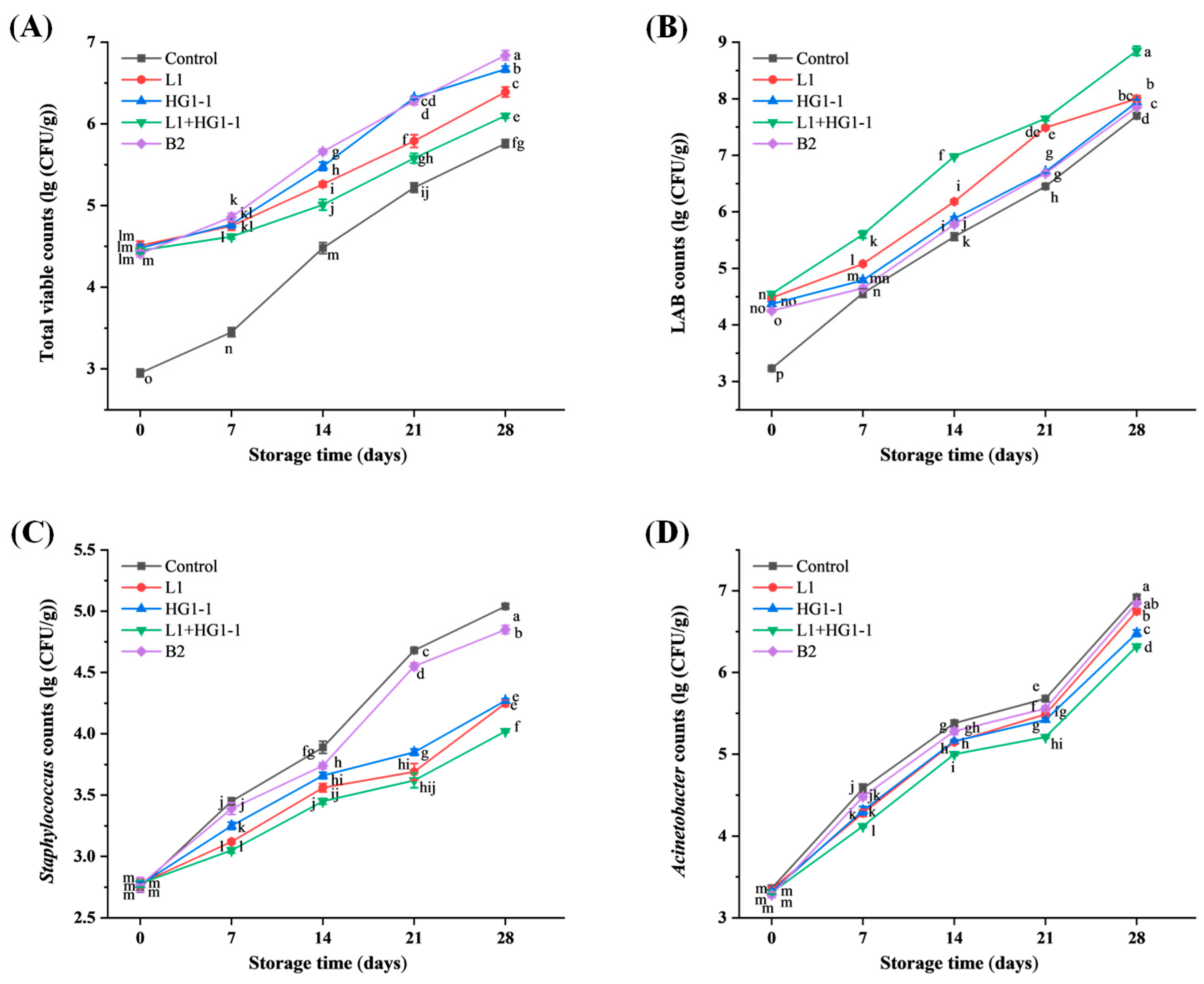
Figure 1. Changes in (A) total viable counts, (B) lactic acid bacteria counts, (C) Staphylococcus counts, and (D) Acinetobacter counts of Harbin red sausages inoculated with different bioprotective cultures during a 28-day storage period at 4 °C. Control: non-inoculation; L1: inoculation with Pediococcus acidilactici L1; HG1-1: inoculation with Lactiplantibacillus plantarum HG1-1; L1 + HG1-1: mixed (1:1) inoculation with Pe. acidilactici L1 and Lac. plantarum HG1-1; B2: inoculation with Latilactobacillus sakei B2. a–p Different lowercase letters indicate a significant (p < 0.05) difference in all means for viable counts, lactic acid bacteria counts, Staphylococcus counts, and Acinetobacter counts.
Foods 14 04293 g001
Figure 2. Changes in (A) pH and (B) thiobarbituric acid reactive substances (TBARS) of Harbin red sausages inoculated with different bioprotective cultures during a 28-day storage period at 4 °C. Control: non-inoculation; L1: inoculation with Pediococcus acidilactici L1; HG1-1: inoculation with Lactiplantibacillus plantarum HG1-1; L1 + HG1-1: mixed (1:1) inoculation with Pe. acidilactici L1 and Lac. plantarum HG1-1; B2: inoculation with Latilactobacillus sakei B2. a–l Different lowercase letters indicate a significant (p < 0.05) difference in all means for pH and TBARS value.
Foods 14 04293 g002
Figure 3. Changes in (A) hardness, (B) springiness, and (C) cohesiveness of Harbin red sausages inoculated with different bioprotective cultures during a 28-day storage period at 4 °C. Control: non-inoculation; L1: inoculation with Pediococcus acidilactici L1; HG1-1: inoculation with Lactiplantibacillus plantarum HG1-1; L1 + HG1-1: mixed (1:1) inoculation with Pe. acidilactici L1 and Lac. plantarum HG1-1; B2: inoculation with Latilactobacillus sakei B2. a–m Different lowercase letters indicate a significant (p < 0.05) difference in all means for hardness, springiness, and cohesiveness.
Foods 14 04293 g003
Figure 4. Changes in (A) L*, (B) a*, and (C) b* value of Harbin red sausages inoculated with different bioprotective cultures during a 28-day storage period at 4 °C. Control: non-inoculation; L1: inoculation with Pediococcus acidilactici L1; HG1-1: inoculation with Lactiplantibacillus plantarum HG1-1; L1 + HG1-1: mixed (1:1) inoculation with Pe. acidilactici L1 and Lac. plantarum HG1-1; B2: inoculation with Latilactobacillus sakei B2. a–m Different lowercase letters indicate a significant (p < 0.05) difference in all means for L*, a*, and b* values.
Foods 14 04293 g004
Figure 5. Stacked diagram of electronic nose (A), principal component analysis of electronic nose (B), stacked diagram of electronic tongue (C), and principal component analysis of electronic tongue (D) for Harbin red sausages inoculated with different bioprotective cultures. Control: non-inoculation; L1: inoculation with Pediococcus acidilactici L1; HG1-1: inoculation with Lactiplantibacillus plantarum HG1-1; L1 + HG1-1: mixed (1:1) inoculation with Pe. acidilactici L1 and Lac. plantarum HG1-1; B2: inoculation with Latilactobacillus sakei B2.
Foods 14 04293 g005
Table 1. Electronic nose (E-nose) sensors and their representative materials.
Sensor NameRepresentative Material SpeciesRepresentative Material
W1CAromatic compoundsSensitive to aromatic constituents, benzene
W5SBroad rangeSensitive to nitrogen oxides
W3CAromaticSensitive to aroma, ammonia
W6SHydrogenSensitive to hydrides
W5CArom-aliphSensitive to short-chain alkane aromatic component
W1SBroad-methaneSensitive to methyl
W1WSulphur-organicSensitive to sulfides
W2SBroad-alcoholSensitive to alcohols, aldehydes and ketones
W2WSulph-chlorSensitive to organic sulfides
W3SMethane-aliphSensitive to long-chain alkanes
Table 2. Changes in moisture content and water activity (aw) of Harbin red sausages inoculated with different bioprotective cultures during a 28-day storage period at 4 °C.
Storage TimeTreatment
ControlL1HG1-1L1 + HG1-1B2
Moisture content (%)058.56 ± 0.01 b58.55 ± 0.01 b58.55 ± 0.01 b58.52 ± 0.01 bc58.49 ± 0.48 c
758.40 ± 0.01 d58.48 ± 0.47 c58.49 ± 0.01 c58.50 ± 0.01 c58.41 ± 0.01 d
1458.89 ± 0.03 a57.98 ± 0.01 e57.97 ± 0.24 e57.99 ± 0.07 e57.88 ± 0.02 f
2157.85 ± 0.01 f57.86 ± 0.01 f57.85 ± 0.02 f57.86 ± 0.01 f57.84 ± 0.02 fg
2857.80 ± 0.02 g57.82 ± 0.01 fg57.81 ± 0.01 fg57.83 ± 0.01 fg57.81 ± 0.01 fg
Water activity (aw)00.99 ± 0.01 a0.98 ± 0.01 a0.99 ± 0.01 a0.98 ± 0.01 a0.98 ± 0.01 a
70.97 ± 0.01 ab0.97 ± 0.01 ab0.98 ± 0.01 a0.97 ± 0.01 ab0.97 ± 0.01 ab
140.96 ± 0.01 ab0.96 ± 0.01 ab0.97 ± 0.01 ab0.97 ± 0.01 ab0.97 ± 0.01 ab
210.95 ± 0.01 ab0.96 ± 0.02 ab0.96 ± 0.01 ab0.96 ± 0.01 ab0.96 ± 0.01 ab
280.94 ± 0.01 b0.95 ± 0.01 ab0.95 ± 0.01 ab0.95 ± 0.01 ab0.93 ± 0.02 b
Control: non-inoculation; L1: inoculation with Pediococcus acidilactici L1; HG1-1: inoculation with Lactiplantibacillus plantarum HG1-1; L1 + HG1-1: mixed (1:1) inoculation with Pe. acidilactici L1 and Lac. plantarum HG1-1; B2: inoculation with Latilactobacillus sakei B2. a–g Different lowercase letters indicate a significant (p < 0.05) difference in all means for moisture content and aw.
Table 3. Changes in browning index, chroma, and total color of Harbin red sausages inoculated with different bioprotective cultures during a 28-day storage period at 4 °C.
Storage Time (Days)Treatment
ControlL1HG1-1L1 + HG1-1B2
Browning index029.73 ± 0.07 j29.73 ± 0.03 j29.81 ± 0.11 ij29.87 ± 0.16 hi29.85 ± 0.15 hi
729.80 ± 0.11 ij29.73 ± 0.09 j30.09 ± 0.08 g29.64 ± 0.07 k29.92 ± 0.11 ghi
1430.28 ± 0.06 fg30.10 ± 0.13 g29.99 ± 0.02 ghi30.04 ± 0.08 gh30.30 ± 0.05 fg
2131.01 ± 0.14 c30.32 ± 0.07 fg30.37 ± 0.04 f29.93 ± 0.07 ghi30.72 ± 0.09 de
2831.35 ± 0.17 b30.62 ± 0.04 e30.89 ± 0.09 cd30.10 ± 0.12 g31.68 ± 0.14 a
Chroma014.96 ± 0.09 a14.99 ± 0.08 a14.98 ± 0.11 a15.02 ± 0.07 a15.02 ± 0.10 a
714.62 ± 0.17 cde14.72 ± 0.11 abc14.77 ± 0.16 ab14.78 ± 0.09 ab14.68 ± 0.08 bcd
1414.54 ± 0.13 cde14.75 ± 0.08 abc14.63 ± 0.07 cde14.84 ± 0.16 ab14.57 ± 0.12 cde
2114.48 ± 0.12 de14.68 ± 0.08 bcd14.61 ± 0.04 cde14.73 ± 0.13 abc14.49 ± 0.09 de
2814.43 ± 0.08 e14.71 ± 0.15 bcd14.71 ± 0.15 bcd14.66 ± 0.06 bcd14.65 ± 0.13 bcd
Total color change (ΔE)0-0.11 ± 0.03 l0.05 ± 0.03 l0.06 ± 0.02 l0.06 ± 0.03 l
70.99 ± 0.13 i0.65 ± 0.09 j0.97 ± 0.03 i0.40 ± 0.05 k0.98 ± 0.05 i
141.85 ± 0.05 f0.99 ± 0.10 i1.20 ± 0.07 h0.69 ± 0.07 j1.84 ± 0.09 f
213.09 ± 0.06 c1.54 ± 0.08 g1.77 ± 0.06 f0.85 ± 0.13 ij2.73 ± 0.13 d
283.70 ± 0.14 a1.79 ± 0.09 f2.14 ± 0.16 e1.23 ± 0.05 h3.49 ± 0.11 b
Control: non-inoculation; L1: inoculation with Pediococcus acidilactici L1; HG1-1: inoculation with Lactiplantibacillus plantarum HG1-1; L1 + HG1-1: mixed (1:1) inoculation with Pe. acidilactici L1 and Lac. plantarum HG1-1; B2: inoculation with Latilactobacillus sakei B2. a–l Different lowercase letters indicate a significant (p < 0.05) difference in all means for browning index, chroma, and total color change.
Table 4. Changes in sensory scores of Harbin red sausages inoculated with different bioprotective cultures during a 28-day storage period at 4 °C.
Sensory AttributeStorage Time (Days)Treatment
ControlL1HG1-1L1 + HG1-1B2
Color06.43 ± 0.24 a6.41 ± 0.25 a6.40 ± 0.26 a6.44 ± 0.27 a6.41 ± 0.28 a
143.80 ± 0.31 c3.90 ± 0.21 bc3.92 ± 0.23 bc4.08 ± 0.27 b3.82 ± 0.21 c
282.98 ± 0.32 f3.56 ± 0.28 de3.50 ± 0.31 de3.66 ± 0.28 d3.41 ± 0.31 e
Hardness06.21 ± 0.21 a6.24 ± 0.32 a6.23 ± 0.24 a6.25 ± 0.28 a6.24 ± 0.24 a
145.75 ± 0.31 cd5.92 ± 0.27 b5.95 ± 0.25 b5.92 ± 0.26 b5.81 ± 0.27 bc
284.95 ± 0.33 g5.58 ± 0.35 e5.56 ± 0.34 e5.68 ± 0.32 de5.27 ± 0.28 f
Odor06.49 ± 0.22 a6.51 ± 0.21 a6.50 ± 0.29 a6.48 ± 0.25 a6.49 ± 0.25 a
143.86 ± 0.27 c4.08 ± 0.21 b4.05 ± 0.28 bc4.10 ± 0.27 b3.90 ± 0.24 c
283.06 ± 0.22 f3.22 ± 0.31 de3.28 ± 0.21 de3.36 ± 0.25 d3.16 ± 0.24 ef
Overall acceptability06.53 ± 0.29 a6.55 ± 0.27 a6.55 ± 0.26 a6.54 ± 0.25 a6.52 ± 0.31 a
143.78 ± 0.31 de4.10 ± 0.21 bc4.02 ± 0.31 bcd4.20 ± 0.31 b4.06 ± 0.28 bc
283.02 ± 0.23 f3.86 ± 0.32 d3.80 ± 0.31 d3.95 ± 0.32 cd3.64 ± 0.34 e
Control: non-inoculation; L1: inoculation with Pediococcus acidilactici L1; HG1-1: inoculation with Lactiplantibacillus plantarum HG1-1; L1 + HG1-1: mixed (1:1) inoculation with Pe. acidilactici L1 and Lac. plantarum HG1-1; B2: inoculation with Latilactobacillus sakei B2. a–g Different lowercase letters indicate a significant (p < 0.05) difference in all means for color, hardness, odor, and overall acceptability.
Disclaimer/Publisher’s Note: The statements, opinions and data contained in all publications are solely those of the individual author(s) and contributor(s) and not of MDPI and/or the editor(s). MDPI and/or the editor(s) disclaim responsibility for any injury to people or property resulting from any ideas, methods, instructions or products referred to in the content.