Dual-Strain Psychobiotics Combining Live Lactiplantibacillus plantarum PS128 and Heat-Treated Lacticaseibacillus paracasei PS23 Improve Psychological and Neuroendocrine Outcomes in Stressed Adults: A Randomized, Placebo-Controlled Trial


Abstract
1. Introduction
2. Materials and Methods
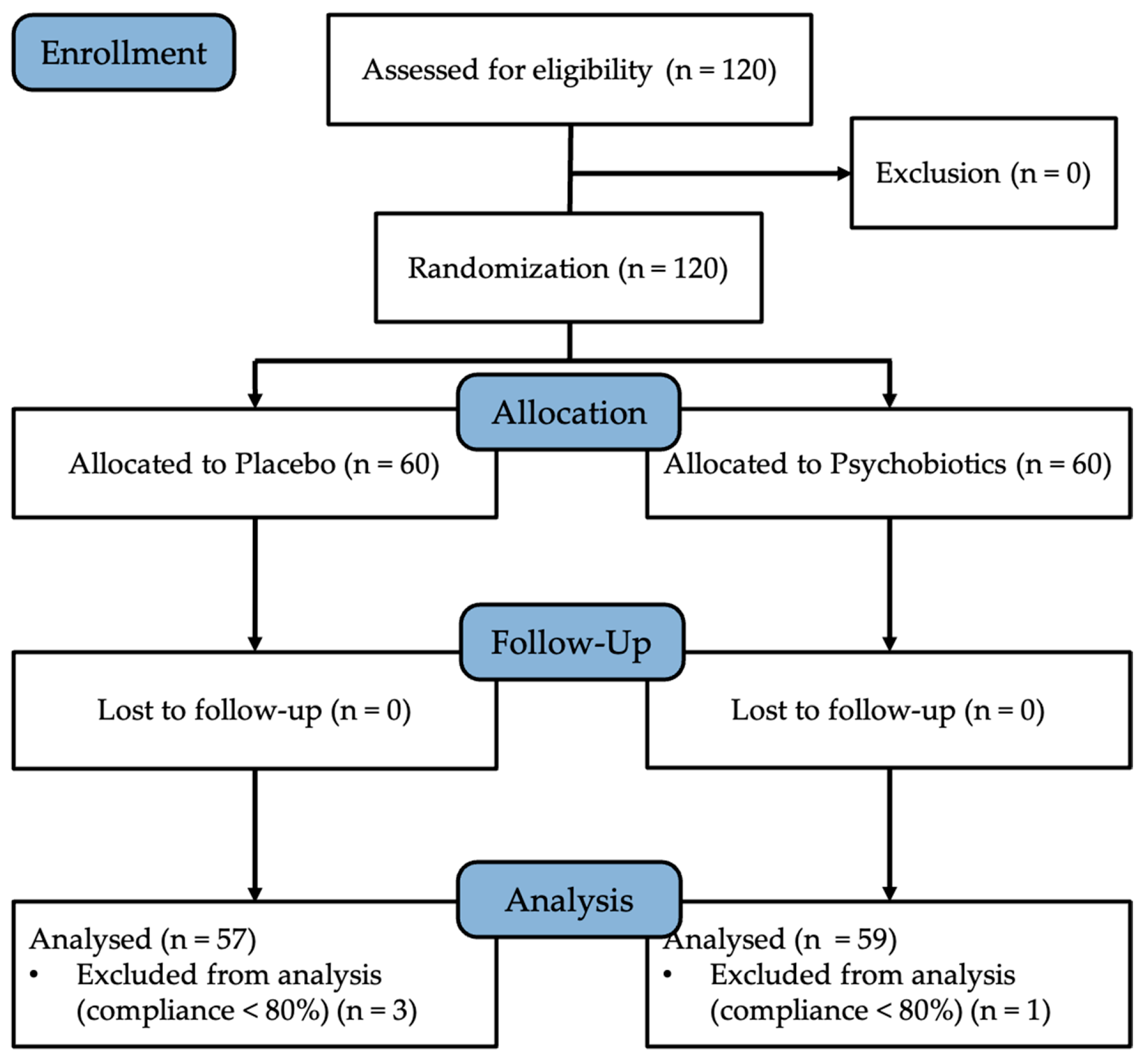
2.1. Study Design
2.2. The Perceived Stress Scale, PSS
2.3. The Job Stress Scale, JSS
2.4. The Chinese Version of the Copenhagen Burnout Inventory, C-CBI
2.5. The State-Trait Anxiety Inventory, STAI
2.6. The Depression Anxiety and Stress Scale-42, DASS-42
2.7. The Insomnia Severity Index, ISI
2.8. The Short Form of Quality of Life, Enjoyment, and Satisfaction Questionnaire, QLESQ-SF
2.9. The Visual Analogue Scale of Gastrointestinal Discomfort, VAS-GI
2.10. The Sleep Diary
2.11. The Patient Global Impression of Change, PGI-C
2.12. Blood Biomarkers
2.13. Statistical Analysis
3. Results
3.1. Demographic Characteristics and Baseline Performances
3.2. Impact of Psychobiotic Intervention on Psychological Parameters
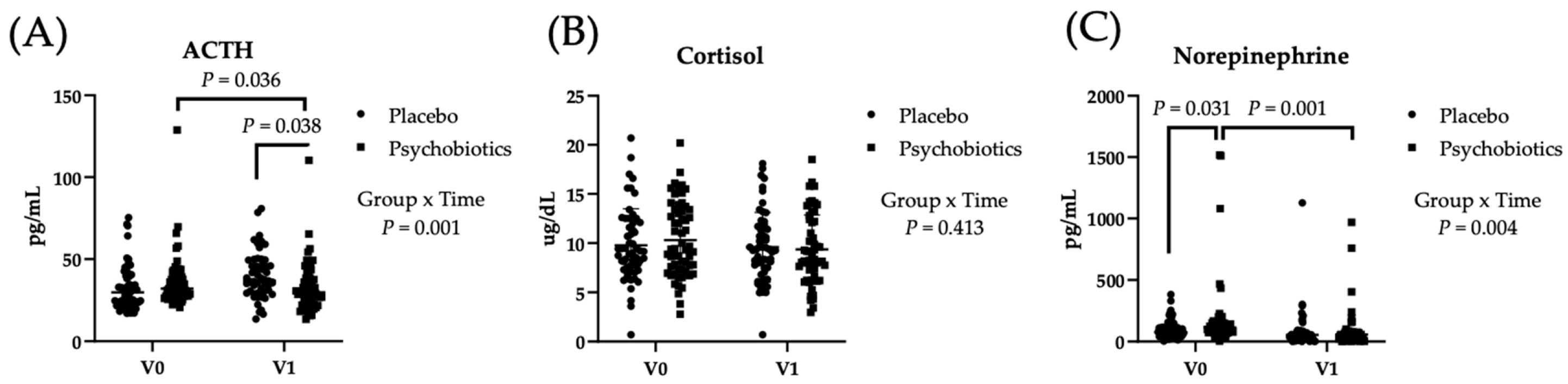
3.3. Effects of Psychobiotic Supplementation on Stress-Associated Blood Biomarkers
4. Discussion
5. Conclusions
Supplementary Materials
Author Contributions
Funding
Institutional Review Board Statement
Informed Consent Statement
Data Availability Statement
Acknowledgments
Conflicts of Interest
References
- James, K.A.; Stromin, J.I.; Steenkamp, N.; Combrinck, M.I. Understanding the relationships between physiological and psychosocial stress, cortisol and cognition. Front. Endocrinol. 2023, 14, 1085950. [Google Scholar] [CrossRef]
- Jun, J.; Kasumova, A.; Tussing, T.; Mackos, A.; Justice, S.; McDaniel, J. Probiotic supplements and stress-related occupational health outcomes: A scoping review. J. Occup. Health 2023, 65, e12404. [Google Scholar] [CrossRef] [PubMed]
- Herman, J.P.; McKlveen, J.M.; Ghosal, S.; Kopp, B.; Wulsin, A.; Makinson, R.; Scheimann, J.; Myers, B. Regulation of the Hypothalamic-Pituitary-Adrenocortical Stress Response. Compr. Physiol. 2016, 6, 603–621. [Google Scholar] [PubMed]
- Kirkbride, J.B.; Anglin, D.M.; Colman, I.; Dykxhoorn, J.; Jones, P.B.; Patalay, P.; Pitman, A.; Soneson, E.; Steare, T.; Wright, T.; et al. The social determinants of mental health and disorder: Evidence, prevention and recommendations. World Psychiatry 2024, 23, 58–90. [Google Scholar] [CrossRef] [PubMed]
- Chen, Y.; Xu, J.; Chen, Y. Regulation of Neurotransmitters by the Gut Microbiota and Effects on Cognition in Neurological Disorders. Nutrients 2021, 13, 2099. [Google Scholar] [CrossRef]
- Zheng, Y.; Bonfili, L.; Wei, T.; Eleuteri, A.M. Understanding the Gut-Brain Axis and Its Therapeutic Implications for Neurodegenerative Disorders. Nutrients 2023, 15, 4631. [Google Scholar] [CrossRef]
- Balakrishnan, R.; Kang, S.I.; Lee, J.Y.; Rho, Y.K.; Kim, B.K.; Choi, D.K. Gut Microbiota-Immune System Interactions in Health and Neurodegenerative Diseases: Insights into Molecular Mechanisms and Therapeutic Applications. Aging Dis. 2024, 16, 3421–3452. [Google Scholar] [CrossRef]
- Damiani, F.; Cornuti, S.; Tognini, P. The gut-brain connection: Exploring the influence of the gut microbiota on neuroplasticity and neurodevelopmental disorders. Neuropharmacology 2023, 231, 109491. [Google Scholar] [CrossRef]
- Molska, M.; Mruczyk, K.; Cisek-Woźniak, A.; Prokopowicz, W.; Szydełko, P.; Jakuszewska, Z.; Marzec, K.; Trocholepsza, M. The Influence of Intestinal Microbiota on BDNF Levels. Nutrients 2024, 16, 2891. [Google Scholar] [CrossRef]
- McGuinness, A.J.; Loughman, A.; Foster, J.A.; Jacka, F. Mood Disorders: The Gut Bacteriome and Beyond. Biol. Psychiatry 2024, 95, 319–328. [Google Scholar] [CrossRef]
- Hill, C.; Guarner, F.; Reid, G.; Gibson, G.R.; Merenstein, D.J.; Pot, B.; Morelli, L.; Canani, R.B.; Flint, H.J.; Salminen, S.; et al. Expert consensus document. The International Scientific Association for Probiotics and Prebiotics consensus statement on the scope and appropriate use of the term probiotic. Nat. Rev. Gastroenterol. Hepatol. 2014, 11, 506–514. [Google Scholar]
- Wiertsema, S.P.; van Bergenhenegouwen, J.; Garssen, J.; Knippels, L.M.J. The Interplay between the Gut Microbiome and the Immune System in the Context of Infectious Diseases throughout Life and the Role of Nutrition in Optimizing Treatment Strategies. Nutrients 2021, 13, 886. [Google Scholar] [CrossRef]
- Del Toro-Barbosa, M.; Hurtado-Romero, A.; Garcia-Amezquita, L.E.; García-Cayuela, T. Psychobiotics: Mechanisms of Action, Evaluation Methods and Effectiveness in Applications with Food Products. Nutrients 2020, 12, 3896. [Google Scholar] [CrossRef]
- Ķimse, L.; Reinis, A.; Miķelsone-Jansone, L.; Gintere, S.; Krūmiņa, A. A Narrative Review of Psychobiotics: Probiotics That Influence the Gut-Brain Axis. Medicina 2024, 60, 601. [Google Scholar] [CrossRef]
- Zareie, M.; Johnson-Henry, K.; Jury, J.; Yang, P.C.; Ngan, B.Y.; McKay, D.M.; Soderholm, J.D.; Perdue, M.H.; Sherman, P.M. Probiotics prevent bacterial translocation and improve intestinal barrier function in rats following chronic psychological stress. Gut 2006, 55, 1553–1560. [Google Scholar] [CrossRef]
- Messaoudi, M.; Lalonde, R.; Violle, N.; Javelot, H.; Desor, D.; Nejdi, A.; Bisson, J.F.; Rougeot, C.; Pichelin, M.; Cazaubiel, M.; et al. Assessment of psychotropic-like properties of a probiotic formulation (Lactobacillus helveticus R0052 and Bifidobacterium longum R0175) in rats and human subjects. Br. J. Nutr. 2011, 105, 755–764. [Google Scholar] [CrossRef]
- Lew, L.C.; Hor, Y.Y.; Yusoff, N.A.A.; Choi, S.B.; Yusoff, M.S.B.; Roslan, N.S.; Ahmad, A.; Mohammad, J.A.M.; Abdullah, M.F.I.L.; Zakaria, N.; et al. Probiotic Lactobacillus plantarum P8 alleviated stress and anxiety while enhancing memory and cognition in stressed adults: A randomised, double-blind, placebo-controlled study. Clin. Nutr. 2019, 38, 2053–2064. [Google Scholar] [CrossRef]
- Abdelhamid, M.; Counts, S.E.; Zhou, C.; Hida, H.; Kim, J.I.; Michikawa, M.; Jung, C.G. Protective Effects of Bifidobacterium Breve MCC1274 as a Novel Therapy for Alzheimer’s Disease. Nutrients 2025, 17, 558. [Google Scholar] [CrossRef]
- Liu, W.H.; Chuang, H.L.; Huang, Y.T.; Wu, C.C.; Chou, G.T.; Wang, S.; Tsai, Y.C. Alteration of behavior and monoamine levels attributable to Lactobacillus plantarum PS128 in germ-free mice. Behav. Brain Res. 2016, 298 Pt B, 202–209. [Google Scholar] [CrossRef]
- Liu, Y.W.; Liu, W.H.; Wu, C.C.; Juan, Y.C.; Wu, Y.C.; Tsai, H.P.; Wang, S.; Tsai, Y.C. Psychotropic effects of Lactobacillus plantarum PS128 in early life-stressed and naïve adult mice. Brain Res. 2016, 1631, 1–12. [Google Scholar] [CrossRef]
- Ho, Y.T.; Tsai, Y.C.; Kuo, T.B.J.; Yang, C.C.H. Effects of Lactobacillus plantarum PS128 on Depressive Symptoms and Sleep Quality in Self-Reported Insomniacs: A Randomized, Double-Blind, Placebo-Controlled Pilot Trial. Nutrients 2021, 13, 2820. [Google Scholar] [CrossRef]
- Wu, S.I.; Wu, C.C.; Tsai, P.J.; Cheng, L.H.; Hsu, C.C.; Shan, I.K.; Chan, P.Y.; Lin, T.W.; Ko, C.J.; Chen, W.L.; et al. Psychobiotic Supplementation of PS128TM Improves Stress, Anxiety, and Insomnia in Highly Stressed Information Technology Specialists: A Pilot Study. Front. Nutr. 2021, 8, 614105. [Google Scholar] [CrossRef]
- Wei, C.L.; Wang, S.; Yen, J.T.; Cheng, Y.F.; Liao, C.L.; Hsu, C.C.; Wu, C.C.; Tsai, Y.C. Antidepressant-like activities of live and heat-killed Lactobacillus paracasei PS23 in chronic corticosterone-treated mice and possible mechanisms. Brain Res. 2019, 1711, 202–213. [Google Scholar] [CrossRef]
- Liao, J.F.; Hsu, C.C.; Chou, G.T.; Hsu, J.S.; Liong, M.T.; Tsai, Y.C. Lactobacillus paracasei PS23 reduced early-life stress abnormalities in maternal separation mouse model. Benef. Microbes 2019, 10, 425–436. [Google Scholar] [CrossRef]
- Wu, S.I.; Wu, C.C.; Cheng, L.H.; Noble, S.W.; Liu, C.J.; Lee, Y.H.; Lin, C.J.; Hsu, C.C.; Chen, W.L.; Tsai, P.J.; et al. Psychobiotic supplementation of HK-PS23 improves anxiety in highly stressed clinical nurses: A double-blind randomized placebo-controlled study. Food Funct. 2022, 13, 8907–8919. [Google Scholar] [CrossRef]
- Van Hasselt, V.B.; Bourke, M.L.; Schuhmann, B.B. Firefighter Stress and Mental Health: Introduction to the Special Issue. Behav. Modif. 2022, 46, 259–266. [Google Scholar] [CrossRef]
- Jain, M.; Anand, A.; Sharma, N.; Shamim, M.A.; Enioutina, E.Y. Effect of Probiotics Supplementation on Cortisol Levels: A Systematic Review and Meta-Analysis. Nutrients 2024, 16, 3564. [Google Scholar] [CrossRef]
- Chiu, Y.H.; Lu, F.J.; Lin, J.H.; Nien, C.L.; Hsu, Y.W.; Liu, H.Y. Psychometric properties of the Perceived Stress Scale (PSS): Measurement invariance between athletes and non-athletes and construct validity. PeerJ 2016, 4, e2790. [Google Scholar] [CrossRef]
- Cohen, S.; Kamarck, T.; Mermelstein, R. A global measure of perceived stress. J. Health Soc. Behav. 1983, 24, 385–396. [Google Scholar] [CrossRef]
- The Ministry of Labor. The Job Stress Scale. 2018. Available online: https://www.ilosh.gov.tw/90734/90811/136449/90819/92380/ (accessed on 1 December 2025).
- Yeh, W.Y.; Cheng, Y.; Chen, C.J.; Hu, P.Y.; Kristensen, T.S. Psychometric properties of the Chinese version of Copenhagen burnout inventory among employees in two companies in Taiwan. Int. J. Behav. Med. 2007, 14, 126–133. [Google Scholar] [CrossRef]
- Speilberger, C.D.; Gorsuch, R.; Lushene, R.; Vagg, P.R.; Jacobs, G.A. Manual for The State-Trait Anxiety Inventory; Consulting Psychologists: Palo Alto, CA, USA, 1983. [Google Scholar]
- Ma, W.F.; Liu, Y.C.; Chen, Y.F.; Lane, H.Y.; Lai, T.J.; Huang, L.C. Evaluation of psychometric properties of the Chinese Mandarin version State-Trait Anxiety Inventory Y form in Taiwanese outpatients with anxiety disorders. J. Psychiatr. Ment. Health Nurs. 2013, 20, 499–507. [Google Scholar] [CrossRef]
- Lovibond, S. Manual for the Depression Anxiety Stress Scales, 2nd ed.; Psychology Foundation of Australia: Sydney, Australia, 1995. [Google Scholar]
- Yang, C.M.; Hsu, S.C.; Lin, S.C.; Chou, Y.Y.; Chen, Y.M. Reliability and validity of the Chinese version of insomnia severity index. Arch. Clin. Psychol. 2009, 4, 95–104. [Google Scholar]
- Lee, Y.T.; Liu, S.I.; Huang, H.C.; Sun, F.J.; Huang, C.R.; Yeung, A. Validity and reliability of the Chinese version of the Short Form of Quality of Life Enjoyment and Satisfaction Questionnaire (Q-LES-Q-SF). Qual. Life Res. 2014, 23, 907–916. [Google Scholar]
- Hurst, H.; Bolton, J. Assessing the clinical significance of change scores recorded on subjective outcome measures. J. Manip. Physiol. Ther. 2004, 27, 26–35. [Google Scholar] [CrossRef]
- Kim, S.Y.; Shin, Y.C.; Oh, K.S.; Shin, D.W.; Lim, W.J.; Cho, S.J.; Jeon, S.W. Gender and age differences in the association between work stress and incident depressive symptoms among Korean employees: A cohort study. Int. Arch. Occup. Environ. Health 2020, 93, 457–467. [Google Scholar]
- Marchand, A.; Blanc, M.E.; Beauregard, N. Do age and gender contribute to workers’ burnout symptoms? Occup. Med. 2018, 68, 405–411. [Google Scholar] [CrossRef]
- Zhang, N.; Zhang, Y.; Li, M.; Wang, W.; Liu, Z.; Xi, C.; Huang, X.; Liu, J.; Huang, J.; Tian, D.; et al. Efficacy of probiotics on stress in healthy volunteers: A systematic review and meta-analysis based on randomized controlled trials. Brain Behav. 2020, 10, e01699. [Google Scholar]
- Chong, H.X.; Yusoff, N.A.A.; Hor, Y.Y.; Lew, L.C.; Jaafar, M.H.; Choi, S.B.; Yusoff, M.S.B.; Wahid, N.; Abdullah, M.F.I.L.; Zakaria, N.; et al. Lactobacillus plantarum DR7 alleviates stress and anxiety in adults: A randomised, double-blind, placebo-controlled study. Benef. Microbes 2019, 10, 355–373. [Google Scholar]
- Moloney, G.M.; Long-Smith, C.M.; Murphy, A.; Dorland, D.; Hojabri, S.F.; Ramirez, L.O.; Marin, D.C.; Bastiaanssen, T.F.S.; Cusack, A.M.; Berding, K.; et al. Improvements in sleep indices during exam stress due to consumption of a Bifidobacterium longum. Brain Behav. Immun. Health 2020, 10, 100174. [Google Scholar]
- Sawada, D.; Kuwano, Y.; Tanaka, H.; Hara, S.; Uchiyama, Y.; Sugawara, T.; Fujiwara, F.; Rokutan, K.; Nishida, K. Daily intake of Lactobacillus gasseri CP2305 relieves fatigue and stress-related symptoms in male university Ekiden runners: A double-blind, randomized, and placebo-controlled clinical trial. J. Funct. Foods 2019, 57, 465–476. [Google Scholar]
- Mesotten, D.; Vanhorebeek, I.; Van den Berghe, G. The altered adrenal axis and treatment with glucocorticoids during critical illness. Nat. Clin. Pract. Endocrinol. Metab. 2008, 4, 496–505. [Google Scholar] [CrossRef]
- de Jong, M.F.; Molenaar, N.; Beishuizen, A.; Groeneveld, A.B. Diminished adrenal sensitivity to endogenous and exogenous adrenocorticotropic hormone in critical illness: A prospective cohort study. Crit. Care 2015, 19, 1. [Google Scholar] [CrossRef]
- Bornstein, S.R.; Engeland, W.C.; Ehrhart-Bornstein, M.; Herman, J.P. Dissociation of ACTH and glucocorticoids. Trends Endocrinol. Metab. 2008, 19, 175–180. [Google Scholar] [CrossRef]
- Silva, Y.P.; Bernardi, A.; Frozza, R.L. The Role of Short-Chain Fatty Acids from Gut Microbiota in Gut-Brain Communication. Front. Endocrinol. 2020, 11, 25. [Google Scholar] [CrossRef]
- Braga, J.D.; Thongngam, M.; Kumrungsee, T. Gamma-aminobutyric acid as a potential postbiotic mediator in the gut-brain axis. npj Sci. Food 2024, 8, 16. [Google Scholar] [CrossRef]
- Lei, A.A.; Phang, V.W.X.; Lee, Y.Z.; Kow, A.S.F.; Tham, C.L.; Ho, Y.C.; Lee, M.T. Chronic Stress-Associated Depressive Disorders: The Impact of HPA Axis Dysregulation and Neuroinflammation on the Hippocampus—A Mini Review. Int. J. Mol. Sci. 2025, 26, 2940. [Google Scholar] [CrossRef]
- Sánchez, M.C.; Herráiz, A.; Tigre, S.; Llama-Palacios, A.; Hernández, M.; Ciudad, M.J.; Collado, L. Evidence of the Beneficial Impact of Three Probiotic-Based Food Supplements on the Composition and Metabolic Activity of the Intestinal Microbiota in Healthy Individuals: An Ex Vivo Study. Nutrients 2023, 15, 5077. [Google Scholar] [CrossRef]
- Nataraj, B.H.; Ali, S.A.; Behare, P.V.; Yadav, H. Postbiotics-parabiotics: The new horizons in microbial biotherapy and functional foods. Microb. Cell Fact. 2020, 19, 168. [Google Scholar] [CrossRef]
- Ozma, M.A.; Abbasi, A.; Akrami, S.; Lahouty, M.; Shahbazi, N.; Ganbarov, K.; Pagliano, P.; Sabahi, S.; Köse, Ş.; Yousefi, M.; et al. Postbiotics as the key mediators of the gut microbiota-host interactions. Infez. Med. 2022, 30, 180–193. [Google Scholar]
- Liu, W.H.; Yang, C.H.; Lin, C.T.; Li, S.W.; Cheng, W.S.; Jiang, Y.P.; Wu, C.C.; Chang, C.H.; Tsai, Y.C. Genome architecture of Lactobacillus plantarum PS128, a probiotic strain with potential immunomodulatory activity. Gut Pathol. 2015, 7, 22. [Google Scholar] [CrossRef]
- Mukherjee, S.; Karmakar, S.; Babu, S.P. TLR2 and TLR4 mediated host immune responses in major infectious diseases: A review. Braz. J. Infect. Dis. 2016, 20, 193–204. [Google Scholar] [CrossRef] [PubMed]
- Lee, K.Y.; Tsai, Y.C.; Wang, S.Y.; Chen, Y.P.; Chen, M.J. Coculture Strategy for Developing Lactobacillus paracasei PS23 Fermented Milk with Anti-Colitis Effect. Foods 2021, 10, 2337. [Google Scholar] [CrossRef]
- Kalmbach, D.A.; Anderson, J.R.; Drake, C.L. The impact of stress on sleep: Pathogenic sleep reactivity as a vulnerability to insomnia and circadian disorders. J. Sleep Res. 2018, 27, e12710. [Google Scholar] [CrossRef]
- McEwen, B.S.; Karatsoreos, I.N. Sleep Deprivation and Circadian Disruption: Stress, Allostasis, and Allostatic Load. Sleep Med. Clin. 2015, 10, 1–10. [Google Scholar] [CrossRef]
- Takada, M.; Nishida, K.; Gondo, Y.; Kikuchi-Hayakawa, H.; Ishikawa, H.; Suda, K.; Kawai, M.; Hoshi, R.; Kuwano, Y.; Miyazaki, K.; et al. Beneficial effects of Lactobacillus casei strain Shirota on academic stress-induced sleep disturbance in healthy adults: A double-blind, randomised, placebo-controlled trial. Benef. Microbes 2017, 8, 153–162. [Google Scholar] [CrossRef]
- Gil-Hernández, E.; Ruiz-González, C.; Rodriguez-Arrastia, M.; Ropero-Padilla, C.; Rueda-Ruzafa, L.; Sánchez-Labraca, N.; Roman, P. Effect of gut microbiota modulation on sleep: A systematic review and meta-analysis of clinical trials. Nutr. Rev. 2023, 81, 1556–1570. [Google Scholar] [CrossRef]
- Takada, M.; Nishida, K.; Kataoka-Kato, A.; Gondo, Y.; Ishikawa, H.; Suda, K.; Kawai, M.; Hoshi, R.; Watanabe, O.; Igarashi, T.; et al. Probiotic Lactobacillus casei strain Shirota relieves stress-associated symptoms by modulating the gut-brain interaction in human and animal models. Neurogastroenterol. Motil. 2016, 28, 1027–1036. [Google Scholar] [CrossRef]
- Mudaliar, S.B.; Poojary, S.S.; Bharath Prasad, A.S.; Mazumder, N. Probiotics and Paraprobiotics: Effects on Microbiota-Gut-Brain Axis and Their Consequent Potential in Neuropsychiatric Therapy. Probiotics Antimicrob. Proteins 2024, 16, 1440–1464. [Google Scholar] [CrossRef]
- Adams, C.A. The probiotic paradox: Live and dead cells are biological response modifiers. Nutr. Res. Rev. 2010, 23, 37–46. [Google Scholar] [CrossRef]



| Placebo (n = 57) | Psychobiotics (n = 59) | ||||
|---|---|---|---|---|---|
| n | % | n | % | p-Value | |
| Sex | 0.077 | ||||
| Male | 54 | 95.0 | 50 | 85.0 | |
| Female | 3 | 5.0 | 9 | 15.0 | |
| Marital status | 0.265 | ||||
| Single | 22 | 39.3 | 24 | 41.4 | |
| Married | 31 | 55.4 | 25 | 43.1 | |
| Cohabit | 3 | 5.4 | 8 | 13.8 | |
| Divorced | 0 | 0.0 | 1 | 1.7 | |
| Children | 0.198 | ||||
| With | 29 | 50.9 | 23 | 39.0 | |
| Without | 28 | 49.1 | 36 | 61.0 | |
| Occupation Experience | 0.971 | ||||
| <1 year | 3 | 5.3 | 4 | 6.8 | |
| 1~2 years | 2 | 3.5 | 2 | 3.4 | |
| 2~4 years | 2 | 3.5 | 5 | 8.5 | |
| 4~6 years | 9 | 15.8 | 8 | 13.6 | |
| 6~8 years | 4 | 7.0 | 5 | 8.5 | |
| 8~10 years | 7 | 12.3 | 8 | 13.6 | |
| 10~15 years | 9 | 15.8 | 8 | 13.6 | |
| >15 years | 21 | 36.8 | 19 | 32.2 | |
| Other Supplement | 0.060 | ||||
| With | 6 | 10.5 | 14 | 23.7 | |
| Without | 51 | 89.5 | 45 | 76.3 | |
| Mean | SD | Mean | SD | p-value | |
| Age | 34.3 | 6.9 | 34.9 | 7.0 | 0.645 |
| Years of Education | 16.0 | 1.9 | 15.6 | 1.9 | 0.288 |
| BMI | 26.2 | 3.3 | 25.9 | 3.5 | 0.678 |
| Variables | Group Effect | Time Effect | Group × Time | |||
|---|---|---|---|---|---|---|
| B (95% CI) | p-Value | B (95% CI) | p-Value | B (95% CI) | p-Value | |
| Perceived Stress Scale (PSS) | ||||||
| PSS Total | 0.917 (−0.764, 2.597) | 0.285 | 1.034 (0.206, 1.861) | 0.014 * | −0.293 (−1.749, 1.164) | 0.694 |
| Job Stress Scale (JSS) | ||||||
| Job Stress | 0.000 (0.000, 0.000) | 1.000 | 0.750 (−0.648, 2.149) | 0.293 | 1.035 (−0.702, 2.772) | 0.243 |
| Control Over Job | 0.301 (−1.736, 2.338) | 0.772 | −0.362 (−2.083, 1.359) | 0.680 | 1.017 (−1.202, 3.236) | 0.369 |
| Job Burden | −0.660 (−2.707, 1.387) | 0.527 | −1.370 (−3.013, 0.274) | 0.103 | 1.150 (−0.881, 3.182) | 0.267 |
| Interpersonal Relationships | 0.862 (−1.275, 2.998) | 0.429 | −0.637 (−2.341, 1.067) | 0.464 | 0.235 (−1.945, 2.415) | 0.833 |
| Job Satisfaction | 1.477 (−0.363, 3.318) | 0.116 | 1.021 (−1.047, 3.090) | 0.333 | −0.783 (−3.277, 1.712) | 0.539 |
| Psychological Health | 0.464 (−1.472, 2.400) | 0.639 | 0.308 (−0.881, 1.496) | 0.612 | 0.187 (−1.459, 1.833) | 0.824 |
| Energy Level | 0.934 (−0.869, 2.737) | 0.310 | −0.837 (−1.724, 0.051) | 0.065 | 0.560 (−0.919, 2.040) | 0.458 |
| General Health | −0.116 (−2.172, 1.939) | 0.912 | −1.338 (−2.525, −0.150) | 0.027 * | 1.848 (0.236, 3.460) | 0.025 * |
| Chinese version of Copenhagen Burnout Inventory (C-CBI) | ||||||
| C-CBI Personal Burnout | 0.876 (−1.142, 2.893) | 0.395 | −0.271 (−1.635, 1.093) | 0.697 | −0.040 (−1.868, 1.787) | 0.966 |
| C-CBI Work-Related Burnout | 0.733 (−1.445, 2.910) | 0.510 | −0.046 (−1.545, 1.454) | 0.952 | 0.068 (−1.920, 2.057) | 0.946 |
| State and Trait Anxiety Inventory (STAI) | ||||||
| STAI State Anxiety Present | −0.206 (−2.105, 1.692) | 0.831 | 1.059 (−0.927, 3.045) | 0.296 | −1.260 (−3.661, 1.141) | 0.304 |
| STAI State Anxiety Absent | 0.311 (−1.326, 1.949) | 0.709 | 2.091 (0.862, 3.321) | 0.001 ** | −2.472 (−4.233, −0.712) | 0.006 ** |
| STAI State | 0.038 (−1.704, 1.780) | 0.966 | 1.613 (−0.027, 3.254) | 0.054 | −1.912 (−4.001, 0.177) | 0.073 |
| STAI Trait Anxiety Present | −0.771 (−2.494, 0.953) | 0.381 | 0.336 (−0.890, 1.563) | 0.591 | −0.289 (−1.958, 1.379) | 0.734 |
| STAI Trait Anxiety Absent | −0.117 (−2.113, 1.878) | 0.908 | 1.448 (0.490, 2.407) | 0.003 ** | −1.101 (−2.415, 0.213) | 0.100 |
| STAI Trait | −0.512 (−2.282, 1.258) | 0.571 | 0.865 (−0.074, 1.804) | 0.071 | −0.678 (−2.006, 0.651) | 0.317 |
| STAI Total | −0.243 (−1.972, 1.487) | 0.783 | 1.327 (0.173, 2.480) | 0.024 * | −1.393 (−3.015, 0.229) | 0.092 |
| Depression Anxiety and Stress Scale-42 (DASS-42) | ||||||
| DASS-42 Depression | 1.260 (−0.402, 2.922) | 0.137 | 0.199 (−0.731, 1.129) | 0.674 | −0.120 (−1.460, 1.220) | 0.861 |
| DASS-42 Anxiety | 0.752 (−1.134, 2.638) | 0.435 | 0.841 (−0.375, 2.056) | 0.175 | −1.126 (−2.647, 0.395) | 0.147 |
| DASS-42 Stress | 0.187 (−1.536, 1.910) | 0.832 | 0.885 (−0.054, 1.823) | 0.065 | −1.056 (−2.452, 0.340) | 0.138 |
| Insomnia Severity Index (ISI) | ||||||
| ISI Initiation | −0.347 (−2.211, 1.518) | 0.716 | 0.286 (−1.626, 2.198) | 0.770 | −0.358 (−2.725, 2.010) | 0.767 |
| ISI Maintenance | −0.228 (−1.888, 1.432) | 0.788 | 1.490 (−0.003, 2.983) | 0.050 * | −1.078 (−3.005, 0.850) | 0.273 |
| ISI Early Awakening | −0.064 (−2.060, 1.933) | 0.950 | 1.983 (0.177, 3.788) | 0.031 * | −2.224 (−4.427, −0.022) | 0.048 * |
| ISI Total | −0.309 (−2.069, 1.451) | 0.731 | 2.195 (1.060, 3.329) | 0.000 *** | −1.609 (−3.153, −0.065) | 0.041 * |
| Short Form of Quality of Life, Enjoyment, and Satisfaction Questionnaire (QLESQ-SF) | ||||||
| QLESQ-SF Overall | 0.031 (−1.931, 1.993) | 0.975 | −1.443 (−2.920, 0.034) | 0.056 | 2.081 (−0.149, 4.310) | 0.067 |
| QLESQ-SF Psychological | 0.511 (−1.371, 2.393) | 0.595 | −0.911 (−2.126, 0.304) | 0.142 | 1.797 (−0.259, 3.852) | 0.087 |
| QLESQ-SF Physical | 0.336 (−1.478, 2.149) | 0.717 | −1.389 (−2.526, −0.253) | 0.017 * | 1.460 (−0.144, 3.064) | 0.074 |
| QLESQ-SF Total | 0.499 (−1.382, 2.380) | 0.603 | −1.164 (−2.275, −0.054) | 0.040 * | 1.851 (−0.022, 3.725) | 0.053 |
| Placebo | Psychobiotics | p-Value | |||
|---|---|---|---|---|---|
| n | % | n | % | ||
| Very much improved | 1 | 1.8 | 0 | 0.0 | 0.250 |
| Much improved | 3 | 5.3 | 5 | 8.5 | |
| Minimally improved | 34 | 59.6 | 29 | 49.2 | |
| No change | 17 | 29.8 | 25 | 42.4 | |
| Minimally worse | 2 | 3.5 | 0 | 0.0 | |
| Much worse | 0 | 0.0 | 0 | 0.0 | |
| Very much worse | 0 | 0.0 | 0 | 0.0 | |
Disclaimer/Publisher’s Note: The statements, opinions and data contained in all publications are solely those of the individual author(s) and contributor(s) and not of MDPI and/or the editor(s). MDPI and/or the editor(s) disclaim responsibility for any injury to people or property resulting from any ideas, methods, instructions or products referred to in the content. |
© 2025 by the authors. Licensee MDPI, Basel, Switzerland. This article is an open access article distributed under the terms and conditions of the Creative Commons Attribution (CC BY) license (https://creativecommons.org/licenses/by/4.0/).
Share and Cite
Lee, M.-C.; Lin, T.-A.; Huang, C.-C. Dual-Strain Psychobiotics Combining Live Lactiplantibacillus plantarum PS128 and Heat-Treated Lacticaseibacillus paracasei PS23 Improve Psychological and Neuroendocrine Outcomes in Stressed Adults: A Randomized, Placebo-Controlled Trial. Foods 2025, 14, 4190. https://doi.org/10.3390/foods14244190
Lee M-C, Lin T-A, Huang C-C. Dual-Strain Psychobiotics Combining Live Lactiplantibacillus plantarum PS128 and Heat-Treated Lacticaseibacillus paracasei PS23 Improve Psychological and Neuroendocrine Outcomes in Stressed Adults: A Randomized, Placebo-Controlled Trial. Foods. 2025; 14(24):4190. https://doi.org/10.3390/foods14244190
Chicago/Turabian StyleLee, Mon-Chien, Ting-An Lin, and Chi-Chang Huang. 2025. "Dual-Strain Psychobiotics Combining Live Lactiplantibacillus plantarum PS128 and Heat-Treated Lacticaseibacillus paracasei PS23 Improve Psychological and Neuroendocrine Outcomes in Stressed Adults: A Randomized, Placebo-Controlled Trial" Foods 14, no. 24: 4190. https://doi.org/10.3390/foods14244190
APA StyleLee, M.-C., Lin, T.-A., & Huang, C.-C. (2025). Dual-Strain Psychobiotics Combining Live Lactiplantibacillus plantarum PS128 and Heat-Treated Lacticaseibacillus paracasei PS23 Improve Psychological and Neuroendocrine Outcomes in Stressed Adults: A Randomized, Placebo-Controlled Trial. Foods, 14(24), 4190. https://doi.org/10.3390/foods14244190