Article

Risk Classification of Food Incidents Using a Risk Evaluation Matrix for Use in Artificial Intelligence-Supported Risk Identification
1
SGS Germany GmbH, Health and Nutrition, Heidenkampsweg 99, 20097 Hamburg, Germany
2
Department of Food Chemistry and Analysis, Institute of Food Technology and Food Chemistry, Technische Universität Berlin, Gustav Meyer Allee 25, 13355 Berlin, Germany
*
Author to whom correspondence should be addressed.
Foods 2024, 13(22), 3675; https://doi.org/10.3390/foods13223675
Submission received: 2 October 2024 / Revised: 10 November 2024 / Accepted: 14 November 2024 / Published: 18 November 2024

Abstract

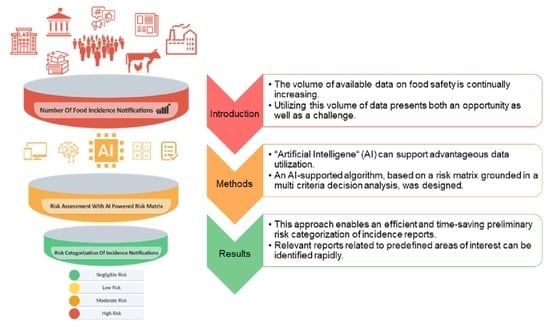
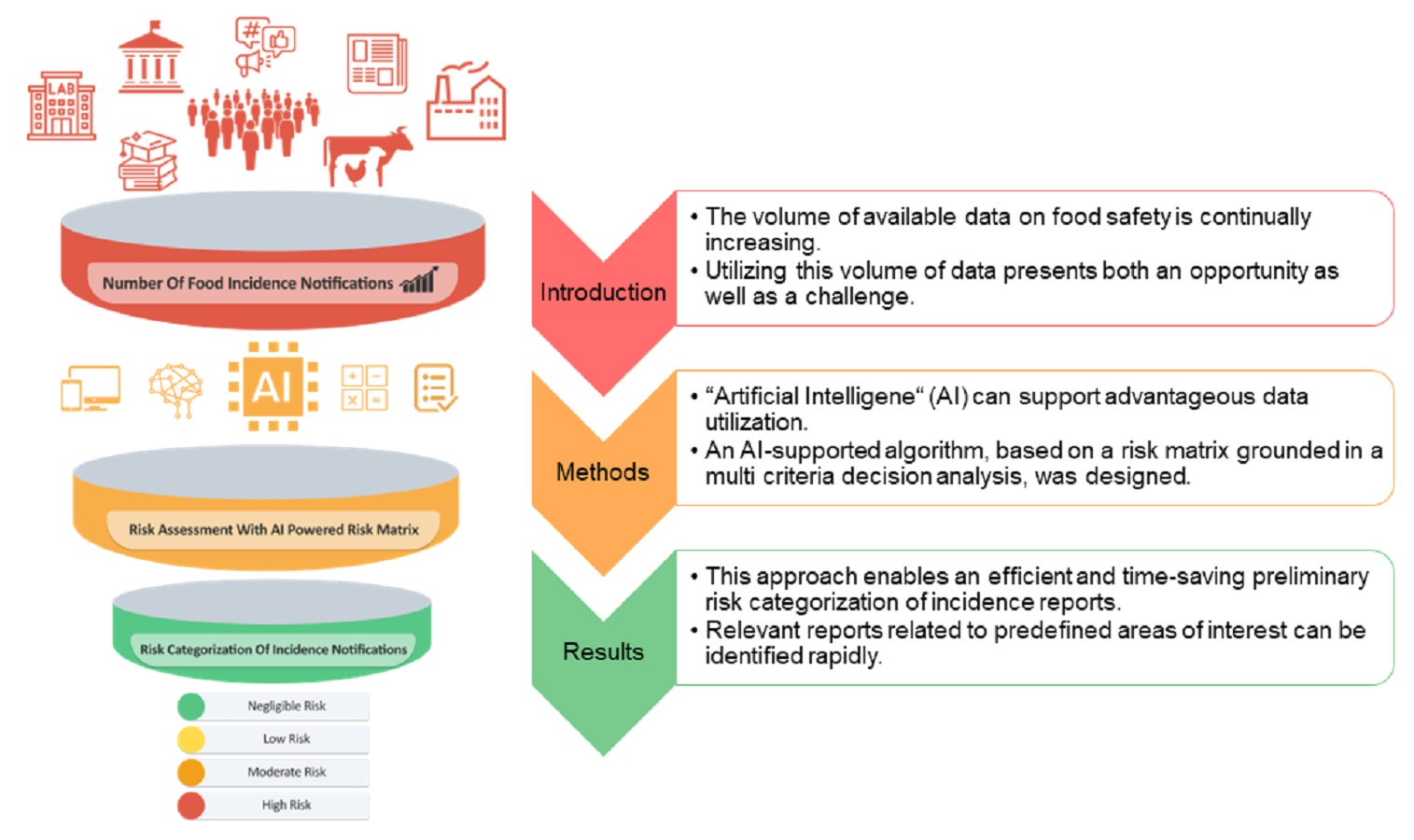
Foodborne illnesses and mortalities persist as a significant global health issue. The World Health Organization estimates that one out of every ten individuals becomes ill following the consumption of contaminated food. However, in the age of digitalization and technological progress, more and more data and data evaluation technologies are available to counteract this problem. A specific challenge in this context is the efficient and beneficial utilization of the continuously increasing volume of data. In pursuit of optimal data utilization, the objective of the present study was to develop a Multi-Criteria Decision Analysis (MCDA)-based assessment scheme to be prospectively implemented into an overall artificial intelligence (AI)-supported database for the autonomous risk categorization of food incident reports. Such additional evaluations might help to identify certain novel or emerging risks by allocating a level of risk prioritization. Ideally, such indications are obtained earlier than an official notification, and therefore, this method can be considered preventive, as the risk is already identified. Our results showed that this approach enables the efficient and time-saving preliminary risk categorization of incident reports, allowing for the rapid identification of relevant reports related to predefined subject areas or inquiries that require further examination. The manual test runs demonstrated practicality, enabling the implementation of the evaluation scheme in AI-supported databases for the autonomous assessment of incident reports. Moreover, it has become evident that increasing the amount of information and evaluation criteria provided to AI notably enhances the precision of risk assessments for individual incident notifications. This will remain an ongoing challenge for the utilization and processing of food safety data in the future.
Keywords: risk assessment; artificial intelligence; food safety; early warning risk assessment; artificial intelligence; food safety; early warning
Graphical Abstract