

Article

Preservative Effect of Alga Flour Extract on Frozen Horse Mackerel (Trachurus trachurus) Lipids

1
Department of Food Science and Technology, Instituto de Investigaciones Marinas (CSIC), 36208 Vigo, Spain
2
Department of Food Science and Chemical Technology, Faculty of Chemical and Pharmaceutical Sciences, University of Chile, Dr. Carlos Lorca Tobar 964, Santiago 8380494, Chile
*
Author to whom correspondence should be addressed.
Foods 2024, 13(20), 3265; https://doi.org/10.3390/foods13203265
Submission received: 12 September 2024 / Revised: 4 October 2024 / Accepted: 11 October 2024 / Published: 14 October 2024
(This article belongs to the Special Issue New Technological Advances in Meat Packaging: Shelf-Life and Safety)

Abstract

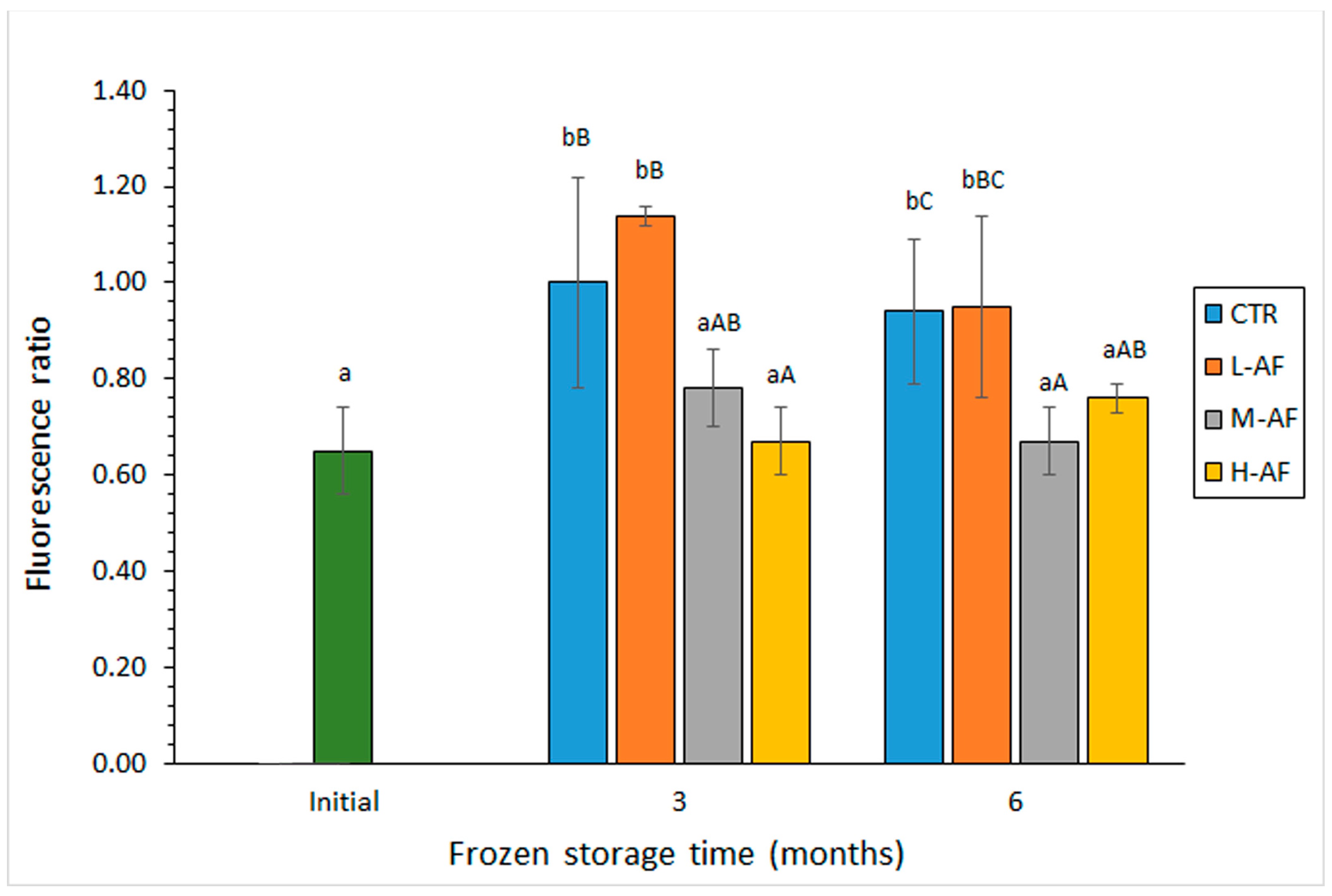
The aim of this study was to investigate the preservative properties of alga Gelidium sp. flour when included in the glazing medium employed for the frozen storage (−18 °C) of horse mackerel (Trachurus trachurus). Different concentrations (low, medium, and high) of an aqueous extract were tested and compared to a control water-glazing condition. Quality changes (lipid oxidation and hydrolysis, fatty acid (FA) profile, and trimethylamine (TMA) formation) were determined after 3- and 6-month storage periods. A general quality loss (lipid oxidation with hydrolysis development and TMA formation) with the frozen storage period was detected in all samples. The presence of an alga flour (AF) extract in the glazing medium led to a lower (p < 0.05) TBARS and fluorescent compound formation and to higher (p < 0.05) polyene values in frozen fish. Furthermore, a preserving effect on free fatty acids was detected in AF-treated fish. On the contrary, the AF-glazing treatment did not affect (p > 0.05) the TMA formation and the total n3/total n6 FA ratio. In general, preservative effects were found to be higher in frozen fish corresponding to the medium concentration tested. Current results show the potential of Gelidium sp. flour as a natural source of preservative hydrophilic compounds for the quality enhancement of frozen horse mackerel.
Keywords: red algae; flour; aqueous extract; frozen fish; glazing; fatty acids; oxidation; hydrolysis; trimethylamine; quality red algae; flour; aqueous extract; frozen fish; glazing; fatty acids; oxidation; hydrolysis; trimethylamine; quality


