



Food Insecurity in Greece and across the Globe: A Narrative Literature Review

 , , ,
, , ,  , ,
, , 
Abstract
1. Introduction
2. Materials and Methods
2.1. Search Strategy and Information Sources
2.2. Eligibility of Studies, Measures of Food Insecurity and Food Insecurity Categorization Levels
3. Results
3.1. Magnitude of Food Insecurity
3.1.1. The World at a Glance
3.1.2. Europe and Greece
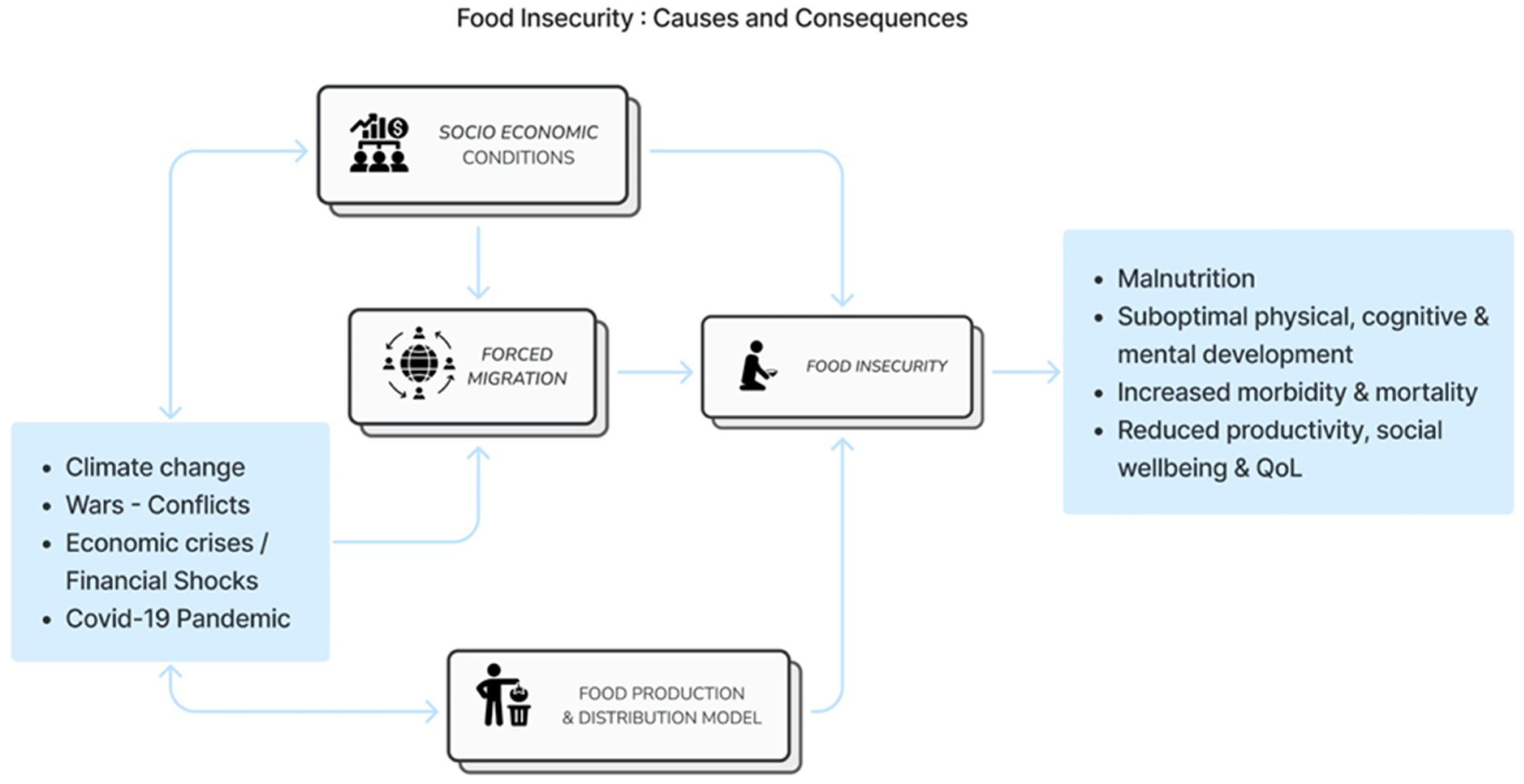
3.2. Macro-Factors Driving Food Insecurity
3.2.1. Climate Change
3.2.2. Wars/Conflicts
3.2.3. Economic Crises and Economic Shocks
3.2.4. COVID-19 Pandemic Effect on Food Insecurity
4. Discussion
5. Conclusions
Author Contributions
Funding
Institutional Review Board Statement
Informed Consent Statement
Data Availability Statement
Acknowledgments
Conflicts of Interest
References
- FAO; IFAD; UNICEF; WFP; WHO. The State of Food Security and Nutrition in the World 2021. Transforming Food Systems for Food Security, Improved Nutrition and Affordable Healthy Diets for All; FAO: Rome, Italy, 2021. [Google Scholar] [CrossRef]
- Grimaccia, E.; Naccarato, A. Food Insecurity in Europe: A Gender Perspective. Soc. Indic. Res. 2022, 161, 649–667. [Google Scholar] [CrossRef] [PubMed]
- Bell, Z.; Scott, S.; Visram, S.; Rankin, J.; Bambra, C.; Heslehurst, N. Food insecurity and the nutritional health and well-being of women and children in high-income countries: Protocol for a qualitative systematic review. BMJ Open 2021, 11, e048180. [Google Scholar] [CrossRef]
- Food Security Information Network. Global Report on Food Crises 2020. Joint Analysis for Better Decisions. 2020. Available online: https://www.wfp.org/publications/2020-global-report-food-crises (accessed on 14 November 2023).
- Vassilakou, T. Childhood Malnutrition: Time for Action. Children 2021, 8, 103. [Google Scholar] [CrossRef] [PubMed]
- Gundersen, C.; Ziliak, J.P. Food Insecurity and Health Outcomes. Health Aff. 2015, 34, 1830–1839. [Google Scholar] [CrossRef]
- Gallegos, D.; Eivers, A.; Sondergeld, P.; Pattinson, C. Food Insecurity and Child Development: A State-of-the-Art Review. Int. J. Environ. Res. Public Health 2021, 18, 8990. [Google Scholar] [CrossRef]
- Ke, J.; Ford-Jones, E.L. Food insecurity and hunger: A review of the effects on children’s health and behaviour. Paediatr. Child. Health 2015, 20, 89–91. [Google Scholar] [CrossRef] [PubMed]
- World Health Organization. Fact Sheets—Malnutrition. Available online: https://www.who.int/news-room/fact-sheets/detail/malnutrition (accessed on 15 January 2024).
- World Child Hunger Facts—World Hunger Education. World Hunger News. Available online: https://www.worldhunger.org/world-child-hunger-facts/ (accessed on 29 April 2024).
- Weaver, L.J.; Fasel, C.B. A Systematic Review of the Literature on the Relationships between Chronic Diseases and Food Insecurity. Food Nutr. Sci. 2018, 9, 519–541. [Google Scholar] [CrossRef]
- McIntyre, L.; Williams, J.V.A.; Lavorato, D.H.; Patten, S. Depression and suicide ideation in late adolescence and early adulthood are an outcome of child hunger. J. Affect. Disord. 2013, 150, 123–129. [Google Scholar] [CrossRef]
- Grammatikopoulou, M.G.; Theodoridis, X.; Chourdakis, M.; Oikonomou, A.; Tirodimos, I.; Dardavessis, T. Food insecurity during childhood: Causes, prevalence, results and recommendations. Paediatriki 2017, 80, 186–199. (In Greek) [Google Scholar]
- Sawaya, A.L.; Roberts, S. Stunting and future risk of obesity: Principal physiological mechanisms. Cad. Saude Publica 2003, 19 (Suppl. S1), S21–S28. [Google Scholar] [CrossRef]
- Larson, P.D.; Larson, N.M. The Hunger of Nations: An empirical study of inter-relationships among the Sustainable Development Goals (SDGs). J. Sustain. Dev. 2019, 12, 39–47. [Google Scholar] [CrossRef]
- Global Hunger Index Organization. 2023 Global Hunger Index. Global, Regional and National Trends. Available online: https://www.globalhungerindex.org/trends.html (accessed on 18 January 2024).
- United Nations, Department of Economic and Social Affairs, Sustainable Development. The 17 Goals of Sustainable Development. Available online: https://sdgs.un.org/goals (accessed on 14 November 2023).
- Ritchie, H.; Rosado, P.; Roser, M. Hunger and Undernourishment. Our World in Data. 2023. Available online: https://ourworldindata.org/hunger-and-undernourishment (accessed on 15 January 2024).
- Food and Agriculture Organization of the United Nations, Voices of the Hungry. Food Insecurity Experience Scale (FIES). Available online: https://www.fao.org/in-action/voices-of-the-hungry/fies/en/ (accessed on 14 November 2023).
- Coates, J.; Swindale, A.; Bilinsky, P. Household Food Insecurity Access Scale (HFIAS) for Measurement of Household Food Access: Indicator Guide (v3). Washington, DC, 2007: FHI 360/FANTA-2. Available online: https://www.fao.org/fileadmin/user_upload/eufao-fsi4dm/doc-training/hfias.pdf (accessed on 14 November 2023).
- Swindale, A.; Bilinsky, P. Household Dietary Diversity Score (HDDS) for Measurement of Household Food Access: Indicator Guide (v.2). Washington, D.C.: FHI 360/FANTA, 2006. Available online: https://www.fantaproject.org/sites/default/files/resources/HDDS_v2_Sep06_0.pdf (accessed on 15 January 2024).
- Deitchler, M.; Ballard, T.; Swindale, A.; Coates, J. Validation of a Measure of Household Hunger for Cross-Cultural Use. Washington, DC: Food and Nutrition Technical Assistance II Project (FANTA-2), FHI 360, 2010. Available online: https://www.fantaproject.org/sites/default/files/resources/HHS_Validation_Report_May2010_0.pdf (accessed on 15 January 2024).
- Barrett, C.B. Measuring food insecurity. Science 2010, 327, 825–828. [Google Scholar] [CrossRef] [PubMed]
- Food and Agriculture Organization of the United Nations. The State of Food Insecurity in the World. Safeguarding against Economic Slowdowns and Downturns. Rome, 2019. Available online: https://www.fao.org/3/ca5162en/ca5162en.pdf (accessed on 20 December 2023).
- FAO; IFAD; UNICEF; WFP; WHO. The State of Food Security and Nutrition in the World 2023. Urbanization, Agrifood Systems Transformation and Healthy Diets across the Rural–Urban Continuum. Rome, 2023. Available online: https://www.fao.org/3/cc3017en/cc3017en.pdf (accessed on 15 January 2024).
- Pereira, A.L.; Handa, S.; Holmqvist, G. Prevalence and Correlates of Food Insecurity among Children across the Globe, Innocenti Working Paper 2017-09; UNICEF Office of Research: Florence, Italy, 2017; Available online: https://www.unicef-irc.org/publications/pdf/IWP_2017_09.pdf (accessed on 18 January 2024).
- Broussand, N.H. What explains gender differences in food insecurity? Food Policy 2019, 83, 180–194. [Google Scholar] [CrossRef]
- UNICEF. The State of the World’s Children 2019. Children, Food and Nutrition: Growing Well in a Changing World. New York, 2019. Available online: https://www.unicef.org/reports/state-of-worlds-children-2019 (accessed on 16 January 2024).
- Tsapogias, C. Climate Crisis and Food Security in Europe. Master’s Thesis, Athens. 2023. Available online: https://polynoe.lib.uniwa.gr/xmlui/handle/11400/4173 (accessed on 16 January 2024). (In Greek).
- Loopstra, R. An overview of food insecurity in Europe and what works and what doesn’t work to tackle food insecurity. Eur. J. Public Health 2020, 30 (Suppl. S5), ckaa165.521. [Google Scholar] [CrossRef]
- Food and Agriculture Organization. The State of Food and Agriculture. Leveraging Automation in Agriculture for Transforming Agrifood Systems; Food and Agriculture Organization: Rome, Italy, 2022. [Google Scholar] [CrossRef]
- Marmot, M. The Health Gap: The Challenge of an Unequal World: The argument. Int. J. Epidemiol. 2017, 46, 1312–1318. [Google Scholar] [CrossRef] [PubMed]
- Hadley, C.; Lindstromb, D.; Tessemac, F.; Belachewc, T. Gender bias in the food insecurity experience of Ethiopian adolescents. Social. Sci. Med. 2008, 66, 427–438. [Google Scholar] [CrossRef] [PubMed]
- Loopstra, R.; Reeves, A.; McKee, M.; Stuckler, D. Food insecurity and social protection in Europe: Quasi-natural experiment of Europe’s great recessions 2004–2012. Prev. Med. 2016, 89, 44–50. [Google Scholar] [CrossRef] [PubMed]
- Foundation for Economic and Industrial Research. Food Bank: Instrument for Addressing Food Insecurity and Food Waste in Greece. Athens, 2017. Available online: http://iobe.gr/docs/research/RES_05_B_24102017_REP_GR.pdf (accessed on 15 January 2024). (In Greek).
- Gatton, M.L.; Gallegos, D. A 5-year review of prevalence, temporal trends and characteristics of individuals experiencing moderate and severe food insecurity in 34 high income countries. BMC Public Health 2023, 23, 2215. [Google Scholar] [CrossRef]
- Hellenic Statistical Authority. Press Release. Food Security. 2022 Survey on Income and Living Conditions. Piraeus. 2023. Available online: https://www.statistics.gr/documents/20181/52ab7204-642e-cf81-f1ed-87f62f059174 (accessed on 20 December 2023).
- Hellenic Statistical Authority. Press Release Food Security. 2020 Survey on Income and Living Conditions. Piraeus. 2021. Available online: https://www.statistics.gr/el/statistics?p_p_id=documents_WAR_publicationsportlet_INSTANCE_qDQ8fBKKo4lN&p_p_lifecycle=2&p_p_state=normal&p_p_mode=view&p_p_cacheability=cacheLevelPage&p_p_col_id=column-2&p_p_col_count=4&p_p_col_pos=1&_documents_WAR_publicationsportlet_INSTANCE_qDQ8fBKKo4lN_javax.faces.resource=document&_documents_WAR_publicationsportlet_INSTANCE_qDQ8fBKKo4lN_ln=downloadResources&_documents_WAR_publicationsportlet_INSTANCE_qDQ8fBKKo4lN_documentID=478620&_documents_WAR_publicationsportlet_INSTANCE_qDQ8fBKKo4lN_locale=el (accessed on 20 December 2023). (In Greek).
- Grammatikopoulou, M.G.; Gkiouras, K.; Theodoridis, X.; Tsisimiri, M.; Markaki, A.G.; Chourdakis, M.; Goulis, D.G. Food insecurity increases the risk of malnutrition among community-dwelling older adults. Maturitas 2019, 119, 8–13. [Google Scholar] [CrossRef] [PubMed]
- Gkiouras, K.; Cheristanidis, S.; Papailia, T.D.; Grammatikopoulou, M.G.; Karamitsios, N.; Goulis, D.G.; Papamitsou, T. Malnutrition and Food Insecurity Might Pose a Double Burden for Older Adults. Nutrients 2020, 12, 2407. [Google Scholar] [CrossRef]
- Chatzivagia, E.; Pepa, A.; Vlassopoulos, A.; Malisova, O.; Filippou, K.; Kapsokefalou, M. Nutrition Transition in the Post-Economic Crisis of Greece: Assessing the Nutritional Gap of Food-Insecure Individuals. A Cross-Sectional Study. Nutrients 2019, 11, 2914. [Google Scholar] [CrossRef]
- Theodoridis, X.; Grammatikopoulou, Μ.; Gkiouras, K.; Papadopoulou, S.; Agorastou, T.; Gkika, I.; Maraki, M.; Dardavessis, T.; Chourdakis, M. Food Insecurity and Mediterranean diet adherence among Greek University students. Nutr. Metab. Cardiovasc. Dis. 2018, 28, 477–485. [Google Scholar] [CrossRef] [PubMed]
- Petralias, A.; Papadimitriou, E.; Riza, E.; Karagas, M.R.; Zagouras, A.B.A.; Linos, A.; on behalf of the DIATROFI Program Research Team. The impact of a school food aid program on household food insecurity. Eur. J. Public Health 2016, 26, 290–296. [Google Scholar] [CrossRef] [PubMed]
- Dalma, A.; Petralias, A.; Tsiampalis, Τ.; Nikolakopoulos, S.; Veloudaki, A.; Kastorini, C.M.; Papadimitriou, E.; Zota, D.; Linos, A.; on behalf of the DIATROFI Program Research Team. Effectiveness of a school food aid programme in improving household food insecurity; a cluster randomized trial. Eur. J. Public Health 2020, 30, 171–178. [Google Scholar] [CrossRef] [PubMed]
- Aggeli, C.; Patelida, M.; Grammatikopoulou, M.G.; Matzaridou, E.-A.; Berdalli, M.; Theodoridis, X.; Gkiouras, K.; Persynaki, A.; Tsiroukidou, K.; Dardavessis, T.; et al. Moderators of food insecurity and diet quality in pairs of mothers and their children. Children 2022, 9, 472. [Google Scholar] [CrossRef] [PubMed]
- Grammatikopoulou, M.G.; Theodoridis, X.; Poulimeneas, D.; Maraki, M.I.; Gkiouras, K.; Tirodimos, I.; Dardavessis, T.; Chourdakis, M. Malnutrition surveillance among refugee children living in reception centres in Greece: A pilot study. Int. Health 2019, 11, 30–35. [Google Scholar] [CrossRef] [PubMed]
- Food and Agriculture Organization. The Impact of Disasters and Crises on Agriculture and Food Security. Rome, Italy, 2021. Available online: https://www.fao.org/documents/card/en/c/cb3673en (accessed on 20 December 2023).
- Parry, M.; Rosenzweig, C.; Livermore, M. Climate change, global food supply and risk of hunger. Philos. Trans. R. Soc. Lond. B Biol. Sci. 2005, 360, 2125–2138. [Google Scholar] [CrossRef] [PubMed]
- World Food Program USA. 14 Facts Linking Climate Change, Disasters & Hunger. Available online: https://www.wfpusa.org/articles/14-facts-climate-disasters-hunger/ (accessed on 16 January 2024).
- Godde, C.M.; Mason-D’Croz, D.; Mayberry, D.E.; Thornton, P.K.; Herrero, M. Impacts of climate change on the livestock food supply chain; a review of the evidence. Glob. Food Secur. 2021, 28, 100488. [Google Scholar] [CrossRef] [PubMed]
- Godde, C.M.; Boone, R.B.; Ash, A.J.; Waha, K.; Sloat, L.L.; Thornton, P.K.; Herrero, M. Global rangeland production systems and livelihoods at threat under climate change and variability. Environ. Res. Lett. 2020, 15, 044021. [Google Scholar] [CrossRef]
- Filipe, J.F.; Herrera, V.; Curone, G.; Vigo, D.; Riva, F. Floods, Hurricanes, and Other Catastrophes: A Challenge for the Immune System of Livestock and Other Animals. Front. Vet. Sci. 2020, 7, 16. [Google Scholar] [CrossRef]
- Sevi, A.; Caroprese, M. Impact of heat stress on milk production, immunity and udder health in sheep: A critical review. Small Rumin. Res. 2012, 107, 1–7. [Google Scholar] [CrossRef]
- Farooq, M.S.; Uzair, M.; Raza, A.; Habib, M.; Xu, Y.; Yousuf, M.; Yang, S.H.; Khan, M.R. Uncovering the Research Gaps to Alleviate the Negative Impacts of Climate Change on Food Security: A Review. Front. Plant Sci. 2022, 13, 927535. [Google Scholar] [CrossRef] [PubMed]
- Willenbockel, D. Extreme Weather Events and Crop Price Spikes in a Changing Climate: Illustrative global simulation scenarios. Research Report. OXFAM. 2012. Available online: https://policy-practice.oxfam.org/resources/extreme-weather-events-and-crop-price-spikes-in-a-changing-climate-illustrative-241338/ (accessed on 20 December 2023).
- Diamantis, D.V.; Katsas, K.; Kastorini, C.M.; Mugford, L.; Dalma, N.; Ramizi, M.; Papapanagiotou, O.; Veloudaki, A.; Linos, A.; Kouvari, M. Older People in Emergencies; Addressing Food Insecurity, Health Status and Quality of Life: Evaluating the “365+ Days of Care” Program. Int. J. Environ. Res. Public Health 2023, 20, 5235. [Google Scholar] [CrossRef] [PubMed]
- Brück, T.; d’Errico, M. Food security and violent conflict: Introduction to the special issue. World Dev. 2019, 117, 167–171. [Google Scholar] [CrossRef]
- World Food Program, U.S.A. What Causes Hunger. Available online: https://www.wfpusa.org/drivers-of-hunger/ (accessed on 10 April 2024).
- Heinrich Böll Stiftung—The Green Political Foundation. War: Conflicts Feed Hunger, Hunger Feeds Conflict. 2021. Available online: https://www.boell.de/en/war-conflicts-feed-hunger (accessed on 16 January 2024).
- Human Appeal. Hunger as a Weapon of War: How Food Insecurity Has Been Exacerbated in Syria and Yemen. United Kingdom, 2018. Available online: https://reliefweb.int/report/syrian-arab-republic/hunger-weapon-war-how-food-insecurity-has-been-exacerbated-syria-and (accessed on 16 January 2024).
- Moffat, T.; Mohammed, C.; Newbold, K.B. Cultural Dimensions of Food Insecurity among Immigrants and Refugees. Hum. Organ. 2017, 76, 15–27. [Google Scholar] [CrossRef]
- Konstantopoulou, S.; Vassilakou, T.; Kontele, I.; Fouskas, T. Looking Arabs in the Teeth: Unveiling the Relation between Oral Health and Nutrition of Arabs in Greece; Chapter in Book Series Advances in Health and Disease; Duncan, L.T., Ed.; No. 58; Nova Sciences Publishers: New York, NY, USA, 2022; pp. 49–89. ISBN 979-8-88697-192-7. [Google Scholar]
- Food and Agriculture Organization. Food Security and the Financial Crisis. 2009. Available online: https://www.fao.org/3/k6360e/k6360e.pdf (accessed on 14 November 2023).
- Mittal, A. The 2008 Food Price Crisis: Rethinking Food Security Policies. G-24 Discussion Paper Series No. 56. United Nations. Geneva, 2009. Available online: https://unctad.org/system/files/official-document/gdsmdpg2420093_en.pdf (accessed on 14 November 2023).
- The Trussell Trust. Foodbank Use Tops One Million for First Time Says Trussell Trust. Press Release. UK, 2015. Available online: https://www.trusselltrust.org/2015/04/22/foodbank-use-tops-one-million-for-first-time-says-trussell-trust/ (accessed on 20 December 2023).
- Ashton, J.R.; Middleton, J.; Lang, T. Open letter to Prime Minister David Cameron on food poverty in the UK. Lancet 2014, 383, 1631. [Google Scholar] [CrossRef] [PubMed]
- Konstantinidis, C. Food insecurity and the struggle for food sovereignty in the time of structural adjustment: The case of Greece. In Food Insecurity. A Matter of Justice, Sovereignty, and Survival; Mayer, T., Anderson, M.D., Eds.; Routledge: New York, NY, USA, 2021; pp. 61–76. [Google Scholar]
- Konstantinidis, C. Food insecurity, austerity, and household food production in Greece, 2009–2014. Rev. Soc. Econ. 2022, 1–39. [Google Scholar] [CrossRef]
- Brinkman, H.J.; de Pee, S.; Sanogo, I.; Subran, L.; Bloem, M.W. High Food Prices and the Global Financial Crisis Have Reduced Access to Nutritious Food and Worsened Nutritional Status and Health. J. Nutr. 2010, 140, 153S–161S. [Google Scholar] [CrossRef] [PubMed]
- Drewnowski, A. Food insecurity has economic root causes. Nat. Food 2022, 3, 555–556. [Google Scholar] [CrossRef]
- Bonaccio, M.; Bes-Rastrollo, M.; de Gaetano, G.; Iacoviello, L. Challenges to the Mediterranean diet at a time of economic crisis. Nutr. Metab. Cardiovasc. Dis. 2016, 26, 1057–1063. [Google Scholar] [CrossRef]
- Koulierakis, G.; Dermati, A.; Vassilakou, T.; Pavi, E.; Zavras, D.; Kyriopoulos, J. Determinants of healthy diet choices during austerity in Greece. BFJ 2022, 124, 2893–2910. [Google Scholar] [CrossRef]
- Huang, J.; Kim, Y.; Birkenmaier, J. Unemployment and household food hardship in the economic recession. Public Health Nutr. 2016, 19, 511–519. [Google Scholar] [CrossRef] [PubMed]
- Capodistrias, P.; Szulecka, J.; Corciolani, M.; Strøm-Andersen, N. European food banks and COVID-19: Resilience and innovation in times of crisis. Socio-Econ. Plan. Sci. 2022, 82, 101187. [Google Scholar] [CrossRef] [PubMed]
- Martinez, E. Food Insecurity Amid the COVID-19 Lockdowns in Nigeria: Do Impacts on Food Insecurity Persist After Lockdowns End? Curr. Dev. Nutr. 2021, 5, 235. [Google Scholar] [CrossRef]
- US Government. US Census Bureau’s Household Pulse Survey. Food Scarcity. June 2021. Available online: https://www.census.gov/data-tools/demo/hhp/#/?periodSelector=2&periodFilter=2 (accessed on 10 April 2024).
- Drewnowski, A.; Otten, J.; Lewis, L.; Collier, S.; Sivaramakrishnan, B.; Rose, C.; Ismach, A.; Nguyen, E.; Buszkiewicz, J. Spotlight Series Brief: Washington State Households with Food Insecurity during the COVID-19 Pandemic, June to July 2020, Research Brief 7. Washington State Food Security Survey. January 2021. Available online: https://nutr.uw.edu/cphn/wafood/brief-7 (accessed on 10 April 2024).
- Hake, M.; Dewey, A.; Engelhard, E.; Strayer, M.; Dawes, S.; Summerfelt, T. The Impact of the Coronavirus on Food Insecurity in 2020 & 2021. Feeding America 2021. Available online: https://www.feedingamerica.org/sites/default/files/2021-03/National%20Projections%20Brief_3.9.2021_0.pdf (accessed on 16 January 2024).
- Coleman-Jensen, A.; Rabbitt, M.P.; Gregory, C.A.; Singh, A. Household Food Security in the United States in 2021. Available online: http://www.ers.usda.gov/publications/pub-details/?pubid=104655 (accessed on 16 January 2024).
- Avery, A. Food Insecurity and Malnutrition. Kompass Nutr. Diet. 2021, 1, 41–43. [Google Scholar] [CrossRef]
- World Food Program USA. COVID-19 Pandemic Is Causing Global Hunger in Poor Countries. 2024. Available online: https://www.wfpusa.org/drivers-of-hunger/covid-19/ (accessed on 10 April 2024).
- Gebeyehu, D.T.; East, L.; Wark, S.; Islam, M.S. A systematic review of the direct and indirect COVID-19’s impact on food security and its dimensions: Pre-and post-comparative analysis. BMC Public Health 2023, 23, 2298. [Google Scholar] [CrossRef]
- World Food Programme. Global Operational Response Plan 2024—Update #10. WFP, February 2024. Available online: https://docs.wfp.org/api/documents/WFP-0000156760/download/?_ga=2.156345851.1907141673.1714023727-1895882399.1714023727 (accessed on 25 April 2024).
- Integrated Food Security Phase Classification. Gaza Strip: IPC Acute Food Insecurity Analysis 15 February–15 July 2024—Special Brief. IPC, March 2024. Available online: https://reliefweb.int/report/occupied-palestinian-territory/gaza-strip-ipc-acute-food-insecurity-analysis-15-february-15-july-2024-special-brief (accessed on 25 April 2024).
- Integrated Food Security Phase Classification. Yemen: Acute Food Insecurity Projection Update October 2023–February 2024. IPC, 2024. Available online: https://reliefweb.int/report/yemen/yemen-ipc-acute-food-insecurity-analysis-update-october-2023-february-2024-issued-february-2024-enar (accessed on 25 April 2024).
- World Food Programme. Emergencies: Sudan. Available online: https://www.wfp.org/emergencies/sudan-emergency (accessed on 25 April 2024).
- UNICEF. Food Insecurity and Malnutrition Reach New Highs in West and Central Africa as Funding to Address Acute Needs Dwindles. UNICEF, 2023. Available online: https://www.unicef.org/wca/press-releases/food-insecurity-and-malnutrition-reach-new-highs-west-and-central-africa-funding (accessed on 26 April 2024).
- United Nations, United Nations Sustainable Development. Goal 2: Zero Hunger. Available online: https://www.un.org/sustainabledevelopment/hunger/ (accessed on 20 December 2023).
- Kastorini, C.M.; Lykou, A.; Yannakoulia, M.; Petralias, A.; Riza, E.; Linos, A.; on behalf of the DIATROFI Program Research Team. The influence of a school-based intervention programme regarding adherence to a healthy diet in children and adolescents from disadvantaged areas in Greece: The DIATROFI study. J. Epidemiol. Community Health 2016, 70, 671–677. [Google Scholar] [CrossRef] [PubMed]
- United Nations Development Programme, Regional Bureau for Africa. Exploring the Role of Social Protection in Enhancing Food Security in Africa. NY, 2011. Available online: https://www.undp.org/sites/g/files/zskgke326/files/migration/africa/Exploring-the-Role-of-Social-Protection-in-Enhancing-Food-Security-in-Africa.pdf (accessed on 14 November 2023).
- Rizvi, A.; Wasfi, R.; Enns, A.; Kristjansson, E. The impact of novel and traditional food bank approaches on food insecurity: A longitudinal study in Ottawa, Canada. BMC Public Health 2021, 21, 771. [Google Scholar] [CrossRef] [PubMed]
- Sachs, J.D.; Lafortune, G.; Fuller, G.; Drumm, E. Implementing the SDG Stimulus. Sustainable Development Report 2023; SDSN: Paris, France; Dublin University Press: Dublin, Ireland, 2023; Available online: https://s3.amazonaws.com/sustainabledevelopment.report/2023/sustainable-development-report-2023.pdf (accessed on 10 April 2024). [CrossRef]
- Chalak, A.; Abou-Daher, C.; Chaaban, J.; Abiad, M.G. The global economic and regulatory determinants of household food waste generation: A cross-country analysis. Waste Manag. 2016, 48, 418–422. [Google Scholar] [CrossRef] [PubMed]
- Aschemann-Witzel, J.; De Hooge, I.; Amani, P.; Bech-Larsen, T.; Oostindjer, M. Consumer-Related Food Waste: Causes and Potential for Action. Sustainability 2015, 7, 6457–6477. [Google Scholar] [CrossRef]
- United Nations; Regional Information Centre for Western Europe. Food for Thought: Tackling Food Waste for a Sustainable Future. UNRIC, 2023. Available online: https://unric.org/en/food-for-thought-tackling-food-waste-for-a-sustainable-future/ (accessed on 16 January 2024).
- Food and Agriculture Organization. Global Food Losses and Food Waste—Extent, Causes and Prevention. Rome, 2011. Available online: https://www.fao.org/3/i2697e/i2697e.pdf (accessed on 14 November 2023).
- Eurostat. Food Waste and Food Waste Prevention—Estimates. 2023. Available online: https://ec.europa.eu/eurostat/statistics-explained/index.php?title=Food_waste_and_food_waste_prevention_-_estimatesEurostat (accessed on 16 January 2024).
- Tsekos, C.; Vassilakou, T. Food choices, morality and the role of environmental ethics. Philos. Study 2022, 12, 147–152. [Google Scholar] [CrossRef]
- Varzakas, T.; Smaoui, S. Global Food Security and Sustainability Issues: The Road to 2030 from Nutrition and Sustainable Healthy Diets to Food Systems Change. Foods 2024, 13, 306. [Google Scholar] [CrossRef] [PubMed]
- Brennan, A.; Browne, S. Food Waste and Nutrition Quality in the Context of Public Health: A Scoping Review. Int. J. Environ. Res. Public Health 2021, 18, 5379. [Google Scholar] [CrossRef] [PubMed]
- Aceto, G.; Persico, V.; Pescapé, A. Industry 4.0 and Health: Internet of Things, Big Data, and Cloud Computing for Healthcare 4.0. J. Ind. Inf. Integr. 2020, 18, 100129. [Google Scholar] [CrossRef]
- Saliem, H.P.; Mardianto, S.; Sumedi Suryani, E.; Widayanti, S.M. Policies and strategies for reducing food loss and waste in Indonesia. IOP Conf. Ser. Earth Environ. Sci. 2021, 892, 012091. [Google Scholar] [CrossRef]
- Food and Agriculture Organisation of the United Nations. The Right to Food. Policy and Programme. Available online: https://www.fao.org/right-to-food/areas-of-work/policy-programme/en/ (accessed on 27 April 2024).
- Food Agriculture Organisation of the United Nations. The Right to Food Integrating the Right to Adequate Food in National Food Nutrition Security Policies Programmes Practical Approaches to Policy Programme Analysis, F.A.O. Rome, 2014. Available online: https://openknowledge.fao.org/server/api/core/bitstreams/814a6044-b7f3-4e37-aefb-18851d9855f4/content (accessed on 28 April 2024).
- Dachner, N.; Tarasuk, V. Tackling household food insecurity: An essential goal of a national food policy. Can. Food Stud. 2018, 5, 230–247. [Google Scholar] [CrossRef]
- European Commission. Communication from the Commission to the European Parliament, the European Council, the Council, the European Economic and Social Committee and the Committee of the Regions. Safeguarding Food Security and Reinforcing the Resilience of Food Systems. European Commission. Brussels, 2022. Available online: https://eur-lex.europa.eu/resource.html?uri=cellar:5391557a-aaa2-11ec-83e1-01aa75ed71a1.0002.02/DOC_1&format=PDF (accessed on 29 April 2024).
- Committee on World Food Security. Global Strategic Framework for Food Security & Nutrition (GSF). CFS, 2013 (2nd Version). Available online: https://www.fao.org/fileadmin/templates/cfs/Docs1213/gsf/GSF_Version_2_EN.pdf (accessed on 26 April 2024).
- Kumar, L.; Chhogyel, N.; Gopalakrishnan, T.; Hasan, K.; Jayasinghe, S.L.; Kariyawasam, C.S.; Kogo, B.K.; Ratnayake, S. Climate Change and Future of Agri-Food Production; Chapter 4 in Future Foods Global Trends, Opportunities, and Sustainability Challenges; Bhat, R., Ed.; Academic Press: London, UK, 2021; pp. 49–79. ISBN 978-0323910019. Available online: https://www.sciencedirect.com/science/article/pii/B9780323910019000098 (accessed on 16 January 2024).
- Whitmee, S.; Haines, A.; Beyrer, C.; Boltz, F.; Capon, A.G.; de Souza Dias, B.F.; Ezeh, A.; Frumkin, H.; Gong, P.; Head, P.; et al. Safeguarding human health in the Anthropocene epoch: Report of The Rockefeller Foundation–Lancet Commission on planetary health. Lancet 2015, 386, 1973–2028. [Google Scholar] [CrossRef]
- Maxwell, D.; Vaitla, B.; Coates, J. How do indicators of household food insecurity measure up? An empirical comparison from Ethiopia. Food Policy 2014, 47, 107–116. [Google Scholar] [CrossRef]

| Study | Population | Methodology | Aim | Indicators of FI | Main Results * |
|---|---|---|---|---|---|
| FAO et al. (2021) [1] | Across the globe | Review | To present the first global assessment of food insecurity and malnutrition for 2020 | N.A. | Economic downturns as a consequence of COVID-19 containment measures all over the world have contributed to one of the largest increases in world hunger in decades, which has affected almost all low- and middle-income countries and can reverse gains made in nutrition. Between 720 million and 811 million people faced hunger in 2020. |
| FAO et al. (2023) [25] | Across the globe | Review | To update the global assessment of food security and nutrition and their main drivers | Prevalence of undernourishment (Sustainable Development Goal (SDG) Indicator 2.1.1) | Global hunger remained relatively unchanged from 2021 to 2022 but is still far above pre-COVID-19-pandemic levels. Approximately 2.4 billion people were moderately or severely food insecure in 2022. |
| Pereira et al. (2017) [26] | Nationally-representative samples from the Gallup World Poll survey (2014–2015) | Observational study | To present the first global and regional estimates of the share and number of children below age 15, who live with a respondent who is food insecure | Food Insecurity Experience Scale (FIES) for the last 12 months | Among 147 countries and four territories, 41% of children under age 15 live with a respondent who is moderately or severely food insecure, 19% live with a respondent who is severely food insecure, and 45% live with a respondent who reported not having enough money to buy food in the previous 12 months |
| Broussand (2019) [27] | 132,983 adults from the Gallup World Poll survey (2014–2015) | Observational study | To investigate the food security in women | Food Insecurity Experience Scale (FIES) for the last 12 months | Women have a higher probability of being food insecure relative to men. The magnitude of the gender gap in food insecurity varies across regions and varies by the severity level of food insecurity |
| UNICEF (2019) [28] | Children | Report | To assess and describe the magnitude and the underlying drivers of malnutrition globally. | N.A. | In 2019, approximately 149 million children below the age of 5 years were stunted, nearly 50 million wasted or subject to acute undernutrition, 340 million experienced systematic micronutrient deficiencies and 38.2 million were overweight or obese |
| Study | Population | Methodology | Aim | Indicators of FI | Main Results * |
|---|---|---|---|---|---|
| Grimaccia & Naccarato (2022) [2] | Nationally representative samples of European participants in the Gallup World Pool data | Observational study | To investigate the role of gender as a determinant of FI in Europe | Food Insecurity Experience Scale (FIES) for the last 12 months | Variation exists in food insecurity both across EU countries and over time between 2009 and 2012, peaking at >25% in Hungary in 2012. |
| Tsapogias (2023) [29] | Ν.A | Narrative review | To investigate the impact of climate crisis on food insecurity in Europe | N.A | Europe is characterized by good levels of food security, compared to most continents. However, there are important issues concerning the current and future food security of Europe’s populations, while at the same time the various risks are not equally distributed in the different regions, on a global scale, but also within the European continent |
| Loopstra (2020) [30] | Populations living in European countries | Observational study | To provide an overview of food insecurity in Europe and what works and what does not work to tackle food insecurity | Food Insecurity Experience Scale (FIES) | Recent data generated via the FAO’s FIES shows that the prevalence rates of food insecurity in European countries range from 3.1% to over 20%. |
| Study | Population | Methodology | Aim | Indicators of FI | Main Results * |
|---|---|---|---|---|---|
| Foundation for Economic and Industrial Research (2017) [35] | Ν.A | Review | Highlight the role of foodbanks for addressing food insecurity and recourse waste. | Ν.A | In 2015, more than 1.4 million people in Greece experienced food insecurity corresponding to 12.9% of the country’s population. |
| Hellenic Statistical Authority (2023) [37] | 10,202 households and 22,317 members of those households participating in the Income and Living Conditions Survey 2022 | Observational study | To investigate the level of FI in Greece in 2021 | Food Insecurity Experience Scale (FIES) | 6.6% of the total population experienced moderate or severe levels of food insecurity, whereas 1.5% of the total population experienced only severe levels of food insecurity |
| Hellenic Statistical Authority (2021) [38] | 15.086 households and 32.962 household members participating in the Income and Living Conditions Survey 2020 | Observational study | To investigate the level of FI in Greece in 2019 | Food Insecurity Experience Scale (FIES) | 6.1% of the population reported experiencing moderate or severe food insecurity;1.6% experienced severe food insecurity |
| Grammatikopoulou et al. (2019) [39] | 207 community-dwelling older adult participants living in Thessaloniki and Kavala, Greece | Cross-sectional study | To assess the prevalence of malnutrition and food insecurity among community-dwelling older adults, and to identify possible factors associated with them | Household Food Insecurity Access Scale (HFIAS) | A large proportion of Greek older adult population is at risk of malnutrition and experience some degree of food insecurity. |
| Gkiouras et al. (2020) [40] | 121 older adults (mean age: 72.6 (± 8.1) years) visiting a Primary Care Health Center at Nea Kallikratia, Northern Greece | Cross-sectional study | to assess the prevalence of food insecurity among older adults and evaluate the association between food insecurity, malnutrition, chronic disease, multimorbidity and healthcare utilization | Household Food Insecurity Access Scale (HFIAS) | An alarmingly high proportion of older adults attending outpatient clinics experience food insecurity, often coinciding with malnutrition. |
| Theodoridis et al. (2018) [42] | A non-probability sample of 236 students from Athens and Thessaloniki during 2016 | Cross-sectional study | To assess Mediterranean diet adherence and FI among university students in Greece. | Household Food Insecurity Access Scale (HFIAS) | The majority of the surveyed university students from Greece demonstrate some degree of FI, with a great proportion (45.3%) being severely food-insecure, 22.0% experiencing moderate FI and the remaining 14.8% with low FI. Increased FI is inversely associated with MD adherence. |
| Petralias et al. (2016) [43] | 162 schools with 25,349 students participated during the 2012–2013 school year | Intervention | To establish the extent of food insecurity and the potential impact of a large-scale school-based nutritional program, in low-socioeconomic status districts of Greece, during the current economic crisis | Food Security Survey Module were assessed at baseline and after a 1–8-month intervention period | Children and families residing in low socioeconomic areas of Greece, experience high levels of food insecurity (i.e., 56.3%) |
| Dalma et al. (2020) [44] | 1442 pre–post intervention questionnaire pairs in the multicomponent intervention (MI: each student received a daily healthy meal along with educational actions; 28 schools) group and 986 in the educational intervention (EI: 23 schools) group | Cluster randomized trial. Schools participating in the DIATROFI Program in Greece during the 2014–2015 school year were randomly allocated between a MI and an EI group | To examine the impact of a school feeding program combining healthy meals provision and educational activities to reduce food insecurity | Food Security Survey Module (FSSM) containing 18 questions | 45% of children’s households residing in low socioeconomic areas of Greece experienced high levels of food insecurity. |
| Study | Population | Methodology | Aim | Indicators of FI | Main Results * |
|---|---|---|---|---|---|
| Climate Change | |||||
| Parry et al. (2005) [48] | Around the globe | Review Report | To describe the outcomes of research assessing the implications of climate change on food production, food supply systems and prevalence of hunger. | Models evaluating the potential alterations in crop yields and the assessment of global responses in food trade. | The prevalence of hunger seems to increase due to climate change, especially in Southern Asia and Africa. In certain regions, this geographical distribution appears to be influenced more by the increase in poverty than by the regional pattern of climate change. |
| Godde et al. (2021) [50] | Around the globe | Review | To examine the vulnerability of climate-related impact across the land-based livestock food supply chain. | Key factors, including feed and water resources, animal health and production, processing and storage capabilities, labor availability, prices, and overall livestock production. | Although it is evident that climate change will influence the sector across the entire food supply chain, significant uncertainties persist regarding the specific nature, scope, and severity of these impacts. |
| Godde et al. (2020) [51] | Around the globe | Review | To comprehend the degree to which climate change poses a threat to global rangelands. | A global rangeland model combined with datasets on livestock and socio-economic factors were utilized. | Half of the global rangeland areas are forecast to undergo a simultaneous decrease in mean biomass. The main threats to livestock are not solely tied to climate change patterns but also to climate variability and extreme weather events. |
| Filipe et al. (2020) [52] | Around the globe | Mini review | To provide an update on the alterations to the immune systems of livestock and other animals resulting from phenomena associated with climate change. | N.A. | Climate change significantly affects the production and reproduction of livestock, resulting in substantial financial setbacks. High-yield animals are particularly vulnerable and are often the most severely affected by environmental alterations. Climate change may also affect the immune systems of animals, resulting in immune suppression and heightened susceptibility to infections. |
| Sevi and Caroprese (2012) [53] | Around the globe | Critical review | Explore the impact of heat stress on sheep production performance, milk quality, immunological state, and udder health. | N.A. | Despite the fact that sheep are heat tolerant species, exposure to high ambient temperatures has a detrimental impact on their production performance, including milk nutritional and technological properties. |
| Farooq et al. (2022) [54] | Around the globe | Review | To describe the effects of climate change on food production systems, as well as the societal and economic factors influencing unbiased food distribution. | N.A. | Climate change, food production, and food security are inextricably interconnected. Climate change will likely exacerbate food insecurity challenges in areas which are already susceptible to climate change. |
| Wars and armed conflicts | |||||
| Food Security Information Network. 2020 [4] | Around the globe | Report | To evaluate acute food insecurity situations globally, involving 16 international partner organizations. | N.A. | Between 2019 and 2020, the global population experiencing food crisis increased from 112 to 123 million. Insecurity and displacement of populations are severe consequences of war or conflict. Over 35 million people experiencing acute food insecurity due to conflicts reside in Asia and the Middle East. Conflict-driven food insecurity is also prevalent in the Lake Chad Basin and Central Sahel regions of Africa. |
| Grammatikopoulou et al. (2019) [46] | 192 refugee children in reception centers in northern Greece | Pilot cross-sectional study | To evaluate the prevalence of acute and chronic malnutrition. | N.A. | A proportion of 7.8% of the children residing in the camps were classified as underweight, 4.6% as wasted, 7.3% as stunted, and 13.0% were found to have experienced at least one form of malnutrition. |
| Brück and Errico (2019) [57] | Around the globe | Mini review | To explore the connections between recent developments in food security and violent conflicts. | N.A. | Violent conflicts emerge as a primary factor driving food insecurity through several mechanisms. |
| Heinrich Böll Stiftung (2021) [59] | Around the globe | Report | To address the social and political causes of hunger and malnutrition. | N.A. | In 2019, conflicts were the trigger for six of the ten worst food crises. All countries that experienced famine in 2020 were affected by violent conflict The ways in which conflicts affect food security and agriculture depend on the local situation. |
| Human Appeal (2018) [60] | Populations living in Syria and Yemen during the armed conflicts | Report | To fight the effects of hunger and malnutrition throughout Syria and Yemen. | N.A. | Since October 2015, the estimated number of Syrian people unable to obtain the basic food required to meet their needs has risen to 38% of the population. A further 4 million are at risk of becoming what is described as acutely “food insecure”. In Yemen, Food Insecurity has 20% since June 2016, with over 60% of the population—17 million people—being food insecure. |
| Economic crises | |||||
| Food Security Information Network Global 2020 [4] | Around the globe | Report | To evaluate acute food insecurity situations globally, involving 16 international partner organizations. | N.A. | Economic crises via inflation and currency devaluation significantly reduce incomes, while food prices stand high, reducing the purchasing power and access of low-income persons and households to adequate and high-quality food. The global financial crisis of 2008–2009 impacted most food security in the developing world, with countries such as Venezuela, Zimbabwe, Haiti and Sudan affected most |
| F.A.O (2009) [63] | Around the globe | Report | To evaluate food insecurity globally | N.A. | In 2009, the global financial and economic crisis forced an additional 100 million people into hunger, resulting in a total of 1 billion undernourished people across the globe |
| Mittal (2009) [64] | Around the globe | Report | To examine the 2008 global food price crisis, identifying long- and short-term causes | Ν.A. | In Europe, the 2008–2009 economic crisis increased food insecurity levels in nearly all countries |
| The Trussell Trust (2015) [65] | Adults and children living in the U.K. | Online data collection system into which foodbanks enter the data from each foodbank voucher | To examine the number of persons visiting food banks in the UK in 2014–2015. | People visiting food banks and receiving three days’ emergency food. | In 2014–2015, nearly 1 million people in the United Kingdom visited food banks (a proxy measure of food insecurity) |
| Konstantinidis (2022) [68] | Representative sample of households, in Greece | Statistics on Income and Living Conditions dataset (SILC) microdata for 2009 and 2014 for Greece, acquired from Eurostat. | To examine the differential effect of the crisis for food insecurity across different types of households. | Affordability of a meal with meat, chicken or fish (or vegetarian equivalent) every second day | The economic crisis had a serious impact on food insecurity in Greece. An increasing food insecurity trend was found over the period 2008–2015, coinciding with the implementation of austerity measures |
| Brinkman et al. (2010) [69] | Around the globe | Research article | To evaluate the effects of crises on food consumption, nutrition, and health. | Risk analysis using the cost of the food basket, assessment surveys | The global economic crisis increased the cost of the food basket across several countries, forcing households to reduce both the quality and quantity of the food they consumed. |
| Bonnaccio et al. (2016) [71] | Mediterranean countries | Review | Το provide an overview of the evidence on the current major determinants of adherence to the Mediterranean diet, with a particular emphasis on Mediterranean Countries at a time of economic crisis. | N.A. | Many foods that are considered healthy have a high cost, making them less affordable for low-income households. |
| Koulierakis et al. (2022) [72] | A representative sample of 2003 individuals living in Greece | Cross-sectional 2016 “Health and Welfare” study. | To investigate the key determinants of dietary choices of the Greek population during a period of financial austerity. | Dietary behaviour was assessed through a set of four questions. | Healthy dietary choices during austerity in Greece have been influenced by financial affordability, unemployment, as well as other demographic characteristics. Fiscal measures and inflation increased food insecurity, and consumers have been affected by the general financial environment. |
| Huang et al. (2016) [73] | 27.497 adolescents form the Survey of the Income and Program Participation, SIPP (2008–2011). | Longitudinal survey conducted at four-month intervals. | To access the correlation between unemployment and household food insecurity amidst the 2007–2009 economic crisis in the USA. | Five questions extracted from an eighteen-item food security scale. | For households facing equivalent durations of unemployment, each additional occurrence of unemployment increased the probability of experiencing food insecurity by 8%. |
| COVID-19 pandemic | |||||
| Kapodistrias et al. (2022) [74] | N.A. | Multiple case study | To analyze the effects of the COVID-19 crisis on the operations of European food banks and assess their resilience in managing the pandemic in 2020. | N.A. | Food banks in 2020 managed to distribute a considerably larger quantity of food despite facing numerous social restrictions and other challenges brought on by the pandemic. The implementation of novel strategies and internal organizational structures, alongside the establishment of new types of external network relations with other companies and/or public organizations, proved to be especially crucial. |
| Avery (2021) [80] | N.A. | Commentary | To describe the evidence suggesting a relationship between food insecurity, malnutrition, and alterations in intestinal microbial composition. | N.A. | COVID-19 resulted in an increase in global food insecurity through several mechanisms (e.g., through enhancing unemployment/under-employment and affecting all stages of the food supply chain). |
| Gebeyehu et al. (2023) [82] | N.A. | Systematic Review | To provide a summary of the food security impact of COVID-19, highlighting the dimensions of food security that have been critically affected. | N.A. | Ten studies confirmed that COVID-19 had significantly impacted food security, affecting individuals, households, and the broader community, leading to food insecurity. Among the included studies, nine argued that the dimension of food accessibility was the most compromised. |
| Martinez (2021) [75] | Data from the Nigerian General Household Survey 2018/19 and the first seven rounds of the LSMS-ISA National Longitudinal Panel Survey on COVID-19 collected between April and November 2020. | Longitudinal study | Τo examine trends in household food insecurity in Nigeria just after lockdowns were imposed and at multiple points later in 2020, and to assess the impacts of lockdowns in spring 2020 on household food insecurity. | Food Insecurity Experience Scale (FIES), before and during the COVID-19 pandemic | Household food insecurity in Nigeria notably increased between January and February 2019 and the early months of the COVID-19 pandemic in April/May 2020. |
| Census Bureau’s Household Pulse Survey (2021) [76] | Adults living in the US. | Research study | To deploy quickly and efficiently, collecting data on critical social and economic matters affecting U.S. households | N.A. | A proportion of 10% of American adults reported a threefold increase in food insecurity compared to pre-pandemic years |
Disclaimer/Publisher’s Note: The statements, opinions and data contained in all publications are solely those of the individual author(s) and contributor(s) and not of MDPI and/or the editor(s). MDPI and/or the editor(s) disclaim responsibility for any injury to people or property resulting from any ideas, methods, instructions or products referred to in the content. |
© 2024 by the authors. Licensee MDPI, Basel, Switzerland. This article is an open access article distributed under the terms and conditions of the Creative Commons Attribution (CC BY) license (https://creativecommons.org/licenses/by/4.0/).
Share and Cite
Fotakis, E.A.; Kontele, I.; Tzoutzou, M.; Grammatikopoulou, M.G.; Arvanitaki, E.; Sergentanis, T.N.; Kotrokois, K.; Kornarou, E.; Vassilakou, T. Food Insecurity in Greece and across the Globe: A Narrative Literature Review. Foods 2024, 13, 1579. https://doi.org/10.3390/foods13101579
Fotakis EA, Kontele I, Tzoutzou M, Grammatikopoulou MG, Arvanitaki E, Sergentanis TN, Kotrokois K, Kornarou E, Vassilakou T. Food Insecurity in Greece and across the Globe: A Narrative Literature Review. Foods. 2024; 13(10):1579. https://doi.org/10.3390/foods13101579
Chicago/Turabian StyleFotakis, Emmanouil Alexandros, Ioanna Kontele, Milia Tzoutzou, Maria G. Grammatikopoulou, Eirini Arvanitaki, Theodoros N. Sergentanis, Konstantinos Kotrokois, Eleni Kornarou, and Tonia Vassilakou. 2024. "Food Insecurity in Greece and across the Globe: A Narrative Literature Review" Foods 13, no. 10: 1579. https://doi.org/10.3390/foods13101579
APA StyleFotakis, E. A., Kontele, I., Tzoutzou, M., Grammatikopoulou, M. G., Arvanitaki, E., Sergentanis, T. N., Kotrokois, K., Kornarou, E., & Vassilakou, T. (2024). Food Insecurity in Greece and across the Globe: A Narrative Literature Review. Foods, 13(10), 1579. https://doi.org/10.3390/foods13101579

