


Perspective

Organizational Food Environments: Advancing Their Conceptual Model
by
Inês Rugani Ribeiro de Castro
1 and
Daniela Silva Canella
2,*
1
Department of Social Nutrition, Institute of Nutrition, Rio de Janeiro State University, Rio de Janeiro 20550-900, Brazil
2
Department of Applied Nutrition, Institute of Nutrition, Rio de Janeiro State University, Rio de Janeiro 20550-900, Brazil
*
Author to whom correspondence should be addressed.
Foods 2022, 11(7), 993; https://doi.org/10.3390/foods11070993
Submission received: 24 January 2022 / Revised: 19 March 2022 / Accepted: 25 March 2022 / Published: 29 March 2022
(This article belongs to the Section Food Systems)

Abstract

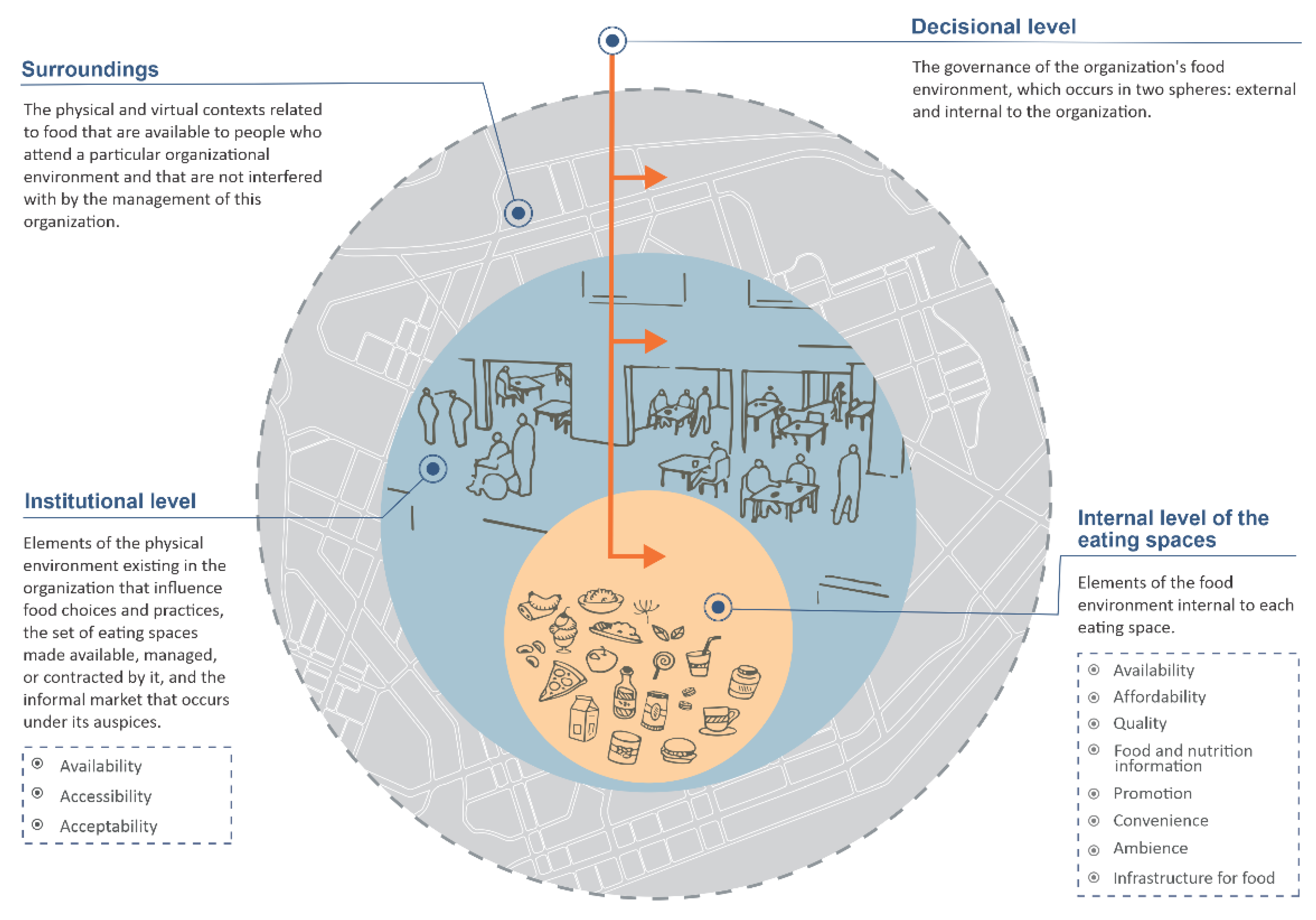
Understanding the complexity of the elements that constitute organizational food environments and their operating dynamics is essential to improving their healthiness. This study developed a conceptual model of organizational food environments. For this purpose, a comprehensive literature review was conducted, a first version of the conceptual model was prepared, a panel of experts was consulted, the model was improved, a second panel of experts was consulted, and the model was finalized. The model consists of four components (the institutional level, internal level of eating spaces, surroundings, and the decisional level) and 10 dimensions related to the institutional level and internal level of eating spaces (the availability, accessibility, affordability, quality, food and nutrition information, and promotion of foods, beverages, and culinary preparations and the availability, acceptability, convenience, ambience, and infrastructure of the eating space), as expressed in a graphical scheme. The conceptual model presented here offers innovative elements which contribute to understanding of the organizational food environment. It can guide the development of both assessment studies of food environments and interventions for their improvement.
Keywords: food environment; workplace; university; school; framework food environment; workplace; university; school; framework


