



Is a Food Shortage Coming to the Western Balkans?



Abstract
1. Introduction

| Paper | Material and Methods | Main Results |
|---|---|---|
| Acker et al., 2001 [24] | The paper analyzes the causes of the Balkan conflict linking food insecurity with political stability. | This research highlighted the role of agricultural education in post-conflict democratization. |
| Papić-Brankov and Milovanović, 2015 [25] | Analysis of the Serbian food security system using Global Food Security Index Indicators. | The results showed the position of Serbia when food security is concerned and indicated two major weaknesses which influence the Serbian food system: low Gross Domestic Product per capita and corruption. |
| Brankov and Lovre, 2017 [26] | The authors used the FAO package indicator to analyze the food security in the former Yugoslav republics. | The results showed that food security levels differ in analyzed countries, while Slovenia has the most favorable position when food security is concerned. |
| Kovljenić and Raletić-Jotanović, 2020 [27] | Using multiple regression analysis, factors influencing food security in the former countries of Yugoslavia were analyzed. | The results showed that the general level of economic development, population growth, foreign trade, and agriculture investments significantly affect the level of food security. Additionally, results showed that Slovenia is the most nutritionally secure country, while the lowest level of food security has been observed in Bosnia and Herzegovina. |
| Matkovski et al., 2020 [6] | Using the PROMETHEE method, Western Balkan and European Union countries are ranked according to food security. Also, factors affecting food security are estimated. FAO dimensions of food security are used. | The results show a significantly lower level of food security in the Western Balkan countries than in the EU. Also, results suggested that food security in the Western Balkans is not endangered, but it can become under crisis conditions. |
| Božić and Nikolić, 2020 [28] | The food security system is analyzed using the Global Food Security Index for Serbia and neighboring countries: Bulgaria, Romania, Hungary, and Greece. | The results showed that Serbia lags behind the selected neighboring countries regarding food security. |
| Brankov et al., 2021 [29] | The food self-sufficiency ratio is calculated for the South-East Europe countries. The influence of different factors affecting the self-sufficiency ratio is estimated. | The analyzed region showed a high level of food self-sufficiency, so it is ready to respond to crisis challenges. Also, this research highlighted regional cooperation, which should be strengthened. |
| Đorđević et al., 2022 [30] | Theoretical presentation of food production in Serbia has been done since the arrival of Slavic tribes on the Balkan Peninsula up to modern times. | The results showed that although Serbia has been self-sufficient in food production throughout its history, there is space for improvement. |
| Bogdanov et al., 2022 [31] | The report made a small attempt to evaluate the level of food self-sufficiency in the Western Balkan based on secondary data. | The results showed that all Western Balkan countries/territories, except Serbia, are net food importers. |
2. Materials and Methods
3. Results
3.1. Food Self-Sufficiency
3.2. Cereals Production and Demand
3.3. Fertilizers, Pesticides, and Irrigation Efficiency
3.4. Econometric Estimation of Input Use
4. Discussion
5. Conclusions
Author Contributions
Funding
Data Availability Statement
Acknowledgments
Conflicts of Interest
Appendix A
| Coefficient | Std. Error | t-Ratio | p-Value | ||
|---|---|---|---|---|---|
| const | 0.00770808 | 0.0340386 | 0.2265 | 0.8223 | |
| Fertilizers efficiency | 0.380233 | 0.0613847 | 6.194 | <0.0001 | *** |
| Precipitation | 0.0406102 | 0.0336786 | 1.206 | 0.2367 | |
| Arable land | 0.114664 | 0.0361433 | 3.172 | 0.0033 | *** |
| Rural population | 0.655492 | 0.0517909 | 12.66 | <0.0001 | *** |
| Temperature change | −0.0588534 | 0.0261677 | −2.249 | 0.0315 | ** |
| Statistics based on the weighted data: | |||||
| Sum squared resid | 35.31887 | S.E. of regression | 1.050578 | ||
| R-squared | 0.979263 | Adjusted R-squared | 0.976022 | ||
| F(5, 32) | 302.2225 | p-value(F) | 6.12 × 10⁻²⁶ | ||
| Log-likelihood | −52.52946 | Akaike criterion | 117.0589 | ||
| Schwarz criterion | 126.8844 | Hannan-Quinn | 120.5548 | ||
| Statistics based on the original data: | |||||
| Mean dependent var | −0.107951 | S.D. dependent var | 1.120360 | ||
| Sum squared resid | 2.103051 | S.E. of regression | 0.256360 | ||
| Test for normality of residual— Null hypothesis: error is normally distributed Test statistic: Chi-square (2) = 4.24099 with p-value = 0.119972 | |||||
| Pesaran CD test for cross-sectional dependence— Null hypothesis: No cross-sectional dependence Asymptotic test statistic: z = 0.746223 with p-value = 0.455533 | |||||
| Coefficient | Std. Error | t-Ratio | p-Value | ||
|---|---|---|---|---|---|
| const | 0.0109142 | 0.0340949 | 0.3201 | 0.7510 | |
| Fertilizers efficiency | 0.337896 | 0.0601721 | 5.615 | <0.0001 | *** |
| GDP PPP | −0.0590066 | 0.0289188 | −2.040 | 0.0496 | ** |
| Arable land | 0.119326 | 0.0341963 | 3.489 | 0.0014 | *** |
| Rural population | 0.691550 | 0.0495851 | 13.95 | <0.0001 | *** |
| Temperature change | −0.0517610 | 0.0260480 | −1.987 | 0.0555 | * |
| Statistics based on the weighted data: | |||||
| Sum squared resid | 33.68589 | S.E. of regression | 1.026004 | ||
| R-squared | 0.981108 | Adjusted R-squared | 0.978156 | ||
| F(5, 32) | 332.3715 | p-value(F) | 1.38 × 10⁻²⁶ | ||
| Log-likelihood | −51.63003 | Akaike criterion | 115.2601 | ||
| Schwarz criterion | 125.0856 | Hannan-Quinn | 118.7559 | ||
| Statistics based on the original data: | |||||
| Mean dependent var | −0.107951 | S.D. dependent var | 1.120360 | ||
| Sum squared resid | 2.068543 | S.E. of regression | 0.254248 | ||
| Test for normality of residual— Null hypothesis: error is normally distributed Test statistic: Chi-square (2) = 1.62587 with p-value = 0.443554 | |||||
| Pesaran CD test for cross-sectional dependence— Null hypothesis: No cross-sectional dependence Asymptotic test statistic: z = −1.04505 with p-value = 0.295999 | |||||
References
- Ganić, M. The Labour Market, Social Inequality and the Role of Emigration: The Case of the Western Balkan Economies. In Western Balkan Economies in Transition; Osbild, R., Bartlett, W., Eds.; Springer: Cham, Switzerland, 2019. [Google Scholar]
- King, R.; Oruc, N. Editorial introduction: Migration in the Western Balkans–Trends and challenges. J. Balk. Near East. Stud. 2019, 21, 1–10. [Google Scholar] [CrossRef] [Scilit]
- Euractiv. Available online: https://www.euractiv.com/section/enlargement/news/the-long-decline-mass-migration-batters-balkans/ (accessed on 8 July 2022).
- Santic, D. Leaving Serbia Aspirations, Intentions and Drivers of Youth Migration; Friedrich-Ebert-Stiftung: Belgrade, Serbia, 2020; Available online: https://library.fes.de/pdf-files/bueros/belgrad/16219.pdf (accessed on 20 September 2022).
- Lange, S.; Nechev, Z.; Trauner, F. Introduction. In Resilience in the Western Balkans. EU Institute for Security Studies; Report No 36; Lange, S., Nechev, Z., Trauner, F., Eds.; European Union: Luxembourg, 2017; p. 5. Available online: https://sha.static.vipsite.cn/media/thinktank/attachments/eb808bc8b9b347cefaea9977a88e7675.pdf (accessed on 20 September 2022).
- Matkovski, B.; Đokić, D.; Zekić, S.; Jurjević, Ž. Determining Food Security in Crisis Conditions: A Comparative Analysis of the Western Balkans and the EU. Sustainability 2020, 12, 9924. [Google Scholar] [CrossRef] [Scilit]
- Jurjević, Ž.; Bogićević, I.; Đokić, D.; Matkovski, B. Information technology as a factor of sustainable development of Serbian agriculture. Strateg. Manag. 2019, 24, 41–46. [Google Scholar] [CrossRef] [Scilit]
- Eurostat. Enlargement Countries—Agriculture, Forestry and Fishing Statistics. Available online: https://ec.europa.eu/eurostat/statistics-explained/index.php?title=Enlargement_countries_-_agriculture,_forestry_and_fishing_statistics#Gross_value_added_and_employment (accessed on 1 July 2022).
- Zhongming, Z.; Linong, L.; Xiaona, Y.; Wangqiang, Z.; Wei, L. Environmental Trends and Perspectives in the Western Balkans: Future Production and Consumption Patterns; European Environment Agency: Copenhagen, Denmark, 2010.
- Ševarlić, M. Poljoprivredno Zemljište; Republički Zavod za Statistiku: Belgrad, Serbia, 2015.
- Papić Brankov, T.; Tanjević, N. Corruption in the land sector. Econ. Agric. 2013, 60, 365–377. [Google Scholar]
- Simonović, Z.; Miletić, S.; Popović, V. Some features of development in the agricultural policy Western Balkan candidates for market access in the EU. Econ. Agric. 2019, 66, 541–557. [Google Scholar] [CrossRef] [Scilit]
- World Bank. Western Balkans Regular Economic Report No.21, Steering Through Crises. Available online: https://openknowledge.worldbank.org/bitstream/handle/10986/37368/P17720607706c30e90841607b7d53ee8106.pdf (accessed on 20 September 2022).
- Eurostat. How Much are Households Spending on Food? Available online: https://ec.europa.eu/eurostat/web/products-eurostat-news/-/ddn-20201228-1 (accessed on 20 September 2022).
- Erjavec, E.; Volk, T.; Rednak, M.; Ciaian, P.; Lazdinis, M. Agricultural policies and European Union accession processes in the Western Balkans: Aspirations versus reality. Eurasian Geogr. Econ. 2021, 62, 46–75. [Google Scholar] [CrossRef] [Scilit]
- FAO; IFAD; UNICEF; WFP; WHO. The State of Food Security and Nutrition in the World 2022; Repurposing Food and Agricultural Policies to Make Healthy Diets More Affordable; FAO: Rome, Italy, 2022.
- Euronews. Global Food Crisis Looms as Ukraine Struggles to Export its Grain after Russian Invasion. Available online: https://www.euronews.com/2022/06/19/global-food-crisis-looms-as-ukraine-struggles-to-export-its-grain-after-russian-invasion (accessed on 8 July 2022).
- World Bank. Western Balkans Regular Economic Report No.22, Beyond the Crises. Available online: https://openknowledge.worldbank.org/bitstream/handle/10986/38189/P17947818ec26c8c17fe014901194ac104a1b5d70a2a.pdf?sequence=1&isAllowed=y (accessed on 23 October 2022).
- IFASTAT. Available online: https://www.ifastat.org/databases/plant-nutrition (accessed on 18 October 2022).
- Reuters. With Fertilizer Costs High and Seeds Scarce, U.S. Farmers Turn to Soy. Available online: https://www.reuters.com/business/energy/with-fertilizer-costs-high-seeds-scarce-us-farmers-turn-soy-2022-02-23 (accessed on 18 October 2022).
- EC. Western Balkans-EU—International Trade in Goods Statistics. Available online: https://ec.europa.eu/eurostat/statisticsexplained/index.php?title=Western_Balkans-EU_-_international_trade_in_goods_statistics&oldid=526493 (accessed on 18 October 2022).
- Trading Economics. Food Inflation. Available online: https://tradingeconomics.com/ (accessed on 20 September 2022).
- FAO. The Importance of Ukraine and the Russian Federation for Global Agricultural Markets and the Risks Associated with the War in Ukraine. Available online: https://www.fao.org/3/cb9013en/cb9013en.pdf (accessed on 15 July 2022).
- Acker, D.G.; Androulidakis, S.; Lansdale, B.M.; Lansdale, E.K.; Smith, B.K.; Warner, R. Food Security and Socio-Political Stability in the Balkans: The Role of Agricultural Education. In Emerging Trends in Agricultural and Extension Education; Association for International Agricultural and Extension Education: Baton Rouge, LA, USA, 2001. [Google Scholar]
- Papić Brankov, T.; Milovanović, M. Measuring food security in the Republic of Serbia. Econ. Agric. 2015, 62, 801–812. [Google Scholar] [CrossRef] [Scilit]
- Brankov, T.; Lovre, I. Food security in the Former Yugoslav Republics. Econ. Agric. 2017, 64, 701–721. [Google Scholar] [CrossRef] [Scilit]
- Kovljenić, M.; Raletić-Jotanović, S. Food security issues in the former Yugoslav countries. Outlook Agric. 2020, 50, 46–54. [Google Scholar] [CrossRef] [Scilit]
- Božić, D.; Nikolić, M. Food security and comparative analysis of situation in Serbia and neighbouring countries. Econ. Agric. 2020, 67, 1191–1204. [Google Scholar] [CrossRef] [Scilit]
- Brankov, T.; Matkovski, B.; Jeremic, M.; Ðuric, I. Food Self-Sufficiency of the SEE Countries; Is the Region Prepared for a Future Crisis? Sustainability 2021, 13, 8747. [Google Scholar] [CrossRef] [Scilit]
- Đorđević, V.; Mirilović, M.; Katanić, N.; Janjić, J.; Nedić, D.; Šarčević, D.; Baltić, M.Ž. Food production and security in the area of Serbia: Historical background and current situation. Meat Technol. 2022, 63, 1–10. [Google Scholar] [CrossRef] [Scilit]
- Bogdanov, N.; Vaško, Ž.; Arias, P.; Pavloska Gjorgjieska, D. Assessment of the Impact of COVID-19 on Agrifood Systems in the Western Balkans—Regional Synthesis Report; FAO: Budapest, Hungary, 2022. [Google Scholar]
- FAO. Report of the World Food Summit. Available online: https://www.fao.org/3/w3548e/w3548e00.htm (accessed on 21 September 2022).
- Baer-Nawrocka, A.; Sadowski, A. Food security and food self-sufficiency around the world: A typology of countries. PLoS ONE 2019, 14, e0213448. [Google Scholar] [CrossRef] [Scilit] [PubMed]
- FAOSTAT. Available online: https://www.fao.org/faostat/en/ (accessed on 8 July 2022).
- Liu, Y.; Pan, X.; Li, J. Current agricultural practices threaten future global food production. J. Agric. Environ. Ethics 2015, 28, 203–216. [Google Scholar] [CrossRef] [Scilit]
- Fader, M.; Gerten, D.; Krause, M.; Lucht, W.; Cramer, W. Spatial decoupling of agricultural production and consumption: Quantifying dependences of countries on food imports due to domestic land and water constraints. Environ. Res. Lett. 2013, 8, 014046. [Google Scholar] [CrossRef] [Scilit]
- Vorosmarty, C.J.; Green, P.; Salisbury, J.; Lammers, R.B. Global water resources: Vulnerability from climate change and population growth. Science 2000, 289, 284–288. [Google Scholar] [CrossRef] [Scilit]
- Rockström, J.; Falkenmark, M.; Karlberg, L.; Hoff, H.; Rost, S.; Gerten, D. Future water availability for global food production: The potential of green water for increasing resilience to global change. Water Resour. Res. 2009, 45, 1–16. [Google Scholar] [CrossRef] [Scilit]
- Gerten, D.; Heinke, J.; Hoff, H.; Biemans, H.; Fader, M.; Waha, K. Global water availability and requirements for future food production. J. Hydrometeorol. 2011, 12, 885–899. [Google Scholar] [CrossRef] [Scilit]
- Vikers, B.; Ali, S.; Balchin, N. The Expanding Threat to Food Security in Least Developed Countries. Available online: https://oecd-development-matters.org/2022/07/05/the-expanding-threat-to-food-security-in-least-developed-countries/ (accessed on 20 September 2022).
- Unated Nations. 2018 Revision of World Urbanization Prospects. Available online: https://population.un.org/wup/ (accessed on 19 September 2022).
- Nadal, W.; Wise, T.A. The Environmental Costs of Agricultural Trade Liberalization: Mexico-US Maize Under NAFTA; Working Group on Environment and Development in the Americas: Brasilia, Brazil, 2004. [Google Scholar]
- Luan, Y.; Cui, X.; Ferrat, M. Historical trends of food self-sufficiency in Africa. Food Secur. 2013, 5, 393–405. [Google Scholar] [CrossRef] [Scilit]
- Chen, D.; Suter, H.; Islam, A.; Edis, R.; Freney, J.R.; Walker, C.N. Prospects of improving efficiency of fertiliser nitrogen in Australian agriculture: A review of enhanced efficiency fertilisers. Aust. J. Soil Res. 2008, 46, 289–301. [Google Scholar] [CrossRef] [Scilit]
- Cassman, K.G.; Dobermann, A.R.; Walters, D.T.; Yang, H. Meeting cereal demand while protecting natural resources and improving environmental quality. Annu. Rev. Environ. Resour. 2003, 28, 315–358. [Google Scholar] [CrossRef] [Scilit]
- Clark, M.; Tilman, D. Comparative analysis of environmental impacts of agricultural production systems, agricultural input efficiency, and food choice. Environ. Res. Lett. 2017, 12, 064016. [Google Scholar] [CrossRef] [Scilit]
- Smith, M.D.; Meade, B. Who Are the World’s Food Insecure? Identifying the Risk Factors of Food Insecurity Around the World. Amber Waves: The Economics of Food, Farming, Natural Resources, and Rural America. 2019. Available online: https://www.ers.usda.gov/amber-waves/2019/june/who-are-the-world-s-food-insecure-identifying-the-risk-factors-of-food-insecurity-around-the-world/ (accessed on 20 October 2022).
- FAO; IFAD; WFP. The State of Food Insecurity in the World 2015: Meeting the 2015 International Hunger Targets: Taking Stock of Uneven Progress; FAO: Rome, Italy, 2015. [Google Scholar]
- Dimitrijevic, M.; Ristić, L.; Despotović, D. Rural development of regions of the Republic of Serbia in terms of employment and sources of income. Anal. Ekon. Fak. U Subotici 2021, 57, 131–148. [Google Scholar] [CrossRef] [Scilit]
- Barbier, E.B.; Hochard, J.P. Poverty and the Spatial Distribution of Rural Population. World Bank Policy Research Working Paper 7101. 2014. Available online: https://ssrn.com/abstract=2522735 (accessed on 20 October 2022).
- Županić, F.Ž.; Radić, D.; Podbregar, I. Climate change and agriculture management: Western Balkan region analysis. Energy Sustain. Soc. 2021, 11, 51. [Google Scholar] [CrossRef] [Scilit]
- Szwed, M.; Karg, G.; Pińskwar, I.; Radziejewski, M.; Graczyk, D.; Kędziora, A.; Kundzewicz, Z.W. Climate change and its effect on agriculture, water resources and human health sectors in Poland. Nat. Hazards Earth Syst. Sci. 2010, 10, 1725–1737. [Google Scholar] [CrossRef] [Scilit]
- Ismaili, H. Participatory Irrigation Management in Albania. Available online: https://balwois.com/wp-content/uploads/old_proc/ffp-2112.pdf (accessed on 19 September 2022).
- USAID AgBiz Program. Fresh Vegetables Value Chain Baseline Screening. Available online: https://pdf.usaid.gov/pdf_docs/PA00J978.pdf (accessed on 19 September 2022).
- World Bank. Available online: https://data.worldbank.org/ (accessed on 8 July 2022).
- Zekić, S.; Matkovski, B.; Đokić, D. Otvoreni Balkan i Regionalna Konkurentnost Izvoza Poljoprivredno-prehrambenih Proizvoda. Jahorinski Poslovni Forum 2022, Ekonomske Lekcije iz Kriza 2008. i 2020. Godine—Iskustva i Preporuke za Preduzetničke Nacije (31-40); Ekonomski fakultet Pale: Pale, Bosnia-Herzegovina, 2022. [Google Scholar]
- Matkovski, B.; Radovanov, B.; Zekić, S. The Effects of Foreign Agri-Food Trade Liberalization in South East Europe. Ekon. Cas. 2018, 66, 945–966. [Google Scholar]
- Statistical Office of the Republic of Serbia—SORS. Official Website. Available online: https://www.stat.gov.rs/ (accessed on 8 July 2022).
- Nastić, L.; Marković, T. State and Possibilities for Development of Livestock Production in the Republic of Serbia. In Handbook of Research on Agricultural Policy, Rural Development, and Entrepreneurship in Contemporary Economies; IGI Global: Hershey, PA, USA, 2020; pp. 314–333. [Google Scholar]
- United Nations Department of Economic and Social Affairs, Population Division. World Population Prospects 2022: Summary of Results; UN DESA/POP/2022/TR/NO. 3; United Nations: Luxembourg, 2022.
- OECD; FAO. Cereals. In OECD-FAO Agricultural Outlook 2022–2031; OECD Publishing: Paris, France, 2022. [Google Scholar]
- Searchinger, T.; Waite, R.; Hanson, C.; Ranganathan, J.; Dumas, P.; Matthews, E.; Klirs, C. Creating a Sustainable Food Future: A Menu of Solutions to Feed Nearly 10 Billion People by 2050; Final Report; World Resources Institute: Washington, DC, USA, 2019. [Google Scholar]
- Erenstein, O.; Jaleta, M.; Sonder, K.; Mottaleb, K.; Prasanna, B.M. Global maize production, consumption and trade: Trends and R&D implications. Food Secur. 2022, 14, 1295–1319. [Google Scholar] [CrossRef] [Scilit]
- Storck, V.; Karpouzas, D.G.; Martin-Laurent, F. Towards a better pesticide policy for the European Union. Sci. Total Environ. 2017, 575, 1027–1033. [Google Scholar] [CrossRef] [Scilit]
- Brankov, T.; Matkovski, B.; Jeremić, M.; Zekić, S. Impact of Economic Development on Pesticide Use in South-East Europe. Pol. J. Environ. Stud. 2021, 30, 1563–1572. [Google Scholar] [CrossRef] [Scilit]
- Hong, N.B.; Yabe, M. Improvement in irrigation water use efficiency: A strategy for climate change adaptation and sustainable development of Vietnamese tea production. Environ. Dev. Sustain. 2017, 19, 1247–1263. [Google Scholar] [CrossRef] [Scilit]
- Matkovski, B.; Zekić, S.; Jurjević, Ž.; Đokić, D. The agribusiness sector as a regional export opportunity: Evidence for the Vojvodina region. Int. J. Emerg. Mark. 2021; ahead-of print. [CrossRef] [Scilit]
- Matkovski, B.; Zekić, S.; Đokić, D.; Jurjević, Ž.; Đurić, I. Export Competitiveness of Agri-Food Sector during the EU Integration Process: Evidence from the Western Balkans. Foods 2022, 11, 10. [Google Scholar] [CrossRef] [Scilit] [PubMed]
- Sanshmit, J.D.; Bachrach, J.D. The Importance of Efficiency of the Agri-Food Sector for Exports. Int. J. Millenn. Stud. 2022, 7, 2. [Google Scholar]
- Statistical Office of the Republic of Serbia. Available online: https://data.stat.gov.rs/ (accessed on 8 July 2022).
- Krstevska, A. Macedonian Dairy Farmers and Their Choice of Buyers: A Transaction Cost Approach; SLU, Department of Economics: Uppsala, Sweden, 2008. [Google Scholar]
- FIPA. Foreign Investment Promotion Agency. Bosnia and Herzegovina Agriculture and Food Processing Industry, 3013. Available online: https://ticaret.gov.tr/data/5b8a43355c7495406a2276af/Tarim_ve_Gida_Sanayi.pdf (accessed on 6 July 2022).
- Lovre, K. Technical Change in Agricultural Development of the Western Balkan Countries. In Emerging Technologies and the Development of Agriculture, Proceeding of Serbian Association of Agricultural Economists 152 Seminar, Novi Sad, Serbia, 30 August–1 September 2016; Serbian Association of Agricultural Economists: Belgrade, Serbia; University of Novi Sad: Novi Sad, Serbia; Institute of Agricultural Economics: Belgrade, Serbia, 2016; pp. 1–14. [Google Scholar]
- ICT. Available online: https://www.trademap.org/ (accessed on 12 July 2022).
- The Borgen Project. 5 Facts about Poverty in Serbia. Available online: https://borgenproject.org/facts-about-poverty-in-serbia/ (accessed on 18 September 2022).
- Clapp, J. Food self-sufficiency: Making sense of it, and when it makes sense. Food Policy 2017, 66, 88–96. [Google Scholar] [CrossRef] [Scilit]
- UnComtrade. Database. Available online: https://comtrade.un.org/data (accessed on 16 September 2022).
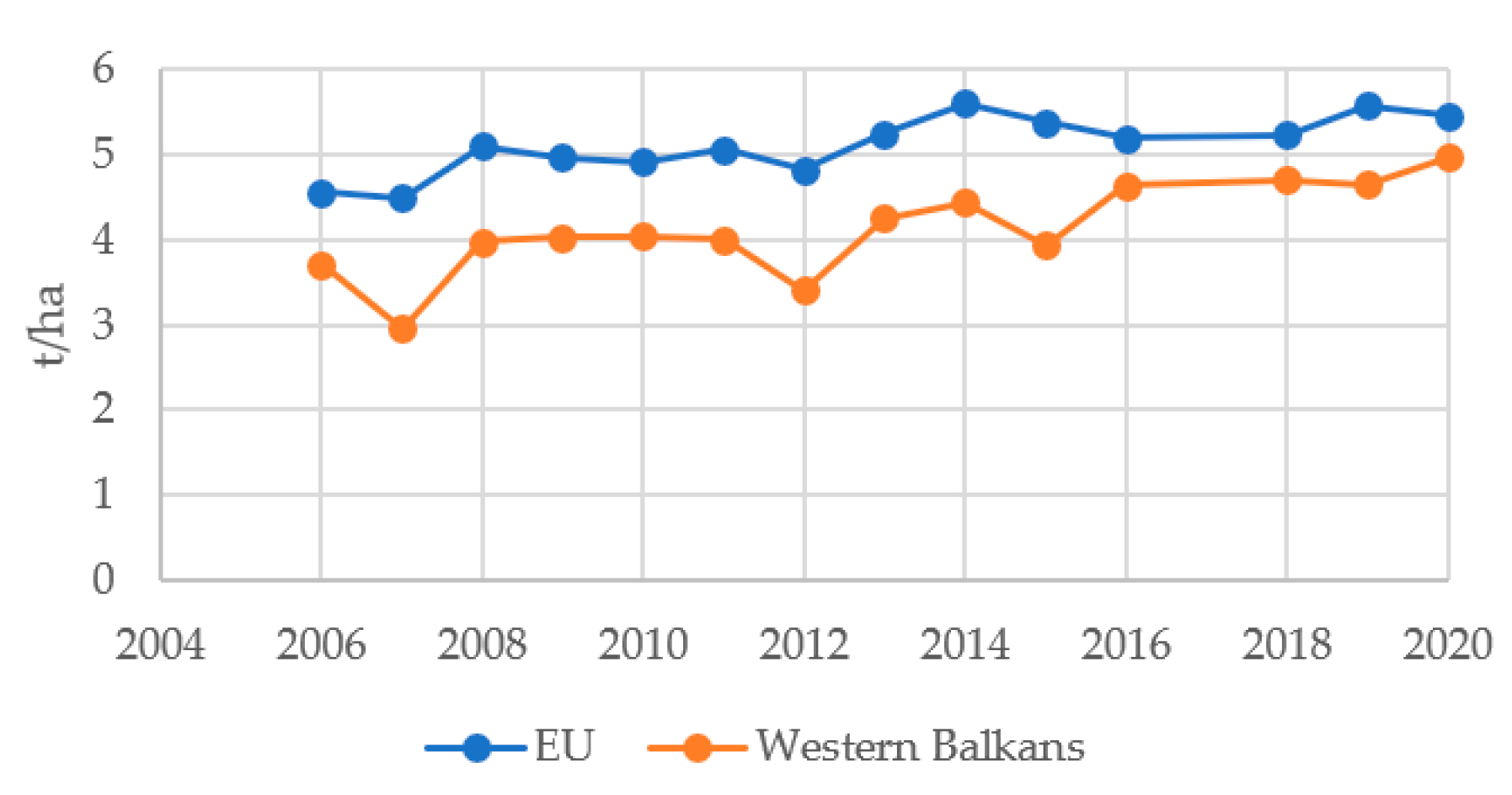
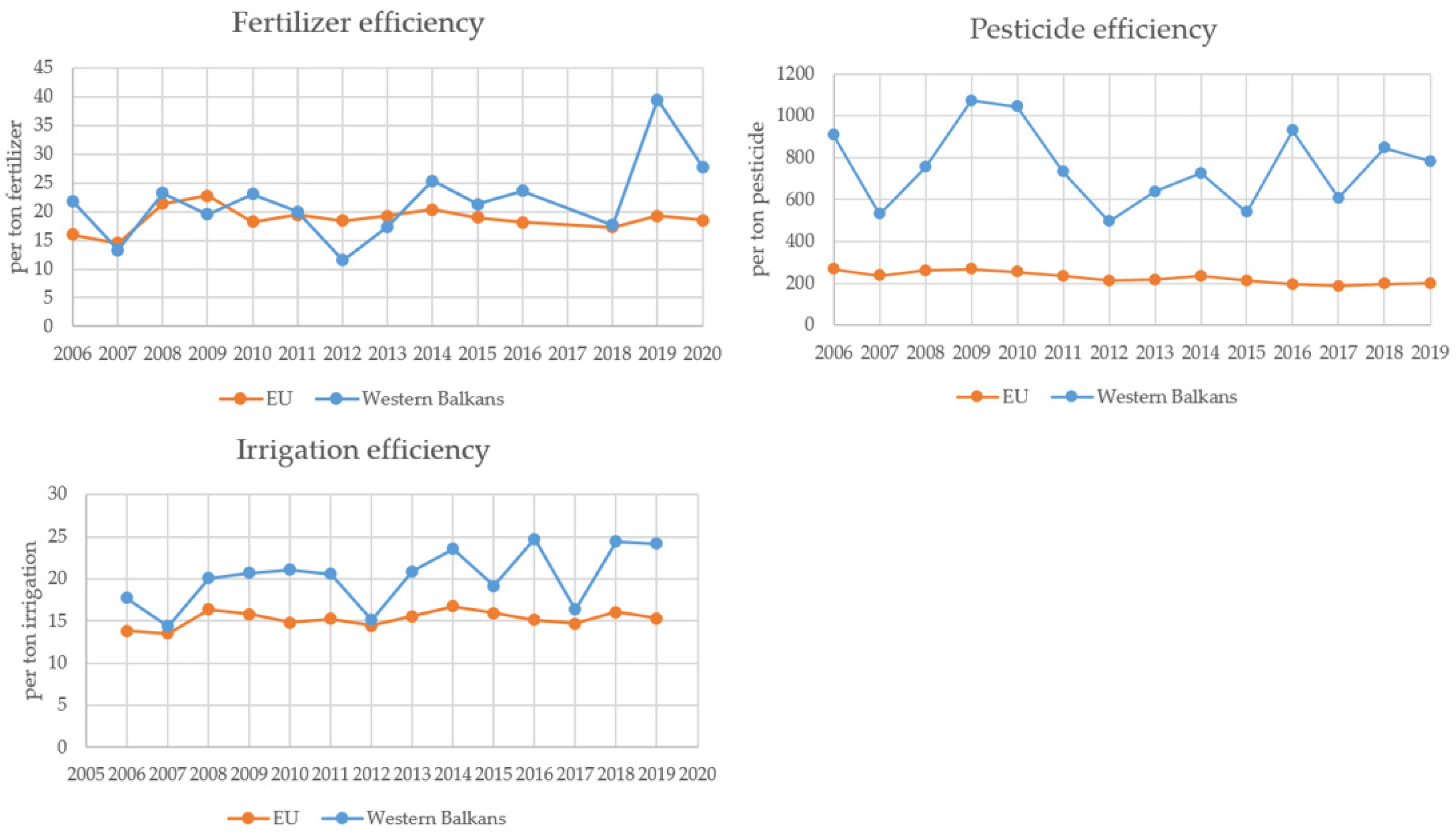
| Variable | Description | Source | Expected Relationship |
|---|---|---|---|
| F | Fertilizers efficiency | FAOSTAT | Positive |
| G | GDP PPP | World Bank | Negative |
| P | Precipitation | World Bank | Positive |
| A | Arable land | World Bank | Positive |
| R | Rural population | World Bank | Negative |
| T | Temperature change | World Bank | Negative |
| Dependent Variable | Joint Test on Named Regressors | Breusch–Pagan Test Statistic | Hausman Test Statistic |
|---|---|---|---|
| SSR_cereals | Chi-square (6) = 91.3096 p-value = 0.0000 | Chi-square (1) = 12.2268 p-value = 0.216493 | Chi-square (4) = 3.36118 p-value = 0.499297 |
| Model I | Model II | |
|---|---|---|
| Const | 0.00770808 | 0.0109142 |
| Fertilizers efficiency | 0.380233 *** | 0.337896 *** |
| GDP PPP | −0.0590066 ** | |
| Precipitation | 0.0406102 | |
| Arable land | 0.114664 *** | 0.119326 *** |
| Rural population | 0.655492 *** | 0.691550 *** |
| Temperature change | −0.0588534 ** | −0.0517610 * |
Publisher’s Note: MDPI stays neutral with regard to jurisdictional claims in published maps and institutional affiliations. |
© 2022 by the authors. Licensee MDPI, Basel, Switzerland. This article is an open access article distributed under the terms and conditions of the Creative Commons Attribution (CC BY) license (https://creativecommons.org/licenses/by/4.0/).
Share and Cite
Brankov, T.; Matkovski, B. Is a Food Shortage Coming to the Western Balkans? Foods 2022, 11, 3672. https://doi.org/10.3390/foods11223672
Brankov T, Matkovski B. Is a Food Shortage Coming to the Western Balkans? Foods. 2022; 11(22):3672. https://doi.org/10.3390/foods11223672
Chicago/Turabian StyleBrankov, Tatjana, and Bojan Matkovski. 2022. "Is a Food Shortage Coming to the Western Balkans?" Foods 11, no. 22: 3672. https://doi.org/10.3390/foods11223672
APA StyleBrankov, T., & Matkovski, B. (2022). Is a Food Shortage Coming to the Western Balkans? Foods, 11(22), 3672. https://doi.org/10.3390/foods11223672

