Meat Analogues in the Perspective of Recent Scientific Research: A Review



Abstract
:
1. Introduction
2. The Essence of Meat Analogues
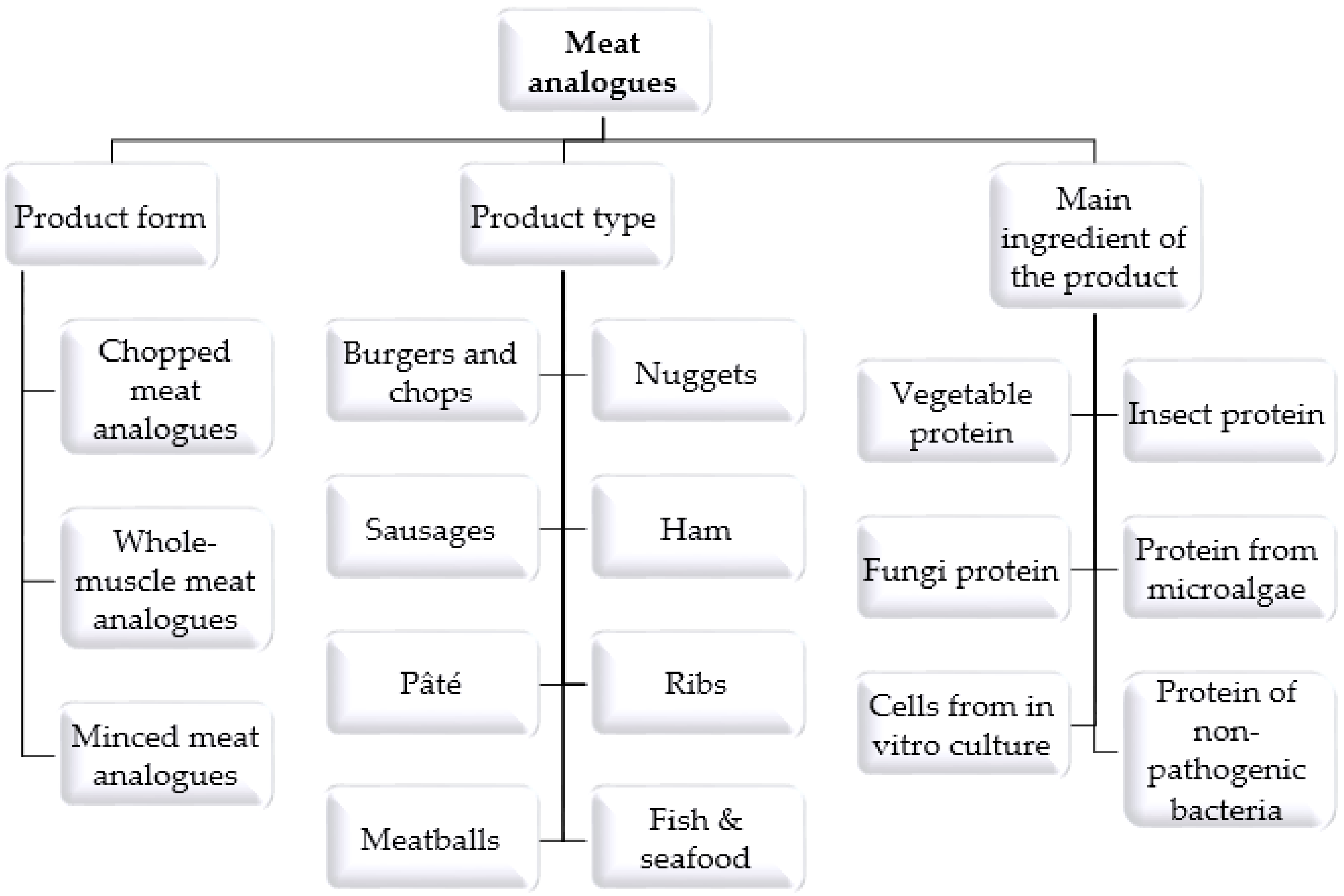
2.1. Composition of Meat Analogues
2.2. Technologies for Producing Meat Analogues
3. Market Development for Meat Analogues
4. Consumer Attitudes towards Meat Analogues

| Study Subject | Participants: | Main Parameters: | Reference |
|---|---|---|---|
| meat disgust | 711 participants from UK | age, gender, disgust sensitivity, self-control, meat intake, hunger level, english level, meat disgust dummy (% meat disgusted), diet | Becker and Lawrence 2021 [19] |
| plant-based and cultured meat | 2019: 1001 and 2020: 1000 participants from Belgium | age, gender, diet, region, education, rural/urban, satisfaction with existing meat analogues, concern for: animal welfare, impact on the environment, sustainability of choices, health, purchase intent for cultured meat, cultured meat meets their needs | Bryant and Sanctorum 2021 [2] |
| plant-based meat analogues | 1434 Midwest University Students (USA) | age, gender, race, residency, fruit and vegetable servings per day, diet, environmental values, beliefs, knowledge, spirituality, views about vegetarianism, factors influencing food purchase, trusted sources of nutrition knowledge, meat analogues consumption | Davitt et al. 2021 [53] |
| insect-based and plant-based protein | 3091 participants from 9 countries | food neophobia, food tech neophobia, healthiness influence, environmental impact, influence, meat nutritional importance, meat taste, texture, smell importance, plant-based and insect-based protein suitability/benefits, plant-based and insect-based protein willingness to try, buy and pay more | De Koning et al. 2020 [54] |
| plant-based diet | data from the NZAVS 1 2017: 17,072 participants 2018: 47,951 participants from New Zealand | self-reported dietary behaviour, protection of native species, subjective health, perceived environmental efficacy, gender, political conservatism, right-wing ideology, disgust, religious (spiritual), beliefs, pro-social orientation, openness orientation | Milfont et al. 2021 [52] |
| plant-based and cultured meat burgers | 533 participants | frequency of purchase (meat, burgers and meat substitutes), importance od factors in purchase decision, support for food technology, attitudes towards: agriculture, naturalness of food, lab food, environmental impact of meat, food choices, political views, science, emotional decision making, age, gender, education, income, diet | Slade 2018 [55] |
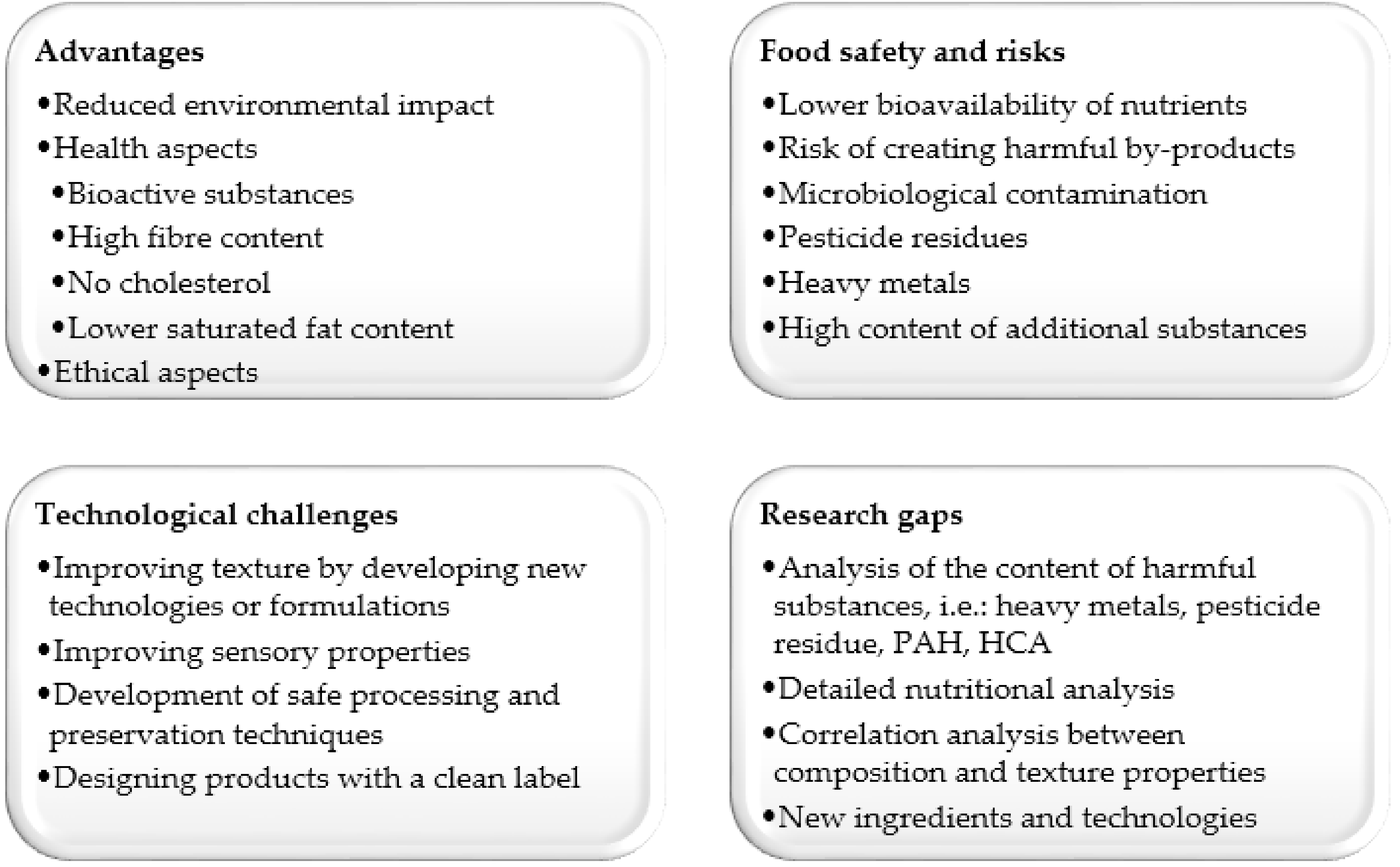
5. Challenges and Perspectives
6. Conclusions
Author Contributions
Funding
Institutional Review Board Statement
Informed Consent Statement
Conflicts of Interest
References
- Blanco-Gutiérrez, I.; Varela-Ortega, C.; Manners, R. Evaluating animal-based foods and plant-based alternatives using multi-criteria and SWOT analyses. Int. J. Environ. Res. Public Health 2020, 17, 7969. [Google Scholar] [CrossRef]
- Bryant, C.; Sanctorum, H. Alternative proteins, evolving attitudes: Comparing consumer attitudes to plant-based and cultured meat in Belgium in two consecutive years. Appetite 2021, 161, 105161. [Google Scholar] [CrossRef]
- Curtain, F.; Grafenauer, S. Plant-based meat substitutes in the flexitarian age: An audit of products on supermarket shelves. Nutrients 2019, 11, 2603. [Google Scholar] [CrossRef] [Green Version]
- Sucapane, D.; Roux, C.; Sobol, K. Exploring how product descriptors and packaging colors impact consumers’ perceptions of plant-based meat alternative products. Appetite 2021, 167, 105590. [Google Scholar] [CrossRef]
- UN. World Population Prospects: The 2017 Revision, Key Findings and Advance Tables; Working Paper No. ESA/P/WP/248; United Nations Department of Economic and Social Affairs, Population Division: New York, NY, USA, 2017; Available online: https://esa.un.org/unpd/wpp/publications/Files/WPP2017_KeyFindings.pdf (accessed on 4 November 2021).
- Choudhury, D.; Singh, S.; Seah, J.S.H.; Yeo, D.C.L.; Tan, L.P. Commercialization of plant-based meat alternatives. Trends Plant Sci. 2020, 25, 1055–1058. [Google Scholar] [CrossRef] [PubMed]
- Aiking, H.; de Boer, J. The next protein transition. Trends Food Sci. Technol. 2020, 105, 515–522. [Google Scholar] [CrossRef]
- Dekkers, B.L.; Boom, R.M.; van der Goot, A.J. Structuring processes for meat analogues. Trends Food Sci. Technol. 2018, 81, 25–36. [Google Scholar] [CrossRef]
- Hadi, J.; Brightwell, G. Safety of Alternative Proteins: Technological, Environmental and Regulatory Aspects of Cultured Meat, Plant-Based Meat, Insect Protein and Single-Cell Protein. Foods 2021, 10, 1226. [Google Scholar] [CrossRef] [PubMed]
- Lee, H.J.; Yong, H.I.; Kim, M.; Choi, Y.S.; Jo, C. Status of meat alternatives and their potential role in the future meat market—A review. Asian Australas. J. Anim. Sci. 2020, 33, 1533. [Google Scholar] [CrossRef] [PubMed]
- De Angelis, D.; Kaleda, A.; Pasqualone, A.; Vaikma, H.; Tamm, M.; Tammik, M.L.; Summo, C. Physicochemical and sensorial evaluation of meat analogues produced from dry-fractionated pea and oat proteins. Foods 2020, 9, 1754. [Google Scholar] [CrossRef]
- Fresán, U.; Sabaté, J. Vegetarian diets: Planetary health and its alignment with human health. Adv. Nutr. 2019, 10 (Suppl. 4), S380–S388. [Google Scholar] [CrossRef] [PubMed] [Green Version]
- Fu, Y.; Chen, T.; Chen, S.H.Y.; Liu, B.; Sun, P.; Sun, H.; Chen, F. The potentials and challenges of using microalgae as an ingredient to produce meat analogues. Trends Food Sci. Technol. 2021, 112, 188–200. [Google Scholar] [CrossRef]
- Guo, Z.; Teng, F.; Huang, Z.; Lv, B.; Lv, X.; Babich, O.; Jiang, L. Effects of material characteristics on the structural characteristics and flavor substances retention of meat analogs. Food Hydrocolloids 2020, 105, 105752. [Google Scholar] [CrossRef]
- Willett, W.; Rockström, J.; Loken, B.; Springmann, M.; Lang, T.; Vermeulen, S.; Murray, C.J. Food in the Anthropocene: The EAT–Lancet Commission on healthy diets from sustainable food systems. Lancet 2019, 393, 447–492. [Google Scholar] [CrossRef]
- FAO. The FAO Action Plan on Antimicrobial Resistance; FAO: Rome, Italy, 2016; Available online: http://www.fao.org/3/a-i5996e.pdf (accessed on 2 December 2021).
- He, J.; Evans, N.M.; Liu, H.; Shao, S. A review of research on plant-based meat alternatives: Driving forces, history, manufacturing, and consumer attitudes. Compr. Rev. Food. Sci. Food Saf. 2020, 19, 2639–2656. [Google Scholar] [CrossRef]
- Jia, S.; Zhang, X.X.; Miao, Y.; Zhao, Y.; Ye, L.; Li, B. Fate of antibiotic resistance genes and their associations with bacterial community in livestock breeding wastewater and its receiving river water. Water Res. 2017, 124, 259–268. [Google Scholar] [CrossRef]
- Becker, E.; Lawrence, N.S. Meat disgust is negatively associated with meat intake–Evidence from a cross-sectional and longitudinal study. Appetite 2021, 164, 105299. [Google Scholar] [CrossRef]
- Collier, E.S.; Oberrauter, L.M.; Normann, A.; Norman, C.; Svensson, M.; Niimi, J.; Bergman, P. Identifying barriers to decreasing meat consumption and increasing acceptance of meat substitutes among Swedish consumers. Appetite 2021, 167, 105643. [Google Scholar] [CrossRef]
- Prabha, K.; Ghosh, P.; Abdullah, S.; Joseph, R.M.; Krishnan, R.; Rana, S.S.; Pradhan, R.C. Recent Development, Challenges, and Prospects of Extrusion Technology. Future Foods 2021, 3, 100019. [Google Scholar] [CrossRef]
- Sha, L.; Xiong, Y.L. Plant protein-based alternatives of reconstructed meat: Science, technology, and challenges. Trends Food Sci. Technol. 2020, 102, 51–61. [Google Scholar] [CrossRef]
- McClements, D.J.; Grossmann, L. The science of plant-based foods: Constructing next-generation meat, fish, milk, and egg analogs. Compr. Rev. Food Sci. Food Saf. 2021, 20, 4049–4100. [Google Scholar] [CrossRef]
- Kyriakopoulou, K.; Keppler, J.K.; van der Goot, A.J. Functionality of ingredients and additives in plant-based meat analogues. Foods 2021, 10, 600. [Google Scholar] [CrossRef]
- Bohrer, B.M. An investigation of the formulation and nutritional composition of modern meat analogue products. Food Sci. Human Wellness 2019, 8, 320–329. [Google Scholar] [CrossRef]
- Zhang, T.; Dou, W.; Zhang, X.; Zhao, Y.; Zhang, Y.; Jiang, L.; Sui, X. The development history and recent updates on soy protein-based meat alternatives. Trends Food Sci. Technol. 2021, 109, 702–710. [Google Scholar] [CrossRef]
- Dreher, J.; König, M.; Herrmann, K.; Terjung, N.; Gibis, M.; Weiss, J. Varying the amount of solid fat in animal fat mimetics for plant-based salami analogues influences texture, appearance and sensory characteristics. LWT 2021, 143, 111140. [Google Scholar] [CrossRef]
- Arshad, M.S.; Sohaib, M.; Ahmad, R.S.; Nadeem, M.T.; Imran, A.; Arshad, M.U.; Amjad, Z. Ruminant meat flavor influenced by different factors with special reference to fatty acids. Lipids Health Dis. 2018, 17, 1–13. [Google Scholar] [CrossRef] [Green Version]
- Rubio, N.R.; Xiang, N.; Kaplan, D.L. Plant-based and cell-based approaches to meat production. Nat. Commun. 2020, 11, 1–11. [Google Scholar] [CrossRef]
- De Marchi, M.; Costa, A.; Pozza, M.; Goi, A.; Manuelian, C.L. Detailed characterization of plant-based burgers. Sci. Rep. 2021, 11, 1–9. [Google Scholar] [CrossRef]
- Fiorentini, M.; Kinchla, A.J.; Nolden, A.A. Role of sensory evaluation in consumer acceptance of plant-based meat analogs and meat extenders: A scoping review. Foods 2020, 9, 1334. [Google Scholar] [CrossRef]
- Wang, B.; Zhang, Q.; Zhang, N.; Bak, K.H.; Soladoye, O.P.; Aluko, R.E.; Zhang, Y. Insights into formation, detection and removal of the beany flavor in soybean protein. Trends Food Sci. Technol. 2021, 112, 336–347. [Google Scholar] [CrossRef]
- Cornet, S.H.; Snel, S.J.; Lesschen, J.; van der Goot, A.J.; van der Sman, R.G. Enhancing the water holding capacity of model meat analogues through marinade composition. J. Food Eng. 2021, 290, 110283. [Google Scholar] [CrossRef]
- Munekata, P.E.S.; Rocchetti, G.; Pateiro, M.; Lucini, L.; Dominguez, R.; Lorenzo, J.M. Addition of plant extracts to meat and meat products to extend shelf-life and health-promoting attributes: An overview. Curr. Opin. Food Sci. 2020, 31, 81–87. [Google Scholar] [CrossRef]
- Tomović, V.; Šojić, B.; Savanović, J.; Kocić-Tanackov, S.; Pavlić, B.; Jokanović, M.; Vujadinović, D. New formulation towards healthier meat products: Juniperus communis L. essential oil as an alternative for sodium nitrite in dry fermented sausages. Foods 2020, 9, 1066. [Google Scholar] [CrossRef]
- Chiang, J.H.; Loveday, S.M.; Hardacre, A.K.; Parker, M.E. Effects of soy protein to wheat gluten ratio on the physicochemical properties of extruded meat analogues. Food Struct. 2019, 19, 100102. [Google Scholar] [CrossRef]
- Chiang, J.H.; Tay, W.; Ong, D.S.M.; Liebl, D.; Ng, C.P.; Henry, C.J. Physicochemical, textural and structural characteristics of wheat gluten-soy protein composited meat analogues prepared with the mechanical elongation method. Food Struct. 2021, 28, 100183. [Google Scholar] [CrossRef]
- Do Carmo, C.S.; Knutsen, S.H.; Malizia, G.; Dessev, T.; Geny, A.; Zobel, H.; Myhrer, K.S.; Varela, P.; Sahlstrøm, S. Meat analogues from a faba bean concentrate can be generated by high moisture extrusion. Future Foods 2021, 3, 100014. [Google Scholar] [CrossRef]
- Jia, W.; Curubeto, N.; Rodríguez-Alonso, E.; Keppler, J.K.; van der Goot, A.J. Rapeseed protein concentrate as a potential ingredient for meat analogues. Innov. Food Sci. Emerg. Technol. 2021, 72, 102758. [Google Scholar] [CrossRef]
- Wittek, P.; Karbstein, H.P.; Emin, M.A. Blending proteins in high moisture extrusion to design meat analogues: Rheological properties, morphology development and product properties. Foods 2021, 10, 1509. [Google Scholar] [CrossRef]
- Kazir, M.; Livney, Y.D. Plant-Based Seafood Analogs. Molecules 2021, 26, 1559. [Google Scholar] [CrossRef] [PubMed]
- Sun, C.; Ge, J.; He, J.; Gan, R.; Fang, Y. Processing, quality, safety, and acceptance of meat analogue products. Engineering 2021, 7, 674–678. [Google Scholar] [CrossRef]
- Zhang, L.; Hu, Y.; Badar, I.H.; Xia, X.; Kong, B.; Chen, Q. Prospects of artificial meat: Opportunities and challenges around consumer acceptance. Trends Food Sci. Technol. 2021, 116, 434–444. [Google Scholar] [CrossRef]
- Ramachandraiah, K. Potential Development of Sustainable 3D-Printed Meat Analogues: A Review. Sustainability 2021, 13, 938. [Google Scholar] [CrossRef]
- Dick, A.; Bhandari, B.; Prakash, S. 3D printing of meat. Meat Sci. 2019, 153, 35–44. [Google Scholar] [CrossRef] [PubMed]
- Ismail, I.; Hwang, Y.H.; Joo, S.T. Meat analog as future food: A review. J. Anim. Sci. Technol. 2020, 62, 111. [Google Scholar] [CrossRef] [PubMed] [Green Version]
- Van Loo, E.J.; Caputo, V.; Lusk, J.L. Consumer preferences for farm-raised meat, lab-grown meat, and plant-based meat alternatives: Does information or brand matter? Food Policy 2020, 95, 101931. [Google Scholar] [CrossRef]
- Shahbazi, M.; Jäger, H.; Chen, J.; Ettelaie, R. Construction of 3D printed reduced-fat meat analogue by emulsion gels. Part II: Printing performance, thermal, tribological, and dynamic sensory characterization of printed objects. Food Hydrocoll. 2021, 121, 107054. [Google Scholar] [CrossRef]
- Onwezen, M.C.; Bouwman, E.P.; Reinders, M.J.; Dagevos, H. A systematic review on consumer acceptance of alternative proteins: Pulses, algae, insects, plant-based meat alternatives, and cultured meat. Appetite 2020, 159, 105058. [Google Scholar] [CrossRef]
- Petersen, T.; Hartmann, M.; Hirsch, S. Which meat (substitute) to buy? Is Front of Package Information reliable to identify the healthier and more natural choice? Food. Qual. Prefer. 2021, 94, 104298. [Google Scholar] [CrossRef]
- Hartmann, C.; Siegrist, M. Consumer perception and behaviour regarding sustainable protein consumption: A systematic review. Trends Food Sci. Technol. 2017, 61, 11–25. [Google Scholar] [CrossRef]
- Milfont, T.L.; Satherley, N.; Osborne, D.; Wilson, M.S.; Sibley, C.G. To meat, or not to meat: A longitudinal investigation of transitioning to and from plant-based diets. Appetite 2021, 166, 105584. [Google Scholar] [CrossRef]
- Davitt, E.D.; Winham, D.M.; Heer, M.M.; Shelley, M.C.; Knoblauch, S.T. Predictors of Plant-Based Alternatives to Meat Consumption in Midwest University Students. J. Nutr. Educ. Behav. 2021, 53, 564–572. [Google Scholar] [CrossRef] [PubMed]
- De Koning, W.; Dean, D.; Vriesekoop, F.; Aguiar, L.K.; Anderson, M.; Mongondry, P.; Boereboom, A. Drivers and inhibitors in the acceptance of meat alternatives: The case of plant and insect-based proteins. Foods 2020, 9, 1292. [Google Scholar] [CrossRef] [PubMed]
- Slade, P. If you build it, will they eat it? Consumer preferences for plant-based and cultured meat burgers. Appetite 2018, 125, 428–437. [Google Scholar] [CrossRef] [PubMed]
- Banovic, M.; Sveinsdóttir, K. Importance of being analogue: Female attitudes towards meat analogue containing rapeseed protein. Food Control 2021, 123, 107833. [Google Scholar] [CrossRef]
- Michel, F.; Hartmann, C.; Siegrist, M. Consumers’ associations, perceptions and acceptance of meat and plant-based meat alternatives. Food. Qual. Prefer. 2021, 87, 104063. [Google Scholar] [CrossRef]
- Sharps, M.A.; Fallon, V.; Ryan, S.; Coulthard, H. The role of perceived descriptive and injunctive norms on the self-reported frequency of meat and plant-based meal intake in UK-based adults. Appetite 2021, 167, 105615. [Google Scholar] [CrossRef]
- The European Parliament. Regulation (EU) 2015/2283 of the European Parliament and of the Council on novel foods, amending Regulation (EU) No 1169/2011 of the European Parliament and of the Council and repealing Regulation (EC) No 258/97 of the European Parliament and of the Council and Commission Regulation (EC) No 1852/2001 (2013/0435 (COD). Off. J. Eur. Union 2015, 327, 1–22. [Google Scholar]
- Harnack, L.; Mork, S.; Valluri, S.; Weber, C.; Schmitz, K.; Stevenson, J.; Pettit, J. Nutrient Composition of a Selection of Plant-Based Ground Beef Alternative Products Available in the United States. J. Acad. Nutr. Diet. 2021, 121, 2401–2408.e12. [Google Scholar] [CrossRef]
- Ur Rahman, U.; Sahar, A.; Ishaq, A.; Aadil, R.M.; Zahoor, T.; Ahmad, M.H. Advanced meat preservation methods: A mini review. J. Food Saf. 2018, 38, e12467. [Google Scholar] [CrossRef]
| Product Type | Composition | Tested Parameters | Reference |
|---|---|---|---|
| meat analogue | soy protein concentrate, wheat gluten, vegetable oil, pumpkin powder, wheat starch, salt | protein content, moisture, pH, colour, textural properties, sensory properties, microscopy, protein solubility | Chiang et al. 2019 [36] |
| chicken analogue | wheat gluten, soy protein isolate, water, soybean oil, wheat starch | protein content, moisture, pH, textural properties analysis, scanning electron microscopy, total amino acids, protein solubility | Chiang et al. 2021 [37] |
| meat analogue | soy protein isolate, wheat gluten, water, salt | pH, maximum swelling, water holding capacity, ionic strength | Cornet et al. 2021 [33] |
| meat analogue | pea protein isolates, defatted soy protein isolates, oat protein | protein content, texture profile analysis, water absorption, oil absorption, sensory analysis | De Angelis et al. 2020 [11] |
| meat analogue | protein concentrate from faba beans | specific mechanical energy (SME), differential scanning calorimetry (DSC), colour, cooking yield, water binding capacity, oil binding capacity, textural properties, sensory evaluation | do Carmo et al. 2021 [38] |
| meat analogue | soy protein isolate, wheat gluten, and natural flavor powder | volatile compounds profile, scanning electron microscopy, low-field nuclear magnetic resonance (NMR), fourier transform-infrared (FT-IR) spectroscopy | Guo et al. 2020 [14] |
| meat analogue | rapeseed protein concentrate, soy protein concentrate, wheat gluten, water, salt | macrostructure, color, tensile strength, scanning electron microscopy, confocal laser scanning microscopy, X-ray microtomography | Jia et al. 2021 [39] |
| high moisture extruted (HME) protein | soy protein isolate, whey protein concentrate | texture, cryo-imaging, micro-CT, rheological measurements, scanning electron microscopy | Wittek et al. 2021 [40] |
Publisher’s Note: MDPI stays neutral with regard to jurisdictional claims in published maps and institutional affiliations. |
© 2021 by the authors. Licensee MDPI, Basel, Switzerland. This article is an open access article distributed under the terms and conditions of the Creative Commons Attribution (CC BY) license (https://creativecommons.org/licenses/by/4.0/).
Share and Cite
Kołodziejczak, K.; Onopiuk, A.; Szpicer, A.; Poltorak, A. Meat Analogues in the Perspective of Recent Scientific Research: A Review. Foods 2022, 11, 105. https://doi.org/10.3390/foods11010105
Kołodziejczak K, Onopiuk A, Szpicer A, Poltorak A. Meat Analogues in the Perspective of Recent Scientific Research: A Review. Foods. 2022; 11(1):105. https://doi.org/10.3390/foods11010105
Chicago/Turabian StyleKołodziejczak, Klaudia, Anna Onopiuk, Arkadiusz Szpicer, and Andrzej Poltorak. 2022. "Meat Analogues in the Perspective of Recent Scientific Research: A Review" Foods 11, no. 1: 105. https://doi.org/10.3390/foods11010105
APA StyleKołodziejczak, K., Onopiuk, A., Szpicer, A., & Poltorak, A. (2022). Meat Analogues in the Perspective of Recent Scientific Research: A Review. Foods, 11(1), 105. https://doi.org/10.3390/foods11010105