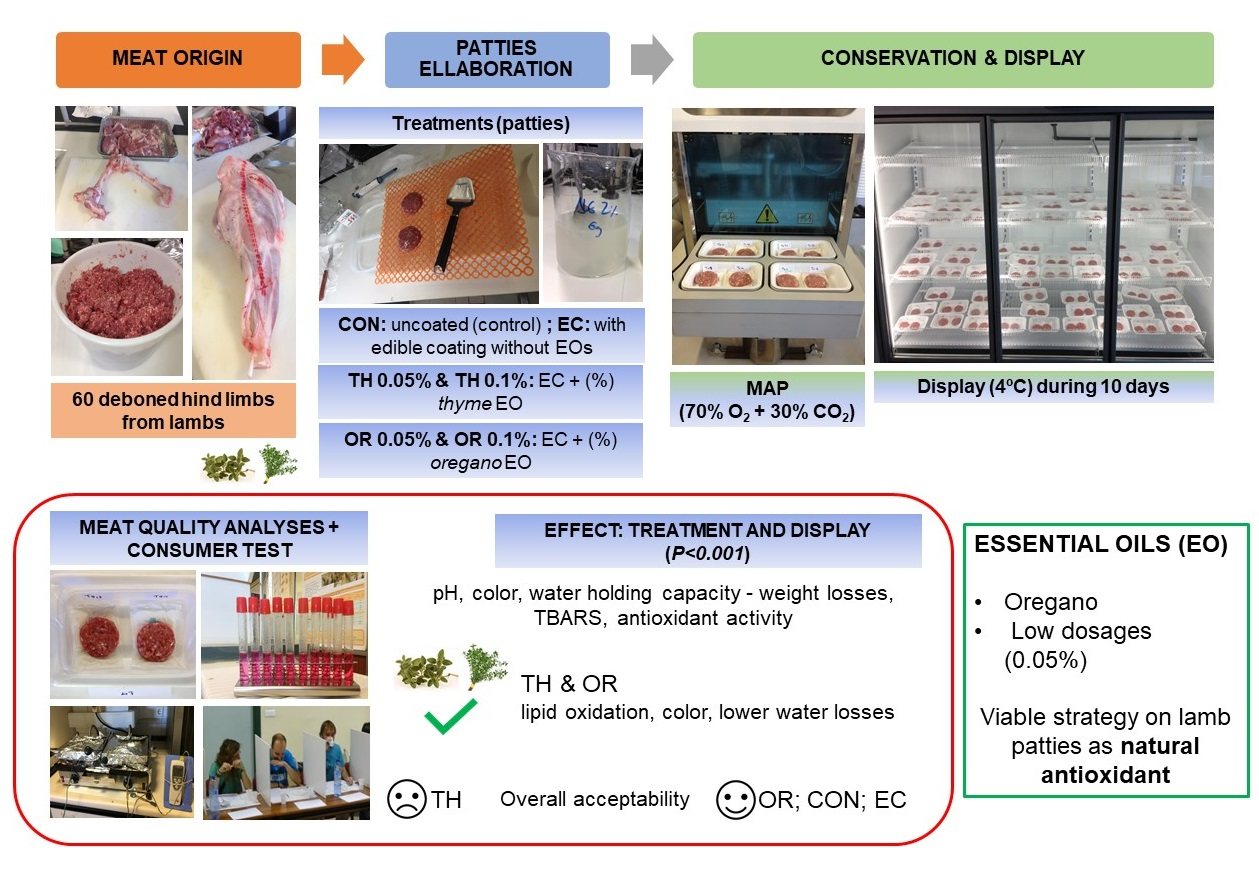
Effect of Active-Edible Coating and Essential Oils on Lamb Patties Oxidation during Display
 , ,
, ,  ,
,  and
and 
Abstract
1. Introduction
2. Materials and Methods
2.1. Materials
2.2. Animals and Preparation of Lamb Patties with Coating
2.3. Proximate Composition
2.4. Fatty Acid Composition
2.5. pH and Weight Losses
2.6. Total Phenolic Compounds and Antioxidant Activity
2.6.1. Total Phenolic Compounds (TPCs)
2.6.2. DPPH Radical Scavenging Assay
2.6.3. ABTS Radical Scavenging Assay
2.7. Lipid Oxidation Analysis
2.8. Color Measurement
2.9. Consumer Acceptability
2.10. Statistical Analysis
3. Results and Discussion
3.1. Essential Oil Composition
3.2. Proximate Composition and Fatty Acids Analysis of Meat Matrix
3.3. pH and Weight Loss of Lamb Patties
3.4. Antioxidant Activity of Essential Oils and Lamb Patties
3.5. Lipid Oxidation of Lamb Patties
3.6. Color of Lamb Patties
3.7. Consumer Test
4. Conclusions
Author Contributions
Funding
Institutional Review Board Statement
Informed Consent Statement
Data Availability Statement
Acknowledgments
Conflicts of Interest
References
- Chivandi, E.; Dangarembizi, R.; Nyakudya, T.T.; Erlwanger, K.H. Chapter 8—Use of Essential Oils as a Preservative of Meat. In Essential Oils in Food Preservation, Flavor and Safety; Preedy, V.R., Ed.; Academic Press: San Diego, CA, USA, 2016; Volume 1, pp. 85–91. [Google Scholar]
- Fernandes, R.P.P.; Trindade, M.A.; Lorenzo, J.M.; Munekata, P.E.S.; de Melo, M.P. Effects of oregano extract on oxidative, microbiological and sensory stability of sheep burgers packed in modified atmosphere. Food Control 2016, 63, 65–75. [Google Scholar] [CrossRef]
- Suman, S.P.; Poulson, P. Myoglobin chemistry and meat color. Annu. Rev. Food Sci. Technol. 2013, 4, 79–99. [Google Scholar] [CrossRef] [PubMed]
- Atarés, L.; Chiralt, A. Essential oils as additives in biodegradable films and coatings for active food packaging. Trends Food Sci. Technol. 2016, 48, 51–62. [Google Scholar] [CrossRef]
- Pateiro, M.; Barba, F.J.; Domínguez, R.; Sant’Ana, A.S.; Mousavi Khaneghah, A.; Gavahian, M.; Gómez, B.; Lorenzo, J.M. Essential oils as natural additives to prevent oxidation reactions in meat and meat products: A review. Food Res. Int. 2018, 113, 156–166. [Google Scholar] [CrossRef] [PubMed]
- Perna, M. Modified Atmosphere Packaging of Fresh Meat. In Reference Module in Food Science; Elsevier: Amsterdam, The Netherlands, 2016. [Google Scholar] [CrossRef]
- Adelakun, O.E.; Oyelade, O.J.; Olanipekun, B.F. Chapter 7-Use of Essential Oils in Food Preservation. In Essential Oils in Food Preservation, Flavor and Safety; Preedy, V.R., Ed.; Academic Press: San Diego, CA, USA, 2016; Volume 1, pp. 71–84. [Google Scholar]
- Food and Drug Administration. CFR Code of Federal Regulations Title 21, subchapter b- food for human consumption. In Part 182—Substances Generally Recognized as Safe; U.S. Food & Drug Administration: Silver Spring, MD, USA, 2019. [Google Scholar]
- Mariod, A.A. Chapter 13-Effect of Essential Oils on Organoleptic (Smell, Taste, and Texture) Properties of Food. In Essential Oils in Food Preservation, Flavor and Safety; Preedy, V.R., Ed.; Academic Press: San Diego, CA, USA, 2016; Volume 1, pp. 131–137. [Google Scholar]
- Rodriguez-Garcia, I.; Silva-Espinoza, B.A.; Ortega-Ramirez, L.A.; Leyva, J.M.; Siddiqui, M.W.; Cruz-Valenzuela, M.R.; Gonzalez-Aguilar, G.A.; Ayala-Zavala, J.F. Oregano Essential Oil as an Antimicrobial and Antioxidant Additive in Food Products. Crit. Rev. Food Sci. 2016, 56, 1717–1727. [Google Scholar] [CrossRef]
- Vital, A.C.P.; Guerrero, A.; Kempinski, E.M.B.C.; Monteschio, J.O.; Sary, C.; Ramos, T.R.; Campo, M.M.; Prado, I.N. Consumer profile and acceptability of cooked beef steaks with edible and active coating containing oregano and rosemary essential oils. Meat Sci. 2018, 143, 153–158. [Google Scholar] [CrossRef]
- Haugaard, P.; Hansen, F.; Jensen, M.; Grunert, K.G. Consumer attitudes toward new technique for preserving organic meat using herbs and berries. Meat Sci. 2014, 96, 126–135. [Google Scholar] [CrossRef]
- Hung, Y.; de Kok, T.M.; Verbeke, W. Consumer attitude and purchase intention towards processed meat products with natural compounds and a reduced level of nitrite. Meat Sci. 2016, 121, 119–126. [Google Scholar] [CrossRef]
- Vital, A.C.P.; Guerrero, A.; Monteschio, J.O.; Valero, M.V.; Carvalho, C.B.; de Abreu Filho, B.A.; Madrona, G.S.; Prado, I.N. Effect of Edible and Active Coating (with Rosemary and Oregano Essential Oils) on Beef Characteristics and Consumer Acceptability. PLoS ONE 2016, 11, e0160535. [Google Scholar] [CrossRef]
- Biondo, P.B.F.; Carbonera, F.; Zawadzki, F.; Chiavelli, L.; Pilau, E.J.; Prado, I.N.; Visentainer, J. Antioxidant Capacity and Identification of Bioactive Compounds by GC-MS of Essential Oils from Spices, Herbs and Citrus. Curr. Bioact. Compd. 2016, 12, 1–7. [Google Scholar] [CrossRef][Green Version]
- El-Jalel, L.F.A.; Elkady, W.M.; Gonaid, M.H.; El-Gareeb, K.A. Difference in chemical composition and antimicrobial activity of Thymus capitatus L. essential oil at different altitudes. Future J. Pharm. Sci. 2018, 4, 156–160. [Google Scholar] [CrossRef]
- Morshedloo, M.R.; Salami, S.A.; Nazeri, V.; Maggi, F.; Craker, L. Essential oil profile of oregano (Origanum vulgare L.) populations grown under similar soil and climate conditions. Ind. Crop. Prod. 2018, 119, 183–190. [Google Scholar] [CrossRef]
- Ruiz-Navajas, Y.; Viuda-Martos, M.; Sendra, E.; Perez-Alvarez, J.A.; Fernández-López, J. In vitro antibacterial and antioxidant properties of chitosan edible films incorporated with Thymus moroderi or Thymus piperella essential oils. Food Control 2013, 30, 386–392. [Google Scholar] [CrossRef]
- Jamróz, E.; Kopel, P.; Tkaczewska, J.; Dordevic, D.; Jancikova, S.; Kulawik, P.; Milosavljevic, V.; Dolezelikova, K.; Smerkova, K.; Svec, P.; et al. Nanocomposite furcellaran films—The influence of nanofillers on functional properties of furcellaran films and effect on linseed oil preservation. Polymers 2019, 11, 2046. [Google Scholar] [CrossRef]
- Benelli, G.; Pavela, R.; Maggi, F.; Wandkou, J.G.N.; Fofie, N.G.B.Y.; Koné-Bamba, D.; Sagratini, G.; Vittori, S.; Caprioli, G. Insecticidal activity of the essential oil and polar extracts from Ocimum gratissimum grown in Ivory Coast: Efficacy on insect pests and vectors and impact on non-target species. Ind. Crop. Prod. 2019, 132, 377–385. [Google Scholar] [CrossRef]
- Van den Dool, H.; Kratz, P.D. A generalization of the retention index system including linear temperature programmed gas-liquid partition chromatography. J. Chromatogr. 1963, 2, 463–471. [Google Scholar] [CrossRef]
- International Organization for Standardization, ISO 1442. In Meat and Meat Products–Determination of Moisture Content; International Organization for Standardization: Geneva, Switzerland, 1997.
- International Organization for Standardization, ISO 937. In Meat and Meat Products–Determination of Nitrogen Content; International Organization for Standardization: Geneva, Switzerland, 1978.
- International Organization for Standardization, ISO 1443. In Meat and Meat Products–Determination of Total Fat Content; International Organization for Standardization: Geneva, Switzerland, 1973.
- International Organization for Standardization, ISO 936. In Meat and Meat Products–Determination of Total Ash; International Organization for Standardization: Geneva, Switzerland, 1998.
- Bligh, E.G.; Dyer, W.J. A rapid method of total lipid extraction and purification. Can. J. Biochem. Phys. 1959, 37, 911–917. [Google Scholar] [CrossRef]
- Carrillho, M.C.; López, M.; Campo, M.M. Effect of the fattening diet on the development of the fatty acid profile in rabbits from weaning. Meat Sci. 2009, 83, 85–95. [Google Scholar] [CrossRef]
- Singleton, V.L.; Rossi, J.A. Colorimetry of Total Phenolics with Phosphomolybdic-Phosphotungstic Acid Reagents. Am. J. Enol. Viticult. 1965, 16, 144–158. [Google Scholar]
- Li, W.; Hydamaka, A.W.; Lowry, L.; Beta, T. Comparison of antioxidant capacity and phenolic compounds of berries, chokecherry and seabuckthorn. Cent. Eur. J. Biol. 2009, 4, 499–506. [Google Scholar] [CrossRef]
- Re, R.; Pellegrini, N.; Proteggente, A.; Pannala, A.; Yang, M.; Rice-Evans, C. Antioxidant activity applying an improved ABTS radical cation decolorization assay. Free Radic. Biol. Med. 1999, 26, 1231–1237. [Google Scholar] [CrossRef]
- Pfalzgraf, A.; Frigg, M.; Steinhart, H. Alpha-Tocopherol Contents and Lipid Oxidation in Pork Muscle and Adipose Tissue during Storage. J. Agric. Food Chem. 1995, 43, 1339–1342. [Google Scholar] [CrossRef]
- Macfie, H.J.; Bratchell, N.; Greenhoff, K.; Vallis, V. Designs to balance the effect of order of presentation and first-order carry-over effects in hall tests. J. Sens. Stud. 1989, 4, 129–148. [Google Scholar] [CrossRef]
- Vitali, L.A.; Beghelli, D.; Nya, P.C.B.; Bistoni, O.; Cappellacci, L.; Damiano, S.; Lupidi, G.; Maggi, F.; Orsomado, G.; Papa, F.; et al. Diverse biological effects of the essential oil from Iranian Trachyspermum ammi. Arab. J. Chem. 2016, 9, 775–786. [Google Scholar] [CrossRef]
- Satyal, P.; Murray, B.L.; Mc Feeters, R.L.; Setzer, W.N. Essential oil characterization of thymus vulgaris from varius geographical locations. Foods 2016, 5, 70. [Google Scholar] [CrossRef]
- Nabavi, S.M.; Marchese, A.; Izadi, M.; Curti, V.; Daglia, M.; Nabavi, S.F. Plants belonging to the genus Thymus as antibacterial agents: From farm to pharmacy. Food Chem. 2015, 173, 339–347. [Google Scholar] [CrossRef]
- López, V.; Cascella, M.; Benelli, G.; Maggi, F.; Gómez-Rincón, C. Green drugs in the fight against Anisakis simplex—larvicidal activity and acetylcholinesterase inhibition of Origanum compactum essential oil. Parasitol. Res. 2018, 117, 861–867. [Google Scholar] [CrossRef]
- Aboukhalid, K.; Lamiri, A.; Agacka-Mołdoch, M.; Doroszewska, T.; Douaik, A.; Bakha, M.; Casanova, J.; Tomi, F.; Machon, N.; Faiz, C.A. Chemical polymorphism of Origanum compactum grown in all natural habitats in Morocco. Chem. Biodivers. 2016, 13, 1126–1139. [Google Scholar] [CrossRef]
- Benelli, G.; Pavela, R.; Petrelli, R.; Cappellacci, L.; Bartolucci, F.; Canale, A.; Maggi, F. Origanum syriacum subsp. syriacum: From an ingredient of Lebanese ‘manoushe’to a source of effective and eco-friendly botanical insecticides. Ind. Crop. Prod. 2019, 134, 26–32. [Google Scholar] [CrossRef]
- Pavela, R.; Morshedloo, M.R.; Mumivand, H.; Khorsand, G.J.; Karami, A.; Maggi, F.; Desneux, N.; Benelli, G. Phenolic-rich essential oils from Apiaceae and Lamiaceae species: Insecticidal activity and safety evaluation on non-target earthworms. Entomol. Gen. 2020. [Google Scholar] [CrossRef]
- Aghbash, B.N.; Pouresmaeil, M.; Dehghan, G.; Nojadeh, M.S.; Mobaiyen, H.; Maggi, F. Chemical Composition, Antibacterial and Radical Scavenging Activity of Essential Oils from Satureja macrantha CA Mey. at Different Growth Stages. Foods 2020, 9, 494. [Google Scholar] [CrossRef]
- Campo, M.M.; Muela, E.; Resconi, V.C.; Barahona, M.; Sañudo, C. Influence of commercial cut on proximate composition and fatty acid profile of Rasa Aragonesa light lamb. J. Food Compos. Anal. 2016, 53, 7–12. [Google Scholar] [CrossRef]
- Campo, M.M.; Mur, L.; Fugita, C.A.; Sañudo, C. Current strategies in lamb production in Mediterranean areas. Anim. Front. 2016, 6, 31–36. [Google Scholar] [CrossRef]
- Nychas, G.-J.E.; Skandamis, P.N.; Tassou, C.C.; Koutsoumanis, K.P. Meat spoilage during distribution. Meat Sci. 2008, 78, 77–89. [Google Scholar] [CrossRef] [PubMed]
- Song, Y.; Liu, L.; Shen, H.; You, J.; Luo, Y. Effect of sodium alginate-based edible coating containing different anti-oxidants on quality and shelf life of refrigerated bream (Megalobrama amblycephala). Food Control 2011, 22, 608–615. [Google Scholar] [CrossRef]
- Stuchell, Y.M.; Krochta, J.M. Edible coatings on frozen King Salmon effect of whey protein isolate and acetylated monoglycerides on moisture loss and lipid oxidation. J. Food Sci. 1995, 60, 28–31. [Google Scholar] [CrossRef]
- Vargas, M.; Albors, A.; Chiralt, A.; González-Martínez, C. Characterization of chitosan-oleic acid composite films. Food Hydrocoll. 2009, 23, 536–547. [Google Scholar] [CrossRef]
- Kumar, Y.; Yadav, D.N.; Ahmad, T.; Narsaiah, K. Recent Trends in the Use of Natural Antioxidants for Meat and Meat Products. Compr. Rev. Food Sci. Food Saf. 2015, 14, 796–812. [Google Scholar] [CrossRef]
- Zhang, H.; Wu, J.; Guo, X. Effects of antimicrobial and antioxidant activities of spice extracts on raw chicken meat quality. Food Sci. Hum. Well. 2016, 5, 39–48. [Google Scholar] [CrossRef]
- Jouki, M.; Mortazavi, S.A.; Yazdi, F.T.; Koocheki, A.; Khazaei, N. Use of quince seed mucilage edible films containing natural preservatives to enhance physico-chemical quality of rainbow trout fillets during cold storage. Food Sci. Hum. Well. 2014, 3, 65–72. [Google Scholar] [CrossRef]
- Vital, A.C.P.; Guerrero, A.; Ornaghi, M.G.; Kempinski, E.M.B.C.; Sary, C.; Monteschio, J.O.; Matumoto-Pinto, P.T.; Ribeiro, R.P.; Prado, I.N. Quality and sensory acceptability of fish fillet (Oreochromis niloticus) with alginate-based coating containing essential oils. J. Food Sci. Technol. 2018, 55, 4945–4955. [Google Scholar] [CrossRef] [PubMed]

| No | Component a | RI b | RI Lit. c | % Thymus vulgaris d | % Origanum compactum d | ID e |
|---|---|---|---|---|---|---|
| 1 | tricyclene | 915 | 921 | Trf | RI, MS | |
| 2 | α-thujene | 919 | 924 | 0.3 ± 0.1 | 0.1 ± 0.0 | RI, MS |
| 3 | α-pinene | 924 | 932 | 5.6 ± 1.2 | 0.2 ± 0.0 | RI, MS, Std |
| 4 | α-fenchene | 936 | 945 | 0.3 ± 0.0 | RI, MS | |
| 5 | camphene | 938 | 946 | 0.2 ± 0.1 | Tr f | RI, MS, Std |
| 6 | sabinene | 964 | 969 | 3.4 ± 0.7 | RI, MS, Std | |
| 7 | β-pinene | 966 | 974 | 0.4 ± 0.1 | Tr | RI, MS, Std |
| 8 | 1-octen-3-ol | 973 | 974 | 0.4 ± 0.1 | 0.1 ± 0.0 | RI, MS, Std |
| 9 | 3-octanone | 985 | 979 | 0.1 ± 0.0 | RI, MS | |
| 10 | myrcene | 987 | 988 | 0.9 ± 0.2 | 0.4 ± 0.1 | RI, MS, Std |
| 11 | 3-octanol | 995 | 988 | 0.1 ± 0.0 | RI, MS | |
| 12 | α-phellandrene | 1001 | 1002 | Tr | Tr | RI, MS, Std |
| 13 | δ-3-carene | 1006 | 1008 | 6.8 ± 1.3 | RI, MS, Std | |
| 14 | δ-terpinene | 1007 | 1008 | Tr | RI, MS | |
| 15 | α-terpinene | 1013 | 1014 | 0.7 ± 0.2 | 0.3 ± 0.0 | RI, MS, Std |
| 16 | p-cymene | 1020 | 1020 | 0.5 ± 0.1 | 6.3 ± 0.9 | RI, MS, Std |
| 17 | limonene | 1023 | 1024 | 5.1 ± 0.9 | 0.2 ± 0.0 | RI, MS, Std |
| 18 | β-phellandrene | 1024 | 1025 | 0.2 ± 0.0 | RI, MS | |
| 19 | 1,8-cineole | 1026 | 1025 | 0.1 ± 0.0 | 0.1 ± 0.0 | RI, MS, Std |
| 20 | (E)-β-ocimene | 1045 | 1044 | Tr | RI, MS, Std | |
| 21 | γ-terpinene | 1054 | 1054 | 1.2 ± 0.2 | 3.9 ± 0.7 | RI, MS, Std |
| 22 | cis-sabinene hydrate | 1062 | 1065 | 0.9 ± 0.2 | RI, MS | |
| 23 | cis-linalool oxide | 1069 | 1067 | 0.1 ± 0.0 | RI, MS | |
| 24 | p-mentha-2,4(8)-diene | 1081 | 1085 | 0.1 ± 0.0 | RI, MS | |
| 25 | terpinolene | 1083 | 1086 | 1.0 ± 0.3 | Tr | RI, MS, Std |
| 26 | trans-linalool oxide | 1085 | 1084 | 0.1 ± 0.0 | RI, MS | |
| 27 | p-cymenene | 1086 | 1089 | Tr | RI, MS | |
| 28 | trans-sabinene hydrate | 1094 | 1098 | 0.2 ± 0.1 | RI, MS | |
| 29 | linalool | 1101 | 1095 | 48.5 ± 4.1 | 1.2 ± 0.3 | RI, MS, Std |
| 30 | hotrienol | 1104 | 1106 | 0.1 ± 0.0 | RI, MS | |
| 31 | cis-p-menth-2-en-1-ol | 1117 | 1118 | 0.2 ± 0.0 | RI, MS | |
| 32 | trans-p-menth-2-en-1-ol | 1135 | 1136 | 0.1 ± 0.0 | RI, MS | |
| 33 | camphor | 1137 | 1141 | 0.3 ± 0.0 | RI, MS, Std | |
| 34 | trans-verbenol | 1146 | 1140 | Tr | RI, MS | |
| 35 | borneol | 1159 | 1165 | 0.3 ± 0.1 | 0.1 ± 0.0 | RI, MS, Std |
| 36 | p-mentha-1,5-dien-8-ol | 1163 | 1166 | Tr | RI, MS | |
| 37 | cis-linalool oxide | 1166 | 1170 | Tr | RI, MS | |
| 38 | terpinen-4-ol | 1171 | 1174 | 3.0 ± 0.6 | 0.5 ± 0.1 | RI, MS, Std |
| 39 | p-cymen-8-ol | 1182 | 1179 | Tr | 0.1 ± 0.0 | RI, MS |
| 40 | α-terpineol | 1185 | 1186 | 0.7 ± 0.2 | 0.2 ± 0.0 | RI, MS, Std |
| 41 | cis-piperitol | 1190 | 1196 | 0.1 ± 0.0 | RI, MS | |
| 42 | cis-dihydrocarvone | 1193 | 1191 | Tr | 0.1 ± 0.0 | RI, MS |
| 43 | trans-piperitol | 1203 | 1207 | Tr | RI, MS | |
| 44 | endo-fenchyl acetate | 1215 | 1218 | 0.1 ± 0.0 | RI, MS | |
| 45 | nerol | 1226 | 1227 | 0.2 ± 0.0 | RI, MS | |
| 46 | citronellol | 1229 | 1223 | 0.1 ± 0.0 | RI, MS, Std | |
| 47 | neral | 1239 | 1235 | Tr | RI, MS, Std | |
| 48 | carvacrol, methyl ether | 1241 | 1241 | Tr | 0.1 ± 0.0 | RI, MS |
| 49 | piperitone | 1249 | 1249 | 0.1 ± 0.0 | RI, MS | |
| 50 | linalyl acetate | 1255 | 1254 | 6.0 ± 1.1 | RI, MS | |
| 51 | geranial | 1269 | 1264 | 0.1 ± 0.0 | RI, MS, Std | |
| 52 | bornyl acetate | 1280 | 1287 | 0.1 ± 0.0 | RI, MS, Std | |
| 53 | thymol | 1293 | 1289 | 3.6 ± 0.7 | 18.5 ± 2.4 | RI, MS, Std |
| 54 | carvacrol | 1301 | 1298 | 0.4 ± 0.1 | 65.4 ± 3.9 | RI, MS, Std |
| 55 | α-cubebene | 1341 | 1345 | 0.1 ± 0.0 | RI, MS | |
| 56 | α-terpinyl acetate | 1344 | 1346 | 1.3 ± 0.2 | RI, MS | |
| 57 | neryl acetate | 1364 | 1359 | Tr | RI, MS, Std | |
| 58 | α-copaene | 1367 | 1374 | Tr | RI, MS | |
| 59 | β-bourbonene | 1373 | 1387 | Tr | RI, MS | |
| 60 | geranyl acetate | 1383 | 1379 | 0.5 ± 0.1 | RI, MS | |
| 61 | (E)-caryophyllene | 1405 | 1417 | 2.8 ± 0.5 | 0.5 ± 0.1 | RI, MS, Std |
| 62 | α-humulene | 1438 | 1452 | 0.1 ± 0.0 | Tr | RI, MS, Std |
| 63 | trans-muurola-3,5-diene | 1455 | 1451 | 0.4 ± 0.1 | RI, MS | |
| 64 | cis-muurola-4(14),5-diene | 1466 | 1465 | 0.1 ± 0.0 | RI, MS | |
| 65 | ar-curcumene | 1473 | 1479 | 0.1 ± 0.0 | RI, MS | |
| 66 | bicyclogermacrene | 1480 | 1500 | 0.1 ± 0.0 | RI, MS | |
| 67 | α-zingiberene | 1485 | 1493 | Tr | RI, MS | |
| 68 | δ-amorphene | 1509 | 1511 | 0.1 ± 0.0 | 0.1 ± 0.0 | RI, MS |
| 69 | hedycaryol | 1536 | 1546 | Tr | RI, MS | |
| 70 | (E)-nerolidol | 1555 | 1561 | 0.1 ± 0.0 | RI, MS, Std | |
| 71 | spathulenol | 1560 | 1577 | 0.1 ± 0.0 | RI, MS | |
| 72 | caryophyllene oxide | 1564 | 1583 | 0.6 ± 0.2 | 0.8 ± 0.2 | RI, MS, Std |
| 73 | humulene epoxide | 1591 | 1608 | Tr | RI, MS | |
| 74 | epi-α-bisabolol | 1674 | 1683 | Tr | RI, MS | |
| 75 | eudesma-4(15),7-dien-1b-ol | 1687 | 1687 | Tr | RI, MS | |
| 76 | isophyllocladene | 1959 | 1967 | Tr | RI, MS | |
| 77 | manool oxide | 1978 | 1987 | Tr | RI, MS | |
| 78 | nezukol | 2124 | 2132 | 0.2 ± 0.0 | RI, MS | |
| Total identified (%) | 99.1 | 99.5 | ||||
| Grouped compounds (%) | ||||||
| Monoterpene hydrocarbons | 26.5 | 11.7 | ||||
| Oxygenated monoterpenes | 67.4 | 86.2 | ||||
| Sesquiterpene hydrocarbons | 3.7 | 0.6 | ||||
| Oxygenated sesquiterpenes | 0.8 | 0.8 | ||||
| Other compounds | 0.7 | 0.2 |
| Treatment (T) | Days of display (D) | T | D | T x D | |||||||||
|---|---|---|---|---|---|---|---|---|---|---|---|---|---|
| CON | EC | TH 0.05 | TH 0.1 | OR 0.05 | OR 0.1 | 1 | 3 | 7 | 10 | ||||
| pH | 5.61 ± 0.04 a | 5.61 ± 0.03 a | 5.58 ± 0.02 b | 5.58 ± 0.02 b | 5.59 ± 0.02 b | 5.59 ± 0.02 b | 5.58 ± 0.01 b | 5.59 ± 0.01 b | 5.60 ± 0.01 a | 5.61 ± 0.02 a | <0.001 | <0.001 | <0.001 |
| Weight Losses † | 7.23 ± 3.12 a | 3.00 ± 1.36 b | 3.17 ± 1.76 b | 3.03 ± 1.37 b | 3.37 ± 1.30 b | 3.23 ± 1.69 b | 1.80 ± 1.03 d | 2.76 ± 1.37 c | 5.05 ± 2.26 b | 5.75 ± 2.15 a | <0.001 | <0.001 | <0.001 |
| TBARS †† | 0.27 ± 0.15 b | 0.34 ± 0.19 a | 0.19 ± 0.09 c | 0.18 ± 0.08 c | 0.10 ± 0.03 d | 0.09 ± 0.03 d | 0.08 ± 0.01 d | 0.13 ± 0.05 c | 0.28 ± 0.14 b | 0.31 ± 0.14 a | <0.001 | <0.001 | <0.001 |
| L* | 48.62 ± 2.43 a | 43.00 ± 2.77 b | 43.09 ± 2.98 b | 43.49 ± 2.93 b | 42.94 ± 3.38 b | 42.83 ± 3.24 b | 47.88 ± 2.29 a | 42.99 ± 2.59 b | 42.80 ± 2.99 b | 42.33 ± 3.29 b | <0.001 | <0.001 | 0.321 |
| a* | 8.66 ± 1.29 b | 10.97 ± 1.28 a | 11.16 ± 1.54 a | 11.12 ± 1.33 a | 11.15 ± 1.02 a | 10.88 ± 1.56 a | 10.40 ± 0.98 a | 10.10 ± 1.13 a | 10.65 ± 1.66 a | 11.49 ± 2.09 b | <0.001 | 0.001 | <0.001 |
| b* | 13.99 ± 1.23 b | 19.29 ± 1.40 a | 19.31 ± 1.63 a | 18.99 ± 2.17 a | 18.43 ± 1.30 a | 18.791.16 a | 17.88 ± 1.49 b | 17.82 ± 1.98 b | 17.84 ± 2.82 b | 18.88 ± 2.91 a | <0.001 | <0.001 | 0.008 |
| Days | CON | EC | TH 0.05 | TH 0.1 | OR 0.05 | OR 0.1 | P Value |
|---|---|---|---|---|---|---|---|
| pH | |||||||
| 1 | 5.59 ± 0.02B | 5.57 ± 0.02C | 5.58 ± 0.01B | 5.58 ± 0.01B | 5.58 ± 0.01B | 5.58 ± 0.01B | 0.210 |
| 3 | 5.59 ± 0.03B | 5.59 ± 0.02B | 5.58 ± 0.01B | 5.58 ± 0.02B | 5.59 ± 0.01AB | 5.59 ± 0.01AB | 0.149 |
| 7 | 5.64 ± 0.03Aa | 5.64 ± 0.02Aa | 5.57 ± 0.02Bb | 5.58 ± 0.01Bb | 5.59 ± 0.01ABb | 5.60 ± 0.02ABb | <0.001 |
| 10 | 5.63 ± 0.02Aa | 5.62 ± 0.01Aa | 5.60 ± 0.01Ab | 5.60 ± 0.01Ab | 5.60 ± 0.01Ab | 5.60 ± 0.01Ab | <0.001 |
| P value | 0.001 | <0.001 | <0.001 | 0.006 | 0.001 | 0.006 | |
| Weight losses (%) | |||||||
| 1 | 3.54 ± 1.34Ba | 1.59 ± 0.30Cb | 1.34 ± 0.94Bb | 1.39 ± 0.09Db | 1.81 ± 0.18Bb | 1.16 ± 0.28Bb | <0.001 |
| 3 | 5.28 ± 1.15Ba | 1.91 ± 0.22Cb | 1.90 ± 0.35Bb | 2.29 ± 0.30Cb | 2.93 ± 1.06Bb | 2.24 ± 0.67Bb | <0.001 |
| 7 | 9.83 ± 0.89Aa | 3.80 ± 0.40Bb | 4.32 ± 0.92Ab | 3.74 ± 0.35Bb | 4.13 ± 0.84Ab | 4.50 ± 0.13Ab | <0.001 |
| 10 | 10.27 ± 1.01Aa | 4.72 ± 0.42Ab | 5.11 ± 0.54Ab | 4.71 ± 0.77Ab | 4.63 ± 0.52Ab | 5.03 ± 0.74Ab | <0.001 |
| P value | <0.001 | <0.001 | <0.001 | <0.001 | <0.001 | <0.001 | |
| Days | CON | EC | TH 0.05 | TH 0.1 | OR 0.05 | OR 0.1 | P Value |
|---|---|---|---|---|---|---|---|
| 1 | 0.08 ± 0.005Cbc | 0.11 ± 0.021Ca | 0.08 ± 0.010Cbc | 0.08 ± 0.005Db | 0.07 ± 0.006Cbc | 0.06 ± 0.002Cc | <0.001 |
| 3 | 0.17 ± 0.020Bb | 0.22 ± 0.016Ba | 0.14 ± 0.021Bc | 0.11 ± 0.011Cc | 0.07 ± 0.005Cd | 0.06 ± 0.004Cd | <0.001 |
| 7 | 0.42 ± 0.035Ab | 0.50 ± 0.073Aa | 0.26 ± 0.023Ac | 0.25 ± 0.013Bc | 0.12 ± 0.008Bd | 0.11 ± 0.014Bd | <0.001 |
| 10 | 0.43 ± 0.061Ab | 0.54 ± 0.036Aa | 0.29 ± 0.036Ac | 0.28 ± 0.021Ac | 0.15 ± 0.015Ad | 0.15 ± 0.012Ad | <0.001 |
| P value | <0.001 | <0.001 | <0.001 | <0.001 | <0.001 | <0.001 |
| Days | CON | EC | TH 0.05 | TH 0.1 | OR 0.05 | OR 0.1 | P Value |
|---|---|---|---|---|---|---|---|
| L* | |||||||
| 1 | 51.32 ± 2.71Aa | 46.49 ± 1.29Ab | 47.04 ± 1.38Ab | 47.54 ± 1.26Ab | 47.36 ± 1.64Ab | 47.52 ± 1.86Ab | 0.001 |
| 3 | 46.70 ± 2.04Ba | 43.14 ± 1.77Bb | 43.01 ± 1.86Bb | 42.83 ± 1.84Bb | 41.52 ± 2.59Bb | 40.73 ± 0.99Bb | <0.001 |
| 7 | 48.17 ± 0.66Ba | 40.93 ± 1.20Bb | 41.78 ± 1.54Bb | 42.55 ± 2.28Bb | 40.74 ± 2.27Bb | 42.63 ± 1.70Bb | <0.001 |
| 10 | 48.30 ± 1.34Ba | 41.45 ± 2.54Bb | 40.54 ± 2.42Bb | 41.06 ± 1.06Bb | 42.16 ± 2.37Bb | 40.47 ± 1.63Bb | <0.001 |
| P value | <0.003 | <0.001 | <0.001 | <0.001 | <0.001 | 0.001 | |
| a* | |||||||
| 1 | 10.13 ± 1.14A | 10.72 ± 1.04AB | 10.77 ± 1.06AB | 10.48 ± 0.54B | 10.81 ± 0.61AB | 9.49 ± 1.00B | 0.141 |
| 3 | 9.03 ± 0.86AB | 9.67 ± 1.30B | 10.05 ± 0.65B | 10.67 ± 0.50B | 10.33 ± 0.81B | 10.83 ± 1.60AB | 0.051 |
| 7 | 7.97 ± 0.45BCb | 11.37 ± 0.66Aa | 11.45 ± 1.94ABa | 10.79 ± 1.43ABa | 11.55 ± 0.86ABa | 10.74 ± 1.10ABa | <0.001 |
| 10 | 7.52 ± 0.76Cb | 12.12 ± 0.71Aa | 12.37 ± 1.43Aa | 12.55 ± 1.48Aa | 11.92 ± 1.08Aa | 12.45 ± 1.06Aa | <0.001 |
| P value | <0.001 | 0.020 | 0.047 | 0.013 | 0.019 | 0.004 | |
| b* | |||||||
| 1 | 15.33 ± 0.69Ab | 18.79 ± 0.98a | 18.90 ± 1.23a | 17.99 ± 1.17a | 17.98 ± 0.77a | 18.29 ± 0.65a | <0.001 |
| 3 | 15.61 ± 0.44Ab | 18.41 ± 1.30a | 18.73 ± 1.11a | 18.63 ± 2.13a | 18.15 ± 1.41a | 18.40 ± 1.63a | <0.001 |
| 7 | 13.03 ± 0.84Bb | 19.76 ± 1.66a | 18.90 ± 2.42a | 18.53 ± 2.85a | 18.04 ± 1.22a | 18.80 ± 1.19a | <0.001 |
| 10 | 12.99 ± 0.80Bb | 20.20 ± 1.07a | 20.69 ± 0.71a | 20.82 ± 1.41a | 19.57 ± 1.27a | 19.68 ± 0.55a | <0.001 |
| P value | <0.001 | 0.088 | 0.113 | 0.105 | 0.097 | 0.148 | |
| Acceptability 1 | CON | EC | TH 0.05 | TH 0.1 | OR 0.05 | OR 0.1 | P Value |
|---|---|---|---|---|---|---|---|
| Flavor | 6.87 ± 1.41 a | 6.75 ± 1.49 ab | 5.98 ± 1.79 bc | 5.45 ± 1.82 c | 6.21 ± 1.90 abc | 6.35 ± 1.86 ab | <0.001 |
| Tenderness | 6.55 ± 1.56 | 6.95 ± 1.33 | 6.60 ± 1.69 | 6.46 ± 1.50 | 6.95 ± 1.47 | 6.80 ± 1.38 | 0.163 |
| Overall | 6.61 ± 1.41 a | 6.56 ± 1.57 a | 5.96 ± 1.73 ab | 5.57 ± 1.85 b | 6.26 ± 1.86 ab | 6.43 ± 1.67 a | <0.001 |
Publisher’s Note: MDPI stays neutral with regard to jurisdictional claims in published maps and institutional affiliations. |
© 2021 by the authors. Licensee MDPI, Basel, Switzerland. This article is an open access article distributed under the terms and conditions of the Creative Commons Attribution (CC BY) license (http://creativecommons.org/licenses/by/4.0/).
Share and Cite
Pelaes Vital, A.C.; Guerrero, A.; Guarnido, P.; Cordeiro Severino, I.; Olleta, J.L.; Blasco, M.; Nunes do Prado, I.; Maggi, F.; Campo, M.d.M. Effect of Active-Edible Coating and Essential Oils on Lamb Patties Oxidation during Display. Foods 2021, 10, 263. https://doi.org/10.3390/foods10020263
Pelaes Vital AC, Guerrero A, Guarnido P, Cordeiro Severino I, Olleta JL, Blasco M, Nunes do Prado I, Maggi F, Campo MdM. Effect of Active-Edible Coating and Essential Oils on Lamb Patties Oxidation during Display. Foods. 2021; 10(2):263. https://doi.org/10.3390/foods10020263
Chicago/Turabian StylePelaes Vital, Ana Carolina, Ana Guerrero, Pablo Guarnido, Izabella Cordeiro Severino, José Luis Olleta, Miguel Blasco, Ivanor Nunes do Prado, Filippo Maggi, and María del Mar Campo. 2021. "Effect of Active-Edible Coating and Essential Oils on Lamb Patties Oxidation during Display" Foods 10, no. 2: 263. https://doi.org/10.3390/foods10020263
APA StylePelaes Vital, A. C., Guerrero, A., Guarnido, P., Cordeiro Severino, I., Olleta, J. L., Blasco, M., Nunes do Prado, I., Maggi, F., & Campo, M. d. M. (2021). Effect of Active-Edible Coating and Essential Oils on Lamb Patties Oxidation during Display. Foods, 10(2), 263. https://doi.org/10.3390/foods10020263